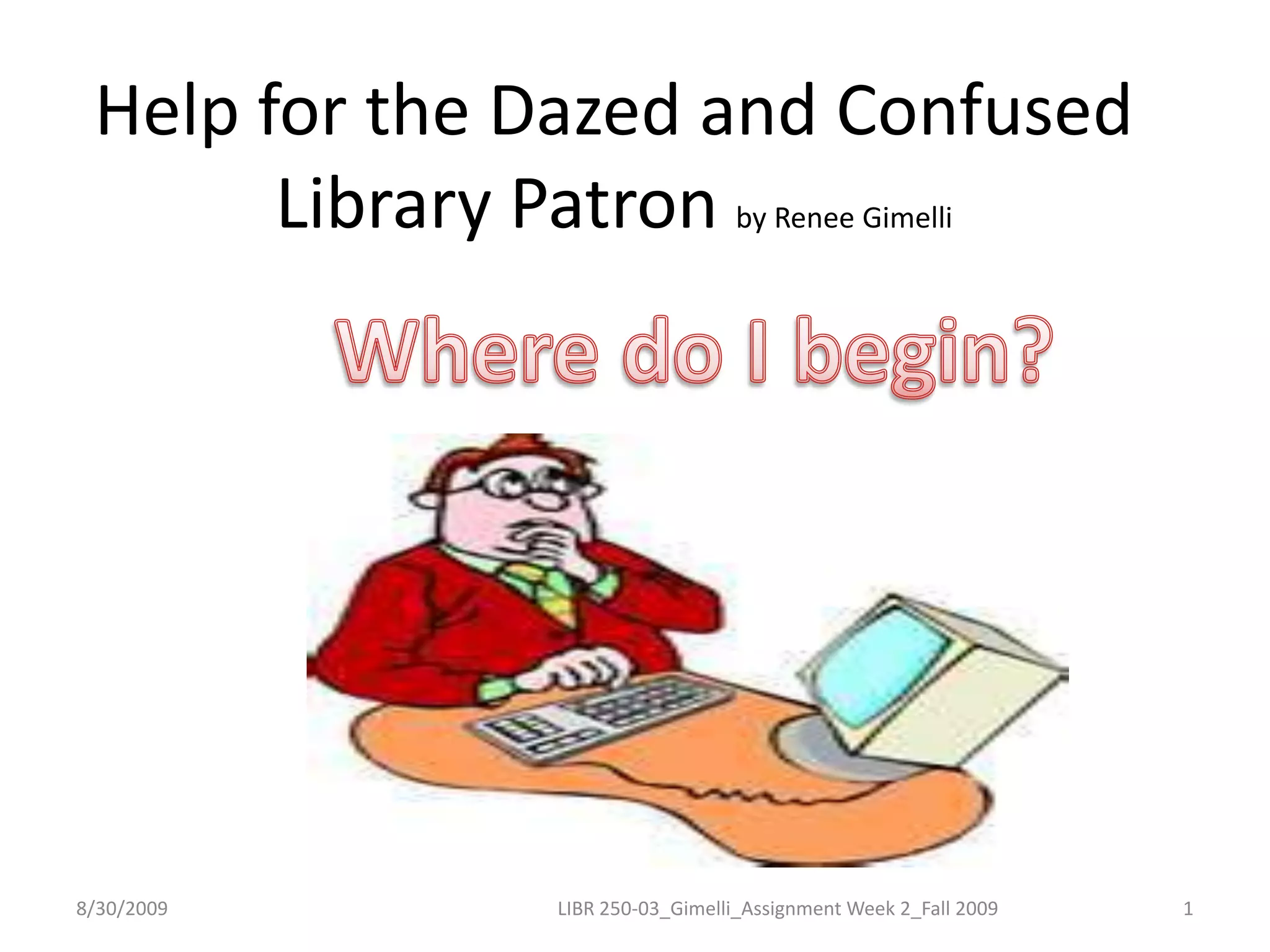
Help for the Dazed and Confused Library Patron by Renee GimelliWhere do I begin?8/30/20091LIBR 250-03_Gimelli_Assignment Week 2_Fall 2009
Accessing InformationObjective is to “Learn by Doing”“Since the real purpose of education is not to have the instructor perform certain activities but to bring about significant changes in the students’ pattern of behaviour, it becomes important to recognize that any statements of objectives [. . .] should be a statement of changes to take place in the students”  (Tyler, 1949).Curriculum as “Product” as proposed by Franklin Bobbitt and Ralph W. TylerA scientific model for setting objectives would emphasize encouraging the students to experiment with clicking through pages, hyperlinks, going back, reformulating search queries, browsing, and generally allaying any fears they have of working with the interface of an OPAC or search engine. The end to be achieved in students: creating comfort with technology and the confidence to click forward and back. 8/30/20092LIBR 250-03_Gimelli_Assignment Week 2_Fall 2009
Steps to Access InformationEach student will formulate a query pertaining to his own interestsDecide what “discipline” this question falls intoList three synonyms or similar subject headings for the topic of researchMake a “wide” search using GoogleIdentify recurring keywords, authors cited, and “narrow” your search using these8/30/20093LIBR 250-03_Gimelli_Assignment Week 2_Fall 2009
Evaluating Information“Evaluation is a complex and critical process”	Judging the value of material for the researcher’s purpose may be influenced by prior knowledge, format, authorship, and quality of website (Dragulanescu, 2002). How to measure “quality” of informationInformation answers the questions of what?, where?, when? and who?  We then take that information and apply our knowledge to answer the questions why? And how?  (Debons,1988 as cited in Dragulanescu,2002). Can you find the author of information in multiple articles? Can you find opposing viewpoints.The web needs to be used as a preliminary search tool and more in-depth analysis can be pursued in scholarly journals or library materials (books, articles, government publications, newspaper stories)8/30/20094LIBR 250-03_Gimelli_Assignment Week 2_Fall 2009
Steps to Evaluate InformationDoes the author mention his source? Can you check it? Can you research the author’s background? Is he known in his field? Is he an expert?How detailed is the information? Do the hyperlinks work and make sense? How current is the site/source? Is the website supported by advertising? Is there too much graphics and not enough text? Can you find an email link to the author? 8/30/20095LIBR 250-03_Gimelli_Assignment Week 2_Fall 2009
Congratulations You are Now a Library Supersearcher8/30/20096LIBR 250-03_Gimelli_Assignment Week 2_Fall 2009
Self-EvaluationDid you find this instruction helpful?What is the most difficult part of searching for you?Did you learn anything specific from this instruction?Do you feel more comfortable researching information on the internet now that you’ve completed this exercise?Would you recommend this instructional process to others?Do you have any suggestions for improving this instructional presentation?8/30/2009LIBR 250-03_Gimelli_Assignment Week 2_Fall 20097
ReferencesDragulanescu, N. (2002). Website quality evaluations: Criteria and tools. Intl. Inform. & Libr. Rev., 34, 247-254. doi:10.1006/iilr.2002.0205Grassian, E. S. & Joan R. Kaplowitz. (2009). Information literacy instruction: Theory and practice (Second Edition). New York: Neal-Schuman.Lederer, N. (2000). New form(at): using the web to teach research and critical thinking skills. Reference Services Review, 38(2), 130-153. Retrieved from http://www.emerald-library.comMacklin, E. (2003, November). Theory into practice: Applying David Jonassen’s work in instructional design to instruction programs in academic libraries. College & Research Libraries, 64 (6), 494-500.  Tyler, R.W. (1949). Basic principles of curriculum and instruction. Chicago, IL: University Press. Retrieved from http://www.infed.org/biblio/b-curric.htm8/30/2009LIBR 250-03_Gimelli_Assignment Week 2_Fall 20098

The New Library

  • 1.
    Help for theDazed and Confused Library Patron by Renee GimelliWhere do I begin?8/30/20091LIBR 250-03_Gimelli_Assignment Week 2_Fall 2009
  • 2.
    Accessing InformationObjective isto “Learn by Doing”“Since the real purpose of education is not to have the instructor perform certain activities but to bring about significant changes in the students’ pattern of behaviour, it becomes important to recognize that any statements of objectives [. . .] should be a statement of changes to take place in the students” (Tyler, 1949).Curriculum as “Product” as proposed by Franklin Bobbitt and Ralph W. TylerA scientific model for setting objectives would emphasize encouraging the students to experiment with clicking through pages, hyperlinks, going back, reformulating search queries, browsing, and generally allaying any fears they have of working with the interface of an OPAC or search engine. The end to be achieved in students: creating comfort with technology and the confidence to click forward and back. 8/30/20092LIBR 250-03_Gimelli_Assignment Week 2_Fall 2009
  • 3.
    Steps to AccessInformationEach student will formulate a query pertaining to his own interestsDecide what “discipline” this question falls intoList three synonyms or similar subject headings for the topic of researchMake a “wide” search using GoogleIdentify recurring keywords, authors cited, and “narrow” your search using these8/30/20093LIBR 250-03_Gimelli_Assignment Week 2_Fall 2009
  • 4.
    Evaluating Information“Evaluation isa complex and critical process” Judging the value of material for the researcher’s purpose may be influenced by prior knowledge, format, authorship, and quality of website (Dragulanescu, 2002). How to measure “quality” of informationInformation answers the questions of what?, where?, when? and who? We then take that information and apply our knowledge to answer the questions why? And how? (Debons,1988 as cited in Dragulanescu,2002). Can you find the author of information in multiple articles? Can you find opposing viewpoints.The web needs to be used as a preliminary search tool and more in-depth analysis can be pursued in scholarly journals or library materials (books, articles, government publications, newspaper stories)8/30/20094LIBR 250-03_Gimelli_Assignment Week 2_Fall 2009
  • 5.
    Steps to EvaluateInformationDoes the author mention his source? Can you check it? Can you research the author’s background? Is he known in his field? Is he an expert?How detailed is the information? Do the hyperlinks work and make sense? How current is the site/source? Is the website supported by advertising? Is there too much graphics and not enough text? Can you find an email link to the author? 8/30/20095LIBR 250-03_Gimelli_Assignment Week 2_Fall 2009
  • 6.
    Congratulations You areNow a Library Supersearcher8/30/20096LIBR 250-03_Gimelli_Assignment Week 2_Fall 2009
  • 7.
    Self-EvaluationDid you findthis instruction helpful?What is the most difficult part of searching for you?Did you learn anything specific from this instruction?Do you feel more comfortable researching information on the internet now that you’ve completed this exercise?Would you recommend this instructional process to others?Do you have any suggestions for improving this instructional presentation?8/30/2009LIBR 250-03_Gimelli_Assignment Week 2_Fall 20097
  • 8.
    ReferencesDragulanescu, N. (2002).Website quality evaluations: Criteria and tools. Intl. Inform. & Libr. Rev., 34, 247-254. doi:10.1006/iilr.2002.0205Grassian, E. S. & Joan R. Kaplowitz. (2009). Information literacy instruction: Theory and practice (Second Edition). New York: Neal-Schuman.Lederer, N. (2000). New form(at): using the web to teach research and critical thinking skills. Reference Services Review, 38(2), 130-153. Retrieved from http://www.emerald-library.comMacklin, E. (2003, November). Theory into practice: Applying David Jonassen’s work in instructional design to instruction programs in academic libraries. College & Research Libraries, 64 (6), 494-500. Tyler, R.W. (1949). Basic principles of curriculum and instruction. Chicago, IL: University Press. Retrieved from http://www.infed.org/biblio/b-curric.htm8/30/2009LIBR 250-03_Gimelli_Assignment Week 2_Fall 20098

Editor's Notes

  • #3 It is interesting that David Jonassen’s work describes developing “meaningful learning experiences “ (Macklin, 2003). The idea of a Cognitive Learning Environment is important because it involves the students in determining what problem they are trying to solve, rather than having the teacher assign a goal structure. This supports Grassian’s (2009) claim that “users are no longer content to be mere passive consumers of information” (p. 6). Macklin describes a problem situated in everyday life as an “ill-structured” problem and requires the student to build on his existing knowledge to solve the problem. This strategy veers away from the older technique of literacy instruction which directed students to a specific resource and asked them questions based on that resource. This was little more than busy work which was naturally resented by students.
  • #4 Grassian’s (2009) astute statement that “we can no longer afford to spend the few precious moments we have with our learner in a fruitless attempt to convince them to start their searches somewhere other than Google” is followed by this advice: “We need to accept their reality and go from there” (p. 8). While there are a whole lot of internet sites, databases, and peer-reviewed journal articles out there, we need to start with the familiar. This exercise, a somewhat well-structured activity, prepares our learners for an ill-structured problem by creating a model for searching other resources.
  • #5 Many colleges require a course in Information Research which is usually taught through the English Department. The logistics of offering all students this course can be a nightmare for librarians. Naomi Lederer, Reference Librarian at Colorado State University Library, created a better method for reaching large numbers of first year students by designing an interactive Web course in “How to do library research” which has over 100 individual pages that link to one another. In addition to basic strategies, she includes pages on evaluating books, journal articles and Web sites. She took much of this criteria from a LEOX Clearinghouse for Library Instruction workshop given by Engeldinger in 1990. I have borrowed freely from her and from the Teaching Library at UC Berkeley and from NicolaeDragulanescu for my steps in evaluating information on the next slide.
  • #6 Lederer cites Martha Tate and Jan Alexander (1998) as the compelling case-makers for “evaluating the author’s expertise and/or experience” (Lederer, 2000:138). Unfortunately, this important part of information literacy is underused. Lederer notes that hits for these evaluation pages are “disappointingly low”. She blames this on page design and location.
  • #7 The goal of information literacy education is to prepare the student for research projects which are assigned by faculty or undertaken on their own to fulfill an information need. Unfortunately, these needs are often immediate and students don’t have time to “learn” the skills they need to be effective researchers. David Ward and Sarah Reisinger from the University of Illinois have advocated a three-step approach to information literacy. Step 1 is a simple “searching for sites” assignment using a directory (Yahoo), a search engine (Google) and a meta-search engine (Metacrawler) and making comparisons. Step 2 includes evaluating sites and making judgments about the veracity of the information provided. Step 3 integrates the gathered information into a report or term paper with proper citations. (taken from Information Research, Vol. 6, No. 1, October 2000, “Designing internet research assignments: building a framework for instructor collaboration.”)
  • #8 Part of any curriculum is evaluation its effectiveness. Learners will approach this instructional program with varying levels of skills, but the design is intended to promote ease and comfort in clicking and hyperlinking around a web page. It is fear which keeps students from having information literacy and from feeling confident in their search and evaluation skills.