The New And Improved Flask Mega-Tutorial Miguel Grinberg
The New And Improved Flask Mega-Tutorial Miguel Grinberg
The New And Improved Flask Mega-Tutorial Miguel Grinberg
The New And Improved Flask Mega-Tutorial Miguel Grinberg
The New And Improved Flask Mega-Tutorial Miguel Grinberg
1.
The New AndImproved Flask Mega-Tutorial Miguel
Grinberg download
https://textbookfull.com/product/the-new-and-improved-flask-mega-
tutorial-miguel-grinberg/
Download full version ebook from https://textbookfull.com
2.
We believe theseproducts will be a great fit for you. Click
the link to download now, or visit textbookfull.com
to discover even more!
Flask Web Development Developing Web Applications With
Python 2nd Edition Miguel Grinberg
https://textbookfull.com/product/flask-web-development-
developing-web-applications-with-python-2nd-edition-miguel-
grinberg/
Educational Leadership Pearson New International
Edition A Bridge to Improved Practice Paula Cordeiro
https://textbookfull.com/product/educational-leadership-pearson-
new-international-edition-a-bridge-to-improved-practice-paula-
cordeiro/
Body school a new guide to improved movement in daily
life 1st Edition Knox
https://textbookfull.com/product/body-school-a-new-guide-to-
improved-movement-in-daily-life-1st-edition-knox/
The Mega DriveSNES Book. Third Edition Imagine
Publishing Limited
https://textbookfull.com/product/the-mega-drivesnes-book-third-
edition-imagine-publishing-limited/
3.
iOS 11 byTutorials Learning the new iOS APIs with
Swift 4 1st Edition The Raywenderlich Tutorial Team
https://textbookfull.com/product/ios-11-by-tutorials-learning-
the-new-ios-apis-with-swift-4-1st-edition-the-raywenderlich-
tutorial-team/
Advances in Chromatography, Volume 57 1st Edition Nelu
Grinberg (Editor)
https://textbookfull.com/product/advances-in-chromatography-
volume-57-1st-edition-nelu-grinberg-editor/
Applied Simulation and Optimization 2 New Applications
in Logistics Industrial and Aeronautical Practice 1st
Edition Miguel Mujica Mota
https://textbookfull.com/product/applied-simulation-and-
optimization-2-new-applications-in-logistics-industrial-and-
aeronautical-practice-1st-edition-miguel-mujica-mota/
Dirty Tobacco Spies Lies and Mega Profits 1st Edition
Telita Snyckers
https://textbookfull.com/product/dirty-tobacco-spies-lies-and-
mega-profits-1st-edition-telita-snyckers/
Technological Trends in Improved Mobility of the
Visually Impaired Sara Paiva
https://textbookfull.com/product/technological-trends-in-
improved-mobility-of-the-visually-impaired-sara-paiva/
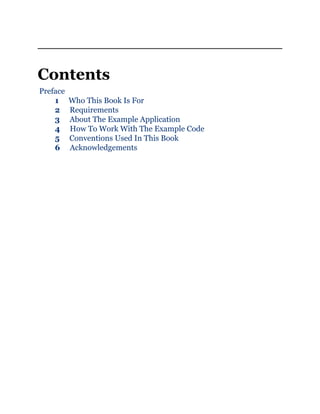
Contents
Preface
1 Who ThisBook Is For
2 Requirements
3 About The Example Application
4 How To Work With The Example Code
5 Conventions Used In This Book
6 Acknowledgements
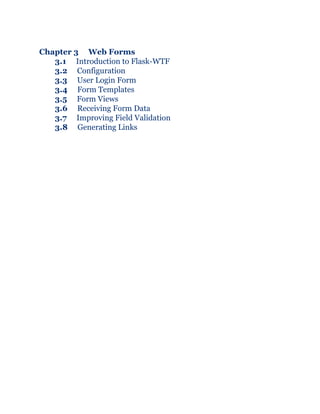
Chapter 3 WebForms
3.1 Introduction to Flask-WTF
3.2 Configuration
3.3 User Login Form
3.4 Form Templates
3.5 Form Views
3.6 Receiving Form Data
3.7 Improving Field Validation
3.8 Generating Links
10.
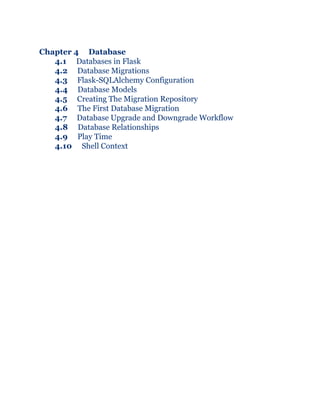
Chapter 4 Database
4.1Databases in Flask
4.2 Database Migrations
4.3 Flask-SQLAlchemy Configuration
4.4 Database Models
4.5 Creating The Migration Repository
4.6 The First Database Migration
4.7 Database Upgrade and Downgrade Workflow
4.8 Database Relationships
4.9 Play Time
4.10 Shell Context
11.
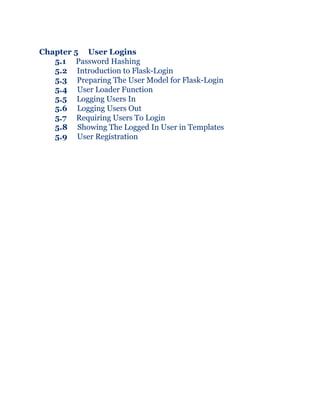
Chapter 5 UserLogins
5.1 Password Hashing
5.2 Introduction to Flask-Login
5.3 Preparing The User Model for Flask-Login
5.4 User Loader Function
5.5 Logging Users In
5.6 Logging Users Out
5.7 Requiring Users To Login
5.8 Showing The Logged In User in Templates
5.9 User Registration
12.
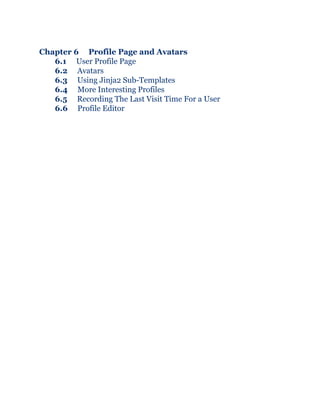
Chapter 6 ProfilePage and Avatars
6.1 User Profile Page
6.2 Avatars
6.3 Using Jinja2 Sub-Templates
6.4 More Interesting Profiles
6.5 Recording The Last Visit Time For a User
6.6 Profile Editor
13.
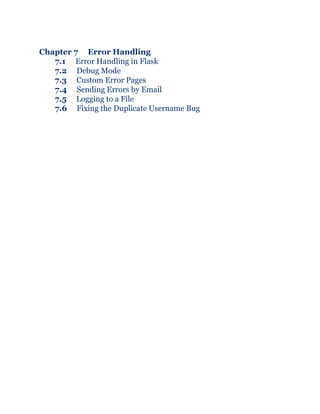
Chapter 7 ErrorHandling
7.1 Error Handling in Flask
7.2 Debug Mode
7.3 Custom Error Pages
7.4 Sending Errors by Email
7.5 Logging to a File
7.6 Fixing the Duplicate Username Bug
14.
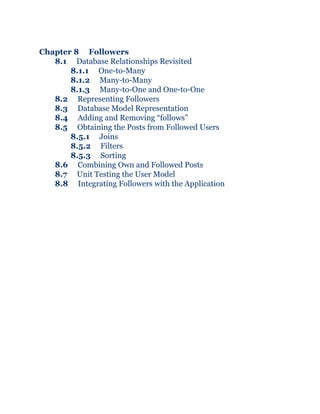
Chapter 8 Followers
8.1Database Relationships Revisited
8.1.1 One-to-Many
8.1.2 Many-to-Many
8.1.3 Many-to-One and One-to-One
8.2 Representing Followers
8.3 Database Model Representation
8.4 Adding and Removing “follows”
8.5 Obtaining the Posts from Followed Users
8.5.1 Joins
8.5.2 Filters
8.5.3 Sorting
8.6 Combining Own and Followed Posts
8.7 Unit Testing the User Model
8.8 Integrating Followers with the Application
15.
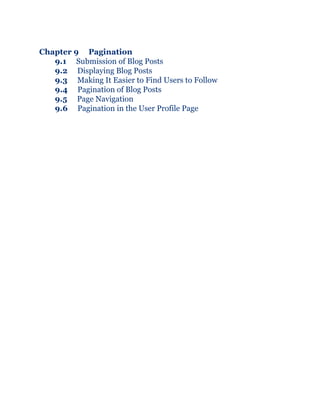
Chapter 9 Pagination
9.1Submission of Blog Posts
9.2 Displaying Blog Posts
9.3 Making It Easier to Find Users to Follow
9.4 Pagination of Blog Posts
9.5 Page Navigation
9.6 Pagination in the User Profile Page
16.
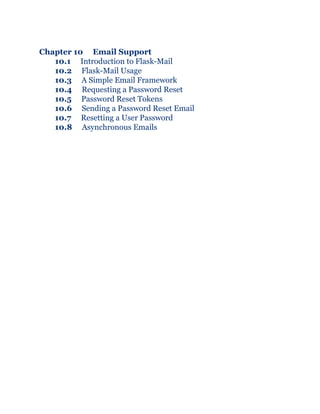
Chapter 10 EmailSupport
10.1 Introduction to Flask-Mail
10.2 Flask-Mail Usage
10.3 A Simple Email Framework
10.4 Requesting a Password Reset
10.5 Password Reset Tokens
10.6 Sending a Password Reset Email
10.7 Resetting a User Password
10.8 Asynchronous Emails
17.
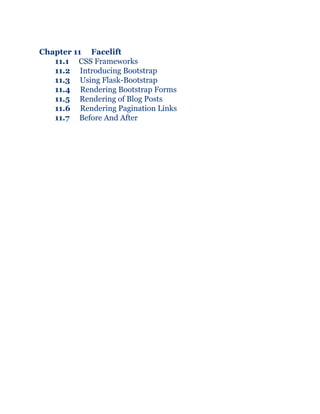
Chapter 11 Facelift
11.1CSS Frameworks
11.2 Introducing Bootstrap
11.3 Using Flask-Bootstrap
11.4 Rendering Bootstrap Forms
11.5 Rendering of Blog Posts
11.6 Rendering Pagination Links
11.7 Before And After
18.
Chapter 12 Datesand Times
12.1 Timezone Hell
12.2 Timezone Conversions
12.3 Introducing Moment.js and Flask-Moment
12.4 Using Moment.js
19.
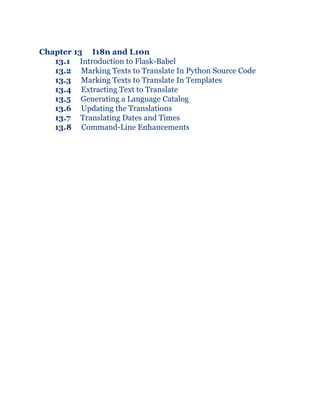
Chapter 13 I18nand L10n
13.1 Introduction to Flask-Babel
13.2 Marking Texts to Translate In Python Source Code
13.3 Marking Texts to Translate In Templates
13.4 Extracting Text to Translate
13.5 Generating a Language Catalog
13.6 Updating the Translations
13.7 Translating Dates and Times
13.8 Command-Line Enhancements
20.
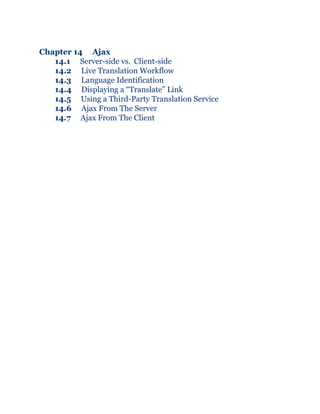
Chapter 14 Ajax
14.1Server-side vs. Client-side
14.2 Live Translation Workflow
14.3 Language Identification
14.4 Displaying a “Translate” Link
14.5 Using a Third-Party Translation Service
14.6 Ajax From The Server
14.7 Ajax From The Client
21.
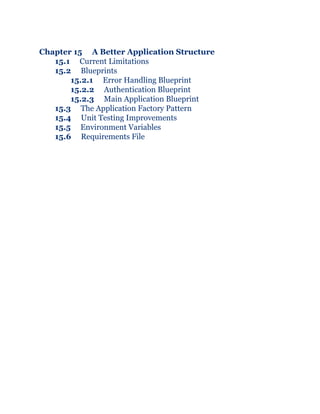
Chapter 15 ABetter Application Structure
15.1 Current Limitations
15.2 Blueprints
15.2.1 Error Handling Blueprint
15.2.2 Authentication Blueprint
15.2.3 Main Application Blueprint
15.3 The Application Factory Pattern
15.4 Unit Testing Improvements
15.5 Environment Variables
15.6 Requirements File
22.
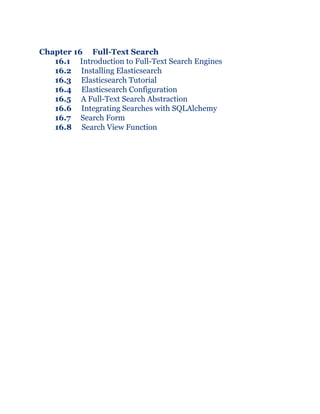
Chapter 16 Full-TextSearch
16.1 Introduction to Full-Text Search Engines
16.2 Installing Elasticsearch
16.3 Elasticsearch Tutorial
16.4 Elasticsearch Configuration
16.5 A Full-Text Search Abstraction
16.6 Integrating Searches with SQLAlchemy
16.7 Search Form
16.8 Search View Function
23.
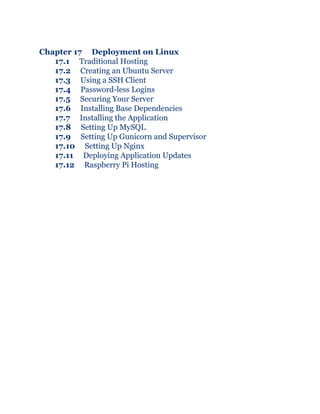
Chapter 17 Deploymenton Linux
17.1 Traditional Hosting
17.2 Creating an Ubuntu Server
17.3 Using a SSH Client
17.4 Password-less Logins
17.5 Securing Your Server
17.6 Installing Base Dependencies
17.7 Installing the Application
17.8 Setting Up MySQL
17.9 Setting Up Gunicorn and Supervisor
17.10 Setting Up Nginx
17.11 Deploying Application Updates
17.12 Raspberry Pi Hosting
24.
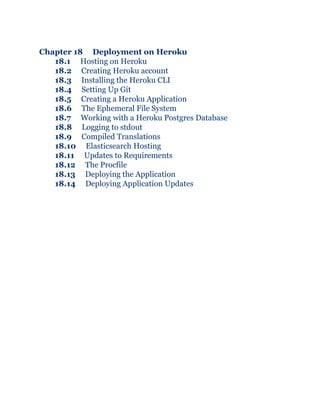
Chapter 18 Deploymenton Heroku
18.1 Hosting on Heroku
18.2 Creating Heroku account
18.3 Installing the Heroku CLI
18.4 Setting Up Git
18.5 Creating a Heroku Application
18.6 The Ephemeral File System
18.7 Working with a Heroku Postgres Database
18.8 Logging to stdout
18.9 Compiled Translations
18.10 Elasticsearch Hosting
18.11 Updates to Requirements
18.12 The Procfile
18.13 Deploying the Application
18.14 Deploying Application Updates
25.
Chapter 19 Deploymenton Docker Containers
19.1 Installing Docker CE
19.2 Building a Container Image
19.3 Starting a Container
19.4 Using Third-Party “Containerized” Services
19.4.1 Adding a MySQL Container
19.4.2 Adding a Elasticsearch Container
19.5 The Docker Container Registry
19.6 Deployment of Containerized Applications
26.
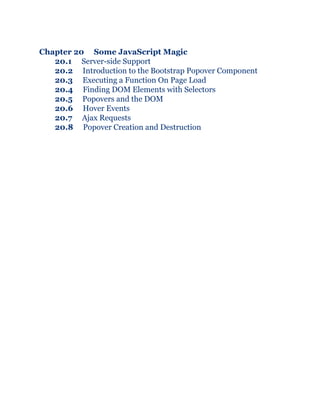
Chapter 20 SomeJavaScript Magic
20.1 Server-side Support
20.2 Introduction to the Bootstrap Popover Component
20.3 Executing a Function On Page Load
20.4 Finding DOM Elements with Selectors
20.5 Popovers and the DOM
20.6 Hover Events
20.7 Ajax Requests
20.8 Popover Creation and Destruction
27.
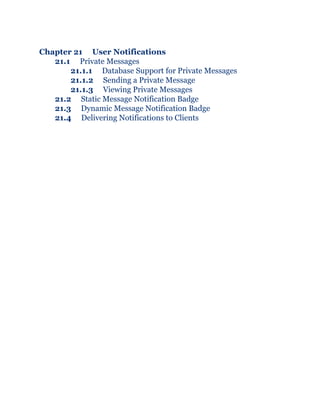
Chapter 21 UserNotifications
21.1 Private Messages
21.1.1 Database Support for Private Messages
21.1.2 Sending a Private Message
21.1.3 Viewing Private Messages
21.2 Static Message Notification Badge
21.3 Dynamic Message Notification Badge
21.4 Delivering Notifications to Clients
28.
Chapter 22 BackgroundJobs
22.1 Introduction to Task Queues
22.2 Using RQ
22.2.1 Creating a Task
22.2.2 Running the RQ Worker
22.2.3 Executing Tasks
22.2.4 Reporting Task Progress
22.3 Database Representation of Tasks
22.4 Integrating RQ with the Flask Application
22.5 Sending Emails from the RQ Task
22.6 Task Helpers
22.7 Implementing the Export Task
22.8 Export Functionality in the Application
22.9 Progress Notifications
22.10 Deployment Considerations
22.10.1 Deployment on a Linux Server
22.10.2 Deployment on Heroku
22.10.3 Deployment on Docker
29.
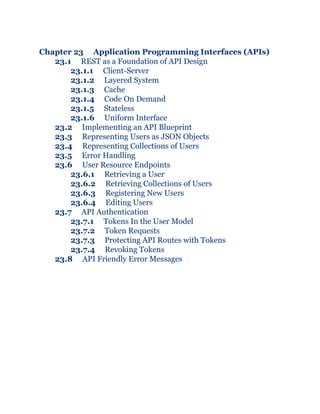
Chapter 23 ApplicationProgramming Interfaces (APIs)
23.1 REST as a Foundation of API Design
23.1.1 Client-Server
23.1.2 Layered System
23.1.3 Cache
23.1.4 Code On Demand
23.1.5 Stateless
23.1.6 Uniform Interface
23.2 Implementing an API Blueprint
23.3 Representing Users as JSON Objects
23.4 Representing Collections of Users
23.5 Error Handling
23.6 User Resource Endpoints
23.6.1 Retrieving a User
23.6.2 Retrieving Collections of Users
23.6.3 Registering New Users
23.6.4 Editing Users
23.7 API Authentication
23.7.1 Tokens In the User Model
23.7.2 Token Requests
23.7.3 Protecting API Routes with Tokens
23.7.4 Revoking Tokens
23.8 API Friendly Error Messages
NERVOUS SYSTEM OFORGANIC
LIFE.
GENERAL REMARKS.
No anatomist has yet considered the nervous system of the
ganglions in the point of view in which I shall present it. This point
of view consists in describing each ganglion as a distinct centre,
independent of the others in its action, furnishing or receiving
particular nerves as the brain furnishes or receives its own, having
nothing in common, except by anastomoses, with the other
analogous organs; so that there is this remarkable difference
between the nervous system of animal life, and that of organic life,
viz. that the first has a single centre, and that it is to the brain that
every kind of sensation comes, and that it is from it every kind of
motion goes; whilst in the second, there are as many little separate
centres, and consequently little secondary nervous systems, as there
are ganglions.
We know that all anatomists, even those who, without affixing to
the expression any very definite meaning, have called the ganglions
little brains, have taken them for dependancies, for enlargements of
the nerves, in whose course they are found; and as most of them
are met with in the great sympathetic, they have presented them as
a distinctive character of this nerve. But from the general idea I have
just given of the ganglions, it is evident that this nerve has no real
existence, and that the continuous thread that is observed from the
neck to the pelvis, is nothing but a succession of nervous
communications, a series of branches that the ganglions placed
32.
above each other,send reciprocally to each other, and not a nerve
going from the brain or the spine.
The first considerations that induced me to think that the great
sympathetic is not a nerve like the others, but a series of
anastomoses, were the following. 1st. These communications are
often interrupted, without any inconvenience, in the organs to which
the great sympathetic goes. There are subjects, for example, in
whom is found a very distinct interval between the pectoral and
lumbar portions of this pretended nerve, which seems cut in this
place, because the last pectoral ganglion and the first lumbar do not
send branches to each other. I have often seen also the sympathetic
nerve cease, and afterwards appear again between two ganglions
and from the same cause, whether in the loins, or in the sacral
region. 2d. Every one knows that the opthalmic ganglion, the
spheno-palatine, &c. are constantly distinct, and that they do not
communicate by their branches except with the cerebral nerves. It
uniformly happens that there is between them and those of the
great sympathetic, what we sometimes see between these last, viz.
a complete deficiency of communication. 3d. In birds, as has been
observed by Cuvier, the superior cervical ganglion is also found
constantly distinct; it never communicates with the inferior. The
filament which in quadrupeds descends the length of the neck, is
wanting in them. In many other animals we frequently find
interruptions in this succession of anastomoses of ganglions, which
constitute what is called the great sympathetic. 4th. The
communications of the ganglions are usually made by a single
branch; but sometimes many go from one of these organs to the
other, so that if the great sympathetic was a nerve like the others, it
would present, in this respect, an arrangement wholly different from
that of the cerebral nervous system. 5th. Whence does the great
sympathetic arise? From the sixth pair? But all the nerves diminish
as they go from the brain towards the organs; but this presents then
an arrangement entirely different; it increases as it sends off
branches. Does it arise from the spinal marrow? But then the
branches with which it furnishes a region would come from the
33.
branches that itreceives from the spinal marrow in this region. Thus
the great and small splanchnic would arise from certain intercostal
pairs, now they are evidently much larger, the first especially, than
the sum of the branches from which they would derive their origin.
Observe then that all anatomists have been of a different opinion
upon the origin of the great sympathetic. How could they agree
upon a thing that has no real existence?
These different considerations render probable the opinion that I
have entertained for some time, that the great sympathetic nerve
does not really exist, that this cord is but a succession of
communications between little nervous systems placed above each
other, and that it is not essential that these communications should
exist, as is seen constantly between the ophthalmic ganglion and the
spheno-palatine, between that and the superior cervical, of which
many animals furnish examples. Then I began to regard each
ganglion as a separate centre of a little nervous system, wholly
different from the cerebral, and distinct even from the little nervous
systems of the other ganglions. By considering the functions of the
nerves going from these centres, I became more and more
convinced that they did not belong to the cerebral system. In fact,
these nerves have properties very different from theirs, as we shall
see; they do not serve for sensations; they have uniformly no
connexion with voluntary locomotion; we see them only in the
organs of internal life; hence why they are found concentrated in the
trunk, in the thorax and abdomen particularly; why they are not met
with in the head, where almost all the organs belong to animal life;
why they are not seen in the extremities, which are exclusively
dependant upon this life.
Distributed almost every where to the organs of the internal life,
the ganglions and their nerves derive their character from it; and
this is it. 1st. They are not symmetrical; thus the nerves of all the
plexuses of the abdomen, those of the cardiacs, &c. have a
remarkable irregularity. 2d. There are numberless varieties in the
form of these plexuses and in that of the ganglions; it is thus that,
34.
sometimes lenticular, sometimestriangular, sometimes divided into
many portions, that which is under the diaphragm is never seen
twice alike. Hence the error of every name derived from the figure; a
remark that is applicable generally to the organs of internal life. We
might rather borrow the names of forms for animal life in which
these forms are more invariable. On the other hand, the existence of
many ganglions varies; sometimes there are three of them in the
neck, at others but two. The arrangement of one side does not
produce a similar one on the other. I have frequently remarked that
the number of filaments arising from the superior cervical ganglion
differs very much from those that take their origin from the opposite
side. There are two analogous organs at each side; but several
attributes of structure destroy the general character of symmetry; it
is like the lungs and the kidnies. We can, then, establish as a
distinctive character between the two nervous systems, the
symmetry of one and the irregularity of the other; now, this
character is one of those which distinguish the two lives, as I have
remarked before.
From all this it is evident that a line of demarcation separates the
nerves of the ganglions and those of the brain, and that the method
is inaccurate which considers them as forming a single nerve, arising
by some origin from this last. Their communications no more prove
it to be a general nerve, than the branches which pass from each of
the cervical, lumbar, or sacral pairs, to the two pairs that are
superior or inferior to it. Notwithstanding these communications, we
consider each pair in a separate manner, and not as one nerve by
their union. So that each ganglion should be described separately,
notwithstanding the branches it sends to others.
The description of the system of the ganglions should be
analogous to that of the cerebral nerves. For example, I describe
first the lenticular ganglion, as was done for the brain; then I
examine its branches, among which is found the great splanchnic;
for it is very improper to say that this nerve gives origin to this
ganglion. The same in the neck, in the head, &c. each ganglion is
35.
first described; thenI treat of its branches, among which are found
those of communication. There are, then, almost as many
descriptions as there are separate ganglions. For example, we ought
not to treat of the ophthalmic nerve with the common motor; to be
convinced of this, it is sufficient to see how much the ciliary nerves
differ from the others, which, belonging to animal life, are also
contained in the orbit.
From all that has been said, it is evident that there are two things
to be examined in the nervous system of organic life, 1st. the
ganglions; 2d. the nerves that go from them.
ARTICLE FIRST.
OF THE GANGLIONS.
I. Situation, forms, relations, &c.
The ganglions are little reddish or greyish bodies, situated in
different parts of the body, and forming so many centres, from
which goes an infinite number of nervous ramifications. Their
position most generally is along the vertebral column, where are
seen successively below each other, the superior and inferior
cervical, the intercostal, the lumbar, and the sacral. It is these
especially whose communicating branches form the great
sympathetic. But besides these ganglions, which are placed as it
were in a row, we find many separate ones in different parts, as the
ophthalmics, the sphenopalatines, the maxillaries in the head, as
also the semilunars in the abdomen. In the thorax there are none
thus separate; though sometimes we see a small one at the base of
the heart.
Besides the ganglions uniformly seen, there are often accidental
ones, if we may so say; such are those that are sometimes found in
36.
the hypogastric plexus,in the solar even, at some distance from the
semilunar, in the middle part of the neck, &c. On the other hand,
some of those that are usually met with are oftentimes not found, as
some of the lumbar, sacral, maxillary, &c.; so that it appears that
there is really an essential difference between the ganglions under
the relation of existence. The superior cervical, the semilunar, the
ophthalmic, &c. are always found; they appear to be essentially
necessary to the action of the organs to which they furnish nerves.
Most of the others may be wanting on the contrary, and be supplied
by those of the neighbouring ones, or by others formed not in the
ordinary anatomical order.
All the ganglions are generally in a deep situation. Destitute of a
bony covering analogous to that of the brain, they are not less
powerfully protected against the action of external bodies. It is this
deep position, that prevents us from making experiments upon
almost all of them, from making those at least which require that the
animal should live a certain time after they have been made. It is
this which will undoubtedly keep up for a length of time the
obscurity that hangs over the functions of these organs.
The form of the ganglions is extremely irregular. In general they
are round; but sometimes they are long, as the superior cervical;
sometimes the ganglion is a species of triangular body, with obtuse
and round ends, as the ophthalmic; sometimes the form is
semilunar, like that which has this name, &c. Generally these forms
are very variable, as I have said; the most uniform is that of the
superior cervical.
Embedded in a quantity of cellular texture, all the ganglions are
separated by it from the neighbouring organs. Almost all of them are
so disposed, that they experience but little motion from these
organs, and cannot receive it from any of the vessels that enter
them. Those situated along the vertebral column especially, present
this phenomenon, very different from that which takes place at the
brain, whose functions are essentially connected with the constant
agitation that the blood imparts to it, and very different from that
37.
which we observein the plexuses of nerves coming from these same
ganglions.
II. Organization.
The ganglions have generally in the adult a reddish colour very
different from that of the nerves; sometimes they are greyish. When
opened, they present a soft, spongy texture, resembling
considerably at first view that of the pretended lymphatic glands.
This texture has nothing in common with the cerebral substance,
nor with that which occupies the canal of the nervous coat. These
two last should rather be ranked in the class of fluids, as I have said;
their substance is a pulp, a real jelly. Thus they have not any of the
properties of solids. They do not harden like horn; the kind of
hardening, the result of the contact of alkohol, of the acids, and of
caloric, is wholly different from the horny hardening. It is analogous
to the hardening of the white of an egg. On the contrary, the texture
of the ganglions hardens like horn in an evident manner, a
phenomenon which is characteristic of all the solids, except the
epidermis, the nails, and the hair, which make a separate class.
Treated by the acids, the ganglions, after wrinkling, hardening like
horn and hardening gradually, soften and become fluid.
Boiling produces a phenomenon nearly analogous; 1st. horny
hardening and hardening at the instant the water boils; 2d.
continuance of this state for half an hour; 3d. softening gradually
brought on; when this last is complete, the effect of the boiling is
finished. In this state, the ganglions are all different from the nerves
submitted to the same experiment. I have observed also in veal, that
they have a very different taste from that of the nerves, a method of
research which should not be neglected in attempting to ascertain
the difference of the nature of the organs. In fact, as we do not yet
know the difference of the principles which enter into the
composition of each, we should be satisfied with the difference of
the qualities.
38.
The alkalies acta little upon the ganglions, which they tend to
dissolve, and which they do partly dissolve, if they are very caustic.
But this solution is infinitely less prompt and less easy than that of
the cerebral pulp by the same re-agents. The ganglions resist
putrefaction as much and even more than the nerves; this forms
also a very remarkable difference between them and the cerebral
substance. In general, we cannot establish any kind of analogy
between them.
The texture of the ganglions appears in nowise fibrous; there is
absolutely no linear, filamentous appearance, &c. upon simple
inspection. Homogeneous, if we may so say, in its nature, it presents
every where an uniform aspect when cut in slices. However the
celebrated Scarpa has considered the ganglions as resulting from a
kind of expansion of the nerves, into an infinite number of extremely
delicate fibres, which interlace with each other, and which become
very distinct by maceration. I have not repeated all his experiments,
which appear to me extremely difficult. I refer then to his work, and
to the plates it contains. I would observe only that there is certainly
something else in the ganglions, besides a simple division of the
nerve into extremely fine threads. In fact, mere inspection is
sufficient to establish between them the greatest difference. There is
as evident a demarcation between the ganglions and the nerves, as
between those of the brain and the brain itself. 1st. Difference of
colour, reddish or greyish tinge in some, white in others; 2d.
difference of consistence, of external qualities, &c.; 3d. difference of
properties. If the nerves coming from the spinal marrow make only
an expansion, in their passage, in the ganglions, by delicate
filaments, there would then be only a difference of form and not of
nature; the properties would be the same. Why then are they so
different as I shall prove hereafter? Why, as a nerve goes from a
ganglion, does it not communicate more voluntary motions? 4th.
Why has not nature placed ganglions in the nerves of the extremities
as in those of the other parts? If there is only a division of the nerve
into finer filaments, in the ganglion, why is there not a proportion
between the filaments that enter on one side, and those that go out
39.
at the opposite?In fact, those that enter into the superior cervical
above, if they only expanded their filaments in this ganglion, and
united afterwards to form those that go off below, would be equal in
respect to size to those that go from it; all the ganglions would
exhibit this constant relation between the nerves of one side and
those of the opposite; now, it is sufficient to examine them to be
convinced that an inverse arrangement exists. 6th. The ganglions
ought always to be in proportion to the size of the nerves which
form them by spreading their fibres. Why then are the intercostal
ganglions so small, and the trunks that unite them, or rather that
give origin to them and which go from them afterwards as we see in
the usual manner, so large? Why on the contrary, is the superior
cervical ganglion so large, and its branches so small? 7th. How can
be explained the frequent interruptions between the ganglions in
man, which are constant in many animals, if there is a continuity
between the nervous filaments that enter the ganglions above, and
those that go from them below? 8th. How does it happen that the
ganglions and their nerves do not follow an exact proportion as to
development with the cerebral nerves, if these form them by
expanding? 9th. Why has not pain the same character in each
species of nerves?
I have no opinion as to the nature or the functions of the
ganglions, because I have no fact to support me; but there is
certainly something more in their texture, than a mere expansion of
nervous filaments. Scarpa admits a peculiar matter which separates
these filaments; but this substance ought to predominate
considerably, as the ganglion surpasses in size the nerves which are
thought to give origin to it. Now I have never seen this substance; I
do not know what it is; all is solid when the ganglion is cut. I think
then by admitting, even to a certain extent, the internal
arrangement that this author has observed in the ganglions, we
cannot describe these organs in the point of view in which he has
presented them.
40.
We know butlittle of the alterations that diseases produce in the
texture of the ganglions. I have already many times examined in
diseases of the heart, of the liver, of the stomach, the intestines, the
ganglions that send nerves to these viscera; they have never
appeared to me to have undergone any change. In cancers of the
stomach in the very last stage, in which all the cellular texture is
engorged, and in which all the lymphatic glands are considerably
swelled, I have always found the semi-lunar ganglion untouched,
except however in one case where it was enlarged and its density a
little increased. At another time I found this same ganglion of the
size of a small nut, with a cartilaginous substance in its centre,
resembling the stone of it, in the body of a man brought to the Hôtel
Dieu on account of periodical mania. Some authors have thought,
and I suspect the same thing also, that the hysteric paroxysms,
which begin by a contraction at the epigastric region, and in which
the patient feels a ball mount up even to the throat, arise from some
affections of the semi-lunar ganglions, from the solar plexus and the
communications which go from ganglion to ganglion, even to the
neck. However two bodies that I have opened lately, exhibited no
alteration, though during life the subjects had been frequently
attacked with these paroxysms; but they may arise evidently from
the ganglions and the epigastric plexuses, without their being
altered in their structure, as a number of cerebral affections leave
after them no trace in the brain. This point deserves particular
examination.
It does not appear that the texture of the ganglions is surrounded
by a peculiar membrane. The cellular texture is only condensed in
their neighbourhood; it then becomes very consistent, and much
contracted around them. It there has the nature of the sub-mucous,
the sub-arterial textures, &c.; it never contains fat. There is then
truly around the ganglions, as around the arteries, under the
mucous surfaces, &c. the two kinds of cellular texture of which we
have spoken in treating of the organization of this texture, and
which differ so essentially from each other in their nature, and even
in their properties. It is the second kind, which is analogous to the
41.
sub-arterial texture, &c.which forms the peculiar membrane
admitted by some authors.
By examining attentively the interior of the ganglions, we see that
there is but very little cellular texture there. I have found this texture
constantly destitute of fat; thus the alkalies do not form a
saponaceous deposit upon them, as upon the cerebral nerves when
plunged in their solution. I have examined many ganglions in this
way, on account of the opinion of Scarpa, who believes that these
organs are penetrated with this fluid, at least in fat people.
The ganglions receive many blood vessels. These penetrate them
from all sides, run first in a kind of cellular covering that surrounds
them, then entering their texture, ramify and are lost there in
numerous anastomoses, and in continuation with the exhalants that
carry nutritive matter. Fine injections show a great quantity of
vessels in these little organs. Nutrition supposes exhalants and
absorbents there.
III. Properties.
It is difficult to analyze the properties of texture in the ganglions.
As to vital properties, they cannot grow, live and be nourished
without organic sensibility, and without insensible contractility of the
same kind. Animal and sensible organic contractility do not exist
there evidently. As to animal sensibility I have observed the following
circumstance. As in opening the abdomen of an animal, of a dog, for
example, he lives very well for some time, and remains even calm
after the first moments of suffering; I have waited for this calm that
succeeds the agitation arising from the incision of the abdominal
parietes, then laid the semi-lunar ganglion bare, and irritated it
powerfully; the animal is not agitated, whilst when I excite a
cerebral lumbar nerve, for comparison, he cries out, raises himself
up and struggles. In general it appears that the sensibility of the
ganglions is infinitely less evident than that of many other organs.
42.
Certainly the skin,the mucous system, the medullary, the nervous of
animal life, &c. surpass it in this respect.
Our ignorance as to the diseases that have their seat in the
ganglions, the distance of those organs from external excitement,
prevent our having any data as to their sympathies. I think it very
probable, however, that these sympathies take a real part in
hysteria, in certain kinds of epilepsy, the paroxysms of which begin,
like those of hysteria, by a painful sensation at the epigastric region,
in that multitude of affections called nervous, and which the vulgar
confound under the name of vapours. One of the most important
objects of research in the neuroses, is to determine those that have
their particular seat in the nervous cerebral system and those which
affect more particularly the system of the ganglions. Place on one
side, palsy, hemiplegia, convulsions of infants, tetanus, catalepsy,
apoplexy, the greatest part of epilepsies, all the numerous accidents
that arise from engorgements, from compressions of the brain from
wounds of the head, nervous affections of the sight, hearing, taste,
smell, &c. and all the diseases the source of which is evidently in the
head; on the other place hysteria, hypochondriasis, melancholia and
all that numerous class of affections in which the abdomen and the
thorax, the first especially, seem to be the spot in which the evil is
seated; you will see that there is an essential difference and that the
symptoms have entirely a different character. I do not say that the
last kind of nervous diseases affect exclusively the ganglions; for too
much obscurity hangs over these affections to pronounce any thing
positive as to their seat, or their nature. Undoubtedly even the
secretory, circulating, pulmonary organs, &c. can be then particularly
affected in their peculiar texture and independently of the nerves
they receive; but certainly it is an interesting subject of research,
and there is too great a difference in the phenomena of the two
orders of affections, not to present differences in their primitive seat.
It is difficult to conceive that the system of the ganglions has not a
great part in the last order.
43.
That which inducesme to think that the difference of the
phenomena that the general order of neuroses presents us, arises
particularly from the difference of the cerebral nerves and of those
of the ganglions, is that their phenomena in a state of health are
very different. Hallé has observed very well that the pains that are
experienced in the parts in which the nerves coming from the
ganglions are distributed, have a peculiar character, and that they do
not resemble those that are felt in the parts where the cerebral
nerves are sent. Thus the painful sensation that is experienced at
the loins in affections of the womb, by vinous injection made into
the tunica vaginalis, &c. a sensation that appears to me to arise from
the sympathetic influence exercised by the organ affected upon the
lumbar ganglions, the pains of the intestines, the burnings at the
epigastric region, &c. &c. do not resemble pains of the external
parts; they are deep, and go to the heart, as we often say. We know
that there are colics essentially nervous, which are certainly
independent of every local affection of the serous, mucous, and
muscular systems of the intestines. These colics are evidently seated
in the nerves of the semi-lunar ganglions, which are spread along
the whole course of the abdominal arteries. They are real neuralgias
of the nervous system of organic life; now these neuralgias have
absolutely nothing in common with the tic douloureux, sciatica, and
other neuralgias of the nervous system of animal life. The
symptoms, the progress, the duration, &c. every thing is different in
these two kinds of affections.
What I have just said upon the injuries of sensation, applies also
to those of motion. No kind of comparison can be made between the
convulsions of the muscles that receive the nerves of animal life, and
the spasmodic and irregular motions which arise in all the muscles
that receive nerves from the ganglions. Nothing resembles tetanus in
the heart, the intestines, the bladder, &c.
All these considerations establish striking differences between the
cerebral nerves and those of the ganglions; differences upon which I
44.
can only presentapproximations, as we have no data as to the
functions of the last.
IV. Development.
The ganglions differ essentially from the brain in the early periods
in their development, which is proportionably much less advanced
than that of the brain. They are only on a level with all the other
organs, whilst this is infinitely superior to them in this respect, as we
have seen. By comparing the superior cervical, semilunar ganglions,
&c. in the fœtus, and in the adult, it is easy to make this remark.
The ganglions receive also less vessels in proportion than the brain.
They do not follow the proportion of increase of the organs to which
they send nerves. Thus those that furnish the genital organs, which
are nearly nothing during the first years of general nutrition, are as
large in proportion as those which go to the liver, the stomach, the
intestines, which are characterized by an early increase. These
nerves follow in this respect the same law as the ganglions, though
the most are found upon the arteries, which are more or less
developed according to the organs they penetrate.
The nervous system of organic life being less early in its
development than that of animal life, should be subject in infancy to
fewer affections; and this is what is observed. Convulsions, and most
of the neuroses of the second, are, as we have seen, a peculiar
appendage upon infancy. On the other hand, the particular order of
nervous affections of which we have spoken, and in which it appears
that the first takes the principal part, is generally less frequent at
this period. All nervous diseases, whose peculiar seat seems to be at
the epigastric region, in which there is so great an abundance of
nerves coming from the ganglions, appear to be foreign to this age.
Another difference that distinguishes the ganglions from the brain
as it respects development, is this, that in the fœtus, they are not,
like it, of extreme softness. Their hardness is little inferior to what
they afterwards possess in adult age.
45.
In proportion aswe advance from infancy, the organic nervous
system begins to become predominant. It is towards the thirtieth or
fortieth year that it appears at its maximum of action; it diminishes
as we approach old age; it decays in part at this epoch. The nerves
become greyish; the ganglions are hard, resisting and smaller. The
neuroses that appear to belong to them are infinitely more rare.
Moreover, the obscurity that rests upon the functions of this system,
does not allow me to point out definitely the alterations they
experience in the different ages.
V. Remarks upon the vertebral ganglions.
In all that I have said thus far upon the ganglions, I have not
noticed those which correspond with the foramina through which the
nerves pass, and which some call simple ganglions. We know that at
the instant each nerve goes from each of these foramina, it exhibits
an evident enlargement, reddish, pulpy, analogous in its appearance
to most of the ganglions. I confess, that I know not how to class
these organs. We cannot deny that they have the greatest analogy
in structure to the others. They are approximated in another respect,
which is this, that the nerves, in going from them, form almost
immediately plexuses that we have designated under the names of
cervical, brachial, lumbar, and sacral, in the same way as the solar,
cardiac, mesenteric plexuses, &c. are formed by the nerves of
organic life, at the moment they go from their respective ganglions.
However, these last nerves are conductors of very different
properties. Irritate in a living animal the superior cervical ganglion,
the inferior even, which is more difficult, though it may be come at,
the muscles to which they send nerves will remain unmoved; the
same phenomenon takes place by exciting the nerves themselves.
On the contrary, every irritation of a filament coming from the
vertebral ganglions, produces immediately convulsions in the
corresponding muscles. The sensibility is entirely different in the two
species of nerves. Besides, there is no analogy between the manner
in which the nerves go in all directions from the vertebral ganglions,
46.
and that inwhich the other ganglions furnish theirs. In the
expectation that further experiments may elucidate the subject, let
us content ourselves with pointing out what is the result of accurate
observation.
ARTICLE SECOND.
OF THE NERVES OF ORGANIC LIFE.
I. Origin.
Each ganglion is, as we have seen, a centre from which go in
different directions, various branches, the whole of which form a
kind of little separate nervous system. The manner of the origin of
these branches has but very little relation with that of the branches
of the brain and of the spinal marrow. The following are some
differences that distinguish it.
1st. The adhesion is much stronger; the nerve breaks any where
else rather than at its origin; the opposite of this takes place in the
preceding system. 2d. It does not appear that the substance of the
ganglion is continued in the nerve to form the medullary substance
of it, since the organization of the one and the other is very
different. Sometimes, however, the ganglion is continued for a short
distance in the form of a cord. This happens especially in the
superior cervical, in the lumbar, the semi-lunar, &c. Then the form
only is different; but it is easy at the first view to distinguish where
the ganglion ends and the nerve begins. 3d. This beginning is made
in a sudden manner; it is like a muscle implanted in a tendon. The
best manner of seeing this arrangement to advantage is to cut
longitudinally the superior cervical ganglion and the cord it sends to
the inferior; the change of nature of the one and the other is then
very apparent; or, if we consider the ganglion as a division of the
numerous filaments of the nervous cords, we distinguish very well
47.
the sudden changethat these filaments experience in passing from
the cord to the nerve. 4th. The dense cellular covering that
surrounds the ganglion is continued upon the nervous origin, and
gives it an increase of consistence at that place. This must be
carefully raised before we come to the nerve. We see then each
distinct filament arising from the ganglion. After it has gone from it,
sometimes it remains separate; this takes place at the semi-lunar,
the lumbar, the opthalmic, whose elongations are of great delicacy.
Sometimes many of these filaments unite together and form a cord
as between the two cervical, as at the great and small splanchnic
nerves, &c.
I have not been able by maceration, ebullition, or the action of the
acids to destroy the adhesion of the nerve with the ganglion, as we
destroy that of the muscle with the tendon, of this with the bone,
&c.
II. Course, Termination, Plexuses.
The nerves after going from the ganglions, are distributed in many
different ways which we shall now examine.
1st. There are always some which go immediately to communicate
with the system of animal life. The ophthalmic ganglion sends
branches to the motores communes, and to the nasal nerve. The
spheno-palatine communicates with the superior maxillary nerve;
the superior cervical with all the nerves that surround it, viz. above
with the motor externus, within with the great hypoglossal, the par
vagum, the glosso-pharyngeal, the spinal, &c.; behind with the first
cervical pairs. All the ganglions situated above each other along the
vertebral column, send communications through each pair of
foramina that correspond with them. The par vagum communicates
with the semi-lunar, &c. It is not then any separate ganglion of the
nerves of animal life; hence the common expression that designates
each ganglion as arising from this or that pair, or being found in its
course, is very inaccurate. Thus the opthalmic is by no means in the
48.
course of thecommon motor nerve. The one and the other send
each a branch, which unites; or rather there is a branch of
communication between the ganglion and the cerebral nerve. In
general all these branches of communication with the system of
animal life, are short, whitish, and of the same nature, or at least of
the same appearance as the nerves of this last. They do not form
any plexus in their course, rarely furnish branches, and appear to
have no other use than that of establishing anastomoses between
the two systems.
2d. Each ganglion sends above and below branches to the two
ganglions that are contiguous to it. We have seen that the opthalmic
and the spheno-palatine are exceptions to this rule. Sometimes also,
as I have said, there are interruptions in other regions.
Notwithstanding this, these general communications make us regard
the ganglions as being connected every where, and able to receive
from each other the different affections of which they can be
primitively the separate seat. These branches of communication are
straight as in the preceding, sometimes very fine, as between the
lumbar and sacral ganglions, at other times larger, as that which is
between the two cervical, superior and inferior, in some cases very
large, as the great splanchnic, which is a real trunk of
communication between the intercostals and the semi-lunar. The
nerves that we are now considering, the last especially, have like the
preceding, an arrangement exactly analogous to the cerebral nerves;
they are formed of whitish cords, which are the result of filaments.
The eye discovers no difference between them.
3d. Many filaments coming from ganglions, go to certain cerebral
muscles, as to the diaphragm, some of those of the neck, &c.;
others go to neighbouring organs only.
4th. The greatest number going from the ganglions in separate
filaments, interlace in the form of a plexus with those of the
contiguous ganglions, in the neighbourhood of, or upon the great
vessels. The most remarkable plexus is the solar, composed by the
innumerable branches that come from the semi-lunar; then we see
49.
the hypogastric, thecardiac, &c. The greater number of these
plexuses are not exclusively formed by the nerves of organic life;
those of the animal give some to them also, as the par vagum
furnishes an example for the solar and the cardiac, as the sacral
nerves afford another for the hypogastric, &c. However the nerves of
organic life always predominate in these plexuses. There is only the
pulmonary in which the par vagum particularly predominates, whilst
the nerves coming from the inferior cervical ganglion are, if we may
so say, but accessory.
The primitive plexuses resulting from the interlacing of the organic
nerves at their exit from the ganglions, form a mass of irregular
nerves, buried in the cellular texture, accommodated to the forms of
the neighbouring organs, and wholly different from those of animal
life, as of the brachial, the lumbar, &c.
In fact, the filaments at every instant, not only place themselves
as in the preceding ones, at the side of each other, at every change
of position; but their extremities continue; they interlace with each
other, change at every point the direction, form networks, and mix
so together, that it is not possible to distinguish any thing except a
thousand nerves, that we might say grew up under the cloth with
which we wiped the place where the plexus was found.
These organs are remarkable for their reddish or greyish colour,
for their softness, for their indistinctness, &c.; it is often difficult to
distinguish them from cellular texture. The best manner of making
them evident is to let the subject macerate for a day or two open in
the water; they whiten then sensibly, do not soften, and appear
even to increase in consistence, like the cerebral nerves in a similar
case. Besides their delicacy is such, that it is impossible to submit
them to any kind of reagents. Only I have observed that they
possess in an eminent degree the property of horny hardening, and
that they do not yield in this respect to the cerebral. This delicacy
depends upon this, that all the filaments are separate from each
other, instead of being like the preceding, collected into cords; it is
this also that makes these nerves so numerous. If all the filaments
50.
of the brachialplexus were separated like those of the solar, they
would present the same appearance and the same number in their
interlacing.
Do the primitive plexuses formed by the ganglions perform a part
in the nervous functions? are they centres to which are referred
important phenomena? What has not been said upon this subject,
concerning the solar plexus? But nothing, I believe, of all that has
been advanced is founded upon accurate observation.
The plexuses of organic life are soon separated into different
divisions, which go to different parts, to those especially of this life.
These divisions arise from an infinite number of little filaments which
go constantly separate, though placed near each other, and which
never unite into cords like the preceding. They accompany almost all
the arteries; thus the renal, the hepatic, the splenic, the coronary
stomachic, the mesenterics, the hypogastric, the carotid and its
distributions, &c. are surrounded with filaments coming from
ganglions. These filaments go in two ways. 1st. Some accompany
the artery without being connected with it; considerable cellular
texture separates them; they go in its course without intermixing in
a sensible manner with it. 2d. The others form for it, if we may so
say, a new coat, exterior to the others, which adhere to it intimately,
and which interlace so together, that they might be taken for a
network surrounding the artery.
When the artery runs but a short course, these two orders of
branches remain distinct from each other as far as the organ, as we
see around the splenic, the hepatic, the renal, &c.; but if the course
is longer, the external branches gradually get into the plexus, and
are entirely lost there. This plexus can be followed upon the great
trunks; it divides upon each branch, and can be still seen; but such
is its tenuity upon the minute ramifications that it disappears there
entirely. The spermatic is one of the arteries upon which it can be
traced the longest. The arteries of the extremities appear to be
destitute of it. In general it is upon those that go to the central
organs of internal life, that this network is the most evident. When
51.
Welcome to ourwebsite – the ideal destination for book lovers and
knowledge seekers. With a mission to inspire endlessly, we offer a
vast collection of books, ranging from classic literary works to
specialized publications, self-development books, and children's
literature. Each book is a new journey of discovery, expanding
knowledge and enriching the soul of the reade
Our website is not just a platform for buying books, but a bridge
connecting readers to the timeless values of culture and wisdom. With
an elegant, user-friendly interface and an intelligent search system,
we are committed to providing a quick and convenient shopping
experience. Additionally, our special promotions and home delivery
services ensure that you save time and fully enjoy the joy of reading.
Let us accompany you on the journey of exploring knowledge and
personal growth!
textbookfull.com