Download Full Version ebook - Visit ebookmeta.com
Web Development with Node and Express 2nd Edition
Ethan Brown
https://ebookmeta.com/product/web-development-with-node-and-
express-2nd-edition-ethan-brown/
OR CLICK HERE
DOWLOAD NOW
Discover More Ebook - Explore Now at ebookmeta.com
Instant digital products (PDF, ePub, MOBI) ready for you
Download now and discover formats that fit your needs...
Start reading on any device today!
Web Development with Clojure Build Bulletproof Web Apps
with Less Code 3rd Edition Dmitri Sotnikov Scot Brown
https://ebookmeta.com/product/web-development-with-clojure-build-
bulletproof-web-apps-with-less-code-3rd-edition-dmitri-sotnikov-scot-
brown/
ebookmeta.com
RESTful Web API Design with Node js Design and implement
comprehensive RESTful solutions in Node js Valentin
Bojinov
https://ebookmeta.com/product/restful-web-api-design-with-node-js-
design-and-implement-comprehensive-restful-solutions-in-node-js-
valentin-bojinov/
ebookmeta.com
Learning JavaScript 3e 3rd Edition Ethan Brown
https://ebookmeta.com/product/learning-javascript-3e-3rd-edition-
ethan-brown/
ebookmeta.com
Anarchism After Deleuze and Guattari 1st Edition Chantelle
Gray
https://ebookmeta.com/product/anarchism-after-deleuze-and-
guattari-1st-edition-chantelle-gray/
ebookmeta.com
Catholicism and Religious Freedom Renewing the Church in
the Second Vatican Council 1st Edition Karl Gabriel
Christian Spieß Katja Winkler
https://ebookmeta.com/product/catholicism-and-religious-freedom-
renewing-the-church-in-the-second-vatican-council-1st-edition-karl-
gabriel-christian-spies-katja-winkler/
ebookmeta.com
The Archive 1st Edition Alex Scarrow
https://ebookmeta.com/product/the-archive-1st-edition-alex-scarrow/
ebookmeta.com
Queen and the Kingsmen Dark Fantasy Book 3 2nd Edition
Alta Hensley Zoe Blake
https://ebookmeta.com/product/queen-and-the-kingsmen-dark-fantasy-
book-3-2nd-edition-alta-hensley-zoe-blake/
ebookmeta.com
Commentary on Aristotle Metaphysics Books I III Critical
edition with Introduction and Notes Alexander Of
Aphrodisias
https://ebookmeta.com/product/commentary-on-aristotle-metaphysics-
books-i-iii-critical-edition-with-introduction-and-notes-alexander-of-
aphrodisias/
ebookmeta.com
AI and the Project Manager How the Rise of Artificial
Intelligence Will Change Your World 1st Edition Peter
Taylor
https://ebookmeta.com/product/ai-and-the-project-manager-how-the-rise-
of-artificial-intelligence-will-change-your-world-1st-edition-peter-
taylor/
ebookmeta.com
An Advanced Lifespan Odyssey for Counseling Professionals
1st Edition Bradley Erford Irvin B Tucker
https://ebookmeta.com/product/an-advanced-lifespan-odyssey-for-
counseling-professionals-1st-edition-bradley-erford-irvin-b-tucker/
ebookmeta.com
1. Preface
a. Who This Book Is For
b. Notes on the Second Edition
c. How This Book Is Organized
d. Example Website
e. Conventions Used in This Book
f. Using Code Examples
g. O’Reilly Online Learning
h. How to Contact Us
i. Acknowledgments
2. 1. Introducing Express
a. The JavaScript Revolution
b. Introducing Express
c. Server-Side and Client-Side Applications
d. A Brief History of Express
e. Node: A New Kind of Web Server
f. The Node Ecosystem
g. Licensing
h. Conclusion
3. 2. Getting Started with Node
a. Getting Node
b. Using the Terminal
c. Editors
d. npm
e. A Simple Web Server with Node
i. Hello World
ii. Event-Driven Programming
iii. Routing
iv. Serving Static Resources
f. Onward to Express
4. 3. Saving Time with Express
a. Scaffolding
b. The Meadowlark Travel Website
c. Initial Steps
i. Views and Layouts
ii. Static Files and Views
iii. Dynamic Content in Views
iv. Conclusion
5. 4. Tidying Up
a. File and Directory Structure
b. Best Practices
c. Version Control
d. How to Use Git with This Book
i. If You’re Following Along by Doing It
Yourself
ii. If You’re Following Along by Using the
Official Repository
e. npm Packages
f. Project Metadata
g. Node Modules
h. Conclusion
6. 5. Quality Assurance
a. The QA Plan
b. QA: Is It Worth It?
c. Logic Versus Presentation
d. The Types of Tests
e. Overview of QA Techniques
f. Installing and Configuring Jest
g. Unit Testing
i. Mocking
ii. Refactoring the Application for
Testability
iii. Writing Our First Test
iv. Test Maintenance
v. Code Coverage
h. Integration Testing
i. Linting
j. Continuous Integration
k. Conclusion
7. 6. The Request and Response Objects
a. The Parts of a URL
b. HTTP Request Methods
c. Request Headers
d. Response Headers
e. Internet Media Types
f. Request Body
g. The Request Object
h. The Response Object
i. Getting More Information
j. Boiling It Down
i. Rendering Content
ii. Processing Forms
iii. Providing an API
k. Conclusion
8. 7. Templating with Handlebars
a. There Are No Absolute Rules Except This One
b. Choosing a Template Engine
c. Pug: A Different Approach
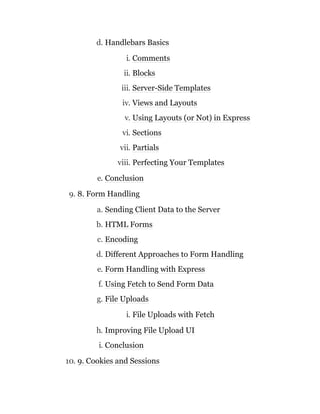
d. Handlebars Basics
i. Comments
ii. Blocks
iii. Server-Side Templates
iv. Views and Layouts
v. Using Layouts (or Not) in Express
vi. Sections
vii. Partials
viii. Perfecting Your Templates
e. Conclusion
9. 8. Form Handling
a. Sending Client Data to the Server
b. HTML Forms
c. Encoding
d. Different Approaches to Form Handling
e. Form Handling with Express
f. Using Fetch to Send Form Data
g. File Uploads
i. File Uploads with Fetch
h. Improving File Upload UI
i. Conclusion
10. 9. Cookies and Sessions
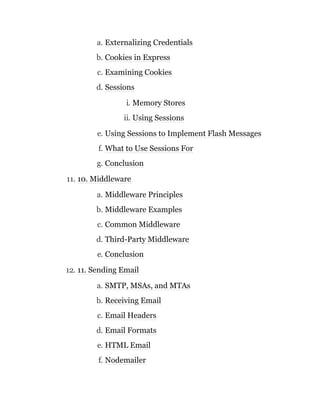
a. Externalizing Credentials
b. Cookies in Express
c. Examining Cookies
d. Sessions
i. Memory Stores
ii. Using Sessions
e. Using Sessions to Implement Flash Messages
f. What to Use Sessions For
g. Conclusion
11. 10. Middleware
a. Middleware Principles
b. Middleware Examples
c. Common Middleware
d. Third-Party Middleware
e. Conclusion
12. 11. Sending Email
a. SMTP, MSAs, and MTAs
b. Receiving Email
c. Email Headers
d. Email Formats
e. HTML Email
f. Nodemailer
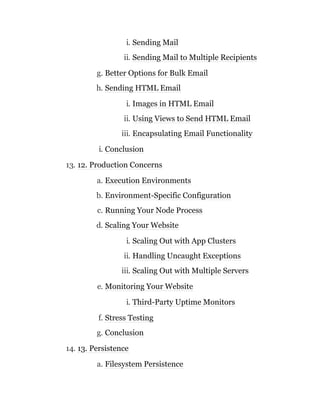
i. Sending Mail
ii. Sending Mail to Multiple Recipients
g. Better Options for Bulk Email
h. Sending HTML Email
i. Images in HTML Email
ii. Using Views to Send HTML Email
iii. Encapsulating Email Functionality
i. Conclusion
13. 12. Production Concerns
a. Execution Environments
b. Environment-Specific Configuration
c. Running Your Node Process
d. Scaling Your Website
i. Scaling Out with App Clusters
ii. Handling Uncaught Exceptions
iii. Scaling Out with Multiple Servers
e. Monitoring Your Website
i. Third-Party Uptime Monitors
f. Stress Testing
g. Conclusion
14. 13. Persistence
a. Filesystem Persistence
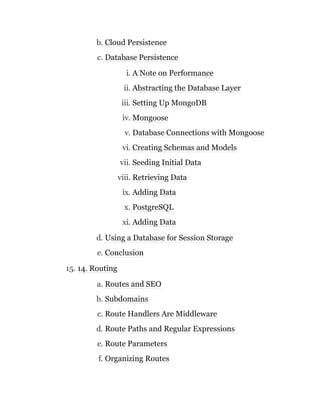
b. Cloud Persistence
c. Database Persistence
i. A Note on Performance
ii. Abstracting the Database Layer
iii. Setting Up MongoDB
iv. Mongoose
v. Database Connections with Mongoose
vi. Creating Schemas and Models
vii. Seeding Initial Data
viii. Retrieving Data
ix. Adding Data
x. PostgreSQL
xi. Adding Data
d. Using a Database for Session Storage
e. Conclusion
15. 14. Routing
a. Routes and SEO
b. Subdomains
c. Route Handlers Are Middleware
d. Route Paths and Regular Expressions
e. Route Parameters
f. Organizing Routes
g. Declaring Routes in a Module
h. Grouping Handlers Logically
i. Automatically Rendering Views
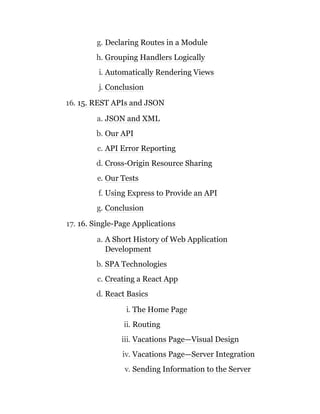
j. Conclusion
16. 15. REST APIs and JSON
a. JSON and XML
b. Our API
c. API Error Reporting
d. Cross-Origin Resource Sharing
e. Our Tests
f. Using Express to Provide an API
g. Conclusion
17. 16. Single-Page Applications
a. A Short History of Web Application
Development
b. SPA Technologies
c. Creating a React App
d. React Basics
i. The Home Page
ii. Routing
iii. Vacations Page—Visual Design
iv. Vacations Page—Server Integration
v. Sending Information to the Server
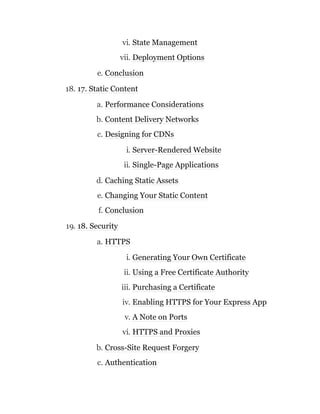
vi. State Management
vii. Deployment Options
e. Conclusion
18. 17. Static Content
a. Performance Considerations
b. Content Delivery Networks
c. Designing for CDNs
i. Server-Rendered Website
ii. Single-Page Applications
d. Caching Static Assets
e. Changing Your Static Content
f. Conclusion
19. 18. Security
a. HTTPS
i. Generating Your Own Certificate
ii. Using a Free Certificate Authority
iii. Purchasing a Certificate
iv. Enabling HTTPS for Your Express App
v. A Note on Ports
vi. HTTPS and Proxies
b. Cross-Site Request Forgery
c. Authentication
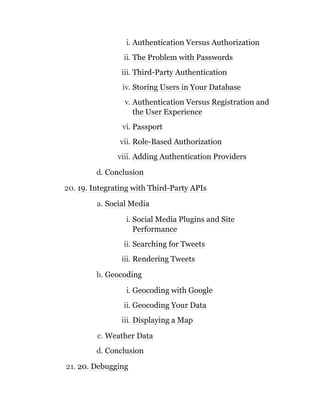
i. Authentication Versus Authorization
ii. The Problem with Passwords
iii. Third-Party Authentication
iv. Storing Users in Your Database
v. Authentication Versus Registration and
the User Experience
vi. Passport
vii. Role-Based Authorization
viii. Adding Authentication Providers
d. Conclusion
20. 19. Integrating with Third-Party APIs
a. Social Media
i. Social Media Plugins and Site
Performance
ii. Searching for Tweets
iii. Rendering Tweets
b. Geocoding
i. Geocoding with Google
ii. Geocoding Your Data
iii. Displaying a Map
c. Weather Data
d. Conclusion
21. 20. Debugging
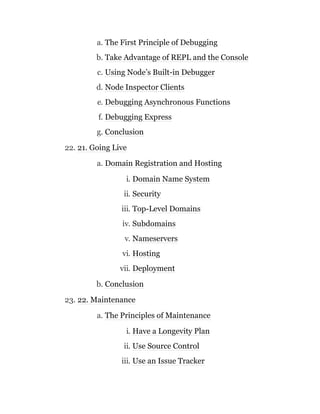
a. The First Principle of Debugging
b. Take Advantage of REPL and the Console
c. Using Node’s Built-in Debugger
d. Node Inspector Clients
e. Debugging Asynchronous Functions
f. Debugging Express
g. Conclusion
22. 21. Going Live
a. Domain Registration and Hosting
i. Domain Name System
ii. Security
iii. Top-Level Domains
iv. Subdomains
v. Nameservers
vi. Hosting
vii. Deployment
b. Conclusion
23. 22. Maintenance
a. The Principles of Maintenance
i. Have a Longevity Plan
ii. Use Source Control
iii. Use an Issue Tracker
iv. Exercise Good Hygiene
v. Don’t Procrastinate
vi. Do Routine QA Checks
vii. Monitor Analytics
viii. Optimize Performance
ix. Prioritize Lead Tracking
x. Prevent “Invisible” Failures
b. Code Reuse and Refactoring
i. Private npm Registry
ii. Middleware
c. Conclusion
24. 23. Additional Resources
a. Online Documentation
b. Periodicals
c. Stack Overflow
d. Contributing to Express
e. Conclusion
25. Index
Web Development with
Node and Express
Leveraging the JavaScript Stack
SECOND EDITION
Ethan Brown
Web Development with Node and Express
by Ethan Brown
Copyright © 2020 Ethan Brown. All rights reserved.
Printed in the United States of America.
Published by O’Reilly Media, Inc., 1005 Gravenstein Highway
North, Sebastopol, CA 95472.
O’Reilly books may be purchased for educational, business, or
sales promotional use. Online editions are also available for
most titles (http://oreilly.com). For more information, contact our
corporate/institutional sales department: 800-998-9938 or
corporate@oreilly.com.
Acquisitions Editor: Jennifer Pollock
Developmental Editor: Angela Rufino
Production Editor: Nan Barber
Copyeditor: Kim Wimpsett
Proofreader: Sharon Wilkey
Indexer: WordCo Indexing Services, Inc.
Interior Designer: David Futato
Cover Designer: Karen Montgomery
Illustrator: Rebecca Demarest
November 2019: Second Edition
Revision History for the Second Edition
2019-11-12: First Release
See http://oreilly.com/catalog/errata.csp?isbn=9781492053514
for release details.
The O’Reilly logo is a registered trademark of O’Reilly Media,
Inc. Web Development with Node and Express, the cover
image, and related trade dress are trademarks of O’Reilly
Media, Inc.
The views expressed in this work are those of the author, and
do not represent the publisher’s views. While the publisher and
the author have used good faith efforts to ensure that the
information and instructions contained in this work are
accurate, the publisher and the author disclaim all
responsibility for errors or omissions, including without
limitation responsibility for damages resulting from the use of or
reliance on this work. Use of the information and instructions
contained in this work is at your own risk. If any code samples
or other technology this work contains or describes is subject
to open source licenses or the intellectual property rights of
others, it is your responsibility to ensure that your use thereof
complies with such licenses and/or rights.
978-1-492-05351-4
[LSI]
Dedication
This book is dedicated to my family:
My father, Tom, who gave me a love of engineering; my
mother, Ann, who gave me a love of writing; and my sister,
Meris, who has been a constant companion.
Preface
Who This Book Is For
This book is for programmers who want to create web
applications (traditional websites; single-page applications with
React, Angular, or Vue; REST APIs; or anything in between)
using JavaScript, Node, and Express. One of the exciting
aspects of Node development is that it has attracted a whole
new audience of programmers. The accessibility and flexibility
of JavaScript have attracted self-taught programmers from all
over the world. At no time in the history of computer science
has programming been so accessible. The number and quality
of online resources for learning to program (and getting help
when you get stuck) is truly astonishing and inspiring. So to
those new (possibly self-taught) programmers, I welcome you.
Then, of course, there are the programmers like me, who have
been around for a while. Like many programmers of my era, I
started off with assembler and BASIC and went through
Pascal, C++, Perl, Java, PHP, Ruby, C, C#, and JavaScript. At
university, I was exposed to more niche languages such as ML,
LISP, and PROLOG. Many of these languages are near and
dear to my heart, but in none of these languages do I see so
much promise as I do in JavaScript. So I am also writing this
book for programmers like myself, who have a lot of
experience and perhaps a more philosophical outlook on
specific technologies.
No experience with Node is necessary, but you should have
some experience with JavaScript. If you’re new to
programming, I recommend Codecademy. If you’re an
intermediate or experienced programmer, I recommend my
own book, Learning JavaScript, 3rd Edition (O’Reilly). The
examples in this book can be used with any system that Node
works on (which covers Windows, macOS, and Linux, among
others). The examples are geared toward command-line
(terminal) users, so you should have some familiarity with your
system’s terminal.
Most important, this book is for programmers who are excited.
Excited about the future of the internet and want to be part of it.
Excited about learning new things, new techniques, and new
ways of looking at web development. If, dear reader, you are
not excited, I hope you will be by the time you reach the end of
this book….
Notes on the Second Edition
It was a joy to write the first edition of this book, and I am to
this day pleased with the practical advice I was able to put into
it and the warm response of my readers. The first edition was
published just as Express 4.0 was released from beta, and
while Express is still on version 4.x, the middleware and tools
that go along with Express have undergone massive changes.
Furthermore, JavaScript itself has evolved, and even the way
web applications are designed has undergone a tectonic shift
(away from pure server-side rendering and toward single-page
applications [SPAs]). While many of the principles in the first
edition are still useful and valid, the specific techniques and
tools are almost completely different. A new edition is overdue.
Because of the ascendancy of SPAs, the focus of this second
edition has also shifted to place more emphasis on Express as
a server for APIs and static assets, and it includes an SPA
example.
How This Book Is Organized
Chapter 1 and Chapter 2 will introduce you to Node and
Express and some of the tools you’ll be using throughout the
book. In Chapter 3 and Chapter 4, you start using Express and
build the skeleton of a sample website that will be used as a
running example throughout the rest of the book.
Chapter 5 discusses testing and QA, and Chapter 6 covers
some of Node’s more important constructs and how they are
extended and used by Express. Chapter 7 covers templating
(using Handlebars), which lays the foundation of building useful
websites with Express. Chapter 8 and Chapter 9 cover
cookies, sessions, and form handlers, rounding out the things
you need to know to build basic functional websites with
Express.
Chapter 10 delves into middleware, a concept central to
Express. Chapter 11 explains how to use middleware to send
email from the server and discusses security and layout issues
inherent to email.
Chapter 12 offers a preview into production concerns. Even
though at this stage in the book you don’t have all the
information you need to build a production-ready website,
thinking about production now can save you from major
headaches in the future.
Chapter 13 is about persistence, with a focus on MongoDB
(one of the leading document databases) and PostgreSQL (a
popular open-source relational database management
system).
Chapter 14 gets into the details of routing with Express (how
URLs are mapped to content), and Chapter 15 takes a
diversion into writing APIs with Express. Chapter 17 covers the
details of serving static content, with a focus on maximizing
performance.
Chapter 18 discusses security: how to build authentication and
authorization into your app (with a focus on using a third-party
authentication provider), as well as how to run your site over
HTTPS.
Chapter 19 explains how to integrate with third-party services.
Examples used are Twitter, Google Maps, and the US National
Weather Service.
Chapter 16 takes what we’ve learned about Express and uses
it to refactor the running example as an SPA, with Express as
the backend server providing the API we created in
Chapter 15.
Chapter 20 and Chapter 21 get you ready for the big day: your
site launch. They cover debugging, so you can root out any
defects before launch, and the process of going live.
Chapter 22 talks about the next important (and oft-neglected)
phase: maintenance.
The book concludes with Chapter 23, which points you to
additional resources, should you want to further your education
about Node and Express, and where you can go to get help.
Example Website
Starting in Chapter 3, a running example will be used
throughout the book: the Meadowlark Travel website. I wrote
the first edition just after getting back from a trip to Lisbon, and
I had travel on my mind, so the example website I chose is for
a fictional travel company in my home state of Oregon (the
Western Meadowlark is the state songbird of Oregon).
Meadowlark Travel allows travelers to connect to local
“amateur tour guides,” and it partners with companies offering
bike and scooter rentals and local tours, with a focus on
ecotourism.
Like any pedagogical example, the Meadowlark Travel website
is contrived, but it is an example that covers many of the
challenges facing real-world websites: third-party component
integration, geolocation, ecommerce, performance, and
security.
As the focus on this book is backend infrastructure, the
example website will not be complete; it merely serves as a
fictional example of a real-world website to provide depth and
context to the examples. Presumably, you are working on your
own website, and you can use the Meadowlark Travel example
as a template for it.
Conventions Used in This Book
The following typographical conventions are used in this book:
Italic
Indicates new terms, URLs, email addresses, filenames,
and file extensions.
Constant width
Used for program listings, as well as within paragraphs to
refer to program elements such as variable or function
names, databases, data types, environment variables,
statements, and keywords.
Constant width bold
Shows commands or other text that should be typed literally
by the user.
Constant width italic
Shows text that should be replaced with user-supplied
values or by values determined by context.
TIP
This element signifies a tip or suggestion.
NOTE
This element signifies a general note.
WARNING
This element indicates a warning or caution.
Using Code Examples
Supplemental material (code examples, exercises, etc.) is
available for download at
https://github.com/EthanRBrown/web-development-with-node-
and-express-2e.
This book is here to help you get your job done. In general, if
example code is offered with this book, you may use it in your
programs and documentation. You do not need to contact us
for permission unless you’re reproducing a significant portion of
the code. For example, writing a program that uses several
chunks of code from this book does not require permission.
Selling or distributing a CD-ROM of examples from O’Reilly
books does require permission. Answering a question by citing
this book and quoting example code does not require
permission. Incorporating a significant amount of example code
from this book into your product’s documentation does require
permission.
We appreciate, but do not require, attribution. An attribution
usually includes the title, author, publisher, and ISBN. For
example: “Web Development with Node and Express, Second
Edition by Ethan Brown (O’Reilly). Copyright 2019 Ethan
Brown, 978-1-492-05351-4.”
If you feel your use of code examples falls outside fair use or
the permission given here, feel free to contact us at
permissions@oreilly.com.
O’Reilly Online Learning
NOTE
For almost 40 years, O’Reilly Media has provided technology and business
training, knowledge, and insight to help companies succeed.
Our unique network of experts and innovators share their
knowledge and expertise through books, articles, conferences,
and our online learning platform. O’Reilly’s online learning
platform gives you on-demand access to live training courses,
in-depth learning paths, interactive coding environments, and a
vast collection of text and video from O’Reilly and 200+ other
publishers. For more information, please visit http://oreilly.com.
How to Contact Us
Please address comments and questions concerning this book
to the publisher:
O’Reilly Media, Inc.
1005 Gravenstein Highway North
Sebastopol, CA 95472
800-998-9938 (in the United States or Canada)
707-829-0515 (international or local)
707-829-0104 (fax)
We have a web page for this book, where we list errata,
examples, and any additional information. You can access this
page at https://oreil.ly/web_dev_node_express_2e.
To comment or ask technical questions about this book, send
email to bookquestions@oreilly.com.
For more information about our books, courses, conferences,
and news, see our website at http://www.oreilly.com.
Find us on Facebook: http://facebook.com/oreilly
Follow us on Twitter: http://twitter.com/oreillymedia
Watch us on YouTube: http://www.youtube.com/oreillymedia
Discovering Diverse Content Through
Random Scribd Documents
mines and stores, and even the farms and forests, are being
administered by others than the owners. The virtue of the people is
taking the place Poor Richard thought only the eye of the owner
could fill. If mankind, driven by their fears and the greed of others,
can do so well, what will be their productivity and cheer when the
"interest of all" sings them to their work?
This new morality and new spring of wealth have been seized first
by the appropriating ones among us. But, as has been in
government, their intervention of greed is but a passing phase.
Mankind belongs to itself, not to kings or monopolists, and will
supersede the one as surely as the other with the institutions of
democracy. Yes, Callicles, said Socrates, the greatest are usually the
bad, for they have the power. If power could continue paternal and
benign, mankind would not be rising through one emancipation after
another into a progressive communion of equalities. The individual
and society will always be wrestling with each other in a composition
of forces. But to just the extent to which civilization prevails, society
will be held as inviolable as the individual; not subordinate—indeed
inaudible—as now in the counting-room and corporation-office. We
have overworked the self-interest of the individual. The line of
conflict between individual and social is a progressive one of the
discovery of point after point in which the two are identical. Society
thus passes from conflict to harmony, and on to another conflict.
Civilization is the unceasing accretion of these social solutions. We
fight out to an equilibrium, as in the abolition of human slavery; then
upon this new level thus built up we enter upon the struggle for a
new equilibrium, as now in the labor movement. The man for
himself destroys himself and all men; only society can foster him and
them.
The greatest happiness of the greatest number is only the doctrine
of self-interest writ large and made more dangerous by multitude. It
is the self-interest of the majority, and this has written some of the
unloveliest chapters of history. There have never been slaves more
miserable than those of Sparta, where the State was the owner.
American democracy prepares to repeat these distresses of the
selfishness of the many, and gives notice to its railway employés of a
new divine right—"the convenience of the public"—to which they
must forego every right of manhood. No better definition of slave
could be found than one who must work at the convenience of
another. This is the position into which recent legal decisions and
acts of the Federal executive force railway men. These speak in the
name of Interstate Commerce, but their logic can be as easily
applied by State judges to State commerce, and all working-men are
manifestly as necessary, each in his function, to the convenience of
the public as the men of the rail. The greatest happiness of all must
be the formula. When Lamennais said, "I love my family more than
myself, my village more than my family, my country more than my
village, and mankind more than my country," he showed himself not
only a good lover, but the only good arithmetician.
Children yet, we run everything we do—love or war, work or leisure,
religion or liberty—to excess. Every possibility of body and mind
must be played upon till it is torn to pieces, as toys by children.
Priests, voluptuaries, tyrants, knights, ascetics—in the long
procession of fanatics a new-comer takes his place; he is called "the
model merchant"—the cruelest fanatic in history. He is the product
of ages given to progressive devotion to "trading." He is the high-
priest of the latest idolatry, the self-worship of self-interest. Whirling-
dervish of the market, self, friends, and family, body and soul, loves,
hopes, and faith, all are sacrificed to seeing how many "turns" he
can make before he drops dead. Trade began, Sir Henry Sumner
Maine tells us, not within the family or community, but without. Its
first appearances are on the neutral borderland between hostile
tribes. There, in times of peace, they meet to trade, and think it no
sin that "the buyer must beware," since the buyer is an enemy.
Trade has spread thence, carrying with itself into family and State
the poison of enmity. From the fatherhood of the old patriarchal life,
where father and brother sold each other nothing, the world has
chaffered along to the anarchy of a "free" trade which sells
everything. One thing after another has passed out from under the
régime of brotherhood and passed in under that of bargainhood.
The ground we move on, the bodies we work with, and the
necessaries we live by are all being "exchanged," by "rules fetched
with cupidity from heartless schools," into the ownership of the
Jacobs of mankind. By these rules the cunning are the good, and the
weak and the tender the bad, and the good are to have all the
goods and the weak are to have nothing. These rules give one the
power to supply or deny work to thousands, and to use the
starvation terms of the men he disemploys as the measure of the
cost of subsistence of all workmen. This must be near the end. The
very churches have become mercantilized, and are markets in which
"prophets" are paid fancy prices—"always called of God," as Milton
said, "but always to a greater benefice"—and worshippers buy and
sell knee-room.
Conceptions of duty take on a correspondingly unnatural
complexion. The main exhortations the world gives beginners are
how to "get on"—the getting on so ardently inculcated being to get,
like the old-man-of-the-sea, on somebody's back. "If war fails you in
the country where you are, you must go where there is war," said
one of the successful men of the fourteenth century to a young
knight who asked him for the Laws of Life. "I shall be perfectly
satisfied with you," I heard one of the great business geniuses of
America say to his son, "if you will only always go to bed at night
worth more than when you got up in the morning." The system
grows, as all systems do, more complicated, and gets further away
from its first purposes of barter of real things and services. It goes
more under the hands of men of apt selfishness, who push it further
away from general comprehension and the general good. Tariffs,
currencies, finances, freight-rate sheets, the laws, become
instruments of privilege, and just in proportion become puzzles no
people can decipher. "I have a right to buy my labor where I can buy
it cheapest"—beginning as a protest against the selfish exclusions of
antiquated trade-guilds outgrown by the new times—has at last
come to mean, "I have a right to do anything to cheapen the labor I
want to buy, even to destroying the family life of the people."
When steaming kettles grew into beasts of burden and public
highways dwindled into private property administered by private
motives for private ends, all previous tendencies were intensified
into a sudden whirl redistributing wealth and labors. It appears to
have been the destiny of the railroad to begin and of oil to lubricate
to its finish the last stage of this crazy commercialism. Business
colors the modern world as war reddened the ancient world. Out of
such delirium monsters are bred, and their excesses destroy the
system that brought them forth. There is a strong suggestion of
moral insanity in the unrelieved sameness of mood and unvarying
repetition of one act in the life of the model merchant. Sane minds
by an irresistible law alternate one tension with another. Only a
lunatic is always smiling or always weeping or always clamoring for
dividends. Eras show their last stages by producing men who sum
up individually the morbid characteristics of the mass. When the
crisis comes in which the gathering tendencies of generations shoot
forward in the avalanche, there is born some group of men perfect
for their function—good be it or bad. They need to take time for no
second thought, and will not delay the unhalting reparations of
nature by so much as the time given to one tear over the battle-field
or the bargain. With their birth their mission is given them, whether
it be the mission of Lucifer or Gabriel. This mission becomes their
conscience. The righteous indignation that other men feel against sin
these men feel against that which withstands them. Sincere as
rattlesnakes, they are selfish with the unconsciousness possible to
only the entirely commonplace, without the curiosity to question
their times or the imagination to conceive the pain they inflict, and
their every ideal is satisfied by the conventionalities of church, parlor,
and counting-room. These men are the touchstones to wither the
cant of an age.
We preach "Do as you would be done by" in our churches, and "A
fair exchange no robbery" in our counting-rooms, and "All citizens
are equal as citizens" in courts and Congress. Just as we are in
danger of believing that to say these things is to do them and be
them, there come unto us these men, practical as granite and
gravitation. Taking their cue not from our lips, but from our lives,
they better the instruction, and, passing easily to the high seats at
every table, prove that we are liars and hypocrites. Their only secret
is that they do, better than we, the things we are all trying to do,
but of which in our morning and evening prayers, seen of all men,
we are continually making believe to pray: Good Lord, deliver us!
When the hour strikes for such leaders, they come and pass as by a
law of nature to the front. All follow them. It is their fate and ours
that they must work out to the end the destiny interwoven of their
own insatiate ambition and the false ideals of us who have created
them and their opportunity.
If our civilization is destroyed, as Macaulay predicted, it will not be
by his barbarians from below. Our barbarians come from above. Our
great money-makers have sprung in one generation into seats of
power kings do not know. The forces and the wealth are new, and
have been the opportunity of new men. Without restraints of culture,
experience, the pride, or even the inherited caution of class or rank,
these men, intoxicated, think they are the wave instead of the float,
and that they have created the business which has created them. To
them science is but a never-ending répertoire of investments stored
up by nature for the syndicates, government but a fountain of
franchises, the nations but customers in squads, and a million the
unit of a new arithmetic of wealth written for them. They claim a
power without control, exercised through forms which make it
secret, anonymous, and perpetual. The possibilities of its
gratification have been widening before them without interruption
since they began, and even at a thousand millions they will feel no
satiation and will see no place to stop. They are gluttons of luxury
and power, rough, unsocialized, believing that mankind must be kept
terrorized. Powers of pity die out of them, because they work
through agents and die in their agents, because what they do is not
for themselves.
Of gods, friends, learnings, of the uncomprehended civilization they
overrun, they ask but one question: How much? What is a good time
to sell? What is a good time to buy? The Church and the Capitol,
incarnating the sacrifices and triumphs of a procession of martyrs
and patriots since the dawn of freedom, are good enough for a
money-changer's shop for them, and a market and shambles. Their
heathen eyes see in the law and its consecrated officers nothing but
an intelligence-office and hired men to help them burglarize the
treasures accumulated for thousands of years at the altars of liberty
and justice, that they may burn their marbles for the lime of
commerce.
By their windfall of new power they have been forced into the
position of public enemies. Its new forms make them seem not to be
within the jurisdiction of the social restraints which many ages of
suffering have taught us to bind about the old powers of man over
man. A fury of rule or ruin has always in the history of human affairs
been a characteristic of the "strong men" whose fate it is to be in at
the death of an expiring principle. The leaders who, two hundred
years ago, would have been crazy with conquest, to-day are crazy
with competition. To a dying era some man is always born to
enfranchise it by revealing it to itself. Men repay such benefactors by
turning to rend them. Most unhappy is the fate of him whose destiny
it is to lead mankind too far in its own path. Such is the function of
these men, such will be their lot, as that of those for whom they are
building up these wizard wealths.
Poor thinking means poor doing. In casting about for the cause of
our industrial evils, public opinion has successively found it in
"competition," "combination," the "corporations," "conspiracies,"
"trusts." But competition has ended in combination, and our new
wealth takes as it chooses the form of corporation or trust, or
corporation again, and with every change grows greater and worse.
Under these kaleidoscopic masks we begin at last to see progressing
to its terminus a steady consolidation, the end of which is one-man
power. The conspiracy ends in one, and one cannot conspire with
himself. When this solidification of many into one has been reached,
we shall be at last face to face with the naked truth that it is not
only the form but the fact of arbitrary power, of control without
consent, of rule without representation that concerns us.
Business motived by the self-interest of the individual runs into
monopoly at every point it touches the social life—land monopoly,
transportation monopoly, trade monopoly, political monopoly in all its
forms, from contraction of the currency to corruption in office. The
society in which in half a lifetime a man without a penny can
become a hundred times a millionaire is as over-ripe, industrially, as
was, politically, the Rome in which the most popular bully could lift
himself from the ranks of the legion on to the throne of the Cæsars.
Our rising issue is with business. Monopoly is business at the end of
its journey. It has got there. The irrepressible conflict is now as
distinctly with business as the issue so lately met was with slavery.
Slavery went first only because it was the cruder form of business.
Against the principles, and the men embodying them and pushing
them to extremes—by which the powers of government, given by all
for all, are used as franchises for personal aggrandizement; by
which, in the same line, the common toil of all and the common gifts
of nature, lands, forces, mines, sites, are turned from service to
selfishness, and are made by one and the same stroke to give gluts
to a few and impoverishment to the many—we must plan our
campaign. The yacht of the millionaire incorporates a million days'
labor which might have been given to abolishing the slums, and
every day it runs the labor of hundreds of men is withdrawn from
the production of helpful things for humanity, and each of us is
equally guilty who directs to his own pleasure the labor he should
turn to the wants of others. Our fanatic of wealth reverses the rule
that serving mankind is the end and wealth an incident, and has
made wealth the end and the service an accident, until he can finally
justify crime itself if it is a means to the end—wealth—which has
come to be the supreme good; and we follow him.
It is an adjudicated fact of the business and social life of America
that to receive the profits of crime and cherish the agents who
commit it does not disqualify for fellowship in the most "solid" circles
—financial, commercial, religious, or social. It illustrates what Ruskin
calls the "morbid" character of modern business that the history of
its most brilliant episodes must be studied in the vestibules of the
penitentiary. The riches of the combinations are the winnings of a
policy which, we have seen, has certain constant features. Property
to the extent of uncounted millions has been changed from the
possession of the many who owned it to the few who hold it:
1. Without the knowledge of the real owners.
2. Without their consent.
3. With no compensation to them for the value taken.
4. By falsehood, often under oath.
5. In violation of the law.
Our civilization is builded on competition, and competition evolves
itself crime—to so acute an infatuation has the lunacy of self-interest
carried our dominant opinion. We are hurried far beyond the point of
not listening to the new conscience which, pioneering in moral
exploration, declares that conduct we think right because called
"trade" is really lying, stealing, murder. "The definite result," Ruskin
preaches, "of all our modern haste to be rich is assuredly and
constantly the murder of a certain number of persons by our hands
every year." To be unawakened by this new voice is bad enough, but
we shut our ears even against the old conscience.
We cannot deal with this unless we cleanse our hearts of all
disordering rage. "The rarer action is in virtue rather than in
vengeance." Our tyrants are our ideals incarnating themselves in
men born to command. What these men are we have made them.
All governments are representative governments; none of them
more so than our government of industry. We go hopelessly astray if
we seek the solution of our problems in the belief that our business
rulers are worse men in kind than ourselves. Worse in degree; yes.
It is a race to the bad, and the winners are the worst. A system in
which the prizes go to meanness invariably marches with the
meanest men at the head. But if any could be meaner than the
meanest it would be they who run and fail and rail.
Every idea finds its especially susceptible souls. These men are our
most susceptible souls to the idea of individual self-interest. They
have believed implicitly what we have taught, and have been the
most faithful in trying to make the talent given them grow into ten
talents. They rise superior to our half-hearted social corrections:
publicity, private competition, all devices of market-opposition,
private litigation, public investigation, legislation, and criminal
prosecution—all. Their power is greater to-day than it was yesterday,
and will be greater to-morrow. The public does not withhold its
favor, but deals with them, protects them, refuses to treat their
crimes as it treats those of the poor, and admits them to the highest
places. The predominant mood is the more or less concealed regret
of the citizens that they have not been able to conceive and execute
the same lucky stroke or some other as profitable. The conclusion is
irresistible that men so given the lead are the representatives of the
real "spirit of the age," and that the protestants against them are
not representative of our times—are at the best but intimators of
times which may be.
Two social energies have been in conflict, and the energy of reform
has so far proved the weaker. We have chartered the self-interest of
the individual as the rightful sovereign of conduct; we have taught
that the scramble for profit is the best method of administering the
riches of earth and the exchange of services. Only those can attack
this system who attack its central principle, that strength gives the
strong in the market the right to destroy his neighbor. Only as we
have denied that right to the strong elsewhere have we made
ourselves as civilized as we are. And we cannot make a change as
long as our songs, customs, catchwords, and public opinions tell all
to do the same thing if they can. Society, in each person of its
multitudes, must recognize that the same principles of the interest of
all being the rule of all, of the strong serving the weak, of the first
being the last—"I am among you as one that serves"—which have
given us the home where the weakest is the one surest of his rights
and of the fullest service of the strongest, and have given us the
republic in which all join their labor that the poorest may be fed, the
weakest defended, and all educated and prospered, must be applied
where men associate in common toil as wherever they associate.
Not until then can the forces be reversed which generate those
obnoxious persons—our fittest.
Our system, so fair in its theory and so fertile in its happiness and
prosperity in its first century, is now, following the fate of systems,
becoming artificial, technical, corrupt; and, as always happens in
human institutions, after noon, power is stealing from the many to
the few. Believing wealth to be good, the people believed the
wealthy to be good. But, again in history, power has intoxicated and
hardened its possessors, and Pharaohs are bred in counting-rooms
as they were in palaces. Their furniture must be banished to the
world-garret, where lie the out-worn trappings of the guilds and
slavery and other old lumber of human institutions.
CHAPTER XXXV
AND THE NEW
We have given the prize of power to the strong, the cunning, the
arithmetical, and we must expect nothing else but that they will use
it cunningly and arithmetically. For what else can they suppose we
gave it to them? If the power really flows from the people, and
should be used for them; if its best administration can be got, as in
government, only by the participation in it of men of all views and
interests; if in the collision of all these, as in democracy, the better
policy is progressively preponderant; if this is a policy which, with
whatever defects, is better than that which can be evolved by
narrower or more selfish or less multitudinous influences of persons
or classes, then this power should be taken up by the people. "The
mere conflict of private interests will never produce a well-ordered
commonwealth of labor," says the author of the article on political
economy in the Encyclopædia Britannica. The failure of monarchy
and feudalism and the visibly impending failure of our business
system all reveal a law of nature. The harmony of things insists that
that which is the source of power, wealth, and delight shall also be
the ruler of it. That which is must also seem. It is the people from
whom come the forces with which kings and millionaires ride the
world, and until the people take their proper place in the seat of
sovereignty, these pseudo owners—mere claimants and usurpers—
will, by the very falsity and iniquity of their position, be pushed into
deceit, tyranny, and cruelty, ending in downfall.
Thousands of years' experience has proved that government must
begin where it ends—with the people; that the general welfare
demands that they who exercise the powers and they upon whom
these are exercised must be the same, and that higher political
ideals can be realized only through higher political forms. Myriads of
experiments to get the substance of liberty out of the forms of
tyranny, to believe in princes, to trust good men to do good as kings,
have taught the inexorable truth that, in the economy of nature,
form and substance must move together, and are as inextricably
interdependent as are, within our experience, what we call matter
and spirit. Identical is the lesson we are learning with regard to
industrial power and property. We are calling upon their owners, as
mankind called upon kings in their day, to be good and kind, wise
and sweet, and we are calling in vain. We are asking them not to be
what we have made them to be. We put power into their hands and
ask them not to use it as power. If this power is a trust for the
people, the people betrayed it when they made private estates out
of it for individuals. If the spirit of power is to change, institutions
must change as much. Liberty recast the old forms of government
into the Republic, and it must remould our institutions of wealth into
the Commonwealth.
The question is not whether monopoly is to continue. The sun sets
every night on a greater majority against it. We are face to face with
the practical issue: Is it to go through ruin or reform? Can we
forestall ruin by reform? If we wait to be forced by events we shall
be astounded to find how much more radical they are than our
utopias. Louis XVI. waited until 1793, and gave his head and all his
investitures to the people who in 1789 asked only to sit at his feet
and speak their mind. Unless we reform of our own free will, nature
will reform us by force, as nature does. Our evil courses have
already gone too far in producing misery, plagues, hatreds, national
enervation. Already the leader is unable to lead, and has begun to
drive with judges armed with bayonets and Gatling guns. History is
the serial obituary of the men who thought they could drive men.
Reform is the science and conscience with which mankind in its
manhood overcomes temptations and escapes consequences by
killing the germs. Ruin is already hard at work among us. Our
libraries are full of the official inquiries and scientific interpretations
which show how our master-motive is working decay in all our parts.
The family crumbles into a competition between the father and the
children whom he breeds to take his place in the factory, to unfit
themselves to be fathers in their turn. A thorough, stalwart
resimplification, a life governed by simple needs and loves, is the
imperative want of the world. It will be accomplished: either self-
conscious volition does it, or the slow wreck and decay of
superfluous and unwholesome men and matters. The latter is the
method of brutes and brute civilizations. The other is the method of
man, so far as he is divine. Has not man, who has in personal
reform risen above the brute method, come to the height at which
he can achieve social reform in masses and by nations? We must
learn; we can learn by reason. Why wait for the cruder teacher?
We have a people like which none has ever existed before. We have
millions capable of conscious co-operation. The time must come in
social evolution when the people can organize the free-will to choose
salvation which the individual has been cultivating for 1900 years,
and can adopt a policy more dignified and more effective than
leaving themselves to be kicked along the path of reform by the
recoil of their own vices. We must bring the size of our morality up
to the size of our cities, corporations, and combinations, or these will
be brought down to fit our half-grown virtue.
Industry and monopoly cannot live together. Our modern perfection
of exchange and division of labor cannot last without equal
perfection of morals and sympathy. Every one is living at the mercy
of every one else in a way entirely peculiar to our times. Nothing is
any longer made by a man; parts of things are made by parts of
men, and become wholes by the luck of a good-humor which so far
keeps men from flying asunder. It takes a whole company to make a
match. A hundred men will easily produce a hundred million
matches, but not one of them could make one match. No farm gets
its plough from the cross-roads blacksmith, and no one in the
chilled-steel factory knows the whole of the plough. The life of
Boston hangs on a procession of reciprocities which must move, as
steadily and sweetly as the roll of the planets, between its bakeries,
the Falls of St. Anthony, and the valley of the Red River. Never was
there a social machinery so delicate. Only on terms of love and
justice can men endure contact so close.
The break-down of all other civilizations has been a slow decay. It
took the Northerners hundreds of years to march to the Tiber. They
grew their way through the old society as the tree planting itself on
a grave is found to have sent its roots along every fibre and muscle
of the dead. Our world is not the simple thing theirs was, of little
groups sufficient to themselves, if need be. New York would begin to
die to-morrow if it were not for Illinois and Dakota. We cannot afford
a revulsion in the hearts by whose union locomotives run, mills
grind, factories make. Practical men are speculating to-day on the
possibility that our civilization may some afternoon be flashed away
by the tick of a telegraph. All these co-operations can be scattered
by a word of hate too many, and we left, with no one who knows
how to make a plough or a match, a civilization cut off as by the
Roman curse from food and fire. Less sensitive civilizations than ours
have burst apart.
Liberty and monopoly cannot live together. What chance have we
against the persistent coming and the easy coalescence of the
confederated cliques, which aspire to say of all business, "This
belongs to us," and whose members, though moving among us as
brothers, are using against us, through the corporate forms we have
given them, powers of invisibility, of entail and accumulation,
unprecedented because impersonal and immortal, and, most
peculiar of all, power to act as persons, as in the commission of
crimes, with exemption from punishment as persons? Two classes
study and practise politics and government: place hunters and
privilege hunters. In a world of relativities like ours size of area has a
great deal to do with the truth of principles. America has grown so
big—and the tickets to be voted, and the powers of government,
and the duties of citizens, and the profits of personal use of public
functions have all grown so big—that the average citizen has broken
down. No man can half understand or half operate the fulness of this
big citizenship, except by giving his whole time to it. This the place
hunter can do, and the privilege hunter. Government, therefore—
municipal, State, national—is passing into the hands of these two
classes, specialized for the functions of power by their appetite for
the fruits of power. The power of citizenship is relinquished by those
who do not and cannot know how to exercise it to those who can
and do—by those who have a livelihood to make to those who make
politics their livelihood.
These specialists of the ward club, the primary, the campaign, the
election, and office unite, by a law as irresistible as that of the
sexes, with those who want all the goods of government—charters,
contracts, rulings, permits. From this marriage it is easy to imagine
that among some other people than ourselves, and in some other
century than this, the off-spring might be the most formidable,
elusive, unrestrained, impersonal, and cruel tyranny the world has
yet seen. There might come a time when the policeman and the
railroad president would equally show that they cared nothing for
the citizen, individually or collectively, because aware that they and
not he were the government. Certainly such an attempt to corner
"the dear people" and the earth and the fulness thereof will break
down. It is for us to decide whether we will let it go on till it breaks
down of itself, dragging down to die, as a savage dies of his vice, the
civilization it has gripped with its hundred hands; or whether, while
we are still young, still virtuous, we will break it down, self-
consciously, as the civilized man, reforming, crushes down the evil.
If we cannot find a remedy, all that we love in the word America
must die. It will be an awful price to pay if this attempt at
government of the people, by the people, for the people must perish
from off the face of the earth to prove to mankind that political
brotherhood cannot survive where industrial brotherhood is denied.
But the demonstration is worth even that.
Aristotle's lost books of the Republics told the story of two hundred
and fifty attempts at free government, and these were but some of
the many that had to be melted down in the crucible of fate to teach
Hamilton and Jefferson what they knew. Perhaps we must be melted
by the same fierce flames to be a light to the feet of those who
come after us. For as true as that a house divided against itself
cannot stand, and that a nation half slave and half free cannot
permanently endure, is it true that a people who are slaves to
market-tyrants will surely come to be their slaves in all else, that all
liberty begins to be lost when one liberty is lost, that a people half
democratic and half plutocratic cannot permanently endure.
The secret of the history we are about to make is not that the world
is poorer or worse. It is richer and better. Its new wealth is too great
for the old forms. The success and beauties of our old mutualities
have made us ready for new mutualities. The wonder of to-day is
the modern multiplication of products by the union of forces; the
marvel of to-morrow will be the greater product which will follow
when that which is co-operatively produced is co-operatively
enjoyed. It is the spectacle of its concentration in the private
fortunes of our day which reveals this wealth to its real makers—the
whole people—and summons them to extend the manners and
institutions of civilization to this new tribal relation.
Whether the great change comes with peace or sword, freely
through reform or by nature's involuntary forces, is a mere matter of
detail, a question of convenience—not of the essence of the thing.
The change will come. With reform, it may come to us. If with force,
perhaps not to us. But it will come. The world is too full of amateurs
who can play the golden rule as an aria with variations. All the runs
and trills and transpositions have been done to death. All the
"sayings" have been said. The only field for new effects is in
epigrams of practice. Titillation of our sympathies has become a
dissipation. We shed a daily tear over the misery of the slums as the
toper takes his dram, and our liver becomes torpid with the floods of
indignation and sentiment we have guzzled without converting them
into their co-efficients of action.
"Regenerate the individual" is a half-truth; the reorganization of the
society which he makes and which makes him is the other half. Man
alone cannot be a Christian. Institutions are applied beliefs. The love
of liberty became liberty in America by clothing itself in the
complicated group of structures known as the government of the
United States. Love is a half-truth, and kissing is a good deal less
than half of that. We need not kiss all our fellow-men, but we must
do for them all we ask them to do for us—nothing less than the
fullest performance of every power. To love our neighbor is to submit
to the discipline and arrangement which make his life reach its best,
and so do we best love ourselves.
History has taught us nothing if not that men can continue to
associate only by the laws of association. The golden rule is the first
and last of these, but the first and last of the golden rule is that it
can be operated only through laws, habits, forms, and institutions.
The Constitution and laws of the United States are, however
imperfectly, the translation into the language of politics of doing as
you would be done by—the essence of equal rights and government
by consent. To ask individuals to-day to lead by their single sacrifices
the life of the brother in the world of business is as if the American
colonist had been asked to lead by his individual enterprise the life
of the citizen of a republic. That was made possible to him only by
union with others. The business world is full of men who yearn to
abandon its methods and live the love they feel; but to attempt to
do so by themselves would be martyrdom, and that is "caviare to the
general." "We admire martyrdom," Mazzini, the martyr, said, "but we
do not recommend it." The change must be social, and its
martyrdoms have already begun.
The new self-interest will remain unenforced in business until we
invent the forms by which the vast multitudes who have been
gathered together in modern production can organize themselves
into a people there as in government. Nothing but this
institutionalization will save them from being scattered away from
each other again, and it can be achieved only by such averaging and
concessions and co-operations as are the price of all union. These
will be gains, not losses. Soldiers become partners in invincibility by
the discipline which adopts an average rate of march instead of
compelling all to keep step with the fastest and stay with the
strongest. Moralists tell men to love each other and the right. How,
by doing what things, by leaving what undone, shall men love each
other? What have the ethicals to say upon the morality of putting
public highways in private hands, and of allowing these private
hands to make a private and privileged use of them? If bad, will a
mere "change of heart," uninstitutionalized, change them?
New freedoms cannot be operated through the old forms of slavery.
The ideals of Washington and Hamilton and Adams could not
breathe under kingly rule. Idle to say they might. Under the mutual
dependence of the inside and outside of things their change has all
through history always been dual. Change of heart is no more
redemption than hunger is dinner. We must have honesty, love,
justice in the heart of the business world, but for these we must also
have the forms which will fit them. These will be very different from
those through which the intercourse of man with man in the
exchange of services now moves to such ungracious ends. Forms of
Asiatic and American government, of early institutions and to-day's,
are not more different. The cardinal virtues cannot be established
and kept at work in trade and on the highways with the old
apparatus. In order that the spirit that gave rebates may go to stay,
the rebate itself must go. If the private use of private ownership of
highways is to go, the private ownership must go. There must be no
private use of public power or public property. These are created by
the common sacrifices of all, and can be rightfully used only for the
common good of all—from all, by all, for all. All the grants and
franchises that have been given to private hands for private profit
are void in morals and void in that higher law which sets the copy
for the laggard pens of legislatures and judges. "No private use of
public powers" is but a threshold truth. The universe, says Emerson,
is the property of every creature in it.
No home so low it may not hope that out of its fledglings one may
grow the hooked claw that will make him a millionaire. To any
adventurer of spirit and prowess in the Italy of the Renaissance
might come the possibility of butchering or poisoning his way to a
castle or a throne. Such prizes of power made the peninsula a
menagerie of tyrants, murderers, voluptuaries, and multitudes of
misery. We got republican liberty by agreeing each with the other
never to seek to become kings or lords or dukes. We can get
industrial and economic liberty only by a like covenant never to let
ourselves or any one else be millionaires.
There can be no public prosperity without public virtue, and no
public virtue without private virtue. But private cannot become public
except by organization. Our attempts at control, regulation, are but
the agitations of the Gracchi, evidencing the wrong, but not rising to
the cure. We are waiting for some genius of good who will
generalize into one body of doctrine our partial truths of reform, and
will help us live the generalization. Never was mankind, across all
lines of race, creed, and institutions, more nearly one in discontent
and restless consciousness of new powers and a new hope and
purpose, never more widely agitated by influences leading in one
direction, never more nearly a committee of the whole on the
question of the day. Never before were the means for flashing one
thought into the minds of the million, and flashing that thought into
action, what they are to-day. The good word or good deed of
Chicago in the morning may be the inspiration of Calcutta before
nightfall. The crusades were but an eddy in comparison with the
universal tide waiting for another Peter the Hermit to lead us where
the Man who is to rise again lies in the hands of the infidel.
Our problem can be read from its good side or its bad, and must be
read from both, as: Business has become a vice, and defeats us and
itself; or, Humanity quickens its step to add to its fellowships the
new brotherhood of labor. The next emancipation, like all
emancipations, must destroy and build. The most constructive
thinker in history said, Love one another; but he also drove the
money-changers from the temple, and denounced the scribes and
Pharisees, and has been busy for nineteen hundred years pulling
down tenements unfit for the habitation of the soul. We see
something new and something old. Old principles run into mania, a
wicked old world bursting into suicidal explosion, as Carlyle said of
the French Revolution. New loves, new capabilities, new institutions,
created by the expansion of old ideals and new opportunities of
human contact. Our love of those to whom we have been
"introduced" is but unlocking a door through which all men will pass
into our hearts. What makes men lovable is not the accident of our
knowing them. It is that they are men. Before 1776 there were
thirteen patriotisms in America.
The bishops of Boswell's day had no ear for the lamentations of the
victims of the slave-trade, but there came a new sympathy which
rose superior to their divine displeasure that this commerce of
Christian merchants should be attacked. We are coming to
sympathize with the animals, and Queen Victoria contributes money
to a hospital for the succor of decayed old gentlemen and lady cats.
By-and-by royal hearts may widen to include men and women
evicted in Ireland, or—worse fate—not evicted from Whitechapel.
The spirit that defended the slave-trade now finds its last ditch
behind the text, The poor ye have with you always. But a new
sympathy rises again, like that which declared that the poor should
be free of the slave-trade and slavery, and declares that the poor
shall be freed from starvation of body, mind, and soul. Slave-trade,
slavery, poverty; the form varies, but against them all runs the
refusal of the human heart to be made happy at the cost of the
misery of others, and its mathematical knowledge that its quotient of
satisfactions will increase with the sum of the happiness of all.
The word of the day is that we are about to civilize industry.
Mankind is quivering with its purpose to make men fellow-citizens,
brothers, lovers in industry, as it has done with them in government
and family, which are also industry. We already have on our shelves
the sciences—hygienic, industrial, political, ethical—to free the world
almost at a stroke from war, accidents, disease, poverty, and their
flowing vices and insanities. The men of these sciences are here at
call praying for employment. The people, by the books they read,
show themselves to be praying to have them put at work. If we who
call ourselves civilization would for one average span devote to life-
dealing the moneys, armies, and genius we now give to death-
dealing, and would establish over the weaker peoples a protectorate
of the United States of Europe and America, we would take a long
step towards settling forever the vexed question of the site of the
Garden of Eden.
"Human nature," "monotony," and "individuality" are the lions which
the reformer is always told will stop the way to a better world. "You
cannot change human nature." There are two human natures—the
human nature of Christ and of Judas; and Christ prevails. There is
the human nature which seeks anonymity, secrecy, the fruits of
power without its duties; and there is the human nature which rises
against these and, province by province, is abolishing them from
human affairs. Men have always been willing to die for their faith.
The bad have died as bravely as the good, Charles I. with as smooth
a front as Sir Harry Vane. In this readiness to die lies folded every
loyalty of life.
"You would make the world a dead level of monotony." Good society
does not think it monotonous that all its women should at the same
time dust the streets with long-tailed gowns, or that its men should
meet every night in funereal black and identical cut, but it shrinks
from the monotony of having all share in reforms which would
equalize surfeit and starvation. "Good society" is still to come, and it
will find some better definition of "monotony" than a fair share for all
—a better definition of variety than too much for ourselves at the
cost of too little for all others. Shall we choose the monotony of
sharing with every one under George III. or Alexander II. the denial
of all right to participate in the supreme power, or shall we choose
the monotony of sharing with every fellow-citizen the right to
become President?—the monotony of being forbidden to enter all
the great livelihoods, some syndicate blocking each way with "This
business belongs to us"? Or the monotony of a democracy, where
every laborer has equal rights with all other citizens to decide upon
the administration of the common toil for the common welfare, and
an equal right with every other to rise to be a Captain of Industry?
Such are the alternatives of "monotony." We have made an historic
choice in one; now for the other.
And "individuality." "You are going to destroy individuality." We can
become individual only by submitting to be bound to others. We
extend our freedom only by finding new laws to obey. Life outside
the law is slavery on as many sides as there are disregarded laws.
The locomotive off its tracks is not free. The more relations, ties,
duties, the more "individual." The isolated man is the mere rudiment
of an individual. But he who has become citizen, neighbor, friend,
brother, son, husband, father, fellow-member, in one, is just by so
many times individualized. Men's expanding powers of co-operation
bring them to the conscious ability to unite for new benefits; but this
extension of individuality is forbidden in the name of individuality.
There are two individualities: that of the dullard, who submits to
take his railroad transportation, his light, his coal, his salt, his
reaping-machine at such prices and of such quality as arbitrary
power forces upon him, and that of the shrewder man who, by an
alliance of the individualities of all, supplies himself at his own price.
Time carries us so easily we do not realize how fast we move. This
social debate has gone far beyond the question whether change
there must be. What shall the change be? is the subject all the world
is discussing. Exposure of abuses no longer excites more than a
languid interest. But every clear plan how things might be
rearranged raises the people. Before every revolution marches a
book—the Contrat Social, Uncle Tom's Cabin. "Every man
nowadays," says Emerson, "carries a revolution in his vest-pocket."
The book which sells more copies than any other of our day abroad
and at home, debated by all down to the boot-blacks as they sit on
the curb-stones, is one calling men to draw from their success in
insuring each other some of the necessaries of life the courage to
move on to insure each other all the necessaries of life, bidding
them abandon the self-defeating anarchy which puts railroad-
wreckers at the head of railroads and famine-producers at the head
of production, and inspiring them to share the common toil and the
fruits of the toil under the ideals which make men Washingtons and
Lincolns. You may question the importance of the plan; you cannot
question the importance of its welcome. It shows the people
gathering-points for the new constitution they know they must
make.
In nothing has liberty justified itself more thoroughly than in the
resolute determination spreading among the American people to add
industrial to political independence. It is the hope of the world that
good has its effects as well as evil, and that on the whole, and in the
long-run, the seed of the good will overgrow the evil. "Heaven has
kindly given our blood a moral flow." Liberty breeds liberties, slavery
breeds slaveries, but the liberties will be the strongest stock. If the
political and religious liberties which the people of this country
aspired to set up had in them the real sap and fibre of a better life
than the world had yet known, it must certainly follow that they
would quicken and strengthen the people for discovery and
obedience in still higher realms. And just this has happened.
Nowhere else has the new claim to tax without representation been
so quickly detected, so intelligently scrutinized, and so bravely
fought. Nowhere else has this spreading plague of selfishness and
false doctrine found a people whose average and general life was
pitched on so high a level that they instantly took the alarm at its
claims over their lives and liberties. It has found a people so
disciplined by the aspiration and achievement of political and
religious rights that they are already possessed of a body of doctrine
capable, by an easy extension, of refuting all the pretensions of the
new absolutism. At the very beginning of this new democratic life
among the nations it was understood that to be safe liberty must be
complete on its industrial as well as on its political and religious
sides. This is the American principle. "Give a man power over my
subsistence," said Alexander Hamilton, "and he has power over the
whole of my moral being." To submit to such a power gives only the
alternative of death or degradation, and the high spirit of America
preferred then, as it prefers now, the rule of right, which gives life.
The mania of business has reached an acuter and extremer
development in America than elsewhere, because nowhere else have
bounteous nature and free institutions produced birthrights and
pottages so well worth "swapping." But the follies and wickedness of
business have nowhere been so sharply challenged as in free
America. "Betake yourself to America," said Carlyle to a friend
beginning a literary career; "there you can utter your freest thoughts
in ways impossible here." It is to this stern wakefulness of a free
people that the world owes it that more light has been thrown in
America than in any other country on the processes of modern
money-making. A free press, organ of a free people, has done
invaluable service. The legislatures have pushed investigation after
investigation into the ways in which large masses of the people have
been deprived, for the benefit of single men or groups of men, of
rights of subsistence and government. Through the courts the free
people have pursued their depredators by civil and criminal process,
by public and private prosecutions. Imperfect and corrupt, these
agencies of press, courts, legislatures have often been; they have
still done a work which has either been left undone altogether in
other countries, or has been done with but a fraction of our
thoroughness.
It is due to them that there exists in the reports of legislative
investigations, State and national, in the proceedings of lawsuits and
criminal trials, in the files of the newspapers, a mass of information
which cannot be found in any other community in the world. There
is in these archives an accumulation of the raw material of tragedy,
comedy, romance, ravellings of the vicissitudes of human life, and
social and personal fate, which will feed the fires of whole
generations of literary men when once they awake to the existence
of these precious rolls. In these pigeon-holes are to be found keys of
the present and clews to the future. As America has the newest and
widest liberty, it is the stage where play the newest and widest
forces of evil as well as good. America is at the front of the forward
line of evolution. It has taken the lead in developing competition to
the extreme form in which it destroys competition, and in
superfining the processes of exchange of services into those of the
acquisition of the property of others without service.
The hope is that the old economic system we inherited has ripened
so much more rapidly than the society and government we have
created that the dead matter it deposits can be thrown off by our
vigorous youth and health. "It is high time our bad wealth came to
an end," says Emerson. It has grown into its monstrous forms so
fast that the dullest eye can separate it from the Commonwealth,
and the slowest mind comprehend its mischievousness. In making
themselves free of arbitrary and corrupt power in government the
Americans prepared themselves to be free in all else, and because
foremost in political liberty they have the promise of being the first
to realize industrial liberty—the trunk of a tree of which political
liberty is the seed, and without which political liberty shrinks back
into nothingness.
"The art of Italy will blossom over our graves," Mazzini said when,
with true insight, he saw that the first artistic, first literary task
before the Italians was to make their country free. Art, literature,
culture, religion, in America, are already beginning to feel the
restrictive pressure which results from the domination of a selfish,
self-indulgent, luxurious, and anti-social power. This power,
mastering the markets of a civilization which gives its main energies
to markets, passes without difficulty to the mastery of all the other
activities. When churches, political campaigns, the expounding of the
law, maintenance of schools and colleges, and family life itself all
depend on money, they must become servile to the money power.
Song, picture, sermon, decrees of court, and the union of hearts
must pass constantly under stronger control of those who give their
lives to trade and encourage everybody else to trade, confident that
the issue of it all will be that they will hold as property, in exclusive
possession, to be doled out on their own terms, the matter by which
alone man can live, either materially or spiritually.
In America, where the supreme political power and much of the
government of church and college have been taken out of traditional
hands and subjected to the changing determinations of popular will,
it has inevitably resulted that the State, church, and school have
passed under this mercantile aristocracy to a far greater extent than
in other countries where stiffer régimes under other and older
influences still stand. Our upper classes—elected, as always, by the
equipoise of effort and opinion between them and the lower classes
—are, under this commercial system, the men who trade best, who
can control their features and their consciences so that they can
always get more than they give, who can play with supply and
demand so that at the end of the game all their brethren are their
tributaries for life. It is the birthright-buying minds that, by the
adoption of this ideal, we choose for our rulers. The progressive
races have altered their ideals of kings with the indescribable
advantage of being ruled by Washingtons and Lincolns and
Gladstones instead of Caligulas and Pharaohs. We have now to make
a similar step forward in another part of life. The previous changes
expressed outwardly an inner change of heart. The reformer of to-
day is simply he who, with quicker ear, detecting that another
change of heart is going on, goes before.
Another great change is working in the inner mind of man, and will
surely be followed by incorporation in institutions and morals and
manners. The social head and heart are both being persuaded that
too many are idle—rich and poor; too many are hurt in body and
soul—rich and poor; too many children are "exposed," as in the old
Greek and Roman market-places; too many are starving within reach
of too much fertile waste; too many passions of envy, greed, and
hate are raging among rich and poor. There is too much left undone
that ought to be done along the whole scale of life, from the lowest
physical to the highest spiritual needs, from better roads to sweeter
music and nobler worship. It cannot be long, historically speaking,
before all this new sense and sentiment will issue in acts. All will be
as zealously protected against the oppression of the cruel in their
daily labor as now against oppression from invader or rioter, and will
be as warmly cheered in liberty to grow to their fullest capabilities as
laborers—i.e., users of matter for the purpose of the spirit—as they
are now welcomed to the liberty of the citizen and the worshipper.
Infinite is the fountain of our rights. We can have all the rights we
will create. All the rights we will give we can have. The American
people will save the liberties they have inherited by winning new
ones to bequeath.
With this will come fruits of new faculty almost beyond calculation. A
new liberty will put an end to pauperism and millionairism and the
crimes and death-rate born of both wretchednesses, just as the
liberty of politics and religion put an end to martyrs and tyrants. The
new liberty is identical in principle and purpose with the other; it is
made inevitable by them. Those who love the liberties already won
must open the door to the new, unless they wish to see them all
take flight together. There can be no single liberty. Liberties go in
clusters like the Pleiades.
We must either regulate, or own, or destroy, perishing by the sword
we take. The possibility of regulation is a dream. As long as this
control of the necessaries of life and this wealth remain private with
individuals, it is they who will regulate, not we. The policy of
regulation, disguise it as we may, is but moving to a compromise
and equilibrium within the evil all complain of. It is to accept the
principle of the sovereignty of the self-interest of the individual and
apply constitutional checks to it. The unprogressive nations palter in
this method with monarchy. But the wits of America are equal to
seeing that as with kingship and slavery so with poverty—the
weeding must be done at the roots. Sir Henry Sumner Maine says
mankind moves from status to contract; from society ruled by
inherited customs to one ruled by agreement, varied according to
circumstances. Present experience suggests the addition that the
movement, like all in nature, is pendulous, and that mankind moves
progressively from status to contract, and from this stage of contract
to another status. We march and rest and march again. If our
society is settling down to an interval of inertia, perhaps ages long,
we must before night comes establish all in as much equality and
comfort as possible.
The aspirations are not new. We have had them since Plato. The
knowledge of means for realizing them is not new. We have had it
since Aristotle, and the history of civilization is but the record of the
progressive embodiment of the ideals in institutions for the life
together—sexual, social, spiritual. What is new in our moment is that
mankind's accumulating forces are preparing for another step
forward in this long processional realization of its best possible.
Nothing so narrow as the mere governmentalizing of the means and
processes of production. It is only the morally nerveless who ask
government to do that which they will not rise to do. The conversion
which is now working itself out within us, and perhaps is more
nearly born than we suspect ("We shall not live to see slavery
abolished," said Emerson, in 1859) is making itself felt on all sides of
our life. In manners, in literature, in marriage, in church, in all, we
see at work the saving ferment which is to make all things new by
bringing them nearer to the old ideals. George Sand was revolted by
the servile accent of the phrase of her day, "Madame est servie."
Society has grown to the better fellowship her finer ear found
wanting in these words, and is now told it is dinner, not madame or
monsieur, that is served.
We are to have, of course, great political changes. We are to apply
the co-operative methods of the post-office and the public school to
many other common toils, to all toils in which private sovereignty
has become through monopoly a despotism over the public, and to
all in which the association of the people and the organization of
processes have been so far developed that the profit-hunting
Captain of Industry may be replaced by the public-serving Captain of
Industry. But we are to have much more. We are to have a private
life of a new beauty, of which these are to be merely the mechanical
exhibitions on the side of politics. We are to move among each
other, able, by the methodical and agreed adherence of all, to do
what the words of Lamennais mean, instead of being able, as now,
in most things, to afford only an indulgence in feeling them. We are
to be commoners, travellers to Altruria.
We are to become fathers, mothers, for the spirit of the father and
mother is not in us while we can say of any child it is not ours, and
leave it in the grime. We are to become men, women, for to all
about reinforcing us we shall insure full growth and thus insure it to
ourselves. We are to become gentlemen, ladies, for we will not
accept from another any service we are not willing to return in kind.
We are to become honest, giving when we get, and getting with the
knowledge and consent of all. We are to become rich, for we shall
share in the wealth now latent in idle men and idle land, and in the
fertility of work done by those who have ceased to withstand but
stand with each other. As we walk our parks we already see that by
saying "thine" to every neighbor we say "mine" of palaces, gardens,
art, science, far beyond any possible to selfishness, even the
selfishness of kings. We shall become patriots, for the heart will
know why it thrills to the flag. Those folds wave the salute of a
greater love than that of the man who will lay down his life for his
friend. There floats the banner of the love of millions, who, though
they do not know you and have never seen you, will die for you and
are living for you, doing in a thousand services unto you as you
would be done by. And the little patriotism, which is the love of the
humanity fenced within our frontier will widen into the reciprocal
service of all men. Generals were, merchants are, brothers will be,
humanity's representative men.
There is to be a people in industry, as in government. The same
rising genius of democracy which discovered that mankind did not
co-operate in the State to provide a few with palaces and king's-evil,
is disclosing that men do not co-operate in trade for any other
purpose than to mobilize the labor of all for the benefit of all, and
that the only true guidance comes from those who are led, and the
only valid titles from those who create. Very wide must be the
emancipation of this new self-interest. If we free America we shall
still be not free, for the financial, commercial, possessory powers of
modern industrial life are organized internationally. If we rose to the
full execution of the first, simplest, and most pressing need of our
times and put an end to all private use of public powers, we should
still be confronted by monopolies existing simply as private property,
as in coal-mines, oil lands.
It is not a verbal accident that science is the substance of the word
conscience. We must know the right before we can do the right.
When it comes to know the facts the human heart can no more
endure monopoly than American slavery or Roman empire. The first
step to a remedy is that the people care. If they know, they will
care. To help them to know and care; to stimulate new hatred of
evil, new love of the good, new sympathy for the victims of power,
and, by enlarging its science, to quicken the old into a new
conscience, this compilation of fact has been made. Democracy is
not a lie. There live in the body of the commonalty the unexhausted
virtue and the ever-refreshened strength which can rise equal to any
problems of progress. In the hope of tapping some reserve of their
powers of self-help this story is told to the people.
APPENDIX
PARTIAL LIST OF TRADE COMBINATIONS, OR TRUSTS, ACHIEVED
OR ATTEMPTED, AND OF THE COMMODITIES COVERED BY
THEM[770]
I.—LIGHT, HEAT, AND POWER
Boilers, for house heating.
Candle-makers, Great Britain, United States.
Coal: anthracite, bituminous.
Coke.
Electric: carbon points, 1885;
candles,1888;
electric goods, national, 1887;
lighting, United States, Great Britain, 1882;
light-fixtures, national, 1889.
Gas: illuminating and fuel, local, sectional, national; fixtures,
national; pipes, 1875;
natural.
Gasoline stoves, 1894.
Governors of steam-boilers.
Hot-water heaters, 1892.
House furnaces, 1889.
Kerosene, 1874.
Kindling wood, Boston, 1891.
Matches: United States; Great Britain;
Canada;
Sweden;
international, 1894.
Paraffine.
Petroleum and its products, 1874.
Radiators, steam and hot-water, Western, 1891.
Scotch mineral oil, 1888.
Steam and hot-water master fitters, national, 1889.

Complete Download Web Development with Node and Express 2nd Edition Ethan Brown PDF All Chapters

  • 1.
    Download Full Versionebook - Visit ebookmeta.com Web Development with Node and Express 2nd Edition Ethan Brown https://ebookmeta.com/product/web-development-with-node-and- express-2nd-edition-ethan-brown/ OR CLICK HERE DOWLOAD NOW Discover More Ebook - Explore Now at ebookmeta.com
  • 2.
    Instant digital products(PDF, ePub, MOBI) ready for you Download now and discover formats that fit your needs... Start reading on any device today! Web Development with Clojure Build Bulletproof Web Apps with Less Code 3rd Edition Dmitri Sotnikov Scot Brown https://ebookmeta.com/product/web-development-with-clojure-build- bulletproof-web-apps-with-less-code-3rd-edition-dmitri-sotnikov-scot- brown/ ebookmeta.com RESTful Web API Design with Node js Design and implement comprehensive RESTful solutions in Node js Valentin Bojinov https://ebookmeta.com/product/restful-web-api-design-with-node-js- design-and-implement-comprehensive-restful-solutions-in-node-js- valentin-bojinov/ ebookmeta.com Learning JavaScript 3e 3rd Edition Ethan Brown https://ebookmeta.com/product/learning-javascript-3e-3rd-edition- ethan-brown/ ebookmeta.com Anarchism After Deleuze and Guattari 1st Edition Chantelle Gray https://ebookmeta.com/product/anarchism-after-deleuze-and- guattari-1st-edition-chantelle-gray/ ebookmeta.com
  • 3.
    Catholicism and ReligiousFreedom Renewing the Church in the Second Vatican Council 1st Edition Karl Gabriel Christian Spieß Katja Winkler https://ebookmeta.com/product/catholicism-and-religious-freedom- renewing-the-church-in-the-second-vatican-council-1st-edition-karl- gabriel-christian-spies-katja-winkler/ ebookmeta.com The Archive 1st Edition Alex Scarrow https://ebookmeta.com/product/the-archive-1st-edition-alex-scarrow/ ebookmeta.com Queen and the Kingsmen Dark Fantasy Book 3 2nd Edition Alta Hensley Zoe Blake https://ebookmeta.com/product/queen-and-the-kingsmen-dark-fantasy- book-3-2nd-edition-alta-hensley-zoe-blake/ ebookmeta.com Commentary on Aristotle Metaphysics Books I III Critical edition with Introduction and Notes Alexander Of Aphrodisias https://ebookmeta.com/product/commentary-on-aristotle-metaphysics- books-i-iii-critical-edition-with-introduction-and-notes-alexander-of- aphrodisias/ ebookmeta.com AI and the Project Manager How the Rise of Artificial Intelligence Will Change Your World 1st Edition Peter Taylor https://ebookmeta.com/product/ai-and-the-project-manager-how-the-rise- of-artificial-intelligence-will-change-your-world-1st-edition-peter- taylor/ ebookmeta.com
  • 4.
    An Advanced LifespanOdyssey for Counseling Professionals 1st Edition Bradley Erford Irvin B Tucker https://ebookmeta.com/product/an-advanced-lifespan-odyssey-for- counseling-professionals-1st-edition-bradley-erford-irvin-b-tucker/ ebookmeta.com
  • 6.
    1. Preface a. WhoThis Book Is For b. Notes on the Second Edition c. How This Book Is Organized d. Example Website e. Conventions Used in This Book f. Using Code Examples g. O’Reilly Online Learning h. How to Contact Us i. Acknowledgments 2. 1. Introducing Express a. The JavaScript Revolution b. Introducing Express c. Server-Side and Client-Side Applications d. A Brief History of Express e. Node: A New Kind of Web Server f. The Node Ecosystem g. Licensing h. Conclusion 3. 2. Getting Started with Node a. Getting Node
  • 7.
    b. Using theTerminal c. Editors d. npm e. A Simple Web Server with Node i. Hello World ii. Event-Driven Programming iii. Routing iv. Serving Static Resources f. Onward to Express 4. 3. Saving Time with Express a. Scaffolding b. The Meadowlark Travel Website c. Initial Steps i. Views and Layouts ii. Static Files and Views iii. Dynamic Content in Views iv. Conclusion 5. 4. Tidying Up a. File and Directory Structure b. Best Practices c. Version Control d. How to Use Git with This Book
  • 8.
    i. If You’reFollowing Along by Doing It Yourself ii. If You’re Following Along by Using the Official Repository e. npm Packages f. Project Metadata g. Node Modules h. Conclusion 6. 5. Quality Assurance a. The QA Plan b. QA: Is It Worth It? c. Logic Versus Presentation d. The Types of Tests e. Overview of QA Techniques f. Installing and Configuring Jest g. Unit Testing i. Mocking ii. Refactoring the Application for Testability iii. Writing Our First Test iv. Test Maintenance v. Code Coverage h. Integration Testing
  • 9.
    i. Linting j. ContinuousIntegration k. Conclusion 7. 6. The Request and Response Objects a. The Parts of a URL b. HTTP Request Methods c. Request Headers d. Response Headers e. Internet Media Types f. Request Body g. The Request Object h. The Response Object i. Getting More Information j. Boiling It Down i. Rendering Content ii. Processing Forms iii. Providing an API k. Conclusion 8. 7. Templating with Handlebars a. There Are No Absolute Rules Except This One b. Choosing a Template Engine c. Pug: A Different Approach
  • 10.
    d. Handlebars Basics i.Comments ii. Blocks iii. Server-Side Templates iv. Views and Layouts v. Using Layouts (or Not) in Express vi. Sections vii. Partials viii. Perfecting Your Templates e. Conclusion 9. 8. Form Handling a. Sending Client Data to the Server b. HTML Forms c. Encoding d. Different Approaches to Form Handling e. Form Handling with Express f. Using Fetch to Send Form Data g. File Uploads i. File Uploads with Fetch h. Improving File Upload UI i. Conclusion 10. 9. Cookies and Sessions
  • 11.
    a. Externalizing Credentials b.Cookies in Express c. Examining Cookies d. Sessions i. Memory Stores ii. Using Sessions e. Using Sessions to Implement Flash Messages f. What to Use Sessions For g. Conclusion 11. 10. Middleware a. Middleware Principles b. Middleware Examples c. Common Middleware d. Third-Party Middleware e. Conclusion 12. 11. Sending Email a. SMTP, MSAs, and MTAs b. Receiving Email c. Email Headers d. Email Formats e. HTML Email f. Nodemailer
  • 12.
    i. Sending Mail ii.Sending Mail to Multiple Recipients g. Better Options for Bulk Email h. Sending HTML Email i. Images in HTML Email ii. Using Views to Send HTML Email iii. Encapsulating Email Functionality i. Conclusion 13. 12. Production Concerns a. Execution Environments b. Environment-Specific Configuration c. Running Your Node Process d. Scaling Your Website i. Scaling Out with App Clusters ii. Handling Uncaught Exceptions iii. Scaling Out with Multiple Servers e. Monitoring Your Website i. Third-Party Uptime Monitors f. Stress Testing g. Conclusion 14. 13. Persistence a. Filesystem Persistence
  • 13.
    b. Cloud Persistence c.Database Persistence i. A Note on Performance ii. Abstracting the Database Layer iii. Setting Up MongoDB iv. Mongoose v. Database Connections with Mongoose vi. Creating Schemas and Models vii. Seeding Initial Data viii. Retrieving Data ix. Adding Data x. PostgreSQL xi. Adding Data d. Using a Database for Session Storage e. Conclusion 15. 14. Routing a. Routes and SEO b. Subdomains c. Route Handlers Are Middleware d. Route Paths and Regular Expressions e. Route Parameters f. Organizing Routes
  • 14.
    g. Declaring Routesin a Module h. Grouping Handlers Logically i. Automatically Rendering Views j. Conclusion 16. 15. REST APIs and JSON a. JSON and XML b. Our API c. API Error Reporting d. Cross-Origin Resource Sharing e. Our Tests f. Using Express to Provide an API g. Conclusion 17. 16. Single-Page Applications a. A Short History of Web Application Development b. SPA Technologies c. Creating a React App d. React Basics i. The Home Page ii. Routing iii. Vacations Page—Visual Design iv. Vacations Page—Server Integration v. Sending Information to the Server
  • 15.
    vi. State Management vii.Deployment Options e. Conclusion 18. 17. Static Content a. Performance Considerations b. Content Delivery Networks c. Designing for CDNs i. Server-Rendered Website ii. Single-Page Applications d. Caching Static Assets e. Changing Your Static Content f. Conclusion 19. 18. Security a. HTTPS i. Generating Your Own Certificate ii. Using a Free Certificate Authority iii. Purchasing a Certificate iv. Enabling HTTPS for Your Express App v. A Note on Ports vi. HTTPS and Proxies b. Cross-Site Request Forgery c. Authentication
  • 16.
    i. Authentication VersusAuthorization ii. The Problem with Passwords iii. Third-Party Authentication iv. Storing Users in Your Database v. Authentication Versus Registration and the User Experience vi. Passport vii. Role-Based Authorization viii. Adding Authentication Providers d. Conclusion 20. 19. Integrating with Third-Party APIs a. Social Media i. Social Media Plugins and Site Performance ii. Searching for Tweets iii. Rendering Tweets b. Geocoding i. Geocoding with Google ii. Geocoding Your Data iii. Displaying a Map c. Weather Data d. Conclusion 21. 20. Debugging
  • 17.
    a. The FirstPrinciple of Debugging b. Take Advantage of REPL and the Console c. Using Node’s Built-in Debugger d. Node Inspector Clients e. Debugging Asynchronous Functions f. Debugging Express g. Conclusion 22. 21. Going Live a. Domain Registration and Hosting i. Domain Name System ii. Security iii. Top-Level Domains iv. Subdomains v. Nameservers vi. Hosting vii. Deployment b. Conclusion 23. 22. Maintenance a. The Principles of Maintenance i. Have a Longevity Plan ii. Use Source Control iii. Use an Issue Tracker
  • 18.
    iv. Exercise GoodHygiene v. Don’t Procrastinate vi. Do Routine QA Checks vii. Monitor Analytics viii. Optimize Performance ix. Prioritize Lead Tracking x. Prevent “Invisible” Failures b. Code Reuse and Refactoring i. Private npm Registry ii. Middleware c. Conclusion 24. 23. Additional Resources a. Online Documentation b. Periodicals c. Stack Overflow d. Contributing to Express e. Conclusion 25. Index
  • 19.
    Web Development with Nodeand Express Leveraging the JavaScript Stack SECOND EDITION Ethan Brown
  • 20.
    Web Development withNode and Express by Ethan Brown Copyright © 2020 Ethan Brown. All rights reserved. Printed in the United States of America. Published by O’Reilly Media, Inc., 1005 Gravenstein Highway North, Sebastopol, CA 95472. O’Reilly books may be purchased for educational, business, or sales promotional use. Online editions are also available for most titles (http://oreilly.com). For more information, contact our corporate/institutional sales department: 800-998-9938 or corporate@oreilly.com. Acquisitions Editor: Jennifer Pollock Developmental Editor: Angela Rufino Production Editor: Nan Barber Copyeditor: Kim Wimpsett Proofreader: Sharon Wilkey Indexer: WordCo Indexing Services, Inc. Interior Designer: David Futato Cover Designer: Karen Montgomery
  • 21.
    Illustrator: Rebecca Demarest November2019: Second Edition Revision History for the Second Edition 2019-11-12: First Release See http://oreilly.com/catalog/errata.csp?isbn=9781492053514 for release details. The O’Reilly logo is a registered trademark of O’Reilly Media, Inc. Web Development with Node and Express, the cover image, and related trade dress are trademarks of O’Reilly Media, Inc. The views expressed in this work are those of the author, and do not represent the publisher’s views. While the publisher and the author have used good faith efforts to ensure that the information and instructions contained in this work are accurate, the publisher and the author disclaim all responsibility for errors or omissions, including without limitation responsibility for damages resulting from the use of or reliance on this work. Use of the information and instructions contained in this work is at your own risk. If any code samples or other technology this work contains or describes is subject to open source licenses or the intellectual property rights of others, it is your responsibility to ensure that your use thereof complies with such licenses and/or rights. 978-1-492-05351-4
  • 22.
  • 23.
    Dedication This book isdedicated to my family: My father, Tom, who gave me a love of engineering; my mother, Ann, who gave me a love of writing; and my sister, Meris, who has been a constant companion.
  • 24.
  • 25.
    Who This BookIs For This book is for programmers who want to create web applications (traditional websites; single-page applications with React, Angular, or Vue; REST APIs; or anything in between) using JavaScript, Node, and Express. One of the exciting aspects of Node development is that it has attracted a whole new audience of programmers. The accessibility and flexibility of JavaScript have attracted self-taught programmers from all over the world. At no time in the history of computer science has programming been so accessible. The number and quality of online resources for learning to program (and getting help when you get stuck) is truly astonishing and inspiring. So to those new (possibly self-taught) programmers, I welcome you. Then, of course, there are the programmers like me, who have been around for a while. Like many programmers of my era, I started off with assembler and BASIC and went through Pascal, C++, Perl, Java, PHP, Ruby, C, C#, and JavaScript. At university, I was exposed to more niche languages such as ML, LISP, and PROLOG. Many of these languages are near and dear to my heart, but in none of these languages do I see so much promise as I do in JavaScript. So I am also writing this book for programmers like myself, who have a lot of experience and perhaps a more philosophical outlook on specific technologies. No experience with Node is necessary, but you should have some experience with JavaScript. If you’re new to
  • 26.
    programming, I recommendCodecademy. If you’re an intermediate or experienced programmer, I recommend my own book, Learning JavaScript, 3rd Edition (O’Reilly). The examples in this book can be used with any system that Node works on (which covers Windows, macOS, and Linux, among others). The examples are geared toward command-line (terminal) users, so you should have some familiarity with your system’s terminal. Most important, this book is for programmers who are excited. Excited about the future of the internet and want to be part of it. Excited about learning new things, new techniques, and new ways of looking at web development. If, dear reader, you are not excited, I hope you will be by the time you reach the end of this book…. Notes on the Second Edition It was a joy to write the first edition of this book, and I am to this day pleased with the practical advice I was able to put into it and the warm response of my readers. The first edition was published just as Express 4.0 was released from beta, and while Express is still on version 4.x, the middleware and tools that go along with Express have undergone massive changes. Furthermore, JavaScript itself has evolved, and even the way web applications are designed has undergone a tectonic shift (away from pure server-side rendering and toward single-page applications [SPAs]). While many of the principles in the first edition are still useful and valid, the specific techniques and
  • 27.
    tools are almostcompletely different. A new edition is overdue. Because of the ascendancy of SPAs, the focus of this second edition has also shifted to place more emphasis on Express as a server for APIs and static assets, and it includes an SPA example.
  • 28.
    How This BookIs Organized Chapter 1 and Chapter 2 will introduce you to Node and Express and some of the tools you’ll be using throughout the book. In Chapter 3 and Chapter 4, you start using Express and build the skeleton of a sample website that will be used as a running example throughout the rest of the book. Chapter 5 discusses testing and QA, and Chapter 6 covers some of Node’s more important constructs and how they are extended and used by Express. Chapter 7 covers templating (using Handlebars), which lays the foundation of building useful websites with Express. Chapter 8 and Chapter 9 cover cookies, sessions, and form handlers, rounding out the things you need to know to build basic functional websites with Express. Chapter 10 delves into middleware, a concept central to Express. Chapter 11 explains how to use middleware to send email from the server and discusses security and layout issues inherent to email. Chapter 12 offers a preview into production concerns. Even though at this stage in the book you don’t have all the information you need to build a production-ready website, thinking about production now can save you from major headaches in the future.
  • 29.
    Chapter 13 isabout persistence, with a focus on MongoDB (one of the leading document databases) and PostgreSQL (a popular open-source relational database management system). Chapter 14 gets into the details of routing with Express (how URLs are mapped to content), and Chapter 15 takes a diversion into writing APIs with Express. Chapter 17 covers the details of serving static content, with a focus on maximizing performance. Chapter 18 discusses security: how to build authentication and authorization into your app (with a focus on using a third-party authentication provider), as well as how to run your site over HTTPS. Chapter 19 explains how to integrate with third-party services. Examples used are Twitter, Google Maps, and the US National Weather Service. Chapter 16 takes what we’ve learned about Express and uses it to refactor the running example as an SPA, with Express as the backend server providing the API we created in Chapter 15. Chapter 20 and Chapter 21 get you ready for the big day: your site launch. They cover debugging, so you can root out any defects before launch, and the process of going live.
  • 30.
    Chapter 22 talksabout the next important (and oft-neglected) phase: maintenance. The book concludes with Chapter 23, which points you to additional resources, should you want to further your education about Node and Express, and where you can go to get help. Example Website Starting in Chapter 3, a running example will be used throughout the book: the Meadowlark Travel website. I wrote the first edition just after getting back from a trip to Lisbon, and I had travel on my mind, so the example website I chose is for a fictional travel company in my home state of Oregon (the Western Meadowlark is the state songbird of Oregon). Meadowlark Travel allows travelers to connect to local “amateur tour guides,” and it partners with companies offering bike and scooter rentals and local tours, with a focus on ecotourism. Like any pedagogical example, the Meadowlark Travel website is contrived, but it is an example that covers many of the challenges facing real-world websites: third-party component integration, geolocation, ecommerce, performance, and security. As the focus on this book is backend infrastructure, the example website will not be complete; it merely serves as a fictional example of a real-world website to provide depth and
  • 31.
    context to theexamples. Presumably, you are working on your own website, and you can use the Meadowlark Travel example as a template for it. Conventions Used in This Book The following typographical conventions are used in this book: Italic Indicates new terms, URLs, email addresses, filenames, and file extensions. Constant width Used for program listings, as well as within paragraphs to refer to program elements such as variable or function names, databases, data types, environment variables, statements, and keywords. Constant width bold Shows commands or other text that should be typed literally by the user. Constant width italic Shows text that should be replaced with user-supplied values or by values determined by context. TIP This element signifies a tip or suggestion.
  • 32.
    NOTE This element signifiesa general note. WARNING This element indicates a warning or caution. Using Code Examples Supplemental material (code examples, exercises, etc.) is available for download at https://github.com/EthanRBrown/web-development-with-node- and-express-2e. This book is here to help you get your job done. In general, if example code is offered with this book, you may use it in your programs and documentation. You do not need to contact us for permission unless you’re reproducing a significant portion of the code. For example, writing a program that uses several chunks of code from this book does not require permission. Selling or distributing a CD-ROM of examples from O’Reilly books does require permission. Answering a question by citing this book and quoting example code does not require permission. Incorporating a significant amount of example code from this book into your product’s documentation does require permission.
  • 33.
    We appreciate, butdo not require, attribution. An attribution usually includes the title, author, publisher, and ISBN. For example: “Web Development with Node and Express, Second Edition by Ethan Brown (O’Reilly). Copyright 2019 Ethan Brown, 978-1-492-05351-4.” If you feel your use of code examples falls outside fair use or the permission given here, feel free to contact us at permissions@oreilly.com. O’Reilly Online Learning NOTE For almost 40 years, O’Reilly Media has provided technology and business training, knowledge, and insight to help companies succeed. Our unique network of experts and innovators share their knowledge and expertise through books, articles, conferences, and our online learning platform. O’Reilly’s online learning platform gives you on-demand access to live training courses, in-depth learning paths, interactive coding environments, and a vast collection of text and video from O’Reilly and 200+ other publishers. For more information, please visit http://oreilly.com. How to Contact Us
  • 34.
    Please address commentsand questions concerning this book to the publisher: O’Reilly Media, Inc. 1005 Gravenstein Highway North Sebastopol, CA 95472 800-998-9938 (in the United States or Canada) 707-829-0515 (international or local) 707-829-0104 (fax) We have a web page for this book, where we list errata, examples, and any additional information. You can access this page at https://oreil.ly/web_dev_node_express_2e. To comment or ask technical questions about this book, send email to bookquestions@oreilly.com. For more information about our books, courses, conferences, and news, see our website at http://www.oreilly.com. Find us on Facebook: http://facebook.com/oreilly Follow us on Twitter: http://twitter.com/oreillymedia Watch us on YouTube: http://www.youtube.com/oreillymedia
  • 35.
    Discovering Diverse ContentThrough Random Scribd Documents
  • 36.
    mines and stores,and even the farms and forests, are being administered by others than the owners. The virtue of the people is taking the place Poor Richard thought only the eye of the owner could fill. If mankind, driven by their fears and the greed of others, can do so well, what will be their productivity and cheer when the "interest of all" sings them to their work? This new morality and new spring of wealth have been seized first by the appropriating ones among us. But, as has been in government, their intervention of greed is but a passing phase. Mankind belongs to itself, not to kings or monopolists, and will supersede the one as surely as the other with the institutions of democracy. Yes, Callicles, said Socrates, the greatest are usually the bad, for they have the power. If power could continue paternal and benign, mankind would not be rising through one emancipation after another into a progressive communion of equalities. The individual and society will always be wrestling with each other in a composition of forces. But to just the extent to which civilization prevails, society will be held as inviolable as the individual; not subordinate—indeed inaudible—as now in the counting-room and corporation-office. We have overworked the self-interest of the individual. The line of conflict between individual and social is a progressive one of the discovery of point after point in which the two are identical. Society thus passes from conflict to harmony, and on to another conflict. Civilization is the unceasing accretion of these social solutions. We fight out to an equilibrium, as in the abolition of human slavery; then upon this new level thus built up we enter upon the struggle for a new equilibrium, as now in the labor movement. The man for himself destroys himself and all men; only society can foster him and them. The greatest happiness of the greatest number is only the doctrine of self-interest writ large and made more dangerous by multitude. It is the self-interest of the majority, and this has written some of the unloveliest chapters of history. There have never been slaves more miserable than those of Sparta, where the State was the owner. American democracy prepares to repeat these distresses of the
  • 37.
    selfishness of themany, and gives notice to its railway employés of a new divine right—"the convenience of the public"—to which they must forego every right of manhood. No better definition of slave could be found than one who must work at the convenience of another. This is the position into which recent legal decisions and acts of the Federal executive force railway men. These speak in the name of Interstate Commerce, but their logic can be as easily applied by State judges to State commerce, and all working-men are manifestly as necessary, each in his function, to the convenience of the public as the men of the rail. The greatest happiness of all must be the formula. When Lamennais said, "I love my family more than myself, my village more than my family, my country more than my village, and mankind more than my country," he showed himself not only a good lover, but the only good arithmetician. Children yet, we run everything we do—love or war, work or leisure, religion or liberty—to excess. Every possibility of body and mind must be played upon till it is torn to pieces, as toys by children. Priests, voluptuaries, tyrants, knights, ascetics—in the long procession of fanatics a new-comer takes his place; he is called "the model merchant"—the cruelest fanatic in history. He is the product of ages given to progressive devotion to "trading." He is the high- priest of the latest idolatry, the self-worship of self-interest. Whirling- dervish of the market, self, friends, and family, body and soul, loves, hopes, and faith, all are sacrificed to seeing how many "turns" he can make before he drops dead. Trade began, Sir Henry Sumner Maine tells us, not within the family or community, but without. Its first appearances are on the neutral borderland between hostile tribes. There, in times of peace, they meet to trade, and think it no sin that "the buyer must beware," since the buyer is an enemy. Trade has spread thence, carrying with itself into family and State the poison of enmity. From the fatherhood of the old patriarchal life, where father and brother sold each other nothing, the world has chaffered along to the anarchy of a "free" trade which sells everything. One thing after another has passed out from under the régime of brotherhood and passed in under that of bargainhood.
  • 38.
    The ground wemove on, the bodies we work with, and the necessaries we live by are all being "exchanged," by "rules fetched with cupidity from heartless schools," into the ownership of the Jacobs of mankind. By these rules the cunning are the good, and the weak and the tender the bad, and the good are to have all the goods and the weak are to have nothing. These rules give one the power to supply or deny work to thousands, and to use the starvation terms of the men he disemploys as the measure of the cost of subsistence of all workmen. This must be near the end. The very churches have become mercantilized, and are markets in which "prophets" are paid fancy prices—"always called of God," as Milton said, "but always to a greater benefice"—and worshippers buy and sell knee-room. Conceptions of duty take on a correspondingly unnatural complexion. The main exhortations the world gives beginners are how to "get on"—the getting on so ardently inculcated being to get, like the old-man-of-the-sea, on somebody's back. "If war fails you in the country where you are, you must go where there is war," said one of the successful men of the fourteenth century to a young knight who asked him for the Laws of Life. "I shall be perfectly satisfied with you," I heard one of the great business geniuses of America say to his son, "if you will only always go to bed at night worth more than when you got up in the morning." The system grows, as all systems do, more complicated, and gets further away from its first purposes of barter of real things and services. It goes more under the hands of men of apt selfishness, who push it further away from general comprehension and the general good. Tariffs, currencies, finances, freight-rate sheets, the laws, become instruments of privilege, and just in proportion become puzzles no people can decipher. "I have a right to buy my labor where I can buy it cheapest"—beginning as a protest against the selfish exclusions of antiquated trade-guilds outgrown by the new times—has at last come to mean, "I have a right to do anything to cheapen the labor I want to buy, even to destroying the family life of the people."
  • 39.
    When steaming kettlesgrew into beasts of burden and public highways dwindled into private property administered by private motives for private ends, all previous tendencies were intensified into a sudden whirl redistributing wealth and labors. It appears to have been the destiny of the railroad to begin and of oil to lubricate to its finish the last stage of this crazy commercialism. Business colors the modern world as war reddened the ancient world. Out of such delirium monsters are bred, and their excesses destroy the system that brought them forth. There is a strong suggestion of moral insanity in the unrelieved sameness of mood and unvarying repetition of one act in the life of the model merchant. Sane minds by an irresistible law alternate one tension with another. Only a lunatic is always smiling or always weeping or always clamoring for dividends. Eras show their last stages by producing men who sum up individually the morbid characteristics of the mass. When the crisis comes in which the gathering tendencies of generations shoot forward in the avalanche, there is born some group of men perfect for their function—good be it or bad. They need to take time for no second thought, and will not delay the unhalting reparations of nature by so much as the time given to one tear over the battle-field or the bargain. With their birth their mission is given them, whether it be the mission of Lucifer or Gabriel. This mission becomes their conscience. The righteous indignation that other men feel against sin these men feel against that which withstands them. Sincere as rattlesnakes, they are selfish with the unconsciousness possible to only the entirely commonplace, without the curiosity to question their times or the imagination to conceive the pain they inflict, and their every ideal is satisfied by the conventionalities of church, parlor, and counting-room. These men are the touchstones to wither the cant of an age. We preach "Do as you would be done by" in our churches, and "A fair exchange no robbery" in our counting-rooms, and "All citizens are equal as citizens" in courts and Congress. Just as we are in danger of believing that to say these things is to do them and be them, there come unto us these men, practical as granite and
  • 40.
    gravitation. Taking theircue not from our lips, but from our lives, they better the instruction, and, passing easily to the high seats at every table, prove that we are liars and hypocrites. Their only secret is that they do, better than we, the things we are all trying to do, but of which in our morning and evening prayers, seen of all men, we are continually making believe to pray: Good Lord, deliver us! When the hour strikes for such leaders, they come and pass as by a law of nature to the front. All follow them. It is their fate and ours that they must work out to the end the destiny interwoven of their own insatiate ambition and the false ideals of us who have created them and their opportunity. If our civilization is destroyed, as Macaulay predicted, it will not be by his barbarians from below. Our barbarians come from above. Our great money-makers have sprung in one generation into seats of power kings do not know. The forces and the wealth are new, and have been the opportunity of new men. Without restraints of culture, experience, the pride, or even the inherited caution of class or rank, these men, intoxicated, think they are the wave instead of the float, and that they have created the business which has created them. To them science is but a never-ending répertoire of investments stored up by nature for the syndicates, government but a fountain of franchises, the nations but customers in squads, and a million the unit of a new arithmetic of wealth written for them. They claim a power without control, exercised through forms which make it secret, anonymous, and perpetual. The possibilities of its gratification have been widening before them without interruption since they began, and even at a thousand millions they will feel no satiation and will see no place to stop. They are gluttons of luxury and power, rough, unsocialized, believing that mankind must be kept terrorized. Powers of pity die out of them, because they work through agents and die in their agents, because what they do is not for themselves. Of gods, friends, learnings, of the uncomprehended civilization they overrun, they ask but one question: How much? What is a good time to sell? What is a good time to buy? The Church and the Capitol,
  • 41.
    incarnating the sacrificesand triumphs of a procession of martyrs and patriots since the dawn of freedom, are good enough for a money-changer's shop for them, and a market and shambles. Their heathen eyes see in the law and its consecrated officers nothing but an intelligence-office and hired men to help them burglarize the treasures accumulated for thousands of years at the altars of liberty and justice, that they may burn their marbles for the lime of commerce. By their windfall of new power they have been forced into the position of public enemies. Its new forms make them seem not to be within the jurisdiction of the social restraints which many ages of suffering have taught us to bind about the old powers of man over man. A fury of rule or ruin has always in the history of human affairs been a characteristic of the "strong men" whose fate it is to be in at the death of an expiring principle. The leaders who, two hundred years ago, would have been crazy with conquest, to-day are crazy with competition. To a dying era some man is always born to enfranchise it by revealing it to itself. Men repay such benefactors by turning to rend them. Most unhappy is the fate of him whose destiny it is to lead mankind too far in its own path. Such is the function of these men, such will be their lot, as that of those for whom they are building up these wizard wealths. Poor thinking means poor doing. In casting about for the cause of our industrial evils, public opinion has successively found it in "competition," "combination," the "corporations," "conspiracies," "trusts." But competition has ended in combination, and our new wealth takes as it chooses the form of corporation or trust, or corporation again, and with every change grows greater and worse. Under these kaleidoscopic masks we begin at last to see progressing to its terminus a steady consolidation, the end of which is one-man power. The conspiracy ends in one, and one cannot conspire with himself. When this solidification of many into one has been reached, we shall be at last face to face with the naked truth that it is not only the form but the fact of arbitrary power, of control without consent, of rule without representation that concerns us.
  • 42.
    Business motived bythe self-interest of the individual runs into monopoly at every point it touches the social life—land monopoly, transportation monopoly, trade monopoly, political monopoly in all its forms, from contraction of the currency to corruption in office. The society in which in half a lifetime a man without a penny can become a hundred times a millionaire is as over-ripe, industrially, as was, politically, the Rome in which the most popular bully could lift himself from the ranks of the legion on to the throne of the Cæsars. Our rising issue is with business. Monopoly is business at the end of its journey. It has got there. The irrepressible conflict is now as distinctly with business as the issue so lately met was with slavery. Slavery went first only because it was the cruder form of business. Against the principles, and the men embodying them and pushing them to extremes—by which the powers of government, given by all for all, are used as franchises for personal aggrandizement; by which, in the same line, the common toil of all and the common gifts of nature, lands, forces, mines, sites, are turned from service to selfishness, and are made by one and the same stroke to give gluts to a few and impoverishment to the many—we must plan our campaign. The yacht of the millionaire incorporates a million days' labor which might have been given to abolishing the slums, and every day it runs the labor of hundreds of men is withdrawn from the production of helpful things for humanity, and each of us is equally guilty who directs to his own pleasure the labor he should turn to the wants of others. Our fanatic of wealth reverses the rule that serving mankind is the end and wealth an incident, and has made wealth the end and the service an accident, until he can finally justify crime itself if it is a means to the end—wealth—which has come to be the supreme good; and we follow him. It is an adjudicated fact of the business and social life of America that to receive the profits of crime and cherish the agents who commit it does not disqualify for fellowship in the most "solid" circles —financial, commercial, religious, or social. It illustrates what Ruskin calls the "morbid" character of modern business that the history of its most brilliant episodes must be studied in the vestibules of the
  • 43.
    penitentiary. The richesof the combinations are the winnings of a policy which, we have seen, has certain constant features. Property to the extent of uncounted millions has been changed from the possession of the many who owned it to the few who hold it: 1. Without the knowledge of the real owners. 2. Without their consent. 3. With no compensation to them for the value taken. 4. By falsehood, often under oath. 5. In violation of the law. Our civilization is builded on competition, and competition evolves itself crime—to so acute an infatuation has the lunacy of self-interest carried our dominant opinion. We are hurried far beyond the point of not listening to the new conscience which, pioneering in moral exploration, declares that conduct we think right because called "trade" is really lying, stealing, murder. "The definite result," Ruskin preaches, "of all our modern haste to be rich is assuredly and constantly the murder of a certain number of persons by our hands every year." To be unawakened by this new voice is bad enough, but we shut our ears even against the old conscience. We cannot deal with this unless we cleanse our hearts of all disordering rage. "The rarer action is in virtue rather than in vengeance." Our tyrants are our ideals incarnating themselves in men born to command. What these men are we have made them. All governments are representative governments; none of them more so than our government of industry. We go hopelessly astray if we seek the solution of our problems in the belief that our business rulers are worse men in kind than ourselves. Worse in degree; yes. It is a race to the bad, and the winners are the worst. A system in which the prizes go to meanness invariably marches with the meanest men at the head. But if any could be meaner than the meanest it would be they who run and fail and rail.
  • 44.
    Every idea findsits especially susceptible souls. These men are our most susceptible souls to the idea of individual self-interest. They have believed implicitly what we have taught, and have been the most faithful in trying to make the talent given them grow into ten talents. They rise superior to our half-hearted social corrections: publicity, private competition, all devices of market-opposition, private litigation, public investigation, legislation, and criminal prosecution—all. Their power is greater to-day than it was yesterday, and will be greater to-morrow. The public does not withhold its favor, but deals with them, protects them, refuses to treat their crimes as it treats those of the poor, and admits them to the highest places. The predominant mood is the more or less concealed regret of the citizens that they have not been able to conceive and execute the same lucky stroke or some other as profitable. The conclusion is irresistible that men so given the lead are the representatives of the real "spirit of the age," and that the protestants against them are not representative of our times—are at the best but intimators of times which may be. Two social energies have been in conflict, and the energy of reform has so far proved the weaker. We have chartered the self-interest of the individual as the rightful sovereign of conduct; we have taught that the scramble for profit is the best method of administering the riches of earth and the exchange of services. Only those can attack this system who attack its central principle, that strength gives the strong in the market the right to destroy his neighbor. Only as we have denied that right to the strong elsewhere have we made ourselves as civilized as we are. And we cannot make a change as long as our songs, customs, catchwords, and public opinions tell all to do the same thing if they can. Society, in each person of its multitudes, must recognize that the same principles of the interest of all being the rule of all, of the strong serving the weak, of the first being the last—"I am among you as one that serves"—which have given us the home where the weakest is the one surest of his rights and of the fullest service of the strongest, and have given us the republic in which all join their labor that the poorest may be fed, the
  • 45.
    weakest defended, andall educated and prospered, must be applied where men associate in common toil as wherever they associate. Not until then can the forces be reversed which generate those obnoxious persons—our fittest. Our system, so fair in its theory and so fertile in its happiness and prosperity in its first century, is now, following the fate of systems, becoming artificial, technical, corrupt; and, as always happens in human institutions, after noon, power is stealing from the many to the few. Believing wealth to be good, the people believed the wealthy to be good. But, again in history, power has intoxicated and hardened its possessors, and Pharaohs are bred in counting-rooms as they were in palaces. Their furniture must be banished to the world-garret, where lie the out-worn trappings of the guilds and slavery and other old lumber of human institutions. CHAPTER XXXV AND THE NEW We have given the prize of power to the strong, the cunning, the arithmetical, and we must expect nothing else but that they will use it cunningly and arithmetically. For what else can they suppose we gave it to them? If the power really flows from the people, and should be used for them; if its best administration can be got, as in government, only by the participation in it of men of all views and interests; if in the collision of all these, as in democracy, the better policy is progressively preponderant; if this is a policy which, with whatever defects, is better than that which can be evolved by narrower or more selfish or less multitudinous influences of persons or classes, then this power should be taken up by the people. "The mere conflict of private interests will never produce a well-ordered commonwealth of labor," says the author of the article on political economy in the Encyclopædia Britannica. The failure of monarchy
  • 46.
    and feudalism andthe visibly impending failure of our business system all reveal a law of nature. The harmony of things insists that that which is the source of power, wealth, and delight shall also be the ruler of it. That which is must also seem. It is the people from whom come the forces with which kings and millionaires ride the world, and until the people take their proper place in the seat of sovereignty, these pseudo owners—mere claimants and usurpers— will, by the very falsity and iniquity of their position, be pushed into deceit, tyranny, and cruelty, ending in downfall. Thousands of years' experience has proved that government must begin where it ends—with the people; that the general welfare demands that they who exercise the powers and they upon whom these are exercised must be the same, and that higher political ideals can be realized only through higher political forms. Myriads of experiments to get the substance of liberty out of the forms of tyranny, to believe in princes, to trust good men to do good as kings, have taught the inexorable truth that, in the economy of nature, form and substance must move together, and are as inextricably interdependent as are, within our experience, what we call matter and spirit. Identical is the lesson we are learning with regard to industrial power and property. We are calling upon their owners, as mankind called upon kings in their day, to be good and kind, wise and sweet, and we are calling in vain. We are asking them not to be what we have made them to be. We put power into their hands and ask them not to use it as power. If this power is a trust for the people, the people betrayed it when they made private estates out of it for individuals. If the spirit of power is to change, institutions must change as much. Liberty recast the old forms of government into the Republic, and it must remould our institutions of wealth into the Commonwealth. The question is not whether monopoly is to continue. The sun sets every night on a greater majority against it. We are face to face with the practical issue: Is it to go through ruin or reform? Can we forestall ruin by reform? If we wait to be forced by events we shall be astounded to find how much more radical they are than our
  • 47.
    utopias. Louis XVI.waited until 1793, and gave his head and all his investitures to the people who in 1789 asked only to sit at his feet and speak their mind. Unless we reform of our own free will, nature will reform us by force, as nature does. Our evil courses have already gone too far in producing misery, plagues, hatreds, national enervation. Already the leader is unable to lead, and has begun to drive with judges armed with bayonets and Gatling guns. History is the serial obituary of the men who thought they could drive men. Reform is the science and conscience with which mankind in its manhood overcomes temptations and escapes consequences by killing the germs. Ruin is already hard at work among us. Our libraries are full of the official inquiries and scientific interpretations which show how our master-motive is working decay in all our parts. The family crumbles into a competition between the father and the children whom he breeds to take his place in the factory, to unfit themselves to be fathers in their turn. A thorough, stalwart resimplification, a life governed by simple needs and loves, is the imperative want of the world. It will be accomplished: either self- conscious volition does it, or the slow wreck and decay of superfluous and unwholesome men and matters. The latter is the method of brutes and brute civilizations. The other is the method of man, so far as he is divine. Has not man, who has in personal reform risen above the brute method, come to the height at which he can achieve social reform in masses and by nations? We must learn; we can learn by reason. Why wait for the cruder teacher? We have a people like which none has ever existed before. We have millions capable of conscious co-operation. The time must come in social evolution when the people can organize the free-will to choose salvation which the individual has been cultivating for 1900 years, and can adopt a policy more dignified and more effective than leaving themselves to be kicked along the path of reform by the recoil of their own vices. We must bring the size of our morality up to the size of our cities, corporations, and combinations, or these will be brought down to fit our half-grown virtue.
  • 48.
    Industry and monopolycannot live together. Our modern perfection of exchange and division of labor cannot last without equal perfection of morals and sympathy. Every one is living at the mercy of every one else in a way entirely peculiar to our times. Nothing is any longer made by a man; parts of things are made by parts of men, and become wholes by the luck of a good-humor which so far keeps men from flying asunder. It takes a whole company to make a match. A hundred men will easily produce a hundred million matches, but not one of them could make one match. No farm gets its plough from the cross-roads blacksmith, and no one in the chilled-steel factory knows the whole of the plough. The life of Boston hangs on a procession of reciprocities which must move, as steadily and sweetly as the roll of the planets, between its bakeries, the Falls of St. Anthony, and the valley of the Red River. Never was there a social machinery so delicate. Only on terms of love and justice can men endure contact so close. The break-down of all other civilizations has been a slow decay. It took the Northerners hundreds of years to march to the Tiber. They grew their way through the old society as the tree planting itself on a grave is found to have sent its roots along every fibre and muscle of the dead. Our world is not the simple thing theirs was, of little groups sufficient to themselves, if need be. New York would begin to die to-morrow if it were not for Illinois and Dakota. We cannot afford a revulsion in the hearts by whose union locomotives run, mills grind, factories make. Practical men are speculating to-day on the possibility that our civilization may some afternoon be flashed away by the tick of a telegraph. All these co-operations can be scattered by a word of hate too many, and we left, with no one who knows how to make a plough or a match, a civilization cut off as by the Roman curse from food and fire. Less sensitive civilizations than ours have burst apart. Liberty and monopoly cannot live together. What chance have we against the persistent coming and the easy coalescence of the confederated cliques, which aspire to say of all business, "This belongs to us," and whose members, though moving among us as
  • 49.
    brothers, are usingagainst us, through the corporate forms we have given them, powers of invisibility, of entail and accumulation, unprecedented because impersonal and immortal, and, most peculiar of all, power to act as persons, as in the commission of crimes, with exemption from punishment as persons? Two classes study and practise politics and government: place hunters and privilege hunters. In a world of relativities like ours size of area has a great deal to do with the truth of principles. America has grown so big—and the tickets to be voted, and the powers of government, and the duties of citizens, and the profits of personal use of public functions have all grown so big—that the average citizen has broken down. No man can half understand or half operate the fulness of this big citizenship, except by giving his whole time to it. This the place hunter can do, and the privilege hunter. Government, therefore— municipal, State, national—is passing into the hands of these two classes, specialized for the functions of power by their appetite for the fruits of power. The power of citizenship is relinquished by those who do not and cannot know how to exercise it to those who can and do—by those who have a livelihood to make to those who make politics their livelihood. These specialists of the ward club, the primary, the campaign, the election, and office unite, by a law as irresistible as that of the sexes, with those who want all the goods of government—charters, contracts, rulings, permits. From this marriage it is easy to imagine that among some other people than ourselves, and in some other century than this, the off-spring might be the most formidable, elusive, unrestrained, impersonal, and cruel tyranny the world has yet seen. There might come a time when the policeman and the railroad president would equally show that they cared nothing for the citizen, individually or collectively, because aware that they and not he were the government. Certainly such an attempt to corner "the dear people" and the earth and the fulness thereof will break down. It is for us to decide whether we will let it go on till it breaks down of itself, dragging down to die, as a savage dies of his vice, the civilization it has gripped with its hundred hands; or whether, while
  • 50.
    we are stillyoung, still virtuous, we will break it down, self- consciously, as the civilized man, reforming, crushes down the evil. If we cannot find a remedy, all that we love in the word America must die. It will be an awful price to pay if this attempt at government of the people, by the people, for the people must perish from off the face of the earth to prove to mankind that political brotherhood cannot survive where industrial brotherhood is denied. But the demonstration is worth even that. Aristotle's lost books of the Republics told the story of two hundred and fifty attempts at free government, and these were but some of the many that had to be melted down in the crucible of fate to teach Hamilton and Jefferson what they knew. Perhaps we must be melted by the same fierce flames to be a light to the feet of those who come after us. For as true as that a house divided against itself cannot stand, and that a nation half slave and half free cannot permanently endure, is it true that a people who are slaves to market-tyrants will surely come to be their slaves in all else, that all liberty begins to be lost when one liberty is lost, that a people half democratic and half plutocratic cannot permanently endure. The secret of the history we are about to make is not that the world is poorer or worse. It is richer and better. Its new wealth is too great for the old forms. The success and beauties of our old mutualities have made us ready for new mutualities. The wonder of to-day is the modern multiplication of products by the union of forces; the marvel of to-morrow will be the greater product which will follow when that which is co-operatively produced is co-operatively enjoyed. It is the spectacle of its concentration in the private fortunes of our day which reveals this wealth to its real makers—the whole people—and summons them to extend the manners and institutions of civilization to this new tribal relation. Whether the great change comes with peace or sword, freely through reform or by nature's involuntary forces, is a mere matter of detail, a question of convenience—not of the essence of the thing. The change will come. With reform, it may come to us. If with force,
  • 51.
    perhaps not tous. But it will come. The world is too full of amateurs who can play the golden rule as an aria with variations. All the runs and trills and transpositions have been done to death. All the "sayings" have been said. The only field for new effects is in epigrams of practice. Titillation of our sympathies has become a dissipation. We shed a daily tear over the misery of the slums as the toper takes his dram, and our liver becomes torpid with the floods of indignation and sentiment we have guzzled without converting them into their co-efficients of action. "Regenerate the individual" is a half-truth; the reorganization of the society which he makes and which makes him is the other half. Man alone cannot be a Christian. Institutions are applied beliefs. The love of liberty became liberty in America by clothing itself in the complicated group of structures known as the government of the United States. Love is a half-truth, and kissing is a good deal less than half of that. We need not kiss all our fellow-men, but we must do for them all we ask them to do for us—nothing less than the fullest performance of every power. To love our neighbor is to submit to the discipline and arrangement which make his life reach its best, and so do we best love ourselves. History has taught us nothing if not that men can continue to associate only by the laws of association. The golden rule is the first and last of these, but the first and last of the golden rule is that it can be operated only through laws, habits, forms, and institutions. The Constitution and laws of the United States are, however imperfectly, the translation into the language of politics of doing as you would be done by—the essence of equal rights and government by consent. To ask individuals to-day to lead by their single sacrifices the life of the brother in the world of business is as if the American colonist had been asked to lead by his individual enterprise the life of the citizen of a republic. That was made possible to him only by union with others. The business world is full of men who yearn to abandon its methods and live the love they feel; but to attempt to do so by themselves would be martyrdom, and that is "caviare to the general." "We admire martyrdom," Mazzini, the martyr, said, "but we
  • 52.
    do not recommendit." The change must be social, and its martyrdoms have already begun. The new self-interest will remain unenforced in business until we invent the forms by which the vast multitudes who have been gathered together in modern production can organize themselves into a people there as in government. Nothing but this institutionalization will save them from being scattered away from each other again, and it can be achieved only by such averaging and concessions and co-operations as are the price of all union. These will be gains, not losses. Soldiers become partners in invincibility by the discipline which adopts an average rate of march instead of compelling all to keep step with the fastest and stay with the strongest. Moralists tell men to love each other and the right. How, by doing what things, by leaving what undone, shall men love each other? What have the ethicals to say upon the morality of putting public highways in private hands, and of allowing these private hands to make a private and privileged use of them? If bad, will a mere "change of heart," uninstitutionalized, change them? New freedoms cannot be operated through the old forms of slavery. The ideals of Washington and Hamilton and Adams could not breathe under kingly rule. Idle to say they might. Under the mutual dependence of the inside and outside of things their change has all through history always been dual. Change of heart is no more redemption than hunger is dinner. We must have honesty, love, justice in the heart of the business world, but for these we must also have the forms which will fit them. These will be very different from those through which the intercourse of man with man in the exchange of services now moves to such ungracious ends. Forms of Asiatic and American government, of early institutions and to-day's, are not more different. The cardinal virtues cannot be established and kept at work in trade and on the highways with the old apparatus. In order that the spirit that gave rebates may go to stay, the rebate itself must go. If the private use of private ownership of highways is to go, the private ownership must go. There must be no private use of public power or public property. These are created by
  • 53.
    the common sacrificesof all, and can be rightfully used only for the common good of all—from all, by all, for all. All the grants and franchises that have been given to private hands for private profit are void in morals and void in that higher law which sets the copy for the laggard pens of legislatures and judges. "No private use of public powers" is but a threshold truth. The universe, says Emerson, is the property of every creature in it. No home so low it may not hope that out of its fledglings one may grow the hooked claw that will make him a millionaire. To any adventurer of spirit and prowess in the Italy of the Renaissance might come the possibility of butchering or poisoning his way to a castle or a throne. Such prizes of power made the peninsula a menagerie of tyrants, murderers, voluptuaries, and multitudes of misery. We got republican liberty by agreeing each with the other never to seek to become kings or lords or dukes. We can get industrial and economic liberty only by a like covenant never to let ourselves or any one else be millionaires. There can be no public prosperity without public virtue, and no public virtue without private virtue. But private cannot become public except by organization. Our attempts at control, regulation, are but the agitations of the Gracchi, evidencing the wrong, but not rising to the cure. We are waiting for some genius of good who will generalize into one body of doctrine our partial truths of reform, and will help us live the generalization. Never was mankind, across all lines of race, creed, and institutions, more nearly one in discontent and restless consciousness of new powers and a new hope and purpose, never more widely agitated by influences leading in one direction, never more nearly a committee of the whole on the question of the day. Never before were the means for flashing one thought into the minds of the million, and flashing that thought into action, what they are to-day. The good word or good deed of Chicago in the morning may be the inspiration of Calcutta before nightfall. The crusades were but an eddy in comparison with the universal tide waiting for another Peter the Hermit to lead us where the Man who is to rise again lies in the hands of the infidel.
  • 54.
    Our problem canbe read from its good side or its bad, and must be read from both, as: Business has become a vice, and defeats us and itself; or, Humanity quickens its step to add to its fellowships the new brotherhood of labor. The next emancipation, like all emancipations, must destroy and build. The most constructive thinker in history said, Love one another; but he also drove the money-changers from the temple, and denounced the scribes and Pharisees, and has been busy for nineteen hundred years pulling down tenements unfit for the habitation of the soul. We see something new and something old. Old principles run into mania, a wicked old world bursting into suicidal explosion, as Carlyle said of the French Revolution. New loves, new capabilities, new institutions, created by the expansion of old ideals and new opportunities of human contact. Our love of those to whom we have been "introduced" is but unlocking a door through which all men will pass into our hearts. What makes men lovable is not the accident of our knowing them. It is that they are men. Before 1776 there were thirteen patriotisms in America. The bishops of Boswell's day had no ear for the lamentations of the victims of the slave-trade, but there came a new sympathy which rose superior to their divine displeasure that this commerce of Christian merchants should be attacked. We are coming to sympathize with the animals, and Queen Victoria contributes money to a hospital for the succor of decayed old gentlemen and lady cats. By-and-by royal hearts may widen to include men and women evicted in Ireland, or—worse fate—not evicted from Whitechapel. The spirit that defended the slave-trade now finds its last ditch behind the text, The poor ye have with you always. But a new sympathy rises again, like that which declared that the poor should be free of the slave-trade and slavery, and declares that the poor shall be freed from starvation of body, mind, and soul. Slave-trade, slavery, poverty; the form varies, but against them all runs the refusal of the human heart to be made happy at the cost of the misery of others, and its mathematical knowledge that its quotient of satisfactions will increase with the sum of the happiness of all.
  • 55.
    The word ofthe day is that we are about to civilize industry. Mankind is quivering with its purpose to make men fellow-citizens, brothers, lovers in industry, as it has done with them in government and family, which are also industry. We already have on our shelves the sciences—hygienic, industrial, political, ethical—to free the world almost at a stroke from war, accidents, disease, poverty, and their flowing vices and insanities. The men of these sciences are here at call praying for employment. The people, by the books they read, show themselves to be praying to have them put at work. If we who call ourselves civilization would for one average span devote to life- dealing the moneys, armies, and genius we now give to death- dealing, and would establish over the weaker peoples a protectorate of the United States of Europe and America, we would take a long step towards settling forever the vexed question of the site of the Garden of Eden. "Human nature," "monotony," and "individuality" are the lions which the reformer is always told will stop the way to a better world. "You cannot change human nature." There are two human natures—the human nature of Christ and of Judas; and Christ prevails. There is the human nature which seeks anonymity, secrecy, the fruits of power without its duties; and there is the human nature which rises against these and, province by province, is abolishing them from human affairs. Men have always been willing to die for their faith. The bad have died as bravely as the good, Charles I. with as smooth a front as Sir Harry Vane. In this readiness to die lies folded every loyalty of life. "You would make the world a dead level of monotony." Good society does not think it monotonous that all its women should at the same time dust the streets with long-tailed gowns, or that its men should meet every night in funereal black and identical cut, but it shrinks from the monotony of having all share in reforms which would equalize surfeit and starvation. "Good society" is still to come, and it will find some better definition of "monotony" than a fair share for all —a better definition of variety than too much for ourselves at the cost of too little for all others. Shall we choose the monotony of
  • 56.
    sharing with everyone under George III. or Alexander II. the denial of all right to participate in the supreme power, or shall we choose the monotony of sharing with every fellow-citizen the right to become President?—the monotony of being forbidden to enter all the great livelihoods, some syndicate blocking each way with "This business belongs to us"? Or the monotony of a democracy, where every laborer has equal rights with all other citizens to decide upon the administration of the common toil for the common welfare, and an equal right with every other to rise to be a Captain of Industry? Such are the alternatives of "monotony." We have made an historic choice in one; now for the other. And "individuality." "You are going to destroy individuality." We can become individual only by submitting to be bound to others. We extend our freedom only by finding new laws to obey. Life outside the law is slavery on as many sides as there are disregarded laws. The locomotive off its tracks is not free. The more relations, ties, duties, the more "individual." The isolated man is the mere rudiment of an individual. But he who has become citizen, neighbor, friend, brother, son, husband, father, fellow-member, in one, is just by so many times individualized. Men's expanding powers of co-operation bring them to the conscious ability to unite for new benefits; but this extension of individuality is forbidden in the name of individuality. There are two individualities: that of the dullard, who submits to take his railroad transportation, his light, his coal, his salt, his reaping-machine at such prices and of such quality as arbitrary power forces upon him, and that of the shrewder man who, by an alliance of the individualities of all, supplies himself at his own price. Time carries us so easily we do not realize how fast we move. This social debate has gone far beyond the question whether change there must be. What shall the change be? is the subject all the world is discussing. Exposure of abuses no longer excites more than a languid interest. But every clear plan how things might be rearranged raises the people. Before every revolution marches a book—the Contrat Social, Uncle Tom's Cabin. "Every man nowadays," says Emerson, "carries a revolution in his vest-pocket."
  • 57.
    The book whichsells more copies than any other of our day abroad and at home, debated by all down to the boot-blacks as they sit on the curb-stones, is one calling men to draw from their success in insuring each other some of the necessaries of life the courage to move on to insure each other all the necessaries of life, bidding them abandon the self-defeating anarchy which puts railroad- wreckers at the head of railroads and famine-producers at the head of production, and inspiring them to share the common toil and the fruits of the toil under the ideals which make men Washingtons and Lincolns. You may question the importance of the plan; you cannot question the importance of its welcome. It shows the people gathering-points for the new constitution they know they must make. In nothing has liberty justified itself more thoroughly than in the resolute determination spreading among the American people to add industrial to political independence. It is the hope of the world that good has its effects as well as evil, and that on the whole, and in the long-run, the seed of the good will overgrow the evil. "Heaven has kindly given our blood a moral flow." Liberty breeds liberties, slavery breeds slaveries, but the liberties will be the strongest stock. If the political and religious liberties which the people of this country aspired to set up had in them the real sap and fibre of a better life than the world had yet known, it must certainly follow that they would quicken and strengthen the people for discovery and obedience in still higher realms. And just this has happened. Nowhere else has the new claim to tax without representation been so quickly detected, so intelligently scrutinized, and so bravely fought. Nowhere else has this spreading plague of selfishness and false doctrine found a people whose average and general life was pitched on so high a level that they instantly took the alarm at its claims over their lives and liberties. It has found a people so disciplined by the aspiration and achievement of political and religious rights that they are already possessed of a body of doctrine capable, by an easy extension, of refuting all the pretensions of the new absolutism. At the very beginning of this new democratic life
  • 58.
    among the nationsit was understood that to be safe liberty must be complete on its industrial as well as on its political and religious sides. This is the American principle. "Give a man power over my subsistence," said Alexander Hamilton, "and he has power over the whole of my moral being." To submit to such a power gives only the alternative of death or degradation, and the high spirit of America preferred then, as it prefers now, the rule of right, which gives life. The mania of business has reached an acuter and extremer development in America than elsewhere, because nowhere else have bounteous nature and free institutions produced birthrights and pottages so well worth "swapping." But the follies and wickedness of business have nowhere been so sharply challenged as in free America. "Betake yourself to America," said Carlyle to a friend beginning a literary career; "there you can utter your freest thoughts in ways impossible here." It is to this stern wakefulness of a free people that the world owes it that more light has been thrown in America than in any other country on the processes of modern money-making. A free press, organ of a free people, has done invaluable service. The legislatures have pushed investigation after investigation into the ways in which large masses of the people have been deprived, for the benefit of single men or groups of men, of rights of subsistence and government. Through the courts the free people have pursued their depredators by civil and criminal process, by public and private prosecutions. Imperfect and corrupt, these agencies of press, courts, legislatures have often been; they have still done a work which has either been left undone altogether in other countries, or has been done with but a fraction of our thoroughness. It is due to them that there exists in the reports of legislative investigations, State and national, in the proceedings of lawsuits and criminal trials, in the files of the newspapers, a mass of information which cannot be found in any other community in the world. There is in these archives an accumulation of the raw material of tragedy, comedy, romance, ravellings of the vicissitudes of human life, and social and personal fate, which will feed the fires of whole
  • 59.
    generations of literarymen when once they awake to the existence of these precious rolls. In these pigeon-holes are to be found keys of the present and clews to the future. As America has the newest and widest liberty, it is the stage where play the newest and widest forces of evil as well as good. America is at the front of the forward line of evolution. It has taken the lead in developing competition to the extreme form in which it destroys competition, and in superfining the processes of exchange of services into those of the acquisition of the property of others without service. The hope is that the old economic system we inherited has ripened so much more rapidly than the society and government we have created that the dead matter it deposits can be thrown off by our vigorous youth and health. "It is high time our bad wealth came to an end," says Emerson. It has grown into its monstrous forms so fast that the dullest eye can separate it from the Commonwealth, and the slowest mind comprehend its mischievousness. In making themselves free of arbitrary and corrupt power in government the Americans prepared themselves to be free in all else, and because foremost in political liberty they have the promise of being the first to realize industrial liberty—the trunk of a tree of which political liberty is the seed, and without which political liberty shrinks back into nothingness. "The art of Italy will blossom over our graves," Mazzini said when, with true insight, he saw that the first artistic, first literary task before the Italians was to make their country free. Art, literature, culture, religion, in America, are already beginning to feel the restrictive pressure which results from the domination of a selfish, self-indulgent, luxurious, and anti-social power. This power, mastering the markets of a civilization which gives its main energies to markets, passes without difficulty to the mastery of all the other activities. When churches, political campaigns, the expounding of the law, maintenance of schools and colleges, and family life itself all depend on money, they must become servile to the money power. Song, picture, sermon, decrees of court, and the union of hearts must pass constantly under stronger control of those who give their
  • 60.
    lives to tradeand encourage everybody else to trade, confident that the issue of it all will be that they will hold as property, in exclusive possession, to be doled out on their own terms, the matter by which alone man can live, either materially or spiritually. In America, where the supreme political power and much of the government of church and college have been taken out of traditional hands and subjected to the changing determinations of popular will, it has inevitably resulted that the State, church, and school have passed under this mercantile aristocracy to a far greater extent than in other countries where stiffer régimes under other and older influences still stand. Our upper classes—elected, as always, by the equipoise of effort and opinion between them and the lower classes —are, under this commercial system, the men who trade best, who can control their features and their consciences so that they can always get more than they give, who can play with supply and demand so that at the end of the game all their brethren are their tributaries for life. It is the birthright-buying minds that, by the adoption of this ideal, we choose for our rulers. The progressive races have altered their ideals of kings with the indescribable advantage of being ruled by Washingtons and Lincolns and Gladstones instead of Caligulas and Pharaohs. We have now to make a similar step forward in another part of life. The previous changes expressed outwardly an inner change of heart. The reformer of to- day is simply he who, with quicker ear, detecting that another change of heart is going on, goes before. Another great change is working in the inner mind of man, and will surely be followed by incorporation in institutions and morals and manners. The social head and heart are both being persuaded that too many are idle—rich and poor; too many are hurt in body and soul—rich and poor; too many children are "exposed," as in the old Greek and Roman market-places; too many are starving within reach of too much fertile waste; too many passions of envy, greed, and hate are raging among rich and poor. There is too much left undone that ought to be done along the whole scale of life, from the lowest physical to the highest spiritual needs, from better roads to sweeter
  • 61.
    music and noblerworship. It cannot be long, historically speaking, before all this new sense and sentiment will issue in acts. All will be as zealously protected against the oppression of the cruel in their daily labor as now against oppression from invader or rioter, and will be as warmly cheered in liberty to grow to their fullest capabilities as laborers—i.e., users of matter for the purpose of the spirit—as they are now welcomed to the liberty of the citizen and the worshipper. Infinite is the fountain of our rights. We can have all the rights we will create. All the rights we will give we can have. The American people will save the liberties they have inherited by winning new ones to bequeath. With this will come fruits of new faculty almost beyond calculation. A new liberty will put an end to pauperism and millionairism and the crimes and death-rate born of both wretchednesses, just as the liberty of politics and religion put an end to martyrs and tyrants. The new liberty is identical in principle and purpose with the other; it is made inevitable by them. Those who love the liberties already won must open the door to the new, unless they wish to see them all take flight together. There can be no single liberty. Liberties go in clusters like the Pleiades. We must either regulate, or own, or destroy, perishing by the sword we take. The possibility of regulation is a dream. As long as this control of the necessaries of life and this wealth remain private with individuals, it is they who will regulate, not we. The policy of regulation, disguise it as we may, is but moving to a compromise and equilibrium within the evil all complain of. It is to accept the principle of the sovereignty of the self-interest of the individual and apply constitutional checks to it. The unprogressive nations palter in this method with monarchy. But the wits of America are equal to seeing that as with kingship and slavery so with poverty—the weeding must be done at the roots. Sir Henry Sumner Maine says mankind moves from status to contract; from society ruled by inherited customs to one ruled by agreement, varied according to circumstances. Present experience suggests the addition that the movement, like all in nature, is pendulous, and that mankind moves
  • 62.
    progressively from statusto contract, and from this stage of contract to another status. We march and rest and march again. If our society is settling down to an interval of inertia, perhaps ages long, we must before night comes establish all in as much equality and comfort as possible. The aspirations are not new. We have had them since Plato. The knowledge of means for realizing them is not new. We have had it since Aristotle, and the history of civilization is but the record of the progressive embodiment of the ideals in institutions for the life together—sexual, social, spiritual. What is new in our moment is that mankind's accumulating forces are preparing for another step forward in this long processional realization of its best possible. Nothing so narrow as the mere governmentalizing of the means and processes of production. It is only the morally nerveless who ask government to do that which they will not rise to do. The conversion which is now working itself out within us, and perhaps is more nearly born than we suspect ("We shall not live to see slavery abolished," said Emerson, in 1859) is making itself felt on all sides of our life. In manners, in literature, in marriage, in church, in all, we see at work the saving ferment which is to make all things new by bringing them nearer to the old ideals. George Sand was revolted by the servile accent of the phrase of her day, "Madame est servie." Society has grown to the better fellowship her finer ear found wanting in these words, and is now told it is dinner, not madame or monsieur, that is served. We are to have, of course, great political changes. We are to apply the co-operative methods of the post-office and the public school to many other common toils, to all toils in which private sovereignty has become through monopoly a despotism over the public, and to all in which the association of the people and the organization of processes have been so far developed that the profit-hunting Captain of Industry may be replaced by the public-serving Captain of Industry. But we are to have much more. We are to have a private life of a new beauty, of which these are to be merely the mechanical exhibitions on the side of politics. We are to move among each
  • 63.
    other, able, bythe methodical and agreed adherence of all, to do what the words of Lamennais mean, instead of being able, as now, in most things, to afford only an indulgence in feeling them. We are to be commoners, travellers to Altruria. We are to become fathers, mothers, for the spirit of the father and mother is not in us while we can say of any child it is not ours, and leave it in the grime. We are to become men, women, for to all about reinforcing us we shall insure full growth and thus insure it to ourselves. We are to become gentlemen, ladies, for we will not accept from another any service we are not willing to return in kind. We are to become honest, giving when we get, and getting with the knowledge and consent of all. We are to become rich, for we shall share in the wealth now latent in idle men and idle land, and in the fertility of work done by those who have ceased to withstand but stand with each other. As we walk our parks we already see that by saying "thine" to every neighbor we say "mine" of palaces, gardens, art, science, far beyond any possible to selfishness, even the selfishness of kings. We shall become patriots, for the heart will know why it thrills to the flag. Those folds wave the salute of a greater love than that of the man who will lay down his life for his friend. There floats the banner of the love of millions, who, though they do not know you and have never seen you, will die for you and are living for you, doing in a thousand services unto you as you would be done by. And the little patriotism, which is the love of the humanity fenced within our frontier will widen into the reciprocal service of all men. Generals were, merchants are, brothers will be, humanity's representative men. There is to be a people in industry, as in government. The same rising genius of democracy which discovered that mankind did not co-operate in the State to provide a few with palaces and king's-evil, is disclosing that men do not co-operate in trade for any other purpose than to mobilize the labor of all for the benefit of all, and that the only true guidance comes from those who are led, and the only valid titles from those who create. Very wide must be the emancipation of this new self-interest. If we free America we shall
  • 64.
    still be notfree, for the financial, commercial, possessory powers of modern industrial life are organized internationally. If we rose to the full execution of the first, simplest, and most pressing need of our times and put an end to all private use of public powers, we should still be confronted by monopolies existing simply as private property, as in coal-mines, oil lands. It is not a verbal accident that science is the substance of the word conscience. We must know the right before we can do the right. When it comes to know the facts the human heart can no more endure monopoly than American slavery or Roman empire. The first step to a remedy is that the people care. If they know, they will care. To help them to know and care; to stimulate new hatred of evil, new love of the good, new sympathy for the victims of power, and, by enlarging its science, to quicken the old into a new conscience, this compilation of fact has been made. Democracy is not a lie. There live in the body of the commonalty the unexhausted virtue and the ever-refreshened strength which can rise equal to any problems of progress. In the hope of tapping some reserve of their powers of self-help this story is told to the people. APPENDIX PARTIAL LIST OF TRADE COMBINATIONS, OR TRUSTS, ACHIEVED OR ATTEMPTED, AND OF THE COMMODITIES COVERED BY THEM[770] I.—LIGHT, HEAT, AND POWER Boilers, for house heating. Candle-makers, Great Britain, United States. Coal: anthracite, bituminous. Coke.
  • 65.
    Electric: carbon points,1885; candles,1888; electric goods, national, 1887; lighting, United States, Great Britain, 1882; light-fixtures, national, 1889. Gas: illuminating and fuel, local, sectional, national; fixtures, national; pipes, 1875; natural. Gasoline stoves, 1894. Governors of steam-boilers. Hot-water heaters, 1892. House furnaces, 1889. Kerosene, 1874. Kindling wood, Boston, 1891. Matches: United States; Great Britain; Canada; Sweden; international, 1894. Paraffine. Petroleum and its products, 1874. Radiators, steam and hot-water, Western, 1891. Scotch mineral oil, 1888. Steam and hot-water master fitters, national, 1889.