THE NETWORKED CREATIVITY IN THE
CENSORED WEB 2.0
A Network and Content Analysis of Chinese Twitter Users’ Adaptation to
Internet Censorship
• Weiai (Wayne) Xu, PhD Candidate, Department of Communication, SUNY-Buffalo
• Miao Feng, PhD Candidate, Department of Communication, University of Illinois - Chicago
BACKGROUND
• China’s Great Firewall (GFW): a sophisticated cyber--infrastructure to limit
access to popular international web services and to filter traffics containing
undesirable content (Freedom House, 2013)
• Reinforced rhetoric to justify domestic internet regulation and “internet
sovereignty” following Edward Snowden’s revelation of U.S. eavesdropping
on global communications (The Diplomat, 2014)
• A trend contradicting open data and big data movement
BACKGROUND
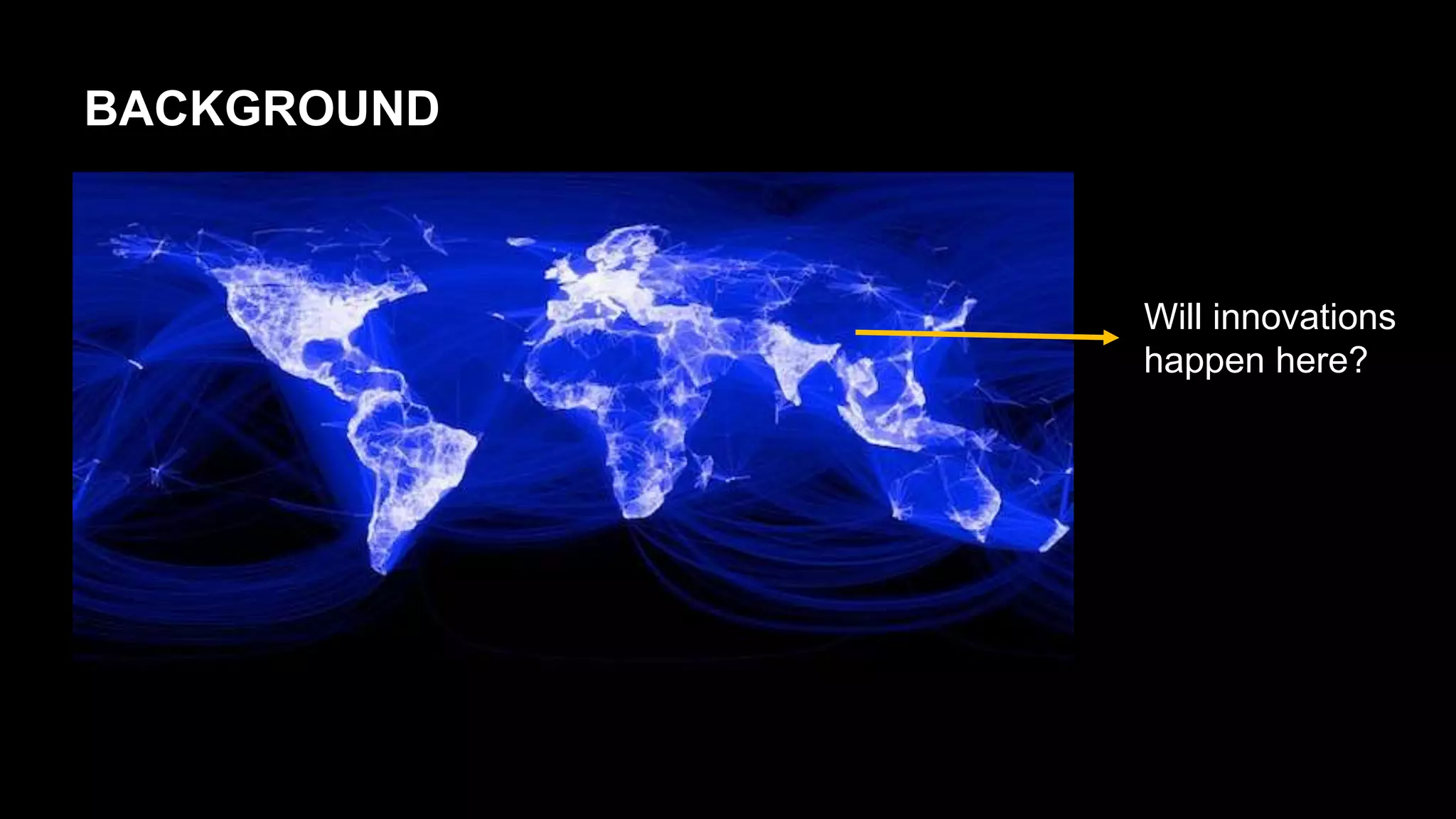
Will innovations
happen here?
FACTS
Online sales on “Singles Day” reached $9 billion, bigger than Black Friday.
“Singles Day” is a manufactured holiday, popularized by Chinese internet
users.
Innovations in consumer culture and products
WeChat, an IM rivalry to WhatsApp and LINE
The world's 3rd largest smartphone distributor. A competitor to
Samsung
More importantly
Creative internet-supported civil movement
Innovative ways to bypass Internet censorship (Freedom House,
2013)
• Virtual private networks
• Proxies
• Peer-to-peer sharing
• Coded language
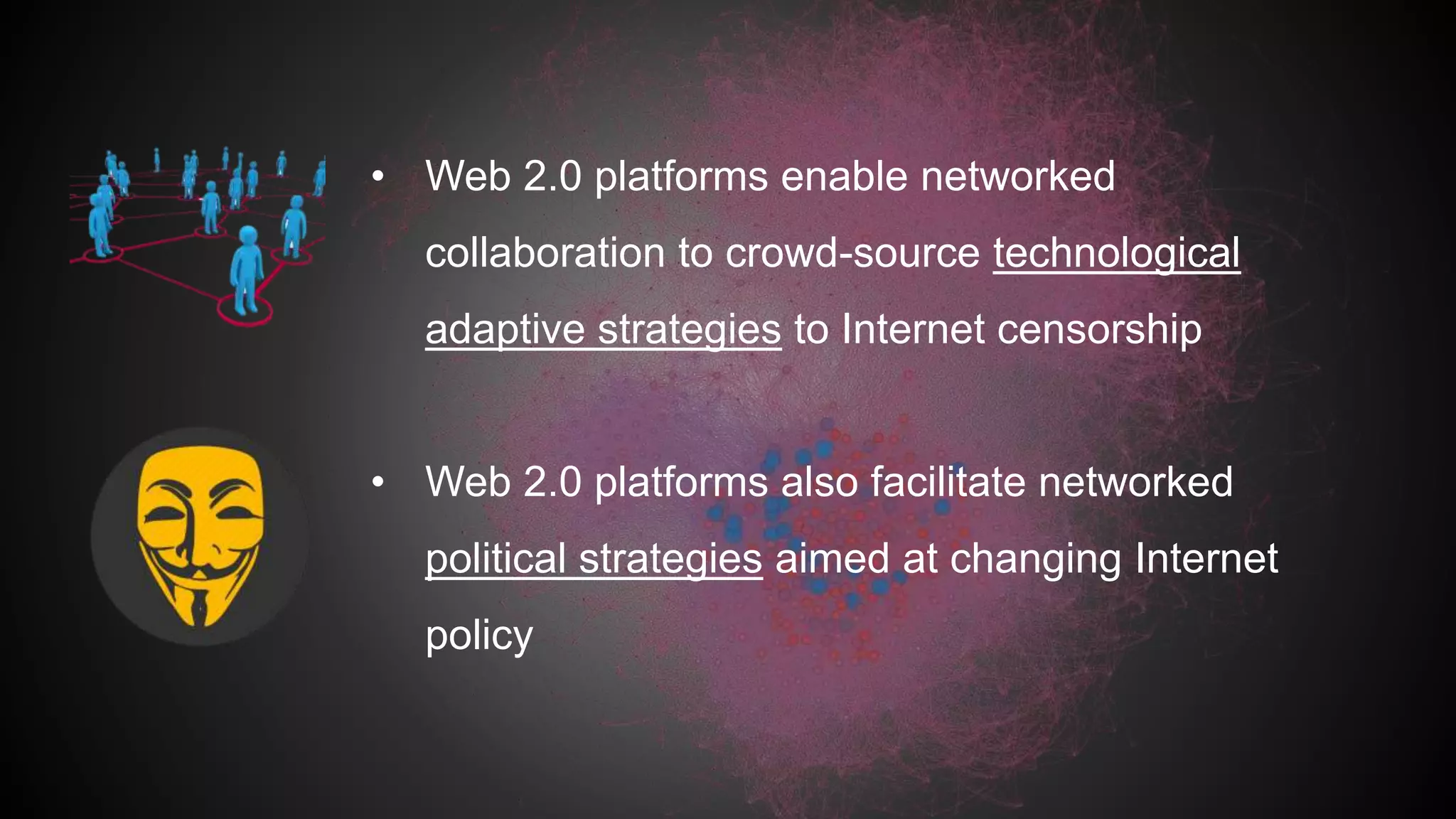
• Web 2.0 platforms enable networked
collaboration to crowd-source technological
adaptive strategies to Internet censorship
• Web 2.0 platforms also facilitate networked
political strategies aimed at changing Internet
policy
A case in point
Use of Twitter hashtags for GFW-related discussions and
mobilization
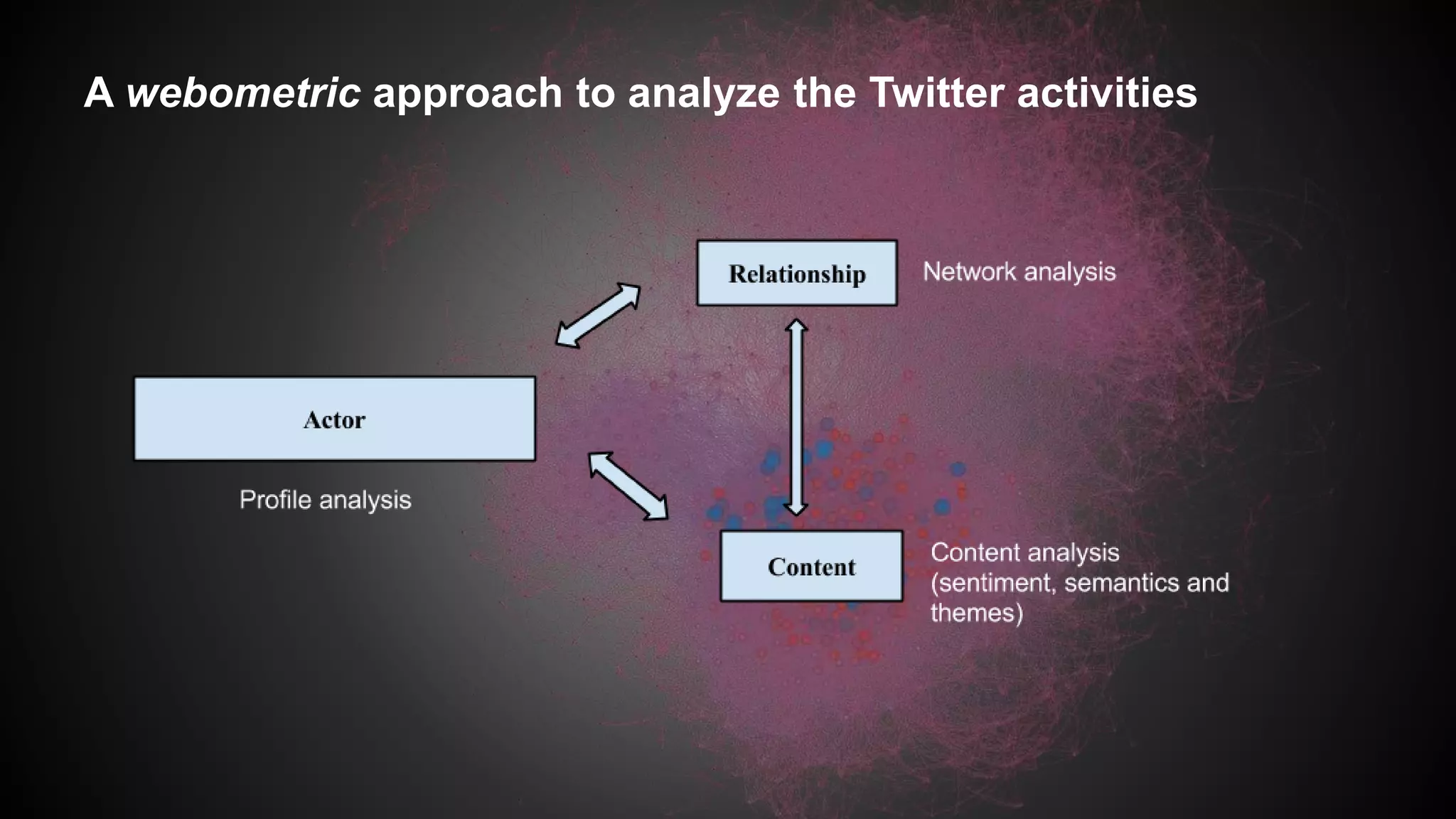
A webometric approach to analyze the Twitter activities
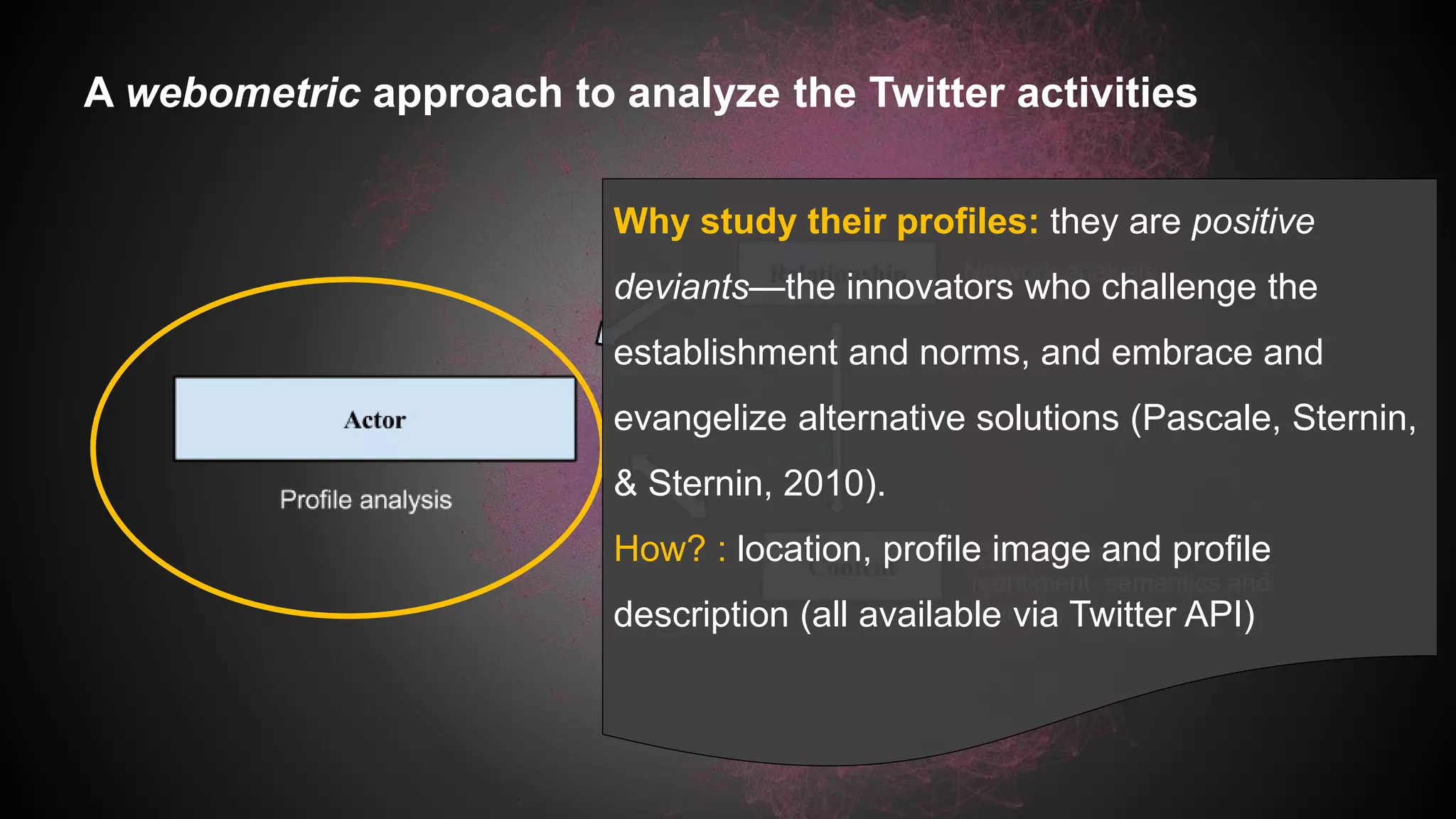
Why study their profiles: they are positive
deviants—the innovators who challenge the
establishment and norms, and embrace and
evangelize alternative solutions (Pascale, Sternin,
& Sternin, 2010).
How? : location, profile image and profile
description (all available via Twitter API)
A webometric approach to analyze the Twitter activities
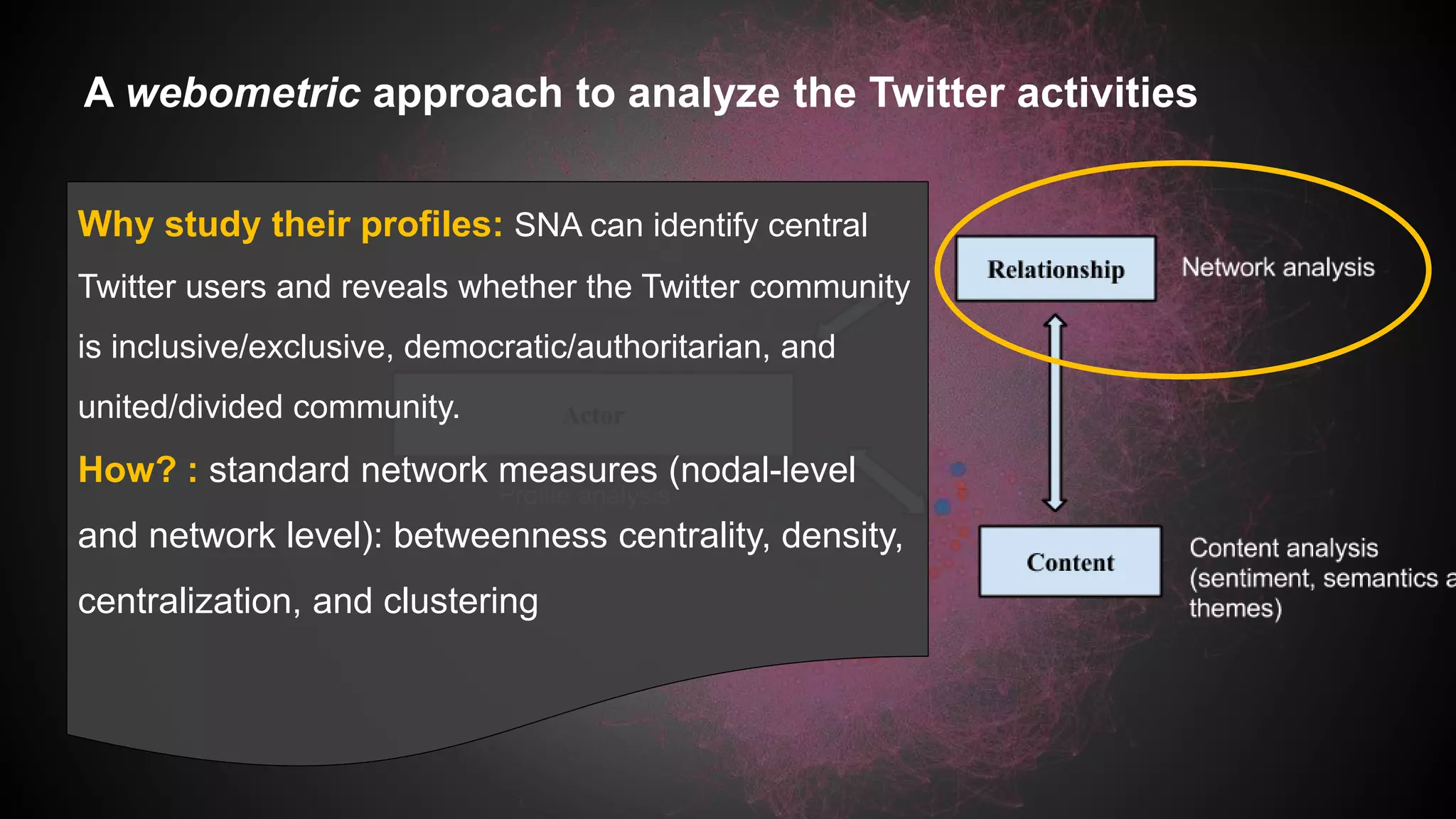
Why study their profiles: SNA can identify central
Twitter users and reveals whether the Twitter community
is inclusive/exclusive, democratic/authoritarian, and
united/divided community.
How? : standard network measures (nodal-level
and network level): betweenness centrality, density,
centralization, and clustering
A webometric approach to analyze the Twitter activities
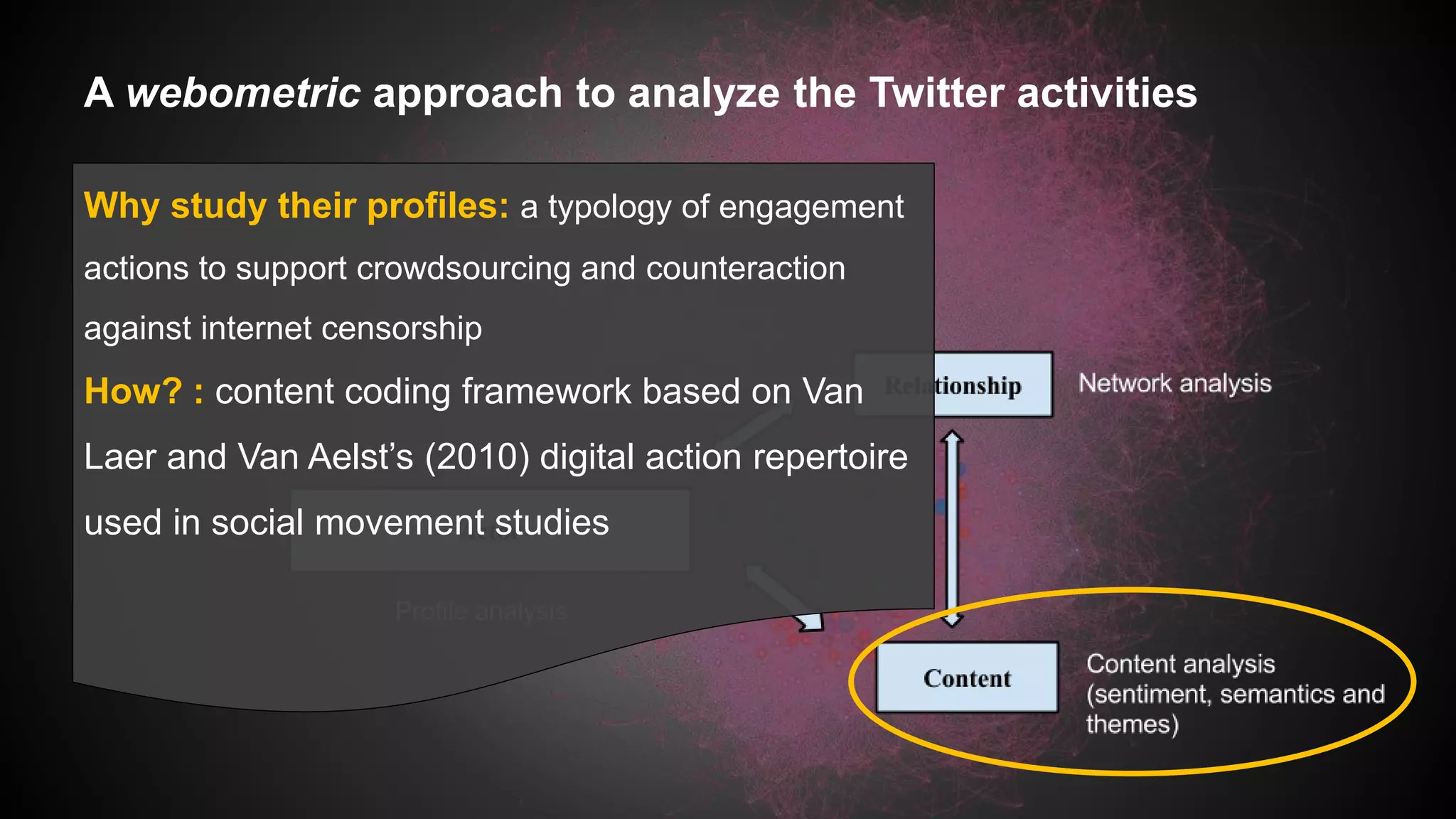
Why study their profiles: a typology of engagement
actions to support crowdsourcing and counteraction
against internet censorship
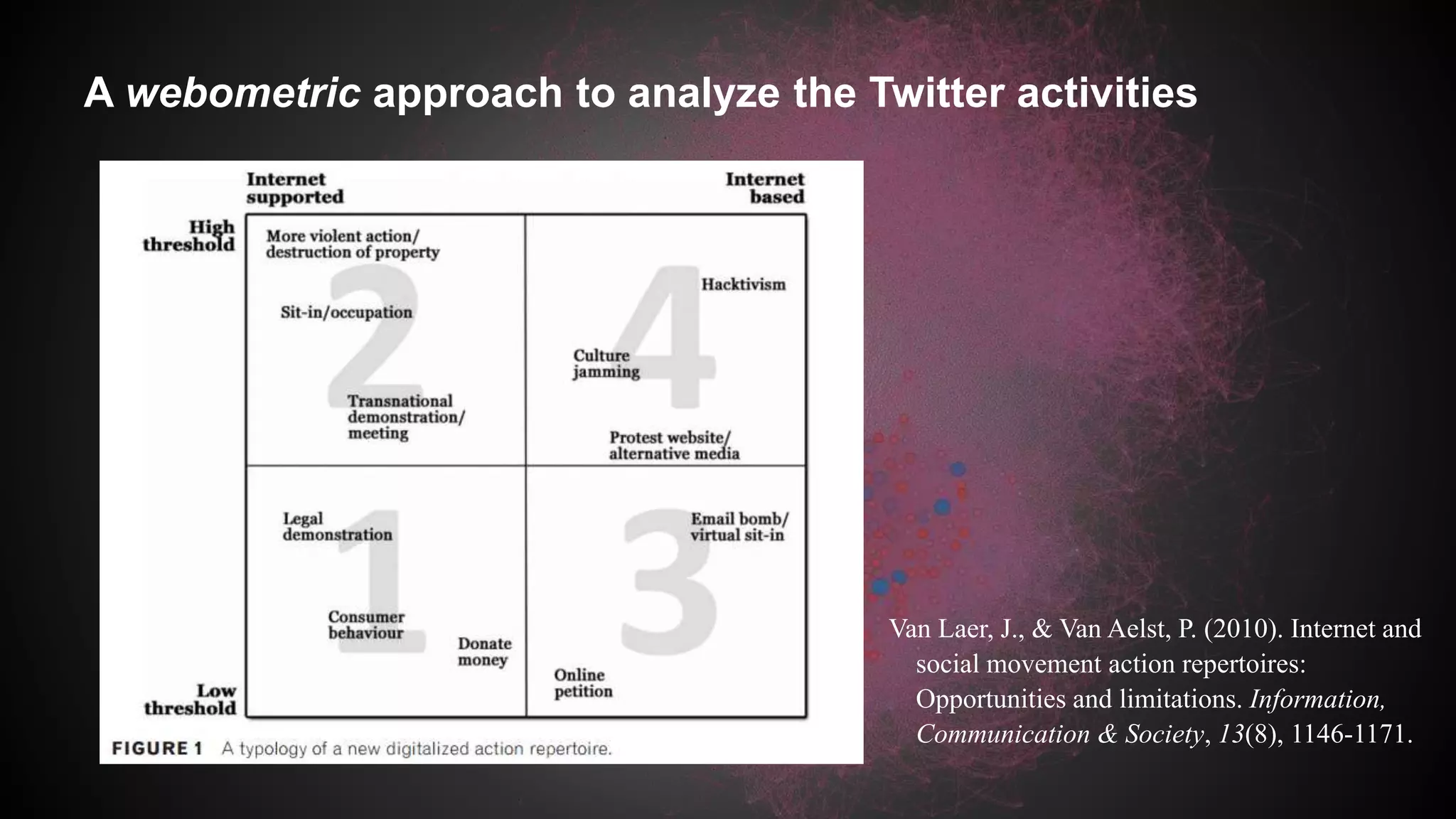
How? : content coding framework based on Van
Laer and Van Aelst’s (2010) digital action repertoire
used in social movement studies
A webometric approach to analyze the Twitter activities
Van Laer, J., & Van Aelst, P. (2010). Internet and
social movement action repertoires:
Opportunities and limitations. Information,
Communication & Society, 13(8), 1146-1171.
A webometric approach to analyze the Twitter activities
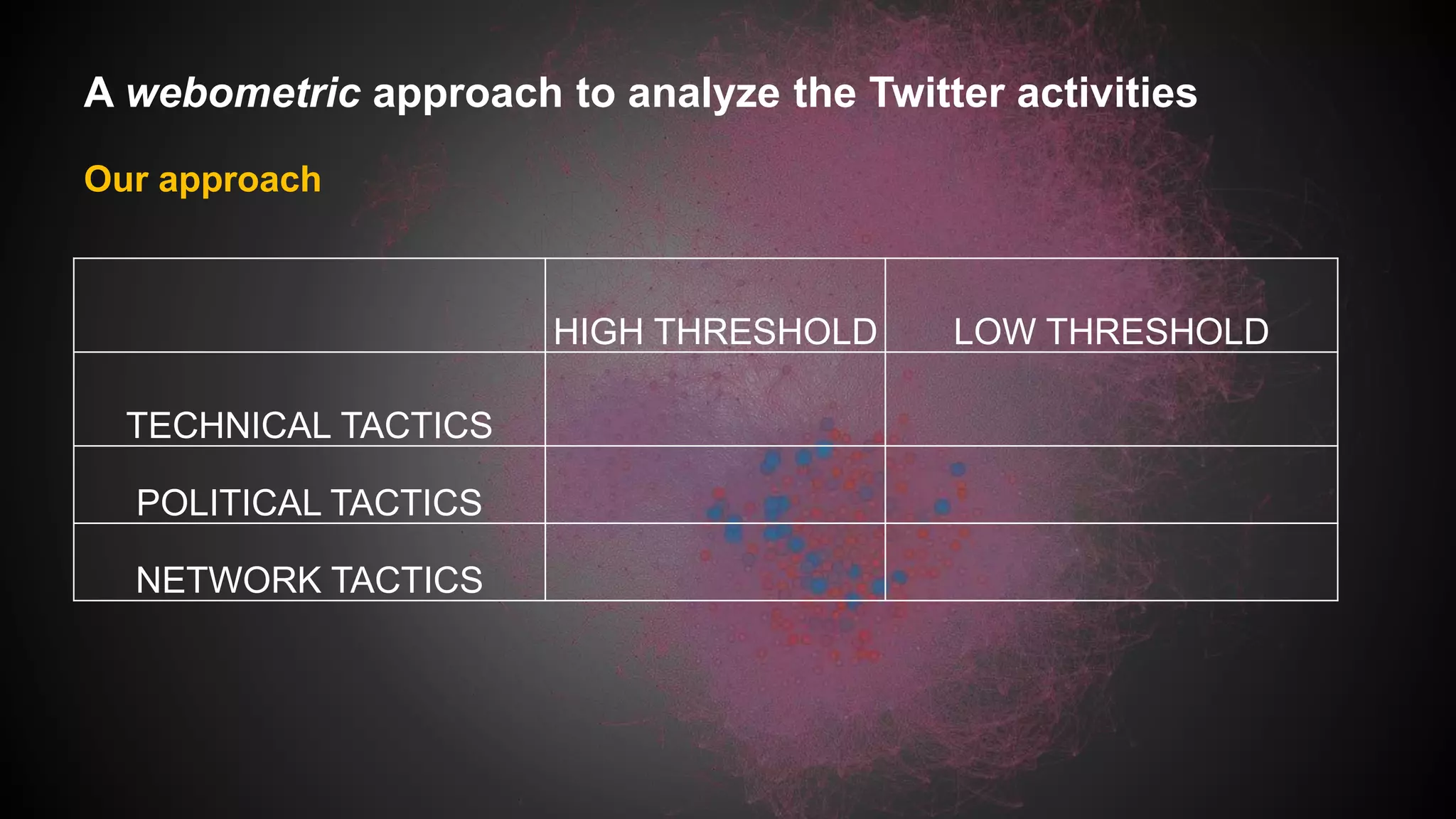
Our approach
HIGH THRESHOLD LOW THRESHOLD
TECHNICAL TACTICS
POLITICAL TACTICS
NETWORK TACTICS
A webometric approach to analyze the Twitter activities
Our approach
Technical tactics—such as spreading knowledge about setting up proxies,
tweaking hosts files, spotting loopholes in the firewall.
political tactics—such as mobilizing virtual protests, email/phone bombs of
ISPs, and culture jamming through parodies and satirical coded language.
networking tactics—reaching out to resourceful individuals and institutions to
obtain skills or utilize the resourceful actors’ large followings to disseminate
information.
Research Questions
1. What are the demographic and behavioral characteristics of the
users involved in Twitter-based discussion and mobilization on the
issue of internet censorship?
2. What are the characteristics of peer interactions among the users
involved in Twitter-based discussion and mobilization on the issue
of internet censorship?
3. What themes and engagement tactics are used by the users
involved in Twitter-based discussion and mobilization on the issue
of internet censorship?
Methods
Data source: Twitter API, Python scripts are used to download all
tweets sent between 6-11-2014 and 8-17-2014
Data analysis plan
References
• Freedom House (2013). Throttling Dissent: China’s New Leaders Refine Internet Control.
<http://www.freedomhouse.org/sites/default/files/resources/Throttling%20Dissent_FOTN%202013_China
_0.pdf >.
• Pascale, R., Sternin, J., & Sternin, M. (2010). The power of positive deviance. Harvard Business School
Publishing, Boston, MA.
• The Diplomat (2014). China's 'Sovereign Internet'. <http://thediplomat.com/2014/06/chinas-sovereign-
internet/>.
• Van Laer, J., & Van Aelst, P. (2010). Internet and social movement action repertoires: Opportunities and
limitations. Information, Communication & Society, 13(8), 1146-1171.

The Networked Creativity in the Censored Web 2.0

  • 1.
    THE NETWORKED CREATIVITYIN THE CENSORED WEB 2.0 A Network and Content Analysis of Chinese Twitter Users’ Adaptation to Internet Censorship • Weiai (Wayne) Xu, PhD Candidate, Department of Communication, SUNY-Buffalo • Miao Feng, PhD Candidate, Department of Communication, University of Illinois - Chicago
  • 2.
    BACKGROUND • China’s GreatFirewall (GFW): a sophisticated cyber--infrastructure to limit access to popular international web services and to filter traffics containing undesirable content (Freedom House, 2013) • Reinforced rhetoric to justify domestic internet regulation and “internet sovereignty” following Edward Snowden’s revelation of U.S. eavesdropping on global communications (The Diplomat, 2014) • A trend contradicting open data and big data movement
  • 3.
  • 4.
    FACTS Online sales on“Singles Day” reached $9 billion, bigger than Black Friday. “Singles Day” is a manufactured holiday, popularized by Chinese internet users. Innovations in consumer culture and products WeChat, an IM rivalry to WhatsApp and LINE The world's 3rd largest smartphone distributor. A competitor to Samsung
  • 5.
  • 6.
    Innovative ways tobypass Internet censorship (Freedom House, 2013) • Virtual private networks • Proxies • Peer-to-peer sharing • Coded language
  • 7.
    • Web 2.0platforms enable networked collaboration to crowd-source technological adaptive strategies to Internet censorship • Web 2.0 platforms also facilitate networked political strategies aimed at changing Internet policy
  • 8.
    A case inpoint Use of Twitter hashtags for GFW-related discussions and mobilization
  • 9.
    A webometric approachto analyze the Twitter activities
  • 10.
    A webometric approachto analyze the Twitter activities Why study their profiles: they are positive deviants—the innovators who challenge the establishment and norms, and embrace and evangelize alternative solutions (Pascale, Sternin, & Sternin, 2010). How? : location, profile image and profile description (all available via Twitter API)
  • 11.
    A webometric approachto analyze the Twitter activities Why study their profiles: SNA can identify central Twitter users and reveals whether the Twitter community is inclusive/exclusive, democratic/authoritarian, and united/divided community. How? : standard network measures (nodal-level and network level): betweenness centrality, density, centralization, and clustering
  • 12.
    A webometric approachto analyze the Twitter activities Why study their profiles: a typology of engagement actions to support crowdsourcing and counteraction against internet censorship How? : content coding framework based on Van Laer and Van Aelst’s (2010) digital action repertoire used in social movement studies
  • 13.
    A webometric approachto analyze the Twitter activities Van Laer, J., & Van Aelst, P. (2010). Internet and social movement action repertoires: Opportunities and limitations. Information, Communication & Society, 13(8), 1146-1171.
  • 14.
    A webometric approachto analyze the Twitter activities Our approach HIGH THRESHOLD LOW THRESHOLD TECHNICAL TACTICS POLITICAL TACTICS NETWORK TACTICS
  • 15.
    A webometric approachto analyze the Twitter activities Our approach Technical tactics—such as spreading knowledge about setting up proxies, tweaking hosts files, spotting loopholes in the firewall. political tactics—such as mobilizing virtual protests, email/phone bombs of ISPs, and culture jamming through parodies and satirical coded language. networking tactics—reaching out to resourceful individuals and institutions to obtain skills or utilize the resourceful actors’ large followings to disseminate information.
  • 16.
    Research Questions 1. Whatare the demographic and behavioral characteristics of the users involved in Twitter-based discussion and mobilization on the issue of internet censorship? 2. What are the characteristics of peer interactions among the users involved in Twitter-based discussion and mobilization on the issue of internet censorship? 3. What themes and engagement tactics are used by the users involved in Twitter-based discussion and mobilization on the issue of internet censorship?
  • 17.
    Methods Data source: TwitterAPI, Python scripts are used to download all tweets sent between 6-11-2014 and 8-17-2014
  • 18.
  • 19.
    References • Freedom House(2013). Throttling Dissent: China’s New Leaders Refine Internet Control. <http://www.freedomhouse.org/sites/default/files/resources/Throttling%20Dissent_FOTN%202013_China _0.pdf >. • Pascale, R., Sternin, J., & Sternin, M. (2010). The power of positive deviance. Harvard Business School Publishing, Boston, MA. • The Diplomat (2014). China's 'Sovereign Internet'. <http://thediplomat.com/2014/06/chinas-sovereign- internet/>. • Van Laer, J., & Van Aelst, P. (2010). Internet and social movement action repertoires: Opportunities and limitations. Information, Communication & Society, 13(8), 1146-1171.

Editor's Notes

  • #4 Picture source: https://www.facebook.com/notes/facebook-engineering/visualizing-friendships/469716398919?ref=nf
  • #5 Sources: http://www.marketwatch.com/story/alibabas-singles-day-bigger-than-black-friday-2014-11-10