Agenda
● Vision and Key Principles
● Universal Access and EarlyChildhood Education
● Howchildrenwill Learn–Curricular andPedagogic structures
● Curriculum -Learning Outcomes -Competencies
● Schools -Complex -Accreditation
● T
eachers -Education and Development
● NEP -NewFeatures
● Key Focus Areas -Equity -Gender -Special Needs
● Goals and ImplementationPlan
Vision of the National Education
Policy 2020
1
Develops a deep sense of respect towards the fundamental
rights, duties and Constitutional values, bonding with one’s
country
, and a conscious awareness of one’s role and
responsibilitiesina changingworld
2
3
An education systemthatcontributes toanequitable
and vibrant knowledge for society,by providing high-
quality education to all
Instilsskills,values,and dispositions that support responsible
commitmentto human rights, sustainable development and
living,and global well-being, thereby reflecting a truly global
citizen
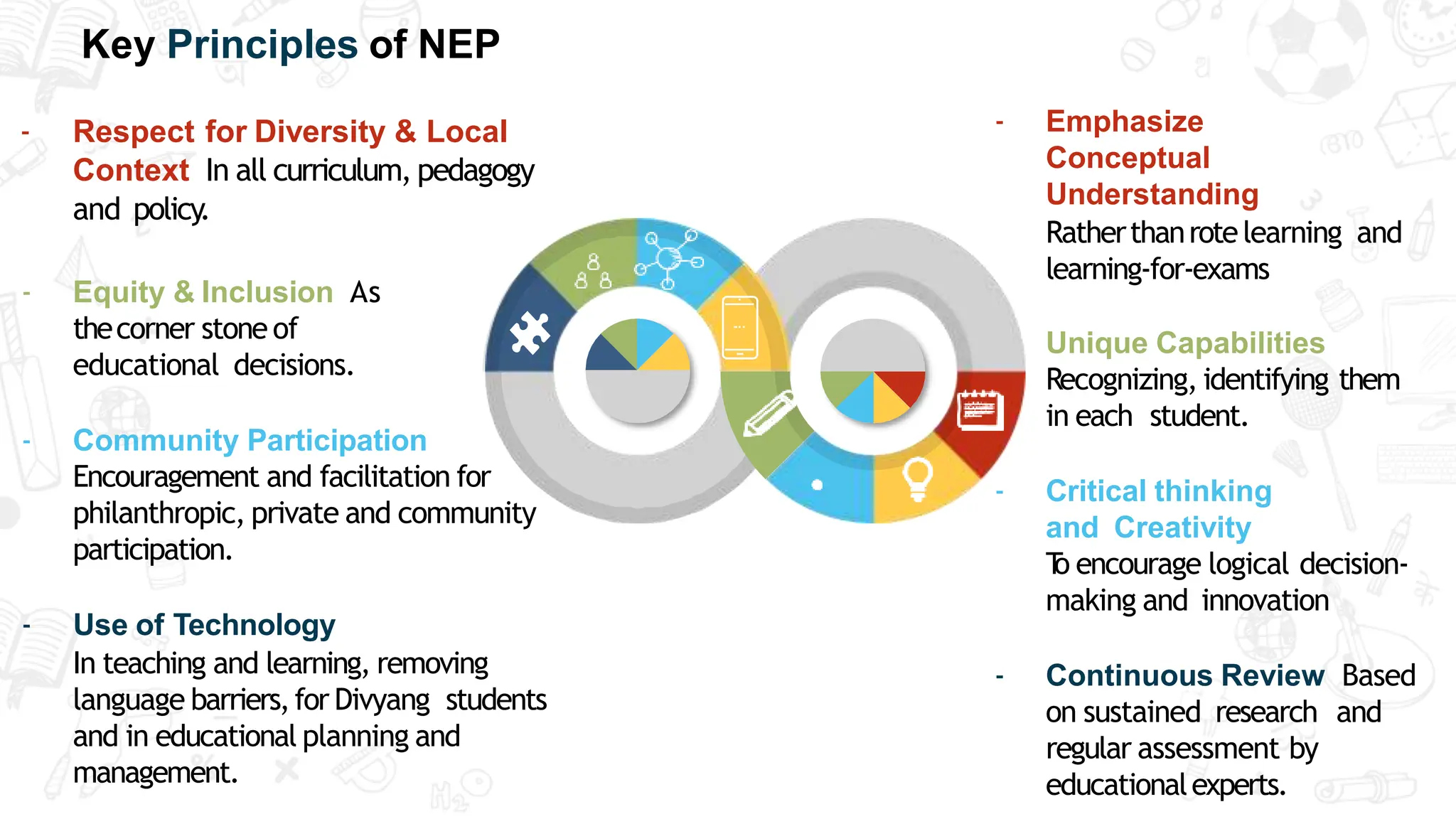
Key Principles of NEP
- Emphasize
Conceptual
Understanding
Ratherthanrotelearning and
learning-for-exams
- Unique Capabilities
Recognizing, identifying them
in each student.
- Critical thinking
and Creativity
T
o encourage logical decision-
making and innovation
- Continuous Review Based
on sustained research and
regular assessment by
educationalexperts.
- Respect for Diversity & Local
Context In all curriculum, pedagogy
and policy.
- Equity & Inclusion As
thecorner stone of
educational decisions.
- Community Participation
Encouragement and facilitation for
philanthropic, private and community
participation.
- Use of Technology
In teaching and learning, removing
language barriers,for Divyang students
and in educational planning and
management.
Universal Access to Early Childhood Care & Education (ECCE)
Foundational Learning
Curriculum
Forage groupof3-8 dividedintwoparts:
(i)From age 3-6inECCEand (ii)age 6 to
8inclass I andII inprimaryschool
Universal Access
Forchildrenof3-6years:access to
free,safe,highquality ECCEat
Anganwadis/Pre-school/Balvatika
Multifaceted
Flexible, multi-level, play-
based, activity-based and
inquiry- based learning
Preparatory Class
Prior totheage of5 everychildwill
move to a “PreparatoryClass” or
“Balvatika”(thatis,beforeClass1)
Implementation to be jointly carried out by Education
Ministry, Ministries of Women and Child Development
(WCD), Health and Family Welfare (HFW) and Tribal Affairs
To ensure access
and opportunity
to all children
Multiple Pathways
Multiple pathwaysto
learning; involving both
formaland non-formal
education modes
Bring Back Drop-outs
T
o bringdropout children
back toschool
Build Schools
Promoting both governments
and non-governmental
philanthropic organizations
to build schools
Alternative Centers
Alternative and innovative
education centers
Learning Outcomes
Focus will beon achieving
desired learning outcomes
at alllevels
Peer Tutoring
Suitable forallcategories
business and personal
presentation
Ensuring Universal Access to Education at all levels
Expected
Outcomes
● Universalisation of Access – from ECCE toSecondary
●Ensure equity and inclusion
●Bringback 2 crores out-of-school children
●AttainSDG goals of retainingall childrenin schools untilcompletion of secondary education
●Improve Qualityand achievement of learning outcomes – Foundational Literacy & Numeracy
(FLN)
●Focus on 21st century skills in teaching,learning and assessment
●Resource sharing- School complexes
●Effective Governance -separation of powers and common norms
●Overcoming the language barrierin learning
●Common standards for publicandprivateschool education
How children will learn ?
New pedagogical and curricular structure of
school education (5+3+3+4): 3years in
Anganwadi/pre-school and 12 years in school
• Secondary Stage(4) multi disciplinary study,
greater critical thinking, flexibility and
student choice of subjects
• Middle Stage (3) experiential learning in
the sciences, mathematics, arts,
socialsciences,and humanities
• Preparatory Stage (3) play,discovery, and
activity-based and interactive classroom
learning
• Foundational stage (5)multi level, play/
activity-based learning
Middl
e
10Years
(Ages 6-16)
2 Years
(Age 16-18)
2
3
years
(Class 1 & 2) (Ages 6-8)
....................................
years
(Anganwadi/ pre-
school/ Balvatika)
(Ages 3-6)
3 Years
(Class 3 to 5)
(Age 8-11)
3 Years
(Class 6 to 8)
(Age 11-14)
4 Years
(Class 9 to 12)
(Age 14-18)
Existing Academic
Structure
New Academic Structure
Foundatio
nal
Preparato
ry
Seconda
ry
Transforming Curricular & PedagogicalStructure
ECCE
Framework
Research and Best
Practices
NCPFECE willbealignedwith
the latest research on ECCE,
and national and
international best practices
Multi-faceted
Framework
Comprising of alphabets,
languages, numbers,
counting,colours,shapes,
indoor and outdoor play
,
puzzlesandlogicalthinking,
problem-solving,drawing,
paintingandothervisual art,
craft,drama and puppetry
,
music andmovement
School Preparation
Module
A 3-month play-based ‘school
preparation module’ for all
Grade1 studentstobe
developedbyNCERT
NCPFECE
National Curricular and
Pedagogical Framework for
Early Childhood Education
(NCPFECE) willbe draftedby
NCERT
Early Childhood Education: Learning in the Formative Years
Etiquette, Behaviour and
Emotional Development
Play-based & Discovery-
Based learning
Self-Identity
T
eamwork & Collaboration
Colours, Shapes,
Alphabets & Numbers
Relationship with Nature
Logical Thinking &
ProblemSolving
Developing curiosity
Arts, crafts and Music Ethics
Attainment of Foundational Literacy And Numeracy by Grade3 in Mission mode
FLN by
Grade 3
Early Learning
Focus on early reading,
writing& mathematics
3-month Play basedSchool
3-month play-based school
preparation module’for all
Grade 1students
National Repository
NationalRepository-HighQuality
Teaching and Learning
Resources onDIKSHA
Libraries
School libraries,including
digitallibrariestobeleveraged
Book Promotion
National Book Promotion Policy
will beformulated and public and
school libraries willbe expanded
National Mission
National Mission on
Foundational Literacy
andNumeracy
Foundational Skills
Universalacquisition of
foundationallearning
skills
Curriculum
Experiential Learning
Fun, creative, collaborative,
and exploratory activities in
classroom for experiential
learning and deeper student
learning
Reduction in Curriculum
Core Essentials
Curriculum in all subjects
to be reduced to its core
essentials
Critical Thinking
Focuson criticalthinking,
inquiry
,discovery
,
discussion and analysis-
based teaching and
learning methods for
holistic education
Interactive Classes
Interactive teachingwith
reduceddependency on
text booklearning;
Questions fromstudents
willbe promoted
● Curriculum and pedagogy to be transformed by 2022 to promote skill based and minimize
rote based learning
Revision of NCF for school education and NCF for teacher education by 2021
Focus on LOs, Competencies and subject - integration
Modules on preparingand implementing
pedagogicalplansbasedoncompetency
and outcome-based education for school
leaders
NO hard separation between:
• curricular/co-curricular/extra-curricular;
• academic/vocational;
• science/humanities
• sports/art/academics
Through arts integrated, sports integrated,
ICT integratedand story tellingbased
pedagogy among others as standard
pedagogy
Emphasisondigitalliteracy
, coding
and computational thinking,
ethical and moralreasoning
Development of scientific temperand
inculcationofknowledgeandpracticeof
humanandconstitutionalvaluessuchas
patriotism,sacrifice,non-violence,truth,
honesty
,peaceetc.
Competency basededucation Integration of subjects
Development of scientific
temper
NO SILOS among subjects/
learning
Emphasis on Digital literacy Promotion of multi-lingual
teaching
Promoting states to enterinto
bilateralagreementswithnear
by statestohire language
teachers
Health check ups
Annualhealthcheckupforall
students
Reduce weight of school
bags
Reducedweight of school bags and
textbooksthroughsuitablechanges in
curriculumand pedagogy
Mandatory skills : Health and
Wellness
Mandatoryskills tobe imbibed by all students
health, nutrition,physical education,fitness,
wellness,sports.In addition-Basic trainingin
preventive healthcare,mentalhealth,first aid,
personal and public hygiene will be included in
the curriculum
Focus on children with
disability Differentiated interventions
and suitable infrastructure developmentat
schools tomake access easierforchildren
withdisability
Inclusive and caring culture at
school
Therole and expectations of principaland
teachers willexplicitly include developing a
caring and inclusive cultureatschool
Hiring counsellors in school
complexes Stategovernments will be
encouragedto hire adequatenumberofcounsellors
andteachers(tobe shared across schoolcomplex)
Mental and physical health andwellness
being:
Mandatory for students to acquire skills in: health and nutrition; physical education, fitness,
wellness, and sports
Experiential
Learning
● Focus on experiential, inquiry
and discovery based teaching
learning methods
Equal Weightage
● No hardseparationbetweencurricular
,
co-curricularand extra curricular
area.
● Freedom of choosing a varietyof
subject combinationto be
provided
Bagless Days
● Bagless daystobescheduledin
academic calendar
Innovative Pedagogy: Transforming teaching learning process
Integrated
Pedagogy
● Arts, sports, and story-telling
and ICT-integrated pedagogy
Promotion of peer
tutoring
● Promoting peertutoringas
voluntaryand joyful activity
under thesupervision ofteachers
Use and integration of
technology
● Integrationoftechnology enabled
pedagogy in classes 6-12
All text books to contain only
essential core material while
capturing any desired
nuances and supplementary
materialas perlocalcontexts
and needs
Affordable, high-qualityand
energised textbooks to be
provided along withfree
digital version on
DIKSHA Platform
States to prepare their
own curricula and text
books based on NCERT
curriculum and textbooks,
incorporating State flavour
and material asneeded
Concerted efforts, through suitable
changes in curriculum and
pedagogy to significantly reduce
the weight of school bags and
text books
Textbook with local content and flavour
India’s future and India’s leadership role in upcomingfields
Increased emphasis on mathematics and
computational thinking throughout the
school years
Inculcatemathematicalthinking and problem
solvingthrough a varietyofinnovative
methods, includingtheregularuse of
puzzlesandgames
Activities involvingcodingwill be introduced
in MiddleStage
Teachingofcontemporary subjectsatmiddle
and secondary stages: ArtificialIntelligence,
Design Thinking,Holistic Health, Organic Living,
Environmental Education,Global Citizenship
Education (GCED)
Mathematical thinking and problem solving
Computational thinking
Including contemporary subjects in
schools
Computational thinking
Knowledge of India
Willbeincorporated in an accurate and scientific
manner wherever relevant.
Indian Knowledge Systems, including tribal
knowledge and indigenous and traditional
ways of learning, will becovered.
Specificcoursesin tribal ethno-medicinal practices,
forest management, traditional (organic) crop cultivation,
natural farming, etc. willalso bemade available.
C curriculum toinclude knowledgefrom ancientIndiato
modernIndia as wellas futureaspirations.
Videodocumentariesoninspirationalluminaries of India,
in science and beyond.
Studentswill begiven a logical frameworkformaking
ethicaldecisionsat a youngage.
In lateryears,expandedalong themesof cheating,
violence,plagiarism, littering& tolerance, equality,empathy
.
TraditionalIndianvaluesandallbasic humanand
Constitutionalvalueswill bedevelopedinall students.
Extract fromtheIndianConstitution willalso be considered
essential reading forall students.
Basic training in health,mental health,good nutrition,
personaland public hygiene,disaster responseandfirst-
aid will also beincluded.
Scientific explanations of the detrimental and
damagingeffectsofalcohol,tobacco,and other
drugs willbepart of curriculum.
Examinations in grades 1 to8
Census assessments at key stage inclasses
3,5 and 8 to trackachievement
Assessment of core concepts and knowledge,
higher-order skills and itsapplication inreal-life
situations.Movingaway from rotelearning.
Key stage assessments
Achievement of critical LOs
Testingto focus onachievementof
essential learning outcomes
Moving away from rote learning
Results of school examinations
Theresultsofschool examinationswillbeused
only fordevelopmental purposes and for
continuous monitoring and improvement of
the schooling system
Reforming examinations in grades 9 to 12 including Board exams
Board exams will be made ‘easier’, as
they will test primarily core
capacities/competencies
Viable models to be explored:
annual/semester/modular Exams; two
parts exams - objective type and
descriptivetype.
Guidelines will be prepared by NCERT
, in
consultation with SCERT
s, Boards of
Assessment (BoAs), and P
ARAKH
BeginningwithMathematics, allsubjects could be offeredat two levels
Teachers to be prepared for a
transformation in the assessment system by
the 2022-23 academic session
Each School Board shall ensure equivalence
of academic standards in learner’s
attainments
Standards,norms and guidelines for School
Boardsthrough P
ARAKH National Center
Transforming the culture of assessment
Assessment to focus on
core concepts, higher
order and foundational
skills
Continuous tracking of
learning outcomes of each
child
Boardexamstobe
more flexible,with
assessment of
essentialskills
The National Testing
Agency (NTA) will work
to offera high-quality
common aptitudetest,to
eliminatetheneedfor
takingcoaching for these
exams
AI - based software to
helptrack theprogressof
theStudents to enable
themto make optimal
career choices.
Self Assessment and
Peer Assessment
National Assessment
Centre will help in bringing
greater synergy in board
exams conductedbyvarious
Boards of Assessments
Holistic Progress Card
States/UT‘S to redesign Progress Cards in
schools tomake themholistic,360-degree,
multi dimensional report
Progress card willinclude self-assessment,
peerassessment, and teacher assessment
Cards to reflectthe progress and
uniqueness of learner in the cognitive,
affective,socio-emotional,and
psychomotor domains
Progress in project-based and inquiry-
basedlearning,quizzes, role plays,
group work,portfolios, etc.,to be
included in report cards
The holistic progress cardwill actively
involve parentsintheirchildren’
s
education and development.
AI-basedsoftwaretobedevelopedtohelp
trackgrowththrough school yearsand to
help students make optimal career
choices.
Multilingualism and the Power of Language Learning
● Medium of instruction uptilgrade5,and
preferablytill Grade 8 and beyond,will be home
language/ mother-tongue/ local language
● ‘The Languages of India’a fun
project/ activity ontobetaken byevery
student
● Three languages tobetaughtwillbe
decidedbystate/UT
● All classical languages will bewidely
availablein schools asoptions
Schools
School Complexes/Clusters
Pairing
Schools
T
winning/pairing of
onegovernment
school withone
privateschool
across the country
Sharing
Resources
Enablesharing of
human& infrastructural
resources
Efficiency
Efficient expeditionand
resourcing for schools
through building school
complexes
Planning
Development of
short-termand
long-term plans
(SDPs)
Governance
Effective
governance of
schools
Integration
Better integration of
educationacross all
levels through
connectedschools and
shared teachers and
resources
Bal Bhavan
Strengthening/setting-up of
Bal Bhavan forchildrenof all
age group to atpar take in
art-related,career-related,
and play-related activities
Samajik Chetna
Kendras
Un-utilizedcapacity
ofschools tobeusedas
SamajikChetna Kendra to
promote social, intellectual,
and voluntary activities
Standard-setting and Accreditation
3
4
1
✔Setting upStateSchool Standards
Authority (SSSA)
✔Self-disclosure of all the
basic regulatory information of
all schools at SSSA and Schoolwebsite
✔To ensure all schools follow
2 certain minimal
professional and quality
standards
✔Development ofSchool Quality
Assessment and Accreditation
Framework (SQAAF) by SCERT &
NCERT
✔Periodic ‘health check-up’ofthe
over all system througha sample-based
National AchievementSurvey (NAS)
✔Public and privateschools (exceptthe
CentralGovernmentschools) willbe
assessed and accredited on common
minimum criteria
✔Private/philanthropic schools to be
encouragedandenabledtoplay a
beneficial role.
Teachers
Teacher Education
Minimum degree
qualification for teaching
thatincludes student-
teaching at local
schools,by2030
For applicants with
an existing
Bachelor’s Degrees
in other specialized
subjects
For those who have
completedthe equivalent of
4-year multidisciplinary
Bachelor’s Degrees or have
obtained a Master’s degree in
aspecialty
Teachereducationwill gradually be moved by2030 intomulti disciplinarycolleges and universities
Multi disciplinary higher education institutions offering the 4-yearin-class integrated B.Ed.
programmetoalso provide blended and/or ODL mode ofteaching to students in remote areas.
4 year
Integrated
B.Ed
1 year
B.Ed
2 year
B.Ed
Teacher Education
Minimum degree
qualification for teaching
that includes student-
teaching at local
schools, by2030
For applicants with
an existing
Bachelor’s Degrees
in other specialized
subjects
For those who have
completedthe equivalent
of 4-year multi disciplinary
Bachelor’s Degrees or have
obtained aMaster’s degree
in aspecialty
All B.Ed.programmes will include training intime-tested techniques inpedagogy,multi-levelteaching
and evaluation,teaching childrenwith disabilities,teaching childrenwith special interests or talents,
use of educational technology,and learner-centered and collaborative learning
4 year
Integrated
B.Ed
1 year
B.Ed
2 year
B.Ed
Teacher Education
4 year
Integrated
B.Ed
1 year
B.Ed
Minimum degree
qualification for teaching
thatincludes student-
teaching at localschools,
by2030
For applicants withan
existing Bachelor’s
Degrees in other
specializedsubjects
For those who have
completedtheequivalent of
4-year multi disciplinary
Bachelor’s Degrees or have
obtained a Master’s degree in
aspecialty
Shorter local teacher education programmes to be available at BITEs,DIETs orat school
complexes for eminent local persons who can be hiredtoteach atschoolsas ‘master instructors’,
for promoting local professions,knowledge,and skills, e.g., local art,music,agriculture,business,
sports, carpentry and other vocational crafts
2 year
B.Ed
Only educationally-
sound,multidisciplinary,
and integrated teacher
education programmes
to be made available
NTA testing for
admission toB.Ed.
NationalHigher Education
RegulatoryCouncil (NHERC), to
functionas single point regulator
for higher education sector
including teacher education
Improving Teacher Education
All teacher education
programmes to be
conductedwithin
composite multi
disciplinary institutions.
Newand
comprehensive National
CurriculumFramework
for Teacher Education
(by2021)
Merit based
scholarships for4year
B.Ed. Integrated
Setting-up of National
Mission for Mentoring
with a large pool of
outstanding
senior/retired faculty
Stringent action against
substandard stand-alone
TeacherEducation
Institutions (TEIs).
Teacher Eligibility Tests
(TETs) at all stages will
bestrengthened
Teacher recruitment and deployment
Transparent transfer system
Online computerizedsystem for teacher
transfersto ensure transparency
Strengthening TETs
T
eacher Eligibility T
ests(TET
s) forallteachers
across Foundational,Preparatory
,Middle and
Secondary stage in bothpublic and private
schools Test score and demonstration -
partof recruitment
Subjectscore fromTETorNT
Atests and
classroom demonstration to betaken
intoaccount for recruitmentof subject
teachers
Restructuring of NCTE
NCTE to berestructured as a
Professional Standard Setting Body
(PSSB)underGeneralEducationCouncil
(GEC)
Tech based planning for teacher
recruitment
T
echnology-basedplanning and forecasting of
teacher-requirementto assess expected
subject-wise teachervacancies over nexttwo
decades
Certificate Courses
Developing specialization for subject or
generalist teachers,teaching children with
disabilities /Divyang children,during pre-
service teacherpreparationwithsynergy
betweenNCT andRCI
01
02
03
04
05
06
Empowering Teachers
ImprovingService Environment through
better
infrastructureatschool
A technology-based comprehensive teacher-
requirement planningforecastingexercisetobe
conducted by eachState.
National ProfessionalStandards for Teachers (NPST) by
2022
Career growth tobeavailablefor teachers with in a
single school stage i.e., Foundational, Preparatory
, Middle,
or
Secondary
Teachers to have more autonomy in
choosingaspects of pedagogy in classroom teaching
Teacher Professional Development
● Merit based tenure track system
● Min.50 hoursofContinuousProfessional
Development(CPD)
Academic leadership positionstobemade
availablefor teachers.
Atleast50hoursof CPD for
teachersbasedontheirown
interestand professional
areas
CPD opportunities will,in particular
,
systematically cover thelatest
pedagogies
School Leadership
Necessaryfacilitiesfortheinitial professional
preparationofthese educators and their
Continuous Professional Development(CPD)
Ample opportunityto get upskilledon latest pedagogy relatedto
foundational literacy and numeracy, formative and adaptive
assessment of learning outcomes,individualised and competency-
based learning and related pedagogies
Key Focus Areas
Focus on Socio-Economically Disadvantaged Groups (SEDGs)
SEDGs can bebroadly categorized based on:
Gender Identities (particularlyfemale andtransgender individuals),
●
● Socio-cultural Identities (such asScheduled Castes, Scheduled
T
ribes, OBCs, and minorities)
● Geographical Identities (such as students from villages,small
towns, and aspirational districts)
● Disabilities including learning disabilities
Socio-economic conditions (such as migrant communities,low
income households, children in vulnerable situations, victims or childrenof
victims of trafficking,orphans including child beggars in urban
areas, and theurban poor).
Separate strategies will be formulated for focused attention for
reducing each of the category-wise gaps in school education.
Ensuring Equity
EQUITY
Additional Schools
Setting-up of additional
JNVs and KVS in
aspirational districts/SEZs
Fee Waivers
Fee waivers and scholarships willbe
offeredtomeritoriousstudentsfromall
SEDGs on a largerscale
Interventions
The critical problems and
recommendations regarding
ECCE, foundational
literacyand numeracy, access,
enrolmentand attendance will
be targeted in a concerted way
for Socio=Economically
disadvant aged groups -
SEDGs.
Special Mechanisms
Specialmechanismsforchildren
belonging to tribalgroups to
receive quality education
Learning
Outcomes
Focus on attainmentof
learningoutcomesofchildren
belonging toSC/ST/OBC
Counsellors
Recruitmentofcounsellors
in schools
SEZs
Large populations from
SEDGs to bedeclaredSpecial
EducationZones(SEZs)
Gender
Policies targeted for Girls
Thrust on designing policies and
schemes targeted towards
female students in the SEDGs
Gender Sensitivity
‘Gender Sensitivity’tobeanintegral
partofcurriculum
Safety and Rights
Carefulattentiontosafetyand
rightsofallchildrenparticularlygirls
toretaintheminschool
KGBVs
Strengthening and extension of
KGBVs up to grade 12
Bridging Gender Gap
Focus on bridging the Gender Gap
and provide equal opportunities to
all.
Gender Inclusion Fund
Gender-InclusionFundforfemaleand
transgenderstudents
Supporting Children with Special Needs (CWSN)
Enabling Mechanisms
Enabling mechanisms for CWSN or
Divyangtoreceivequalityeducation
Regular Schooling
Children with special needs will be
integrated in the regular schooling
process from elementary to higher
education levels
Assistive Devices and Orientation to
Parents
T
echnology enabledassistive
devices/toolforCWSN and orientationof
thetools/devices forparents/caregivers
Alternative Schools
Alternativeforms of schools willbe
encouraged to preservethealternative
pedagogicalstyles
Modules
NIOS will develop high-quality
modules toteachIndianSign
Language
Certificate Courses
Certificate courses for pre-service and
in-service teachers to become special
educators
01
02
03
04
05
06
Integrating Vocational Education at All Levels
LokVidya
‘LokVidya’,knowledge developed
in India,willbemadeaccessible to
students
Practice Based Curriculum
Apractice-based curriculum for
Grades 6-8 to beappropriately
designed
Skills Framework
National Skills Qualifications Framework
will be detailed further for each
discipline vocation/profession
Vocational Crafts
All studentsofgrades 6-8will intern
with local vocationalexpertssuch as
carpenters,gardeners,potters,artists,
etc.to developavocationalcraft
Skill GapAnalysis
Focus areasbasedonskills gap
analysis and mappingof local
opportunities
Open Distance Learning
Mode
Coursesto beofferedthroughOpen
andDistance Learning(ODL)mode.
01
02
03
04
05
06
Exposure to vocational
education
By2025,atl east50% of learners shall
Have exposure to vocational education
Setting up of PARAKH
Assessments
PARAKH
Setting-up of National Center for Performance
Assessment, Review and Analysis of Knowledge
for Holistic development(P
ARAKH)
Shifttowardscompetencybasedassessments
21st Century Skills
Promotingcriticaland creativethinkingaligned
to the21stcenturyin classrooms
Objectives of
PARAKH
● Settingnorms,standards and guidelines forassessment andevaluation
● Guiding the State Achievement Survey (SAS)
● Conducting the National Achievement Survey(NAS)
● Monitoring achievement ofLearning Outcomes inthecountry
Support For Gifted Students / Students With SpecialTalents
Olympiads and
competitions in various
subjectstobeconducted across
the country
NCERT and NCTE will
develop guidelines for the
education of gifted children
Extensive use of technology
to encourage talented/gifted
children
Encourage gifted/ talented
students
Pursuerealm beyondthe general
school curriculum
Project-based clubs to be
encouraged and supported and
supported at all levels in schools
Efforts for interventions in rural
areas and in regional
languages to ensure wide
spread participation
B.Ed. Programmes
to allow specialisationin
education of gifted children
Online and DigitalEducation
Digital Platforms
Digital platforms and ongoing ICT-
based educational initiatives to be
optimizedandexpanded
Pilot Studies
A series of pilotstudies to be
conducted
Expansion of Platforms
Expansion of existinge-learning
platforms -DIKSHA, SW
A
Y
AM, etc.
Content Creation
Content creation, digital repository
,
and dissemination. Technology
Integration In T
eaching, Learning &
Assessment
Blended Learning
Emphasis on effective models of
Blended learning
Inclusion and Access
Enhance Educational Access to
Disadvantaged Groups including
Divyang students
Adult Education and Lifelong Learning
The Adult Education
Curriculum To Include
Following Five Types Of
Programme:
A. Foundational Literacy And
Numeracy
B. CriticalLifeSkills
C. VocationalSkillsDevelopment
D. Basic Education
E. ContinuingEducation
Innovative Initiatives
Innovative initiatives for adultswiththe help
of community participation and
technology integration
Integration with HEIs
Integrationof Adult Education
Centres(AECs) withHEIs andother
publicinstitutions
Technology Based Options
Technology-based highquality options for
adultlearning such asapps,online
courses/modules, satellite-based TV
channels
Online Books
Online books, ICT-equipped libraries,
Adult Education Centres, etc. to be
developedthrough governmentand
Philanthropic initiatives
Goals & Timelines
for the
implementation
Timeline for Implementation of ECE and new Assessment pattern
Early
Childhood
Education
Implementation
of new
curriculum and
assessment
2021-22 2022-23 2023-24 2024-25 2025-26
Initiating implementation
of 1 yearof pre-primary
school and 3-month
preparatorymodulefor
Class -1 students
( Phase 1)
Expansionof1 yearof
pre-primaryschool
through primary
schools and
Anganwadis
(Phase 2)
Class
9th
Class
10th
Class
11th
Class
12th
NewBoardExampatternfor
Class 12th
New BoardExampatternfor
Class 10th
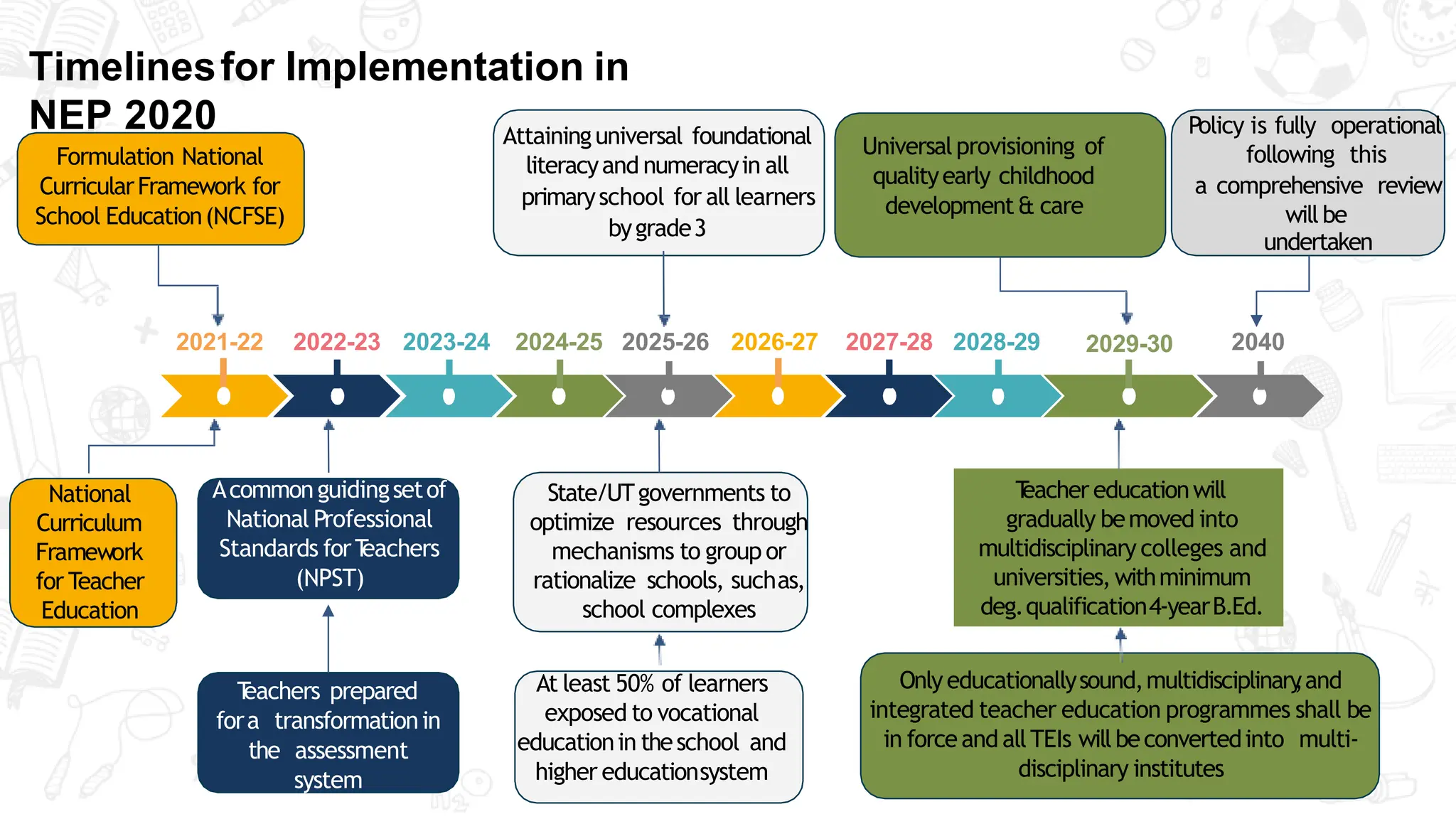
Timelinesfor Implementation in
NEP 2020
2021-22 2022-23 2023-24 2024-25 2025-26 2026-27 2027-28 2028-29 2029-30 2040
Formulation National
CurricularFramework for
School Education(NCFSE)
National
Curriculum
Framework
for Teacher
Education
Acommonguidingsetof
National Professional
Standards forT
eachers
(NPST)
Attaininguniversal foundational
literacyand numeracyin all
primaryschool for all learners
bygrade3
Universalprovisioning of
qualityearly childhood
development& care
T
eachers prepared
fora transformationin
the assessment
system
State/UTgovernments to
optimize resources through
mechanisms to group or
rationalize schools, suchas,
school complexes
At least 50% of learners
exposed to vocational
educationin theschool and
higher educationsystem
T
eacher educationwill
gradually bemoved into
multidisciplinary colleges and
universities,withminimum
deg.qualification4-yearB.Ed.
Onlyeducationallysound,multidisciplinary
,and
integrated teacher education programmes shall be
in forceand allTEIs willbeconvertedinto multi-
disciplinary institutes
Policy is fully operational
following this
a comprehensive review
willbe
undertaken
New Features of the
Policy
New Features (1/3)
1
Preparation for Schooling and Elementary Schooling Level
● ECCEforallby2030: National Curriculum Framework for ECCE
● Achieve100% Gross EnrolmentRatioinschool educationby2030
● Preparatoryclass/ Balvatika for5-6 yearold children in Anganwadis/
pre- schools
● School Preparation module for all class1entrants
● National Foundational Literacy and Numeracy Mission
● Setup of Bal Bhavans
School Infrastructure and Resources
● Special Education Zones (SEZ)
● Utilize unusedcapacity ofschools as Samajik Chetna
Kendras
● Schoolcomplex/clustersfor resource sharing
2
3
Holistic Development of the Student
● No hardseparationof curricular
, extraandco-curricular
,arts andscience,sports andvocational crafts.
Curriculumto integrate Indian culture and ethos
● Innovative pedagogies to be explored suchas experiential teaching/learning methods
Book promotion policy and digital libraries
● Holistic Report card – use AI for identifying specificaptitude ofchild
● Vocational education integration fromprimary grades anda tendays(no bag days) internshipwith
local trades/craftspersonfor Grades 6-8
● Lok Vidya – local artists as master instructors in schools
New Features (2/3)
4
Inclusivity
● Gender Inclusion Fund; KGBVs uptoclass12
● Specialprovisionsfor Gifted children
● Adult Education (AE) tofocus upon technology basedsolutions;NCFfor AEtobe
developed
● NIOSto expand to include vocational coursesandcoursesfor grades3,5and8
● Medium of instruction will be inthemothertongue/ local language tillGrade5 (atleast)
Assessments
● NationalAssessment Centerfor Performance Assessment, Reviewand Analysis of Knowledge for
Holistic development– PARAKH
● Exams inGrades3,5 and8 ,inadditiontoBoardexamsinGrades10 and12
● Boardexams: Modular
, lowstakes, basedonconceptual knowledgeand itsapplication
5
6
Curriculum and Pedagogical Framework
● New curricular and pedagogical framework of 5+3+3+4
● Reduction incurriculumtocore concepts
● Identification of life skills tobe attained in each grade as a partofNCF
● Alternative model of schools tobe encouraged toadoptNCF
● ICT integration inteachingand learning methodologies
● Tracking students as well as theirlearning levels;universalisationofsecondaryeducation
New Features (3/3)
7
Teacher Recruitments/ Teacher Education
● Minimumqualification degreefor teaching will be a 4-year integratedB.Ed.Degree by2030
● Teacher recruitment basedon TET
, NTA testandteachingdemonstration;TET mandatory forteaching
● Minimum50 hoursof in-servicetrainingperteacher/year
● NationalProfessionalStandards forTeachers(NPST) by 2022
● IT anddatabasedpredictive planning for requirementofstudents inTEIs; TEIs to moveto
multidisciplinarycollegesanduniversitiesby2030
● Stringentaction on non-performing TEIs
● Mandatoryfor every PhD studenttodoa moduleonteacher education
8
Role of Government Departments /Bodies /Institutions
● State Department to look after policy making; Directorate of Education to look after operations, SCERT to
look after academics and State School Standards Authority to set minimum common standards for online
self-disclosure by all public and private schools
● Random samplingofstudents for continuous onlinefeedback onself-disclosure byschools
● Engagementofsocial workers,alumni, retired teachers and volunteerswithschools
● Strengthening the Central Advisory Board of Education (CABE) for developing, articulating, evaluating and
revising the vision of education on a continuous basis in collaboration with MHRD and corresponding apex bodies
of States
● Its desirable that Ministry of Human Resource Development MHRD) be re-designatedas Ministry of
Education (MoE) to bringthefocusbackon education and learning
Thank you.

NEP at a glance for a CBSE SCHOOL .pptx

  • 2.
    Agenda ● Vision andKey Principles ● Universal Access and EarlyChildhood Education ● Howchildrenwill Learn–Curricular andPedagogic structures ● Curriculum -Learning Outcomes -Competencies ● Schools -Complex -Accreditation ● T eachers -Education and Development ● NEP -NewFeatures ● Key Focus Areas -Equity -Gender -Special Needs ● Goals and ImplementationPlan
  • 3.
    Vision of theNational Education Policy 2020 1 Develops a deep sense of respect towards the fundamental rights, duties and Constitutional values, bonding with one’s country , and a conscious awareness of one’s role and responsibilitiesina changingworld 2 3 An education systemthatcontributes toanequitable and vibrant knowledge for society,by providing high- quality education to all Instilsskills,values,and dispositions that support responsible commitmentto human rights, sustainable development and living,and global well-being, thereby reflecting a truly global citizen
  • 4.
    Key Principles ofNEP - Emphasize Conceptual Understanding Ratherthanrotelearning and learning-for-exams - Unique Capabilities Recognizing, identifying them in each student. - Critical thinking and Creativity T o encourage logical decision- making and innovation - Continuous Review Based on sustained research and regular assessment by educationalexperts. - Respect for Diversity & Local Context In all curriculum, pedagogy and policy. - Equity & Inclusion As thecorner stone of educational decisions. - Community Participation Encouragement and facilitation for philanthropic, private and community participation. - Use of Technology In teaching and learning, removing language barriers,for Divyang students and in educational planning and management.
  • 5.
    Universal Access toEarly Childhood Care & Education (ECCE) Foundational Learning Curriculum Forage groupof3-8 dividedintwoparts: (i)From age 3-6inECCEand (ii)age 6 to 8inclass I andII inprimaryschool Universal Access Forchildrenof3-6years:access to free,safe,highquality ECCEat Anganwadis/Pre-school/Balvatika Multifaceted Flexible, multi-level, play- based, activity-based and inquiry- based learning Preparatory Class Prior totheage of5 everychildwill move to a “PreparatoryClass” or “Balvatika”(thatis,beforeClass1) Implementation to be jointly carried out by Education Ministry, Ministries of Women and Child Development (WCD), Health and Family Welfare (HFW) and Tribal Affairs
  • 6.
    To ensure access andopportunity to all children Multiple Pathways Multiple pathwaysto learning; involving both formaland non-formal education modes Bring Back Drop-outs T o bringdropout children back toschool Build Schools Promoting both governments and non-governmental philanthropic organizations to build schools Alternative Centers Alternative and innovative education centers Learning Outcomes Focus will beon achieving desired learning outcomes at alllevels Peer Tutoring Suitable forallcategories business and personal presentation Ensuring Universal Access to Education at all levels
  • 7.
    Expected Outcomes ● Universalisation ofAccess – from ECCE toSecondary ●Ensure equity and inclusion ●Bringback 2 crores out-of-school children ●AttainSDG goals of retainingall childrenin schools untilcompletion of secondary education ●Improve Qualityand achievement of learning outcomes – Foundational Literacy & Numeracy (FLN) ●Focus on 21st century skills in teaching,learning and assessment ●Resource sharing- School complexes ●Effective Governance -separation of powers and common norms ●Overcoming the language barrierin learning ●Common standards for publicandprivateschool education
  • 8.
  • 9.
    New pedagogical andcurricular structure of school education (5+3+3+4): 3years in Anganwadi/pre-school and 12 years in school • Secondary Stage(4) multi disciplinary study, greater critical thinking, flexibility and student choice of subjects • Middle Stage (3) experiential learning in the sciences, mathematics, arts, socialsciences,and humanities • Preparatory Stage (3) play,discovery, and activity-based and interactive classroom learning • Foundational stage (5)multi level, play/ activity-based learning Middl e 10Years (Ages 6-16) 2 Years (Age 16-18) 2 3 years (Class 1 & 2) (Ages 6-8) .................................... years (Anganwadi/ pre- school/ Balvatika) (Ages 3-6) 3 Years (Class 3 to 5) (Age 8-11) 3 Years (Class 6 to 8) (Age 11-14) 4 Years (Class 9 to 12) (Age 14-18) Existing Academic Structure New Academic Structure Foundatio nal Preparato ry Seconda ry Transforming Curricular & PedagogicalStructure
  • 10.
    ECCE Framework Research and Best Practices NCPFECEwillbealignedwith the latest research on ECCE, and national and international best practices Multi-faceted Framework Comprising of alphabets, languages, numbers, counting,colours,shapes, indoor and outdoor play , puzzlesandlogicalthinking, problem-solving,drawing, paintingandothervisual art, craft,drama and puppetry , music andmovement School Preparation Module A 3-month play-based ‘school preparation module’ for all Grade1 studentstobe developedbyNCERT NCPFECE National Curricular and Pedagogical Framework for Early Childhood Education (NCPFECE) willbe draftedby NCERT
  • 11.
    Early Childhood Education:Learning in the Formative Years Etiquette, Behaviour and Emotional Development Play-based & Discovery- Based learning Self-Identity T eamwork & Collaboration Colours, Shapes, Alphabets & Numbers Relationship with Nature Logical Thinking & ProblemSolving Developing curiosity Arts, crafts and Music Ethics
  • 12.
    Attainment of FoundationalLiteracy And Numeracy by Grade3 in Mission mode FLN by Grade 3 Early Learning Focus on early reading, writing& mathematics 3-month Play basedSchool 3-month play-based school preparation module’for all Grade 1students National Repository NationalRepository-HighQuality Teaching and Learning Resources onDIKSHA Libraries School libraries,including digitallibrariestobeleveraged Book Promotion National Book Promotion Policy will beformulated and public and school libraries willbe expanded National Mission National Mission on Foundational Literacy andNumeracy Foundational Skills Universalacquisition of foundationallearning skills
  • 13.
  • 14.
    Experiential Learning Fun, creative,collaborative, and exploratory activities in classroom for experiential learning and deeper student learning Reduction in Curriculum Core Essentials Curriculum in all subjects to be reduced to its core essentials Critical Thinking Focuson criticalthinking, inquiry ,discovery , discussion and analysis- based teaching and learning methods for holistic education Interactive Classes Interactive teachingwith reduceddependency on text booklearning; Questions fromstudents willbe promoted ● Curriculum and pedagogy to be transformed by 2022 to promote skill based and minimize rote based learning Revision of NCF for school education and NCF for teacher education by 2021
  • 15.
    Focus on LOs,Competencies and subject - integration Modules on preparingand implementing pedagogicalplansbasedoncompetency and outcome-based education for school leaders NO hard separation between: • curricular/co-curricular/extra-curricular; • academic/vocational; • science/humanities • sports/art/academics Through arts integrated, sports integrated, ICT integratedand story tellingbased pedagogy among others as standard pedagogy Emphasisondigitalliteracy , coding and computational thinking, ethical and moralreasoning Development of scientific temperand inculcationofknowledgeandpracticeof humanandconstitutionalvaluessuchas patriotism,sacrifice,non-violence,truth, honesty ,peaceetc. Competency basededucation Integration of subjects Development of scientific temper NO SILOS among subjects/ learning Emphasis on Digital literacy Promotion of multi-lingual teaching Promoting states to enterinto bilateralagreementswithnear by statestohire language teachers
  • 16.
    Health check ups Annualhealthcheckupforall students Reduceweight of school bags Reducedweight of school bags and textbooksthroughsuitablechanges in curriculumand pedagogy Mandatory skills : Health and Wellness Mandatoryskills tobe imbibed by all students health, nutrition,physical education,fitness, wellness,sports.In addition-Basic trainingin preventive healthcare,mentalhealth,first aid, personal and public hygiene will be included in the curriculum Focus on children with disability Differentiated interventions and suitable infrastructure developmentat schools tomake access easierforchildren withdisability Inclusive and caring culture at school Therole and expectations of principaland teachers willexplicitly include developing a caring and inclusive cultureatschool Hiring counsellors in school complexes Stategovernments will be encouragedto hire adequatenumberofcounsellors andteachers(tobe shared across schoolcomplex) Mental and physical health andwellness being: Mandatory for students to acquire skills in: health and nutrition; physical education, fitness, wellness, and sports
  • 17.
    Experiential Learning ● Focus onexperiential, inquiry and discovery based teaching learning methods Equal Weightage ● No hardseparationbetweencurricular , co-curricularand extra curricular area. ● Freedom of choosing a varietyof subject combinationto be provided Bagless Days ● Bagless daystobescheduledin academic calendar Innovative Pedagogy: Transforming teaching learning process Integrated Pedagogy ● Arts, sports, and story-telling and ICT-integrated pedagogy Promotion of peer tutoring ● Promoting peertutoringas voluntaryand joyful activity under thesupervision ofteachers Use and integration of technology ● Integrationoftechnology enabled pedagogy in classes 6-12
  • 18.
    All text booksto contain only essential core material while capturing any desired nuances and supplementary materialas perlocalcontexts and needs Affordable, high-qualityand energised textbooks to be provided along withfree digital version on DIKSHA Platform States to prepare their own curricula and text books based on NCERT curriculum and textbooks, incorporating State flavour and material asneeded Concerted efforts, through suitable changes in curriculum and pedagogy to significantly reduce the weight of school bags and text books Textbook with local content and flavour
  • 19.
    India’s future andIndia’s leadership role in upcomingfields Increased emphasis on mathematics and computational thinking throughout the school years Inculcatemathematicalthinking and problem solvingthrough a varietyofinnovative methods, includingtheregularuse of puzzlesandgames Activities involvingcodingwill be introduced in MiddleStage Teachingofcontemporary subjectsatmiddle and secondary stages: ArtificialIntelligence, Design Thinking,Holistic Health, Organic Living, Environmental Education,Global Citizenship Education (GCED) Mathematical thinking and problem solving Computational thinking Including contemporary subjects in schools Computational thinking
  • 20.
    Knowledge of India Willbeincorporatedin an accurate and scientific manner wherever relevant. Indian Knowledge Systems, including tribal knowledge and indigenous and traditional ways of learning, will becovered. Specificcoursesin tribal ethno-medicinal practices, forest management, traditional (organic) crop cultivation, natural farming, etc. willalso bemade available. C curriculum toinclude knowledgefrom ancientIndiato modernIndia as wellas futureaspirations. Videodocumentariesoninspirationalluminaries of India, in science and beyond. Studentswill begiven a logical frameworkformaking ethicaldecisionsat a youngage. In lateryears,expandedalong themesof cheating, violence,plagiarism, littering& tolerance, equality,empathy . TraditionalIndianvaluesandallbasic humanand Constitutionalvalueswill bedevelopedinall students. Extract fromtheIndianConstitution willalso be considered essential reading forall students. Basic training in health,mental health,good nutrition, personaland public hygiene,disaster responseandfirst- aid will also beincluded. Scientific explanations of the detrimental and damagingeffectsofalcohol,tobacco,and other drugs willbepart of curriculum.
  • 21.
    Examinations in grades1 to8 Census assessments at key stage inclasses 3,5 and 8 to trackachievement Assessment of core concepts and knowledge, higher-order skills and itsapplication inreal-life situations.Movingaway from rotelearning. Key stage assessments Achievement of critical LOs Testingto focus onachievementof essential learning outcomes Moving away from rote learning Results of school examinations Theresultsofschool examinationswillbeused only fordevelopmental purposes and for continuous monitoring and improvement of the schooling system
  • 22.
    Reforming examinations ingrades 9 to 12 including Board exams Board exams will be made ‘easier’, as they will test primarily core capacities/competencies Viable models to be explored: annual/semester/modular Exams; two parts exams - objective type and descriptivetype. Guidelines will be prepared by NCERT , in consultation with SCERT s, Boards of Assessment (BoAs), and P ARAKH BeginningwithMathematics, allsubjects could be offeredat two levels Teachers to be prepared for a transformation in the assessment system by the 2022-23 academic session Each School Board shall ensure equivalence of academic standards in learner’s attainments Standards,norms and guidelines for School Boardsthrough P ARAKH National Center
  • 23.
    Transforming the cultureof assessment Assessment to focus on core concepts, higher order and foundational skills Continuous tracking of learning outcomes of each child Boardexamstobe more flexible,with assessment of essentialskills The National Testing Agency (NTA) will work to offera high-quality common aptitudetest,to eliminatetheneedfor takingcoaching for these exams AI - based software to helptrack theprogressof theStudents to enable themto make optimal career choices. Self Assessment and Peer Assessment National Assessment Centre will help in bringing greater synergy in board exams conductedbyvarious Boards of Assessments
  • 24.
    Holistic Progress Card States/UT‘Sto redesign Progress Cards in schools tomake themholistic,360-degree, multi dimensional report Progress card willinclude self-assessment, peerassessment, and teacher assessment Cards to reflectthe progress and uniqueness of learner in the cognitive, affective,socio-emotional,and psychomotor domains Progress in project-based and inquiry- basedlearning,quizzes, role plays, group work,portfolios, etc.,to be included in report cards The holistic progress cardwill actively involve parentsintheirchildren’ s education and development. AI-basedsoftwaretobedevelopedtohelp trackgrowththrough school yearsand to help students make optimal career choices.
  • 25.
    Multilingualism and thePower of Language Learning ● Medium of instruction uptilgrade5,and preferablytill Grade 8 and beyond,will be home language/ mother-tongue/ local language ● ‘The Languages of India’a fun project/ activity ontobetaken byevery student ● Three languages tobetaughtwillbe decidedbystate/UT ● All classical languages will bewidely availablein schools asoptions
  • 26.
  • 27.
    School Complexes/Clusters Pairing Schools T winning/pairing of onegovernment schoolwithone privateschool across the country Sharing Resources Enablesharing of human& infrastructural resources Efficiency Efficient expeditionand resourcing for schools through building school complexes Planning Development of short-termand long-term plans (SDPs) Governance Effective governance of schools Integration Better integration of educationacross all levels through connectedschools and shared teachers and resources Bal Bhavan Strengthening/setting-up of Bal Bhavan forchildrenof all age group to atpar take in art-related,career-related, and play-related activities Samajik Chetna Kendras Un-utilizedcapacity ofschools tobeusedas SamajikChetna Kendra to promote social, intellectual, and voluntary activities
  • 28.
    Standard-setting and Accreditation 3 4 1 ✔SettingupStateSchool Standards Authority (SSSA) ✔Self-disclosure of all the basic regulatory information of all schools at SSSA and Schoolwebsite ✔To ensure all schools follow 2 certain minimal professional and quality standards ✔Development ofSchool Quality Assessment and Accreditation Framework (SQAAF) by SCERT & NCERT ✔Periodic ‘health check-up’ofthe over all system througha sample-based National AchievementSurvey (NAS) ✔Public and privateschools (exceptthe CentralGovernmentschools) willbe assessed and accredited on common minimum criteria ✔Private/philanthropic schools to be encouragedandenabledtoplay a beneficial role.
  • 29.
  • 30.
    Teacher Education Minimum degree qualificationfor teaching thatincludes student- teaching at local schools,by2030 For applicants with an existing Bachelor’s Degrees in other specialized subjects For those who have completedthe equivalent of 4-year multidisciplinary Bachelor’s Degrees or have obtained a Master’s degree in aspecialty Teachereducationwill gradually be moved by2030 intomulti disciplinarycolleges and universities Multi disciplinary higher education institutions offering the 4-yearin-class integrated B.Ed. programmetoalso provide blended and/or ODL mode ofteaching to students in remote areas. 4 year Integrated B.Ed 1 year B.Ed 2 year B.Ed
  • 31.
    Teacher Education Minimum degree qualificationfor teaching that includes student- teaching at local schools, by2030 For applicants with an existing Bachelor’s Degrees in other specialized subjects For those who have completedthe equivalent of 4-year multi disciplinary Bachelor’s Degrees or have obtained aMaster’s degree in aspecialty All B.Ed.programmes will include training intime-tested techniques inpedagogy,multi-levelteaching and evaluation,teaching childrenwith disabilities,teaching childrenwith special interests or talents, use of educational technology,and learner-centered and collaborative learning 4 year Integrated B.Ed 1 year B.Ed 2 year B.Ed
  • 32.
    Teacher Education 4 year Integrated B.Ed 1year B.Ed Minimum degree qualification for teaching thatincludes student- teaching at localschools, by2030 For applicants withan existing Bachelor’s Degrees in other specializedsubjects For those who have completedtheequivalent of 4-year multi disciplinary Bachelor’s Degrees or have obtained a Master’s degree in aspecialty Shorter local teacher education programmes to be available at BITEs,DIETs orat school complexes for eminent local persons who can be hiredtoteach atschoolsas ‘master instructors’, for promoting local professions,knowledge,and skills, e.g., local art,music,agriculture,business, sports, carpentry and other vocational crafts 2 year B.Ed
  • 33.
    Only educationally- sound,multidisciplinary, and integratedteacher education programmes to be made available NTA testing for admission toB.Ed. NationalHigher Education RegulatoryCouncil (NHERC), to functionas single point regulator for higher education sector including teacher education Improving Teacher Education All teacher education programmes to be conductedwithin composite multi disciplinary institutions. Newand comprehensive National CurriculumFramework for Teacher Education (by2021) Merit based scholarships for4year B.Ed. Integrated Setting-up of National Mission for Mentoring with a large pool of outstanding senior/retired faculty Stringent action against substandard stand-alone TeacherEducation Institutions (TEIs). Teacher Eligibility Tests (TETs) at all stages will bestrengthened
  • 34.
    Teacher recruitment anddeployment Transparent transfer system Online computerizedsystem for teacher transfersto ensure transparency Strengthening TETs T eacher Eligibility T ests(TET s) forallteachers across Foundational,Preparatory ,Middle and Secondary stage in bothpublic and private schools Test score and demonstration - partof recruitment Subjectscore fromTETorNT Atests and classroom demonstration to betaken intoaccount for recruitmentof subject teachers Restructuring of NCTE NCTE to berestructured as a Professional Standard Setting Body (PSSB)underGeneralEducationCouncil (GEC) Tech based planning for teacher recruitment T echnology-basedplanning and forecasting of teacher-requirementto assess expected subject-wise teachervacancies over nexttwo decades Certificate Courses Developing specialization for subject or generalist teachers,teaching children with disabilities /Divyang children,during pre- service teacherpreparationwithsynergy betweenNCT andRCI 01 02 03 04 05 06
  • 35.
    Empowering Teachers ImprovingService Environmentthrough better infrastructureatschool A technology-based comprehensive teacher- requirement planningforecastingexercisetobe conducted by eachState. National ProfessionalStandards for Teachers (NPST) by 2022 Career growth tobeavailablefor teachers with in a single school stage i.e., Foundational, Preparatory , Middle, or Secondary Teachers to have more autonomy in choosingaspects of pedagogy in classroom teaching Teacher Professional Development ● Merit based tenure track system ● Min.50 hoursofContinuousProfessional Development(CPD) Academic leadership positionstobemade availablefor teachers.
  • 36.
    Atleast50hoursof CPD for teachersbasedontheirown interestandprofessional areas CPD opportunities will,in particular , systematically cover thelatest pedagogies School Leadership Necessaryfacilitiesfortheinitial professional preparationofthese educators and their Continuous Professional Development(CPD) Ample opportunityto get upskilledon latest pedagogy relatedto foundational literacy and numeracy, formative and adaptive assessment of learning outcomes,individualised and competency- based learning and related pedagogies
  • 37.
  • 38.
    Focus on Socio-EconomicallyDisadvantaged Groups (SEDGs) SEDGs can bebroadly categorized based on: Gender Identities (particularlyfemale andtransgender individuals), ● ● Socio-cultural Identities (such asScheduled Castes, Scheduled T ribes, OBCs, and minorities) ● Geographical Identities (such as students from villages,small towns, and aspirational districts) ● Disabilities including learning disabilities Socio-economic conditions (such as migrant communities,low income households, children in vulnerable situations, victims or childrenof victims of trafficking,orphans including child beggars in urban areas, and theurban poor). Separate strategies will be formulated for focused attention for reducing each of the category-wise gaps in school education.
  • 39.
    Ensuring Equity EQUITY Additional Schools Setting-upof additional JNVs and KVS in aspirational districts/SEZs Fee Waivers Fee waivers and scholarships willbe offeredtomeritoriousstudentsfromall SEDGs on a largerscale Interventions The critical problems and recommendations regarding ECCE, foundational literacyand numeracy, access, enrolmentand attendance will be targeted in a concerted way for Socio=Economically disadvant aged groups - SEDGs. Special Mechanisms Specialmechanismsforchildren belonging to tribalgroups to receive quality education Learning Outcomes Focus on attainmentof learningoutcomesofchildren belonging toSC/ST/OBC Counsellors Recruitmentofcounsellors in schools SEZs Large populations from SEDGs to bedeclaredSpecial EducationZones(SEZs)
  • 40.
    Gender Policies targeted forGirls Thrust on designing policies and schemes targeted towards female students in the SEDGs Gender Sensitivity ‘Gender Sensitivity’tobeanintegral partofcurriculum Safety and Rights Carefulattentiontosafetyand rightsofallchildrenparticularlygirls toretaintheminschool KGBVs Strengthening and extension of KGBVs up to grade 12 Bridging Gender Gap Focus on bridging the Gender Gap and provide equal opportunities to all. Gender Inclusion Fund Gender-InclusionFundforfemaleand transgenderstudents
  • 41.
    Supporting Children withSpecial Needs (CWSN) Enabling Mechanisms Enabling mechanisms for CWSN or Divyangtoreceivequalityeducation Regular Schooling Children with special needs will be integrated in the regular schooling process from elementary to higher education levels Assistive Devices and Orientation to Parents T echnology enabledassistive devices/toolforCWSN and orientationof thetools/devices forparents/caregivers Alternative Schools Alternativeforms of schools willbe encouraged to preservethealternative pedagogicalstyles Modules NIOS will develop high-quality modules toteachIndianSign Language Certificate Courses Certificate courses for pre-service and in-service teachers to become special educators 01 02 03 04 05 06
  • 42.
    Integrating Vocational Educationat All Levels LokVidya ‘LokVidya’,knowledge developed in India,willbemadeaccessible to students Practice Based Curriculum Apractice-based curriculum for Grades 6-8 to beappropriately designed Skills Framework National Skills Qualifications Framework will be detailed further for each discipline vocation/profession Vocational Crafts All studentsofgrades 6-8will intern with local vocationalexpertssuch as carpenters,gardeners,potters,artists, etc.to developavocationalcraft Skill GapAnalysis Focus areasbasedonskills gap analysis and mappingof local opportunities Open Distance Learning Mode Coursesto beofferedthroughOpen andDistance Learning(ODL)mode. 01 02 03 04 05 06 Exposure to vocational education By2025,atl east50% of learners shall Have exposure to vocational education
  • 43.
    Setting up ofPARAKH Assessments PARAKH Setting-up of National Center for Performance Assessment, Review and Analysis of Knowledge for Holistic development(P ARAKH) Shifttowardscompetencybasedassessments 21st Century Skills Promotingcriticaland creativethinkingaligned to the21stcenturyin classrooms Objectives of PARAKH ● Settingnorms,standards and guidelines forassessment andevaluation ● Guiding the State Achievement Survey (SAS) ● Conducting the National Achievement Survey(NAS) ● Monitoring achievement ofLearning Outcomes inthecountry
  • 44.
    Support For GiftedStudents / Students With SpecialTalents Olympiads and competitions in various subjectstobeconducted across the country NCERT and NCTE will develop guidelines for the education of gifted children Extensive use of technology to encourage talented/gifted children Encourage gifted/ talented students Pursuerealm beyondthe general school curriculum Project-based clubs to be encouraged and supported and supported at all levels in schools Efforts for interventions in rural areas and in regional languages to ensure wide spread participation B.Ed. Programmes to allow specialisationin education of gifted children
  • 45.
    Online and DigitalEducation DigitalPlatforms Digital platforms and ongoing ICT- based educational initiatives to be optimizedandexpanded Pilot Studies A series of pilotstudies to be conducted Expansion of Platforms Expansion of existinge-learning platforms -DIKSHA, SW A Y AM, etc. Content Creation Content creation, digital repository , and dissemination. Technology Integration In T eaching, Learning & Assessment Blended Learning Emphasis on effective models of Blended learning Inclusion and Access Enhance Educational Access to Disadvantaged Groups including Divyang students
  • 46.
    Adult Education andLifelong Learning The Adult Education Curriculum To Include Following Five Types Of Programme: A. Foundational Literacy And Numeracy B. CriticalLifeSkills C. VocationalSkillsDevelopment D. Basic Education E. ContinuingEducation Innovative Initiatives Innovative initiatives for adultswiththe help of community participation and technology integration Integration with HEIs Integrationof Adult Education Centres(AECs) withHEIs andother publicinstitutions Technology Based Options Technology-based highquality options for adultlearning such asapps,online courses/modules, satellite-based TV channels Online Books Online books, ICT-equipped libraries, Adult Education Centres, etc. to be developedthrough governmentand Philanthropic initiatives
  • 47.
    Goals & Timelines forthe implementation
  • 48.
    Timeline for Implementationof ECE and new Assessment pattern Early Childhood Education Implementation of new curriculum and assessment 2021-22 2022-23 2023-24 2024-25 2025-26 Initiating implementation of 1 yearof pre-primary school and 3-month preparatorymodulefor Class -1 students ( Phase 1) Expansionof1 yearof pre-primaryschool through primary schools and Anganwadis (Phase 2) Class 9th Class 10th Class 11th Class 12th NewBoardExampatternfor Class 12th New BoardExampatternfor Class 10th
  • 49.
    Timelinesfor Implementation in NEP2020 2021-22 2022-23 2023-24 2024-25 2025-26 2026-27 2027-28 2028-29 2029-30 2040 Formulation National CurricularFramework for School Education(NCFSE) National Curriculum Framework for Teacher Education Acommonguidingsetof National Professional Standards forT eachers (NPST) Attaininguniversal foundational literacyand numeracyin all primaryschool for all learners bygrade3 Universalprovisioning of qualityearly childhood development& care T eachers prepared fora transformationin the assessment system State/UTgovernments to optimize resources through mechanisms to group or rationalize schools, suchas, school complexes At least 50% of learners exposed to vocational educationin theschool and higher educationsystem T eacher educationwill gradually bemoved into multidisciplinary colleges and universities,withminimum deg.qualification4-yearB.Ed. Onlyeducationallysound,multidisciplinary ,and integrated teacher education programmes shall be in forceand allTEIs willbeconvertedinto multi- disciplinary institutes Policy is fully operational following this a comprehensive review willbe undertaken
  • 50.
    New Features ofthe Policy
  • 51.
    New Features (1/3) 1 Preparationfor Schooling and Elementary Schooling Level ● ECCEforallby2030: National Curriculum Framework for ECCE ● Achieve100% Gross EnrolmentRatioinschool educationby2030 ● Preparatoryclass/ Balvatika for5-6 yearold children in Anganwadis/ pre- schools ● School Preparation module for all class1entrants ● National Foundational Literacy and Numeracy Mission ● Setup of Bal Bhavans School Infrastructure and Resources ● Special Education Zones (SEZ) ● Utilize unusedcapacity ofschools as Samajik Chetna Kendras ● Schoolcomplex/clustersfor resource sharing 2 3 Holistic Development of the Student ● No hardseparationof curricular , extraandco-curricular ,arts andscience,sports andvocational crafts. Curriculumto integrate Indian culture and ethos ● Innovative pedagogies to be explored suchas experiential teaching/learning methods Book promotion policy and digital libraries ● Holistic Report card – use AI for identifying specificaptitude ofchild ● Vocational education integration fromprimary grades anda tendays(no bag days) internshipwith local trades/craftspersonfor Grades 6-8 ● Lok Vidya – local artists as master instructors in schools
  • 52.
    New Features (2/3) 4 Inclusivity ●Gender Inclusion Fund; KGBVs uptoclass12 ● Specialprovisionsfor Gifted children ● Adult Education (AE) tofocus upon technology basedsolutions;NCFfor AEtobe developed ● NIOSto expand to include vocational coursesandcoursesfor grades3,5and8 ● Medium of instruction will be inthemothertongue/ local language tillGrade5 (atleast) Assessments ● NationalAssessment Centerfor Performance Assessment, Reviewand Analysis of Knowledge for Holistic development– PARAKH ● Exams inGrades3,5 and8 ,inadditiontoBoardexamsinGrades10 and12 ● Boardexams: Modular , lowstakes, basedonconceptual knowledgeand itsapplication 5 6 Curriculum and Pedagogical Framework ● New curricular and pedagogical framework of 5+3+3+4 ● Reduction incurriculumtocore concepts ● Identification of life skills tobe attained in each grade as a partofNCF ● Alternative model of schools tobe encouraged toadoptNCF ● ICT integration inteachingand learning methodologies ● Tracking students as well as theirlearning levels;universalisationofsecondaryeducation
  • 53.
    New Features (3/3) 7 TeacherRecruitments/ Teacher Education ● Minimumqualification degreefor teaching will be a 4-year integratedB.Ed.Degree by2030 ● Teacher recruitment basedon TET , NTA testandteachingdemonstration;TET mandatory forteaching ● Minimum50 hoursof in-servicetrainingperteacher/year ● NationalProfessionalStandards forTeachers(NPST) by 2022 ● IT anddatabasedpredictive planning for requirementofstudents inTEIs; TEIs to moveto multidisciplinarycollegesanduniversitiesby2030 ● Stringentaction on non-performing TEIs ● Mandatoryfor every PhD studenttodoa moduleonteacher education 8 Role of Government Departments /Bodies /Institutions ● State Department to look after policy making; Directorate of Education to look after operations, SCERT to look after academics and State School Standards Authority to set minimum common standards for online self-disclosure by all public and private schools ● Random samplingofstudents for continuous onlinefeedback onself-disclosure byschools ● Engagementofsocial workers,alumni, retired teachers and volunteerswithschools ● Strengthening the Central Advisory Board of Education (CABE) for developing, articulating, evaluating and revising the vision of education on a continuous basis in collaboration with MHRD and corresponding apex bodies of States ● Its desirable that Ministry of Human Resource Development MHRD) be re-designatedas Ministry of Education (MoE) to bringthefocusbackon education and learning
  • 54.