Benjamin Ang
EDUCATION CHAIR,
Internet Society
CONSULTANT,
Keystone Law
Corporation
LECTURER, Temasek
Polytechnic
Ben.ang@gmail.com
Techmusicartandlaw
.blogspot.com
THE LAW AND AARON
SWARTZ – COULD IT
HAPPEN IN SINGAPORE?
Copyright
Is there copyright in journal articles?
Who owns the copyright?
Will the police take action for a breach?
Is there a law against accessing data?
What can police do when investigating a
case?
How can we prevent suicide?
OUTLINE
COPYRIGHT
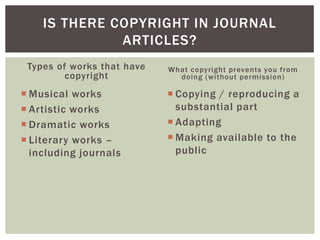
Types of works that have
copyright
 Musical works
 Artistic works
 Dramatic works
 Literary works –
including journals
What copyright prevents you from
doing (without permission)
 Copying / reproducing a
substantial part
 Adapting
 Making available to the
public
IS THERE COPYRIGHT IN JOURNAL
ARTICLES?
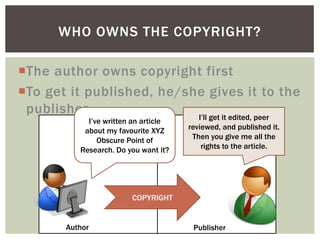
The author owns copyright first
To get it published, he/she gives it to the
publisher
WHO OWNS THE COPYRIGHT?
I‘ve written an article
about my favourite XYZ
Obscure Point of
Research. Do you want it?
Author Publisher
I‘ll get it edited, peer
reviewed, and published it.
Then you give me all the
rights to the article.
COPYRIGHT
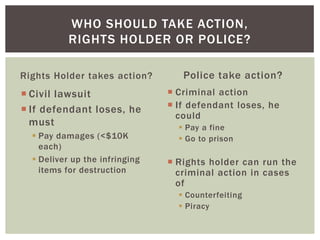
Rights Holder takes action?
 Civil lawsuit
 If defendant loses, he
must
 Pay damages (<$10K
each)
 Deliver up the infringing
items for destruction
Police take action?
 Criminal action
 If defendant loses, he
could
 Pay a fine
 Go to prison
 Rights holder can run the
criminal action in cases
of
 Counterfeiting
 Piracy
WHO SHOULD TAKE ACTION,
RIGHTS HOLDER OR POLICE?
IS THERE A LAW
AGAINST
ACCESSING DATA
WITHOUT AUTHORITY?
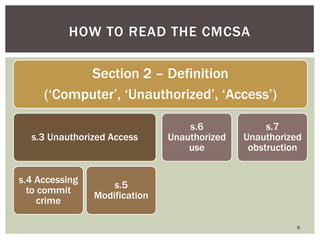
Section 2 – Definition
(‗Computer‘, ‗Unauthorized‘, ‗Access‘)
s.3 Unauthorized Access
s.4 Accessing
to commit
crime
s.5
Modification
s.6
Unauthorized
use
s.7
Unauthorized
obstruction
8
HOW TO READ THE CMCSA
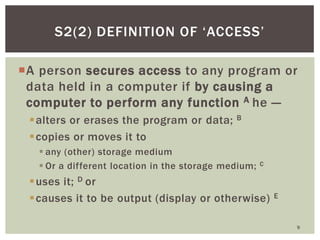
A person secures access to any program or
data held in a computer if by causing a
computer to perform any function A he —
alters or erases the program or data; B
copies or moves it to
 any (other) storage medium
 Or a different location in the storage medium; C
uses it; D or
causes it to be output (display or otherwise) E
9
S2(2) DEFINITION OF ‗ACCESS‘
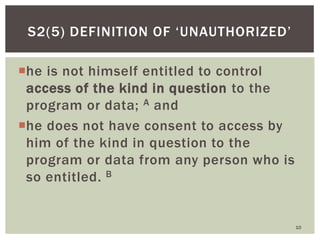
he is not himself entitled to control
access of the kind in question to the
program or data; A and
he does not have consent to access by
him of the kind in question to the
program or data from any person who is
so entitled. B
10
S2(5) DEFINITION OF ‗UNAUTHORIZED‘
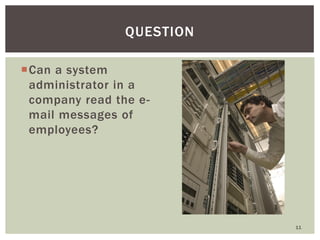
Can a system
administrator in a
company read the e-
mail messages of
employees?
11
QUESTION
12
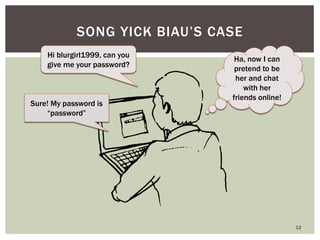
SONG YICK BIAU‘S CASE
Sure! My password is
―password‖
Hi blurgirl1999, can you
give me your password?
Ha, now I can
pretend to be
her and chat
with her
friends online!
13
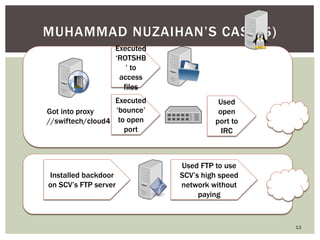
MUHAMMAD NUZAIHAN‘S CASE(S)
Got into proxy
//swiftech/cloud4
Executed
‗ROTSHB
‘ to
access
files
Executed
‗bounce‘
to open
port
Used
open
port to
IRC
Installed backdoor
on SCV‘s FTP server
Used FTP to use
SCV‘s high speed
network without
paying
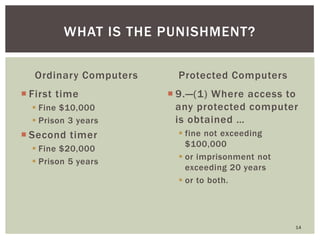
Ordinary Computers
 First time
 Fine $10,000
 Prison 3 years
 Second timer
 Fine $20,000
 Prison 5 years
Protected Computers
 9.—(1) Where access to
any protected computer
is obtained …
 fine not exceeding
$100,000
 or imprisonment not
exceeding 20 years
 or to both.
14
WHAT IS THE PUNISHMENT?
s.9(2) … the person committing the
offence knew, or ought reasonably to
have known, that the computer or
program or data is used directly in
connection with or necessary for —
the security, defence or international relations
of Singapore; A
15
WHICH ARE ―PROTECTED‖ COMPUTERS?
the existence or identity of a confidential source
of information relating to the enforcement of a
criminal law; B
the provision of services directly related to
communications infrastructure, banking and
financial services, public utilities, public
transportation or public key infrastructure; or C
the protection of public safety including systems
related to essential emergency services such as
police, civil defence and medical services. D
16
WHICH ARE ―PROTECTED‖ COMPUTERS?
WHAT CAN POLICE DO
WHEN INVESTIGATING A
CASE?
S.15A(2)(a) The powers referred to in sections
39 and 40 of the Criminal Procedure Code
They can search and seize computers
They can break encryption
They can demand passwords
Obstruction = jail
S.15A(2)(b) provide any information necessary
S.15A(2)(c) … (including real-time information)
18
POLICE POWERS OF SEARCH AND SEIZURE
IS SUICIDE INEVITABLE?
Legal Aid Bureau
https://www.mlaw.gov.sg/content/lab/e
n.html
Samaritans of Singapore
http://www.samaritans.org.sg/
Touch Community Helpline
http://www.touch.org.sg/helplines
WHAT CAN AN ACCUSED PERSON DO?
IF IT HAPPENS TO YOU,
GET HELP

The Law and Aaron Swartz: Could it happen in Singapore?

  • 1.
    Benjamin Ang EDUCATION CHAIR, InternetSociety CONSULTANT, Keystone Law Corporation LECTURER, Temasek Polytechnic Ben.ang@gmail.com Techmusicartandlaw .blogspot.com THE LAW AND AARON SWARTZ – COULD IT HAPPEN IN SINGAPORE?
  • 2.
    Copyright Is there copyrightin journal articles? Who owns the copyright? Will the police take action for a breach? Is there a law against accessing data? What can police do when investigating a case? How can we prevent suicide? OUTLINE
  • 3.
  • 4.
    Types of worksthat have copyright  Musical works  Artistic works  Dramatic works  Literary works – including journals What copyright prevents you from doing (without permission)  Copying / reproducing a substantial part  Adapting  Making available to the public IS THERE COPYRIGHT IN JOURNAL ARTICLES?
  • 5.
    The author ownscopyright first To get it published, he/she gives it to the publisher WHO OWNS THE COPYRIGHT? I‘ve written an article about my favourite XYZ Obscure Point of Research. Do you want it? Author Publisher I‘ll get it edited, peer reviewed, and published it. Then you give me all the rights to the article. COPYRIGHT
  • 6.
    Rights Holder takesaction?  Civil lawsuit  If defendant loses, he must  Pay damages (<$10K each)  Deliver up the infringing items for destruction Police take action?  Criminal action  If defendant loses, he could  Pay a fine  Go to prison  Rights holder can run the criminal action in cases of  Counterfeiting  Piracy WHO SHOULD TAKE ACTION, RIGHTS HOLDER OR POLICE?
  • 7.
    IS THERE ALAW AGAINST ACCESSING DATA WITHOUT AUTHORITY?
  • 8.
    Section 2 –Definition (‗Computer‘, ‗Unauthorized‘, ‗Access‘) s.3 Unauthorized Access s.4 Accessing to commit crime s.5 Modification s.6 Unauthorized use s.7 Unauthorized obstruction 8 HOW TO READ THE CMCSA
  • 9.
    A person securesaccess to any program or data held in a computer if by causing a computer to perform any function A he — alters or erases the program or data; B copies or moves it to  any (other) storage medium  Or a different location in the storage medium; C uses it; D or causes it to be output (display or otherwise) E 9 S2(2) DEFINITION OF ‗ACCESS‘
  • 10.
    he is nothimself entitled to control access of the kind in question to the program or data; A and he does not have consent to access by him of the kind in question to the program or data from any person who is so entitled. B 10 S2(5) DEFINITION OF ‗UNAUTHORIZED‘
  • 11.
    Can a system administratorin a company read the e- mail messages of employees? 11 QUESTION
  • 12.
    12 SONG YICK BIAU‘SCASE Sure! My password is ―password‖ Hi blurgirl1999, can you give me your password? Ha, now I can pretend to be her and chat with her friends online!
  • 13.
    13 MUHAMMAD NUZAIHAN‘S CASE(S) Gotinto proxy //swiftech/cloud4 Executed ‗ROTSHB ‘ to access files Executed ‗bounce‘ to open port Used open port to IRC Installed backdoor on SCV‘s FTP server Used FTP to use SCV‘s high speed network without paying
  • 14.
    Ordinary Computers  Firsttime  Fine $10,000  Prison 3 years  Second timer  Fine $20,000  Prison 5 years Protected Computers  9.—(1) Where access to any protected computer is obtained …  fine not exceeding $100,000  or imprisonment not exceeding 20 years  or to both. 14 WHAT IS THE PUNISHMENT?
  • 15.
    s.9(2) … theperson committing the offence knew, or ought reasonably to have known, that the computer or program or data is used directly in connection with or necessary for — the security, defence or international relations of Singapore; A 15 WHICH ARE ―PROTECTED‖ COMPUTERS?
  • 16.
    the existence oridentity of a confidential source of information relating to the enforcement of a criminal law; B the provision of services directly related to communications infrastructure, banking and financial services, public utilities, public transportation or public key infrastructure; or C the protection of public safety including systems related to essential emergency services such as police, civil defence and medical services. D 16 WHICH ARE ―PROTECTED‖ COMPUTERS?
  • 17.
    WHAT CAN POLICEDO WHEN INVESTIGATING A CASE?
  • 18.
    S.15A(2)(a) The powersreferred to in sections 39 and 40 of the Criminal Procedure Code They can search and seize computers They can break encryption They can demand passwords Obstruction = jail S.15A(2)(b) provide any information necessary S.15A(2)(c) … (including real-time information) 18 POLICE POWERS OF SEARCH AND SEIZURE
  • 19.
  • 20.
    Legal Aid Bureau https://www.mlaw.gov.sg/content/lab/e n.html Samaritansof Singapore http://www.samaritans.org.sg/ Touch Community Helpline http://www.touch.org.sg/helplines WHAT CAN AN ACCUSED PERSON DO?
  • 21.
    IF IT HAPPENSTO YOU, GET HELP