The Interview Process for Junior Devs
by Naoise Golden Santos
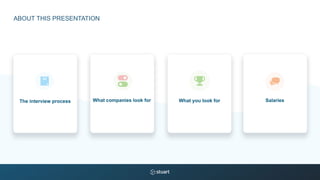
What you look for SalariesWhat companies look forThe interview process
ABOUT THIS PRESENTATION
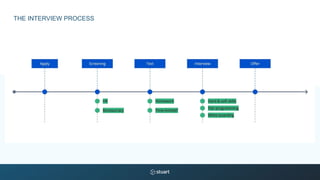
THE INTERVIEW PROCESS
www.stuart.com
THE INTERVIEW PROCESS
WHAT DO COMPANIES TEAMS
LOOK FOR?
www.stuart.com
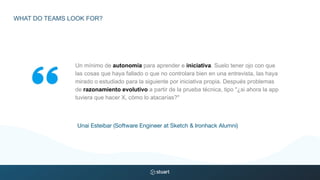
Un mínimo de autonomía para aprender e iniciativa. Suelo tener ojo con que
las cosas que haya fallado o que no controlara bien en una entrevista, las haya
mirado o estudiado para la siguiente por iniciativa propia. Después problemas
de razonamiento evolutivo a partir de la prueba técnica, tipo "¿si ahora la app
tuviera que hacer X, cómo lo atacarías?"
Unai Esteibar (Software Engineer at Sketch & Ironhack Alumni)
WHAT DO TEAMS LOOK FOR?
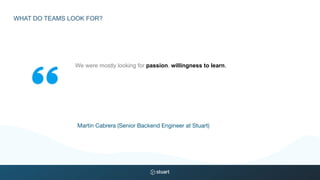
We were mostly looking for passion, willingness to learn.
Martin Cabrera (Senior Backend Engineer at Stuart)
WHAT DO TEAMS LOOK FOR?
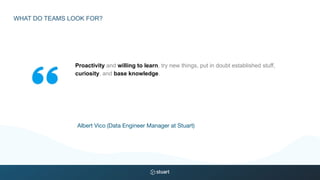
Proactivity and willing to learn, try new things, put in doubt established stuff,
curiosity, and base knowledge.
Albert Vico (Data Engineer Manager at Stuart)
WHAT DO TEAMS LOOK FOR?
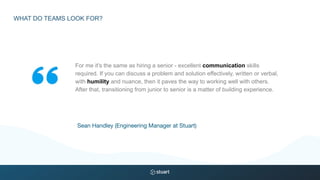
For me it's the same as hiring a senior - excellent communication skills
required. If you can discuss a problem and solution effectively, written or verbal,
with humility and nuance, then it paves the way to working well with others.
After that, transitioning from junior to senior is a matter of building experience.
Sean Handley (Engineering Manager at Stuart)
WHAT DO TEAMS LOOK FOR?
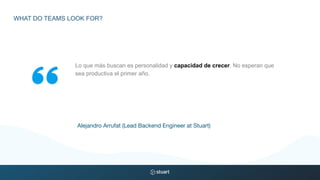
Lo que más buscan es personalidad y capacidad de crecer. No esperan que
sea productiva el primer año.
Alejandro Arrufat (Lead Backend Engineer at Stuart)
WHAT DO TEAMS LOOK FOR?
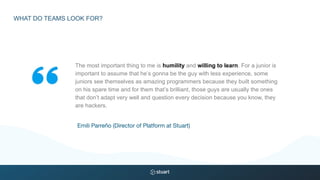
The most important thing to me is humility and willing to learn. For a junior is
important to assume that he’s gonna be the guy with less experience, some
juniors see themselves as amazing programmers because they built something
on his spare time and for them that’s brilliant, those guys are usually the ones
that don’t adapt very well and question every decision because you know, they
are hackers.
Emili Parreño (Director of Platform at Stuart)
WHAT DO TEAMS LOOK FOR?
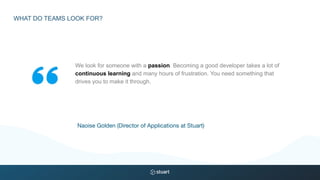
We look for someone with a passion. Becoming a good developer takes a lot of
continuous learning and many hours of frustration. You need something that
drives you to make it through.
Naoise Golden (Director of Applications at Stuart)
WHAT DO TEAMS LOOK FOR?
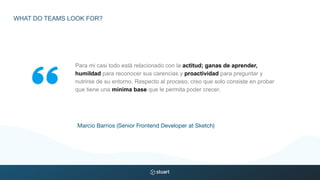
Para mi casi todo está relacionado con la actitud; ganas de aprender,
humildad para reconocer sus carencias y proactividad para preguntar y
nutrirse de su entorno. Respecto al proceso, creo que solo consiste en probar
que tiene una mínima base que le permita poder crecer.
Marcio Barrios (Senior Frontend Developer at Sketch)
WHAT DO TEAMS LOOK FOR?
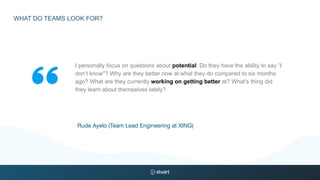
I personally focus on questions about potential: Do they have the ability to say “I
don’t know"? Why are they better now at what they do compared to six months
ago? What are they currently working on getting better at? What's thing did
they learn about themselves lately?
Rude Ayelo (Team Lead Engineering at XING)
WHAT DO TEAMS LOOK FOR?
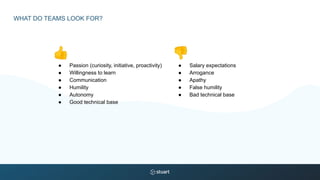
👍
● Passion (curiosity, initiative, proactivity)
● Willingness to learn
● Communication
● Humility
● Autonomy
● Good technical base
👎
● Salary expectations
● Arrogance
● Apathy
● False humility
● Bad technical base
WHAT DO TEAMS LOOK FOR?
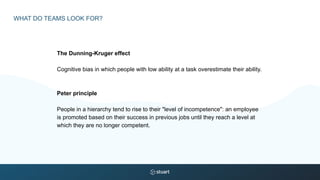
The Dunning-Kruger effect
Cognitive bias in which people with low ability at a task overestimate their ability.
Peter principle
People in a hierarchy tend to rise to their "level of incompetence": an employee
is promoted based on their success in previous jobs until they reach a level at
which they are no longer competent.
WHAT DO TEAMS LOOK FOR?
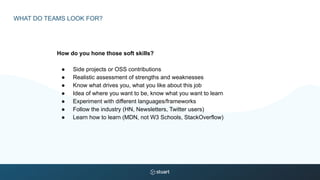
How do you hone those soft skills?
● Side projects or OSS contributions
● Realistic assessment of strengths and weaknesses
● Know what drives you, what you like about this job
● Idea of where you want to be, know what you want to learn
● Experiment with different languages/frameworks
● Follow the industry (HN, Newsletters, Twitter users)
● Learn how to learn (MDN, not W3 Schools, StackOverflow)
WHAT SHOULD YOU BE
LOOKING FOR IN A
COMPANY?
www.stuart.com
WHAT SHOULD YOU BE LOOKING FOR IN A COMPANY?
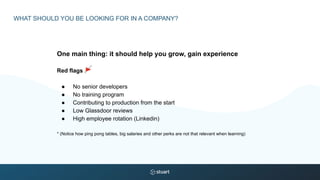
One main thing: it should help you grow, gain experience
Red flags 🚩
● No senior developers
● No training program
● Contributing to production from the start
● Low Glassdoor reviews
● High employee rotation (Linkedin)
* (Notice how ping pong tables, big salaries and other perks are not that relevant when learning)
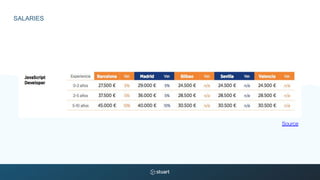
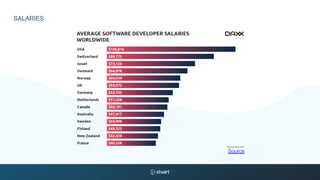
SALARIES
www.stuart.com
SALARIES
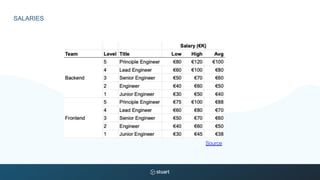
Glassdoor is your friend.
SALARIES
Source
SALARIES
Source
SALARIES
Source
SALARIES
How about full remote?
● I wouldn’t expect nor recommend starting full remote
● Learning needs a great deal of interaction in real life, serendipity and
happenstance with your colleagues and mentors
● Full remote is on itself a skill you can only get with experience, working in
remote-friendly companies
THANK YOU!
Q&A
www.stuart.com

The interview process for junior developers

  • 1.
    The Interview Processfor Junior Devs by Naoise Golden Santos
  • 3.
    What you lookfor SalariesWhat companies look forThe interview process ABOUT THIS PRESENTATION
  • 4.
  • 5.
  • 6.
    WHAT DO COMPANIESTEAMS LOOK FOR? www.stuart.com
  • 7.
    Un mínimo deautonomía para aprender e iniciativa. Suelo tener ojo con que las cosas que haya fallado o que no controlara bien en una entrevista, las haya mirado o estudiado para la siguiente por iniciativa propia. Después problemas de razonamiento evolutivo a partir de la prueba técnica, tipo "¿si ahora la app tuviera que hacer X, cómo lo atacarías?" Unai Esteibar (Software Engineer at Sketch & Ironhack Alumni) WHAT DO TEAMS LOOK FOR?
  • 8.
    We were mostlylooking for passion, willingness to learn. Martin Cabrera (Senior Backend Engineer at Stuart) WHAT DO TEAMS LOOK FOR?
  • 9.
    Proactivity and willingto learn, try new things, put in doubt established stuff, curiosity, and base knowledge. Albert Vico (Data Engineer Manager at Stuart) WHAT DO TEAMS LOOK FOR?
  • 10.
    For me it'sthe same as hiring a senior - excellent communication skills required. If you can discuss a problem and solution effectively, written or verbal, with humility and nuance, then it paves the way to working well with others. After that, transitioning from junior to senior is a matter of building experience. Sean Handley (Engineering Manager at Stuart) WHAT DO TEAMS LOOK FOR?
  • 11.
    Lo que másbuscan es personalidad y capacidad de crecer. No esperan que sea productiva el primer año. Alejandro Arrufat (Lead Backend Engineer at Stuart) WHAT DO TEAMS LOOK FOR?
  • 12.
    The most importantthing to me is humility and willing to learn. For a junior is important to assume that he’s gonna be the guy with less experience, some juniors see themselves as amazing programmers because they built something on his spare time and for them that’s brilliant, those guys are usually the ones that don’t adapt very well and question every decision because you know, they are hackers. Emili Parreño (Director of Platform at Stuart) WHAT DO TEAMS LOOK FOR?
  • 13.
    We look forsomeone with a passion. Becoming a good developer takes a lot of continuous learning and many hours of frustration. You need something that drives you to make it through. Naoise Golden (Director of Applications at Stuart) WHAT DO TEAMS LOOK FOR?
  • 14.
    Para mi casitodo está relacionado con la actitud; ganas de aprender, humildad para reconocer sus carencias y proactividad para preguntar y nutrirse de su entorno. Respecto al proceso, creo que solo consiste en probar que tiene una mínima base que le permita poder crecer. Marcio Barrios (Senior Frontend Developer at Sketch) WHAT DO TEAMS LOOK FOR?
  • 15.
    I personally focuson questions about potential: Do they have the ability to say “I don’t know"? Why are they better now at what they do compared to six months ago? What are they currently working on getting better at? What's thing did they learn about themselves lately? Rude Ayelo (Team Lead Engineering at XING) WHAT DO TEAMS LOOK FOR?
  • 16.
    WHAT DO TEAMSLOOK FOR? 👍 ● Passion (curiosity, initiative, proactivity) ● Willingness to learn ● Communication ● Humility ● Autonomy ● Good technical base 👎 ● Salary expectations ● Arrogance ● Apathy ● False humility ● Bad technical base
  • 17.
    WHAT DO TEAMSLOOK FOR? The Dunning-Kruger effect Cognitive bias in which people with low ability at a task overestimate their ability. Peter principle People in a hierarchy tend to rise to their "level of incompetence": an employee is promoted based on their success in previous jobs until they reach a level at which they are no longer competent.
  • 18.
    WHAT DO TEAMSLOOK FOR? How do you hone those soft skills? ● Side projects or OSS contributions ● Realistic assessment of strengths and weaknesses ● Know what drives you, what you like about this job ● Idea of where you want to be, know what you want to learn ● Experiment with different languages/frameworks ● Follow the industry (HN, Newsletters, Twitter users) ● Learn how to learn (MDN, not W3 Schools, StackOverflow)
  • 19.
    WHAT SHOULD YOUBE LOOKING FOR IN A COMPANY? www.stuart.com
  • 20.
    WHAT SHOULD YOUBE LOOKING FOR IN A COMPANY? One main thing: it should help you grow, gain experience Red flags 🚩 ● No senior developers ● No training program ● Contributing to production from the start ● Low Glassdoor reviews ● High employee rotation (Linkedin) * (Notice how ping pong tables, big salaries and other perks are not that relevant when learning)
  • 21.
  • 22.
  • 23.
  • 24.
  • 25.
  • 26.
    SALARIES How about fullremote? ● I wouldn’t expect nor recommend starting full remote ● Learning needs a great deal of interaction in real life, serendipity and happenstance with your colleagues and mentors ● Full remote is on itself a skill you can only get with experience, working in remote-friendly companies
  • 27.