IAN
PLANT
PHOTOGRAPHY
Pro Secrets For UNLEASHING Your Creativity
ESSENTIAL
y mission is to educate and inspire
others in the art and craft of photog-
Mraphy. So I make my books practical,
informative, fun to read—and packed with plenty of
delicious eye candy. This eBook introduces you to several important
concepts that are covered in greater depth in my many articles,
blog posts, books, and video tutorials. To delve deeper into how to
improve your photography, visit me at www.ianplant.com and
www.outdoorphotographyguide.com.
Enjoy this free book—you'll be taking better photos in no time!
Sorry, but my ever-expanding team of overpaid lawyers make me
say this stuff. This free ebook is for personal use only. Please be
aware that “all rights are reserved,” which means that if you try to
use any portion of this for commercial purposes, you’ll get eaten by
a hungry lion. This book, and all of the photographs and written
text contained therein, are protected by U.S. and international copy-
right laws. No part of this book may be reproduced without my
prior written permission. So don’t even think about it!
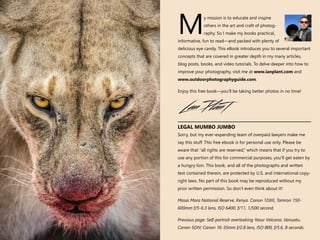
Masai Mara National Reserve, Kenya. Canon 1DXII, Tamron 150-
600mm f/5-6.3 lens, ISO 6400, f/11, 1/500 second.
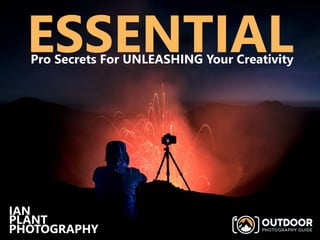
Previous page: Self-portrait overlooking Yasur Volcano, Vanuatu.
Canon 5DIV, Canon 16-35mm f/2.8 lens, ISO 800, f/5.6, 8 seconds.
LEGAL MUMBO JUMBO
Lan PlanT
love photography—I bet you do as well—but for a long time
my photographs just didn’t seem to match the depth of my
Ipassion. I struggled, desperately searching for a way to reach
my full potential as an artist.
And then I came to a profound realization: great photography
doesn’t come from gear or Photoshop. Rather, it comes from show-
ing people something they haven’t seen before. It was with this
insight that my career really took off. Now, I travel the world creat-
ing the photos I’ve always wanted to make, and I regularly sell my
work to leading photo magazines. And you can too!
What follows are creative lessons and techniques that I consider to
be essential to my success. These techniques really amount to one
thing: teaching you how to see the world with fresh eyes. If you can
do that, you’ll grab the attention of viewers, and never let go!
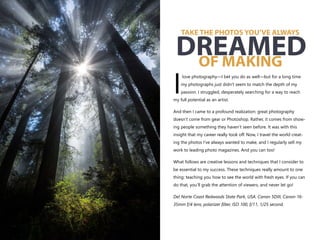
Del Norte Coast Redwoods State Park, USA. Canon 5DIII, Canon 16-
35mm f/4 lens, polarizer filter, ISO 100, f/11, 1/25 second.
TAKE THE PHOTOS YOU’VE ALWAYS
OF MAKING
DREAMED
1. Constituting or being part of the essence of something.
2. Something fundamental.
3. Something necessary or indispensable.
es·sen·tial rt is the act of uncovering the hidden essence, stripping
away all artifice, baring truth to the world. Only when the
Anon-essential has been removed can the artist reveal the
secret side of things, and truly express what the heart sees but the
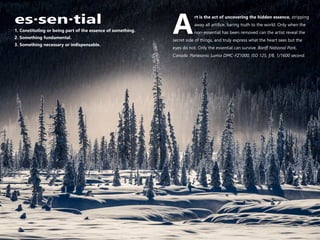
eyes do not. Only the essential can survive. Banff National Park,
Canada. Panasonic Lumix DMC-FZ1000, ISO 125, f/8, 1/1600 second.
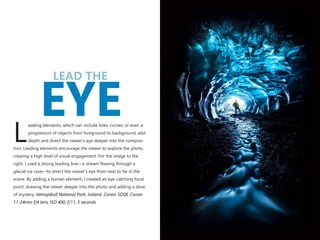
LEAD THE
EYEeading elements, which can include lines, curves, or even a
progression of objects from foreground to background, add
Ldepth and direct the viewer’s eye deeper into the composi-
tion. Leading elements encourage the viewer to explore the photo,
creating a high level of visual engagement. For the image to the
right, I used a strong leading line—a stream flowing through a
glacial ice cave—to direct the viewer’s eye from near to far in the
scene. By adding a human element, I created an eye-catching focal
point, drawing the viewer deeper into the photo and adding a dose
of mystery. Vatnajökull National Park, Iceland. Canon 5DSR, Canon
11-24mm f/4 lens, ISO 400, f/11, 5 seconds.
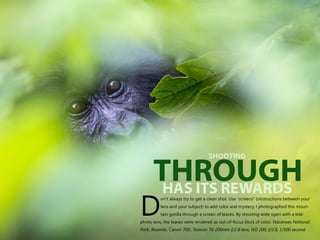
on’t always try to get a clean shot. Use “screens” (obstructions between your
lens and your subject) to add color and mystery. I photographed this moun-
Dtain gorilla through a screen of leaves. By shooting wide open with a tele-
photo lens, the leaves were rendered as out-of-focus blurs of color. Volcanoes National
Park, Rwanda. Canon 70D, Tamron 70-200mm f/2.8 lens, ISO 200, f/2.8, 1/500 second.
SHOOTING
HAS ITS REWARDS
THROUGH
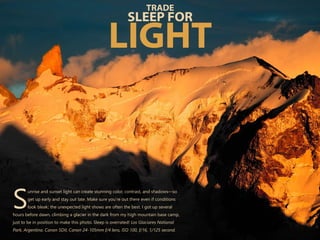
unrise and sunset light can create stunning color, contrast, and shadows—so
get up early and stay out late. Make sure you’re out there even if conditions
Slook bleak; the unexpected light shows are often the best. I got up several
hours before dawn, climbing a glacier in the dark from my high mountain base camp,
just to be in position to make this photo. Sleep is overrated! Los Glaciares National
Park, Argentina. Canon 5DII, Canon 24-105mm f/4 lens, ISO 100, f/16, 1/125 second.
TRADE
SLEEP FOR
LIGHT
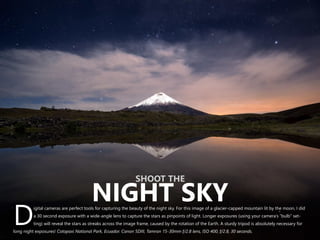
igital cameras are perfect tools for capturing the beauty of the night sky. For this image of a glacier-capped mountain lit by the moon, I did
a 30 second exposure with a wide-angle lens to capture the stars as pinpoints of light. Longer exposures (using your camera’s “bulb” set-
Dting) will reveal the stars as streaks across the image frame, caused by the rotation of the Earth. A sturdy tripod is absolutely necessary for
long night exposures! Cotopaxi National Park, Ecuador. Canon 5DIII, Tamron 15-30mm f/2.8 lens, ISO 400, f/2.8, 30 seconds.
SHOOT THE
NIGHT SKY
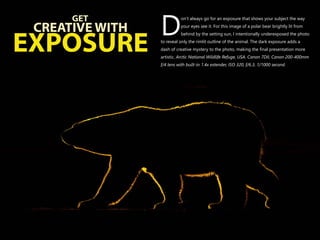
on’t always go for an exposure that shows your subject the way
your eyes see it. For this image of a polar bear brightly lit from
Dbehind by the setting sun, I intentionally underexposed the photo
to reveal only the rimlit outline of the animal. The dark exposure adds a
dash of creative mystery to the photo, making the final presentation more
artistic. Arctic National Wildlife Refuge, USA.
f/4 lens with built-in 1.4x extender, ISO 320, f/6.3, 1/1000 second.
Canon 7DII, Canon 200-400mm
GET
CREATIVE WITH
EXPOSURE
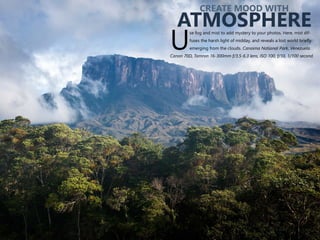
se fog and mist to add mystery to your photos. Here, mist dif-
fuses the harsh light of midday, and reveals a lost world briefly
Uemerging from the clouds. Canaima National Park, Venezuela.
Canon 70D, Tamron 16-300mm f/3.5-6.3 lens, ISO 100, f/10, 1/100 second.
CREATE MOOD WITH
ATMOSPHERE
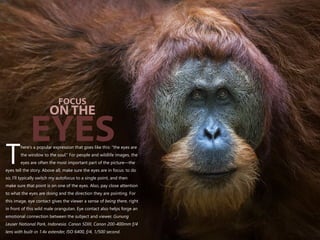
here’s a popular expression that goes like this: “the eyes are
the window to the soul.” For people and wildlife images, the
Teyes are often the most important part of the picture—the
eyes tell the story. Above all, make sure the eyes are in focus: to do
so, I’ll typically switch my autofocus to a single point, and then
make sure that point is on one of the eyes. Also, pay close attention
to what the eyes are doing and the direction they are pointing. For
this image, eye contact gives the viewer a sense of being there, right
in front of this wild male orangutan. Eye contact also helps forge an
emotional connection between the subject and viewer. Gunung
Leuser National Park, Indonesia. Canon 5DIII, Canon 200-400mm f/4
lens with built-in 1.4x extender, ISO 6400, f/4, 1/500 second.
FOCUS
ON THE
EYES
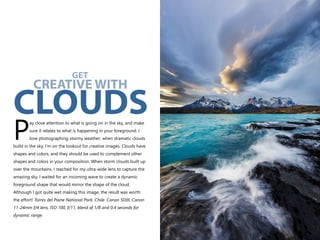
ay close attention to what is going on in the sky, and make
sure it relates to what is happening in your foreground. I
Plove photographing stormy weather; when dramatic clouds
build in the sky, I’m on the lookout for creative images. Clouds have
shapes and colors, and they should be used to complement other
shapes and colors in your composition. When storm clouds built up
over the mountains, I reached for my ultra-wide lens to capture the
amazing sky. I waited for an incoming wave to create a dynamic
foreground shape that would mirror the shape of the cloud.
Although I got quite wet making this image, the result was worth
the effort! Torres del Paine National Park, Chile. Canon 5DIII, Canon
11-24mm f/4 lens, ISO 100, f/11, blend of 1/8 and 0.4 seconds for
dynamic range.
GET
CREATIVE WITH
CLOUDS
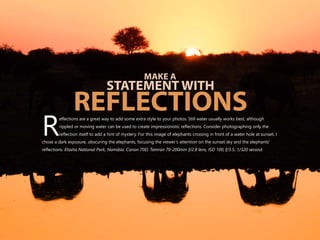
eflections are a great way to add some extra style to your photos. Still water usually works best, although
rippled or moving water can be used to create impressionistic reflections. Consider photographing only the
Rreflection itself to add a hint of mystery. For this image of elephants crossing in front of a water hole at sunset, I
chose a dark exposure, obscuring the elephants, focusing the viewer’s attention on the sunset sky and the elephants'
reflections. Etosha National Park, Namibia. Canon 70D, Tamron 70-200mm f/2.8 lens, ISO 100, f/3.5, 1/320 second.
MAKE A
STATEMENT WITH
REFLECTIONS
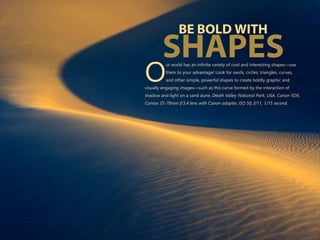
ur world has an infinite variety of cool and interesting shapes—use
them to your advantage! Look for swirls, circles, triangles, curves,
Oand other simple, powerful shapes to create boldly graphic and
visually engaging images—such as this curve formed by the interaction of
shadow and light on a sand dune. Death Valley National Park, USA. Canon 5DII,
Contax 35-70mm f/3.4 lens with Canon adapter, ISO 50, f/11, 1/15 second.
BE BOLD WITH
SHAPES
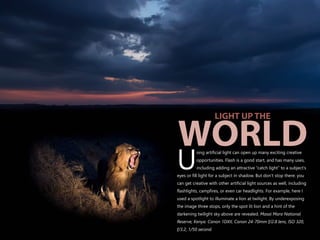
sing artificial light can open up many exciting creative
opportunities. Flash is a good start, and has many uses,
Uincluding adding an attractive “catch light” to a subject’s
eyes or fill light for a subject in shadow. But don’t stop there: you
can get creative with other artificial light sources as well, including
flashlights, campfires, or even car headlights. For example, here I
used a spotlight to illuminate a lion at twilight. By underexposing
the image three stops, only the spot lit lion and a hint of the
darkening twilight sky above are revealed. Masai Mara National
Reserve, Kenya. Canon 1DXII, Canon 24-70mm f/2.8 lens, ISO 320,
f/3.2, 1/50 second.
LIGHT UP THE
WORLD
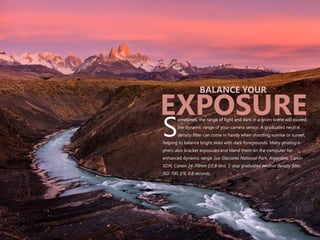
ometimes, the range of light and dark in a given scene will exceed
the dynamic range of your camera sensor. A graduated neutral
Sdensity filter can come in handy when shooting sunrise or sunset,
helping to balance bright skies with dark foregrounds. Many photogra-
phers also bracket exposures and blend them on the computer for
enhanced dynamic range. Los Glaciares National Park, Argentina. Canon
5DIII, Canon 24-70mm f/2.8 lens, 2-stop graduated neutral density filter,
ISO 100, f/9, 0.8 seconds.
BALANCE YOUR
EXPOSURE
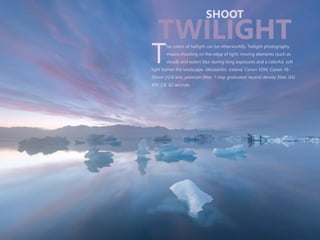
he colors of twilight can be otherworldly. Twilight photography
means shooting on the edge of light; moving elements (such as
Tclouds and water) blur during long exposures and a colorful, soft
light bathes the landscape. Jökulsárlón, Iceland. Canon 5DIII, Canon 16-
35mm f/2.8 lens, polarizer filter, 1-stop graduated neutral density filter, ISO
400, f/8, 82 seconds.
SHOOT
TWILIGHT
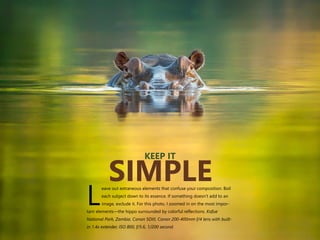
eave out extraneous elements that confuse your composition. Boil
each subject down to its essence. If something doesn’t add to an
Limage, exclude it. For this photo, I zoomed in on the most impor-
tant elements—the hippo surrounded by colorful reflections. Kafue
National Park, Zambia. Canon 5DIII, Canon 200-400mm f/4 lens with built-
in 1.4x extender, ISO 800, f/5.6, 1/200 second.
KEEP IT
SIMPLE
EXPRESS YOUR
PASSION WITH
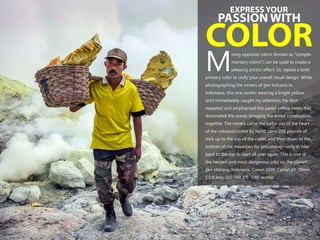
COLORixing opposite colors (known as “comple-
mentary colors”) can be used to create a
Mpleasing artistic effect. Or, repeat a bold
primary color to unify your overall visual design. While
photographing the miners of Ijen Volcano in
Indonesia, this one worker wearing a bright yellow
shirt immediately caught my attention; his shirt
repeated and emphasized the pastel yellow tones that
dominated the scene, bringing the entire composition
together. The miners carve the sulfur out of the heart
of the volcano’s crater by hand, carry 200 pounds of
rock up to the top of the crater, and then down to the
bottom of the mountain for processing—only to hike
back to the top to start all over again. This is one of
the hardest and most dangerous jobs on the planet!
Ijen Volcano, Indonesia. Canon 5DIII, Canon 24-70mm
f/2.8 lens, ISO 100, f/5, 1/80 second.
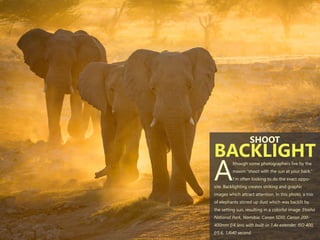
lthough some photographers live by the
maxim “shoot with the sun at your back,”
AI’m often looking to do the exact oppo-
site. Backlighting creates striking and graphic
images which attract attention. In this photo, a trio
of elephants stirred up dust which was backlit by
the setting sun, resulting in a colorful image. Etosha
National Park, Namibia. Canon 5DIII, Canon 200-
400mm f/4 lens with built-in 1.4x extender, ISO 400,
f/5.6, 1/640 second.
SHOOT
BACKLIGHT
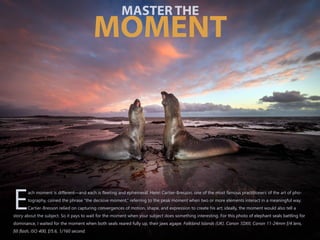
ach moment is different—and each is fleeting and ephemeral. Henri Cartier-Bresson, one of the most famous practitioners of the art of pho-
tography, coined the phrase “the decisive moment,” referring to the peak moment when two or more elements interact in a meaningful way.
ECartier-Bresson relied on capturing convergences of motion, shape, and expression to create his art; ideally, the moment would also tell a
story about the subject. So it pays to wait for the moment when your subject does something interesting. For this photo of elephant seals battling for
dominance, I waited for the moment when both seals reared fully up, their jaws agape. Falkland Islands (UK). Canon 1DXII, Canon 11-24mm f/4 lens,
fill flash, ISO 400, f/5.6, 1/160 second.
MASTER THE
MOMENT
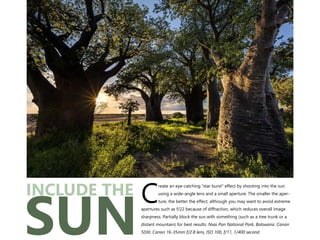
reate an eye-catching “star burst” effect by shooting into the sun
using a wide-angle lens and a small aperture. The smaller the aper-
Cture, the better the effect, although you may want to avoid extreme
apertures such as f/22 because of diffraction, which reduces overall image
sharpness. Partially block the sun with something (such as a tree trunk or a
distant mountain) for best results. Nxai Pan National Park, Botswana. Canon
5DIII, Canon 16-35mm f/2.8 lens, ISO 100, f/11, 1/400 second.
INCLUDE THE
SUN
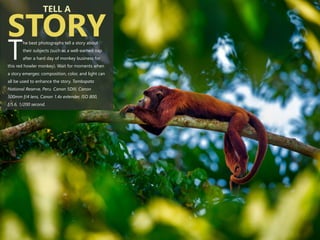
he best photographs tell a story about
their subjects (such as a well-earned nap
Tafter a hard day of monkey business for
this red howler monkey). Wait for moments when
a story emerges: composition, color, and light can
all be used to enhance the story. Tambopata
National Reserve, Peru. Canon 5DIII, Canon
500mm f/4 lens, Canon 1.4x extender, ISO 800,
f/5.6, 1/200 second.
TELL A
STORY
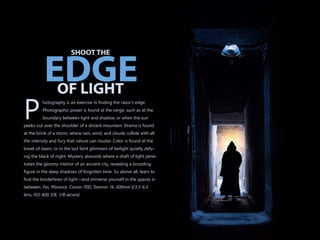
hotography is an exercise in finding the razor’s edge.
Photographic power is found at the verge, such as at the
Pboundary between light and shadow, or when the sun
peeks out over the shoulder of a distant mountain. Drama is found
at the brink of a storm, where rain, wind, and clouds collide with all
the intensity and fury that nature can muster. Color is found at the
break of dawn, or in the last faint glimmers of twilight quietly defy-
ing the black of night. Mystery abounds where a shaft of light pene-
trates the gloomy interior of an ancient city, revealing a brooding
figure in the deep shadows of forgotten time. So above all, learn to
find the borderlines of light—and immerse yourself in the spaces in
between. Fes, Morocco. Canon 70D, Tamron 16-300mm f/3.5-6.3
lens, ISO 400, f/8, 1/8 second.
SHOOT THE
OF LIGHT
EDGE
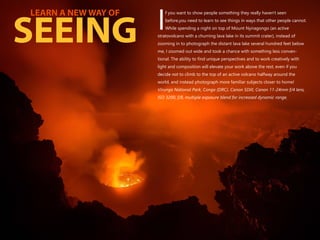
f you want to show people something they really haven't seen
before,you need to learn to see things in ways that other people cannot.
IWhile spending a night on top of Mount Nyiragongo (an active
stratovolcano with a churning lava lake in its summit crater), instead of
zooming in to photograph the distant lava lake several hundred feet below
me, I zoomed out wide and took a chance with something less conven-
tional. The ability to find unique perspectives and to work creatively with
light and composition will elevate your work above the rest, even if you
decide not to climb to the top of an active volcano halfway around the
world, and instead photograph more familiar subjects closer to home!
Virunga National Park, Congo (DRC). Canon 5DIII, Canon 11-24mm f/4 lens,
ISO 3200, f/8, multiple exposure blend for increased dynamic range.
LEARN A NEW WAY OF
SEEING
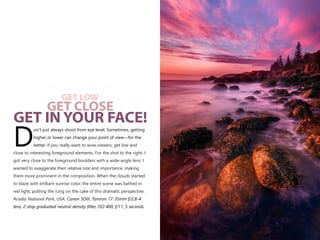
on’t just always shoot from eye level. Sometimes, getting
higher or lower can change your point of view—for the
Dbetter.
Canon 5DIII, Tamron 17-35mm f/2.8-4
lens, 2-stop graduated neutral density filter, ISO 400, f/11, 5 seconds.
If you really want to wow viewers, get low and
close to interesting foreground elements. For the shot to the right, I
got very close to the foreground boulders with a wide-angle lens. I
wanted to exaggerate their relative size and importance, making
them more prominent in the composition. When the clouds started
to blaze with brilliant sunrise color, the entire scene was bathed in
red light, putting the icing on the cake of this dramatic perspective.
Acadia National Park, USA.
GET LOW
GET CLOSE
GET IN YOUR FACE!
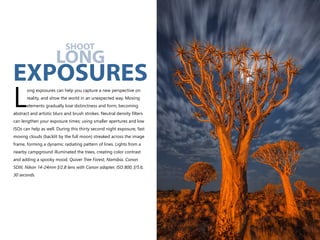
ong exposures can help you capture a new perspective on
reality, and show the world in an unexpected way. Moving
Lelements gradually lose distinctness and form, becoming
abstract and artistic blurs and brush strokes. Neutral density filters
can lengthen your exposure times; using smaller apertures and low
ISOs can help as well. During this thirty second night exposure, fast
moving clouds (backlit by the full moon) streaked across the image
frame, forming a dynamic radiating pattern of lines. Lights from a
nearby campground illuminated the trees, creating color contrast
and adding a spooky mood. Quiver Tree Forest, Namibia. Canon
5DIII, Nikon 14-24mm f/2.8 lens with Canon adapter, ISO 800, f/5.6,
30 seconds.
SHOOT
LONG
EXPOSURES
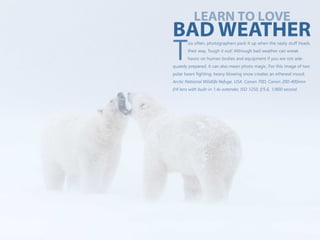
oo often, photographers pack it up when the nasty stuff heads
their way. Tough it out! Although bad weather can wreak
Thavoc on human bodies and equipment if you are not ade-
quately prepared, it can also mean photo magic. For this image of two
polar bears fighting, heavy blowing snow creates an ethereal mood.
Arctic National Wildlife Refuge, USA. Canon 70D, Canon 200-400mm
f/4 lens with built-in 1.4x extender, ISO 1250, f/5.6, 1/800 second.
LEARN TO LOVE
BAD WEATHER
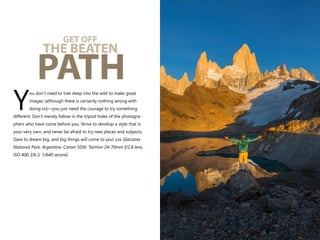
ou don’t need to trek deep into the wild to make great
images (although there is certainly nothing wrong with
Ydoing so)—you just need the courage to try something
different. Don’t merely follow in the tripod holes of the photogra-
phers who have come before you. Strive to develop a style that is
your very own, and never be afraid to try new places and subjects.
Dare to dream big, and big things will come to you! Los Glaciares
National Park, Argentina. Canon 5DIII, Tarmon 24-70mm f/2.8 lens,
ISO 400, f/6.3, 1/640 second.
GET OFF
THE BEATEN
PATH
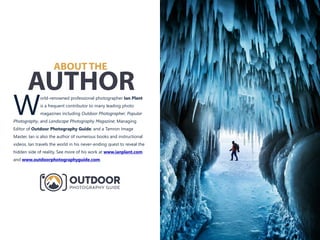
ABOUT THE
AUTHORorld-renowned professional photographer Ian Plant
is a frequent contributor to many leading photo
Wmagazines including Outdoor Photographer, Popular
Photography, and Landscape Photography Magazine; Managing
Editor of Outdoor Photography Guide; and a Tamron Image
Master. Ian is also the author of numerous books and instructional
videos. Ian travels the world in his never-ending quest to reveal the
hidden side of reality. See more of his work at
and .
www.ianplant.com
www.outdoorphotographyguide.com

Essential

  • 1.
    IAN PLANT PHOTOGRAPHY Pro Secrets ForUNLEASHING Your Creativity ESSENTIAL
  • 2.
    y mission isto educate and inspire others in the art and craft of photog- Mraphy. So I make my books practical, informative, fun to read—and packed with plenty of delicious eye candy. This eBook introduces you to several important concepts that are covered in greater depth in my many articles, blog posts, books, and video tutorials. To delve deeper into how to improve your photography, visit me at www.ianplant.com and www.outdoorphotographyguide.com. Enjoy this free book—you'll be taking better photos in no time! Sorry, but my ever-expanding team of overpaid lawyers make me say this stuff. This free ebook is for personal use only. Please be aware that “all rights are reserved,” which means that if you try to use any portion of this for commercial purposes, you’ll get eaten by a hungry lion. This book, and all of the photographs and written text contained therein, are protected by U.S. and international copy- right laws. No part of this book may be reproduced without my prior written permission. So don’t even think about it! Masai Mara National Reserve, Kenya. Canon 1DXII, Tamron 150- 600mm f/5-6.3 lens, ISO 6400, f/11, 1/500 second. Previous page: Self-portrait overlooking Yasur Volcano, Vanuatu. Canon 5DIV, Canon 16-35mm f/2.8 lens, ISO 800, f/5.6, 8 seconds. LEGAL MUMBO JUMBO Lan PlanT
  • 3.
    love photography—I betyou do as well—but for a long time my photographs just didn’t seem to match the depth of my Ipassion. I struggled, desperately searching for a way to reach my full potential as an artist. And then I came to a profound realization: great photography doesn’t come from gear or Photoshop. Rather, it comes from show- ing people something they haven’t seen before. It was with this insight that my career really took off. Now, I travel the world creat- ing the photos I’ve always wanted to make, and I regularly sell my work to leading photo magazines. And you can too! What follows are creative lessons and techniques that I consider to be essential to my success. These techniques really amount to one thing: teaching you how to see the world with fresh eyes. If you can do that, you’ll grab the attention of viewers, and never let go! Del Norte Coast Redwoods State Park, USA. Canon 5DIII, Canon 16- 35mm f/4 lens, polarizer filter, ISO 100, f/11, 1/25 second. TAKE THE PHOTOS YOU’VE ALWAYS OF MAKING DREAMED
  • 4.
    1. Constituting orbeing part of the essence of something. 2. Something fundamental. 3. Something necessary or indispensable. es·sen·tial rt is the act of uncovering the hidden essence, stripping away all artifice, baring truth to the world. Only when the Anon-essential has been removed can the artist reveal the secret side of things, and truly express what the heart sees but the eyes do not. Only the essential can survive. Banff National Park, Canada. Panasonic Lumix DMC-FZ1000, ISO 125, f/8, 1/1600 second.
  • 5.
    LEAD THE EYEeading elements,which can include lines, curves, or even a progression of objects from foreground to background, add Ldepth and direct the viewer’s eye deeper into the composi- tion. Leading elements encourage the viewer to explore the photo, creating a high level of visual engagement. For the image to the right, I used a strong leading line—a stream flowing through a glacial ice cave—to direct the viewer’s eye from near to far in the scene. By adding a human element, I created an eye-catching focal point, drawing the viewer deeper into the photo and adding a dose of mystery. Vatnajökull National Park, Iceland. Canon 5DSR, Canon 11-24mm f/4 lens, ISO 400, f/11, 5 seconds.
  • 6.
    on’t always tryto get a clean shot. Use “screens” (obstructions between your lens and your subject) to add color and mystery. I photographed this moun- Dtain gorilla through a screen of leaves. By shooting wide open with a tele- photo lens, the leaves were rendered as out-of-focus blurs of color. Volcanoes National Park, Rwanda. Canon 70D, Tamron 70-200mm f/2.8 lens, ISO 200, f/2.8, 1/500 second. SHOOTING HAS ITS REWARDS THROUGH
  • 7.
    unrise and sunsetlight can create stunning color, contrast, and shadows—so get up early and stay out late. Make sure you’re out there even if conditions Slook bleak; the unexpected light shows are often the best. I got up several hours before dawn, climbing a glacier in the dark from my high mountain base camp, just to be in position to make this photo. Sleep is overrated! Los Glaciares National Park, Argentina. Canon 5DII, Canon 24-105mm f/4 lens, ISO 100, f/16, 1/125 second. TRADE SLEEP FOR LIGHT
  • 8.
    igital cameras areperfect tools for capturing the beauty of the night sky. For this image of a glacier-capped mountain lit by the moon, I did a 30 second exposure with a wide-angle lens to capture the stars as pinpoints of light. Longer exposures (using your camera’s “bulb” set- Dting) will reveal the stars as streaks across the image frame, caused by the rotation of the Earth. A sturdy tripod is absolutely necessary for long night exposures! Cotopaxi National Park, Ecuador. Canon 5DIII, Tamron 15-30mm f/2.8 lens, ISO 400, f/2.8, 30 seconds. SHOOT THE NIGHT SKY
  • 9.
    on’t always gofor an exposure that shows your subject the way your eyes see it. For this image of a polar bear brightly lit from Dbehind by the setting sun, I intentionally underexposed the photo to reveal only the rimlit outline of the animal. The dark exposure adds a dash of creative mystery to the photo, making the final presentation more artistic. Arctic National Wildlife Refuge, USA. f/4 lens with built-in 1.4x extender, ISO 320, f/6.3, 1/1000 second. Canon 7DII, Canon 200-400mm GET CREATIVE WITH EXPOSURE
  • 10.
    se fog andmist to add mystery to your photos. Here, mist dif- fuses the harsh light of midday, and reveals a lost world briefly Uemerging from the clouds. Canaima National Park, Venezuela. Canon 70D, Tamron 16-300mm f/3.5-6.3 lens, ISO 100, f/10, 1/100 second. CREATE MOOD WITH ATMOSPHERE
  • 11.
    here’s a popularexpression that goes like this: “the eyes are the window to the soul.” For people and wildlife images, the Teyes are often the most important part of the picture—the eyes tell the story. Above all, make sure the eyes are in focus: to do so, I’ll typically switch my autofocus to a single point, and then make sure that point is on one of the eyes. Also, pay close attention to what the eyes are doing and the direction they are pointing. For this image, eye contact gives the viewer a sense of being there, right in front of this wild male orangutan. Eye contact also helps forge an emotional connection between the subject and viewer. Gunung Leuser National Park, Indonesia. Canon 5DIII, Canon 200-400mm f/4 lens with built-in 1.4x extender, ISO 6400, f/4, 1/500 second. FOCUS ON THE EYES
  • 12.
    ay close attentionto what is going on in the sky, and make sure it relates to what is happening in your foreground. I Plove photographing stormy weather; when dramatic clouds build in the sky, I’m on the lookout for creative images. Clouds have shapes and colors, and they should be used to complement other shapes and colors in your composition. When storm clouds built up over the mountains, I reached for my ultra-wide lens to capture the amazing sky. I waited for an incoming wave to create a dynamic foreground shape that would mirror the shape of the cloud. Although I got quite wet making this image, the result was worth the effort! Torres del Paine National Park, Chile. Canon 5DIII, Canon 11-24mm f/4 lens, ISO 100, f/11, blend of 1/8 and 0.4 seconds for dynamic range. GET CREATIVE WITH CLOUDS
  • 13.
    eflections are agreat way to add some extra style to your photos. Still water usually works best, although rippled or moving water can be used to create impressionistic reflections. Consider photographing only the Rreflection itself to add a hint of mystery. For this image of elephants crossing in front of a water hole at sunset, I chose a dark exposure, obscuring the elephants, focusing the viewer’s attention on the sunset sky and the elephants' reflections. Etosha National Park, Namibia. Canon 70D, Tamron 70-200mm f/2.8 lens, ISO 100, f/3.5, 1/320 second. MAKE A STATEMENT WITH REFLECTIONS
  • 14.
    ur world hasan infinite variety of cool and interesting shapes—use them to your advantage! Look for swirls, circles, triangles, curves, Oand other simple, powerful shapes to create boldly graphic and visually engaging images—such as this curve formed by the interaction of shadow and light on a sand dune. Death Valley National Park, USA. Canon 5DII, Contax 35-70mm f/3.4 lens with Canon adapter, ISO 50, f/11, 1/15 second. BE BOLD WITH SHAPES
  • 15.
    sing artificial lightcan open up many exciting creative opportunities. Flash is a good start, and has many uses, Uincluding adding an attractive “catch light” to a subject’s eyes or fill light for a subject in shadow. But don’t stop there: you can get creative with other artificial light sources as well, including flashlights, campfires, or even car headlights. For example, here I used a spotlight to illuminate a lion at twilight. By underexposing the image three stops, only the spot lit lion and a hint of the darkening twilight sky above are revealed. Masai Mara National Reserve, Kenya. Canon 1DXII, Canon 24-70mm f/2.8 lens, ISO 320, f/3.2, 1/50 second. LIGHT UP THE WORLD
  • 16.
    ometimes, the rangeof light and dark in a given scene will exceed the dynamic range of your camera sensor. A graduated neutral Sdensity filter can come in handy when shooting sunrise or sunset, helping to balance bright skies with dark foregrounds. Many photogra- phers also bracket exposures and blend them on the computer for enhanced dynamic range. Los Glaciares National Park, Argentina. Canon 5DIII, Canon 24-70mm f/2.8 lens, 2-stop graduated neutral density filter, ISO 100, f/9, 0.8 seconds. BALANCE YOUR EXPOSURE
  • 17.
    he colors oftwilight can be otherworldly. Twilight photography means shooting on the edge of light; moving elements (such as Tclouds and water) blur during long exposures and a colorful, soft light bathes the landscape. Jökulsárlón, Iceland. Canon 5DIII, Canon 16- 35mm f/2.8 lens, polarizer filter, 1-stop graduated neutral density filter, ISO 400, f/8, 82 seconds. SHOOT TWILIGHT
  • 18.
    eave out extraneouselements that confuse your composition. Boil each subject down to its essence. If something doesn’t add to an Limage, exclude it. For this photo, I zoomed in on the most impor- tant elements—the hippo surrounded by colorful reflections. Kafue National Park, Zambia. Canon 5DIII, Canon 200-400mm f/4 lens with built- in 1.4x extender, ISO 800, f/5.6, 1/200 second. KEEP IT SIMPLE
  • 19.
    EXPRESS YOUR PASSION WITH COLORixingopposite colors (known as “comple- mentary colors”) can be used to create a Mpleasing artistic effect. Or, repeat a bold primary color to unify your overall visual design. While photographing the miners of Ijen Volcano in Indonesia, this one worker wearing a bright yellow shirt immediately caught my attention; his shirt repeated and emphasized the pastel yellow tones that dominated the scene, bringing the entire composition together. The miners carve the sulfur out of the heart of the volcano’s crater by hand, carry 200 pounds of rock up to the top of the crater, and then down to the bottom of the mountain for processing—only to hike back to the top to start all over again. This is one of the hardest and most dangerous jobs on the planet! Ijen Volcano, Indonesia. Canon 5DIII, Canon 24-70mm f/2.8 lens, ISO 100, f/5, 1/80 second.
  • 20.
    lthough some photographerslive by the maxim “shoot with the sun at your back,” AI’m often looking to do the exact oppo- site. Backlighting creates striking and graphic images which attract attention. In this photo, a trio of elephants stirred up dust which was backlit by the setting sun, resulting in a colorful image. Etosha National Park, Namibia. Canon 5DIII, Canon 200- 400mm f/4 lens with built-in 1.4x extender, ISO 400, f/5.6, 1/640 second. SHOOT BACKLIGHT
  • 21.
    ach moment isdifferent—and each is fleeting and ephemeral. Henri Cartier-Bresson, one of the most famous practitioners of the art of pho- tography, coined the phrase “the decisive moment,” referring to the peak moment when two or more elements interact in a meaningful way. ECartier-Bresson relied on capturing convergences of motion, shape, and expression to create his art; ideally, the moment would also tell a story about the subject. So it pays to wait for the moment when your subject does something interesting. For this photo of elephant seals battling for dominance, I waited for the moment when both seals reared fully up, their jaws agape. Falkland Islands (UK). Canon 1DXII, Canon 11-24mm f/4 lens, fill flash, ISO 400, f/5.6, 1/160 second. MASTER THE MOMENT
  • 22.
    reate an eye-catching“star burst” effect by shooting into the sun using a wide-angle lens and a small aperture. The smaller the aper- Cture, the better the effect, although you may want to avoid extreme apertures such as f/22 because of diffraction, which reduces overall image sharpness. Partially block the sun with something (such as a tree trunk or a distant mountain) for best results. Nxai Pan National Park, Botswana. Canon 5DIII, Canon 16-35mm f/2.8 lens, ISO 100, f/11, 1/400 second. INCLUDE THE SUN
  • 23.
    he best photographstell a story about their subjects (such as a well-earned nap Tafter a hard day of monkey business for this red howler monkey). Wait for moments when a story emerges: composition, color, and light can all be used to enhance the story. Tambopata National Reserve, Peru. Canon 5DIII, Canon 500mm f/4 lens, Canon 1.4x extender, ISO 800, f/5.6, 1/200 second. TELL A STORY
  • 24.
    hotography is anexercise in finding the razor’s edge. Photographic power is found at the verge, such as at the Pboundary between light and shadow, or when the sun peeks out over the shoulder of a distant mountain. Drama is found at the brink of a storm, where rain, wind, and clouds collide with all the intensity and fury that nature can muster. Color is found at the break of dawn, or in the last faint glimmers of twilight quietly defy- ing the black of night. Mystery abounds where a shaft of light pene- trates the gloomy interior of an ancient city, revealing a brooding figure in the deep shadows of forgotten time. So above all, learn to find the borderlines of light—and immerse yourself in the spaces in between. Fes, Morocco. Canon 70D, Tamron 16-300mm f/3.5-6.3 lens, ISO 400, f/8, 1/8 second. SHOOT THE OF LIGHT EDGE
  • 25.
    f you wantto show people something they really haven't seen before,you need to learn to see things in ways that other people cannot. IWhile spending a night on top of Mount Nyiragongo (an active stratovolcano with a churning lava lake in its summit crater), instead of zooming in to photograph the distant lava lake several hundred feet below me, I zoomed out wide and took a chance with something less conven- tional. The ability to find unique perspectives and to work creatively with light and composition will elevate your work above the rest, even if you decide not to climb to the top of an active volcano halfway around the world, and instead photograph more familiar subjects closer to home! Virunga National Park, Congo (DRC). Canon 5DIII, Canon 11-24mm f/4 lens, ISO 3200, f/8, multiple exposure blend for increased dynamic range. LEARN A NEW WAY OF SEEING
  • 26.
    on’t just alwaysshoot from eye level. Sometimes, getting higher or lower can change your point of view—for the Dbetter. Canon 5DIII, Tamron 17-35mm f/2.8-4 lens, 2-stop graduated neutral density filter, ISO 400, f/11, 5 seconds. If you really want to wow viewers, get low and close to interesting foreground elements. For the shot to the right, I got very close to the foreground boulders with a wide-angle lens. I wanted to exaggerate their relative size and importance, making them more prominent in the composition. When the clouds started to blaze with brilliant sunrise color, the entire scene was bathed in red light, putting the icing on the cake of this dramatic perspective. Acadia National Park, USA. GET LOW GET CLOSE GET IN YOUR FACE!
  • 27.
    ong exposures canhelp you capture a new perspective on reality, and show the world in an unexpected way. Moving Lelements gradually lose distinctness and form, becoming abstract and artistic blurs and brush strokes. Neutral density filters can lengthen your exposure times; using smaller apertures and low ISOs can help as well. During this thirty second night exposure, fast moving clouds (backlit by the full moon) streaked across the image frame, forming a dynamic radiating pattern of lines. Lights from a nearby campground illuminated the trees, creating color contrast and adding a spooky mood. Quiver Tree Forest, Namibia. Canon 5DIII, Nikon 14-24mm f/2.8 lens with Canon adapter, ISO 800, f/5.6, 30 seconds. SHOOT LONG EXPOSURES
  • 28.
    oo often, photographerspack it up when the nasty stuff heads their way. Tough it out! Although bad weather can wreak Thavoc on human bodies and equipment if you are not ade- quately prepared, it can also mean photo magic. For this image of two polar bears fighting, heavy blowing snow creates an ethereal mood. Arctic National Wildlife Refuge, USA. Canon 70D, Canon 200-400mm f/4 lens with built-in 1.4x extender, ISO 1250, f/5.6, 1/800 second. LEARN TO LOVE BAD WEATHER
  • 29.
    ou don’t needto trek deep into the wild to make great images (although there is certainly nothing wrong with Ydoing so)—you just need the courage to try something different. Don’t merely follow in the tripod holes of the photogra- phers who have come before you. Strive to develop a style that is your very own, and never be afraid to try new places and subjects. Dare to dream big, and big things will come to you! Los Glaciares National Park, Argentina. Canon 5DIII, Tarmon 24-70mm f/2.8 lens, ISO 400, f/6.3, 1/640 second. GET OFF THE BEATEN PATH
  • 30.
    ABOUT THE AUTHORorld-renowned professionalphotographer Ian Plant is a frequent contributor to many leading photo Wmagazines including Outdoor Photographer, Popular Photography, and Landscape Photography Magazine; Managing Editor of Outdoor Photography Guide; and a Tamron Image Master. Ian is also the author of numerous books and instructional videos. Ian travels the world in his never-ending quest to reveal the hidden side of reality. See more of his work at and . www.ianplant.com www.outdoorphotographyguide.com