The History
of Artificial
Intelligence
From Early Beginnings to Modern
Advancements
Presentation
Overview
AI Overview
We will begin with an overview of AI, its definition, and its goals, to
understand the basics of AI and its purpose.
Beginnings of AI
The first period of AI, known as the 'Beginnings of AI', was
characterized by the development of early AI techniques and the first AI
programs.
AI Winter
The second period of AI, known as the 'AI Winter', was characterized by
decreased funding and interest in AI research due to perceived failures
and limitations.
Modern Era of AI
The third period of AI, known as the 'Modern Era of AI', is characterized
by the resurgence of AI research and breakthroughs in machine
learning, deep learning, and other AI techniques.
The Beginnings of AI
Dartmouth Conference
The Dartmouth Conference in the mid-1950s marked the beginning of AI
research and formalized AI as a field of study.
Early AI Research
Early AI research focused on the development of expert systems, which were
designed to mimic the decision-making abilities of human experts.
Challenges in Early AI Research
AI researchers faced many challenges in the early days of the field, including
limited computational power and a lack of data and algorithms.
Dartmouth Conference
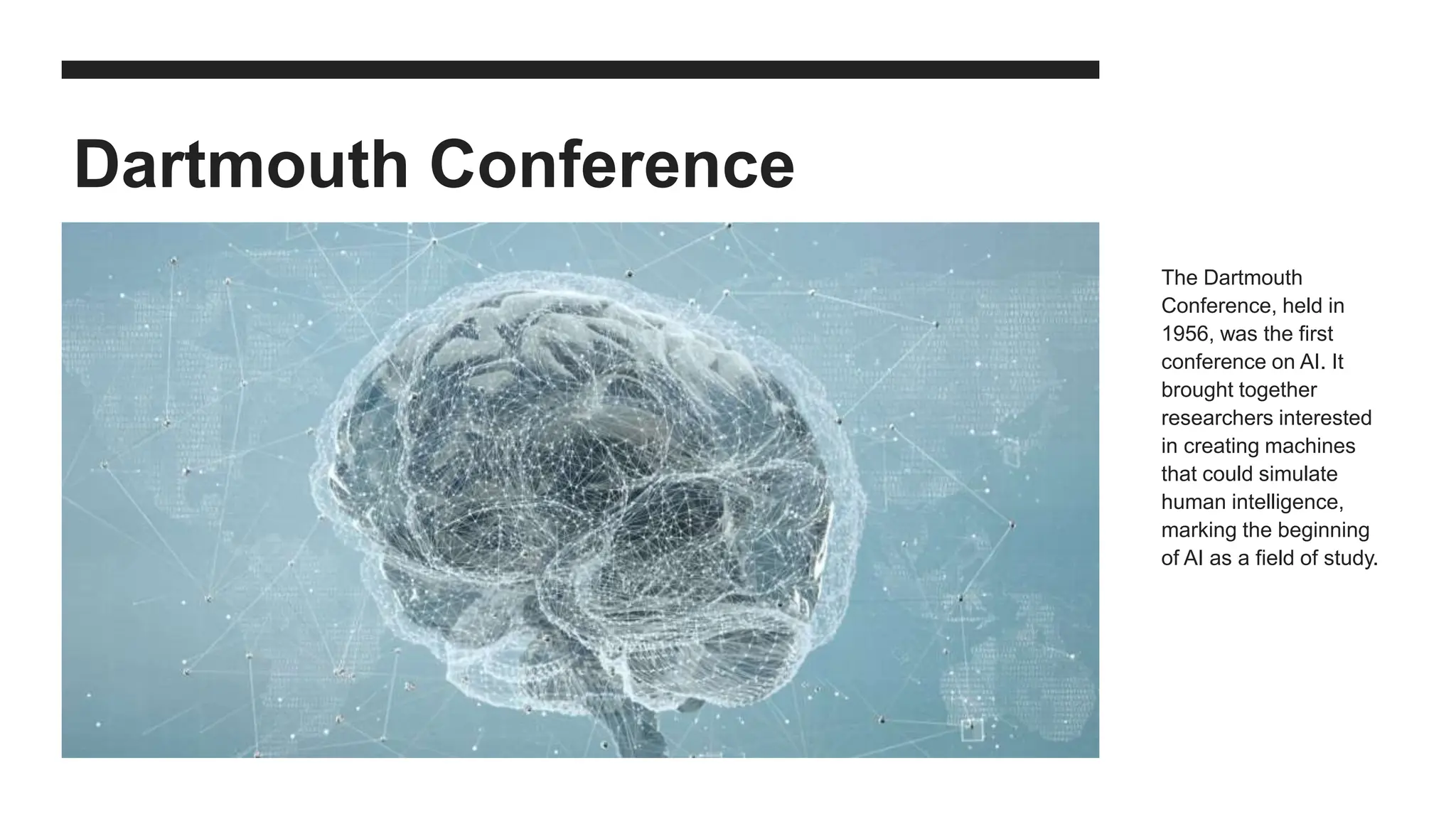
The Dartmouth
Conference, held in
1956, was the first
conference on AI. It
brought together
researchers interested
in creating machines
that could simulate
human intelligence,
marking the beginning
of AI as a field of study.
Early Research
Expert Systems and Rule-Based Decisions
In the early years of AI research, the focus was on creating expert systems
that could make decisions based on rules and logic.
Chess and Mathematical Problems
Researchers developed systems that could play chess and solve
mathematical problems which were the early applications of AI.
Limitations and Complexity
However, researchers soon realized that the limitations of computing power
and the complexity of human reasoning made the development of true AI a
difficult task.
Expert Systems
Expert systems were
the first applications of
artificial intelligence
(AI) used for decision-
making based on rules
and logic. These
systems were used in
fields like medicine and
finance to assist
humans in decision-
making.
The AI Winter
Reduced Funding for AI Research
The AI winter was characterized by a significant reduction in funding for AI
research, which limited the progress made in the field and led to a lack of
interest from researchers and the general public.
Challenges to AI Research
The AI winter posed significant challenges to AI research, including a lack of
funding, limited interest from researchers and the public, and the absence of
significant breakthroughs in the field.
Reasons for the AI Winter
The AI winter was caused by a combination of factors, including overhyped
expectations for AI, limited funding, a lack of significant progress in the field,
and the absence of practical applications for AI research.
Lack of funding
During the AI winter,
funding for AI research
decreased significantly.
Researchers faced a
lack of resources and
struggled to develop
new AI technologies.
Limitations of AI Research
The complexity of
human intelligence
poses a significant
challenge for AI
researchers, who have
struggled to replicate
the nuanced nature of
human thought and
perception.
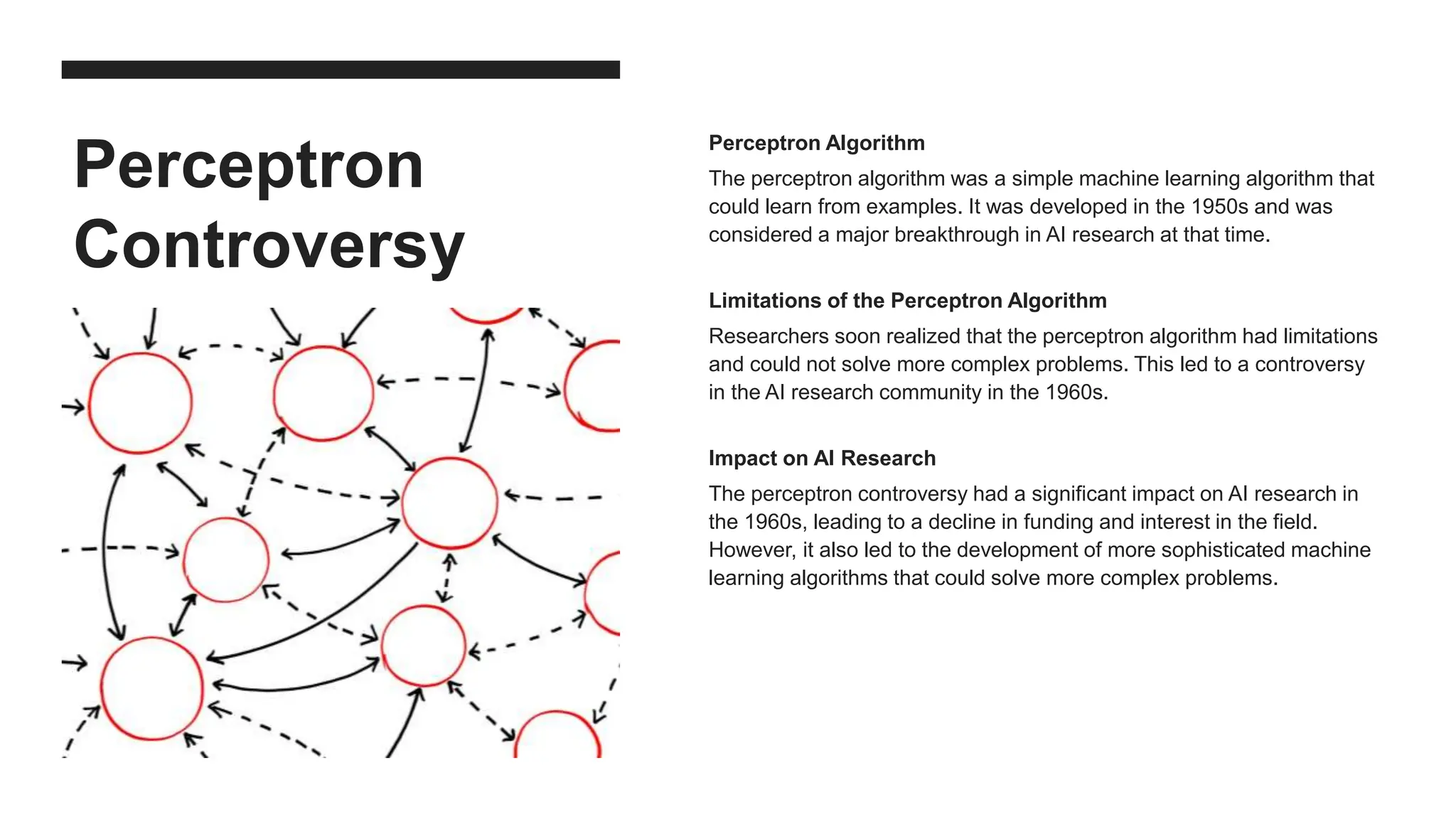
Perceptron
Controversy
Perceptron Algorithm
The perceptron algorithm was a simple machine learning algorithm that
could learn from examples. It was developed in the 1950s and was
considered a major breakthrough in AI research at that time.
Limitations of the Perceptron Algorithm
Researchers soon realized that the perceptron algorithm had limitations
and could not solve more complex problems. This led to a controversy
in the AI research community in the 1960s.
Impact on AI Research
The perceptron controversy had a significant impact on AI research in
the 1960s, leading to a decline in funding and interest in the field.
However, it also led to the development of more sophisticated machine
learning algorithms that could solve more complex problems.
The Modern Era
of AI
Machine Learning
Machine learning is a subfield of AI that enables
computers to learn from data and improve their
performance over time without being explicitly
programmed.
Deep Learning
Deep learning is a subset of machine learning that
involves the use of neural networks to learn from data. It
has led to breakthroughs in computer vision, natural
language processing, and speech recognition.
Machine Learning
Subset of AI
Machine learning is a subset of AI that focuses on making predictions and
decisions based on data. It enables machines to learn from experience and
improve their performance over time.
Natural Language Processing
Machine learning has enabled significant improvements in natural language
processing, allowing machines to understand and generate human language
more accurately.
Image Recognition
Machine learning has revolutionized image recognition technology, enabling
machines to identify objects, people, and scenes in images with high
accuracy.
Deep Learning
Deep learning is a type
of machine learning
that uses sophisticated
neural networks to
allow machines to learn
from large amounts of
data, making it possible
to achieve
breakthroughs in areas
such as speech
recognition, image
classification, and
game playing.
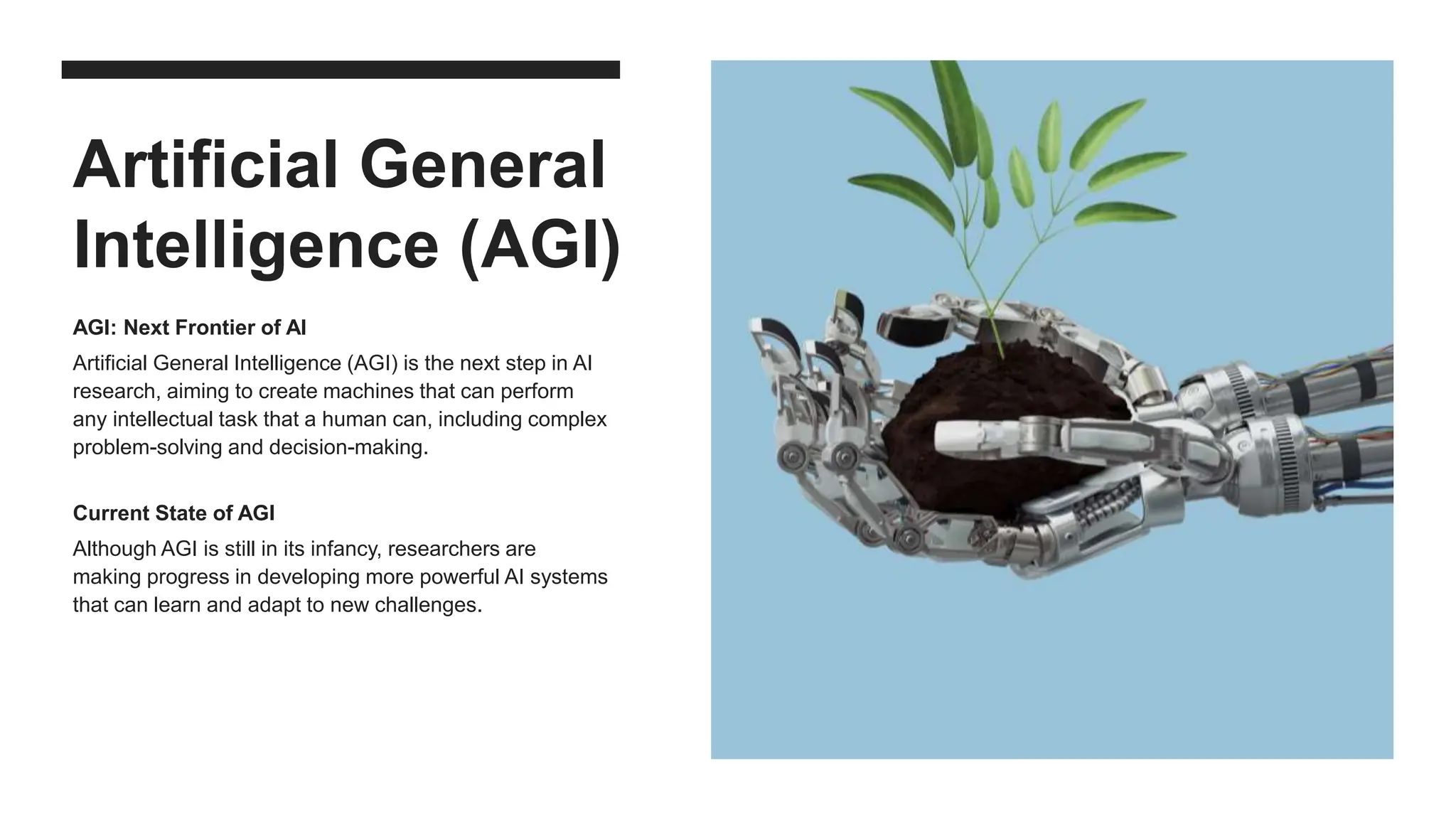
Artificial General
Intelligence (AGI)
AGI: Next Frontier of AI
Artificial General Intelligence (AGI) is the next step in AI
research, aiming to create machines that can perform
any intellectual task that a human can, including complex
problem-solving and decision-making.
Current State of AGI
Although AGI is still in its infancy, researchers are
making progress in developing more powerful AI systems
that can learn and adapt to new challenges.
Conclusion
As the field of AI continues to
evolve, we can expect to see
even more remarkable
achievements in the years to
come, with widespread
applications in various
industries, including
healthcare, finance, and
transportation.
For more rich information
about AI:
https://aisystemcorp.com/wp/

The History of Artificial Intelligence: From Early Beginnings to Modern Advancements

  • 1.
    The History of Artificial Intelligence FromEarly Beginnings to Modern Advancements
  • 2.
    Presentation Overview AI Overview We willbegin with an overview of AI, its definition, and its goals, to understand the basics of AI and its purpose. Beginnings of AI The first period of AI, known as the 'Beginnings of AI', was characterized by the development of early AI techniques and the first AI programs. AI Winter The second period of AI, known as the 'AI Winter', was characterized by decreased funding and interest in AI research due to perceived failures and limitations. Modern Era of AI The third period of AI, known as the 'Modern Era of AI', is characterized by the resurgence of AI research and breakthroughs in machine learning, deep learning, and other AI techniques.
  • 3.
    The Beginnings ofAI Dartmouth Conference The Dartmouth Conference in the mid-1950s marked the beginning of AI research and formalized AI as a field of study. Early AI Research Early AI research focused on the development of expert systems, which were designed to mimic the decision-making abilities of human experts. Challenges in Early AI Research AI researchers faced many challenges in the early days of the field, including limited computational power and a lack of data and algorithms.
  • 4.
    Dartmouth Conference The Dartmouth Conference,held in 1956, was the first conference on AI. It brought together researchers interested in creating machines that could simulate human intelligence, marking the beginning of AI as a field of study.
  • 5.
    Early Research Expert Systemsand Rule-Based Decisions In the early years of AI research, the focus was on creating expert systems that could make decisions based on rules and logic. Chess and Mathematical Problems Researchers developed systems that could play chess and solve mathematical problems which were the early applications of AI. Limitations and Complexity However, researchers soon realized that the limitations of computing power and the complexity of human reasoning made the development of true AI a difficult task.
  • 6.
    Expert Systems Expert systemswere the first applications of artificial intelligence (AI) used for decision- making based on rules and logic. These systems were used in fields like medicine and finance to assist humans in decision- making.
  • 7.
    The AI Winter ReducedFunding for AI Research The AI winter was characterized by a significant reduction in funding for AI research, which limited the progress made in the field and led to a lack of interest from researchers and the general public. Challenges to AI Research The AI winter posed significant challenges to AI research, including a lack of funding, limited interest from researchers and the public, and the absence of significant breakthroughs in the field. Reasons for the AI Winter The AI winter was caused by a combination of factors, including overhyped expectations for AI, limited funding, a lack of significant progress in the field, and the absence of practical applications for AI research.
  • 8.
    Lack of funding Duringthe AI winter, funding for AI research decreased significantly. Researchers faced a lack of resources and struggled to develop new AI technologies.
  • 9.
    Limitations of AIResearch The complexity of human intelligence poses a significant challenge for AI researchers, who have struggled to replicate the nuanced nature of human thought and perception.
  • 10.
    Perceptron Controversy Perceptron Algorithm The perceptronalgorithm was a simple machine learning algorithm that could learn from examples. It was developed in the 1950s and was considered a major breakthrough in AI research at that time. Limitations of the Perceptron Algorithm Researchers soon realized that the perceptron algorithm had limitations and could not solve more complex problems. This led to a controversy in the AI research community in the 1960s. Impact on AI Research The perceptron controversy had a significant impact on AI research in the 1960s, leading to a decline in funding and interest in the field. However, it also led to the development of more sophisticated machine learning algorithms that could solve more complex problems.
  • 11.
    The Modern Era ofAI Machine Learning Machine learning is a subfield of AI that enables computers to learn from data and improve their performance over time without being explicitly programmed. Deep Learning Deep learning is a subset of machine learning that involves the use of neural networks to learn from data. It has led to breakthroughs in computer vision, natural language processing, and speech recognition.
  • 12.
    Machine Learning Subset ofAI Machine learning is a subset of AI that focuses on making predictions and decisions based on data. It enables machines to learn from experience and improve their performance over time. Natural Language Processing Machine learning has enabled significant improvements in natural language processing, allowing machines to understand and generate human language more accurately. Image Recognition Machine learning has revolutionized image recognition technology, enabling machines to identify objects, people, and scenes in images with high accuracy.
  • 13.
    Deep Learning Deep learningis a type of machine learning that uses sophisticated neural networks to allow machines to learn from large amounts of data, making it possible to achieve breakthroughs in areas such as speech recognition, image classification, and game playing.
  • 14.
    Artificial General Intelligence (AGI) AGI:Next Frontier of AI Artificial General Intelligence (AGI) is the next step in AI research, aiming to create machines that can perform any intellectual task that a human can, including complex problem-solving and decision-making. Current State of AGI Although AGI is still in its infancy, researchers are making progress in developing more powerful AI systems that can learn and adapt to new challenges.
  • 15.
    Conclusion As the fieldof AI continues to evolve, we can expect to see even more remarkable achievements in the years to come, with widespread applications in various industries, including healthcare, finance, and transportation. For more rich information about AI: https://aisystemcorp.com/wp/

Editor's Notes

  • #2 In this presentation, we will take a journey through the history of Artificial Intelligence (AI), from its early beginnings to the modern era. AI has come a long way since the first conference on AI at Dartmouth College in 1956. We will explore the achievements and challenges that have characterized the development of AI over the years.
  • #3 We will begin with an overview of AI, its definition, and its goals. Then, we will delve into the three main periods of AI history: the beginnings of AI, the AI winter, and the modern era of AI. Each period will be followed by a more detailed examination of the accomplishments and challenges of AI research during that time.
  • #4 AI research started in the mid-1950s with the Dartmouth Conference. This marked the beginning of AI as a field of study. We will explore the early research in AI, such as the development of expert systems, and the challenges faced by researchers in this period.
  • #5 The Dartmouth Conference, held in 1956, was the first conference on AI. It brought together researchers interested in creating machines that could simulate human intelligence. The conference marked the beginning of AI as a field of study.
  • #6 In the early years of AI research, the focus was on creating expert systems that could make decisions based on rules and logic. Researchers developed systems that could play chess and solve mathematical problems. However, they soon realized that the limitations of computing power and the complexity of human reasoning made the development of true AI a difficult task.
  • #7 Expert systems were the first successful applications of AI. These systems could make decisions based on rules and logic. They were used in fields like medicine and finance to assist humans in decision-making.
  • #8 The AI winter was a period of reduced funding and interest in AI research. It lasted from the late 1970s to the mid-1990s. We will examine the reasons for the AI winter and the challenges it posed to AI research.
  • #9 During the AI winter, funding for AI research decreased significantly. Researchers faced a lack of resources and struggled to develop new AI technologies.
  • #10 The AI winter was also caused by the limitations of AI research. Researchers realized that the complexity of human intelligence was difficult to replicate, and that AI systems struggled to handle ambiguity and uncertainty.
  • #11 The perceptron controversy was a major setback for AI research in the 1960s. The perceptron was a simple algorithm that could learn from examples. However, researchers realized that it had limitations and could not solve more complex problems, leading to a decline in funding and interest in AI research.
  • #12 The modern era of AI is characterized by the development of machine learning and deep learning algorithms. We will explore the breakthroughs that have been made in AI research in recent years.
  • #13 Machine learning is a subset of AI that allows machines to learn from data and improve their performance. It has led to breakthroughs in areas such as natural language processing, image recognition, and autonomous vehicles.
  • #14 Deep learning is a type of machine learning that allows machines to learn from large amounts of data. It has led to breakthroughs in areas such as speech recognition, image classification, and game playing.
  • #15 Artificial General Intelligence (AGI) is the next frontier of AI research. It aims to create machines that can perform any intellectual task that a human can. Although AGI is still in its infancy, researchers are making progress in developing more powerful AI systems.
  • #16 AI has come a long way since the Dartmouth Conference in 1956. Researchers have faced many challenges over the years, from the limitations of computing power to the complexity of human reasoning. However, breakthroughs in machine learning and deep learning have led to remarkable achievements in recent years. As the field of AI continues to evolve, we can expect to see even more exciting developments in the years to come.