The Heart—Activity 4
                                                                      Name ________________________________________________ Date _________________ Class Period ___________


                                                                      Heart Rate Measuring Techniques—
                                                                      Taking Your Pulse Manually
                                                                         Your heartbeat is the sound of the valves in your heart closing as they
                                                                      push blood from one chamber to another. Heart rate is the number of times
                                                                      the heart beats per minute (BPM), and the pulse is the beat of the heart
                                                                      that can be felt in any artery that lies close to the skin.
                                                                          The heart beats at different rates depending on whether your body is at
                                                                      rest or at work. When resting, the heart rate beats an average of 72 times
                                                                      per minute for high school students and an average of 85 BPM for middle
                                                                      school students. During strenuous physical activity, your heart rate or pulse
                                                                      increases, sometimes to twice or more its resting rate. Your stroke volume,
                                                                      the amount of blood pumped for each heartbeat, also increases. This is
                                                                      because the muscles that are working demand more blood to supply them
                                                                      with oxygen and other nutrients.
                                                                         Heart rate is measured by counting the number of times your heart
                                                                      beats in one minute. One way to determine your heart rate is to manually
                                                                      take your pulse.
                                                                         The two most common locations used to take a pulse are at the radial
                                                                      artery in the wrist and the carotid artery in the neck. It is best to practice
                                                                      locating and counting your pulse when you are at rest and again during
                                                                      physical activity.
Copyright © by The McGraw-Hill Companies, Inc. All rights reserved.


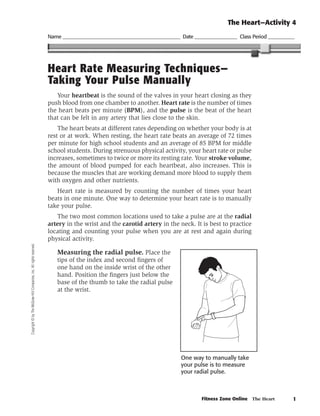
                                                                         Measuring the radial pulse. Place the
                                                                         tips of the index and second fingers of
                                                                         one hand on the inside wrist of the other
                                                                         hand. Position the fingers just below the
                                                                         base of the thumb to take the radial pulse
                                                                         at the wrist.


                                                                                                                            One way to manually take
                                                                                                                            your pulse is to measure
                                                                                                                            your radial pulse.

                                                                                                                                      C01-07A
                                                                                                                                    Fitness Zone Online    The Heart
The Heart—Activity 4
Name ________________________________________________ Date _________________ Class Period ___________


    Measuring the carotid pulse. Place the tips of the
    index and second fingers of one hand on the side of
    the neck just beside the windpipe.

    Measuring your resting heart rate. Your pulse
    fluctuates during the day due to activity, stress, caf-
    feine, medications, and other factors that might influ-
    ence your heart rate. A resting pulse is the lowest
    your heart rate would go during the day. You can
    get your best reading when you first wake up in the
    morning, before any activity. Relax your body, and
    follow the steps below for measuring your pulse.

    The following are steps to take when measuring your
    pulse:                                                          Measuring the carotid pulse
    	 •	 Step One: Apply light to moderate pressure with the        is another way to manually
         fingers until the blood pulsing beneath the fingers        measure your pulse.
         is felt. If no pulse is felt, move the fingers around
         slightly, up or down, until a pulse is felt. Do not
         apply excessive pressure. This may compress the artery and distort C01-08A
         the measurement. Once the pulse is felt, move to step two.
    	 •	 Step Two: Using a watch or clock with a second hand, count the
         number of beats felt in 30 seconds, then multiply that number by


                                                                                                        Copyright © by The McGraw-Hill Companies, Inc. All rights reserved.
         two to compute a heart rate, expressed in BPM (beats per minute).


        Fitness Zone Online    The Heart
The Heart—Activity 4
                                                                      Name ________________________________________________ Date _________________ Class Period ___________


                                                                      Heart Rate Activity
                                                                           An Example of a Resting Heart Rate

                                                                                                                                    Example of Resting Heart Rate:
                                                                       Pulse Rate (in 30 seconds) : _______________ ×2 =          Number of beats in 30 seconds = 43
                                                                       ________________ (beats per minute)                              Multiply by two = 86
                                                                                                                                     Resting pulse rate = 86 BPM 

                                                                           Take your own pulse for 30 seconds, and multiply by two.
                                                                           Take your pulse six different times.
                                                                          Try it three times at the carotid artery and three times at the radial
                                                                      artery.

                                                                                    Trial                      Carotid Pulse                    Radial Pulse

                                                                       1

                                                                       2

                                                                       3


                                                                         Add all six numbers together, and divide by 6 to come up with your
                                                                      average.

                                                                            _____ + _____ + _____ + _____ + _____ + _____ = _____ (average)
Copyright © by The McGraw-Hill Companies, Inc. All rights reserved.


                                                                               _____ divided by 6 = _____ (your average resting heart rate)

                                                                         Remember this number so that you may use it later as your resting
                                                                      heart rate.


                                                                                                                                    Fitness Zone Online    The Heart
The Heart—Activity 4
Name ________________________________________________ Date _________________ Class Period ___________


Evaluation
	 1.	What does pulse mean?
		 ___________________________________________________________________________________
		 ___________________________________________________________________________________
	 2.	Why does your pulse fluctuate during the day?
		 ___________________________________________________________________________________
		 ___________________________________________________________________________________
	 3.	What does stroke volume mean?
		 ___________________________________________________________________________________
		 ___________________________________________________________________________________


                                                                                                        Copyright © by The McGraw-Hill Companies, Inc. All rights reserved.


       Fitness Zone Online    The Heart

The heart activity_4

  • 1.
    The Heart—Activity 4 Name ________________________________________________ Date _________________ Class Period ___________ Heart Rate Measuring Techniques— Taking Your Pulse Manually Your heartbeat is the sound of the valves in your heart closing as they push blood from one chamber to another. Heart rate is the number of times the heart beats per minute (BPM), and the pulse is the beat of the heart that can be felt in any artery that lies close to the skin. The heart beats at different rates depending on whether your body is at rest or at work. When resting, the heart rate beats an average of 72 times per minute for high school students and an average of 85 BPM for middle school students. During strenuous physical activity, your heart rate or pulse increases, sometimes to twice or more its resting rate. Your stroke volume, the amount of blood pumped for each heartbeat, also increases. This is because the muscles that are working demand more blood to supply them with oxygen and other nutrients. Heart rate is measured by counting the number of times your heart beats in one minute. One way to determine your heart rate is to manually take your pulse. The two most common locations used to take a pulse are at the radial artery in the wrist and the carotid artery in the neck. It is best to practice locating and counting your pulse when you are at rest and again during physical activity. Copyright © by The McGraw-Hill Companies, Inc. All rights reserved. Measuring the radial pulse. Place the tips of the index and second fingers of one hand on the inside wrist of the other hand. Position the fingers just below the base of the thumb to take the radial pulse at the wrist. One way to manually take your pulse is to measure your radial pulse. C01-07A Fitness Zone Online    The Heart
  • 2.
    The Heart—Activity 4 Name________________________________________________ Date _________________ Class Period ___________ Measuring the carotid pulse. Place the tips of the index and second fingers of one hand on the side of the neck just beside the windpipe. Measuring your resting heart rate. Your pulse fluctuates during the day due to activity, stress, caf- feine, medications, and other factors that might influ- ence your heart rate. A resting pulse is the lowest your heart rate would go during the day. You can get your best reading when you first wake up in the morning, before any activity. Relax your body, and follow the steps below for measuring your pulse. The following are steps to take when measuring your pulse: Measuring the carotid pulse • Step One: Apply light to moderate pressure with the is another way to manually fingers until the blood pulsing beneath the fingers measure your pulse. is felt. If no pulse is felt, move the fingers around slightly, up or down, until a pulse is felt. Do not apply excessive pressure. This may compress the artery and distort C01-08A the measurement. Once the pulse is felt, move to step two. • Step Two: Using a watch or clock with a second hand, count the number of beats felt in 30 seconds, then multiply that number by Copyright © by The McGraw-Hill Companies, Inc. All rights reserved. two to compute a heart rate, expressed in BPM (beats per minute). Fitness Zone Online    The Heart
  • 3.
    The Heart—Activity 4 Name ________________________________________________ Date _________________ Class Period ___________ Heart Rate Activity An Example of a Resting Heart Rate Example of Resting Heart Rate: Pulse Rate (in 30 seconds) : _______________ ×2 = Number of beats in 30 seconds = 43 ________________ (beats per minute) Multiply by two = 86 Resting pulse rate = 86 BPM  Take your own pulse for 30 seconds, and multiply by two. Take your pulse six different times. Try it three times at the carotid artery and three times at the radial artery. Trial Carotid Pulse Radial Pulse 1 2 3 Add all six numbers together, and divide by 6 to come up with your average. _____ + _____ + _____ + _____ + _____ + _____ = _____ (average) Copyright © by The McGraw-Hill Companies, Inc. All rights reserved. _____ divided by 6 = _____ (your average resting heart rate) Remember this number so that you may use it later as your resting heart rate. Fitness Zone Online    The Heart
  • 4.
    The Heart—Activity 4 Name________________________________________________ Date _________________ Class Period ___________ Evaluation 1. What does pulse mean? ___________________________________________________________________________________ ___________________________________________________________________________________ 2. Why does your pulse fluctuate during the day? ___________________________________________________________________________________ ___________________________________________________________________________________ 3. What does stroke volume mean? ___________________________________________________________________________________ ___________________________________________________________________________________ Copyright © by The McGraw-Hill Companies, Inc. All rights reserved. Fitness Zone Online    The Heart