The goodies that
Zope begat
Pyramid, Plone, buildout + more
Dylan Jay @djay75
Who am I?
Dylan Jay
Core Plone Contributor
1995 First web app (ISAPI)
1999 Built first e-commerce
site (zope)
2003 Built first startup
(IntroVino)
2004 Started
PretaWeb/PretaGov (Plone0
Reasons for this talk
History
"Those who don't learn from history are
doomed to add it as a feature of their
framework"
Better choices
There is no perfect framework, only a perfect mess when you pick
wrong
Reuse
The goodies
1. Traversal
2. ZODB
3. ZTK Adapters
4. Sprints
5. Pyramid
6. Buildout
7. Plone + the customisation cliff
8. Diazo
9. RobotFramework - RobotSuite
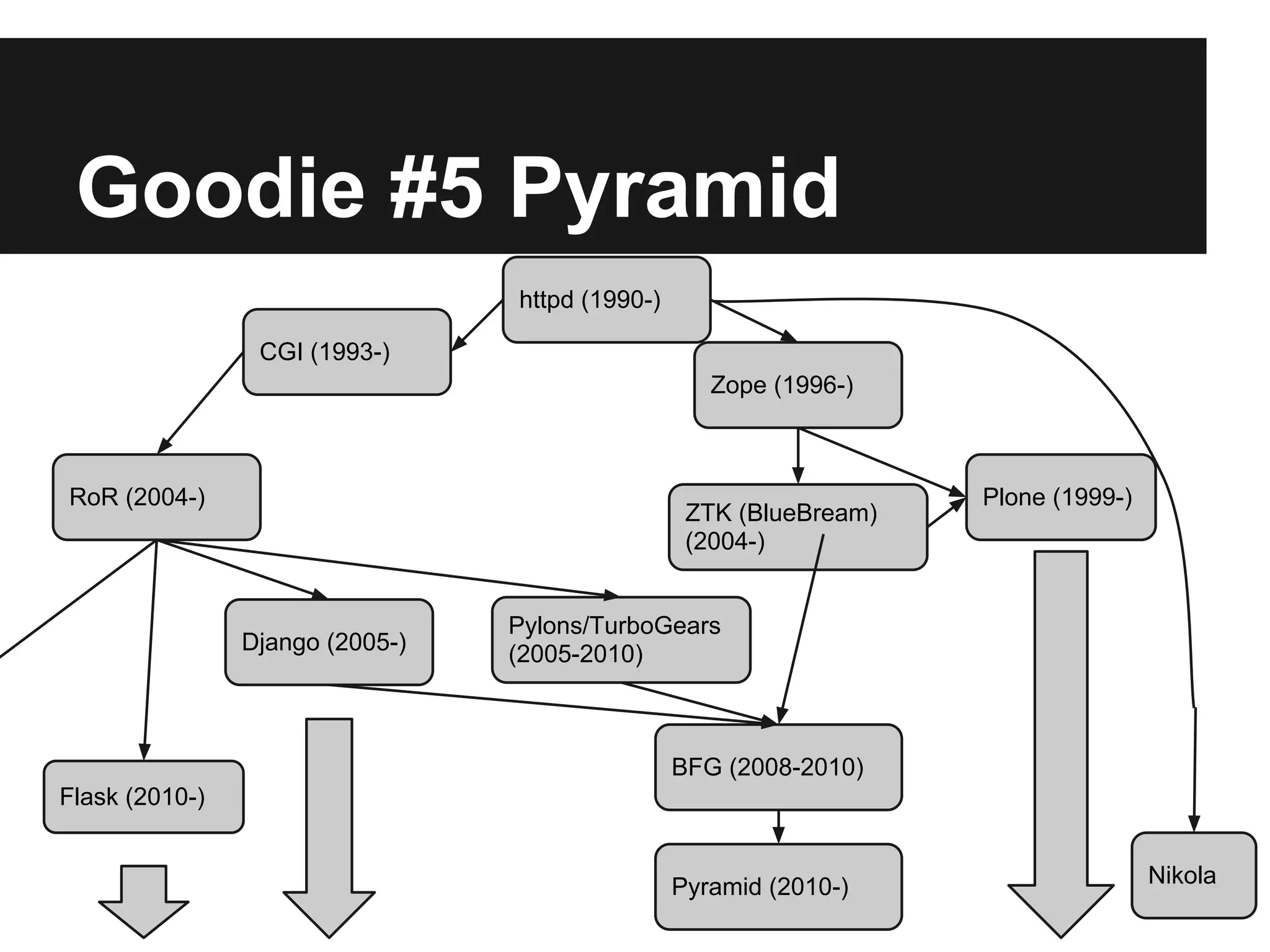
Python family tree(web)
Zope (1996-)
ZTK (BlueBream)
(2004-)
Pylons/TurboGears
(2005-2010)Django (2005-)
Flask (2010-)
RoR (2004-) Plone (1999-)
BFG (2008-2010)
CGI (1993-)
httpd (1990-)
NikolaPyramid (2010-)
Zope - wtf was that about?
Back in 1996
● webserver = path to file
● cgi = path to script + args
● OO - was very big
● Jim Fulton was on a
plane
traversal = path to object + '/' + method
zope = zope object publishing environment
Goodie #1 - Traversal
response = traverse(root, HTTP_PATH.split('/'), request)
def traverse(context, path, request):
if len(path) == 0:
return context(request)
elif len(path) == 1:
view_method = getattr( context, path[0] )
return view_method(request)
else:
sub_context = context[ path[0] ]
return traverse( sub_context, path[1:], request)
Traversal - why?
Good for CMS
plugins cooperating
webapps
complex apps
TraversalRoutes
/A/B/C/myaction/myaction/id123
distributedcentrally defined
Good for relational
single use apps
Goodie #2: ZODB
● Want to store something non relational?
● Want to store something non key-value?
● Got complex object structures?
Use Object persistence
ZODB: The piss easy DB
$ easyinstall ZODB
db = DB( FileStorage.FileStorage('./Data.fs') )
connection = db.open()
dbroot = connection.root()
transaction.commit()
db.close()
dbroot['a_number'] = 3
dbroot['a_string'] = 'Gift'
dbroot['a_list'] = [1, 2, 3, 5, 7, 12]
dbroot['a_dictionary'] = { 1918: 'Red Sox', 1919: 'Reds' }
dbroot['deeply_nested'] = {
1918: [ ('Red Sox', 4), ('Cubs', 2) ],
1919: [ ('Reds', 5), ('White Sox', 3) ],
}
ZODB: simple but powerful
● transactions - multiversion concurrency
control (MVCC)
● scalability across a network (using ZEO)
● replication (using ZRS or relstorage)
● history/undo
● transparently pluggable storage
● built-in caching
● Blob support
Goodie #3: Adapters
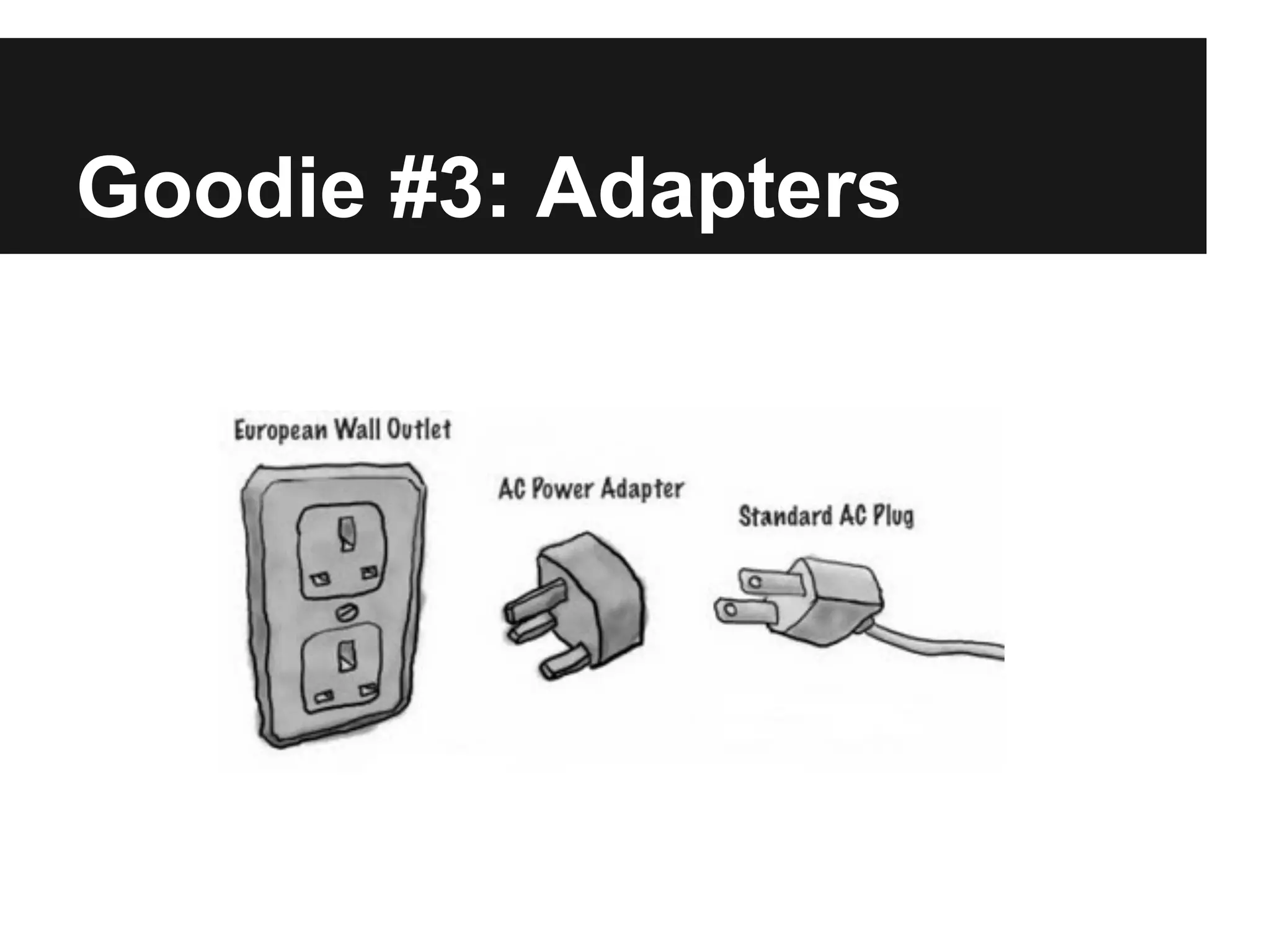
Adapters: why?
● Solves how to plug complex software
together
● Better than Object Orientation
● Perfect for overridable software
● Perfect for plugin architecture
● ZTK - ZCA - Zope3 == Adapters
ZTK Adapters
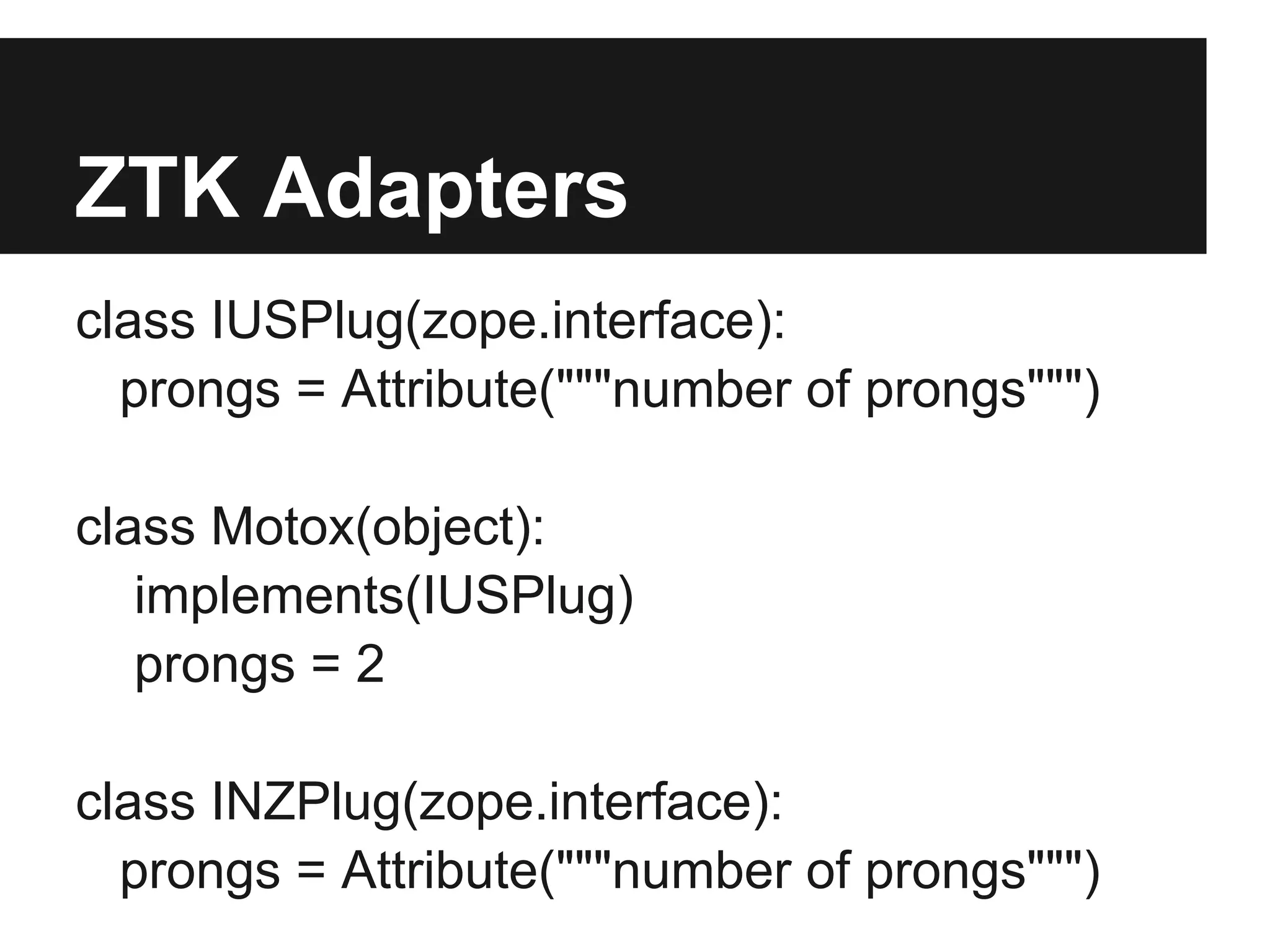
class IUSPlug(zope.interface):
prongs = Attribute("""number of prongs""")
class Motox(object):
implements(IUSPlug)
prongs = 2
class INZPlug(zope.interface):
prongs = Attribute("""number of prongs""")
ZTK Adapters
class ACPowerAdapter(object):
implements(INZPlug)
adapts(IUSPlug)
def __init__(self, plug):
self.prongs = plug.prongs + 1
self.voltage = 240
registry.registerAdapter(ACPowerAdapter)
ZTK Adapters
>>> myphone = MotoX()
>>> myphone.prongs == 3
False
>>> adaptedphone = INZPlug(myphone)
>>> adaptedphone.prongs == 3
True
Goodie #4: Sprints
“The practice of using sprints for open source
software development was pioneered by the
Zope Corporation in the early days of the Zope
3 project. Between January 2002 and January
2006, more than 30 Zope 3 sprints had taken
place.[citation needed]”
Plone Pacific Rim Sprint 14-15 Sept
Goodie #5 Pyramid
Zope (1996-)
ZTK (BlueBream)
(2004-)
Pylons/TurboGears
(2005-2010)Django (2005-)
Flask (2010-)
RoR (2004-) Plone (1999-)
BFG (2008-2010)
CGI (1993-)
httpd (1990-)
NikolaPyramid (2010-)
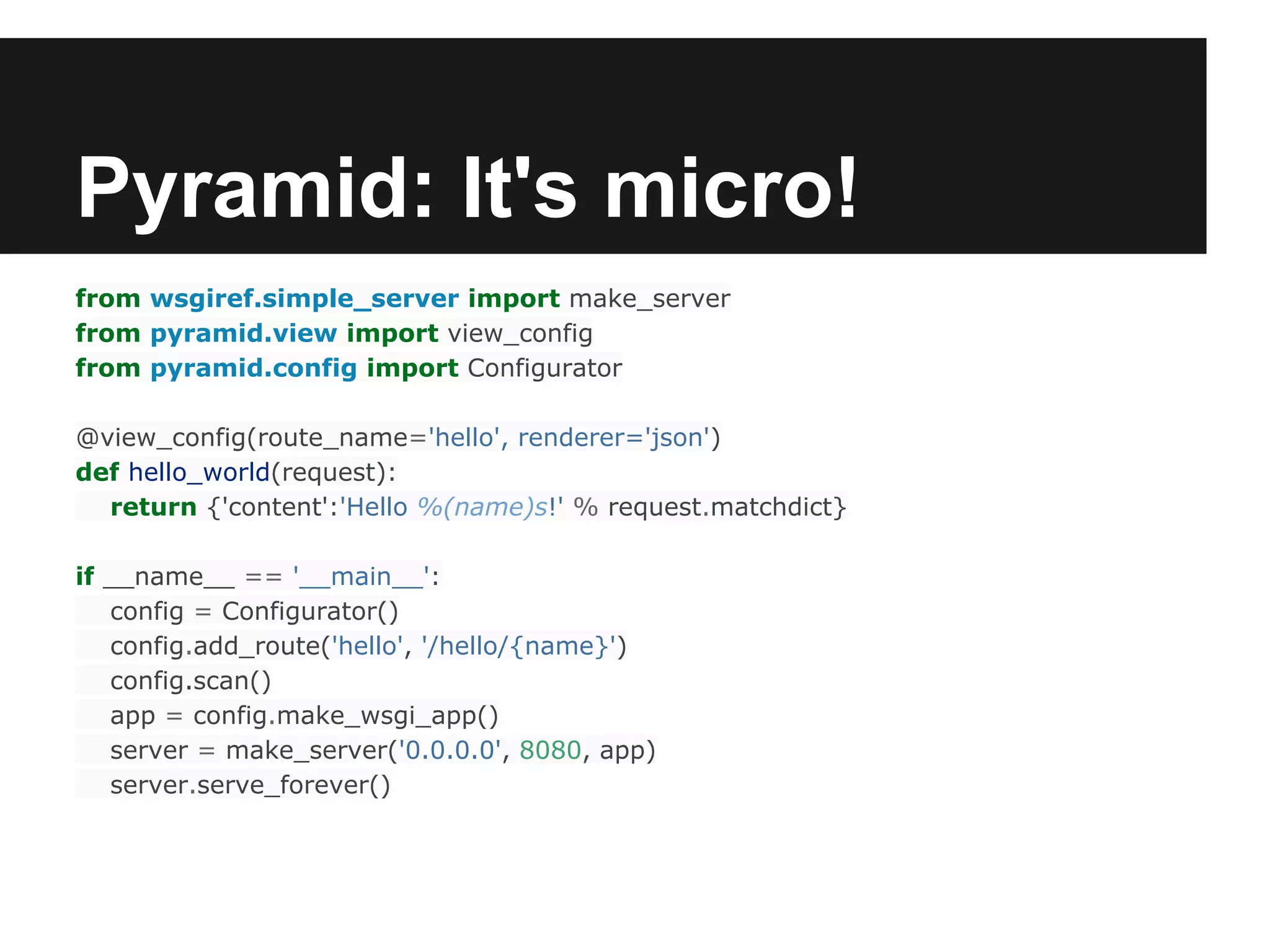
Pyramid: It's micro!
from wsgiref.simple_server import make_server
from pyramid.view import view_config
from pyramid.config import Configurator
if __name__ == '__main__':
config = Configurator()
config.add_route('hello', '/hello/{name}')
config.scan()
app = config.make_wsgi_app()
server = make_server('0.0.0.0', 8080, app)
server.serve_forever()
@view_config(route_name='hello', renderer='json')
def hello_world(request):
return {'content':'Hello %(name)s!' % request.matchdict}
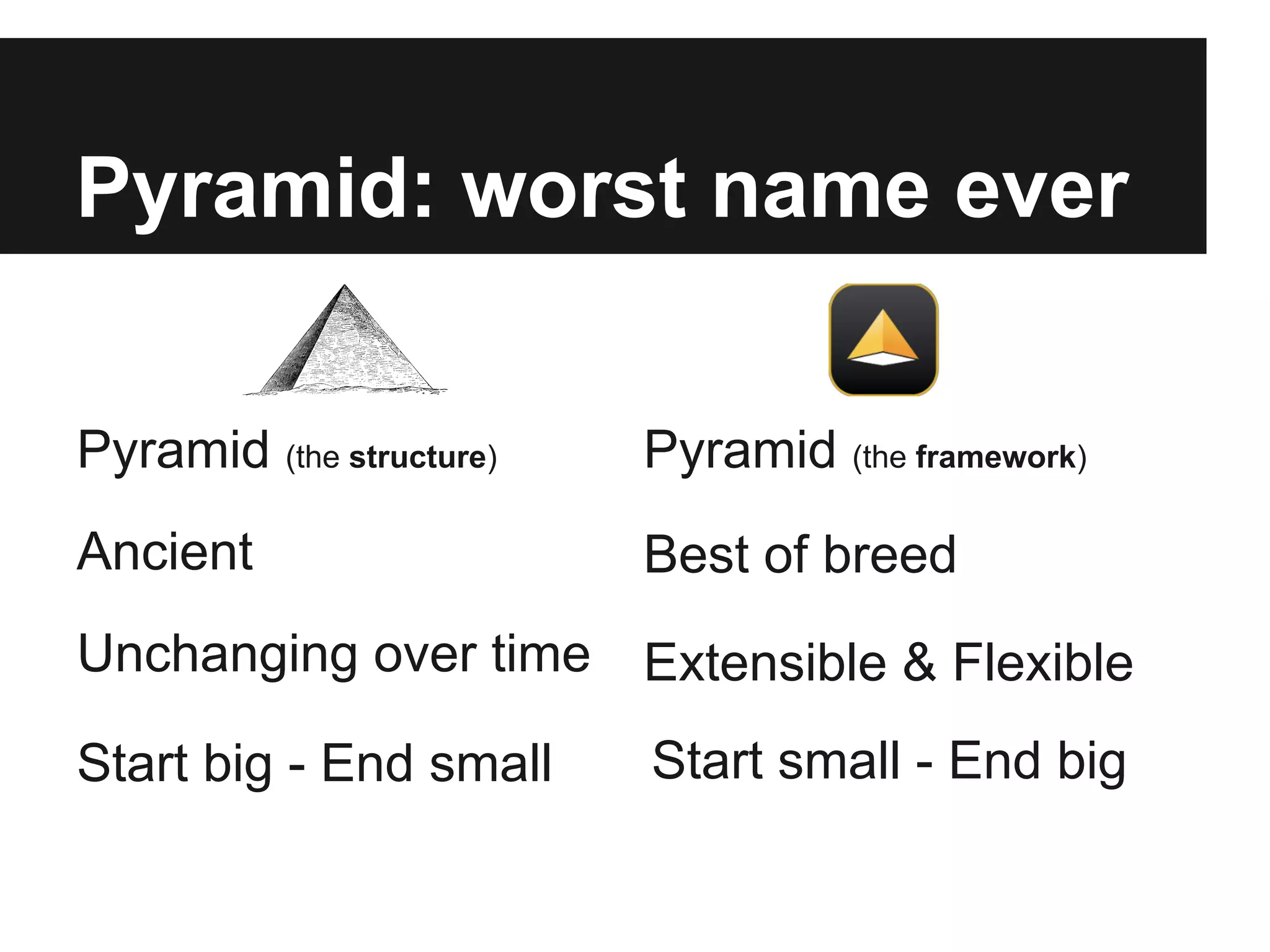
Pyramid: worst name ever
Pyramid (the structure) Pyramid (the framework)
Start big - End small Start small - End big
Ancient Best of breed
Unchanging over time Extensible & Flexible
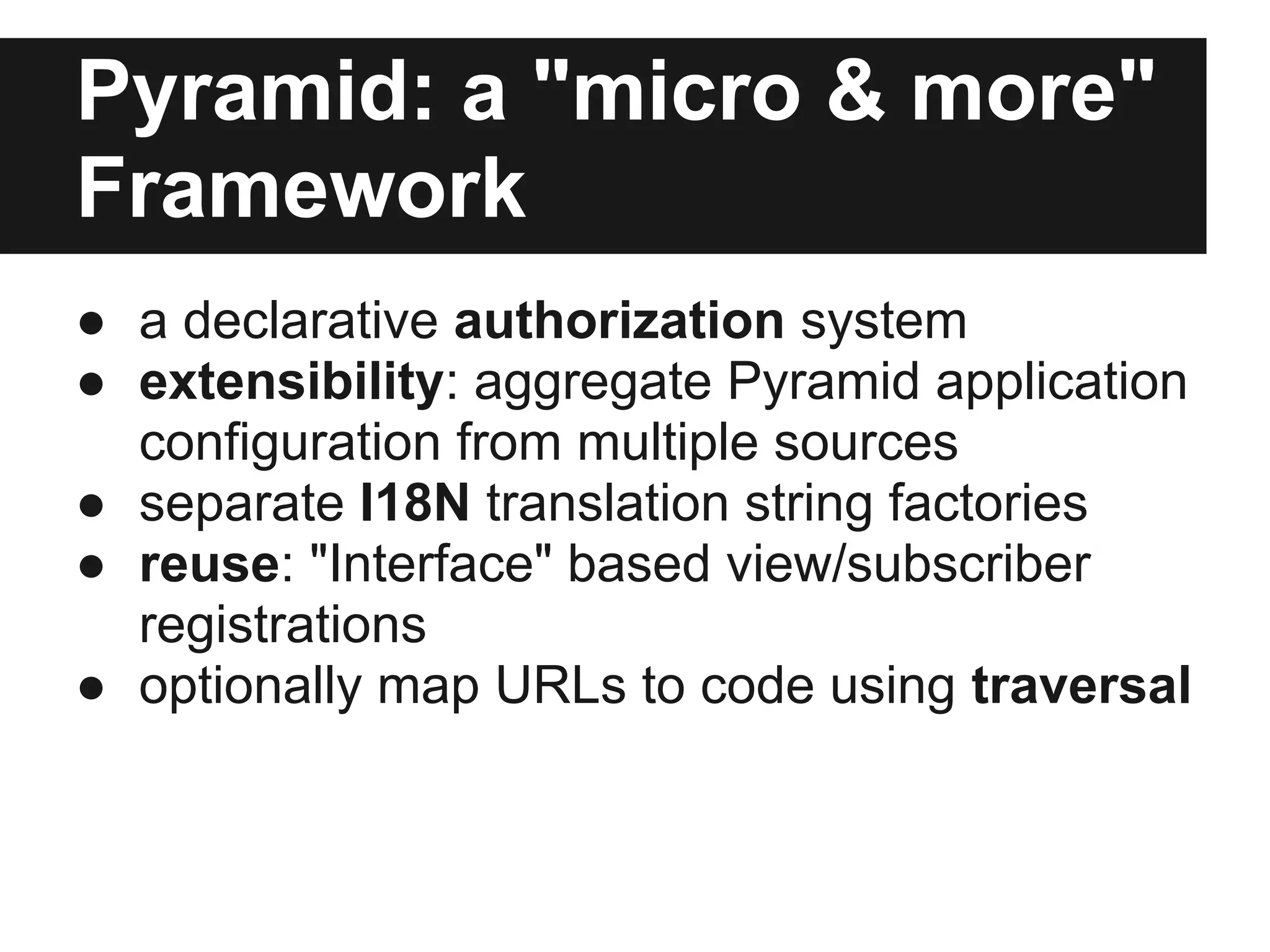
Pyramid: a "micro & more"
Framework
● a declarative authorization system
● extensibility: aggregate Pyramid application
configuration from multiple sources
● separate I18N translation string factories
● reuse: "Interface" based view/subscriber
registrations
● optionally map URLs to code using traversal
Pyramid: routes vs.
traversal: why not both?
from wsgiref.simple_server import make_server
from pyramid.config import Configurator
from pyramid.response import Response
class Resource(dict):
pass
def get_root(request):
return Resource({'a': Resource({'b': Resource({'c': Resource()})})})
def hello_world_of_resources(context, request):
output = "Here's a resource and its children: %s" % context
return Response(output)
if __name__ == '__main__':
config = Configurator(root_factory=get_root)
config.add_view(hello_world_of_resources, context=Resource)
app = config.make_wsgi_app()
server = make_server('0.0.0.0', 8080, app)
server.serve_forever()
Goodie #6: buildout
buildout - what you get if you put make, puppet,
python, pip, virtualenv into a blender
Buildout
● uses recipes - python packages that know
how to build other things
○ like puppet
● automated dependencies
○ like Make
● recipes download and install python
packages into your environment
○ like PIP/easy_install
● everything gets installed into a local directory
isolated from your system
○ like virtualenv
Buildout is like...
you need it when
- you’re on tour (deploy different places)
- very different components
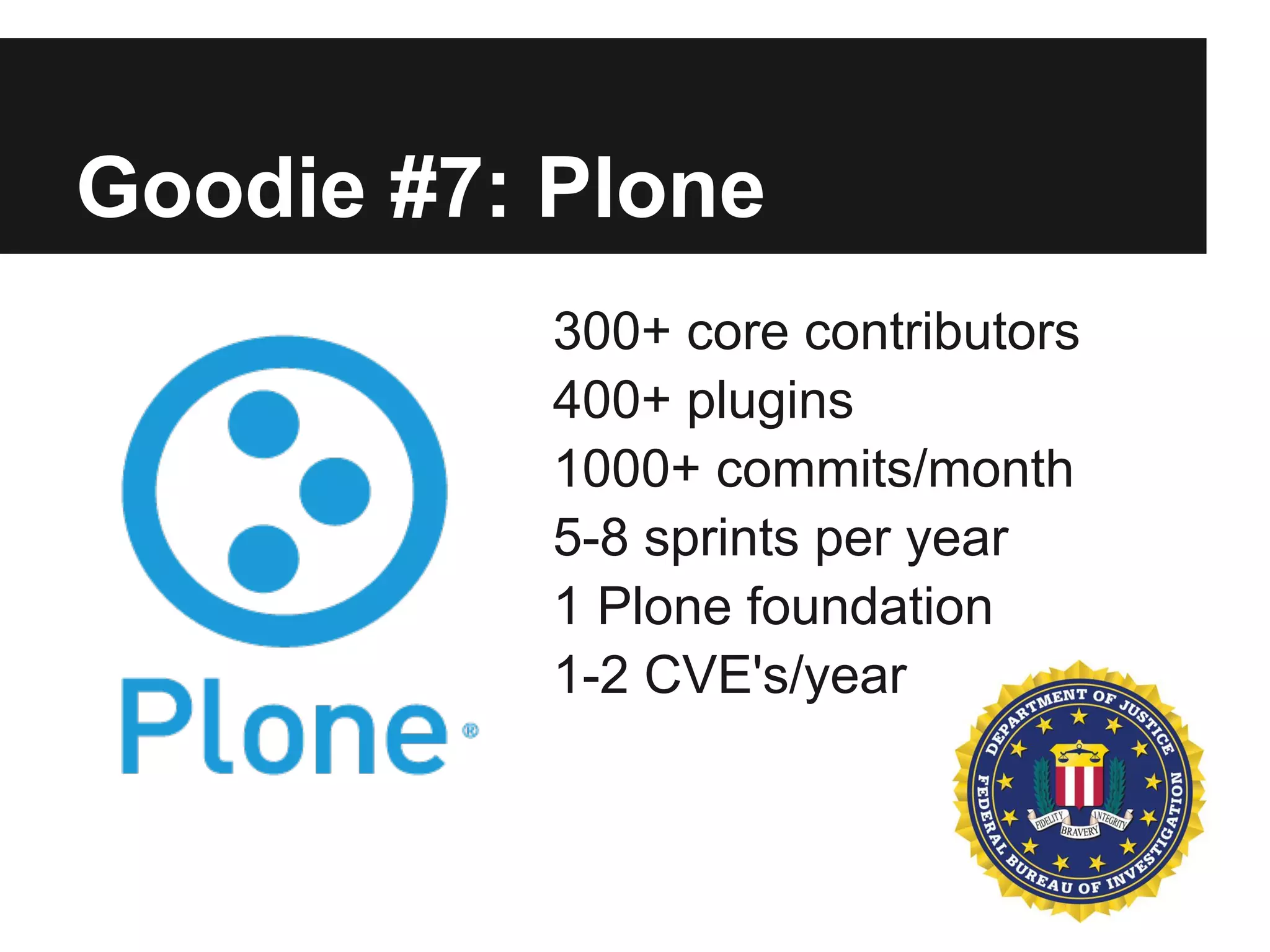
Goodie #7: Plone
300+ core contributors
400+ plugins
1000+ commits/month
5-8 sprints per year
1 Plone foundation
1-2 CVE's/year
Plone
Plone step 1: Install
wget --no-check-certificate https://launchpad.
net/plone/4.3/4.3.1/+download/Plone-4.3.1-
UnifiedInstaller.tgz
# Extract the downloaded file
tar -xf Plone-4.3-UnifiedInstaller.tgz
# Go the folder containing installer script
cd Plone-4.3-UnifiedInstaller
# Run script
./install.sh standalone
cd ~/Plone/zinstance
bin/instance fg
Plone: #2 Add content
Plone Step 2: Add content
Plone Step 3: Add plugins
$ nano buildout.cfg
[instance]
...
eggs =
Products.PloneFormGen
collective.recaptcha
$ bin/buildout
$ bin/instance fg
Plone Step 4: Theme it
Framework vs CMS
start with a blank page start with fully featured site
build up customise down
good for "app" sites good for "content" sites others can edit
Framework CMS
startup tool agency tool
risk reinventing the wheel risk hitting customisation cliff
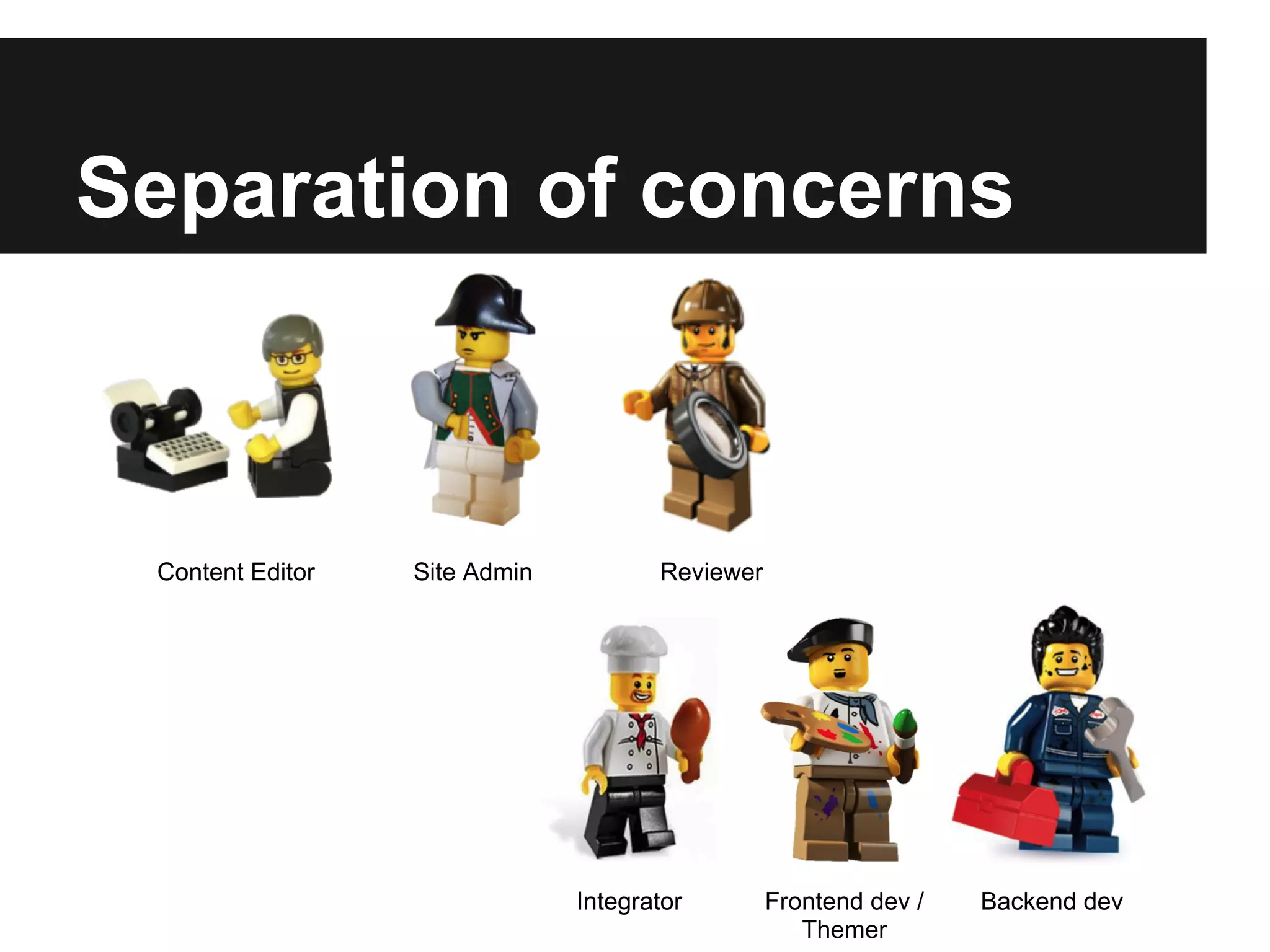
dev has full control shared control, editors, admin, dev, themer
Content Editor Site Admin
Separation of concerns
Backend devFrontend dev /
Themer
Integrator
Reviewer
Developers blog
Integrator
Static site generator
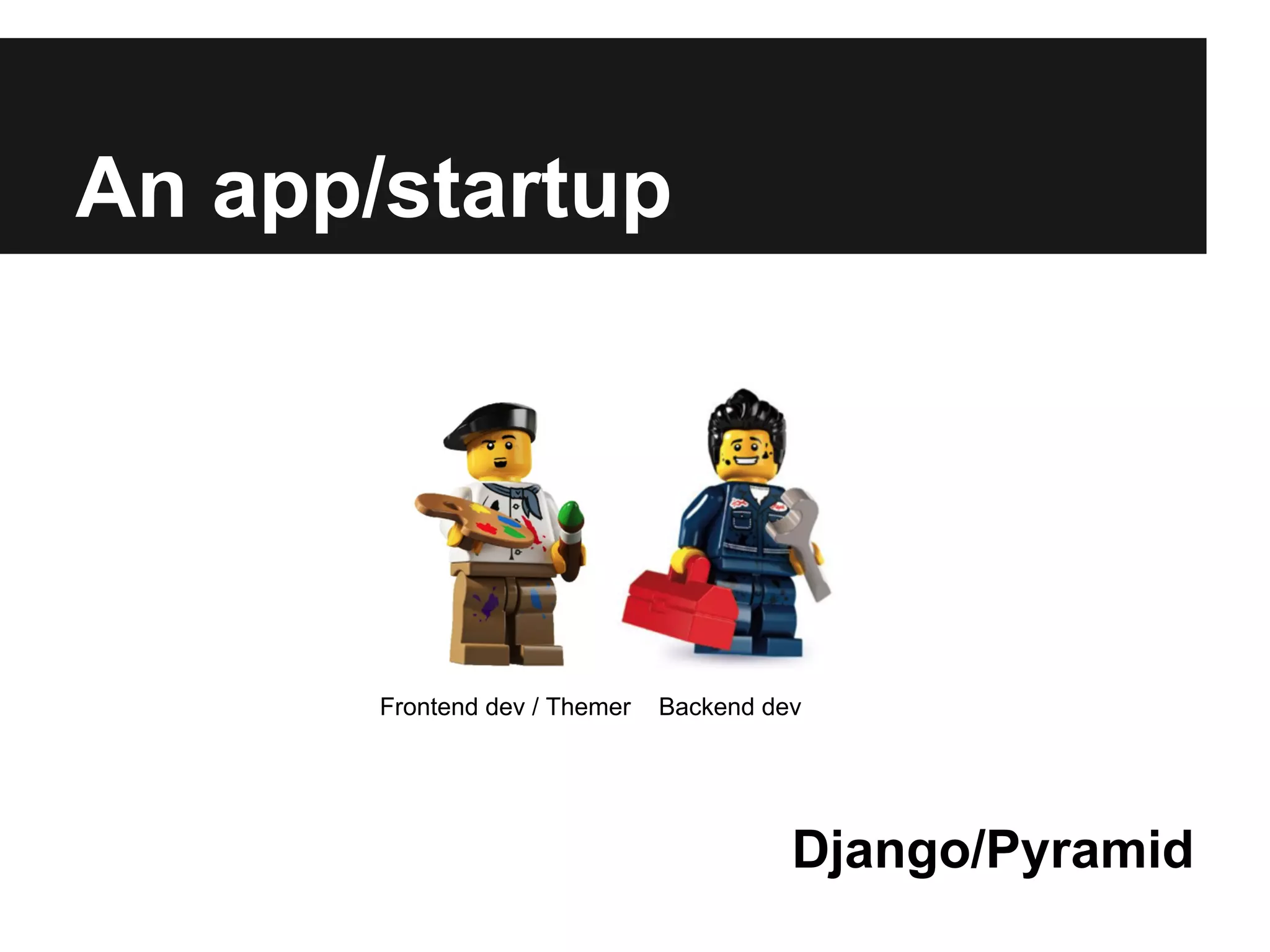
An app/startup
Backend devFrontend dev / Themer
Django/Pyramid
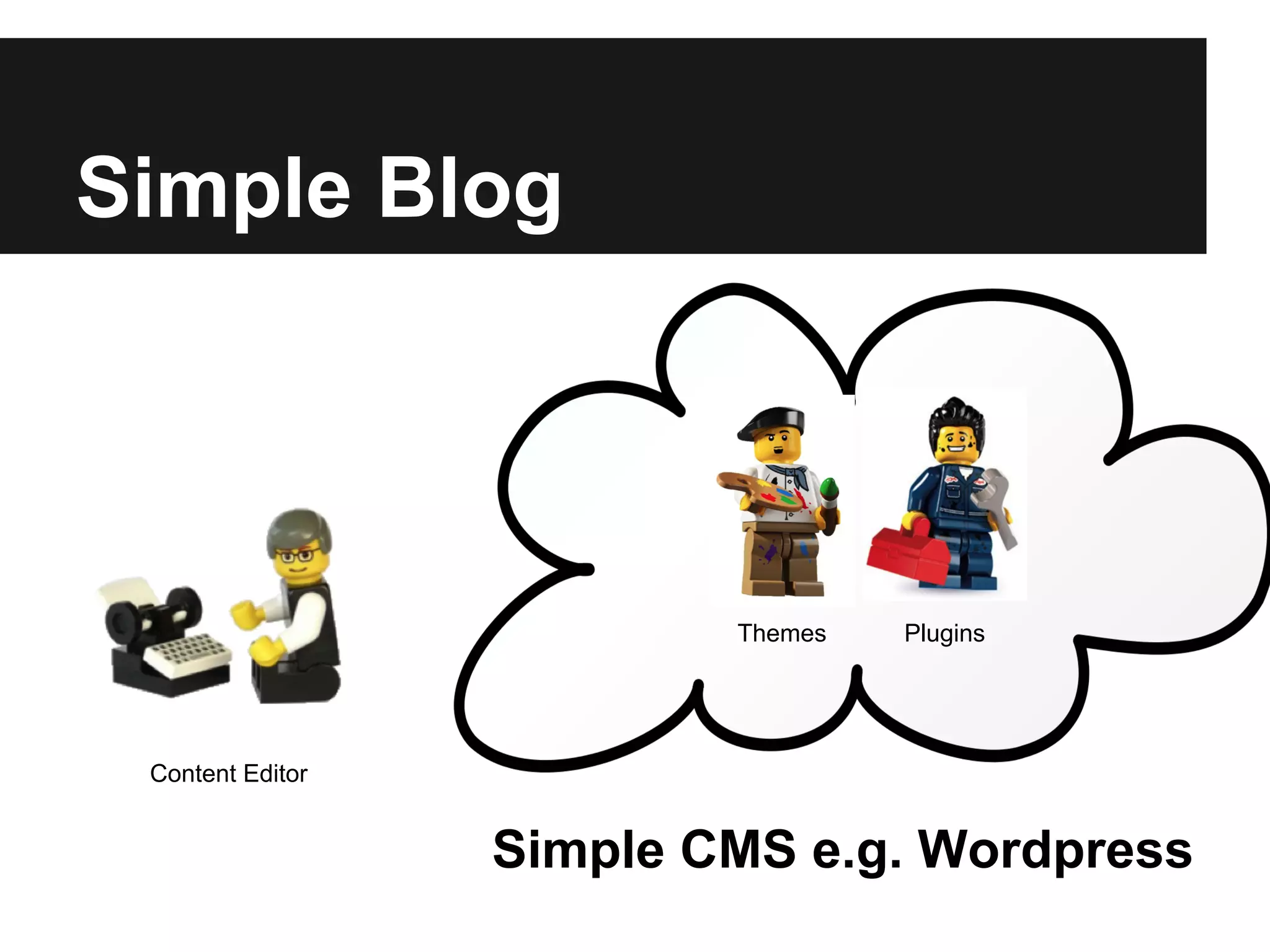
Simple Blog
Content Editor
PluginsThemes
Simple CMS e.g. Wordpress
Large content site
PluginsThemes
Frontend dev /
Themer
Content Editor Site Admin
Integrator
Reviewer
Enterprise CMS
Web consultancy
Plugins
Frontend dev /
Themer
Content Editor
Site Admin
Integrator CMS/Framework
The customisation cliff
Framework
CMS
Goodie #8: Diazo
- Ultimate in code - html seperation
- templates without altering your html
- allows designer to work on html while you
work on the code - round trip
Diazo.org
1. app with very simple html
- "content"
2. create mockups in html of
how you want the pages to
really look - "theme"
3. create a rules.xml.
4. Compile it to single XSLT
file,
5. execute it in middleware
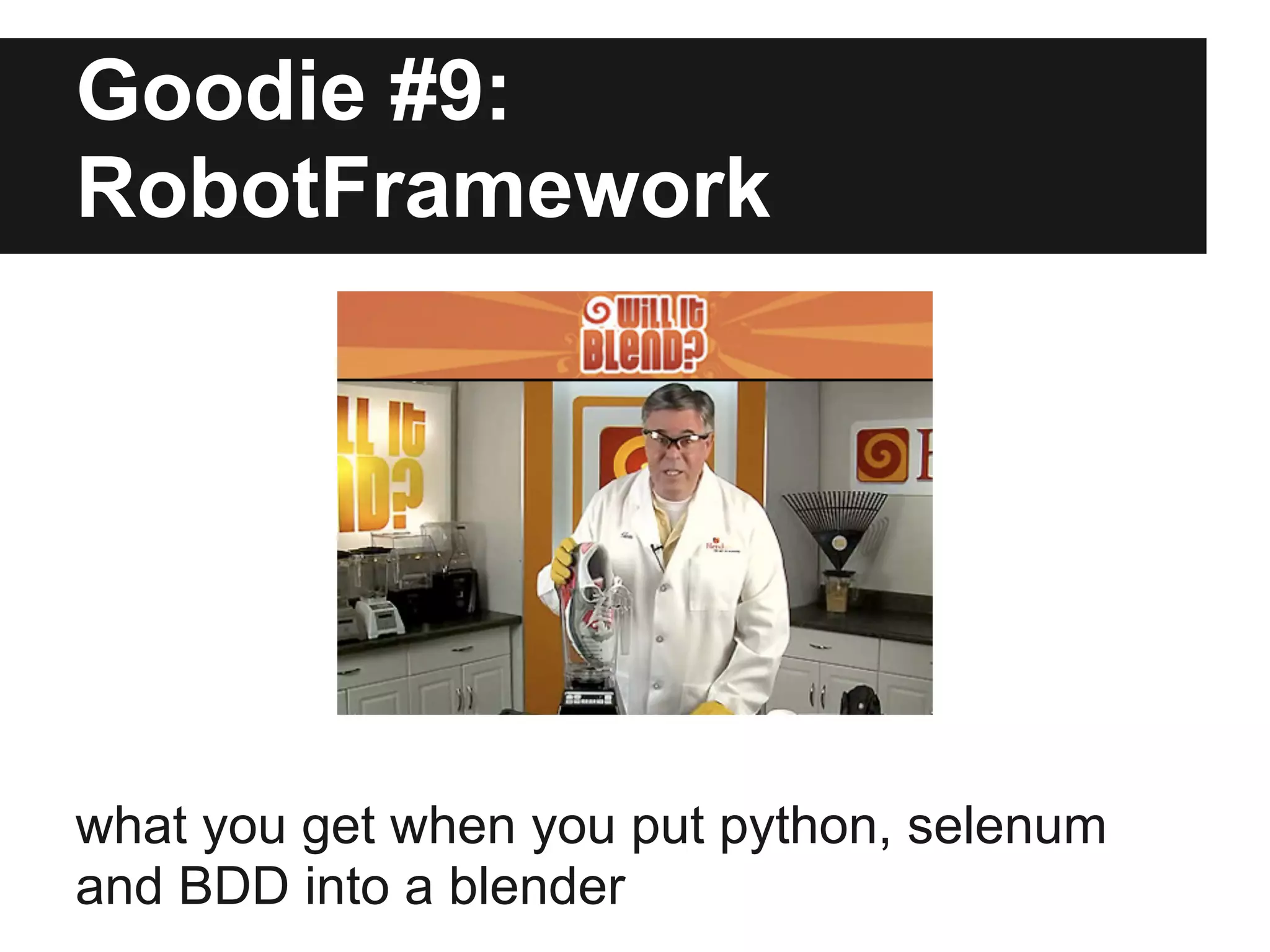
Goodie #9:
RobotFramework
what you get when you put python, selenum
and BDD into a blender
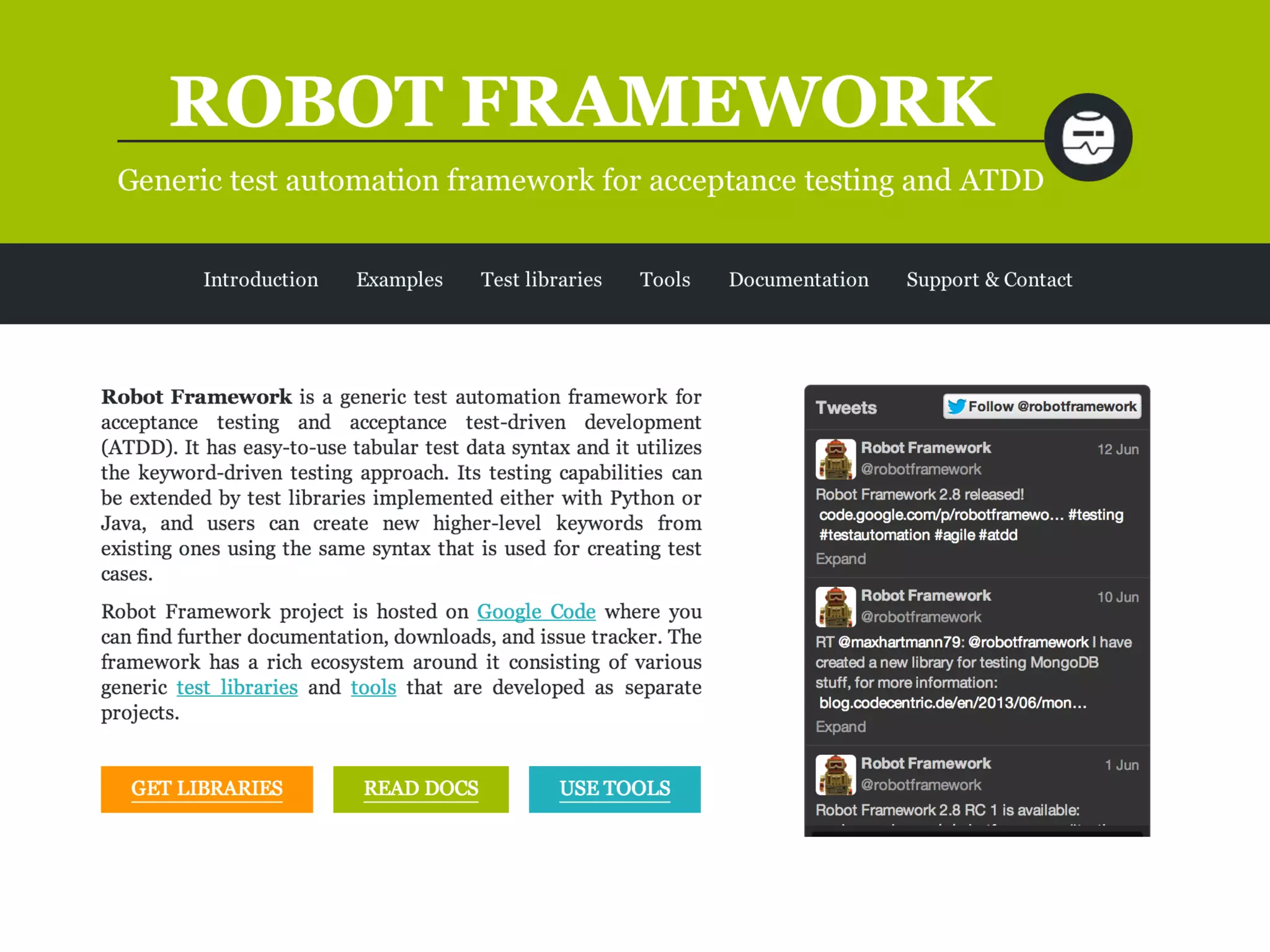
RobotFramework
RobotFramework
● Not invented by Plone/Zope (Nokia did)
● but robotsuite was
● Used to test Plone
● Automated screenshots for user manuals
Thanks
Dylan Jay (pretagov.com.au)

The goodies of zope, pyramid, and plone (2)

  • 1.
    The goodies that Zopebegat Pyramid, Plone, buildout + more Dylan Jay @djay75
  • 2.
    Who am I? DylanJay Core Plone Contributor 1995 First web app (ISAPI) 1999 Built first e-commerce site (zope) 2003 Built first startup (IntroVino) 2004 Started PretaWeb/PretaGov (Plone0
  • 3.
    Reasons for thistalk History "Those who don't learn from history are doomed to add it as a feature of their framework" Better choices There is no perfect framework, only a perfect mess when you pick wrong Reuse
  • 4.
    The goodies 1. Traversal 2.ZODB 3. ZTK Adapters 4. Sprints 5. Pyramid 6. Buildout 7. Plone + the customisation cliff 8. Diazo 9. RobotFramework - RobotSuite
  • 5.
    Python family tree(web) Zope(1996-) ZTK (BlueBream) (2004-) Pylons/TurboGears (2005-2010)Django (2005-) Flask (2010-) RoR (2004-) Plone (1999-) BFG (2008-2010) CGI (1993-) httpd (1990-) NikolaPyramid (2010-)
  • 6.
    Zope - wtfwas that about? Back in 1996 ● webserver = path to file ● cgi = path to script + args ● OO - was very big ● Jim Fulton was on a plane traversal = path to object + '/' + method zope = zope object publishing environment
  • 7.
    Goodie #1 -Traversal response = traverse(root, HTTP_PATH.split('/'), request) def traverse(context, path, request): if len(path) == 0: return context(request) elif len(path) == 1: view_method = getattr( context, path[0] ) return view_method(request) else: sub_context = context[ path[0] ] return traverse( sub_context, path[1:], request)
  • 8.
    Traversal - why? Goodfor CMS plugins cooperating webapps complex apps TraversalRoutes /A/B/C/myaction/myaction/id123 distributedcentrally defined Good for relational single use apps
  • 9.
    Goodie #2: ZODB ●Want to store something non relational? ● Want to store something non key-value? ● Got complex object structures? Use Object persistence
  • 10.
    ZODB: The pisseasy DB $ easyinstall ZODB db = DB( FileStorage.FileStorage('./Data.fs') ) connection = db.open() dbroot = connection.root() transaction.commit() db.close() dbroot['a_number'] = 3 dbroot['a_string'] = 'Gift' dbroot['a_list'] = [1, 2, 3, 5, 7, 12] dbroot['a_dictionary'] = { 1918: 'Red Sox', 1919: 'Reds' } dbroot['deeply_nested'] = { 1918: [ ('Red Sox', 4), ('Cubs', 2) ], 1919: [ ('Reds', 5), ('White Sox', 3) ], }
  • 11.
    ZODB: simple butpowerful ● transactions - multiversion concurrency control (MVCC) ● scalability across a network (using ZEO) ● replication (using ZRS or relstorage) ● history/undo ● transparently pluggable storage ● built-in caching ● Blob support
  • 12.
  • 13.
    Adapters: why? ● Solveshow to plug complex software together ● Better than Object Orientation ● Perfect for overridable software ● Perfect for plugin architecture ● ZTK - ZCA - Zope3 == Adapters
  • 14.
    ZTK Adapters class IUSPlug(zope.interface): prongs= Attribute("""number of prongs""") class Motox(object): implements(IUSPlug) prongs = 2 class INZPlug(zope.interface): prongs = Attribute("""number of prongs""")
  • 15.
    ZTK Adapters class ACPowerAdapter(object): implements(INZPlug) adapts(IUSPlug) def__init__(self, plug): self.prongs = plug.prongs + 1 self.voltage = 240 registry.registerAdapter(ACPowerAdapter)
  • 16.
    ZTK Adapters >>> myphone= MotoX() >>> myphone.prongs == 3 False >>> adaptedphone = INZPlug(myphone) >>> adaptedphone.prongs == 3 True
  • 17.
    Goodie #4: Sprints “Thepractice of using sprints for open source software development was pioneered by the Zope Corporation in the early days of the Zope 3 project. Between January 2002 and January 2006, more than 30 Zope 3 sprints had taken place.[citation needed]” Plone Pacific Rim Sprint 14-15 Sept
  • 18.
    Goodie #5 Pyramid Zope(1996-) ZTK (BlueBream) (2004-) Pylons/TurboGears (2005-2010)Django (2005-) Flask (2010-) RoR (2004-) Plone (1999-) BFG (2008-2010) CGI (1993-) httpd (1990-) NikolaPyramid (2010-)
  • 19.
    Pyramid: It's micro! fromwsgiref.simple_server import make_server from pyramid.view import view_config from pyramid.config import Configurator if __name__ == '__main__': config = Configurator() config.add_route('hello', '/hello/{name}') config.scan() app = config.make_wsgi_app() server = make_server('0.0.0.0', 8080, app) server.serve_forever() @view_config(route_name='hello', renderer='json') def hello_world(request): return {'content':'Hello %(name)s!' % request.matchdict}
  • 20.
    Pyramid: worst nameever Pyramid (the structure) Pyramid (the framework) Start big - End small Start small - End big Ancient Best of breed Unchanging over time Extensible & Flexible
  • 21.
    Pyramid: a "micro& more" Framework ● a declarative authorization system ● extensibility: aggregate Pyramid application configuration from multiple sources ● separate I18N translation string factories ● reuse: "Interface" based view/subscriber registrations ● optionally map URLs to code using traversal
  • 22.
    Pyramid: routes vs. traversal:why not both? from wsgiref.simple_server import make_server from pyramid.config import Configurator from pyramid.response import Response class Resource(dict): pass def get_root(request): return Resource({'a': Resource({'b': Resource({'c': Resource()})})}) def hello_world_of_resources(context, request): output = "Here's a resource and its children: %s" % context return Response(output) if __name__ == '__main__': config = Configurator(root_factory=get_root) config.add_view(hello_world_of_resources, context=Resource) app = config.make_wsgi_app() server = make_server('0.0.0.0', 8080, app) server.serve_forever()
  • 23.
    Goodie #6: buildout buildout- what you get if you put make, puppet, python, pip, virtualenv into a blender
  • 24.
    Buildout ● uses recipes- python packages that know how to build other things ○ like puppet ● automated dependencies ○ like Make ● recipes download and install python packages into your environment ○ like PIP/easy_install ● everything gets installed into a local directory isolated from your system ○ like virtualenv
  • 25.
    Buildout is like... youneed it when - you’re on tour (deploy different places) - very different components
  • 26.
    Goodie #7: Plone 300+core contributors 400+ plugins 1000+ commits/month 5-8 sprints per year 1 Plone foundation 1-2 CVE's/year
  • 28.
    Plone Plone step 1:Install wget --no-check-certificate https://launchpad. net/plone/4.3/4.3.1/+download/Plone-4.3.1- UnifiedInstaller.tgz # Extract the downloaded file tar -xf Plone-4.3-UnifiedInstaller.tgz # Go the folder containing installer script cd Plone-4.3-UnifiedInstaller # Run script ./install.sh standalone cd ~/Plone/zinstance bin/instance fg
  • 29.
    Plone: #2 Addcontent Plone Step 2: Add content
  • 30.
    Plone Step 3:Add plugins $ nano buildout.cfg [instance] ... eggs = Products.PloneFormGen collective.recaptcha $ bin/buildout $ bin/instance fg
  • 31.
    Plone Step 4:Theme it
  • 32.
    Framework vs CMS startwith a blank page start with fully featured site build up customise down good for "app" sites good for "content" sites others can edit Framework CMS startup tool agency tool risk reinventing the wheel risk hitting customisation cliff dev has full control shared control, editors, admin, dev, themer
  • 33.
    Content Editor SiteAdmin Separation of concerns Backend devFrontend dev / Themer Integrator Reviewer
  • 34.
  • 35.
    An app/startup Backend devFrontenddev / Themer Django/Pyramid
  • 36.
  • 37.
    Large content site PluginsThemes Frontenddev / Themer Content Editor Site Admin Integrator Reviewer Enterprise CMS
  • 38.
    Web consultancy Plugins Frontend dev/ Themer Content Editor Site Admin Integrator CMS/Framework
  • 39.
  • 40.
    Goodie #8: Diazo -Ultimate in code - html seperation - templates without altering your html - allows designer to work on html while you work on the code - round trip
  • 41.
    Diazo.org 1. app withvery simple html - "content" 2. create mockups in html of how you want the pages to really look - "theme" 3. create a rules.xml. 4. Compile it to single XSLT file, 5. execute it in middleware
  • 42.
    Goodie #9: RobotFramework what youget when you put python, selenum and BDD into a blender
  • 43.
  • 44.
    RobotFramework ● Not inventedby Plone/Zope (Nokia did) ● but robotsuite was ● Used to test Plone ● Automated screenshots for user manuals
  • 45.