Handbook of Star Forming Regions Vol. I
                                           Astronomical Society of the Pacific, 2008
                                           Bo Reipurth, ed.


                                                   Star Forming Regions in Cepheus


                                                   M´ ria Kun
                                                    a
                                                   Konkoly Observatory, H-1525 Budapest, P.O. Box 67, Hungary
arXiv:0809.4761v1 [astro-ph] 27 Sep 2008


                                                   Zolt´ n T. Kiss
                                                       a
                                                   Baja Astronomical Observatory, P.O. Box 766, H-6500 Baja, Hungary

                                                   Zolt´ n Balog1
                                                       a
                                                   Steward Observatory, University of Arizona, 933 N. Cherry Av., Tucson AZ
                                                   85721, USA

                                                   Abstract.       The northern Milky Way in the constellation of Cepheus (100◦ ≤ l ≤
                                                   120◦ ; 0◦ ≤ b ≤ 20◦ ) contains several star forming regions. The molecular clouds of
                                                   the Cepheus Flare region at b > 10◦ , are sites of low and intermediate mass star for-
                                                   mation located between 200 and 450 pc from the Sun. Three nearby OB associations,
                                                   Cep OB2, Cep OB3, Cep OB4, located at 600–800 pc, are each involved in forming
                                                   stars, like the well known high mass star forming region S 140 at 900 pc. The reflection
                                                   nebula NGC 7129 around 1 kpc harbors young, compact clusters of low and intermedi-
                                                   ate mass stars. The giant star forming complex NGC 7538 and the young open cluster
                                                   NGC 7380, associated with the Perseus arm, are located at d > 2 kpc.


                                           1.   Overview

                                           In this chapter we describe the star forming regions of the constellation of Cepheus.
                                           A large scale map of the constellation, with the boundaries defined by IAU overlaid,
                                           and the most prominent star forming regions indicated, is shown in Fig. 1. This huge
                                           area of the sky, stretching between the Galactic latitudes of about 0◦ and +30◦ , contains
                                           several giant star forming molecular cloud complexes located at various distances from
                                           the Sun. According to their distance they can be ranged into three large groups:
                                           (1) Clouds nearer than 500 pc located mainly at b ≥ 10◦ , in the Cepheus Flare.
                                           (2) Three OB associations, Cep OB 2, Cep OB 3 and Cep OB 4 between 600–900 pc.
                                           (3) Star forming regions associated with the Perseus spiral arm at 2–3 kpc.
                                           In the following we discuss the first two of these groups.
                                                Fig. 2 shows the distribution of dark clouds perpendicular to the Galactic plane
                                           (Dobashi et al. 2005), with the outlines of the major star forming complexes overplot-
                                           ted.
                                                The large-scale 13 CO observations performed by Yonekura et al. (1997) led to a
                                           refinement of division of the clouds into complexes. The groups listed in Table 2,


                                           1
                                            on leave from Dept. of Optics and Quantum Electronics, University of Szeged, D´ m t´ r 9, Szeged,
                                                                                                                          o e
                                           H-6720, Hungary

                                                                                           1
2


     Figure 1. Positions of the major star forming regions of Cepheus, overplotted on
     a schematic drawing of the constellation.


adopted from Yonekura et al. (1997), were defined on the basis of their positions, radial
velocities, and distances, where distance data were available.
      Table 1 lists the dark clouds identified in the Cepheus region from Barnard (1927)
to the Tokyo Gakugei University (TGU) Survey (Dobashi et al. 2005), and the molecu-
lar clouds, mostly revealed by the millimeter emission by various isotopes of the carbon
monoxide (Dobashi et al. 1994; Yonekura et al. 1997). The cloud name in the first col-
umn is the LDN (Lynds 1962) name where it exists, otherwise the first appearance of
the cloud in the literature. Equatorial (J2000) and Galactic coordinates are listed in
columns (2)–(5), and the area of the cloud in square degrees in column (6). Column (7)
shows the radial velocity of the cloud with respect to the Local Standard of Rest. The
number of associated young stellar objects is given in column (8), and the alternative
names, following the system of designations by SIMBAD, are listed in column (9). We
3

note that the LDN coordinates, derived from visual examination of the POSS plates,
may be uncertain in several cases.
     Figure 3 shows the distribution of the pre-main sequence stars and candidates over
the whole Cepheus region.


     Figure 2. Distribution of the visual extinction in the Cepheus region in the [l,b]
     plane (Dobashi et al. 2005) with outlines of the major star forming regions, discussed
     in this chapter, overplotted. Solid rectangles indicate the nominal boundaries of the
     OB associations (Humphreys 1978; de Zeeuw et al. 1999), and the dashed rectan-
     gle shows the Cepheus Flare cloud complex; giant HII regions are marked by solid
     grey circles, and star symbols indicate young open clusters. Three large circles,
     drawn by radial dashes, show giant shell-like structures in the interstellar medium.
     The Cepheus Flare Shell (Olano et al. 2006) belongs to the nearby Cepheus Flare
     complex, and the Cepheus Bubble (Kun et al. 1987) is associated with the associ-
     ation Cep OB2, and the Cepheus OB4 Shell (Olano et al. 2006) is associated with
     Cep OB4.
4


    Figure 3. Pre-main sequence stars and candidates in the Cepheus region overlaid
    on the map of visual extinction obtained from 2MASS data based on interstellar
    reddening using the NICER method (Lombardi & Alves 2001). Large circles de-
    note those clouds from Table 1 which have been associated with young stars. The
    meaning of different symbols are as follows: Filled triangles - T Tauri stars; Filled
    squares - Herbig Ae/Be stars; Filled circles - Weak-line T Tauri stars; Diamonds -
    Tr 37 ROSAT X-ray sources; Open triangles - PMS members of Tr 37; Open squares
    - Candidate and possible PMS members of Cep OB3b; X - Hα emission stars; + -
    T Tauri candidates selected from a 2MASS color-color diagram.
Table 1.: List of clouds catalogued in Cepheus.

Cloud name   RA(2000) Dec(2000)     l          b       Area     vLSR       nstar   Alternative names
              (h m)     (◦ ′ )     (◦ )       (◦ )   (sq.deg.) (km s−1 )
LDN 1122      20 32.7   +65 20.3 99.97      +14.81    0.041      4.8        0      YMD CO 1, TGU 597
LDN 1089      20 32.8   +63 30.3 98.40      +13.78    0.244     −2.4        0      TDS 366, TGU 586
LDN 1094      20 32.8   +64 00.3 98.83      +14.06    0.002      0.1        1      CB 222
TGU 667       20 33.9   +73 51.6 107.53     +19.33    2.460                 1      [KTK2006] G107.1+19.3, [KTK2006]
                                                                                   G107.5+19.8, [KTK2006] G107.9+18.9
LDN 1152      20 34.4   +68 00.4 102.37 +16.14        0.025      2.9        0      YMD CO 8
CB 223        20 34.7   +64 10.7 99.10 +13.98         0.003     −2.7        0
LDN 1100      20 34.8   +64 00.4 98.96 +13.88         0.007     −2.7        1      CB 224
LDN 1033      20 37.2   +57 10.5 93.44 +9.69          0.714     −2.4        0      TDS 343, TDS 345, TDS 346,
                                                                                   TGU 549, DBY 093.1+09.6,
                                                                                   DBY 093.5+09.4
LDN 1036      20 38.2   +57 10.6 93.52 +9.58          0.088     −2.1        1      DBY 093.5+09.4
LDN 1041      20 38.2   +57 30.6 93.79 +9.78          0.022     −2.1        0      DBY 093.5+09.4
LDN 1157      20 39.5   +68 00.7 102.65 +15.75        0.005      2.9        1      [DE95] LDN 1157 A1, YMD CO 8, TGU 619
LDN 1147      20 40.5   +67 20.8 102.14 +15.29        0.127      2.9        0      YMD CO 8, TDS 379, TGU 619,
                                                                                   JWT Core 36, [LM99] 340,
                                                                                   [BM89] 1-99, [LM99] 344
LDN 1148      20 40.5   +67 20.8 102.14 +15.29        0.015      2.9        1      YMD CO 8, TGU 619
LDN 1044      20 41.2   +57 20.8 93.90 +9.35          0.006     −2.1        0      DBY 093.5+09.4
LDN 1049      20 42.2   +57 30.8 94.12 +9.35          0.005      0.6        0      DBY 094.1+09.4
LDN 1039      20 42.3   +56 50.8 93.58 +8.94          0.079     −2.1        0      DBY 093.5+09.4
LDN 1051      20 42.7   +57 30.9 94.16 +9.29          0.010      0.6        0      DBY 094.1+09.4
LDN 1155      20 43.5   +67 40.9 102.60 +15.25        0.006      2.9        0      YMD CO 8, TGU 619
LDN 1158      20 44.5   +67 41.0 102.66 +15.17        0.111      0.9        0      TDS 388, [BM89] 1-100, [LM99] 346, TGU 619
                                                                                   [BM89] 1-102, [BM89] 1-103, [LM99] 348
LDN 1038      20 46.3   +56 21.0   93.53 +8.20        0.660     −2.1        0      [BM89] 1-104, DBY 093.5+09.4
LDN 1076      20 49.3   +59 51.2   96.57 +10.04       0.008     −2.2        0      DBY 096.8+10.2
LDN 1082      20 51.1   +60 11.3   96.98 +10.07       0.111     −2.6        8      Barnard 150, GF 9, TDS 362, [LM99] 350,
                                                                                   DBY 097.1+10.1, [BM89] 1-105, [LM99] 351
LDN 1171      20 53.5   +68 19.5 103.71 +14.88        0.002       3.4       0      CB 229
LDN 1037      20 54.4   +55 26.5 93.53 +6.75          0.591                 0      TGU 551
LDN 1168      20 56.6   +67 36.6 103.31 +14.21        0.003                 0


                                                                                                                                5
6
                                                      Table 1.: Continued.

Cloud name   RA(2000) Dec(2000)     l       b        Area     vLSR       nstar   Alternative names
              (h m)     (◦ ′ )     (◦ )    (◦ )    (sq.deg.) (km s−1 )
LDN 1061      20 58.3   +57 21.7 95.36 +7.56        0.618     −2.1         0     DBY 095.2+07.4, DBY 095.2+07.4
LDN 1071      20 58.3   +58 11.7 96.00 +8.10        0.092     −0.4         0     Barnard 354, DBY 096.0+08.1, TGU 569
LDN 1056      20 58.4   +56 01.7 94.35 +6.69        0.036                  0
TGU 730       20 58.8   +78 11.8 112.23 +20.50      0.803     −8.0         3     [BM89] 1-108, [BM89] 1-109,
                                                                                 [B77] 48, [BM89] 1-112, GN 21.00.4, RNO 129
LDN 1228      20 59.0   +77 31.8 111.67 +20.10      0.086     −7.6         4     YMD CO 66, MBM 162, TGU 718
LDN 1170      21 01.7   +67 36.9 103.63 +13.84      0.215      2.8         0     TDS 392, TGU 629, GSH 093+07+9
                                                                                 [LM99] 359, [LM99] 361
LDN 1058      21 02.4   +56 01.9 94.72 +6.27        0.869     −1.1         1     TDS 354, TGU 558
LDN 1174      21 02.6   +68 11.9 104.15 +14.14      0.294      2.8       > 15
                                                                         ∼       TDS 393, [LM99] 358, [BM89]1-110,
                                                                                 [B77] 39, [BM89] 1-113, [LM99] 360,
                                                                                 [BM89] 1-114, [BM89] 3B- 9,
                                                                                 [BM89] 1-111, PP 100, [BM89] 1-115
                                                                                 Ced 187, GN 21.01.0, YMD CO 14
LDN 1172      21 02.7   +67 41.9 103.76 +13.82      0.010       2.7      >4
                                                                         ∼       YMD CO 14, TGU 629
LDN 1167      21 03.7   +67 02.0 103.30 +13.32      0.062       2.8        0     YMD CO 11
LDN 1173      21 04.7   +67 42.0 103.88 +13.67      0.006       2.7        0     YMD CO 14
LDN 1068      21 06.3   +57 07.1 95.89 +6.59        0.027       0.2        0     Barnard 359, DBY 095.9+06.6, TGU 570
LDN 1063      21 07.4   +56 22.2 95.44 +5.97        0.025       0.3        0     Barnard 151, Barnard 360,
                                                                                 DBY 095.5+06.5, TGU 561
LDN 1065      21 07.4   +56 32.2 95.56     +6.09    0.023      0.3         0     DBY 095.5+06.5, TGU 568
LDN 1069      21 08.4   +56 52.2 95.90     +6.21    0.018      0.3         0     DBY 095.5+06.5
LDN 1067      21 09.4   +56 42.3 95.87     +6.00    0.012      0.3         0     DBY 095.5+06.5, TGU 568
Sh 2-129      21 11.3   +59 42.3 98.26     +7.84    1.190      3.7         2     DBY 097.3+08.5, BFS 9
LDN 1060      21 11.5   +55 17.4 95.02     +4.82    0.031     −0.9         0     DBY 090.5+02.4
LDN 1119      21 13.2   +61 42.4 99.91     +9.03    0.010      2.5         0     DBY 100.1+09.3, TGU 598
LDN 1062      21 13.5   +55 32.4 95.40     +4.79    0.003     −0.9         0     DBY 090.5+02.4
LDN 1064      21 13.5   +55 37.4 95.46     +4.85    0.001     −0.9         0     DBY 090.5+02.4
LDN 1125      21 14.7   +61 42.5 100.04    +8.90    0.010      2.5         1     Barnard 152, TDS 376, [LM99] 365,
                                                                                 DBY 100.1+09.3, TGU 598
LDN 1072      21 16.5   +56 12.6   96.18   +4.95    1.510     −0.6         0     Barnard 153, TDS 358, TGU 574,
                                                                                 DBY 096.3+05.2
LDN 1177      21 18.8   +68 15.7 105.22 +13.06      0.005       2.9        2     CB 230, TGU 641
Table 1.: Continued.

Cloud name       RA(2000) Dec(2000)     l       b        Area     vLSR       nstar   Alternative names
                  (h m)     (◦ ′ )     (◦ )    (◦ )    (sq.deg.) (km s−1 )
TGU 589           21 19.7   +59 27.7 98.83 +6.90        0.560                  2
LDN 1162          21 20.0   +65 02.8 102.92 +10.76      0.004                  0
LDN 1080          21 21.5   +56 32.8 96.91 +4.69        0.001                  0     Barnard 154
YMD CO 23         21 22.2   +69 22.6 106.27 +13.60      0.056      −9.4        2     TGU 656
LDN 1108          21 26.4   +59 33.1 99.49 +6.37        0.046                  0
DBY 098.4+05.2    21 26.8   +57 55.9 98.40 +5.17        0.107      1.0         0
LDN 1086          21 28.5   +57 33.2 98.30 +4.74        0.095     −4.6        18     DBY 098.8+04.2, TGU 584, [PGS95] 2,
                                                                                     IC 1396 W, FSE 1
LDN 1176          21 31.0   +66 43.3 104.93 +11.15      0.446    −10.4        0      YMD CO 17, TGU 634,
                                                                                     JWT Core 44, GAL 104.9+11.2
LDN 1145          21 31.3   +62 43.3 102.14    +8.24    0.183                  0     TGU 622, [PGH98b] Cloud 11
LDN 1146          21 31.3   +62 43.3 102.14    +8.24    0.183                  0
LDN 1096          21 31.5   +58 03.3 98.93     +4.83    0.001                  0     TGU 590
LDN 1102          21 32.5   +58 03.3 99.03     +4.74    0.008                  0
LDN 1085          21 33.3   +56 44.6 98.23     +3.69    0.010      3.4         0     WWC 156
LDN 1093          21 33.5   +57 38.4 98.85     +4.34    0.034     −4.6        20     DBY 098.8+04.2, TGU 587, FSE 3
                                                                                     [PGS95] 8
LDN 1083          21 33.6   +55 58.0 97.72 +3.11        0.761      8.7               WCC 178–179
LDN 1098          21 34.5   +57 38.0 98.95 +4.25        0.025     −4.6        20     DBY 098.8+04.2, FSE 3
Barnard 365       21 34.9   +56 43.0 98.36 +3.53        0.010      7.6               WWC 140
TGU 639           21 35.5   +66 32.0 105.13 +10.70      0.280                 1      [KTK2006] G105.0+10.7
LDN 1087          21 35.6   +56 33.5 98.32 +3.35        0.013       7.4       2      TDS 364
LDN 1090          21 35.6   +56 43.5 98.43 +3.48        0.028                 0      Barnard 365
LDN 1199          21 35.9   +68 33.5 106.57 +12.15      0.235    −11.5        1      TDS 398, TGU 653
                                                                                     [KTK2006] G106.4+12.0,
                                                                                     [KTK2006] G106.7+12.3
LDN 1099          21 36.5   +57 23.5   98.98   +3.88    0.008     −8.0        22     DBY 099.1+04.0, FSE 5
LDN 1116          21 36.5   +58 33.5   99.76   +4.75    0.034                  3     [IS94] 7, [PGS95] 16, [IS94] 14, SFO 35,
                                                                                     [G85] 5, [PGS95] 17, [PGS95] 19, FSE 6
LDN 1105          21 37.1   +57 33.5 99.15 +3.95        0.008    −8.0         22     TDS 369, [B77] 37, DBY 099.1+04.0, FSE 5
YMD CO 19         21 37.3   +67 01.2 105.60 +10.93      0.279    −10.2         1     TGU 642, [KTK2006] G105.5+10.8,
                                                                                     [KTK2006] G105.7+10.8
LDN 1092          21 37.6   +56 58.5   98.81   +3.48    0.014                 1


                                                                                                                                7
8
                                                       Table 1.: Continued.

Cloud name   RA(2000) Dec(2000)      l       b        Area     vLSR       nstar   Alternative names
              (h m)     (◦ ′ )      (◦ )    (◦ )    (sq.deg.) (km s−1 )
LDN 1112      21 38.5   +58 03.6   99.63    +4.20    0.013     −0.3         0     DBY 099.7+04.1
LDN 1117      21 38.5   +58 18.6   99.79    +4.39    0.004     −0.7         0     WWC 114–116
LDN 1088      21 38.6   +56 13.6   98.41    +2.83    0.019      7.2         2     Barnard 160, TGU 585,
                                                                                  DBY 098.4+02.9
LDN 1135      21 39.4   +60 38.6   101.44   +6.06    0.054                  0
LDN 1110      21 39.5   +57 53.6    99.62   +3.99    0.007     −0.3         2     DBY 099.7+04.1
LDN 1111      21 39.5   +57 53.6    99.62   +3.99    0.002     −0.3         2     Barnard 161, DBY 099.7+04.1, CB 233
LDN 1123      21 39.5   +58 28.6   100.00   +4.43    0.003                  0
LDN 1126      21 39.5   +58 33.6   100.06   +4.49    0.006                  0
LDN 1101      21 39.6   +56 58.6    99.01   +3.30    0.095                  0
LDN 1131      21 40.0   +59 33.7   100.77   +5.20    0.046     −0.4         0     Barnard 366, TDS 378,
                                                                                  DBY 100.9+05.3, TGU 609
LDN 1140      21 40.4   +60 53.7 101.70     +6.16    0.240                  0
LDN 1121      21 40.5   +58 16.7 99.97      +4.19    0.008     −0.2       > 25
                                                                          ∼       DBY 100.0+04.2, [IS94] 5, [G85] 14,
                                                                                  [LM99] 379, [IS94] 17, IC 1396 N,
                                                                                  SFO 38, [PGS95] 24, FSE 19, TGU 599
CB 234        21 40.5   +70 18.6   108.09 +13.15     0.044     −5.0         0
LDN 1127      21 40.9   +58 33.7   100.20 +4.37      0.004                  0     TGU 599
TDS 395       21 40.9   +66 35.7   105.57 +10.38     0.161    −10.8         1     [KTK2006] G105.5+10.3, YMD CO 18
LDN 1124      21 41.5   +58 13.7   100.04 +4.07      0.015    −0.2         20     DBY 100.0+4.2, IC 1396 N
LDN 1128      21 41.5   +58 33.7   100.26 +4.32      0.015     1.2          0     TGU 599, WWC 117
LDN 1134      21 41.5   +60 13.7   101.35 +5.58      2.630    −0.4          0     [PGH98b] Cloud 19, DBY 100.9+05.3,
                                                                                  [PGH98b] Cloud 21,
                                                                                  DBY 101.7+05.0
LDN 1103      21 41.7   +56 43.7   99.07    +2.92    0.003                  0
LDN 1104      21 42.1   +56 43.7   99.11    +2.89    0.006       4.1        2     Barnard 163, TDS 371, WWC 184,
                                                                                  [G85] 17, [LM99] 381
LDN 1181      21 42.1   +66 08.7 105.36 +9.97        0.008     −9.9        0      YMD CO 18, TGU 645
LDN 1183      21 42.1   +66 13.7 105.42 +10.03       0.090     −9.9       >84     Ced 196, GM 1-57, [B77] 40, TDS 395,
                                                                                  [FMS2001] NGC 7129,
                                                                                  [MPR2003] HI Ring, [MPR2003] HI Knot,
                                                                                  BFS 11, JWT Core 46
LDN 1095      21 42.6   +56 18.8   98.89    +2.52    0.012                  0
Table 1.: Continued.

Cloud name       RA(2000) Dec(2000)      l       b        Area     vLSR       nstar   Alternative names
                  (h m)     (◦ ′ )      (◦ )    (◦ )    (sq.deg.) (km s−1 )
LDN 1106          21 42.6   +56 53.8    99.27 +2.97      0.009     −0.4         0     [PGS95] 28
LDN 1113          21 44.6   +57 11.8    99.67 +3.02      0.002      4.5         1     Barnard 367, WWC 186
LDN 1130          21 44.6   +58 18.8   100.40 +3.87      0.012     −3.0         8     TGU 604, [PGS95] 32, FSE 8
LDN 1136          21 45.5   +59 58.9   101.57 +5.06      0.012     −2.9         0     DBY 101.7+05.0
DBY 100.0+03.0    21 46.3   +57 25.1   100.00 +3.03      0.015     −1.9        16     IC 1396 E,SFO 39, FSE 9
LDN 1115          21 46.6   +56 58.9    99.74 +2.68      0.002                  0
LDN 1118          21 46.6   +57 12.9    99.89 +2.86      0.001     −2.1         0     SFO 42, [PGS95] 38
LDN 1129          21 46.6   +57 53.9   100.33 +3.38      0.041     −2.1         0     [PGS95] 36, DBY 100.4+03.4, WWC 40–42
LDN 1132          21 46.6   +58 43.9   100.87 +4.02      0.003                  0
LDN 1120          21 47.6   +57 09.0    99.96 +2.72      0.001                  0
LDN 1114          21 49.7   +56 24.0    99.69 +1.96      0.016     −1.8         0     TDS 375, DBY 099.9+01.8
LDN 1241          21 50.0   +76 44.1   113.08 +17.48     1.380     −3.7         0     YMD CO 72, YMD CO 75,
                                                                                      TGU 728, TGU 739
LDN 1144          21 50.5   +60 07.1   102.14   +4.77    0.027    −2.2          1     Barnard 166, DBY 102.1+04.8
LDN 1137          21 51.6   +59 04.1   101.58   +3.87    0.018    −10.5         0     [G85] 31, DBY 101.5+03.8
LDN 1138          21 51.6   +59 04.1   101.58   +3.87    0.018    −10.5         0     DBY 101.5+03.8
LDN 1109          21 51.7   +55 49.1    99.55   +1.33    0.150    −1.5          0     DBY 099.5+01.2
Barnard 167       21 52.0   +60 04.0   102.25   +4.61    0.005                  1
LDN 1139          21 55.6   +58 34.3   101.68   +3.15    0.015       0.1       15     Barnard 169, DBY 101.3+03.00, TGU 620,
                                                                                      [LM99] 386, [PGH98b] Cloud 27, FSE 10
LDN 1141          21 55.6   +58 44.3   101.78   +3.28    0.010       0.1        0     Barnard 171, DBY 101.3+03.00,
LDN 1142          21 56.6   +59 04.3   102.09   +3.47    0.002       0.1        0     CB 235, DBY 101.3+03.00
LDN 1143          21 57.6   +58 59.3   102.14   +3.32    0.020       0.1        1     Barnard 170, TDS 380, DBY 101.3+03.00
LDN 1149          21 57.6   +59 07.3   102.22   +3.43    0.015       0.1        0     DBY 101.3+03.00
LDN 1151          21 59.6   +59 04.4   102.40   +3.23    0.027       0.1        0     DBY 101.3+03.00
LDN 1153          22 00.6   +58 59.5   102.45   +3.09    0.079       0.1        0     TDS 383, DBY 101.3+03.00
LDN 1133          22 02.7   +56 14.5   101.02   +0.72    0.248                  0
LDN 1160          22 04.7   +58 59.6   102.87   +2.78    0.019      0.1         0     DBY 101.3+03.00
LDN 1166          22 05.7   +59 34.6   103.32   +3.18    0.001     −3.0         0     CB 236
LDN 1159          22 06.7   +58 34.7   102.84   +2.29    2.790     −1.0        17     Barnard 174, TDS 384, TDS 391, [LM99] 389,
                                                                                      [GA90] 3-36, DSH J2206.2+5819,
                                                                                      DBY 102.9+02.4, [G85] 32,
                                                                                      DBY 102.8+02.1, DBY 103.3+02.8,


                                                                                                                                   9
10
                                                        Table 1.: Continued.

Cloud name   RA(2000) Dec(2000)      l        b        Area     vLSR       nstar   Alternative names
              (h m)     (◦ ′ )      (◦ )     (◦ )    (sq.deg.) (km s−1 )
                                                                                   DBY 103.2+01.8, [PGH98b] Cloud 30,
                                                                                   DBY 103.5+02.0, GSH 103+02-66
LDN 1164      22 06.7   +59 09.7   103.18    +2.76    0.019     −2.2        36     DBY 103.3+02.8, FSE 11
LDN 1165      22 07.2   +59 04.7   103.18    +2.66    0.019     −2.2         1     DBY 103.3+02.8
LDN 1169      22 07.2   +59 44.7   103.57    +3.20    0.004     −3.2         0     CB 237
TGU 659       22 09.0   +64 29.7   106.53    +6.93    1.070                  1     [KTK2006] G106.9+07.1
LDN 1178      22 09.1   +62 19.8   105.27    +5.16    0.005                  0
LDN 1243      22 10.6   +75 20.0   113.16   +15.61    0.081     −2.9         0     YMD C0 74
LDN 1219      22 11.6   +70 59.9   110.58   +12.06    0.003     −4.6         1     Barnard 175, TDS 414, YMD CO 57
LDN 1182      22 13.1   +61 54.9   105.42    +4.55    0.004                  0
LDN 1217      22 13.1   +70 44.9   110.54   +11.79    0.186     −4.6         1     Ced 201, YMD CO 57, TDS 414, TGU 696
LDN 1186      22 13.6   +62 07.9   105.59    +4.70    0.005                  0     TGU 649
LDN 1175      22 13.7   +60 44.9   104.81    +3.55    0.015                  0     TGU 635
LDN 1191      22 14.1   +62 24.9   105.80    +4.90    0.004                  0
LDN 1193      22 14.6   +62 24.9   105.85    +4.87    0.002                  0
LDN 1235      22 14.9   +73 25.0   112.24   +13.88    0.037     −4.0         4     YMD CO 69, TDS 426, HCL 1F,
                                                                                   TGU725, [BM89] 1-117, [LM99] 390
TGU 627       22 15.2   +58 47.6 103.87 +1.83         0.210                  3
LDN 1150      22 15.8   +56 00.0 102.37 −0.53         0.007    −6.9          0     Barnard 369, TDS 385, TGU 621
LDN 1188      22 16.7   +61 45.0 105.67 +4.18         0.398    −10.6       > 20
                                                                           ∼       YMD CO 21, TGU 652,
                                                                                   [PGH98b] Cloud 33, [ADM95] 3,
                                                                                   [ADM95] 4, [ADM95] 5, [ADM95] 7,
                                                                                   [ADM95] 13, [ADM95] 8, GN 22.15.0
LDN 1154      22 16.8   +56 13.0   102.61   −0.43     0.007                  0
TGU 636       22 16.9   +60 11.6   104.83    +2.87    0.240                  2
TGU 640       22 17.6   +60 36.5   105.13    +3.17    0.330                  2     DG 181, DG 182, GN 22.14.9
LDN 1156      22 19.9   +55 45.1   102.71   −1.05     0.043                  0
LDN 1161      22 19.9   +56 08.1   102.92   −0.73     0.006                  0     [KC97c] G102.9-00.7
YMD CO 29     22 20.2   +63 53.1   107.20    +5.73    0.018    −11.0        13     Sh2-145, SFO 44
LDN 1184      22 20.7   +60 45.1   105.53    +3.08    0.124                  0     TGU 643, TGU 644
LDN 1247      22 20.8   +75 15.2   113.66   +15.17    0.167     −5.1         0     TDS 430, TGU 742
LDN 1163      22 20.9   +56 10.1   103.05   −0.78     0.007                  0
LDN 1201      22 23.6   +63 30.2   107.31    +5.21    0.009                  0     TGU 661
Table 1.: Continued.

Cloud name   RA(2000) Dec(2000)      l      b        Area     vLSR        nstar   Alternative names
              (h m)     (◦ ′ )      (◦ )   (◦ )    (sq.deg.) (km s−1 )
LDN 1202      22 26.7   +63 05.3 107.38    +4.67    0.004                  0      TGU 661
LDN 1204      22 26.7   +63 15.3 107.47    +4.82    2.500     −7.6       > 100
                                                                         ∼        YMD CO 27, TDS 399, TDS 401,
                                                                                  TDS 403, TDS 404, TDS 405, [KC97c],
                                                                                  [PGH98b] Cloud 32, [PGH98b] Cloud 37,
                                                                                  [PGH98b] Cloud 38, [G84b] 12,
                                                                                  DG 185, [PGH98b] Cloud 36, Sh2-140,
                                                                                  GSH 108+05-46, GN 22.21.5, TGU 661
LDN 1180      22 26.8   +59 15.3 105.37    +1.41    7.000     −3.6         19     YMD CO 20, YMD CO 24, TDS 396, TDS 397,
                                                                                  CB 240, TGU 631, TGU 638, TGU 655,
                                                                                  TGU 658, Min 2-72, [PGH98b] Cloud 34,
                                                                                  [KC97c] G104.6+01.4, KR 47,
                                                                                  [LM99] 394, [KC97c] G105.6+00.4,
                                                                                  Sh 2-138, [GSL2002] 109, [GSL2002] 110,
                                                                                  [P85b] 18, [LM99] 396,
                                                                                  DSH J2222.5+5918B, TGU 657,
LDN 1195      22 26.8   +61 15.3   106.42 +3.11     0.017                  1      [B77] 42, [LM99] 391, GN 22.24.9
LDN 1196      22 26.8   +61 15.3   106.42 +3.11     0.029                  1
LDN 1179      22 27.3   +59 02.3   105.31 +1.19     0.002                  0
LDN 1203      22 27.7   +63 00.3   107.43 +4.54     0.016                  0      TGU 661
TGU 719       22 27.8   +71 21.4   111.90 +11.63    0.510                  3
LDN 1221      22 28.4   +69 00.4   110.67 +9.61     0.020     −4.9         3      TDS 416, [KTK2006] G110.6+09.6,
                                                                                  [LM99] 392, TGU 702
LDN 1206      22 28.7   +64 25.4   108.27 +5.70     0.083                  0      TGU 673, [PGH98b] Cloud 35
LDN 1185      22 29.3   +59 05.4   105.56 +1.10     0.006                  0
LDN 1207      22 29.7   +64 25.4   108.36 +5.64     0.047                  0
LDN 1209      22 29.7   +64 45.4   108.53 +5.93     0.111     −8.8         3      Sh2-150, TGU 680
LDN 1208      22 30.7   +64 25.4   108.46 +5.58     0.018                  0
LDN 1190      22 30.9   +59 08.4   105.75 +1.04     0.004                  0
LDN 1242      22 31.2   +73 15.4   113.15 +13.11    0.793                  0
LDN 1213      22 31.6   +65 25.5   109.06 +6.39     0.006     −9.2         0      YMD CO 48, TGU 686, Sh2-150
LDN 1194      22 32.9   +59 05.5   105.95 +0.87     0.009                  0
LDN 1214      22 33.6   +65 45.5   109.41 +6.57     0.256     −8.5         1      TDS 407, YMD CO 48, Sh2-150


                                                                                                                            11
LDN 1192      22 33.9   +58 35.5   105.81 +0.37     0.007     −3.6         0      CB 240
12
                                                      Table 1.: Continued.

Cloud name   RA(2000) Dec(2000)      l      b        Area     vLSR       nstar   Alternative names
              (h m)     (◦ ′ )      (◦ )   (◦ )    (sq.deg.) (km s−1 )
TDS 417       22 35.5   +69 13.1 111.33    +9.47    0.014     −7.2         1     YMD CO 65, [B77] 46, GN 22.33.6
                                                                                 [KTK2006] G101.9+15.8
TGU 679       22 35.9   +63 35.2 108.53 +4.57       0.170                  1
LDN 1251      22 36.1   +75 15.6 114.51 +14.65      0.195     −3.8       ∼ 20
                                                                         >       YMD CO 79, TGU 750, [SMN94] B,
                                                                                 HCL 1A, [SMN94] C, [SMN94] D,
                                                                                 [LM99] 397, [NJH2003] 5, [TW96] H2,
                                                                                 [SMN94] E, [TW96] H1,
                                                                                 [KTK2006] G114.4+14.6
LDN 1198      22 36.9   +59 25.6   106.57 +0.90     0.054    −11.91        2
TGU 672       22 37.5   +62 20.6   108.07 +3.40     0.360                  1
LDN 1197      22 37.9   +58 55.6   106.43 +0.40     0.009                  0
LDN 1187      22 38.0   +57 15.6   105.62 −1.06     0.145                  0
LDN 1189      22 39.0   +57 15.6   105.74 −1.12     0.473                  0
TGU 671       22 44.1   +60 16.1   107.77 +1.20     0.200                  2
LDN 1210      22 44.9   +62 05.8   108.70 +2.77     0.011    −10.0         0     YMD CO 40, TGU 699
Sh 2-142      22 45.0   +57 55.8   106.76 −0.92     1.063    −41.0        14     Ced 206, GM 2-42, TGU 663, SFO 43,
                                                                                 [KC97c] G107.2-01.0, [KC97c] G107.3-00.9
LDN 1205      22 45.9   +60 25.8   108.04 +1.24     0.095                  0
LDN 1200      22 46.0   +58 45.8   107.27 −0.24     0.020     −3.7         3     YMD CO 28, TDS 402, TGU 665
TGU 678       22 46.5   +61 12.8   108.47 +1.90     0.170                  1
LDN 1211      22 46.9   +62 10.8   108.95 +2.74     0.011    −11.1         4     YMD CO 40, TGU 699
LDN 1212      22 47.9   +62 12.9   109.07 +2.71     0.014    −10.0         0     YMD CO 40, TGU 699
TGU 689       22 50.2   +62 51.5   109.60 +3.17     0.160                  2
TGU 692       22 50.7   +63 15.4   109.83 +3.50     0.240                  2
YMD CO 38     22 51.1   +60 51.6   108.80 +1.33     0.028      −8.5        1     TGU 606, [KTK2006] G100.6+16.2
YMD CO 49     22 51.1   +62 38.9   109.60 +2.93     0.014      −9.6        1     TGU 690
LDN 1215      22 51.9   +62 06.0   109.44 +2.40     0.021                  0     TGU 699
LDN 1216      22 51.9   +62 16.0   109.52 +2.55     0.142     −9.5        11     Cep F, TDS 408,
                                                                                 GN 22.51.3, TGU 699
LDN 1236      22 52.7   +68 56.0 112.56    +8.49    0.044    −5.0          0     YMD CO 73, TGU 729
YMD CO 51     22 56.2   +62 02.7 109.87    +2.13    0.489    −10.2       > 15
                                                                         ∼       Cep A
LDN 1223      22 56.9   +64 16.1 110.89    +4.11    1.010                  1     TGU 703, [BKP2003] 455
                                                                                 GN 22.58.2, GSH 111+04-105
Table 1.: Continued.

Cloud name   RA(2000) Dec(2000)      l       b        Area     vLSR        nstar   Alternative names
              (h m)     (◦ ′ )      (◦ )    (◦ )    (sq.deg.) (km s−1 )
TGU 715       22 57.0   +65 53.5   111.60 +5.57      1.280                  0
TGU 684       22 57.4   +59 27.5   108.90 −0.27      0.230    −47.0         6      [KC97c] G109.1-00.3, [G82a] 13
TGU 705       22 59.5   +63 26.0   110.80 +3.23      0.410                  2
LDN 1218      23 02.0   +62 16.2   110.58 +2.05      1.590     −5.1       >400     YMD CO 53, YMD CO 51
                                                                                   YMD CO 56, YMD CO 58, YMD CO 59, YMD CO 62,
                                                                                   YMD CO 63, TDS 418, Cep A, Cep A west,
                                                                                   [THR85] Cep A-3, GAL 109.88+02.11,
                                                                                   [HW84] 7d, [B77] 44, [TOH95] Ridge,
                                                                                   [TOH95] C, [TOH95] B, [TOH95] A,
                                                                                   Cep B, GN 22.55.2, [KC97c] G110.2+02.5, Cep E,
                                                                                   Cep E South, Cep E North, [YNF96] a,
                                                                                   [YNF96] b, TGU 699
YMD CO 55     23 02.1   +61 29.2   110.27 +1.33      0.056     −7.3          2
LDN 1224      23 04.0   +63 46.2   111.39 +3.33      0.016                   0
LDN 1220      23 04.1   +61 51.2   110.63 +1.57      0.006    −10.1          1     YMD CO 58, Cep E
LDN 1222      23 05.1   +61 46.2   110.70 +1.45      0.002    −10.1          0     YMD CO 58, Cep E, TGU 699
TGU 707       23 09.0   +61 04.8   110.87 +0.63      0.160                   1
TGU 700       23 09.7   +60 06.4   110.57 −0.30      0.650    −52.8         10     BFS 18
LDN 1226      23 10.1   +62 16.3   111.44 +1.68      0.009    −10.7          0     YMD CO 63, TGU 699
LDN 1227      23 10.1   +62 19.3   111.46 +1.73      0.008    −10.7          0     YMD CO 63, TGU 699
LDN 1240      23 11.0   +66 26.3   113.12 +5.50      0.126                   0
LDN 1225      23 12.1   +61 36.3   111.41 +0.97      0.036    −10.9          4     TDS 419, CB 242, TGU 699
LDN 1239      23 12.3   +66 04.3   113.11 +5.11      0.005    −7.6           0     CB 241
NGC 7538      23 14.1   +61 29.4   111.58 +0.77      0.011    −57.0       ∼2000    [KSH92] CS 5, [KSH92] CS 4, [M73] C,
                                                                                   [KSH92] CS 3, Ced 209, [WAM82] 111.543+0.7,
                                                                                   [M73] B, [M73] A, [KSH92] CS 2, Sh2-158
                                                                                   GAL 111.53+00.82, [WC89] 111.54+0.78, [KSH92] CS 1
LDN 1229      23 14.1   +61 59.4   111.78   +1.24    0.004    −10.0          0     Cep D, TGU 699
LDN 1230      23 14.1   +62 01.4   111.79   +1.27    0.002    −10.0          0     Cep D, TGU 699
LDN 1233      23 16.5   +62 20.4   112.15   +1.47    0.001    −10.0          0     Cep D
LDN 1232      23 17.2   +61 46.4   112.03   +0.91    0.004    −10.6          0     YMD CO 68, TGU 699
LDN 1234      23 17.2   +62 24.4   112.25   +1.51    0.004                   0
TGU 717       23 17.3   +60 48.1   111.70    0.00    0.200    −30.1        >9


                                                                                                                                        13
                                                                           ∼
14
                                                       Table 1.: Continued.

Cloud name   RA(2000) Dec(2000)      l       b        Area     vLSR       nstar   Alternative names
              (h m)     (◦ ′ )      (◦ )    (◦ )    (sq.deg.) (km s−1 )
TGU 757       23 17.3   +69 56.0 114.97     +8.53    0.270                 1
LDN 1231      23 18.2   +61 16.4 111.97     +0.40    0.013    −11.2        0      TDS 424
LDN 1250      23 22.1   +67 16.5 114.45     +5.89    2.630    −8.6         1      YMD CO 78, YMD CO 80,
                                                                                  TDS 432, TGU 747
                                                                                  GSH 114+06-47
LDN 1259      23 22.9   +74 16.5   116.93 +12.44     0.035       3.9       0      YMD CO 101, TGU 772
LDN 1244      23 25.2   +62 46.5   113.25 +1.53      0.007                 0
LDN 1246      23 25.2   +63 36.5   113.52 +2.32      0.002    −11.1        0      CB 243, [GA90] 3-40, [LM99] 400
LDN 1261      23 27.0   +74 16.5   117.20 +12.35     0.030     3.9         2      YMD CO 101, TDS 447, TGU 772,
                                                                                  TDS 448, CB 244, [LM99] 401
LDN 1262      23 27.0   +74 16.5   117.20 +12.35     0.066     3.9          2     [BM89] 3B-10, [BM89] 1-119, TGU 772
YMD CO 85     23 32.6   +67 02.0   115.33 +5.33      0.084    −5.4          0
YMD CO 86     23 35.8   +66 26.2   115.47 +4.67      0.056    −7.0          0
YMD CO 87     23 39.3   +65 42.4   115.60 +3.87      0.168    −25.3         2
TGU 767       23 42.9   +68 52.9   116.80 +6.83      0.400                  2
LDN 1264      23 52.5   +68 16.7   117.50 +6.03      0.102                  0
LDN 1266      23 57.5   +67 16.7   117.75 +4.95      2.540     −6.8        14     YMD CO 103, YMD CO 104, YMD CO 105,
                                                                                  YMD CO 108, YMD CO 111, TDS 449, TDS 451,
                                                                                  TGU 774, [LM99] 404, [YF92] C1,
                                                                                  [LM99] 405, [YF92] C2, GN 23.56.1,
                                                                                  [KC97c] G118.1+05.0, [LM99] 406, [GA90] 1-1,
                                                                                  [GA90] 1-1a, [LM99] 1, [KC97c] G118.4+04.7,
                                                                                  DG 1, [GA90] 3-41, [GA90] 3-42,
                                                                                  SFO 1, SFO 3, DSH J2359.6+6741
LDN 1274      23 57.5   +70 56.7   118.52   +8.54    0.032     −2.5         0     YMD CO 109
LDN 1268      23 59.5   +67 26.7   117.97   +5.07    0.158     −6.2         3     Sh2-171, YMD CO 104, TGU 774
LDN 1269      00 00.6   +67 09.7   118.01   +4.78    0.025                  0     TGU 774
LDN 1270      00 01.6   +67 09.7   118.11   +4.76    0.009                  2     TGU 774
LDN 1271      00 01.6   +67 16.7   118.13   +4.87    0.010    −15.1         0     YMD CO 108, TGU 774
LDN 1272      00 02.6   +67 16.7   118.23   +4.85    8.690    −6.3         23     YMD CO 97, YMD CO 98, YMD CO 110,
                                                                                  YMD CO 112, YMD CO 113, YMD CO 114,
                                                                                  YMD CO 116, TGU 779, SFO 2, [GA90] 3-1,
                                                                                  [GA90] 1-1b, GSH 119+05-74
Table 1.: Continued.

Cloud name        RA(2000) Dec(2000)        l       b       Area     vLSR       nstar   Alternative names
                   (h m)     (◦ ′ )        (◦ )    (◦ )   (sq.deg.) (km s−1 )
LDN 1273           00 02.6    +68 31.7 118.46     +6.08    0.199      −8.8        4     YMD CO 114
LDN 1275           00 06.6    +67 26.7 118.64     +4.95    0.020                  0     TGU 781

                           ´
References: [ADM95] – Abrah´ m et al. (1995); Barnard – Barnard (1927); [B77] – Bernes (1977); [BKP2003] – Brunt et al. (2003);
                                a
[BM89] – Benson & Myers (1989); BFS – Blitz et al. (1982); CB – Clemens & Barvainis (1988); Ced – Cederblad (1946) DBY –
Dobashi et al. (1994); [DE95] – Davis & Eisl¨ ffel (1995); DG – Dorschner & G¨ rtler (1964); DSH – Kronberger et al. (2006); [ETM94] –
                                              o                                  u
Eiroa et al. (1994); [FMS2001] – Font et al. (2001); FSE – Froebrich et al. (2005); [G82a] – Gyulbudaghian (1982) [G85] – Gyulbudaghian
(1985); [GA90] – Gyulbudaghian & Akopyan (1990); GAL – Kerber et al. (1996); GF – Schneider & Elmegreen (1979); GM – Magakian
(2003); GN – Magakian (2003); GSH – Ehlerova & Palous (2005); [GSL2002] – Giveon et al. (2002) HCL – Heiles (1967); [HW84] –
Hughes & Wouterloot (1984); [IS94] – Indrani & Sridharan (1994); JWT Core – Jessop & Ward-Thompson (2000); [KC97c] – Kuchar & Clark
(1997); KR – Kallas & Reich (1980); [KSH92] – Kawabe et al. (1992); [KTK2006] – Kiss et al. (2006); LDN – Lynds (1962); [LM99] –
Lee & Myers (1999); [M73] – Martin (1973); MBM – Magnani et al. (1985); Min – Minkowski (1947); [MPR2003] – Matthews et al.
(2003); [NJH2003] – Nikoli´ et al. (2003); [P85b] – Petrossian (1985) [PGH98b] Cloud – Patel et al. (1998); [PGS95] – Patel et al. (1995);
                             c
PP – Parsamian & Petrosian (1979); RNO – Cohen (1980) SFO – Sugitani et al. (1991); Sh 2- – Sharpless (1959); [SMN94] – Sato et al.
(1994); TDS – Taylor et al. (1987); TGU – Dobashi et al. (2005); [THR85] – Torrelles et al. (1985); [TOH95] – Testi et al. (1995); [TW96] –
T´ th & Walmsley (1996); [WAM82] – Wink, Altenhoff & Mezger (1982); [WC89] – Wood & Churchwell (1989); WWC – Weikard et al.
  o
(1996); YMD CO – Yonekura et al. (1997); [YF92] – Yang & Fukui (1992); [YNF96] – Yu et al. (1996).


                                                                                                                                              15
16

2.     The Cepheus Flare

2.1.    Large-scale Studies of the Cepheus Flare
The term ‘Cepheus flare’ was first used by Hubble (1934) who recognized that the zone
of avoidance of external galaxies, confined to the Galactic plane, extended to higher
latitudes at certain segments of the plane, suggesting significant obscuration outside
the main Galactic belt. He called these wide segments for Galactic disk flares. The
Cepheus Flare can be found at 100◦ ≤ l ≤ 120◦ : there is a large amount of dense ISM
above b ≥ 10◦ (Lynds 1962; Taylor, Dickman & Scoville 1987; Clemens & Barvainis
1988; Dobashi et al. 2005).
      Heiles’ (1967) study of the HI distribution in the region revealed two kinematically
separate sheets of interstellar gas in the Galactic latitude interval +13◦ ≤ b ≤ +17◦ ,
moving at a velocity of ∼ 15 km s−1 relative to each other. Heiles speculated that the
two sheets probably represent an expanding or colliding system at a distance interval
of 300–500 pc. Berkhuijsen (1973) found a giant radio continuum region Loop III
centered on l=124±2◦ , b=+15.5±3◦ and stretching across 65◦ , and suggested that it
was a result of multiple supernova explosions. The HI shell reported by Hu (1981) at
l=105◦ , b=+17◦ and vcentr =+3 km s−1 also indicates that the interstellar medium in this
region is in a state of energetic motion. The wide range in the velocity thus may reflect
disturbances from various shocks.
      Lebrun’s (1986) low-resolution CO survey revealed that, in this region, the clouds
constitute a coherent giant molecular cloud complex. Based on Racine’s (1968) study
of reflection nebulae, Lebrun placed the Cepheus Flare molecular clouds between 300
and 500 pc. Grenier et al. (1989) extended the CO survey to a region of 490 deg2 in
Cepheus–Cassiopeia above b=+10◦ . They found that the clouds could be divided into
two kinematically well separated subsystems around the radial velocities of vLSR ∼
0 km s−1 and −10 km s−1 , respectively. They also detected CO emission around
vLSR ∼ 0 km s−1 at higher longitudes (124◦ < l < 140◦ ) in Cassiopeia, and found an
area free of CO emission at 118◦ < l < 124◦ . They suggested that the void between
the Cepheus and Cassiopeia clouds is a supernova bubble. They estimated the age of
the bubble as 4 × 10⁴ years, and proposed that it may result from a Type I supernova.
      Yonekura et al. (1997) conducted a large-scale 13 CO survey of the Cepheus–Cassiopeia
                                                 ′
region at an 8-arcmin grid spacing and with 2.7 beam size. Out of the 188 molecular
clouds found in the whole surveyed region 51 fall in the Cepheus Flare region. Their
surface distribution, adopted from Yonekura et al. (1997), is shown in Fig. 4.
      These clouds, distributed over the velocity interval of (−15,+6) km s−1 , were clas-
sified into three kinematically different components by Yonekura et al. (see Table 2).
The high latitude part of the molecular complex is included in Magnani et al.’s (1985)
catalog of high latitude molecular clouds. Ammonia observations of dense cores have
been reported by Benson & Myers (1989) and T´ th & Walmsley (1996). In addition to
                                                   o
the two major catalogs of dark clouds (Lynds 1962; Dobashi et al. 2005), dark cloud
cores were catalogued by Lee & Myers (1999).
      Kun (1998) determined cloud distances using Wolf diagrams, and presented a list
of candidate YSOs found during an objective prism Hα survey, and selected from the
IRAS Catalogs.
      Kiss et al. (2006) performed a complex study of the visual and infrared properties
of the ISM in the Cepheus Flare region using USNO, 2MASS, DIRBE, IRAS, and
ISO data. Based on the distribution of visual extinction they identified 208 clouds,
17
      Table 2.     Cloud groups in Cepheus, classified by Yonekura et al. (1997).
           N      Longitude Latitude          VLSR        D    M      Associated   Ref.
                   ll   lu   bl bu          Vl Vu (pc) (M⊙ )              objects
                  (◦ ) (◦ ) (◦ ) (◦ )       (km s−1 )
                                               Close Group
           1       99   105 13      18       1      5    440 3900 NGC 7023, L1157 1, 2
           2      102   104 16      18     −4 −1         300    90                   3
           3      105   110 −1       1     −4 −1         300   110          L1200    3
           4      106   116 13      19     −8 −1         300 3600   Cepheus Flare    4
           5      110   116 4       12     −9 −3         300   730  L1221, L1250     3
           6      110   117 19      21     −9 −4         300   680          L1228    3
           7      115   117 −4      −1     −4 −1         140    20  L1253, L1257     5
           8      116   118 12      13       3      5    200    26          L1262    6
           9      117   124 6       10     −3 −1         300   200          L1304    3
                                               Distant Group
           10∗     95    99 3        7     −8       2    624 4000         IC 1396   17
           13     103   111 9       15     −21 −8 1000 12000            NGC 7129 7, 8
           14     105   110 0        7     −14 −6        910 11000           S 140   9
           15     108   117 0        4     −17 −4        730 15000       Cep OB3    10
           16     115   116 3        5     −26 −23 1000 1400          M115.5+4.0    11
           17     116   124 −2       7     −22 −2        850 27000       Cep OB4    12
                                          Clouds in Perseus Arm
           22     111 112 −1         1     −31 −30 2200 2500           MWC1080 13, 14
           23     112 113 −3        −2     −37 −34 3000 5400                Cas A   15
           24     123 124 −7        −6     −32 −30 2100 2000             NGC 281    16

References. (1) Viotti (1969); (2) Shevchenko et al. (1989); (3) Grenier et al. (1989); (4) Kun & Prusti
(1993); (5) Snell (1981); (6) Myers & Benson (1983); (7) Racine (1968); (8) Shevchenko & Yakubov
(1989); (9) Crampton & Fisher (1974); (10) Crawford & Barnes (1970); (11) Yang (1990); (12)
MacConnell (1968); (13) Levreault (1985); (14) Levreault (1988); (15) Ungerechts & Thaddeus (1989);
(16) Hogg (1959); (17) de Zeeuw et al. (1999).
∗
  The 13 CO clouds in the region of IC 1396 are included in Dobashi et al. (1994), not in Yonekura et al.
(1997).


                                         13
      Figure 4. Distribution of               CO clouds in the Cepheus Flare (adopted from
      Yonekura et al. 1997)
18

and divided them into 8 complexes. They examined the morphology of clouds, and
established several empirical relationships between various properties of the clouds.
     Olano et al. (2006) studied the space distribution and kinematics of the interstel-
lar matter in Cepheus and Cassiopeia, using the Leiden–Dwingeloo HI data and the
Columbia Survey CO data. They found that the broad and often double-peaked spectral
line profiles suggest that the Cepheus Flare forms part of a big expanding shell that
encloses an old supernova remnant. Assuming a distance of 300 pc for the center of
the shell, located at (l,b) ≈ (120◦ ,+17◦ ), they derived a radius of approximately 50 pc,
expansion velocity of 4 km s−1 , and HI mass of 1.3 × 10⁴ M⊙ for the Cepheus Flare
Shell. The supernova bubble proposed by Grenier et al. (1989), the radio continuum
structure Loop III (Berkhuijsen 1973), and the Cepheus Flare Shell are various observ-
able aspects of the supernova explosion(s) that shaped the structure of the interstellar
medium and triggered star formation in the Cepheus Flare during the past few million
years.

2.2.   Distance to the Cepheus Flare Clouds
Spectroscopic and photometric studies of stars illuminating reflection nebulae in the
Cepheus Flare (Racine 1968) indicated, long before the discovery of the molecular
cloud complex, that interstellar dust can be found at several distances along the line of
sight in this region. The presence of clouds at different velocities also suggests that
there are clouds at various distances (Grenier et al. 1989).
     At the low Galactic latitude boundary of the Cepheus Flare we find the associa-
tions Cep OB2 and Cep OB3 at a distance of ∼ 800 pc. Therefore Grenier et al. (1989)
propose that the negative velocity component of the Cepheus flare clouds (vLSR ∼
−10 km s−1 ) is an extension of these local arm features, while the more positive (vLSR ∼
0 km s−1 ) velocity component corresponds to a nearby cloud complex at a distance of
300 pc.
     Table 2 suggests a more complicated pattern of cloud distances. Both the close
and the distant components are composed of several complexes, probably located at
different distances. Other distance determinations found in the literature support this
suggestion. Below we list some results and problems related to the distance of Cepheus
Flare clouds.
     Distances of individual clouds can reliably be derived by studying the effects of
the clouds on the light of associated stars. Racine (1968), in a spectroscopic and pho-
tometric study of stars in reflection nebulae, obtained a distance of 400±80 pc for the
Cepheus R2 association above the latitude +10◦ . Both velocity components are repre-
sented among the clouds being illuminated by the stars of Cep R2.
     A prominent object of the distant component, in addition to the possible outer
parts of Cep OB2 and Cep OB3, is NGC 7129. Though Kun, Bal´ zs & T´ th (1987)
                                                                      a        o
     ´
and Abrah´ m, Bal´ zs & Kun (2000) proposed that NGC 7129 may be associated with
           a       a
the Cepheus Bubble, and thus with Cep OB2, other observations suggest that NGC 7129
may be farther than Cep OB2. Racine (1968) investigated three member stars, and de-
rived m − M ≈ 12.2 for BD+65◦ 1637, and 10.0 for both BD+65◦ 1638 and LkHα 234,
and labeled each value as uncertain. Shevchenko & Yakubov (1989), based on an AV
vs. distance diagram, derived 1250 pc for NGC 7129. Yonekura et al. (1997) found
a group of clouds at l ∼ 107◦ − 111◦ , b ∼ +13◦ at similar velocity, and regarded
them as an extension of the NGC 7129 clouds to the northeast (group 13 in Table 2).
This result suggests that a considerable part of the Cepheus Flare clouds is located at
19


     Table 3. Distance measured for the clouds within the Cepheus Flare region to-
     gether with their probable lower and upper limits and the method of determination.

     Cloud               l       b      d (∆d)    Method                                    Ref.
                        (◦ )    (◦ )     (pc)
     L1147/L1158       102.0   15.0     325±13    AV vs. distance                           4
     L1167/L1174       104.0   15.0    440±100    spectroscopy & photometry of HD 200775    1
     L1167/L1174       104.0   15.0     288±25    AV vs. distance                           4
     L1167/L1174       104.0   15.0    430+160
                                           −90    Hipparcos parallax of HD 200775           10
     L1177            105.14   13.12    300±30    Wolf diagram                              6
     L1199            106.50   12.21   500±100    Wolf diagram                              6
     L1199            106.50   12.21      800     spectroscopy & photometry of HD 206135    2
     TDS400           107.01   16.78    300+50
                                           −10    Wolf diagram                              6
     CB 234           108.10   13.15    300+50
                                           −10    Wolf diagram                              6
                                           +50
     TDS406           108.50   18.15    300−20    Wolf diagram                              6
     L1217            110.34   11.41    400+50
                                           −20    Wolf diagram                              6
     L1219            110.60   11.96    400+50
                                           −20    Wolf diagram                              6
     L1219            110.60   11.96      400     spectroscopy & photometry of BD+69 1231   2, 8
     TDS420           111.57   14.25    300+50
                                           −10    Wolf diagram                              6
     L1228            111.63   20.14   200+100
                                           −20    Wolf diagram                              6
                                           +30
     L1228            111.63   20.14    180−10    spectroscopy & photometry of BD+76 825
     TDS421           111.71   13.80    250+30
                                           −10    Wolf diagram                              6
     L1235            112.22   13.86      200     AV vs. distance                           3
                                           +50
     L1235            112.22   13.86    300−10    Wolf diagram                              6
     L1235            112.22   13.86    400±80    spectroscopy & photometry of HD 210806    2, 8
     L1235            112.22   13.86    300+80
                                           −40    Hipparcos parallax of HD 210806           7
     L1241            113.03   17.51    300+50
                                           −10    Wolf diagram                              6
     L1242            113.08   13.14    300+30
                                           −10    Wolf diagram                              6
     L1243            113.10   15.64    300+50
                                           −10    Wolf diagram                              6
                                           +50
     L1247            113.60   15.20    300−10    Wolf diagram                              6
     L1251            114.45   14.68   300±50     AV vs. distance                           5
     L1251            114.45   14.68    300+50
                                           −10    Wolf diagram                              6
     L1251            114.45   14.68   337±50     star count analysis                       9
     MBM163–165       116.00   20.25   200+100
                                           −20    Wolf diagram                              6
     L1259–1262       117.00   12.40    180+40
                                            −20   Wolf diagram                              6


References: (1) Viotti (1969); (2) Racine (1968); (3) Snell (1981); (4) Straizys et al. (1992); (5)
Kun & Prusti (1993); (6) Kun (1998); (7) ESA (1997); (8) Kun et al. (2000); (9) Bal´ zs et al. (2004);
                                                                                   a
(10) van den Ancker et al. (1997)


about 1 kpc. The situation is, however, far from clear. Simonson & van Someren Greve
(1976) found a large HI cloud coinciding both in position and velocity with the molecu-
lar clouds of Yonekura et al.’s group 13. They associated this cloud not with NGC 7129,
but with the reflection nebulae of Cep R2 (Racine 1968) at a distance of some 400 pc.
The Wolf diagrams constructed by Kun (1998) show two layers of extinction towards
b ∼ +11◦ − +13◦ , at 300 pc and ∼ 450 pc, respectively, thus it is tempting to identify
the two velocity components with these two layers.
      Another direct distance determination within the area of the Cepheus Flare is that
of Viotti (1969), who derived 440±100 pc for the reflection nebula NGC 7023, based on
high resolution spectroscopy and UBV photometry of its illuminating star, HD 200775.
In spite of the large uncertainty of this value, this is the most frequently cited distance of
20

NGC 7023. Alecian et al. (2008) pointed out that HD 200775 is a spectroscopic binary
with two nearly identical components, thus its observed luminosity has to be partitioned
on both components, which suggests a distance of about 350 pc. The distance from the
Hipparcos parallax of HD 200775, 430+160 pc (van den Ancker et al. 1997) has to be
                                          −90
treated with some caution, since part of the measured displacement of the star resulted
from its orbital motion. The projected separation of the components, estimated by
Alecian et al. (2008), 16 ± 9 mas, commensurates with the measured parallax, and the
orbital period of 1412 days suggests that Hipparcos might have measured the position
of the star at any point of the orbit.
      Straizys et al. (1992) determined the visual extinction AV vs. distance using pho-
tometric measurements of 79 stars in the Vilnius photometric system for the L1147/1158
and NGC 7023 (L 1167/1174) regions. They obtained a distance 288±25 pc for NGC
7023, and the same method resulted in 325±13 pc for the L1147/L1158 group.
      Snell (1981) studied the interstellar reddening towards L 1235 and pointed out the
presence of an absorbing layer at a distance of 200 pc. This value is frequently assumed
to be the distance of several other clouds in the region as well (e.g. Benson & Myers
1989).
      Kun & Prusti (1993) found a distance of 300±50 pc for L 1251 by examining the
interstellar reddening as a function of distance moduli of field stars. Kun (1998) deter-
mined distances of dark clouds over the whole area of the Cepheus Flare using Wolf
diagrams. The Wolf diagrams indicated that the interstellar matter in the Cepheus Flare
is concentrated at three characteristic distances: 200, 300 and 450 pc. The three com-
ponents, though partly overlapping, can be separated along the Galactic latitude. The
three absorbing layers can be identified with Yonekura et al.’s (1997) groups 6, 4, and 1,
respectively. The overlap of the layers makes the distance determination of some dark
clouds ambiguous. For instance, both the 300 pc and 200 pc layers can be recognized
towards L 1228. However, L 1228 differs in radial velocity from the other clouds of
the 300 pc component. Moreover, the star BD+76◦ 825 (spectral type: F2 V, B=11.21,
V=10.62) is projected within a compact group of pre-main sequence stars of L 1228 and
illuminates a faint reflection nebula (Padgett et al. 2004). Thus the photometric distance
of this star, 180 pc, is a good estimate of the distance of L 1228. The Cepheus Flare
shell, proposed by Olano et al. (2006), may explain the existence of dark clouds at both
200 and 300 pc (see Fig. 5). Table 3 summarizes the results of distance determinations
in the Cepheus Flare region. The group of clouds whose distance remains controversial
is associated with the negative velocity component at l ∼ 107◦ − 111◦ , b ∼ +13◦ .

2.3.   Star Formation in the Cepheus Flare
Star formation takes place in dense cores of molecular clouds. Dense cores within
dark clouds are usually designated with letters appended to the name of the cloud, e.g.
L 1082 A, L 1251 E. Several dense cores and IRAS sources of the Cepheus Flare clouds
have been included in large molecular surveys aimed at studying their various proper-
ties and the associated young stellar objects. Below we list some major survey papers
including key data for Cepheus Flare clouds, cores, and IRAS sources.
Myers et al. (1983) – CO observations (L1152, L1155 H, L1155 D, L1082 C, L1082 A,
L1082 B, L1174, L1172 D, L1172 B, L1262 A);
Clemens & Barvainis (1988) – positions, radial velocities, and IRAS associations of
small, optically selected molecular clouds (CB 222, CB 224, CB 229 (L1171), CB 230,
CB 232, CB 244);
21


    Figure 5. Upper panel: Distribution of the most prominent molecular clouds of
    the Cepheus Flare and nearby interstellar shells, projected on the Galactic plane, and
    viewed from the direction of the North Galactic pole. Lower panel: the same objects
    projected onto a plane perpendicular to the Galactic equator.


Benson & Myers (1989) – NH3 observations (L1152, L1155 B, L1155 C, L1155 D,
L1155 G, L1158, L1082 C, L1082 A, L1174, L1174 B, L1172 D, L1172 A, L1172 B,
L1228 C, L1228 B, L1235, L1251 A, L1262 A);
Goodman et al. (1993) – velocity gradients (L1152, L1082 A, L1082 B, L1082 C, L1174,
L1172 A, L1251 A, L1251 E, L1262 A);
Benson et al. (1998) – N2 H+ , C3 H2 , and CCS observations (L1155, L1152, L1152 (IR),
L1082 A, L1082 C, L1174, L1172 A, L1228, L1228 D, L1221, L1251 A, L1251 E, L1262);
Myers et al. (1988) – search for outflows (L1152, L1082 A, L1174, L1172 D, L1262);
Fukui (1989) – search for outflows (PV Cep, L1228, L1172, NGC 7129, LkHα 234,
L1221, L1251 A, L1251 B, L1262);
Furuya et al. (2003) – search for H2 O masers (L1082, L1082 A, L1082 B, L1228, L1174,
22

L1172 D, L1221, L1251 A, L1251 B, L1262);
Mardones et al. (1997) – search for protostellar infall (IRAS 20353+6742,
IRAS 20386+6751, IRAS 21017+6742, IRAS 22343+7501, IRAS 22376+7455, IRAS
23238+7401).


     Table 4.     Molecular outflows and sources in the Cepheus Flare.
                Cloud      RA(2000)      Dec(2000)    Source                References
                L 1157      20 39 06     +68 02 13    IRAS 20386+6751       5,17
                L 1157      20 45 54     +67 57 39    PV Cep                5,10,12
                L 1082     20 47 56.6    +60 04 14    IRAS 20468+5953       22
                L 1082     20 51 30.1    +60 18 39    GF9–2                 22,23
                L 1082     20 53 13.6    +60 14 40    IRAS 20520+6003       22
                L 1228 A    20 57 13     +77 35 47    IRAS 20582+7724       5,7,9
                L 1228 B    20 57 06     +77 36 56    HH 200 IRS            9
                L 1174 A    21 00 22     +68 12 52    L 1174 A              21
                L 1172      21 02 24     +67 54 27    IRAS 21017+6742       2, 5,13,
                L 1174      21 03 02     +68 06 57    RNO 131A              1,3,20
                L 1177      21 17 40     +68 17 32    IRAS 21169+6804       19, 21
                L 1183      21 42 57     +66 04 47    RNO 138               1,3,24
                L 1183      21 43 01     +66 03 37    NGC 7129 FIRS 2       4,5,8,10
                L 1183      21 43 02     +66 06 29    LkHα 234              4,5,8,10
                L 1183      21 43 00     +66 11 28    V350 Cep              24
                L 1219      22 14 08     +70 15 05    IRAS 22129+7000       14,25
                L 1221      22 28 03     +69 01 13    IRAS 22266+6845       6,11,18
                TDS 417     22 35 06     +69 10 53    IRAS 22336+6855       6
                L 1251 A    22 35 24     +75 17 06    IRAS 22343+7501       5,15
                L 1251 B    22 38 47     +75 11 29    IRAS 22376+7455       5,15,16
                L 1262      23 25 46     +74 17 33    IRAS 23238+7401       5,17,20


References. 1: Armstrong (1989); 2: Beichman, Myers & Emerson (1986); 3: Cohen (1980); 4:
Edwards & Snell (1983); 5: Fukui (1989); 6: Haikala & Dietrich (1989); 7: Haikala & Laureijs (1989);
8: Harvey, Wilking & Joy (1984); 9: Bally et al. (1995); 10: Lada (1985); 11: Lee et al. (2002); 12:
Levreault (1984); 13: Myers et al. (1988); 14: Nikoli´ & Kun (2004); 15: Sato & Fukui (1989); 16:
                                                       c
Sato et al. (1994); 17: Terebey et al. (1989); 18: Umemoto et al. (1991); 19: Wang et al. (1995); 20:
Wu et al. (1992); 21: Yun & Clemens (1992); 22: Wiesemeyer et al. (1999); 23: Furuya et al. (2006); 24:
Liseau & Sandell (1983); 25: Goicoechea et al. (2008).

     The Cepheus Flare cloud cores can be found among the targets of infrared, submil-
limeter and millimeter continuum surveys of embedded low mass young stellar objects
as well:
Connelley et al. (2007) – a K-band atlas of reflection nebulae (IRAS 20353+6742,
IRAS 20453+6746, IRAS 21017+6742, IRAS 22266+6845, IRAS 22376+7455);
Young et al. (2006) – submillimeter (450 and 850 µm) survey of cores included in
the Spitzer c2d project (L 1152, CB 224, L 1157, L 1082 C, L 1082 A, L 1228, L 1177
(CB 230), L 1221, L 1251 C, L 1251 E, L 1155 C);
Rodr´guez & Reipurth (1998) – VLA observations of HH exciting sources (L 1152,
     ı
L 1157, L 1221).
     We find these objects in statistical studies of dense cores and young stellar objects:
Fuller & Myers (1992) – line width–size relations (L 1152, L 1262);
Myers et al. (1991) – shapes of cores (L 1152, L 1251, L 1262);
Wu et al. (2004) – properties of outflows (L 1152, L 1155, L 1082, L 1174, L 1172,
23

L 1228, L 1177, L 1221, L 1251, L 1262);
Wu et al. (2007) – submm (350 µm) survey of cores included in the Spitzer c2d project
(L 1152, L 1157, L 1148, L 1177, L 1228, RNO 129, L 1221, L 1251).
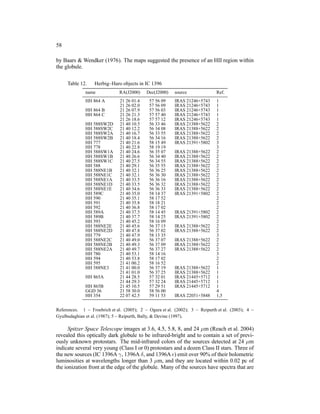
      The molecular outflows discovered in the Cepheus Flare and their driving sources
are listed in Table 4, and the Herbig–Haro objects and driving sources can be found in
Table 5.
      Figure 3 shows the surface distribution of pre-main sequence stars and candidates
in the Cepheus Flare. Apparently star formation occurs in small aggregates, especially
along the boundaries of the complex. The central part of the cloud complex contains
clouds of low density and is avoided by known signposts of star formation.
      The samples of T Tauri stars, displayed in Fig. 3, result from several surveys for
Hα emission stars conducted in the region of Cepheus Flare. Only 10 pre-main se-
quence objects are catalogued in the Herbig–Bell Catalog (Herbig & Bell 1988, here-
inafter HBC). Ogura & Sato (1990) reported on 69 detected and 49 suspected Hα emis-
sion stars in a wide environment of L 1228. Kun (1998) reported 142 Hα emission stars,
distributed over the whole area of the Cepheus Flare, identified on objective prism pho-
tographic Schmidt plates and 128 IRAS sources as possible YSOs. Spectroscopic fol-
low up observations of both samples are underway (Kun et al., in preparation). We
show in Fig. 3 and list in Table 7 those stars from these two surveys whose pre-main
sequence nature has already been confirmed. The known Herbig Ae/Be stars are also
listed in Table 7.
      Tachihara et al.’s (2005) spectroscopic observations toward the ROSAT X-ray sources
resulted in detecting 16 Li-rich stars, representing weak line T Tauri stars. The main
properties of these WTTSs are listed in Table 6.
      The distribution of the WTTSs in the Cepheus Flare differs from that of other
YSOs. In the CO void found by Grenier et al. (1989), a group of WTTSs is separated
from the 13 CO cloud by > 10 pc. The cloud-to-WTTS separations are significantly
                            ∼
larger in Cepheus than in other nearby SFRs such as Chamaeleon. Because of their
grouping, Tachihara et al. propose the in-situ formation model for them. From the
total mass of the group of TTSs, a ∼ 800 M⊙ molecular cloud might have formed
them, while only ∼ 200 M⊙ molecular gas remained in their vicinity. An external
disturbance might have dissipated the molecular cloud within several 105 yr. As the
distances to the WTTSs are unknown, Tachihara et al. suggest two possible scenarios
for the history of the formation of the WTTS sample isolated from the cloud complex:
(1) The WTTSs in the CO void were formed at 300 pc and affected by the supernova
shock discussed by Grenier et al. (1989); or (2) They are at 200 pc and an unknown
supernova explosion has the responsibility for the parent cloud dissipation. Radial ve-
locity measurements might help to find the relationship between the stars and the cloud
complex. Taking into account the picture of the Cepheus Flare Shell, the same super-
nova might have triggered star formation at both 200 and 300 pc.

2.4.   Notes on Individual Objects
L 1147/L 1158 The cloud group often referred to as the L 1147/L 1158 complex con-
sists of the clouds Lynds 1147, 1148, 1152, 1155, 1157, and 1158. L 1157 harbors a
Class 0 object, L 1157-mm, with Lbol ∼ 11 L⊙ . It coincides with IRAS 20386+6751
and drives a spectacular outflow. The L 1157 outflow has been studied in detail through
many molecular lines, such as CO (Umemoto et al. 1992; Gueth, Guilloteau & Bachiller
1996; Bachiller & P´ rez Guti´ rrez 1997; Hirano & Taniguchi 2001), SiO (Mikami et al.
                     e       e
24


     Table 5.     Herbig–Haro objects and their sources in the Cepheus Flare.
       Name          RA(2000)     Dec(2000) Source                  Cloud    D(pc) Reference
       HH 376B       20 35 06.1   +67 48 47   IRAS 20359+6745       L1152     440    11,13
       HH 376A       20 36 02.4   +67 54 28   IRAS 20359+6745       L1152     440    11,13
       HH 376        20 36 55.3   +67 59 28   IRAS 20359+6745       L1152     440    15,19
       HH 375        20 39 06.2   +68 02 15   IRAS 20386+6751       L1157     440    2,18,19
       HH 315C       20 45 06.9   +68 04 50   PV Cep                L1158     500    2,8,13
       HH 315        20 45 34.0   +68 03 25   PV Cep                L1158     500    2,8,13
       HH 315B       20 45 34.0   +68 03 25   PV Cep                L1158     500    2,8,13
       HH 315A       20 45 38.4   +68 00 55   PV Cep                L1158     500    2,8,13
       HH 215        20 45 53.8   +67 57 39   PV Cep                L1158     500    10,12,13
       HH 415        20 46 04.6   +68 00 28                         L1158     500    8,11,16
       HH 315D       20 46 06.4   +67 54 13   PV Cep                L1158     500    2,8,13
       HH 315E       20 46 28.1   +67 52 20   PV Cep                L1158     500    2,8,13
       HH 315F       20 47 09.9   +67 50 05   PV Cep                L1158     500    2,8,13
       HHL 65        20 53 06.0   +67 10 00                                   300    7
       HH 199R3      20 54 49.1   +77 32 16   IRAS 20582+7724       L1228     200    4
       HH 199R2      20 54 56.2   +77 32 21   IRAS 20582+7724       L1228     200    4
       HH 200B6      20 55 09.4   +77 31 20   HH 200 IRS            L1228     200    4
       HH 199R1      20 55 12.2   +77 33 11   IRAS 20582+7724       L1228     200    4
       HH 200B5      20 55 22.5   +77 32 17   HH 200 IRS            L1228     200    4
       HH 200B4      20 55 33.9   +77 33 07   HH 200 IRS            L1228     200    4
       HH 200B4a     20 56 11.0   +77 34 18   HH 200 IRS            L1228     200    4
       HH 200B3      20 56 22.2   +77 35 01   HH 200 IRS            L1228     200    4
       HH 200B2      20 56 35.9   +77 35 34   HH 200 IRS            L1228     200    4
       HH 200B1      20 56 51.2   +77 36 21   HH 200 IRS            L1228     200    4
       HH 199B1      20 57 27.2   +77 35 38   IRAS 20582+7724       L1228     200    4
       HH 199B2      20 57 31.0   +77 35 44   IRAS 20582+7724       L1228     200    4
       HH 199B3      20 57 34.1   +77 35 53   IRAS 20582+7724       L1228     200    4
       HH 199B4      20 58 21.7   +77 37 42   IRAS 20582+7724       L1228     200    4
       HH 199B5      20 59 08.0   +77 39 25   IRAS 20582+7724       L1228     200    4
       HH 198        20 59 09.7   +78 22 48   IRAS 21004+7811       L1228     200    4,14,16,17
       HH 200R1      20 59 48.2   +77 43 50   HH 200 IRS            L1228     200    4
       HH 199B6      21 00 27.4   +77 40 54   IRAS 20582+7724       L1228     200    4
       HHL 67        21 05 00.0   +66 47 00                                   300    7
       HH 450        22 14 24.1   +70 14 26   IRAS 22129+7000       L1219     400    5
       HH 450X       22 14 50.1   +70 13 47                         L1219     400    5
       HH 363        22 27 46.7   +69 00 38   IRAS 22266+6845       L1221     200    1,9
       HH 149        22 35 24.2   +75 17 06   IRAS 22343+7501       L1251     300    3,13
       HH 373        22 37 00.0   +75 15 16                         L1251     300    16
       HH 374        22 37 39.1   +75 07 31                         L1251     300    16
       HH 374A       22 37 39.2   +75 07 31                         L1251     300    1
       HH 374B       22 37 50.0   +75 08 13                         L1251     300    1
       HH 364        22 38 19.2   +75 13 07                         L1251     300    16
       HH 189C       22 38 39.4   +75 09 49                         L1251     300    6
       HH 189        22 38 39.9   +75 10 41   IRAS 22376+7455?      L1251     300    6
       HH 189B       22 38 40.0   +75 10 40   KP 44?                L1251     300    6
       HH 189E       22 38 40.3   +75 13 52                         L1251     300    1
       HH 189A       22 38 40.4   +75 10 53                         L1251     300    6
       HH 189D       22 38 44.2   +75 13 28                         L1251     300    1
       HH 358        23 24 39.0   +74 12 35                         L1262     180    1,16
       HH 359        23 26 29.0   +74 22 28                         L1262     180    1,16


References. 1: Alten et al. (1997); 2: Arce & Goodman (2002); 3: Bal´ zs et al. (1992); 4: Bally et al.
                                                                      a
(1995); 5: Bally & Reipurth (2001); 6: Eiroa et al. (1994); 7: Gyulbudaghian et al. (1987); 8:
G´ mez et al. (1997); 9: Lee et al. (2002); 10: Moreno-Corral et al. (1995); 11: Movsessian et al.
  o
(2004); 12: Neckel et al. (1987); 13: Reipurth, Bally, & Devine (1997); 14: Movsessian & Magakian
(2004); 15: Rodr´guez & Reipurth (1998); 16: Wu et al. (1992); 17: Brugel & Fesen (1990); 18:
                  ı
Devine, Reipurth & Bally (1997); 19: Davis & Eisl¨ ffel (1995).
                                                 o
25

1992; Zhang et al. 1995; Gueth, Guilloteau & Bachiller 1998; Zhang, Ho & Wright 2000;
Bachiller et al. 2001), H2 (Hodapp 1994; Davis & Eisl¨ ffel 1995), NH3 (Bachiller et al.
                                                        o
2001; Tafalla & Bachiller 1995; Umemoto et al. 1999), and CH3 OH (Bachiller et al.
1995, 2001; Avery & Chiao 1996). Many other lines have been detected (Bachiller & P´ rez Guti´ rrez
                                                                                            e  e
1997; Bachiller et al. 2001; Beltr´ n et al. 2004; Benedettini et al. 2007; Arce et al. 2008),
                                  a
making L 1157 the prototype of chemically active outflows. Gas phase shock chem-
istry models have been used by Amin (2001) to study the production of the observed
species in the L 1157 outflow . Arce & Sargent (2006) studied the outflow–envelope
interaction on a 104 AU scale using high angular resolution multiline observations.
Velusamy et al. (2002) detected spatially resolved methanol emission at 1 mm from
L 1157. Their results indicate the presence of a warm gas layer in the infall–disk inter-
face, consistent with an accretion shock. Regarding the protostar itself, dust continuum
observations have been carried out at 2.7 mm (Gueth et al. 1996, 1997; Beltr´ n et al.
                                                                                    a
2004), 1.3 mm (Shirley et al. 2000; Chini et al. 2001; Gueth, Bachiller & Tafalla 2003;
Beltr´ n et al. 2004), 850 µm (Shirley et al. 2000; Chini et al. 2001; Young et al. 2006),
      a
450 µm (Chini et al. 2001), as well as 60, 100, 160, and 200 µm (Froebrich et al. 2003).
Using the VLA, Rodr´guez & Reipurth (1998) detected the protostar as a radio contin-
                        ı
uum source at 3.6 cm. Froebrich et al. (2003) obtained a far-infrared spectrum of the
L 1157 protostar using the LWS on board ISO. Deep Spitzer IRAC images of L 1157
reveal many details of the outflow and the circumstellar environment of the protostar.
Looney et al. (2007) report on the detection of a flattened structure seen in absorption
at 8 µm against the background emission. The structure is perpendicular to the outflow
and is extended to a diameter of 2 arcmin. This structure is the first clear detection of a
flattened circumstellar envelope or pseudo-disk around a Class 0 protostar.


    Table 6.        Weak-line T Tauri stars in the Cepheus Flare (Tachihara et al. 2005)
        ID      GSC       RA(2000) Dec(2000) Sp. Type        V      V − IC M1 (M⊙ ) Age(Myr)1
    4c1      0450001478 00 38 05.4    +79 03 21     K1      10.43    0.92       1.6     2
    4c2                 00 38 05.4    +79 03 21     K7      13.86    1.77       0.8    15
    5c1      0450001549 00 39 06.1    +79 19 10     K6      12.18    1.52       0.6     1
    5c2                 00 39 06.1    +79 19 10     M22     14.12    2.10       0.4     1
     19      0458901101 20 20 29.3    +78 07 22     G8      10.39    0.82       1.6     6
    20       0445900083 20 25 15.4    +73 36 33     K0      10.62    0.84       1.6     4
    28       0458601090 21 11 29.4    +76 14 29     G8      11.66    0.81       1.0    25
    34       0460801986 22 11 11.0    +79 18 00     K7      13.09    1.55       0.7     3
    36c1     0427200174 22 27 05.3    +65 21 31     K4      12.92    1.13       0.9    20
    36c2                22 27 05.3    +65 21 31     M42     15.55    2.50       0.2    0.2
    37c1     0448000917 22 33 44.9    +70 33 18     K3      11.63    1.65       1.0    0.4
    38       0460400743 22 39 58.1    +77 49 40     K2      11.88    1.03       1.2     8
    40       0460502733 23 00 44.4    +77 28 38     K0      10.98    0.88       1.4     6
    41       0460500268 23 05 36.1    +78 22 39     K6      13.19    1.59       0.8     7
    43c1     0448900036 23 09 43.4    +73 57 15     K7      13.21    1.86       0.3     4
    43c2                23 09 43.4    +73 57 15     M32     15.55    2.50       0.7     3
    44       0460500170 23 16 18.1    +78 41 56     K4      11.77    1.24       1.0     2
    45       0447900348 23 43 41.9    +68 46 27     K2      12.64    1.00       0.9    25
    46       0461001318 23 51 10.0    +78 58 05     K1      11.34    0.93       1.3     6
    1
        Derived from the evolutionary tracks by D’Antona & Mazzitelli (1994).
    2
        Derived only from the V − IC color.
     The K′ image of the outflow source, presented by Hodapp (1994), is dominated by
nebulosity of bipolar morphology, indicative of an in-plane bipolar outflow. Knots of
nebulosity extend to the north and south of the outflow position. Both the northern and
the southern lobes contain bow shock fronts.
26

     X-ray observations of L 1157, performed by the ASCA satellite, have been pub-
lished by Furusho et al. (2000).
     The molecular cloud L 1155 was mapped by Harjunp¨ a & Mattila (1991) in the
                                                           a¨
lines of C18 O, HCO+ , and NH3 . The observations revealed that L 1155 consists of two
separate clumps, L1155 C1 and L1155 C2. The optically visible pre-main sequence star
associated with L 1152 is HBC 695 (RNO 124), studied in detail by Movsessian et al.
(2004).
     Recently Kauffmann et al. (2005), using the data base of the Spitzer Space Tele-
scope Legacy Program From Molecular Cores to Planet Forming Disks (c2d, Evans et al.
2003) found a candidate sub-stellar (M ≪ 0.1M⊙ ) mass protostellar object in L 1148.
The object L 1148–IRS coincides with IRAS F20404+6712.

PV Cep The highly variable pre-main sequence star PV Cep lies near the northeastern
edge of the dark cloud complex L 1147/L 1158. It is a bright IRAS source, and has been
detected in radio continuum (Anglada et al. 1992). It illuminates a reflection nebula,
known as GM–29 (Gyulbudaghian & Magakian 1977) and RNO 125 (Cohen 1980).
A dramatic brightening of the star (an EXor-like outburst) was observed in the period
1976–1978, and at the same time the shape of the associated nebula changed drastically
(Cohen, Kuhi & Harlan 1977).
     The stellar parameters of PV Cep are somewhat uncertain. Most of its optical
spectrograms available show no photospheric absorption features. Cohen et al. (1977),
based on measurements of narrow-band continuum indices, estimated a spectral type
about A5. Cohen et al. (1981) found the same spectral type based on the strength of the
Hδ absorption line, apparent in two blue spectra. They note, however, that the hydrogen
features probably represent merely a shell spectrum. Magakian & Movsessian (2001)
estimated a spectral type of G8–K0, based on a spectrum taken in July 1978, when
the star was some 2 magnitudes fainter than during the outburst. No other estimate of
spectral type can be found in the literature (see Hern´ ndez et al. 2004, for a review).
                                                         a
The spectral type of F, quoted by Staude (1986) and Neckel et al. (1987) is also based
on the spectral information presented by Cohen et al. (1981).
     Cohen et al. (1981) found a distance of about 500 pc for PV Cep. Their esti-
mate was based on three independent arguments. (1) PV Cep is probably related to
NGC 7023. The spectroscopic and photometric data of its illuminating star, HD 200775,
suggest a distance of 520 pc. (2) The spectroscopic and photometric data of the neb-
ulous star RNO 124, located in the same cloud complex as PV Cep, suggest the same
distance. (3) A similar distance can be obtained from the light travel time from the star
to a nebular spike which brightened about a year after the outburst of the star. On the
contrary, Straizys et al. (1992) obtained a distance of 325 pc for the L 1147/L 1158 dark
cloud complex (see Table 3).
     The environment of the star shows a bipolar and rapidly changing optical mor-
phology (Cohen et al. 1981; Neckel & Staude 1984; Staude 1986; Neckel et al. 1987;
Levreault & Opal 1987; Scarrott et al. 1991a,b), as well as a bipolar CO outflow parallel
to the symmetry axis of the reflection nebula (Levreault 1984). Neckel et al. (1987) de-
tected several HH-knots, known as HH 215, emanating from PV Cep. Reipurth, Bally, & Devine
(1997) and G´ mez, Kenyon & Whitney (1997) discovered a giant (∼ 2.3 pc long)
               o
Herbig-Haro flow, HH 315, consisting of 23 knots. HH 215 is also part of this giant
flow. Reipurth, Bally, & Devine (1997) detected a further small knot, HH 415, located
north-east of PV Cep, but this may be a dwarf galaxy with Hα redshifted into the [SII]
passband (Bally, priv. comm.). Near-infrared spectroscopy of PV Cep is presented
27

by Hamann & Persson (1994) and Greene & Lada (1996), and optical spectroscopy by
Corcoran & Ray (1997).
                                               ´
     Far-infrared data obtained by ISOPHOT (Abrah´ m et al. 2000) indicate the pres-
                                                     a
ence of an extended dust component on arcminute scale around PV Cep. The existence
of a dust core close to PV Cep is also supported by the 13 CO (J=1–0) mapping of the
region by Fuente et al. (1998b), who found a molecular core with a size of some 60′′ .


     Figure 6. Optical image of a field of 36′ × 24′ of L 1082, obtained by Giovanni
     Benintende (http://www.astrogb.com/).


L 1082 is a remarkable filamentary cloud (see Fig. 6), first catalogued by E. E. Barnard
(1927) as Barnard 150. It appears as GF 9 in the catalog of globular filaments by
Schneider & Elmegreen (1979). Several dense cores, namely L 1082 A,B,C (Myers et al.
1983), and LM99 349, 350, 351 (≡ L 1082 C), 352 (Lee & Myers 1999), as well as four
IRAS sources, IRAS 20468+5953, 20503+6006, 20520+6003, and 20526+5958 are
found along the filament. A finding chart for the objects in L 1082 is given in Figure 7.
     No distance determination is available in the literature for L 1082. Several authors
assume that L 1082 is close to NGC 7023 not only on the sky, but also in space, and
thus accept 440 pc as its distance (e.g. Ciardi et al. 1998). We note that the angular
separation of 10◦ between NGC 7023 and L 1082 corresponds to 70 pc at the distance
of NGC 7023. If both objects belong to the same complex, a similar difference can
be expected between their distances. Wiesemeyer et al. (1997), based on statistical
arguments, assume a distance of 100±50 pc. Furuya et al. (2003) refer to 150 pc, and
Furuya et al. (2006) derive the physical parameters of GF 9–2 using 200 pc. Kun (2007)
speculates that L 1082 may lie at the interaction region of the Local Bubble and Loop III
(Cepheus Flare Shell). In this case its likely distance is about 150 pc.
28

     Ciardi et al. (1998) performed near-infrared observations of a core and a filament
region within GF 9 (GF 9-Core and GF 9–Fila, see Fig. 7). They found that neither the
core nor the filament contains a Class I or Class II YSO. The extinction maps of the two
7′ × 7′ fields observed reveal masses 26 and 22 M⊙ in the core and the filament, re-
spectively (at a distance of 440 pc). The core contains a centrally condensed extinction
maximum that appears to be associated with IRAS 20503+6006, whereas GF 9–Fila
does not show centrally peaked dust distribution.


     Figure 7. Finding chart for the structure of L 1082, based on Poidevin & Bastien’s
     (2006) Fig. 1 and Wiesemeyer et al.’s (1998) Fig. 1. Crosses indicate the positions
     of the IRAS and ISOCAM point sources, open cirles mark the dense cores L 1082 A,
     B, and C (Benson & Myers 1989), diamonds show the dense cores catalogued by
     Lee & Myers (1999). Two rectangles show the regions GF 9 Core and GF 9 Fila,
     studied in detail by Ciardi et al. (1998; 2000). The size of the underlying DSS red
     image is 70′ × 50′ .


      Wiesemeyer et al. (1998) presented mid-infrared ISOCAM observations of L 1082.
They identified 9 sources along the filament, and designated them as GF 9–1, 2, 3a,
3b, 4, 5, 6, I6, and 7. The designations probably follow Mezger (1994) who la-
beled dense cores along the filament by the same numbers. GF 9–2 coincides in po-
sition with IRAS 20503+6006, GF 9–3b with IRAS 20520+6003, GF 9–I6 with IRAS
20468+5953, and GF 9–4 lies at 12′′ west of IRAS 20526+5958. They find that these
latter two sources are Class 0 protostars, both associated with CO outflows, whereas
GF 9–6 and GF 9–7 are most likely reddened background stars. They speculate that the
other ISOCAM sources, not associated with outflows, may be transitional objects be-
tween prestellar (Class −1) and Class 0 evolutionary stages. Wiesemeyer et al. (1999)
29

presented far-infrared ISOPHOT and millimeter continuum measurements for GF 9–2,
GF 9–3a/3b, and GF 9–4.
      Ciardi et al. (2000) performed CO, 13 CO, and CS observations of the GF 9–Core
and GF 9–Fila regions, determined excitation temperatures, densities and masses. The
CS observations reveal that both regions contain centrally condensed, high-density gas
cores. The temperatures and masses of the two regions and of the cores contained within
the regions are similar, but the densities in GF 9–Core are twice those of GF 9–Fila.
      De Gregorio Monsalvo et al. (2006) detected CCS emission from GF 9–2. The
structure of the magnetic field associated with GF 9 was studied by Jones (2003) and
Poidevin & Bastien (2006).
      Furuya et al. (2003) detected H2 O maser emission from GF 9–2. Furuya et al.
(2006) studied in detail the spatial and velocity structure of GF 9–2, using several
molecular transitions obtained by single-dish and interferometric radio observations
and 350 µm continuum data. The observations revealed a dense core with a diameter
of ∼ 0.08 pc and mass of ∼ 3 M⊙ . Within the core a protostellar envelope with a
size of ∼ 4500 AU and mass of ∼ 0.6 M⊙ could be identified. The radial column
density profile of the core can be well fitted by a power-law form of ρ(r) ∝ r −2 for the
0.003 < r/pc < 0.08 region. The power-law index of −2 agrees with the expectation
for an outer part of the gravitationally collapsing core. They found no jet-like outflow,
but a compact, low-velocity outflow may have formed at the center. They discovered a
potential protobinary system with a projected separation of ∼ 1200 AU, embedded in a
circumbinary disk-like structure with ∼ 2000 AU radius at the core center. The binary
consists of a very young protostar and a pre-protostellar condensation. The studies led
to the conclusion that GF 9–2 is very likely at an extremely early stage of low-mass star
formation before arriving at its most active outflow phase.
      Stecklum, Meusinger & Froebrich (2007) discovered 14 Herbig–Haro objects in
the GF 9 region which apparently belong to at least three large HH-flows. Five HH-
objects and GF 9–2 are linearly aligned, suggesting that they constitute an HH-flow
driven by IRAS 20503+6006. Its overall length amounts to 43.5 arcmin, which corre-
sponds to 2.3 pc for an assumed distance of 200 pc. The presence of a well-developed,
parsec-scale outflow from GF 9–2 indicates a more advanced evolutionary stage of this
source than previously believed.
      Furuya et al. (2008) mapped GF 9 in the NH3 (1,1) and (2,2) inversion lines, using
the Nobeyama 45-m telescope, with an angular resolution of 73′′ . The large-scale map
reveal that the filament contains at least 7 dense cores, as well as 3 candidates, located
at regular intervals of ∼ 0.9 pc (at an assumed distance of 200 pc). The cores have
                         <
kinetic temperatures of ∼ 10 K and LTE-masses of 1.8 – 8.2 M⊙ , making them typical
sites of low-mass star formation, probably formed via the gravitational fragmentation
of the natal filamentary cloud.


NGC 7023 is a reflection nebula, illuminated by the young massive star
HD 200775 and a group of fainter stars. It was discovered by William Herschel in
1794. HD 200775 (also known as V380 Cep and HBC 726) is a Herbig Be star that has
been extensively studied (e.g. Herbig 1960; Altamore et al. 1980; Pogodin et al. 2004;
Alecian et al. 2008). The surrounding reflection nebula has been observed in detail (e.g.
Slipher 1918; Witt & Cottrell 1980; Witt et al. 1982; Rogers et al. 1995; Laureijs et al.
1996; Fuente et al. 2000; Werner et al. 2004; Bern´ et al. 2008). Figure 8 shows an
                                                    e
optical image of the reflection nebula.
30


     Figure 8. Optical image of NGC 7023, illuminated by the Herbig Be star
     HD 200775. The size of the field is about 30′ × 20′ . Courtesy of Richard Gilbert of
     the Star Shadows Remote Observatory.


      Weston (1953) found that, centered on the reflection nebula, there is a small clus-
ter consisting of stars which are variable and show Hα line in emission. Some two
dozens of variable stars of the region were studied by Rosino & Romano (1962). Nev-
ertheless, the HBC lists only four of these stars (HBC 726, 304, 306, 307, see Table 7)
as confirmed T Tauri type stars. Recently Goodman & Arce (2004) speculated that the
young Herbig Ae star PV Cep, located more than 10 pc to the west of the cluster, might
have been ejected from NGC 7023 at least 100,000 years ago. HD 200775 is located
at the northern edge of an elongated molecular cloud, corresponding to the dark clouds
L 1167, 1168, 1170, 1171, 1172, 1173 and 1174, referred to as the L 1167/L 1174 com-
plex. The cloud complex has been mapped in CO by Elmegreen & Elmegreen (1978).
They found that the size of the cloud is 0.5◦ ×1.0◦ , or 3.9 pc×7.7 pc, and the mass of
the molecular hydrogen is some 600 M⊙ .
Table 7.: Pre-main sequence stars in the Cepheus Flare – (A) Classical T Tauri stars

Names                                                  IRAS         2MASS J/          2MASS magnitudes                  IRAS fluxes
                                                                  RA,Dec(J2000)       J     H        K F(12) F(25) F(60)             F(100)
HBC 695n, RNO 124, K98 6                           20359+6745 20361986+6756316 11.364        9.739    8.781 0.44 1.05 1.81
GSC 04472-00143                                    20535+7439 20530638+7450348 10.149        9.405    8.861 0.42 0.63 0.68
HH 200 IRS, L 1228 VLA 4                                      20570670+7736561∗
FT Cep, K98 26                                     20587+6802 20592284+6814437 10.588        9.342    8.532   0.55 0.92 0.89
K98 30, OSHA 42                                   F20598+7728 20584668+7740256 11.513       10.365    9.699   0.09 0.16
RNO 129 S1, OSHA 44, K98 32                        21004+7811 20591409+7823040 9.437         7.530    6.319   6.23 11.12 36.30       76.60:
RNO 129 S2, OSHA 44, K98 32                        21004+7811 20591256+7823078 10.993:      12.060    9.174
RNO 129 A                                                      20590373+7823088 12.565      11.280   10.726
HBC 304, FU Cep, LkHα 427                          21009+6758 21014672+6808454 11.792       10.798   10.159
K98 35, PRN S5                                    F21016+7651 21005285+7703149 11.290       10.288    9.773   0.12 0.15 0.34
                                                  F21022+7729 21011339+7741091 12.676       11.202   10.327   0.08 0.13 0.17
NGC 7023 RS 2                                                  21012706+6810381 12.323      11.150   10.417
NGC 7023 RS 2                                                  21012637+6810385 11.107      10.084    9.571
PW Cep, LkHα 425, NGC 7023 RS 3                                21013590+6808219 12.336      11.564   11.052
NGC 7023 RS 5                                                  21014250+6812572 11.911      10.892   10.421
LkHα 428, NGC 7023 RS 8                                        21022829+6803285 11.141      10.457    9.723
HZ Cep, NGC 7023 RS S3                                         21014358+6809361 11.218      10.415   10.156
HBC 306, FV Cep, LkHα 275, K98 38                 F21017+6813 21022039+6825240 11.513       10.529    9.880   0.12 0.14
PRN S1(b)                                                      21012508+7706540 17.212:     14.640   13.156
PRN S1(a)                                                      21012638+7707029 16.460:     14.622   13.244
OSHA 48, PRN S6                                                21012919+7702373 9.919        9.093    8.563
OSHA 49, K98 40, PRN S7                           F21023+7650 21013097+7701536 11.669       10.910   10.614   0.17 0.23 0.72
OSHA 50, K98 41, PRN S8                                        21013267+7701176 11.993      11.060   10.419   0.08 0.08 0.09
PRN S4                                                         21013505+7703567 13.217      12.018   11.084
PRN S2                                                         21013945+7706166 15.399      14.007   12.973
PRN S3                                                         21014960+7705479 12.449      11.272   10.802
OSHA 53, K98 43, PRN S9                           F21028+7645 21020488+7657184 11.108       10.352   10.027   0.09 0.20 0.24
FW Cep, NGC 7023 RS 9                                          21023299+6807290 11.559      10.713   10.411
NGC 7023 RS 10                                     21023+6754 21025943+6806322 13.871       13.083   12.357   0.27 0.39
K98 46                                            F21037+7614 21030242+7626538 11.585       10.843   10.471   0.13 0.18
HBC 307, EH Cep, LkHα 276, K98 42                  21027+6747 21032435+6759066 9.538         8.767    8.196   0.59 0.71
        ∗
            No 2MASS counterpart.


                                                                                                                                              31
32
                                    Table 7.: Pre-main sequence stars in the Cepheus Flare – (A) Classical T Tauri stars (cont.)

Names                                                      IRAS         2MASS J/          2MASS magnitudes                  IRAS fluxes
                                                                      RA/Dec(J2000)       J     H        K F(12) F(25) F(60)             F(100)
OSHA 59, K98 49                                       F21066+7710 21055189+7722189      10.689     9.755    9.086   0.17 0.24 0.18
K98 53                                                            21153595+6940477      11.585    10.843   10.471   0.13 0.18
K98 58                                                F21202+6835 21205785+6848183      14.318    13.035   11.866        0.20             5.49:
RNO 135, K98 61                                        21326+7608 21323108+7621567      11.101    10.072    9.688             1.46         5.01
K98 66                                                            21355434+7201330      11.323    10.724   10.463
K98 71                                                F21394+6621 21402754+6635214      11.344    10.540   10.046   0.34 0.64 2.56
HBC 731, SVS 6                                                    21425961+660433.8     12.886    11.624   10.948
HBC 732, V350 Cep, MMN 13                                         21430000+6611279      12.714    11.691   11.008
NGC 7129 S V1                                                     21401174+6630198      13.161    12.173   11.591
NGC 7129 S V2                                                     21402277+6636312      13.882    12.671   11.890
NGC 7129 S V3                                                     21403852+6635017      13.108    11.888   11.267
V391 Cep, K98 72                                      F21404+6608 21413315+6622204      11.680    10.555    9.750   0.36 0.40
NGC 7129 MMN 1                                                    21422308+6606044      15.059    14.050   13.394
NGC 7129 HL85 14, MMN2 2                                          21423880+6606358      14.796    13.479   12.514
NGC 7129 MMN 3                                                    21424194+6609244      15.179    14.340   13.987
NGC 7129 MMN 5                                                    21425142+6605562      15.199    14.128   13.573
NGC 7129 MEG 1                                                    21425177+6607000      16.679    15.546   14.675
NGC 7129 MMN 6                                                    21425262+6606573      13.821    12.650   11.803
NGC 7129 MMN 7                                                    21425314+6607148      14.338    13.193   12.679
NGC 7129 MMN 8                                                    21425346+6609197      16.990    15.497   14.578
NGC 7129 MMN 9                                                    21425350+6608054      13.214    12.365   12.124
NGC 7129 MMN 10                                                   21425481+6606128      14.192    13.254   12.907
NGC 7129 MEG 2                                                    21425476+6606354      14.183    13.179   12.564
NGC 7129 MMN 11                                                   21425626+6606022      12.423    11.657   11.406
RNO 138, V392 Cep                                                 21425771+6604235      14.567:   14.478   13.658
NGC 7129 MMN 12                                                   21425810+6607394      14.299    13.532   13.030
NGC 7129 MEG 3                                                    21425878+6606369      13.487    12.561   12.337
NGC 7129 MMN 14                                                   21430024+6606475      14.161    12.778   12.085
NGC 7129 MMN 15                                                   21430246+6607040      14.004    13.109   12.256
GGD 33A                                                           21430320+6611150      16.619    15.461   14.337
NGC 7129 MMN 17                                                   21431162+6609115      12.605    11.800   11.487
        ∗
            No 2MASS counterpart.
Table 7.: Pre-main sequence stars in the Cepheus Flare – (A) Classical T Tauri stars (cont.)

Names                                                      IRAS         2MASS J/           2MASS magnitudes                  IRAS fluxes
                                                                      RA/Dec(J2000)        J     H        K F(12) F(25) F(60)                  F(100)
                                                                                      ∗
NGC 7129 MMN 18                                                      2143124+661238
NGC 7129 MMN 19                                                     21431683+6605487      14.184   13.300   13.123
NGC 7129 MMN 20                                                     21433183+6608507      13.935   12.894   12.295
NGC 7129 MMN 21                                                     21433271+6610113      14.986   13.792   13.547
NGC 7129 MMN 22                                                     21434345+6607308      13.655   12.609   12.146
K98 73                                                              21443229+7008130      11.777   10.939   10.535             0.14    0.25
K98 95                                                              22131219+7332585      10.987   10.048    9.498      0.3    0.26    0.32      0.28
GSC 04467-00835                                        22129+6949   2214068+7005043       9.620     9.072    8.753   0.254    0.567   0.484     0.50:
K98 108                                                             22190203+7319252      10.666    9.947    9.561    0.15     0.26      0.3
K98 109                                                             22190169+7346072      11.677   10.738   10.234    0.06     0.12    0.16      0.4
K98 110                                                             22190343+7349596      12.848   12.264   12.162    0.15     0.19    0.12     0.16
K98 119                                                22256+7102   22265660+7118011      10.967    9.646    8.525    1.74     2.28    2.48     4.17
KP 1, XMMU J223412.2+751809                            22331+7502   22341189+7518101      10.095    8.808    7.827
KP 39, XMMU J223516.6+751848                                        22351668+7518471      11.808   10.589    9.858
KP 2, XMMU J223605.8+751831                            22350+7502   2236059+7518325       11.957   10.894   10.253
KP #10                                                 22355+7505   2236345+7521352       11.984   10.628   10.026    0.11 0.24 0.23
KP 43, XMMU J223727.7+751525                                        22372780+7515256      11.289   10.202    9.854
KP 3, XMMU J223750.1+750408                                         22374953+7504065      11.785   10.974   10.680
ETM Star 3, XMMU J223818.8+751154                                   22381872+7511538      11.248    9.815    8.912
KP 44, ETM Star 1, XMMU J223842.5+751146                            22384249+7511455      12.166   11.313   11.028
KP 45, XMMU J22397.3+751029                                         22392717+7510284      11.748   10.851   10.377
KP 46, XMMU J223942.9+750644                           22385+7457   22394030+7513216      10.920    9.481    8.698
GSC 04601-03483                                       F22424+7450   22433926+7506302      10.958   10.379   10.216   0.080 0.240 0.522
K98 128                                                             22490470+7513145      12.011   11.208   10.814
TYC 4601-1543-1                                        22480+7533   22491626+7549438      9.938     9.256    8.727    0.61 0.90 0.81
HBC 741, AS 507, K98 140                               23189+7357   23205208+7414071      8.308     7.754    7.480

        ∗
            No 2MASS counterpart.


                                                                                                                                                        33
34
     Table 7.     Pre-main sequence stars the Cepheus Flare – (B) Herbig Ae/Be stars
      Names                                                IRAS         2MASS J             2MASS magnitudes                  IRAS fluxes
                                                                      RA/Dec(J2000)          J     H       K        F(12)   F(25)   F(60)      F(100)
      HBC 696n, PV Cep, K98 9                         20453+6746    20455394+6757386 12.453        9.497 7.291 12.82 32.93     48.85    57.92
      HBC 726, HD 200775, MWC 361                     21009+6758    21013691+6809477 6.111         5.465 4.651 26.700 76.800 638.000 1100.000
      HD 203024                                       21153+6842    21160299+6854521 8.377         8.209 8.120 3.680 10.800    4.260
      GSC 04461-01336, BD+68◦ 1118                    21169+6842    21173917+6855098 9.269         8.741 8.105 1.570 3.480     4.130     2.59
      HBC 730, V361 Cep, AS 475, BD +65◦ 1637                       21425018+6606352 8.973         8.729 8.474
      HBC 309, LkHα 234, V373 Cep                     21418+6552    21430682+6606542 9.528         8.201 7.081 14.78 78.96 687.70 1215.00
      HBC 734, BH Cep, K98 83                         22006+6930    22014287+6944364 9.686         8.993 8.310 0.524 1.200     1.390
      HBC 735, BO Cep, K98 100                       F22156+6948    22165406+7003450 10.319        9.849 9.581 0.285 1.428
      HBC 736, SV Cep, K98 113                        22205+7325    22213319+7340270 9.350         8.560 7.744   4.22   5.22    2.66     1.76
      GSC 04608-02063                                 22219+7908    22220233+7923279 11.509       10.920 10.266


References to star names: NGC 7023 RS – variable stars from Rosino & Romano (1962); OSHA – Hα emission stars from Ogura & Sato (1990); KP – Hα emission
star from Kun & Prusti (1993), Table 2; KP# – IRAS point source from Kun & Prusti (1993), Table 3; ETM – Eiroa et al. (1994); K98 – Hα emission stars from Kun
(1998); NGC 7129 MEG – Miranda et al. (1993); NGC 7129 MMN – Magakian et al. (2004); PRN – Padgett et al. (2004); NGC 7129 S – Semkov (2003); XMMU –
Simon (2006)
35


    Figure 9. 13 CO contours of the molecular cloud associated with NGC 7023,
    overplotted on the DSS red image (Elmegreen & Elmegreen 1978). Positions of
    HD 200775 and lower mass pre-main sequence stars, as well as the protostar IRAS
    21017+6742 are indicated.

     Watt et al. (1986) found a bipolar outflow associated with HD 200775. The region
of the outflow has been mapped in 13 CO(1-0) by Fuente et al. (1998). These observa-
tions show that the star is located within a biconical cavity, which has probably been
excavated by a bipolar outflow. However, Fuente et al. found no evidence for current
high-velocity gas within the lobes of the cavity.
     Myers et al. (1988) detected another molecular outflow centered on the IRAS source
IRAS 21017+6742. Hodapp’s (1994) K′ image of the L 1172 outflow shows four stars
associated with localized nebulosity. None of them are close to the nominal outflow
position. Visser, Richer & Chandler (2002) detected three submillimeter sources at the
36

position of IRAS 21017+6742: L 1172 SMM 1–SMM 3. They found that L 1172 SMM 1,
located at RA(2000)=21h 02m 21.5s , Dec(2000)=+67◦ 54′ 14′′ is a protostar and the driv-
ing source of the outflow, whereas SMM 2 and SMM 3 are starless dust clumps. Fig-
ure 9 shows the 13 CO contour map of the L 1167/L 1174 complex, adopted from Elmegreen & Elmegreen
(1978). Known pre-main sequence stars of the region are also indicated.

L 1177 (CB 230) contains a molecular outflow driven by the IRAS source 21169+6804
(Yun & Clemens 1994). Near infrared observations by Yun (1996) revealed this source
to be a binary protostar with a projected separation of 12′′ , and embedded in a com-
mon infrared nebula. The stars can be found near the center of a dense core whose
size is about 360′′ (0.5 pc at 300 pc). Further CO and infrared studies can be found in
Clemens, Yun & Heyer (1991). Submillimeter polarization measurements by Wolf, Launhardt & Henning
(2003) reveal a magnetic field strength of 218 µG for the envelope of CB 230. Wolf et al.
found that the outflow is oriented almost perpendicular to the symmetry axis of the
globule core, whereas the magnetic field is parallel to the same axis. They discuss the
possibility that the orientation of the magnetic field relative to the outflow directions re-
flects the evolutionary stage of the globule. Two A-type emission line stars, HD 203024
and BD +68◦ 1118 can be found to the north of the globule, at the edge of the diffuse
outer part of the cloud. Their formation history may be connected to each other (Kun
1998). Miroshnichenko et al. (1997) and Kun, Vink´ & Szabados (2000) classify these
                                                      o
objects as candidate Herbig Ae/Be stars, whereas Mora et al. (2001) state that they are
main sequence stars.

L 1228 is a small cloud stretching some 3◦ along a north-south direction. Its most
probable distance is 180 pc (see Sect. 2.2.). L 1228 differs kinematically from the
rest of the Cepheus Flare molecular clouds, suggesting that the cloud is located on the
near side of the Cepheus Flare shell. Numerous Hα emission stars have been found
around this cloud (Ogura & Sato 1990; Kun 1998), as well as several molecular out-
flows (Haikala & Laureijs 1989) and Herbig–Haro objects (Bally et al. 1995).
      The elongated cloud consists of three centers of star formation.
      (1) The northernmost part is a small, nebulous group of stars, RNO 129, associ-
ated with IRAS 21004+7811. Bally et al. (1995) found Herbig–Haro emission from
RNO 129. A detailed study of RNO 129 can be found in Movsessian & Magakian
(2004). Arce & Sargent (2006) included RNO 129 in their study of the evolution of
outflow-envelope interactions in low-mass protostars.
      (2) The L 1228 core or L 1228 A contains the Class I source IRAS 20582+7724. A
13 CO map of the cloud is presented in Miesch & Bally (1994). A dense core, mapped

in ammonia by Anglada, Sep´ lveda & G´ mez (1997), contains at least two sources
                                u            o
driving molecular outflows as well as two Herbig-Haro flows, HH 199 and HH 200,
revealed by the Hα image of L 1228 A, obtained by Bally et al. (1995) and shown
in Fig. 10. HH 199 emerges from IRAS 20582+7724, associated with an east–west
oriented infrared reflection nebula (Hodapp 1994; Reipurth et al. 2000). Whereas the
molecular outflow and the HH 199 flow have a position angle of about 60◦ , Hodapp
(1994) and Bally et al. (1995) found a well-collimated H2 emission flow at a position
angle of about 100◦ . Either IRAS 20582+7724 is a possibly wide binary where each
component is launching a separate flow, or one of the components of a very close binary
is precessing rapidly, giving rise to the two very different flow angles. HH 200 is driven
by an embedded T Tauri star about 1.5 arcmin further to the northwest (Bally et al.
1995). A low-resolution 3.6 cm survey of the L 1228 cloud by Rodr´guez & Reipurth
                                                                         ı
37


     Figure 10. Hα + [SII] image of L 1228 A, based on KPNO 4 m images obtained
     with the Mosaic 1 prime focus CCD camera through narrow-band Hα and [SII] filters
     (80A passband). HH objects discussed in Bally et al. (1995) are marked. (Courtesy
     of John Bally).


(1996) revealed two sources. L 1228 VLA 1 is associated with the IRAS source, and
the other, VLA 2, has no known counterpart but is located in the direction of the high
extinction part of the L 1228 core. Reipurth et al. (2004) detected two further 3.6 cm
sources, VLA 3 and VLA 4. VLA 4 is supposed to be the driving source of the HH 200
flow. The environment of IRAS 20582+7724 was studied in detail by Tafalla & Myers
(1997), Arce & Sargent (2004), and Arce & Sargent (2006).
      The K′ image of L 1228 A, presented by Hodapp (1994), shows a star associated
with a parabola-shaped nebula, located near the molecular outflow position. Two other
stars further north at offsets (−21′′ ,72′′ ) and (12′′ ,75′′ ) are also associated with some
less extended nebulae. The relatively bright stars in this region clearly stand out against
the faint background stars, so that Hodapp classified this region as a cluster.
      (3) L 1228 South contains a small aggregate of low-mass pre-main sequence stars.
Padgett et al. (2004) identified 9 infrared sources in the images taken with IRAC on
board the Spitzer Space Telescope (see Table 7).

L 1219 (B 175) is a small cometary shaped cloud at the southernmost edge of the
Cepheus Flare cloud complex. The cloud is illuminated by the B9.5V type star BD +69◦
1231, associated with the reflection nebula Ced 201 (see Cesarsky et al. 2000, and ref-
erences therein). Two cold IRAS sources, 22129+7000 and 22127+7014, are projected
38

within the dark cloud. By an imaging and spectroscopic study Bally & Reipurth (2001)
discovered a Herbig-Haro object, HH 450, emerging from IRAS 22129+7000. Fur-
thermore, they found several parsec-scale filaments of emission that trace the rim of
a new supernova remnant, G 110.3+11.3, which appears to be approaching the glob-
ule (see Figure 11). At 400 pc, G 110.3+11.3 is one of the closest known supernova
remnants. The supernova remnant and the HH flow appear to be heading toward a
frontal collision in about 1000 yr. Nikoli´ & Kun (2004) discovered a CO outflow from
                                          c
IRAS 22129+7000. Goicoechea et al. (2008) present Spitzer IRAC and MIPS data, 1.2-
mm dust continuum map, as well as observations of several molecular lines for IRAS
22129+7000. They detected a collimated molecular outflow in the CO J = 3 − 2 line,
whereas the profile of the HCO+ J = 1 − 0 line suggested inward motion. Based on
the SED they classified the object as either a transition Class 0/I source or a multiple
protostellar system. They discuss the role of the photodissociation region associated
with Ced 201 in triggering the star formation in L 1219.


     Figure 11. Left: An image of B 175 (L 1219) from Bally & Reipurth (2001).
     Right: the map of visual extinction, obtained from the 2MASS data using the NICER
     algorithm of Lombardi & Alves (2001), shows the northern core of the cloud cen-
     tered on IRAS 22127+7014.

      Three known pre-main sequence stars can be found to the south of L 1219: the
Herbig Ae stars BH Cep and BO Cep (HBC 734 and 735, respectively) and a T Tauri
star, associated with IRAS 22129+6949. The head of the cometary globule with IRAS
22129+7000 is pointing toward south. The embedded source IRAS 21127+7014, lo-
cated to the north of IRAS 22129+7000, may be the youngest object associated with
this cloud. The left panel of Fig. 11 shows the head of the globule B 175 and the super-
nova filaments, adopted from Bally & Reipurth (2001), and the right panel shows the
extinction map of the whole cloud, revealing another core to the north.

L 1221 is a small, isolated cometary dark cloud to the south of the main body of
the Cepheus Flare cloud complex. No distance determination has been published for
this cloud. A frequently assumed distance is 200 pc (e.g. Fukui 1989; Umemoto et al.
39

1991). Inside the cloud, Umemoto et al. (1991) found an unusual U-shaped CO outflow
associated with a low-luminosity (2.7L⊙ ) Class I source, IRAS 22266+6845. More re-
cent CO observations at high resolution showed that the U-shaped outflow may actually
consist of two bipolar outflows, an east-west outflow associated with the IRAS source
and a north-south outflow about 25′′ to the east of the IRAS source, interacting with
each other (Lee et al. 2002). To the south of the IRAS source, a fairly bright compact
object, HH 363, is detected in Hα and [S II] (Alten et al. 1997). There are three infrared
sources within the error ellipse of the IRAS source: a close binary consisting of an east
source and a west source around the IRAS source position and another source 45′′ to
the southeast. The east source is identified as the IRAS source. Furuya et al. (2003)
detected H2 O maser emission associated with IRAS 22266+6845. Lee & Ho (2005)
mapped IRAS 22266+6845 in 3.3 mm continuum, CO, HCO+ , and N2 H+ . Continuum
emission is seen around the east source and the southeast source at 3.3 mm, probably
tracing the dust around them. Assuming a temperature of 40 K, the masses of the dust
plus gas are estimated to be 0.02 and 0.01 M⊙ around the east source and southeast
source, respectively. No continuum emission is seen toward the west source. The east–
west outflow is likely powered by the east source, which shows a southeast extension
along the outflow axis in the K′ image (Connelley et al. 2007). Wu et al. (2007) de-
tected two submillimeter sources in the cloud, L 1221 SMM 1 and L 1221 SMM 2,
apparently coinciding with the binary and the southeast source, respectively.


L 1251 is a cloud elongated east–west at the eastern boundary of the Cepheus Flare
molecular complex. Its cometary shape suggests interaction with the supernova bubble
described by Grenier et al. (1989). Recent star formation is indicated by two molecular
outflows, driven by IRAS 22343+7501 and IRAS 22376+7455, respectively (Sato & Fukui
1989).
     The distance of L 1251 was determined by three different methods (see Table 3).
The cloud has been mapped in several molecular lines, such as 13 CO, C18 O, H13 CO+ ,
SiO (Sato et al. 1994), NH3 (Benson & Myers 1989; T´ th & Walmsley 1996), HNC,
                                                          o
HCN, HCO+ , CS (Nikoli´ , Johansson, & Harju 2003). Kun & Prusti (1993) studied
                            c
the YSO population and reported on 12 Hα emission stars and IRAS point sources as
YSO candidates. Bal´ zs et al. (1992) discovered an optical jet, HH 149, originating
                        a
from IRAS 22343+7501. Rosvick & Davidge (1995) found that this IRAS source is as-
sociated with a cluster of five near-infrared sources spread over a 10′ ×10′ area (sources
A–E). Meehan et al. (1998) found two thermal radio continuum sources, VLA A and
VLA B, coinciding with the near infrared sources D and A, respectively. Beltr´ n et al.
                                                                                  a
(2001) found 9 radio continuum sources around IRAS 22343+7501, two of them,
VLA 6 and VLA 7 separated by 7′′ , are located within the error ellipse of the IRAS
source and identical with Meehan et al.’s VLA A and VLA B, respectively. Beltr´ n et al.
                                                                                  a
found a third source, VLA 5 to be a probable YSO, based on the positive spectral index.
Nikoli´ et al. (2003) concluded that both VLA 6 and VLA 7 are protostars driving their
       c
own outflow.
     The high resolution VLA observations by Reipurth et al. (2004) revealed four ra-
dio continuum sources in the region around IRAS 22343+7501, three of which were
known from previous studies. The high resolution VLA A map has revealed a new
source, VLA 10, close to VLA 6, with which it was blended in the earlier low-resolution
data of Meehan et al. (1998). The designations VLA 10 and 11 is a continuation of the
numbering scheme of Beltr´ n et al. (2001). Meehan et al. (1998) suggest that VLA 6
                              a
40

corresponds to the very red and embedded source IRS D, while VLA 7 is the brighter
source IRS A.
     Eiroa et al. (1994) discovered a chain of Herbig–Haro objects, HH 189A,B,C near
IRAS 22376+7455 (L 1251 B). The Spitzer Space Telescope observed L 1251 B as part
of the Legacy Program From Molecular Cores to Planet Forming Disks (Evans et al.
2003) at wavelengths from 3.6 to 70 µm. The observations revealed a small clus-
ter of protostars, consisting of 5 Class 0/I and 14 Class II objects (Lee et al. 2006).
Three Class 0/I objects are projected on IRAS 22376+7455, the most luminous is
located 5′′ north of the IRAS position. Thus the molecular outflow observed from
IRAS 22376+7455 (Sato & Fukui 1989) is probably a combined effect of more out-
flows. Lee et al. (2007) studied the complex motions in the region, based on both
single-dish and interferometric molecular line observations. The data have shown very
complex kinematics including infall, rotation, and outflow motions. The well-known
outflow, associated with L 1251 B, was resolved into a few narrow and compact com-
ponents. They detected infall signatures in the shape of HCO+ , CS, and HCN lines
to the east of L 1251 B, where no infrared object has been detected, and an extended
emission has been found at 850 µm. This result shows that, in addition to the Class 0–
Class II objects, the young cluster contains a pre-protostellar core as well. Results of
spectroscopic follow-up observations of the optically visible candidate YSOs reported
by Kun & Prusti (1993) are given in Eredics & Kun (2003). Simon (2006) detected
41 X-ray sources in the image obtained with the XMM-Newton telescope. The list of
X-ray sources contains both outflow sources and 8 optically visible T Tauri stars.
     The structure of the cloud and the properties of its dust grains were studied, based
on optical extinction maps, by Kandori et al. (2003) and Bal´ zs et al. (2004).
                                                               a
     Young et al. (2006) and Wu et al. (2007) observed submm sources associated with
the dense cores L 1251 A, B, and C.


L 1261/L 1262 (CB 244) are small clouds to the east of the main body of the Cepheus
Flare cloud complex, at a probable distance of 180 pc from the Sun (Kun 1998). Two
young, low luminosity objects, the G2 type classical T Tauri star HBC 741 (AS 507)
and the cold IRAS source IRAS 23238+7401 are projected on the cloud. A CO out-
flow centered on IRAS 23238+7401 was found by Parker et al. (1988). Wolf et al.’s
(2003) submillimeter polarization measurements resulted in a magnetic field strength
of 257 µG for the envelope of CB 244.


2.5.   NGC 7129
Though NGC 7129 lies in the Cepheus Flare, it is more distant than the clouds discussed
above. NGC 7129 (Ced 196) is a reflection nebula in the region of a young cluster, con-
taining three B-type stars, namely BD +65◦ 1637, BD +65◦ 1638, and LkHα 234, as well
as several low-mass pre-main sequence stars (e.g. Herbig 1960; Strom, Vrba & Strom
1976; Cohen & Schwartz 1983; Magakian, Movsessian & Nikogossian 2004, see Ta-
ble 7). Whereas BD +65◦ 1638 is regarded a young main sequence star (but see Matthews et al.
2003), BD +65◦ 1637 and LkHα 234 are pre-main sequence stars (Herbig 1960; Hern´ ndez et al.
                                                                                    a
2004). An optical image of NGC 7129, displaying several spectacular signposts of the
interactions between the young stars and their environments, is shown in Fig. 12. A
finding chart for the most prominent objects, related to star formation, is displayed in
Fig. 13.
41


    Figure 12. An optical image of NGC 7129, displaying the young cluster, embed-
    ded in a reflection nebula, as well as several HH objects. The size of the area is about
    15′ × 18′ . Photograph by Robert Gendler.


LkHα 234 and its environments It has been suggested that LkHα 234 is the youngest
among the three B-type stars (Hillenbrand et al. 1992). This star and its environment
have been studied extensively at optical, infrared, radio, centimeter to submillimeter
wavelengths. Photometric and spectroscopic variability of LkHα 234 have been studied
by Shevchenko et al. (1991) and Chakraborty & Mahadevan (2004), respectively.
42

      Wilking et al. (1986) presented high-resolution continuum and molecular-line ob-
servations of the circumstellar environment of LkHα 234. Sandell & Olofsson (1981)
and Tofani et al. (1995) detected three H2 O maser sources from the environment of
LkHα 234. Ray et al. (1990) identified an optical jet originating from this region.
Mitchell & Matthews (1994) detected a molecular jet associated with LkHα 234, and
Schultz et al. (1995) observed shocked molecular hydrogen in the LkHα 234 region.
VLA observations by Trinidad et al. (2004) of water masers and radio continuum emis-
sion at 1.3 and 3.6 cm show that the LkHα 234 region contains a cluster of YSOs. In
a field of ∼ 5′′ they detected five radio continuum sources (VLA 1, VLA 2, VLA 3A,
VLA 3B, and LkHα 234) and 21 water maser spots. These water masers are mainly
distributed in three clusters associated with VLA 1, VLA 2, and VLA 3B. The VLA
observations suggest that there are at least four independent, nearly parallel outflows in
the LkHα 234 region. Probably all sources observed in this region (∼ 5′′ in diameter)
form a cluster of YSOs, which were born inside the same core in the NGC 7129 molec-
ular cloud. This fact could explain that the major axes of the outflows have nearly
the same orientation. Marvel (2005) performed VLBI observations of maser sources
around LkHα 234, and detected maser emission associated with LkHα 234–VLA 2
and LkHα 234–VLA 3b. No maser source associated with LkHα 234 itself has been
detected.
      Tommasi et al. (1999) obtained far-infrared spectra of the LkHα 234 region, us-
ing the Long Wavelength Spectrograph of ISO. The observed spectra are consistent
with a photodissociation region, associated with not LkHα 234, but with BD +65◦ 1637.
Morris et al. (2004) have obtained mid-IR spectroscopy of regions around LkHα 234,
with the Spitzer Space Telescope Infrared Spectrograph (IRS). They detected warm
material at 16 µm around BD +65◦ 1638 which clearly shows that this region is not free
of gas and dust. Wang & Looney (2007) identified a group of low-mass young stars
around LkHα 234 using the Spitzer data base.

Interstellar matter associated with NGC 7129 Molecular line observations of the re-
gion (Bechis et al. 1978; Font, Mitchell & Sandell 2001; Miskolczi et al. 2001; Ridge et al.
2003) revealed a kidney-shaped molecular cloud of about 11 pc in extent to the east and
south of the cluster. BD +65◦ 1637 and most of the fainter cluster members are found
in a cavity of the cloud, bordered by a prominent molecular ridge, while LkHα 234,
located to the east of the main cluster, is associated with a peak of 13 CO emission.
The optical jet detected by Ray et al. (1990) is pointing southwest into the cavity.
Torrelles et al. (1983) and G¨ sten & Marcaide (1986) presented ammonia observations
                             u
of NGC 7129.
      Matthews et al. (2003) observed the region in the 21 cm line of H I with an angular
resolution of 1′ . The observations revealed a ring of H I emission about 30′ in extent.
The H I ring appears to be part of the surface of a molecular cloud and is centered on a
relatively dense concentration of H I with unusually wide line profiles and positionally
coincident with BD +65◦ 1638. An infrared point source, IRAS 21418+6552, coincides
within the positional errors with the H I knot.
      A continuum source coincident with BD +65◦ 1638 has also been detected at 1420
MHz, which shows a significant extension to the northeast overlapping the position
of LkHα 234. Comparing the radio continuum data with other radio observations of
BD +65◦ 1638, Matthews et al. (2003) found that BD +65◦ 1638 has a flat centimeter-
wave spectrum, consistent with an optically thin H II region around the star. The au-
thors conclude that the physical association of the star with the H I knot indicates that
43


     Figure 13. A DSS 2 red image of NGC 7129 in which the crude position of the
     molecular ridge, bordering the cluster, is overplotted by white cross-dashed lines.
     The B-type cluster members, HH objects, and some interesting low-mass young
     stars are labeled. Crosses indicate the far-infrared sources FIRS 1 and FIRS 2, and
     diamonds stand for the compact millimeter sources detected by Fuente et al. (2001)
     outside the FIRS 1 and FIRS 2 regions.


BD +65◦ 1638 belongs to a rare class of “dissociating stars”, having an extremely young
age of not more than a few thousand years. BD +65◦ 1638 itself is found to be a 6 M⊙
star that has just emerged from its cocoon and lies on the birthline.

Embedded young stellar objects in NGC 7129 Bechis et al. (1978) identified two far-
infrared sources in NGC 7129: FIRS 1 coincides with LkHα 234, while FIRS 2, a
deeply embedded protostellar object is located three arcminutes to the south of the
cluster, at the primary peak of the 13 CO emission. It was found to coincide with an
H2 O maser (Cesarsky et al. 1978; Rodr´guez et al. 1980b; Sandell & Olofsson 1981).
                                        ı
NGC 7129 FIRS 2 has not been detected in the optical and near infrared. From the
far-infrared and submillimeter observations, Eiroa, Palacios & Casali (1998) derived a
44

luminosity of 430 L⊙ , a dust temperature of 35 K, and a mass of 6 M⊙ . The low
dust temperature and the low Lbol /L1.3 mm ratio of this source suggest that it is an
intermediate mass counterpart of Class 0 sources. Fuente, Neri & Caselli (2005a) de-
tected a hot molecular core associated with FIRS 2, and Fuente et al. (2005b) carried
out a molecular survey of FIRS 2 and LkHα 234 with the aim of studying the chemical
evolution of the envelopes of intermediate-mass young stellar objects. Fuente (2008)
present high angular resolution imaging of the hot core of NGC 7129 FIRS 2, using the
Plateau de Bure Interferometer. This is the first chemical study of an intermediate-mass
hot core and provides important hints to understand the dependence of the hot core
chemistry on the stellar luminosity.
      Two molecular outflows were found in NGC 7129 by Edwards & Snell (1983).
They seem to be associated with LkHα 234 and FIRS 2. Weintraub et al. (1994), via
near infrared polarimetry, identified a deeply embedded source, NGC 7129 PS 1, lo-
cated about 3′′ northwest of LkHα 234. This source was not identified in the direct
near-infrared images of LkHα 234, which revealed 5 sources (IRS 1–IRS 5, IRS 1 ≡
LkHα 234) in a 20′′ × 20′′ field centered on LkHα 234. Weintraub et al. (1996) de-
tected NGC 7129 PS 1 at 3.8 µm, and proposed that it was the actual outflow source
instead of LkHα 234.
      Cabrit et al. (1997) present high-resolution imaging of the region around LkHα 234
in the 10 µm and 17 µm atmospheric windows and in the H2 v=1-0 S(1) line and adja-
cent continuum. The cold mid-infrared companion, detected at 2.7′′ to the north-west
of the optical star, corresponds to NGC 7129 PS 1. The companion illuminates an arc-
shaped reflection nebula with very red colors, and is associated with a radio continuum
source, H2 O masers, and a bright extended H2 emission knot, indicating that it is deeply
embedded and has strong outflow activity. Cabrit et al. (1997) refer to this star as IRS 6,
extending Weintraub et al.’s notation.
      Fuente et al. (2001) obtained single-dish and interferometric continuum images at
2.6 mm and 1.3 mm of both FIRS 2 and LkHα 234. They identified two millimeter
sources associated with FIRS 2: FIRS 2–MM1, apparently associated with the CO out-
flow, and a weaker source, FIRS 2–MM2, which does not present any sign of stellar ac-
tivity. The interferometric 1.3 mm continuum image of FIRS 1 reveals that LkHα234 is
a member of a cluster of embedded objects. Two millimeter clumps are associated with
this far-infrared source. The stronger is spatially coincident with IRS 6. A new millime-
ter clump, FIRS 1–MM1, is detected at an offset (−3.23′′ , 3.0′′ ) from LkHα 234. The
extremely young object FIRS 1–MM1 (it has not been detected in the near- and mid-
infrared) is the likely driving source of the H2 jet. There is no evidence for the existence
of a bipolar outflow associated with LkHα 234. In addition to FIRS 1 and FIRS 2, six
other compact millimeter clumps are detected in the region, NGC 7129 MM1 to MM5
(see Fig. 13), and the sixth coincides with the bipolar nebula RNO 138.
      Submillimeter continuum observations by Font et al. (2001) revealed three com-
pact sources: LkHα 234 SMM 1, LkHα 234 SMM 2 and FIRS 2. SMM 1 coincides
with IRS 6, which, according to the submillimeter observations, may be a deeply em-
bedded Herbig Be star, whereas SMM 2 is a newly discovered source (see Figure 14).
Table 8 shows the coordinates, wavelengths of detection, measured fluxes and sizes of
the deeply embedded young stellar objects in NGC 7129, observed in submillimeter,
millimeter, and centimeter continuum.

Low-mass pre-main sequence members of NGC 7129 were identified as Hα emis-
sion objects by Hartigan & Lada (1985), Miranda et al. (1993), and Magakian et al.
45


      Table 8.     Embedded YSOs in NGC 7129.
        Name                           RA(2000)         Dec(2000)      λ(mm)      Flux(mJy)     Ref.
        NGC 7129 FIRS1 IRS6            21 43 06.4       66 06 55.6      2.6                91     1
        NGC 7129 FIRS1 IRS6            21 43 06.5       66 06 55.2      1.3               313     1
        NGC 7129 FIRS1 MM 1            21 43 06.3       66 06 57.4      1.3               180     1
        LkHα 234                       21 43 06.8       66 06 54.4      1.3              < 20     1
        NGC 7129 FIRS2 MM 1            21 43 01.7       66 03 23.6      2.6                72     1
                                       21 43 01.7       66 03 23.6      1.3               381     1
        NGC 7129 FIRS2 MM 2            21 43 01.6       66 03 26.1      2.6                22     1
                                       21 43 01.7       66 03 24.7      1.3               137     1
        NGC 7129 FIRS2 IR              21 43 01.8       66 03 27.4      2.6              <15      1
                                       21 43 01.8       66 03 27.4      1.3              <19      1
        NGC 7129 FIRS 1                21 43 06.5       66 06 52.3      1.3               690     1
                                       21 43 06.5       66 06 52.3      1.3              4283     1
        NGC 7129 FIRS 2                21 43 01.4       66 03 22.3      1.3               597     1
                                       21 43 01.4       66 03 22.3      1.3              2613     1
        NGC 7129 MM 1                  21 42 57.9       66 05 21.4      1.3                96     1
        NGC 7129 MM 2                  21 42 58.7       66 05 34.5      1.3                89     1
        NGC 7129 MM 3                  21 42 38.1       66 06 50.2      1.3                62     1
        NGC 7129 MM 4                  21 43 23.7       66 08 29.0      1.3                60     1
        NGC 7129 MM 5                  21 43 26.3       66 03 24.7      1.3                29     1
        RNO 138                        21 42 57.6        66 04 26       1.3                22     1
        LkHα 234 SMM 1                 21 43 06.76      66 06 56.0      0.85             3120     2
        LkHα 234 SMM 1                 21 43 06.76      66 06 56.0      0.45            20700     2
        LkHα 234 SMM 2                 21 43 03.20      66 07 13.1      0.85              730     2
        LkHα 234 SMM 2                 21 43 03.20      66 07 13.1      0.45             6200     2
        NGC 7129 FIRS 2                21 43 01.51      66 03 24.2      0.85             3350     2
        NGC 7129 FIRS 2                21 43 01.51      66 03 24.2      0.45            18100     2
        NGC 7129 VLA 1                21 43 06.093     66 06 58.13      36.0                      3
        NGC 7129 VLA 1                                                  13.0                      3
        NGC 7129 VLA 2                21 43 06.321     66 06 55.95      36.0              0.1     3
        NGC 7129 VLA 2                                                  13.0            <0.33     3
        NGC 7129 VLA 3A               21 43 06.479     66 06 55.02      36.0             0.67     3
        NGC 7129 VLA 3A                                                 13.0             1.96     3
        NGC 7129 VLA 3B               21 43 06.462     66 06 55.22      36.0             0.61     3
        NGC 7129 VLA 3B                                                 13.0             1.19     3


References: 1: Fuente et al. (2001); 2: Font et al. (2001); 3: Trinidad et al. (2004)


(2004), as variable stars (Semkov 2003) and near-infrared sources (Strom et al. 1976;
Cohen & Schwartz 1983). Muzerolle et al. (2004) presented observations of NGC 7129
taken with the Multiband Imaging Photometer for Spitzer (MIPS). A significant popu-
lation of sources, likely pre-main sequence members of the young stellar cluster, have
been revealed outside the central photoionization region. Combining Infrared Array
Camera (IRAC) and ground-based near-infrared images, Gutermuth et al. (2004) ob-
tained colors and spectral energy distributions for some 60 objects. Most of the pre-
main sequence candidates are associated with the densest part of the molecular cloud,
indicating active star formation over a broad (some 3 pc) area outside the central cluster.
     A remarkable object is the small bipolar nebula RNO 138, located at the south-
ern edge of NGC 7129. Several authors (Cohen & Schwartz 1983; Draper et al. 1984)
suggest that the T Tauri star SVS 6, located 15′′ NE of RNO 138, is the illuminat-
ing source. However, Miranda et al. (1994) report that a star within the nebulosity,
RNO 138 S, appeared as an optically visible object in 1993. It brightened by ∼ 1.2 mag
46


     Figure 14. Dust continuum emission of NGC 7129, observed at 850 µm by
     Font et al. (2001). Near-infrared sources are marked by star symbols, and H2 O maser
     sources by triangles.


between 1988 and 1993. The Li I absorption characteristic of young low-mass stars and
P Cygni profile of the Hα line were recognized in the optical spectrum of RNO 138 S.
Miranda et al. (1994) suggest that RNO 138 S, probably a FUor, is the illuminating
source of RNO 138. Another interesting star is V350 Cep (denoted as IRS 1 by Cohen & Schwartz
1983), which brightened about 4 mag in the 1970’s (Semkov 2004), and has been stay-
ing at the high level since then. Liseau & Sandell (1983) detected CO outflows associ-
ated with both RNO 138 and V350 Cep. Herbig (2008) has shown that V350 Cep does
not belong to the class of the EXor-type eruptive young stars. The list of low-mass
pre-main sequence stars in NGC 7129, based on a literature search, is given in Table 7.

Herbig–Haro objects In the optical, a large number of HH-objects in and near NGC
7129 have been reported (Gyulbudaghian, Glushkov & Denisyuk 1978; Hartigan & Lada
47


    Figure 15. Mosaic of the NGC 7129 region in the 1-0 S(1) line of H2 + cont. at
    2.12 µm, adopted from Eisl¨ ffel (2000). Emission from several molecular outflows,
                                o
    as well as from a probable photodissociation region to the east and south of the stellar
    cluster can be seen. Some H2 outflows and H2 counterparts of optical Herbig–Haro
    objects are labeled.


1985; Eiroa, G´ mez de Castro & Miranda 1992; G´ mez de Castro, Miranda & Eiroa 1993;
                o                                 o
Miranda, Eiroa, & Birkle 1994; G´ mez de Castro & Robles 1999, see Table 9). Molec-
                                   o
ular hydrogen emission in the near-infrared has been detected from several of the
optical Herbig–Haro objects (Wilking et al. 1990). An infrared search for the excit-
ing sources of the optical HH objects was presented by Cohen & Schwartz (1983).
Spectroscopic observations of HH objects are presented by Cohen & Fuller (1985).
Fuente et al. (2001) suggest that NGC 7129 MM4 is the illuminating star of the nebular
object GGD 34. Eisl¨ ffel (2000) used deep imaging in the near-infrared 1-0 S(1) line of
                     o
H2 at 2.12 µm to search for parsec-scale outflows in NGC 7129 (Fig. 15). They identi-
fied numerous outflows (see Table 9), but likely driving sources could be identified for
only three of them. For most of the other emission-line knots and molecular flows no
evident sources could be identified. The Spitzer observations revealed several distinct
outflow arcs, traced by 4.5 µm bright knots, associated with FIRS 2 (Muzerolle et al.
2004). The multipolar nature of this outflow system, in general agreement with the
outflow analysis of Fuente et al. (2001), supports the claim by Miskolczi et al. (2001)
that FIRS 2 is a multiple protostellar system.
48


      Table 9.     Herbig–Haro objects in NGC 7129.
            name                  RA(2000)      Dec(2000)     Source                 Reference
            HH 822               21 41 42.1     +66 01 45     LkHα 234               5
            HH 103A              21 42 23.8     +66 03 47     LkHα 234               5,13
            HH 103B              21 42 24.7     +66 03 40     LkHα 234               1,13
            HH 232, GGD 32       21 42 26.9     +66 04 27                            6,8
            HH 242               21 42 38.7     +66 06 36                            6,10,12
            HH 825               21 42 39.2     +66 10 56     IRAS 21416+6556        5
            HH 238               21 42 40.3     +66 05 41     LkHα 234               6,10
            HH 237               21 42 42.3     +66 05 23     LkHα 234               6,10
            HH 239               21 42 44.1     +66 06 37     LkHα 234               6,10
            HH 824               21 42 56.9     +66 09 10     IRAS 21416+6556        4,10
            HH 236               21 42 59.2     +66 07 39     LkHα 234               6,10
            HH 233, GGD 33       21 43 00.0     +66 12 00     GGD 33a                1,3,13
            HH 167               21 43 06.7     +66 06 54     LkHα 234               4
            HH 105B              21 43 19.8     +66 07 53     LkHα 234               1,6,9
            HH 105A              21 43 22.1     +66 07 47     LkHα 234               1,6,9
            HH 823               21 43 27.9     +66 11 46                            4
            HH 234               21 43 29.7     +66 08 38                            6
            GGD 34               21 43 30.4     +66 03 43     NGC 7129 MM 4          1,2,7,11
            HH 235, GGD 35       21 43 42.0     +66 09 00                            6,8,13
            HH 821               21 43 43.4     +66 08 47     LkHα 234               5
            HH 820               21 43 47.9     +66 09 50     LkHα 234               5
            HH 818               21 43 57.7     +66 10 26     LkHα 234               5
            HH 819               21 44 01.0     +66 09 52     LkHα 234               5
            HH 817               21 44 13.3     +66 10 55     LkHα 234               5
            HH 816               21 44 26.4     +66 10 58     LkHα 234               5
            HH 815               21 44 29.9     +66 13 42     LkHα 234               5


References: 1 – Eiroa, G´ mez de Castro & Miranda (1992); 2 – G´ mez de Castro & Robles (1999);
                           o                                           o
3 – Miranda, Eiroa, & Birkle (1994); 4 – Moreno-Corral, Chavarr´a-K., & de Lara (1995); 5 –
                                                                         ı
McGroarty et al. (2004); 6 – Wu et al. (2002); 7 – G´ mez de Castro et al. (1993); 8 – Cohen & Schwartz
                                                    o
(1983); 9 – Hartigan & Lada (1985); 10 – Miranda et al. (1993); 11 – Fuente et al. (2001); 12 – Avila et al.
(2001); 13 – Cohen & Fuller (1985).


3.   Star Formation in the Association Cep OB2

The association Cep OB2 was discovered by Ambartsumian (1949). Simonson (1968)
identified 75 bright members, including the runaway O6 Iab star λ Cep (HIP 109556).
The clusters NGC 7160 and Trumpler 37 (Tr 37), with its associated H II region IC 1396
(Fig. 16), have similar distances as Cep OB2, about 800 pc. Simonson & van Someren Greve
(1976) suggested the division of Cep OB2 into two subgroups. The younger subgroup,
Cep OB2b is Tr 37, one of the youngest known open clusters, with an age of 3.7 Myr
(e.g., Marschall, Karshner & Comins 1990). Garrison & Kormendy (1976) suggested
that the bright star µ Cep (HIP 107259, M2 Ia) is a member of Tr 37. The main source of
excitation of IC 1396 is the O6 star HD 206267 (HIP 106886), a Trapezium-like system
(Harvin 2004). IC 1396 and neighboring areas contain a large number of Hα emission
objects (e.g. Kun 1986; Kun & P´ sztor 1990; Bal´ zs et al. 1996), classical T Tauri stars
                                     a              a
(Sicilia-Aguilar et al. 2004, 2005) and several globules containing embedded young
stellar objects (e.g., Duvert et al. 1990; Schwartz, Wilking & Gyulbudaghian 1991). The
other subgroup, Cep OB2a, contains a large number of evolved massive stars that are
49

spread over a large area, between 100◦ ≤ l ≤ 106◦ and +2◦ ≤ b ≤ +8◦ . The age of
this subgroup is about 7-8 Myr, and contains NGC 7160. This subgroup is surrounded
by a 9◦ diameter infrared emission ring, the Cepheus Bubble (see Fig. 2), which possi-
bly resulted from a supernova explosion (Kun et al. 1987). This supernova might have
triggered star formation in the ring, as suggested by the presence of several H II regions,
and a number of infrared sources that have the characteristics of embedded young stel-
lar objects (Bal´ zs & Kun 1989).
                 a


     Figure 16.   Optical image of the HII region IC 1396. Color composite by Davide
     De Martin.
50

      De Zeeuw et al. (1999) determined the distance of Cep OB2, based on Hipparcos
results on 76 members (one O, 56 B, 10 A, five F, one G, two K, and one M type stars).
They obtained a mean distance of 615±35 pc.
      Daflon et al. (1999) studied the chemical abundances of OB stars in Cep OB2.
Their results indicate that this association is slightly metal-poor. The highest mass
association members have been involved in several studies of the interstellar matter in
the region of the association. Clayton & Fitzpatrick (1987) detected anomalous dust in
the region of Tr 37, by studying the far-ultraviolet extinction curves of 17 early-type
stars. In order to measure the value of RV = AV /EB−V , Roth (1988) combined near-
infrared photometry of OB stars with existing optical and ultraviolet data of the same
sample. The results suggest anomalous grain size distribution with respect to an average
Galactic extinction curve. Morbidelli et al. (1997) performed VRIJHK photometry of
14 bright cluster members. They obtained the normal Galactic value of RV = 3.1.
      In order to establish the velocity structure and column density of the interstellar
matter in the region of Cep OB2, Pan et al. (2004; 2005) studied several interstellar
absorption lines in high resolution spectra of early-type association members. Their
results are consistent with the large-scale structure suggested by radio molecular maps,
and suggest significant variations in the column density on small (∼ 10000 AU) scales.
      Cep OB2 was mapped in the 21 cm line of HI by Simonson & van Someren Greve
(1976). They detected an HI concentration of 2 × 10⁴ M⊙ surrounding the HII region
and bright-rimmed dark clouds associated with Cep OB2b, and found no significant
amount of neutral hydrogen associated with Cep OB2a. Wendker & Baars (1980) con-
structed a three-dimensional model of the ionized region based on a 2695 MHz radio
continuum map. The first molecular study of IC 1396 was performed by Loren, Peters & Vanden Bout
(1975). Heske & Wendker (1985) surveyed the dark clouds of IC 1396 in the 6 cm ab-
sorption line of the H2 CO. Large-scale 12 CO and 13 CO mapping of the dark clouds in
IC 1396 are presented by Patel et al. (1995) and Weikard et al. (1996). Both IC 1396
and NGC 7160 have been included in the CO survey of regions around 34 open clusters
performed by Leisawitz, Bash, & Thaddeus (1989).
      The low and intermediate mass members of Cep OB2 belong to different popula-
tions, born in various subgroups during the lifetime of the association. Significant low
mass populations, born together with and thus nearly coeval with the high luminosity
members, are expected in both Cep OB2b and Cep OB2a. Younger subgroups are be-
ing born in the clouds bordering the HII region IC 1396, due to triggering effects by the
luminous stars of Cep OB2b.

3.1.   Pre-main Sequence Stars in the Open Cluster Tr 37
Marschall & van Altena (1987) derived kinematic membership probabilities for stars
of Tr 37, and identified 427 probable members. Marschall et al. (1990) performed
U BV (RI)C photometry of 120 members, most of them brighter than V ≈ 13.5. Their
HR diagram indicated a number of probable pre-main sequence members.
     During a search for intermediate mass pre-main sequence members of Tr 37, Contreras et al.
(2002) found three emission-line stars (MVA 426, MVA 437, and Kun 314S). They sug-
gest that the low frequency of emission-line activity in the sample of B–A type stars
indicates that inner disks around intermediate-mass stars evolve faster than those of
low-mass stars.
     Sicilia-Aguilar et al. (2004), based on spectroscopic and photometric observations
of candidate objects, presented the first identifications of low-mass (spectral types K–
51

M) pre-main sequence members of Tr 37 and NGC 7160. They expanded the studies
in a second paper (Sicilia-Aguilar et al. 2005). In all, they identified and studied 130
members of Tr 37, and ∼30 for NGC 7160. They confirmed previous age estimates of
4 Myr for Tr 37 and 10 Myr for NGC 7160, and found active accretion in ∼40% of the
stars in Tr 37, with average accretion rates of 10−8 M⊙ yr−1 , derived from their U-band
excesses. These results expand the existing samples of accreting stars. Only 1 accreting
star was detected in the older cluster NGC 7160, suggesting that disk accretion ends
before the age of 10 Myr.
      In order to follow the evolution of protoplanetary accretion disks through the ages
∼3–10 Myr, Sicilia-Aguilar et al. (2006a) utilized the wavelength range 3.6–24 µm,
offered by the IRAC and MIPS instruments of the Spitzer Space Telescope. They found
detectable disk emission in the IRAC bands from 48% of the low mass stars of Tr 37.
Some 10% of these disks have been detected only at wavelengths > 4.5 µm, indicating
optically thin inner disks. Comparison of the SEDs of Tr 37 members with those of the
younger Taurus region indicates that the decrease of infrared excess is larger at 6–8 µm
than at 24 µm, suggesting that disk evolution is faster at smaller radii.
      Sicilia-Aguilar et al. (2004, 2005) also investigated the spatial asymmetries in Tr 37
and the possible presence of younger populations triggered by Tr 37 itself. They found
a spatial east-west asymmetry in the cluster that cannot yet be fully explained. The low-
mass Tr 37 members are concentrated on the western side of the O6 star HD 206267.
In contrast, the B-A stars (Contreras et al. 2002) are more uniformly distributed, with
a small excess to the east. Both the high and intermediate-mass stars and the low-mass
stars show a clear “edge” to the east of HD 206267. The youngest stars are found pref-
erentially on the western side of HD 206267. The presence of dense globules in this
region suggests that the expansion of the HII region into an inhomogeneous environ-
ment triggered this later epoch of star formation. Larger amounts of interstellar material
on the western side may also have helped to shield disk systems from the photoevapo-
rating effects of the central O6 star.
      Sicilia-Aguilar et al. (2006b) obtained high-resolution spectra of a large number
of stars in the region of Tr 37. They derived accretion rates from the Hα emission line,
and found lower average accretion rate in Tr 37 than in the younger Taurus. They used
radial velocities as membership criterion, and thus confirmed the membership of 144
stars and found 26 new members. They also calculated rotational velocities, and found
no significant difference between the rotation of accreting and non-accreting stars. In
order to study the dust evolution in protoplanetary disks, Sicilia-Aguilar et al. (2007)
studied the 10 µm silicate feature in the Spitzer IRS spectra of several members of
Tr 37. GM Cep, a solar-type member of Tr 37 exhibiting EXor-like outbursts, was
studied in detail by Sicilia-Aguilar et al. (2008).
      Tr 37 was searched for X-ray sources as possible WTTSs by Schulz, Bergh¨ fer & Zinnecker
                                                                                  o
(1997). Soft X-ray observations with the ROSAT PSPC revealed X-ray emission from
an area of 30′ radius around the center of globule IC 1396A, which was resolved into 85
discrete sources of which 13 sources were identified as foreground objects. Most of the
detected X-ray sources, except HD 206267, are very weak, which causes the measured
luminosity function to be cut off at logLx < 30.3 erg s−1 . X-ray sources are located
not only in Tr 37 but are also scattered around the molecular globules IC 1396A and B
(see Sect. 3.2.). Their X-ray spectra appear hard with luminosities between log L∼ 30
and 31. LkHα 349, a 105 yr old pre-main sequence star at the very center of globule A,
52

appears very luminous with Lx = 5.1 × 1030 erg s−1 . The source density within 5′ of
the center of emission is 270 sources per square degree.
     Getman et al. (2007) detected 117 X-ray sources in a field centered on the globule
IC 1396N (see Sect. 3.2.), of which 50-60 are likely members of Trumpler 37.


     Table 10.     A. Bright rimmed globules and dark clouds associated with IC 1396.
     Names                                RA(J2000) D(J2000) IRAS Source Ref.
                                          [h m]     [◦ ′ ]
     FSE 12                               21 25       57 53
     FSE 13                               21 25       58 37
     FSE 1, IC 1396 W                     21 26       57 58      21246+5743 4,14,16,17
     FSE 14, LDN 1086                     21 28       57 31
     BRC 32                               21 32 24    57 24 08   21308+5710
     BRC 33, Pottasch IC 1396C            21 33 12    57 29 33   21316+5716
     BRC 34, GRS 3, Pottasch IC 1396D     21 33 32    58 03 29   21320+5750
     GRS 1                                21 32 25    57 48 44
     FSE 2, GRS 2                         21 33 54    57 49 44   21312+5736
     FSE 15                               21 33       59 30
     FSE 16, LDN 1102                     21 33       58 09
     FSE 3, LDN 1093, LDN 1098,           21 34 11    57 31 06   21324+5716 29
      GRS 4, Pottasch IC 1396B
     Weikard Rim I                        21 34 35    58 19.5
     FSE 4, Pottasch IC 1396A,            21 36 12    57 27 34 21346+5714 5,6,7,14,19,
      GRS 6, BRC 36                                                       29,32,33
     GRS 5, BRC 35                        21 36 05    58 32 17 21345+5818
     FSE 5, LDN 1099, LDN 1105, GRS 6     21 36 54    57 30    21352+5715
     FSE 6, LDN 1116                      21 37       58 37    21354+5823
     FSE 17, LDN 1088, GRS 9              21 38 56    56 07 36
     GRS 7                                21 37 56    57 47 57
     Weikard Rim J                        21 38 56    56 21.3
     FSE 7, GRS 12, BRC 37,               21 40 25    56 35 52 21388+5622 8,9,10,11,14,20,
      Pottasch IC 1396H                                                   25,28,31,33,34
     WB89 108                             21 40 38    56 48    21390+5634
     GRS 13                               21 40 30    57 46 28
     GRS 14                               21 40 41    58 15 52
     FSE 19, IC 1396 N(orth), LDN 1121,   21 40 43    58 20 09 21391+5802 1,2,3,13,14,15,
      GRS 14, WB89 110,                                                   18,25,30,32
      BRC 38, Pottasch IC 1396E
     FSE 8, GRS 20, LDN 1130,             21 44 00    58 17 00 21428+5802 29
      Pottasch IC 1396F
     GRS 26                               21 44 51    57 08 00
     GRS 23                               21 45 05    56 59 22 21443+5646
     GRS 24                               21 45 09    56 47 52
     LDN 1132                             21 45 45    58 29.3
     GRS 25, WB89 122                     21 45 58    57 13 54 21436+5657
     GRS 27                               21 46 03    57 08 41
     GRS 28                               21 46 27    57 18 07
     FSE 9, IC 1396 E(ast),               21 46 38    57 25 55 21445+5712 14,21,25,33
      WB89 123, LDN 1118, GRS 29,
      BRC 39, Pottasch IC 1396 G
     BRC 40                               21 46 14    57 08 59 21446+5655
     BRC 41                               21 46 29    57 18 41 21448+5704
     BRC 42                               21 46 37    57 12 25 21450+5658
     FSE 21, LDN 1129                     21 46 27    57 46 37
     FSE 22                               21 49       56 43


References to globule names and column 5 can be found under Table 10 B.
53


       Table 10.     B. Other clouds in the IC 1396 region whose relation to Cep OB2 is
       uncertain.

          Names                            RA(J2000) D(J2000) IRAS source Ref.
                                           [h m]     [◦ ′ ]
          FSE 18, LDN 1131                 21 40        59 34
          FSE 20, LDN 1131                 21 41        59 36
          FSE 10, LDN 1139                 21 55 36     58 35      21539+5821 14
          FSE 23, LDN 1153                 22 01        58 54
          FSE 11, LDN 1165, LDN 1164       22 07 00     59 02      22051+5848
          GRS 32, LDN 1165                 22 07 00     59 00      22051+5848 12,14,15,22,23,
                                                                              24,25,26,27,28
          FSE 24, LBN 102.84+02.07         22 08        58 23
          FSE 25, LBN 102.84+02.07         22 08        58 31


References to globule names: Pottasch–Pottasch (1956); GRS–Gyulbudaghian (1985); WB89–
Wouterloot & Brand (1989); BRC–Sugitani et al. (1991); Weikard–Weikard et al. (1996); FSE–
Froebrich et al. (2005).
References to column 5. 1. Beltr´ n et al. (2002); 2. Nisini et al. (2001); 3. Codella et al. (2001);
                                      a
4. Froebrich & Scholz (2003); 5. Nakano et al. (1989); 6. Hessman et al. (1995); 7. Reach et al.
(2004); 8. Duvert et al. (1990); 9. Sugitani et al. (1991); 10. de Vries et al. (2002); 11. Ogura et al.
(2002); 12. Reipurth & Bally (2001); 13. Reipurth et al. (2003); 14: Schwartz et al. (1991); 15:
Reipurth, Bally, & Devine (1997); 16: Froebrich et al. (2003); 17: Zhou et al. (2006); 18: Getman et al.
(2007); 19: Sicilia-Aguilar et al. (2006a); 20: Sugitani et al. (1997); 21: Serabyn et al. (1993); 22:
Reipurth & Aspin (1997); 23: Tapia et al. (1997); 24: Parker et al. (1991); 25: Connelley et al. (2007),
26: Visser et al. (2002); 27: Slysh et al. (1997); 28: Bronfman et al. (1996); 29: Moriarty-Schieven et al.
(1996); 30: Neri et al. (2007); 31: Ogura et al. (2007); 32: Valdettaro et al. (2005); 33: Valdettaro et al.
(2008); 34: Ikeda et al. (2008).


3.2.    Star Formation in Globules of IC 1396
The HII region IC 1396 is powered by the O6.5 V star HD 206267. It appears that the
expansion of this HII region has resulted in sweeping up a molecular ring of radius
12 pc (Patel et al. 1998). Patel et al. derive an expansion age of the molecular ring of
about 3 Myr.
      The ring-like HII region, shown in Fig. 16, is some 3◦ in diameter and is sur-
rounded by a number of bright-rimmed globules which are probable sites of triggered
star formation due to compression by ionization/shock fronts and radiation pressure.
Many bright rimmed clouds harbor IRAS point sources of low dust temperature. They
also frequently contain small clusters of near-IR stars. The most prominent globules
are located in the western and northern portions of the H II region.
      The globules of IC 1396 received different designations during various studies.
Pottasch (1956) labeled the most prominent bright rimmed globules with letters from
A to H, in the order of their increasing distance from the exciting star. Weikard et al.
(1996) supplemented this list by rims I and J. IC 1396A corresponds to the famous
Elephant Trunk Nebula. Gyulbudaghian (1985) identified 32 globules in the region of
Cep OB2, and designated them as GRS (globules of radial systems) 1–32. Four ra-
dial systems of globules have been identified near IC 1396. One system, consisting of
16 globules, is centered on IC 1396. Another system of 12 globules, slightly south of
IC 1396, appears to be associated with BD +54◦ 2612, whereas two further radial sys-
54

tems have been identified to the east and south-east of the main system of globules sur-
rounding HD 206267. The system associated with HD 206267 is dominated by bright-
rimmed globules with diffuse tails generated by the radiation field of HD 206267. The
other systems appear as opaque globules without rims. The systems partially overlap
spatially. Gyulbudaghian, Rodr´guez & Cant´ (1986) have surveyed the GRS globules
                                 ı             o
for CO emission. They found that the radial systems separate in radial velocity. The
mean LSR velocity of the HD 206267 system is −2.8 ± 2.4 km s−1 , whereas the same
for the BD+54◦ 2612 system is +6.5 ± 1.0 km s−1 . Two of the globules, GRS 12 and
GRS 14, are associated with H2 O masers (Gyulbudaghian, Rodr´guez & Curiel 1990).
                                                                   ı
      Schwartz et al. (1991) used the IRAS data base to locate young stellar object can-
didates associated with the globules of IC 1396. They found that only six globule-
related sources have point-like structure and luminosities considerably in excess of that
which can be caused by external heating. Most of the IRAS point sources associated
with the globules are probably externally heated small-scale dust structures not related
to star formation. Eleven globules of IC 1396 can be found in the catalog of bright
rimmed clouds by Sugitani, Fukui & Ogura (1991) (BRC 32–42). Froebrich et al. (2005)
presented a large-scale study of the IC 1396 region using new deep NIR and optical
images, complemented by 2MASS data. They identified 25 globules (FSE 1–25) using
extinction maps and the list of Schwartz et al. (1991). Four of them were previously un-
catalogued in the SIMBAD database. In all but four cases the masses (or at least lower
limits) of the globules could be determined, and the size could be measured properly for
all but seven objects. For ten globules in IC 1396 they determined (J−H, H−K) color-
color diagrams and identified the young stellar population. Five globules contain a rich
population of reddened objects, most of them probably young stellar objects. The five
globules with many red objects include the targets with the highest extinction values,


     Figure 17. Distribution of the globules listed in Table 10 and other dark clouds
     projected near IC 1396, overplotted on a DSS red image of the region (open circles).
     Star symbols show the embedded protostars, and plusses mark the IRAS sources of
     uncertain nature (Schwartz et al. 1991).
55

suggesting a correlation of the strength of the star formation activity with the mass of
the globule.
      Moriarty-Schieven et al. (1996) have made the first arcminute resolution images
of atomic hydrogen toward IC 1396, and have found remarkable “tail”-like structures
associated with the globules IC 1396A, B and F, extending up to 6.5 pc radially away
from the central ionizing star. These H I “tails” may be material which has been ablated
from the globule through ionization and/or photodissociation and then accelerated away
from the globule by the stellar wind, but which has since drifted into the “shadow” of
the globules.
      Star formation in small globules is often thought to be strongly influenced by the
radiation pressure of a nearby bright star. Froebrich et al. therefore investigated how
the globule properties in IC 1396 depend on the distance from the O star HD 206267.
The masses of the globules have clearly shown positive correlation with the distance
from this star, suggesting that evaporation due to photo-ionization affects the mass dis-
tribution of the globules around HD 206267. Their data are consistent with a scenario
in which the radiation pressure from the O-type star regulates the star forming activity
in the globules, in the sense that the radiation pressure compresses the gas and thus
leads to enhanced star formation.
      The names and coordinates of the known globules of IC 1396, as well as their
associated IRAS sources are listed in Table 10, and the distribution of the same objects
with respect to the HII zone is shown in Fig. 17. Some of the globules in IC 1396 were
already investigated in detail and/or are known to harbor outflow sources. We give
references for the works on individual globules in the last column of the table.
      Ogura et al. (2002) performed Hα grism spectroscopy and narrow band imaging
observations of the BRCs listed by Sugitani et al. (1991) in order to search for candidate
pre-main sequence stars and Herbig-Haro objects. They have detected a large number
of Hα emission stars down to a limiting magnitude of about R = 20. Their results for
IC 1396 are reproduced in Table 11, and the finding charts for the Hα emission stars are
shown in Fig. 18. Submillimeter observations of bright rimmed globules are presented
by Morgan et al. (2008).
      The primary indicators of star formation in the globules are the embedded IRAS
point sources, molecular outflows and Herbig–Haro objects. Table 12 lists the Herbig–
Haro objects found for the IC 1396 region.

3.3.   Notes on Individual Globules
                          ◦
IC 1396 W lies about 1. 75 W–NW of HD 206267. In the center of the small (about
6′ ) dark cloud, the IRAS source 21246+5743 can be found. This source is not detected

at 12 µm. The very red IRAS colors and the extended appearance in the 100 µm IRAS
image suggest a young, deeply embedded source. Observations of this object with
the photometer ISOPHOT confirmed that IRAS 21246+5743 is a Class 0 source that
will reach about one solar mass on the main sequence (Froebrich & Scholz 2003). The
ISOPHOT maps at 160 and 200 µm show two further cold objects (2.5 arcmin SW and
NE, respectively) in the vicinity of the central source. This might be an indication of
other newly forming stars or cold dust in the IC 1396 W globule.
      Froebrich & Scholz (2003) have observed the IC 1396 W globule in J, H, K′ , and
a narrow band filter centered on the 2.122 µm 1-0 S(1) line of molecular hydrogen.
They detected three molecular outflows in the field. The flow axes are parallel within
3◦ in projection. Magnetic fields cannot consistently explain this phenomenon. A
56


     Table 11. Hα emission stars associated with bright rimmed clouds in IC 1396,
     identified by Ogura et al. (2002), and revised by Ikeda et al. (2008)

        N    RA(J2000.0) Dec(J2000.0) EW       N   RA(J2000.0) Dec(J2000.0) EW
                         BRC 33                             BRC 38
         1   21 34 19.8    57 30 01    53.4    4    21 40 31.7  58 17 55     ···
         2   21 34 20.8    57 30 47     3.3    5    21 40 36.7  58 13 46     4.0
         3   21 34 49.2:   57 31 25:   66.2    6    21 40 37.0  58 14 38    63.3
                         BRC 34                7    21 40 37.2  58 15 03    29.8
         1    21 33 29.4   58 02 50    43.0    8    21 40 40.5  58 13 43     ···
         2    21 33 55.8   58 01 18     ···    9    21 40 41.3  58 15 11    26.1
                         BRC 37               10    21 40 41.7  58 14 25    14.8
         1    21 40 25.3   56 36 43     ···   11    21 40 45.0  58 15 03    75.7
         2    21 40 26.1   56 36 31    18.4   12    21 40 48.1  58 15 38    19.0
         3    21 40 26.8   56 36 23    40.9   13    21 40 48.9  58 15 00     ···
         4    21 40 27.2   56 36 30     ···   14    21 40 49.0  58 15 12     ···
         5    21 40 27.4   56 36 21     ···   15    21 40 49.2  58 17 09    22.2
         6    21 40 28.2   56 36 05     ···   16    21 41 02.0  58 15 25     ···
         7    21 40 28.8   56 36 09    78.8                 BRC 39
         8    21 40 32.4   56 38 39    14.4    1    21 45 50.3  57 26 49     ···
                         BRC 38                2    21 46 01.6  57 29 38     3.1
         1    21 40 26.2   58 14 24    22.2    3    21 46 07.1  57 26 31    13.0
         2    21 40 27.4   58 14 21    59.3    4    21 46 26.0  57 28 28     ···
         3    21 40 28.1   58 15 14    20.7   5N   21:45:54.08 57:28:18.5    9.3


parallel initial angular momentum of these objects, caused by the fragmentation of
small clouds/globules, might be the reason for the alignment. NIR photometry, IRAS
and ISOPHOT observations (Froebrich et al. 2003) led to the discovery of the driving
sources of the outflows. The brightest outflow is driven by the Class 0 source IRAS
21246+5743. Two flows are driven by more evolved Class I/II objects. The JHK pho-
tometry of the globule also revealed a population of young stars, situated mainly in a
dense embedded subcluster, about 2.5 arcmin south-west of IRAS 21246+5743. This
cluster coincides with a clump of dense gas. The other young stars are almost uniformly
distributed in the observed field.
      Zhou et al. (2006) mapped IC 1396 W in the CO(1-0) line, and found that its CO
molecular cloud may consist of three physically distinct components with different ve-
locities. They detected neither molecular outflows nor the dense cores associated with
candidate driving sources. One possible reason is that CO(1-0) and its isotopes cannot
trace high density gas, and another is that the beam of the observation was too large to
observe them. The CO cloud may be part of the natal molecular cloud of IC 1396 W,
in the process of disrupting and blowing away. The CO cloud seems to be in the fore-
ground of the H2 outflows.


IC 1396A, Elephant Trunk nebula contains an intermediate mass (M ∼ 3 M⊙ , Sp.
type: F9 – Hern´ ndez et al. 2004) pre-main sequence star, LkHα 349 (Herbig & Rao
               a
1972; Hessman et al. 1995) and a K7 type T Tauri star LkHα 349c (Cohen & Kuhi
1979; Herbig & Bell 1988). No other YSOs were known before the Spitzer Space
Telescope. Radio continuum maps of IC 1396A at 6 cm and 11 cm were obtained
57


Figure 18. Hα emission stars in bright rimmed globules of IC 1396, found by
Ogura et al. (2002). Top: BRC 33, BRC 34; middle: BRC 37, BRC 38(≡ IC 1396 N);
bottom: BRC 39. The position of the IRAS source associated with the globule is
drawn by a pair of thick tick marks.
58

by Baars & Wendker (1976). The maps suggested the presence of an HII region within
the globule.

     Table 12.    Herbig–Haro objects in IC 1396
              name             RA(J2000)    Dec(J2000)    source              Ref.
              HH 864 A         21 26 01.4    57 56 09     IRAS 21246+5743     1
                               21 26 02.0    57 56 09     IRAS 21246+5743     1
              HH 864 B         21 26 07.9    57 56 03     IRAS 21246+5743     1
              HH 864 C         21 26 21.3    57 57 40     IRAS 21246+5743     1
                               21 26 18.6    57 57 12     IRAS 21246+5743     1
              HH 588SW2D       21 40 10.5    56 33 46     IRAS 21388+5622     2
              HH 588SW2C       21 40 12.2    56 34 08     IRAS 21388+5622     2
              HH 588SW2A       21 40 16.7    56 33 55     IRAS 21388+5622     2
              HH 588SW2B       21 40 18.4    56 34 16     IRAS 21388+5622     2
              HH 777           21 40 21.6    58 15 49     IRAS 21391+5802     3
              HH 778           21 40 22.8    58 19 19                         3
              HH 588SW1A       21 40 24.6    56 35 07     IRAS 21388+5622     2
              HH 588SW1B       21 40 26.6    56 34 40     IRAS 21388+5622     2
              HH 588SW1C       21 40 27.5    56 34 55     IRAS 21388+5622     2
              HH 588           21 40 29.1    56 35 55     IRAS 21388+5622     2
              HH 588NE1B       21 40 32.1    56 36 25     IRAS 21388+5622     2
              HH 588NE1C       21 40 32.1    56 36 30     IRAS 21388+5622     2
              HH 588NE1A       21 40 33.5    56 36 16     IRAS 21388+5622     2
              HH 588NE1D       21 40 33.5    56 36 32     IRAS 21388+5622     2
              HH 588NE1E       21 40 34.6    56 36 33     IRAS 21388+5622     2
              HH 589C          21 40 35.0    58 14 37     IRAS 21391+5802     2
              HH 590           21 40 35.1    58 17 52                         2
              HH 591           21 40 35.8    58 18 21                         2
              HH 592           21 40 36.8    58 17 02                         2
              HH 589A          21 40 37.5    58 14 45     IRAS 21391+5802     2
              HH 589B          21 40 37.7    58 14 25     IRAS 21391+5802     2
              HH 593           21 40 45.2    58 16 09                         2
              HH 588NE2E       21 40 45.6    56 37 15     IRAS 21388+5622     2
              HH 588NE2D       21 40 47.8    56 37 02     IRAS 21388+5622     2
              HH 779           21 40 47.9    58 13 35                         3
              HH 588NE2C       21 40 49.0    56 37 07     IRAS 21388+5622     2
              HH 588NE2B       21 40 49.3    56 37 09     IRAS 21388+5622     2
              HH 588NE2A       21 40 49.7    56 37 27     IRAS 21388+5622     2
              HH 780           21 40 53.1    58 14 16                         3
              HH 594           21 40 53.8    58 17 02                         2
              HH 595           21 41 00.2    58 16 52                         2
              HH 588NE3        21 41 00.0    56 37 19     IRAS 21388+5622     1
                               21 41 01.0    56 37 25     IRAS 21388+5622     1
              HH 865A          21 44 28.5    57 32 01     IRAS 21445+5712     1
                               21 44 29.3    57 32 24     IRAS 21445+5712     1
              HH 865B          21 45 10.5    57 29 51     IRAS 21445+5712     1
              GGD 36           21 58 30.0    58 56 00                         4
              HH 354           22 07 42.5    59 11 53     IRAS 22051+5848     1,5


References. 1 – Froebrich et al. (2005); 2 – Ogura et al. (2002); 3 – Reipurth et al. (2003); 4 –
Gyulbudaghian et al. (1987); 5 – Reipurth, Bally, & Devine (1997).

      Spitzer Space Telescope images at 3.6, 4.5, 5.8, 8, and 24 µm (Reach et al. 2004)
revealed this optically dark globule to be infrared-bright and to contain a set of previ-
ously unknown protostars. The mid-infrared colors of the sources detected at 24 µm
indicate several very young (Class I or 0) protostars and a dozen Class II stars. Three of
the new sources (IC 1396A γ, 1396A δ, and 1396A ǫ) emit over 90% of their bolometric
luminosities at wavelengths longer than 3 µm, and they are located within 0.02 pc of
the ionization front at the edge of the globule. Many of the sources have spectra that are
59

still rising at 24 µm. The two previously known young stars LkHα 349 and 349c are
both detected, with component c harboring a massive disk and LkHα 349 itself being
bare. About 5% of the mass of the globule is presently in the form of protostars in the
105 –106 yr age range.
       The globule mass was estimated to be 220 M⊙ from a high-resolution CO map
(Patel et al. 1995), much smaller than the virial mass, estimated as 300–800 M⊙ (Patel et al.
1995; Weikard et al. 1996).


     Figure 19. YSOs in IC 1396A, discovered by Spitzer Space Telescope
     (Sicilia-Aguilar et al. 2006a), overplotted on the DSS red image of the globule. Cir-
     cles mark Class I, and star symbols Class II sources. Diamonds mark uncertain
     members.

     Sicilia-Aguilar et al. (2006a), based on IRAC and MIPS photometry, identified 57
YSOs born in the Elephant Trunk. Most of them have no optical counterparts. Based on
the color indices and the shape of the SEDs, Sicilia-Aguilar et al. identified 11 Class I
and 32 Class II objects. Their average age is about 1 Myr. The surface distribution of
these objects is displayed in Fig. 19, adopted from Sicilia-Aguilar et al. (2006a).
     Valdettaro et al. (2005, 2008) detected H2 O maser emission from the direction of
IRAS 21345+5714, associated with IC 1396A. Probably each protostar observed by
Spitzer contribute to the fluxes of the IRAS source.

BRC 37, IC 1396H High resolution 12 CO, 13 CO and CS observations of this globule
have been performed by Duvert et al. (1990). They detected a bipolar outflow and
identified the possible optical counterpart of the driving source IRAS 21388+5622.
Sugitani et al. (1997) reported on interferometric 13 CO observations of BRC 37. They
found evidence of interaction with the UV radiation from the exciting star of IC 1396.
Bronfman et al. (1996) included IRAS 21388+5622 in their CS(2–1) survey of IRAS
point sources with color characteristic of ultracompact H II regions. In order to study
the age distribution of stars Ogura et al. (2007) undertook BV Ic JHKs photometry of
60

stars in and around some bright rimmed globules including BRC 37. Their results
indicate that star formation proceeds from the exciting star outward of the HII region.
Ikeda et al. (2008) carried out near-IR/optical observations of BRC 37 in order to study
the sequential star formation in the globule. Several results published by Ogura et al.
(2002) are revised in the paper. Valdettaro et al. (2008) detected H2 O maser emission
from IRAS 21388+5622.

IC 1396N Serabyn et al. (1993) estimated the density and temperature structure of
this globule (they use the designation IC 1396E), and found evidence of the possibility
that recent internal star formation was triggered by the ionization front in its south-
ern surface. On the basis of NH3 data, gas temperatures in the globule are found to
increase outward from the center, from a minimum of 17 K in its tail to a maximum
of 26 K on the surface most directly facing the stars ionizing IC 1396. Sugitani et al.
(2000) performed 2 mm continuum observations of IC 1396N (BRC 38). Codella et al.
(2001) reported mm-wave multiline and continuum observations of IC 1396N. Single-
dish high resolution observations in CO and CS lines reveal the cometary structure of
the globule with unprecedented detail. The globule head contains a dense core of 0.2
pc, whereas the tail, pointing away from the exciting star, has a total length of 0.8 pc.
Two high velocity bipolar outflows have been identified in the CO maps: the first one
is located around the position of the strong infrared source IRAS 21391+5802 in the
head of the globule, and the second one is located in the northern region. The outflows
emerge from high density clumps which exhibit strong line emission of CS, HCO+ ,
and DCO+ . The sources driving the outflows have been identified by mm-wave con-
tinuum observations (e.g. Beltr´ n et al. 2002). The globule head harbors two YSOs
                                  a
separated by about 104 AU. SiO line observations of the central outflow unveil a highly
collimated structure with four clumps of sizes pc, which are located along the outflow
axis and suggest episodic events in the mass loss process from the central star.
      Nisini et al. (2001) presented near infrared images of IC 1396N in the H2 2.12 µm
narrow band filter as well as in broad band J, H, and K filters. They detected sev-
eral chains of collimated H2 knots inside the globule, having different luminosities
but similar orientations in the sky. Most of the knots are associated with peaks of
high velocity CO emission, indicating that they trace shocked regions along collimated
stellar jets. From the morphology and orientation of the H2 knots, they identify at
least three different jets: one of them is driven by the young protostar associated with
IRAS 21391+5802, while only one of the two other driving sources could be identified
by means of near infrared photometry. The NIR photometry revealed the existence of a
cluster of young embedded sources located in a south-north line which follows the dis-
tribution of the high density gas and testifies to a highly efficient star formation activity
through all the globule. Valdettaro et al. (2005) and Furuya et al. (2003) detected H2 O
maser emission from IC 1396N.
      Saraceno et al. (1996) present a far-infrared spectrum of IRAS 21391+5802, to-
gether with submillimeter and millimeter photometry. A rich spectrum of CO, OH, and
H2 O lines are detected in the ISO-LWS spectrum, indicative of a warm, dense region
around the source. They also obtained an accurate measure of the bolometric luminos-
ity and an estimate of the total envelope mass.
      Reipurth et al. (2003) identified a major Herbig-Haro flow, HH 777, that is burst-
ing out of the IC 1396N cometary cloud core. Near- and mid-infrared images reveal
a very red object embedded in the center of the core, located on the symmetry axis of
the large HH 777 flow, suggesting that this is likely the driving source. The projected
61


     Figure 20. Members of the young cluster born in IC 1396N, overplotted on the
     DSS red image of the globule. Star symbols show the X-ray sources associated with
     Class II objects, plusses mark those corresponding to Class I objects (Getman et al.
     2007), diamonds show the Hα emission stars detected by Ogura et al. (2002), and
     open circles indicate the near-infrared sources found by Nisini et al. (2001). Posi-
     tions of the HH objects, discovered by Reipurth et al. (2003), are indicated and a
     large thick cross shows the position of HH 777 IRS.


separation of the working surface from the source is 0.6 pc. Additionally, 0.4 pc to the
east of the source and on the flow axis, there is a faint, previously known HH object
(HH 594) that may be part of the counterflow (Ogura et al. 2002). It thus appears that
we are seeing a blowout of a parsec-scale flow into the surrounding H II region.
      IC 1396N has been observed with the ACIS detector on board the Chandra X-Ray
Observatory (Getman et al. 2007). 25 of the 117 detected X-ray sources are associ-
ated with young stars formed within the globule. Infrared photometry (2MASS and
Spitzer) shows that the X-ray population is very young: 3 older Class III stars, 16 clas-
sical T Tauri stars, and 6 protostars including a Class 0/I system. The total T Tauri
population in the globule, including the undetected population, amount to ∼30 stars,
which implies a star formation efficiency of 1%-4%. Four of the X-ray-selected mem-
bers coincide with near-infrared sources reported by Nisini et al. (2001), and 9 of them
correspond to Hα emission stars detected by Ogura et al. (2002). An elongated spatial
distribution of sources with an age gradient oriented toward the exciting star is discov-
ered in the X-ray population. The geometric and age distribution is consistent with
the radiation-driven implosion model for triggered star formation in cometary globules
by H II region shocks. The large number of X-ray-luminous protostars in the globule
suggests either an unusually high ratio of Class I/0 to Class II/III stars or a nonstandard
initial mass function favoring higher mass stars by the triggering process. The Chandra
source associated with the luminous Class 0/I protostar IRAS 21391+5802 is one of the
62


      Table 13. Young stellar objects in IC 1396N detected by Chandra, and their in-
      frared counterparts (Getman et al. 2007)

                Source                 NIR(2MASS)                     MIR
       No.         CXOU J             J     H    Ks [3.6] [4.5] [5.8] Class Other Id.∗
                                    (mag) (mag) (mag) (mag) (mag) (mag)
        41   214027.31+581421.1 14.30 13.30 12.88 11.62 11.09 10.74 II                 OSP 2
        49   214031.58+581755.2 14.03 12.89 12.39 11.51 11.16 10.23 II                 OSP 4
        53   214036.57+581345.8 13.51 12.58 12.24 12.13 11.94 12.01 III                OSP 5
        55   214036.90+581437.9 11.90 10.89 10.23 9.38 9.10      8.76 II               OSP 6
        60   214039.62+581609.3                     11.29 9.42   8.31 Ia               NMV 2
        61   214039.87+581834.8 >18.29 15.30 13.36 11.63 10.95 10.21 II                NMV 3
        62   214041.12+581359.0 12.96 12.08 11.77 11.61 11.72 11.49 III
        63   214041.16+581511.2 12.97 11.61 10.68 9.15 8.61      8.05 II               OSP 9
        65   214041.56+581425.5 13.65 12.62 12.17 11.40 11.20 10.68 II                 OSP 10
        66   214041.81+581612.3                     11.30 8.90   7.50 0/Ib
        67   214041.91+581523.1 15.68 14.30 13.65 12.69 12.49 >9.82 II
        68   214042.89+581601.0                     10.60 8.78   7.60 Ic
        70   214043.47+581559.7                     12.89 11.95 >9.85 I/II
        71   214043.64+581618.9 >17.89 >16.09 13.51 9.97 8.72    8.00 I                NMV 10
        72   214044.34+581513.3 16.05 14.59 13.60 12.42 11.64 10.60 II
        73   214044.84+581605.1 >15.85 14.28 12.89 11.73 11.15 10.68 II                NMV 11
        74   214044.85+581503.4 14.62 13.35 12.66 12.29 11.40 10.96 II                 OSP 11
        76   214045.18+581559.8                     11.95 10.82 10.03 I
        77   214045.51+581511.4 14.65 13.71 13.11 12.54 12.21 11.82 II
        78   214045.53+581602.9 15.68 13.73 12.85 12.23 11.84 >10.37 II
        80   214045.79+581549.0                     12.59 11.19 10.04 I
        81   214046.49+581523.2 12.81 11.95 11.65 11.37 11.33 11.39 III
        82   214046.89+581533.3 15.30 13.55 12.63 11.97 11.80 11.15 II
        85   214048.03+581537.9 13.89 12.95 12.67 12.08 11.91 10.77 II                 OSP 12
        87   214049.09+581709.3 14.14 12.86 12.13 10.77 10.19    9.69 II               OSP 15

∗
  OSP: Ogura et al. (2002); NMV: Nisini et al. (2001)
a
  X-ray source 60 is offset by 3.2′′ to the north of the radio continuum source VLA 1 and by 5.0′′ to the
northwest of the millimeter source BIMA 1 of Beltr´ n et al. (2002).
                                                       a
b
  X-ray source 66 is within 0.5′′ of the radio continuum source VLA 2 and millimeter source BIMA 2 of
Beltr´ n et al. (2002). This is also millimeter source A of Codella et al. (2001).
     a
c
  X-ray source 68 is within 1.0′′ of the radio continuum source VLA 3 and millimeter source BIMA 3 of
Beltr´ n et al. (2002).
     a


youngest stars ever detected in the X-ray band. Table 13 shows the list of young stars
identified by their X-ray emission, together with their NIR (2MASS) and MIR (Spitzer
IRAC) magnitudes. Positions of the young stars born in this globule and some of the
associated HH objects are displayed in Fig. 20.
     Neri et al. (2007) investigated the mm-morphology of IC 1396N at a scale of
∼250 AU. They have mapped the thermal dust emission at 3.3 and 1.3 mm, and the
emission from the J=13k → 12k hyperfine transitions of methyl cyanide (CH3 CN) in
the most extended configurations of the IRAM Plateau de Bure interferometer. The
observation revealed the existence of a sub-cluster of hot cores in IC 1396 N, consist-
ing of at least three cores, and distributed in a direction perpendicular to the emanat-
ing outflow. The cores are embedded in a common envelope of extended and diffuse
63

dust emission. The CH3 CN emission peaks towards the most massive hot core and is
marginally extended in the outflow direction. The protocluster IC 1396N has been in-
cluded in a high angular resolution imaging survey of the circumstellar material around
intermediate mass stars conducted by Fuente (2008), as well as in a study of clustering
properties of Class 0 protostars by Fuente et al. (2007).

IC 1396 East (IC 1396G) IRAS 21445+5712, associated with this globule, coincides
with a faint, red, nebulous star (Schwartz et al. 1991). Ogura et al. (2002) detected
Hα emission in the spectrum of this star (BRC 39 No. 3). Fukui (1989) detected a
molecular outflow associated with IRAS 21445+5712. Connelley et al. (2007) found
a small, elongated near-infrared nebula around the star. IRAS 21445+5712 has been
included in several surveys for H2 O maser sources (Felli et al. 1992; Wouterloot et al.
1993; Furuya et al. 2003; Valdettaro et al. 2008). High-resolution VLA observations by
Valdettaro et al. (2008) resulted in the first detection of water maser emission associated
with IRAS 21445+5712.

L 1165 This cloud, harboring IRAS 22051+5848, is included in several studies of
the globules associated with IC 1396 (e.g. Schwartz et al. 1991; Gyulbudaghian 1985;
Froebrich et al. 2005), though it lies at 2.6◦ east of the H II zone (corresponding to
some 30 pc at the distance of IC 1396). IRAS 22051+5848 is associated with a small
reflection nebula, catalogued as Gy 2–21 by Gyulbudaghian (1982). Schwartz et al.
(1991) note that, according to its CO radial velocity (Gyulbudaghian et al. 1986), this
globule may be foreground to IC 1396. Parker, Padman & Scott (1991) observed a
bipolar CO outflow originating from IRAS 22051+5848. Tapia et al. (1997) presented
near-infrared, IJHK, images of the globule. They identified the NIR counterpart of
the IRAS source and an extended infrared nebula around it. Reipurth, Bally, & Devine
(1997) detected a giant Herbig–Haro flow, HH 354, associated with IRAS 22051+5848.
Reipurth & Aspin (1997) obtained a near-infrared spectrum of the source, also known
as HH 354 IRS. They concluded that the detected CO absorption and the high luminos-
ity of the star suggest that HH 354 IRS is probably a FUor. Visser et al. (2002) detected
a submillimeter source, L 1165 SMM 1, associated with the globule. Slysh et al. (1997)
observed an OH maser emission at the position of the IRAS source. L 1165 is included
in the CS(2–1) survey of IRAS point sources with colors characteristic of ultracompact
H II regions published by Bronfman et al. (1996). The distance of L 1165 is uncertain.
Several authors (e.g. Reipurth, Bally, & Devine 1997; Froebrich et al. 2005) associate
this cloud with IC 1396, whereas others, e. g. Tapia et al. (1997) assume a kinematic
distance of 200 pc, and Visser et al. (2002) use 300 pc, with a reference to Dobashi et al.
(1994). This value is based on the assumption that the cloud is part of the Lindblad ring.
Gyulbudaghian et al. (1986) associate L 1165 with a radial system of globules centered
on the A0 type giant HD 209811. The Hipparcos parallax of this star suggests a distance
of about 400 pc.


4.   Star Formation along the Cepheus Bubble

The Cepheus Bubble is a giant far infrared ring-like structure around Cep OB2a, de-
scribed by Kun et al. (1987), and identified as an HI shell by Patel et al. (1998) and
 ´
Abrah´ m et al. (2000). Several HII regions, such as IC 1396, S 140, S 134, S 129, and
      a
G 99.1+07.4 (Kuchar & Clark 1997) are located on the periphery of the ring. The sim-
64


     Figure 21. IRAS 100 µm (IRIS) image of the Cepheus Bubble. The HII regions
     and reflection nebulae, probably associated with the Bubble (Kun et al. 1987), are
     indicated. Star symbols show the O-type and supergiant members of Cep OB2
     (Humphreys 1978).


ilarity of the distances of these HII regions (700–900 pc) and the presence of the in-
frared ring-like structure apparently connecting them suggest that the infrared ring is
a real feature and is physically connected with the HII regions. It was probably cre-
ated by the stellar winds and supernova explosions of the evolved high-mass members
of Cep OB2a. In particular, the O9 IIe type star HD 207198, located near the center
                                                                  ´
of the Bubble, may be a major source of powerful stellar wind (Abrah´ m et al. 2000).
                                                                        a
Figure 21 shows the distribution of the IRAS 100 µm emission over the area of the
Bubble. The known HII regions and reflection nebulae, as well as the O-type and su-
pergiant members of Cep OB2 are indicated in the figure. CO observations performed
by Patel et al. (1998) over the 10◦ ×10◦ area of the Cepheus Bubble revealed the molec-
ular clouds associated with it. They found a total molecular mass of 1 × 10⁵ M⊙ . Most
of the molecular mass is associated with L 1204/S 140 and IC 1396, but there are fur-
ther molecular clouds whose star forming activity has not yet been studied. Patel et al.
65

have shown that the shapes and kinematic properties of the IC 1396 globules indicate
their interaction with the Bubble. The most comprehensive list of clouds and star form-
ing regions associated with the Cepheus Bubble can be found in Kiss, Mo´ r & T´ th’s
                                                                           o       o
(2004) Table C.

4.1.   Star Formation in S 140
The HII region S 140 is located at the southwestern edge of the L 1204 dark cloud, along
                        ´
the Cepheus Bubble (Abrah´ m et al. 2000), at a distance of about 900 pc from the Sun
                              a
(Crampton & Fisher 1974). The ionization of the clouds is maintained by HD 211880, a
B0V star (Blair et al. 1978). It is separated from L 1204 by a nearly edge-on ionization
front. The core of the cloud is totally invisible in optical images while even the earliest
infrared and radio observations have suggested that there is a dense cluster in the center
of the core. Rouan et al. (1977) detected far-infrared emission from a region in L 1204,
a few arcmin NE of S 140. They deduced a dust temperature of about 35 K, computed
the total IR intensity, and estimated a mass of 600 M⊙ for the observed area. Further
infrared and submillimeter studies of the infrared source, S 140 IRS (Tokunaga et al.
1978; Dinerstein et al. 1979; Beichman et al. 1979; Little et al. 1980; Hackwell et al.
1982; Thronson et al. 1983) confirmed that the heating source of the cloud is a small
cluster of embedded stars.
      Several observational studies have been carried out to study the region in different
wavelength regimes. These are mostly focused on the photon-dominated region (PDR)
at the edge of L 1204, and on the embedded infrared sources located right behind it
(e.g. Hayashi et al. 1985; Keene et al. 1985; Lester et al. 1986; Schwartz et al. 1989;
Hasegawa et al. 1991; Golynkin & Konovalenko 1991; Smirnov et al. 1992; Plume et al.
1994; Wilner & Welch 1994; Zhou et al. 1994; Schneider et al. 1995; Minchin et al.
1995a,c; Stoerzer et al. 1995; Park & Minh 1995; Preibisch & Smith 2002; Bally et al.
2002; Poelman & Spaans 2006, 2005). VLA observations of the 6 cm H2 CO line by
Evans et al. (1987) revealed absorption of the cosmic background radiation towards a
4′ × 3′ region of the S 140 molecular cloud with structures on scales from 20′′ to 4′ .
They attributed these structures to clumps with masses around 40 M⊙ and suggested
that the clumps represent the first stages of the fragmentation of this portion of the cloud
(although they did not rule out the possibility that the absorption maxima are low den-
sity holes surrounded by high-density regions). VLA observation of NH3 by Zhou et al.
(1993), however, showed absence of significant NH3 (1,1) emission at the H2 CO ab-
sorption peaks, indicating that the peaks correspond to low density “holes” rather than
high-density clumps. The high density molecular gas was studied by Ungerechts et al.
(1986), who mapped the region using NH3 (1,1) and (2,2), and found that the column
density and rotational temperature peak at the position of the embedded infrared source.
The kinetic temperature is peaked at 40 K and decreasing smoothly to 20 K within the
neighborhood of the infrared source. Zeng et al. (1991) studied the hyperfine structures
of HCN (1-0) emission from the high density molecular core.
      Several optical, near-, mid- and far-infrared, and radio surveys were carried out
looking for young stars in the region (e.g. Rouan et al. 1977; Beichman et al. 1979;
Hayashi et al. 1987; Evans et al. 1989; Persi et al. 1995; Ogura et al. 2002; Bally et al.
2002; Preibisch & Smith 2002). Beichman, Becklin & Wynn-Williams (1979) provided
the first catalog of young stellar objects, consisting of three infrared sources, IRS 1, 2, 3.
Later Evans et al. (1989) added two additional sources (VLA 4 and NW) to the cata-
log from observations using the VLA at 6 and 2 cm. The positions of the sources can
66

be found in Table 14. From the spectral indices of IRS 1–3 they concluded that the
radio emission from these sources originates from optically thin HII regions ionized
by Lyman-continuum photons from single, main sequence stars with spectral type of
B1.5-B2. Evans et al. (1989) also carried out near-IR photometry using the NOAO in-
frared camera at 1.2, 1.65, and 2.2 µm. They detected all known far-IR sources except
IRS 2 and found additional 11 sources in the near-IR. At least five of these near-IR
sources appear to be discrete sources, suggesting that a deeply embedded young cluster
is forming in the region. Another cluster, containing about 100 near-IR sources asso-
ciated with S 140, was discovered north of the region by a K′ -band imaging survey by
Hodapp (1994).
      Joyce & Simon (1986) carried out a near-infrared polarization study and found
an extremely high level of 2.2 µm polarization towards S 140 IRS 1, indicating an
outflow directed nearly along our line of sight. This finding was later confirmed by
Hayashi et al. (1987) who observed the HII region in 12 CO and 13 CO. Minchin et al.
(1993) found that the blue and redshifted lobes of the CO bipolar outflow have posi-
tion angles of 160◦ and 340◦ , respectively. The high-resolution CS map obtained by
Hayashi & Murata (1992) reveals a prominent V-shaped ridge or a ring around the S 140
IR cluster encircling the blue and red lobes of the molecular outflow, with no emission
detected in the vicinity of the IR sources. The observations suggest that the CS ring is
a remnant of a nearly pole-on massive gaseous disk interacting with the high-velocity
outflow.
      A self-consistent model of the region, consistent with all the molecular, atomic
and submm continuum data was provided by Minchin et al. (1995b) (see Fig. 22). Ac-
cording to their model the eastern ridge is the dense, clumpy edge of the blueshifted
outflow lobe that is closest to the observer. This outflow has expanded towards the edge
of the molecular cloud so its blueshifted lobe is bounded by the HII region. Outside this
edge is an externally illuminated PDR. The CI emission emanates from the outer edge
of the cloud, with the CS emission tracing the compressed high density gas between the
expanding outflow and PDR regions. The NH3 and continuum emission emanate from
the inner edge of the outflow lobe, shielded from the external UV field.
      Optical and near-infrared images of S 140, adopted from Preibisch & Smith (2002)
are displayed in Fig. 23. According to the catalog of Porras et al. (2003) the S 140
region contains two young stellar groups. One is S 140 itself, another one is S 140 N
identified by Hodapp (1994).
      Schwartz (1989) found that the IRS 1 radio source consists of a core source with
a jetlike appendage pointing toward an extended radio source suggesting ejection of an
interstellar bullet of material from IRS 1.
      Harker et al. (1997) observed the protostellar system in S 140 at 2.2, 3.1 and 3.45 µm.
They developed a simple model of the region which has been used to derive the phys-
ical conditions of the dust and gas. IRS 1 is surrounded by a dense dusty disk viewed
almost edge-on. Photons leaking out through the poles of the disk illuminate the inner
edge of a surrounding shell of molecular gas as seen at locations NW and VLA4. Their
thick disk model can explain both the observed K−[3.45] color and scattered light in-
tensity distributions. The observed K−[3.45] color of the bluest regions implies a cool
radiation field with a color temperature of 850-900K. Most likely, these cool tempera-
tures are the result of reprocessing of the protostellar radiation field by dust close to the
protostar.
67


     Figure 22. Schematic representation of the S 140/L 1204 region showing the plane
     that contains the observer, the external illuminating star HD 211880, the HII re-
     gion/molecular cloud interface and the embedded molecular outflow. Fig 2. of
     Minchin et al. (1995b).


      K band (2.0-2.3 µm) and H2 observations have revealed two bipolar outflows in the
region (Preibisch & Smith 2002; Weigelt et al. 2002), one of them with an orientation
similar to the CO outflow (160/340◦ ) and the other one in the 20/200◦ direction. Both
bipolar outflows seem to be centered on IRS 1.
      Ogura et al. (2002) catalogued 8 stars with visible Hα emission (Table 15, Fig. 24).
The emission line stars are mostly concentrated around the tip of the bright rim, simi-
larly to the distribution found for near-IR clusters in the vicinity of an IRAS source.

                    Table 14.   Position of far-infrared sources in S 140
                            number    RA (J2000)    Dec (J2000)
                            IRS 1     22 19 18.4     +63 18 55
                            IRS 2     22 19 18.2     +63 19 05
                            IRS 3     22 19 19.6     +63 18 50
                            VLA 4     22 19 17.5     +63 18 41
                            NW        22 19 18.8     +63 18 57
68


     Table 15.     List of Hα emission objects in S 140 (Ogura et al. 2002; Ikeda et al. 2008)
                          number      RA (J2000)      Dec(J2000)      EW(Hα)
                          1            22 18 47.8      +63 18 18         ···
                          2            22 18 48.5      +63 16 40        13.6
                          3            22 18 49.6      +63 18 56         ···
                          4            22 18 59.0      +63 18 12        94.8
                          5            22 18 59.4      +63 19 07         ···
                          6            22 19 03.5      +63 18 01         ···
                          7            22 19 09.9      +63 17 21        26.4
                          8            22 19 16.9      +63 17 22       163.5


     Table 16.     List of HH objects in S 140
      Name       RA (J2000) Dec (J2000) Remark from Bally et al. (2002)                        Ref.
      HH 615      22 19 15.6     +63 17 29    [S II] jet aimed at HH 616A                       1
      HH 616A     22 19 05.9     +63 16 43    Northern tip                                      1
      HH 616B     22 19 05.9     +63 16 26    Middle tip                                        1
      HH 616C     22 19 05.7     +63 16 19    Southern tip                                      1
      HH 616D     22 19 07.1     +63 16 40    Inner shock                                       1
      HH 616E     22 19 12.8     +63 16 43    [S II] edge, southern rim of HH 616               1
      HH 616F     22 19 14.3     +63 16 28    [S II] edge, southeastern rim of HH 616           1
      HH 617      22 19 03.0     +63 17 53    Northern bow; tip of northern breakout            1
      HH 623      22 19 55.0     +63 19 30    Faint knot east of S 140IR                        1
      HH 618A     22 19 53.0     +63 19 29    Western part of pair, east of S 140IR             1
      HH 618B     22 19 54.9     +63 19 30    Eastern part of pair, east of S 140IR             1
      Filament    22 18 52.1     +63 16:08    Hα filament at P.A. = 300◦                         1
      HH 251      22 19 34.4     +63 32 57    −                                                 2
      HH 252      22 19 37.8     +63 32 38    −                                                 2
      HH 253      22 19 45.0     +63 31 45    −                                                 2
      HH 254      22 19 49.6     +63 31 14    −                                                 2
      HH 619      22 19 16.4     +63 32 49    Two knots in east-west flow                        1
      HH 620      22 19 27.6     +63 32 50    Cluster of three knots south of nebular star      1
      HH 621      22 19 21.5     +63 34 44    Cluster of knots: HH 251-254 counterflow           1
      HH 622      22 19 50.6     +63 35 18    Pair of knots at P.A. = 220◦ from nebular star    1
      HH 609      22 21 28.8     +63 30 02    Southwestern [S II] knot in chain of two          1
      HH 610      22 21 33.3     +63 37 34    Tiny knot west of reflection nebula                1
      HH 611      22 21 39.5     +63 36 53    Compact groups of [S II] knots                    1
      HH 612      22 21 54.5     +63 34 39    Compact diffuse [S II] knot                       1
      HH 613      22 21 58.5     +63 33 23    Faint [S II] group                                1
      HH 614      22 22 01.2     +63 27 56    Diffuse [S II] complex                            1
      References: (1) Bally et al. (2002); (2) Eiroa et al. (1993).
69


Figure 23.   Optical and NIR images of S 140 (Preibisch & Smith 2002).
70


     Figure 24. Finding chart for Hα emission objects in S 140. G designate ghost
     images. (Ogura et al. 2002)


     Tafalla et al. (1993) observed the dense gas in the L 1204/S 140 molecular com-
plex using CS(J = 1-0) and NH3 . The large-scale CS(J = 1-0) maps show that L 1204 is
formed by three filamentary clouds, each being fragmented into cores of a few hundred
solar masses and surrounded by low-level emission. The most prominent core is associ-
ated with S 140, the star-forming activity, however, is not restricted to the vicinity of the
HII region, but extends throughout the complex; very red IRAS sources lie close to most
of the cores, and molecular outflows have been detected in half of them. The ammonia
observations reveal velocity shifts of about 0.5-0.8 km/s in the dense gas inside the cores
with embedded stars. These velocity shifts, although small, are systematic and tend to
divide the cores into two velocity regimes with little overlap. Fast rotation of the cores
or the interaction between the bipolar outflows and the dense gas (or a combination of
both) are the most likely causes for these velocity shifts. Minchin et al. (1996) studied
the structure of the magnetic field by measuring the 800 µm polarization at three posi-
tions towards S 140. Several studies reported detection of water maser emission toward
the S 140 IRS region (e.g. Lekht et al. 1993; Tofani et al. 1995; Lekht & Sorochenko
2001; Trinidad et al. 2003).
     Bally et al. (2002) carried out a wide field CCD survey of Herbig–Haro objects
in the S 140 HII region and reported several new Herbig–Haro objects in the vicinity
of S 140 (Table 16). They found two large bow shocks, HH 616 and HH 617. The
northern shock, HH 617, is probably associated with the molecular hydrogen outflow
from IRS 3, while the source of the larger velocity southern bow shock, HH 616, is still
unclear. It appears to trace an outflow from an unknown source south of S 140.
     Recently a survey using InfraRed Array Camera (IRAC) on board the Spitzer
Space Telescope was carried out by Megeath et al. (2004). They used the IRAC color
plane to identify 12 Class 0/I and 23 Class II objects (Table 17). The list of Megeath et al.
(2004) contains 5 stars (1, 2, 4, 6, 7 in Table 15) with Hα emission from Ogura et al.
(2002).
     Using H- and Ks -band imaging polarimetry for S 140 and spectropolarimetry from
1.26 to 4.18 µm for IRS 1, Yao et al. (1998) discovered two reflection nebulae, illumi-
nated by IRS 1 and IRS 3, which seem to be physically connected. Based on the location
71


     Table 17.   List of Class II/I/0 objects in S 140 (Megeath et al. 2004)
            RA (J2000)    Dec (J2000)   [3.6]    [4.5]   [5.8]   [8.0]     Class
             22 18 21.6   +63 15 32     12.38   12.07    11.65   11.09   Class II
             22 18 37.2   +63 13 01     12.91   12.49    12.20   11.65   Class II
             22 18 48.5   +63 16 40      9.94    9.65    9.22    8.77    Class II
             22 18 47.6   +63 18 17     13.03   12.82    12.26   11.38   Class II
             22 18 58.8   +63 18 11     11.84   11.32    10.50   9.87    Class II
             22 19 03.4   +63 18 00     12.10   11.78    10.99   10.13   Class II
             22 19 24.5   +63 14 26     11.81   11.50    11.50   10.92   Class II
             22 19 09.7   +63 17 20     11.97   11.62    11.32   10.62   Class II
             22 19 28.3   +63 15 07     12.35   11.56    11.43   10.58   Class II
             22 19 25.9   +63 18 24     11.70   10.90    10.23   9.50    Class II
             22 19 20.4   +63 19 38     10.74    9.98    9.59    8.95    Class II
             22 19 28.5   +63 18 49     11.92   11.32    10.51   9.54    Class II
             22 19 27.1   +63 19 22      9.80    9.16    7.93    7.06    Class II
             22 19 48.7   +63 16 41     11.37   11.22    11.23   10.46   Class II
             22 19 29.1   +63 21 01     13.64   12.89    12.29   11.30   Class II
             22 19 38.1   +63 19 32     12.85   12.56    11.78   10.83   Class II
             22 20 19.2   +63 16 23     13.01   12.65    12.27   11.31   Class II
             22 20 21.0   +63 16 14     13.09   12.62    11.81   10.90   Class II
             22 20 07.5   +63 18 45     13.32   12.76    12.24   11.18   Class II
             22 19 37.0   +63 25 31     12.54   12.36    11.63   10.65   Class II
             22 20 27.3   +63 17 07     11.51   11.20    11.02   10.47   Class II
             22 20 27.2   +63 17 58     12.31   11.58    11.10   10.34   Class II
             22 19 37.9   +63 17 10     11.43   11.18    10.83   9.54    Class II
             22 19 15.6   +63 19 33     11.29    9.75    8.90    7.87    Class 0/I
             22 19 25.7   +63 18 49     10.61    9.56    8.74    8.12    Class 0/I
             22 19 30.9   +63 18 32     11.16   10.13    9.19    8.54    Class 0/I
             22 19 32.5   +63 19 24      9.96    8.38    6.24    4.83    Class 0/I
             22 19 39.4   +63 19 03     11.94   10.92    10.43   9.70    Class 0/I
             22 19 43.5   +63 20 08     11.91   11.18    10.57   9.30    Class 0/I
             22 19 52.3   +63 19 01     14.73   12.78    11.86   11.00   Class 0/I
             22 19 48.3   +63 20 27     14.24   12.42    11.62   10.86   Class 0/I
             22 19 45.5   +63 21 21     14.59   13.01    12.39   11.47   Class 0/I
             22 20 18.5   +63 18 57     12.12   10.73    10.07   8.91    Class 0/I
             22 20 19.4   +63 19 05     13.90   12.75    11.90   11.05   Class 0/I
             22 19 35.1   +63 20 26     14.80   13.40    12.43   12.14   Class 0/I


and orientation of the reflection lobes around IRS 1, Yao et al. (1998) suggest that S 140
IRS 1 may drive a quadrupolar outflow. Schertl et al. (2000) studied the structure of the
envelope around the central protostar in IRS 1 using high resolution bispectrum speckle
interferometry and speckle polarimetry. Their high resolution images showed bright
emission which can be attributed to light reflected from the inner walls of a cavity in
the circumstellar material around IRS 1. Given that the orientation of the evacuated
cavity agrees with the direction of the molecular outflow they suggest that the cavity
has been carved out by the strong outflow from IRS 1. Recently Hoare (2006) obtained
multiepoch high-resolution radio continuum maps of IRS 1 using the full MERLIN ar-
ray. The observations revealed a highly elongated source that changes over time and
is perpendicular to the larger scale bipolar molecular outflow. He explained the phe-
nomenon with an equatorial wind driven by radiation pressure from the central star
and inner disk acting on the gas in the surface layer of the disk. Jiang et al. (2008)
obtained K-band polarimetric images with the Coronagraphic Imager with Adaptive
72

Optics (CIAO) mounted on the Subaru telescope. They found that S140 IRS 1 shows
well-defined outflow cavity walls and a polarization disk which matches the direction
of previously observed equatorial disk wind (Hoare 2006), thus confirming that the
polarization disk is actually the circumstellar disk. Preibisch et al. (2001) obtained a
bispectrum speckle interferometric K-band image with a resolution of 150 mas and a
seeing-limited molecular hydrogen line emission image of IRS 3. Their speckle im-
                                                                               ′′
age resolves IRS 3 into three point sources, a close binary with separation 0. 63 and a
third component 1.  ′′ 3 away. A rough assessment of the system stability suggests that

the IRS 3 triple system is unstable. The speckle image also reveals extended diffuse
emission of very complex morphology around IRS 3.
     Trinidad et al. (2007) present results of 1.3 cm continuum and H2 O maser emis-
sion observations made with the VLA in its A configuration toward IRS 1 and also
present results of continuum observations at 7 mm and re-analyse observations at 2,
3.5 and 6 cm (previously published). IRS 1A is detected at all wavelengths, showing an
elongated structure. Three water maser spots are detected along the major axis of the ra-
dio source IRS 1A. They have also detected a new continuum source at 3.5 cm (IRS 1C)
                ′′
located some 0. 6 northeast of IRS 1A. The presence of these two YSOs (IRS 1A and
1C) could explain the existence of the two bipolar molecular outflows observed in the
region. In addition, they have also detected three continuum clumps (IRS 1B, 1D and
1E) located along the major axis of IRS 1A, and they discuss two possible models to
explain the nature of IRS 1A: a thermal jet and an equatorial wind.
     Several papers have studied the physical processes in photon dominated regions of
S 140 using sub-mm and radio observations (see e.g. Li et al. 2002; Poelman & Spaans
2005, 2006; Rodr´guez et al. 2007, and references therein). Ashby et al. (2000) de-
                   ı
tected H2 O in S 140 using the Submillimeter Wave Astronomy Satellite. They used
Monte Carlo simulation to model the radiative transport and to interpret the detected
557 GHz line profiles. Their model required significant bulk flow in order to explain
the relatively single-peaked H2 O line. However, they were not able to discriminate
between infall and outflow.


4.2.   L 1188
                                                                 ´
L 1188 is one of the molecular clouds along the Cepheus Bubble. Abrah´ m et al. (1995)
                                                                       a
mapped the cloud in   13 CO, and found a molecular mass of ∼ 1800 M
                                                                      ⊙ within a field
of 74′ ×44′ . They selected 6 IRAS point sources as candidate YSOs in the field, and
found 15 Hα emission stars during a photographic objective prism survey. Figure 25
shows the 100 µm optical depth image of the L 1188/L 1204 region, suggesting that
these clouds are connected to each other, and the distribution of the candidate YSOs
in and around L 1188. K¨ nyves et al. (2004) studied the SEDs of the IRAS sources
                           o
associated with L 1188 using 2MASS, MSX, IRAS, and ISOPHOT data.


4.3.   S 145
                                                       ◦       ◦
S 145 is an extended HII region, located at (l,b)=(107. 67, +5. 69), in the north-eastern
part of the Cepheus Bubble. Both its distance and velocity suggest its relation to the
bubble (Patel et al. 1998; Kiss et al. 2004). S 145 is associated with a bright rimmed
cloud BRC 44 (Sugitani et al. 1991), in which Ogura et al. (2002) found 13 Hα emis-
sion stars (Table 18, and Fig. 26).
73


Figure 25. Left: 100 µm optical depth image of the L 1188/L 1204 region. Right:
Distribution of the molecular gas, IRAS point sources and Hα emission stars in the
                        ´
region of L 1188 (From Abrah´ m et al. 1995).
                              a


Figure 26. Finding chart for Hα emission objects in BRC 44, a bright-rimmed
dark cloud associated with S145 (Ogura et al. 2002).
74


       Table 18. Hα emission stars associated with BRC 44 from Ogura et al. (2002)
       (EW-s and remarks revised by Ikeda et al. (2008) are shown.)

            N    RA(J2000)     Dec(J2000)       ˚
                                            EW (A)   Remarks
            1    22 28 19.01   64 13 54.0    55.8
            2    22 28 21.00   64 14 13.2     4.2    reflection nebula ?
            3    22 28 41.77   64 13 11.6     ···    contam. from nearby star
            4    22 28 43.54   64 13 19.1     ···    double star
            5    22 28 43.98   64 13 26.0    50.6
            6    22 28 44.12   64 13 31.2    20.1    very weak cont.
            7    22 28 44.74   64 13 12.0     ···    contam. from nearby stars
            8    22 28 45.31   64 13 05.6    22.5    bad pix.
            9    22 28 45.48   64 13 23.0     ···    contam. from No. 11 star
            10   22 28 45.77   64 13 24.9     ···    contam. from Nos. 5 and 12 stars
            11   22 28 45.96   64 13 22.1    53.5    contam. from No. 9 star
            12   22 28 46.24   64 13 25.6     ···    contam. from No. 5 star
            13   22 28 47.12   64 13 14.3     9.5


4.4.    S 134
Two star-forming molecular clouds, associated with this HII region, can be found in
the literature. Yonekura et al. (1998) observed a head-tail structured molecular cloud
and CO outflow associated with IRAS 22103+5828, whereas Dobashi & Uehara (2001)
reported on a CO outflow and molecular cloud associated with IRAS 22134+5834.
The latter source proved to be a high-mass protostar at a very early evolutionary stage
(Sridharan et al. 2002). It is associated with H2 O maser emission (Cesaroni et al. 1988).


5.     Star Formation in the Association Cep OB3

Blaauw, Hiltner & Johnson (1959) made the first detailed photometric investigation of
the association Cep OB3. They found 40 early-type members at 725 pc. Blaauw
(1964) found evidence for two subgroups, Cep OB3a and Cep OB3b, with ages of
8 and 4 Myr, respectively. The luminous stars of the younger subgroup, Cep OB3b,
excite the HII region S 155. Garmany (1973) suggested an expansion age of 0.72 Myr,
based on the relative motion of the two subgroups. Seventeen of the 40 Cep OB3
members compiled by Blaauw et al. are contained in the Hipparcos Catalog. However,
de Zeeuw et al. (1999) could not identify Cep OB3 as a moving group using the Hip-
parcos data. Hoogerwerf et al. (2001) have shown that the parent association of the
runaway star λ Cep is probably not Cep OB2, but Cep OB3.
     Several photometric studies (Crawford & Barnes 1970; Garrison 1970; Jordi, Trullors & Galad´-Enr´quez
                                                                                                     ı ı
1996) refined the Blaauw et al. membership list, and extended it to fainter stars. Moreno-Corral et al.
(1993) performed JHK′ LM photometry for the 40 luminous stars in Blaauw et al.’s list.
A comprehensive summary of all previous membership studies was given by Jordi et al.
(1996), who obtained ages of 7.5 and 5.5 Myr for the two subgroups.
     Simonson & van Someren Greve (1976) found an expanding HI shell centered on
the young subgroup in Cep OB3 but did not detect significant H I associated with the
older subgroup.
75

      Sargent (1977, 1979) mapped the vicinity of Cep OB3 in the J=1-0 transition of
12 CO,  and found a 20 pc×60 pc molecular cloud complex at the average radial ve-
locity of −10 km s−1 , close to the velocity range of the association members and
S 155. Sargent’s CO observations revealed several clumps in the Cep OB3 molecu-
lar cloud. She labeled them as Cep A,B,C,D,E,F, and concluded that some of them,
especially Cep A, are sites of triggered star formation due to the interaction of the ex-
panding HII region S 155 and the molecular cloud. Elmegreen & Lada (1977) con-
sidered Cep OB3 as one of the examples of sequential star formation. Felli et al.
(1978) measured the thermal radio emission from Cep OB3 and S 155. Ammonia
maps around the IRAS sources associated with the Cep A–Cep F clouds are presented
in Harju, Walmsley & Wouterloot (1993). The distribution of the luminous stars of
Cep OB3 and the associated molecular cloud as shown up in the extinction map of the
region (Dobashi et al. 2005) is displayed in Fig. 27.


     Figure 27. Distribution of the visual extinction (Dobashi et al. 2005) and the
     young, luminous stars in the region of Cep OB3b. The dense clumps Cep A–Cep
     F, identified in the distribution of CO by Sargent (1977), the dark cloud Lynds 1211,
     as well as the most prominent associated young stars are labeled. The lowest contour
     of the extinction is at AV = 1 mag, and the increment is 0.7 mag. Star symbols mark
     the luminous members of Cep OB3, listed by Garmany & Stencel (1992).
76


       Figure 28. Pre-main sequence stars and candidates in the Cep OB3 region over-
       laid on the map of visual extinction, obtained from 2MASS data based on interstellar
       reddening using the NICER method (Lombardi & Alves 2001). Large circles denote
       the clouds from Table 1 associated with young stars. The meaning of the different
       symbols are as follows: Filled triangles - T Tauri stars; Filled squares - Herbig Ae/Be
       stars; Filled circles - Weak-line T Tauri stars; Open squares - Photometric candidate
       and possible PMS members; X - Hα emission stars; + - T Tauri candidates selected
       from 2MASS.


5.1.    Pre-main Sequence Stars and Candidates in Cep OB3b
Naylor & Fabian (1999) discovered over 50 X-ray point sources in the region of Cep
OB3 with ROSAT PSPC and HRI, the majority of which are probably T Tauri stars.
Using the ratio of high-mass to low-mass stars to constrain the initial mass function,
Naylor & Fabian (1999) found that it is consistent with that for field stars. Most of the
T Tauri stars are close to, but outside the molecular cloud.
      Pozzo et al. (2003) identified 10 T Tauri stars and 6 candidates using UBVI pho-
tometry and follow-up multi-fiber spectroscopy. Their optical survey covered an area
of some 1300 arcmin2 . The newly discovered pre-main sequence stars have masses in
the range ∼ 0.9 − 3.0 M⊙ and ages from < 1 Myr to nearly 10 Myr. Out of the 10
definite TTS, four have a ROSAT X-ray counterpart in Naylor & Fabian (1999).
      Mikami & Ogura (2001) presented a list and finding charts of Hα emission stars
in the region of Cep OB3. Their objective prism survey covered an area of 36 square
degrees. They found 108 Hα emission stars, 68 of which are new. The surface distribu-
tion of the Hα emission stars outlines a ring-like area, which almost coincides with that
of the heated dust shown by the IRAS images. The surveyed area is much larger than
that occupied by the stars of Cep OB3, and extends to the south of the associated molec-
ular cloud. It includes NGC 7419, a cluster at 2 kpc, and King 10, below the Galactic
77


                                         ◦     ◦
Figure 29. R-band image covering 0. 5 × 0. 5 of the Cep B and Cep OB3b neigh-
borhood from the Digitized Sky Survey (DSS). North is up, and east is to the left.
The Chandra 17′ × 17′ ACIS-I field (Getman et al. 2006) is outlined by the square,
and the dashed rectangle shows the region in which Ogura et al. (2002) searched for
Hα emission stars. Cep B, the hottest component of the Cepheus molecular cloud, is
at the bottom left corner of the Chandra field. To the north and west lies Cep OB3b,
the younger of two subgroups of the Cep OB3 association. The interface between
Cep B and Cep OB3 is delineated by the H II region S 155. The most massive and
optically bright stars in the field, HD 217086 (O7n) and HD 217061 (B1V), are la-
beled. Black plusses indicate the T Tauri stars identified by Pozzo et al. (2003).
Blue crosses show the X-ray sources which are probably members of a cluster be-
longing to Cep OB3b. Red triangles indicate the X-ray emitting members of an
embedded cluster in the molecular cloud Cep B, whereas green diamonds show the
X-ray sources whose 2MASS counterparts are indicative of K-band excess, originat-
ing from accretion disks. Small, thick red plusses within the dashed rectangle show
the Hα emission stars found by Ogura et al. (2002). Black circle outlines the bright
Hα knot on the ionization front, associated with a compact cluster and studied in
detail by Moreno-Corral et al. (1993) and Testi et al. (1995). A star symbol shows
the infrared source AFGL 3000, and a thick black cross is the bright radio continuum
source No. 9 discovered by Felli et al. (1978).
78

plane. Further objects, not associated with Cep OB3 but included in the surveyed area
and lying along the shell-like surface, are S 157, NGC 7654, and S 158.
     A portion of the Cep OB3b and the molecular cloud Cepheus B have been ob-
served with the ACIS detector on board the Chandra X-ray Observatory (Getman et al.
2006). The observations resulted in the discovery of two rich clusters of pre-main se-
quence stars. The cluster projected outside the molecular cloud is part of the association
Cep OB3b. The X-ray observations detected 321 pre-main sequence members. This is
the best census of the stellar population of the region. The results suggest that the X-ray
luminosity function, and thus probably the IMF, of Cepheus OB3b differs from that of
the Orion Nebula Cluster: more stars of M < 0.3M⊙ can be found in Cepheus OB3b
than in Orion.
     Figure 28 shows the distribution of pre-main sequence stars and catalogued clouds
overlaid on the visual extinction in the Cep OB3 region (Dobashi et al. 2005). Figure 29
shows the field of view and the main results of the X-ray observations.

5.2.   Star Formation in the Molecular Cloud associated with Cep OB3
Cepheus A is a very active high-mass star-forming region within the molecular cloud
associated with Cep OB3. It shows strings of sources whose spectra suggest that some
are thermal and some nonthermal (Hughes & Wouterloot 1984; Hughes 1985, 1988),
several compact HII regions (Beichman et al. 1979; Rodr´guez et al. 1980a), OH, H2 O,
                                                           ı
and CH3 OH masers (Blitz & Lada 1979; Wouterloot, Habing & Herman 1980; Lada et al.
1981; Cohen, Rowland & Blair 1984; Mehringer, Zhou & Dickel 1997; Patel et al. 2007),
and strong infrared emission (Koppenaal et al. 1979; Beichman et al. 1979; Evans et al.
1981) within an area smaller than 1 arcmin. Cep A has been therefore an exciting target
for high-resolution interferometric observations and has a huge literature.
      A powerful molecular outflow was discovered by Rodr´guez et al. (1980a) and
                                                                 ı
studied in further detail by among others Richardson et al. (1987), Torrelles et al. (1987),
Hayashi, Hasegawa & Kaifu (1988), Bally & Lane (1990), Torrelles et al. (1993), Narayanan & Walker
(1996), and Froebrich et al. (2002). Water maser emission has been detected from
several centers of activity (Torrelles et al. 1996), and numerous thermal and nonther-
mal radio sources (Garay et al. 1996; Hughes 2001). The HH object HH 168 (original
name GGD 37), consisting of several knots (Hartigan & Lada 1985), lies about 2′ west
of Cep A. It was studied in detail by Hartigan & Lada (1985), Lenzen et al. (1984),
Hartigan et al. (1986), Lenzen (1988), Garay et al. (1996), Wright et al. (1996), and
Hartigan, Morse & Bally (2000). An apparent counter-flow of HH 168, HH 169 was
discovered by Lenzen (1988) 2′ northeast of Cep A. The objects are part of a larger, el-
liptical region containing several fainter HH objects (Corcoran, Ray & Mundt 1993). A
comprehensive summary of the literature of HH 168 and 169 can be found in Reipurth
(1999).
      Hughes & Wouterloot (1982) mapped Cep A at 21 cm. The map has shown the
                                                                          ′′
presence of two sources, Cep A West and Cep A East, separated by ∼ 1. 5. Cep A West
is associated with optical nebulosities and an optically visible star at its peak contour
level. It is named HW object (Hartigan & Lada 1985), and appears to be an H II region
on the near side of the cloud. Hughes (1989) obtained radio maps of Cep A West,
and found it to consist of two compact sources, W 1 and W 2. The first component is
constant in time, while the second is variable, and there is a third, diffuse component,
W 3. The HW object was found to be nonstellar, radiating mainly in Hα, and suggested
to be an HH object. Garay et al. (1996) studied in detail the three sources within Cep A
79


     Figure 30. Structure of Cepheus A (Hartigan & Lada 1985). Solid lines show
     the 20 cm continuum contours (Rodr´guez & Cant´ 1983), dot-dash and long-
                                              ı             o
     dashed lines show the distribution of the redshifted and blueshifted CO, respectively
     (Rodr´guez et al. 1980a), and a short-dashed line shows the extent of the NH3 emis-
           ı
     sion (Ho, Moran & Rodr´guez 1982). Triangles are reflection nebulae, plus signs
                              ı
     indicate HH objects, and filled circles are visible stars. The hatched circular area
     is an extended 20 µm emission area (Beichman et al. 1979). Small numbered open
     circles show the 6 cm continuum sources, detected by Hughes & Wouterloot (1984)
     and shown in more detail in Fig. 31.


West, and found that the energy source, powering the activity observed in Cep A West,
is probably W 2, associated with a low-luminosity embedded pre-main sequence star,
whereas emission of the shocked gas flowing from W 2 can be observed from the diffuse
component W 3. Wright et al. (1996), based on observations by ISO SWS, studied the
molecular hydrogen emission from the GGD 37 complex in Cep A West.
     OH and H2 O maser sources are situated near the center of Cep A East, which
appears younger and more heavily extincted than Cep A West. Hughes & Wouterloot
(1984) performed radio observations of Cep A East, with resolutions down to 1′′ at
21 cm and 6 cm, using both the Westerbork Synthesis Radio Telescope and VLA. The
maps have shown two strings of 14 compact radio sources, numbered as HW 1a, 1b, 2,
3a–d, 4, 5, 6, 7a–d, (see Fig. 31) which were interpreted as HII regions, being produced
by about 14 stars, each of which mimics main-sequence B3 stars; the length of each
string is about 0.1 pc. Hughes (1988; 1993) reported on the variability and high proper
motion of some compact radio sources of Cep A East and discovered two new, highly
variable compact radio sources (sources 8 and 9). He suggested that, contrary to the
original interpretation, some of the compact sources are probably not H II regions, but
Herbig–Haro objects. Garay et al. (1996), based on multifrequency, high resolution ra-
80


     Figure 31. VLA map at 6 cm of Cep A East, observed by Hughes & Wouterloot
     (1984), displaying two chains of 14 compact sources.


dio continuum observations, classified the 16 compact sources into two groups: sources
2, 3a,3c, 3d, 8, and 9 harbor an energy source, whereas sources 1a, 1b, 4, 5, 6, 7a, 7b,
7c, and 7d are excited by an external source of energy. Of the stellar sources, HW 2, 3c,
and 3d are probably associated with high luminosity stars, while the variable sources
3a, 8, and 9 are probably low-mass pre-main sequence stars. The nature of source
3b remained uncertain. Torrelles et al. (1998) detected a new continuum source (Cep
A:VLA 1) in an 1.3 cm VLA map. Goetz et al. (1998) present new infrared images,
including near-infrared broadband (K, L′ , and M′ ) and spectral line ([Fe II] emission
line at 1.644 µm and H2 1-0 S[1] line at 2.122 µm) observations of Cep A East. The
images show two regions of shock-excited line emission from separate bipolar flows.
Figure 30, adopted from Hartigan & Lada (1985), shows the schematic structure of the
region of Cep A, and Fig. 31 shows the distribution of the radio continuum sources in
Cep A East, discovered by Hughes & Wouterloot (1984).
      Both the compact radio continuum and H2 O maser sources in Cep A exhibit re-
markable variations on various time scales. Hughes (1985; 1988; 1993; 2001) reported
on the variability of sources HW 2, 3c, and 3d, and pointed out that the strong vari-
ability results in appreciable changes in the spectra. Variations of H2 O maser emis-
sion have been detected by Mattila et al. (1985; 1988), Cohen & Brebner (1985), and
Rowland & Cohen (1986).
      Patel et al. (2007), using the Submillimeter Array (SMA), detected the 321.226
GHz, 1029 − 936 ortho-H2 O maser emission from Cep A. The 22.235 GHz, 616 − 523
water masers were also observed with the Very Large Array 43 days following the
SMA observations. Three of the nine detected submillimeter maser spots are associ-
ated with the centimeter masers spatially as well as kinematically, while there are 36
22 GHz maser spots without corresponding submillimeter masers. The authors inter-
pret the submillimeter masers in Cepheus A to be tracing significantly hotter regions
(600-2000 K) than the centimeter masers.
81

        Rodr´guez et al. (1994) obtained multifrequency VLA radio continuum observa-
              ı
tions of HW 2, the most luminous radio continuum source of the region. They have
shown HW 2 to be a powerful thermal radio jet, and suggest that it is responsible for
at least part of the complex outflow and excitation phenomena observed in the re-
gion. HW 2 proved to be a complex object, consisting of several components (e.g.
G´ mez et al. 1999; Curiel et al. 2002, 2006; Jim´ nez-Serra et al. 2007; Brogan et al.
  o                                                   e
2007), including a hot core (Mart´n-Pintado et al. 2005). Torrelles et al. (2001) report
                                       ı
three epochs of VLBA water maser observations toward HW 2. VLBA data show that
some of the masers detected previously with the VLA (Torrelles et al. 1998) unfold into
unexpected and remarkable linear/arcuate “microstructures,” revealing, in particular
three filaments (R1, R2, R3) with length sizes ∼ 3–25 mas (2–18 AU) and unresolved
in the perpendicular direction (< 0.1 AU), an arcuate structure (R4-A) of ≈ 20 mas
                                    ∼
size (15 AU), and a curved chain of masers (R5) of ≈ 100 mas size (≈ 72 AU). Some
of these structures unfold into even smaller linear “building blocks” (down to scales of
0.4 AU) shaping the larger structures.
        Jim´ nez-Serra et al. (2007) present VLA and PdBI subarcsecond images (0.15′′ −
            e
0.6 ′′ ) of the radio continuum emission at 7 mm and of the SO J = 19
                                                                    2         2,18 − 183,15
and J = 278,20 − 287,21 lines toward the Cep A HW 2 region. The SO2 images reveal
the presence of a hot core internally heated by an intermediate-mass protostar, and a
circumstellar rotating disk around the HW 2 radio jet of size 600 × 100 AU and mass
1 M⊙ . The high-sensitivity radio continuum image at 7 mm shows, in addition to the
ionized jet, an extended emission to the west (and marginally to the south) of the HW2
jet, filling the southwest cavity of the HW 2 disk.
        Torrelles et al. (2007) report SMA 335 GHz continuum observations with angular
resolution of ∼ 0. 3, together with VLA ammonia observations with ∼ 1′′ resolution
                       ′′

toward Cep A HW 2. The observations have shown a flattened disk structure of the dust
                    ′′
emission of ∼ 0. 6 size (450 AU), peaking on HW 2. In addition, two ammonia cores
were observed, one associated with a hot core previously reported and an elongated
                                              ′′
core with a double peak separated by ∼ 1. 3, with signs of heating at the inner edges
of the gas facing HW 2. The double-peaked ammonia structure, as well as the double-
peaked CH3 CN structure reported previously (and proposed to be two independent hot
cores), surround both the dust emission as well as the double-peaked SO2 disk structure
found by Jim´ nez-Serra et al. (2007).
                e
        Pravdo & Tsuboi (2005) report the discovery of X-rays from both components of
Cepheus A, East and West, with the XMM-Newton observatory. They detected promi-
nent X-ray emission from the complex of compact radio sources and call this source
HWX. Its hard X-ray spectrum and complex spatial distribution may arise from one or
more protostars associated with the radio complex, the outflows, or a combination of the
two. They also detected 102 X-ray sources, many presumed to be pre-main sequence
stars on the basis of the reddening of their optical and IR counterparts.
        Sonnentrucker et al. (2008) report the first fully sampled maps of the distribution
of interstellar CO2 ices, H2 O ices and total hydrogen nuclei, as inferred from the 9.7 µm
silicate feature, toward Cepheus A East with the IRS instrument on board the Spitzer
Space Telescope. They find that the column density distributions for these solid state
features all peak at, and are distributed around, the location of HW2. A correlation
between the column density distributions of CO2 and water ice with that of total hydro-
gen indicates that the solid state features mostly arise from the same molecular clumps
along the probed sight lines.
82


     Figure 32.   Hα emission stars in Cep B found by Ogura et al. (2002).


     Comito et al. (2007) employed the Plateau de Bure Interferometer to acquire (sub-
)arcsecond-resolution imaging of high-density and shock tracers, such as methyl cyanide
(CH3 CN) and silicon monoxide (SiO), towards the HW2 position. They find that on
the 1 arcsec (∼ 725 AU) scale, the flattened distribution of molecular gas around HW2
appears to be due to the projected superposition, on the plane of the sky, of at least three
protostellar objects, of which at least one is powering a molecular outflow at a small
angle with respect to the line of sight. The presence of a protostellar disk around HW2
is not ruled out, but such structure is likely to be detected on a smaller spatial scale, or
using different molecular tracers.

Cepheus B is located at the edge of the HII region S 155. Felli et al. (1978) and
Panagia & Thum (1981) suggested that a younger subgroup of Cep OB3 originated
from the Cep B/S 155 complex. Several features of the Cep B/S 155 interface indicate
triggered star formation in Cep B, for instance a bright Hα nebula located near the ion-
ization front, referred to as the Hα knot by Moreno-Corral et al. (1993) and Testi et al.
(1995), a compact radio continuum source (source #9) detected by Felli et al. (1978),
and the bright infrared source AFGL 3000.
      Moreno-Corral et al. (1993) studied the S 155/Cep B interface with Hα and
BV (RI)C imaging, and identified a cluster of pre-main sequence stars in the Hα knot.
Testi et al. (1995) performed radio and near infrared observations of the Hα knot. The
unresolved radio source #9 lies on top of the diffuse emission. Far infrared and high res-
olution CO observations indicate that an embedded B1–B0.5 star is the source of heat
for the molecular hot spot and the source of ionization of #9. More than 100 low lumi-
nosity stars have been found in an area of about 3′ × 2′ , and most of them lie above and
to the right of the main sequence. Many of them are associated with reflection nebulosi-
ties. Testi et al. (1995) concluded that they are pre-main sequence stars. They identified
new Herbig Ae/Be stars among the cluster members. Ogura et al. (2002) found 33 Hα
emission stars in Cep B. The list of these candidate pre-main sequence stars is given in
Table 19, and the finding chart, adopted from Ogura et al. (2002) is displayed in Fig. 32.
Getman et al. (2006) identified 64 members of the cluster embedded in Cep B, based on
83

deep X-ray observations with the Chandra Observatory (see Fig. 29). Mookerjea et al.
(2006) studied the emission from the photon dominated regions in Cepheus B, based
on 15′ × 15′ fully sampled maps of [C I] at 492 GHz and 12 CO (4-3) observed at 1′
resolution. They estimated the column densities of neutral carbon in Cepheus B and
studied the factors which determine the abundance of neutral carbon relative to CO.

        Table 19. Hα emission stars associated with bright rimmed cloud Cep B
        (Ogura et al. 2002)

            N      RA(J2000)      Dec(J2000)   EW∗     Remarks∗
            1      22 56 37.97    62 39 51.1    69.7
            2      22 56 38.12    62 40 58.7   104.7   very weak cont.
            3      22 56 39.33    62 38 15.5    80.1
            4      22 56 39.58    62 38 43.1    17.2   very weak cont.
            5      22 56 39.93    62 41 37.1    14.6   M-star ?
            6      22 56 43.54    62 38 07.5     ···   invisible cont.
            7      22 56 45.33    62 41 15.8     8.0   M-star ?
            8      22 56 47.79    62 38 14.0    22.4
            9      22 56 48.02    62 38 40.2   125.6   very weak cont.
            10     22 56 48.23    62 39 11.1    62.3   very weak cont.
            11     22 56 49.54    62 41 10.0    21.4
            12     22 56 49.77    62 40 30.1    81.3   very weak cont.
            13     22 56 51.41    62 38 55.8     ···   invisible cont.
            14     22 56 52.40    62 40 59.6    63.6   contam. from nearby star
            15     22 56 53.87    62 41 17.7    19.0
            16     22 56 54.65    62 38 57.8    16.8   weak cont., contam. from bright rim
            17     22 56 56.11    62 39 30.8     ···   invisible cont.
            18     22 56 57.83    62 40 14.0    59.8
            19     22 56 58.65    62 40 56.0     ···   Hα ?
            20     22 56 59.68    62 39 20.2    76.4
            21     22 57 00.22    62 39 09.4    24.9   weak cont.
            22     22 57 01.88    62 37 52.1     ···   invisible cont.
            23     22 57 02.63    62 41 48.7     ···   contam. from nearby star
            24     22 57 02.93    62 41 14.9     4.9
            25     22 57 04.31    62 38 21.1     ···   contam. from neighboring stars
            26     22 57 07.86    62 41 33.2    23.1   weak cont.
            27     22 57 10.82    62 40 51.0     ···   invisible cont., contam. from bright rim
            28     22 57 11.48    62 38 14.1    39.6   very weak cont.
            29     22 57 12.10    62 41 48.1     ···   contam. from No. 30 star
            30     22 57 13.26    62 41 49.3     ···   contam. from No. 29 star
            31     22 57 14.11    62 41 19.8     ···   double star, both show Hα emission
            32     22 57 19.38    62 40 22.5     ···   Hα ?, contam. from bright. rim
            33     22 57 27.04    62 41 07.9     6.4
            34N    22 57 04.93    62 38 23.2    14.2
            35N    22 57 05.91    62 38 18.4    10.1
            36N    22 56 36.14    62 36 45.9     ···   invisible cont.
            37N    22 56 35.29    62 39 07.8     8.1

∗
    Column revised by Ikeda et al. (2008)


Cepheus C The mass of this clump, estimated from the formaldehyde observations
obtained by Few & Cohen (1983) is ∼ 3600 N⊙ , which ranks Cep C as the most mas-
sive clump of the Cep OB3 molecular cloud. The region contains a cluster of infrared
sources (Hodapp 1994) and is associated with water maser emission (Wouterloot & Walmsley
1986) and an outflow (Fukui 1989). The Cep C cluster, first identified in a near-IR sur-
vey by Hodapp (1994), was included in the Young Stellar Cluster survey performed by
the Spitzer Space Telescope (Megeath et al. 2004). In addition to the near-IR cluster,
84

the IRAC data show Class I and II sources distributed over a 3 pc diameter region. The
molecular gas traced by the C18 O is visible in the IRAC images as filamentary dark
clouds obscuring a diffuse nebulosity extending across the entire mosaic. Two Class I
objects appear outside the C18 O emission; 13 CO emission is found toward both of these
sources.


Cepheus E is the second most massive and dense clump (M ∼2100 M⊙ ) of the
Cep OB3 molecular cloud according to the H2 CO map (Few & Cohen 1983). An
outflow was identified in Cepheus E based on millimeter CO observations (Sargent
1977; Fukui 1989), followed by near-infrared and higher spatial resolution CO stud-
ies (Hodapp 1994; Eisl¨ ffel et al. 1996; Ladd & Hodapp 1997; Noriega-Crespo et al.
                          o
1998).
     The outflow is quite compact, and driven by the source IRAS 23011+6126, also
known as Cep E-mm. The outflow is deeply embedded in a clump of density 105 cm−3
and nearly invisible at optical wavelengths, with the exception of its southern lobe,
which is breaking through the molecular cloud and is seen as HH 377 (Devine et al.
1997; Noriega-Crespo 1997; Noriega-Crespo & Garnavich 2001; Ayala et al. 2000).
Lefloch, Eisl¨ ffel & Lazareff (1996) have shown that IRAS 23011+6126 is a Class 0
             o
protostar. The properties of the outflow have been thoroughly analyzed by Eisl¨ ffel et al.
                                                                              o
(1996), Moro-Martin et al. (2001) and Smith et al. (2003). H2 and [FeII] images ob-
tained by Eisl¨ ffel et al. (1996) have shown two, almost perpendicular outflows ema-
               o
nating from Cep E, suggesting that the driving source is a Class 0 binary. Submillimeter
and near-infrared line and continuum observations by Ladd & Hodapp (1997) led to a
similar conclusion. With the assumption that the morphology of the jet results from
precession, Terquem et al. (1999) inferred an orbital separation of 4–20 AU and disk
radius of 1–10 AU for the binary.
     Hot molecular bullets were detected in the outflow by Hatchell, Fuller & Ladd
(1999). A comparative study of the Cep E-mm source, in the context of other well
known Class 0/I sources, was carried out by Froebrich et al. (2003).
     Submillimeter observations by Chini et al. (2001) and far-infrared photometry by
Froebrich et al. (2003) resulted in Lsubmm /Lbol = 0.017 ± 0.001, an envelope mass
Menv = 7.0 M⊙ , an estimated age of 3 × 10⁴ yr, and an H2 luminosity of 0.07 L⊙ ,
which confirm that Cep E-mm belongs to the Class 0 objects. At a distance2 of 730 pc,
Cep E-mm is one of the brightest Class 0 protostars known and likely to become an
intermediate-mass (3 M⊙ ) star (Moro-Martin et al. 2001; Froebrich et al. 2003).
     The Cep E outflow and its protostellar source have been observed using the three
instruments aboard the Spitzer Space Telescope (Noriega-Crespo et al. 2004). The new
observations have shown that the morphology of the outflow in the mid-infrared is
remarkably similar to that of the near-infrared observations. The Cep E-mm source
or IRAS 23011+6126 was detected in all four IRAC channels. The IRAC and MIPS
integrated fluxes of the Cep E-mm source are consistent with the Class 0 envelope
models.


2
 Throughout the literature of Cep E, the distance of 730 pc is used. This value is not an independent esti-
mate for this cloud, but rounded from the 725 pc derived by Blaauw et al. (1959) and Crawford & Barnes
(1970) for Cep OB3 (see Ladd & Hodapp 1997).
85

Cepheus F (L 1216) contains V733 Cep (Persson’s star), the only known bona fide
FUor in the star forming regions of Cepheus, located at the coordinates 22:53:33.3,
+62:32:23 (J 2000). The brightening of this star was discovered by Persson (2004)
by comparing the old and new Palomar Sky Survey plates. Reipurth et al. (2007) have
shown that the optical spectrum of Persson’s star exhibits all the features characteristic
of FU Ori type stars. They also identified a molecular outflow associated with the star.
At an assumed distance of 800 pc the observed apparent magnitude R ∼ 17.3 mag,
together with the extinction AV ∼ 8 mag, estimated from the strength of the water
vapor features in the infrared spectrum, corresponds to a luminosity of about 135 L⊙ .
The star erupted sometime between 1953 and 1984.
     Reipurth et al. (2007) identified several nebulous near-infrared sources in L 1216
around IRAS 22151+6215 (Table 20, adopted from Reipurth et al. 2007). To the south
of the aggregate of infrared sources containing Persson’s star there is an extended far-
infrared source, Cep F(FIR) (Sargent et al. 1983), with a luminosity of about 500 L⊙ .
Several IRAS sources can be found around this object (see Table 21, adopted from
Reipurth et al. 2007), which most probably form an embedded cluster containing a Her-
big Ae/Be star. A compact HII region without an obvious IRAS counterpart, Cep F(HII),
was discovered by Harten, Thum & Felli (1981) to the south of Cep F(FIR).

                      Table 20.  Near-infrared sources in Cep F
                      around IRAS 22151+6215 (Reipurth et al.
                      2007)
                             ID       RA(2000)     Dec(2000)      K′
                             IRS 1    22 53 40.7      62 32 02   16.3
                             IRS 2    22 53 41.1      62 31 56   13.7
                             IRS 3    22 53 40.9      62 31 49   18.1
                             IRS 4    22 53 41.0      62 31 48   17.4
                             IRS 5    22 53 41.2      62 31 48   15.6
                             IRS 6    22 53 43.3      62 31 46   14.2


     Table 21.   IRAS sources around Cep F(FIR) (Reipurth et al. 2007)
    IRAS          RA(2000)        Dec(2000)   12µm      25µm      60µm      100µm     LIRAS
    22507+6208    22 50 47.9      62 08 16    0.54:      1.00     12.99:     53.98     18
    22152+6201    22 51 14.1      62 01 23    1.61       4.86     13.11    <104.62     23
    22518+6208    22 51 53.5      62 08 02    2.07       1.92:    34.53     210.21:    56
    22521+6205    22 52 08.0      62 05 51    0.62       1.84    <21.48     257.23:    49


L 1211 is a class 5 dark cloud (Lynds 1962) about 1◦ west of Cepheus A (see Fig. 27).
The mass of this cloud, derived from 13 CO measurements, is 1900 M⊙ (Yonekura et al.
1997). Its angular proximity to the group of Cepheus A-F clouds and its similar LSR
velocity suggest that it is related to the group, and therefore lies at a similar distance
from the Sun (725 pc, see Blaauw et al. 1959; Crawford & Barnes 1970; Sargent 1977).
Fukui (1989) has reported a bipolar outflow around the embedded source IRAS 22453+6146.
Harju et al. (1993) have mapped the ammonia emission around this source, finding a
dense molecular core, and Hodapp (1994) has imaged the region in the K′ band, find-
ing a small cluster of sources associated with diffuse emission.
86


     Figure 33. Distribution of 1.2 mm emission (contours) in L 1211 superimposed
     on images of emission at different wavelengths. (a) Optical DSS (red) image. (b)
     K′ (2.1 µm) image from Hodapp (1994). (c) 25 µm IRAS HIRES image. Contours
     are at intervals of 25 mJy per beam starting at 25 mJy per beam. Adopted from
     Tafalla et al. (1999).


      Tafalla et al. (1999) conducted millimeter continuum and line observations of a
dense core in L 1211. They have found a small cluster of at least 4 millimeter sources
with no optical counterparts, but each associated with near infrared diffuse emission.
The strongest mm source has no NIR point-like counterpart, and constitutes a good
candidate for a Class 0 object. The other mm objects appear associated with NIR
sources and most likely belong to Class I, as also suggested by the spectral energy
distributions derived from combining mm data with IRAS HIRES fluxes. As evidenced
by mm line data, the mm sources are embedded in an elongated, turbulent core of
about 150 M⊙ of mass and 0.6 pc length. Two of the millimeter sources power bipo-
lar molecular outflows, another signature of their extreme youth. These outflows are
referred to as the L1211-MMS1 and L1211-MMS4 outflows. L 1211 is included in
the far-infrared (ISOPHOT) photometric studies of embedded objects performed by
Froebrich et al. (2003). Table 22 lists the coordinates, millimeter fluxes and estimated
masses of the mm-sources in L 1211, and Fig. 33 shows their appearance at different
wavelengths (adopted from Tafalla et al. 1999). Table 23 lists the Herbig–Haro objects
in the Cepheus OB3 molecular cloud.

                         Table 22.      L 1211 millimeter sources
                    Source       RA(2000)    Dec(2000)    Int. flux   Mass∗
                                                           (mJy)     (M⊙ )
                    MMS 1       22 46 54.5   62 01 31        45       0.3
                    MMS 2       22 47 07.6   62 01 26       215       1.3
                    MMS 3       22 47 12.4   62 01 37        85       0.5
                    MMS 4       22 47 17.2   62 02 34       135       0.8
                     ∗
                       Assuming optically thin dust at 30 K with an opacity
                     of 0.01 cm2 g−1
87


       Table 23.   Herbig–Haro objects in the Cepheus OB3 molecular clouds.
        Name       RA(2000)     Dec(2000)   Source             Cloud      d   Reference
        [H89] W3   22 56 08.8   +62 01 44                      Cep A    700   2
        HH 168     22 56 18.0   +62 01 47   HW 2               Cep A    700   1,5
        HH 169     22 56 34.8   +62 02 36   HW 2               Cep A    700   3
        HH 174     22 56 58.5   +62 01 42   HW 2               Cep A    700   4
        HH 377     23 03 00.0   +61 42 00   IRAS 23011+6126    Cep E    700   6


References:     1 – Gyulbudaghian, Glushkov & Denisyuk (1978); 2 – Hughes (1989); 3 –
Corcoran, Ray & Mundt (1993); 4 – Bally et al. (1999); 5 – Hartigan, Morse & Bally (2000); 6 –
Devine et al. (1997).


6.     Star Formation in Cepheus OB4

6.1.    Structure of Cep OB4

Cep OB4 was discovered by Blanco & Williams (1959), who noticed the presence of
                                                            ◦     ◦
16 early-type stars in a small region around (l,b)=(118. 4,+4. 7), including the cluster
Berkeley 59. Cep OB4 is related to a dense, irregular dark cloud containing several
emission regions, including the dense H II region S 171 (W 1) in the central part, and
NGC 7822 to the north of S 171 (Lozinskaya, Sitnik & Toropova 1987), see Fig. 34. We
note that in the original catalogs both W 1 (RA(J2000)=00 02 52; Dec(J2000)=+67 14,
Westerhout 1958) and S 171 (RA(J2000)=00 04 40.3; Dec(J2000)=+67 09, Sharpless
1959) are associated with NGC 7822, situated about one degree north of the HII region,
according to its catalog coordinates (RA(J2000)=00 03.6; Dec(J2000)=+68 37). The
Simbad data server also associates these objects with each other. A detailed description
of the association and related objects was given by MacConnell (1968). He identified
42 members earlier than B8 at 845 pc. MacConnell’s UBV photometric study of the
luminous members of Cep OB4 revealed a correlation between the luminosity and red-
dening of the stars: the O and early B stars were found only within the cloud, whereas
later B type stars are found only outside the cloud due to the incompleteness of their
detection. Based on the absence of supergiants, an earliest spectral type of O7 V, and
the gravitational contraction time of a B8 star, MacConnell estimated an age between
0.6 and 6 Myr.
      Lozinskaya et al. (1987) studied the morphology and kinematics of the H II re-
gions associated with Cep OB4 based on monochromatic images of the [OIII], [NII],
                                                                               ◦
[SII] and Hα lines, and found two expanding shells: one shell, of radius ∼0. 7, connects
NGC 7822 and S 171. Most Cep OB4 members are located inside this shell; their en-
ergy input into the interstellar medium can account for its observed size and expansion
velocity of 10 km s−1 . The other shell, of radius ∼1. 5, is centered on S 171 and has an
                                                        ◦

expansion velocity of ∼30–40 km s     −1 ; it may be the result of a supernova explosion or

of the stellar wind of a massive star that so far has escaped detection.
      Olano et al. (2006) found that the space distribution and kinematics of the interstel-
lar matter in the region of Cep OB4 suggest the presence of a big expanding shell, cen-
tered on (l,b) ∼ (122◦ ,+10◦ ). Assuming a distance of 800 pc for the center they derived
a radius of some 100 pc, expansion velocity of 4 km s−1 , and HI mass of 9.9 × 10⁴ M⊙
for the Cepheus OB4 Shell, whose approximate position is plotted in Fig. 1.
88


     Figure 34. A large scale red photograph of the Cep OB4 region. The infrared
     sources and the radio continuum loop are indicated on the red DSS image. The HII
     region W1 is also known as S171. Star symbols show the luminous stars of Cep OB4
     (Rossano et al. 1983), and crosses mark the Hα emission stars (MacConnell 1968).


     Only 19 of the 42 classical members of Cep OB4 are listed in the Hipparcos Cat-
alog (de Zeeuw et al. 1999). This may be caused by a combination of crowding effects
and the large extinction toward Cep OB4, AV > 3 mag (MacConnell 1968). Based
on their proper motions and parallaxes, three MacConnell stars (HIP 117724, 118192,
118194) are not associated with Cep OB4. De Zeeuw et al. (1999) found that the Hip-
parcos parallaxes of the other classical members are consistent with a distance of 800–
1000 pc.
     Rossano, Grayzeck & Angerhofer (1983) mapped the Cep OB4 region in the 6 cm
transition of H2 CO, and detected neutral gas at the velocities −13, −7, and −1 km s−1 .
They established that Cep OB4 consisted of two kinematically distinct components,
W1 west and W1 east, and a loop-shaped, optically thin, thermal shell, the Cep Loop.
They modeled the observed morphology and kinematics as follows. The association
Cep OB4 consists of two subgroups with differing ages and kinematic properties. The
89

older, dispersed, subgroup extends over an area about 4 degrees (60 pc) in diameter,
clustered towards the Cep Loop. The younger subgroup, the young cluster Berkeley 59,
extends over an area of 15′ (about 4 pc) in diameter, located along the southern edge of
the Cep Loop. The average velocity of the OB stars of the older subgroup is −6 km s−1 .
Thus Rossano et al. (1983) propose that the gas component at −7 km s−1 represents the
undisturbed gas associated with the star forming region. Beginning with a cloud com-
plex having a velocity of −7 km s−1 , star formation occurred near the center of what is
now the Cep Loop. The Cep Loop was subsequently formed by this first generation of
OB stars. Expansion of the Cep Loop into a cloud to the north resulted in collisional
excitation of the HII region NGC 7822. In the south, expansion of the Cep Loop re-
sulted in fragmentation of the remainder of the original dark complex producing clouds
at −13 and −1 km s−1 . Berkeley 59 was formed in this environment. Ionization of
the clouds surrounding Berkeley 59 has resulted in ionized gas at each velocity com-
ponent. Ionization is now occurring most actively in a −1 km s−1 cloud west of Be 59.
Okada et al. (2003) studied the photodissociation region associated with S 171 using
mid- to far-infrared spectroscopy using the ISO SWS, LWS, and PHT-S instruments.
Gahm et al. (2006) investigated the structure and velocity of an elephant trunk asso-
ciated with NGC 7822. Figure 34, based on Fig. 1 of Rossano et al. (1983), shows a
large scale red photograph of the Cep OB4 region. The infrared sources and the radio
continuum loop are indicated. Star symbols show the luminous stars of Cep OB4, and
crosses mark the Hα emission stars.


6.2.   Low and Intermediate Mass Star Formation in Cep OB4

MacConnell (1968) found 24 Hα emission-line (named as MacC H1–H24) objects
within the dark cloud in the region of Cep OB4, some of which may be T Tauri stars.
Cohen & Kuhi (1976) obtained optical spectrophotometry and infrared photometry of
some MacC H stars, determined their spectral types and luminosities, as well as masses
and ages using Iben’s (1965) pre-main sequence evolutionary tracks. They identified
four new nebulous stars in the same field (MC 1–MC 4), three of which have shown Hα
emission. Table 24 lists the Hα emission stars found by MacConnell, and nebulous Hα
emission stars reported by Cohen & Kuhi (1976), supplemented by the spectral types
determined by Cohen & Kuhi (1976).
      Sharma et al. (2007) obtained slitless spectroscopy and JH photometry for Berke-
ley 59. They identified 9 Hα emission stars, whose location in the J/J−H color-
magnitude diagram indicates that they may be pre-main sequence stars. The age of the
cluster was estimated from the turn-off and turn-on points and is found to lie between
about 1 and 4 million years. Pandey et al. (2008) present U BV IC CCD photometry
of Be 59 with the aim to study the star formation scenario in the cluster. Using slit-
less spectroscopy, they have identified 48 Hα emission stars in the region of Be 59.
The ages of these YSOs range between <1 and ∼ 2 Myr, whereas the mean age of
the massive stars in the cluster region is found to be ∼2 Myr. They found evidence
for second-generation star formation outside the boundary of the cluster, which may be
triggered by massive stars in the cluster. The radial extent of the cluster is found to be
∼10 arcmin (2.9 pc). The interstellar extinction in the cluster region varies between
E(B−V) = 1.4 to 1.8 mag. The ratio of total-to-selective extinction in the cluster region
is estimated as 3.7 ± 0.3. The distance of the cluster is found to be 1.00 ± 0.05 kpc.
90


     Figure 35. Hα emission stars discovered by Ogura et al. (2002) in BRC 1 (left)
     and BRC 2 (right) associated with S 171. The position of the IRAS source associated
     with the cloud is shown by a pair of thick tick marks.


      Spectroscopic observations of the eclipsing binary system BD+66◦ 1673 by Majaess et al.
(2008) revealed it to be an O5 V((f))n star and the probable ionizing star of the Be 59/Cep
OB4 complex.
      Yang & Fukui (1992) discovered two dense molecular clumps near Be 59 and in
the central region of S 171. They have shown that the clumps indicate the interaction
between the HII region and the neighboring molecular cloud.
      Sugitani et al. (1991) identified three bright rimmed clouds, BRC 1, BRC 2, and
BRC 3, associated with S 171. We note that BRC 2 is actually associated with NGC
7822 (see Fig. 34). Ogura et al. (2002) found Hα emission stars in BRC 1 and BRC 2.
Each cloud is included in the SCUBA survey of bright rimmed clouds by Morgan et al.
(2008). Table 25 lists the coordinates and Hα equivalent widths (revised by Ikeda et al.
2008) of these stars, and Fig. 35 shows the finding charts.
      The bright rimmed cloud BRC 2 contains a compact cluster of Hα emission stars.
The S 171 cluster was observed by the IRAC on board the Spitzer Space Telescope
(Megeath et al. 2004). The cluster of young stars is situated near the edge of the cloud
with a dense group of five Class I sources at the northern apex of the cluster. This mor-
phology suggests that star formation is triggered by a photoevaporation-driven shock
wave propagating into the cloud, as first proposed for this region by Sugitani et al.
(1991). In addition to the stars in the cluster, Spitzer detected six Class II and two
Class I objects spread throughout the molecular cloud. The presence of these stars
suggests that a distributed mode of star formation is also occurring in the cloud.
      A new generation of low mass stars has been born in the molecular clouds in the
neighborhood of the young luminous stars. Yang et al. (1990) reported on the discov-
ery of a molecular cloud in Cep OB4. The cloud M 120.1+3.0, appearing dense and
filamentary, is composed of two parts. Each of the two parts has a size of 6 pc×1 pc,
and a mass of 800 M⊙ . The cloud is associated with 12 low luminosity (L < 20 L⊙ )
IRAS sources, and the locations of the sources show remarkable coincidence with the
distribution of the dense molecular gas. Two molecular outflows have been discovered
towards two IRAS sources, IRAS 00213+6530 and IRAS 00259+6510. The results
indicate that low-mass star formation took place recently in the cloud.
91


      Table 24. Data for the Hα emission stars found by MacConnell (1968) and Cohen
      & Kuhi (1976) in the region of Cep OB4

      Name Other name              RA(2000) Dec(2000)         V    B−V U−B          Type Remarks
      H1     HBC 742            23 52 33.0      68 25 55   14.97    1.47 +0.27 B8eα
      H2                        23 41 45.0      66 39 36   12.47     1.1 −0.09               1
      H3     HBC 319, Blanco 1 23 54 26.6       66 54 17   14.50    1.09 −0.15 K2          2,20
      H4     HBC 321n, Blanco 3 23 58 41.4      66 26 11   14.67   1.96:        A9eα         3
      H5     HBC 322, Blanco 4 23 59 20.2       66 23 10   15.80   1.75:         K5        4,20
      H6                        23 59 12.0      66 22 16   16.79                 pT
      H7     Blanco 5            0 00 57.3      66 28 53   16.68    0.97         pT          5
      H8     Blanco 11           0 15 21.6      65 45 32   17.33   0.60:         pT          6
      H9     Blanco 10           0 13 29.1      65 35 59   14.96   1.28: +0.72: K4         7,20
      H10    Blanco 9            0 12 54.4      65 34 09   14.72   1.51: +0.52: K4         8,20
      H11    Blanco 7            0 07 06.1      65 40 15   16.83   0.92:         pT
      H12                        0 07 03.1      65 38 37   16.23   1.12:         F:        9,20
      H13    Blanco 8            0 07 18.4      65 36 42   16.77   0.87:         pT         10
      H14                       23 41 24.8      65 40 40   15.74
      H15    GG 179              0 17 35.0      65 16 08   12.12    1.04   −0.10           11
      H16    Sh 118              0 07 20.2      64 57 21   13.79    1.17   −0.36           12
      H17                        0 04 52.2      65 05 49   13.49    0.83   −0.12           13
      H18    HBC 323, Blanco 6   0 02 13.0      64 54 22   14.21   1.29:   +0.02:   K7    14,20
      H19    HBC 320, Blanco 2 23 57 34.3       64 54 21   14.21   1.29:   +0.02:   K3    15,20
      H20    GG 162             23 50 02.3      64 41 41   12.23
      H21                        0 06 40.6      65 34 52   11.55   0.49    +0.32            16
      H22    MWC 1085           23 52 12.4      67 10 07    9.96   0.53    −0.22    B3e     17
      H23    AS 517             23 57 33.9      66 25 54   10.37   0.70    +0.01    B5e     18
      H24    AS 2                0 12 58.9      66 19 19   10.68   0.77    +0.25    B5e     19
      MC1                        0 06 57.9      65 37 21    14.6                    A5      20
      MC2                        0 35 57.5      66 19 15    14.1                    A2      20
      MC3                        0 16 35.0      65 43 20    16.8                    K5      20
      MC4                        0 16 42.0      65 44 20    14.4                    K4      20
      sH15                       0 13 23.9      65 35 20    13.6                    K1      20


Remarks: (1) Faint, blue continuum; could be Be. (2) Probable Ca II infrared emission; suspected var. in
B. (3) LkHa 259; probably not T Tauri type. (4) Found independently by Herbig (unpublished); probable
Ca II infrared emission; var. in B and V. (5) Found independently by Herbig (unpublished). (6) Suspected
var. in B (no filter) and V. (8) Found independently by Herbig (unpublished); probable var. in V. (7)
Found independently by Herbig (unpublished); probable var. in V. (8) Found independently by Herbig
(unpublished); probable var. in V. (9) Near-red nebulosity; probable Ca II infrared emission; var. in V.
(10) Var. in V. (11) Faint, blue continuum; could be Be. (12) Known planetary nebula, Sh 118. (13)
Faint, blue continuum; could be Be. (14) Var. in U and V. (15) Var. in U and V. (16) New Be star;
spectral type about B8, very broad Balmer lines, particularly Hζ and Hη. (17) Known Be star; No. 30 of
MacConnell’s Table 3. (18) Known Be star; No. 33 of MacConnell’s Table 3. (19) Known Be star; No.
32 of MacConnell’s Table 3. (20) Spectral type from Cohen & Kuhi (1976)


7.   Cepheus OB6

The nearby association Cep OB6 first appeared in the literature in 1999. De Zeeuw et al.
(1999) identified this moving group of 27 stars in the Hipparcos data base. The stars
                                             ◦      ◦
show a modest concentration at (l,b)≈ (104. 0, −0. 5). The final sample contains 20
stars, 6 B, 7 A, 1 F, 2 G and 3 K type in the area 110◦ < l < 110◦ , and −2◦ < b <
+2◦ . The brightest member is the K1Ib supergiant ζ Cep (HIP 109492). The color–
magnitude diagram is very narrow, and strengthens the evidence that these stars form
92


     Table 25. Hα emission stars associated with bright rimmed clouds of S 171 and
     NGC 7822 (Ogura et al. 2002; Ikeda et al. 2008).

      N     RA(J2000)     Dec(J2000)   EW(Hα)     Remarks
                                          BRC 1
      1     23 59 42.50   67 22 27.8     ···      invisible cont., contam. from nearby star
      2     23 59 43.72   67 25 50.0     26.6     weak cont.
      3     23 59 43.99   67 22 46.8     ···      invisible cont.
      4     23 59 47.61   67 23 11.2     ···      Hα ?, invisible cont.
      5     23 59 47.98   67 23 06.9     ···      Hα ?, weak cont.
      6     23 59 52.75   67 25 37.5     32.6     weak cont.
                                          BRC 2
      1     00 03 51.03   68 33 15.8     ···      Hα ?
      2     00 03 52.32   68 31 58.8     ···      invisible cont.
      3     00 03 54.52   68 33 44.6     ···      contam. from nearby stars
      4     00 03 54.98   68 32 42.8    145.7     very weak cont.
      5     00 03 57.12   68 33 46.7     15.6
      6     00 03 57.35   68 33 23.0     99.6
      7     00 03 58.33   68 34 06.5     13.1
      8     00 03 59.12   68 32 47.3     18.2
      9     00 04 01.70   68 34 13.8      2.8
      10    00 04 01.81   68 34 00.0     14.0
      11    00 04 01.80   68 34 37.4      5.5
      12    00 04 01.88   68 34 34.5     21.2
      13    00 04 02.32   68 31 36.2     ···      Hα ?
      14    00 04 02.65   68 34 26.6     24.9
      15    00 04 04.69   68 33 49.3     25.8     weak cont.
      16    00 04 04.59   68 34 52.2     23.0
      17    00 04 05.28   68 33 56.0    136.6     very weak cont.
      18    00 04 05.26   68 33 53.1     50.4
      19    00 04 05.66   68 33 44.3     94.5
      20    00 04 07.33   68 33 42.3     ···      invisible cont.
      21    00 04 07.60   68 33 25.1     12.8
      22    00 04 11.66   68 33 25.4     46.7
      23    00 04 13.97   68 32 21.8     85.7     weak cont.
      24    00 04 14.71   68 32 49.1     42.1
      25    00 04 15.18   68 33 02.0     16.1
      26    00 04 15.41   68 34 05.5     26.6     very weak cont.
      27    00 04 21.66   68 30 59.6     ···      Hα ?
      28    00 04 25.36   68 32 31.0     12.3     weak cont.
      29    00 04 29.99   68 31 19.9     ···      Hα ?
      30N   00 03 59.88   68 33 41.7      1.4


a moving group, that is, an old OB association. The earliest spectral type is B5III,
suggesting an age of some 50 million years. The mean distance of the association is
270 ± 12 pc. The supergiant δ Cephei, the archetype of Cepheid variables, also belongs
to Cep OB6. Makarov (2007) during his study of the Galactic orbits of nearby stars
found that a few members of the AB Dor moving group were in conjunction with the
coeval Cepheus OB6 association 38 Myr ago. He proposed that the AB Dor nucleus
formed 38 Myr ago during a close passage of, or encounter with, the Cepheus OB6
cloud, which may have triggered formation of the latter association as well. No younger
subgroup of Cep OB 6 has been identified.

  Acknowledgments. This work was supported by the Hungarian OTKA grant
T049082. We are grateful to Jeong-Eun Lee for sending us the results on L 1251 B
before publication, to Mikl´ s R´ cz for his help with some figures, to L´ szl´ Szabados
                           o a                                          a o
93

for a careful reading of the manuscript, and to Tom Megeath for the data in Table 17.
We thank Giovanni Benintende, Richard Gilbert, John Bally, Robert Gendler, and Da-
vide De Martin for the use of figures 6, 8, 10, 12, and 16, respectively. Bo Reipurth’s
referee report led to an enormous improvement of this chapter. We used the Simbad
and ADS data bases throughout this work.

References
´
Abrah´ m, P., Dobashi, K., Mizuno, A., & Fukui, Y. 1995, A&A, 300, 525
       a
´
Abrah´ m, P., Bal´ zs, L. G., & Kun, M. 2000, A&A, 354, 645
       a           a
´
Abrah´ m, P., Leinert, Ch., Burkert, A., Henning, Th., & Lemke, D. 2000, A&A, 354, 965
       a
Alecian, E., Catala, C., Wade, G. A., Donati, J.-F., Petit, P., Landstreet, J. D., B¨ hm, T., Bouret,
                                                                                    o
         J.-C., Bagnulo, S., Folsom, C., Grunhut, J., & Silvester, J. 2008, MNRAS, 385, 391
Altamore, A., Baratta, G. B., Cassatella, A., Grasdalen, G. L., Persi, P., & Viotti, R. 1980, A&A,
         90, 290
Alten, V. P., Bally, J., Devine, D., Miller, G. J. 1997, Low Mass Star Formation - from Infall to
         Outflow, poster proceedings of IAU 182, ed. F. Malbet & A. Castets, p.51
Ambartsumian, V. A. 1949, Dokl. Akad. Nauk. SSR, 68, 22
Amin, M. Y. 2001, New Astr., 6, 393
Anglada, G., Rodr´guez, L. F., Cant´ , J., Estalella, R., & Torrelles, J. M. 1992, ApJ, 395, 494
                     ı                   o
Anglada, G., Sep´ lveda, I., & G´ mez, J. F. 1997, A&AS, 121, 255
                   u                 o
Arce, H. G. & Goodman, A. A. 2002, ApJ, 575, 911
Arce, H. G. & Sargent A. I. 2004, ApJ, 612, 342
Arce, H. G. & Sargent A. I. 2006, ApJ, 646, 1070
Arce, H. G., Santiago-Garc´a, J., Jorgensen, J. K., Tafalla, M., & Bachiller, R. 2008, ApJ, 681,
                                ı
         L21
Armstrong, J. T. 1989, in The Physics and Chemistry of Interstellar Molecular Clouds, ed. G.
         Winnewisser & J. T. Armstrong (Berlin: Springer), p. 143
Ashby, M. L. N., Plume, R., Carpenter, J. M., Neufeld, D. A. et al. 2000, ApJ, 539, L115
Avery, L. W. & Chiao, M. 1996, ApJ, 463, 642
Avila, R., Rodr´guez, L. F., & Curiel, S. 2001, RMxAA, 37, 201
                 ı
Ayala, S., Noriega-Crespo, A., Garnavich, P., Curiel, S., Raga, A. C., & B¨ hm, K. H. 2000, AJ,
                                                                               o
         120, 909
Baars, J. W. M. & Wendker, H. J. 1976, A&A, 49, 473
Bachiller, R., Liechti, S., Walmsley, C. M., & Colomer, F. 1995, A&A, 295, 51
Bachiller, R. & P´ rez Guti´ rrez, M. 1997, ApJ, 487, L93
                   e           e
Bachiller, R., P´ rez Guti´ rrez, M., Kumar, M. S. N., & Tafalla, M. 2001, A&A, 372, 899
                 e          e
   a             ´
Bal´ zs, L. G., Abrah´ m, P., Kun, M., T´ th, L. V., & Kelemen, J. 2004, A&A, 425, 133
                       a                    o
Bal´ zs, L. G., Eisl¨ ffel, J., Holl, A., Kelemen, J., & Kun, M. 1992, A&A, 255, 281
   a                 o
Bal´ zs, L. G., Garibjanyan, A. T., Mirzoyan, L. V., Hambaryan, V. V., Kun, M., Front´ , A., &
   a                                                                                         o
         Kelemen, J. 1996, A&A, 311, 145
Bal´ zs, L.G. & Kun, M. 1989, Astron. Nachr., 310, 192
   a
Bally, J., Devine, D., Fesen, R. A., & Lane, A. P. 1995, ApJ, 454, 345
Bally, J., Reipurth, B., Lada, C. J., & Billawala, Y. 1999, AJ, 117, 410
Bally, J. & Lane, A. P. 1990, ASP Conf. Ser. 14, Astrophysics with Infrared Arrays, ed. R.
         Elston, p. 273
Bally, J. & Reipurth, B. 2001, ApJ, 552, L159
Bally, J., Reipurth, B., Walawender, J., & Armond, T. 2002, AJ, 124, 2152
Barnard, E.E. 1927, Barnard’s Catalogue of 349 Dark Objects in the Sky. A Photographic Atlas
         of Selected Regions of the Milky Way, by Barnard, E.E., ed. Frost, E.B. and Calvert,
         M.R., Carnegie Institution of Washington
         see also http://www.library.gatech.edu/barnard/
Bechis, K. P., Harvey, M. P. M., Campbell, M. F., & Hoffmann, W. F. 1978, ApJ, 226, 439
Beichman, A., Becklin, E. E., & Wynn-Williams, C. G. 1979, ApJ, 232, L47
94

Beichman, C. A., Myers, P. C., Emerson, J. P., et al. 1986, ApJ, 307, 337
Beltr´ n, M. T., Estalella, R., Anglada, G., Rodr´guez, L. F., & Torrelles, J. M. 2001, AJ, 121,
     a                                                ı
        1156
Beltr´ n, M. T., Girart, J. M., Estalella, R., Ho, P. T. P., & Palau, A. 2002, ApJ, 573, 246
     a
Beltr´ n, M.T., Gueth, F., Guilloteau, S., & Dutrey, A. 2004, A&A, 416, 631
     a
Benedettini, M., Viti, S., Codella, C., Bachiller, R., Gueth, F., Beltr´ n, M. T., Dutrey, A., &
                                                                             a
        Guilloteau, S. 2007, MNRAS, 381, 1127
Benson, P. J., Caselli, P., & Myers, P. C. 1998, ApJ, 506, 743
Benson, P. J. & Myers, P. C. 1989, ApJS, 71, 89
Berkhuijsen, E. M. 1973, A&A, 24, 143
Bern´ , O., Joblin, C., Rapacioli, M., Thomas, J., Cuillandre, J.-C., & Deville, Y. 2008, A&A,
     e
        479, L41
Bernes, C. 1977, A&AS, 29, 65
Blaauw, A. 1964, ARA&A, 2, 213
Blaauw, A., Hiltner, W. A., & Johnson, H. L. 1959, ApJ, 130, 69
Blair, G. N., Evans, N. J., II, Vanden Bout, P. A., & Peters, W. L., III 1978, ApJ, 219, 896
Blanco, V. M. & Williams, A. D. 1959, ApJ, 130, 482
Blitz, L., Fich, M., & Stark, A. A. 1982, ApJS, 49, 183
Blitz, L. & Lada, C.J. 1979, ApJ, 227, 152
Brogan, C. L., Chandler, C. J., Hunter, T. R., Shirley, Y. L., & Sarma, A. P. 2007, ApJ, 660,
        L133
Bronfman, L., Nyman, L.-A., & May, J. 1996, A&AS, 115, 81
Brugel, E. W. & Fesen, R. A. 1990, BAAS, 22, 1258
Brunt, C. M., Kerton, C. R., & Pomerleau, C., 2003, ApJS, 144, 47
Cabrit, S., Lagage, P.-O., McCaughrean, M., & Olofsson, G. 1997, A&A, 321, 523
Cederblad, S. 1946, Lund Medd. Astron. Obs. Ser. II, 119, 1
Cesaroni, R., Palagi, F., Felli, M., Catarzi, M., Comoretto, G., di Franco S., Giovanardi, C., &
        Palla, F. 1988, A&AS, 76, 445
Cesarsky, C. J., Cesarsky, D. A., Churchwell, E., & Lequeux, J. 1978, A&A, 68, 33
Cesarsky, D., Lequeux, J., Ryter, C., & G´ rin, M. 2000, A&A, 354, 87
                                               e
Chakraborty, A., Ge, J., & Mahadevan, S. 2004, ApJ, 606, L69
Chini, R., Ward-Thompson, D., Kirk, J. M., et al. 2001, A&A, 369, 155
Ciardi, D. R., Woodward, C. E., Clemens, D. P., Harker, D. E., & Rudy, R. J. 1998, AJ, 116,
        349
Ciardi, D. R., Woodward, C. E., Clemens, D. P., Harker, D. E., & Rudy, R. J. 2000, AJ, 120,
        393
Clayton, G. C. & Fitzpatrick, E. L. 1987, AJ, 92, 157
Clemens, D. P. & Barvainis, R., 1988, ApJS, 68, 257
Clemens, D. P., Yun, J. L., & Heyer, M. H. 1991, ApJS, 75, 877
Codella, C., Bachiller, R., Nisini, B., Saraceno, P., & Testi, L. 2001, A&A, 376, 271
Cohen, M. 1980, AJ, 85, 29
Cohen, R. J. & Brebner, G. C. 1985, MNRAS, 216, 51
Cohen, M. & Fuller, G. A. 1985, ApJ, 296, 620
Cohen, M. & Kuhi, L.V. 1976, ApJ, 210, 365
Cohen, M. & Kuhi, L.V. 1979, ApJS, 41, 743
Cohen, M. & Schwartz, R. D. 1983, ApJ, 265, 877
Cohen, M., Kuhi, L. V., & Harlan, E. A. 1977, ApJ, 215, L127
Cohen, M., Kuhi, L. V., Spinrad, H., & Harlan, E. A. 1981, ApJ, 245, 920
Cohen, R. J., Rowland, P. R., & Blair, M. M. 1984, MNRAS, 210, 425
Comito, C., Schilke, P., Endesfelder, U., Jim´ nez-Serra, I., & Mart´n-Pintado, J. 2007, A&A,
                                                   e                       ı
        469, 207
Connelley, M. S., Reipurth, B., & Tokunaga, A. T. 2007, AJ, 133, 1528
Contreras, M. E., Sicilia-Aguilar, A., Muzerolle, J., Calvet, N., Berlind, P., & Hartmann, L.
        2002, AJ, 124, 1585
Corcoran, D., Ray, T. P., & Mundt, R. 1993, A&A, 279, 206
95

Corcoran, D. & Ray, T. P. 1997, A&A, 321, 189
Crampton, D. & Fisher, W. A. 1974, Publ. Dom. Astrophys. Obs., 14, 283
Crawford, D. L. & Barnes, J. V. 1970, AJ, 75, 952
Curiel, S., Ho, P. T. P., Patel, N. A., Torrelles, J. M., Rodr´guez, L. F., et al. 2006, ApJ, 638, 878
                                                              ı
Curiel, S., Trinidad, M. A., Cant´ , J., Rodr´guez, L. F., Torrelles, J. M., et al. 2002, ApJ, 564,
                                     o          ı
         L35
Daflon, S., Cunha, K., & Becker, S. R. 1999, ApJ, 522, 950
Davis, C. J. & Eisl¨ ffel, J. 1995, A&A, 330, 851
                       o
de Gregorio-Monsalvo, I., G´ mez, J. F., Su´ rez, O., Kuiper, T. B. H., Rodr´guez, L. F., &
                                 o                 a                                   ı
         Jim´ nez-Bail´ n, E. 2006, ApJ, 642, 319
              e          o
Devine, D., Reipurth, B., & Bally, J. 1997, Low Mass Star Formation – from Infall to Outflow,
         poster proceedings of IAU Symp. No. 182, eds. F. Malbet & A. Castets, p. 91
de Vries, C. H., Narayanan, G., & Snell, R. L. 2002, ApJ, 577, 798
de Zeeuw, P. T., Hoogerwerf, R., de Bruijne, J. H. J., Brown, A., & Blaauw, A. 1999, AJ, 114,
         354
Dinerstein, H. L., Lester, D. F., & Rank, D. M. 1979, ApJ, 227, L39
Dobashi, K. & Uehara, H. 2001, PASJ, 53, 799
Dobashi, K., Bernard, J. P., Yonekura, Y., & Fukui, Y. 1994, ApJS, 95, 419
Dobashi, K., Uehara, H., Kandori, R., Sakurai, T., Kaiden, M., Umemoto, F., & Sato, F. 2005,
         PASJ, 57, S1
Dorschner, J., & G¨ rtler, J. 1964, Astron. Nachr., 287, 257
                       u
Draper, P. W., Warren-Smith, R. F., & Scarrott, S. M. 1984, MNRAS, 212, 5P
Duvert, G., Cernicharo, J., Bachiller, R., & G´ mez-Gonz´ lez J. 1990, A&A, 233, 190
                                                  o           a
Edwards, S., & Snell, R. L. 1983, ApJ, 270, 605
Ehlerova, S. & Palous, J. 2005, A&A, 437, 101
Eiroa, C., G´ mez de Castro, A. I., & Miranda, L. F. 1992, A&AS, 92, 721
               o
Eiroa C., Lenzen R., Miranda L. F., Torrelles J. M., Anglada G., & Estalella, R. 1993, AJ, 106,
         613
Eiroa, C., Palacios, J., & Casali, M. M. 1998, A&A, 335, 243
Eiroa, C., Torrelles, J. M., Miranda, L. F., Anglada, G., & Estalella R. 1994, A&AS, 108, 73
Eisl¨ ffel, J. 2000, A&A, 345, 236
    o
Eisl¨ ffel, J., Smith, M. D., Davis, C. J., & Ray, T. P. 1996, AJ, 112, 2086
    o
Elmegreen, D. M. & Elmegreen, B. G. 1978, ApJ, 220, 510
Elmegreen, B. G. & Lada, C. J. 1977, ApJ, 214, 725
Eredics, M. & Kun, M. 2003, Comm. Konkoly Obs., 13, 27
ESA 1997, The Hipparcos and Tycho Catalogues, ESA SP–1200
Evans, N. J., II, Allen, L. E., Blake, G. A., Boogert, A. C. A., et al. 2003, PASP, 115, 965
Evans, N. J. II, Kutner, M. L., & Mundy, L. G. 1987, ApJ, 323, 145
Evans, N. J. II, Mundy, L. G., Kutner, M. L., & Depoy, D. L. 1989, ApJ, 346, 212
Evans, N. J., II, Slovak, M. H., Becklin, E. E., Beichman, C., Gatley, I., Werner, M. W., Hilde-
         brand, R. H., Keene, J. & Whitcomb S. E. 1981, ApJ, 244, 115
Felli, M., Palagi, F., & Tofani, G. 1992, A&A, 255, 293
Felli, M., Tofani, G., Harten, R. H., & Panagia, N. 1978, A&A, 69, 199
Few, R. W. & Cohen, R. J. 1983, MNRAS, 203, 853
Font, A. S., Mitchell, G. F., & Sandell, G. 2001, ApJ, 555, 950
Froebrich, D., Smith, M. D., & Eisl¨ ffel, J. 2002, A&A, 385, 239
                                        o
Froebrich, D., & Scholz, A. 2003, A&A, 407, 207
Froebrich, D., Scholz, A., Eisl¨ ffel, J., & Murphy, G. C. 2005, A&A, 432, 575
                                  o
Froebrich, D., Smith, M. D., Hodapp, K.-W., & Eisl¨ ffel, J. 2003, MNRAS, 346, 163
                                                          o
Fuente, A. 2008, Ap&SS, 313, 135
Fuente, A., Ceccarelli, C., Neri, R., Alonso-Albi, T., Caselli, P., Johnstone, D., van Dishoeck,
         E. F., & Wyrowski, F. 2007, A&A, 468, L37
Fuente, A., Mart´n-Pintado, J., Rodr´guez-Franco, A., & Moriarty-Schieven, G. D. 1998a,
                     ı                    ı
         A&A, 339, 575
Fuente, A., Mart´n-Pintado, J., Bachiller, R., Neri, R., & Palla, F. 1998b, A&A, 334, 253
                   ı
96

Fuente, A., Mart´n-Pintado, J., Rodr´guez-Fern´ ndez, N. J., Cernicharo, J., & G´ rin, M. 2000,
                  ı                    ı           a                                 e
        A&A, 354, 1053
Fuente, A., Neri, R., Mart´n-Pintado, J., Bachiller, R., Rodr´guez-Franco, A., & Palla, F. 2001,
                            ı                                   ı
        A&A, 366, 873
Fuente, A., Neri, R., & Caselli, P. 2005a, A&A, 444, 481
Fuente, A., Rizzo, J. R., Caselli, P., Bachiller, R. & Henkel, C. 2005b, A&A, 433, 535
Fukui, Y. 1989, Low Mass Star Formation and Pre-Main Sequence Objects, ed. B. Reipurth
        (Garching: ESO), p. 95
Fuller, G. A. & Myers, P. C. 1992, ApJ, 384, 523
Furusho, T., Yamasaki, N. Y., Ohashi, T., Saito, Y., & Voges, W. 2000, PASJ, 52, 677
Furuya, R. S., Kitamura, Y., Wootten, A., Claussen, M. J., & Kawabe, R. 2003, ApJS, 144, 71
Furuya, R. S., Kitamura, Y., & Shinnaga, H. 2006, ApJ, 653, 1369
Furuya, R. S., Kitamura, Y., & Shinnaga, H. 2008, PASJ, 60, 421
Gahm, G. F., Carlqvist, P., Johansson, L. E. B., & Nikoli´ , S. 2006, A&A, 454, 201
                                                             c
Garay, G., Ramirez, S., Rodr´guez, L. F., Curiel, S., & Torrelles, J. M. 1996, ApJ, 459, 193
                               ı
Garmany, C. D. 1973, AJ, 78, 185
Garmany, C. D. & Stencel, R. E. 1992, A&AS, 94, 211
Garrison, R. 1970, AJ, 75, 1001
Garrison, R. F. & Kormendy, J. 1976, PASP, 88, 865
Getman, K. V., Feigelson, E. D., Townsley, L., Broos, P., Garmire, G., & Tsujimoto, M. 2006,
        ApJS, 163, 306
Getman, K. V., Feigelson, E. D., Garmire, G., Broos, P., & Wang, J. 2007, ApJ, 654, 316
Giveon, U., Sternberg, A., Lutz, D., Feuchtgruber, H., & Pauldrach, A. W. A. 2002, ApJ, 566,
        880
Goetz, J. A., Pipher, J. L., Forrest, W. J., Watson, D. M., Raines, S. N., et al. 1998, ApJ, 504,
        359
Goicoechea, J. R., Bern´ , O., G´ rin, M., Joblin, C., & Teyssier, D., 2008, ApJ, 680, 466
                         e       e
Golynkin, A. A., & Konovalenko, A. A. 1991, Sov. Astr. Lett., 17, 7
G´ mez, J. F., Sargent, A. I., Torrelles, J. M., Ho, P. T. P., Rodr´guez, L. F., Cant´ , J., & Garay,
 o                                                                 ı                 o
        G. 1999, ApJ, 514, 287
G´ mez, M., Kenyon, S. J., & Whitney, B. A. 1997, AJ, 114, 265
 o
G´ mez de Castro, A. I., Miranda, L. F., & Eiroa, C. 1993, A&A, 267, 559
 o
G´ mez de Castro, A. I., & Robles, A. 1999, A&A, 344, 632
 o
Goodman, A. A. & Arce, H. G. 2004, ApJ, 608, 831
Goodman A. A., Benson, P. J., Fuller, G. A., & Myers, P. C. 1993, ApJ, 406, 528
Greene, T. P. & Lada, C. J. 1996, AJ, 112, 2184
Grenier, I. A., Lebrun, F., Arnaud, M., Dame, T. M., & Thaddeus, P. 1989, ApJ, 347, 231
Gueth, F., Bachiller, R., & Tafalla, M. 2003, A&A, 401, L5
Gueth, F., Guilloteau, S., & Bachiller, R. 1996, A&A, 307, 891
Gueth, F., Guilloteau, S., & Bachiller, R. 1998, A&A, 333, 287
Gueth, F., Guilloteau, S., Dutrey, A., & Bachiller, R. 1997, A&A, 323, 943
G¨ sten, R. & Marcaide, J. M. 1986, A&A, 164, 342
 u
Gutermuth, R. A., Megeath, S. T., Muzerolle, J., Allen, L. A., Pipher, J. L., Myers, P. C., &
        Fazio, G. G. 2004, ApJS, 154, 374
Gyulbudaghian, A. L. 1982, Sov. Astr. Lett., 8, 123
Gyulbudaghian, A. L. 1985, Astrophysics, 23, 538
Gyulbudagyan A. L., & Akopyan V. A. 1990, Astrophysics, 33, 528
Gyulbudaghian, A. L., Glushkov, Yu. I., & Denisyuk, E. K. 1978, ApJ, 224, L137
Gyulbudaghian, A. L., & Magakian, T. Yu. 1977, Sov. Astr. Lett. 3, 58
Gyulbudaghian, A. L., Rodr´guez, L. F., & Cant´ , J. 1986, Astrophysics, 24, 119
                              ı                    o
Gyulbudaghian, A. L., Rodr´guez, L. F., & Mendoza-Torres, E. 1987, RMxAA, 15, 53
                              ı
Gyulbudaghian, A. L., Rodr´guez, L. F., & Curiel, S. 1990, RMxAA, 20, 51
                              ı
Hackwell, J. A., Grasdalen, G. L., & Gehrz, R. D. 1982, ApJ, 252, 250
Haikala, L., & Dietrich, D. 1989, in The Physics and Chemistry of Interstellar Molecular
        Clouds, ed. G. Winnewisser & J. T. Armstrong (Berlin: Springer), p.236
97

Haikala, L. & Laureijs, R. J. 1989, A&A, 223, 287
Hamann, F. & Persson, S. E. 1994, ApJS, 82, 285
Harju, J., Walmsley, C. W., & Wouterloot, J. G. A. 1993, A&AS, 98, 51
Harjunp¨ a, P., & Mattila, K. 1991, A&A, 249, 493
          a¨
Harker, D., Bregman, J., Tielens, A. G. G. M., Temi, P., & Rank, D. 1997, A&A, 324, 629
Harten, R. H., Thum, C., & Felli, M. 1981, A&A, 94, 231
Hartigan, P. & Lada, C.J. 1985, ApJS, 59, 383
Hartigan, P., Lada, C. J., Tapia, S., & Stocke, J. 1986, AJ, 92, 1155
Hartigan, P. Morse, J., & Bally, J. 2000, AJ, 120, 1436
Harvey, P. M., Wilking, B. A., & Joy, M. 1984, ApJ, 278, 156
Harvin, J. A. 2004, PASP, 116, 186
Hasegawa, T. I., Mitchell, G. F., & Henriksen, R. N. 1991, AJ, 102, 666
Hatchell, J., Fuller, G. A., & Ladd, E. F. 1999, A&A, 346, 278
Hayashi, M., & Murata, Y. 1992, PASJ, 44, 391
Hayashi, S. S., Hasegawa, T., & Kaifu, N. 1988, ApJ, 332, 354
Hayashi, M., Hasegawa, T., Omodaka, T., Hayashi, S. S., & Miyawaki, R. 1987 ApJ, 312, 327
Hayashi, M., Suzuki, S., Omodaka, T., & Hasegawa, T. 1985, ApJ, 288, 170
Heiles, C. 1967, ApJS, 15, 97
Herbig, G. H. 1960, ApJS, 4, 337
Herbig, G. H. 2008, AJ, 135, 637
Herbig, G.H. & Rao, N.K. 1972, ApJ, 174, 401
Herbig, G. H. & Bell, K. R. 1988, Lick Obs. Bull. No. 1111 (Santa Cruz: Lick Obs.)
Hern´ ndez, J., Calvet, N., Hartmann, L., & Berlind, P. 2004, AJ, 127, 1682
      a
Heske, A., & Wendker, H. J. 1985, A&A, 149, 199
Hessman, F. V., Beckwith, S. V. W., Bender, R., Eisl¨ ffel, J., Goetz, W., & Guenther, E. 1995,
                                                       o
         A&A, 299, 464
Hillenbrand, L. A., Strom, S. E., Vrba, F. J., & Keene, J. 1992, ApJ, 397, 613
Hirano, N. & Taniguchi, Y. 2001, ApJ, 550, L219
Ho, P. T. P., Moran, J. M., & Rodr´guez, L. F. 1982, ApJ, 262, 619
                                     ı
Hoare, M. G. 2006, ApJ, 649 856
Hodapp, K.-W. 1994, ApJS, 94, 615
Hogg, H. S. 1959, Handbuch der Physik, ed. S. Flugge (Berlin: Springer), 53, 194
Hoogerwerf, R., de Bruijne, J. H. J., & de Zeeuw, P. T. 2001, A&A, 365, 49
Hu, E. M. 1981, ApJ, 248, 119
Hubble, E. 1934, ApJ, 79, 8
Hughes, V. A. 1985, ApJ, 298, 830
Hughes, V. A. 1988, ApJ, 333, 788
Hughes, V. A. 1989, AJ, 97, 1114
Hughes, V. A. 1993, AJ, 105, 331
Hughes, V. A. 2001, ApJ, 563, 919
Hughes, V. A. & Wouterloot, J. G. A. 1982, A&A, 106, 171
Hughes, V. A. & Wouterloot, J. G. A. 1984, ApJ, 276, 204
Humphreys, R. M. 1978, ApJS, 38, 309
Iben, I. Jr. 1965, ApJ, 142, 1447
Ikeda, H., Sugitani, K., Watanabe, M., Fukuda, N., Tamura, M., Nakajima,Y., Pickles, A. J., et
         al. 2008, AJ, 135, 2323
Indrani, C. & Sridharan, T. K. 1994, JApA, 15, 157
Jessop, N. E. & Ward-Thompson, D. 2000, MNRAS, 311, 63
Jiang, Z., Tamura, M., Hoare, M. G., Yao, Y., Ishii, M., Fang, M., & Yang, J. 2008, ApJ, 673,
         L175
Jim´ nez-Serra, I., Mart´n-Pintado, J., Rodr´guez-Franco, A., Chandler, C., Comito, C., &
    e                     ı                    ı
         Schilke, P. 2007, ApJ, 661, L187
Jones, T. J. 2003, AJ, 125, 3208
Jordi, C., Trullors, E., & Galad´-Enr´quez, D. 1996, A&A, 312, 499
                                 ı     ı
Joyce, R. R., & Simon, T. 1986, AJ, 91, 113
98

Kallas, E. & Reich, W. 1980, A&AS, 42, 227
Kandori, R., Dobashi, K., Uehara, H., Sato, F., & Yanagisawa, K. 2003, AJ, 126, 1888
Kauffmann, J., Bertoldi, F., Evans, N. J. II, & the C2D Collaboration 2005, Astron. Nachr., 326,
         878
Kawabe, R., Suzuki, M., Hirano, N., Akabane, K., Barsony, M., Najita, J. R., Kameya, O., &
         Ishiguro, M. 1992, PASJ, 44, 435
Keene, J., Blake, G. A., Phillips, T. G., Huggins, P. J., & Beichman, C. A. 1985, ApJ, 299, 967
Kerber, F., Lercher, G., & Weinberger, R. 1996, A&AS, 119, 423
Kiss, Cs., Mo´ r, A., & T´ th, L. V. 2004, A&A, 418, 131
                o           o
Kiss, Z. T., T´ th, L. V., Krause, O., Kun, M., & Stickel, M. 2006, A&A, 453, 923
               o
Koppenaal, K., van Duinen, R. J., Aalders, J. W. G., Sargent, A. I., & Nordh, L. 1979, A&A,
         75, L1
 o                 o                      ´
K¨ nyves, V., Mo´ r, A., Kiss, Cs., & Abrah´ m, P. 2004, Balt. Astr., 13, 470
                                               a
Kronberger, M., Teutsch, P., Alessi, B., Steine, M., Ferrero, L., et al. 2006, A&A, 447, 921
Kuchar, T. A. & Clark, F. O. 1997, ApJ, 488, 224
Kun, M. 1986, Ap&SS, 125, 13
Kun, M. 1998, ApJS, 115, 59
Kun, M. 2007, Triggered Star Formation in a Turbulent ISM, Ed. B. G. Elmegreen and J. Palous.
         Proc. of the IAU Symp. 237, Cambridge Univ. Press, p.119
Kun, M., Bal´ zs, L.G., & T´ th, I. 1987, Ap&SS, 134, 211
               a               o
Kun, M. & P´ sztor, L. 1990, Ap&SS, 174, 13
               a
Kun, M. & Prusti T. 1993, A&A, 272, 235
Kun, M., Vink´ , J., & Szabados, L. 2000, MNRAS, 319, 777
                 o
Lada, C. J. 1985, ARA&A, 23, 267
Lada, C. J., Blitz, L., Reid, M. J., & Moran, J. M. 1981, ApJ, 243, 769
Ladd, E. F. & Hodapp, K. W. 1997, ApJ, 474, 749
                                        ´
Laureijs, R. J., Acosta-Pulido, J., Abrah´ m, P., Kinkel, U., Klaas, U., et al. 1996, A&A, 315,
                                             a
         L 313
Lebrun, F. 1986, ApJ, 306, 16
Lee, C.-F. & Ho, P. T. P. 2005, ApJ, 632, 964
Lee, C. W. & Myers, P. C. 1999, ApJS, 123, 233
Lee, C.-F., Mundy, L. G., Stone, J. M., & Ostriker, E. C. 2002, ApJ, 576, 294
Lee, J. E., Di Francesco, J., Lai, S. P., Bourke, T. L., Evans, N. J., II., et al. 2006, ApJ, 648, 491
Lee, J.-E., Di Francesco, J., Bourke, T. L., Evans, N. J., II., & Wu, J. 2007, ApJ, 671, 1748
Lefloch, B., Eisl¨ ffel, J., & Lazareff, B. 1996, A&A, 313, L17
                   o
Leisawitz, D., Bash, N. F., & Thaddeus, P. 1989, ApJS, 70, 731
Lekht, E. E. & Sorochenko, R. L. 2001, Astronomy Reports, 45, 113
Lekht, E. E., Likhachev, S. F., Sorochenko, R. L., & Strel’nitskii, V. S. 1993, Astronomy Re-
         ports, 37, 367
Lenzen, R. 1988, A&A, 190, 269
Lenzen, R., Hodapp, K.-W., & Solf, J. 1984, A&A, 137, 202
Lester, D. F., Harvey, P. M., Joy, M., & Ellis, H. B., Jr. 1986, ApJ, 309, 80
Levreault, R. M. 1984, ApJ, 277, 634
Levreault, R. M. 1985, Ph.D. thesis, Univ. Texas, Austin
Levreault, R. M. 1988, ApJS, 67, 283
Levreault, R. M. & Opal, C. B. 1987, AJ, 93, 669
Li, W., Evans, N. J., II, Jaffe, D. T., van Dishoeck, E. F., & Thi, W. F. 2002, ApJ, 568, 242
Liseau, R. & Sandell, G. 1983, RMxAA, 7, 199
Little, L. T., Brown, A. T., MacDonald, G. H., Riley, P. W., & Matheson, D. N. 1980, MNRAS,
         193, 115
Lombardi, M., & Alves, J. 2001, A&A, 377, 1023
Looney, L. W., Tobin, J. J., & Kwon, W. 2007, ApJ, 670, L131
Loren, R. B., Peters, W. L., & Vanden Bout, P. A. 1975, ApJ, 195, 75
Lozinskaya, T. A., Sitnik, T. G., & Toropova, M. S. 1987, Soviet Ast., 31, 493
Lynds, B. T. 1962, ApJS, 7, 1
99

MacConnell, D. J. 1968, ApJS, 16, 275
Magakian, T. Yu. 2003, A&A, 399, 141
Magakian, T. Yu., & Movsessian, T. A. 2001, Astrophysics, 44, 419
Magakian, T. Yu., Movsessian, T. A., & Nikogossian, E. H. 2004, Astrophysics, 47, 519
Magnani, L., Blitz, L., & Mundy, L. 1985, ApJ, 295, 402
Majaess, D. J., Turner, D. G., Lane, D. J., & Moncrieff, K. E. 2008, JAVSO.tmp., 74
Makarov, V. V. 2007, ApJS, 169, 105
Mardones, D., Myers, P. C., Tafalla, M., Wilner, D. J., Bachiller, R., & Garay, G. 1997, ApJ,
       489, 719
Marschall, L. A., Karshner, G. B., & Comins, N. F. 1990, AJ, 99, 1536
Marschall, L. A. & van Altena, W. F. 1987, AJ, 94, 71
Martin, A. H. M. 1973, MNRAS, 163, 141
Mart´n-Pintado, J., Jim´ nez-Serra, I., Rodr´guez-Franco, A., Mart´n, S., & Thum, C. 2005, ApJ,
    ı                   e                    ı                      ı
       628, L61
Marvel, K. B. 2005, AJ, 130, 2732
Matthews, H. E., Purton, C. R., Roger, R. S., Dewdney, P. E., & Mitchell, G. F. 2003, ApJ, 592,
       176
Mattila, K., Holsti, N., Toriseva, M., Anttila, R., & Malkamaki, L. 1985, A&A, 145, 192
Mattila, K., Toriseva, M., Liljestr¨ m, T., Anttila, R., & Malkamaki, L. 1988, A&AS, 73, 209
                                     o
McGroarty, F., Ray, T. P., & Bally, J. 2004, A&A, 415, 189
Meehan, L. S. G., Wilking, B. A., Claussen, M. J., Mundy, L. G., & Wootten, A. 1998, AJ, 115,
       1599
Megeath, S. T., Allen, L. E., Gutermuth, R. A., et al. 2004, ApJS, 154, 367
Mehringer, D. M., Zhou, S., & Dickel, H. R. 1997, ApJ, 475, 57
Mezger, P. G. 1994, Ap&SS, 212, 197
Miesch, M. S. & Bally, J. 1994, ApJ, 429, 645
Mikami, T., Umemoto, T., Yamamoto, S., & Saito, S. 1992, ApJ, 392, L87
Mikami, T. & Ogura, K. 2001, Ap&SS, 275, 441
Minchin, N. R., Bonifacio, V. H. R., & Murray, A. G. 1996, A&A, 315, L5
Minchin, N. R., White, G. J., & Ward-Thompson, D. 1995a, A&A, 301, 894
Minchin, N. R., Ward-Thompson, D., & White, G. J. 1995b, Ap&SS, 224, 203
Minchin, N. R., Krause, D., Stutzki, J., & White, G. J. 1995c, in: The Physics and Chemistry of
       Interstellar Molecular Clouds, Ed. G. Winnewisser & G. C. Pelz. Springer, p. 210
Minchin, N. R., White, G. J., & Padman, R. 1993, A&A, 277, 595
Minkowski, R. 1947, PASP, 59, 257
Miranda, L. F., Eiroa, C., & Birkle, K. 1994, A&A, 289, L7
Miranda, L. F., Eiroa, C., & G´ mez de Castro, A. I. 1993, A&A, 271, 564
                                 o
Miroshnichenko, A. S., Bergner, Y. K., & Kuratov, K. S. 1997, Astron. Letters, 23, 97
Miskolczi, B., Tothill, N .F. H., Mitchell, G. F., & Matthews, H. E. 2001, ApJ, 560, 841
Mitchell, G. F. & Matthews, H. E. 1994, ApJ, 423, L55
Mookerjea, B., Kramer, C., R¨ llig, M., & Masur, M. 2006, A&A, 456, 235
                                o
Mora, A., Mer´n, B., Solano, E., Montesinos, B., de Winter, D., et al. 2001, A&A, 378, 116
               ı
Morbidelli, L., Patriarchi, P., Perinotto, M., Barbaro, G., & di Bartolomeo, A. 1997, A&A, 327,
       125
Moreno-Corral, M. A., Chavarr´a-K., C., de Lara, E., & Wagner, S. 1993, A&A, 273, 619
                                   ı
Moreno-Corral, M. A., Chavarr´a-K., C., & de Lara, E. 1995, RMxAC, 3, 121
                                   ı
Morgan, L. K., Thompson, M. A., Urquhart, J. S., & White, G. J. 2008, A&A, 477, 557
Moriarty-Schieven, G. H., Xie, T., & Patel, N. A. 1996, ApJ, 463, L105
Moro-Martin, A., Noriega-Crespo, A., Molinari, S., Testi, L., Cernicharo, J., & Sargent, A. I.
       2001, ApJ, 555, 146
Morris, P. W., Noriega-Crespo, A., Marleau, F. R., Teplitz, H. I., Uchida, K. I., & Armus, L.
       2004, ApJS, 154, 339
Movsessian, T. A. & Magakian, T. Yu. 2004, Astron. Rep., 48, 988
Movsessian, T. A., Magakian, T. Yu., Boulesteix, J., & Amram, T. 2004, A&A, 413, 203
100

Muzerolle, J., Megeath, S. T., Gutermuth, R. A., Allen, L. E., Pipher, J. L., et al. 2004, ApJS,
         154, 379
Myers P. C. & Benson P. J. 1983, ApJ, 266, 309
Myers, P. C., Fuller, G. A., Goodman, A. A., & Benson, P. J. 1991, ApJ, 376, 561
Myers, P. C., Linke, R., & Benson, P. J. 1983, ApJ, 264, 517
Myers, P. C., Heyer, M., Snell, R. L., & Goldsmith, P. F. 1988, ApJ, 324, 907
Nakano, M., Tomita, Y., Ohtani, H., Ogura, K., & Sofue, Y. 1989, PASJ, 41, 1073
Narayanan, G. & Walker, C, K. 1996, ApJ, 466, 844
Naylor, T. & Fabian, A. C. 1999, MNRAS, 302, 714
Neckel, T. & Staude, H. J. 1984, A&A, 131, 200
Neckel, T., Staude, H. J., Sarcander, M., Birkle, K. 1987, A&A, 175, 231
Neri, R., Fuente, A., Ceccarelli, C., Caselli, P., Johnstone, D., van Dishoeck, E. F., et al. 2007,
         A&A, 468, L33
Nikoli´ , S., Johansson, L. E. B., & Harju, J. 2003, A&A, 409, 941
       c
Nikoli´ , S., & Kun, M., 2004, Balt. Astr., 13, 487
       c
Nisini, B., Massi, F., Vitali, F., Giannini, T., et al. 2001, A&A, 376, 553
Noriega-Crespo, A. 1997, in IAU Symp. 182, Herbig-Haro Flows and the Birth of Low Mass
         Stars, ed. B. Reipurth & C. Bertout (Dordrecht: Kluwer), 103
Noriega-Crespo, A., & Garnavich, P. M. 2001, AJ, 122, 3317
Noriega-Crespo, A., Garnavich, P. M., & Molinari, S. 1998, AJ, 116, 1388
Noriega-Crespo, A., Moro-Martin, A., Carey, S., Morris, P. W., Padgett, D. L., Latter, W. B., &
         Muzerolle, J. 2004, ApJS, 154, 402
Ogura, K., Chauhan, N., Pandey, A.K., Bhatt, B. C., Ojha, D., & Itoh, Y. 2007, PASJ, 59, 199
Ogura, K. & Sato, F. 1990, PASJ, 42, 583
Ogura, K., Sugitani, K., & Pickles, A. 2002, AJ, 123, 2597
Okada, Y., Onaka, T., Shibai, H., & Doi, Y. 2003, A&A, 412, 199
Olano, C. A., Meschin, P. I., & Niemela, V. S. 2006, MNRAS, 369, 867
Padgett, D. L., Rebull, L. M., Noriega-Crespo, A., Carey, S. J., Stapelfeldt, K. R., et al. 2004,
         ApJS, 154, 433
Pan, K., Federman, S. R., Cunha, K., Smith, V. V., & Welty, D. E. 2004, ApJS, 151, 313
Pan, K., Federman, S. R., Sheffer, Y., & Andersson, B. G. 2005, ApJ, 633, 986
Panagia, N., & Thum, C. 1981, A&A, 98, 295
Pandey, A. K., Sharma, S., Ogura, K., Ojha, D. K., Chen, W. P., Bhatt, B. C., & Ghosh, S. K.
         2008, MNRAS, 383, 1241
Park, Y. & Minh, Y. 1995, Journal of Korean Astron. Soc., 28, 255
Parker, N. D., Padman, R., & Scott, P. F. 1991, MNRAS, 252, 442
Parker, N. D., Padman, R., Scott, P. F., & Hills, R. E. 1988, MNRAS, 234, 67P
Parsamian E. S. & Petrosian V. M. 1979, Byurakan Soobs., 51, 3
Patel, N. A., Curiel, S., Zhang, Q., Sridharan, T. K., Ho, P. T. P., & Torrelles, J. M. 2007, ApJ,
         658, L55
Patel, N. A., Goldsmith, P. F., Heyer, M. H., Snell, R. L., & Pratap, P. 1998, ApJ, 507, 241
Patel, N. A., Goldsmith, P. F., Snell, R. L., Hezel, T., & Xie, T. 1995, ApJ, 447, 721
Persi, P., Ferrari-Toniolo, M., Marenzi, A. R., Busso, M., Corcione, L., Marengo, M., & Tapia,
         M. 1995, Ap&SS, 224, 535
Persson, R. 2004, IAUC 8441
Petrossian, V. M. 1985, Astrofizika, 22, 423
Plume, R., Jaffe, D. T., & Keene, J. 1994, ApJ, 425, L49
Poelman, D. R. & Spaans, M. 2005, A&A, 440, 559
Poelman, D. R. & Spaans, M. 2006, A&A, 453, 615
Pogodin, M. A., Miroshnichenko, A. S., Tarasov, A. E., Mitskevich, M. P., Chountonov, G. A.,
         et al. 2004, A&A, 417, 715
Poidevin, F. & Bastien, P. 2006, ApJ, 650, 945
Porras, A., Christopher, M., Allen, L., Di Francesco, J., Megeath, S. T., & Myers, P. C. 2003,
         AJ, 126, 1916
Pottasch, S. 1956, Bull. Astron. Inst. Netherlands, 13, 77
101

Pozzo, M., Naylor, T., Jeffries, R. D., & Drew, J. E. 2003, MNRAS, 341, 805
Pravdo, S. H. & Tsuboi, Y. 2005, ApJ, 626, 272
Preibisch, T. & Smith, M. D. 2002, A&A, 383, 540
Preibisch, T., Balega, Y. Y., Schertl, D., Smith, M. D., & Weigelt, G. 2001, A&A, 378, 539
Racine, R. 1968, AJ, 73, 233
Ray, T. P., Poetzel, R., Solf, J., & Mundt, R. 1990, ApJ, 357, L45
Reach, W. T., Rho, J., Young, E., Muzerolle, J., Fajardo-Acosta, S., et al. 2004, ApJS, 154, 385
Reipurth, B. 1999, A General Catalogue of Herbig-Haro Objects, 2. Edition,
        (http://casa.colorado.edu/hhcat/)
Reipurth, B., Armond, T., Raga, A., & Bally, J. 2003, ApJ, 593, 47
Reipurth, B. & Aspin, C. 1997, AJ, 114, 2700
Reipurth, B. & Bally, J. 2001, ARA&A, 39, 403
Reipurth, B., Aspin, C., Beck, T., Brogan, C., Connelley, M. C., & Herbig, G. H. 2007, AJ, 133,
        1000
Reipurth, B., Bally, J., & Devine, D. 1997, AJ, 114, 2708
Reipurth, B., Rodr´guez, L. F., Anglada, G., & Bally, J. 2004, AJ, 127, 1736
                    ı
Reipurth, B., Yu, K. C., Heathcote, S., & Bally, J. 2000, AJ, 120, 1449
Richardson, K. J., White, G. J., Avery, L. W., Woodsworth, A. W. 1987, A&A, 174, 197
Ridge, N. A., Wilson, T. L., Megeath, S. T., Allen, L. E., & Myers, P. C. 2003, AJ, 126, 286
Rodr´guez, L. F. & Cant´ , J. 1983, RMxAA, 8, 163
     ı                    o
Rodr´guez, L. F., Garay, G., Curiel, S., Ramirez, S., Torrelles, J. M., G´ mez, Y., & Velazquez,
     ı                                                                      o
        A. 1994, ApJ, 430, L65
Rodr´guez, L. F., Ho, P. T. P., & Moran, J. M. 1980, ApJ, 240, L149
     ı
Rodr´guez, L. F., Moran, J. M., Ho, P. T. P., & Gottlieb, E. W. 1980, ApJ, 235, 845
     ı
Rodr´guez, L. F. & Reipurth, B. 1996, RMxAA, 32, 27
     ı
Rodr´guez, L. F. & Reipurth, B. 1998, RMxAA, 34, 13
     ı
Rodr´guez, M. I., Wiklind, T., Allen, R. J., Escalante, V., & Loinard, L. 2007, ApJ, 663, 824
     ı
Rogers, C., Heyer, M. H., & Dewdney, P. E. 1995, ApJ, 442, 694
Rosino, L. & Romano, G. 1962, Asiago Contrib. 127
Rossano, G. S., Grayzeck, E. J., & Angerhofer, P. E. 1983, AJ, 88, 1835
Rosvick, J. M. & Davidge, T. J. 1995, PASP, 107, 49
Roth, M. 1988, MNRAS, 233, 773
Rouan, D., Lena, P. J., Puget, J. L., de Boer, K. S., & Wijnbergen, J. J. 1977, ApJ, 213, L35
Rowland, P. R. & Cohen, R. J. 1986, MNRAS, 220, 233
Sandell, G. & Olofsson, H. 1981, A&A, 99, 80
Saraceno, P., Ceccarelli, C., Clegg, P., Correia, C., di Giorgio, A., et al. 1996, A&A, 315, L293
Sargent, A. I. 1977, ApJ, 218, 736
Sargent, A. I. 1979, AJ, 88, 1236
Sargent, A. I., van Duinen, R. J., Nordh, H. L., Fridlund, C. V. M., Aalders, J. W. G., & Bein-
        tema, D. 1983, AJ, 88, 1236
Sato, F. & Fukui, Y. 1989, ApJ, 343, 773
Sato, F., Mizuno, A., Nagahama, T., Onishi, T., Yonekura, Y., & Fukui, Y. 1994, ApJ, 435, 279
Scarrott, S. M., Rolph, C. D., & Tadhunter, C. N. 1991a, MNRAS, 249, 131
Scarrott, S. M., Rolph, C. D., & Tadhunter, C. N. 1991b, MNRAS, 250, 111
Schertl, D., Balega, Y., Hannemann, T., Hofmann, K.-H., Preibisch, T., & Weigelt, G. 2000,
        A&A, 361, L29
Schneider, N., Madden, S., Stutzki, J., Block, D., & Winnewisser, G. 1995, in The Physics
        and Chemistry of Interstellar Molecular Clouds, ed. G. Winnewisser & J. T. Armstrong
        (Berlin: Springer), p. 128
Schulz, N. S., Bergh¨ fer, T. W., & Zinnecker, H. 1997, A&A, 325, 1001
                      o
Schultz, A. S. B., Rank, D., Temi, P. & Harker, D. 1995, Ap&SS, 233, 71
Schwartz, P. R. 1989, ApJ, 338, L25
Schwartz, P. R., Snell, R. L., & Schloerb, F. P. 1989, ApJ, 336, 519
Schwartz, R. D., Wilking, B. A., & Gyulbudaghian, A. L. 1991, ApJ, 370, 263
Schneider, S. & Elmegreen, B. G. 1979, ApJS, 41, 87
102

Semkov, E. H. 2003, IBVS, 5406
Semkov, E. H. 2004, Balt. Astr. 13, 538
Serabyn, E., G¨ sten, R., & Mundy, L. 1993, ApJ, 404, 247
                u
Sharma, S., Ogura, K., Pandey, A. K., Ojha, D. K., & Bhatt, B. C. 2007, Bull. Astron. Soc.
        India, 35, 53
Sharpless, S., 1959, ApJS, 4, 257
Shevchenko, V. S., Grankin, K. N., Ibragimov, M. A., Mel’nikov, S. Y., Yakubov, S. D. &
        Melikyan, N. D. 1991, IBVS, 3628
Shevchenko, V. S., Ibragimov, M. A., & Yakubov, S. D. 1989, Soviet Ast., 33, 487
Shevchenko, V. S., & Yakubov, S. D. 1989, Soviet Ast., 33, 370
Shirley, Y. L., Evans, N. J., Rawlings, J. M. C., & Gregersen, E. M. 2000, ApJS, 131, 249
Sicilia-Aguilar, A., Hartmann, L. W., Brice˜ o, C., Muzerolle, J., & Calvet, N. 2004, AJ, 128,
                                               n
        805
Sicilia-Aguilar, A., Hartmann, L., Hern´ ndez, J., Brice˜ o, C., & Calvet, N. 2005, AJ, 130, 188
                                           a              n
Sicilia-Aguilar, A., Hartmann, L. W., Calvet, N., Megeath, S. T., Muzerolle, J., et al. 2006a,
        ApJ, 638, 897
Sicilia-Aguilar, A., Hartmann, L.W., F¨ r´ sz, G., Henning, T., Dullemond, C., & Brandner, W.
                                          ue
        2006b, AJ, 132, 2135
Sicilia-Aguilar, A., Hartmann, L.W., Watson, D., Bohac, C., Henning, T., & Bouwman, J. 2007,
        ApJ, 659, 1637
                            ı                     ´
Sicilia-Aguilar, A., Mer´n, B., Hormuth, F., Abrah´ m, P., Henning, T., Kun, M., Patel, N.,
                                                        a
        Juh´ sz, A., Brandner, W., Hartmann, L., Csizmadia, Sz., Mo´ r, A. 2008, ApJ, 673, 382
            a                                                         o
Simon, T. 2006, AJ, 131, 501
Simonson, S. C. 1968, ApJ, 154, 923
Simonson, S. C. & van Someren Greve, H. W. 1976, A&A, 49, 343
Slipher, V. M. 1918, PASP, 30, 63
Slysh, V. I., Dzura, A. M., Val’tts, I. E., & Gerard, E. 1997, A&AS, 124, 85
Smirnov, G. T., Sorochenko, R. L., & Kitaev, V. V. 1992, Sov. Astr. Lett., 18, 192
Smith, M. D., Froebrich, D., & Eisl¨ ffel, J. 2003, ApJ, 592, 245
                                      o
Snell, R. L., 1981, ApJS, 45, 121
Sonnentrucker, P., Neufeld, D. A., Gerakines, P. A., Bergin, E. A., Melnick, G. J., Forrest, W.
        J., Pipher, J. L., & Whittet, D. C. B. 2008, ApJ, 672, 361
Sridharan, T. K., Beuther, H., Schilke, P., Menten, K. M., & Wyrowski, F. 2002, ApJ, 566, 945
Staude, H. J., 1986, Ap&SS, 128, 179
Stecklum, B., Meusinger, H., & Froebrich, D. 2007, Ap&SS, 311, 63
Stoerzer, H., Stutzki, J., & Sternberg, A. 1995, A&A, 296, L9
Straizys, V., Cernis, K., Kazlauskas, A., & Meistas, E. 1992, Balt. Astr., 1, 149
Strom, S. E., Vrba, F. J., & Strom, K. M. 1976, AJ, 81, 638
Sugitani, K., Fukui, Y., & Ogura, K. 1991, ApJS, 77, 59
Sugitani, K., Matsuo, H., Nakano, M., Tamura, M., & Ogura, K. 2000, AJ, 119, 323
Sugitani, K., Morita, K., Nakano, M, Tamura, M., & Ogura, K. 1997, ApJ, 486, L141
Tachihara, K., Neuh¨ user, R., Kun, M., & Fukui, Y. 2005, A&A, 437, 919
                       a
Tafalla, M. & Bachiller, R. 1995, ApJ, 443, L37
Tafalla, M. & Myers, P. C. 1997, ApJ, 491, 653
Tafalla, M., Bachiller, R., & Mart´n-Pintado, J. 1993, ApJ, 403, 175
                                    ı
Tafalla, M., Myers, P. C., Mardones, D., & Bachiller, R. 1999, A&A, 348, 479
Tapia, M., Persi, P., Bohigas, J., & Ferrari-Toniolo, M. 1997, AJ, 113, 1769
Taylor, D. K., Dickman, R. L., & Scoville, N. Z. 1987, ApJ, 315, 104
Terebey, S., Vogel, S. N., & Myers, P. C. 1989, ApJ, 340, 472
Terquem, C., Eisl¨ ffel, J., Papaloizou, J. C. B., & Nelson, R. P. 1999, ApJ, 512, L131
                   o
Testi, L., Olmi, L., Hunt, L., Felli, M., & Goldsmith, P. 1995, A&A, 303, 881
Thronson, H. A., Jr., Lada, C. J., Smith, H. A., Glaccum, W., Harper, D. A., Schwartz, P. R., &
        Knowles, S. H. 1983, ApJ, 271, 625
Tofani, G., Felli, M., Taylor, G. B., & Hunter, T. R. 1995, ApJS, 112, 299
Tokunaga, A. T., Erickson, E. F., Caroff, L. J., & Dana, R. A. 1978, ApJ, 224, L19
103

Tommasi, E., Lorenzetti, D., Giannini, T., Nisini, B., & Palla, F. 1999, Ap&SS, 291, 187
Torrelles, J. M., G´ mez, J. F., Garay, G., Rodr´guez, L. F., Curiel, S., Cohen, R. J., & Ho, P. T.
                   o                              ı
        P. 1998, ApJ, 509, 262
Torrelles, J. M., G´ mez, J. F., Rodr´guez, L. F., Curiel S., Ho, P. T. P., & Garay, G. 1996, ApJ,
                   o                   ı
        457, L107
Torrelles, J. M., Ho, P. T. P., Moran, J. M., Rodr´guez, L. F., & Cant´ , J. 1987, ApJ, 321, 884
                                                   ı                   o
Torrelles, J. M., Ho, P. T. P., Rodr´guez, L. F., & Cant´ , J. 1985, ApJ, 288, 595
                                     ı                    o
Torrelles, J. M., Patel, N. A., Curiel, S., Ho, P. T. P., Garay, G., & Rodr´guez, L. F. 2007, ApJ,
                                                                             ı
        666, L37
Torrelles, J. M., Patel, N. A., G´ mez, J. F., Ho, P. T. P., Rodr´guez, L. F., Anglada, G., Garay,
                                  o                               ı
        G., Greenhill, L., Curiel, S., & Cant´ , J. 2001, ApJ, 560, 853
                                               o
Torrelles, J. M., Rodr´guez, L. F., Cant´ , J., Carral, P., Marcaide, J., Moran, J. M., & Ho, P. T.
                       ı                    o
        P. 1983, ApJ, 274, 214
Torrelles, J. M., Verdes-Montenegro, L., Ho, P. T. P., Rodr´guez, L. F., & Cant´ , J. 1993, ApJ,
                                                                ı                   o
        410, 202
T´ th, L. V. & Walmsley, C. M. 1996, A&A, 311, 981
 o
Trinidad, M. A., Curiel, S., Torrelles, J. M., Rodriguez, L. F., Cant´ , J., G´ mez, J. F., Patel, N.,
                                                                      o        o
        & Ho, P. T. P. 2004, ApJ, 613, 416
Trinidad, M. A., Rojas, V., Plascencia, J. C., Ricalde, A., Curiel, S., & Rodr´guez, L. F. 2003,
                                                                                  ı
        RMxAA, 39, 311
Trinidad, M. A., Torrelles, J. M., Rodr´guez, L. F., & Curiel, S. 2007, AJ, 134, 1870
                                          ı
Umemoto, T., Hirano, N., Kameya, O., Fukui, Y., Kuno, N., & Takakubo, K. 1991, ApJ, 377,
        510
Umemoto, T., Iwata, T., Fukui, Y., Mikami, H., Yamamoto, S., Kameya, O., & Hirano, N. 1992,
        ApJ, 392, 83
Umemoto, T., Mikami, H., Yamamoto, S., & Hirano, N. 1999, ApJ, 525, L105
Ungerechts, H. & Thaddeus, P. 1989, in The Physics and Chemistry of Interstellar Molecular
        Clouds, ed. G. Winnewisser & J. T. Armstrong (Berlin: Springer), 213
Ungerechts, H., Winnewisser, G., & Walmsley, C. M. 1986, A&A, 157, 207
Valdettaro, R., Palla, F., Brand, J., & Cesaroni, R. 2005, A&A, 443, 535
Valdettaro, R., Migenes, V., Trinidad, M. A., Brand, J., & Palla, F. 2008, ApJ, 675, 1352
van den Ancker, M., De Winter, D., & Tjin A Djie, H. R. E. 1998, A&A, 330, 145
Velusamy, T., Langer, W. D., & Goldsmith, P. F. 2002, ApJ, 565, L43
Viotti, R., 1969, Mem. Soc. Astr. It., 40, 75
Visser, A. E., Richer, J. S. & Chandler, C. J. 2002, AJ, 124, 2756
Wang, Y., Evans, N. J., Zhou, S., & Clemens, D. P. 1995, ApJ, 454, 217
Wang, S. & Looney, L. W. 2007, ApJ, 659, 1360
Watt, G. D., Burton, W. B., Choe, S.-U., & Liszt, H. S. 1986, A&A, 163, 194
Weigelt, G., Balega, Y. Y., Preibisch, T., Schertl, D., & Smith, M. D. 2002, A&A, 381, 905
Weikard, H., Wouterloot, J. G. A., Castets, A., Winnewisser, G., & Sugitani, K. 1996, A&A,
        309, 581
Weintraub, D. A., Kastner, J. H., & Mahesh, A. 1994, ApJ, 420, L87
Weintraub, D. A., Kastner, J. H., Gatley, I., & Merrill, K. M. 1996, ApJ, 468, L45
Wendker, H. J. & Baars, W. M. 1980, A&A, 89, 180
Werner, M. V., Uchida, K. I., Sellgren, K., Marengo, M., Gordon, K. D., Morris, P. W., Houck,
        J. R., & Stansberry, J. A. 2004, ApJS, 154, 309
Westerhout, G. 1958, Bull. Astron. Inst. Netherlands, 14, 215
Weston, E. B. 1953, AJ, 58, 48
Wiesemeyer, H., Cox, P., G¨ sten, R., & Zylka, R. 1999, The Universe as seen by ISO, Eds. P.
                                u
        Cox & M. F. Kessler, ESA SP–427, p. 533
Wiesemeyer, H., G¨ sten, R., Cox, P., Zylka, R., & Wright, M. C. H. 1998, Star Formation with
                    u
        the Infrared Space Observatory, ed. by J. L. Yun and R. Liseau, ASP Conf. Ser. 132, p.
        189
Wiesemeyer, H., G¨ sten, R., & Wright, M. C. H. 1997, Low Mass Star Formation - from Infall to
                    u
        Outflow, Poster proceedings of IAU Symposium No. 182, ed. F. Malbet and A. Castets,
104

        p. 260
Wilking, B. A., Mundy, L. G., & Schwartz, R. D. 1986, ApJ, 303, L61
Wilking, B. A., Schwartz, R. D., Mundy, L. G., & Schultz, A. S. B. 1990, AJ, 99, 344
Wilner, D. J. & Welch, W. J. 1994, ApJ, 427, 898
Wink, J. E., Altenhoff, W. J., & Mezger, P. G. 1982, A&A, 108, 227
Witt, A. N. & Cottrell, M. J. 1980, AJ, 85, 22
Witt, A. N., Walker, G. A. H., Bohlin, R. C., & Stecher, T. P. 1982, ApJ, 261, 492
Wolf, S., Launhardt, R., & Henning, T. 2003, ApJ, 592, 233
Wood, D. O. S. & Churchwell, E. 1989, ApJS, 69, 831
Wouterloot, J. G. A. & Brand, J. 1989, A&A, 80, 149
Wouterloot, J. G. A., Brand, J., & Fiegle, K. 1993, A&AS, 98, 589
Wouterloot, J. G. A., Habing, H. J., & Herman, J. 1980, A&A, 81, 11
Wouterloot, J. G. A. & Walmsley, C. M. 1986, A&A, 168, 237
Wright, C. M., Drapatz, S., Timmermann, R., van der Werf, P. P., Katterloher, R., & de Graauw,
        T. 1996, A&A, 315, 301
Wu, Y., Zhou, S., & Evans, N. J. II 1992, ApJ, 394, 196
Wu, J.-W., Wu, Y.-F., Wang, J.-Z., & Cai K. 2002, ChJAA, 2, 33
Wu, Y., Wei, Y., Zhao, M., Shi, Y., Yu, W., Qin, S., & Huang, M. 2004, A&A, 426, 503
Wu, J., Dunham, M. M., Evans, N. J. II, Bourke, T. L., & Young, C. H. 2007, AJ, 133, 1560
Yang, J. 1990, Ph.D. thesis, Nagoya Univ.
Yang, J., Fukui, Y., Umemoto, T., Ogawa, H., & Chen, H. 1990, ApJ, 362, 538
Yang, J. & Fukui, Y. 1992, ApJ, 386, 618
Yao, Y., Ishii, M., Nagata, T., Ogawa, Y., Sato, S., Watanabe, M., & Yamashita, T. 1998, ApJ,
        500, 320
Yonekura, Y., Dobashi, K., Hayashi, Y., Sato, F., Ogawa, H., & Fukui, Y. 1998, AJ, 115, 2009
Yonekura, Y., Dobashi, K., Mizuno, A., Ogawa, H., & Fukui, Y. 1997, ApJS, 110, 21
Young, C. H., Bourke, T. L., Young, K. E., Evans II, N. J., Jorgensen, J. K., Shirley, Y. L., van
        Dishoeck, E. F., & Hogerheide, M. 2006, AJ, 132, 1998
Yu, Z., Nagahama, T., & Fukui, Y. 1996, ApJ, 471, 867
Yun, J. L. 1996, AJ, 111, 930
Yun, J. L. & Clemens, D. P. 1992, ApJ, 385, L21
Yun, J. L. & Clemens, D. P. 1994, ApJS, 92, 145
Zeng, Q., Yang, J., Cao, Y. Q., Lou, G. F., & Fukui, Y. 1991, Ap&SS, 180, 151
Zhang, Q., Ho, P. T. P., Wright, M. C. H., & Wilner, D. J. 1995, ApJ, 451, L71
Zhang, Q., Ho, P. T. P., & Wright, M. C. H. 2000, AJ, 119, 134
Zhou, S., Butner, H. M., Evans, N. J., II, G¨ sten, R., Kutner, M. L., & Mundy, L. G. 1994, ApJ,
                                            u
        428, 219
Zhou, S., Evans, N. J., II, Mundy, L. G., & Kutner, M. L. 1993, ApJ, 417, 613
Zhou, J. J., Zhang, X. Z., Zhang, H. B., Esimbek, J., Zhang, J. Y., & Ju, B. G. 2006, New.
        Astron., 12, 111

Star forming cepheus

  • 1.
    Handbook of StarForming Regions Vol. I Astronomical Society of the Pacific, 2008 Bo Reipurth, ed. Star Forming Regions in Cepheus M´ ria Kun a Konkoly Observatory, H-1525 Budapest, P.O. Box 67, Hungary arXiv:0809.4761v1 [astro-ph] 27 Sep 2008 Zolt´ n T. Kiss a Baja Astronomical Observatory, P.O. Box 766, H-6500 Baja, Hungary Zolt´ n Balog1 a Steward Observatory, University of Arizona, 933 N. Cherry Av., Tucson AZ 85721, USA Abstract. The northern Milky Way in the constellation of Cepheus (100◦ ≤ l ≤ 120◦ ; 0◦ ≤ b ≤ 20◦ ) contains several star forming regions. The molecular clouds of the Cepheus Flare region at b > 10◦ , are sites of low and intermediate mass star for- mation located between 200 and 450 pc from the Sun. Three nearby OB associations, Cep OB2, Cep OB3, Cep OB4, located at 600–800 pc, are each involved in forming stars, like the well known high mass star forming region S 140 at 900 pc. The reflection nebula NGC 7129 around 1 kpc harbors young, compact clusters of low and intermedi- ate mass stars. The giant star forming complex NGC 7538 and the young open cluster NGC 7380, associated with the Perseus arm, are located at d > 2 kpc. 1. Overview In this chapter we describe the star forming regions of the constellation of Cepheus. A large scale map of the constellation, with the boundaries defined by IAU overlaid, and the most prominent star forming regions indicated, is shown in Fig. 1. This huge area of the sky, stretching between the Galactic latitudes of about 0◦ and +30◦ , contains several giant star forming molecular cloud complexes located at various distances from the Sun. According to their distance they can be ranged into three large groups: (1) Clouds nearer than 500 pc located mainly at b ≥ 10◦ , in the Cepheus Flare. (2) Three OB associations, Cep OB 2, Cep OB 3 and Cep OB 4 between 600–900 pc. (3) Star forming regions associated with the Perseus spiral arm at 2–3 kpc. In the following we discuss the first two of these groups. Fig. 2 shows the distribution of dark clouds perpendicular to the Galactic plane (Dobashi et al. 2005), with the outlines of the major star forming complexes overplot- ted. The large-scale 13 CO observations performed by Yonekura et al. (1997) led to a refinement of division of the clouds into complexes. The groups listed in Table 2, 1 on leave from Dept. of Optics and Quantum Electronics, University of Szeged, D´ m t´ r 9, Szeged, o e H-6720, Hungary 1
  • 2.
    2 Figure 1. Positions of the major star forming regions of Cepheus, overplotted on a schematic drawing of the constellation. adopted from Yonekura et al. (1997), were defined on the basis of their positions, radial velocities, and distances, where distance data were available. Table 1 lists the dark clouds identified in the Cepheus region from Barnard (1927) to the Tokyo Gakugei University (TGU) Survey (Dobashi et al. 2005), and the molecu- lar clouds, mostly revealed by the millimeter emission by various isotopes of the carbon monoxide (Dobashi et al. 1994; Yonekura et al. 1997). The cloud name in the first col- umn is the LDN (Lynds 1962) name where it exists, otherwise the first appearance of the cloud in the literature. Equatorial (J2000) and Galactic coordinates are listed in columns (2)–(5), and the area of the cloud in square degrees in column (6). Column (7) shows the radial velocity of the cloud with respect to the Local Standard of Rest. The number of associated young stellar objects is given in column (8), and the alternative names, following the system of designations by SIMBAD, are listed in column (9). We
  • 3.
    3 note that theLDN coordinates, derived from visual examination of the POSS plates, may be uncertain in several cases. Figure 3 shows the distribution of the pre-main sequence stars and candidates over the whole Cepheus region. Figure 2. Distribution of the visual extinction in the Cepheus region in the [l,b] plane (Dobashi et al. 2005) with outlines of the major star forming regions, discussed in this chapter, overplotted. Solid rectangles indicate the nominal boundaries of the OB associations (Humphreys 1978; de Zeeuw et al. 1999), and the dashed rectan- gle shows the Cepheus Flare cloud complex; giant HII regions are marked by solid grey circles, and star symbols indicate young open clusters. Three large circles, drawn by radial dashes, show giant shell-like structures in the interstellar medium. The Cepheus Flare Shell (Olano et al. 2006) belongs to the nearby Cepheus Flare complex, and the Cepheus Bubble (Kun et al. 1987) is associated with the associ- ation Cep OB2, and the Cepheus OB4 Shell (Olano et al. 2006) is associated with Cep OB4.
  • 4.
    4 Figure 3. Pre-main sequence stars and candidates in the Cepheus region overlaid on the map of visual extinction obtained from 2MASS data based on interstellar reddening using the NICER method (Lombardi & Alves 2001). Large circles de- note those clouds from Table 1 which have been associated with young stars. The meaning of different symbols are as follows: Filled triangles - T Tauri stars; Filled squares - Herbig Ae/Be stars; Filled circles - Weak-line T Tauri stars; Diamonds - Tr 37 ROSAT X-ray sources; Open triangles - PMS members of Tr 37; Open squares - Candidate and possible PMS members of Cep OB3b; X - Hα emission stars; + - T Tauri candidates selected from a 2MASS color-color diagram.
  • 5.
    Table 1.: Listof clouds catalogued in Cepheus. Cloud name RA(2000) Dec(2000) l b Area vLSR nstar Alternative names (h m) (◦ ′ ) (◦ ) (◦ ) (sq.deg.) (km s−1 ) LDN 1122 20 32.7 +65 20.3 99.97 +14.81 0.041 4.8 0 YMD CO 1, TGU 597 LDN 1089 20 32.8 +63 30.3 98.40 +13.78 0.244 −2.4 0 TDS 366, TGU 586 LDN 1094 20 32.8 +64 00.3 98.83 +14.06 0.002 0.1 1 CB 222 TGU 667 20 33.9 +73 51.6 107.53 +19.33 2.460 1 [KTK2006] G107.1+19.3, [KTK2006] G107.5+19.8, [KTK2006] G107.9+18.9 LDN 1152 20 34.4 +68 00.4 102.37 +16.14 0.025 2.9 0 YMD CO 8 CB 223 20 34.7 +64 10.7 99.10 +13.98 0.003 −2.7 0 LDN 1100 20 34.8 +64 00.4 98.96 +13.88 0.007 −2.7 1 CB 224 LDN 1033 20 37.2 +57 10.5 93.44 +9.69 0.714 −2.4 0 TDS 343, TDS 345, TDS 346, TGU 549, DBY 093.1+09.6, DBY 093.5+09.4 LDN 1036 20 38.2 +57 10.6 93.52 +9.58 0.088 −2.1 1 DBY 093.5+09.4 LDN 1041 20 38.2 +57 30.6 93.79 +9.78 0.022 −2.1 0 DBY 093.5+09.4 LDN 1157 20 39.5 +68 00.7 102.65 +15.75 0.005 2.9 1 [DE95] LDN 1157 A1, YMD CO 8, TGU 619 LDN 1147 20 40.5 +67 20.8 102.14 +15.29 0.127 2.9 0 YMD CO 8, TDS 379, TGU 619, JWT Core 36, [LM99] 340, [BM89] 1-99, [LM99] 344 LDN 1148 20 40.5 +67 20.8 102.14 +15.29 0.015 2.9 1 YMD CO 8, TGU 619 LDN 1044 20 41.2 +57 20.8 93.90 +9.35 0.006 −2.1 0 DBY 093.5+09.4 LDN 1049 20 42.2 +57 30.8 94.12 +9.35 0.005 0.6 0 DBY 094.1+09.4 LDN 1039 20 42.3 +56 50.8 93.58 +8.94 0.079 −2.1 0 DBY 093.5+09.4 LDN 1051 20 42.7 +57 30.9 94.16 +9.29 0.010 0.6 0 DBY 094.1+09.4 LDN 1155 20 43.5 +67 40.9 102.60 +15.25 0.006 2.9 0 YMD CO 8, TGU 619 LDN 1158 20 44.5 +67 41.0 102.66 +15.17 0.111 0.9 0 TDS 388, [BM89] 1-100, [LM99] 346, TGU 619 [BM89] 1-102, [BM89] 1-103, [LM99] 348 LDN 1038 20 46.3 +56 21.0 93.53 +8.20 0.660 −2.1 0 [BM89] 1-104, DBY 093.5+09.4 LDN 1076 20 49.3 +59 51.2 96.57 +10.04 0.008 −2.2 0 DBY 096.8+10.2 LDN 1082 20 51.1 +60 11.3 96.98 +10.07 0.111 −2.6 8 Barnard 150, GF 9, TDS 362, [LM99] 350, DBY 097.1+10.1, [BM89] 1-105, [LM99] 351 LDN 1171 20 53.5 +68 19.5 103.71 +14.88 0.002 3.4 0 CB 229 LDN 1037 20 54.4 +55 26.5 93.53 +6.75 0.591 0 TGU 551 LDN 1168 20 56.6 +67 36.6 103.31 +14.21 0.003 0 5
  • 6.
    6 Table 1.: Continued. Cloud name RA(2000) Dec(2000) l b Area vLSR nstar Alternative names (h m) (◦ ′ ) (◦ ) (◦ ) (sq.deg.) (km s−1 ) LDN 1061 20 58.3 +57 21.7 95.36 +7.56 0.618 −2.1 0 DBY 095.2+07.4, DBY 095.2+07.4 LDN 1071 20 58.3 +58 11.7 96.00 +8.10 0.092 −0.4 0 Barnard 354, DBY 096.0+08.1, TGU 569 LDN 1056 20 58.4 +56 01.7 94.35 +6.69 0.036 0 TGU 730 20 58.8 +78 11.8 112.23 +20.50 0.803 −8.0 3 [BM89] 1-108, [BM89] 1-109, [B77] 48, [BM89] 1-112, GN 21.00.4, RNO 129 LDN 1228 20 59.0 +77 31.8 111.67 +20.10 0.086 −7.6 4 YMD CO 66, MBM 162, TGU 718 LDN 1170 21 01.7 +67 36.9 103.63 +13.84 0.215 2.8 0 TDS 392, TGU 629, GSH 093+07+9 [LM99] 359, [LM99] 361 LDN 1058 21 02.4 +56 01.9 94.72 +6.27 0.869 −1.1 1 TDS 354, TGU 558 LDN 1174 21 02.6 +68 11.9 104.15 +14.14 0.294 2.8 > 15 ∼ TDS 393, [LM99] 358, [BM89]1-110, [B77] 39, [BM89] 1-113, [LM99] 360, [BM89] 1-114, [BM89] 3B- 9, [BM89] 1-111, PP 100, [BM89] 1-115 Ced 187, GN 21.01.0, YMD CO 14 LDN 1172 21 02.7 +67 41.9 103.76 +13.82 0.010 2.7 >4 ∼ YMD CO 14, TGU 629 LDN 1167 21 03.7 +67 02.0 103.30 +13.32 0.062 2.8 0 YMD CO 11 LDN 1173 21 04.7 +67 42.0 103.88 +13.67 0.006 2.7 0 YMD CO 14 LDN 1068 21 06.3 +57 07.1 95.89 +6.59 0.027 0.2 0 Barnard 359, DBY 095.9+06.6, TGU 570 LDN 1063 21 07.4 +56 22.2 95.44 +5.97 0.025 0.3 0 Barnard 151, Barnard 360, DBY 095.5+06.5, TGU 561 LDN 1065 21 07.4 +56 32.2 95.56 +6.09 0.023 0.3 0 DBY 095.5+06.5, TGU 568 LDN 1069 21 08.4 +56 52.2 95.90 +6.21 0.018 0.3 0 DBY 095.5+06.5 LDN 1067 21 09.4 +56 42.3 95.87 +6.00 0.012 0.3 0 DBY 095.5+06.5, TGU 568 Sh 2-129 21 11.3 +59 42.3 98.26 +7.84 1.190 3.7 2 DBY 097.3+08.5, BFS 9 LDN 1060 21 11.5 +55 17.4 95.02 +4.82 0.031 −0.9 0 DBY 090.5+02.4 LDN 1119 21 13.2 +61 42.4 99.91 +9.03 0.010 2.5 0 DBY 100.1+09.3, TGU 598 LDN 1062 21 13.5 +55 32.4 95.40 +4.79 0.003 −0.9 0 DBY 090.5+02.4 LDN 1064 21 13.5 +55 37.4 95.46 +4.85 0.001 −0.9 0 DBY 090.5+02.4 LDN 1125 21 14.7 +61 42.5 100.04 +8.90 0.010 2.5 1 Barnard 152, TDS 376, [LM99] 365, DBY 100.1+09.3, TGU 598 LDN 1072 21 16.5 +56 12.6 96.18 +4.95 1.510 −0.6 0 Barnard 153, TDS 358, TGU 574, DBY 096.3+05.2 LDN 1177 21 18.8 +68 15.7 105.22 +13.06 0.005 2.9 2 CB 230, TGU 641
  • 7.
    Table 1.: Continued. Cloudname RA(2000) Dec(2000) l b Area vLSR nstar Alternative names (h m) (◦ ′ ) (◦ ) (◦ ) (sq.deg.) (km s−1 ) TGU 589 21 19.7 +59 27.7 98.83 +6.90 0.560 2 LDN 1162 21 20.0 +65 02.8 102.92 +10.76 0.004 0 LDN 1080 21 21.5 +56 32.8 96.91 +4.69 0.001 0 Barnard 154 YMD CO 23 21 22.2 +69 22.6 106.27 +13.60 0.056 −9.4 2 TGU 656 LDN 1108 21 26.4 +59 33.1 99.49 +6.37 0.046 0 DBY 098.4+05.2 21 26.8 +57 55.9 98.40 +5.17 0.107 1.0 0 LDN 1086 21 28.5 +57 33.2 98.30 +4.74 0.095 −4.6 18 DBY 098.8+04.2, TGU 584, [PGS95] 2, IC 1396 W, FSE 1 LDN 1176 21 31.0 +66 43.3 104.93 +11.15 0.446 −10.4 0 YMD CO 17, TGU 634, JWT Core 44, GAL 104.9+11.2 LDN 1145 21 31.3 +62 43.3 102.14 +8.24 0.183 0 TGU 622, [PGH98b] Cloud 11 LDN 1146 21 31.3 +62 43.3 102.14 +8.24 0.183 0 LDN 1096 21 31.5 +58 03.3 98.93 +4.83 0.001 0 TGU 590 LDN 1102 21 32.5 +58 03.3 99.03 +4.74 0.008 0 LDN 1085 21 33.3 +56 44.6 98.23 +3.69 0.010 3.4 0 WWC 156 LDN 1093 21 33.5 +57 38.4 98.85 +4.34 0.034 −4.6 20 DBY 098.8+04.2, TGU 587, FSE 3 [PGS95] 8 LDN 1083 21 33.6 +55 58.0 97.72 +3.11 0.761 8.7 WCC 178–179 LDN 1098 21 34.5 +57 38.0 98.95 +4.25 0.025 −4.6 20 DBY 098.8+04.2, FSE 3 Barnard 365 21 34.9 +56 43.0 98.36 +3.53 0.010 7.6 WWC 140 TGU 639 21 35.5 +66 32.0 105.13 +10.70 0.280 1 [KTK2006] G105.0+10.7 LDN 1087 21 35.6 +56 33.5 98.32 +3.35 0.013 7.4 2 TDS 364 LDN 1090 21 35.6 +56 43.5 98.43 +3.48 0.028 0 Barnard 365 LDN 1199 21 35.9 +68 33.5 106.57 +12.15 0.235 −11.5 1 TDS 398, TGU 653 [KTK2006] G106.4+12.0, [KTK2006] G106.7+12.3 LDN 1099 21 36.5 +57 23.5 98.98 +3.88 0.008 −8.0 22 DBY 099.1+04.0, FSE 5 LDN 1116 21 36.5 +58 33.5 99.76 +4.75 0.034 3 [IS94] 7, [PGS95] 16, [IS94] 14, SFO 35, [G85] 5, [PGS95] 17, [PGS95] 19, FSE 6 LDN 1105 21 37.1 +57 33.5 99.15 +3.95 0.008 −8.0 22 TDS 369, [B77] 37, DBY 099.1+04.0, FSE 5 YMD CO 19 21 37.3 +67 01.2 105.60 +10.93 0.279 −10.2 1 TGU 642, [KTK2006] G105.5+10.8, [KTK2006] G105.7+10.8 LDN 1092 21 37.6 +56 58.5 98.81 +3.48 0.014 1 7
  • 8.
    8 Table 1.: Continued. Cloud name RA(2000) Dec(2000) l b Area vLSR nstar Alternative names (h m) (◦ ′ ) (◦ ) (◦ ) (sq.deg.) (km s−1 ) LDN 1112 21 38.5 +58 03.6 99.63 +4.20 0.013 −0.3 0 DBY 099.7+04.1 LDN 1117 21 38.5 +58 18.6 99.79 +4.39 0.004 −0.7 0 WWC 114–116 LDN 1088 21 38.6 +56 13.6 98.41 +2.83 0.019 7.2 2 Barnard 160, TGU 585, DBY 098.4+02.9 LDN 1135 21 39.4 +60 38.6 101.44 +6.06 0.054 0 LDN 1110 21 39.5 +57 53.6 99.62 +3.99 0.007 −0.3 2 DBY 099.7+04.1 LDN 1111 21 39.5 +57 53.6 99.62 +3.99 0.002 −0.3 2 Barnard 161, DBY 099.7+04.1, CB 233 LDN 1123 21 39.5 +58 28.6 100.00 +4.43 0.003 0 LDN 1126 21 39.5 +58 33.6 100.06 +4.49 0.006 0 LDN 1101 21 39.6 +56 58.6 99.01 +3.30 0.095 0 LDN 1131 21 40.0 +59 33.7 100.77 +5.20 0.046 −0.4 0 Barnard 366, TDS 378, DBY 100.9+05.3, TGU 609 LDN 1140 21 40.4 +60 53.7 101.70 +6.16 0.240 0 LDN 1121 21 40.5 +58 16.7 99.97 +4.19 0.008 −0.2 > 25 ∼ DBY 100.0+04.2, [IS94] 5, [G85] 14, [LM99] 379, [IS94] 17, IC 1396 N, SFO 38, [PGS95] 24, FSE 19, TGU 599 CB 234 21 40.5 +70 18.6 108.09 +13.15 0.044 −5.0 0 LDN 1127 21 40.9 +58 33.7 100.20 +4.37 0.004 0 TGU 599 TDS 395 21 40.9 +66 35.7 105.57 +10.38 0.161 −10.8 1 [KTK2006] G105.5+10.3, YMD CO 18 LDN 1124 21 41.5 +58 13.7 100.04 +4.07 0.015 −0.2 20 DBY 100.0+4.2, IC 1396 N LDN 1128 21 41.5 +58 33.7 100.26 +4.32 0.015 1.2 0 TGU 599, WWC 117 LDN 1134 21 41.5 +60 13.7 101.35 +5.58 2.630 −0.4 0 [PGH98b] Cloud 19, DBY 100.9+05.3, [PGH98b] Cloud 21, DBY 101.7+05.0 LDN 1103 21 41.7 +56 43.7 99.07 +2.92 0.003 0 LDN 1104 21 42.1 +56 43.7 99.11 +2.89 0.006 4.1 2 Barnard 163, TDS 371, WWC 184, [G85] 17, [LM99] 381 LDN 1181 21 42.1 +66 08.7 105.36 +9.97 0.008 −9.9 0 YMD CO 18, TGU 645 LDN 1183 21 42.1 +66 13.7 105.42 +10.03 0.090 −9.9 >84 Ced 196, GM 1-57, [B77] 40, TDS 395, [FMS2001] NGC 7129, [MPR2003] HI Ring, [MPR2003] HI Knot, BFS 11, JWT Core 46 LDN 1095 21 42.6 +56 18.8 98.89 +2.52 0.012 0
  • 9.
    Table 1.: Continued. Cloudname RA(2000) Dec(2000) l b Area vLSR nstar Alternative names (h m) (◦ ′ ) (◦ ) (◦ ) (sq.deg.) (km s−1 ) LDN 1106 21 42.6 +56 53.8 99.27 +2.97 0.009 −0.4 0 [PGS95] 28 LDN 1113 21 44.6 +57 11.8 99.67 +3.02 0.002 4.5 1 Barnard 367, WWC 186 LDN 1130 21 44.6 +58 18.8 100.40 +3.87 0.012 −3.0 8 TGU 604, [PGS95] 32, FSE 8 LDN 1136 21 45.5 +59 58.9 101.57 +5.06 0.012 −2.9 0 DBY 101.7+05.0 DBY 100.0+03.0 21 46.3 +57 25.1 100.00 +3.03 0.015 −1.9 16 IC 1396 E,SFO 39, FSE 9 LDN 1115 21 46.6 +56 58.9 99.74 +2.68 0.002 0 LDN 1118 21 46.6 +57 12.9 99.89 +2.86 0.001 −2.1 0 SFO 42, [PGS95] 38 LDN 1129 21 46.6 +57 53.9 100.33 +3.38 0.041 −2.1 0 [PGS95] 36, DBY 100.4+03.4, WWC 40–42 LDN 1132 21 46.6 +58 43.9 100.87 +4.02 0.003 0 LDN 1120 21 47.6 +57 09.0 99.96 +2.72 0.001 0 LDN 1114 21 49.7 +56 24.0 99.69 +1.96 0.016 −1.8 0 TDS 375, DBY 099.9+01.8 LDN 1241 21 50.0 +76 44.1 113.08 +17.48 1.380 −3.7 0 YMD CO 72, YMD CO 75, TGU 728, TGU 739 LDN 1144 21 50.5 +60 07.1 102.14 +4.77 0.027 −2.2 1 Barnard 166, DBY 102.1+04.8 LDN 1137 21 51.6 +59 04.1 101.58 +3.87 0.018 −10.5 0 [G85] 31, DBY 101.5+03.8 LDN 1138 21 51.6 +59 04.1 101.58 +3.87 0.018 −10.5 0 DBY 101.5+03.8 LDN 1109 21 51.7 +55 49.1 99.55 +1.33 0.150 −1.5 0 DBY 099.5+01.2 Barnard 167 21 52.0 +60 04.0 102.25 +4.61 0.005 1 LDN 1139 21 55.6 +58 34.3 101.68 +3.15 0.015 0.1 15 Barnard 169, DBY 101.3+03.00, TGU 620, [LM99] 386, [PGH98b] Cloud 27, FSE 10 LDN 1141 21 55.6 +58 44.3 101.78 +3.28 0.010 0.1 0 Barnard 171, DBY 101.3+03.00, LDN 1142 21 56.6 +59 04.3 102.09 +3.47 0.002 0.1 0 CB 235, DBY 101.3+03.00 LDN 1143 21 57.6 +58 59.3 102.14 +3.32 0.020 0.1 1 Barnard 170, TDS 380, DBY 101.3+03.00 LDN 1149 21 57.6 +59 07.3 102.22 +3.43 0.015 0.1 0 DBY 101.3+03.00 LDN 1151 21 59.6 +59 04.4 102.40 +3.23 0.027 0.1 0 DBY 101.3+03.00 LDN 1153 22 00.6 +58 59.5 102.45 +3.09 0.079 0.1 0 TDS 383, DBY 101.3+03.00 LDN 1133 22 02.7 +56 14.5 101.02 +0.72 0.248 0 LDN 1160 22 04.7 +58 59.6 102.87 +2.78 0.019 0.1 0 DBY 101.3+03.00 LDN 1166 22 05.7 +59 34.6 103.32 +3.18 0.001 −3.0 0 CB 236 LDN 1159 22 06.7 +58 34.7 102.84 +2.29 2.790 −1.0 17 Barnard 174, TDS 384, TDS 391, [LM99] 389, [GA90] 3-36, DSH J2206.2+5819, DBY 102.9+02.4, [G85] 32, DBY 102.8+02.1, DBY 103.3+02.8, 9
  • 10.
    10 Table 1.: Continued. Cloud name RA(2000) Dec(2000) l b Area vLSR nstar Alternative names (h m) (◦ ′ ) (◦ ) (◦ ) (sq.deg.) (km s−1 ) DBY 103.2+01.8, [PGH98b] Cloud 30, DBY 103.5+02.0, GSH 103+02-66 LDN 1164 22 06.7 +59 09.7 103.18 +2.76 0.019 −2.2 36 DBY 103.3+02.8, FSE 11 LDN 1165 22 07.2 +59 04.7 103.18 +2.66 0.019 −2.2 1 DBY 103.3+02.8 LDN 1169 22 07.2 +59 44.7 103.57 +3.20 0.004 −3.2 0 CB 237 TGU 659 22 09.0 +64 29.7 106.53 +6.93 1.070 1 [KTK2006] G106.9+07.1 LDN 1178 22 09.1 +62 19.8 105.27 +5.16 0.005 0 LDN 1243 22 10.6 +75 20.0 113.16 +15.61 0.081 −2.9 0 YMD C0 74 LDN 1219 22 11.6 +70 59.9 110.58 +12.06 0.003 −4.6 1 Barnard 175, TDS 414, YMD CO 57 LDN 1182 22 13.1 +61 54.9 105.42 +4.55 0.004 0 LDN 1217 22 13.1 +70 44.9 110.54 +11.79 0.186 −4.6 1 Ced 201, YMD CO 57, TDS 414, TGU 696 LDN 1186 22 13.6 +62 07.9 105.59 +4.70 0.005 0 TGU 649 LDN 1175 22 13.7 +60 44.9 104.81 +3.55 0.015 0 TGU 635 LDN 1191 22 14.1 +62 24.9 105.80 +4.90 0.004 0 LDN 1193 22 14.6 +62 24.9 105.85 +4.87 0.002 0 LDN 1235 22 14.9 +73 25.0 112.24 +13.88 0.037 −4.0 4 YMD CO 69, TDS 426, HCL 1F, TGU725, [BM89] 1-117, [LM99] 390 TGU 627 22 15.2 +58 47.6 103.87 +1.83 0.210 3 LDN 1150 22 15.8 +56 00.0 102.37 −0.53 0.007 −6.9 0 Barnard 369, TDS 385, TGU 621 LDN 1188 22 16.7 +61 45.0 105.67 +4.18 0.398 −10.6 > 20 ∼ YMD CO 21, TGU 652, [PGH98b] Cloud 33, [ADM95] 3, [ADM95] 4, [ADM95] 5, [ADM95] 7, [ADM95] 13, [ADM95] 8, GN 22.15.0 LDN 1154 22 16.8 +56 13.0 102.61 −0.43 0.007 0 TGU 636 22 16.9 +60 11.6 104.83 +2.87 0.240 2 TGU 640 22 17.6 +60 36.5 105.13 +3.17 0.330 2 DG 181, DG 182, GN 22.14.9 LDN 1156 22 19.9 +55 45.1 102.71 −1.05 0.043 0 LDN 1161 22 19.9 +56 08.1 102.92 −0.73 0.006 0 [KC97c] G102.9-00.7 YMD CO 29 22 20.2 +63 53.1 107.20 +5.73 0.018 −11.0 13 Sh2-145, SFO 44 LDN 1184 22 20.7 +60 45.1 105.53 +3.08 0.124 0 TGU 643, TGU 644 LDN 1247 22 20.8 +75 15.2 113.66 +15.17 0.167 −5.1 0 TDS 430, TGU 742 LDN 1163 22 20.9 +56 10.1 103.05 −0.78 0.007 0 LDN 1201 22 23.6 +63 30.2 107.31 +5.21 0.009 0 TGU 661
  • 11.
    Table 1.: Continued. Cloudname RA(2000) Dec(2000) l b Area vLSR nstar Alternative names (h m) (◦ ′ ) (◦ ) (◦ ) (sq.deg.) (km s−1 ) LDN 1202 22 26.7 +63 05.3 107.38 +4.67 0.004 0 TGU 661 LDN 1204 22 26.7 +63 15.3 107.47 +4.82 2.500 −7.6 > 100 ∼ YMD CO 27, TDS 399, TDS 401, TDS 403, TDS 404, TDS 405, [KC97c], [PGH98b] Cloud 32, [PGH98b] Cloud 37, [PGH98b] Cloud 38, [G84b] 12, DG 185, [PGH98b] Cloud 36, Sh2-140, GSH 108+05-46, GN 22.21.5, TGU 661 LDN 1180 22 26.8 +59 15.3 105.37 +1.41 7.000 −3.6 19 YMD CO 20, YMD CO 24, TDS 396, TDS 397, CB 240, TGU 631, TGU 638, TGU 655, TGU 658, Min 2-72, [PGH98b] Cloud 34, [KC97c] G104.6+01.4, KR 47, [LM99] 394, [KC97c] G105.6+00.4, Sh 2-138, [GSL2002] 109, [GSL2002] 110, [P85b] 18, [LM99] 396, DSH J2222.5+5918B, TGU 657, LDN 1195 22 26.8 +61 15.3 106.42 +3.11 0.017 1 [B77] 42, [LM99] 391, GN 22.24.9 LDN 1196 22 26.8 +61 15.3 106.42 +3.11 0.029 1 LDN 1179 22 27.3 +59 02.3 105.31 +1.19 0.002 0 LDN 1203 22 27.7 +63 00.3 107.43 +4.54 0.016 0 TGU 661 TGU 719 22 27.8 +71 21.4 111.90 +11.63 0.510 3 LDN 1221 22 28.4 +69 00.4 110.67 +9.61 0.020 −4.9 3 TDS 416, [KTK2006] G110.6+09.6, [LM99] 392, TGU 702 LDN 1206 22 28.7 +64 25.4 108.27 +5.70 0.083 0 TGU 673, [PGH98b] Cloud 35 LDN 1185 22 29.3 +59 05.4 105.56 +1.10 0.006 0 LDN 1207 22 29.7 +64 25.4 108.36 +5.64 0.047 0 LDN 1209 22 29.7 +64 45.4 108.53 +5.93 0.111 −8.8 3 Sh2-150, TGU 680 LDN 1208 22 30.7 +64 25.4 108.46 +5.58 0.018 0 LDN 1190 22 30.9 +59 08.4 105.75 +1.04 0.004 0 LDN 1242 22 31.2 +73 15.4 113.15 +13.11 0.793 0 LDN 1213 22 31.6 +65 25.5 109.06 +6.39 0.006 −9.2 0 YMD CO 48, TGU 686, Sh2-150 LDN 1194 22 32.9 +59 05.5 105.95 +0.87 0.009 0 LDN 1214 22 33.6 +65 45.5 109.41 +6.57 0.256 −8.5 1 TDS 407, YMD CO 48, Sh2-150 11 LDN 1192 22 33.9 +58 35.5 105.81 +0.37 0.007 −3.6 0 CB 240
  • 12.
    12 Table 1.: Continued. Cloud name RA(2000) Dec(2000) l b Area vLSR nstar Alternative names (h m) (◦ ′ ) (◦ ) (◦ ) (sq.deg.) (km s−1 ) TDS 417 22 35.5 +69 13.1 111.33 +9.47 0.014 −7.2 1 YMD CO 65, [B77] 46, GN 22.33.6 [KTK2006] G101.9+15.8 TGU 679 22 35.9 +63 35.2 108.53 +4.57 0.170 1 LDN 1251 22 36.1 +75 15.6 114.51 +14.65 0.195 −3.8 ∼ 20 > YMD CO 79, TGU 750, [SMN94] B, HCL 1A, [SMN94] C, [SMN94] D, [LM99] 397, [NJH2003] 5, [TW96] H2, [SMN94] E, [TW96] H1, [KTK2006] G114.4+14.6 LDN 1198 22 36.9 +59 25.6 106.57 +0.90 0.054 −11.91 2 TGU 672 22 37.5 +62 20.6 108.07 +3.40 0.360 1 LDN 1197 22 37.9 +58 55.6 106.43 +0.40 0.009 0 LDN 1187 22 38.0 +57 15.6 105.62 −1.06 0.145 0 LDN 1189 22 39.0 +57 15.6 105.74 −1.12 0.473 0 TGU 671 22 44.1 +60 16.1 107.77 +1.20 0.200 2 LDN 1210 22 44.9 +62 05.8 108.70 +2.77 0.011 −10.0 0 YMD CO 40, TGU 699 Sh 2-142 22 45.0 +57 55.8 106.76 −0.92 1.063 −41.0 14 Ced 206, GM 2-42, TGU 663, SFO 43, [KC97c] G107.2-01.0, [KC97c] G107.3-00.9 LDN 1205 22 45.9 +60 25.8 108.04 +1.24 0.095 0 LDN 1200 22 46.0 +58 45.8 107.27 −0.24 0.020 −3.7 3 YMD CO 28, TDS 402, TGU 665 TGU 678 22 46.5 +61 12.8 108.47 +1.90 0.170 1 LDN 1211 22 46.9 +62 10.8 108.95 +2.74 0.011 −11.1 4 YMD CO 40, TGU 699 LDN 1212 22 47.9 +62 12.9 109.07 +2.71 0.014 −10.0 0 YMD CO 40, TGU 699 TGU 689 22 50.2 +62 51.5 109.60 +3.17 0.160 2 TGU 692 22 50.7 +63 15.4 109.83 +3.50 0.240 2 YMD CO 38 22 51.1 +60 51.6 108.80 +1.33 0.028 −8.5 1 TGU 606, [KTK2006] G100.6+16.2 YMD CO 49 22 51.1 +62 38.9 109.60 +2.93 0.014 −9.6 1 TGU 690 LDN 1215 22 51.9 +62 06.0 109.44 +2.40 0.021 0 TGU 699 LDN 1216 22 51.9 +62 16.0 109.52 +2.55 0.142 −9.5 11 Cep F, TDS 408, GN 22.51.3, TGU 699 LDN 1236 22 52.7 +68 56.0 112.56 +8.49 0.044 −5.0 0 YMD CO 73, TGU 729 YMD CO 51 22 56.2 +62 02.7 109.87 +2.13 0.489 −10.2 > 15 ∼ Cep A LDN 1223 22 56.9 +64 16.1 110.89 +4.11 1.010 1 TGU 703, [BKP2003] 455 GN 22.58.2, GSH 111+04-105
  • 13.
    Table 1.: Continued. Cloudname RA(2000) Dec(2000) l b Area vLSR nstar Alternative names (h m) (◦ ′ ) (◦ ) (◦ ) (sq.deg.) (km s−1 ) TGU 715 22 57.0 +65 53.5 111.60 +5.57 1.280 0 TGU 684 22 57.4 +59 27.5 108.90 −0.27 0.230 −47.0 6 [KC97c] G109.1-00.3, [G82a] 13 TGU 705 22 59.5 +63 26.0 110.80 +3.23 0.410 2 LDN 1218 23 02.0 +62 16.2 110.58 +2.05 1.590 −5.1 >400 YMD CO 53, YMD CO 51 YMD CO 56, YMD CO 58, YMD CO 59, YMD CO 62, YMD CO 63, TDS 418, Cep A, Cep A west, [THR85] Cep A-3, GAL 109.88+02.11, [HW84] 7d, [B77] 44, [TOH95] Ridge, [TOH95] C, [TOH95] B, [TOH95] A, Cep B, GN 22.55.2, [KC97c] G110.2+02.5, Cep E, Cep E South, Cep E North, [YNF96] a, [YNF96] b, TGU 699 YMD CO 55 23 02.1 +61 29.2 110.27 +1.33 0.056 −7.3 2 LDN 1224 23 04.0 +63 46.2 111.39 +3.33 0.016 0 LDN 1220 23 04.1 +61 51.2 110.63 +1.57 0.006 −10.1 1 YMD CO 58, Cep E LDN 1222 23 05.1 +61 46.2 110.70 +1.45 0.002 −10.1 0 YMD CO 58, Cep E, TGU 699 TGU 707 23 09.0 +61 04.8 110.87 +0.63 0.160 1 TGU 700 23 09.7 +60 06.4 110.57 −0.30 0.650 −52.8 10 BFS 18 LDN 1226 23 10.1 +62 16.3 111.44 +1.68 0.009 −10.7 0 YMD CO 63, TGU 699 LDN 1227 23 10.1 +62 19.3 111.46 +1.73 0.008 −10.7 0 YMD CO 63, TGU 699 LDN 1240 23 11.0 +66 26.3 113.12 +5.50 0.126 0 LDN 1225 23 12.1 +61 36.3 111.41 +0.97 0.036 −10.9 4 TDS 419, CB 242, TGU 699 LDN 1239 23 12.3 +66 04.3 113.11 +5.11 0.005 −7.6 0 CB 241 NGC 7538 23 14.1 +61 29.4 111.58 +0.77 0.011 −57.0 ∼2000 [KSH92] CS 5, [KSH92] CS 4, [M73] C, [KSH92] CS 3, Ced 209, [WAM82] 111.543+0.7, [M73] B, [M73] A, [KSH92] CS 2, Sh2-158 GAL 111.53+00.82, [WC89] 111.54+0.78, [KSH92] CS 1 LDN 1229 23 14.1 +61 59.4 111.78 +1.24 0.004 −10.0 0 Cep D, TGU 699 LDN 1230 23 14.1 +62 01.4 111.79 +1.27 0.002 −10.0 0 Cep D, TGU 699 LDN 1233 23 16.5 +62 20.4 112.15 +1.47 0.001 −10.0 0 Cep D LDN 1232 23 17.2 +61 46.4 112.03 +0.91 0.004 −10.6 0 YMD CO 68, TGU 699 LDN 1234 23 17.2 +62 24.4 112.25 +1.51 0.004 0 TGU 717 23 17.3 +60 48.1 111.70 0.00 0.200 −30.1 >9 13 ∼
  • 14.
    14 Table 1.: Continued. Cloud name RA(2000) Dec(2000) l b Area vLSR nstar Alternative names (h m) (◦ ′ ) (◦ ) (◦ ) (sq.deg.) (km s−1 ) TGU 757 23 17.3 +69 56.0 114.97 +8.53 0.270 1 LDN 1231 23 18.2 +61 16.4 111.97 +0.40 0.013 −11.2 0 TDS 424 LDN 1250 23 22.1 +67 16.5 114.45 +5.89 2.630 −8.6 1 YMD CO 78, YMD CO 80, TDS 432, TGU 747 GSH 114+06-47 LDN 1259 23 22.9 +74 16.5 116.93 +12.44 0.035 3.9 0 YMD CO 101, TGU 772 LDN 1244 23 25.2 +62 46.5 113.25 +1.53 0.007 0 LDN 1246 23 25.2 +63 36.5 113.52 +2.32 0.002 −11.1 0 CB 243, [GA90] 3-40, [LM99] 400 LDN 1261 23 27.0 +74 16.5 117.20 +12.35 0.030 3.9 2 YMD CO 101, TDS 447, TGU 772, TDS 448, CB 244, [LM99] 401 LDN 1262 23 27.0 +74 16.5 117.20 +12.35 0.066 3.9 2 [BM89] 3B-10, [BM89] 1-119, TGU 772 YMD CO 85 23 32.6 +67 02.0 115.33 +5.33 0.084 −5.4 0 YMD CO 86 23 35.8 +66 26.2 115.47 +4.67 0.056 −7.0 0 YMD CO 87 23 39.3 +65 42.4 115.60 +3.87 0.168 −25.3 2 TGU 767 23 42.9 +68 52.9 116.80 +6.83 0.400 2 LDN 1264 23 52.5 +68 16.7 117.50 +6.03 0.102 0 LDN 1266 23 57.5 +67 16.7 117.75 +4.95 2.540 −6.8 14 YMD CO 103, YMD CO 104, YMD CO 105, YMD CO 108, YMD CO 111, TDS 449, TDS 451, TGU 774, [LM99] 404, [YF92] C1, [LM99] 405, [YF92] C2, GN 23.56.1, [KC97c] G118.1+05.0, [LM99] 406, [GA90] 1-1, [GA90] 1-1a, [LM99] 1, [KC97c] G118.4+04.7, DG 1, [GA90] 3-41, [GA90] 3-42, SFO 1, SFO 3, DSH J2359.6+6741 LDN 1274 23 57.5 +70 56.7 118.52 +8.54 0.032 −2.5 0 YMD CO 109 LDN 1268 23 59.5 +67 26.7 117.97 +5.07 0.158 −6.2 3 Sh2-171, YMD CO 104, TGU 774 LDN 1269 00 00.6 +67 09.7 118.01 +4.78 0.025 0 TGU 774 LDN 1270 00 01.6 +67 09.7 118.11 +4.76 0.009 2 TGU 774 LDN 1271 00 01.6 +67 16.7 118.13 +4.87 0.010 −15.1 0 YMD CO 108, TGU 774 LDN 1272 00 02.6 +67 16.7 118.23 +4.85 8.690 −6.3 23 YMD CO 97, YMD CO 98, YMD CO 110, YMD CO 112, YMD CO 113, YMD CO 114, YMD CO 116, TGU 779, SFO 2, [GA90] 3-1, [GA90] 1-1b, GSH 119+05-74
  • 15.
    Table 1.: Continued. Cloudname RA(2000) Dec(2000) l b Area vLSR nstar Alternative names (h m) (◦ ′ ) (◦ ) (◦ ) (sq.deg.) (km s−1 ) LDN 1273 00 02.6 +68 31.7 118.46 +6.08 0.199 −8.8 4 YMD CO 114 LDN 1275 00 06.6 +67 26.7 118.64 +4.95 0.020 0 TGU 781 ´ References: [ADM95] – Abrah´ m et al. (1995); Barnard – Barnard (1927); [B77] – Bernes (1977); [BKP2003] – Brunt et al. (2003); a [BM89] – Benson & Myers (1989); BFS – Blitz et al. (1982); CB – Clemens & Barvainis (1988); Ced – Cederblad (1946) DBY – Dobashi et al. (1994); [DE95] – Davis & Eisl¨ ffel (1995); DG – Dorschner & G¨ rtler (1964); DSH – Kronberger et al. (2006); [ETM94] – o u Eiroa et al. (1994); [FMS2001] – Font et al. (2001); FSE – Froebrich et al. (2005); [G82a] – Gyulbudaghian (1982) [G85] – Gyulbudaghian (1985); [GA90] – Gyulbudaghian & Akopyan (1990); GAL – Kerber et al. (1996); GF – Schneider & Elmegreen (1979); GM – Magakian (2003); GN – Magakian (2003); GSH – Ehlerova & Palous (2005); [GSL2002] – Giveon et al. (2002) HCL – Heiles (1967); [HW84] – Hughes & Wouterloot (1984); [IS94] – Indrani & Sridharan (1994); JWT Core – Jessop & Ward-Thompson (2000); [KC97c] – Kuchar & Clark (1997); KR – Kallas & Reich (1980); [KSH92] – Kawabe et al. (1992); [KTK2006] – Kiss et al. (2006); LDN – Lynds (1962); [LM99] – Lee & Myers (1999); [M73] – Martin (1973); MBM – Magnani et al. (1985); Min – Minkowski (1947); [MPR2003] – Matthews et al. (2003); [NJH2003] – Nikoli´ et al. (2003); [P85b] – Petrossian (1985) [PGH98b] Cloud – Patel et al. (1998); [PGS95] – Patel et al. (1995); c PP – Parsamian & Petrosian (1979); RNO – Cohen (1980) SFO – Sugitani et al. (1991); Sh 2- – Sharpless (1959); [SMN94] – Sato et al. (1994); TDS – Taylor et al. (1987); TGU – Dobashi et al. (2005); [THR85] – Torrelles et al. (1985); [TOH95] – Testi et al. (1995); [TW96] – T´ th & Walmsley (1996); [WAM82] – Wink, Altenhoff & Mezger (1982); [WC89] – Wood & Churchwell (1989); WWC – Weikard et al. o (1996); YMD CO – Yonekura et al. (1997); [YF92] – Yang & Fukui (1992); [YNF96] – Yu et al. (1996). 15
  • 16.
    16 2. The Cepheus Flare 2.1. Large-scale Studies of the Cepheus Flare The term ‘Cepheus flare’ was first used by Hubble (1934) who recognized that the zone of avoidance of external galaxies, confined to the Galactic plane, extended to higher latitudes at certain segments of the plane, suggesting significant obscuration outside the main Galactic belt. He called these wide segments for Galactic disk flares. The Cepheus Flare can be found at 100◦ ≤ l ≤ 120◦ : there is a large amount of dense ISM above b ≥ 10◦ (Lynds 1962; Taylor, Dickman & Scoville 1987; Clemens & Barvainis 1988; Dobashi et al. 2005). Heiles’ (1967) study of the HI distribution in the region revealed two kinematically separate sheets of interstellar gas in the Galactic latitude interval +13◦ ≤ b ≤ +17◦ , moving at a velocity of ∼ 15 km s−1 relative to each other. Heiles speculated that the two sheets probably represent an expanding or colliding system at a distance interval of 300–500 pc. Berkhuijsen (1973) found a giant radio continuum region Loop III centered on l=124±2◦ , b=+15.5±3◦ and stretching across 65◦ , and suggested that it was a result of multiple supernova explosions. The HI shell reported by Hu (1981) at l=105◦ , b=+17◦ and vcentr =+3 km s−1 also indicates that the interstellar medium in this region is in a state of energetic motion. The wide range in the velocity thus may reflect disturbances from various shocks. Lebrun’s (1986) low-resolution CO survey revealed that, in this region, the clouds constitute a coherent giant molecular cloud complex. Based on Racine’s (1968) study of reflection nebulae, Lebrun placed the Cepheus Flare molecular clouds between 300 and 500 pc. Grenier et al. (1989) extended the CO survey to a region of 490 deg2 in Cepheus–Cassiopeia above b=+10◦ . They found that the clouds could be divided into two kinematically well separated subsystems around the radial velocities of vLSR ∼ 0 km s−1 and −10 km s−1 , respectively. They also detected CO emission around vLSR ∼ 0 km s−1 at higher longitudes (124◦ < l < 140◦ ) in Cassiopeia, and found an area free of CO emission at 118◦ < l < 124◦ . They suggested that the void between the Cepheus and Cassiopeia clouds is a supernova bubble. They estimated the age of the bubble as 4 × 10⁴ years, and proposed that it may result from a Type I supernova. Yonekura et al. (1997) conducted a large-scale 13 CO survey of the Cepheus–Cassiopeia ′ region at an 8-arcmin grid spacing and with 2.7 beam size. Out of the 188 molecular clouds found in the whole surveyed region 51 fall in the Cepheus Flare region. Their surface distribution, adopted from Yonekura et al. (1997), is shown in Fig. 4. These clouds, distributed over the velocity interval of (−15,+6) km s−1 , were clas- sified into three kinematically different components by Yonekura et al. (see Table 2). The high latitude part of the molecular complex is included in Magnani et al.’s (1985) catalog of high latitude molecular clouds. Ammonia observations of dense cores have been reported by Benson & Myers (1989) and T´ th & Walmsley (1996). In addition to o the two major catalogs of dark clouds (Lynds 1962; Dobashi et al. 2005), dark cloud cores were catalogued by Lee & Myers (1999). Kun (1998) determined cloud distances using Wolf diagrams, and presented a list of candidate YSOs found during an objective prism Hα survey, and selected from the IRAS Catalogs. Kiss et al. (2006) performed a complex study of the visual and infrared properties of the ISM in the Cepheus Flare region using USNO, 2MASS, DIRBE, IRAS, and ISO data. Based on the distribution of visual extinction they identified 208 clouds,
  • 17.
    17 Table 2. Cloud groups in Cepheus, classified by Yonekura et al. (1997). N Longitude Latitude VLSR D M Associated Ref. ll lu bl bu Vl Vu (pc) (M⊙ ) objects (◦ ) (◦ ) (◦ ) (◦ ) (km s−1 ) Close Group 1 99 105 13 18 1 5 440 3900 NGC 7023, L1157 1, 2 2 102 104 16 18 −4 −1 300 90 3 3 105 110 −1 1 −4 −1 300 110 L1200 3 4 106 116 13 19 −8 −1 300 3600 Cepheus Flare 4 5 110 116 4 12 −9 −3 300 730 L1221, L1250 3 6 110 117 19 21 −9 −4 300 680 L1228 3 7 115 117 −4 −1 −4 −1 140 20 L1253, L1257 5 8 116 118 12 13 3 5 200 26 L1262 6 9 117 124 6 10 −3 −1 300 200 L1304 3 Distant Group 10∗ 95 99 3 7 −8 2 624 4000 IC 1396 17 13 103 111 9 15 −21 −8 1000 12000 NGC 7129 7, 8 14 105 110 0 7 −14 −6 910 11000 S 140 9 15 108 117 0 4 −17 −4 730 15000 Cep OB3 10 16 115 116 3 5 −26 −23 1000 1400 M115.5+4.0 11 17 116 124 −2 7 −22 −2 850 27000 Cep OB4 12 Clouds in Perseus Arm 22 111 112 −1 1 −31 −30 2200 2500 MWC1080 13, 14 23 112 113 −3 −2 −37 −34 3000 5400 Cas A 15 24 123 124 −7 −6 −32 −30 2100 2000 NGC 281 16 References. (1) Viotti (1969); (2) Shevchenko et al. (1989); (3) Grenier et al. (1989); (4) Kun & Prusti (1993); (5) Snell (1981); (6) Myers & Benson (1983); (7) Racine (1968); (8) Shevchenko & Yakubov (1989); (9) Crampton & Fisher (1974); (10) Crawford & Barnes (1970); (11) Yang (1990); (12) MacConnell (1968); (13) Levreault (1985); (14) Levreault (1988); (15) Ungerechts & Thaddeus (1989); (16) Hogg (1959); (17) de Zeeuw et al. (1999). ∗ The 13 CO clouds in the region of IC 1396 are included in Dobashi et al. (1994), not in Yonekura et al. (1997). 13 Figure 4. Distribution of CO clouds in the Cepheus Flare (adopted from Yonekura et al. 1997)
  • 18.
    18 and divided theminto 8 complexes. They examined the morphology of clouds, and established several empirical relationships between various properties of the clouds. Olano et al. (2006) studied the space distribution and kinematics of the interstel- lar matter in Cepheus and Cassiopeia, using the Leiden–Dwingeloo HI data and the Columbia Survey CO data. They found that the broad and often double-peaked spectral line profiles suggest that the Cepheus Flare forms part of a big expanding shell that encloses an old supernova remnant. Assuming a distance of 300 pc for the center of the shell, located at (l,b) ≈ (120◦ ,+17◦ ), they derived a radius of approximately 50 pc, expansion velocity of 4 km s−1 , and HI mass of 1.3 × 10⁴ M⊙ for the Cepheus Flare Shell. The supernova bubble proposed by Grenier et al. (1989), the radio continuum structure Loop III (Berkhuijsen 1973), and the Cepheus Flare Shell are various observ- able aspects of the supernova explosion(s) that shaped the structure of the interstellar medium and triggered star formation in the Cepheus Flare during the past few million years. 2.2. Distance to the Cepheus Flare Clouds Spectroscopic and photometric studies of stars illuminating reflection nebulae in the Cepheus Flare (Racine 1968) indicated, long before the discovery of the molecular cloud complex, that interstellar dust can be found at several distances along the line of sight in this region. The presence of clouds at different velocities also suggests that there are clouds at various distances (Grenier et al. 1989). At the low Galactic latitude boundary of the Cepheus Flare we find the associa- tions Cep OB2 and Cep OB3 at a distance of ∼ 800 pc. Therefore Grenier et al. (1989) propose that the negative velocity component of the Cepheus flare clouds (vLSR ∼ −10 km s−1 ) is an extension of these local arm features, while the more positive (vLSR ∼ 0 km s−1 ) velocity component corresponds to a nearby cloud complex at a distance of 300 pc. Table 2 suggests a more complicated pattern of cloud distances. Both the close and the distant components are composed of several complexes, probably located at different distances. Other distance determinations found in the literature support this suggestion. Below we list some results and problems related to the distance of Cepheus Flare clouds. Distances of individual clouds can reliably be derived by studying the effects of the clouds on the light of associated stars. Racine (1968), in a spectroscopic and pho- tometric study of stars in reflection nebulae, obtained a distance of 400±80 pc for the Cepheus R2 association above the latitude +10◦ . Both velocity components are repre- sented among the clouds being illuminated by the stars of Cep R2. A prominent object of the distant component, in addition to the possible outer parts of Cep OB2 and Cep OB3, is NGC 7129. Though Kun, Bal´ zs & T´ th (1987) a o ´ and Abrah´ m, Bal´ zs & Kun (2000) proposed that NGC 7129 may be associated with a a the Cepheus Bubble, and thus with Cep OB2, other observations suggest that NGC 7129 may be farther than Cep OB2. Racine (1968) investigated three member stars, and de- rived m − M ≈ 12.2 for BD+65◦ 1637, and 10.0 for both BD+65◦ 1638 and LkHα 234, and labeled each value as uncertain. Shevchenko & Yakubov (1989), based on an AV vs. distance diagram, derived 1250 pc for NGC 7129. Yonekura et al. (1997) found a group of clouds at l ∼ 107◦ − 111◦ , b ∼ +13◦ at similar velocity, and regarded them as an extension of the NGC 7129 clouds to the northeast (group 13 in Table 2). This result suggests that a considerable part of the Cepheus Flare clouds is located at
  • 19.
    19 Table 3. Distance measured for the clouds within the Cepheus Flare region to- gether with their probable lower and upper limits and the method of determination. Cloud l b d (∆d) Method Ref. (◦ ) (◦ ) (pc) L1147/L1158 102.0 15.0 325±13 AV vs. distance 4 L1167/L1174 104.0 15.0 440±100 spectroscopy & photometry of HD 200775 1 L1167/L1174 104.0 15.0 288±25 AV vs. distance 4 L1167/L1174 104.0 15.0 430+160 −90 Hipparcos parallax of HD 200775 10 L1177 105.14 13.12 300±30 Wolf diagram 6 L1199 106.50 12.21 500±100 Wolf diagram 6 L1199 106.50 12.21 800 spectroscopy & photometry of HD 206135 2 TDS400 107.01 16.78 300+50 −10 Wolf diagram 6 CB 234 108.10 13.15 300+50 −10 Wolf diagram 6 +50 TDS406 108.50 18.15 300−20 Wolf diagram 6 L1217 110.34 11.41 400+50 −20 Wolf diagram 6 L1219 110.60 11.96 400+50 −20 Wolf diagram 6 L1219 110.60 11.96 400 spectroscopy & photometry of BD+69 1231 2, 8 TDS420 111.57 14.25 300+50 −10 Wolf diagram 6 L1228 111.63 20.14 200+100 −20 Wolf diagram 6 +30 L1228 111.63 20.14 180−10 spectroscopy & photometry of BD+76 825 TDS421 111.71 13.80 250+30 −10 Wolf diagram 6 L1235 112.22 13.86 200 AV vs. distance 3 +50 L1235 112.22 13.86 300−10 Wolf diagram 6 L1235 112.22 13.86 400±80 spectroscopy & photometry of HD 210806 2, 8 L1235 112.22 13.86 300+80 −40 Hipparcos parallax of HD 210806 7 L1241 113.03 17.51 300+50 −10 Wolf diagram 6 L1242 113.08 13.14 300+30 −10 Wolf diagram 6 L1243 113.10 15.64 300+50 −10 Wolf diagram 6 +50 L1247 113.60 15.20 300−10 Wolf diagram 6 L1251 114.45 14.68 300±50 AV vs. distance 5 L1251 114.45 14.68 300+50 −10 Wolf diagram 6 L1251 114.45 14.68 337±50 star count analysis 9 MBM163–165 116.00 20.25 200+100 −20 Wolf diagram 6 L1259–1262 117.00 12.40 180+40 −20 Wolf diagram 6 References: (1) Viotti (1969); (2) Racine (1968); (3) Snell (1981); (4) Straizys et al. (1992); (5) Kun & Prusti (1993); (6) Kun (1998); (7) ESA (1997); (8) Kun et al. (2000); (9) Bal´ zs et al. (2004); a (10) van den Ancker et al. (1997) about 1 kpc. The situation is, however, far from clear. Simonson & van Someren Greve (1976) found a large HI cloud coinciding both in position and velocity with the molecu- lar clouds of Yonekura et al.’s group 13. They associated this cloud not with NGC 7129, but with the reflection nebulae of Cep R2 (Racine 1968) at a distance of some 400 pc. The Wolf diagrams constructed by Kun (1998) show two layers of extinction towards b ∼ +11◦ − +13◦ , at 300 pc and ∼ 450 pc, respectively, thus it is tempting to identify the two velocity components with these two layers. Another direct distance determination within the area of the Cepheus Flare is that of Viotti (1969), who derived 440±100 pc for the reflection nebula NGC 7023, based on high resolution spectroscopy and UBV photometry of its illuminating star, HD 200775. In spite of the large uncertainty of this value, this is the most frequently cited distance of
  • 20.
    20 NGC 7023. Alecianet al. (2008) pointed out that HD 200775 is a spectroscopic binary with two nearly identical components, thus its observed luminosity has to be partitioned on both components, which suggests a distance of about 350 pc. The distance from the Hipparcos parallax of HD 200775, 430+160 pc (van den Ancker et al. 1997) has to be −90 treated with some caution, since part of the measured displacement of the star resulted from its orbital motion. The projected separation of the components, estimated by Alecian et al. (2008), 16 ± 9 mas, commensurates with the measured parallax, and the orbital period of 1412 days suggests that Hipparcos might have measured the position of the star at any point of the orbit. Straizys et al. (1992) determined the visual extinction AV vs. distance using pho- tometric measurements of 79 stars in the Vilnius photometric system for the L1147/1158 and NGC 7023 (L 1167/1174) regions. They obtained a distance 288±25 pc for NGC 7023, and the same method resulted in 325±13 pc for the L1147/L1158 group. Snell (1981) studied the interstellar reddening towards L 1235 and pointed out the presence of an absorbing layer at a distance of 200 pc. This value is frequently assumed to be the distance of several other clouds in the region as well (e.g. Benson & Myers 1989). Kun & Prusti (1993) found a distance of 300±50 pc for L 1251 by examining the interstellar reddening as a function of distance moduli of field stars. Kun (1998) deter- mined distances of dark clouds over the whole area of the Cepheus Flare using Wolf diagrams. The Wolf diagrams indicated that the interstellar matter in the Cepheus Flare is concentrated at three characteristic distances: 200, 300 and 450 pc. The three com- ponents, though partly overlapping, can be separated along the Galactic latitude. The three absorbing layers can be identified with Yonekura et al.’s (1997) groups 6, 4, and 1, respectively. The overlap of the layers makes the distance determination of some dark clouds ambiguous. For instance, both the 300 pc and 200 pc layers can be recognized towards L 1228. However, L 1228 differs in radial velocity from the other clouds of the 300 pc component. Moreover, the star BD+76◦ 825 (spectral type: F2 V, B=11.21, V=10.62) is projected within a compact group of pre-main sequence stars of L 1228 and illuminates a faint reflection nebula (Padgett et al. 2004). Thus the photometric distance of this star, 180 pc, is a good estimate of the distance of L 1228. The Cepheus Flare shell, proposed by Olano et al. (2006), may explain the existence of dark clouds at both 200 and 300 pc (see Fig. 5). Table 3 summarizes the results of distance determinations in the Cepheus Flare region. The group of clouds whose distance remains controversial is associated with the negative velocity component at l ∼ 107◦ − 111◦ , b ∼ +13◦ . 2.3. Star Formation in the Cepheus Flare Star formation takes place in dense cores of molecular clouds. Dense cores within dark clouds are usually designated with letters appended to the name of the cloud, e.g. L 1082 A, L 1251 E. Several dense cores and IRAS sources of the Cepheus Flare clouds have been included in large molecular surveys aimed at studying their various proper- ties and the associated young stellar objects. Below we list some major survey papers including key data for Cepheus Flare clouds, cores, and IRAS sources. Myers et al. (1983) – CO observations (L1152, L1155 H, L1155 D, L1082 C, L1082 A, L1082 B, L1174, L1172 D, L1172 B, L1262 A); Clemens & Barvainis (1988) – positions, radial velocities, and IRAS associations of small, optically selected molecular clouds (CB 222, CB 224, CB 229 (L1171), CB 230, CB 232, CB 244);
  • 21.
    21 Figure 5. Upper panel: Distribution of the most prominent molecular clouds of the Cepheus Flare and nearby interstellar shells, projected on the Galactic plane, and viewed from the direction of the North Galactic pole. Lower panel: the same objects projected onto a plane perpendicular to the Galactic equator. Benson & Myers (1989) – NH3 observations (L1152, L1155 B, L1155 C, L1155 D, L1155 G, L1158, L1082 C, L1082 A, L1174, L1174 B, L1172 D, L1172 A, L1172 B, L1228 C, L1228 B, L1235, L1251 A, L1262 A); Goodman et al. (1993) – velocity gradients (L1152, L1082 A, L1082 B, L1082 C, L1174, L1172 A, L1251 A, L1251 E, L1262 A); Benson et al. (1998) – N2 H+ , C3 H2 , and CCS observations (L1155, L1152, L1152 (IR), L1082 A, L1082 C, L1174, L1172 A, L1228, L1228 D, L1221, L1251 A, L1251 E, L1262); Myers et al. (1988) – search for outflows (L1152, L1082 A, L1174, L1172 D, L1262); Fukui (1989) – search for outflows (PV Cep, L1228, L1172, NGC 7129, LkHα 234, L1221, L1251 A, L1251 B, L1262); Furuya et al. (2003) – search for H2 O masers (L1082, L1082 A, L1082 B, L1228, L1174,
  • 22.
    22 L1172 D, L1221,L1251 A, L1251 B, L1262); Mardones et al. (1997) – search for protostellar infall (IRAS 20353+6742, IRAS 20386+6751, IRAS 21017+6742, IRAS 22343+7501, IRAS 22376+7455, IRAS 23238+7401). Table 4. Molecular outflows and sources in the Cepheus Flare. Cloud RA(2000) Dec(2000) Source References L 1157 20 39 06 +68 02 13 IRAS 20386+6751 5,17 L 1157 20 45 54 +67 57 39 PV Cep 5,10,12 L 1082 20 47 56.6 +60 04 14 IRAS 20468+5953 22 L 1082 20 51 30.1 +60 18 39 GF9–2 22,23 L 1082 20 53 13.6 +60 14 40 IRAS 20520+6003 22 L 1228 A 20 57 13 +77 35 47 IRAS 20582+7724 5,7,9 L 1228 B 20 57 06 +77 36 56 HH 200 IRS 9 L 1174 A 21 00 22 +68 12 52 L 1174 A 21 L 1172 21 02 24 +67 54 27 IRAS 21017+6742 2, 5,13, L 1174 21 03 02 +68 06 57 RNO 131A 1,3,20 L 1177 21 17 40 +68 17 32 IRAS 21169+6804 19, 21 L 1183 21 42 57 +66 04 47 RNO 138 1,3,24 L 1183 21 43 01 +66 03 37 NGC 7129 FIRS 2 4,5,8,10 L 1183 21 43 02 +66 06 29 LkHα 234 4,5,8,10 L 1183 21 43 00 +66 11 28 V350 Cep 24 L 1219 22 14 08 +70 15 05 IRAS 22129+7000 14,25 L 1221 22 28 03 +69 01 13 IRAS 22266+6845 6,11,18 TDS 417 22 35 06 +69 10 53 IRAS 22336+6855 6 L 1251 A 22 35 24 +75 17 06 IRAS 22343+7501 5,15 L 1251 B 22 38 47 +75 11 29 IRAS 22376+7455 5,15,16 L 1262 23 25 46 +74 17 33 IRAS 23238+7401 5,17,20 References. 1: Armstrong (1989); 2: Beichman, Myers & Emerson (1986); 3: Cohen (1980); 4: Edwards & Snell (1983); 5: Fukui (1989); 6: Haikala & Dietrich (1989); 7: Haikala & Laureijs (1989); 8: Harvey, Wilking & Joy (1984); 9: Bally et al. (1995); 10: Lada (1985); 11: Lee et al. (2002); 12: Levreault (1984); 13: Myers et al. (1988); 14: Nikoli´ & Kun (2004); 15: Sato & Fukui (1989); 16: c Sato et al. (1994); 17: Terebey et al. (1989); 18: Umemoto et al. (1991); 19: Wang et al. (1995); 20: Wu et al. (1992); 21: Yun & Clemens (1992); 22: Wiesemeyer et al. (1999); 23: Furuya et al. (2006); 24: Liseau & Sandell (1983); 25: Goicoechea et al. (2008). The Cepheus Flare cloud cores can be found among the targets of infrared, submil- limeter and millimeter continuum surveys of embedded low mass young stellar objects as well: Connelley et al. (2007) – a K-band atlas of reflection nebulae (IRAS 20353+6742, IRAS 20453+6746, IRAS 21017+6742, IRAS 22266+6845, IRAS 22376+7455); Young et al. (2006) – submillimeter (450 and 850 µm) survey of cores included in the Spitzer c2d project (L 1152, CB 224, L 1157, L 1082 C, L 1082 A, L 1228, L 1177 (CB 230), L 1221, L 1251 C, L 1251 E, L 1155 C); Rodr´guez & Reipurth (1998) – VLA observations of HH exciting sources (L 1152, ı L 1157, L 1221). We find these objects in statistical studies of dense cores and young stellar objects: Fuller & Myers (1992) – line width–size relations (L 1152, L 1262); Myers et al. (1991) – shapes of cores (L 1152, L 1251, L 1262); Wu et al. (2004) – properties of outflows (L 1152, L 1155, L 1082, L 1174, L 1172,
  • 23.
    23 L 1228, L1177, L 1221, L 1251, L 1262); Wu et al. (2007) – submm (350 µm) survey of cores included in the Spitzer c2d project (L 1152, L 1157, L 1148, L 1177, L 1228, RNO 129, L 1221, L 1251). The molecular outflows discovered in the Cepheus Flare and their driving sources are listed in Table 4, and the Herbig–Haro objects and driving sources can be found in Table 5. Figure 3 shows the surface distribution of pre-main sequence stars and candidates in the Cepheus Flare. Apparently star formation occurs in small aggregates, especially along the boundaries of the complex. The central part of the cloud complex contains clouds of low density and is avoided by known signposts of star formation. The samples of T Tauri stars, displayed in Fig. 3, result from several surveys for Hα emission stars conducted in the region of Cepheus Flare. Only 10 pre-main se- quence objects are catalogued in the Herbig–Bell Catalog (Herbig & Bell 1988, here- inafter HBC). Ogura & Sato (1990) reported on 69 detected and 49 suspected Hα emis- sion stars in a wide environment of L 1228. Kun (1998) reported 142 Hα emission stars, distributed over the whole area of the Cepheus Flare, identified on objective prism pho- tographic Schmidt plates and 128 IRAS sources as possible YSOs. Spectroscopic fol- low up observations of both samples are underway (Kun et al., in preparation). We show in Fig. 3 and list in Table 7 those stars from these two surveys whose pre-main sequence nature has already been confirmed. The known Herbig Ae/Be stars are also listed in Table 7. Tachihara et al.’s (2005) spectroscopic observations toward the ROSAT X-ray sources resulted in detecting 16 Li-rich stars, representing weak line T Tauri stars. The main properties of these WTTSs are listed in Table 6. The distribution of the WTTSs in the Cepheus Flare differs from that of other YSOs. In the CO void found by Grenier et al. (1989), a group of WTTSs is separated from the 13 CO cloud by > 10 pc. The cloud-to-WTTS separations are significantly ∼ larger in Cepheus than in other nearby SFRs such as Chamaeleon. Because of their grouping, Tachihara et al. propose the in-situ formation model for them. From the total mass of the group of TTSs, a ∼ 800 M⊙ molecular cloud might have formed them, while only ∼ 200 M⊙ molecular gas remained in their vicinity. An external disturbance might have dissipated the molecular cloud within several 105 yr. As the distances to the WTTSs are unknown, Tachihara et al. suggest two possible scenarios for the history of the formation of the WTTS sample isolated from the cloud complex: (1) The WTTSs in the CO void were formed at 300 pc and affected by the supernova shock discussed by Grenier et al. (1989); or (2) They are at 200 pc and an unknown supernova explosion has the responsibility for the parent cloud dissipation. Radial ve- locity measurements might help to find the relationship between the stars and the cloud complex. Taking into account the picture of the Cepheus Flare Shell, the same super- nova might have triggered star formation at both 200 and 300 pc. 2.4. Notes on Individual Objects L 1147/L 1158 The cloud group often referred to as the L 1147/L 1158 complex con- sists of the clouds Lynds 1147, 1148, 1152, 1155, 1157, and 1158. L 1157 harbors a Class 0 object, L 1157-mm, with Lbol ∼ 11 L⊙ . It coincides with IRAS 20386+6751 and drives a spectacular outflow. The L 1157 outflow has been studied in detail through many molecular lines, such as CO (Umemoto et al. 1992; Gueth, Guilloteau & Bachiller 1996; Bachiller & P´ rez Guti´ rrez 1997; Hirano & Taniguchi 2001), SiO (Mikami et al. e e
  • 24.
    24 Table 5. Herbig–Haro objects and their sources in the Cepheus Flare. Name RA(2000) Dec(2000) Source Cloud D(pc) Reference HH 376B 20 35 06.1 +67 48 47 IRAS 20359+6745 L1152 440 11,13 HH 376A 20 36 02.4 +67 54 28 IRAS 20359+6745 L1152 440 11,13 HH 376 20 36 55.3 +67 59 28 IRAS 20359+6745 L1152 440 15,19 HH 375 20 39 06.2 +68 02 15 IRAS 20386+6751 L1157 440 2,18,19 HH 315C 20 45 06.9 +68 04 50 PV Cep L1158 500 2,8,13 HH 315 20 45 34.0 +68 03 25 PV Cep L1158 500 2,8,13 HH 315B 20 45 34.0 +68 03 25 PV Cep L1158 500 2,8,13 HH 315A 20 45 38.4 +68 00 55 PV Cep L1158 500 2,8,13 HH 215 20 45 53.8 +67 57 39 PV Cep L1158 500 10,12,13 HH 415 20 46 04.6 +68 00 28 L1158 500 8,11,16 HH 315D 20 46 06.4 +67 54 13 PV Cep L1158 500 2,8,13 HH 315E 20 46 28.1 +67 52 20 PV Cep L1158 500 2,8,13 HH 315F 20 47 09.9 +67 50 05 PV Cep L1158 500 2,8,13 HHL 65 20 53 06.0 +67 10 00 300 7 HH 199R3 20 54 49.1 +77 32 16 IRAS 20582+7724 L1228 200 4 HH 199R2 20 54 56.2 +77 32 21 IRAS 20582+7724 L1228 200 4 HH 200B6 20 55 09.4 +77 31 20 HH 200 IRS L1228 200 4 HH 199R1 20 55 12.2 +77 33 11 IRAS 20582+7724 L1228 200 4 HH 200B5 20 55 22.5 +77 32 17 HH 200 IRS L1228 200 4 HH 200B4 20 55 33.9 +77 33 07 HH 200 IRS L1228 200 4 HH 200B4a 20 56 11.0 +77 34 18 HH 200 IRS L1228 200 4 HH 200B3 20 56 22.2 +77 35 01 HH 200 IRS L1228 200 4 HH 200B2 20 56 35.9 +77 35 34 HH 200 IRS L1228 200 4 HH 200B1 20 56 51.2 +77 36 21 HH 200 IRS L1228 200 4 HH 199B1 20 57 27.2 +77 35 38 IRAS 20582+7724 L1228 200 4 HH 199B2 20 57 31.0 +77 35 44 IRAS 20582+7724 L1228 200 4 HH 199B3 20 57 34.1 +77 35 53 IRAS 20582+7724 L1228 200 4 HH 199B4 20 58 21.7 +77 37 42 IRAS 20582+7724 L1228 200 4 HH 199B5 20 59 08.0 +77 39 25 IRAS 20582+7724 L1228 200 4 HH 198 20 59 09.7 +78 22 48 IRAS 21004+7811 L1228 200 4,14,16,17 HH 200R1 20 59 48.2 +77 43 50 HH 200 IRS L1228 200 4 HH 199B6 21 00 27.4 +77 40 54 IRAS 20582+7724 L1228 200 4 HHL 67 21 05 00.0 +66 47 00 300 7 HH 450 22 14 24.1 +70 14 26 IRAS 22129+7000 L1219 400 5 HH 450X 22 14 50.1 +70 13 47 L1219 400 5 HH 363 22 27 46.7 +69 00 38 IRAS 22266+6845 L1221 200 1,9 HH 149 22 35 24.2 +75 17 06 IRAS 22343+7501 L1251 300 3,13 HH 373 22 37 00.0 +75 15 16 L1251 300 16 HH 374 22 37 39.1 +75 07 31 L1251 300 16 HH 374A 22 37 39.2 +75 07 31 L1251 300 1 HH 374B 22 37 50.0 +75 08 13 L1251 300 1 HH 364 22 38 19.2 +75 13 07 L1251 300 16 HH 189C 22 38 39.4 +75 09 49 L1251 300 6 HH 189 22 38 39.9 +75 10 41 IRAS 22376+7455? L1251 300 6 HH 189B 22 38 40.0 +75 10 40 KP 44? L1251 300 6 HH 189E 22 38 40.3 +75 13 52 L1251 300 1 HH 189A 22 38 40.4 +75 10 53 L1251 300 6 HH 189D 22 38 44.2 +75 13 28 L1251 300 1 HH 358 23 24 39.0 +74 12 35 L1262 180 1,16 HH 359 23 26 29.0 +74 22 28 L1262 180 1,16 References. 1: Alten et al. (1997); 2: Arce & Goodman (2002); 3: Bal´ zs et al. (1992); 4: Bally et al. a (1995); 5: Bally & Reipurth (2001); 6: Eiroa et al. (1994); 7: Gyulbudaghian et al. (1987); 8: G´ mez et al. (1997); 9: Lee et al. (2002); 10: Moreno-Corral et al. (1995); 11: Movsessian et al. o (2004); 12: Neckel et al. (1987); 13: Reipurth, Bally, & Devine (1997); 14: Movsessian & Magakian (2004); 15: Rodr´guez & Reipurth (1998); 16: Wu et al. (1992); 17: Brugel & Fesen (1990); 18: ı Devine, Reipurth & Bally (1997); 19: Davis & Eisl¨ ffel (1995). o
  • 25.
    25 1992; Zhang etal. 1995; Gueth, Guilloteau & Bachiller 1998; Zhang, Ho & Wright 2000; Bachiller et al. 2001), H2 (Hodapp 1994; Davis & Eisl¨ ffel 1995), NH3 (Bachiller et al. o 2001; Tafalla & Bachiller 1995; Umemoto et al. 1999), and CH3 OH (Bachiller et al. 1995, 2001; Avery & Chiao 1996). Many other lines have been detected (Bachiller & P´ rez Guti´ rrez e e 1997; Bachiller et al. 2001; Beltr´ n et al. 2004; Benedettini et al. 2007; Arce et al. 2008), a making L 1157 the prototype of chemically active outflows. Gas phase shock chem- istry models have been used by Amin (2001) to study the production of the observed species in the L 1157 outflow . Arce & Sargent (2006) studied the outflow–envelope interaction on a 104 AU scale using high angular resolution multiline observations. Velusamy et al. (2002) detected spatially resolved methanol emission at 1 mm from L 1157. Their results indicate the presence of a warm gas layer in the infall–disk inter- face, consistent with an accretion shock. Regarding the protostar itself, dust continuum observations have been carried out at 2.7 mm (Gueth et al. 1996, 1997; Beltr´ n et al. a 2004), 1.3 mm (Shirley et al. 2000; Chini et al. 2001; Gueth, Bachiller & Tafalla 2003; Beltr´ n et al. 2004), 850 µm (Shirley et al. 2000; Chini et al. 2001; Young et al. 2006), a 450 µm (Chini et al. 2001), as well as 60, 100, 160, and 200 µm (Froebrich et al. 2003). Using the VLA, Rodr´guez & Reipurth (1998) detected the protostar as a radio contin- ı uum source at 3.6 cm. Froebrich et al. (2003) obtained a far-infrared spectrum of the L 1157 protostar using the LWS on board ISO. Deep Spitzer IRAC images of L 1157 reveal many details of the outflow and the circumstellar environment of the protostar. Looney et al. (2007) report on the detection of a flattened structure seen in absorption at 8 µm against the background emission. The structure is perpendicular to the outflow and is extended to a diameter of 2 arcmin. This structure is the first clear detection of a flattened circumstellar envelope or pseudo-disk around a Class 0 protostar. Table 6. Weak-line T Tauri stars in the Cepheus Flare (Tachihara et al. 2005) ID GSC RA(2000) Dec(2000) Sp. Type V V − IC M1 (M⊙ ) Age(Myr)1 4c1 0450001478 00 38 05.4 +79 03 21 K1 10.43 0.92 1.6 2 4c2 00 38 05.4 +79 03 21 K7 13.86 1.77 0.8 15 5c1 0450001549 00 39 06.1 +79 19 10 K6 12.18 1.52 0.6 1 5c2 00 39 06.1 +79 19 10 M22 14.12 2.10 0.4 1 19 0458901101 20 20 29.3 +78 07 22 G8 10.39 0.82 1.6 6 20 0445900083 20 25 15.4 +73 36 33 K0 10.62 0.84 1.6 4 28 0458601090 21 11 29.4 +76 14 29 G8 11.66 0.81 1.0 25 34 0460801986 22 11 11.0 +79 18 00 K7 13.09 1.55 0.7 3 36c1 0427200174 22 27 05.3 +65 21 31 K4 12.92 1.13 0.9 20 36c2 22 27 05.3 +65 21 31 M42 15.55 2.50 0.2 0.2 37c1 0448000917 22 33 44.9 +70 33 18 K3 11.63 1.65 1.0 0.4 38 0460400743 22 39 58.1 +77 49 40 K2 11.88 1.03 1.2 8 40 0460502733 23 00 44.4 +77 28 38 K0 10.98 0.88 1.4 6 41 0460500268 23 05 36.1 +78 22 39 K6 13.19 1.59 0.8 7 43c1 0448900036 23 09 43.4 +73 57 15 K7 13.21 1.86 0.3 4 43c2 23 09 43.4 +73 57 15 M32 15.55 2.50 0.7 3 44 0460500170 23 16 18.1 +78 41 56 K4 11.77 1.24 1.0 2 45 0447900348 23 43 41.9 +68 46 27 K2 12.64 1.00 0.9 25 46 0461001318 23 51 10.0 +78 58 05 K1 11.34 0.93 1.3 6 1 Derived from the evolutionary tracks by D’Antona & Mazzitelli (1994). 2 Derived only from the V − IC color. The K′ image of the outflow source, presented by Hodapp (1994), is dominated by nebulosity of bipolar morphology, indicative of an in-plane bipolar outflow. Knots of nebulosity extend to the north and south of the outflow position. Both the northern and the southern lobes contain bow shock fronts.
  • 26.
    26 X-ray observations of L 1157, performed by the ASCA satellite, have been pub- lished by Furusho et al. (2000). The molecular cloud L 1155 was mapped by Harjunp¨ a & Mattila (1991) in the a¨ lines of C18 O, HCO+ , and NH3 . The observations revealed that L 1155 consists of two separate clumps, L1155 C1 and L1155 C2. The optically visible pre-main sequence star associated with L 1152 is HBC 695 (RNO 124), studied in detail by Movsessian et al. (2004). Recently Kauffmann et al. (2005), using the data base of the Spitzer Space Tele- scope Legacy Program From Molecular Cores to Planet Forming Disks (c2d, Evans et al. 2003) found a candidate sub-stellar (M ≪ 0.1M⊙ ) mass protostellar object in L 1148. The object L 1148–IRS coincides with IRAS F20404+6712. PV Cep The highly variable pre-main sequence star PV Cep lies near the northeastern edge of the dark cloud complex L 1147/L 1158. It is a bright IRAS source, and has been detected in radio continuum (Anglada et al. 1992). It illuminates a reflection nebula, known as GM–29 (Gyulbudaghian & Magakian 1977) and RNO 125 (Cohen 1980). A dramatic brightening of the star (an EXor-like outburst) was observed in the period 1976–1978, and at the same time the shape of the associated nebula changed drastically (Cohen, Kuhi & Harlan 1977). The stellar parameters of PV Cep are somewhat uncertain. Most of its optical spectrograms available show no photospheric absorption features. Cohen et al. (1977), based on measurements of narrow-band continuum indices, estimated a spectral type about A5. Cohen et al. (1981) found the same spectral type based on the strength of the Hδ absorption line, apparent in two blue spectra. They note, however, that the hydrogen features probably represent merely a shell spectrum. Magakian & Movsessian (2001) estimated a spectral type of G8–K0, based on a spectrum taken in July 1978, when the star was some 2 magnitudes fainter than during the outburst. No other estimate of spectral type can be found in the literature (see Hern´ ndez et al. 2004, for a review). a The spectral type of F, quoted by Staude (1986) and Neckel et al. (1987) is also based on the spectral information presented by Cohen et al. (1981). Cohen et al. (1981) found a distance of about 500 pc for PV Cep. Their esti- mate was based on three independent arguments. (1) PV Cep is probably related to NGC 7023. The spectroscopic and photometric data of its illuminating star, HD 200775, suggest a distance of 520 pc. (2) The spectroscopic and photometric data of the neb- ulous star RNO 124, located in the same cloud complex as PV Cep, suggest the same distance. (3) A similar distance can be obtained from the light travel time from the star to a nebular spike which brightened about a year after the outburst of the star. On the contrary, Straizys et al. (1992) obtained a distance of 325 pc for the L 1147/L 1158 dark cloud complex (see Table 3). The environment of the star shows a bipolar and rapidly changing optical mor- phology (Cohen et al. 1981; Neckel & Staude 1984; Staude 1986; Neckel et al. 1987; Levreault & Opal 1987; Scarrott et al. 1991a,b), as well as a bipolar CO outflow parallel to the symmetry axis of the reflection nebula (Levreault 1984). Neckel et al. (1987) de- tected several HH-knots, known as HH 215, emanating from PV Cep. Reipurth, Bally, & Devine (1997) and G´ mez, Kenyon & Whitney (1997) discovered a giant (∼ 2.3 pc long) o Herbig-Haro flow, HH 315, consisting of 23 knots. HH 215 is also part of this giant flow. Reipurth, Bally, & Devine (1997) detected a further small knot, HH 415, located north-east of PV Cep, but this may be a dwarf galaxy with Hα redshifted into the [SII] passband (Bally, priv. comm.). Near-infrared spectroscopy of PV Cep is presented
  • 27.
    27 by Hamann &Persson (1994) and Greene & Lada (1996), and optical spectroscopy by Corcoran & Ray (1997). ´ Far-infrared data obtained by ISOPHOT (Abrah´ m et al. 2000) indicate the pres- a ence of an extended dust component on arcminute scale around PV Cep. The existence of a dust core close to PV Cep is also supported by the 13 CO (J=1–0) mapping of the region by Fuente et al. (1998b), who found a molecular core with a size of some 60′′ . Figure 6. Optical image of a field of 36′ × 24′ of L 1082, obtained by Giovanni Benintende (http://www.astrogb.com/). L 1082 is a remarkable filamentary cloud (see Fig. 6), first catalogued by E. E. Barnard (1927) as Barnard 150. It appears as GF 9 in the catalog of globular filaments by Schneider & Elmegreen (1979). Several dense cores, namely L 1082 A,B,C (Myers et al. 1983), and LM99 349, 350, 351 (≡ L 1082 C), 352 (Lee & Myers 1999), as well as four IRAS sources, IRAS 20468+5953, 20503+6006, 20520+6003, and 20526+5958 are found along the filament. A finding chart for the objects in L 1082 is given in Figure 7. No distance determination is available in the literature for L 1082. Several authors assume that L 1082 is close to NGC 7023 not only on the sky, but also in space, and thus accept 440 pc as its distance (e.g. Ciardi et al. 1998). We note that the angular separation of 10◦ between NGC 7023 and L 1082 corresponds to 70 pc at the distance of NGC 7023. If both objects belong to the same complex, a similar difference can be expected between their distances. Wiesemeyer et al. (1997), based on statistical arguments, assume a distance of 100±50 pc. Furuya et al. (2003) refer to 150 pc, and Furuya et al. (2006) derive the physical parameters of GF 9–2 using 200 pc. Kun (2007) speculates that L 1082 may lie at the interaction region of the Local Bubble and Loop III (Cepheus Flare Shell). In this case its likely distance is about 150 pc.
  • 28.
    28 Ciardi et al. (1998) performed near-infrared observations of a core and a filament region within GF 9 (GF 9-Core and GF 9–Fila, see Fig. 7). They found that neither the core nor the filament contains a Class I or Class II YSO. The extinction maps of the two 7′ × 7′ fields observed reveal masses 26 and 22 M⊙ in the core and the filament, re- spectively (at a distance of 440 pc). The core contains a centrally condensed extinction maximum that appears to be associated with IRAS 20503+6006, whereas GF 9–Fila does not show centrally peaked dust distribution. Figure 7. Finding chart for the structure of L 1082, based on Poidevin & Bastien’s (2006) Fig. 1 and Wiesemeyer et al.’s (1998) Fig. 1. Crosses indicate the positions of the IRAS and ISOCAM point sources, open cirles mark the dense cores L 1082 A, B, and C (Benson & Myers 1989), diamonds show the dense cores catalogued by Lee & Myers (1999). Two rectangles show the regions GF 9 Core and GF 9 Fila, studied in detail by Ciardi et al. (1998; 2000). The size of the underlying DSS red image is 70′ × 50′ . Wiesemeyer et al. (1998) presented mid-infrared ISOCAM observations of L 1082. They identified 9 sources along the filament, and designated them as GF 9–1, 2, 3a, 3b, 4, 5, 6, I6, and 7. The designations probably follow Mezger (1994) who la- beled dense cores along the filament by the same numbers. GF 9–2 coincides in po- sition with IRAS 20503+6006, GF 9–3b with IRAS 20520+6003, GF 9–I6 with IRAS 20468+5953, and GF 9–4 lies at 12′′ west of IRAS 20526+5958. They find that these latter two sources are Class 0 protostars, both associated with CO outflows, whereas GF 9–6 and GF 9–7 are most likely reddened background stars. They speculate that the other ISOCAM sources, not associated with outflows, may be transitional objects be- tween prestellar (Class −1) and Class 0 evolutionary stages. Wiesemeyer et al. (1999)
  • 29.
    29 presented far-infrared ISOPHOTand millimeter continuum measurements for GF 9–2, GF 9–3a/3b, and GF 9–4. Ciardi et al. (2000) performed CO, 13 CO, and CS observations of the GF 9–Core and GF 9–Fila regions, determined excitation temperatures, densities and masses. The CS observations reveal that both regions contain centrally condensed, high-density gas cores. The temperatures and masses of the two regions and of the cores contained within the regions are similar, but the densities in GF 9–Core are twice those of GF 9–Fila. De Gregorio Monsalvo et al. (2006) detected CCS emission from GF 9–2. The structure of the magnetic field associated with GF 9 was studied by Jones (2003) and Poidevin & Bastien (2006). Furuya et al. (2003) detected H2 O maser emission from GF 9–2. Furuya et al. (2006) studied in detail the spatial and velocity structure of GF 9–2, using several molecular transitions obtained by single-dish and interferometric radio observations and 350 µm continuum data. The observations revealed a dense core with a diameter of ∼ 0.08 pc and mass of ∼ 3 M⊙ . Within the core a protostellar envelope with a size of ∼ 4500 AU and mass of ∼ 0.6 M⊙ could be identified. The radial column density profile of the core can be well fitted by a power-law form of ρ(r) ∝ r −2 for the 0.003 < r/pc < 0.08 region. The power-law index of −2 agrees with the expectation for an outer part of the gravitationally collapsing core. They found no jet-like outflow, but a compact, low-velocity outflow may have formed at the center. They discovered a potential protobinary system with a projected separation of ∼ 1200 AU, embedded in a circumbinary disk-like structure with ∼ 2000 AU radius at the core center. The binary consists of a very young protostar and a pre-protostellar condensation. The studies led to the conclusion that GF 9–2 is very likely at an extremely early stage of low-mass star formation before arriving at its most active outflow phase. Stecklum, Meusinger & Froebrich (2007) discovered 14 Herbig–Haro objects in the GF 9 region which apparently belong to at least three large HH-flows. Five HH- objects and GF 9–2 are linearly aligned, suggesting that they constitute an HH-flow driven by IRAS 20503+6006. Its overall length amounts to 43.5 arcmin, which corre- sponds to 2.3 pc for an assumed distance of 200 pc. The presence of a well-developed, parsec-scale outflow from GF 9–2 indicates a more advanced evolutionary stage of this source than previously believed. Furuya et al. (2008) mapped GF 9 in the NH3 (1,1) and (2,2) inversion lines, using the Nobeyama 45-m telescope, with an angular resolution of 73′′ . The large-scale map reveal that the filament contains at least 7 dense cores, as well as 3 candidates, located at regular intervals of ∼ 0.9 pc (at an assumed distance of 200 pc). The cores have < kinetic temperatures of ∼ 10 K and LTE-masses of 1.8 – 8.2 M⊙ , making them typical sites of low-mass star formation, probably formed via the gravitational fragmentation of the natal filamentary cloud. NGC 7023 is a reflection nebula, illuminated by the young massive star HD 200775 and a group of fainter stars. It was discovered by William Herschel in 1794. HD 200775 (also known as V380 Cep and HBC 726) is a Herbig Be star that has been extensively studied (e.g. Herbig 1960; Altamore et al. 1980; Pogodin et al. 2004; Alecian et al. 2008). The surrounding reflection nebula has been observed in detail (e.g. Slipher 1918; Witt & Cottrell 1980; Witt et al. 1982; Rogers et al. 1995; Laureijs et al. 1996; Fuente et al. 2000; Werner et al. 2004; Bern´ et al. 2008). Figure 8 shows an e optical image of the reflection nebula.
  • 30.
    30 Figure 8. Optical image of NGC 7023, illuminated by the Herbig Be star HD 200775. The size of the field is about 30′ × 20′ . Courtesy of Richard Gilbert of the Star Shadows Remote Observatory. Weston (1953) found that, centered on the reflection nebula, there is a small clus- ter consisting of stars which are variable and show Hα line in emission. Some two dozens of variable stars of the region were studied by Rosino & Romano (1962). Nev- ertheless, the HBC lists only four of these stars (HBC 726, 304, 306, 307, see Table 7) as confirmed T Tauri type stars. Recently Goodman & Arce (2004) speculated that the young Herbig Ae star PV Cep, located more than 10 pc to the west of the cluster, might have been ejected from NGC 7023 at least 100,000 years ago. HD 200775 is located at the northern edge of an elongated molecular cloud, corresponding to the dark clouds L 1167, 1168, 1170, 1171, 1172, 1173 and 1174, referred to as the L 1167/L 1174 com- plex. The cloud complex has been mapped in CO by Elmegreen & Elmegreen (1978). They found that the size of the cloud is 0.5◦ ×1.0◦ , or 3.9 pc×7.7 pc, and the mass of the molecular hydrogen is some 600 M⊙ .
  • 31.
    Table 7.: Pre-mainsequence stars in the Cepheus Flare – (A) Classical T Tauri stars Names IRAS 2MASS J/ 2MASS magnitudes IRAS fluxes RA,Dec(J2000) J H K F(12) F(25) F(60) F(100) HBC 695n, RNO 124, K98 6 20359+6745 20361986+6756316 11.364 9.739 8.781 0.44 1.05 1.81 GSC 04472-00143 20535+7439 20530638+7450348 10.149 9.405 8.861 0.42 0.63 0.68 HH 200 IRS, L 1228 VLA 4 20570670+7736561∗ FT Cep, K98 26 20587+6802 20592284+6814437 10.588 9.342 8.532 0.55 0.92 0.89 K98 30, OSHA 42 F20598+7728 20584668+7740256 11.513 10.365 9.699 0.09 0.16 RNO 129 S1, OSHA 44, K98 32 21004+7811 20591409+7823040 9.437 7.530 6.319 6.23 11.12 36.30 76.60: RNO 129 S2, OSHA 44, K98 32 21004+7811 20591256+7823078 10.993: 12.060 9.174 RNO 129 A 20590373+7823088 12.565 11.280 10.726 HBC 304, FU Cep, LkHα 427 21009+6758 21014672+6808454 11.792 10.798 10.159 K98 35, PRN S5 F21016+7651 21005285+7703149 11.290 10.288 9.773 0.12 0.15 0.34 F21022+7729 21011339+7741091 12.676 11.202 10.327 0.08 0.13 0.17 NGC 7023 RS 2 21012706+6810381 12.323 11.150 10.417 NGC 7023 RS 2 21012637+6810385 11.107 10.084 9.571 PW Cep, LkHα 425, NGC 7023 RS 3 21013590+6808219 12.336 11.564 11.052 NGC 7023 RS 5 21014250+6812572 11.911 10.892 10.421 LkHα 428, NGC 7023 RS 8 21022829+6803285 11.141 10.457 9.723 HZ Cep, NGC 7023 RS S3 21014358+6809361 11.218 10.415 10.156 HBC 306, FV Cep, LkHα 275, K98 38 F21017+6813 21022039+6825240 11.513 10.529 9.880 0.12 0.14 PRN S1(b) 21012508+7706540 17.212: 14.640 13.156 PRN S1(a) 21012638+7707029 16.460: 14.622 13.244 OSHA 48, PRN S6 21012919+7702373 9.919 9.093 8.563 OSHA 49, K98 40, PRN S7 F21023+7650 21013097+7701536 11.669 10.910 10.614 0.17 0.23 0.72 OSHA 50, K98 41, PRN S8 21013267+7701176 11.993 11.060 10.419 0.08 0.08 0.09 PRN S4 21013505+7703567 13.217 12.018 11.084 PRN S2 21013945+7706166 15.399 14.007 12.973 PRN S3 21014960+7705479 12.449 11.272 10.802 OSHA 53, K98 43, PRN S9 F21028+7645 21020488+7657184 11.108 10.352 10.027 0.09 0.20 0.24 FW Cep, NGC 7023 RS 9 21023299+6807290 11.559 10.713 10.411 NGC 7023 RS 10 21023+6754 21025943+6806322 13.871 13.083 12.357 0.27 0.39 K98 46 F21037+7614 21030242+7626538 11.585 10.843 10.471 0.13 0.18 HBC 307, EH Cep, LkHα 276, K98 42 21027+6747 21032435+6759066 9.538 8.767 8.196 0.59 0.71 ∗ No 2MASS counterpart. 31
  • 32.
    32 Table 7.: Pre-main sequence stars in the Cepheus Flare – (A) Classical T Tauri stars (cont.) Names IRAS 2MASS J/ 2MASS magnitudes IRAS fluxes RA/Dec(J2000) J H K F(12) F(25) F(60) F(100) OSHA 59, K98 49 F21066+7710 21055189+7722189 10.689 9.755 9.086 0.17 0.24 0.18 K98 53 21153595+6940477 11.585 10.843 10.471 0.13 0.18 K98 58 F21202+6835 21205785+6848183 14.318 13.035 11.866 0.20 5.49: RNO 135, K98 61 21326+7608 21323108+7621567 11.101 10.072 9.688 1.46 5.01 K98 66 21355434+7201330 11.323 10.724 10.463 K98 71 F21394+6621 21402754+6635214 11.344 10.540 10.046 0.34 0.64 2.56 HBC 731, SVS 6 21425961+660433.8 12.886 11.624 10.948 HBC 732, V350 Cep, MMN 13 21430000+6611279 12.714 11.691 11.008 NGC 7129 S V1 21401174+6630198 13.161 12.173 11.591 NGC 7129 S V2 21402277+6636312 13.882 12.671 11.890 NGC 7129 S V3 21403852+6635017 13.108 11.888 11.267 V391 Cep, K98 72 F21404+6608 21413315+6622204 11.680 10.555 9.750 0.36 0.40 NGC 7129 MMN 1 21422308+6606044 15.059 14.050 13.394 NGC 7129 HL85 14, MMN2 2 21423880+6606358 14.796 13.479 12.514 NGC 7129 MMN 3 21424194+6609244 15.179 14.340 13.987 NGC 7129 MMN 5 21425142+6605562 15.199 14.128 13.573 NGC 7129 MEG 1 21425177+6607000 16.679 15.546 14.675 NGC 7129 MMN 6 21425262+6606573 13.821 12.650 11.803 NGC 7129 MMN 7 21425314+6607148 14.338 13.193 12.679 NGC 7129 MMN 8 21425346+6609197 16.990 15.497 14.578 NGC 7129 MMN 9 21425350+6608054 13.214 12.365 12.124 NGC 7129 MMN 10 21425481+6606128 14.192 13.254 12.907 NGC 7129 MEG 2 21425476+6606354 14.183 13.179 12.564 NGC 7129 MMN 11 21425626+6606022 12.423 11.657 11.406 RNO 138, V392 Cep 21425771+6604235 14.567: 14.478 13.658 NGC 7129 MMN 12 21425810+6607394 14.299 13.532 13.030 NGC 7129 MEG 3 21425878+6606369 13.487 12.561 12.337 NGC 7129 MMN 14 21430024+6606475 14.161 12.778 12.085 NGC 7129 MMN 15 21430246+6607040 14.004 13.109 12.256 GGD 33A 21430320+6611150 16.619 15.461 14.337 NGC 7129 MMN 17 21431162+6609115 12.605 11.800 11.487 ∗ No 2MASS counterpart.
  • 33.
    Table 7.: Pre-mainsequence stars in the Cepheus Flare – (A) Classical T Tauri stars (cont.) Names IRAS 2MASS J/ 2MASS magnitudes IRAS fluxes RA/Dec(J2000) J H K F(12) F(25) F(60) F(100) ∗ NGC 7129 MMN 18 2143124+661238 NGC 7129 MMN 19 21431683+6605487 14.184 13.300 13.123 NGC 7129 MMN 20 21433183+6608507 13.935 12.894 12.295 NGC 7129 MMN 21 21433271+6610113 14.986 13.792 13.547 NGC 7129 MMN 22 21434345+6607308 13.655 12.609 12.146 K98 73 21443229+7008130 11.777 10.939 10.535 0.14 0.25 K98 95 22131219+7332585 10.987 10.048 9.498 0.3 0.26 0.32 0.28 GSC 04467-00835 22129+6949 2214068+7005043 9.620 9.072 8.753 0.254 0.567 0.484 0.50: K98 108 22190203+7319252 10.666 9.947 9.561 0.15 0.26 0.3 K98 109 22190169+7346072 11.677 10.738 10.234 0.06 0.12 0.16 0.4 K98 110 22190343+7349596 12.848 12.264 12.162 0.15 0.19 0.12 0.16 K98 119 22256+7102 22265660+7118011 10.967 9.646 8.525 1.74 2.28 2.48 4.17 KP 1, XMMU J223412.2+751809 22331+7502 22341189+7518101 10.095 8.808 7.827 KP 39, XMMU J223516.6+751848 22351668+7518471 11.808 10.589 9.858 KP 2, XMMU J223605.8+751831 22350+7502 2236059+7518325 11.957 10.894 10.253 KP #10 22355+7505 2236345+7521352 11.984 10.628 10.026 0.11 0.24 0.23 KP 43, XMMU J223727.7+751525 22372780+7515256 11.289 10.202 9.854 KP 3, XMMU J223750.1+750408 22374953+7504065 11.785 10.974 10.680 ETM Star 3, XMMU J223818.8+751154 22381872+7511538 11.248 9.815 8.912 KP 44, ETM Star 1, XMMU J223842.5+751146 22384249+7511455 12.166 11.313 11.028 KP 45, XMMU J22397.3+751029 22392717+7510284 11.748 10.851 10.377 KP 46, XMMU J223942.9+750644 22385+7457 22394030+7513216 10.920 9.481 8.698 GSC 04601-03483 F22424+7450 22433926+7506302 10.958 10.379 10.216 0.080 0.240 0.522 K98 128 22490470+7513145 12.011 11.208 10.814 TYC 4601-1543-1 22480+7533 22491626+7549438 9.938 9.256 8.727 0.61 0.90 0.81 HBC 741, AS 507, K98 140 23189+7357 23205208+7414071 8.308 7.754 7.480 ∗ No 2MASS counterpart. 33
  • 34.
    34 Table 7. Pre-main sequence stars the Cepheus Flare – (B) Herbig Ae/Be stars Names IRAS 2MASS J 2MASS magnitudes IRAS fluxes RA/Dec(J2000) J H K F(12) F(25) F(60) F(100) HBC 696n, PV Cep, K98 9 20453+6746 20455394+6757386 12.453 9.497 7.291 12.82 32.93 48.85 57.92 HBC 726, HD 200775, MWC 361 21009+6758 21013691+6809477 6.111 5.465 4.651 26.700 76.800 638.000 1100.000 HD 203024 21153+6842 21160299+6854521 8.377 8.209 8.120 3.680 10.800 4.260 GSC 04461-01336, BD+68◦ 1118 21169+6842 21173917+6855098 9.269 8.741 8.105 1.570 3.480 4.130 2.59 HBC 730, V361 Cep, AS 475, BD +65◦ 1637 21425018+6606352 8.973 8.729 8.474 HBC 309, LkHα 234, V373 Cep 21418+6552 21430682+6606542 9.528 8.201 7.081 14.78 78.96 687.70 1215.00 HBC 734, BH Cep, K98 83 22006+6930 22014287+6944364 9.686 8.993 8.310 0.524 1.200 1.390 HBC 735, BO Cep, K98 100 F22156+6948 22165406+7003450 10.319 9.849 9.581 0.285 1.428 HBC 736, SV Cep, K98 113 22205+7325 22213319+7340270 9.350 8.560 7.744 4.22 5.22 2.66 1.76 GSC 04608-02063 22219+7908 22220233+7923279 11.509 10.920 10.266 References to star names: NGC 7023 RS – variable stars from Rosino & Romano (1962); OSHA – Hα emission stars from Ogura & Sato (1990); KP – Hα emission star from Kun & Prusti (1993), Table 2; KP# – IRAS point source from Kun & Prusti (1993), Table 3; ETM – Eiroa et al. (1994); K98 – Hα emission stars from Kun (1998); NGC 7129 MEG – Miranda et al. (1993); NGC 7129 MMN – Magakian et al. (2004); PRN – Padgett et al. (2004); NGC 7129 S – Semkov (2003); XMMU – Simon (2006)
  • 35.
    35 Figure 9. 13 CO contours of the molecular cloud associated with NGC 7023, overplotted on the DSS red image (Elmegreen & Elmegreen 1978). Positions of HD 200775 and lower mass pre-main sequence stars, as well as the protostar IRAS 21017+6742 are indicated. Watt et al. (1986) found a bipolar outflow associated with HD 200775. The region of the outflow has been mapped in 13 CO(1-0) by Fuente et al. (1998). These observa- tions show that the star is located within a biconical cavity, which has probably been excavated by a bipolar outflow. However, Fuente et al. found no evidence for current high-velocity gas within the lobes of the cavity. Myers et al. (1988) detected another molecular outflow centered on the IRAS source IRAS 21017+6742. Hodapp’s (1994) K′ image of the L 1172 outflow shows four stars associated with localized nebulosity. None of them are close to the nominal outflow position. Visser, Richer & Chandler (2002) detected three submillimeter sources at the
  • 36.
    36 position of IRAS21017+6742: L 1172 SMM 1–SMM 3. They found that L 1172 SMM 1, located at RA(2000)=21h 02m 21.5s , Dec(2000)=+67◦ 54′ 14′′ is a protostar and the driv- ing source of the outflow, whereas SMM 2 and SMM 3 are starless dust clumps. Fig- ure 9 shows the 13 CO contour map of the L 1167/L 1174 complex, adopted from Elmegreen & Elmegreen (1978). Known pre-main sequence stars of the region are also indicated. L 1177 (CB 230) contains a molecular outflow driven by the IRAS source 21169+6804 (Yun & Clemens 1994). Near infrared observations by Yun (1996) revealed this source to be a binary protostar with a projected separation of 12′′ , and embedded in a com- mon infrared nebula. The stars can be found near the center of a dense core whose size is about 360′′ (0.5 pc at 300 pc). Further CO and infrared studies can be found in Clemens, Yun & Heyer (1991). Submillimeter polarization measurements by Wolf, Launhardt & Henning (2003) reveal a magnetic field strength of 218 µG for the envelope of CB 230. Wolf et al. found that the outflow is oriented almost perpendicular to the symmetry axis of the globule core, whereas the magnetic field is parallel to the same axis. They discuss the possibility that the orientation of the magnetic field relative to the outflow directions re- flects the evolutionary stage of the globule. Two A-type emission line stars, HD 203024 and BD +68◦ 1118 can be found to the north of the globule, at the edge of the diffuse outer part of the cloud. Their formation history may be connected to each other (Kun 1998). Miroshnichenko et al. (1997) and Kun, Vink´ & Szabados (2000) classify these o objects as candidate Herbig Ae/Be stars, whereas Mora et al. (2001) state that they are main sequence stars. L 1228 is a small cloud stretching some 3◦ along a north-south direction. Its most probable distance is 180 pc (see Sect. 2.2.). L 1228 differs kinematically from the rest of the Cepheus Flare molecular clouds, suggesting that the cloud is located on the near side of the Cepheus Flare shell. Numerous Hα emission stars have been found around this cloud (Ogura & Sato 1990; Kun 1998), as well as several molecular out- flows (Haikala & Laureijs 1989) and Herbig–Haro objects (Bally et al. 1995). The elongated cloud consists of three centers of star formation. (1) The northernmost part is a small, nebulous group of stars, RNO 129, associ- ated with IRAS 21004+7811. Bally et al. (1995) found Herbig–Haro emission from RNO 129. A detailed study of RNO 129 can be found in Movsessian & Magakian (2004). Arce & Sargent (2006) included RNO 129 in their study of the evolution of outflow-envelope interactions in low-mass protostars. (2) The L 1228 core or L 1228 A contains the Class I source IRAS 20582+7724. A 13 CO map of the cloud is presented in Miesch & Bally (1994). A dense core, mapped in ammonia by Anglada, Sep´ lveda & G´ mez (1997), contains at least two sources u o driving molecular outflows as well as two Herbig-Haro flows, HH 199 and HH 200, revealed by the Hα image of L 1228 A, obtained by Bally et al. (1995) and shown in Fig. 10. HH 199 emerges from IRAS 20582+7724, associated with an east–west oriented infrared reflection nebula (Hodapp 1994; Reipurth et al. 2000). Whereas the molecular outflow and the HH 199 flow have a position angle of about 60◦ , Hodapp (1994) and Bally et al. (1995) found a well-collimated H2 emission flow at a position angle of about 100◦ . Either IRAS 20582+7724 is a possibly wide binary where each component is launching a separate flow, or one of the components of a very close binary is precessing rapidly, giving rise to the two very different flow angles. HH 200 is driven by an embedded T Tauri star about 1.5 arcmin further to the northwest (Bally et al. 1995). A low-resolution 3.6 cm survey of the L 1228 cloud by Rodr´guez & Reipurth ı
  • 37.
    37 Figure 10. Hα + [SII] image of L 1228 A, based on KPNO 4 m images obtained with the Mosaic 1 prime focus CCD camera through narrow-band Hα and [SII] filters (80A passband). HH objects discussed in Bally et al. (1995) are marked. (Courtesy of John Bally). (1996) revealed two sources. L 1228 VLA 1 is associated with the IRAS source, and the other, VLA 2, has no known counterpart but is located in the direction of the high extinction part of the L 1228 core. Reipurth et al. (2004) detected two further 3.6 cm sources, VLA 3 and VLA 4. VLA 4 is supposed to be the driving source of the HH 200 flow. The environment of IRAS 20582+7724 was studied in detail by Tafalla & Myers (1997), Arce & Sargent (2004), and Arce & Sargent (2006). The K′ image of L 1228 A, presented by Hodapp (1994), shows a star associated with a parabola-shaped nebula, located near the molecular outflow position. Two other stars further north at offsets (−21′′ ,72′′ ) and (12′′ ,75′′ ) are also associated with some less extended nebulae. The relatively bright stars in this region clearly stand out against the faint background stars, so that Hodapp classified this region as a cluster. (3) L 1228 South contains a small aggregate of low-mass pre-main sequence stars. Padgett et al. (2004) identified 9 infrared sources in the images taken with IRAC on board the Spitzer Space Telescope (see Table 7). L 1219 (B 175) is a small cometary shaped cloud at the southernmost edge of the Cepheus Flare cloud complex. The cloud is illuminated by the B9.5V type star BD +69◦ 1231, associated with the reflection nebula Ced 201 (see Cesarsky et al. 2000, and ref- erences therein). Two cold IRAS sources, 22129+7000 and 22127+7014, are projected
  • 38.
    38 within the darkcloud. By an imaging and spectroscopic study Bally & Reipurth (2001) discovered a Herbig-Haro object, HH 450, emerging from IRAS 22129+7000. Fur- thermore, they found several parsec-scale filaments of emission that trace the rim of a new supernova remnant, G 110.3+11.3, which appears to be approaching the glob- ule (see Figure 11). At 400 pc, G 110.3+11.3 is one of the closest known supernova remnants. The supernova remnant and the HH flow appear to be heading toward a frontal collision in about 1000 yr. Nikoli´ & Kun (2004) discovered a CO outflow from c IRAS 22129+7000. Goicoechea et al. (2008) present Spitzer IRAC and MIPS data, 1.2- mm dust continuum map, as well as observations of several molecular lines for IRAS 22129+7000. They detected a collimated molecular outflow in the CO J = 3 − 2 line, whereas the profile of the HCO+ J = 1 − 0 line suggested inward motion. Based on the SED they classified the object as either a transition Class 0/I source or a multiple protostellar system. They discuss the role of the photodissociation region associated with Ced 201 in triggering the star formation in L 1219. Figure 11. Left: An image of B 175 (L 1219) from Bally & Reipurth (2001). Right: the map of visual extinction, obtained from the 2MASS data using the NICER algorithm of Lombardi & Alves (2001), shows the northern core of the cloud cen- tered on IRAS 22127+7014. Three known pre-main sequence stars can be found to the south of L 1219: the Herbig Ae stars BH Cep and BO Cep (HBC 734 and 735, respectively) and a T Tauri star, associated with IRAS 22129+6949. The head of the cometary globule with IRAS 22129+7000 is pointing toward south. The embedded source IRAS 21127+7014, lo- cated to the north of IRAS 22129+7000, may be the youngest object associated with this cloud. The left panel of Fig. 11 shows the head of the globule B 175 and the super- nova filaments, adopted from Bally & Reipurth (2001), and the right panel shows the extinction map of the whole cloud, revealing another core to the north. L 1221 is a small, isolated cometary dark cloud to the south of the main body of the Cepheus Flare cloud complex. No distance determination has been published for this cloud. A frequently assumed distance is 200 pc (e.g. Fukui 1989; Umemoto et al.
  • 39.
    39 1991). Inside thecloud, Umemoto et al. (1991) found an unusual U-shaped CO outflow associated with a low-luminosity (2.7L⊙ ) Class I source, IRAS 22266+6845. More re- cent CO observations at high resolution showed that the U-shaped outflow may actually consist of two bipolar outflows, an east-west outflow associated with the IRAS source and a north-south outflow about 25′′ to the east of the IRAS source, interacting with each other (Lee et al. 2002). To the south of the IRAS source, a fairly bright compact object, HH 363, is detected in Hα and [S II] (Alten et al. 1997). There are three infrared sources within the error ellipse of the IRAS source: a close binary consisting of an east source and a west source around the IRAS source position and another source 45′′ to the southeast. The east source is identified as the IRAS source. Furuya et al. (2003) detected H2 O maser emission associated with IRAS 22266+6845. Lee & Ho (2005) mapped IRAS 22266+6845 in 3.3 mm continuum, CO, HCO+ , and N2 H+ . Continuum emission is seen around the east source and the southeast source at 3.3 mm, probably tracing the dust around them. Assuming a temperature of 40 K, the masses of the dust plus gas are estimated to be 0.02 and 0.01 M⊙ around the east source and southeast source, respectively. No continuum emission is seen toward the west source. The east– west outflow is likely powered by the east source, which shows a southeast extension along the outflow axis in the K′ image (Connelley et al. 2007). Wu et al. (2007) de- tected two submillimeter sources in the cloud, L 1221 SMM 1 and L 1221 SMM 2, apparently coinciding with the binary and the southeast source, respectively. L 1251 is a cloud elongated east–west at the eastern boundary of the Cepheus Flare molecular complex. Its cometary shape suggests interaction with the supernova bubble described by Grenier et al. (1989). Recent star formation is indicated by two molecular outflows, driven by IRAS 22343+7501 and IRAS 22376+7455, respectively (Sato & Fukui 1989). The distance of L 1251 was determined by three different methods (see Table 3). The cloud has been mapped in several molecular lines, such as 13 CO, C18 O, H13 CO+ , SiO (Sato et al. 1994), NH3 (Benson & Myers 1989; T´ th & Walmsley 1996), HNC, o HCN, HCO+ , CS (Nikoli´ , Johansson, & Harju 2003). Kun & Prusti (1993) studied c the YSO population and reported on 12 Hα emission stars and IRAS point sources as YSO candidates. Bal´ zs et al. (1992) discovered an optical jet, HH 149, originating a from IRAS 22343+7501. Rosvick & Davidge (1995) found that this IRAS source is as- sociated with a cluster of five near-infrared sources spread over a 10′ ×10′ area (sources A–E). Meehan et al. (1998) found two thermal radio continuum sources, VLA A and VLA B, coinciding with the near infrared sources D and A, respectively. Beltr´ n et al. a (2001) found 9 radio continuum sources around IRAS 22343+7501, two of them, VLA 6 and VLA 7 separated by 7′′ , are located within the error ellipse of the IRAS source and identical with Meehan et al.’s VLA A and VLA B, respectively. Beltr´ n et al. a found a third source, VLA 5 to be a probable YSO, based on the positive spectral index. Nikoli´ et al. (2003) concluded that both VLA 6 and VLA 7 are protostars driving their c own outflow. The high resolution VLA observations by Reipurth et al. (2004) revealed four ra- dio continuum sources in the region around IRAS 22343+7501, three of which were known from previous studies. The high resolution VLA A map has revealed a new source, VLA 10, close to VLA 6, with which it was blended in the earlier low-resolution data of Meehan et al. (1998). The designations VLA 10 and 11 is a continuation of the numbering scheme of Beltr´ n et al. (2001). Meehan et al. (1998) suggest that VLA 6 a
  • 40.
    40 corresponds to thevery red and embedded source IRS D, while VLA 7 is the brighter source IRS A. Eiroa et al. (1994) discovered a chain of Herbig–Haro objects, HH 189A,B,C near IRAS 22376+7455 (L 1251 B). The Spitzer Space Telescope observed L 1251 B as part of the Legacy Program From Molecular Cores to Planet Forming Disks (Evans et al. 2003) at wavelengths from 3.6 to 70 µm. The observations revealed a small clus- ter of protostars, consisting of 5 Class 0/I and 14 Class II objects (Lee et al. 2006). Three Class 0/I objects are projected on IRAS 22376+7455, the most luminous is located 5′′ north of the IRAS position. Thus the molecular outflow observed from IRAS 22376+7455 (Sato & Fukui 1989) is probably a combined effect of more out- flows. Lee et al. (2007) studied the complex motions in the region, based on both single-dish and interferometric molecular line observations. The data have shown very complex kinematics including infall, rotation, and outflow motions. The well-known outflow, associated with L 1251 B, was resolved into a few narrow and compact com- ponents. They detected infall signatures in the shape of HCO+ , CS, and HCN lines to the east of L 1251 B, where no infrared object has been detected, and an extended emission has been found at 850 µm. This result shows that, in addition to the Class 0– Class II objects, the young cluster contains a pre-protostellar core as well. Results of spectroscopic follow-up observations of the optically visible candidate YSOs reported by Kun & Prusti (1993) are given in Eredics & Kun (2003). Simon (2006) detected 41 X-ray sources in the image obtained with the XMM-Newton telescope. The list of X-ray sources contains both outflow sources and 8 optically visible T Tauri stars. The structure of the cloud and the properties of its dust grains were studied, based on optical extinction maps, by Kandori et al. (2003) and Bal´ zs et al. (2004). a Young et al. (2006) and Wu et al. (2007) observed submm sources associated with the dense cores L 1251 A, B, and C. L 1261/L 1262 (CB 244) are small clouds to the east of the main body of the Cepheus Flare cloud complex, at a probable distance of 180 pc from the Sun (Kun 1998). Two young, low luminosity objects, the G2 type classical T Tauri star HBC 741 (AS 507) and the cold IRAS source IRAS 23238+7401 are projected on the cloud. A CO out- flow centered on IRAS 23238+7401 was found by Parker et al. (1988). Wolf et al.’s (2003) submillimeter polarization measurements resulted in a magnetic field strength of 257 µG for the envelope of CB 244. 2.5. NGC 7129 Though NGC 7129 lies in the Cepheus Flare, it is more distant than the clouds discussed above. NGC 7129 (Ced 196) is a reflection nebula in the region of a young cluster, con- taining three B-type stars, namely BD +65◦ 1637, BD +65◦ 1638, and LkHα 234, as well as several low-mass pre-main sequence stars (e.g. Herbig 1960; Strom, Vrba & Strom 1976; Cohen & Schwartz 1983; Magakian, Movsessian & Nikogossian 2004, see Ta- ble 7). Whereas BD +65◦ 1638 is regarded a young main sequence star (but see Matthews et al. 2003), BD +65◦ 1637 and LkHα 234 are pre-main sequence stars (Herbig 1960; Hern´ ndez et al. a 2004). An optical image of NGC 7129, displaying several spectacular signposts of the interactions between the young stars and their environments, is shown in Fig. 12. A finding chart for the most prominent objects, related to star formation, is displayed in Fig. 13.
  • 41.
    41 Figure 12. An optical image of NGC 7129, displaying the young cluster, embed- ded in a reflection nebula, as well as several HH objects. The size of the area is about 15′ × 18′ . Photograph by Robert Gendler. LkHα 234 and its environments It has been suggested that LkHα 234 is the youngest among the three B-type stars (Hillenbrand et al. 1992). This star and its environment have been studied extensively at optical, infrared, radio, centimeter to submillimeter wavelengths. Photometric and spectroscopic variability of LkHα 234 have been studied by Shevchenko et al. (1991) and Chakraborty & Mahadevan (2004), respectively.
  • 42.
    42 Wilking et al. (1986) presented high-resolution continuum and molecular-line ob- servations of the circumstellar environment of LkHα 234. Sandell & Olofsson (1981) and Tofani et al. (1995) detected three H2 O maser sources from the environment of LkHα 234. Ray et al. (1990) identified an optical jet originating from this region. Mitchell & Matthews (1994) detected a molecular jet associated with LkHα 234, and Schultz et al. (1995) observed shocked molecular hydrogen in the LkHα 234 region. VLA observations by Trinidad et al. (2004) of water masers and radio continuum emis- sion at 1.3 and 3.6 cm show that the LkHα 234 region contains a cluster of YSOs. In a field of ∼ 5′′ they detected five radio continuum sources (VLA 1, VLA 2, VLA 3A, VLA 3B, and LkHα 234) and 21 water maser spots. These water masers are mainly distributed in three clusters associated with VLA 1, VLA 2, and VLA 3B. The VLA observations suggest that there are at least four independent, nearly parallel outflows in the LkHα 234 region. Probably all sources observed in this region (∼ 5′′ in diameter) form a cluster of YSOs, which were born inside the same core in the NGC 7129 molec- ular cloud. This fact could explain that the major axes of the outflows have nearly the same orientation. Marvel (2005) performed VLBI observations of maser sources around LkHα 234, and detected maser emission associated with LkHα 234–VLA 2 and LkHα 234–VLA 3b. No maser source associated with LkHα 234 itself has been detected. Tommasi et al. (1999) obtained far-infrared spectra of the LkHα 234 region, us- ing the Long Wavelength Spectrograph of ISO. The observed spectra are consistent with a photodissociation region, associated with not LkHα 234, but with BD +65◦ 1637. Morris et al. (2004) have obtained mid-IR spectroscopy of regions around LkHα 234, with the Spitzer Space Telescope Infrared Spectrograph (IRS). They detected warm material at 16 µm around BD +65◦ 1638 which clearly shows that this region is not free of gas and dust. Wang & Looney (2007) identified a group of low-mass young stars around LkHα 234 using the Spitzer data base. Interstellar matter associated with NGC 7129 Molecular line observations of the re- gion (Bechis et al. 1978; Font, Mitchell & Sandell 2001; Miskolczi et al. 2001; Ridge et al. 2003) revealed a kidney-shaped molecular cloud of about 11 pc in extent to the east and south of the cluster. BD +65◦ 1637 and most of the fainter cluster members are found in a cavity of the cloud, bordered by a prominent molecular ridge, while LkHα 234, located to the east of the main cluster, is associated with a peak of 13 CO emission. The optical jet detected by Ray et al. (1990) is pointing southwest into the cavity. Torrelles et al. (1983) and G¨ sten & Marcaide (1986) presented ammonia observations u of NGC 7129. Matthews et al. (2003) observed the region in the 21 cm line of H I with an angular resolution of 1′ . The observations revealed a ring of H I emission about 30′ in extent. The H I ring appears to be part of the surface of a molecular cloud and is centered on a relatively dense concentration of H I with unusually wide line profiles and positionally coincident with BD +65◦ 1638. An infrared point source, IRAS 21418+6552, coincides within the positional errors with the H I knot. A continuum source coincident with BD +65◦ 1638 has also been detected at 1420 MHz, which shows a significant extension to the northeast overlapping the position of LkHα 234. Comparing the radio continuum data with other radio observations of BD +65◦ 1638, Matthews et al. (2003) found that BD +65◦ 1638 has a flat centimeter- wave spectrum, consistent with an optically thin H II region around the star. The au- thors conclude that the physical association of the star with the H I knot indicates that
  • 43.
    43 Figure 13. A DSS 2 red image of NGC 7129 in which the crude position of the molecular ridge, bordering the cluster, is overplotted by white cross-dashed lines. The B-type cluster members, HH objects, and some interesting low-mass young stars are labeled. Crosses indicate the far-infrared sources FIRS 1 and FIRS 2, and diamonds stand for the compact millimeter sources detected by Fuente et al. (2001) outside the FIRS 1 and FIRS 2 regions. BD +65◦ 1638 belongs to a rare class of “dissociating stars”, having an extremely young age of not more than a few thousand years. BD +65◦ 1638 itself is found to be a 6 M⊙ star that has just emerged from its cocoon and lies on the birthline. Embedded young stellar objects in NGC 7129 Bechis et al. (1978) identified two far- infrared sources in NGC 7129: FIRS 1 coincides with LkHα 234, while FIRS 2, a deeply embedded protostellar object is located three arcminutes to the south of the cluster, at the primary peak of the 13 CO emission. It was found to coincide with an H2 O maser (Cesarsky et al. 1978; Rodr´guez et al. 1980b; Sandell & Olofsson 1981). ı NGC 7129 FIRS 2 has not been detected in the optical and near infrared. From the far-infrared and submillimeter observations, Eiroa, Palacios & Casali (1998) derived a
  • 44.
    44 luminosity of 430L⊙ , a dust temperature of 35 K, and a mass of 6 M⊙ . The low dust temperature and the low Lbol /L1.3 mm ratio of this source suggest that it is an intermediate mass counterpart of Class 0 sources. Fuente, Neri & Caselli (2005a) de- tected a hot molecular core associated with FIRS 2, and Fuente et al. (2005b) carried out a molecular survey of FIRS 2 and LkHα 234 with the aim of studying the chemical evolution of the envelopes of intermediate-mass young stellar objects. Fuente (2008) present high angular resolution imaging of the hot core of NGC 7129 FIRS 2, using the Plateau de Bure Interferometer. This is the first chemical study of an intermediate-mass hot core and provides important hints to understand the dependence of the hot core chemistry on the stellar luminosity. Two molecular outflows were found in NGC 7129 by Edwards & Snell (1983). They seem to be associated with LkHα 234 and FIRS 2. Weintraub et al. (1994), via near infrared polarimetry, identified a deeply embedded source, NGC 7129 PS 1, lo- cated about 3′′ northwest of LkHα 234. This source was not identified in the direct near-infrared images of LkHα 234, which revealed 5 sources (IRS 1–IRS 5, IRS 1 ≡ LkHα 234) in a 20′′ × 20′′ field centered on LkHα 234. Weintraub et al. (1996) de- tected NGC 7129 PS 1 at 3.8 µm, and proposed that it was the actual outflow source instead of LkHα 234. Cabrit et al. (1997) present high-resolution imaging of the region around LkHα 234 in the 10 µm and 17 µm atmospheric windows and in the H2 v=1-0 S(1) line and adja- cent continuum. The cold mid-infrared companion, detected at 2.7′′ to the north-west of the optical star, corresponds to NGC 7129 PS 1. The companion illuminates an arc- shaped reflection nebula with very red colors, and is associated with a radio continuum source, H2 O masers, and a bright extended H2 emission knot, indicating that it is deeply embedded and has strong outflow activity. Cabrit et al. (1997) refer to this star as IRS 6, extending Weintraub et al.’s notation. Fuente et al. (2001) obtained single-dish and interferometric continuum images at 2.6 mm and 1.3 mm of both FIRS 2 and LkHα 234. They identified two millimeter sources associated with FIRS 2: FIRS 2–MM1, apparently associated with the CO out- flow, and a weaker source, FIRS 2–MM2, which does not present any sign of stellar ac- tivity. The interferometric 1.3 mm continuum image of FIRS 1 reveals that LkHα234 is a member of a cluster of embedded objects. Two millimeter clumps are associated with this far-infrared source. The stronger is spatially coincident with IRS 6. A new millime- ter clump, FIRS 1–MM1, is detected at an offset (−3.23′′ , 3.0′′ ) from LkHα 234. The extremely young object FIRS 1–MM1 (it has not been detected in the near- and mid- infrared) is the likely driving source of the H2 jet. There is no evidence for the existence of a bipolar outflow associated with LkHα 234. In addition to FIRS 1 and FIRS 2, six other compact millimeter clumps are detected in the region, NGC 7129 MM1 to MM5 (see Fig. 13), and the sixth coincides with the bipolar nebula RNO 138. Submillimeter continuum observations by Font et al. (2001) revealed three com- pact sources: LkHα 234 SMM 1, LkHα 234 SMM 2 and FIRS 2. SMM 1 coincides with IRS 6, which, according to the submillimeter observations, may be a deeply em- bedded Herbig Be star, whereas SMM 2 is a newly discovered source (see Figure 14). Table 8 shows the coordinates, wavelengths of detection, measured fluxes and sizes of the deeply embedded young stellar objects in NGC 7129, observed in submillimeter, millimeter, and centimeter continuum. Low-mass pre-main sequence members of NGC 7129 were identified as Hα emis- sion objects by Hartigan & Lada (1985), Miranda et al. (1993), and Magakian et al.
  • 45.
    45 Table 8. Embedded YSOs in NGC 7129. Name RA(2000) Dec(2000) λ(mm) Flux(mJy) Ref. NGC 7129 FIRS1 IRS6 21 43 06.4 66 06 55.6 2.6 91 1 NGC 7129 FIRS1 IRS6 21 43 06.5 66 06 55.2 1.3 313 1 NGC 7129 FIRS1 MM 1 21 43 06.3 66 06 57.4 1.3 180 1 LkHα 234 21 43 06.8 66 06 54.4 1.3 < 20 1 NGC 7129 FIRS2 MM 1 21 43 01.7 66 03 23.6 2.6 72 1 21 43 01.7 66 03 23.6 1.3 381 1 NGC 7129 FIRS2 MM 2 21 43 01.6 66 03 26.1 2.6 22 1 21 43 01.7 66 03 24.7 1.3 137 1 NGC 7129 FIRS2 IR 21 43 01.8 66 03 27.4 2.6 <15 1 21 43 01.8 66 03 27.4 1.3 <19 1 NGC 7129 FIRS 1 21 43 06.5 66 06 52.3 1.3 690 1 21 43 06.5 66 06 52.3 1.3 4283 1 NGC 7129 FIRS 2 21 43 01.4 66 03 22.3 1.3 597 1 21 43 01.4 66 03 22.3 1.3 2613 1 NGC 7129 MM 1 21 42 57.9 66 05 21.4 1.3 96 1 NGC 7129 MM 2 21 42 58.7 66 05 34.5 1.3 89 1 NGC 7129 MM 3 21 42 38.1 66 06 50.2 1.3 62 1 NGC 7129 MM 4 21 43 23.7 66 08 29.0 1.3 60 1 NGC 7129 MM 5 21 43 26.3 66 03 24.7 1.3 29 1 RNO 138 21 42 57.6 66 04 26 1.3 22 1 LkHα 234 SMM 1 21 43 06.76 66 06 56.0 0.85 3120 2 LkHα 234 SMM 1 21 43 06.76 66 06 56.0 0.45 20700 2 LkHα 234 SMM 2 21 43 03.20 66 07 13.1 0.85 730 2 LkHα 234 SMM 2 21 43 03.20 66 07 13.1 0.45 6200 2 NGC 7129 FIRS 2 21 43 01.51 66 03 24.2 0.85 3350 2 NGC 7129 FIRS 2 21 43 01.51 66 03 24.2 0.45 18100 2 NGC 7129 VLA 1 21 43 06.093 66 06 58.13 36.0 3 NGC 7129 VLA 1 13.0 3 NGC 7129 VLA 2 21 43 06.321 66 06 55.95 36.0 0.1 3 NGC 7129 VLA 2 13.0 <0.33 3 NGC 7129 VLA 3A 21 43 06.479 66 06 55.02 36.0 0.67 3 NGC 7129 VLA 3A 13.0 1.96 3 NGC 7129 VLA 3B 21 43 06.462 66 06 55.22 36.0 0.61 3 NGC 7129 VLA 3B 13.0 1.19 3 References: 1: Fuente et al. (2001); 2: Font et al. (2001); 3: Trinidad et al. (2004) (2004), as variable stars (Semkov 2003) and near-infrared sources (Strom et al. 1976; Cohen & Schwartz 1983). Muzerolle et al. (2004) presented observations of NGC 7129 taken with the Multiband Imaging Photometer for Spitzer (MIPS). A significant popu- lation of sources, likely pre-main sequence members of the young stellar cluster, have been revealed outside the central photoionization region. Combining Infrared Array Camera (IRAC) and ground-based near-infrared images, Gutermuth et al. (2004) ob- tained colors and spectral energy distributions for some 60 objects. Most of the pre- main sequence candidates are associated with the densest part of the molecular cloud, indicating active star formation over a broad (some 3 pc) area outside the central cluster. A remarkable object is the small bipolar nebula RNO 138, located at the south- ern edge of NGC 7129. Several authors (Cohen & Schwartz 1983; Draper et al. 1984) suggest that the T Tauri star SVS 6, located 15′′ NE of RNO 138, is the illuminat- ing source. However, Miranda et al. (1994) report that a star within the nebulosity, RNO 138 S, appeared as an optically visible object in 1993. It brightened by ∼ 1.2 mag
  • 46.
    46 Figure 14. Dust continuum emission of NGC 7129, observed at 850 µm by Font et al. (2001). Near-infrared sources are marked by star symbols, and H2 O maser sources by triangles. between 1988 and 1993. The Li I absorption characteristic of young low-mass stars and P Cygni profile of the Hα line were recognized in the optical spectrum of RNO 138 S. Miranda et al. (1994) suggest that RNO 138 S, probably a FUor, is the illuminating source of RNO 138. Another interesting star is V350 Cep (denoted as IRS 1 by Cohen & Schwartz 1983), which brightened about 4 mag in the 1970’s (Semkov 2004), and has been stay- ing at the high level since then. Liseau & Sandell (1983) detected CO outflows associ- ated with both RNO 138 and V350 Cep. Herbig (2008) has shown that V350 Cep does not belong to the class of the EXor-type eruptive young stars. The list of low-mass pre-main sequence stars in NGC 7129, based on a literature search, is given in Table 7. Herbig–Haro objects In the optical, a large number of HH-objects in and near NGC 7129 have been reported (Gyulbudaghian, Glushkov & Denisyuk 1978; Hartigan & Lada
  • 47.
    47 Figure 15. Mosaic of the NGC 7129 region in the 1-0 S(1) line of H2 + cont. at 2.12 µm, adopted from Eisl¨ ffel (2000). Emission from several molecular outflows, o as well as from a probable photodissociation region to the east and south of the stellar cluster can be seen. Some H2 outflows and H2 counterparts of optical Herbig–Haro objects are labeled. 1985; Eiroa, G´ mez de Castro & Miranda 1992; G´ mez de Castro, Miranda & Eiroa 1993; o o Miranda, Eiroa, & Birkle 1994; G´ mez de Castro & Robles 1999, see Table 9). Molec- o ular hydrogen emission in the near-infrared has been detected from several of the optical Herbig–Haro objects (Wilking et al. 1990). An infrared search for the excit- ing sources of the optical HH objects was presented by Cohen & Schwartz (1983). Spectroscopic observations of HH objects are presented by Cohen & Fuller (1985). Fuente et al. (2001) suggest that NGC 7129 MM4 is the illuminating star of the nebular object GGD 34. Eisl¨ ffel (2000) used deep imaging in the near-infrared 1-0 S(1) line of o H2 at 2.12 µm to search for parsec-scale outflows in NGC 7129 (Fig. 15). They identi- fied numerous outflows (see Table 9), but likely driving sources could be identified for only three of them. For most of the other emission-line knots and molecular flows no evident sources could be identified. The Spitzer observations revealed several distinct outflow arcs, traced by 4.5 µm bright knots, associated with FIRS 2 (Muzerolle et al. 2004). The multipolar nature of this outflow system, in general agreement with the outflow analysis of Fuente et al. (2001), supports the claim by Miskolczi et al. (2001) that FIRS 2 is a multiple protostellar system.
  • 48.
    48 Table 9. Herbig–Haro objects in NGC 7129. name RA(2000) Dec(2000) Source Reference HH 822 21 41 42.1 +66 01 45 LkHα 234 5 HH 103A 21 42 23.8 +66 03 47 LkHα 234 5,13 HH 103B 21 42 24.7 +66 03 40 LkHα 234 1,13 HH 232, GGD 32 21 42 26.9 +66 04 27 6,8 HH 242 21 42 38.7 +66 06 36 6,10,12 HH 825 21 42 39.2 +66 10 56 IRAS 21416+6556 5 HH 238 21 42 40.3 +66 05 41 LkHα 234 6,10 HH 237 21 42 42.3 +66 05 23 LkHα 234 6,10 HH 239 21 42 44.1 +66 06 37 LkHα 234 6,10 HH 824 21 42 56.9 +66 09 10 IRAS 21416+6556 4,10 HH 236 21 42 59.2 +66 07 39 LkHα 234 6,10 HH 233, GGD 33 21 43 00.0 +66 12 00 GGD 33a 1,3,13 HH 167 21 43 06.7 +66 06 54 LkHα 234 4 HH 105B 21 43 19.8 +66 07 53 LkHα 234 1,6,9 HH 105A 21 43 22.1 +66 07 47 LkHα 234 1,6,9 HH 823 21 43 27.9 +66 11 46 4 HH 234 21 43 29.7 +66 08 38 6 GGD 34 21 43 30.4 +66 03 43 NGC 7129 MM 4 1,2,7,11 HH 235, GGD 35 21 43 42.0 +66 09 00 6,8,13 HH 821 21 43 43.4 +66 08 47 LkHα 234 5 HH 820 21 43 47.9 +66 09 50 LkHα 234 5 HH 818 21 43 57.7 +66 10 26 LkHα 234 5 HH 819 21 44 01.0 +66 09 52 LkHα 234 5 HH 817 21 44 13.3 +66 10 55 LkHα 234 5 HH 816 21 44 26.4 +66 10 58 LkHα 234 5 HH 815 21 44 29.9 +66 13 42 LkHα 234 5 References: 1 – Eiroa, G´ mez de Castro & Miranda (1992); 2 – G´ mez de Castro & Robles (1999); o o 3 – Miranda, Eiroa, & Birkle (1994); 4 – Moreno-Corral, Chavarr´a-K., & de Lara (1995); 5 – ı McGroarty et al. (2004); 6 – Wu et al. (2002); 7 – G´ mez de Castro et al. (1993); 8 – Cohen & Schwartz o (1983); 9 – Hartigan & Lada (1985); 10 – Miranda et al. (1993); 11 – Fuente et al. (2001); 12 – Avila et al. (2001); 13 – Cohen & Fuller (1985). 3. Star Formation in the Association Cep OB2 The association Cep OB2 was discovered by Ambartsumian (1949). Simonson (1968) identified 75 bright members, including the runaway O6 Iab star λ Cep (HIP 109556). The clusters NGC 7160 and Trumpler 37 (Tr 37), with its associated H II region IC 1396 (Fig. 16), have similar distances as Cep OB2, about 800 pc. Simonson & van Someren Greve (1976) suggested the division of Cep OB2 into two subgroups. The younger subgroup, Cep OB2b is Tr 37, one of the youngest known open clusters, with an age of 3.7 Myr (e.g., Marschall, Karshner & Comins 1990). Garrison & Kormendy (1976) suggested that the bright star µ Cep (HIP 107259, M2 Ia) is a member of Tr 37. The main source of excitation of IC 1396 is the O6 star HD 206267 (HIP 106886), a Trapezium-like system (Harvin 2004). IC 1396 and neighboring areas contain a large number of Hα emission objects (e.g. Kun 1986; Kun & P´ sztor 1990; Bal´ zs et al. 1996), classical T Tauri stars a a (Sicilia-Aguilar et al. 2004, 2005) and several globules containing embedded young stellar objects (e.g., Duvert et al. 1990; Schwartz, Wilking & Gyulbudaghian 1991). The other subgroup, Cep OB2a, contains a large number of evolved massive stars that are
  • 49.
    49 spread over alarge area, between 100◦ ≤ l ≤ 106◦ and +2◦ ≤ b ≤ +8◦ . The age of this subgroup is about 7-8 Myr, and contains NGC 7160. This subgroup is surrounded by a 9◦ diameter infrared emission ring, the Cepheus Bubble (see Fig. 2), which possi- bly resulted from a supernova explosion (Kun et al. 1987). This supernova might have triggered star formation in the ring, as suggested by the presence of several H II regions, and a number of infrared sources that have the characteristics of embedded young stel- lar objects (Bal´ zs & Kun 1989). a Figure 16. Optical image of the HII region IC 1396. Color composite by Davide De Martin.
  • 50.
    50 De Zeeuw et al. (1999) determined the distance of Cep OB2, based on Hipparcos results on 76 members (one O, 56 B, 10 A, five F, one G, two K, and one M type stars). They obtained a mean distance of 615±35 pc. Daflon et al. (1999) studied the chemical abundances of OB stars in Cep OB2. Their results indicate that this association is slightly metal-poor. The highest mass association members have been involved in several studies of the interstellar matter in the region of the association. Clayton & Fitzpatrick (1987) detected anomalous dust in the region of Tr 37, by studying the far-ultraviolet extinction curves of 17 early-type stars. In order to measure the value of RV = AV /EB−V , Roth (1988) combined near- infrared photometry of OB stars with existing optical and ultraviolet data of the same sample. The results suggest anomalous grain size distribution with respect to an average Galactic extinction curve. Morbidelli et al. (1997) performed VRIJHK photometry of 14 bright cluster members. They obtained the normal Galactic value of RV = 3.1. In order to establish the velocity structure and column density of the interstellar matter in the region of Cep OB2, Pan et al. (2004; 2005) studied several interstellar absorption lines in high resolution spectra of early-type association members. Their results are consistent with the large-scale structure suggested by radio molecular maps, and suggest significant variations in the column density on small (∼ 10000 AU) scales. Cep OB2 was mapped in the 21 cm line of HI by Simonson & van Someren Greve (1976). They detected an HI concentration of 2 × 10⁴ M⊙ surrounding the HII region and bright-rimmed dark clouds associated with Cep OB2b, and found no significant amount of neutral hydrogen associated with Cep OB2a. Wendker & Baars (1980) con- structed a three-dimensional model of the ionized region based on a 2695 MHz radio continuum map. The first molecular study of IC 1396 was performed by Loren, Peters & Vanden Bout (1975). Heske & Wendker (1985) surveyed the dark clouds of IC 1396 in the 6 cm ab- sorption line of the H2 CO. Large-scale 12 CO and 13 CO mapping of the dark clouds in IC 1396 are presented by Patel et al. (1995) and Weikard et al. (1996). Both IC 1396 and NGC 7160 have been included in the CO survey of regions around 34 open clusters performed by Leisawitz, Bash, & Thaddeus (1989). The low and intermediate mass members of Cep OB2 belong to different popula- tions, born in various subgroups during the lifetime of the association. Significant low mass populations, born together with and thus nearly coeval with the high luminosity members, are expected in both Cep OB2b and Cep OB2a. Younger subgroups are be- ing born in the clouds bordering the HII region IC 1396, due to triggering effects by the luminous stars of Cep OB2b. 3.1. Pre-main Sequence Stars in the Open Cluster Tr 37 Marschall & van Altena (1987) derived kinematic membership probabilities for stars of Tr 37, and identified 427 probable members. Marschall et al. (1990) performed U BV (RI)C photometry of 120 members, most of them brighter than V ≈ 13.5. Their HR diagram indicated a number of probable pre-main sequence members. During a search for intermediate mass pre-main sequence members of Tr 37, Contreras et al. (2002) found three emission-line stars (MVA 426, MVA 437, and Kun 314S). They sug- gest that the low frequency of emission-line activity in the sample of B–A type stars indicates that inner disks around intermediate-mass stars evolve faster than those of low-mass stars. Sicilia-Aguilar et al. (2004), based on spectroscopic and photometric observations of candidate objects, presented the first identifications of low-mass (spectral types K–
  • 51.
    51 M) pre-main sequencemembers of Tr 37 and NGC 7160. They expanded the studies in a second paper (Sicilia-Aguilar et al. 2005). In all, they identified and studied 130 members of Tr 37, and ∼30 for NGC 7160. They confirmed previous age estimates of 4 Myr for Tr 37 and 10 Myr for NGC 7160, and found active accretion in ∼40% of the stars in Tr 37, with average accretion rates of 10−8 M⊙ yr−1 , derived from their U-band excesses. These results expand the existing samples of accreting stars. Only 1 accreting star was detected in the older cluster NGC 7160, suggesting that disk accretion ends before the age of 10 Myr. In order to follow the evolution of protoplanetary accretion disks through the ages ∼3–10 Myr, Sicilia-Aguilar et al. (2006a) utilized the wavelength range 3.6–24 µm, offered by the IRAC and MIPS instruments of the Spitzer Space Telescope. They found detectable disk emission in the IRAC bands from 48% of the low mass stars of Tr 37. Some 10% of these disks have been detected only at wavelengths > 4.5 µm, indicating optically thin inner disks. Comparison of the SEDs of Tr 37 members with those of the younger Taurus region indicates that the decrease of infrared excess is larger at 6–8 µm than at 24 µm, suggesting that disk evolution is faster at smaller radii. Sicilia-Aguilar et al. (2004, 2005) also investigated the spatial asymmetries in Tr 37 and the possible presence of younger populations triggered by Tr 37 itself. They found a spatial east-west asymmetry in the cluster that cannot yet be fully explained. The low- mass Tr 37 members are concentrated on the western side of the O6 star HD 206267. In contrast, the B-A stars (Contreras et al. 2002) are more uniformly distributed, with a small excess to the east. Both the high and intermediate-mass stars and the low-mass stars show a clear “edge” to the east of HD 206267. The youngest stars are found pref- erentially on the western side of HD 206267. The presence of dense globules in this region suggests that the expansion of the HII region into an inhomogeneous environ- ment triggered this later epoch of star formation. Larger amounts of interstellar material on the western side may also have helped to shield disk systems from the photoevapo- rating effects of the central O6 star. Sicilia-Aguilar et al. (2006b) obtained high-resolution spectra of a large number of stars in the region of Tr 37. They derived accretion rates from the Hα emission line, and found lower average accretion rate in Tr 37 than in the younger Taurus. They used radial velocities as membership criterion, and thus confirmed the membership of 144 stars and found 26 new members. They also calculated rotational velocities, and found no significant difference between the rotation of accreting and non-accreting stars. In order to study the dust evolution in protoplanetary disks, Sicilia-Aguilar et al. (2007) studied the 10 µm silicate feature in the Spitzer IRS spectra of several members of Tr 37. GM Cep, a solar-type member of Tr 37 exhibiting EXor-like outbursts, was studied in detail by Sicilia-Aguilar et al. (2008). Tr 37 was searched for X-ray sources as possible WTTSs by Schulz, Bergh¨ fer & Zinnecker o (1997). Soft X-ray observations with the ROSAT PSPC revealed X-ray emission from an area of 30′ radius around the center of globule IC 1396A, which was resolved into 85 discrete sources of which 13 sources were identified as foreground objects. Most of the detected X-ray sources, except HD 206267, are very weak, which causes the measured luminosity function to be cut off at logLx < 30.3 erg s−1 . X-ray sources are located not only in Tr 37 but are also scattered around the molecular globules IC 1396A and B (see Sect. 3.2.). Their X-ray spectra appear hard with luminosities between log L∼ 30 and 31. LkHα 349, a 105 yr old pre-main sequence star at the very center of globule A,
  • 52.
    52 appears very luminouswith Lx = 5.1 × 1030 erg s−1 . The source density within 5′ of the center of emission is 270 sources per square degree. Getman et al. (2007) detected 117 X-ray sources in a field centered on the globule IC 1396N (see Sect. 3.2.), of which 50-60 are likely members of Trumpler 37. Table 10. A. Bright rimmed globules and dark clouds associated with IC 1396. Names RA(J2000) D(J2000) IRAS Source Ref. [h m] [◦ ′ ] FSE 12 21 25 57 53 FSE 13 21 25 58 37 FSE 1, IC 1396 W 21 26 57 58 21246+5743 4,14,16,17 FSE 14, LDN 1086 21 28 57 31 BRC 32 21 32 24 57 24 08 21308+5710 BRC 33, Pottasch IC 1396C 21 33 12 57 29 33 21316+5716 BRC 34, GRS 3, Pottasch IC 1396D 21 33 32 58 03 29 21320+5750 GRS 1 21 32 25 57 48 44 FSE 2, GRS 2 21 33 54 57 49 44 21312+5736 FSE 15 21 33 59 30 FSE 16, LDN 1102 21 33 58 09 FSE 3, LDN 1093, LDN 1098, 21 34 11 57 31 06 21324+5716 29 GRS 4, Pottasch IC 1396B Weikard Rim I 21 34 35 58 19.5 FSE 4, Pottasch IC 1396A, 21 36 12 57 27 34 21346+5714 5,6,7,14,19, GRS 6, BRC 36 29,32,33 GRS 5, BRC 35 21 36 05 58 32 17 21345+5818 FSE 5, LDN 1099, LDN 1105, GRS 6 21 36 54 57 30 21352+5715 FSE 6, LDN 1116 21 37 58 37 21354+5823 FSE 17, LDN 1088, GRS 9 21 38 56 56 07 36 GRS 7 21 37 56 57 47 57 Weikard Rim J 21 38 56 56 21.3 FSE 7, GRS 12, BRC 37, 21 40 25 56 35 52 21388+5622 8,9,10,11,14,20, Pottasch IC 1396H 25,28,31,33,34 WB89 108 21 40 38 56 48 21390+5634 GRS 13 21 40 30 57 46 28 GRS 14 21 40 41 58 15 52 FSE 19, IC 1396 N(orth), LDN 1121, 21 40 43 58 20 09 21391+5802 1,2,3,13,14,15, GRS 14, WB89 110, 18,25,30,32 BRC 38, Pottasch IC 1396E FSE 8, GRS 20, LDN 1130, 21 44 00 58 17 00 21428+5802 29 Pottasch IC 1396F GRS 26 21 44 51 57 08 00 GRS 23 21 45 05 56 59 22 21443+5646 GRS 24 21 45 09 56 47 52 LDN 1132 21 45 45 58 29.3 GRS 25, WB89 122 21 45 58 57 13 54 21436+5657 GRS 27 21 46 03 57 08 41 GRS 28 21 46 27 57 18 07 FSE 9, IC 1396 E(ast), 21 46 38 57 25 55 21445+5712 14,21,25,33 WB89 123, LDN 1118, GRS 29, BRC 39, Pottasch IC 1396 G BRC 40 21 46 14 57 08 59 21446+5655 BRC 41 21 46 29 57 18 41 21448+5704 BRC 42 21 46 37 57 12 25 21450+5658 FSE 21, LDN 1129 21 46 27 57 46 37 FSE 22 21 49 56 43 References to globule names and column 5 can be found under Table 10 B.
  • 53.
    53 Table 10. B. Other clouds in the IC 1396 region whose relation to Cep OB2 is uncertain. Names RA(J2000) D(J2000) IRAS source Ref. [h m] [◦ ′ ] FSE 18, LDN 1131 21 40 59 34 FSE 20, LDN 1131 21 41 59 36 FSE 10, LDN 1139 21 55 36 58 35 21539+5821 14 FSE 23, LDN 1153 22 01 58 54 FSE 11, LDN 1165, LDN 1164 22 07 00 59 02 22051+5848 GRS 32, LDN 1165 22 07 00 59 00 22051+5848 12,14,15,22,23, 24,25,26,27,28 FSE 24, LBN 102.84+02.07 22 08 58 23 FSE 25, LBN 102.84+02.07 22 08 58 31 References to globule names: Pottasch–Pottasch (1956); GRS–Gyulbudaghian (1985); WB89– Wouterloot & Brand (1989); BRC–Sugitani et al. (1991); Weikard–Weikard et al. (1996); FSE– Froebrich et al. (2005). References to column 5. 1. Beltr´ n et al. (2002); 2. Nisini et al. (2001); 3. Codella et al. (2001); a 4. Froebrich & Scholz (2003); 5. Nakano et al. (1989); 6. Hessman et al. (1995); 7. Reach et al. (2004); 8. Duvert et al. (1990); 9. Sugitani et al. (1991); 10. de Vries et al. (2002); 11. Ogura et al. (2002); 12. Reipurth & Bally (2001); 13. Reipurth et al. (2003); 14: Schwartz et al. (1991); 15: Reipurth, Bally, & Devine (1997); 16: Froebrich et al. (2003); 17: Zhou et al. (2006); 18: Getman et al. (2007); 19: Sicilia-Aguilar et al. (2006a); 20: Sugitani et al. (1997); 21: Serabyn et al. (1993); 22: Reipurth & Aspin (1997); 23: Tapia et al. (1997); 24: Parker et al. (1991); 25: Connelley et al. (2007), 26: Visser et al. (2002); 27: Slysh et al. (1997); 28: Bronfman et al. (1996); 29: Moriarty-Schieven et al. (1996); 30: Neri et al. (2007); 31: Ogura et al. (2007); 32: Valdettaro et al. (2005); 33: Valdettaro et al. (2008); 34: Ikeda et al. (2008). 3.2. Star Formation in Globules of IC 1396 The HII region IC 1396 is powered by the O6.5 V star HD 206267. It appears that the expansion of this HII region has resulted in sweeping up a molecular ring of radius 12 pc (Patel et al. 1998). Patel et al. derive an expansion age of the molecular ring of about 3 Myr. The ring-like HII region, shown in Fig. 16, is some 3◦ in diameter and is sur- rounded by a number of bright-rimmed globules which are probable sites of triggered star formation due to compression by ionization/shock fronts and radiation pressure. Many bright rimmed clouds harbor IRAS point sources of low dust temperature. They also frequently contain small clusters of near-IR stars. The most prominent globules are located in the western and northern portions of the H II region. The globules of IC 1396 received different designations during various studies. Pottasch (1956) labeled the most prominent bright rimmed globules with letters from A to H, in the order of their increasing distance from the exciting star. Weikard et al. (1996) supplemented this list by rims I and J. IC 1396A corresponds to the famous Elephant Trunk Nebula. Gyulbudaghian (1985) identified 32 globules in the region of Cep OB2, and designated them as GRS (globules of radial systems) 1–32. Four ra- dial systems of globules have been identified near IC 1396. One system, consisting of 16 globules, is centered on IC 1396. Another system of 12 globules, slightly south of IC 1396, appears to be associated with BD +54◦ 2612, whereas two further radial sys-
  • 54.
    54 tems have beenidentified to the east and south-east of the main system of globules sur- rounding HD 206267. The system associated with HD 206267 is dominated by bright- rimmed globules with diffuse tails generated by the radiation field of HD 206267. The other systems appear as opaque globules without rims. The systems partially overlap spatially. Gyulbudaghian, Rodr´guez & Cant´ (1986) have surveyed the GRS globules ı o for CO emission. They found that the radial systems separate in radial velocity. The mean LSR velocity of the HD 206267 system is −2.8 ± 2.4 km s−1 , whereas the same for the BD+54◦ 2612 system is +6.5 ± 1.0 km s−1 . Two of the globules, GRS 12 and GRS 14, are associated with H2 O masers (Gyulbudaghian, Rodr´guez & Curiel 1990). ı Schwartz et al. (1991) used the IRAS data base to locate young stellar object can- didates associated with the globules of IC 1396. They found that only six globule- related sources have point-like structure and luminosities considerably in excess of that which can be caused by external heating. Most of the IRAS point sources associated with the globules are probably externally heated small-scale dust structures not related to star formation. Eleven globules of IC 1396 can be found in the catalog of bright rimmed clouds by Sugitani, Fukui & Ogura (1991) (BRC 32–42). Froebrich et al. (2005) presented a large-scale study of the IC 1396 region using new deep NIR and optical images, complemented by 2MASS data. They identified 25 globules (FSE 1–25) using extinction maps and the list of Schwartz et al. (1991). Four of them were previously un- catalogued in the SIMBAD database. In all but four cases the masses (or at least lower limits) of the globules could be determined, and the size could be measured properly for all but seven objects. For ten globules in IC 1396 they determined (J−H, H−K) color- color diagrams and identified the young stellar population. Five globules contain a rich population of reddened objects, most of them probably young stellar objects. The five globules with many red objects include the targets with the highest extinction values, Figure 17. Distribution of the globules listed in Table 10 and other dark clouds projected near IC 1396, overplotted on a DSS red image of the region (open circles). Star symbols show the embedded protostars, and plusses mark the IRAS sources of uncertain nature (Schwartz et al. 1991).
  • 55.
    55 suggesting a correlationof the strength of the star formation activity with the mass of the globule. Moriarty-Schieven et al. (1996) have made the first arcminute resolution images of atomic hydrogen toward IC 1396, and have found remarkable “tail”-like structures associated with the globules IC 1396A, B and F, extending up to 6.5 pc radially away from the central ionizing star. These H I “tails” may be material which has been ablated from the globule through ionization and/or photodissociation and then accelerated away from the globule by the stellar wind, but which has since drifted into the “shadow” of the globules. Star formation in small globules is often thought to be strongly influenced by the radiation pressure of a nearby bright star. Froebrich et al. therefore investigated how the globule properties in IC 1396 depend on the distance from the O star HD 206267. The masses of the globules have clearly shown positive correlation with the distance from this star, suggesting that evaporation due to photo-ionization affects the mass dis- tribution of the globules around HD 206267. Their data are consistent with a scenario in which the radiation pressure from the O-type star regulates the star forming activity in the globules, in the sense that the radiation pressure compresses the gas and thus leads to enhanced star formation. The names and coordinates of the known globules of IC 1396, as well as their associated IRAS sources are listed in Table 10, and the distribution of the same objects with respect to the HII zone is shown in Fig. 17. Some of the globules in IC 1396 were already investigated in detail and/or are known to harbor outflow sources. We give references for the works on individual globules in the last column of the table. Ogura et al. (2002) performed Hα grism spectroscopy and narrow band imaging observations of the BRCs listed by Sugitani et al. (1991) in order to search for candidate pre-main sequence stars and Herbig-Haro objects. They have detected a large number of Hα emission stars down to a limiting magnitude of about R = 20. Their results for IC 1396 are reproduced in Table 11, and the finding charts for the Hα emission stars are shown in Fig. 18. Submillimeter observations of bright rimmed globules are presented by Morgan et al. (2008). The primary indicators of star formation in the globules are the embedded IRAS point sources, molecular outflows and Herbig–Haro objects. Table 12 lists the Herbig– Haro objects found for the IC 1396 region. 3.3. Notes on Individual Globules ◦ IC 1396 W lies about 1. 75 W–NW of HD 206267. In the center of the small (about 6′ ) dark cloud, the IRAS source 21246+5743 can be found. This source is not detected at 12 µm. The very red IRAS colors and the extended appearance in the 100 µm IRAS image suggest a young, deeply embedded source. Observations of this object with the photometer ISOPHOT confirmed that IRAS 21246+5743 is a Class 0 source that will reach about one solar mass on the main sequence (Froebrich & Scholz 2003). The ISOPHOT maps at 160 and 200 µm show two further cold objects (2.5 arcmin SW and NE, respectively) in the vicinity of the central source. This might be an indication of other newly forming stars or cold dust in the IC 1396 W globule. Froebrich & Scholz (2003) have observed the IC 1396 W globule in J, H, K′ , and a narrow band filter centered on the 2.122 µm 1-0 S(1) line of molecular hydrogen. They detected three molecular outflows in the field. The flow axes are parallel within 3◦ in projection. Magnetic fields cannot consistently explain this phenomenon. A
  • 56.
    56 Table 11. Hα emission stars associated with bright rimmed clouds in IC 1396, identified by Ogura et al. (2002), and revised by Ikeda et al. (2008) N RA(J2000.0) Dec(J2000.0) EW N RA(J2000.0) Dec(J2000.0) EW BRC 33 BRC 38 1 21 34 19.8 57 30 01 53.4 4 21 40 31.7 58 17 55 ··· 2 21 34 20.8 57 30 47 3.3 5 21 40 36.7 58 13 46 4.0 3 21 34 49.2: 57 31 25: 66.2 6 21 40 37.0 58 14 38 63.3 BRC 34 7 21 40 37.2 58 15 03 29.8 1 21 33 29.4 58 02 50 43.0 8 21 40 40.5 58 13 43 ··· 2 21 33 55.8 58 01 18 ··· 9 21 40 41.3 58 15 11 26.1 BRC 37 10 21 40 41.7 58 14 25 14.8 1 21 40 25.3 56 36 43 ··· 11 21 40 45.0 58 15 03 75.7 2 21 40 26.1 56 36 31 18.4 12 21 40 48.1 58 15 38 19.0 3 21 40 26.8 56 36 23 40.9 13 21 40 48.9 58 15 00 ··· 4 21 40 27.2 56 36 30 ··· 14 21 40 49.0 58 15 12 ··· 5 21 40 27.4 56 36 21 ··· 15 21 40 49.2 58 17 09 22.2 6 21 40 28.2 56 36 05 ··· 16 21 41 02.0 58 15 25 ··· 7 21 40 28.8 56 36 09 78.8 BRC 39 8 21 40 32.4 56 38 39 14.4 1 21 45 50.3 57 26 49 ··· BRC 38 2 21 46 01.6 57 29 38 3.1 1 21 40 26.2 58 14 24 22.2 3 21 46 07.1 57 26 31 13.0 2 21 40 27.4 58 14 21 59.3 4 21 46 26.0 57 28 28 ··· 3 21 40 28.1 58 15 14 20.7 5N 21:45:54.08 57:28:18.5 9.3 parallel initial angular momentum of these objects, caused by the fragmentation of small clouds/globules, might be the reason for the alignment. NIR photometry, IRAS and ISOPHOT observations (Froebrich et al. 2003) led to the discovery of the driving sources of the outflows. The brightest outflow is driven by the Class 0 source IRAS 21246+5743. Two flows are driven by more evolved Class I/II objects. The JHK pho- tometry of the globule also revealed a population of young stars, situated mainly in a dense embedded subcluster, about 2.5 arcmin south-west of IRAS 21246+5743. This cluster coincides with a clump of dense gas. The other young stars are almost uniformly distributed in the observed field. Zhou et al. (2006) mapped IC 1396 W in the CO(1-0) line, and found that its CO molecular cloud may consist of three physically distinct components with different ve- locities. They detected neither molecular outflows nor the dense cores associated with candidate driving sources. One possible reason is that CO(1-0) and its isotopes cannot trace high density gas, and another is that the beam of the observation was too large to observe them. The CO cloud may be part of the natal molecular cloud of IC 1396 W, in the process of disrupting and blowing away. The CO cloud seems to be in the fore- ground of the H2 outflows. IC 1396A, Elephant Trunk nebula contains an intermediate mass (M ∼ 3 M⊙ , Sp. type: F9 – Hern´ ndez et al. 2004) pre-main sequence star, LkHα 349 (Herbig & Rao a 1972; Hessman et al. 1995) and a K7 type T Tauri star LkHα 349c (Cohen & Kuhi 1979; Herbig & Bell 1988). No other YSOs were known before the Spitzer Space Telescope. Radio continuum maps of IC 1396A at 6 cm and 11 cm were obtained
  • 57.
    57 Figure 18. Hαemission stars in bright rimmed globules of IC 1396, found by Ogura et al. (2002). Top: BRC 33, BRC 34; middle: BRC 37, BRC 38(≡ IC 1396 N); bottom: BRC 39. The position of the IRAS source associated with the globule is drawn by a pair of thick tick marks.
  • 58.
    58 by Baars &Wendker (1976). The maps suggested the presence of an HII region within the globule. Table 12. Herbig–Haro objects in IC 1396 name RA(J2000) Dec(J2000) source Ref. HH 864 A 21 26 01.4 57 56 09 IRAS 21246+5743 1 21 26 02.0 57 56 09 IRAS 21246+5743 1 HH 864 B 21 26 07.9 57 56 03 IRAS 21246+5743 1 HH 864 C 21 26 21.3 57 57 40 IRAS 21246+5743 1 21 26 18.6 57 57 12 IRAS 21246+5743 1 HH 588SW2D 21 40 10.5 56 33 46 IRAS 21388+5622 2 HH 588SW2C 21 40 12.2 56 34 08 IRAS 21388+5622 2 HH 588SW2A 21 40 16.7 56 33 55 IRAS 21388+5622 2 HH 588SW2B 21 40 18.4 56 34 16 IRAS 21388+5622 2 HH 777 21 40 21.6 58 15 49 IRAS 21391+5802 3 HH 778 21 40 22.8 58 19 19 3 HH 588SW1A 21 40 24.6 56 35 07 IRAS 21388+5622 2 HH 588SW1B 21 40 26.6 56 34 40 IRAS 21388+5622 2 HH 588SW1C 21 40 27.5 56 34 55 IRAS 21388+5622 2 HH 588 21 40 29.1 56 35 55 IRAS 21388+5622 2 HH 588NE1B 21 40 32.1 56 36 25 IRAS 21388+5622 2 HH 588NE1C 21 40 32.1 56 36 30 IRAS 21388+5622 2 HH 588NE1A 21 40 33.5 56 36 16 IRAS 21388+5622 2 HH 588NE1D 21 40 33.5 56 36 32 IRAS 21388+5622 2 HH 588NE1E 21 40 34.6 56 36 33 IRAS 21388+5622 2 HH 589C 21 40 35.0 58 14 37 IRAS 21391+5802 2 HH 590 21 40 35.1 58 17 52 2 HH 591 21 40 35.8 58 18 21 2 HH 592 21 40 36.8 58 17 02 2 HH 589A 21 40 37.5 58 14 45 IRAS 21391+5802 2 HH 589B 21 40 37.7 58 14 25 IRAS 21391+5802 2 HH 593 21 40 45.2 58 16 09 2 HH 588NE2E 21 40 45.6 56 37 15 IRAS 21388+5622 2 HH 588NE2D 21 40 47.8 56 37 02 IRAS 21388+5622 2 HH 779 21 40 47.9 58 13 35 3 HH 588NE2C 21 40 49.0 56 37 07 IRAS 21388+5622 2 HH 588NE2B 21 40 49.3 56 37 09 IRAS 21388+5622 2 HH 588NE2A 21 40 49.7 56 37 27 IRAS 21388+5622 2 HH 780 21 40 53.1 58 14 16 3 HH 594 21 40 53.8 58 17 02 2 HH 595 21 41 00.2 58 16 52 2 HH 588NE3 21 41 00.0 56 37 19 IRAS 21388+5622 1 21 41 01.0 56 37 25 IRAS 21388+5622 1 HH 865A 21 44 28.5 57 32 01 IRAS 21445+5712 1 21 44 29.3 57 32 24 IRAS 21445+5712 1 HH 865B 21 45 10.5 57 29 51 IRAS 21445+5712 1 GGD 36 21 58 30.0 58 56 00 4 HH 354 22 07 42.5 59 11 53 IRAS 22051+5848 1,5 References. 1 – Froebrich et al. (2005); 2 – Ogura et al. (2002); 3 – Reipurth et al. (2003); 4 – Gyulbudaghian et al. (1987); 5 – Reipurth, Bally, & Devine (1997). Spitzer Space Telescope images at 3.6, 4.5, 5.8, 8, and 24 µm (Reach et al. 2004) revealed this optically dark globule to be infrared-bright and to contain a set of previ- ously unknown protostars. The mid-infrared colors of the sources detected at 24 µm indicate several very young (Class I or 0) protostars and a dozen Class II stars. Three of the new sources (IC 1396A γ, 1396A δ, and 1396A ǫ) emit over 90% of their bolometric luminosities at wavelengths longer than 3 µm, and they are located within 0.02 pc of the ionization front at the edge of the globule. Many of the sources have spectra that are
  • 59.
    59 still rising at24 µm. The two previously known young stars LkHα 349 and 349c are both detected, with component c harboring a massive disk and LkHα 349 itself being bare. About 5% of the mass of the globule is presently in the form of protostars in the 105 –106 yr age range. The globule mass was estimated to be 220 M⊙ from a high-resolution CO map (Patel et al. 1995), much smaller than the virial mass, estimated as 300–800 M⊙ (Patel et al. 1995; Weikard et al. 1996). Figure 19. YSOs in IC 1396A, discovered by Spitzer Space Telescope (Sicilia-Aguilar et al. 2006a), overplotted on the DSS red image of the globule. Cir- cles mark Class I, and star symbols Class II sources. Diamonds mark uncertain members. Sicilia-Aguilar et al. (2006a), based on IRAC and MIPS photometry, identified 57 YSOs born in the Elephant Trunk. Most of them have no optical counterparts. Based on the color indices and the shape of the SEDs, Sicilia-Aguilar et al. identified 11 Class I and 32 Class II objects. Their average age is about 1 Myr. The surface distribution of these objects is displayed in Fig. 19, adopted from Sicilia-Aguilar et al. (2006a). Valdettaro et al. (2005, 2008) detected H2 O maser emission from the direction of IRAS 21345+5714, associated with IC 1396A. Probably each protostar observed by Spitzer contribute to the fluxes of the IRAS source. BRC 37, IC 1396H High resolution 12 CO, 13 CO and CS observations of this globule have been performed by Duvert et al. (1990). They detected a bipolar outflow and identified the possible optical counterpart of the driving source IRAS 21388+5622. Sugitani et al. (1997) reported on interferometric 13 CO observations of BRC 37. They found evidence of interaction with the UV radiation from the exciting star of IC 1396. Bronfman et al. (1996) included IRAS 21388+5622 in their CS(2–1) survey of IRAS point sources with color characteristic of ultracompact H II regions. In order to study the age distribution of stars Ogura et al. (2007) undertook BV Ic JHKs photometry of
  • 60.
    60 stars in andaround some bright rimmed globules including BRC 37. Their results indicate that star formation proceeds from the exciting star outward of the HII region. Ikeda et al. (2008) carried out near-IR/optical observations of BRC 37 in order to study the sequential star formation in the globule. Several results published by Ogura et al. (2002) are revised in the paper. Valdettaro et al. (2008) detected H2 O maser emission from IRAS 21388+5622. IC 1396N Serabyn et al. (1993) estimated the density and temperature structure of this globule (they use the designation IC 1396E), and found evidence of the possibility that recent internal star formation was triggered by the ionization front in its south- ern surface. On the basis of NH3 data, gas temperatures in the globule are found to increase outward from the center, from a minimum of 17 K in its tail to a maximum of 26 K on the surface most directly facing the stars ionizing IC 1396. Sugitani et al. (2000) performed 2 mm continuum observations of IC 1396N (BRC 38). Codella et al. (2001) reported mm-wave multiline and continuum observations of IC 1396N. Single- dish high resolution observations in CO and CS lines reveal the cometary structure of the globule with unprecedented detail. The globule head contains a dense core of 0.2 pc, whereas the tail, pointing away from the exciting star, has a total length of 0.8 pc. Two high velocity bipolar outflows have been identified in the CO maps: the first one is located around the position of the strong infrared source IRAS 21391+5802 in the head of the globule, and the second one is located in the northern region. The outflows emerge from high density clumps which exhibit strong line emission of CS, HCO+ , and DCO+ . The sources driving the outflows have been identified by mm-wave con- tinuum observations (e.g. Beltr´ n et al. 2002). The globule head harbors two YSOs a separated by about 104 AU. SiO line observations of the central outflow unveil a highly collimated structure with four clumps of sizes pc, which are located along the outflow axis and suggest episodic events in the mass loss process from the central star. Nisini et al. (2001) presented near infrared images of IC 1396N in the H2 2.12 µm narrow band filter as well as in broad band J, H, and K filters. They detected sev- eral chains of collimated H2 knots inside the globule, having different luminosities but similar orientations in the sky. Most of the knots are associated with peaks of high velocity CO emission, indicating that they trace shocked regions along collimated stellar jets. From the morphology and orientation of the H2 knots, they identify at least three different jets: one of them is driven by the young protostar associated with IRAS 21391+5802, while only one of the two other driving sources could be identified by means of near infrared photometry. The NIR photometry revealed the existence of a cluster of young embedded sources located in a south-north line which follows the dis- tribution of the high density gas and testifies to a highly efficient star formation activity through all the globule. Valdettaro et al. (2005) and Furuya et al. (2003) detected H2 O maser emission from IC 1396N. Saraceno et al. (1996) present a far-infrared spectrum of IRAS 21391+5802, to- gether with submillimeter and millimeter photometry. A rich spectrum of CO, OH, and H2 O lines are detected in the ISO-LWS spectrum, indicative of a warm, dense region around the source. They also obtained an accurate measure of the bolometric luminos- ity and an estimate of the total envelope mass. Reipurth et al. (2003) identified a major Herbig-Haro flow, HH 777, that is burst- ing out of the IC 1396N cometary cloud core. Near- and mid-infrared images reveal a very red object embedded in the center of the core, located on the symmetry axis of the large HH 777 flow, suggesting that this is likely the driving source. The projected
  • 61.
    61 Figure 20. Members of the young cluster born in IC 1396N, overplotted on the DSS red image of the globule. Star symbols show the X-ray sources associated with Class II objects, plusses mark those corresponding to Class I objects (Getman et al. 2007), diamonds show the Hα emission stars detected by Ogura et al. (2002), and open circles indicate the near-infrared sources found by Nisini et al. (2001). Posi- tions of the HH objects, discovered by Reipurth et al. (2003), are indicated and a large thick cross shows the position of HH 777 IRS. separation of the working surface from the source is 0.6 pc. Additionally, 0.4 pc to the east of the source and on the flow axis, there is a faint, previously known HH object (HH 594) that may be part of the counterflow (Ogura et al. 2002). It thus appears that we are seeing a blowout of a parsec-scale flow into the surrounding H II region. IC 1396N has been observed with the ACIS detector on board the Chandra X-Ray Observatory (Getman et al. 2007). 25 of the 117 detected X-ray sources are associ- ated with young stars formed within the globule. Infrared photometry (2MASS and Spitzer) shows that the X-ray population is very young: 3 older Class III stars, 16 clas- sical T Tauri stars, and 6 protostars including a Class 0/I system. The total T Tauri population in the globule, including the undetected population, amount to ∼30 stars, which implies a star formation efficiency of 1%-4%. Four of the X-ray-selected mem- bers coincide with near-infrared sources reported by Nisini et al. (2001), and 9 of them correspond to Hα emission stars detected by Ogura et al. (2002). An elongated spatial distribution of sources with an age gradient oriented toward the exciting star is discov- ered in the X-ray population. The geometric and age distribution is consistent with the radiation-driven implosion model for triggered star formation in cometary globules by H II region shocks. The large number of X-ray-luminous protostars in the globule suggests either an unusually high ratio of Class I/0 to Class II/III stars or a nonstandard initial mass function favoring higher mass stars by the triggering process. The Chandra source associated with the luminous Class 0/I protostar IRAS 21391+5802 is one of the
  • 62.
    62 Table 13. Young stellar objects in IC 1396N detected by Chandra, and their in- frared counterparts (Getman et al. 2007) Source NIR(2MASS) MIR No. CXOU J J H Ks [3.6] [4.5] [5.8] Class Other Id.∗ (mag) (mag) (mag) (mag) (mag) (mag) 41 214027.31+581421.1 14.30 13.30 12.88 11.62 11.09 10.74 II OSP 2 49 214031.58+581755.2 14.03 12.89 12.39 11.51 11.16 10.23 II OSP 4 53 214036.57+581345.8 13.51 12.58 12.24 12.13 11.94 12.01 III OSP 5 55 214036.90+581437.9 11.90 10.89 10.23 9.38 9.10 8.76 II OSP 6 60 214039.62+581609.3 11.29 9.42 8.31 Ia NMV 2 61 214039.87+581834.8 >18.29 15.30 13.36 11.63 10.95 10.21 II NMV 3 62 214041.12+581359.0 12.96 12.08 11.77 11.61 11.72 11.49 III 63 214041.16+581511.2 12.97 11.61 10.68 9.15 8.61 8.05 II OSP 9 65 214041.56+581425.5 13.65 12.62 12.17 11.40 11.20 10.68 II OSP 10 66 214041.81+581612.3 11.30 8.90 7.50 0/Ib 67 214041.91+581523.1 15.68 14.30 13.65 12.69 12.49 >9.82 II 68 214042.89+581601.0 10.60 8.78 7.60 Ic 70 214043.47+581559.7 12.89 11.95 >9.85 I/II 71 214043.64+581618.9 >17.89 >16.09 13.51 9.97 8.72 8.00 I NMV 10 72 214044.34+581513.3 16.05 14.59 13.60 12.42 11.64 10.60 II 73 214044.84+581605.1 >15.85 14.28 12.89 11.73 11.15 10.68 II NMV 11 74 214044.85+581503.4 14.62 13.35 12.66 12.29 11.40 10.96 II OSP 11 76 214045.18+581559.8 11.95 10.82 10.03 I 77 214045.51+581511.4 14.65 13.71 13.11 12.54 12.21 11.82 II 78 214045.53+581602.9 15.68 13.73 12.85 12.23 11.84 >10.37 II 80 214045.79+581549.0 12.59 11.19 10.04 I 81 214046.49+581523.2 12.81 11.95 11.65 11.37 11.33 11.39 III 82 214046.89+581533.3 15.30 13.55 12.63 11.97 11.80 11.15 II 85 214048.03+581537.9 13.89 12.95 12.67 12.08 11.91 10.77 II OSP 12 87 214049.09+581709.3 14.14 12.86 12.13 10.77 10.19 9.69 II OSP 15 ∗ OSP: Ogura et al. (2002); NMV: Nisini et al. (2001) a X-ray source 60 is offset by 3.2′′ to the north of the radio continuum source VLA 1 and by 5.0′′ to the northwest of the millimeter source BIMA 1 of Beltr´ n et al. (2002). a b X-ray source 66 is within 0.5′′ of the radio continuum source VLA 2 and millimeter source BIMA 2 of Beltr´ n et al. (2002). This is also millimeter source A of Codella et al. (2001). a c X-ray source 68 is within 1.0′′ of the radio continuum source VLA 3 and millimeter source BIMA 3 of Beltr´ n et al. (2002). a youngest stars ever detected in the X-ray band. Table 13 shows the list of young stars identified by their X-ray emission, together with their NIR (2MASS) and MIR (Spitzer IRAC) magnitudes. Positions of the young stars born in this globule and some of the associated HH objects are displayed in Fig. 20. Neri et al. (2007) investigated the mm-morphology of IC 1396N at a scale of ∼250 AU. They have mapped the thermal dust emission at 3.3 and 1.3 mm, and the emission from the J=13k → 12k hyperfine transitions of methyl cyanide (CH3 CN) in the most extended configurations of the IRAM Plateau de Bure interferometer. The observation revealed the existence of a sub-cluster of hot cores in IC 1396 N, consist- ing of at least three cores, and distributed in a direction perpendicular to the emanat- ing outflow. The cores are embedded in a common envelope of extended and diffuse
  • 63.
    63 dust emission. TheCH3 CN emission peaks towards the most massive hot core and is marginally extended in the outflow direction. The protocluster IC 1396N has been in- cluded in a high angular resolution imaging survey of the circumstellar material around intermediate mass stars conducted by Fuente (2008), as well as in a study of clustering properties of Class 0 protostars by Fuente et al. (2007). IC 1396 East (IC 1396G) IRAS 21445+5712, associated with this globule, coincides with a faint, red, nebulous star (Schwartz et al. 1991). Ogura et al. (2002) detected Hα emission in the spectrum of this star (BRC 39 No. 3). Fukui (1989) detected a molecular outflow associated with IRAS 21445+5712. Connelley et al. (2007) found a small, elongated near-infrared nebula around the star. IRAS 21445+5712 has been included in several surveys for H2 O maser sources (Felli et al. 1992; Wouterloot et al. 1993; Furuya et al. 2003; Valdettaro et al. 2008). High-resolution VLA observations by Valdettaro et al. (2008) resulted in the first detection of water maser emission associated with IRAS 21445+5712. L 1165 This cloud, harboring IRAS 22051+5848, is included in several studies of the globules associated with IC 1396 (e.g. Schwartz et al. 1991; Gyulbudaghian 1985; Froebrich et al. 2005), though it lies at 2.6◦ east of the H II zone (corresponding to some 30 pc at the distance of IC 1396). IRAS 22051+5848 is associated with a small reflection nebula, catalogued as Gy 2–21 by Gyulbudaghian (1982). Schwartz et al. (1991) note that, according to its CO radial velocity (Gyulbudaghian et al. 1986), this globule may be foreground to IC 1396. Parker, Padman & Scott (1991) observed a bipolar CO outflow originating from IRAS 22051+5848. Tapia et al. (1997) presented near-infrared, IJHK, images of the globule. They identified the NIR counterpart of the IRAS source and an extended infrared nebula around it. Reipurth, Bally, & Devine (1997) detected a giant Herbig–Haro flow, HH 354, associated with IRAS 22051+5848. Reipurth & Aspin (1997) obtained a near-infrared spectrum of the source, also known as HH 354 IRS. They concluded that the detected CO absorption and the high luminos- ity of the star suggest that HH 354 IRS is probably a FUor. Visser et al. (2002) detected a submillimeter source, L 1165 SMM 1, associated with the globule. Slysh et al. (1997) observed an OH maser emission at the position of the IRAS source. L 1165 is included in the CS(2–1) survey of IRAS point sources with colors characteristic of ultracompact H II regions published by Bronfman et al. (1996). The distance of L 1165 is uncertain. Several authors (e.g. Reipurth, Bally, & Devine 1997; Froebrich et al. 2005) associate this cloud with IC 1396, whereas others, e. g. Tapia et al. (1997) assume a kinematic distance of 200 pc, and Visser et al. (2002) use 300 pc, with a reference to Dobashi et al. (1994). This value is based on the assumption that the cloud is part of the Lindblad ring. Gyulbudaghian et al. (1986) associate L 1165 with a radial system of globules centered on the A0 type giant HD 209811. The Hipparcos parallax of this star suggests a distance of about 400 pc. 4. Star Formation along the Cepheus Bubble The Cepheus Bubble is a giant far infrared ring-like structure around Cep OB2a, de- scribed by Kun et al. (1987), and identified as an HI shell by Patel et al. (1998) and ´ Abrah´ m et al. (2000). Several HII regions, such as IC 1396, S 140, S 134, S 129, and a G 99.1+07.4 (Kuchar & Clark 1997) are located on the periphery of the ring. The sim-
  • 64.
    64 Figure 21. IRAS 100 µm (IRIS) image of the Cepheus Bubble. The HII regions and reflection nebulae, probably associated with the Bubble (Kun et al. 1987), are indicated. Star symbols show the O-type and supergiant members of Cep OB2 (Humphreys 1978). ilarity of the distances of these HII regions (700–900 pc) and the presence of the in- frared ring-like structure apparently connecting them suggest that the infrared ring is a real feature and is physically connected with the HII regions. It was probably cre- ated by the stellar winds and supernova explosions of the evolved high-mass members of Cep OB2a. In particular, the O9 IIe type star HD 207198, located near the center ´ of the Bubble, may be a major source of powerful stellar wind (Abrah´ m et al. 2000). a Figure 21 shows the distribution of the IRAS 100 µm emission over the area of the Bubble. The known HII regions and reflection nebulae, as well as the O-type and su- pergiant members of Cep OB2 are indicated in the figure. CO observations performed by Patel et al. (1998) over the 10◦ ×10◦ area of the Cepheus Bubble revealed the molec- ular clouds associated with it. They found a total molecular mass of 1 × 10⁵ M⊙ . Most of the molecular mass is associated with L 1204/S 140 and IC 1396, but there are fur- ther molecular clouds whose star forming activity has not yet been studied. Patel et al.
  • 65.
    65 have shown thatthe shapes and kinematic properties of the IC 1396 globules indicate their interaction with the Bubble. The most comprehensive list of clouds and star form- ing regions associated with the Cepheus Bubble can be found in Kiss, Mo´ r & T´ th’s o o (2004) Table C. 4.1. Star Formation in S 140 The HII region S 140 is located at the southwestern edge of the L 1204 dark cloud, along ´ the Cepheus Bubble (Abrah´ m et al. 2000), at a distance of about 900 pc from the Sun a (Crampton & Fisher 1974). The ionization of the clouds is maintained by HD 211880, a B0V star (Blair et al. 1978). It is separated from L 1204 by a nearly edge-on ionization front. The core of the cloud is totally invisible in optical images while even the earliest infrared and radio observations have suggested that there is a dense cluster in the center of the core. Rouan et al. (1977) detected far-infrared emission from a region in L 1204, a few arcmin NE of S 140. They deduced a dust temperature of about 35 K, computed the total IR intensity, and estimated a mass of 600 M⊙ for the observed area. Further infrared and submillimeter studies of the infrared source, S 140 IRS (Tokunaga et al. 1978; Dinerstein et al. 1979; Beichman et al. 1979; Little et al. 1980; Hackwell et al. 1982; Thronson et al. 1983) confirmed that the heating source of the cloud is a small cluster of embedded stars. Several observational studies have been carried out to study the region in different wavelength regimes. These are mostly focused on the photon-dominated region (PDR) at the edge of L 1204, and on the embedded infrared sources located right behind it (e.g. Hayashi et al. 1985; Keene et al. 1985; Lester et al. 1986; Schwartz et al. 1989; Hasegawa et al. 1991; Golynkin & Konovalenko 1991; Smirnov et al. 1992; Plume et al. 1994; Wilner & Welch 1994; Zhou et al. 1994; Schneider et al. 1995; Minchin et al. 1995a,c; Stoerzer et al. 1995; Park & Minh 1995; Preibisch & Smith 2002; Bally et al. 2002; Poelman & Spaans 2006, 2005). VLA observations of the 6 cm H2 CO line by Evans et al. (1987) revealed absorption of the cosmic background radiation towards a 4′ × 3′ region of the S 140 molecular cloud with structures on scales from 20′′ to 4′ . They attributed these structures to clumps with masses around 40 M⊙ and suggested that the clumps represent the first stages of the fragmentation of this portion of the cloud (although they did not rule out the possibility that the absorption maxima are low den- sity holes surrounded by high-density regions). VLA observation of NH3 by Zhou et al. (1993), however, showed absence of significant NH3 (1,1) emission at the H2 CO ab- sorption peaks, indicating that the peaks correspond to low density “holes” rather than high-density clumps. The high density molecular gas was studied by Ungerechts et al. (1986), who mapped the region using NH3 (1,1) and (2,2), and found that the column density and rotational temperature peak at the position of the embedded infrared source. The kinetic temperature is peaked at 40 K and decreasing smoothly to 20 K within the neighborhood of the infrared source. Zeng et al. (1991) studied the hyperfine structures of HCN (1-0) emission from the high density molecular core. Several optical, near-, mid- and far-infrared, and radio surveys were carried out looking for young stars in the region (e.g. Rouan et al. 1977; Beichman et al. 1979; Hayashi et al. 1987; Evans et al. 1989; Persi et al. 1995; Ogura et al. 2002; Bally et al. 2002; Preibisch & Smith 2002). Beichman, Becklin & Wynn-Williams (1979) provided the first catalog of young stellar objects, consisting of three infrared sources, IRS 1, 2, 3. Later Evans et al. (1989) added two additional sources (VLA 4 and NW) to the cata- log from observations using the VLA at 6 and 2 cm. The positions of the sources can
  • 66.
    66 be found inTable 14. From the spectral indices of IRS 1–3 they concluded that the radio emission from these sources originates from optically thin HII regions ionized by Lyman-continuum photons from single, main sequence stars with spectral type of B1.5-B2. Evans et al. (1989) also carried out near-IR photometry using the NOAO in- frared camera at 1.2, 1.65, and 2.2 µm. They detected all known far-IR sources except IRS 2 and found additional 11 sources in the near-IR. At least five of these near-IR sources appear to be discrete sources, suggesting that a deeply embedded young cluster is forming in the region. Another cluster, containing about 100 near-IR sources asso- ciated with S 140, was discovered north of the region by a K′ -band imaging survey by Hodapp (1994). Joyce & Simon (1986) carried out a near-infrared polarization study and found an extremely high level of 2.2 µm polarization towards S 140 IRS 1, indicating an outflow directed nearly along our line of sight. This finding was later confirmed by Hayashi et al. (1987) who observed the HII region in 12 CO and 13 CO. Minchin et al. (1993) found that the blue and redshifted lobes of the CO bipolar outflow have posi- tion angles of 160◦ and 340◦ , respectively. The high-resolution CS map obtained by Hayashi & Murata (1992) reveals a prominent V-shaped ridge or a ring around the S 140 IR cluster encircling the blue and red lobes of the molecular outflow, with no emission detected in the vicinity of the IR sources. The observations suggest that the CS ring is a remnant of a nearly pole-on massive gaseous disk interacting with the high-velocity outflow. A self-consistent model of the region, consistent with all the molecular, atomic and submm continuum data was provided by Minchin et al. (1995b) (see Fig. 22). Ac- cording to their model the eastern ridge is the dense, clumpy edge of the blueshifted outflow lobe that is closest to the observer. This outflow has expanded towards the edge of the molecular cloud so its blueshifted lobe is bounded by the HII region. Outside this edge is an externally illuminated PDR. The CI emission emanates from the outer edge of the cloud, with the CS emission tracing the compressed high density gas between the expanding outflow and PDR regions. The NH3 and continuum emission emanate from the inner edge of the outflow lobe, shielded from the external UV field. Optical and near-infrared images of S 140, adopted from Preibisch & Smith (2002) are displayed in Fig. 23. According to the catalog of Porras et al. (2003) the S 140 region contains two young stellar groups. One is S 140 itself, another one is S 140 N identified by Hodapp (1994). Schwartz (1989) found that the IRS 1 radio source consists of a core source with a jetlike appendage pointing toward an extended radio source suggesting ejection of an interstellar bullet of material from IRS 1. Harker et al. (1997) observed the protostellar system in S 140 at 2.2, 3.1 and 3.45 µm. They developed a simple model of the region which has been used to derive the phys- ical conditions of the dust and gas. IRS 1 is surrounded by a dense dusty disk viewed almost edge-on. Photons leaking out through the poles of the disk illuminate the inner edge of a surrounding shell of molecular gas as seen at locations NW and VLA4. Their thick disk model can explain both the observed K−[3.45] color and scattered light in- tensity distributions. The observed K−[3.45] color of the bluest regions implies a cool radiation field with a color temperature of 850-900K. Most likely, these cool tempera- tures are the result of reprocessing of the protostellar radiation field by dust close to the protostar.
  • 67.
    67 Figure 22. Schematic representation of the S 140/L 1204 region showing the plane that contains the observer, the external illuminating star HD 211880, the HII re- gion/molecular cloud interface and the embedded molecular outflow. Fig 2. of Minchin et al. (1995b). K band (2.0-2.3 µm) and H2 observations have revealed two bipolar outflows in the region (Preibisch & Smith 2002; Weigelt et al. 2002), one of them with an orientation similar to the CO outflow (160/340◦ ) and the other one in the 20/200◦ direction. Both bipolar outflows seem to be centered on IRS 1. Ogura et al. (2002) catalogued 8 stars with visible Hα emission (Table 15, Fig. 24). The emission line stars are mostly concentrated around the tip of the bright rim, simi- larly to the distribution found for near-IR clusters in the vicinity of an IRAS source. Table 14. Position of far-infrared sources in S 140 number RA (J2000) Dec (J2000) IRS 1 22 19 18.4 +63 18 55 IRS 2 22 19 18.2 +63 19 05 IRS 3 22 19 19.6 +63 18 50 VLA 4 22 19 17.5 +63 18 41 NW 22 19 18.8 +63 18 57
  • 68.
    68 Table 15. List of Hα emission objects in S 140 (Ogura et al. 2002; Ikeda et al. 2008) number RA (J2000) Dec(J2000) EW(Hα) 1 22 18 47.8 +63 18 18 ··· 2 22 18 48.5 +63 16 40 13.6 3 22 18 49.6 +63 18 56 ··· 4 22 18 59.0 +63 18 12 94.8 5 22 18 59.4 +63 19 07 ··· 6 22 19 03.5 +63 18 01 ··· 7 22 19 09.9 +63 17 21 26.4 8 22 19 16.9 +63 17 22 163.5 Table 16. List of HH objects in S 140 Name RA (J2000) Dec (J2000) Remark from Bally et al. (2002) Ref. HH 615 22 19 15.6 +63 17 29 [S II] jet aimed at HH 616A 1 HH 616A 22 19 05.9 +63 16 43 Northern tip 1 HH 616B 22 19 05.9 +63 16 26 Middle tip 1 HH 616C 22 19 05.7 +63 16 19 Southern tip 1 HH 616D 22 19 07.1 +63 16 40 Inner shock 1 HH 616E 22 19 12.8 +63 16 43 [S II] edge, southern rim of HH 616 1 HH 616F 22 19 14.3 +63 16 28 [S II] edge, southeastern rim of HH 616 1 HH 617 22 19 03.0 +63 17 53 Northern bow; tip of northern breakout 1 HH 623 22 19 55.0 +63 19 30 Faint knot east of S 140IR 1 HH 618A 22 19 53.0 +63 19 29 Western part of pair, east of S 140IR 1 HH 618B 22 19 54.9 +63 19 30 Eastern part of pair, east of S 140IR 1 Filament 22 18 52.1 +63 16:08 Hα filament at P.A. = 300◦ 1 HH 251 22 19 34.4 +63 32 57 − 2 HH 252 22 19 37.8 +63 32 38 − 2 HH 253 22 19 45.0 +63 31 45 − 2 HH 254 22 19 49.6 +63 31 14 − 2 HH 619 22 19 16.4 +63 32 49 Two knots in east-west flow 1 HH 620 22 19 27.6 +63 32 50 Cluster of three knots south of nebular star 1 HH 621 22 19 21.5 +63 34 44 Cluster of knots: HH 251-254 counterflow 1 HH 622 22 19 50.6 +63 35 18 Pair of knots at P.A. = 220◦ from nebular star 1 HH 609 22 21 28.8 +63 30 02 Southwestern [S II] knot in chain of two 1 HH 610 22 21 33.3 +63 37 34 Tiny knot west of reflection nebula 1 HH 611 22 21 39.5 +63 36 53 Compact groups of [S II] knots 1 HH 612 22 21 54.5 +63 34 39 Compact diffuse [S II] knot 1 HH 613 22 21 58.5 +63 33 23 Faint [S II] group 1 HH 614 22 22 01.2 +63 27 56 Diffuse [S II] complex 1 References: (1) Bally et al. (2002); (2) Eiroa et al. (1993).
  • 69.
    69 Figure 23. Optical and NIR images of S 140 (Preibisch & Smith 2002).
  • 70.
    70 Figure 24. Finding chart for Hα emission objects in S 140. G designate ghost images. (Ogura et al. 2002) Tafalla et al. (1993) observed the dense gas in the L 1204/S 140 molecular com- plex using CS(J = 1-0) and NH3 . The large-scale CS(J = 1-0) maps show that L 1204 is formed by three filamentary clouds, each being fragmented into cores of a few hundred solar masses and surrounded by low-level emission. The most prominent core is associ- ated with S 140, the star-forming activity, however, is not restricted to the vicinity of the HII region, but extends throughout the complex; very red IRAS sources lie close to most of the cores, and molecular outflows have been detected in half of them. The ammonia observations reveal velocity shifts of about 0.5-0.8 km/s in the dense gas inside the cores with embedded stars. These velocity shifts, although small, are systematic and tend to divide the cores into two velocity regimes with little overlap. Fast rotation of the cores or the interaction between the bipolar outflows and the dense gas (or a combination of both) are the most likely causes for these velocity shifts. Minchin et al. (1996) studied the structure of the magnetic field by measuring the 800 µm polarization at three posi- tions towards S 140. Several studies reported detection of water maser emission toward the S 140 IRS region (e.g. Lekht et al. 1993; Tofani et al. 1995; Lekht & Sorochenko 2001; Trinidad et al. 2003). Bally et al. (2002) carried out a wide field CCD survey of Herbig–Haro objects in the S 140 HII region and reported several new Herbig–Haro objects in the vicinity of S 140 (Table 16). They found two large bow shocks, HH 616 and HH 617. The northern shock, HH 617, is probably associated with the molecular hydrogen outflow from IRS 3, while the source of the larger velocity southern bow shock, HH 616, is still unclear. It appears to trace an outflow from an unknown source south of S 140. Recently a survey using InfraRed Array Camera (IRAC) on board the Spitzer Space Telescope was carried out by Megeath et al. (2004). They used the IRAC color plane to identify 12 Class 0/I and 23 Class II objects (Table 17). The list of Megeath et al. (2004) contains 5 stars (1, 2, 4, 6, 7 in Table 15) with Hα emission from Ogura et al. (2002). Using H- and Ks -band imaging polarimetry for S 140 and spectropolarimetry from 1.26 to 4.18 µm for IRS 1, Yao et al. (1998) discovered two reflection nebulae, illumi- nated by IRS 1 and IRS 3, which seem to be physically connected. Based on the location
  • 71.
    71 Table 17. List of Class II/I/0 objects in S 140 (Megeath et al. 2004) RA (J2000) Dec (J2000) [3.6] [4.5] [5.8] [8.0] Class 22 18 21.6 +63 15 32 12.38 12.07 11.65 11.09 Class II 22 18 37.2 +63 13 01 12.91 12.49 12.20 11.65 Class II 22 18 48.5 +63 16 40 9.94 9.65 9.22 8.77 Class II 22 18 47.6 +63 18 17 13.03 12.82 12.26 11.38 Class II 22 18 58.8 +63 18 11 11.84 11.32 10.50 9.87 Class II 22 19 03.4 +63 18 00 12.10 11.78 10.99 10.13 Class II 22 19 24.5 +63 14 26 11.81 11.50 11.50 10.92 Class II 22 19 09.7 +63 17 20 11.97 11.62 11.32 10.62 Class II 22 19 28.3 +63 15 07 12.35 11.56 11.43 10.58 Class II 22 19 25.9 +63 18 24 11.70 10.90 10.23 9.50 Class II 22 19 20.4 +63 19 38 10.74 9.98 9.59 8.95 Class II 22 19 28.5 +63 18 49 11.92 11.32 10.51 9.54 Class II 22 19 27.1 +63 19 22 9.80 9.16 7.93 7.06 Class II 22 19 48.7 +63 16 41 11.37 11.22 11.23 10.46 Class II 22 19 29.1 +63 21 01 13.64 12.89 12.29 11.30 Class II 22 19 38.1 +63 19 32 12.85 12.56 11.78 10.83 Class II 22 20 19.2 +63 16 23 13.01 12.65 12.27 11.31 Class II 22 20 21.0 +63 16 14 13.09 12.62 11.81 10.90 Class II 22 20 07.5 +63 18 45 13.32 12.76 12.24 11.18 Class II 22 19 37.0 +63 25 31 12.54 12.36 11.63 10.65 Class II 22 20 27.3 +63 17 07 11.51 11.20 11.02 10.47 Class II 22 20 27.2 +63 17 58 12.31 11.58 11.10 10.34 Class II 22 19 37.9 +63 17 10 11.43 11.18 10.83 9.54 Class II 22 19 15.6 +63 19 33 11.29 9.75 8.90 7.87 Class 0/I 22 19 25.7 +63 18 49 10.61 9.56 8.74 8.12 Class 0/I 22 19 30.9 +63 18 32 11.16 10.13 9.19 8.54 Class 0/I 22 19 32.5 +63 19 24 9.96 8.38 6.24 4.83 Class 0/I 22 19 39.4 +63 19 03 11.94 10.92 10.43 9.70 Class 0/I 22 19 43.5 +63 20 08 11.91 11.18 10.57 9.30 Class 0/I 22 19 52.3 +63 19 01 14.73 12.78 11.86 11.00 Class 0/I 22 19 48.3 +63 20 27 14.24 12.42 11.62 10.86 Class 0/I 22 19 45.5 +63 21 21 14.59 13.01 12.39 11.47 Class 0/I 22 20 18.5 +63 18 57 12.12 10.73 10.07 8.91 Class 0/I 22 20 19.4 +63 19 05 13.90 12.75 11.90 11.05 Class 0/I 22 19 35.1 +63 20 26 14.80 13.40 12.43 12.14 Class 0/I and orientation of the reflection lobes around IRS 1, Yao et al. (1998) suggest that S 140 IRS 1 may drive a quadrupolar outflow. Schertl et al. (2000) studied the structure of the envelope around the central protostar in IRS 1 using high resolution bispectrum speckle interferometry and speckle polarimetry. Their high resolution images showed bright emission which can be attributed to light reflected from the inner walls of a cavity in the circumstellar material around IRS 1. Given that the orientation of the evacuated cavity agrees with the direction of the molecular outflow they suggest that the cavity has been carved out by the strong outflow from IRS 1. Recently Hoare (2006) obtained multiepoch high-resolution radio continuum maps of IRS 1 using the full MERLIN ar- ray. The observations revealed a highly elongated source that changes over time and is perpendicular to the larger scale bipolar molecular outflow. He explained the phe- nomenon with an equatorial wind driven by radiation pressure from the central star and inner disk acting on the gas in the surface layer of the disk. Jiang et al. (2008) obtained K-band polarimetric images with the Coronagraphic Imager with Adaptive
  • 72.
    72 Optics (CIAO) mountedon the Subaru telescope. They found that S140 IRS 1 shows well-defined outflow cavity walls and a polarization disk which matches the direction of previously observed equatorial disk wind (Hoare 2006), thus confirming that the polarization disk is actually the circumstellar disk. Preibisch et al. (2001) obtained a bispectrum speckle interferometric K-band image with a resolution of 150 mas and a seeing-limited molecular hydrogen line emission image of IRS 3. Their speckle im- ′′ age resolves IRS 3 into three point sources, a close binary with separation 0. 63 and a third component 1. ′′ 3 away. A rough assessment of the system stability suggests that the IRS 3 triple system is unstable. The speckle image also reveals extended diffuse emission of very complex morphology around IRS 3. Trinidad et al. (2007) present results of 1.3 cm continuum and H2 O maser emis- sion observations made with the VLA in its A configuration toward IRS 1 and also present results of continuum observations at 7 mm and re-analyse observations at 2, 3.5 and 6 cm (previously published). IRS 1A is detected at all wavelengths, showing an elongated structure. Three water maser spots are detected along the major axis of the ra- dio source IRS 1A. They have also detected a new continuum source at 3.5 cm (IRS 1C) ′′ located some 0. 6 northeast of IRS 1A. The presence of these two YSOs (IRS 1A and 1C) could explain the existence of the two bipolar molecular outflows observed in the region. In addition, they have also detected three continuum clumps (IRS 1B, 1D and 1E) located along the major axis of IRS 1A, and they discuss two possible models to explain the nature of IRS 1A: a thermal jet and an equatorial wind. Several papers have studied the physical processes in photon dominated regions of S 140 using sub-mm and radio observations (see e.g. Li et al. 2002; Poelman & Spaans 2005, 2006; Rodr´guez et al. 2007, and references therein). Ashby et al. (2000) de- ı tected H2 O in S 140 using the Submillimeter Wave Astronomy Satellite. They used Monte Carlo simulation to model the radiative transport and to interpret the detected 557 GHz line profiles. Their model required significant bulk flow in order to explain the relatively single-peaked H2 O line. However, they were not able to discriminate between infall and outflow. 4.2. L 1188 ´ L 1188 is one of the molecular clouds along the Cepheus Bubble. Abrah´ m et al. (1995) a mapped the cloud in 13 CO, and found a molecular mass of ∼ 1800 M ⊙ within a field of 74′ ×44′ . They selected 6 IRAS point sources as candidate YSOs in the field, and found 15 Hα emission stars during a photographic objective prism survey. Figure 25 shows the 100 µm optical depth image of the L 1188/L 1204 region, suggesting that these clouds are connected to each other, and the distribution of the candidate YSOs in and around L 1188. K¨ nyves et al. (2004) studied the SEDs of the IRAS sources o associated with L 1188 using 2MASS, MSX, IRAS, and ISOPHOT data. 4.3. S 145 ◦ ◦ S 145 is an extended HII region, located at (l,b)=(107. 67, +5. 69), in the north-eastern part of the Cepheus Bubble. Both its distance and velocity suggest its relation to the bubble (Patel et al. 1998; Kiss et al. 2004). S 145 is associated with a bright rimmed cloud BRC 44 (Sugitani et al. 1991), in which Ogura et al. (2002) found 13 Hα emis- sion stars (Table 18, and Fig. 26).
  • 73.
    73 Figure 25. Left:100 µm optical depth image of the L 1188/L 1204 region. Right: Distribution of the molecular gas, IRAS point sources and Hα emission stars in the ´ region of L 1188 (From Abrah´ m et al. 1995). a Figure 26. Finding chart for Hα emission objects in BRC 44, a bright-rimmed dark cloud associated with S145 (Ogura et al. 2002).
  • 74.
    74 Table 18. Hα emission stars associated with BRC 44 from Ogura et al. (2002) (EW-s and remarks revised by Ikeda et al. (2008) are shown.) N RA(J2000) Dec(J2000) ˚ EW (A) Remarks 1 22 28 19.01 64 13 54.0 55.8 2 22 28 21.00 64 14 13.2 4.2 reflection nebula ? 3 22 28 41.77 64 13 11.6 ··· contam. from nearby star 4 22 28 43.54 64 13 19.1 ··· double star 5 22 28 43.98 64 13 26.0 50.6 6 22 28 44.12 64 13 31.2 20.1 very weak cont. 7 22 28 44.74 64 13 12.0 ··· contam. from nearby stars 8 22 28 45.31 64 13 05.6 22.5 bad pix. 9 22 28 45.48 64 13 23.0 ··· contam. from No. 11 star 10 22 28 45.77 64 13 24.9 ··· contam. from Nos. 5 and 12 stars 11 22 28 45.96 64 13 22.1 53.5 contam. from No. 9 star 12 22 28 46.24 64 13 25.6 ··· contam. from No. 5 star 13 22 28 47.12 64 13 14.3 9.5 4.4. S 134 Two star-forming molecular clouds, associated with this HII region, can be found in the literature. Yonekura et al. (1998) observed a head-tail structured molecular cloud and CO outflow associated with IRAS 22103+5828, whereas Dobashi & Uehara (2001) reported on a CO outflow and molecular cloud associated with IRAS 22134+5834. The latter source proved to be a high-mass protostar at a very early evolutionary stage (Sridharan et al. 2002). It is associated with H2 O maser emission (Cesaroni et al. 1988). 5. Star Formation in the Association Cep OB3 Blaauw, Hiltner & Johnson (1959) made the first detailed photometric investigation of the association Cep OB3. They found 40 early-type members at 725 pc. Blaauw (1964) found evidence for two subgroups, Cep OB3a and Cep OB3b, with ages of 8 and 4 Myr, respectively. The luminous stars of the younger subgroup, Cep OB3b, excite the HII region S 155. Garmany (1973) suggested an expansion age of 0.72 Myr, based on the relative motion of the two subgroups. Seventeen of the 40 Cep OB3 members compiled by Blaauw et al. are contained in the Hipparcos Catalog. However, de Zeeuw et al. (1999) could not identify Cep OB3 as a moving group using the Hip- parcos data. Hoogerwerf et al. (2001) have shown that the parent association of the runaway star λ Cep is probably not Cep OB2, but Cep OB3. Several photometric studies (Crawford & Barnes 1970; Garrison 1970; Jordi, Trullors & Galad´-Enr´quez ı ı 1996) refined the Blaauw et al. membership list, and extended it to fainter stars. Moreno-Corral et al. (1993) performed JHK′ LM photometry for the 40 luminous stars in Blaauw et al.’s list. A comprehensive summary of all previous membership studies was given by Jordi et al. (1996), who obtained ages of 7.5 and 5.5 Myr for the two subgroups. Simonson & van Someren Greve (1976) found an expanding HI shell centered on the young subgroup in Cep OB3 but did not detect significant H I associated with the older subgroup.
  • 75.
    75 Sargent (1977, 1979) mapped the vicinity of Cep OB3 in the J=1-0 transition of 12 CO, and found a 20 pc×60 pc molecular cloud complex at the average radial ve- locity of −10 km s−1 , close to the velocity range of the association members and S 155. Sargent’s CO observations revealed several clumps in the Cep OB3 molecu- lar cloud. She labeled them as Cep A,B,C,D,E,F, and concluded that some of them, especially Cep A, are sites of triggered star formation due to the interaction of the ex- panding HII region S 155 and the molecular cloud. Elmegreen & Lada (1977) con- sidered Cep OB3 as one of the examples of sequential star formation. Felli et al. (1978) measured the thermal radio emission from Cep OB3 and S 155. Ammonia maps around the IRAS sources associated with the Cep A–Cep F clouds are presented in Harju, Walmsley & Wouterloot (1993). The distribution of the luminous stars of Cep OB3 and the associated molecular cloud as shown up in the extinction map of the region (Dobashi et al. 2005) is displayed in Fig. 27. Figure 27. Distribution of the visual extinction (Dobashi et al. 2005) and the young, luminous stars in the region of Cep OB3b. The dense clumps Cep A–Cep F, identified in the distribution of CO by Sargent (1977), the dark cloud Lynds 1211, as well as the most prominent associated young stars are labeled. The lowest contour of the extinction is at AV = 1 mag, and the increment is 0.7 mag. Star symbols mark the luminous members of Cep OB3, listed by Garmany & Stencel (1992).
  • 76.
    76 Figure 28. Pre-main sequence stars and candidates in the Cep OB3 region over- laid on the map of visual extinction, obtained from 2MASS data based on interstellar reddening using the NICER method (Lombardi & Alves 2001). Large circles denote the clouds from Table 1 associated with young stars. The meaning of the different symbols are as follows: Filled triangles - T Tauri stars; Filled squares - Herbig Ae/Be stars; Filled circles - Weak-line T Tauri stars; Open squares - Photometric candidate and possible PMS members; X - Hα emission stars; + - T Tauri candidates selected from 2MASS. 5.1. Pre-main Sequence Stars and Candidates in Cep OB3b Naylor & Fabian (1999) discovered over 50 X-ray point sources in the region of Cep OB3 with ROSAT PSPC and HRI, the majority of which are probably T Tauri stars. Using the ratio of high-mass to low-mass stars to constrain the initial mass function, Naylor & Fabian (1999) found that it is consistent with that for field stars. Most of the T Tauri stars are close to, but outside the molecular cloud. Pozzo et al. (2003) identified 10 T Tauri stars and 6 candidates using UBVI pho- tometry and follow-up multi-fiber spectroscopy. Their optical survey covered an area of some 1300 arcmin2 . The newly discovered pre-main sequence stars have masses in the range ∼ 0.9 − 3.0 M⊙ and ages from < 1 Myr to nearly 10 Myr. Out of the 10 definite TTS, four have a ROSAT X-ray counterpart in Naylor & Fabian (1999). Mikami & Ogura (2001) presented a list and finding charts of Hα emission stars in the region of Cep OB3. Their objective prism survey covered an area of 36 square degrees. They found 108 Hα emission stars, 68 of which are new. The surface distribu- tion of the Hα emission stars outlines a ring-like area, which almost coincides with that of the heated dust shown by the IRAS images. The surveyed area is much larger than that occupied by the stars of Cep OB3, and extends to the south of the associated molec- ular cloud. It includes NGC 7419, a cluster at 2 kpc, and King 10, below the Galactic
  • 77.
    77 ◦ ◦ Figure 29. R-band image covering 0. 5 × 0. 5 of the Cep B and Cep OB3b neigh- borhood from the Digitized Sky Survey (DSS). North is up, and east is to the left. The Chandra 17′ × 17′ ACIS-I field (Getman et al. 2006) is outlined by the square, and the dashed rectangle shows the region in which Ogura et al. (2002) searched for Hα emission stars. Cep B, the hottest component of the Cepheus molecular cloud, is at the bottom left corner of the Chandra field. To the north and west lies Cep OB3b, the younger of two subgroups of the Cep OB3 association. The interface between Cep B and Cep OB3 is delineated by the H II region S 155. The most massive and optically bright stars in the field, HD 217086 (O7n) and HD 217061 (B1V), are la- beled. Black plusses indicate the T Tauri stars identified by Pozzo et al. (2003). Blue crosses show the X-ray sources which are probably members of a cluster be- longing to Cep OB3b. Red triangles indicate the X-ray emitting members of an embedded cluster in the molecular cloud Cep B, whereas green diamonds show the X-ray sources whose 2MASS counterparts are indicative of K-band excess, originat- ing from accretion disks. Small, thick red plusses within the dashed rectangle show the Hα emission stars found by Ogura et al. (2002). Black circle outlines the bright Hα knot on the ionization front, associated with a compact cluster and studied in detail by Moreno-Corral et al. (1993) and Testi et al. (1995). A star symbol shows the infrared source AFGL 3000, and a thick black cross is the bright radio continuum source No. 9 discovered by Felli et al. (1978).
  • 78.
    78 plane. Further objects,not associated with Cep OB3 but included in the surveyed area and lying along the shell-like surface, are S 157, NGC 7654, and S 158. A portion of the Cep OB3b and the molecular cloud Cepheus B have been ob- served with the ACIS detector on board the Chandra X-ray Observatory (Getman et al. 2006). The observations resulted in the discovery of two rich clusters of pre-main se- quence stars. The cluster projected outside the molecular cloud is part of the association Cep OB3b. The X-ray observations detected 321 pre-main sequence members. This is the best census of the stellar population of the region. The results suggest that the X-ray luminosity function, and thus probably the IMF, of Cepheus OB3b differs from that of the Orion Nebula Cluster: more stars of M < 0.3M⊙ can be found in Cepheus OB3b than in Orion. Figure 28 shows the distribution of pre-main sequence stars and catalogued clouds overlaid on the visual extinction in the Cep OB3 region (Dobashi et al. 2005). Figure 29 shows the field of view and the main results of the X-ray observations. 5.2. Star Formation in the Molecular Cloud associated with Cep OB3 Cepheus A is a very active high-mass star-forming region within the molecular cloud associated with Cep OB3. It shows strings of sources whose spectra suggest that some are thermal and some nonthermal (Hughes & Wouterloot 1984; Hughes 1985, 1988), several compact HII regions (Beichman et al. 1979; Rodr´guez et al. 1980a), OH, H2 O, ı and CH3 OH masers (Blitz & Lada 1979; Wouterloot, Habing & Herman 1980; Lada et al. 1981; Cohen, Rowland & Blair 1984; Mehringer, Zhou & Dickel 1997; Patel et al. 2007), and strong infrared emission (Koppenaal et al. 1979; Beichman et al. 1979; Evans et al. 1981) within an area smaller than 1 arcmin. Cep A has been therefore an exciting target for high-resolution interferometric observations and has a huge literature. A powerful molecular outflow was discovered by Rodr´guez et al. (1980a) and ı studied in further detail by among others Richardson et al. (1987), Torrelles et al. (1987), Hayashi, Hasegawa & Kaifu (1988), Bally & Lane (1990), Torrelles et al. (1993), Narayanan & Walker (1996), and Froebrich et al. (2002). Water maser emission has been detected from several centers of activity (Torrelles et al. 1996), and numerous thermal and nonther- mal radio sources (Garay et al. 1996; Hughes 2001). The HH object HH 168 (original name GGD 37), consisting of several knots (Hartigan & Lada 1985), lies about 2′ west of Cep A. It was studied in detail by Hartigan & Lada (1985), Lenzen et al. (1984), Hartigan et al. (1986), Lenzen (1988), Garay et al. (1996), Wright et al. (1996), and Hartigan, Morse & Bally (2000). An apparent counter-flow of HH 168, HH 169 was discovered by Lenzen (1988) 2′ northeast of Cep A. The objects are part of a larger, el- liptical region containing several fainter HH objects (Corcoran, Ray & Mundt 1993). A comprehensive summary of the literature of HH 168 and 169 can be found in Reipurth (1999). Hughes & Wouterloot (1982) mapped Cep A at 21 cm. The map has shown the ′′ presence of two sources, Cep A West and Cep A East, separated by ∼ 1. 5. Cep A West is associated with optical nebulosities and an optically visible star at its peak contour level. It is named HW object (Hartigan & Lada 1985), and appears to be an H II region on the near side of the cloud. Hughes (1989) obtained radio maps of Cep A West, and found it to consist of two compact sources, W 1 and W 2. The first component is constant in time, while the second is variable, and there is a third, diffuse component, W 3. The HW object was found to be nonstellar, radiating mainly in Hα, and suggested to be an HH object. Garay et al. (1996) studied in detail the three sources within Cep A
  • 79.
    79 Figure 30. Structure of Cepheus A (Hartigan & Lada 1985). Solid lines show the 20 cm continuum contours (Rodr´guez & Cant´ 1983), dot-dash and long- ı o dashed lines show the distribution of the redshifted and blueshifted CO, respectively (Rodr´guez et al. 1980a), and a short-dashed line shows the extent of the NH3 emis- ı sion (Ho, Moran & Rodr´guez 1982). Triangles are reflection nebulae, plus signs ı indicate HH objects, and filled circles are visible stars. The hatched circular area is an extended 20 µm emission area (Beichman et al. 1979). Small numbered open circles show the 6 cm continuum sources, detected by Hughes & Wouterloot (1984) and shown in more detail in Fig. 31. West, and found that the energy source, powering the activity observed in Cep A West, is probably W 2, associated with a low-luminosity embedded pre-main sequence star, whereas emission of the shocked gas flowing from W 2 can be observed from the diffuse component W 3. Wright et al. (1996), based on observations by ISO SWS, studied the molecular hydrogen emission from the GGD 37 complex in Cep A West. OH and H2 O maser sources are situated near the center of Cep A East, which appears younger and more heavily extincted than Cep A West. Hughes & Wouterloot (1984) performed radio observations of Cep A East, with resolutions down to 1′′ at 21 cm and 6 cm, using both the Westerbork Synthesis Radio Telescope and VLA. The maps have shown two strings of 14 compact radio sources, numbered as HW 1a, 1b, 2, 3a–d, 4, 5, 6, 7a–d, (see Fig. 31) which were interpreted as HII regions, being produced by about 14 stars, each of which mimics main-sequence B3 stars; the length of each string is about 0.1 pc. Hughes (1988; 1993) reported on the variability and high proper motion of some compact radio sources of Cep A East and discovered two new, highly variable compact radio sources (sources 8 and 9). He suggested that, contrary to the original interpretation, some of the compact sources are probably not H II regions, but Herbig–Haro objects. Garay et al. (1996), based on multifrequency, high resolution ra-
  • 80.
    80 Figure 31. VLA map at 6 cm of Cep A East, observed by Hughes & Wouterloot (1984), displaying two chains of 14 compact sources. dio continuum observations, classified the 16 compact sources into two groups: sources 2, 3a,3c, 3d, 8, and 9 harbor an energy source, whereas sources 1a, 1b, 4, 5, 6, 7a, 7b, 7c, and 7d are excited by an external source of energy. Of the stellar sources, HW 2, 3c, and 3d are probably associated with high luminosity stars, while the variable sources 3a, 8, and 9 are probably low-mass pre-main sequence stars. The nature of source 3b remained uncertain. Torrelles et al. (1998) detected a new continuum source (Cep A:VLA 1) in an 1.3 cm VLA map. Goetz et al. (1998) present new infrared images, including near-infrared broadband (K, L′ , and M′ ) and spectral line ([Fe II] emission line at 1.644 µm and H2 1-0 S[1] line at 2.122 µm) observations of Cep A East. The images show two regions of shock-excited line emission from separate bipolar flows. Figure 30, adopted from Hartigan & Lada (1985), shows the schematic structure of the region of Cep A, and Fig. 31 shows the distribution of the radio continuum sources in Cep A East, discovered by Hughes & Wouterloot (1984). Both the compact radio continuum and H2 O maser sources in Cep A exhibit re- markable variations on various time scales. Hughes (1985; 1988; 1993; 2001) reported on the variability of sources HW 2, 3c, and 3d, and pointed out that the strong vari- ability results in appreciable changes in the spectra. Variations of H2 O maser emis- sion have been detected by Mattila et al. (1985; 1988), Cohen & Brebner (1985), and Rowland & Cohen (1986). Patel et al. (2007), using the Submillimeter Array (SMA), detected the 321.226 GHz, 1029 − 936 ortho-H2 O maser emission from Cep A. The 22.235 GHz, 616 − 523 water masers were also observed with the Very Large Array 43 days following the SMA observations. Three of the nine detected submillimeter maser spots are associ- ated with the centimeter masers spatially as well as kinematically, while there are 36 22 GHz maser spots without corresponding submillimeter masers. The authors inter- pret the submillimeter masers in Cepheus A to be tracing significantly hotter regions (600-2000 K) than the centimeter masers.
  • 81.
    81 Rodr´guez et al. (1994) obtained multifrequency VLA radio continuum observa- ı tions of HW 2, the most luminous radio continuum source of the region. They have shown HW 2 to be a powerful thermal radio jet, and suggest that it is responsible for at least part of the complex outflow and excitation phenomena observed in the re- gion. HW 2 proved to be a complex object, consisting of several components (e.g. G´ mez et al. 1999; Curiel et al. 2002, 2006; Jim´ nez-Serra et al. 2007; Brogan et al. o e 2007), including a hot core (Mart´n-Pintado et al. 2005). Torrelles et al. (2001) report ı three epochs of VLBA water maser observations toward HW 2. VLBA data show that some of the masers detected previously with the VLA (Torrelles et al. 1998) unfold into unexpected and remarkable linear/arcuate “microstructures,” revealing, in particular three filaments (R1, R2, R3) with length sizes ∼ 3–25 mas (2–18 AU) and unresolved in the perpendicular direction (< 0.1 AU), an arcuate structure (R4-A) of ≈ 20 mas ∼ size (15 AU), and a curved chain of masers (R5) of ≈ 100 mas size (≈ 72 AU). Some of these structures unfold into even smaller linear “building blocks” (down to scales of 0.4 AU) shaping the larger structures. Jim´ nez-Serra et al. (2007) present VLA and PdBI subarcsecond images (0.15′′ − e 0.6 ′′ ) of the radio continuum emission at 7 mm and of the SO J = 19 2 2,18 − 183,15 and J = 278,20 − 287,21 lines toward the Cep A HW 2 region. The SO2 images reveal the presence of a hot core internally heated by an intermediate-mass protostar, and a circumstellar rotating disk around the HW 2 radio jet of size 600 × 100 AU and mass 1 M⊙ . The high-sensitivity radio continuum image at 7 mm shows, in addition to the ionized jet, an extended emission to the west (and marginally to the south) of the HW2 jet, filling the southwest cavity of the HW 2 disk. Torrelles et al. (2007) report SMA 335 GHz continuum observations with angular resolution of ∼ 0. 3, together with VLA ammonia observations with ∼ 1′′ resolution ′′ toward Cep A HW 2. The observations have shown a flattened disk structure of the dust ′′ emission of ∼ 0. 6 size (450 AU), peaking on HW 2. In addition, two ammonia cores were observed, one associated with a hot core previously reported and an elongated ′′ core with a double peak separated by ∼ 1. 3, with signs of heating at the inner edges of the gas facing HW 2. The double-peaked ammonia structure, as well as the double- peaked CH3 CN structure reported previously (and proposed to be two independent hot cores), surround both the dust emission as well as the double-peaked SO2 disk structure found by Jim´ nez-Serra et al. (2007). e Pravdo & Tsuboi (2005) report the discovery of X-rays from both components of Cepheus A, East and West, with the XMM-Newton observatory. They detected promi- nent X-ray emission from the complex of compact radio sources and call this source HWX. Its hard X-ray spectrum and complex spatial distribution may arise from one or more protostars associated with the radio complex, the outflows, or a combination of the two. They also detected 102 X-ray sources, many presumed to be pre-main sequence stars on the basis of the reddening of their optical and IR counterparts. Sonnentrucker et al. (2008) report the first fully sampled maps of the distribution of interstellar CO2 ices, H2 O ices and total hydrogen nuclei, as inferred from the 9.7 µm silicate feature, toward Cepheus A East with the IRS instrument on board the Spitzer Space Telescope. They find that the column density distributions for these solid state features all peak at, and are distributed around, the location of HW2. A correlation between the column density distributions of CO2 and water ice with that of total hydro- gen indicates that the solid state features mostly arise from the same molecular clumps along the probed sight lines.
  • 82.
    82 Figure 32. Hα emission stars in Cep B found by Ogura et al. (2002). Comito et al. (2007) employed the Plateau de Bure Interferometer to acquire (sub- )arcsecond-resolution imaging of high-density and shock tracers, such as methyl cyanide (CH3 CN) and silicon monoxide (SiO), towards the HW2 position. They find that on the 1 arcsec (∼ 725 AU) scale, the flattened distribution of molecular gas around HW2 appears to be due to the projected superposition, on the plane of the sky, of at least three protostellar objects, of which at least one is powering a molecular outflow at a small angle with respect to the line of sight. The presence of a protostellar disk around HW2 is not ruled out, but such structure is likely to be detected on a smaller spatial scale, or using different molecular tracers. Cepheus B is located at the edge of the HII region S 155. Felli et al. (1978) and Panagia & Thum (1981) suggested that a younger subgroup of Cep OB3 originated from the Cep B/S 155 complex. Several features of the Cep B/S 155 interface indicate triggered star formation in Cep B, for instance a bright Hα nebula located near the ion- ization front, referred to as the Hα knot by Moreno-Corral et al. (1993) and Testi et al. (1995), a compact radio continuum source (source #9) detected by Felli et al. (1978), and the bright infrared source AFGL 3000. Moreno-Corral et al. (1993) studied the S 155/Cep B interface with Hα and BV (RI)C imaging, and identified a cluster of pre-main sequence stars in the Hα knot. Testi et al. (1995) performed radio and near infrared observations of the Hα knot. The unresolved radio source #9 lies on top of the diffuse emission. Far infrared and high res- olution CO observations indicate that an embedded B1–B0.5 star is the source of heat for the molecular hot spot and the source of ionization of #9. More than 100 low lumi- nosity stars have been found in an area of about 3′ × 2′ , and most of them lie above and to the right of the main sequence. Many of them are associated with reflection nebulosi- ties. Testi et al. (1995) concluded that they are pre-main sequence stars. They identified new Herbig Ae/Be stars among the cluster members. Ogura et al. (2002) found 33 Hα emission stars in Cep B. The list of these candidate pre-main sequence stars is given in Table 19, and the finding chart, adopted from Ogura et al. (2002) is displayed in Fig. 32. Getman et al. (2006) identified 64 members of the cluster embedded in Cep B, based on
  • 83.
    83 deep X-ray observationswith the Chandra Observatory (see Fig. 29). Mookerjea et al. (2006) studied the emission from the photon dominated regions in Cepheus B, based on 15′ × 15′ fully sampled maps of [C I] at 492 GHz and 12 CO (4-3) observed at 1′ resolution. They estimated the column densities of neutral carbon in Cepheus B and studied the factors which determine the abundance of neutral carbon relative to CO. Table 19. Hα emission stars associated with bright rimmed cloud Cep B (Ogura et al. 2002) N RA(J2000) Dec(J2000) EW∗ Remarks∗ 1 22 56 37.97 62 39 51.1 69.7 2 22 56 38.12 62 40 58.7 104.7 very weak cont. 3 22 56 39.33 62 38 15.5 80.1 4 22 56 39.58 62 38 43.1 17.2 very weak cont. 5 22 56 39.93 62 41 37.1 14.6 M-star ? 6 22 56 43.54 62 38 07.5 ··· invisible cont. 7 22 56 45.33 62 41 15.8 8.0 M-star ? 8 22 56 47.79 62 38 14.0 22.4 9 22 56 48.02 62 38 40.2 125.6 very weak cont. 10 22 56 48.23 62 39 11.1 62.3 very weak cont. 11 22 56 49.54 62 41 10.0 21.4 12 22 56 49.77 62 40 30.1 81.3 very weak cont. 13 22 56 51.41 62 38 55.8 ··· invisible cont. 14 22 56 52.40 62 40 59.6 63.6 contam. from nearby star 15 22 56 53.87 62 41 17.7 19.0 16 22 56 54.65 62 38 57.8 16.8 weak cont., contam. from bright rim 17 22 56 56.11 62 39 30.8 ··· invisible cont. 18 22 56 57.83 62 40 14.0 59.8 19 22 56 58.65 62 40 56.0 ··· Hα ? 20 22 56 59.68 62 39 20.2 76.4 21 22 57 00.22 62 39 09.4 24.9 weak cont. 22 22 57 01.88 62 37 52.1 ··· invisible cont. 23 22 57 02.63 62 41 48.7 ··· contam. from nearby star 24 22 57 02.93 62 41 14.9 4.9 25 22 57 04.31 62 38 21.1 ··· contam. from neighboring stars 26 22 57 07.86 62 41 33.2 23.1 weak cont. 27 22 57 10.82 62 40 51.0 ··· invisible cont., contam. from bright rim 28 22 57 11.48 62 38 14.1 39.6 very weak cont. 29 22 57 12.10 62 41 48.1 ··· contam. from No. 30 star 30 22 57 13.26 62 41 49.3 ··· contam. from No. 29 star 31 22 57 14.11 62 41 19.8 ··· double star, both show Hα emission 32 22 57 19.38 62 40 22.5 ··· Hα ?, contam. from bright. rim 33 22 57 27.04 62 41 07.9 6.4 34N 22 57 04.93 62 38 23.2 14.2 35N 22 57 05.91 62 38 18.4 10.1 36N 22 56 36.14 62 36 45.9 ··· invisible cont. 37N 22 56 35.29 62 39 07.8 8.1 ∗ Column revised by Ikeda et al. (2008) Cepheus C The mass of this clump, estimated from the formaldehyde observations obtained by Few & Cohen (1983) is ∼ 3600 N⊙ , which ranks Cep C as the most mas- sive clump of the Cep OB3 molecular cloud. The region contains a cluster of infrared sources (Hodapp 1994) and is associated with water maser emission (Wouterloot & Walmsley 1986) and an outflow (Fukui 1989). The Cep C cluster, first identified in a near-IR sur- vey by Hodapp (1994), was included in the Young Stellar Cluster survey performed by the Spitzer Space Telescope (Megeath et al. 2004). In addition to the near-IR cluster,
  • 84.
    84 the IRAC datashow Class I and II sources distributed over a 3 pc diameter region. The molecular gas traced by the C18 O is visible in the IRAC images as filamentary dark clouds obscuring a diffuse nebulosity extending across the entire mosaic. Two Class I objects appear outside the C18 O emission; 13 CO emission is found toward both of these sources. Cepheus E is the second most massive and dense clump (M ∼2100 M⊙ ) of the Cep OB3 molecular cloud according to the H2 CO map (Few & Cohen 1983). An outflow was identified in Cepheus E based on millimeter CO observations (Sargent 1977; Fukui 1989), followed by near-infrared and higher spatial resolution CO stud- ies (Hodapp 1994; Eisl¨ ffel et al. 1996; Ladd & Hodapp 1997; Noriega-Crespo et al. o 1998). The outflow is quite compact, and driven by the source IRAS 23011+6126, also known as Cep E-mm. The outflow is deeply embedded in a clump of density 105 cm−3 and nearly invisible at optical wavelengths, with the exception of its southern lobe, which is breaking through the molecular cloud and is seen as HH 377 (Devine et al. 1997; Noriega-Crespo 1997; Noriega-Crespo & Garnavich 2001; Ayala et al. 2000). Lefloch, Eisl¨ ffel & Lazareff (1996) have shown that IRAS 23011+6126 is a Class 0 o protostar. The properties of the outflow have been thoroughly analyzed by Eisl¨ ffel et al. o (1996), Moro-Martin et al. (2001) and Smith et al. (2003). H2 and [FeII] images ob- tained by Eisl¨ ffel et al. (1996) have shown two, almost perpendicular outflows ema- o nating from Cep E, suggesting that the driving source is a Class 0 binary. Submillimeter and near-infrared line and continuum observations by Ladd & Hodapp (1997) led to a similar conclusion. With the assumption that the morphology of the jet results from precession, Terquem et al. (1999) inferred an orbital separation of 4–20 AU and disk radius of 1–10 AU for the binary. Hot molecular bullets were detected in the outflow by Hatchell, Fuller & Ladd (1999). A comparative study of the Cep E-mm source, in the context of other well known Class 0/I sources, was carried out by Froebrich et al. (2003). Submillimeter observations by Chini et al. (2001) and far-infrared photometry by Froebrich et al. (2003) resulted in Lsubmm /Lbol = 0.017 ± 0.001, an envelope mass Menv = 7.0 M⊙ , an estimated age of 3 × 10⁴ yr, and an H2 luminosity of 0.07 L⊙ , which confirm that Cep E-mm belongs to the Class 0 objects. At a distance2 of 730 pc, Cep E-mm is one of the brightest Class 0 protostars known and likely to become an intermediate-mass (3 M⊙ ) star (Moro-Martin et al. 2001; Froebrich et al. 2003). The Cep E outflow and its protostellar source have been observed using the three instruments aboard the Spitzer Space Telescope (Noriega-Crespo et al. 2004). The new observations have shown that the morphology of the outflow in the mid-infrared is remarkably similar to that of the near-infrared observations. The Cep E-mm source or IRAS 23011+6126 was detected in all four IRAC channels. The IRAC and MIPS integrated fluxes of the Cep E-mm source are consistent with the Class 0 envelope models. 2 Throughout the literature of Cep E, the distance of 730 pc is used. This value is not an independent esti- mate for this cloud, but rounded from the 725 pc derived by Blaauw et al. (1959) and Crawford & Barnes (1970) for Cep OB3 (see Ladd & Hodapp 1997).
  • 85.
    85 Cepheus F (L1216) contains V733 Cep (Persson’s star), the only known bona fide FUor in the star forming regions of Cepheus, located at the coordinates 22:53:33.3, +62:32:23 (J 2000). The brightening of this star was discovered by Persson (2004) by comparing the old and new Palomar Sky Survey plates. Reipurth et al. (2007) have shown that the optical spectrum of Persson’s star exhibits all the features characteristic of FU Ori type stars. They also identified a molecular outflow associated with the star. At an assumed distance of 800 pc the observed apparent magnitude R ∼ 17.3 mag, together with the extinction AV ∼ 8 mag, estimated from the strength of the water vapor features in the infrared spectrum, corresponds to a luminosity of about 135 L⊙ . The star erupted sometime between 1953 and 1984. Reipurth et al. (2007) identified several nebulous near-infrared sources in L 1216 around IRAS 22151+6215 (Table 20, adopted from Reipurth et al. 2007). To the south of the aggregate of infrared sources containing Persson’s star there is an extended far- infrared source, Cep F(FIR) (Sargent et al. 1983), with a luminosity of about 500 L⊙ . Several IRAS sources can be found around this object (see Table 21, adopted from Reipurth et al. 2007), which most probably form an embedded cluster containing a Her- big Ae/Be star. A compact HII region without an obvious IRAS counterpart, Cep F(HII), was discovered by Harten, Thum & Felli (1981) to the south of Cep F(FIR). Table 20. Near-infrared sources in Cep F around IRAS 22151+6215 (Reipurth et al. 2007) ID RA(2000) Dec(2000) K′ IRS 1 22 53 40.7 62 32 02 16.3 IRS 2 22 53 41.1 62 31 56 13.7 IRS 3 22 53 40.9 62 31 49 18.1 IRS 4 22 53 41.0 62 31 48 17.4 IRS 5 22 53 41.2 62 31 48 15.6 IRS 6 22 53 43.3 62 31 46 14.2 Table 21. IRAS sources around Cep F(FIR) (Reipurth et al. 2007) IRAS RA(2000) Dec(2000) 12µm 25µm 60µm 100µm LIRAS 22507+6208 22 50 47.9 62 08 16 0.54: 1.00 12.99: 53.98 18 22152+6201 22 51 14.1 62 01 23 1.61 4.86 13.11 <104.62 23 22518+6208 22 51 53.5 62 08 02 2.07 1.92: 34.53 210.21: 56 22521+6205 22 52 08.0 62 05 51 0.62 1.84 <21.48 257.23: 49 L 1211 is a class 5 dark cloud (Lynds 1962) about 1◦ west of Cepheus A (see Fig. 27). The mass of this cloud, derived from 13 CO measurements, is 1900 M⊙ (Yonekura et al. 1997). Its angular proximity to the group of Cepheus A-F clouds and its similar LSR velocity suggest that it is related to the group, and therefore lies at a similar distance from the Sun (725 pc, see Blaauw et al. 1959; Crawford & Barnes 1970; Sargent 1977). Fukui (1989) has reported a bipolar outflow around the embedded source IRAS 22453+6146. Harju et al. (1993) have mapped the ammonia emission around this source, finding a dense molecular core, and Hodapp (1994) has imaged the region in the K′ band, find- ing a small cluster of sources associated with diffuse emission.
  • 86.
    86 Figure 33. Distribution of 1.2 mm emission (contours) in L 1211 superimposed on images of emission at different wavelengths. (a) Optical DSS (red) image. (b) K′ (2.1 µm) image from Hodapp (1994). (c) 25 µm IRAS HIRES image. Contours are at intervals of 25 mJy per beam starting at 25 mJy per beam. Adopted from Tafalla et al. (1999). Tafalla et al. (1999) conducted millimeter continuum and line observations of a dense core in L 1211. They have found a small cluster of at least 4 millimeter sources with no optical counterparts, but each associated with near infrared diffuse emission. The strongest mm source has no NIR point-like counterpart, and constitutes a good candidate for a Class 0 object. The other mm objects appear associated with NIR sources and most likely belong to Class I, as also suggested by the spectral energy distributions derived from combining mm data with IRAS HIRES fluxes. As evidenced by mm line data, the mm sources are embedded in an elongated, turbulent core of about 150 M⊙ of mass and 0.6 pc length. Two of the millimeter sources power bipo- lar molecular outflows, another signature of their extreme youth. These outflows are referred to as the L1211-MMS1 and L1211-MMS4 outflows. L 1211 is included in the far-infrared (ISOPHOT) photometric studies of embedded objects performed by Froebrich et al. (2003). Table 22 lists the coordinates, millimeter fluxes and estimated masses of the mm-sources in L 1211, and Fig. 33 shows their appearance at different wavelengths (adopted from Tafalla et al. 1999). Table 23 lists the Herbig–Haro objects in the Cepheus OB3 molecular cloud. Table 22. L 1211 millimeter sources Source RA(2000) Dec(2000) Int. flux Mass∗ (mJy) (M⊙ ) MMS 1 22 46 54.5 62 01 31 45 0.3 MMS 2 22 47 07.6 62 01 26 215 1.3 MMS 3 22 47 12.4 62 01 37 85 0.5 MMS 4 22 47 17.2 62 02 34 135 0.8 ∗ Assuming optically thin dust at 30 K with an opacity of 0.01 cm2 g−1
  • 87.
    87 Table 23. Herbig–Haro objects in the Cepheus OB3 molecular clouds. Name RA(2000) Dec(2000) Source Cloud d Reference [H89] W3 22 56 08.8 +62 01 44 Cep A 700 2 HH 168 22 56 18.0 +62 01 47 HW 2 Cep A 700 1,5 HH 169 22 56 34.8 +62 02 36 HW 2 Cep A 700 3 HH 174 22 56 58.5 +62 01 42 HW 2 Cep A 700 4 HH 377 23 03 00.0 +61 42 00 IRAS 23011+6126 Cep E 700 6 References: 1 – Gyulbudaghian, Glushkov & Denisyuk (1978); 2 – Hughes (1989); 3 – Corcoran, Ray & Mundt (1993); 4 – Bally et al. (1999); 5 – Hartigan, Morse & Bally (2000); 6 – Devine et al. (1997). 6. Star Formation in Cepheus OB4 6.1. Structure of Cep OB4 Cep OB4 was discovered by Blanco & Williams (1959), who noticed the presence of ◦ ◦ 16 early-type stars in a small region around (l,b)=(118. 4,+4. 7), including the cluster Berkeley 59. Cep OB4 is related to a dense, irregular dark cloud containing several emission regions, including the dense H II region S 171 (W 1) in the central part, and NGC 7822 to the north of S 171 (Lozinskaya, Sitnik & Toropova 1987), see Fig. 34. We note that in the original catalogs both W 1 (RA(J2000)=00 02 52; Dec(J2000)=+67 14, Westerhout 1958) and S 171 (RA(J2000)=00 04 40.3; Dec(J2000)=+67 09, Sharpless 1959) are associated with NGC 7822, situated about one degree north of the HII region, according to its catalog coordinates (RA(J2000)=00 03.6; Dec(J2000)=+68 37). The Simbad data server also associates these objects with each other. A detailed description of the association and related objects was given by MacConnell (1968). He identified 42 members earlier than B8 at 845 pc. MacConnell’s UBV photometric study of the luminous members of Cep OB4 revealed a correlation between the luminosity and red- dening of the stars: the O and early B stars were found only within the cloud, whereas later B type stars are found only outside the cloud due to the incompleteness of their detection. Based on the absence of supergiants, an earliest spectral type of O7 V, and the gravitational contraction time of a B8 star, MacConnell estimated an age between 0.6 and 6 Myr. Lozinskaya et al. (1987) studied the morphology and kinematics of the H II re- gions associated with Cep OB4 based on monochromatic images of the [OIII], [NII], ◦ [SII] and Hα lines, and found two expanding shells: one shell, of radius ∼0. 7, connects NGC 7822 and S 171. Most Cep OB4 members are located inside this shell; their en- ergy input into the interstellar medium can account for its observed size and expansion velocity of 10 km s−1 . The other shell, of radius ∼1. 5, is centered on S 171 and has an ◦ expansion velocity of ∼30–40 km s −1 ; it may be the result of a supernova explosion or of the stellar wind of a massive star that so far has escaped detection. Olano et al. (2006) found that the space distribution and kinematics of the interstel- lar matter in the region of Cep OB4 suggest the presence of a big expanding shell, cen- tered on (l,b) ∼ (122◦ ,+10◦ ). Assuming a distance of 800 pc for the center they derived a radius of some 100 pc, expansion velocity of 4 km s−1 , and HI mass of 9.9 × 10⁴ M⊙ for the Cepheus OB4 Shell, whose approximate position is plotted in Fig. 1.
  • 88.
    88 Figure 34. A large scale red photograph of the Cep OB4 region. The infrared sources and the radio continuum loop are indicated on the red DSS image. The HII region W1 is also known as S171. Star symbols show the luminous stars of Cep OB4 (Rossano et al. 1983), and crosses mark the Hα emission stars (MacConnell 1968). Only 19 of the 42 classical members of Cep OB4 are listed in the Hipparcos Cat- alog (de Zeeuw et al. 1999). This may be caused by a combination of crowding effects and the large extinction toward Cep OB4, AV > 3 mag (MacConnell 1968). Based on their proper motions and parallaxes, three MacConnell stars (HIP 117724, 118192, 118194) are not associated with Cep OB4. De Zeeuw et al. (1999) found that the Hip- parcos parallaxes of the other classical members are consistent with a distance of 800– 1000 pc. Rossano, Grayzeck & Angerhofer (1983) mapped the Cep OB4 region in the 6 cm transition of H2 CO, and detected neutral gas at the velocities −13, −7, and −1 km s−1 . They established that Cep OB4 consisted of two kinematically distinct components, W1 west and W1 east, and a loop-shaped, optically thin, thermal shell, the Cep Loop. They modeled the observed morphology and kinematics as follows. The association Cep OB4 consists of two subgroups with differing ages and kinematic properties. The
  • 89.
    89 older, dispersed, subgroupextends over an area about 4 degrees (60 pc) in diameter, clustered towards the Cep Loop. The younger subgroup, the young cluster Berkeley 59, extends over an area of 15′ (about 4 pc) in diameter, located along the southern edge of the Cep Loop. The average velocity of the OB stars of the older subgroup is −6 km s−1 . Thus Rossano et al. (1983) propose that the gas component at −7 km s−1 represents the undisturbed gas associated with the star forming region. Beginning with a cloud com- plex having a velocity of −7 km s−1 , star formation occurred near the center of what is now the Cep Loop. The Cep Loop was subsequently formed by this first generation of OB stars. Expansion of the Cep Loop into a cloud to the north resulted in collisional excitation of the HII region NGC 7822. In the south, expansion of the Cep Loop re- sulted in fragmentation of the remainder of the original dark complex producing clouds at −13 and −1 km s−1 . Berkeley 59 was formed in this environment. Ionization of the clouds surrounding Berkeley 59 has resulted in ionized gas at each velocity com- ponent. Ionization is now occurring most actively in a −1 km s−1 cloud west of Be 59. Okada et al. (2003) studied the photodissociation region associated with S 171 using mid- to far-infrared spectroscopy using the ISO SWS, LWS, and PHT-S instruments. Gahm et al. (2006) investigated the structure and velocity of an elephant trunk asso- ciated with NGC 7822. Figure 34, based on Fig. 1 of Rossano et al. (1983), shows a large scale red photograph of the Cep OB4 region. The infrared sources and the radio continuum loop are indicated. Star symbols show the luminous stars of Cep OB4, and crosses mark the Hα emission stars. 6.2. Low and Intermediate Mass Star Formation in Cep OB4 MacConnell (1968) found 24 Hα emission-line (named as MacC H1–H24) objects within the dark cloud in the region of Cep OB4, some of which may be T Tauri stars. Cohen & Kuhi (1976) obtained optical spectrophotometry and infrared photometry of some MacC H stars, determined their spectral types and luminosities, as well as masses and ages using Iben’s (1965) pre-main sequence evolutionary tracks. They identified four new nebulous stars in the same field (MC 1–MC 4), three of which have shown Hα emission. Table 24 lists the Hα emission stars found by MacConnell, and nebulous Hα emission stars reported by Cohen & Kuhi (1976), supplemented by the spectral types determined by Cohen & Kuhi (1976). Sharma et al. (2007) obtained slitless spectroscopy and JH photometry for Berke- ley 59. They identified 9 Hα emission stars, whose location in the J/J−H color- magnitude diagram indicates that they may be pre-main sequence stars. The age of the cluster was estimated from the turn-off and turn-on points and is found to lie between about 1 and 4 million years. Pandey et al. (2008) present U BV IC CCD photometry of Be 59 with the aim to study the star formation scenario in the cluster. Using slit- less spectroscopy, they have identified 48 Hα emission stars in the region of Be 59. The ages of these YSOs range between <1 and ∼ 2 Myr, whereas the mean age of the massive stars in the cluster region is found to be ∼2 Myr. They found evidence for second-generation star formation outside the boundary of the cluster, which may be triggered by massive stars in the cluster. The radial extent of the cluster is found to be ∼10 arcmin (2.9 pc). The interstellar extinction in the cluster region varies between E(B−V) = 1.4 to 1.8 mag. The ratio of total-to-selective extinction in the cluster region is estimated as 3.7 ± 0.3. The distance of the cluster is found to be 1.00 ± 0.05 kpc.
  • 90.
    90 Figure 35. Hα emission stars discovered by Ogura et al. (2002) in BRC 1 (left) and BRC 2 (right) associated with S 171. The position of the IRAS source associated with the cloud is shown by a pair of thick tick marks. Spectroscopic observations of the eclipsing binary system BD+66◦ 1673 by Majaess et al. (2008) revealed it to be an O5 V((f))n star and the probable ionizing star of the Be 59/Cep OB4 complex. Yang & Fukui (1992) discovered two dense molecular clumps near Be 59 and in the central region of S 171. They have shown that the clumps indicate the interaction between the HII region and the neighboring molecular cloud. Sugitani et al. (1991) identified three bright rimmed clouds, BRC 1, BRC 2, and BRC 3, associated with S 171. We note that BRC 2 is actually associated with NGC 7822 (see Fig. 34). Ogura et al. (2002) found Hα emission stars in BRC 1 and BRC 2. Each cloud is included in the SCUBA survey of bright rimmed clouds by Morgan et al. (2008). Table 25 lists the coordinates and Hα equivalent widths (revised by Ikeda et al. 2008) of these stars, and Fig. 35 shows the finding charts. The bright rimmed cloud BRC 2 contains a compact cluster of Hα emission stars. The S 171 cluster was observed by the IRAC on board the Spitzer Space Telescope (Megeath et al. 2004). The cluster of young stars is situated near the edge of the cloud with a dense group of five Class I sources at the northern apex of the cluster. This mor- phology suggests that star formation is triggered by a photoevaporation-driven shock wave propagating into the cloud, as first proposed for this region by Sugitani et al. (1991). In addition to the stars in the cluster, Spitzer detected six Class II and two Class I objects spread throughout the molecular cloud. The presence of these stars suggests that a distributed mode of star formation is also occurring in the cloud. A new generation of low mass stars has been born in the molecular clouds in the neighborhood of the young luminous stars. Yang et al. (1990) reported on the discov- ery of a molecular cloud in Cep OB4. The cloud M 120.1+3.0, appearing dense and filamentary, is composed of two parts. Each of the two parts has a size of 6 pc×1 pc, and a mass of 800 M⊙ . The cloud is associated with 12 low luminosity (L < 20 L⊙ ) IRAS sources, and the locations of the sources show remarkable coincidence with the distribution of the dense molecular gas. Two molecular outflows have been discovered towards two IRAS sources, IRAS 00213+6530 and IRAS 00259+6510. The results indicate that low-mass star formation took place recently in the cloud.
  • 91.
    91 Table 24. Data for the Hα emission stars found by MacConnell (1968) and Cohen & Kuhi (1976) in the region of Cep OB4 Name Other name RA(2000) Dec(2000) V B−V U−B Type Remarks H1 HBC 742 23 52 33.0 68 25 55 14.97 1.47 +0.27 B8eα H2 23 41 45.0 66 39 36 12.47 1.1 −0.09 1 H3 HBC 319, Blanco 1 23 54 26.6 66 54 17 14.50 1.09 −0.15 K2 2,20 H4 HBC 321n, Blanco 3 23 58 41.4 66 26 11 14.67 1.96: A9eα 3 H5 HBC 322, Blanco 4 23 59 20.2 66 23 10 15.80 1.75: K5 4,20 H6 23 59 12.0 66 22 16 16.79 pT H7 Blanco 5 0 00 57.3 66 28 53 16.68 0.97 pT 5 H8 Blanco 11 0 15 21.6 65 45 32 17.33 0.60: pT 6 H9 Blanco 10 0 13 29.1 65 35 59 14.96 1.28: +0.72: K4 7,20 H10 Blanco 9 0 12 54.4 65 34 09 14.72 1.51: +0.52: K4 8,20 H11 Blanco 7 0 07 06.1 65 40 15 16.83 0.92: pT H12 0 07 03.1 65 38 37 16.23 1.12: F: 9,20 H13 Blanco 8 0 07 18.4 65 36 42 16.77 0.87: pT 10 H14 23 41 24.8 65 40 40 15.74 H15 GG 179 0 17 35.0 65 16 08 12.12 1.04 −0.10 11 H16 Sh 118 0 07 20.2 64 57 21 13.79 1.17 −0.36 12 H17 0 04 52.2 65 05 49 13.49 0.83 −0.12 13 H18 HBC 323, Blanco 6 0 02 13.0 64 54 22 14.21 1.29: +0.02: K7 14,20 H19 HBC 320, Blanco 2 23 57 34.3 64 54 21 14.21 1.29: +0.02: K3 15,20 H20 GG 162 23 50 02.3 64 41 41 12.23 H21 0 06 40.6 65 34 52 11.55 0.49 +0.32 16 H22 MWC 1085 23 52 12.4 67 10 07 9.96 0.53 −0.22 B3e 17 H23 AS 517 23 57 33.9 66 25 54 10.37 0.70 +0.01 B5e 18 H24 AS 2 0 12 58.9 66 19 19 10.68 0.77 +0.25 B5e 19 MC1 0 06 57.9 65 37 21 14.6 A5 20 MC2 0 35 57.5 66 19 15 14.1 A2 20 MC3 0 16 35.0 65 43 20 16.8 K5 20 MC4 0 16 42.0 65 44 20 14.4 K4 20 sH15 0 13 23.9 65 35 20 13.6 K1 20 Remarks: (1) Faint, blue continuum; could be Be. (2) Probable Ca II infrared emission; suspected var. in B. (3) LkHa 259; probably not T Tauri type. (4) Found independently by Herbig (unpublished); probable Ca II infrared emission; var. in B and V. (5) Found independently by Herbig (unpublished). (6) Suspected var. in B (no filter) and V. (8) Found independently by Herbig (unpublished); probable var. in V. (7) Found independently by Herbig (unpublished); probable var. in V. (8) Found independently by Herbig (unpublished); probable var. in V. (9) Near-red nebulosity; probable Ca II infrared emission; var. in V. (10) Var. in V. (11) Faint, blue continuum; could be Be. (12) Known planetary nebula, Sh 118. (13) Faint, blue continuum; could be Be. (14) Var. in U and V. (15) Var. in U and V. (16) New Be star; spectral type about B8, very broad Balmer lines, particularly Hζ and Hη. (17) Known Be star; No. 30 of MacConnell’s Table 3. (18) Known Be star; No. 33 of MacConnell’s Table 3. (19) Known Be star; No. 32 of MacConnell’s Table 3. (20) Spectral type from Cohen & Kuhi (1976) 7. Cepheus OB6 The nearby association Cep OB6 first appeared in the literature in 1999. De Zeeuw et al. (1999) identified this moving group of 27 stars in the Hipparcos data base. The stars ◦ ◦ show a modest concentration at (l,b)≈ (104. 0, −0. 5). The final sample contains 20 stars, 6 B, 7 A, 1 F, 2 G and 3 K type in the area 110◦ < l < 110◦ , and −2◦ < b < +2◦ . The brightest member is the K1Ib supergiant ζ Cep (HIP 109492). The color– magnitude diagram is very narrow, and strengthens the evidence that these stars form
  • 92.
    92 Table 25. Hα emission stars associated with bright rimmed clouds of S 171 and NGC 7822 (Ogura et al. 2002; Ikeda et al. 2008). N RA(J2000) Dec(J2000) EW(Hα) Remarks BRC 1 1 23 59 42.50 67 22 27.8 ··· invisible cont., contam. from nearby star 2 23 59 43.72 67 25 50.0 26.6 weak cont. 3 23 59 43.99 67 22 46.8 ··· invisible cont. 4 23 59 47.61 67 23 11.2 ··· Hα ?, invisible cont. 5 23 59 47.98 67 23 06.9 ··· Hα ?, weak cont. 6 23 59 52.75 67 25 37.5 32.6 weak cont. BRC 2 1 00 03 51.03 68 33 15.8 ··· Hα ? 2 00 03 52.32 68 31 58.8 ··· invisible cont. 3 00 03 54.52 68 33 44.6 ··· contam. from nearby stars 4 00 03 54.98 68 32 42.8 145.7 very weak cont. 5 00 03 57.12 68 33 46.7 15.6 6 00 03 57.35 68 33 23.0 99.6 7 00 03 58.33 68 34 06.5 13.1 8 00 03 59.12 68 32 47.3 18.2 9 00 04 01.70 68 34 13.8 2.8 10 00 04 01.81 68 34 00.0 14.0 11 00 04 01.80 68 34 37.4 5.5 12 00 04 01.88 68 34 34.5 21.2 13 00 04 02.32 68 31 36.2 ··· Hα ? 14 00 04 02.65 68 34 26.6 24.9 15 00 04 04.69 68 33 49.3 25.8 weak cont. 16 00 04 04.59 68 34 52.2 23.0 17 00 04 05.28 68 33 56.0 136.6 very weak cont. 18 00 04 05.26 68 33 53.1 50.4 19 00 04 05.66 68 33 44.3 94.5 20 00 04 07.33 68 33 42.3 ··· invisible cont. 21 00 04 07.60 68 33 25.1 12.8 22 00 04 11.66 68 33 25.4 46.7 23 00 04 13.97 68 32 21.8 85.7 weak cont. 24 00 04 14.71 68 32 49.1 42.1 25 00 04 15.18 68 33 02.0 16.1 26 00 04 15.41 68 34 05.5 26.6 very weak cont. 27 00 04 21.66 68 30 59.6 ··· Hα ? 28 00 04 25.36 68 32 31.0 12.3 weak cont. 29 00 04 29.99 68 31 19.9 ··· Hα ? 30N 00 03 59.88 68 33 41.7 1.4 a moving group, that is, an old OB association. The earliest spectral type is B5III, suggesting an age of some 50 million years. The mean distance of the association is 270 ± 12 pc. The supergiant δ Cephei, the archetype of Cepheid variables, also belongs to Cep OB6. Makarov (2007) during his study of the Galactic orbits of nearby stars found that a few members of the AB Dor moving group were in conjunction with the coeval Cepheus OB6 association 38 Myr ago. He proposed that the AB Dor nucleus formed 38 Myr ago during a close passage of, or encounter with, the Cepheus OB6 cloud, which may have triggered formation of the latter association as well. No younger subgroup of Cep OB 6 has been identified. Acknowledgments. This work was supported by the Hungarian OTKA grant T049082. We are grateful to Jeong-Eun Lee for sending us the results on L 1251 B before publication, to Mikl´ s R´ cz for his help with some figures, to L´ szl´ Szabados o a a o
  • 93.
    93 for a carefulreading of the manuscript, and to Tom Megeath for the data in Table 17. We thank Giovanni Benintende, Richard Gilbert, John Bally, Robert Gendler, and Da- vide De Martin for the use of figures 6, 8, 10, 12, and 16, respectively. Bo Reipurth’s referee report led to an enormous improvement of this chapter. We used the Simbad and ADS data bases throughout this work. References ´ Abrah´ m, P., Dobashi, K., Mizuno, A., & Fukui, Y. 1995, A&A, 300, 525 a ´ Abrah´ m, P., Bal´ zs, L. G., & Kun, M. 2000, A&A, 354, 645 a a ´ Abrah´ m, P., Leinert, Ch., Burkert, A., Henning, Th., & Lemke, D. 2000, A&A, 354, 965 a Alecian, E., Catala, C., Wade, G. A., Donati, J.-F., Petit, P., Landstreet, J. D., B¨ hm, T., Bouret, o J.-C., Bagnulo, S., Folsom, C., Grunhut, J., & Silvester, J. 2008, MNRAS, 385, 391 Altamore, A., Baratta, G. B., Cassatella, A., Grasdalen, G. L., Persi, P., & Viotti, R. 1980, A&A, 90, 290 Alten, V. P., Bally, J., Devine, D., Miller, G. J. 1997, Low Mass Star Formation - from Infall to Outflow, poster proceedings of IAU 182, ed. F. Malbet & A. Castets, p.51 Ambartsumian, V. A. 1949, Dokl. Akad. Nauk. SSR, 68, 22 Amin, M. Y. 2001, New Astr., 6, 393 Anglada, G., Rodr´guez, L. F., Cant´ , J., Estalella, R., & Torrelles, J. M. 1992, ApJ, 395, 494 ı o Anglada, G., Sep´ lveda, I., & G´ mez, J. F. 1997, A&AS, 121, 255 u o Arce, H. G. & Goodman, A. A. 2002, ApJ, 575, 911 Arce, H. G. & Sargent A. I. 2004, ApJ, 612, 342 Arce, H. G. & Sargent A. I. 2006, ApJ, 646, 1070 Arce, H. G., Santiago-Garc´a, J., Jorgensen, J. K., Tafalla, M., & Bachiller, R. 2008, ApJ, 681, ı L21 Armstrong, J. T. 1989, in The Physics and Chemistry of Interstellar Molecular Clouds, ed. G. Winnewisser & J. T. Armstrong (Berlin: Springer), p. 143 Ashby, M. L. N., Plume, R., Carpenter, J. M., Neufeld, D. A. et al. 2000, ApJ, 539, L115 Avery, L. W. & Chiao, M. 1996, ApJ, 463, 642 Avila, R., Rodr´guez, L. F., & Curiel, S. 2001, RMxAA, 37, 201 ı Ayala, S., Noriega-Crespo, A., Garnavich, P., Curiel, S., Raga, A. C., & B¨ hm, K. H. 2000, AJ, o 120, 909 Baars, J. W. M. & Wendker, H. J. 1976, A&A, 49, 473 Bachiller, R., Liechti, S., Walmsley, C. M., & Colomer, F. 1995, A&A, 295, 51 Bachiller, R. & P´ rez Guti´ rrez, M. 1997, ApJ, 487, L93 e e Bachiller, R., P´ rez Guti´ rrez, M., Kumar, M. S. N., & Tafalla, M. 2001, A&A, 372, 899 e e a ´ Bal´ zs, L. G., Abrah´ m, P., Kun, M., T´ th, L. V., & Kelemen, J. 2004, A&A, 425, 133 a o Bal´ zs, L. G., Eisl¨ ffel, J., Holl, A., Kelemen, J., & Kun, M. 1992, A&A, 255, 281 a o Bal´ zs, L. G., Garibjanyan, A. T., Mirzoyan, L. V., Hambaryan, V. V., Kun, M., Front´ , A., & a o Kelemen, J. 1996, A&A, 311, 145 Bal´ zs, L.G. & Kun, M. 1989, Astron. Nachr., 310, 192 a Bally, J., Devine, D., Fesen, R. A., & Lane, A. P. 1995, ApJ, 454, 345 Bally, J., Reipurth, B., Lada, C. J., & Billawala, Y. 1999, AJ, 117, 410 Bally, J. & Lane, A. P. 1990, ASP Conf. Ser. 14, Astrophysics with Infrared Arrays, ed. R. Elston, p. 273 Bally, J. & Reipurth, B. 2001, ApJ, 552, L159 Bally, J., Reipurth, B., Walawender, J., & Armond, T. 2002, AJ, 124, 2152 Barnard, E.E. 1927, Barnard’s Catalogue of 349 Dark Objects in the Sky. A Photographic Atlas of Selected Regions of the Milky Way, by Barnard, E.E., ed. Frost, E.B. and Calvert, M.R., Carnegie Institution of Washington see also http://www.library.gatech.edu/barnard/ Bechis, K. P., Harvey, M. P. M., Campbell, M. F., & Hoffmann, W. F. 1978, ApJ, 226, 439 Beichman, A., Becklin, E. E., & Wynn-Williams, C. G. 1979, ApJ, 232, L47
  • 94.
    94 Beichman, C. A.,Myers, P. C., Emerson, J. P., et al. 1986, ApJ, 307, 337 Beltr´ n, M. T., Estalella, R., Anglada, G., Rodr´guez, L. F., & Torrelles, J. M. 2001, AJ, 121, a ı 1156 Beltr´ n, M. T., Girart, J. M., Estalella, R., Ho, P. T. P., & Palau, A. 2002, ApJ, 573, 246 a Beltr´ n, M.T., Gueth, F., Guilloteau, S., & Dutrey, A. 2004, A&A, 416, 631 a Benedettini, M., Viti, S., Codella, C., Bachiller, R., Gueth, F., Beltr´ n, M. T., Dutrey, A., & a Guilloteau, S. 2007, MNRAS, 381, 1127 Benson, P. J., Caselli, P., & Myers, P. C. 1998, ApJ, 506, 743 Benson, P. J. & Myers, P. C. 1989, ApJS, 71, 89 Berkhuijsen, E. M. 1973, A&A, 24, 143 Bern´ , O., Joblin, C., Rapacioli, M., Thomas, J., Cuillandre, J.-C., & Deville, Y. 2008, A&A, e 479, L41 Bernes, C. 1977, A&AS, 29, 65 Blaauw, A. 1964, ARA&A, 2, 213 Blaauw, A., Hiltner, W. A., & Johnson, H. L. 1959, ApJ, 130, 69 Blair, G. N., Evans, N. J., II, Vanden Bout, P. A., & Peters, W. L., III 1978, ApJ, 219, 896 Blanco, V. M. & Williams, A. D. 1959, ApJ, 130, 482 Blitz, L., Fich, M., & Stark, A. A. 1982, ApJS, 49, 183 Blitz, L. & Lada, C.J. 1979, ApJ, 227, 152 Brogan, C. L., Chandler, C. J., Hunter, T. R., Shirley, Y. L., & Sarma, A. P. 2007, ApJ, 660, L133 Bronfman, L., Nyman, L.-A., & May, J. 1996, A&AS, 115, 81 Brugel, E. W. & Fesen, R. A. 1990, BAAS, 22, 1258 Brunt, C. M., Kerton, C. R., & Pomerleau, C., 2003, ApJS, 144, 47 Cabrit, S., Lagage, P.-O., McCaughrean, M., & Olofsson, G. 1997, A&A, 321, 523 Cederblad, S. 1946, Lund Medd. Astron. Obs. Ser. II, 119, 1 Cesaroni, R., Palagi, F., Felli, M., Catarzi, M., Comoretto, G., di Franco S., Giovanardi, C., & Palla, F. 1988, A&AS, 76, 445 Cesarsky, C. J., Cesarsky, D. A., Churchwell, E., & Lequeux, J. 1978, A&A, 68, 33 Cesarsky, D., Lequeux, J., Ryter, C., & G´ rin, M. 2000, A&A, 354, 87 e Chakraborty, A., Ge, J., & Mahadevan, S. 2004, ApJ, 606, L69 Chini, R., Ward-Thompson, D., Kirk, J. M., et al. 2001, A&A, 369, 155 Ciardi, D. R., Woodward, C. E., Clemens, D. P., Harker, D. E., & Rudy, R. J. 1998, AJ, 116, 349 Ciardi, D. R., Woodward, C. E., Clemens, D. P., Harker, D. E., & Rudy, R. J. 2000, AJ, 120, 393 Clayton, G. C. & Fitzpatrick, E. L. 1987, AJ, 92, 157 Clemens, D. P. & Barvainis, R., 1988, ApJS, 68, 257 Clemens, D. P., Yun, J. L., & Heyer, M. H. 1991, ApJS, 75, 877 Codella, C., Bachiller, R., Nisini, B., Saraceno, P., & Testi, L. 2001, A&A, 376, 271 Cohen, M. 1980, AJ, 85, 29 Cohen, R. J. & Brebner, G. C. 1985, MNRAS, 216, 51 Cohen, M. & Fuller, G. A. 1985, ApJ, 296, 620 Cohen, M. & Kuhi, L.V. 1976, ApJ, 210, 365 Cohen, M. & Kuhi, L.V. 1979, ApJS, 41, 743 Cohen, M. & Schwartz, R. D. 1983, ApJ, 265, 877 Cohen, M., Kuhi, L. V., & Harlan, E. A. 1977, ApJ, 215, L127 Cohen, M., Kuhi, L. V., Spinrad, H., & Harlan, E. A. 1981, ApJ, 245, 920 Cohen, R. J., Rowland, P. R., & Blair, M. M. 1984, MNRAS, 210, 425 Comito, C., Schilke, P., Endesfelder, U., Jim´ nez-Serra, I., & Mart´n-Pintado, J. 2007, A&A, e ı 469, 207 Connelley, M. S., Reipurth, B., & Tokunaga, A. T. 2007, AJ, 133, 1528 Contreras, M. E., Sicilia-Aguilar, A., Muzerolle, J., Calvet, N., Berlind, P., & Hartmann, L. 2002, AJ, 124, 1585 Corcoran, D., Ray, T. P., & Mundt, R. 1993, A&A, 279, 206
  • 95.
    95 Corcoran, D. &Ray, T. P. 1997, A&A, 321, 189 Crampton, D. & Fisher, W. A. 1974, Publ. Dom. Astrophys. Obs., 14, 283 Crawford, D. L. & Barnes, J. V. 1970, AJ, 75, 952 Curiel, S., Ho, P. T. P., Patel, N. A., Torrelles, J. M., Rodr´guez, L. F., et al. 2006, ApJ, 638, 878 ı Curiel, S., Trinidad, M. A., Cant´ , J., Rodr´guez, L. F., Torrelles, J. M., et al. 2002, ApJ, 564, o ı L35 Daflon, S., Cunha, K., & Becker, S. R. 1999, ApJ, 522, 950 Davis, C. J. & Eisl¨ ffel, J. 1995, A&A, 330, 851 o de Gregorio-Monsalvo, I., G´ mez, J. F., Su´ rez, O., Kuiper, T. B. H., Rodr´guez, L. F., & o a ı Jim´ nez-Bail´ n, E. 2006, ApJ, 642, 319 e o Devine, D., Reipurth, B., & Bally, J. 1997, Low Mass Star Formation – from Infall to Outflow, poster proceedings of IAU Symp. No. 182, eds. F. Malbet & A. Castets, p. 91 de Vries, C. H., Narayanan, G., & Snell, R. L. 2002, ApJ, 577, 798 de Zeeuw, P. T., Hoogerwerf, R., de Bruijne, J. H. J., Brown, A., & Blaauw, A. 1999, AJ, 114, 354 Dinerstein, H. L., Lester, D. F., & Rank, D. M. 1979, ApJ, 227, L39 Dobashi, K. & Uehara, H. 2001, PASJ, 53, 799 Dobashi, K., Bernard, J. P., Yonekura, Y., & Fukui, Y. 1994, ApJS, 95, 419 Dobashi, K., Uehara, H., Kandori, R., Sakurai, T., Kaiden, M., Umemoto, F., & Sato, F. 2005, PASJ, 57, S1 Dorschner, J., & G¨ rtler, J. 1964, Astron. Nachr., 287, 257 u Draper, P. W., Warren-Smith, R. F., & Scarrott, S. M. 1984, MNRAS, 212, 5P Duvert, G., Cernicharo, J., Bachiller, R., & G´ mez-Gonz´ lez J. 1990, A&A, 233, 190 o a Edwards, S., & Snell, R. L. 1983, ApJ, 270, 605 Ehlerova, S. & Palous, J. 2005, A&A, 437, 101 Eiroa, C., G´ mez de Castro, A. I., & Miranda, L. F. 1992, A&AS, 92, 721 o Eiroa C., Lenzen R., Miranda L. F., Torrelles J. M., Anglada G., & Estalella, R. 1993, AJ, 106, 613 Eiroa, C., Palacios, J., & Casali, M. M. 1998, A&A, 335, 243 Eiroa, C., Torrelles, J. M., Miranda, L. F., Anglada, G., & Estalella R. 1994, A&AS, 108, 73 Eisl¨ ffel, J. 2000, A&A, 345, 236 o Eisl¨ ffel, J., Smith, M. D., Davis, C. J., & Ray, T. P. 1996, AJ, 112, 2086 o Elmegreen, D. M. & Elmegreen, B. G. 1978, ApJ, 220, 510 Elmegreen, B. G. & Lada, C. J. 1977, ApJ, 214, 725 Eredics, M. & Kun, M. 2003, Comm. Konkoly Obs., 13, 27 ESA 1997, The Hipparcos and Tycho Catalogues, ESA SP–1200 Evans, N. J., II, Allen, L. E., Blake, G. A., Boogert, A. C. A., et al. 2003, PASP, 115, 965 Evans, N. J. II, Kutner, M. L., & Mundy, L. G. 1987, ApJ, 323, 145 Evans, N. J. II, Mundy, L. G., Kutner, M. L., & Depoy, D. L. 1989, ApJ, 346, 212 Evans, N. J., II, Slovak, M. H., Becklin, E. E., Beichman, C., Gatley, I., Werner, M. W., Hilde- brand, R. H., Keene, J. & Whitcomb S. E. 1981, ApJ, 244, 115 Felli, M., Palagi, F., & Tofani, G. 1992, A&A, 255, 293 Felli, M., Tofani, G., Harten, R. H., & Panagia, N. 1978, A&A, 69, 199 Few, R. W. & Cohen, R. J. 1983, MNRAS, 203, 853 Font, A. S., Mitchell, G. F., & Sandell, G. 2001, ApJ, 555, 950 Froebrich, D., Smith, M. D., & Eisl¨ ffel, J. 2002, A&A, 385, 239 o Froebrich, D., & Scholz, A. 2003, A&A, 407, 207 Froebrich, D., Scholz, A., Eisl¨ ffel, J., & Murphy, G. C. 2005, A&A, 432, 575 o Froebrich, D., Smith, M. D., Hodapp, K.-W., & Eisl¨ ffel, J. 2003, MNRAS, 346, 163 o Fuente, A. 2008, Ap&SS, 313, 135 Fuente, A., Ceccarelli, C., Neri, R., Alonso-Albi, T., Caselli, P., Johnstone, D., van Dishoeck, E. F., & Wyrowski, F. 2007, A&A, 468, L37 Fuente, A., Mart´n-Pintado, J., Rodr´guez-Franco, A., & Moriarty-Schieven, G. D. 1998a, ı ı A&A, 339, 575 Fuente, A., Mart´n-Pintado, J., Bachiller, R., Neri, R., & Palla, F. 1998b, A&A, 334, 253 ı
  • 96.
    96 Fuente, A., Mart´n-Pintado,J., Rodr´guez-Fern´ ndez, N. J., Cernicharo, J., & G´ rin, M. 2000, ı ı a e A&A, 354, 1053 Fuente, A., Neri, R., Mart´n-Pintado, J., Bachiller, R., Rodr´guez-Franco, A., & Palla, F. 2001, ı ı A&A, 366, 873 Fuente, A., Neri, R., & Caselli, P. 2005a, A&A, 444, 481 Fuente, A., Rizzo, J. R., Caselli, P., Bachiller, R. & Henkel, C. 2005b, A&A, 433, 535 Fukui, Y. 1989, Low Mass Star Formation and Pre-Main Sequence Objects, ed. B. Reipurth (Garching: ESO), p. 95 Fuller, G. A. & Myers, P. C. 1992, ApJ, 384, 523 Furusho, T., Yamasaki, N. Y., Ohashi, T., Saito, Y., & Voges, W. 2000, PASJ, 52, 677 Furuya, R. S., Kitamura, Y., Wootten, A., Claussen, M. J., & Kawabe, R. 2003, ApJS, 144, 71 Furuya, R. S., Kitamura, Y., & Shinnaga, H. 2006, ApJ, 653, 1369 Furuya, R. S., Kitamura, Y., & Shinnaga, H. 2008, PASJ, 60, 421 Gahm, G. F., Carlqvist, P., Johansson, L. E. B., & Nikoli´ , S. 2006, A&A, 454, 201 c Garay, G., Ramirez, S., Rodr´guez, L. F., Curiel, S., & Torrelles, J. M. 1996, ApJ, 459, 193 ı Garmany, C. D. 1973, AJ, 78, 185 Garmany, C. D. & Stencel, R. E. 1992, A&AS, 94, 211 Garrison, R. 1970, AJ, 75, 1001 Garrison, R. F. & Kormendy, J. 1976, PASP, 88, 865 Getman, K. V., Feigelson, E. D., Townsley, L., Broos, P., Garmire, G., & Tsujimoto, M. 2006, ApJS, 163, 306 Getman, K. V., Feigelson, E. D., Garmire, G., Broos, P., & Wang, J. 2007, ApJ, 654, 316 Giveon, U., Sternberg, A., Lutz, D., Feuchtgruber, H., & Pauldrach, A. W. A. 2002, ApJ, 566, 880 Goetz, J. A., Pipher, J. L., Forrest, W. J., Watson, D. M., Raines, S. N., et al. 1998, ApJ, 504, 359 Goicoechea, J. R., Bern´ , O., G´ rin, M., Joblin, C., & Teyssier, D., 2008, ApJ, 680, 466 e e Golynkin, A. A., & Konovalenko, A. A. 1991, Sov. Astr. Lett., 17, 7 G´ mez, J. F., Sargent, A. I., Torrelles, J. M., Ho, P. T. P., Rodr´guez, L. F., Cant´ , J., & Garay, o ı o G. 1999, ApJ, 514, 287 G´ mez, M., Kenyon, S. J., & Whitney, B. A. 1997, AJ, 114, 265 o G´ mez de Castro, A. I., Miranda, L. F., & Eiroa, C. 1993, A&A, 267, 559 o G´ mez de Castro, A. I., & Robles, A. 1999, A&A, 344, 632 o Goodman, A. A. & Arce, H. G. 2004, ApJ, 608, 831 Goodman A. A., Benson, P. J., Fuller, G. A., & Myers, P. C. 1993, ApJ, 406, 528 Greene, T. P. & Lada, C. J. 1996, AJ, 112, 2184 Grenier, I. A., Lebrun, F., Arnaud, M., Dame, T. M., & Thaddeus, P. 1989, ApJ, 347, 231 Gueth, F., Bachiller, R., & Tafalla, M. 2003, A&A, 401, L5 Gueth, F., Guilloteau, S., & Bachiller, R. 1996, A&A, 307, 891 Gueth, F., Guilloteau, S., & Bachiller, R. 1998, A&A, 333, 287 Gueth, F., Guilloteau, S., Dutrey, A., & Bachiller, R. 1997, A&A, 323, 943 G¨ sten, R. & Marcaide, J. M. 1986, A&A, 164, 342 u Gutermuth, R. A., Megeath, S. T., Muzerolle, J., Allen, L. A., Pipher, J. L., Myers, P. C., & Fazio, G. G. 2004, ApJS, 154, 374 Gyulbudaghian, A. L. 1982, Sov. Astr. Lett., 8, 123 Gyulbudaghian, A. L. 1985, Astrophysics, 23, 538 Gyulbudagyan A. L., & Akopyan V. A. 1990, Astrophysics, 33, 528 Gyulbudaghian, A. L., Glushkov, Yu. I., & Denisyuk, E. K. 1978, ApJ, 224, L137 Gyulbudaghian, A. L., & Magakian, T. Yu. 1977, Sov. Astr. Lett. 3, 58 Gyulbudaghian, A. L., Rodr´guez, L. F., & Cant´ , J. 1986, Astrophysics, 24, 119 ı o Gyulbudaghian, A. L., Rodr´guez, L. F., & Mendoza-Torres, E. 1987, RMxAA, 15, 53 ı Gyulbudaghian, A. L., Rodr´guez, L. F., & Curiel, S. 1990, RMxAA, 20, 51 ı Hackwell, J. A., Grasdalen, G. L., & Gehrz, R. D. 1982, ApJ, 252, 250 Haikala, L., & Dietrich, D. 1989, in The Physics and Chemistry of Interstellar Molecular Clouds, ed. G. Winnewisser & J. T. Armstrong (Berlin: Springer), p.236
  • 97.
    97 Haikala, L. &Laureijs, R. J. 1989, A&A, 223, 287 Hamann, F. & Persson, S. E. 1994, ApJS, 82, 285 Harju, J., Walmsley, C. W., & Wouterloot, J. G. A. 1993, A&AS, 98, 51 Harjunp¨ a, P., & Mattila, K. 1991, A&A, 249, 493 a¨ Harker, D., Bregman, J., Tielens, A. G. G. M., Temi, P., & Rank, D. 1997, A&A, 324, 629 Harten, R. H., Thum, C., & Felli, M. 1981, A&A, 94, 231 Hartigan, P. & Lada, C.J. 1985, ApJS, 59, 383 Hartigan, P., Lada, C. J., Tapia, S., & Stocke, J. 1986, AJ, 92, 1155 Hartigan, P. Morse, J., & Bally, J. 2000, AJ, 120, 1436 Harvey, P. M., Wilking, B. A., & Joy, M. 1984, ApJ, 278, 156 Harvin, J. A. 2004, PASP, 116, 186 Hasegawa, T. I., Mitchell, G. F., & Henriksen, R. N. 1991, AJ, 102, 666 Hatchell, J., Fuller, G. A., & Ladd, E. F. 1999, A&A, 346, 278 Hayashi, M., & Murata, Y. 1992, PASJ, 44, 391 Hayashi, S. S., Hasegawa, T., & Kaifu, N. 1988, ApJ, 332, 354 Hayashi, M., Hasegawa, T., Omodaka, T., Hayashi, S. S., & Miyawaki, R. 1987 ApJ, 312, 327 Hayashi, M., Suzuki, S., Omodaka, T., & Hasegawa, T. 1985, ApJ, 288, 170 Heiles, C. 1967, ApJS, 15, 97 Herbig, G. H. 1960, ApJS, 4, 337 Herbig, G. H. 2008, AJ, 135, 637 Herbig, G.H. & Rao, N.K. 1972, ApJ, 174, 401 Herbig, G. H. & Bell, K. R. 1988, Lick Obs. Bull. No. 1111 (Santa Cruz: Lick Obs.) Hern´ ndez, J., Calvet, N., Hartmann, L., & Berlind, P. 2004, AJ, 127, 1682 a Heske, A., & Wendker, H. J. 1985, A&A, 149, 199 Hessman, F. V., Beckwith, S. V. W., Bender, R., Eisl¨ ffel, J., Goetz, W., & Guenther, E. 1995, o A&A, 299, 464 Hillenbrand, L. A., Strom, S. E., Vrba, F. J., & Keene, J. 1992, ApJ, 397, 613 Hirano, N. & Taniguchi, Y. 2001, ApJ, 550, L219 Ho, P. T. P., Moran, J. M., & Rodr´guez, L. F. 1982, ApJ, 262, 619 ı Hoare, M. G. 2006, ApJ, 649 856 Hodapp, K.-W. 1994, ApJS, 94, 615 Hogg, H. S. 1959, Handbuch der Physik, ed. S. Flugge (Berlin: Springer), 53, 194 Hoogerwerf, R., de Bruijne, J. H. J., & de Zeeuw, P. T. 2001, A&A, 365, 49 Hu, E. M. 1981, ApJ, 248, 119 Hubble, E. 1934, ApJ, 79, 8 Hughes, V. A. 1985, ApJ, 298, 830 Hughes, V. A. 1988, ApJ, 333, 788 Hughes, V. A. 1989, AJ, 97, 1114 Hughes, V. A. 1993, AJ, 105, 331 Hughes, V. A. 2001, ApJ, 563, 919 Hughes, V. A. & Wouterloot, J. G. A. 1982, A&A, 106, 171 Hughes, V. A. & Wouterloot, J. G. A. 1984, ApJ, 276, 204 Humphreys, R. M. 1978, ApJS, 38, 309 Iben, I. Jr. 1965, ApJ, 142, 1447 Ikeda, H., Sugitani, K., Watanabe, M., Fukuda, N., Tamura, M., Nakajima,Y., Pickles, A. J., et al. 2008, AJ, 135, 2323 Indrani, C. & Sridharan, T. K. 1994, JApA, 15, 157 Jessop, N. E. & Ward-Thompson, D. 2000, MNRAS, 311, 63 Jiang, Z., Tamura, M., Hoare, M. G., Yao, Y., Ishii, M., Fang, M., & Yang, J. 2008, ApJ, 673, L175 Jim´ nez-Serra, I., Mart´n-Pintado, J., Rodr´guez-Franco, A., Chandler, C., Comito, C., & e ı ı Schilke, P. 2007, ApJ, 661, L187 Jones, T. J. 2003, AJ, 125, 3208 Jordi, C., Trullors, E., & Galad´-Enr´quez, D. 1996, A&A, 312, 499 ı ı Joyce, R. R., & Simon, T. 1986, AJ, 91, 113
  • 98.
    98 Kallas, E. &Reich, W. 1980, A&AS, 42, 227 Kandori, R., Dobashi, K., Uehara, H., Sato, F., & Yanagisawa, K. 2003, AJ, 126, 1888 Kauffmann, J., Bertoldi, F., Evans, N. J. II, & the C2D Collaboration 2005, Astron. Nachr., 326, 878 Kawabe, R., Suzuki, M., Hirano, N., Akabane, K., Barsony, M., Najita, J. R., Kameya, O., & Ishiguro, M. 1992, PASJ, 44, 435 Keene, J., Blake, G. A., Phillips, T. G., Huggins, P. J., & Beichman, C. A. 1985, ApJ, 299, 967 Kerber, F., Lercher, G., & Weinberger, R. 1996, A&AS, 119, 423 Kiss, Cs., Mo´ r, A., & T´ th, L. V. 2004, A&A, 418, 131 o o Kiss, Z. T., T´ th, L. V., Krause, O., Kun, M., & Stickel, M. 2006, A&A, 453, 923 o Koppenaal, K., van Duinen, R. J., Aalders, J. W. G., Sargent, A. I., & Nordh, L. 1979, A&A, 75, L1 o o ´ K¨ nyves, V., Mo´ r, A., Kiss, Cs., & Abrah´ m, P. 2004, Balt. Astr., 13, 470 a Kronberger, M., Teutsch, P., Alessi, B., Steine, M., Ferrero, L., et al. 2006, A&A, 447, 921 Kuchar, T. A. & Clark, F. O. 1997, ApJ, 488, 224 Kun, M. 1986, Ap&SS, 125, 13 Kun, M. 1998, ApJS, 115, 59 Kun, M. 2007, Triggered Star Formation in a Turbulent ISM, Ed. B. G. Elmegreen and J. Palous. Proc. of the IAU Symp. 237, Cambridge Univ. Press, p.119 Kun, M., Bal´ zs, L.G., & T´ th, I. 1987, Ap&SS, 134, 211 a o Kun, M. & P´ sztor, L. 1990, Ap&SS, 174, 13 a Kun, M. & Prusti T. 1993, A&A, 272, 235 Kun, M., Vink´ , J., & Szabados, L. 2000, MNRAS, 319, 777 o Lada, C. J. 1985, ARA&A, 23, 267 Lada, C. J., Blitz, L., Reid, M. J., & Moran, J. M. 1981, ApJ, 243, 769 Ladd, E. F. & Hodapp, K. W. 1997, ApJ, 474, 749 ´ Laureijs, R. J., Acosta-Pulido, J., Abrah´ m, P., Kinkel, U., Klaas, U., et al. 1996, A&A, 315, a L 313 Lebrun, F. 1986, ApJ, 306, 16 Lee, C.-F. & Ho, P. T. P. 2005, ApJ, 632, 964 Lee, C. W. & Myers, P. C. 1999, ApJS, 123, 233 Lee, C.-F., Mundy, L. G., Stone, J. M., & Ostriker, E. C. 2002, ApJ, 576, 294 Lee, J. E., Di Francesco, J., Lai, S. P., Bourke, T. L., Evans, N. J., II., et al. 2006, ApJ, 648, 491 Lee, J.-E., Di Francesco, J., Bourke, T. L., Evans, N. J., II., & Wu, J. 2007, ApJ, 671, 1748 Lefloch, B., Eisl¨ ffel, J., & Lazareff, B. 1996, A&A, 313, L17 o Leisawitz, D., Bash, N. F., & Thaddeus, P. 1989, ApJS, 70, 731 Lekht, E. E. & Sorochenko, R. L. 2001, Astronomy Reports, 45, 113 Lekht, E. E., Likhachev, S. F., Sorochenko, R. L., & Strel’nitskii, V. S. 1993, Astronomy Re- ports, 37, 367 Lenzen, R. 1988, A&A, 190, 269 Lenzen, R., Hodapp, K.-W., & Solf, J. 1984, A&A, 137, 202 Lester, D. F., Harvey, P. M., Joy, M., & Ellis, H. B., Jr. 1986, ApJ, 309, 80 Levreault, R. M. 1984, ApJ, 277, 634 Levreault, R. M. 1985, Ph.D. thesis, Univ. Texas, Austin Levreault, R. M. 1988, ApJS, 67, 283 Levreault, R. M. & Opal, C. B. 1987, AJ, 93, 669 Li, W., Evans, N. J., II, Jaffe, D. T., van Dishoeck, E. F., & Thi, W. F. 2002, ApJ, 568, 242 Liseau, R. & Sandell, G. 1983, RMxAA, 7, 199 Little, L. T., Brown, A. T., MacDonald, G. H., Riley, P. W., & Matheson, D. N. 1980, MNRAS, 193, 115 Lombardi, M., & Alves, J. 2001, A&A, 377, 1023 Looney, L. W., Tobin, J. J., & Kwon, W. 2007, ApJ, 670, L131 Loren, R. B., Peters, W. L., & Vanden Bout, P. A. 1975, ApJ, 195, 75 Lozinskaya, T. A., Sitnik, T. G., & Toropova, M. S. 1987, Soviet Ast., 31, 493 Lynds, B. T. 1962, ApJS, 7, 1
  • 99.
    99 MacConnell, D. J.1968, ApJS, 16, 275 Magakian, T. Yu. 2003, A&A, 399, 141 Magakian, T. Yu., & Movsessian, T. A. 2001, Astrophysics, 44, 419 Magakian, T. Yu., Movsessian, T. A., & Nikogossian, E. H. 2004, Astrophysics, 47, 519 Magnani, L., Blitz, L., & Mundy, L. 1985, ApJ, 295, 402 Majaess, D. J., Turner, D. G., Lane, D. J., & Moncrieff, K. E. 2008, JAVSO.tmp., 74 Makarov, V. V. 2007, ApJS, 169, 105 Mardones, D., Myers, P. C., Tafalla, M., Wilner, D. J., Bachiller, R., & Garay, G. 1997, ApJ, 489, 719 Marschall, L. A., Karshner, G. B., & Comins, N. F. 1990, AJ, 99, 1536 Marschall, L. A. & van Altena, W. F. 1987, AJ, 94, 71 Martin, A. H. M. 1973, MNRAS, 163, 141 Mart´n-Pintado, J., Jim´ nez-Serra, I., Rodr´guez-Franco, A., Mart´n, S., & Thum, C. 2005, ApJ, ı e ı ı 628, L61 Marvel, K. B. 2005, AJ, 130, 2732 Matthews, H. E., Purton, C. R., Roger, R. S., Dewdney, P. E., & Mitchell, G. F. 2003, ApJ, 592, 176 Mattila, K., Holsti, N., Toriseva, M., Anttila, R., & Malkamaki, L. 1985, A&A, 145, 192 Mattila, K., Toriseva, M., Liljestr¨ m, T., Anttila, R., & Malkamaki, L. 1988, A&AS, 73, 209 o McGroarty, F., Ray, T. P., & Bally, J. 2004, A&A, 415, 189 Meehan, L. S. G., Wilking, B. A., Claussen, M. J., Mundy, L. G., & Wootten, A. 1998, AJ, 115, 1599 Megeath, S. T., Allen, L. E., Gutermuth, R. A., et al. 2004, ApJS, 154, 367 Mehringer, D. M., Zhou, S., & Dickel, H. R. 1997, ApJ, 475, 57 Mezger, P. G. 1994, Ap&SS, 212, 197 Miesch, M. S. & Bally, J. 1994, ApJ, 429, 645 Mikami, T., Umemoto, T., Yamamoto, S., & Saito, S. 1992, ApJ, 392, L87 Mikami, T. & Ogura, K. 2001, Ap&SS, 275, 441 Minchin, N. R., Bonifacio, V. H. R., & Murray, A. G. 1996, A&A, 315, L5 Minchin, N. R., White, G. J., & Ward-Thompson, D. 1995a, A&A, 301, 894 Minchin, N. R., Ward-Thompson, D., & White, G. J. 1995b, Ap&SS, 224, 203 Minchin, N. R., Krause, D., Stutzki, J., & White, G. J. 1995c, in: The Physics and Chemistry of Interstellar Molecular Clouds, Ed. G. Winnewisser & G. C. Pelz. Springer, p. 210 Minchin, N. R., White, G. J., & Padman, R. 1993, A&A, 277, 595 Minkowski, R. 1947, PASP, 59, 257 Miranda, L. F., Eiroa, C., & Birkle, K. 1994, A&A, 289, L7 Miranda, L. F., Eiroa, C., & G´ mez de Castro, A. I. 1993, A&A, 271, 564 o Miroshnichenko, A. S., Bergner, Y. K., & Kuratov, K. S. 1997, Astron. Letters, 23, 97 Miskolczi, B., Tothill, N .F. H., Mitchell, G. F., & Matthews, H. E. 2001, ApJ, 560, 841 Mitchell, G. F. & Matthews, H. E. 1994, ApJ, 423, L55 Mookerjea, B., Kramer, C., R¨ llig, M., & Masur, M. 2006, A&A, 456, 235 o Mora, A., Mer´n, B., Solano, E., Montesinos, B., de Winter, D., et al. 2001, A&A, 378, 116 ı Morbidelli, L., Patriarchi, P., Perinotto, M., Barbaro, G., & di Bartolomeo, A. 1997, A&A, 327, 125 Moreno-Corral, M. A., Chavarr´a-K., C., de Lara, E., & Wagner, S. 1993, A&A, 273, 619 ı Moreno-Corral, M. A., Chavarr´a-K., C., & de Lara, E. 1995, RMxAC, 3, 121 ı Morgan, L. K., Thompson, M. A., Urquhart, J. S., & White, G. J. 2008, A&A, 477, 557 Moriarty-Schieven, G. H., Xie, T., & Patel, N. A. 1996, ApJ, 463, L105 Moro-Martin, A., Noriega-Crespo, A., Molinari, S., Testi, L., Cernicharo, J., & Sargent, A. I. 2001, ApJ, 555, 146 Morris, P. W., Noriega-Crespo, A., Marleau, F. R., Teplitz, H. I., Uchida, K. I., & Armus, L. 2004, ApJS, 154, 339 Movsessian, T. A. & Magakian, T. Yu. 2004, Astron. Rep., 48, 988 Movsessian, T. A., Magakian, T. Yu., Boulesteix, J., & Amram, T. 2004, A&A, 413, 203
  • 100.
    100 Muzerolle, J., Megeath,S. T., Gutermuth, R. A., Allen, L. E., Pipher, J. L., et al. 2004, ApJS, 154, 379 Myers P. C. & Benson P. J. 1983, ApJ, 266, 309 Myers, P. C., Fuller, G. A., Goodman, A. A., & Benson, P. J. 1991, ApJ, 376, 561 Myers, P. C., Linke, R., & Benson, P. J. 1983, ApJ, 264, 517 Myers, P. C., Heyer, M., Snell, R. L., & Goldsmith, P. F. 1988, ApJ, 324, 907 Nakano, M., Tomita, Y., Ohtani, H., Ogura, K., & Sofue, Y. 1989, PASJ, 41, 1073 Narayanan, G. & Walker, C, K. 1996, ApJ, 466, 844 Naylor, T. & Fabian, A. C. 1999, MNRAS, 302, 714 Neckel, T. & Staude, H. J. 1984, A&A, 131, 200 Neckel, T., Staude, H. J., Sarcander, M., Birkle, K. 1987, A&A, 175, 231 Neri, R., Fuente, A., Ceccarelli, C., Caselli, P., Johnstone, D., van Dishoeck, E. F., et al. 2007, A&A, 468, L33 Nikoli´ , S., Johansson, L. E. B., & Harju, J. 2003, A&A, 409, 941 c Nikoli´ , S., & Kun, M., 2004, Balt. Astr., 13, 487 c Nisini, B., Massi, F., Vitali, F., Giannini, T., et al. 2001, A&A, 376, 553 Noriega-Crespo, A. 1997, in IAU Symp. 182, Herbig-Haro Flows and the Birth of Low Mass Stars, ed. B. Reipurth & C. Bertout (Dordrecht: Kluwer), 103 Noriega-Crespo, A., & Garnavich, P. M. 2001, AJ, 122, 3317 Noriega-Crespo, A., Garnavich, P. M., & Molinari, S. 1998, AJ, 116, 1388 Noriega-Crespo, A., Moro-Martin, A., Carey, S., Morris, P. W., Padgett, D. L., Latter, W. B., & Muzerolle, J. 2004, ApJS, 154, 402 Ogura, K., Chauhan, N., Pandey, A.K., Bhatt, B. C., Ojha, D., & Itoh, Y. 2007, PASJ, 59, 199 Ogura, K. & Sato, F. 1990, PASJ, 42, 583 Ogura, K., Sugitani, K., & Pickles, A. 2002, AJ, 123, 2597 Okada, Y., Onaka, T., Shibai, H., & Doi, Y. 2003, A&A, 412, 199 Olano, C. A., Meschin, P. I., & Niemela, V. S. 2006, MNRAS, 369, 867 Padgett, D. L., Rebull, L. M., Noriega-Crespo, A., Carey, S. J., Stapelfeldt, K. R., et al. 2004, ApJS, 154, 433 Pan, K., Federman, S. R., Cunha, K., Smith, V. V., & Welty, D. E. 2004, ApJS, 151, 313 Pan, K., Federman, S. R., Sheffer, Y., & Andersson, B. G. 2005, ApJ, 633, 986 Panagia, N., & Thum, C. 1981, A&A, 98, 295 Pandey, A. K., Sharma, S., Ogura, K., Ojha, D. K., Chen, W. P., Bhatt, B. C., & Ghosh, S. K. 2008, MNRAS, 383, 1241 Park, Y. & Minh, Y. 1995, Journal of Korean Astron. Soc., 28, 255 Parker, N. D., Padman, R., & Scott, P. F. 1991, MNRAS, 252, 442 Parker, N. D., Padman, R., Scott, P. F., & Hills, R. E. 1988, MNRAS, 234, 67P Parsamian E. S. & Petrosian V. M. 1979, Byurakan Soobs., 51, 3 Patel, N. A., Curiel, S., Zhang, Q., Sridharan, T. K., Ho, P. T. P., & Torrelles, J. M. 2007, ApJ, 658, L55 Patel, N. A., Goldsmith, P. F., Heyer, M. H., Snell, R. L., & Pratap, P. 1998, ApJ, 507, 241 Patel, N. A., Goldsmith, P. F., Snell, R. L., Hezel, T., & Xie, T. 1995, ApJ, 447, 721 Persi, P., Ferrari-Toniolo, M., Marenzi, A. R., Busso, M., Corcione, L., Marengo, M., & Tapia, M. 1995, Ap&SS, 224, 535 Persson, R. 2004, IAUC 8441 Petrossian, V. M. 1985, Astrofizika, 22, 423 Plume, R., Jaffe, D. T., & Keene, J. 1994, ApJ, 425, L49 Poelman, D. R. & Spaans, M. 2005, A&A, 440, 559 Poelman, D. R. & Spaans, M. 2006, A&A, 453, 615 Pogodin, M. A., Miroshnichenko, A. S., Tarasov, A. E., Mitskevich, M. P., Chountonov, G. A., et al. 2004, A&A, 417, 715 Poidevin, F. & Bastien, P. 2006, ApJ, 650, 945 Porras, A., Christopher, M., Allen, L., Di Francesco, J., Megeath, S. T., & Myers, P. C. 2003, AJ, 126, 1916 Pottasch, S. 1956, Bull. Astron. Inst. Netherlands, 13, 77
  • 101.
    101 Pozzo, M., Naylor,T., Jeffries, R. D., & Drew, J. E. 2003, MNRAS, 341, 805 Pravdo, S. H. & Tsuboi, Y. 2005, ApJ, 626, 272 Preibisch, T. & Smith, M. D. 2002, A&A, 383, 540 Preibisch, T., Balega, Y. Y., Schertl, D., Smith, M. D., & Weigelt, G. 2001, A&A, 378, 539 Racine, R. 1968, AJ, 73, 233 Ray, T. P., Poetzel, R., Solf, J., & Mundt, R. 1990, ApJ, 357, L45 Reach, W. T., Rho, J., Young, E., Muzerolle, J., Fajardo-Acosta, S., et al. 2004, ApJS, 154, 385 Reipurth, B. 1999, A General Catalogue of Herbig-Haro Objects, 2. Edition, (http://casa.colorado.edu/hhcat/) Reipurth, B., Armond, T., Raga, A., & Bally, J. 2003, ApJ, 593, 47 Reipurth, B. & Aspin, C. 1997, AJ, 114, 2700 Reipurth, B. & Bally, J. 2001, ARA&A, 39, 403 Reipurth, B., Aspin, C., Beck, T., Brogan, C., Connelley, M. C., & Herbig, G. H. 2007, AJ, 133, 1000 Reipurth, B., Bally, J., & Devine, D. 1997, AJ, 114, 2708 Reipurth, B., Rodr´guez, L. F., Anglada, G., & Bally, J. 2004, AJ, 127, 1736 ı Reipurth, B., Yu, K. C., Heathcote, S., & Bally, J. 2000, AJ, 120, 1449 Richardson, K. J., White, G. J., Avery, L. W., Woodsworth, A. W. 1987, A&A, 174, 197 Ridge, N. A., Wilson, T. L., Megeath, S. T., Allen, L. E., & Myers, P. C. 2003, AJ, 126, 286 Rodr´guez, L. F. & Cant´ , J. 1983, RMxAA, 8, 163 ı o Rodr´guez, L. F., Garay, G., Curiel, S., Ramirez, S., Torrelles, J. M., G´ mez, Y., & Velazquez, ı o A. 1994, ApJ, 430, L65 Rodr´guez, L. F., Ho, P. T. P., & Moran, J. M. 1980, ApJ, 240, L149 ı Rodr´guez, L. F., Moran, J. M., Ho, P. T. P., & Gottlieb, E. W. 1980, ApJ, 235, 845 ı Rodr´guez, L. F. & Reipurth, B. 1996, RMxAA, 32, 27 ı Rodr´guez, L. F. & Reipurth, B. 1998, RMxAA, 34, 13 ı Rodr´guez, M. I., Wiklind, T., Allen, R. J., Escalante, V., & Loinard, L. 2007, ApJ, 663, 824 ı Rogers, C., Heyer, M. H., & Dewdney, P. E. 1995, ApJ, 442, 694 Rosino, L. & Romano, G. 1962, Asiago Contrib. 127 Rossano, G. S., Grayzeck, E. J., & Angerhofer, P. E. 1983, AJ, 88, 1835 Rosvick, J. M. & Davidge, T. J. 1995, PASP, 107, 49 Roth, M. 1988, MNRAS, 233, 773 Rouan, D., Lena, P. J., Puget, J. L., de Boer, K. S., & Wijnbergen, J. J. 1977, ApJ, 213, L35 Rowland, P. R. & Cohen, R. J. 1986, MNRAS, 220, 233 Sandell, G. & Olofsson, H. 1981, A&A, 99, 80 Saraceno, P., Ceccarelli, C., Clegg, P., Correia, C., di Giorgio, A., et al. 1996, A&A, 315, L293 Sargent, A. I. 1977, ApJ, 218, 736 Sargent, A. I. 1979, AJ, 88, 1236 Sargent, A. I., van Duinen, R. J., Nordh, H. L., Fridlund, C. V. M., Aalders, J. W. G., & Bein- tema, D. 1983, AJ, 88, 1236 Sato, F. & Fukui, Y. 1989, ApJ, 343, 773 Sato, F., Mizuno, A., Nagahama, T., Onishi, T., Yonekura, Y., & Fukui, Y. 1994, ApJ, 435, 279 Scarrott, S. M., Rolph, C. D., & Tadhunter, C. N. 1991a, MNRAS, 249, 131 Scarrott, S. M., Rolph, C. D., & Tadhunter, C. N. 1991b, MNRAS, 250, 111 Schertl, D., Balega, Y., Hannemann, T., Hofmann, K.-H., Preibisch, T., & Weigelt, G. 2000, A&A, 361, L29 Schneider, N., Madden, S., Stutzki, J., Block, D., & Winnewisser, G. 1995, in The Physics and Chemistry of Interstellar Molecular Clouds, ed. G. Winnewisser & J. T. Armstrong (Berlin: Springer), p. 128 Schulz, N. S., Bergh¨ fer, T. W., & Zinnecker, H. 1997, A&A, 325, 1001 o Schultz, A. S. B., Rank, D., Temi, P. & Harker, D. 1995, Ap&SS, 233, 71 Schwartz, P. R. 1989, ApJ, 338, L25 Schwartz, P. R., Snell, R. L., & Schloerb, F. P. 1989, ApJ, 336, 519 Schwartz, R. D., Wilking, B. A., & Gyulbudaghian, A. L. 1991, ApJ, 370, 263 Schneider, S. & Elmegreen, B. G. 1979, ApJS, 41, 87
  • 102.
    102 Semkov, E. H.2003, IBVS, 5406 Semkov, E. H. 2004, Balt. Astr. 13, 538 Serabyn, E., G¨ sten, R., & Mundy, L. 1993, ApJ, 404, 247 u Sharma, S., Ogura, K., Pandey, A. K., Ojha, D. K., & Bhatt, B. C. 2007, Bull. Astron. Soc. India, 35, 53 Sharpless, S., 1959, ApJS, 4, 257 Shevchenko, V. S., Grankin, K. N., Ibragimov, M. A., Mel’nikov, S. Y., Yakubov, S. D. & Melikyan, N. D. 1991, IBVS, 3628 Shevchenko, V. S., Ibragimov, M. A., & Yakubov, S. D. 1989, Soviet Ast., 33, 487 Shevchenko, V. S., & Yakubov, S. D. 1989, Soviet Ast., 33, 370 Shirley, Y. L., Evans, N. J., Rawlings, J. M. C., & Gregersen, E. M. 2000, ApJS, 131, 249 Sicilia-Aguilar, A., Hartmann, L. W., Brice˜ o, C., Muzerolle, J., & Calvet, N. 2004, AJ, 128, n 805 Sicilia-Aguilar, A., Hartmann, L., Hern´ ndez, J., Brice˜ o, C., & Calvet, N. 2005, AJ, 130, 188 a n Sicilia-Aguilar, A., Hartmann, L. W., Calvet, N., Megeath, S. T., Muzerolle, J., et al. 2006a, ApJ, 638, 897 Sicilia-Aguilar, A., Hartmann, L.W., F¨ r´ sz, G., Henning, T., Dullemond, C., & Brandner, W. ue 2006b, AJ, 132, 2135 Sicilia-Aguilar, A., Hartmann, L.W., Watson, D., Bohac, C., Henning, T., & Bouwman, J. 2007, ApJ, 659, 1637 ı ´ Sicilia-Aguilar, A., Mer´n, B., Hormuth, F., Abrah´ m, P., Henning, T., Kun, M., Patel, N., a Juh´ sz, A., Brandner, W., Hartmann, L., Csizmadia, Sz., Mo´ r, A. 2008, ApJ, 673, 382 a o Simon, T. 2006, AJ, 131, 501 Simonson, S. C. 1968, ApJ, 154, 923 Simonson, S. C. & van Someren Greve, H. W. 1976, A&A, 49, 343 Slipher, V. M. 1918, PASP, 30, 63 Slysh, V. I., Dzura, A. M., Val’tts, I. E., & Gerard, E. 1997, A&AS, 124, 85 Smirnov, G. T., Sorochenko, R. L., & Kitaev, V. V. 1992, Sov. Astr. Lett., 18, 192 Smith, M. D., Froebrich, D., & Eisl¨ ffel, J. 2003, ApJ, 592, 245 o Snell, R. L., 1981, ApJS, 45, 121 Sonnentrucker, P., Neufeld, D. A., Gerakines, P. A., Bergin, E. A., Melnick, G. J., Forrest, W. J., Pipher, J. L., & Whittet, D. C. B. 2008, ApJ, 672, 361 Sridharan, T. K., Beuther, H., Schilke, P., Menten, K. M., & Wyrowski, F. 2002, ApJ, 566, 945 Staude, H. J., 1986, Ap&SS, 128, 179 Stecklum, B., Meusinger, H., & Froebrich, D. 2007, Ap&SS, 311, 63 Stoerzer, H., Stutzki, J., & Sternberg, A. 1995, A&A, 296, L9 Straizys, V., Cernis, K., Kazlauskas, A., & Meistas, E. 1992, Balt. Astr., 1, 149 Strom, S. E., Vrba, F. J., & Strom, K. M. 1976, AJ, 81, 638 Sugitani, K., Fukui, Y., & Ogura, K. 1991, ApJS, 77, 59 Sugitani, K., Matsuo, H., Nakano, M., Tamura, M., & Ogura, K. 2000, AJ, 119, 323 Sugitani, K., Morita, K., Nakano, M, Tamura, M., & Ogura, K. 1997, ApJ, 486, L141 Tachihara, K., Neuh¨ user, R., Kun, M., & Fukui, Y. 2005, A&A, 437, 919 a Tafalla, M. & Bachiller, R. 1995, ApJ, 443, L37 Tafalla, M. & Myers, P. C. 1997, ApJ, 491, 653 Tafalla, M., Bachiller, R., & Mart´n-Pintado, J. 1993, ApJ, 403, 175 ı Tafalla, M., Myers, P. C., Mardones, D., & Bachiller, R. 1999, A&A, 348, 479 Tapia, M., Persi, P., Bohigas, J., & Ferrari-Toniolo, M. 1997, AJ, 113, 1769 Taylor, D. K., Dickman, R. L., & Scoville, N. Z. 1987, ApJ, 315, 104 Terebey, S., Vogel, S. N., & Myers, P. C. 1989, ApJ, 340, 472 Terquem, C., Eisl¨ ffel, J., Papaloizou, J. C. B., & Nelson, R. P. 1999, ApJ, 512, L131 o Testi, L., Olmi, L., Hunt, L., Felli, M., & Goldsmith, P. 1995, A&A, 303, 881 Thronson, H. A., Jr., Lada, C. J., Smith, H. A., Glaccum, W., Harper, D. A., Schwartz, P. R., & Knowles, S. H. 1983, ApJ, 271, 625 Tofani, G., Felli, M., Taylor, G. B., & Hunter, T. R. 1995, ApJS, 112, 299 Tokunaga, A. T., Erickson, E. F., Caroff, L. J., & Dana, R. A. 1978, ApJ, 224, L19
  • 103.
    103 Tommasi, E., Lorenzetti,D., Giannini, T., Nisini, B., & Palla, F. 1999, Ap&SS, 291, 187 Torrelles, J. M., G´ mez, J. F., Garay, G., Rodr´guez, L. F., Curiel, S., Cohen, R. J., & Ho, P. T. o ı P. 1998, ApJ, 509, 262 Torrelles, J. M., G´ mez, J. F., Rodr´guez, L. F., Curiel S., Ho, P. T. P., & Garay, G. 1996, ApJ, o ı 457, L107 Torrelles, J. M., Ho, P. T. P., Moran, J. M., Rodr´guez, L. F., & Cant´ , J. 1987, ApJ, 321, 884 ı o Torrelles, J. M., Ho, P. T. P., Rodr´guez, L. F., & Cant´ , J. 1985, ApJ, 288, 595 ı o Torrelles, J. M., Patel, N. A., Curiel, S., Ho, P. T. P., Garay, G., & Rodr´guez, L. F. 2007, ApJ, ı 666, L37 Torrelles, J. M., Patel, N. A., G´ mez, J. F., Ho, P. T. P., Rodr´guez, L. F., Anglada, G., Garay, o ı G., Greenhill, L., Curiel, S., & Cant´ , J. 2001, ApJ, 560, 853 o Torrelles, J. M., Rodr´guez, L. F., Cant´ , J., Carral, P., Marcaide, J., Moran, J. M., & Ho, P. T. ı o P. 1983, ApJ, 274, 214 Torrelles, J. M., Verdes-Montenegro, L., Ho, P. T. P., Rodr´guez, L. F., & Cant´ , J. 1993, ApJ, ı o 410, 202 T´ th, L. V. & Walmsley, C. M. 1996, A&A, 311, 981 o Trinidad, M. A., Curiel, S., Torrelles, J. M., Rodriguez, L. F., Cant´ , J., G´ mez, J. F., Patel, N., o o & Ho, P. T. P. 2004, ApJ, 613, 416 Trinidad, M. A., Rojas, V., Plascencia, J. C., Ricalde, A., Curiel, S., & Rodr´guez, L. F. 2003, ı RMxAA, 39, 311 Trinidad, M. A., Torrelles, J. M., Rodr´guez, L. F., & Curiel, S. 2007, AJ, 134, 1870 ı Umemoto, T., Hirano, N., Kameya, O., Fukui, Y., Kuno, N., & Takakubo, K. 1991, ApJ, 377, 510 Umemoto, T., Iwata, T., Fukui, Y., Mikami, H., Yamamoto, S., Kameya, O., & Hirano, N. 1992, ApJ, 392, 83 Umemoto, T., Mikami, H., Yamamoto, S., & Hirano, N. 1999, ApJ, 525, L105 Ungerechts, H. & Thaddeus, P. 1989, in The Physics and Chemistry of Interstellar Molecular Clouds, ed. G. Winnewisser & J. T. Armstrong (Berlin: Springer), 213 Ungerechts, H., Winnewisser, G., & Walmsley, C. M. 1986, A&A, 157, 207 Valdettaro, R., Palla, F., Brand, J., & Cesaroni, R. 2005, A&A, 443, 535 Valdettaro, R., Migenes, V., Trinidad, M. A., Brand, J., & Palla, F. 2008, ApJ, 675, 1352 van den Ancker, M., De Winter, D., & Tjin A Djie, H. R. E. 1998, A&A, 330, 145 Velusamy, T., Langer, W. D., & Goldsmith, P. F. 2002, ApJ, 565, L43 Viotti, R., 1969, Mem. Soc. Astr. It., 40, 75 Visser, A. E., Richer, J. S. & Chandler, C. J. 2002, AJ, 124, 2756 Wang, Y., Evans, N. J., Zhou, S., & Clemens, D. P. 1995, ApJ, 454, 217 Wang, S. & Looney, L. W. 2007, ApJ, 659, 1360 Watt, G. D., Burton, W. B., Choe, S.-U., & Liszt, H. S. 1986, A&A, 163, 194 Weigelt, G., Balega, Y. Y., Preibisch, T., Schertl, D., & Smith, M. D. 2002, A&A, 381, 905 Weikard, H., Wouterloot, J. G. A., Castets, A., Winnewisser, G., & Sugitani, K. 1996, A&A, 309, 581 Weintraub, D. A., Kastner, J. H., & Mahesh, A. 1994, ApJ, 420, L87 Weintraub, D. A., Kastner, J. H., Gatley, I., & Merrill, K. M. 1996, ApJ, 468, L45 Wendker, H. J. & Baars, W. M. 1980, A&A, 89, 180 Werner, M. V., Uchida, K. I., Sellgren, K., Marengo, M., Gordon, K. D., Morris, P. W., Houck, J. R., & Stansberry, J. A. 2004, ApJS, 154, 309 Westerhout, G. 1958, Bull. Astron. Inst. Netherlands, 14, 215 Weston, E. B. 1953, AJ, 58, 48 Wiesemeyer, H., Cox, P., G¨ sten, R., & Zylka, R. 1999, The Universe as seen by ISO, Eds. P. u Cox & M. F. Kessler, ESA SP–427, p. 533 Wiesemeyer, H., G¨ sten, R., Cox, P., Zylka, R., & Wright, M. C. H. 1998, Star Formation with u the Infrared Space Observatory, ed. by J. L. Yun and R. Liseau, ASP Conf. Ser. 132, p. 189 Wiesemeyer, H., G¨ sten, R., & Wright, M. C. H. 1997, Low Mass Star Formation - from Infall to u Outflow, Poster proceedings of IAU Symposium No. 182, ed. F. Malbet and A. Castets,
  • 104.
    104 p. 260 Wilking, B. A., Mundy, L. G., & Schwartz, R. D. 1986, ApJ, 303, L61 Wilking, B. A., Schwartz, R. D., Mundy, L. G., & Schultz, A. S. B. 1990, AJ, 99, 344 Wilner, D. J. & Welch, W. J. 1994, ApJ, 427, 898 Wink, J. E., Altenhoff, W. J., & Mezger, P. G. 1982, A&A, 108, 227 Witt, A. N. & Cottrell, M. J. 1980, AJ, 85, 22 Witt, A. N., Walker, G. A. H., Bohlin, R. C., & Stecher, T. P. 1982, ApJ, 261, 492 Wolf, S., Launhardt, R., & Henning, T. 2003, ApJ, 592, 233 Wood, D. O. S. & Churchwell, E. 1989, ApJS, 69, 831 Wouterloot, J. G. A. & Brand, J. 1989, A&A, 80, 149 Wouterloot, J. G. A., Brand, J., & Fiegle, K. 1993, A&AS, 98, 589 Wouterloot, J. G. A., Habing, H. J., & Herman, J. 1980, A&A, 81, 11 Wouterloot, J. G. A. & Walmsley, C. M. 1986, A&A, 168, 237 Wright, C. M., Drapatz, S., Timmermann, R., van der Werf, P. P., Katterloher, R., & de Graauw, T. 1996, A&A, 315, 301 Wu, Y., Zhou, S., & Evans, N. J. II 1992, ApJ, 394, 196 Wu, J.-W., Wu, Y.-F., Wang, J.-Z., & Cai K. 2002, ChJAA, 2, 33 Wu, Y., Wei, Y., Zhao, M., Shi, Y., Yu, W., Qin, S., & Huang, M. 2004, A&A, 426, 503 Wu, J., Dunham, M. M., Evans, N. J. II, Bourke, T. L., & Young, C. H. 2007, AJ, 133, 1560 Yang, J. 1990, Ph.D. thesis, Nagoya Univ. Yang, J., Fukui, Y., Umemoto, T., Ogawa, H., & Chen, H. 1990, ApJ, 362, 538 Yang, J. & Fukui, Y. 1992, ApJ, 386, 618 Yao, Y., Ishii, M., Nagata, T., Ogawa, Y., Sato, S., Watanabe, M., & Yamashita, T. 1998, ApJ, 500, 320 Yonekura, Y., Dobashi, K., Hayashi, Y., Sato, F., Ogawa, H., & Fukui, Y. 1998, AJ, 115, 2009 Yonekura, Y., Dobashi, K., Mizuno, A., Ogawa, H., & Fukui, Y. 1997, ApJS, 110, 21 Young, C. H., Bourke, T. L., Young, K. E., Evans II, N. J., Jorgensen, J. K., Shirley, Y. L., van Dishoeck, E. F., & Hogerheide, M. 2006, AJ, 132, 1998 Yu, Z., Nagahama, T., & Fukui, Y. 1996, ApJ, 471, 867 Yun, J. L. 1996, AJ, 111, 930 Yun, J. L. & Clemens, D. P. 1992, ApJ, 385, L21 Yun, J. L. & Clemens, D. P. 1994, ApJS, 92, 145 Zeng, Q., Yang, J., Cao, Y. Q., Lou, G. F., & Fukui, Y. 1991, Ap&SS, 180, 151 Zhang, Q., Ho, P. T. P., Wright, M. C. H., & Wilner, D. J. 1995, ApJ, 451, L71 Zhang, Q., Ho, P. T. P., & Wright, M. C. H. 2000, AJ, 119, 134 Zhou, S., Butner, H. M., Evans, N. J., II, G¨ sten, R., Kutner, M. L., & Mundy, L. G. 1994, ApJ, u 428, 219 Zhou, S., Evans, N. J., II, Mundy, L. G., & Kutner, M. L. 1993, ApJ, 417, 613 Zhou, J. J., Zhang, X. Z., Zhang, H. B., Esimbek, J., Zhang, J. Y., & Ju, B. G. 2006, New. Astron., 12, 111