FUNDAMENTALS OF ENGLISH
READING COMPREHENSION
FEBRUARY 2021
WHAT IS READING COMPREHENSION?
 Reading comprehension is understanding what is read.
 May also be defined as “…the ability to read text, process it &
understand its meaning.” (Source: www.wikipedia.org)
 Essential for:
assimilating information
enjoying what the author is writing about
piecing together the main points of a text
 Contexts: academic, legal, business, technical, entertainment…
READING COMPREHENSION
 For the reader, reading comprehension involves a
combination of strengths, skills & strategies in order to
understand what the writer is trying to tell you:
1. reading techniques
2. proficient word recognition/strong vocabulary & spelling
3. knowledge of grammar rules
4. interpretation
READING TECHNIQUES
SPEED READING
Skimming & scanning are speed reading techniques used to
assimilate information & form visual cues from a source quickly.
 Skimming – looking at a text quickly in order to have a
basic idea of its contents & noting important information.
(Skimming alone may not be ideal when complete
comprehension of material is the objective.)
 Scanning – actively looking at a text to find some specific
information
READING TECHNIQUES
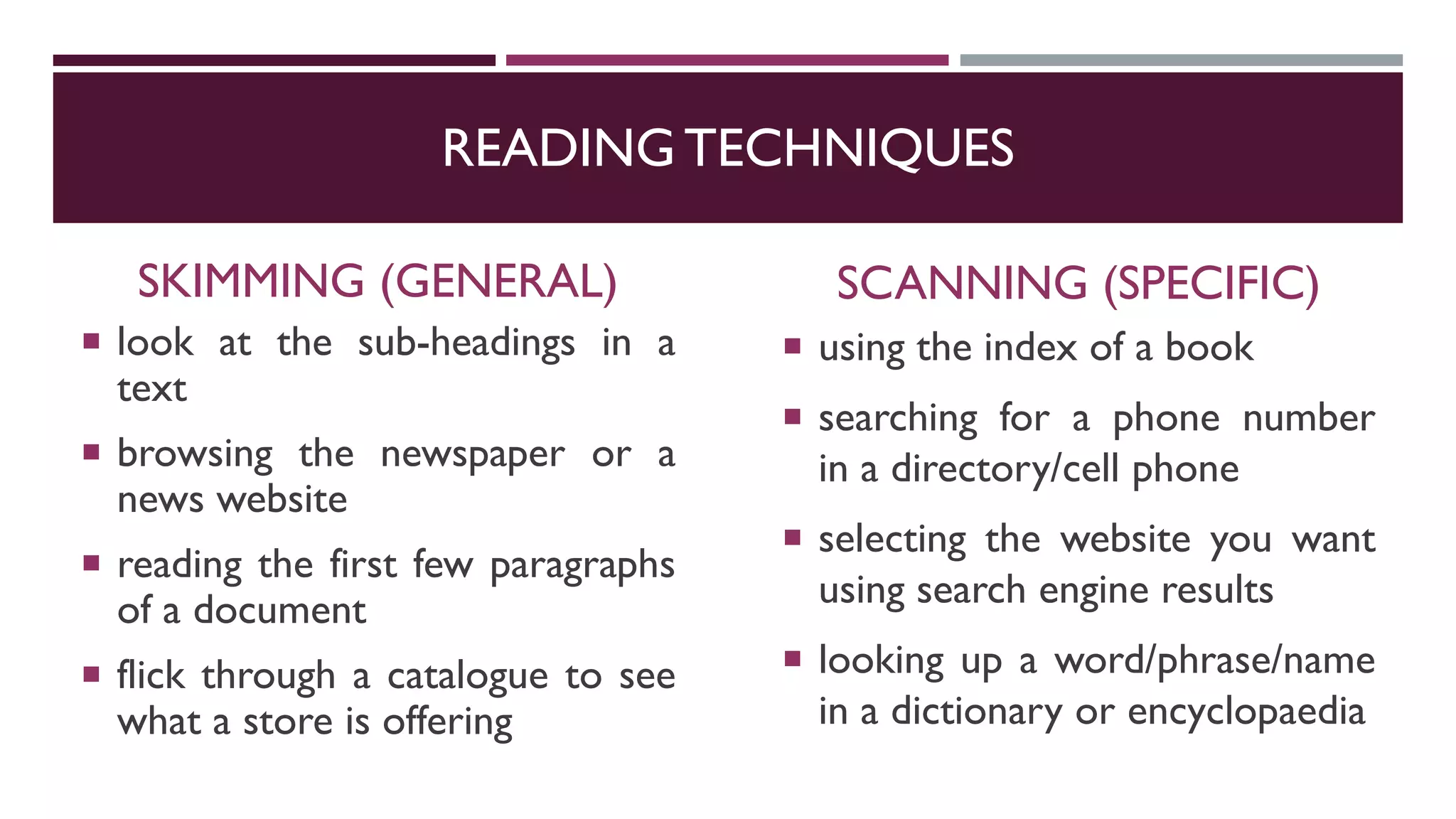
SKIMMING (GENERAL)
 look at the sub-headings in a
text
 browsing the newspaper or a
news website
 reading the first few paragraphs
of a document
 flick through a catalogue to see
what a store is offering
SCANNING (SPECIFIC)
 using the index of a book
 searching for a phone number
in a directory/cell phone
 selecting the website you want
using search engine results
 looking up a word/phrase/name
in a dictionary or encyclopaedia
READING TECHNIQUES
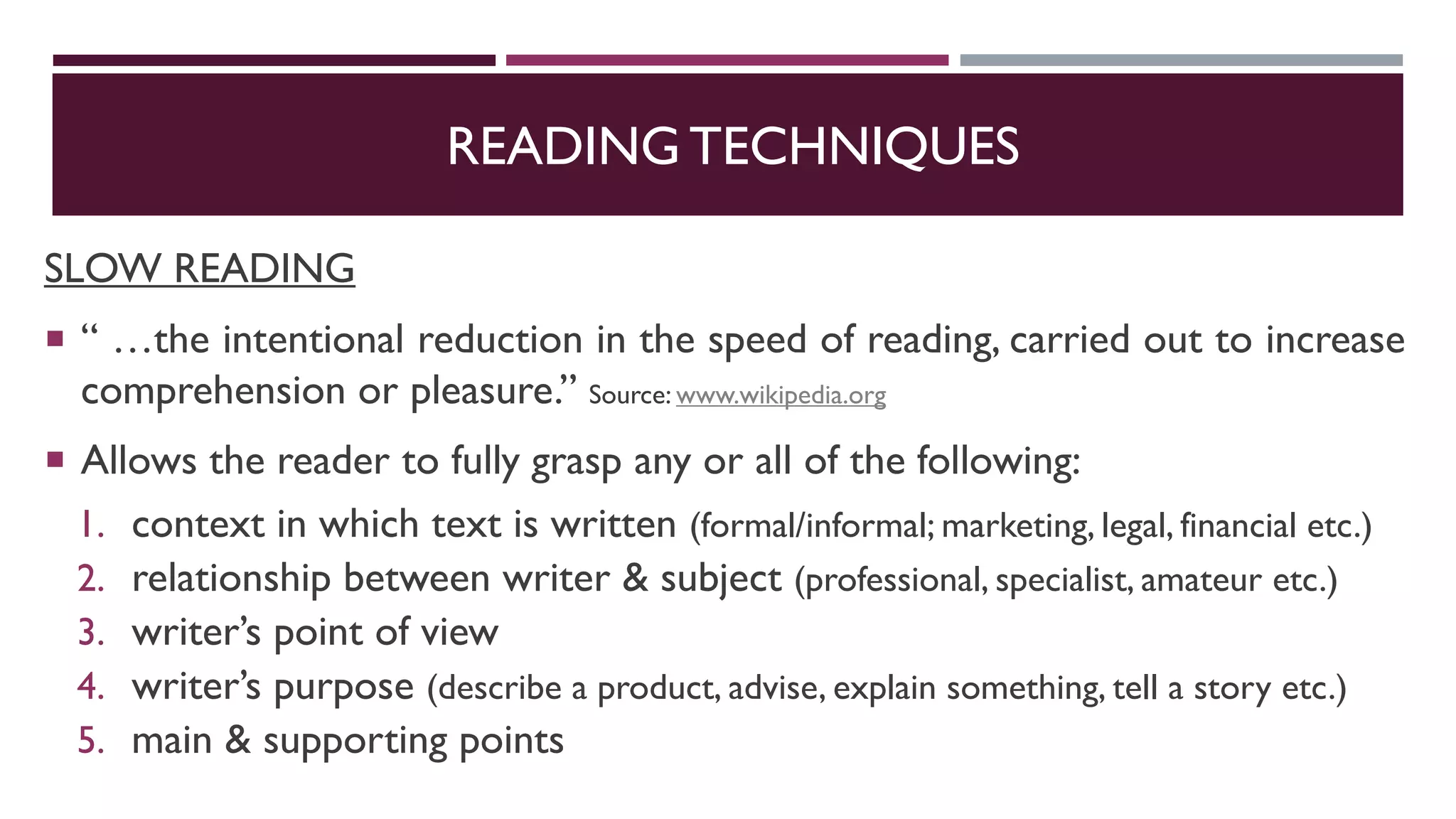
SLOW READING
 “ …the intentional reduction in the speed of reading, carried out to increase
comprehension or pleasure.” Source: www.wikipedia.org
 Allows the reader to fully grasp any or all of the following:
1. context in which text is written (formal/informal; marketing, legal, financial etc.)
2. relationship between writer & subject (professional, specialist, amateur etc.)
3. writer’s point of view
4. writer’s purpose (describe a product, advise, explain something, tell a story etc.)
5. main & supporting points
WORD RECOGNITION,VOCABULARY & SPELLING
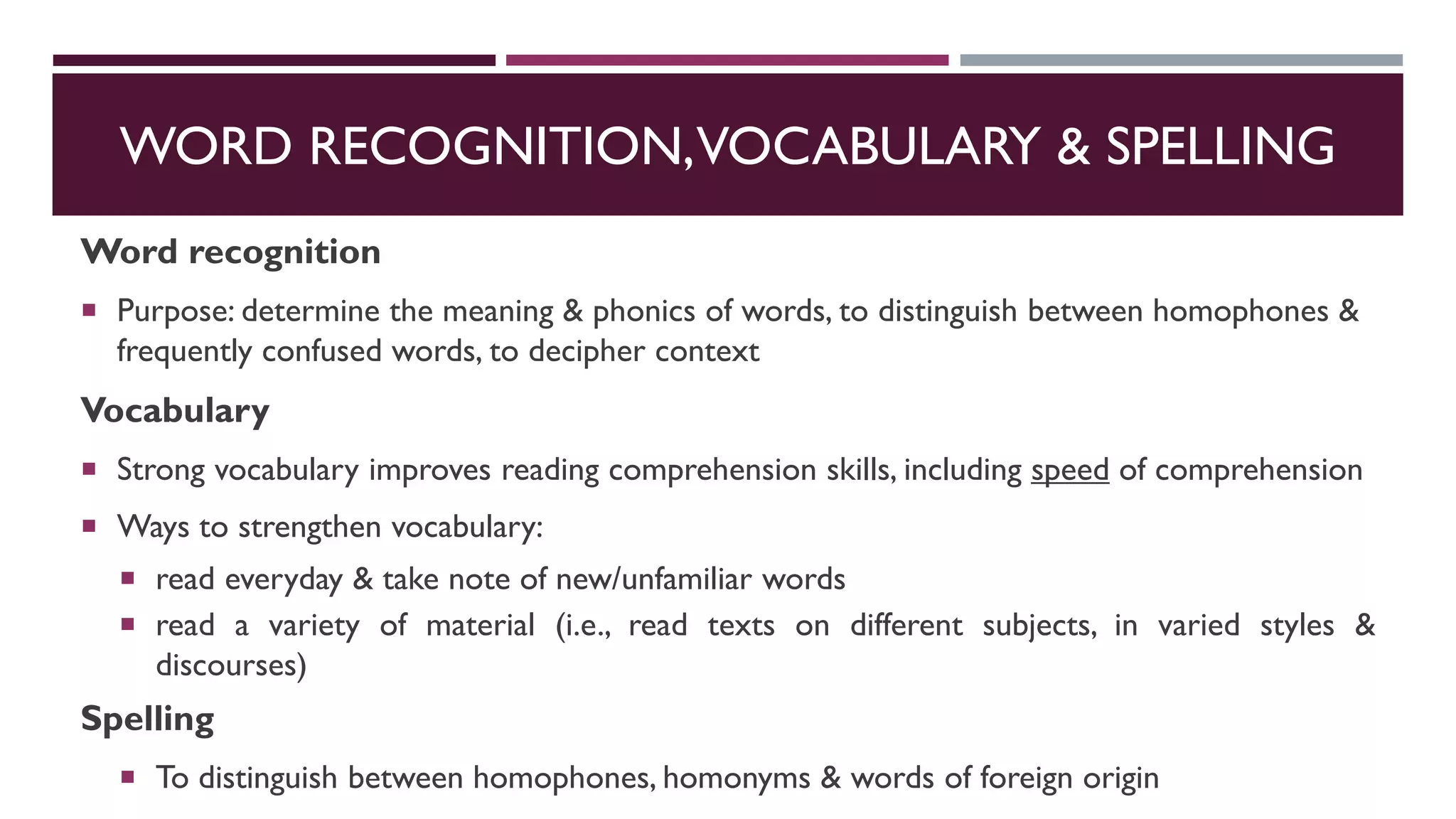
Word recognition
 Purpose: determine the meaning & phonics of words, to distinguish between homophones &
frequently confused words, to decipher context
Vocabulary
 Strong vocabulary improves reading comprehension skills, including speed of comprehension
 Ways to strengthen vocabulary:
 read everyday & take note of new/unfamiliar words
 read a variety of material (i.e., read texts on different subjects, in varied styles &
discourses)
Spelling
 To distinguish between homophones, homonyms & words of foreign origin
GRAMMAR
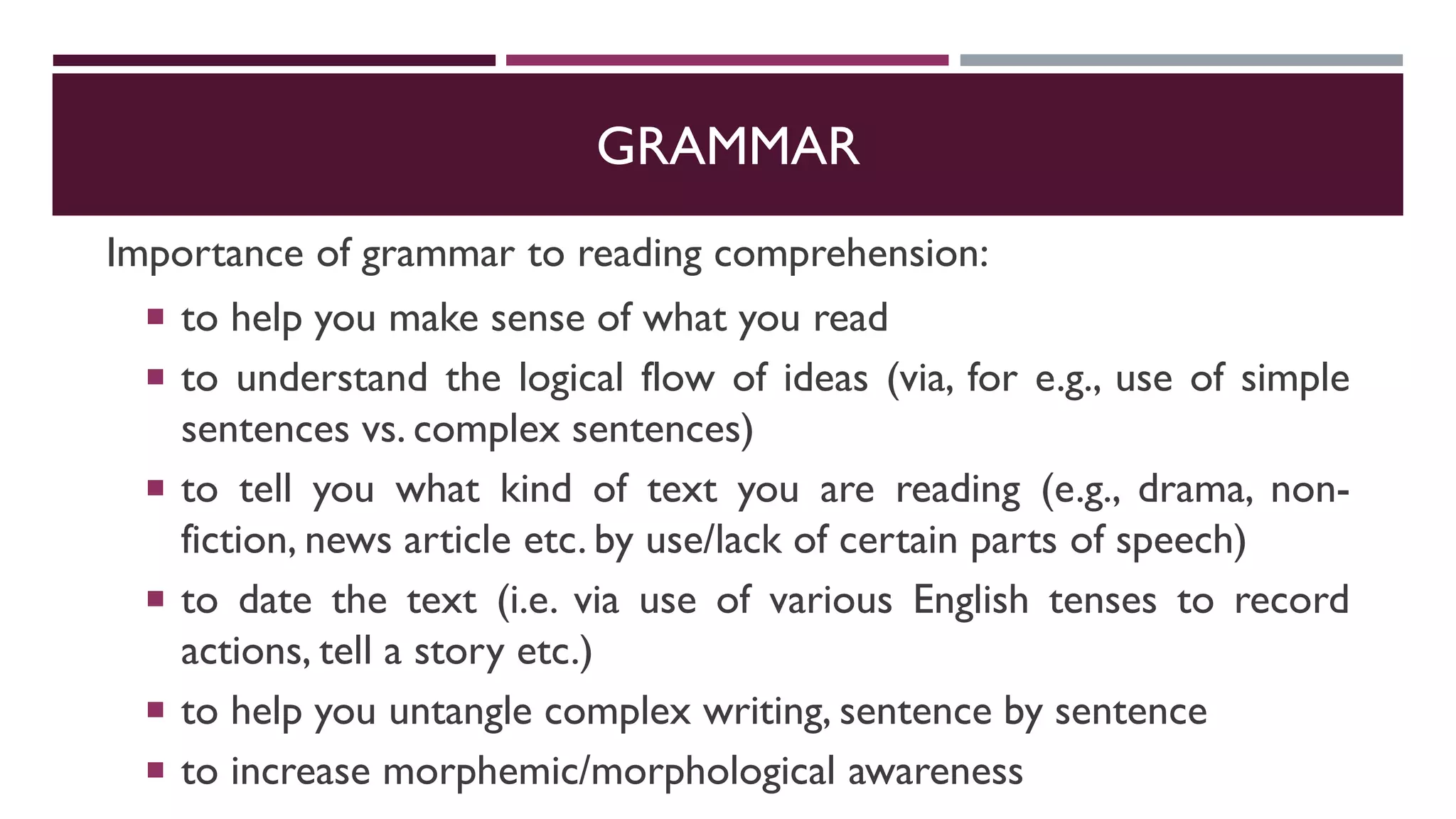
Importance of grammar to reading comprehension:
 to help you make sense of what you read
 to understand the logical flow of ideas (via, for e.g., use of simple
sentences vs. complex sentences)
 to tell you what kind of text you are reading (e.g., drama, non-
fiction, news article etc. by use/lack of certain parts of speech)
 to date the text (i.e. via use of various English tenses to record
actions, tell a story etc.)
 to help you untangle complex writing, sentence by sentence
 to increase morphemic/morphological awareness
INTERPRETATION
 Literal or strict rule – most dominant
 gives words in the text their literal meaning
 Analyse text - divide reading into what a text says, does &
means
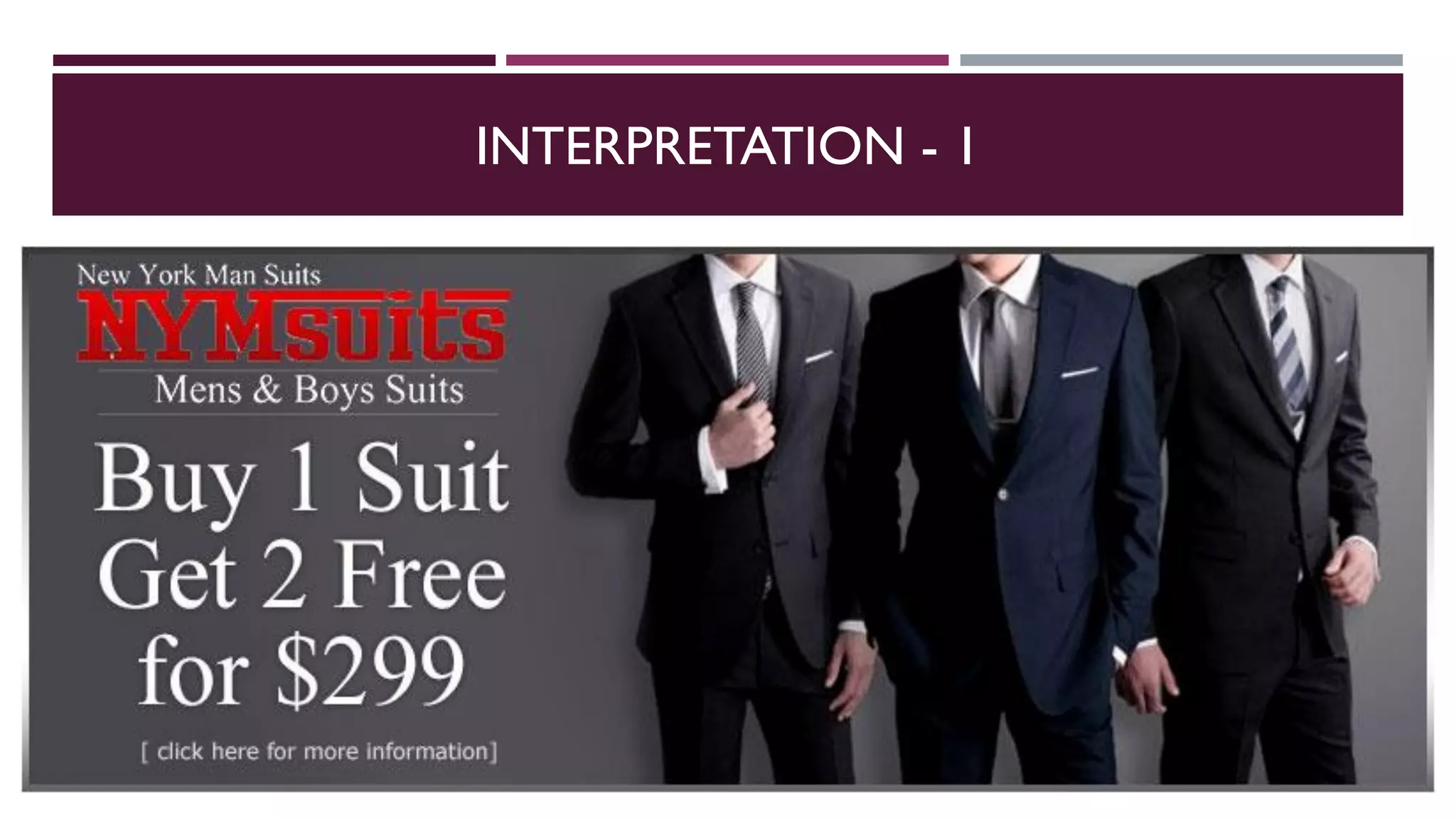
INTERPRETATION - 1
INTERPRETATION - 2
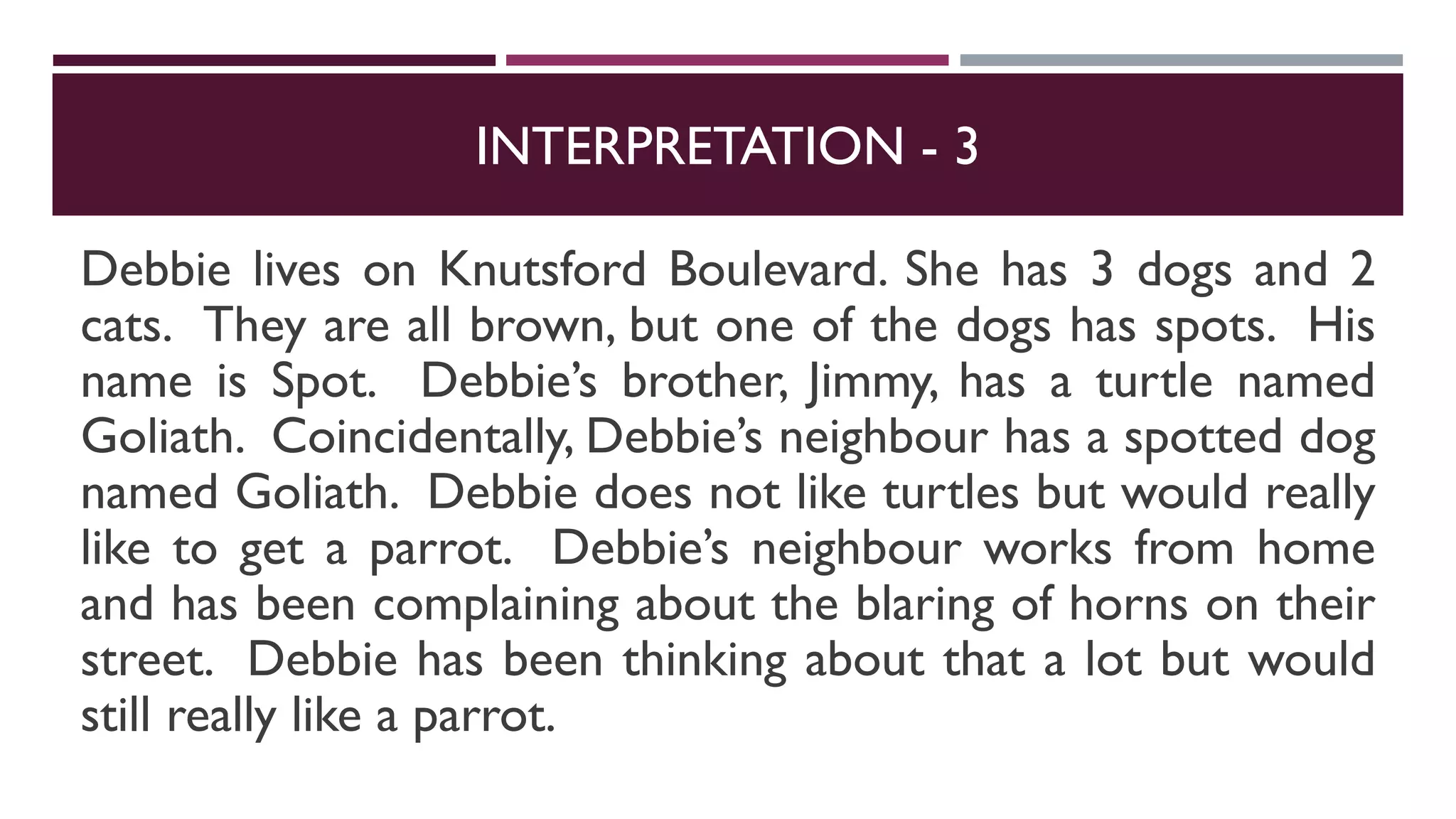
INTERPRETATION - 3
Debbie lives on Knutsford Boulevard. She has 3 dogs and 2
cats. They are all brown, but one of the dogs has spots. His
name is Spot. Debbie’s brother, Jimmy, has a turtle named
Goliath. Coincidentally, Debbie’s neighbour has a spotted dog
named Goliath. Debbie does not like turtles but would really
like to get a parrot. Debbie’s neighbour works from home
and has been complaining about the blaring of horns on their
street. Debbie has been thinking about that a lot but would
still really like a parrot.
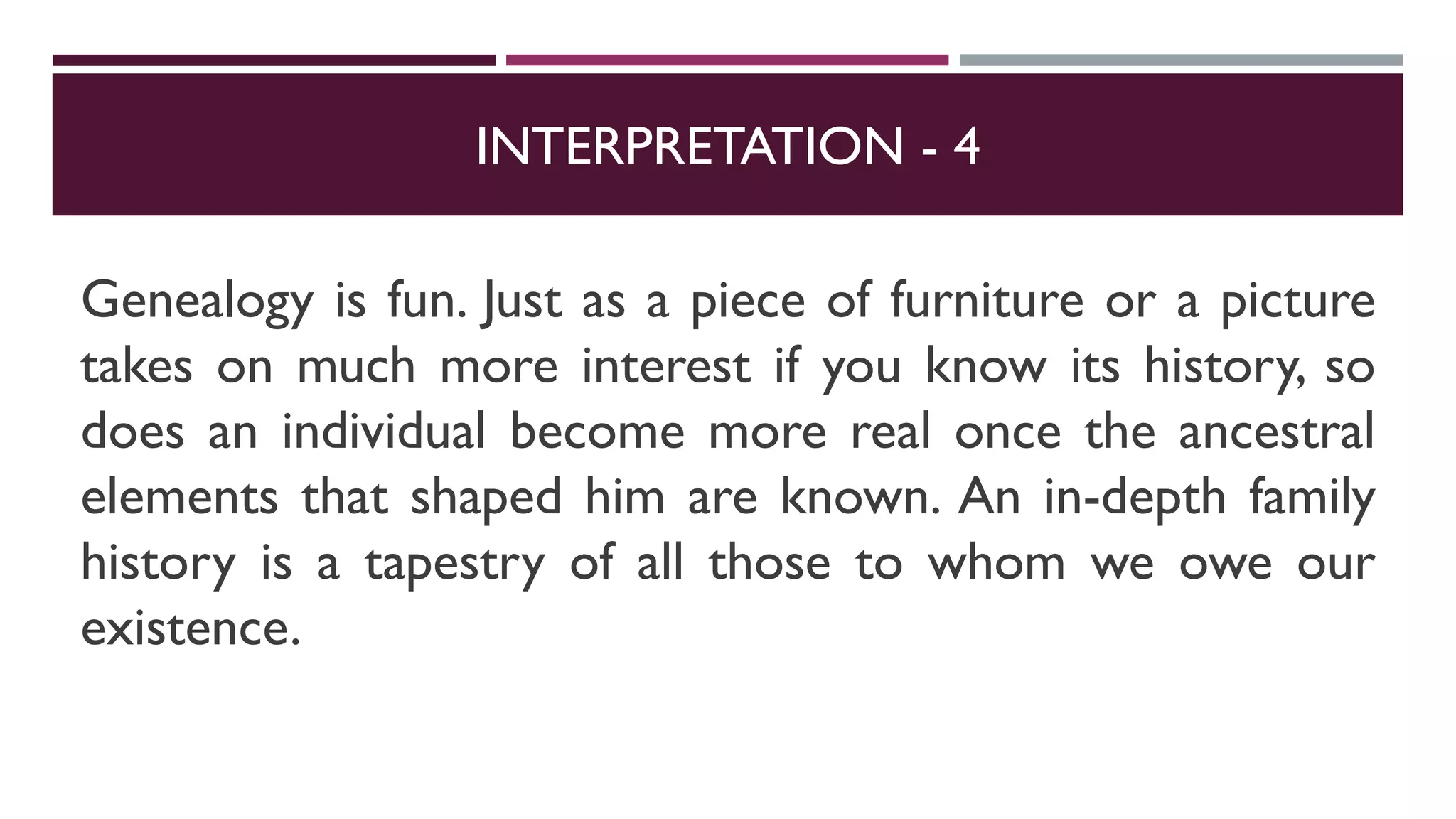
INTERPRETATION - 4
Genealogy is fun. Just as a piece of furniture or a picture
takes on much more interest if you know its history, so
does an individual become more real once the ancestral
elements that shaped him are known. An in-depth family
history is a tapestry of all those to whom we owe our
existence.
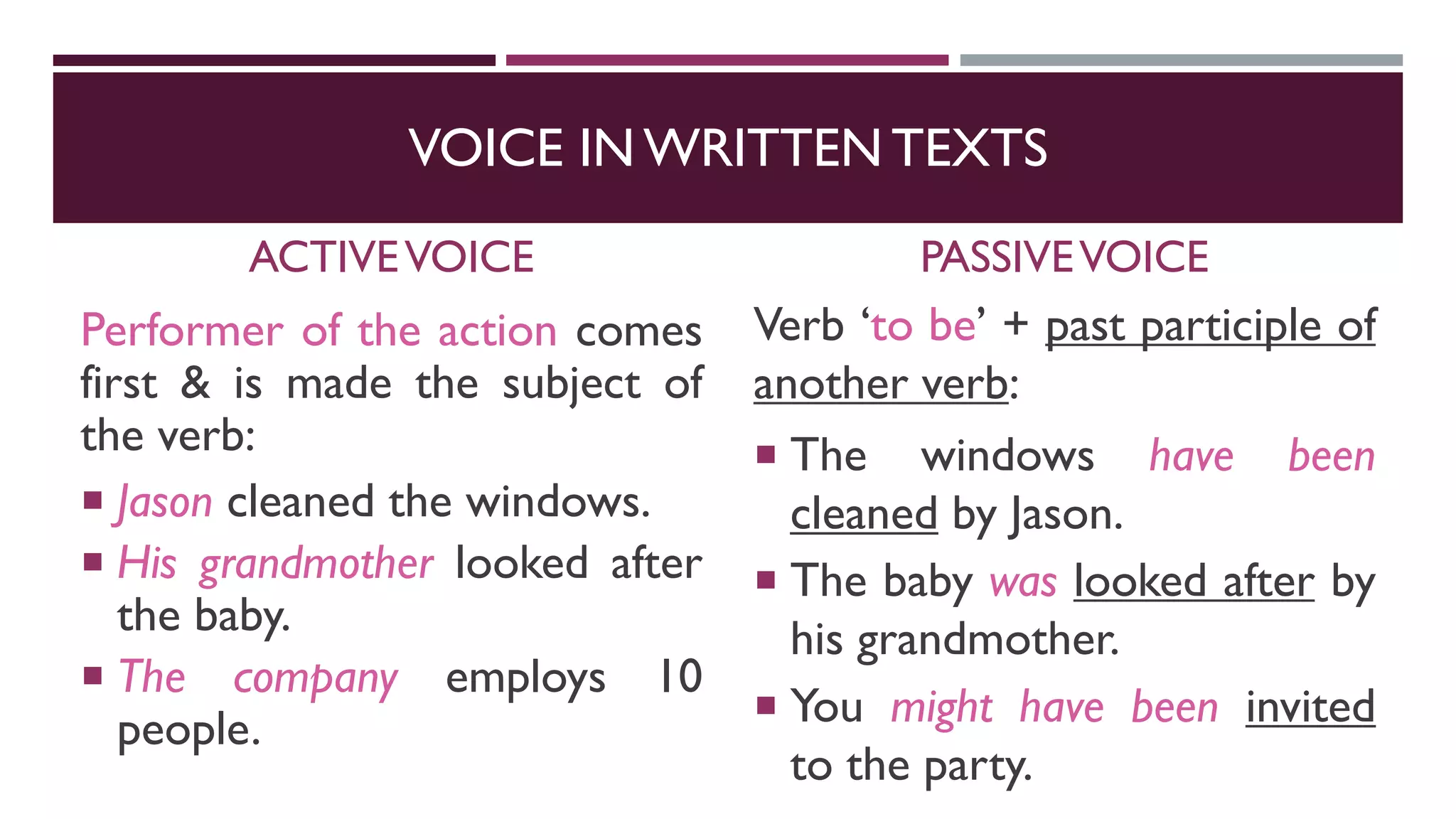
VOICE IN WRITTEN TEXTS
ACTIVEVOICE
Performer of the action comes
first & is made the subject of
the verb:
 Jason cleaned the windows.
 His grandmother looked after
the baby.
 The company employs 10
people.
PASSIVEVOICE
Verb ‘to be’ + past participle of
another verb:
 The windows have been
cleaned by Jason.
 The baby was looked after by
his grandmother.
 You might have been invited
to the party.
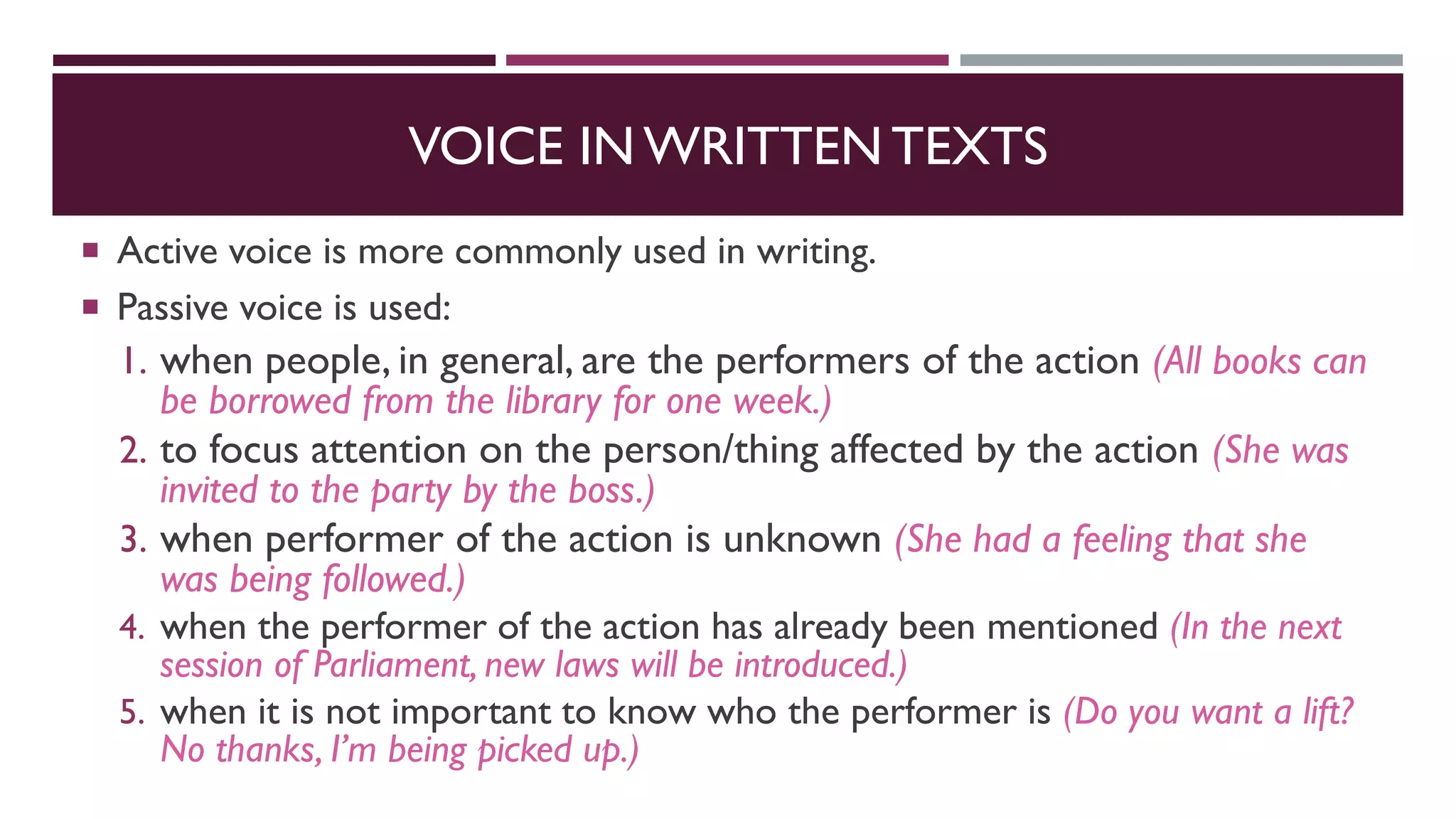
VOICE IN WRITTEN TEXTS
 Active voice is more commonly used in writing.
 Passive voice is used:
1. when people, in general, are the performers of the action (All books can
be borrowed from the library for one week.)
2. to focus attention on the person/thing affected by the action (She was
invited to the party by the boss.)
3. when performer of the action is unknown (She had a feeling that she
was being followed.)
4. when the performer of the action has already been mentioned (In the next
session of Parliament, new laws will be introduced.)
5. when it is not important to know who the performer is (Do you want a lift?
No thanks, I’m being picked up.)
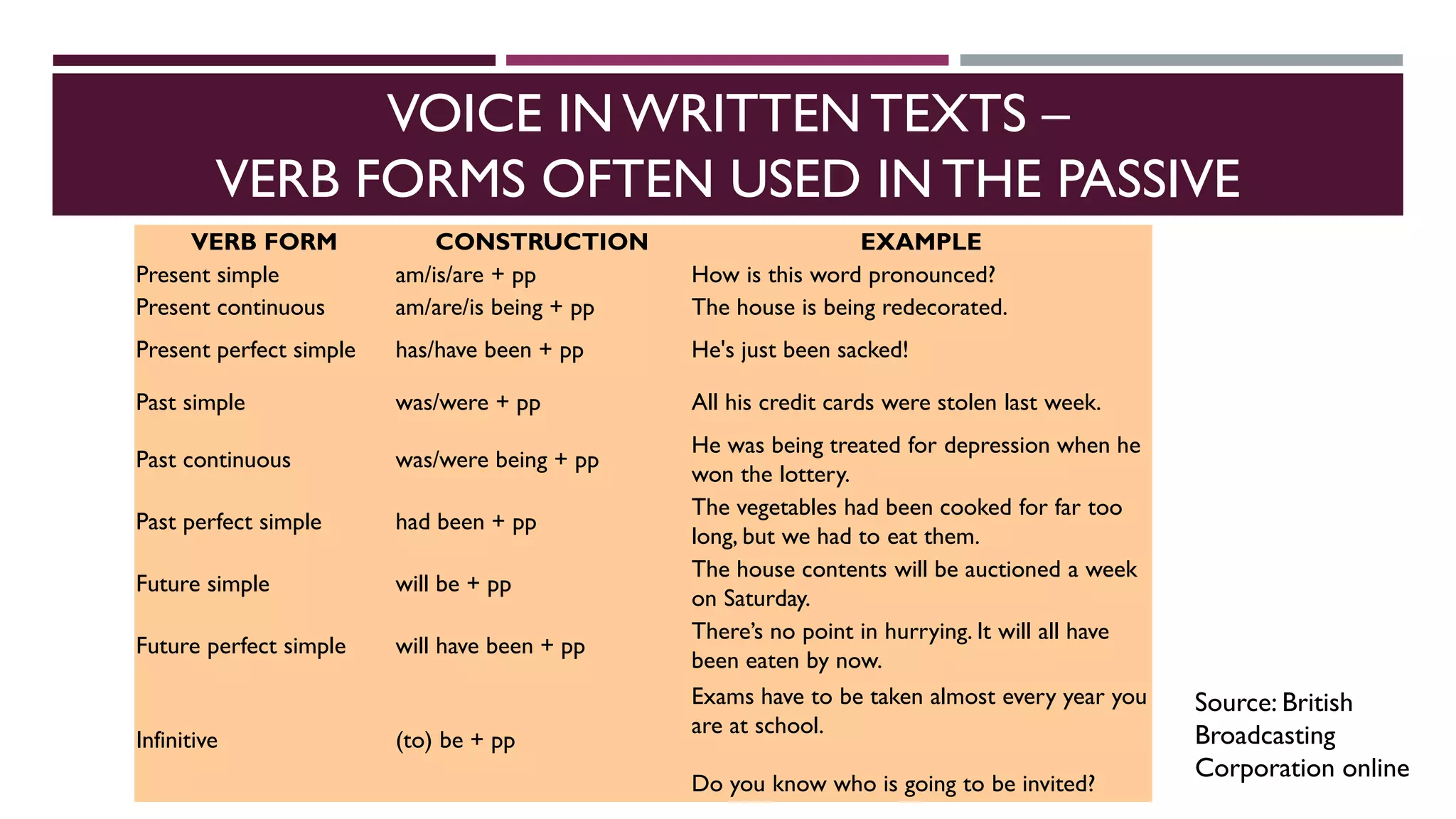
VOICE IN WRITTEN TEXTS –
VERB FORMS OFTEN USED IN THE PASSIVE
VERB FORM CONSTRUCTION EXAMPLE
Present simple am/is/are + pp How is this word pronounced?
Present continuous am/are/is being + pp The house is being redecorated.
Present perfect simple has/have been + pp He's just been sacked!
Past simple was/were + pp All his credit cards were stolen last week.
Past continuous was/were being + pp
He was being treated for depression when he
won the lottery.
Past perfect simple had been + pp
The vegetables had been cooked for far too
long, but we had to eat them.
Future simple will be + pp
The house contents will be auctioned a week
on Saturday.
Future perfect simple will have been + pp
There’s no point in hurrying. It will all have
been eaten by now.
Infinitive (to) be + pp
Exams have to be taken almost every year you
are at school.
Do you know who is going to be invited?
Source: British
Broadcasting
Corporation online
THE END

The fundamentals of English.

  • 1.
    FUNDAMENTALS OF ENGLISH READINGCOMPREHENSION FEBRUARY 2021
  • 2.
    WHAT IS READINGCOMPREHENSION?  Reading comprehension is understanding what is read.  May also be defined as “…the ability to read text, process it & understand its meaning.” (Source: www.wikipedia.org)  Essential for: assimilating information enjoying what the author is writing about piecing together the main points of a text  Contexts: academic, legal, business, technical, entertainment…
  • 3.
    READING COMPREHENSION  Forthe reader, reading comprehension involves a combination of strengths, skills & strategies in order to understand what the writer is trying to tell you: 1. reading techniques 2. proficient word recognition/strong vocabulary & spelling 3. knowledge of grammar rules 4. interpretation
  • 4.
    READING TECHNIQUES SPEED READING Skimming& scanning are speed reading techniques used to assimilate information & form visual cues from a source quickly.  Skimming – looking at a text quickly in order to have a basic idea of its contents & noting important information. (Skimming alone may not be ideal when complete comprehension of material is the objective.)  Scanning – actively looking at a text to find some specific information
  • 5.
    READING TECHNIQUES SKIMMING (GENERAL) look at the sub-headings in a text  browsing the newspaper or a news website  reading the first few paragraphs of a document  flick through a catalogue to see what a store is offering SCANNING (SPECIFIC)  using the index of a book  searching for a phone number in a directory/cell phone  selecting the website you want using search engine results  looking up a word/phrase/name in a dictionary or encyclopaedia
  • 6.
    READING TECHNIQUES SLOW READING “ …the intentional reduction in the speed of reading, carried out to increase comprehension or pleasure.” Source: www.wikipedia.org  Allows the reader to fully grasp any or all of the following: 1. context in which text is written (formal/informal; marketing, legal, financial etc.) 2. relationship between writer & subject (professional, specialist, amateur etc.) 3. writer’s point of view 4. writer’s purpose (describe a product, advise, explain something, tell a story etc.) 5. main & supporting points
  • 7.
    WORD RECOGNITION,VOCABULARY &SPELLING Word recognition  Purpose: determine the meaning & phonics of words, to distinguish between homophones & frequently confused words, to decipher context Vocabulary  Strong vocabulary improves reading comprehension skills, including speed of comprehension  Ways to strengthen vocabulary:  read everyday & take note of new/unfamiliar words  read a variety of material (i.e., read texts on different subjects, in varied styles & discourses) Spelling  To distinguish between homophones, homonyms & words of foreign origin
  • 8.
    GRAMMAR Importance of grammarto reading comprehension:  to help you make sense of what you read  to understand the logical flow of ideas (via, for e.g., use of simple sentences vs. complex sentences)  to tell you what kind of text you are reading (e.g., drama, non- fiction, news article etc. by use/lack of certain parts of speech)  to date the text (i.e. via use of various English tenses to record actions, tell a story etc.)  to help you untangle complex writing, sentence by sentence  to increase morphemic/morphological awareness
  • 9.
    INTERPRETATION  Literal orstrict rule – most dominant  gives words in the text their literal meaning  Analyse text - divide reading into what a text says, does & means
  • 10.
  • 11.
  • 12.
    INTERPRETATION - 3 Debbielives on Knutsford Boulevard. She has 3 dogs and 2 cats. They are all brown, but one of the dogs has spots. His name is Spot. Debbie’s brother, Jimmy, has a turtle named Goliath. Coincidentally, Debbie’s neighbour has a spotted dog named Goliath. Debbie does not like turtles but would really like to get a parrot. Debbie’s neighbour works from home and has been complaining about the blaring of horns on their street. Debbie has been thinking about that a lot but would still really like a parrot.
  • 13.
    INTERPRETATION - 4 Genealogyis fun. Just as a piece of furniture or a picture takes on much more interest if you know its history, so does an individual become more real once the ancestral elements that shaped him are known. An in-depth family history is a tapestry of all those to whom we owe our existence.
  • 14.
    VOICE IN WRITTENTEXTS ACTIVEVOICE Performer of the action comes first & is made the subject of the verb:  Jason cleaned the windows.  His grandmother looked after the baby.  The company employs 10 people. PASSIVEVOICE Verb ‘to be’ + past participle of another verb:  The windows have been cleaned by Jason.  The baby was looked after by his grandmother.  You might have been invited to the party.
  • 15.
    VOICE IN WRITTENTEXTS  Active voice is more commonly used in writing.  Passive voice is used: 1. when people, in general, are the performers of the action (All books can be borrowed from the library for one week.) 2. to focus attention on the person/thing affected by the action (She was invited to the party by the boss.) 3. when performer of the action is unknown (She had a feeling that she was being followed.) 4. when the performer of the action has already been mentioned (In the next session of Parliament, new laws will be introduced.) 5. when it is not important to know who the performer is (Do you want a lift? No thanks, I’m being picked up.)
  • 16.
    VOICE IN WRITTENTEXTS – VERB FORMS OFTEN USED IN THE PASSIVE VERB FORM CONSTRUCTION EXAMPLE Present simple am/is/are + pp How is this word pronounced? Present continuous am/are/is being + pp The house is being redecorated. Present perfect simple has/have been + pp He's just been sacked! Past simple was/were + pp All his credit cards were stolen last week. Past continuous was/were being + pp He was being treated for depression when he won the lottery. Past perfect simple had been + pp The vegetables had been cooked for far too long, but we had to eat them. Future simple will be + pp The house contents will be auctioned a week on Saturday. Future perfect simple will have been + pp There’s no point in hurrying. It will all have been eaten by now. Infinitive (to) be + pp Exams have to be taken almost every year you are at school. Do you know who is going to be invited? Source: British Broadcasting Corporation online
  • 17.