The Forex quick guide
                for beginners and private traders
This guide was created by Easy-Forex™ Trading Platform , and is offered FR EE
to all Forex traders.


                     Make your Forex learning much more efficient:
                              Register now at Easy-Forex™
                 edit by http:/ectheme.blogspot.com


        Joining is free and simple, and it gives you online access to many supporting
             tools, such as Forex outlook, Forex charts, info-center, and more.

                                   www.Easy-Forex.com


In this book: (click a chapter title below to directly get there)
                                                                                        page
   Intro     How to use this book                                                         3

   1.        Forex? What is it, anyway? (a simple introduction, for the                   4
             very beginners…)
   2.        What is Forex trading? What is a Forex deal?                                 6

   3.        What is the global Forex market?                                            12

   4.        Overview of trading Forex online                                            21

   5.        Training for success                                                        25

   6.        Technical Analysis: patterns and forecast methods used                      29
             today
   7.        Fundamental Analysis and leading market indicators                          47

   8.        Day-Trading (on the Easy-Forex™ Trading Platform)                           56

   9.        Twenty issues you must consider                                             64

   10.       Tips for every Forex trader                                                 71

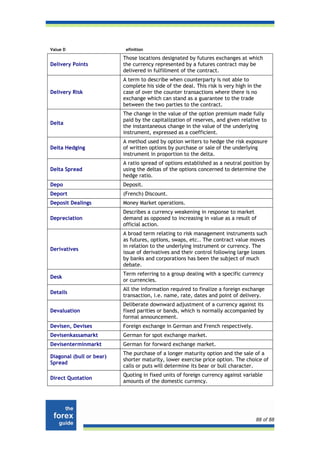
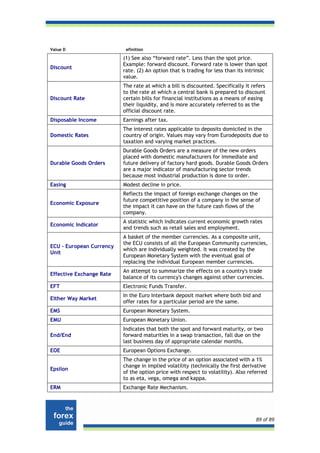
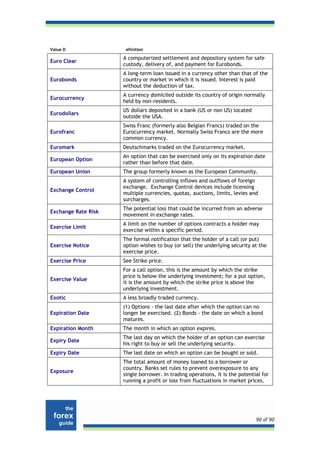
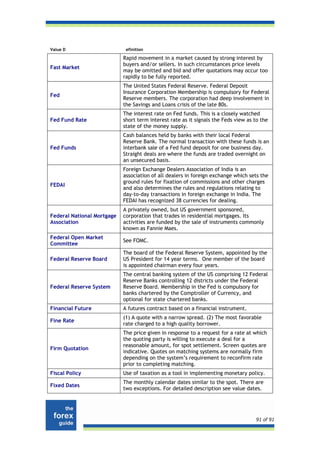
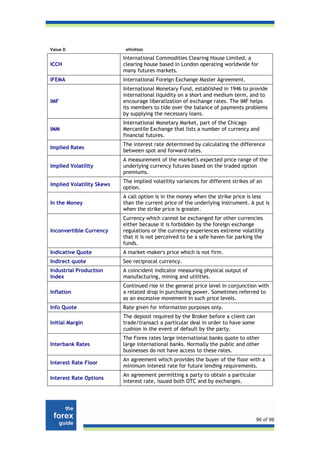
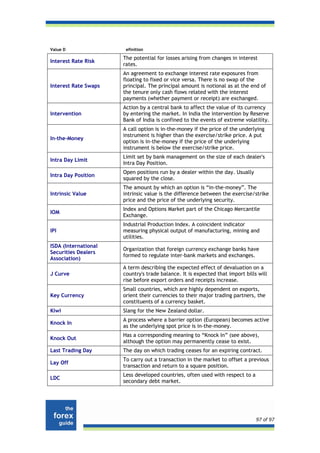
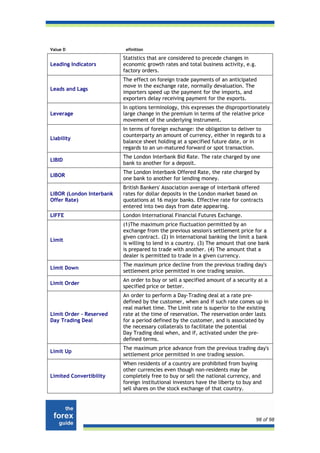
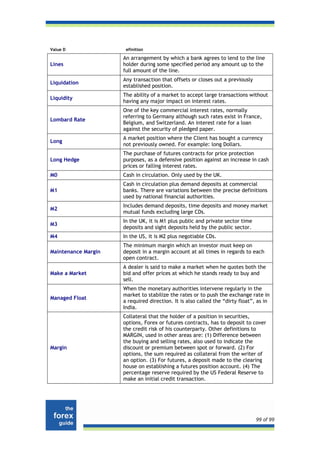
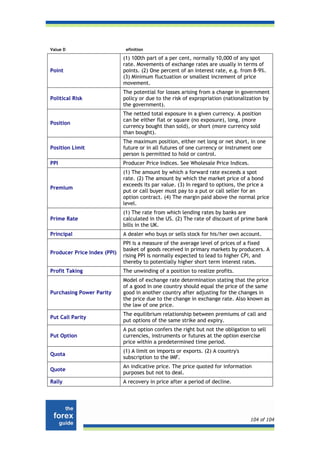
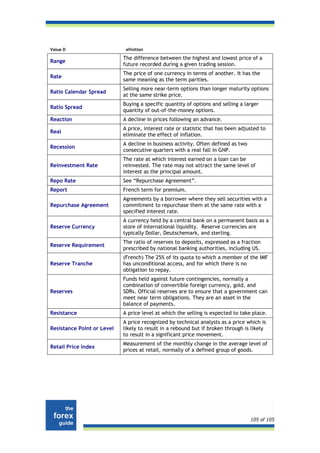
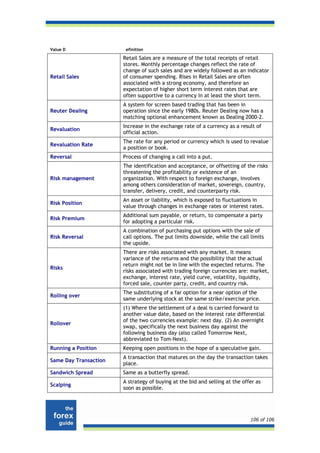
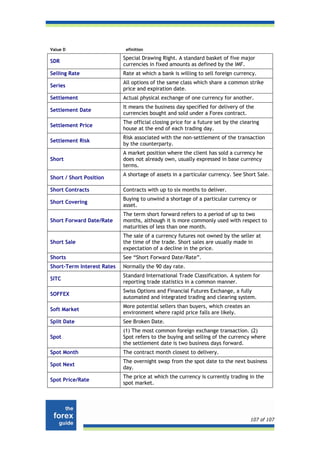
   11.       Forex glossary                                                              78

   12.       Disclaimer (risk warning)                                                  114


                                                                                          2 of 2
Introduction: how to use this book

This book has been developed to help the Forex beginner, though experienced
and professional traders may find it a handy reference.
Beginners and novice traders are likely t o benefit from reading the entire
text, s tarting with Chapter 1, which pr   ovides a basic over view of what
currency trading is, and how to get started.
The chapters are set out in a logi cal flow, but do not need to be read in order
to make sense, as each works as a discrete unit unto itself. You may prefer to
focus first on those chapters that you feel will complement your particular
knowledge base best. Chapter 11 is a gl ossary of terms (listed alphabetically)
used in the Forex business, that will pr ove helpful as you read this book, a nd
may serve as a valuable reference as you become an experienced currency
trader.
With the h elp of this guide , you will soon be ready to start trading Forex – i n
fact, with the assistance of the online Easy-Forex™ team, you can start today.
We wish y ou success in your trading, and hope you f ind this book interesting,
helpful and enjoyable.
Before you start, please remember:
   •   Forex t rading (OTC Trading) involv es substantial risk of l oss, a nd
       may not be suitable for everyo ne. Before deciding to undertake such
       transactions, a user should carefully evaluate whether his/her financia l
       situation is appropriate for such transactions. Read more in the " RISK
       WARNING" section on Easy-Forex site / Risk Disclaimer.
   •   Always ask your Forex dealer (the TRADING PLATFORM you wish to
       trade with) the questi ons we prepared for you in this book (chapter 9).
       Selecting the appropriate Forex TRADING PLATFORM is essential for
       success in handling your trading and monitoring your activity, as well as
       maximizing profits, while minimizing losses and costs.


       Your comments and suggestions are highly appreciated (and may well be
             incorporated in our next edition)! Be our guest and write us:
                               ForexBooks@Forex.info


                                                                               3 of 3
[1] Forex? What is it, anyway?
The market
The currency trading (foreign exchange, Forex, FX) m arket is the biggest and
fastest growing market on earth. Its daily turnover is more than 2.5 trillion
dollars. The participants in this mark et are central and comm ercial banks ,
corporations, institutional inves tors, hedge funds, a nd private individuals like
you.

What happens in the market?
Markets are places w here goods are traded, and the same goes with Forex. In
Forex markets, the “goods” are the curre ncies of various countries (as well as
gold and s ilver). For example, you migh t buy euro with US dollars, or you
might sell Japanese Yen for Canadian dollars. It’s as basic     as tradin g on e
currency for another.
Of course, you don’t have to purchase or sell actual, physical currency: you
trade and work with your own base currency, and deal with any currency pai r
you wish to.

“Leverage” is the Forex advantage
The ratio of investment to actual value is called “leverage”. Using a $1,000 to
buy a Forex contract with a $100,000 value is “leveraging” at a 1:100 ratio.
The $1,000 is all you i nvest and all you risk, but the gains you can make ma y
be many times greater.

How does one profit in the Forex market?
Obviously, buy low and sell      high! Th e profit potential c omes from th e
fluctuations (changes ) in the currency exchange market. Unlike the stock
market, w here share are purchased, F orex trading does not require physical
purchase of the currencies, but rather     involves contracts for amount a nd
exchange rate of currency pairs.
The advantageous thing about the Fo         rex market is that regular daily
fluctuations – in the regular currency exchange markets, often around 1% - ar e
multiplied by 100! ( Easy-Forex™ generally offers trading ratios from 1:50 to
1:200).

How risky is Forex trading?
You cannot lose more than your initial investment (also called your “margin”).
The profit you may make is unlimited, but you can never lose more than the
margin. You are strongly advised to never risk more than you can afford to
lose.


                                                                             4 of 4
How do I start trading?
If you wish to trade u sing the Easy-Forex™ Trading Platform, or any other, you
must first register an d t hen deposit the amount y ou wish to have in your
margin account to inv est. Registering is easy with Easy-Forex™ and it accepts
payment via most major credit cards,       PayPal, Western Union. Once your
deposit has been received, you are ready to start trading.

How do I monitor my Forex trading?
Online, anywhere, anytime. You have fu ll control to monitor your trading
status, check scenarios, change some te rms in your Forex deals, close deals,
or withdraw profits.


          Easy-Forex™ wishes you enjoyable and successful Forex trading!


                                                                           5 of 5
[2] What is Forex trading? What is a Forex deal?
The investor's goal i   n Forex trading    is to profit from foreign currency
movements.
More than 95% of all Forex trading performed today is for speculative purposes
(e.g. t o p rofit from currency movemen ts). The r est bel ongs to hed ging
(managing business exposures to various currencies) and other activities.
Forex trades (tradi ng onboard i nternet pl atforms) are non-delivery trades:
currencies are not physically traded, bu t rather there are currency contr acts
which are agreed upon and performed. Both parties to such c ontracts (the
trader and the tradi ng platfor m) undert ake to fulf ill their obligations: one
side undertakes to sell the amount specified, and the other undertakes to buy
it. As mentioned, over 95% of the market activity is for speculative purpos es,
so there is no intenti on on either side to actually pe rform the contract (the
physical delivery of the currencies). Thus , the contract ends by offsetting it
against an opposite position, resulting in the profit and loss of the par ties
involved.


Components of a Forex deal
A Forex deal is a contract agreed up on between the trader and the market-
maker (i.e. the Trading Platform). The contract is comprised of the following
components:
   •   The currency pairs (which currency to buy; which currency to sell)
   •   The princi pal amount (or "face", or "nomi nal": the amount of c urrency
       involved in the deal)
   •   The rate (the agreed exchange rate between the two currencies).
Time frame is also a factor in some deals, bu t this chapter focuses on D ay-
Trading (similar to “Spot” or “C urrent Time” trading), in which deals have a
lifespan of no more than a single full day. Thus, time frame does not play
into the equation. Note, howeve r, that deals can be r enewed (“rolled-over”)
to the next day for a limited period of time.
The Forex deal, in this context, is therefore an obligation to buy and sell a
specified amount of a partic ular pair of currencies at a pre-determi     ned
exchange rate.
Forex trading is always done in c urrency pairs. For example, imagine that the
exchange r ate of EUR/USD (euros to US dollars) on a certain day is 1.5000
(this number is also r eferred to as a “spo t rate”, or just “rate”, for short). If


                                                                                6 of 6
an investor had bought 1,000 euros on that date, he would have paid 1,500.00
US dollars. If one year later, the Forex rate was 1.5100, the value of the euro
has increased in relation to the US do llar. The inv estor could now sell the
1,03300 euros in order to receive 1,510.00 US dollars. The investor would then
have USD 10.00 more than when he started a year earlier.
However, to know if the investor made a good investment, one needs to compare
this investment option to alternative investments. At the very minimum, the return
on investment (ROI) should be compared to the return on a “risk-free” investment.
Long-term US government bonds are considered to be a risk-free investment since
there is virtually no chance of default - i.e. the US government is not likely to go
bankrupt, or be unable or unwilling to pay its debts.

Trade only when you expect the currenc y you are buy ing to i ncrease in val ue
relative to the currency you are selling. I f the currency you are buying does
increase in value, you must sell back that currency in order to lock in the
profit. An open trade (also called an “open position”) is one in which a trader
has bought or sold a particular currency pair, and ha s not yet sold or bought
back the equivalent amount to complete the deal.
It is estim ated that around 95% of th e F X market i s speculati ve. In other
words, the person or instit ution that bought or sold the currenc y has no pl an
to actually take delivery of the currency in the end; r ather, they were solely
speculating on the movement of that particular currency.


Exchange rate
Because currencies are traded i n pairs and exchanged one against the other
when traded, the rate at whic h they are exchanged is called the exchange
rate. The majority of currencies are traded against the US dollar (USD), which
is traded more than any other currenc y. The four currencies traded most
frequently after the US dollar are the eu ro (EUR), the Japanese yen (JPY), the
British pound sterling (GBP) and the Sw iss franc (CHF). These fi ve currencies
make up the majority of the m arket and are called the major currencies or
“the Majors”. Some sources also include the Australian dollar (AUD) within the
group of major currencies.
The first c urrency in the exchange pair is referred to as the base currency .
The second currency is the counter currency or quote currency . The cou nter
or quote currency is thus the numerator in the ratio, and the base currency is
the denominator.
The exchange rate tells a buyer how muc h of the c ounter or quote c urrency
must be paid to obtain one unit of the base currency. The exchange rate also
tells a seller how much is received in the counter or quote currency wh   en


                                                                               7 of 7
selling one unit of the base c urrency. For exampl e, an exc hange rate for
EUR/USD of 1.5083 specifies to the buyer of euros that 1.5083 USD must be
paid to obtain 1 euro.


Spreads
It is the di fference between BU Y and SE LL, o r BID and ASK. In other words,
this is the difference between the market maker's "selling" price (to i      ts
clients) and the price the market maker "buys" it from its clients.
If an inves tor buys a currency and imme diately sells it (and thus there is no
change in the rate of exchange), the investor will lose money. The reason for
this is “the spread”. At any given moment, the amount that wil l be received
in the counter currency wh en selling a unit of ba se currency will be lower
than the a mount of c ounter currency which is requir ed to purc hase a uni t of
base currency. For instance, the EU R/USD bid/ask currency rates at your
bank may be 1.4975/1.5025, representing a spread of 500 pips (percentage in
points; one pip = 0.0001). Such a rate        is much higher than the bid/ask
currency rates that online For ex inve stors commonly encounter, such as
1.5015/1.5020, with a spread of 5 pips. In general, smaller spreads are better
for Forex i nvestors since they r equire a s maller movement in exchange rates
in order to profit from a trade.


Prices, Quotes and Indications
The price of a currency (in terms of the counter currency), is called “Quote”.
There are two kinds of quotes in the Forex market:
Direct Quote: the price for 1 US dollar in term s of the other currency, e.g. –
Japanese Yen, Canadian dollar, etc.
Indirect Quote: the pr ice of 1 unit of a currency in terms of US dollars, e.g. –
British pound, euro.
The market maker pr ovides the investor with a quote. The quote is the pri ce
the market maker will honor w hen the deal is executed.     This is unlike an
“indication” by the market maker, which informs the trader about the mark et
price level, but is not the final rate for a deal.
Cross rates – any quote which is not against the US dollar is called “cross”. For
example, GBP/JPY is a cross rate, since it is calculated via the US dollar. Here
is how the GBP/JPY rate is calculated:


                                                                            8 of 8
GBP/USD = 2.0000;
              USD/JPY = 110.00;
              Therefore: GBP/JPY = 110.00 x 2.0000 = 220.00.


Margin
Banks and/or online trading providers need collateral to ensure that the
investor can pay in the event of a loss. The collateral is called the “margin”
and is also known as minimum s ecurity in Forex mar kets. In pr actice, i t i s a
deposit to the trader's account that is intended to cover any currency tradin g
losses in the future.
Margin enables private investors to trad e in markets that have high mi nimum
units of tra ding, by al lowing traders to hol d a much l arger position than th eir
account value. Margin trading also enhanc es the rate of profit, but similarly
enhances the rate of loss, beyond that taken without leveraging.


Maintenance Margin
Most tradi ng pla tforms require a “mainte nance mar gin” be de posited by the
trader par allel to th e margins deposi ted for actual trades. The main reason
for this is to ensure the necessary amo unt is available in the event of a “gap”
or “slippage” in rates. Maintenance m         argins are also used to cov     er
administrative costs.
When a tr ader sets a Stop-Los s rate, most market makers cannot guarantee
that the stop-l oss will actually be us ed. For example, if the market for a
particular counter currency had a vert ical fall from 1.1850 to 1.1900 between
the close and opening of the market, and the trader had a stop-loss of 1.1875,
at which rate would the deal be closed ? No matter how the rate slippage is
accounted for, the tr ader would probably be required to add-up on his initial
margin to finalize the automatically cl osed transacti on. The funds from the
maintenance margin might be used for this purpose.
Important note : Easy-Forex™ does NOT require that traders deposit a
maintenance margin. Easy-Forex™ guaran tees the e xact rate (Stop-L oss or
other) as pre-defined by the trader.
    If you don’t wish to deposit “maintenance margin”, in addition to the margin
       required for trading, join Easy-Forex™: no “maintenance margin”, trade
                                  from as little as $100!


                                                                                   9 of 9
Leverage
Leveraged financing is a common practice in Forex trading, and allows traders
to use credit, such as a trade purchased on margin, to maxi      mize returns.
Collateral for the loan/leverage in the margined acc ount is provided by the
initial deposit. This can create the opportunity to control USD 100,000 for as
little as USD 1,000.
There are five ways private investor        s can trade in Forex, directly       or
indirectly:
   •    The spot market
   •    Forwards and futures
   •    Options
   •    Contracts for difference
   •    Spread betting
Please note that this book focus es on the most com mon way of trading in the
Forex market, “Day-Trading” (related to “Spot”). Please refer to the gl ossary
for explanations of each of the five ways investors can trade in Forex.


A spot transaction
A spot transaction is a straightf orward exchange of one currency for another.
The spot rate is the current market price, which is also called the “benchmark
price”. Spot transact ions do no t requ ire immediate settlement, or payment
“on the s pot”. The s ettlement date, or “value date” is the second business
day after the “deal date” (or “trade date”) on which the transaction is agreed
by the trader and market maker. The two-day period provides time to confirm
the agreement and to arrange the clearing and necessary debiting and
crediting of bank accounts in various international locations.


Risks
Although Forex trading can lead to         very profitable resul ts, there are
substantial risks involved: exc hange rate ri sks, interest rate risks, credit risks
and event risks.
Approximately 80% of all currency transactions last a period of s even days or
less, with more than 40% lasting fewer than two da ys. Given the extremely


                                                                             10 of 10
short lifes pan of th e typical trade, tec hnical in dicators hea vily influence
entry, exit and order placement decisions.


   You don’t need British pounds or Japanese yens to trade with them. Use your
                   own account base currency at Easy-Forex™.


                                                                             11 of 11
[3] What is the global Forex market?
Today, the Forex market is a nonstop cash market where currencies of nations
are traded, typically via brokers. Foreign currencies are continually and
simultaneously bought and s old across local and global markets. The value of
traders' investments increases or de creases based on currency movements.
Foreign exchange market conditions can change at any time in response to
real-time events.
The main attractions of short-term currency trading to private investors are:
   •   24-hour tr ading, 5 days a wee k with nonstop access (24/7) to global
       Forex dealers.
   •   An enormous liquid market, making it easy to trade most currencies.
   •   Volatile markets offering profit opportunities.
   •   Standard instruments for controlling risk exposure.
   •   The ability to profit in rising as well as falling markets.
   •   Leveraged trading with low margin requirements.
   •   Many options for zero commission trading.


A brief history of the Forex market
The follow ing is an overview into th  e hi storical evolution of the forei gn
exchange market and the roots of the international currency trading, from the
days of the gold exchange, through    the Bretton-Woods Agr eement, to its
current manifestation.


The Gold exchange period and the Bretton-Woods Agreement
The Bretton-Woods Agreement, establis hed in 1944, fixed national currencies
against the US dollar, and set the dollar at a rate of USD 35 per ounce of gold.
In 1967, a Chicago bank refused to make a loan in pound ster ling to a college
professor by the name of Milton Friedm an, becaus e he had intende d to use
the funds to short th e British currency. The bank's refusal to grant the loan
was due to the Bretton-Woods Agreement.
Bretton-Woods was a imed at es tablishing i nternational monetar y stability by
preventing money from taking flight across countries, thus curbing speculation
in foreign currencies. Between 1876 an d World War I, th e gold exchange
standard had ruled over the internatio nal economic system. Under the gold


                                                                         12 of 12
standard, currencies experienc ed an era of stabili    ty becaus e they were
supported by the price of gold.
However, the gold standard had a weakne ss in that it tended to c reate boom-
bust economies. As an economy strength ened, i t would import a great deal,
running down the gold reserves required to support i ts currency. As a result,
the money supply would diminish, interest rates would escalate and economic
activity would slow to the point of recession. Ultimately, prices of
commodities would hit rock bottom      , th us appeari ng attractive to oth er
nations, who would then sprint into a buying frenzy. In turn, this would inject
the economy with gold until it i ncreased its money su pply, thus driving do wn
interest rates and restoring wealth. Such boom-bust patterns were common
throughout the era of the gol d stan dard, un til Wo rld War I temporari ly
discontinued trade flows and the free movement of gold.
The Bretton-Woods A greement was founded after World War II, in order to
stabilize and regulate the inter national Forex market. Participating countr ies
agreed to try to mai ntain the v alue of their currency with in a narrow margin
against the dollar and an equivalent rate of gold. The dollar gained a premium
position as a reference currenc y, reflecti ng the shi ft in global econom ic
dominance from Europe to the USA. Countries were prohibited from devaluing
their currencies to benefit export market s, and were only allowed to dev alue
their currencies by less than 10%. Po st-war construction during the 1950s,
however, r equired gr eat volum es of F orex trading as masses of capital w ere
needed. This had a destabilizing effect on the exchange rates established i n
Bretton-Woods.
In 1971, t he agreement was scrapped w hen the US dollar ceased to be
exchangeable for gold. By 1973, the forc es of supply and demand were in
control of the currencies of major indu strialized nations, and currency now
moved more freely across borders. Prices were floated daily, with volum es,
speed and price volatility all increasin g throughout the 1970s. New financial
instruments, market deregulation and trade liberali zation em erged, further
stoking growth of Forex markets.
The explosion of computer technology that began in the 1980s accelerated
the pace by exte nding the market continuum for cross -border capital
movements through Asian, European and American time zones . Transacti ons
in foreign exchange increased rapidly from nearly $70 billion a day in the
1980s, to more than $3 trillion a day two decades later.


                                                                         13 of 13
The explosion of the euro market
The rapid developme nt of the Eurodollar market, which can be defined as U S
dollars de posited in banks ou tside th e US, was a major m echanism for
speeding up Forex trading. Similarly, Euro markets are those where currencies
are deposi ted outside their c ountry of origin. The Eurodollar market came
into being in the 1950s as a res ult of the Soviet Union depositing US dollars
earned from oil revenue outside the US, i n fear of having thes e assets fr ozen
by US regu lators. This gave rise to a va st offshore pool of dollars outside t he
control of US authori ties. The US gove rnment reacted by im posing law s to
restrict dollar lending to foreigners. Eu ro markets were particularly attractive
because they had far fewer reg ulations and offered higher yields. From the
late 1980s onwards, US companies bega n to borrow offshore, finding Euro
markets an advantageous place for hold ing excess liquidity, providing s hort-
term loans and financing imports and exports.
London w as and remains the principal      offshore market. In the 1980s, it
became the key cent er in the Eurodollar market, when British banks began
lending dollars as an alternative to po unds in order t o maintain their leading
position i n global finance. London's     convenie nt geogra phical loc ation
(operating during Asian and American markets) is also instrumental            in
preserving its dominance in the Euro market.


Euro-Dollar currency exchange
The euro to US dollar exchange rate is the price at which the w orld demand
for US dollars equals the world supply   of euros. Re gardless of geographi cal
origin, a rise in the world dem and for euros leads to an appreciation of the
euro.
Factors affecting the Euro to US dollar exchange rate
Four factors are identified as fundamental determinants of the real euro to US
dollar exchange rate:
   •   The international real interest ra te differential be tween the Federal
       Reserve and European Central Bank
   •   Relative prices in the traded and non-traded goods sectors
   •   The real oil price
   •   The relative fiscal position of the US and Euro zone
The nominal bilateral US dollar to euro exchange is the exchange rate that
attracts th e most attention . Notwiths tanding the c omparative importance of


                                                                           14 of 14
bilateral trade links with the US, trade with the UK i s, to some extent, more
important for the euro.
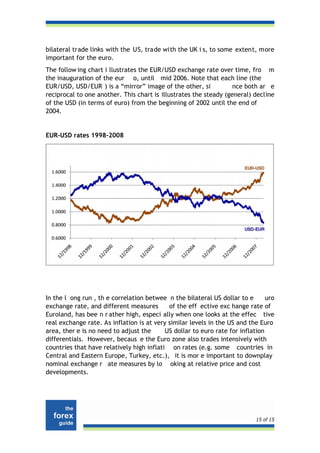
The follow ing chart i llustrates the EUR/USD exchange rate over time, fro m
the inauguration of the eur o, until mid 2006. Note that each line (the
EUR/USD, USD/EUR ) is a “mirror” image of the other, si            nce both ar e
reciprocal to one another. This chart is illustrates the steady (general) decline
of the USD (in terms of euro) from the beginning of 2002 until the end of
2004.


EUR-USD rates 1998-2008


In the l ong run , th e correlation betwee n the bilateral US dollar to e       uro
exchange rate, and different measures       of the eff ective exc hange rate of
Euroland, has bee n r ather high, especi ally when one looks at the effec tive
real exchange rate. As inflation is at very similar levels in the US and the Euro
area, ther e is no need to adjust the      US dollar to euro rate for inflation
differentials. However, becaus e the Euro zone also trades intensively with
countries that have relatively high inflati on rates (e.g. some countries in
Central and Eastern Europe, Turkey, etc.), it is mor e important to downplay
nominal exchange r ate measures by lo oking at relative price and cost
developments.


                                                                            15 of 15
The fall of the US dollar
The steady and orderly decline of the US dollar from early 2002 to early 2007
against the euro, ster ling, Australian dollar, Canadian dollar an d a few ot her
currencies (i.e. its trade-weighted average, which is what counts for purpos es
of trade adjustment), remains significant.
In the wake of the sub-prime mortgage crises in the US, dollar losses
escalated and continued to feel the backlash. The Fe d responded with several
rounds of rate hikes while weighing the    balance of domesti c growth and
inflation fears.


             When was the last time the EUR-JPY pair was over 150.00?
                 (Have a look at Easy-Forex™ professional charts).


The basic theories underlying the US dollar to euro exchange rate
Law of One Price: In competitive markets, free of transportation cost barriers
to trade, i dentical products sold in di fferent countries must sell at the same
price when the prices are stated in terms of the same currency.
Interest rate effects: If capital is allowed to flow freely, exchange rates
become stable at a point where equality of interest is established.


The dual forces of supply and demand
These two reciprocal forces determine euro vs. US dollar exchange rates.
Various factors affect these tw o forces , which in turn affect the exchange
rates:
The business environment: Positive indi cations (i n terms of governme nt
policy, competitive advantages , market size, etc.) i ncrease the demand for
the currency, as more and more enterpri ses want to invest in its place of
origin.
Stock market: The major stock indices      also have a correlati on with the
currency rates, prov iding a daily read of the mood of the busin          ess
environment.
Political factors: All exchange rates are susceptible to political instability and
anticipation about n ew govern ments. Fo r example, poli tical instabili ty in


                                                                           16 of 16
Russia is also a flag for the euro to US dollar exchange, because of the
substantial amount of German investment in Russia.
Economic data: Economic data such as labor reports (payrolls, unemployment
rate and average hourly earnings), c onsumer price indices (CPI), producer
price indices (PPI), gross domestic       product (GD P), intern ational tr ade,
productivity, industri al produc tion, c onsumer confi dence etc ., also aff ect
currency exchange rates.
Confidence in a currency is the greatest determinant of the real euro to US
dollar exc hange rate. Decisions are m    ade based on expected futur      e
developments that may affect the currency.


Types of exchange rate systems
An exchange can operate under one of       four main types of exchange r      ate
systems:
Fully fixed exchange rates
In a fixed exchange r ate system, the go vernment (or the central bank acting
on its behalf) intervenes in the currency market in order to keep the exchange
rate close to a fixed target. It i s committed to a single fixed exchange rate
and does not allow major fluctuations from this central rate.
Semi-fixed exchange rates
Currency c an move within a permitted ra nge, but the excha nge rate is th e
dominant target of economic policy-making. Interest rates are set to meet
the target exchange rate.
Free floating
The value of the currency is det ermined so lely by supply and de mand in th e
foreign exchange market. Consequently, trade flows and capi tal flows are the
main factors affecting the exchange rate.
The defini tion of a f loating exchange rate system is a monetary system in
which exchange rates are allowed to move due to market forces without
intervention by nati onal govern ments. The Bank of England, for exam ple,
does not actively intervene in the    currency markets to achi eve a desi red
exchange rate level.
With floati ng exchange rates, changes in m arket supply and demand caus e a
currency to change in value. Pure free floating exchange rates are rare - most
governments at one time or a nother s eek to “manage” the v alue of their
currency through changes in interest rates and other means of controls.


                                                                           17 of 17
Managed floating exchange rates
Most governments engage in managed floating systems, if not part of a fixed
exchange rate system.


The advantages of fixed exchange rates
Fixed rates provide greater certainty for exporters and importers and, under
normal circumstances, there is less speculative activity - though this depends
on whether dealers in foreign exch      ange markets regard a given fixed
exchange rate as appropriate and credible.
The advantages of floating exchange rates
Fluctuations in the e xchange ra te can provide an automatic adjustment f or
countries with a large balance of payments deficit. A second key advantage of
floating exchange rates is that i t a llows the governm ent/monetary authori ty
flexibility in determining interest rates as they do not need to be used to
influence the exchange rate.


                           The EUR-USD has dropped? So what!
   (you can profit in any direction it takes, provided you chose the winning direction…)


Who are the participants in today’s Forex market?
In general, there are two main groups in the Forex marketplace:
Hedgers account for less than 5% of the market, but are the key reason
futures and other such financi al instrum ents exist. The group using these
hedging tools is primarily businesses an d other orga nizations participatin g i n
international trade. Their goal is to    diminish or neutralize the impac t of
currency fluctuations.
Speculators account for more than 95% of the market.
This group includes private individual s and corporations, public entities                   ,
banks, etc . They participate in the Forex market in order to create profit,
taking advantage of the fluctuations of interest rates and exchange rates.
The activit y of this group is res ponsible f or the hi gh liqui dity of the F orex
market. They conduct their trading by using leveraged investing, making it a
financially efficient source for earning.


                                                                                       18 of 18
Market making
Since most Forex deals are made by (ind ividual and organizational) traders, in
conjunction with market makers, it’s im portant to un derstand the role of th e
market maker in the Forex industry.


Questions and answers about 'market making'


What is a market maker?
A market maker is the counter part to the client. The Market M aker does not
operate as an intermediary or trustee. A Market Maker performs the hedging
of its clients' positions according to its policy, which includes offsetting
various clients' posi tions, an d h edging via liquidi ty providers (banks) an d its
equity capital, at its discretion.


Who are the market makers in the Forex industry?
Banks, for example, or trading platforms (s uch as Easy-Forex™), who b uy and
sell financial instr uments “ make the market”. That is         contrary to
intermediaries, which represent clients, basing their income on commission.

Do market makers go against a client's position?
By definiti on, a market maker i s the c ounterpart to all its clie nts' positions ,
and always offers a t wo-sided quote (t wo rates: BUY and SELL). Therefore,
there is nothing personal between the market maker and the customer.
Generally, market makers regard all of     the positions of their clients as a
whole. They offset between clients' op posite positi ons, and he dge their net
exposure according to their risk manage ment polic ies and the guidelines of
regulatory authorities.


Do market makers and clients have a conflict of interest?
Market makers are n ot intermediaries, portfolio managers, or advisors, who
represent customers (while earning comm ission). Instead, they buy and sell
currencies to the customer, in this case the trader. By definition, the mar ket
maker always provides a two-s ided qu ote (the sell and the buy price), and
thus is indifferent in regards to the intenti on of the trader. Banks do that, as
do merchants in th e markets, who bo th buy from, and sell to, their
customers. The relationshi p between the trader (the customer) and the
market maker (the bank; the trading platform; Easy-Forex™; e tc.) is sim ply
based on the fundamental market forces of supply and demand.


                                                                             19 of 19
Can a market maker influence market prices against a client’s position?
Definitely not, because the Forex market is the nearest thing to a “perfec     t
market” (as defined by economic theory) in which no single participant is
powerful e nough to push price s in a sp ecific direction. This is the biggest
market in the world today, wit h daily vo lumes reaching 3 trillion dollars . No
market maker is in a position to effectively manipulate the market.


What is the main source of earnings for Forex market makers?
The major source of earnings for market makers is the spread between the bid
and the ask prices. Easy-Forex™ Trading Platform, for instance, maintains
neutrality regarding the direction of any or all deals made by its traders; it
earns its income from the spread.

How do market makers manage their exposure?
The way m ost market makers hedge their exposure is to he dge in bulk. They
aggregate all client positions and pass som e, or all, of their net risk to their
liquidity providers. Easy-Forex™, for ex ample, hedges its exposure in thi s
fashion, in accordance with its          risk management policy and l         egal
requirements.
For liquidity, Easy-Forex™ works in cooperation with world's leading banks
providing l iquidity to the Forex indust ry: UBS (Switz erland) an d RBS (R oyal
Bank of Scotland).


        Easy-Forex™ guarantees the accuracy, security and integrity of all
                          transactions. Read more here


                                                                             20 of 20
[4] Overview of trading Forex online

How a Forex system operates in real time
Online fo reign ex change t rading o ccurs in real t ime. E xchange rat es are
constantly changing, in intervals of seconds . Quotes are accurate for the ti me
they are displayed only. At any moment, a different rate may be quoted.
When a trader locks i n a rate and exec utes a transac tion, that transaction is
immediately processed; the trade has been executed.


Up-to-date exchange rates
As rates change so rapidly, any Forex software must display the most up-to-
date rate s. To ac complish this, the       Forex s oftware i s conti nuously
communicating with a remote server that provides the most curr ent exchange
rates. The rates quoted, unlike traditional bank exc hange rates, are actual
tradable rates. A trader may choose to “loc k in” to a rate (called the “freeze
rate”) only as long as it is displayed.


Trading online on Forex platforms
The internet revoluti on caused a majo r c hange in the way Forex trading is
conducted throughout the world.
Until the advent of the internet-Forex age at the end of the 1990’s, Forex
trading was conducted via phone orders       (or fax, or in-person ), poste d t o
brokers or banks. M ost of the tr ading could be executed only during business
hours. The same was true for most activiti es related to Forex, such as making
the deposits necessary for trading, n ot to mention profit taking. The internet
has radically altered the Forex market, enabling around the clock trading and
conveniences such as the use of credit cards for fund deposits.


Forex on the internet: basic steps
In general, the i ndividual Forex trader is required to fulfill two steps prior to
trading:
   •   Register at the trading platform
   •   Deposit funds to facilitate trading


                                                                            21 of 21
Requirements vary with each tr ading platf orm, but these steps bear further
discussion:


Registering
Registration is done online by the individual trader. There are various forms
used in the industry. Some are quite      simple, where others are longer and
more time-consuming. In part, this can be attributed to governmental          or
other authorities’ requirements , though so me F orex p latforms require more
information than is actually needed . Some even require a face-to-face
meeting, or to obtain hard copies of required documents such as a pass port,
or driver’s license.
The key requirements for registr ation are the trader’s full name, telephone,
e-mail address, residence, and sometime s also the trader’s yearly income or
capital (equity) and an ID number (passpor t / driver’s license / SSN / etc.).
Typically, the Forex platform is not required to run a t horough check, but rely
on the regi strant to be truthful. Neve rtheless, each Forex platform conducts
certain routines, in order to check and verify the authentici ty of the de tails
provided.
Registrants are required to dec lare that funds used for trading are not i    n
question, and are not the result of any criminal act or money laundering
activity. This is mandatory as part of a global anti-money laundering effort.


   It is advised t hat the reader becomes familiar with Anti-Money Laundering
   regulations, an d t he procedures a ssociated with the prevention of thi s
   criminal activity.


Depositing funds
New registrants must deposit funds to       facilitate tradin g. However, th e
majority of the Forex platforms today requi re that, in addition to funds us ed
for actual trading, an additional      amount be deposite d. Often called
“maintenance margin” or “activ ity collateral”, its purpose is for the platform
to have an additi onal guarantee. Some of the platforms that require an
additional deposi t do pay in terest on the c ollateral, which is “f rozen” un der
the trader’s name.
The Easy-Forex™ Trading Platform does NOT require any additional guarantee,
and allows trading with 100% of the amo unt deposited. Easy-Forex™ is able to


                                                                                22 of 22
provide these advantages because it ass ures “guaranteed rates and Stop-
Loss”. That means that there will neve r be any additional requirement for
funds as a result of a “gap” that causes you to surpass the Stop-Loss. See “20
issues you must consider” (Chapter 9) for more.


Trading online
The trading platform operates 24 hours a day just as the global Forex market
runs around the clock.
However, many online Forex market         makers require     the d ownload and
installation of software specific to their own trading platform. Consequently ,
accessibility is limited to those terminals that have the software. Since Forex
trading is borderless, and may be performed at any given time, it is obviou sly
advantageous to hav e access to trading f rom as many locations as possible.
The Easy-Forex™ Trading Platform is a fully web-bas ed system, which means
trading can be conducted from any co        mputer connected to the internet.
Traders are only required to log-in, ensu re they have available funds to trade,
or make new deposits, and commence trading.


The Trading Platform: real-time software
The main feature of any Forex trading        platform is real time access  to
exchange r ates, to deal and order maki ng, to deposits and withdrawals, and
to monitoring the status of positions and one’s account.
The Easy-Forex™ Trading Platform system uses web services to continuous ly
fetch the most current exchange rates. The most recent data displays without
the need f or a page r efresh. This includes account s tatus screens such as “My
Position”, which updates continually to reflect changes in rates and other real
time elements.


        Easy-Forex™ guarantees the accuracy, security and integrity of all
                          transactions. Read more here


Transaction processing and storage
As soon as a transaction is executed, the relevant data is processed securely
and sent to the data server wh ere it is stored. A backup is created on          a
different server farm , to ensure data integrity and continuity    . All of this
happens in real time, with no human intervention.


                                                                             23 of 23
Trading via brokers and dealing rooms (by phone)
Performing Forex trading via D ealing Room dealers (over the phone) requires
knowledge about the way deali ng rooms work, and the terminologies used in
the course of trading.
At start, the client should s pecify whether he/she is i nterested in obtaining a
QUOTE (in order to make a de al) or just an INDICA TION. In the case of an
indication, the price given do es not bi nd the deal er, but rather provi des
information about market conditions.
When aski ng for QUOTE, the trader mu st specify the currency pair and the
deal amount (vol ume). For example: “Need a quote for EUR/US           D in
EUR100,000”.
It is wise to withhold from the dealer the intended directi on of the deal,
specifying the pair only. Ac cordingly, the deal er then provides a quote
comprising two prices, buy and sell (“both sides quote ”). The quote binds the
dealer for the very second i t is given. If the trader does not im mediately ask
for execution, then the price is no longer in force. The dealer would then tell
the customer “risk”, or “change”, meaning – the price quoted i s no l onger in
force. In such case, the trader should ask for a new price.
On the other hand, in order to make a deal, the trader must proclaim “buy”
or “sell”, together with the currency (or the price).
An example:
   •   The trader asks for a quote for EUR/USD.
   •   The dealer says “1.5010/15”.
   •   If the tra der wants to buy EUR, he/she sa ys “buy" (or "buy EURO”, or
       “15”.
   •   If the trader wants to sell EUR, he/she says “sell" (or "sell EURO”, or
       “10”.
The mome nt the tra der says “buy” (or “ sell”) he/s he is bound to the deal ,
regardless of the market situation.


    Banks are closed at nights, weekends and holidays. Trade, deposit and
                        withdraw at Easy-Forex™, 24x7


                                                                            24 of 24
[5] Training for success

Understanding the nuances of the Forex market requires experience and
training, but is critical to success. In fact, ongoing learning is as important to
the veteran trader as it is to the beginner. The foreign currency market is
massive, and the key to success is know ledge. Through training, observati on
and practice, you can learn how to id entify and understand where the Forex
market is going, and what controls that direction.
To invest i n the righ t currencies at th e right time in a large, nonstop and
global trading arena, there is much to learn. Forex m arkets move quickly and
can take new directions from moment to moment. Forex training helps you
assess when to enter a currency based on the directi on it is taking, and how
to forecast its direction for the near future.


Training with Easy-Forex™
Easy-Forex™ offers one of the most effective forms of training through hands-
on experience. For as little as U SD 25 at risk per trade, you can start tradi ng
while learning in real-time. Easy-For ex™ strongly r ecommends starting with
very small volumes, and de positing an amount to cover a series of trades.
Learn the basics of the foreign exchange market, trading terminology,
advanced technical analysis, and how to develop suc cessful trading strategies.
Discover how the F orex market offers more opportunities for quick financ ial
gains than almost any other market.


  To learn more about the trading advantages of Easy-Forex™, join Easy-Forex™
                 (registration is quick and free, no obligation)


The many available resources and tools to train yourself
There are many free tools and resources available in the market, particularly
online. Among these, you will find:
Charts
There are many kinds of charts (see Chap ter 6, Technical Analysis). Start wi th
simple cha rts. Try to iden tify trends and major changes, and try to rel ate
them to technical patterns as well as to macro events (news, either financ ial


                                                                                25 of 25
or political). Make an effort to determi ne the general magnitude of each
change on the chart (meaning: what is the $ value of the change, if you were
trading at that point).
Guided tours
Most platf orms provi de gui ded tours, dem os or tutorials, either online or via
download.
News / breaking news
Keep abreast of world news. Read all the headlines, particularly those directly
related to Forex. Check the impact of such news, if any, on the charts.
Forex outlooks
Read daily/weekly outlooks posted on Forex or general financial sites. M any
include alerts to upcoming repor ts and events such as market indicators and
interest rate decisions.


      To read today’s professional outlook and view detailed charts, join Easy-
               Forex™ (registration is quick and free, no obligation):
                                 www.Easy-Forex.com


Forecasts
Read forecasts, some of which are availa ble free of charge. Bear in mind that
forecasts and predicti ons are made by people, none of whom can guaran tee
the occurrence of future events…
Indices
Follow the indices of the leadin g markets (e.g . Dow-Jones, NAS DAQ; Nikkei;
etc.). Com pare them to the c hanges in the Forex market, as well as      to
changes in particular currency pairs.
Economic indicators
Pay attention to the release of economi     c indicators (for example – the
monthly u nemployment rate in the USA), and try to identify their impact on
the market in general, and on specific currency pairs in particular.
Glossary
Don’t hesitate to br owse Forex glossaries, which are offered free on many
platforms. A given word may have different meaning as it relates to Forex and
to the terminology used by the Forex market participants.


                                                                                  26 of 26
Seminars and courses
Try to attend profes sional Forex semi nars. Some seminars are offered fr ee,
often as part of a client recruitment proc ess by a given platfor m; many are,
nevertheless, worth attendi ng. Educational courses are offered online and by
many post-secondary institutions.
Forex books
Read, or even jus t browse. M any book s are offer ed free, or as part of a
service package to the trader. F or many, historical ba ckground and technical
analysis are topics better covered in books than in an educational setting.
Internet forums / blogs
Visit and participate i n Forex forums. Th is gives you an opportunity to learn
from the experience of others. Of cou        rse, remember that some forum
participants may be biased, pr omoting a given Forex platform or their own
agenda.


                 No commissions? How about profit withdrawal fees?
  (No hidden costs at Easy-Forex™. Join and trade without banking costs or other
      indirect costs. Read more: www.Easy-Forex.com/ - Spreads and Commissions)


So much to consider…
To succeed as a Forex trader, you must tak e into consideration a wide variety
of factors such as:
   •   spread (“pips”);
   •   commissions and fees;
   •   ease of access to the trading platform;
   •   minimum amounts needed for trading;
   •   additional amounts needed (if any);
   •   control over activity and positions;
   •   the platform software requirements;
   •   ease of deposits and withdrawals;
   •   personal service and support provided by the platform;
   •   the platform’s business partners;
   •   the platform’s management, offices and outreach;
   •   the products offered onboard the platform; and many others.


                                                                              27 of 27
Online training, no downloads
Easy-Forex™ is dedicated to educating its customers. Customers can acces s
FREE one-on-one online training. The trai ning goal is to teach people specific
strategies for trading currencies over th e internet. Both novice investors an d
expert day traders have benefited from the training provided by Easy-Forex™.


The “demo” account idea
Many Forex platforms offer new regist rants a “demo” account. A typical
example w ould provi de 10,000 “demo” dollars t hat can be “traded” a s a
means of learning how to succeed in Forex.
Easy-Forex™ does not offer “demo” accounts.       Coming to u nderstand that
reason must rule over emotion is th e most important lesson a trader can
learn, and it cannot be done with play money. If ther e is no consequence to
indulging i n emotional respons es to the market, there is no learning, so
“demo” accounts tend to have l ittle educational value. Rather, Easy-Forex™
allows you to start trading with just $100, including full access to one-on-one
training. New registrants are thus able to garner both an educational and
experiential benefit unavailable through simulated situations.


                To get personal assistance and free training,
          Join Easy-Forex™ (registration is quick and free, no obligation)


                                                                         28 of 28
[6] Technical Analysis:
        Patterns and forecast methods used today


Basic Forex forecast methods:
Technical analysis and fundamental analysis
This chapter and the next one provide insight into the two ma jor methods of
analysis used to forec ast the behavior of the Forex m arket. Technical analysis
and fundamental analysis differ greatly, but both c an be usef ul forecasting
tools for the Forex trader. They have the same goal - to predict a price or
movement. The technician studies the         effects, w hile the fundamentalist
studies the causes of market movement s. Many successful traders combine a
mixture of both approaches for superior results.
        If both Fundamental analysis and Technical analysis point to the same
               direction, your chances for profitable trading are better.


In this chapter…
The categories and approaches i n Forex Technical Analysis all aim to support
the investor in determining his/her views and forecasts regarding the
exchange rates of currency pairs. Th is c hapter des cribes the approac hes,
methods and tools used to this end. H owever, this chapter does not intend to
provide a comprehensive and/or professional level of knowledge and skill, but
rather let the reader become familiar     with the terms and tools use   d by
technical analysts.
As there are many ways to categorize the tools available, the description of
tools in th is chapter may sometimes see m repetiti ve. The se ctions in this
chapter are:
[6.1] Technical Analysis: background, advantages, disadvantages;
[6.2] Various techniques and terms;
[6.3]Charts and diagrams;
[6.4] Technical Analysis categories / approaches:
      a. Price   indicators;
      b. Number     theory;
      c. Waves;
      d. Gaps;
      e. Trends;
[6.5] Some other popular tools.
[6.6] Another way to categorize Technical Indicators.


                                                                                29 of 29
[6.1] Technical analysis
Technical analysis is a method of predicting price movements and future
market trends by s tudying w hat ha s occurred in the past using charts       .
Technical analysis is concerne d with what has actually happened in the
market, rather than what shoul d happen, and takes i nto account the price of
instruments and the volume of trading, and creates charts from that data as a
primary tool. One m ajor advantage of te chnical analysis is that experienced
analysts can follow many markets and market instruments simultaneously.
Technical analysis is built on three essential principles:
1. Market action discounts e verything! This means that the actual price is a
reflection of everything that is know n to the market that could affect it.
Some of these factors are: fu     ndamentals (inflation, interest rates, etc.),
supply a nd deman d, political fa ctors an d market se ntiment. H owever, th e
pure technical analyst is only c oncerned with price movements, not wi th the
reasons for any changes.
2. Prices move in trends. Tec hnical anal ysis is used to identi fy patterns of
market behavior that have long been recognized as significant. For many
given patterns there is a high probabili ty that they will produce the expec ted
results. There are also recogni zed pa tterns that repeat them selves on a
consistent basis.
3. History repeats itself. Forex chart patterns hav e been recognized and
categorized for over 100 years, and th e manner in which many patterns are
repeated l eads to the conclusion that human psychology changes little over
time. Since patterns have worked well in the past, it is assumed that they will
continue to work well into the future.


Disadvantages of Technical Analysis
   •   Some critics claim that the Dow approach (“prices are not random”) is
       quite wea k, since t oday’s prices do no t necessar ily project futur e
       prices;
   •   The critics claim that signals about the changing of a trend appear too
       late, ofte n after th e chan ge had already taken place. Therefore,
       traders who rely on technical analysis react too late, hence losing
       about 1/3 of the fluctuations;
   •   Analysis made in short time intervals may be exposed to “noise”, and
       may result in a misreading of market directions;


                                                                         30 of 30
•   The use of most patterns has been wide ly publicized in the last several
       years. Many traders are quite familiar with these patterns and often act
       on them in concern. This creates a self-fulfilling prophecy, as waves of
       buying or selling are created in re   sponse to “bullish” or “bearish”
       patterns.


Advantages of Technical Analysis
   •   Technical analysis ca n be used to projec t movements of any asset
       (which is priced under demand/supply forces) available for trade in the
       capital market;
   •   Technical analysis focuses on what is ha ppening, a s oppose d to wha t
       has previously happened, and is therefore valid at any price level;
   •   The technical approach concentrates on prices, which neutralizes
       external factors. Pure technic al analysis is based on objecti ve tool s
       (charts, tables) while disregarding emotions and other factors;
   •   Signaling indicators s ometimes point to th e imminent end of a trend,
       before it shows in the actual ma    rket. A ccordingly, the trader can
       maintain profit or minimize losses.


                           Be disciplined, don’t be greedy.
               Close your Forex the position as you originally planned.


[6.2] Various techniques and terms
Many different techn iques an d indicators can be use d to foll ow and pre dict
trends in markets. The objecti ve is to predict the major componen ts of th e
trend: its direction , its level and the timi ng. Some of the most widely known
include:
   •   Bollinger Bands - a range of price volatility named after John Bol linger,
       who invented them in the 1980s. Th ey evolved from the concept of
       trading bands, and can be used to m easure the relative height or depth
       of price. A band is pl otted two standard deviations away from a simple
       moving av erage. As standard deviation is a measure of volatility        ,
       Bollinger Bands adjust themselves      to market conditions. When the
       markets become more volatile, th e bands widen (move further away
       from the average), and during less volatile periods, the bands c ontract
       (move closer to the average).


                                                                          31 of 31
Bollinger Bands are one of the mo       st popular technical analysis
    techniques. The clos er prices mo ve to t he u pper band, t he more
    overbought is the market, and the closer prices move to the lower
    band, the more oversold is the market.
•   Support / Resistance – The Support level is the lowest price an
    instrument trades at over a period of time. The longer the pric e stays
    at a partic ular level, the stronger the support at that level. On the
    chart this is price level under the market where buying inter        est is
    sufficiently strong to overcome selli ng pressure. Som e traders believe
    that the s tronger the support at a gi ven level, the less likely it will
    break below that lev el in the future. The Resistance level is a price at
    which an instrument or market can trade, but which it cannot exceed,
    for a certain period of time. On the chart this is a pri ce level ov er the
    market where selling pressure overcomes buying pressure, and a price
    advance is turned back.
•   Support / Resistance Breakout - when a price passes through and stays
    beyond an area of support or resistance.
    CCI - Commodity Channel Index - an oscillator used to help determine
    when an investment instrument has been overbought and oversold. The
    Commodity Channel Index, f        irst developed by Donald La     mbert,
    quantifies the relationship betw een the asset's price, a moving average
    (MA) of the asset's pr ice, and normal deviations (D) from that average.
    The CCI has seen substantial growth in popularity a     mongst te chnical
    investors; today's traders often use the indicator to determine cyclica l
    trends in equities and currencies as well as commodities.
    The CCI, when used in conjunction with other osc       illators, ca n be a
    valuable tool to identify potential peaks and valleys in the asset's price,
    and th us provide in vestors with r easonable evidence to es timate
    changes in the direction of price movement of the asset.
•   Hikkake Pa ttern – a method of identifyin g reversals and conti nuation
    patterns, this was dis covered and in troduced to the market thr ough a
    series of publishe d articles writte n by technical analyst Daniel L.
    Chesler, CMT. Used for determin        ing market turning-points an     d
    continuations (also known as tre nding behavior). It is a simple patte rn
    that can be viewed in market pric e data, using tradi tional bar charts,
    or Japanese candlestick charts.
•   Moving averages - are used to emphasize the direction of a trend and to
    smooth out price and volume fluctuatio ns, or “noise”, that c an confuse
    interpretation. There are seven different types of moving averages:


                                                                        32 of 32
•   simple (arithmetic)
       •   exponential
       •   time series
       •   weighed
       •   triangular
       •   variable
       •   volume adjusted
    The only s ignificant difference betw een the various types of moving
    averages is the weight assigned to the most recent data. F or example,
    a simple (arithmetic ) moving average is calculated by addi     ng the
    closing pri ce of the instrument for a number of ti me periods, then
    dividing this total by the number of time periods.
    The mos t popular method of interpreti ng a movi ng average is t          o
    compare the relati onship betw een a moving average of the
    instrument’s closing price, and the instrument’s closing price itself.
       •   Sell signal : when the instrument’s price f alls below its moving
           average
       •   Buy signal: when the instrument’s price ri ses above its moving
           average
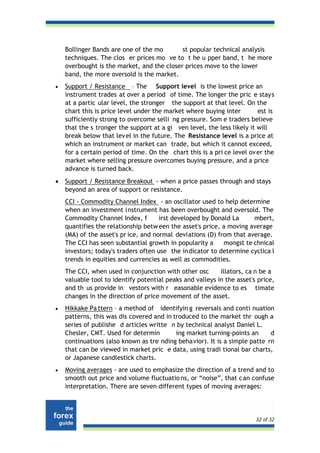
    The other technique is called the do uble crossover, which uses short-
    term and long-ter m averages. Typic ally, upw ard mom entum is
    confirmed when a short-term aver age (e.g., 15 -day) crosses above a
    longer-term average (e.g., 50-day). Downward momentum is confirmed
    when a short-term average crosses below a long-term average.


•   MACD - Moving Av        erage Convergence/Divergence - a technica         l
    indicator, develope d by Gerald Appel, us ed to de tect swings in the
    price of financial instruments.      The MACD is computed using two
    exponentially smoothed moving averages (see further down) of the
    security's historical price, and is usually shown over a period of time on


                                                                        33 of 33
a chart. By then comparing the          MACD to its own moving average
    (usually called the "signal line" ), traders believe they can detec t when
    the securi ty is likely to rise or      fall. M ACD is frequently used i n
    conjunction with other technic al indi cators such as the RSI (Relative
    Strength Index, see further down) and the stochastic oscillator (s ee
    further down).
•   Momentum – is an oscillator designed to measure the rate of pric         e
    change, not the ac tual price level. This oscillator consists of the net
    difference between the current closing price and the oldest closing
    price from a predetermined period.
    The formula for calculating the momentum (M) is:
          M = CCP – OCP
          Where:        CCP – current closing price
                        OCP – old closing price
    Momentum and rate of change (ROC) are simple indicators showing
    the difference between today's closing pri ce and the close N days ago.
    "Momentum" is simply the difference, and the ROC is a ratio expressed
    in percentage. They refer in general to prices continuing to tre nd. The
    momentum and ROC i ndicators s how that by remaining positive, while
    an uptrend is sustained, or negative, while a downtrend is sustained.
    A crossing up through zero may be used as a signal to buy, or a crossing
    down through zero a s a signal to sell. How high (or how low, when
    negative) the indicators get shows how strong the trend is.
•   RSI - Rela tive Stren gth In dex - a technical momentum indicator      ,
    devised by Welles Wi lder, meas ures the relative cha nges betw een the
    higher and lower closing prices. RSI compares the magnitude of recent
    gains to recent loss es in an attempt to determi ne overbought and
    oversold conditions of an asset.
    The formula for calculating RSI is:
          RSI = 100 – [100 / (1 + RS)]
          Where:        RS - average of N days up closes, divided by
                        average of N days down closes
                        N - predetermined number of days
    The RSI ranges from 0 to 100. An asset is deemed to be overbought
    once the RSI approac hes the 70 leve l, me aning that it may be gettin g
    overvalued and is a good candi date for a pullback. Likewise, if the RSI
    approaches 30, it is an indicati  on that the asset may be gettin       g


                                                                       34 of 34
oversold and therefore likely to become undervalue d. A trade r using
    RSI should be aware that large s urges and drops in the price of an asset
    will affect the RSI by creating false bu y or sell signals. The RSI is best
    used as a valuable complement to other stock-picking tools.
•   Stochastic oscillator - A technical momentum indicator that compares
    an instrument's closing price to its price range over a given time period.
    The oscillator's sensitivity to market movements can be reduced by
    adjusting the time period, or by taki ng a moving average of the resul t.
    This indicator is calculated with the following formula:
                  %K = 100 * [(C – L14) / (H14 – L14)]
           C= the most recent closing price;
           L14= the low of the 14 previous trading sessions;
           H14= the highest price traded during the same 14-day period.

    The theory behind this indicator, based on George Lane’s observations,
    is that in an upwar d-trending market , pr ices tend to close near their
    high, and during a downward-trendin g m arket, prices tend to close
    near their low. Transaction signals occur when the %K crosses through a
    three-period moving average called the “%D”.
•   Trend line - a sloping line of support or resistance.
       •   Up trend l ine – strai ght line dr awn upwar d to the right along
           successive reaction lows
       •   Down trend line – straight line     drawn downwards to the righ      t
           along successive rally peaks
    Two poi nts are needed to draw th e trend line, and a third point to
    make it valid trend line. Trend lines are used in many ways by traders.
    One way is that when price returns to an existing principal trend line’ it
    may be an opport unity to open new posit ions in the direction of th e
    trend in the belief that the trend     line will hold and the tr end will
    continue further. A second wa y is that when price action breaks
    through the principal trend line of an existing trend, it is evidence that
    the trend may be going to fail, and a trader may consider trading in the
    opposite direction to the existing trend, or exiting positions in th     e
    direction of the trend.


                Don’t fall in love with your Forex position.
                Never take revenge of your Forex position.


                                                                          35 of 35
[6.3] Charts and diagrams
Forex charts are based on mar ket action involving price. Charts are major
tools in Forex trading. There are many kinds of charts, each of which helps to
visually analyze market conditions, a ssess and create forecasts, and identify
behavior patterns.
Most charts present the behavior of curren cy exchange rates over time. Rates
(prices) are measured on the v ertical axis and time is shown of the horizonta l
axis.
Charts are used by both techni cal an d fundamental analysts. The tec hnical
analyst an alyzes the “micro” moveme nts, trying to match the           a ctual
occurrence with known patterns. T        he fundamental analyst tries to find
correlation between the trend seen on the chart and “macro” events
occurring parallel to that (political and others).
What is an appropriate time scale to use on a chart?
It depends on the trader’s strategy. Th e short-range investor would proba bly
select a day chart (units of hours, minutes), wher    e the medium and long-
range investor would use the we ekly or monthly charts. High resolution c harts
(e.g. – minutes and seconds) may show “noise”, meaning that with fine details
in view, it is sometimes harder to see the overall trend.
The major types of charts:
   •   Line chart
       The simplest
       form, base d upon
       the closin g rates
       (in each time
       unit), for ming a
       homogeneous
       line. (Such chart,
       on the 5-minutes
       scale, will show a
       line connecting all
       the actual rates
       every 5 minutes).
       This chart does not s how what happe ned during the time uni t selected
       by the viewer, only closing rates for such time intervals. The line chart
       is a simple tool for setting support and resistance levels.


                                                                         36 of 36
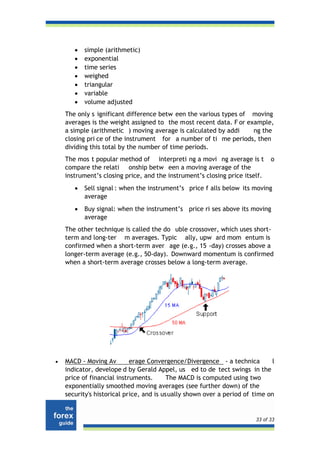
•   Point and figure charts - charts based on price without time . Unlike
    most other investment charts, point and figure charts do not present a
    linear representation of time. Instead, they show trends in price.
    Increases are represented by a rising stack of Xs, and decreases are
    represented by a declining stac k of Os . This type of chart is used to
    filter out non-si gnificant price move ments, and enables the trader to
    easily determine critical support and resistance levels. Traders will
    place orders when the pric       e move s beyond identified s upport /
    resistance levels.


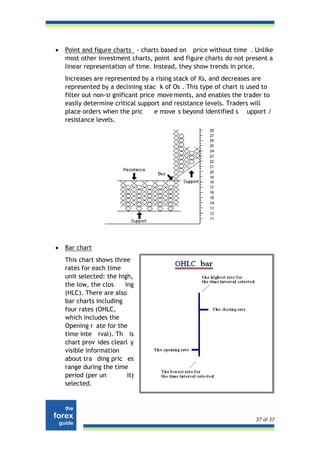
•   Bar chart
    This chart shows three
    rates for each time
    unit selected: the high,
    the low, the clos    ing
    (HLC). There are also
    bar charts including
    four rates (OHLC,
    which includes the
    Opening r ate for the
    time inte rval). Th is
    chart prov ides clearl y
    visible information
    about tra ding pric es
    range during the time
    period (per un        it)
    selected.


                                                                     37 of 37
•   Candlestick chart
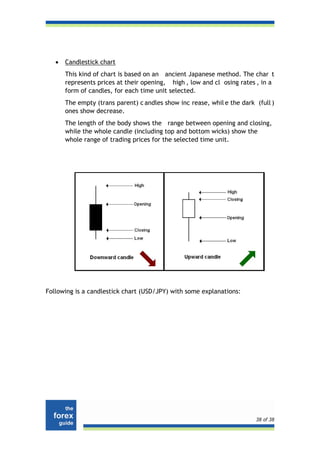
       This kind of chart is based on an ancient Japanese method. The char t
       represents prices at their opening, high , low and cl osing rates , in a
       form of candles, for each time unit selected.
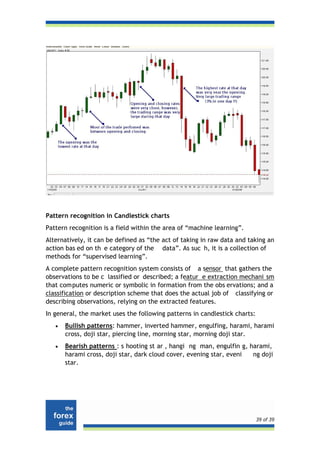
       The empty (trans parent) c andles show inc rease, whil e the dark (full )
       ones show decrease.
       The length of the body shows the range between opening and closing,
       while the whole candle (including top and bottom wicks) show the
       whole range of trading prices for the selected time unit.


Following is a candlestick chart (USD/JPY) with some explanations:


                                                                         38 of 38
Pattern recognition in Candlestick charts
Pattern recognition is a field within the area of “machine learning”.
Alternatively, it can be defined as “the act of taking in raw data and taking an
action bas ed on th e category of the data”. As suc h, it is a collection of
methods for “supervised learning”.
A complete pattern recognition system consists of a sensor that gathers the
observations to be c lassified or described; a featur e extraction mechani sm
that computes numeric or symbolic in formation from the obs ervations; and a
classification or description scheme that does the actual job of classifying or
describing observations, relying on the extracted features.
In general, the market uses the following patterns in candlestick charts:
   •   Bullish patterns: hammer, inverted hammer, engulfing, harami, harami
       cross, doji star, piercing line, morning star, morning doji star.
   •   Bearish patterns : s hooting st ar , hangi ng man, engulfin g, harami,
       harami cross, doji star, dark cloud cover, evening star, eveni  ng doji
       star.


                                                                            39 of 39
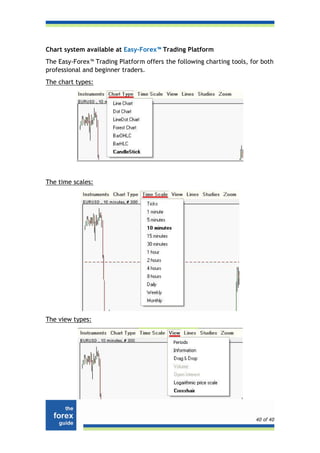
Chart system available at Easy-Forex™ Trading Platform
The Easy-Forex™ Trading Platform offers the following charting tools, for both
professional and beginner traders.
The chart types:


The time scales:


The view types:


                                                                        40 of 40
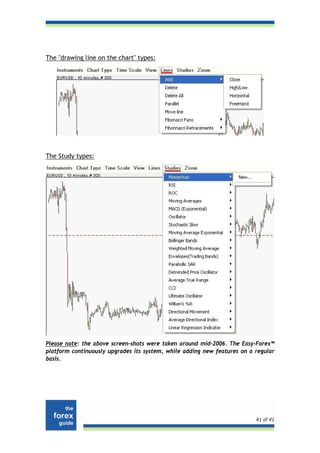
The "drawing line on the chart" types:


The Study types:


Please note: the above screen-shots were taken around mid-2006. The Easy-Forex™
platform continuously upgrades its system, while adding new features on a regular
basis.


                                                                          41 of 41
[6.4] Technical Analysis categories / approaches
Technical Analysis can be divided into five major categories:
      •   Price indicators (oscillators, e.g.: Relative Strength Index (RSI))
      •   Number theory (Fibonacci numbers, Gann numbers)
      •   Waves (Elliott's wave theory)
      •   Gaps (high-low, open-closing)
      •   Trends (following moving average).


[a] Price       indicators
Relative Strength In dex (RSI): The RSI measures the ratio of up-moves to
down-moves and nor malizes the calculati on, so that the in dex is expresse d in
a range of 0-100. If the RSI is 70 or great er, then the instrument is assumed to
be overbought (a si tuation in which prices have risen more than market
expectations). An RSI of 30 or less is taken as a signal that the ins trument may
be oversol d (a situation in which pric es have fallen more than the market
expectations).
Stochastic oscillator: This is used to indicate overbought/oversold conditions
on a scale of 0-100% . The indicator is based on the observation that in a
strong up-trend, period closing prices tend to concentrate in the higher par t
of the period's range. Conversely, as prices fall in a strong down-trend, closing
prices tend to be near the extreme        low of the period ran ge. S tochastic
calculations produce two lines, %K and %D, that are used to indicate
overbought/oversold areas of a chart. Divergence between the stochas tic
lines and the price action of the unde      rlying instrument gives a powerful
trading signal.
Moving Average Converge nce/Divergence (MACD): This indicator invol ves
plotting tw o momentum lines. The MACD line is the difference between two
exponential moving averages and the si        gnal or trigger line, which is an
exponential moving average of the difference. If the MACD and trigger lines
cross, then this is taken as a signal that a change in the trend is likely.


[b]       Number theory:
Fibonacci numbers: The Fibonacci number sequence (1, 1, 2, 3, 5, 8, 13, 21,
34 ...) is constructed by adding the first two num bers to arrive at the thi rd.
The ratio of any number to the next larger number is 61.8%, which i         sa
popular Fibonacci retracement number. The inverse of 61.8%, which is 38.2%,


                                                                                42 of 42
is also used as a Fibonacci retracement number (as well as extensions of that
ratio, 161.8%, 261.8%). Wave patterns an        d behavior, identified in For ex
trading, correlate (to some exte nt) with relations within the Fi bonacci series.
The tool i s used in technical analysis that c ombines various num bers of
Fibonacci retracements, all of which ar e drawn from different highs and lows.
Fibonacci clusters are indicators which are usually found on the side of a pri ce
chart and look like a series of h orizontal bars with various degrees of shading.
Each retracement level that ove rlaps with another, m akes the horizontal bar
on the side darker at that pric e level. The most significant levels of suppor t
and resistance are found where the Fi bonacci cluster is the dar kest. This tool
helps gau ging the rel ative stren gth of the support or resistance of various
price levels in one quick glanc e. Traders often pay close attention to the
volume ar ound the identified levels        to confir m the strength of th      e
support/resistance.
Gann numbers: W.D. Gann was a stock and a com modity trader working in
the '50s, who reputedly made over $50 mi llion in the markets. He made his
fortune usi ng methods that he develo ped for trading inst ruments based on
relationships between price movement       and tim e, known as time/ price
equivalents. There is no easy explanati on for Gann's methods , but in essence
he used angles in charts to determine support and resistance areas, and to
predict th e times of future tr end cha nges. He als o used li nes in char ts to
predict support and resistance areas.


[c] Waves
Elliott's wave theory: The Elliott Wave Theory is an approach to market
analysis that is based on repetit ive wave patterns an d the Fibo nacci num ber
sequence. An ideal El liott wave patte rn shows a five-wave advance follow ed
by a three-wave decline.


[d] Gaps
Gaps are s paces left on the bar char t w here no trading has taken plac e.
Gaps can be created by factors such as regular buy ing or selling pressur e,
earnings announcements, a change in an analyst's outlook or any other type of
news release.


                                                                          43 of 43
An up gap is formed when the lowest price on a trading day is higher than the
highest high of the previous day. A down gap is formed when the highest pri ce
of the day is lower than the l owest price of the prior day. An u p gap is usually
a sign of market strength, whi le a down gap is a si gn of market weakness. A
breakaway gap is a price gap that forms on the co mpletion o f a n i mportant
price patte rn. It us ually signals the be ginning of an i mportant price move. A
runaway gap is a pri ce gap that usually occu rs around the mi d-point of an
important market trend. For that reason , it is also call ed a measuring gap. An
exhaustion gap is a price gap that occurs at the end of an important trend and
signals that the trend is ending.


[e] Trends
A trend refers to the direction of prices. Rising peaks and trough s constitute
an up trend; falling peaks and troughs constitute a downtrend that determines
the steepness of the current trend. The breaking of a trend line usually signals
a trend reversal. Horizontal peaks and troughs characterize a trading range.
In general, Charles Dow categorized tr ends into 3 categories: (a) Bull tr end
(up-trend: a series of highs and lows , where each high is higher than the
previous one); (b) Bear trend (down-tren d: a series of highs and lows, where
each low i s lower than the pr evious one); (c) Trea ding trend (horizo ntal-
trend: a series of highs and low s, where peaks and lows are around the sam e
as the previous peaks and lows).
Moving averages are used to smooth pric e information in order to confirm
trends and support-and-resistance levels. They are also useful in deciding on a
trading str ategy, particularly in futures trading or a market with a strong up
or down trend. Rec ognizing a t rend may be done u sing standard deviati on,
which is a measure of volatility. Bolli    nger Bands, for example, illustrate
trends with this approach. When th e markets become more volatile, the


                                                                           44 of 44
bands widen (move further away from th e average), while during less volatile
periods, the bands contract (move closer to the average).
Various Trend lines
Pattern re cognition i n Trend li nes, whic h detec t a nd draw t he followi ng
patterns: ascendin g; desce nding; symmetrically & exten        ded trian gles;
wedges; trend channels.


[6.5] Some other popular technical tools:
Coppock Curve is an investment tool used in technical analysis f or predicting
bear market lows. It is calculated as a 10-month weighted movi ng average of
the sum of the 14-month rate of change and the 11-m onth rate of change for
the index.
DMI (Directional Movement Indicator) is a popular technical indicator used to
determine whether or not a currency pair is trending.
The Parabolic System (SAR) is a stop-loss system based on price and time. It
is used to determine good exit and entry points.


        You are almost ready to trade in real-time, but you want to discuss
                something online. Chat with an Easy-Forex™ expert.


[6.6] Another way to categorize Technical Indicators:
The indicators and tools aim to provide information in various approaches:
 • Cycle indicators
   A cycle is a term to indicate repeating patterns of market movement,
   specific to recurrent events, such      as s easons, el ections, etc. Many
   markets have a tendency to m ove in cyc lical patterns. Cycle indicator s
   determine the timi ng of a parti cular market patterns. (Exam ple: Elliott
   Wave).
 • Momentum indicators
   Momentum is a gener al term us ed to desc ribe the speed at whi ch price s
   move over a given time period. Momentum indicators deter         mine the
   strength or weakness of a trend as it progresses over time. M omentum is
   highest at the beginning of a trend and lowest at trend turning points. Any
   divergence of directions in price and momentum is a warning of weakness;


                                                                              45 of 45
if price extremes occur with weak momentum, i        t signals an end of
   movement in that dir ection. If momentum is trending strongly and prices
   are flat, i t signals a potential chan ge i n price di rection. (Example:
   Stochastic, MACD, RSI).
• Strength indicators
  Market strength describes the intensity of market opinion with reference
  to a price by examining the market positions tak     en by various market
  participants. Volume or open interest , are the basic ingredients of this
  indicator. Their signals are coincident or l eading the market. (Example:
  Trading Volume).
• Support/Resistance indicators
   Support and resistanc e describe price levels where markets repeatedl y
   rise or fall, and then r everse. This method shows the price levels at which
   the market is expected to revers e and stay within the S/R levels (e.g. –
   not excee ding the s upport or the resi stance level). This phenomenon is
   attributed to basic supply and demand forces. (Example: Trend Lines)
• Trend indicators
  Trend is a term use d to descri be the per sistence of price mov ement i n
  one directi on over ti me. Trends move in three direc tions: up, down and
  sideways. Trend indi cators smooth varia ble price data to       create a
  composite of market direction. Gene rally, the trend could be e ither UP,
  or DOWN, or TREAD (flat). (Example: Moving Averages, Trend lines).
• Volatility indicators
  Describe the intensity of fluctuations i n the market prices. A change i n
  the volatility level hints at a coming change in the price. Vol atility is a
  general term used to describe the magnitude, or size, of day-to-day price
  fluctuations independent of their direction. Generally, changes in
  volatility tend to lead changes in prices. (Example: Bollinger Bands).


Unlike the fundamental analyst, the techni cal analyst is not much concerned
with any of the “bigger pi cture” factors affecting the market, but
concentrates on the activity of that instrument's market.


        To read today’s professional outlook and view detailed charts,
        Join Easy-Forex™ (registration is quick and free, no obligation):
                            www.Easy-Forex.com


                                                                            46 of 46
[7] Fundamental Analysis
      and leading market (economic) indicators


Fundamental analysis is a method of forecasting futur e price movements of a
financial i nstrument based on economic , political , e nvironmental and other
relevant factors, as w ell as data that will affect the basic supply and dema nd
of whatev er underli es the financial instrument. In practice, many market
players use technical analysis in conj unction with fundamental analysis to
determine their trading strategy. One major advantage of technical analysis is
that experi enced anal ysts can follow many markets and market i nstruments,
whereas the fundamental analyst needs to know a par               ticular market
intimately. Fundame ntal analy sis focuses on what ough t to happe n i n a
market. Among the factors considered are: supply         and demand; seasonal
cycles; weather; government policy.
The fundamental analyst studi es the caus es of market movem ents, while the
technical analyst stu dies the e ffect. Fu ndamental analysis is a macro, or
strategic, assessment of where a curre ncy should be traded, based on any
criteria but the movement of the currenc y's price itself. These c riteria often
include the economic conditions of th e country that the currency represents ,
monetary policy, and other “fundamental” elements.
Many profi table trades are made mome nts prior to, or s hortly after, m ajor
economic announcements.


Leading economic indicators
The following is a list of economic indicators used in the USA. Obviously, there
are many more, as well as those of other leading economies (such as
Germany, the UK, Japan, etc.). In genera l, it is not only the numerical v alue
of an in dicator tha t is important, but a lso the m arket’s an ticipation and
prediction of th e forecast , and the i     mpact of the relation betw       een
anticipated and actual figures on the market.
Such macro indicators are followed by the vast major ity of traders worldwide.
The “quali ty” of the publishe d data can differ over time. The value of t he
indicator data is considered greater if   it presents new information, or is
instrumental to drawing conclusions which coul d not be drawn under othe r
reports or data. Furthermore, an indicato r is highly valuable if one may use i t
to better forecast future trends.


                                                                          47 of 47
Note that in the US A most in dicators ar e publis hed on c ertain weekda ys,
rather than on a particular monthly da te (e.g. the second Wednesday in each
month, as opposed to the 14th of each month, etc.).
Each indicator is marked as High (H), Medium (M) or Low (L), according to the
importance commonly attributed to it.


[H] CCI - Consumer Confidence Index

The Conference Board; last Tuesday of          each month, 10:00am EST, covers current
month's data
The CCI is a survey based on a sample of 5,000 U.S. househ olds and is considered one of the
most a ccurate indi cators of c onfidence. The idea behind c onsumer c onfidence i s that w hen
the economy warrants more job s, increased wages, and l ower interest rates, it increases our
confidence and spending power. The respondents answer que stions about th eir income, t he
market condition as they see it, and th e chances to see increase in their income. Confidence
is looked at closely by the Federal Re serve when determining interest rates. It is considered
to be a big market mover as private consumption is two thirds of the American economy.


[H] CPI - Consumer Price Index; Core-CPI

Bureau of Labor an d Statistics; ar ound the 20 th of each month, 8:30am EST, covers
previous month's data
The CPI is considered the most widely used mea sure of inflation and is regard ed as an
indicator of the effecti veness o f go vernment po licy. The CPI is a basket of consu mer goods
(and serv ices) tracked fr om m onth to month (ex cluding ta xes). The CPI is o ne of the m ost
followed e conomic i ndicators a nd co nsidered to be a very bi g ma rket mover. A r ising CPI
indicates infl ation. The Core-CPI (CPI, exclud ing food and energy, expense it ems which are
subject to seasonal fluctuations) gives a more stringent measure of general prices.


[H] Employme nt Report

Department of Labor; t he first Frid ay of each month, 8:3 0am EST, covers previ ous
month data
The collection of the d ata is gathe red thro ugh a s urvey a mong 37 5,000 bus iness and 60,000
households. The report reviews: the number of new work places created or cancelled in the
economy, average wages per hour and the averag e length of the work week . The report is
considered as one of the mo st im portant eco nomic public ations, bo th fo r the f act tha t i t
discloses new up-to-date information and due to the fact that, t ogether with NFP, it gives a
good pi cture of the tot al state o f the econ omy. The repo rt a lso bre aks out data by se ctor
(e.g. manufacturing, services, building, mining, public, etc.)


                                                                                         48 of 48
[H] Employment Situation Report

Bureau of Labor and St atistics; the first Friday of each month, 8:30am EST, cov ers
previous month data
The Employment Situation Report is a monthly indicator which contains two major parts. One
part is the u nemployment and new job s created: the report reveals the unemployment r ate
and the change in the unemployment rate. The second part of the report indicates things like
average wee kly hours worked and average hour ly earnings. This data i s imp ortant for
determining the tightness of the labor market, which is a major determinant of inflation. The
Bureau of Labor surveys over 25 0 re gions across th e United States and cove rs al most every
major indust ry. This indi cator is ce rtainly on e of the most watched ind icators and al most
always moves markets. Investors value the fact th at information in the Empl oyment report is
very timely as it is less than a week old. The report provides one of the best snapshots of the
health of the economy.


[H] FOMC Meeting (Federal Open Market Committee): Rate announcement

The meeting of the US Federal      Bank re presentatives, held 8 times a year.  The
decision ab out the prime interest rate is pu blished during each meeting (around
14:15 EST).
The FED (the Federal Re serve of USA) is re sponsible for managing the US monetary policy,
controlling t he banks, providing ser vices t o governmental organizations a nd cit izens, and
maintaining the country’s financial stability.
There are 12 Fed regions in the USA (each comp rising several states), represented in the Fed
committee by regional commissioners.
The rate of interest on a currency is in prac tice the price of the money. Th e higher the rate
of interest on a currency, the more people will tend to hold that currency, to purchase it and
in that way to strengthen the value of the currency. This is very important indicator affecting
the rate of inflation and is a very big market mover.
There is gre at import ance to the FOMC a nnouncement, how ever – the content of t       he
deliberation held in the meeting, which is published 2 weeks after the rate announcement, is
almost as important to the markets.


    The FED’s announcement has shaken the Forex market? Learn about
      economic indicators; read the online financial calendar onboard
                      Easy-Forex™ Trading Platform.


[H] GDP - Gross Domestic Product

BEA (Burea u of Econo mic Analys is); last da y of the quarter, 8:30         am EST , co vers
previous quarter data.


                                                                                       49 of 49
The US Commerce de partment p ublishes the GDP in 3 modes: adv ance; prel iminary
and final.
GDP is a gross measure of market activity. It represents the monetary value of all the goods
and s ervices produ ced by an ec onomy over a spe cified period. This in cludes c onsumption,
government purchases, investments, and the tr ade balance. The GDP is perh aps the gre atest
indicator of t he econo mic health of a country. I t is usually measured on a yearly basis, but
quarterly stats are also released.
The Commerce Dep artment releases an "advance report" on the last day of each quarte r.
Within a mo nth it follows up with the "prel iminary report" and then the "final rep ort" is
released yet a month later. The most recent GDP figures have a relatively high importance to
the markets. GDP indicates the pace at which a country's economy is growing (or shrinking).


[H] ISM (Institute for Supply Management) Manufacturing Index

Institute for Supply M anagement; the first business day of the month, 10:00am EST,
covers previous month data
The Manufacturing ISM Repo rt on Business is based on data compiled from monthly replies to
questions asked of purchasing executives in more than 400 industrial companies. It reflects a
compound average of 5 main economic areas (new customers’ orders 30%; manufacturing 25%;
employment 20%; supply order s 15%; inventories 10%). Any dat a ov er 5 0 p oints shows t he
expansion of economic activities, and data under 50 points shows a contraction.


[H] MCSI - Michigan Consumer Sentiment Index

University of Michigan; first of each month, covers previous month data
A sur vey o f consumer sentiment, c onducted by t he Univer sity of M ichigan. The index is
becoming more and more useful for investors. It gives a snapshot of whether or not consumers
feel like spending money.


[H] NFP - Changes in non-farm payrolls

Department of Labor; t he first Frid ay of each month, 8:3 0am EST, covers previ ous
month data
The data int ended to represent ch anges in the t otal number of paid U.S. workers       of any
business, excluding the following:
- general government employees;
- private household employees;
- employees of nonprofit organizations that provide assistance to individuals;
- farm employees.
The total n on-farm payroll accounts for approx imately 80% of the workers resp onsible for
the entire gr oss do mestic product o f the Unit ed States. The report is used to assist
government policy-makers and econ omists in determining the current state of the econ omy
and predicting future levels of economic activity. It is a very big market mover, due largely to
high fluctuations in the forecasting.


                                                                                        50 of 50
[H] PMI - Purchasing Managers Index

Institute for Supply Man agement; the first business day of each month, 10:00am ES T,
covers previous month's data
The PM I is a co mposite index that i s based on fi ve m ajor ind icators includ ing: new orders;
inventory levels; production; supplier delive ries and the employment en vironment. E ach
indicator has a different weight and the data is adjusted for seasonal factors. The Association
of Purch asing M anagers su rveys o ver 300 pur chasing man agers nationwide w ho repre sent 20
different ind ustries. A P MI index ov er 50 indicates that manufacturin g is e xpanding, w hile
anything bel ow 5 0 means that the in dustry i s contracting. The PMI report is an e xtremely
important indicator for the financial markets as it is the best indicator of factory production.
The inde x i s po pularly used f or d etecting inflationary pre ssure a s wel l as indicating
manufacturing activity. The PMI is not as strong as the CPI in detecting inflation, but because
the data is released one day after th e month, it is very ti mely. Should th e PM I report an
unexpected change, it is usually followed by a quick reaction in market. On e especially key
area o f the r eport is gr owth in new or ders, wh ich predicts manufacturing activity in futu re
months.


[H] Retail Sales Data; Retail Sales less Automotives
                                       th
Bureau of Census; around the 12             of each month, 8:30am EST, covers previous
month’s data
Retail sales are a key driving force in US economy. This indicator tracks the merchandise sold
by co mpanies with in the retail tr ade and m easures the total consu mer spending on retails
sales (not including service costs). The retail revenues are a major part (two thirds) of the US
economy. Th e Census Bureau surveys hundreds of various sized firms and business offering
some type of retail trade. Every month the data is released showing the percent change from
the previou s month’s data. A negat ive number indicates th at sale s de creased fr om the
previous months sales. This indicator is a very big market mover because it is used as a gauge
of c onsumer acti vity and conf idence, as hi gher sales f igures indicate in creased e conomic
activity. The data is very timely bec ause retail sales data is released with in 2 weeks of the
previous month.


[H] Tankan Survey

BoJ (Bank o f Japan); fo ur times a year in Ap ril, July, October and m id-December;
10:50pm GMT
An economic survey of Japanese business issued by the central Bank of Japan, which it t hen
uses t o f ormulate mon etary pol icy. The survey covers th ousands of Japanese companies
with a sp ecified minimum am ount o f capital, although firms de emed sufficiently influential
may al so be included. Th e co mpanies are a sked ab out current t rends and conditions in t he
business place and their respective industries, as well as their expected business activities for
the next quarter and year. It is considered a big market mover for JPY currency pairs.


                                                                                         51 of 51
[H]   TIC (Treasury International Capital) Data on transactions in long term
      securities
Department of the Treasury; around the 12th working day of each month, 9:00am EST,
covers month before previous data
The TI C data pr ovides i nformation a bout the most i mportant way the US is f inancing it s
ongoing current account deficit: sellin g long-term securities to foreigners, or exporting debt.
It is important to remember that there are other ways of financing a deficit: borrowing from
foreign banks or attracting net FDI inflows. Bu t since FDI flows have been negative and ban k
flows tend to be small, most of the financin g the US needs has come from t he sale of long-
term securities t o f oreigners. TI C dat a are a g ood measurement of how much a country i s
trusted in the international investment community. It is considered a big market mover.


[H] Trade Balance

Department of Comme rce; the second w eek of each month, 8:30am EST, cov                    ers
month before previous data
A country’s trade balan ce is the largest compon ent of a country 's balance of payment s. The
balance of trade measures the difference between the value of goods and services that a
nation exports, and those it impo rts. A country ha s a trade deficit if it imports more than it
exports. The opposite scenario is a trade surplus. It is considered a very big market mover.


[M] Budget Statement Monthly

A monthly report by US government (the Treasury Department), showing the monthly
budget deficit or surplus
The level of deficit/surplus affects the level of US bonds issues by the government, hence –
their price. In addition, this report re flects the level of tax collect ed by the gove rnment,
which is ind icative of the level of e conomic activity. Consequently, the Apr il rep ort (the
month in wh ich Americans sub mit the ir ta x re turns) is even more important than those
released in other months.


[M] Composite Index of Leading Indicators

The Conference Board; around the 20th of each month, 10:00am EST              An index used
to predic t the di rection of the ec onomy's movements i n the mo nths to come. The i ndex i s
made up o f 10 economic components, whose changes tend t o precede changes in the overall
economy. These 10 components include:
  1. the average weekly hours worked by manufacturing workers;
  2. the average number of initial applications for unemployment insurance;
  3. the amount of manufacturers' new orders for consumer goods and materials;
  4. the speed of delivery of new merchandise to vendors from suppliers;
  5. the amount of new orders for capital goods unrelated to defense;
  6. the amount of new building permits for residential buildings;
  7. the S&P 500 stock index;


                                                                                        52 of 52
8. the inflation-adjusted monetary supply (M2);
  9. the spread between long and short interests rates;
  10. consumer sentiment.
By lo oking at the Co mposite I ndex o f Leading I ndicators in the l ight of busine ss cycles and
general ec onomic c onditions, inve stors and bu sinesses can f orm expe ctations about wh at's
ahead, and make b etter-informed decisions. It has medium i mportance, as its many
components are already known at the time of its publication.


[M] Curren t Account

BEA (Bureau of Economic Analysis); quarterly, around six weeks after quarter end
The difference between a nation's total exports of goods, services and transfers, and its total
imports of th e sa me. Curr ent acc ount balance calculations excl ude transact ions in financial
assets and liabilities. The level of the current account is followed as an indicator of trends in
foreign trade, so it is regarded as a big market mover.


[M] Durable Goods

Bureau of Census; the fourth we ek of each month, 8 :30am ES T, covers prev ious
month data
Durable G oods Orders measures ne w order s pl aced w ith domestic manufacturers for
immediate and future delivery of factory hard goods. A durable good is defined as a good that
lasts an exte nded period of time (over three years) during whi ch its ser vices are extende d.
Rising Durable Goods Orders are normally associated with stronger economic activity, and can
therefore lead to higher short-term interest rates. Higher rates often support a currency, at
least in the short term.


[M] GDP Price Deflator

BEA (Burea u of Econo mic Analys is); last da y of the quarter, 8:30           am EST , co vers
previous quarter data
The GDP deflator shows how much a change in the base year's GDP relies upon changes in the
price level. Also known as the "GDP impl icit pr ice deflator." As it i s not based on a f ixed
basket of goods and s ervices, the GD P deflat or h as an advantage over the con sumer p rice
index (CPI). Changes in consumption patterns, or th e introduction of new goo ds and services,
are automatically re flected in the de flator. Th is in dicator i s of medium importance t o t he
markets.


[M] Housing Starts

Bureau of Census; around the mid dle of each month, 8 :30am ES T, c overs previous
month data
This economic indi cator track s how many new single-family homes or ot her residential
buildings were constru cted through the month. For the survey, each hou se and each sin gle


                                                                                          53 of 53
apartment is counted as one housing start. This indicator is not a huge mark et mover, but it
has been reported by U .S. Cens us t hat the h ousing indu stry represents over 25% of all
investment dollars, and a 5% value of t he overall economy. Housing starts are considered t o
be a leading indicator, meaning it detects tren ds in the ec onomy looking forward. Declining
housing start s show a sl owing economy, while increases in housing act ivity can pull an
economy out of a downturn.


[M] Industrial Production Capacity; Production Utilization

Federal Reserve; middle of the month, 9:15am EST, covers previous month data
It is a cha in-weighted measure of th e chang e in the produ ction o f the na tion's f actories,
mines and utilities as well as a measure of their industrial capacity and of how many available
resources are being used (commonly known as capacity utilization). In addition, the Capacity
Utilization I ndex pro vides an estim ate of how much fact ory c apacity is in use. They are
important indicators, as the manufacturing sector accounts for one-quarter of the economy.


[M] Initial Jobless Claims

Department of Labor; once a week on Thursday at 8:30am EST, covers previous week
data
The data states the number of people who applied to receive unemployment pay for the fir st
time. It has low to mediu m importance as this re lates to weekly data with high fluctuations;
the average of four weeks is more stable.


[M] Philadelphia Fed Index (Business Outlook Survey)

Federal Reserve Bank of Philadelph ia; around t he 17 th of each month, 10:00am EST,
covers previous month data
The Business Outlook Survey is a mont hly survey of ma nufacturers located around the states
of Penn sylvania, New J ersey and Dela ware. C ompanies surveyed indi cate t he dire ction of
change in th eir o verall busine ss activity and in t he variou s measures of activity at their
plants. The index signals expansion when it is above zero and contraction w hen below. This
index is considered to be a good indicator of changes in everything from employment, general
prices, and conditions within the manufacturing industry. It isn't a big market mover, but the
results found in the survey can indicate what to expect from the Purchasing Managers' Index
(which comes out a few days later and covers the entire U.S.).


[M] PPI - Producer Price Index; Core-PPI

Bureau of Labor and Statistics; the second full week of each month, 8:30am EST,
covers previous month data
The PPI is not as widely used as the CPI, but it is still considered to be a good indicator of
inflation. Thi s indi cator reflects the c hange of m anufacturers’ co st of input (raw materi als,
semi-finished goods, etc.). Formerly known as th e "Wholesale Price Index", the PPI is a basket
of various indexes covering a w ide range of areas affecting domestic producers. Each month


                                                                                           54 of 54
approximately 100,000 prices are collected from 30,000 production and manufacturing firms.
It is n ot a s strong a s th e CPI in det ecting infl ation, but be cause it in cludes g oods bei ng
produced, it is often a forecast of future CPI releases.


[L] Beige Book

Federal Reserve Board; two Wednesdays be fore every FOMC meeting , 8 times per
year, 2:15pm EST
Beige book is the common ly used term for the Fed report entitled: "Summary of Commentary
on Current E conomic Conditions by Federal Res erve Distr ict". It is publ ished just before the
FOMC me eting on intere st r ates and is use d t o inform the members on chan ges in the
economy since the last meeting. This report is published eight times per year. The Beige Book
is not considered to be a big market mover. It is a gauge of the strength of the econ omy and
not a c ommentary on th e view s o f F ed me mbers. Oc casionally it can move market s i f t he
findings are substantially different from analyst expectations.


[L] ECI - Employment Cost Index

Bureau of L abor and St atistics; the last Th ursday of A pr, Jul, Nov and Jan, 8:30 am
EST; covers previous quarter’s data
The ECI trac ks m ovement in the co st of lab or wh ich in cludes wages, fringe benefit s, a nd
bonuses for employees at all levels of involv ement The Bureau of Labor surveys over 3,000
private sect or fir ms and over 50 0 local governments, sch ools and oth er public se ctor
organizations. This indicator i s not w idely watche d, but it i s am ong a s elect gr oup of
indicators that have enough power to move the markets. This is particularly true in
inflationary time s. The i dea behind the ECI is t hat as w age pres sures increase, s o does
inflation. Th is i s mainly b ecause c ompensation ten ds to in crease bef ore companies inc rease
prices for consumers (inflation).


[L] PCE - Personal Consumption Expenditure

BEA (Burea u of Econo mic Analys is); last da y of each month, 8:30 am EST, cov ers
previous month data
PCE measures price changes in consumer goods and services. The PCE is a fairly predictable
report that u sually has lit tle impact on the ma rkets. The Core PCE, which is the index l ess
prices of food and energy, estimates inflationary trend more precisely.


                                                                                            55 of 55
[8] Day Trading on a Forex platform
             (example, using the Easy-Forex™ platform)

Step (1): Deciding to perform a Forex deal
You have an intenti on to trade Forex, and you have your own reasoning f or
doing so – e.g. you f eel that the US D will increase c ompared with the EUR.
The EUR/USD exchange rate is, at th      e time, around 1.5000 (the common
presentation of the Euro-US$ pair is EUR/USD, meaning 1.5000 US dollars for 1
Euro). Your feeling can be based on your experience, or on technical analysis ,
or fundamental analysis, etc. F or whatever reason, y ou believe that the USD
will rise to around 1.4850 (EUR will be down, which means USD will go up. Or
you will need less USD for 1 e    uro). You wa nt to profit if your forecast is
correct, and so choose to make a trade.
Step (2): Determining the deal
Below is a screen-shot of a Day-Trading deal in the making and an explanation
of each step required to put the trade into effect:


                                                                        56 of 56
Select currencies: Select the c urrency to buy and the currency to sell. This is
your ‘currency pair’. There is no conne ction be tween your “base working
currency” (or “account base currency”, the currency in which you handle your
Forex account and make deposits and wi thdrawals) and the currencies in the
pair you select. In thi s example you selected “BUY USD” because you feel it is
low in terms of Euro, and it wil l increase in the near future. Once it increases
to the level you anticipate, you will close the deal, a nd get more EUR for th e
USD you previously “bought” - hence, you make profit.
Select the Amount to trade: Since Forex trading is “non-delivery” trading (i .e.
– no physi cal currencies are transacted ), the Fore x deal (contract) ha s a
“volume”, or “size”, meaning the amount of the c urrencies in this contract.
You deter mine the volume of the contra ct, but you do not hav e to purchase
the whole amount. In general, y ou work in the most common leverage (see
below), 1:100: therefore a deal of 10, 000 Euro will require much less money
to facilitate it.
Select the Amount (Margin) to risk: This is your investment. This is the amount
you risk, meaning the MAXIMUM amount you can lose. On a 1:100 leverage,
EUR 10,000 against USD thus requires       only USD 100 (in fact, the actual
leverage you are offered in this case is 1:150, since you “buy” EUR10,000 with
USD 15,000, according to the example ra te of 1.5000, guaranteed using only
USD 100 of your own money).
Stop-Loss rate : This is the currency exchange rate at which your deal woul d
automatically close in the event the mark et ran counter to your forecast. In
this event, you would lose your USD 100 investment. You can define another
Stop-Loss rate, howev er, the “M argin to risk” will change acc ordingly. There
is a direct relationship between the Stop-L oss rate a nd the “Margin” (i .e the
amount risked) required for the deal.
Freeze Rate: This fea ture is uni que to the Easy-Forex™ Trading Platform. You
see the rate for the deal and are almost ready to accept it, but before you do,
you need another couple of seconds to think. With the freeze rate feature you
are allowed a small window of time to either decline or accept the deal.
Accept: When you’re ready, click “Accept” and your deal is activated. You
have enough money i n your Forex account to make the deal, s o it’s in pl ay.
You are holding now an “Open Position” in Forex.
Set SMS Alert : If you have signed up to the SMS Alert service you can set a n
alert for this deal. Y ou will be notified vi a text to y our mobile phone when
this deal closes (either because it reached its Stop-Loss or Take-Profit rate).


                                                                          57 of 57
Please note, “Renew al until…” : The Day-Trading deal resembles a “SPOT”
transaction (but is not identic al). The rates in the deal are the updated
current rates (“spot”), and the deal may be closed anytime during the trading
day. However, the tr ader can e xtend the deal to the follo wing day (paying a
small renewal fee). Most platf orms offer an autom atic renew al of the deal ,
for a few days period. The trader may cl ose the position at a ny time. If the
trader clos es the deal before the indica ted closing time (usuall y it is 22:00
GMT), no renewal fee will be charged for that day.


Step (3): Checking account status
Below is a screen-shot of a typical “My Position” report:


With online platform s, traders have 24x7 access in order to monitor open
positions, to close positions, or change parameters (definitions) in the deal.
You ca n c heck your positions f or Day Tr ades, Limit Orders and Forwards (if
this is offered in your region). You can also check the status of the SMS Alerts
you have set.


                                                                          58 of 58
To view the details of a specific deal, click on the + (plus) sign.
Visual Trading is uni que to Eas y-Forex™ and it allow s you to easily view the
significant details of your deal, in real time, as show n in the sli ding graph on
the right.
ID: The reference number of the deal, as recorded in the platform.

Buy: The volume of the currency “bought”.

Sell: The volume of the currency “sold”.

Open Rate: The exchange rate of the currency pair at the time the deal was
opened by the trader.

Current rate: The exchange rate of this currency pair at the time the trader is
viewing the screen).

Stop-Loss r ate: The r ate define d for automatic “stop-loss” of the deal . The
deal will c lose if this rate occurs in the market du ring the ti me the de al i s
active.

Take-Profit rate: (Not defined in this exam ple). This is the rate at which the
deal will close automatically assuming the market moves in the direction
forecast by the trader . When defined, this rate allows a trader to take prof it
automatically when a set rate i s achiev ed, thus allowing the trader to focus
on other tasks rather than watching the market closely.

Profit/Loss: The current status of the trader’s position. This will be the profi t
(or the loss) from this deal, if it was closed at this very second.

Open date: The day the deal was opened by the trader.

Rolling until: The last day to which the deal will be automatically renewed.

Amount (Margin) to risk: The amount invested by the trader for the deal. This
is the maximum amount the trader can lose.


                                                                           59 of 59
Step (4): Modifying your deal
This is where you can change Stop-Loss and Take Profit rates. You can al so
test out profit and loss scenarios with the Trade Controller.


Change St op-Loss: The trader is allowed to change their Stop-Loss, at any
time while the deal i s still acti ve. As previously mentione d, doing so would
affect the amount of margin needed fo r the deal. If the trader changes the
Stop-Loss downward (in a case where the position is losing, and is now near
the autom atic closing), then additi onal f unds will be required for margin. If
the trader changes the Stop-Loss upwa rd (in a c ase where the deal will
already see a profit, and the trader wishes to define a higher Stop-Loss       to
decrease the original risk), then the difference will be credited.
Change Take-Profit : Similarly, the trader i s a llowed to define , or change , a
Take-Profit rate. Note that unlik e a Stop-Loss rate, the trader does not have
to define any Take-Profit rate; it simply allows the trader to focus on tasks
other than rate-watching.
Trade Controller™: The trader can key in various hypothetical exc hange rates
to see thei r impact on their ove rall position (amou nt of profit or loss), if a nd
when such rates occur in the market. Yo u can do this manually on the tradi ng
ticket or to make it even easier use the Trade Controller.


                                                                             60 of 60
Inside Viewer™ : This is a snaps hot of all open Day Trades by traders on the
Easy-Forex™ platform. You can view the Popularity of a specific currency pair.
The Direction or percentage of buy or sell of a pair. A nd the Structure of open
deals, the average Stop-Loss and Take-Profit rates set by other traders.


Step (5): Closing the deal manually
Using the deal defined in the sc reen shot above, the deal de finitions are: Buy
USD; sell EUR; EUR10,000; Deal rate 1.5000; Stop-Loss 1.2052; no Take-Profit
defined; margin USD 100.


Scenarios to a Day-Trading deal
Example, please note:
This table is for illustration purposes on ly. It does not take SPREADS into
account. Please note, past performance is not indicativ           e of future
performance.
Opening the EUR-USD deal
(example)
                                                                "Nominal"
  1.5000    $100.00    € 10,000.00    $15,000.00                Leverage:    1 / 100
                                                                 Effective
                                                                leverage:    1 / 150
                                                                                          Exchan
                              SELL          BUY                                           ge rate
    Rate      Margin     EUR value     USD value     EUR P-L      USD P-L    Investme      Actual
                                                                               nt Yield   Change


Scenarios, when the EUR-USD rate goes up (EUR increases against the USD)
  1.5010     $100.00     € 9,993.34    $15,000.00      € 6.66      $10.00       10.0%        0.1%
  1.5020     $100.00     € 9,986.68    $15,000.00    € 13.32       $20.01       20.0%        0.1%
  1.5030     $100.00     € 9,980.04    $15,000.00    € 19.96       $30.00       30.0%        0.2%
  1.5040     $100.00     € 9,973.40    $15,000.00    € 26.60       $40.01       40.0%        0.3%
  1.5050     $100.00     € 9,966.78    $15,000.00    € 33.22       $50.00       50.0%        0.3%
  1.5060     $100.00     € 9,960.16    $15,000.00    € 39.84       $60.00       60.0%        0.4%
  1.5070     $100.00     € 9,953.55    $15,000.00    € 46.45       $70.00       70.0%        0.5%
  1.5080     $100.00     € 9,946.95    $15,000.00    € 53.05       $80.00       80.0%        0.5%
  1.5090     $100.00     € 9,940.36    $15,000.00    € 59.64       $90.00       90.0%        0.6%
  1.5100     $100.00     € 9,933.77    $15,000.00    € 66.23      $100.01      100.0%        0.7%
  1.5110     $100.00     € 9,927.20    $15,000.00    € 72.80      $110.00      110.0%        0.7%
  1.5120     $100.00     € 9,920.63    $15,000.00    € 79.37      $120.01      120.0%        0.8%


                                                                                  61 of 61
1.5130     $100.00    € 9,914.08    $15,000.00     € 85.92     $130.00     130.0%        0.9%
  1.5140     $100.00    € 9,907.53    $15,000.00     € 92.47     $140.00     140.0%        0.9%
  1.5150     $100.00    € 9,900.99    $15,000.00     € 99.01     $150.00     150.0%        1.0%
  1.5160     $100.00    € 9,894.46    $15,000.00    € 105.54     $160.00     160.0%        1.1%
  1.5170     $100.00    € 9,887.94    $15,000.00    € 112.06     $170.00     170.0%        1.1%
  1.5180     $100.00    € 9,881.42    $15,000.00    € 118.58     $180.00     180.0%        1.2%
  1.5190     $100.00    € 9,874.92    $15,000.00    € 125.08     $190.00     190.0%        1.3%
  1.5200     $100.00    € 9,868.42    $15,000.00    € 131.58     $200.00     200.0%        1.3%


Scenarios, when the EUR-USD rate goes down (USD increases against the EUR)
  1.4990     $100.00   € 10,006.67    $15,000.00     -€ 6.67     -$10.00      -10.0%       -0.1%
  1.4980     $100.00   € 10,013.35    $15,000.00    -€ 13.35     -$20.00      -20.0%       -0.1%
  1.4970     $100.00   € 10,020.04    $15,000.00    -€ 20.04     -$30.00      -30.0%       -0.2%
  1.4960     $100.00   € 10,026.74    $15,000.00    -€ 26.74     -$40.00      -40.0%       -0.3%
  1.4950     $100.00   € 10,033.44    $15,000.00    -€ 33.44     -$49.99      -50.0%       -0.3%
  1.4940     $100.00   € 10,040.16    $15,000.00    -€ 40.16     -$60.00      -60.0%       -0.4%
  1.4930     $100.00   € 10,046.89    $15,000.00    -€ 46.89     -$70.01      -70.0%       -0.5%
  1.4920     $100.00   € 10,053.62    $15,000.00    -€ 53.62     -$80.00      -80.0%       -0.5%
  1.4910     $100.00   € 10,060.36    $15,000.00    -€ 60.36     -$90.00      -90.0%       -0.6%
  1.4900     $100.00   € 10,067.11    $15,000.00    -€ 67.11     -$99.99     -100.0%       -0.7%
  1.4890     $100.00   € 10,073.88    $15,000.00    -€ 73.88    -$100.00     -100.0%       -0.7%
  1.4880     $100.00   € 10,080.65    $15,000.00    -€ 80.65    -$100.00     -100.0%       -0.8%
  1.4870     $100.00   € 10,087.42    $15,000.00    -€ 87.42    -$100.00     -100.0%       -0.9%
  1.4860     $100.00   € 10,094.21    $15,000.00    -€ 94.21    -$100.00     -100.0%       -0.9%
  1.4850     $100.00   € 10,101.01    $15,000.00   -€ 101.01    -$100.00     -100.0%       -1.0%
  1.4840     $100.00   € 10,107.82    $15,000.00   -€ 107.82    -$100.00     -100.0%       -1.1%
  1.4830     $100.00   € 10,114.63    $15,000.00   -€ 114.63    -$100.00     -100.0%       -1.1%
  1.4820     $100.00   € 10,121.46    $15,000.00   -€ 121.46    -$100.00     -100.0%       -1.2%
  1.4810     $100.00   € 10,128.29    $15,000.00   -€ 128.29    -$100.00     -100.0%       -1.3%
  1.4800     $100.00   € 10,135.14    $15,000.00   -€ 135.14    -$100.00     -100.0%       -1.3%


The table shows the effect of “leveraged” trading: the trader invests USD 100,
for a EUR 10,000 contract. Therefore,     a small change in the currency
exchange rate reflects a much higher change in value.
The Trader may lose up to 100% of the investment (U SD 100), but can gain an
unlimited profit.


                                                                                62 of 62
The table also illustrates the value of PIPs . In this deal, every PIP (the fourth
decimal digit) results in a profit or loss of USD 1.00 to the trader. So lon g as
the trader gains on this deal, each PI P is worth $1 on a $100 ma rgin leveraged
at 1:100 .
Limit Orders (reserving a Day-Trading deal)
Some deal ing rooms and platf orms offe r the trader the abi lity to set a
"reserved" rate for a deal, that would "c   apture", if and when such a rate
occurs in the market, resulting in a Day-Trading deal.
The trader can define the rate they wish, and let the platform do the
watching, until (if a nd when), it appears in the market. Easy-Forex™ does not
charge additional fees for Limit Orders. Setting up a Limit Order is very
similar to the proces s describe d abov e for Day-Trading. Should the reserved
deal not be realized, the funds which were allocated for it will be returned to
the trader's account.


      You don’t have to miss a trading opportunity when you go on vacation! Make a
   Limit-Order with your preferred currency rate, and Easy-Forex™ will automatically
          open the deal for you (if indeed it occurs in the market), at no costs!


                                                                                   63 of 63
[9] Twenty issues you must consider

When choosing a F orex brok er or platform, there are many diff             erent
considerations to thi nk about, and a l ot of questions to ask each of them .
Those rais ed in this chapter ar e presen ted as a gui de you should use in y our
search for the right broker or platform for you. Please note that some of the
answers below refer to the terms offered by the             Easy-Forex™ Trading
Platform.


     We believe that a skilled and well informed trader is a be tter trader, for
     both the trading platforms and the individual traders.


Personal account management
Is anybody there? Are there real people behind the phone (or the e-mail
box)? Do I have a one-on-one relationship with an individual who knows my
account and is able to provide continuity of service online?
Expert Easy-Forex™ team members are available to you at all ti mes, anytime.
Moreover, you have your own Account Ser vice Manager working closely with
you, while dealing room services are o ffered to you by expert Forex deal ers.
You may speak with us by phone, by e-mail, or over the advanced online CHAT
system that we operate. Depending on your location, you can also visit an
Easy-Forex™ regional office to m eet in person. Yes, it’s the internet, but we
are real, and we take it personally.


Live training and one-on-one help
Do they offer professional assistance and tools?
Easy-Forex™ offers background information for the Forex market, a Gui ded-
Tour, semi nars, one -on-one tra ining, CHAT, tele phone support, as well as
other assistance tools, including technical support. You are never left alone to
trade without help, whenever you want it. Moreove r, your personal Account
Service Manager will guide you l ive on your first trading steps, to help you ge t
acquainted with the Easy-Forex™ system, and will ans wer all of your techni cal
questions.


Guaranteed Rates and Stop-Loss
Is it “around” or “near” the rate I set, or exactly on it?


                                                                               64 of 64
Easy-Forex™ guarantees your exact Stop-Loss rate by using the latest
technologies. We are committed to the principle that you will never lose more
than the margin risked by the Stop-Loss rate you choose.
The same principle holds true for any Ta ke-Profit rate you set: your deal will
close automatically on the exact Take-Profit rate you define.
Needless to say, you can change both    Stop-Loss and Take-Profit rates at any
time while a deal remains open.
It is highly important that you know that, due to th     e nature of the forex
global market, 100% guarantee to pre-se t rates is im possible. Such may occur
under hi ghly volatile market c onditions, where other parties to the F orex
trade (e.g. – the trader, the platform, the liquidity provider, etc .) are unable
to execute specific rates, or specific rate range, due to condi tions tha t ar e
beyond their control.
Simply put: Easy-For ex™ makes any and all efforts to guarantee the rates,
when it is able to doi ng so, unl ess ma rket conditions prevent delivering the
rate selected.


No software download
Is the internet platform friendly and easy to use? Do I need to download any
software? Am I restricted to a specific computer terminal?
Easy-Forex™ Trading Platform was the fi rst, an d may be t he only, Fo rex
platform that enables users to start trading so simply and quickly.
With n o s oftware to downloa d, you can log in to your account an d tr ade
anytime, from anywhere.


Instant deposit with a credit card
Am I bound to wait for banking hours, or can I deposit trading margins with
my credit card? Will I miss an opportunity if I decide to change the margins in
the middle of the night? When I profit, can I withdraw the profits to my
credit card account?
Easy-Forex™ was the first, and may be the only, For ex platf orm that all ows
you to fund your account with your cred it card (or PayPal, or Western Union,
and others), so you c an start trading immediately, regardless of banking work
days or hours. Easy-Forex™ cares about protecting your credit card security
and your privacy to the highes t standard . To achieve that, we use the latest
technologies and comply with all relevant regulations.


                                                                          65 of 65
Profits withdrawn ca n, of cours e, be tr ansferred back to the source of your
original deposit (i.e., your credit card account).


Start trading without delay
How time-consuming is the account set-up process? Can I immediately
register, deposit the margins for the deal, and start running?
With Easy-Forex™, the answer i s “Yes”. There is no software to download,
and you h ave the option of u sing your credit card to de posit the ma rgin
required to trade. Please note that        due to security measures aimed at
protecting you, the sc ope of deals during the first week of tradi ng with Easy-
Forex™, is limited. This restriction will be removed after making phone
contact with our team.


                Banks are closed at nights, weekends and holidays.
                Trade, deposit and withdraw at Easy-Forex™, 24x7


Margin trading with as little as US$100
What is the lowest amount I can risk?
The Easy-Forex™ system enables you to trade wi th very small amounts if you
wish: you can start using Easy-Forex™ with as little as $100. No bank (that we
know of) offers such an opportunity.       Starting to trade with such s     mall
amounts is the best way to get acqu       ainted with the Forex marketplac e.
“Demo” accounts , wh ich are off ered by m any but n ot by Easy-Forex™, allow
you to trade only imaginary money. Consequently, you are unlikely to trade
in the same way you would with your own real money, thus minimizing the
value of such accounts as a learning tool . By trading, instead, w ith very small
amounts of your money, you familiarize yourself with the system, and are free
to increas e your level and s cope of activity at your own pace as your
confidence and experience grow.


Freeze the rate you see
When I select a rate for a deal, can I "FREEZE" it for a few seconds before I
make my final decision?
Unlike any other tradi ng platform today, Easy-Forex™ offers you the abili ty to
freeze an exchange r ate for a few seconds, regardless of rate movements .
This means that the rate you see and freeze is the rate you get if you proceed
with the deal. During a “freeze” , the Forex market could change, but you ar e
guaranteed the rate you have frozen.


                                                                          66 of 66
Commissions? Fees? Spreads?
                   (read about the features offered at Easy-Forex™)


No hidden costs
Are all costs readily apparent? Am I charged commissions on trading? Am I
charged commissions on withdrawals of profit?
With Easy-Forex™, you pay no c ommissions for the deals you m ake (see our
Spreads and Commissions page onboar d our website). Easy-For ex™ acts as a
market maker, and makes its earnings from the spreads that are embedded in
the currency rates. In the "Day-Trading" zone you may roll over your positions
to the next day for a renewal fee. Ther e are no charges for profit withdrawals
or deposits . Moreover, Easy-Forex™ does not levy its side of bank costs onto
the trader. Easy-Forex™ perfor ms withdraw al transactions at mid-rate v alue:
when you want to take profits from a deal involving a currency other than
your operating currency, Easy-Forex™ converts at an average of the current
high and l ow rates. Some platforms charge the high rate to generate an
additional revenue stream.


Security and Safety
What kind of safety and security measures are taken to protect my
transactions?
Easy-Forex™ treats the issues of data securi ty, privacy, integrity and backup
with the utmost attention and care. These criteria are achieved by:
   •   Ensuring authorized access only. Easy-Forex™ uses two layers of top
       class firewall: one at the server level and one at the application level;
   •   Using an advanced SSL by Veri      Sign for us er authentication and data
       transfer;
   •   Separating the applic ation servers (the ser vers that handle our clients'
       online ac tivity) from transactional inform ation whic h is stored on a
       different data server;
   •   Locating two different farm servers separately for data recovery,
       integrity and replication. Data has to be synchronized in both locations,
       thus ca nnot be tam pered with . All the information on the ser vers is
       encrypted when stored;


                                                                           67 of 67
•   The physic al security of each s erver farm is very high. Armed guards
       are on loc ation 24 hours a day , and access to the premises is strictly
       forbidden except for authorized personnel.
Easy-Forex™ ensures that whatever happens: fail       ure, disaster, etc., your
transactions are intact, secure, and backed up.


                To get personal assistance and free training,
       Join Easy-Forex™ (registration is quick and free, no obligation)


Special terms for frequent traders
Can the trading terms I am offered be tailor-made to my personal
preferences?
The spreads and other terms i n our site assume deals of small and up to
medium volumes. If y ou are a frequent trader dealing in lar ger volumes, we
offer you a tailor-made account to suit your exact needs (spreads, leverage
ratio, mob ile-phone alerts, etc .). Contact us by e-mail or phone to obtain
your special trading terms.


Competitive spreads
How many "pips" are offered in the spread?
The spreads on our si te assume deals of small and up to medium volumes. If
you are a frequent trader deal ing in larger volumes , we offer tailor-made
accounts to suit your exact needs (spreads and leverage).


Live, real-time streaming quotes
Are the rates presented the most current? Is the information presented in my
account status window updated at the same time so my position is always
current?
The Easy-Forex™ high-edge system uses the la test highly sophisticated an d
advanced technologies in order to offer you up-to-the-second quotes. You may
check your accounts and posi tions in real time, you m ay do so 24 hours a da y,
and make a deal based on real-time infor mation. Easy-Forex™ believes it is
highly important for you to be able to control your funds whe never you wish,
and base your deals on real-time information. That is the level of service we
are committed to providing to our clients.


                                                                          68 of 68
Refer-a-friend incentive program
Will I be credited and enjoy benefits for referring friends to the trading
platform?
Of course. HOWEVER: this de pends on the user’s country of residence and
jurisdiction. Such pro gram may be imple mented in several world regio ns,
where in other region s it may not be o ffered. Please check with your account
sales manager!.
Being an Easy-Forex™ user, you are entitl ed to cash and other bonuses f        or
referrals. Your regional Easy-Forex™ office can provide details.
You can a lso benefit by joining forc es with the trading platform via       IB
(Introducing Broker) programs, and Internet-Affiliate programs. Easy-Forex™
rewards performance in these progra     ms, p roviding on line a ccess to it s
business partners. When it come s to Forex affiliate programs, Easy-Forex™ is
number one in the world (by number of Forex-Affiliates enrolled, as well as by
commissions paid to them).


Business partners and reputation
Who are their business partners? Who is their liquidity supplier? Is it a known
international bank? Who do they work with regarding data security?
Easy-Forex™ works only with organizations with the hi ghest reputation in their
fields. This applies to all areas, including the prov    ision of liquidity , data
security, external auditing and others: click on their logos on our homepage to
learn about our partners or read the       ABOUT section. We are proud t o joi n
forces with the best! To name just a few, Easy-Forex™ works closely with UBS,
the world-leading Swiss bank to provide li quidity; with RBS (the Royal Bank of
Scotland); with StreamLine (world lead ing credit car d clearing house); wi th
PWC as our external auditors ; with Reut ers, our ma jor onli ne data provi der;
with VeriSign, for our data and transa ction security; and other s of similar
reputation.


Full control with online access
Can I control my Forex account from anywhere on the globe, from any
computer, at any desired time, 24x7x365?
Using any computer connected to the           internet, anywhere on the gl obe,
registered traders c an access the Easy-Forex™ system. In case you have
technical difficulties - relating to old versions of PC hardware or software -
please read our TECHNICAL SUPPORT se ction (li nked at the bottom of ou r


                                                                           69 of 69
homepage), or conta ct us by e-mail, phone or chat to get online techni       cal
support.


Full Transparency
May I generate detailed reports with the click of a button, as well as track all
transactions performed in my Forex account, whenever I wish?
Yes. You may check the val ue of your position at any time, as well as see
historical data (transactions and deals) with the click of a button. Moreover,
you may g enerate "scenarios" ("what-if?" ) with possible rates at your position,
in order to see if you are in a gain or loss.


                    When logic dictates, you can control greed.


                                                                          70 of 70
[10]          Tips for every Forex trader

At Easy-Forex™, we believe that proper training is     essential to achiev ing
trading success. Without the appropriate preparation and expertise, a trader's
chances of succeeding are substantially reduced. Our free Forex training w as
created to teach our clients a s trategy to day-trade currenc ies. Traders that
use a strategy, or system to trade, tr emendously increase their probabili ty of
success as Forex traders. Easy-Forex™ of fers the following F orex Training
resources:
   •   This book as well as other Easy-Forex™ books;
   •   A Guided Tour on the Easy-Forex™ website;
   •   Information (“Info-Center”) on the Easy-Forex™ website;
   •   Technical analysis;
   •   Fundamental analysis;
   •   Access to charts, news, outl    ooks and r esearch, once a trader has
       registered with the system;
   •   Free, live 1-on-1 training online;
   •   And finally, you can start trading – and learning – for as little as USD 25.
       This is your best actual training, and we recommend you view it as
       such, “playing small” while you learn the market step-by-step.


Easy-Forex™ not only advises you to star t with a small amount of money, but
makes the first step easy for you. However, before you start:
   •   Carefully read the Terms and Conditions
   •   We strongly advise that you read the Disclaimers and the Risk Warning
   •   Remember: Forex is a risky business!


It should n ot take more that a few trades to familiarize yourself with the
Easy-Forex™ Trading Platform. Ideally, you wi ll start by making a few smaller
trades in order to become familiar with the market and the platform. Only
then should you consider making larger trades.


                                                                            71 of 71
Learn at your own pace
Learn at your own pace, and l earn from the experi ences of others, who can
provide insight, analyses and information, and can he lp you steer clear of t he
hazards novices sometimes encounter. Read (and participate in) Forex forums
and reviews which are available in many places on the net.
Now is the time to e xpand your tradin g kn owledge. Currency markets diff er
from other trading markets due to tim      e zone liquidity, specific currency-
related is sues, central bank activity, real and nomi         nal interest rate
differentials and more. This is the time to learn to understand these factors.


Learning Forex trading:
Topics you should be familiar with:
   •   Evaluation of currency trades;
   •   Developing a market view;
   •   Using trend analysis indicators;
   •   Reading and understanding Forex charts;
   •   Pinpointing advanced support and resistance levels;
   •   Assessing trading signals;
   •   Identifying market tops and bottoms;
   •   Setting price objectives for winning trades;
   •   Handling Stop-Loss and Take-Profit limits.


Hands-on Forex training
Easy-Forex™ hands-on trading means      immediate access to proven trading
techniques you can use to i ncrease profi ts. Whether you are a short-term,
breakout, range or position trader, Easy-Forex™ experts can help you learn
trading tec hniques th at can ma ximize yo ur ability to identify l ow-risk/high-
probability trades. Our training is a ppropriate for a wide range of Forex
traders, from individuals just starti  ng in the spot currency market, to
experienced professionals.
Like anything in life, you don't r eally understand it until you jum p into it. G et
started on Easy-Forex™, risking as littl e as USD 25 per trade. Tak e the Guided
Tour through the trai ning mater ial while you are entering and watching your
first trades - because there's nothing quite like trading while you learn. This is


                                                                             72 of 72
practical, visual, hands-on trai ning. Plus, it allows the new traders to develop
an understanding of basic tradi ng tec hniques, risk c ontrol, and the ope ning
and management of a live trading account.
Whether you are an investor who wants       to learn Day-Trading for the first
time, or a day trader with stock market or futures trading experience, who
wants to give Forex trading a try, take the first steps with   Easy-Forex™. Go
through th e basics of the Forex market, experience real time training wi th
real time trading, take the Guided To ur and then trade. Our training gi ves
new and experienced traders alike all the necessary tools to start buying and
selling currencies in the foreign exchange market.


Make use of what the Easy-Forex™ Trading Platform offers:
   •   24-hr commission-free trading in 14+ currency pairs;
   •   Web-based trading platform requires no download or installation;
   •   Guaranteed fills on stops and limits up to USD 2,000,000;
   •   Free access to charting, news, and research;
   •   24-hour customer support via phone and web site;
   •   Deposits accepted in multiple currencies;
   •   Credit card, PayPal and Western-Union deposit facilities;
   •   Straightforward withdrawal procedures.


Don't atte mpt to tra de un til y ou receive the traini ng nee ded to becom e a
successful trader. There are substantial earnings t o be made i n the forei gn
currency market, but trading in Forex is for the well-informed.
Easy-Forex™ offers you a first-rate Fo rex trading platform and an unmatc hed
degree of service. Obviously, our expert s are real people in real offices and
dealing rooms, ready to assist.


Real-time dealers available 24x7
Trading foreign exchange is exciting and potentially very profitable, but there
are also significant r isk factors. It is crucial that you fully understand the
implications of margin trading and th e particular hazards and opportuni ties
that foreign exchange trading of fers. However, if you are ever in doubt about
any aspects of a trade, you can always discuss the matter in-depth with one of
our dealers. They are available 24 hours a day.


                                                                          73 of 73
Forex risk management strategies
The Forex market behaves differently         from othe r markets. The spe ed,
volatility, and enorm ous size of the Forex market are unlike anything els e in
the financi al world. Beware: the Forex market cannot be c           ontrolled - no
single event, individual, or factor rules it. As such, it is the closest market to
what economists cal l “a perfect market”! However, just lik            e any other
speculative business, increased risk entails chances for a higher profits as well
as higher losses.


Currency markets are highly speculative and volatile in nature.
Any currency can become very expensive or very cheap in relation to any or
all other currencies in a matter of days, hours, or sometimes, i n minutes. The
unpredictable nature of currencies is wh at attracts an investor to trade and
invest in this market.


Truly ask yourself: "How much am I ready to lose?"
When you terminated, closed or exited your position, had you understood the
risks and taken steps to avoid them?


Some foreign exchange risk management issues
The following may come up in your day-to-day foreign exchange transactions.
   •   Unexpected corrections in currency exchange rates
   •   Wild variations in foreign exchange rates
   •   Volatile markets offering profit opportunities
   •   Lost payments
   •   Delayed confirmation of payments and receivables
   •   Divergence between bank drafts received and the contract price
These are issues every trader should cover, both before and during a trade.


Exit the Forex market at profit targets
Limit orders, also known as Take-Profit orders, allow Forex traders to exit the
Forex market at pre-determined profit targets. If you are short (sol       d) a


                                                                            74 of 74
currency pair, the sys tem will only allow you to plac e a limit order below the
current market price, because this is the profit zone. Similarly, if you are long
(bought) the currency pair, the system will only allow you to place a li      mit
order above the current market price. Take-Profit orders help create a
disciplined trading methodology and make it possible for traders to walk away
from the computer without continuously monitoring the market.


Control risk by capping losses
Stop-Loss orders allow traders to set an exit point for a losing trade. If you are
short a currency pair, the Stop-Loss orde r should be placed abov e the current
market price. If you are long the curre ncy pair, the Stop-Loss order should be
placed below the cur rent market price. Stop-Loss or ders help traders control
risk by capping l osses. St op-Loss orders are counter-intuitive bec ause you do
not want them to be hit; however, you will be happy that you placed them.


                         Be disciplined, don’t be greedy.
                Close your Forex position as you originally planned!


Where should I place my Stop-Loss and Take-Profit orders?
As a general rule of thumb, traders shou ld set St op-Loss orders closer to t he
opening price than Take-Profi t orders. If this rule is followed, a trader needs
to be ri ght less than 50% of the time to be profitabl e. For example, a trader
who uses 30 pip Sto p-Loss and 1 00-pip Tak e-Profit orders, needs to be rig ht
only one -third of the time t o make a pr ofit. Wher e traders place Stop-Los s
and Take-Profit orders will depend on how risk-averse they are. Stop-Loss
orders should n ot be so tight th at normal market vol atility triggers the order.
Similarly, Take-Profit orders should reflec t a realisti c expectation of gai ns
based on the market's trading activity and the length of time one wants to
hold the position . When initiall y setting up a trade, it is prudent to look to
change the Stop-Loss and se t it at a rate i n the “middle ground” where you
are not overexposed to the trade, and at the same time, are not too close to
the market.
Trading f oreign currencies is a dem      anding an d po tentially profit able
opportunity for trained and e xperienced investors. However, before dec iding
to participate in the Forex market, you should soberl y reflect o n the desired
result of your investment and your level of experience.


                                                                           75 of 75
Warning! Do not invest money you cannot afford to lose!


There is significant risk in any fo     reign exchange deal. Any transaction
involving currencies involves risks, incl uding, but not limited to, the poten tial
for changi ng politic al and/or economic conditi ons, that may substanti ally
affect the price or liquidity of a currency.
Moreover, the leveraged natur e of Fo rex trading means that any mar           ket
movement will have an equally proportion al effect on your de posited fu nds.
This may work against you as well as fo r you. The possibility exists t hat you
could s ustain a tota l loss of y our init ial margin funds and be required to
deposit additional fu nds to mai ntain yo ur position. If you fail to meet any
margin call within the time prescribed, your positio n will be liquida ted a nd
you will be responsible for any r esulting losses. “Stop-Loss” or “ Take-Profit”
order strategies may lower an investor's exposure to risk.
Easy-Forex™ foreign exchange technology links around-the-clock to the world's
foreign cur rency exchange trading floor s to g et the lo west fo reign currency
rates and to take every opportunity to make or settle a transaction.


Reducing risk when trading Forex:
Trade like a technical analyst does. For the best possible results,
understanding the fundamentals behi         nd an investment also requi    res
understanding the technical analysis method. When your fundamental and
technical s ignals poi nt in the s ame di rection, you have a good chance   of
having a successful trade, espec ially with good money management skills. Use
simple support and r esistance techni cal analysis, Fibonacci Retracing and
reversal days.


   •   Be disciplined;
   •   Create a position and unders       tand your reasons for having that
       position;
   •   Establish Stop-Loss and Take-Profit levels.


Discipline includes hitting your stops and not following the temptation to stay
with a losing position that has gone through your Stop-Loss level.


                                                                            76 of 76
A good rule of thumb is: In a bull market, be long or neutral - in a bear
market, be short or neutral. If you forget this rul    e and trade against the
trend, you will usually cause yourself worries, and frequently, losses.
Never add to a losing positi on. On the Easy-Forex™ platfor m, traders can
change their trade orders as many times as they wish free of charge, either as
a Stop-Loss or as a Take-Profit. The tr ader can also c lose the tr ade manually
without a Stop-Loss or Take-Profit orde r being hit. Many successful traders
update their Stop-Loss price in their “liv e” positions beyond the rate at which
they made the trade , so that the worst that can h       appen is that they ge t
stopped out and still make a profit.


              Never invest in Forex what you are not prepared to lose.


                                                                         77 of 77
[11]            Forex Glossary

The following offers brief explanation of the most popular ter ms used in the
market today.


 Value                    Definition

                          Total exposure a bank has with a customer for both spot
 Aggregate (Risk)
                          and forward contracts.
                          Total demand for goods and services in the economy.
                          Aggregate demand includes private and public sector
 Aggregate Demand         demand for goods and services within the country, and the
                          demand of consumers and firms in other countries for goods
                          and services.
                          Total supply of goods and services in the economy (including
 Aggregate Supply
                          imports) available to meet aggregate demand.
                          Difference in the value between currencies. Also used to
 Agio                     describe percentage charges for conversion from paper
                          money into cash, or from a weak into a strong currency.
                          An option which may be exercised on any valid business
 American Option          date throughout the life of the option. A European option
                          can only be exercised on a specific date.
                          Describes a currency strengthening in response to market
 Appreciation             demand as opposed to increasing in value as a result of
                          official action.
                          A risk-free type of trading where the same instrument is
 Arbitrage                bought and sold simultaneously in two different markets in
                          order to cash in on the difference between the markets.
 Around                   Used in quoting forward “premium/discount”.
                          The price at which the currency or instrument is offered.
 Ask Price
                           Ask is the lowest price acceptable to the buyer.
                          The right to receive from a counterparty an amount of
                          currency either in regards to a balance sheet asset (e.g. a
 Asset
                          loan), or at a specified future date in regards to an
                          unmatched Forward or spot deal.
                          The international society of foreign exchange dealers
 Association Cambiste
                          consisting of national "Forex clubs" affiliated on a worldwide
 International
                          basis.
                          An instruction given to a dealer to buy or sell at the best
 At Best
                          rate that is currently available in the market.
 At or Better             An order to deal at a specific rate or better.
 At Par Forward Spread    When the forward price is equivalent to the spot price.
 At the Price Stop-Loss   A stop-loss order that must be executed at the requested
 Order                    level regardless of market conditions.


                                                                                   78 of 78
Value D                efinition

                      An option whose strike/exercise price is equal to or near
At-the-Money
                      the current market price of the underlying instrument.
                      Sale of an item to the highest bidder. (1) A method
                      commonly used in exchange control regimes for the
                      allocation of foreign exchange. (2) A method for allocating
                      government paper, such as US Treasury Bills. Small investors
Auction               are given preferential access to the bills. The average
                      issuing price is then computed on the basis of the
                      competitive bids accepted. In some circumstances, such as
                      government auctions, it is the yield rather than the price
                      which is bid.
                      A contract where the exercise price is based on the
                      difference between the strike price and the average spot
Average Rate Option
                      rate over the contract period. Sometimes called an “Asian
                      option”.
Back Office           Settlement and related processes.
                      (1) Transaction where all the obligations and liabilities in
                      one transaction are mirrored in a second transaction. (2)
Back to Back          Transaction where a loan is made in one currency in one
                      country against a loan in another country in another
                      currency.
                      A systematic record of the economic transactions during a
                      given period for a country. (1) The term is often used to
                      mean either: (i) balance of payments on “current account”;
                      or (ii) the current account plus certain long term capital
                      movements. (2) The combination of the trade balance,
Balance of Payments
                      current balance, capital account and invisible balance,
                      which together make up the balance of payments total.
                      Prolonged balance of payment deficits tend to lead to
                      restrictions in capital transfers, and or decline in currency
                      values.
                      The value of exports less imports. Invisibles are normally
                      excluded, which is why balance of trade is also referred to
Balance of Trade
                      as mercantile or physical trade. Figures can be quoted as
                      FoB/FaS , customs cleared, or FoB export.
                      The range in which a currency is permitted to move. A
Band
                      system used in the ERM.
                      Line of credit granted by a bank to a customer, also known
Bank Line
                      as a "line".
                      Bank notes are paper issued by the central or issuing bank.
                      They are legal tender, but are not usually considered to be
                      part of the FX market. However bank notes can be
Bank Notes
                      converted, in some counties, into FX. Bank notes are
                      normally priced at a premium to the current spot rate for a
                      currency.
                      The rate at which a central bank is prepared to lend money
Bank Rate
                      to its domestic banking system.
Banking Day           See trading day and value date.


                                                                               79 of 79
Value D               efinition

                     A family of path dependent options whose pay-off pattern
                     and survival to the expiration date depend not only on the
                     final price of the underlying currency, but also on whether
Barrier Option       or not the underlying currency breaks a predetermined
                     price level at any time during the life of the option. See
                     Down and Out call/put, Down and in call/put, Up and out
                     call/put, Up and in call/put.
                     The currency in which the operating results of the bank or
Base Currency
                     institution are reported.
                     A term used in the UK for the rate used by banks to
Base Rate            calculate the interest rate to borrowers. Top quality
                     borrowers will pay a small amount over base.
Basis                The difference between the cash price and futures price.
                     The process whereby the basis tends towards zero as the
Basis Convergence
                     contract expiry approaches.
Basis Point          One per cent of one per cent.
                     The price expressed in terns of yield maturity or annual rate
Basis Price
                     of return.
                     Taking opposite positions in the cash and futures market
Basis Trading        with the intention of profiting from favorable movements in
                     the basis.
                     A group of currencies normally used to manage the
Basket               exchange rate of another currency, sometimes referred to
                     as a unit of account.
Bear                 A person (investor) who believes that prices will decline.
                     A market in which prices decline sharply against a
Bear Market          background of widespread pessimism (opposite of Bull
                     Market).
                     A spread designed to exploit falling exchange rates by
Bear Put Spread      purchasing a put option with a high exercise price and
                     selling one with a low exercise price.
                     The price at which a buyer has offered to purchase the
                     currency or instrument. Bid is the highest price that the
                     buyer is offering for the particular currency at the moment;
Bid Price            the difference between the ask price and the bid price is
                     the spread. Together, the two prices constitute a quotation.
                     The bid-ask spread is stated as a percentage cost of
                     transacting in the foreign exchange.
                     Refers normally to the first three digits of an exchange rate
                     that dealers treat as understood in quoting. For example, a
Big Figure
                     quote of "30/40" on dollar mark could indicate a price of
                     1.5530/40BIS: Bank of International Settlement.
                     A system used where foreign currency is limited. In such a
                     system, payments are usually routed through the central
Bilateral Clearing
                     banks, and sometimes require that the trade balance is
                     equaled every year.


                                                                              80 of 80
Value D                      efinition

                            A binary “call” (or “step up”) is like a standard European
                            call option except that the pay off at expiry is fixed at one
Binary Options
                            unit of the counter currency when the call expires in the
                            money.
                            An option pricing formula initially derived by Fisher Black
                            and Myron Scholes for securities options and later refined by
Black-Scholes Model
                            Black for options on futures. It is widely used in the
                            currency markets.
                            The recording of a transaction outside the country where
Booked
                            the transaction is itself negotiated.
Boris                       Slang for Russian trading.
                            The price of a financial instrument at which the option
                            buyer recovers the premium, meaning that either a loss or
Break Even Point
                            gain is made. In the case of a call option, the break even
                            point is the exercise price plus the premium.
                            In the options market, undoing a conversion or a reversal to
Break Out
                            restore the option buyer's original position.
                            The site of the 1944 conference which led to the
                            establishment of the post war foreign exchange system that
                            remained intact until the early 1970s. The conference also
Bretton-Woods
                            resulted in the formation of the IMF. The fixed exchange
                            rate system established at Bretton-Woods allowed 1%
                            fluctuations of a given currency to gold or the dollar.
                            Deals that are undertaken for value dates that are not
                            standard periods e.g. 1 month. The standard periods are 1
Broken Dates or Period      week, 2 weeks, 1, 2, 3, 6 and 12 months. Terms also used
                            are odd dates, or cock dates, broken dates or broken
                            period.
                            An agent, who executes orders to buy and sell currencies
                            and related instruments either for a commission or on a
                            spread. Brokers are agents working on commission and not
                            principals or agents acting on their own account. In the
                            foreign exchange market, brokers tend to act as
Broker
                            intermediaries between banks bringing buyers and sellers
                            together for a commission paid by the initiator or by both
                            parties. There are four or five major global brokers
                            operating through subsidiaries, affiliates and partners in
                            many countries.
Brokerage                   Commission charged by a broker.
Broker-Dealer               See Dealer.
BUBA                        Bundesbank, the central bank of Germany.
Bull                        A person (investor) who believes that prices will rise.
                            An option position composed of both long and short options
                            of the same type, either calls or puts, designed to be
Bull (call or put) Spread   profitable in a declining market. An option with a lower
                            strike price is bought and one with a higher strike price is
                            sold.
Bull Market                 A market characterized by rising prices.


                                                                                      81 of 81
Value D              efinition

Bulldogs            Sterling bonds issued in the UK by foreign institutions.
Bullion             A term for gold bars, not coin.
Bundesbank          Central bank of Germany.
                    (1) A futures butterfly spread is a spread trade in which
                    multiple futures months are traded simultaneously at a
                    differential. The trade basically consists of two futures
                    spread transactions with either three or four different
                    futures months at one differential. (2) An options butterfly
Butterfly Spread
                    spread is a combination of a bear and bull spread trade in
                    which multiple options months and strike prices are traded
                    simultaneously at a differential. The trade basically consists
                    of two options spread transactions with either three or four
                    different options months and strikes at one differential.
                    The purchaser of an option, whether a call or put option.
                    The buyer may also be referred to as the option holder.
Buyer/Taker
                    Option buyers receive the right, but not the obligation, to
                    enter a futures/securities market position.
                    Rate at which the market and a market maker in particular
Buying Rate
                    are willing to buy the currency. Sometimes called bid rate.
                    To buy the nearby contract and simultaneously sell the
Buying The Spread
                    deferred contract. Also referred to as a bull spread.
                    A term used in the foreign exchange market for the US
Cable
                    Dollar/British Pound rate.
                    Telegraphic transfer of funds from one centre to another.
Cable Transfer
                    Now synonymous with interbank electronic fund transfer.
                    An option position comprising the purchase and sale of two
Calendar Spread     option contracts of the same type with different expiration
                    dates at the same exercise price.
                    An option that gives the holder the right to buy the
Call                underlying instrument at a specified price during a fixed
                    period.
                    A call option confers the right but not the obligation to buy
Call Option
                    stock, shares or futures at a specified price.
Cambiste            French term for foreign exchange dealer.
                    Juxtaposition of the long and short term capital imports and
Capital Account
                    exports of a country.
                    The interest cost of financing securities or other financial
Carry
                    instruments held.
                    A finance charge associated with the storing of commodities
Carry-Over Charge   (or foreign exchange contracts) from one delivery date to
                    another.


                                                                               82 of 82
Value D                        efinition

                              Normally refers to an exchange transaction contracted for
                              settlement on the day the deal is struck. This term is mainly
                              used in the North American markets and those countries
Cash                          that rely on these markets for foreign exchange services
                              because of time zone preferences i.e. Latin America. In
                              Europe and Asia, cash transactions are often referred to as
                              “value same day” deals.
                              The buying of an asset today and selling of a future contract
Cash and Carry                on the asset. A reverse cash and carry is possible by selling
                              an asset and buying a future.
Cash Delivery                 Same day settlement.
                              A procedure for settling futures contract where the cash
Cash Settlement               difference between the future and the market price is paid
                              instead of physical delivery.
CBOE                          Chicago Board Options Exchange.
CBOT or CBT                   Chicago Board of Trade.
CD                            Certificate of Deposit.
                              A central bank provides financial and banking services for a
                              country's government and commercial banks. It implements
Central Bank                  the government's monetary policy as well by changing
                              interest rates. It is normally the issuing bank and controls
                              bank licensing, and any foreign exchange control regime.
                              Exchange rates against the ECU adopted for each currency
Central Rate                  within the EMS. Currencies have limited movement from the
                              central rate according to the relevant band.
                              A negotiable certificate in bearer form issued by a
                              commercial bank as evidence of a deposit with that bank
                              which states the maturity value, maturity rate and interest
                              rate payable. CDs vary in size with maturities ranging from
Certificate of Deposit (CD)
                              a few weeks to several years. CDs may normally be
                              redeemed before maturity only by sale on the secondary
                              market, but may also be redeemed back to issuing bank
                              through payment of a penalty.
                              The Commodity Futures Trading Commission, the US Federal
CFTC                          regulatory agency for futures traded on commodity
                              markets, including financial futures.
CHAPS                         Clearing House Automated Payment System.
                              An individual who studies graphs and charts of historic data
                              to find trends and predict trend reversals. These include
                              the observance of certain patterns and characteristics of
Chartist
                              the charts to derive resistance levels, head and shoulders
                              patterns, and double bottom or double top patterns which
                              are thought to indicate trend reversals.
                              The New York clearing house clearing system. (Clearing
CHIPS                         House Interbank Payment System). Most euro transactions
                              are cleared and settled through this system.


                                                                                     83 of 83
Value D                     efinition

                           Copenhagen Interbank Rate, the rate at which the banks
                           lend the Danish Krone on an unsecured basis. The rate is
CIBOR                      calculated daily by the Denmark’s Nationalbank (the Danish
                           Central Bank), based on rules set out by the Danish Banker's
                           Association.
                           The process of setting a number of items against one
Clearing                   another and making fund transfers only on the net balance
                           as part of the settlement process.
                           A transaction which leaves the trade with a zero net
Closed Position            commitment to the market with respect to a particular
                           currency.
Closing Purchase           The purchase of an option identical to one already sold to
Transaction                liquidate a position.
CME                        Chicago Mercantile Exchange Cock Dates (see broken dates).
                           An economic indicator that generally moves in line with the
Coincident Indicator
                           general business cycle such as industrial production.
Comex                      Commodity Exchange of New York.
                           The fee that a broker may charge clients for dealing on
Commission
                           their behalf.
                           An option on an option, the dates and price of such option
Compound Option
                           being fixed.
Comptant                   French term for spot settlement in foreign exchange.
                           A memorandum to the other party describing all the
Confirmation
                           relevant details of the transaction.
                           Monthly measure of the change in the prices of a defined
                           basket of consumer goods including food, clothing, and
                           transport. Countries vary in their approach to rents and
                           mortgages. Rising CPI is normally associated with
Consumer Price Index       expectations of higher short term interest rates and may
                           therefore be supportive for a currency in the short term.
                           Nevertheless, a longer term inflation problem will
                           eventually undermine confidence in the currency and
                           weakness will follow.
                           An agreement to buy or sell a specified amount of a
Contract                   particular currency or option during a specified month in
                           the future (See Futures contract).
                           The date on which a currency must be delivered to fulfill
                           the terms of the contract. For options, the last day on
Contract Expiration Date
                           which the option holder can exercise his right to buy or sell
                           the underlying instrument or currency.
                           The month in which a futures contract matures or becomes
Contract Month             deliverable if not liquidated or traded out before the date
                           specified.
                           The bank that regularly performs services on behalf of a
                           foreign bank that has no branch in the relevant centre, e.g.
Correspondent Bank
                           to facilitate the transfer of funds. In the US, this often
                           occurs domestically due to interstate banking restrictions.


                                                                                   84 of 84
Value D                 efinition

                       The interest rate parity, where the forward price is
Cost of Carry          determined by the cost of borrowing money in order to hold
                       the position.
Cost of Living Index   Broadly equivalent to Retail Price Index or Consumer price.
                       Where a person buys a currency against the dollar, it is the
Counter Value
                       dollar value of the transaction.
                       The other side to a deal (customer, or bank) with which a
Counterparty
                       foreign exchange deal is executed.
                       Foreign Currency Inter-bank Exchange (FOREX) instruments
                       are Positions (Buy and/or Sell) between the Client and its
                       Counterparty and, unlike exchange-traded foreign exchange
                       instruments which are, in effect, guaranteed by a clearing
                       organization affiliated with the exchange on which the
                       instruments are traded, are not guaranteed by a clearing
Counterparty Risks     organization. Thus, when the Customer purchases an OTC
                       foreign exchange instrument, it relies on the Counterparty
                       from which it has purchased the instrument to fulfill the
                       contract. Failure of a Counterparty to fulfill a Position could
                       result in losses of any prior payment made pursuant to the
                       Positions, as well as the loss of the expected benefit of the
                       transaction.
                       Factors that affect currency trading unique to the specific
Country Risk           country including political, regulatory, legal and holiday
                       risks.
                       (1) On bearer stocks, the detachable part of the hide behind
Coupon                 nominee status. Certificate exchangeable for dividends. (2)
                       Denotes the rate of interest on a fixed interest security.
Coupon Value           The annual rate of interest of a bond.
Cours du Change        (French) Exchange rate.
Cours Libre            (French) Free exchange rate.
Cours Officiel         (French) Official exchange rate.
Court                  French for "short" as in “une position courte”.
Courtier               (French) Broker.
                       (1) To take out a forward foreign exchange contract. (2) To
Cover                  close out a short position by buying currency or securities
                       which have been sold.
                       A term used in the foreign exchange market for the US
Covered Call
                       Dollar/British Pound rate.
                       A strategy of writing call options against a long position in
Covered Call Write     the underlying asset. A covered put write being based on a
                       short position in the asset.


                                                                                85 of 85
Value D                     efinition

                           An arbitrage approach which consists of borrowing currency
                           A, exchanging it for currency B, investing currency B for the
                           duration of the loan, and, after taking off the forward cover
                           on maturity, showing a profit on the entire set of deals. It is
                           based on the theorem of interest rate parity (one of the key
Covered Interest Rate
                           theoretical economic relationships), which says that the
Arbitrage
                           return on a hedged foreign investment will just equal the
                           domestic interest rate on investments of identical risk.
                           When the covered interest rate differential between the
                           two money markets is zero, there is no arbitrage incentive
                           to move funds from one market to another.
                           The interest rate margin between two instruments
Covered Margin             denominated in different currencies after taking into
                           account of the cost of forward cover.
                           Consumer Price Index. Monthly measure of the change in
                           the prices of a defined basket of consumer goods including
CPI
                           food, clothing, and transport. Countries vary in their
                           approach to rents and mortgages.
CPSS                       Committee on Payment and Settlement Systems.
                           An exchange rate system where a country's exchange rate is
Crawling Peg (Adjustable
                           "pegged" (i.e. fixed) in relation to another currency. The
Peg)
                           official rate may be changed from time to time.
Credit Lombard             See Lombard rate.
                           The risk that a debtor will not repay; more specifically the
Credit Risk                risk that the counterparty does not have the currency
                           promised for delivery.
                           A foreign exchange deal entered into involving two
Cross Deal
                           currencies, neither of which is the base currency.
                           A technique using financial futures to hedge different but
Cross Hedge                related cash instruments based on the view that the price
                           movements between the instruments move in concert.
                           An exchange rate between two currencies, usually
                           constructed from the individual exchange rates of the two
Cross Rate
                           currencies, as most currencies are quoted against the
                           dollar.
                           The situation which exists when a broker's bid is higher than
Crossed Market
                           the lowest offer of another broker.
                           A cross-trade transaction is a transaction in which either the
Cross-Trade                buy-broker and the sell-broker are the same, or the buy-
                           broker and the sell-broker belong to the same firm.
                           The type of money that a country uses. It can be traded for
Currency                   other currencies on the foreign exchange market, so each
                           currency has a value relative to another.
                           Various weightings of other currencies grouped together in
                           relation to a basket currency (e.g. ECU or SDR). Sometimes
Currency Basket
                           used by currencies to fix their rate, often on a trade
                           weighted basket.
Currency Swaps             See swaps.


                                                                                    86 of 86
Value D                    efinition

                          The net balance of a country's international payments
                          arising from exports and imports together with unilateral
Current Account
                          transfers such as aid and migrant remittances. It excludes
                          capital flows.
                          The value of all exports (goods plus services), less all
                          imports of a country over a specific period of time, equal to
Current Balance
                          the sum of trade and invisible balances plus net receipts of
                          interest, profits and dividends from abroad.
                          The set of expiration dates applicable to different classes of
Cycle
                          options.
                          An order that if not executed on the specific day, is
Day Order
                          automatically canceled.
                          Speculators who take positions that are liquidated prior to
Day Trader
                          the close of the same trading day.
                          A Day-Trading deal is a currency exchange deal which
                          renews automatically every night at 22:00 (GMT time)
                          starting the day the deal was made and until it ends. The
                          deal ends in one of the following events: 1. Termination
Day Trading
                          initiated by the trader. 2. The day trading rate has reached
                          the Stop-Loss rate (or Take-Profit rate) you predefined. 3.
                          The deal end date. As long as the deal is open, it is charged
                          a renewal fee every night at 22:00 (GMT time).
Daylight Exposure Limit   See intra-day position.
Deal Date                 The date on which a transaction is agreed upon.
                          The primary method of recording the basic information
Deal Ticket
                          relating to a transaction.
                          An individual or firm acting as a principal, rather than as an
                          agent, in the purchase and/or sale of securities. Dealers
Dealer
                          trade for their own account and risk, in contrast to brokers,
                          who do trade only on behalf of their clients.
                          The panel of communications equipment forming part of a
Dealing Board
                          dealer's desk.
                          The latest day or time by which the buyer of an option must
Declaration Date          intimate to the seller his willingness or unwillingness to
                          exercise the option.
                          Shortfall in the balance of trade, balance of payments, or
Deficit
                          government budgets.
                          Difference between real and nominal Gross National
Deflator
                          Product, which is equivalent to the overall inflation rate.
                          The settlement of a transaction by receipt, or tender of a
Delivery
                          financial instrument or currency.
                          The date of maturity of the contract, when the final
                          settlement of transaction is made by exchanging the
Delivery Date
                          currencies. This date is more commonly known as the value
                          date.
                          The calendar month in which a futures contract comes to
Delivery Month
                          maturity and becomes deliverable.


                                                                                  87 of 87
Value D                    efinition

                          Those locations designated by futures exchanges at which
Delivery Points           the currency represented by a futures contract may be
                          delivered in fulfillment of the contract.
                          A term to describe when counterparty is not able to
                          complete his side of the deal. This risk is very high in the
Delivery Risk             case of over the counter transactions where there is no
                          exchange which can stand as a guarantee to the trade
                          between the two parties to the contract.
                          The change in the value of the option premium made fully
                          paid by the capitalization of reserves, and given relative to
Delta
                          the instantaneous change in the value of the underlying
                          instrument, expressed as a coefficient.
                          A method used by option writers to hedge the risk exposure
Delta Hedging             of written options by purchase or sale of the underlying
                          instrument in proportion to the delta.
                          A ratio spread of options established as a neutral position by
Delta Spread              using the deltas of the options concerned to determine the
                          hedge ratio.
Depo                      Deposit.
Deport                    (French) Discount.
Deposit Dealings          Money Market operations.
                          Describes a currency weakening in response to market
Depreciation              demand as opposed to increasing in value as a result of
                          official action.
                          A broad term relating to risk management instruments such
                          as futures, options, swaps, etc.. The contract value moves
                          in relation to the underlying instrument or currency. The
Derivatives
                          issue of derivatives and their control following large losses
                          by banks and corporations has been the subject of much
                          debate.
                          Term referring to a group dealing with a specific currency
Desk
                          or currencies.
                          All the information required to finalize a foreign exchange
Details
                          transaction, i.e. name, rate, dates and point of delivery.
                          Deliberate downward adjustment of a currency against its
Devaluation               fixed parities or bands, which is normally accompanied by
                          formal announcement.
Devisen, Devises          Foreign exchange in German and French respectively.
Devisenkassamarkt         German for spot exchange market.
Devisenterminmarkt        German for forward exchange market.
                          The purchase of a longer maturity option and the sale of a
Diagonal (bull or bear)
                          shorter maturity, lower exercise price option. The choice of
Spread
                          calls or puts will determine its bear or bull character.
                          Quoting in fixed units of foreign currency against variable
Direct Quotation
                          amounts of the domestic currency.


                                                                                   88 of 88
Value D                    efinition

                          (1) See also “forward rate”. Less than the spot price.
                          Example: forward discount. Forward rate is lower than spot
Discount
                          rate. (2) An option that is trading for less than its intrinsic
                          value.
                          The rate at which a bill is discounted. Specifically it refers
                          to the rate at which a central bank is prepared to discount
Discount Rate             certain bills for financial institutions as a means of easing
                          their liquidity, and is more accurately referred to as the
                          official discount rate.
Disposable Income         Earnings after tax.
                          The interest rates applicable to deposits domiciled in the
Domestic Rates            country of origin. Values may vary from Eurodeposits due to
                          taxation and varying market practices.
                          Durable Goods Orders are a measure of the new orders
                          placed with domestic manufacturers for immediate and
Durable Goods Orders      future delivery of factory hard goods. Durable Goods Orders
                          are a major indicator of manufacturing sector trends
                          because most industrial production is done to order.
Easing                    Modest decline in price.
                          Reflects the impact of foreign exchange changes on the
                          future competitive position of a company in the sense of
Economic Exposure
                          the impact it can have on the future cash flows of the
                          company.
                          A statistic which indicates current economic growth rates
Economic Indicator
                          and trends such as retail sales and employment.
                          A basket of the member currencies. As a composite unit,
                          the ECU consists of all the European Community currencies,
ECU - European Currency
                          which are individually weighted. It was created by the
Unit
                          European Monetary System with the eventual goal of
                          replacing the individual European member currencies.
                          An attempt to summarize the effects on a country's trade
Effective Exchange Rate
                          balance of its currency's changes against other currencies.
EFT                       Electronic Funds Transfer.
                          In the Euro Interbank deposit market where both bid and
Either Way Market
                          offer rates for a particular period are the same.
EMS                       European Monetary System.
EMU                       European Monetary Union.
                          Indicates that both the spot and forward maturity, or two
End/End                   forward maturities in a swap transaction, fall due on the
                          last business day of appropriate calendar months.
EOE                       European Options Exchange.
                          The change in the price of an option associated with a 1%
                          change in implied volatility (technically the first derivative
Epsilon
                          of the option price with respect to volatility). Also referred
                          to as eta, vega, omega and kappa.
ERM                       Exchange Rate Mechanism.


                                                                                    89 of 89
Value D               efinition

                     A computerized settlement and depository system for safe
Euro Clear
                     custody, delivery of, and payment for Eurobonds.
                     A long-term loan issued in a currency other than that of the
Eurobonds            country or market in which it is issued. Interest is paid
                     without the deduction of tax.
                     A currency domiciled outside its country of origin normally
Eurocurrency
                     held by non-residents.
                     US dollars deposited in a bank (US or non US) located
Eurodollars
                     outside the USA.
                     Swiss Franc (formerly also Belgian Francs) traded on the
Eurofranc            Eurocurrency market. Normally Swiss Francs are the more
                     common currency.
Euromark             Deutschmarks traded on the Eurocurrency market.
                     An option that can be exercised only on its expiration date
European Option
                     rather than before that date.
European Union       The group formerly known as the European Community.
                     A system of controlling inflows and outflows of foreign
                     exchange. Exchange Control devices include licensing
Exchange Control
                     multiple currencies, quotas, auctions, limits, levies and
                     surcharges.
                     The potential loss that could be incurred from an adverse
Exchange Rate Risk
                     movement in exchange rates.
                     A limit on the number of options contracts a holder may
Exercise Limit
                     exercise within a specific period.
                     The formal notification that the holder of a call (or put)
Exercise Notice      option wishes to buy (or sell) the underlying security at the
                     exercise price.
Exercise Price       See Strike price.
                     For a call option, this is the amount by which the strike
                     price is below the underlying investment; for a put option,
Exercise Value
                     it is the amount by which the strike price is above the
                     underlying investment.
Exotic               A less broadly traded currency.
                     (1) Options - the last date after which the option can no
Expiration Date      longer be exercised. (2) Bonds - the date on which a bond
                     matures.
Expiration Month     The month in which an option expires.
                     The last day on which the holder of an option can exercise
Expiry Date
                     his right to buy or sell the underlying security.
Expiry Date          The last date on which an option can be bought or sold.
                     The total amount of money loaned to a borrower or
                     country. Banks set rules to prevent overexposure to any
Exposure
                     single borrower. In trading operations, it is the potential for
                     running a profit or loss from fluctuations in market prices.


                                                                              90 of 90
Value D                      efinition

                            Rapid movement in a market caused by strong interest by
                            buyers and/or sellers. In such circumstances price levels
Fast Market
                            may be omitted and bid and offer quotations may occur too
                            rapidly to be fully reported.
                            The United States Federal Reserve. Federal Deposit
                            Insurance Corporation Membership is compulsory for Federal
Fed
                            Reserve members. The corporation had deep involvement in
                            the Savings and Loans crisis of the late 80s.
                            The interest rate on Fed funds. This is a closely watched
Fed Fund Rate               short term interest rate as it signals the Feds view as to the
                            state of the money supply.
                            Cash balances held by banks with their local Federal
                            Reserve Bank. The normal transaction with these funds is an
Fed Funds                   interbank sale of a Fed fund deposit for one business day.
                            Straight deals are where the funds are traded overnight on
                            an unsecured basis.
                            Foreign Exchange Dealers Association of India is an
                            association of all dealers in foreign exchange which sets the
                            ground rules for fixation of commissions and other charges
FEDAI
                            and also determines the rules and regulations relating to
                            day-to-day transactions in foreign exchange in India. The
                            FEDAI has recognized 38 currencies for dealing.
                            A privately owned, but US government sponsored,
Federal National Mortgage   corporation that trades in residential mortgages. Its
Association                 activities are funded by the sale of instruments commonly
                            known as Fannie Maes.
Federal Open Market
                            See FOMC.
Committee
                            The board of the Federal Reserve System, appointed by the
Federal Reserve Board       US President for 14 year terms. One member of the board
                            is appointed chairman every four years.
                            The central banking system of the US comprising 12 Federal
                            Reserve Banks controlling 12 districts under the Federal
Federal Reserve System      Reserve Board. Membership in the Fed is compulsory for
                            banks chartered by the Comptroller of Currency, and
                            optional for state chartered banks.
Financial Future            A futures contract based on a financial instrument.
                            (1) A quote with a narrow spread. (2) The most favorable
Fine Rate
                            rate charged to a high quality borrower.
                            The price given in response to a request for a rate at which
                            the quoting party is willing to execute a deal for a
                            reasonable amount, for spot settlement. Screen quotes are
Firm Quotation
                            indicative. Quotes on matching systems are normally firm
                            depending on the system’s requirement to reconfirm rate
                            prior to completing matching.
Fiscal Policy               Use of taxation as a tool in implementing monetary policy.
                            The monthly calendar dates similar to the spot. There are
Fixed Dates
                            two exceptions. For detailed description see value dates.


                                                                                    91 of 91
Value D                   efinition

                         Official rate set by monetary authorities for one or more
                         currencies. In practice, even fixed exchange rates are
Fixed Exchange Rate
                         allowed to fluctuate between definite upper and lower
                         bands, leading to intervention by the central bank.
                         A method of determining rates by normally finding a rate
                         that balances buyers to sellers. Such a process occurs either
Fixing                   once or twice daily at defined times. Used by some
                         currencies, particularly for establishing tourist rates . The
                         system is also used in the London Bullion market.
                         Where a client has not traded in that currency, or where an
                         earlier deal is reversed thereby creating a neutral (flat)
Flat/Square
                         position. For example, you bought $500,000 then sold
                         $500,000 = FLAT .
                         Exchange rates with a fixed parity against one or more
Flexible Exchange Rate   currencies with frequent revaluation. A form of managed
                         float.
                         (1) See Floating exchange rate. (2) Cash in hand or in the
                         course of being transferred between banks. (3) The Federal
Float                    Reserve Float exists because checks sent to the Federal
                         Reserve Banks are sometimes credited in advance of the
                         depositing bank loosing the reserve.
                         When the value of a currency is decided by the market
Floating Exchange Rate   forces dictating the supply and demand of that particular
                         currency.
                         (1) An agreement with a counterparty that sets a lower
                         limit to interest rates for the floor buyer for a stated time.
Floor                    (2) A term for an exchanges trading area (cf. screen based
                         trading), normally the trading area is referred to as a pit in
                         the commodities and futures markets.
                         Federal Open Market Committee, the committee that sets
FOMC                     money supply targets in the US, which tend to be
                         implemented through Fed Fund interest rates etc.
                         The purchase or sale of a currency against the sale or
Foreign Exchange
                         purchase of another.
                         A position in which one party agrees to purchase from or
Foreign Position         sell to the other party an agreed amount of foreign
                         currency.
Forex                    An abbreviation of foreign exchange.
                         The purchase or sale of a currency against the sale or
                         purchase of another currency. The maximum time for a deal
Forex Deal               is defined when the deal opens. The deal can be closed at
                         any moment until the expiry date and time. For technical
                         reasons, a deal cannot be closed in its first 3 minutes.
                         Sometimes used as synonym for “forward deal” or “future”.
Forward Contract         More specifically, it referes to arrangements with the same
                         effect as a forward deal between a bank and a customer.
                         Forward contracts intended to protect against movements
Forward Cover Taking
                         in the exchange rate.


                                                                                  92 of 92
Value D                    efinition

Forward Deal              A deal with a value date greater than the spot value date.
                          A forward / forward deal is one where both legs of the deal
Forward / Forward
                          have value dates greater than the current spot value date.
                          Discounts or premiums between spot rate and the forward
Forward Margins
                          rate for a currency. Normally quoted in points.
                          Trading days on which day contracts can be transacted later
Forward Maturities
                          than the spot date.
                          Foreign exchange transactions for which the fulfillment of
                          the mutual delivery obligations is made on a date later than
Forward Operations
                          the second business day after the transaction was
                          concluded.
                          A commitment to buy or sell a currency for delivery on a
                          specified future date or period. The price is quoted as the
Forward Outright
                          spot rate minus or plus the forward points for the chosen
                          period.
                          The interest rate differential between two currencies
                          expressed in exchange rate points. The forward points are
Forward Points            added to or subtracted from the spot rate to give the
                          forward or outright rate, depending on whether the
                          currency is at a forward premium or discount.
                          The rate at which a foreign exchange contract is struck
                          today for settlement at a specified future date, which is
                          decided at the time of entering into the contract. The
                          decision to subtract or add points is determined by the
                          differential between the deposit rates for both currencies
                          concerned in the transaction. The base currency with the
Forward Rate
                          higher interest rate is said to be at a discount to the lower
                          interest rate quoted currency in the forward market.
                          Therefore the forward points are subtracted from the spot
                          rate. Similarly, the base currency with the lower interest
                          rate is said to be at a premium, and the forward points are
                          added to the spot rate to obtain the forward rate.
                          The FRA is an agreement between two parties that
Forward Rate Agreements   determines the interest rate that will apply to a notional
                          future loan or deposit of an agreement.
                          Total reserves held by a bank less the reserves required by
Free Reserves
                          the authority.
                          The activities carried out by the dealer, normal trading
Front Office
                          activities.
Fundamental Analysis      Analysis based on economic and political factors.
                          The macro economic factors that are accepted as forming
                          the foundation for the relative value of a currency. These
Fundamentals
                          include inflation, growth, trade balance, government
                          deficit, and interest rates.
                          A term for USD/CAD/Fungibles Instruments that are
                          equivalent, substitutable and interchangeable in law. May
Funds
                          apply to certain exchange traded currency contracts offered
                          on a number of exchanges.


                                                                                  93 of 93
Value D                    efinition

                          A contract traded on a futures exchange that requires the
                          delivery of a specified quality and quantity of a commodity,
Futures Contract
                          currency or financial instruments within a specified future
                          month, if not liquidated before the contract matures.
                          They are firm agreements to deliver (or take delivery of) a
                          standardized amount of something on a certain date at a
                          predetermined price. Futures exist in currencies, money
Futures Exchange-Traded
                          market deposits, bonds, shares and commodities. They are
Contracts
                          traded on an exchange with the clearing corporation
                          guaranteeing the contract and moreover the trade is done
                          on a mark to market basis.
FX                        Foreign Exchange.
                          G7 plus Belgium, Netherlands and Sweden, a group
G10                       associated with IMF discussions. Switzerland is sometimes
                          peripherally involved.
                          The Group of Five. The five leading industrial countries: US,
G5
                          Germany, Japan, France, UK.
                          The seven leading industrial countries, being US , Germany,
G7
                          Japan, France, UK, Canada, Italy.
                          The rate at which a delta changes over time, or for one unit
Gamma
                          change in the price of the underlying asset.
                          A mismatch between maturities and cash flows in a bank, or
Gap                       individual dealer’s position book. Gap exposure is
                          effectively interest rate exposure.
                          A system for global after hours electronic trading in futures
                          and options developed by Reuters for CME and CBOT, for
GLOBEX
                          use in conjunction with various exchanges around the
                          world.
                          Removes inflation from the GNP figure. Usually expressed as
GNP Deflator
                          a percentage and based on an index figure.
                          The difference between the actual real GNP and the
GNP Gap                   potential real GNP. If the gap is negative an economy is
                          overheated.
                          The purchase of a stock or commodity for investment or
Going Long
                          speculation.
                          The selling of a currency or instrument not owned by the
Going Short
                          seller.
                          The original system for supporting the value of currency
                          issued. Accordingly, the monetary system backs its currency
Gold Standard             with a reserve of gold, and allows currency holders to
                          convert their currency into gold. This system was in vogue
                          before 1973 when the fixed exchange rates were prevalent.
Gross                     Before deduction of tax.


                                                                                  94 of 94
Value D                      efinition

                            Total value of a country's output, income or expenditure
                            produced within the country's physical borders. GDP is the
                            broadest measure of aggregate economic activity available.
                            Reported quarterly, GDP growth is widely followed as the
Gross Domestic Product      primary indicator of the strength of economic activity. GDP
                            represents the total value of a country’s production during
                            the period and consists of the purchases of domestically
                            produced goods and services by individuals, businesses,
                            foreigners and governments.
Gross National Product      Gross domestic product plus “factor income from abroad” -
(GNP)                       income earned from investment or work abroad.
GTC                         See “Good until canceled”.
                            An order left with a dealer to buy or sell at a fixed price.
                            The order remains in place until it is cancelled by the
GTC "Good Till Cancelled"   client. Different than normal practice, the order does not
                            expire at the end of the trading day, although normally
                            terminates at the end of the trading month.
                            A currency whose value is expected to remain stable or
Hard Currency
                            increase in terms of other currencies.
                            A pattern in price trends which chartists consider indicative
                            of a price trend reversal. In this pattern, the price has risen
                            for some time, and at the peak of the left shoulder, profit
                            taking has caused the price to drop or level. The price then
Head and Shoulders          rises steeply again to the head before more profit taking
                            causes the price to drop to around the same level as the
                            shoulder. A further modest rise or level will indicate that a
                            further major fall is imminent. The breach of the neckline is
                            the indication to sell.
                            The purchase or sale of options or futures contracts as a
                            temporary substitute for a transaction to be made at a later
Hedge
                            date. Usually it involves opposite positions in the cash,
                            futures or options markets.
                            A hedging transaction is one whose main aim is to protect
                            an asset or liability against a fluctuation in the foreign
Hedging
                            exchange rate, rather than profit from the exchange rate
                            fluctuations.
HIBOR                       Hong Kong Inter-bank Offered Rate.
                            The annualized standard deviation of percentage changes in
Historical Volatility       futures prices over a specific period. It is an indication of
                            past volatility in the marketplace.
                            Acceptance of purchasing at the offer, or selling at the bid.
Hit the Bid

Holder                      Same as buyer.
                            Housing starts are a measure of the number of residential
Housing Starts
                            units on which construction has begun each month.
                            Very high and self-sustaining inflation levels. One definition
Hyperinflation              is the period from which inflation exceeds 50%, until it
                            drops below that level for 12 months.


                                                                                     95 of 95
Value D                     efinition

                           International Commodities Clearing House Limited, a
ICCH                       clearing house based in London operating worldwide for
                           many futures markets.
IFEMA                      International Foreign Exchange Master Agreement.
                           International Monetary Fund, established in 1946 to provide
                           international liquidity on a short and medium term, and to
IMF                        encourage liberalization of exchange rates. The IMF helps
                           its members to tide over the balance of payments problems
                           by supplying the necessary loans.
                           International Monetary Market, part of the Chicago
IMM                        Mercantile Exchange that lists a number of currency and
                           financial futures.
                           The interest rate determined by calculating the difference
Implied Rates
                           between spot and forward rates.
                           A measurement of the market's expected price range of the
Implied Volatility         underlying currency futures based on the traded option
                           premiums.
                           The implied volatility variances for different strikes of an
Implied Volatility Skews
                           option.
                           A call option is in the money when the strike price is less
In the Money               than the current price of the underlying instrument. A put is
                           when the strike price is greater.
                           Currency which cannot be exchanged for other currencies
                           either because it is forbidden by the foreign exchange
Inconvertible Currency     regulations or the currency experiences extreme volatility
                           that it is not perceived to be a safe haven for parking the
                           funds.
Indicative Quote           A market-maker's price which is not firm.
Indirect quote             See reciprocal currency.
Industrial Production      A coincident indicator measuring physical output of
Index                      manufacturing, mining and utilities.
                           Continued rise in the general price level in conjunction with
Inflation                  a related drop in purchasing power. Sometimes referred to
                           as an excessive movement in such price levels.
Info Quote                 Rate given for information purposes only.
                           The deposit required by the Broker before a client can
Initial Margin             trade/transact a particular deal in order to have some
                           cushion in the event of default by the party.
                           The Forex rates large international banks quote to other
Interbank Rates            large international banks. Normally the public and other
                           businesses do not have access to these rates.
                           An agreement which provides the buyer of the floor with a
Interest Rate Floor
                           minimum interest rate for future lending requirements.
                           An agreement permitting a party to obtain a particular
Interest Rate Options
                           interest rate, issued both OTC and by exchanges.


                                                                                    96 of 96
Value D                efinition

                      The potential for losses arising from changes in interest
Interest Rate Risk
                      rates.
                      An agreement to exchange interest rate exposures from
                      floating to fixed or vice versa. There is no swap of the
Interest Rate Swaps   principal. The principal amount is notional as at the end of
                      the tenure only cash flows related with the interest
                      payments (whether payment or receipt) are exchanged.
                      Action by a central bank to affect the value of its currency
Intervention          by entering the market. In India the intervention by Reserve
                      Bank of India is confined to the events of extreme volatility.
                      A call option is in-the-money if the price of the underlying
                      instrument is higher than the exercise/strike price. A put
In-the-Money
                      option is in-the-money if the price of the underlying
                      instrument is below the exercise/strike price.
                      Limit set by bank management on the size of each dealer's
Intra Day Limit
                      Intra Day Position.
                      Open positions run by a dealer within the day. Usually
Intra Day Position
                      squared by the close.
                      The amount by which an option is “in-the-money”. The
Intrinsic Value       intrinsic value is the difference between the exercise/strike
                      price and the price of the underlying security.
                      Index and Options Market part of the Chicago Mercantile
IOM
                      Exchange.
                      Industrial Production Index. A coincident indicator
IPI                   measuring physical output of manufacturing, mining and
                      utilities.
ISDA (International
                      Organization that foreign currency exchange banks have
Securities Dealers
                      formed to regulate inter-bank markets and exchanges.
Association)
                      A term describing the expected effect of devaluation on a
J Curve               country's trade balance. It is expected that import bills will
                      rise before export orders and receipts increase.
                      Small countries, which are highly dependent on exports,
Key Currency          orient their currencies to their major trading partners, the
                      constituents of a currency basket.
Kiwi                  Slang for the New Zealand dollar.
                      A process where a barrier option (European) becomes active
Knock In
                      as the underlying spot price is in-the-money.
                      Has a corresponding meaning to “Knock In” (see above),
Knock Out
                      although the option may permanently cease to exist.
Last Trading Day      The day on which trading ceases for an expiring contract.
                      To carry out a transaction in the market to offset a previous
Lay Off
                      transaction and return to a square position.
                      Less developed countries, often used with respect to a
LDC
                      secondary debt market.


                                                                               97 of 97
Value D                    efinition

                          Statistics that are considered to precede changes in
Leading Indicators        economic growth rates and total business activity, e.g.
                          factory orders.
                          The effect on foreign trade payments of an anticipated
                          move in the exchange rate, normally devaluation. The
Leads and Lags
                          importers speed up the payment for the imports, and
                          exporters delay receiving payment for the exports.
                          In options terminology, this expresses the disproportionately
Leverage                  large change in the premium in terms of the relative price
                          movement of the underlying instrument.
                          In terms of foreign exchange: the obligation to deliver to
                          counterparty an amount of currency, either in regards to a
Liability
                          balance sheet holding at a specified future date, or in
                          regards to an un-matured forward or spot transaction.
                          The London Interbank Bid Rate. The rate charged by one
LIBID
                          bank to another for a deposit.
                          The London Interbank Offered Rate, the rate charged by
LIBOR
                          one bank to another for lending money.
                          British Bankers' Association average of interbank offered
LIBOR (London Interbank   rates for dollar deposits in the London market based on
Offer Rate)               quotations at 16 major banks. Effective rate for contracts
                          entered into two days from date appearing.
LIFFE                     London International Financial Futures Exchange.
                          (1)The maximum price fluctuation permitted by an
                          exchange from the previous session's settlement price for a
                          given contract. (2) In international banking the limit a bank
Limit
                          is willing to lend in a country. (3) The amount that one bank
                          is prepared to trade with another. (4) The amount that a
                          dealer is permitted to trade in a given currency.
                          The maximum price decline from the previous trading day's
Limit Down
                          settlement price permitted in one trading session.
                          An order to buy or sell a specified amount of a security at a
Limit Order
                          specified price or better.
                          An order to perform a Day-Trading deal at a rate pre-
                          defined by the customer, when and if such rate comes up in
                          real market time. The Limit rate is superior to the existing
Limit Order – Reserved    rate at the time of reservation. The reservation order lasts
Day Trading Deal          for a period defined by the customer, and is associated by
                          the necessary collaterals to facilitate the potential
                          Day Trading deal when, and if, activated under the pre-
                          defined terms.
                          The maximum price advance from the previous trading day's
Limit Up
                          settlement price permitted in one trading session.
                          When residents of a country are prohibited from buying
                          other currencies even though non-residents may be
Limited Convertibility    completely free to buy or sell the national currency, and
                          foreign institutional investors have the liberty to buy and
                          sell shares on the stock exchange of that country.


                                                                                  98 of 98
Value D               efinition

                     An arrangement by which a bank agrees to lend to the line
Lines                holder during some specified period any amount up to the
                     full amount of the line.
                     Any transaction that offsets or closes out a previously
Liquidation
                     established position.
                     The ability of a market to accept large transactions without
Liquidity
                     having any major impact on interest rates.
                     One of the key commercial interest rates, normally
                     referring to Germany although such rates exist in France,
Lombard Rate
                     Belgium, and Switzerland. An interest rate for a loan
                     against the security of pledged paper.
                     A market position where the Client has bought a currency
Long
                     not previously owned. For example: long Dollars.
                     The purchase of futures contracts for price protection
Long Hedge           purposes, as a defensive position against an increase in cash
                     prices or falling interest rates.
M0                   Cash in circulation. Only used by the UK.
                     Cash in circulation plus demand deposits at commercial
M1                   banks. There are variations between the precise definitions
                     used by national financial authorities.
                     Includes demand deposits, time deposits and money market
M2
                     mutual funds excluding large CDs.
                     In the UK, it is M1 plus public and private sector time
M3
                     deposits and sight deposits held by the public sector.
M4                   In the US, it is M2 plus negotiable CDs.
                     The minimum margin which an investor must keep on
Maintenance Margin   deposit in a margin account at all times in regards to each
                     open contract.
                     A dealer is said to make a market when he quotes both the
Make a Market        bid and offer prices at which he stands ready to buy and
                     sell.
                     When the monetary authorities intervene regularly in the
                     market to stabilize the rates or to push the exchange rate in
Managed Float
                     a required direction. It is also called the “dirty float”, as in
                     India.
                     Collateral that the holder of a position in securities,
                     options, Forex or futures contracts, has to deposit to cover
                     the credit risk of his counterparty. Other definitions to
                     MARGIN, used in other areas are: (1) Difference between
                     the buying and selling rates, also used to indicate the
Margin               discount or premium between spot or forward. (2) For
                     options, the sum required as collateral from the writer of
                     an option. (3) For futures, a deposit made to the clearing
                     house on establishing a futures position account. (4) The
                     percentage reserve required by the US Federal Reserve to
                     make an initial credit transaction.


                                                                               99 of 99
Value D                     efinition

                           A demand for additional funds to cover positions. A demand
                           for additional funds to be deposited in a margin account to
Margin Call
                           meet margin requirements because of adverse future price
                           movements.
                           The possibility that a customer goes bankrupt after entering
                           into a forward contract. In such an event, the issuer must
Marginal Risk
                           close the commitment, running the risk of having to pay the
                           marginal movement on the contract.
                           The profits and/or losses are tallied at the end of the
                           session according to the closing prices of the security, and
                           the account is "marked to the market" daily. The party will
Mark-to-Market             be called upon to make good the losses if there has been an
                           adverse movement in the prices, and it can book the profits
                           in the event there has been a favorable movement in the
                           prices.
Mark Up                    Premium.
                           The minimum amount conventionally dealt for between
Market Amount
                           banks.
                           A market maker is a person or firm authorized to create and
Market Maker
                           maintain a market in an instrument.
                           An order to buy or sell a financial instrument immediately
Market Order
                           at the best possible price.
                           Market value of a Forex position at any time is the amount
                           of the domestic currency that could be purchased at the
Market Value
                           then market rate in exchange for the amount of foreign
                           currency to be delivered under the Forex Contract.
MATIF                      Marche a Terme International de France.
                           Date for settlement of the transaction which is decided at
Maturity
                           the time of entering into the contract.
                           (1) The last trading day of a futures contract. (2) Date on
                           which a bond matures, at which time the face value will be
Maturity Date              returned to the purchaser. Sometimes the maturity date is
                           not one specified date, but a range of dates during which
                           the bond may be repaid.
                           The study of economic activity as it applies to individual
Micro Economics            firms or well defined small groups of individuals or
                           economic sectors.
                           The control of the trading activity including position
Mid Office
                           keeping.
                           The price half-way between the two prices, or the average
Mid-Price or Middle Rate   of both buying and selling prices offered by the market
                           makers.
Milliard                   European term for 1,000 million.
                           Expression used to indicate that the contacting party is
Mine
                           willing to buy at the rate offered by the quoting bank.
Minimum Price              The smallest increment of market price movement possible
Fluctuation                in a given futures contract.


                                                                                    100 of 100
Value D                    efinition

                          Reserves required to be deposited at central banks by
Minimum Reserve           commercial banks and other financial institutions,
                          sometimes referred to as Registered Reserves.
Mio                       Million.
MITI                      Japanese ministry of International Trade & Industry.
MM                        Money Markets.
                          A market consisting of financial institutions and dealers in
Money Market
                          money or in credit, who wish to either borrow or lend.
                          Comprises the acceptance and re-lending of deposits on the
Money Market Operations
                          money market.
                          The amount of money in the economy, which can be
Money Supply              measured in a number of ways. In India there are four
                          measures of money supply i.e. M1, M2, M3, M4.
                          A way of smoothing a set of data, widely used in price time
Moving Average
                          series.
                          Different exchange rates for different types of transaction.
Multiple Exchange Rates
                          The South African Rand is an example.
Mutual Fund               An open-end investment company. Equivalent to unit trust.
                          The nearest actively traded delivery month, a.k.a. current
Nearby Month
                          delivery month, lead month.
                          The number of futures contracts bought or sold which have
Net Position
                          not yet been offset by opposite transactions.
Nickel                    US term for five basis points.
                          A foreign currency current account maintained with another
                          bank. The account is used to receive and pay currency
Nostro Account
                          assets and liabilities denominated in the currency of the
                          country in which the bank is resident.
                          An order whereby the price may trade through or better
Not Held Basis Order      than the client's desired level, but the principal is not held
                          responsible if the order is not executed.
                          A financial instrument consisting of a promise to pay rather
Note
                          than an order to pay, or a certificate of indebtedness.
                          Organization for Economic Cooperation and Development,
                          an international organization helping governments tackle
OECD
                          the economic, social and governance challenges of a
                          globalized economy.
                          The rate at which a dealer is willing to sell the base
Offer
                          currency.
Offered Market            Temporary situation where offers exceed bid.
                          A US balance of payments measure based on movement of
Official Settlements
                          dollars in foreign official holdings and US reserves. Also
Account
                          referred to as reserve transaction account.
Offset                    The closing-out or liquidation of a futures position.


                                                                                   101 of 101
Value D                     efinition

                           The operations of a financial institution which although
                           physically located in a country, has little connection with
                           that country's financial systems. In certain countries a bank
Off-Shore
                           is not permitted to do business in the domestic market, but
                           can do business with other foreign banks. This is known as
                           an off-shore banking unit.
                           Old lady of Threadneedle Street, a term for the Bank of
Old Lady
                           England.
                           Where the execution of one order automatically cancels a
One Cancels Other Order    previous order - also referred to as OCO or “One cancels the
                           other”.
                           The total number of outstanding option or futures contracts
Open Interest              that have not been closed out by offset or fulfilled by
                           delivery.
Open Market Committee      See Federal Open Market Committee.
                           Central bank operations in the markets to influence
Open Market Operations
                           exchange and interest rates.
                           Any deal which has not been settled by physical payment or
                           reversed by an equal and opposite deal for the same value
Open Position
                           date. It can be termed as a high risk, high return
                           proposition.
                           A contract conferring the right but not the obligation to buy
Option                     (call) or to sell (put) a specified amount of an instrument at
                           a specified price within a predetermined time period.
                           All options of the same type - calls or puts -listed on the
Option Class
                           same underlying instrument.
                           All options of the same class having the same
Option Series
                           exercise/strike price and expiration date.
Original Margin            See Initial Margin.
OTC                        See – “Over the Counter”.
                           A put option is out-of-the-money if the exercise/strike price
                           is below the price of the underlying instrument. A call
Out-of-the-Money
                           option is out-of-the money if the exercise/strike price is
                           higher than the price of the underlying instrument.
Outright Deal              A forward deal that is not part of a swap operation.
                           A foreign exchange transaction involving either the
Outright Forward           purchase or the sale of a currency for settlement at a
                           future date.
                           The forward rate of a foreign exchange deal based on spot
Outright Rate
                           price plus forward discount/premium.
Over Bought or Over Sold   See long and short.


                                                                                  102 of 102
Value D                   efinition

                         A market conducted directly between dealers and principals
                         via a telephone and computer network rather than a
                         regulated exchange trading floor. These markets have not
Over The Counter (OTC)   been very popular because of the risks both the parties face
                         in case the other party fails to honor the contract. They
                         have never been part of the Stock Exchange since they were
                         seen as "unofficial".
                         Is an economy on a high growth rate trajectory placing
Overheated (Economy)     pressure on the production capacity, resulting in increased
                         inflationary pressures and higher interest rates.
Overnight                A deal from today until the next business day.
                         Net long or short position in one or more currencies that a
                         dealer can carry over into the next dealing day. Passing the
Overnight Limit          book to other bank dealing rooms in the next trading time
                         zone reduces the need for dealers to maintain these
                         unmonitored exposures.
                         When a number of exchange and /or deposit orders have to
Package Deal
                         be fulfilled simultaneously.
                         (1) The nominal value of a security or instrument. (2) The
Par
                         official value of a currency.
Parities                 The value of one currency in terms of another.
                         (1) Foreign exchange dealer's slang for “your price is the
Parity                   correct market price”. (2) Official rates in terms of SDR or
                         other pegging currency.
                         The date on which a dividend or bond interest payment is
Payment Date
                         scheduled to be delivered.
                         Payroll employment is a measure of the number of people
                         being paid as employees by non-farm business
                         establishments and units of government. Monthly changes in
                         payroll employment reflect the number of net new jobs
                         created or lost during the month. Changes are widely
Payroll Employment
                         followed as an important indicator of economic activity.
                         Large increases in payroll employment are seen as signs of
                         strong economic activity that could eventually lead to
                         higher interest rates that are supportive of the currency at
                         least in the short term.
                         It means a foreign currency which is freely convertible, i.e.
                         a currency which is permitted by the rules and regulations
Permitted Currency       of the country concerned to be converted into major
                         reserve currencies, and for which a fairly active and liquid
                         market exists for dealing against the major currencies.
                         Foreign exchange reserves of oil producing nations arising
Petrodollars
                         from oil sales.
PIBOR                    Paris Inter-bank Offered Rate.
Pip                      See point. (0.0001 of a unit).
                         The 1985 Plaza Hotel agreement by the G5 to lower the
Plaza Accord
                         dollar.


                                                                              103 of 103
Value D                       efinition

                             (1) 100th part of a per cent, normally 10,000 of any spot
                             rate. Movements of exchange rates are usually in terms of
Point                        points. (2) One percent of an interest rate, e.g. from 8-9%.
                             (3) Minimum fluctuation or smallest increment of price
                             movement.
                             The potential for losses arising from a change in government
Political Risk               policy or due to the risk of expropriation (nationalization by
                             the government).
                             The netted total exposure in a given currency. A position
                             can be either flat or square (no exposure), long, (more
Position
                             currency bought than sold), or short (more currency sold
                             than bought).
                             The maximum position, either net long or net short, in one
Position Limit               future or in all futures of one currency or instrument one
                             person is permitted to hold or control.
PPI                          Producer Price Indices. See Wholesale Price Indices.
                             (1) The amount by which a forward rate exceeds a spot
                             rate. (2) The amount by which the market price of a bond
                             exceeds its par value. (3) In regard to options, the price a
Premium
                             put or call buyer must pay to a put or call seller for an
                             option contract. (4) The margin paid above the normal price
                             level.
                             (1) The rate from which lending rates by banks are
Prime Rate                   calculated in the US. (2) The rate of discount of prime bank
                             bills in the UK.
Principal                    A dealer who buys or sells stock for his/her own account.
                             PPI is a measure of the average level of prices of a fixed
                             basket of goods received in primary markets by producers. A
Producer Price Index (PPI)
                             rising PPI is normally expected to lead to higher CPI, and
                             thereby to potentially higher short term interest rates.
Profit Taking                The unwinding of a position to realize profits.
                             Model of exchange rate determination stating that the price
                             of a good in one country should equal the price of the same
Purchasing Power Parity      good in another country after adjusting for the changes in
                             the price due to the change in exchange rate. Also known as
                             the law of one price.
                             The equilibrium relationship between premiums of call and
Put Call Parity
                             put options of the same strike and expiry.
                             A put option confers the right but not the obligation to sell
Put Option                   currencies, instruments or futures at the option exercise
                             price within a predetermined time period.
                             (1) A limit on imports or exports. (2) A country's
Quota
                             subscription to the IMF.
                             An indicative price. The price quoted for information
Quote
                             purposes but not to deal.
Rally                        A recovery in price after a period of decline.


                                                                                    104 of 104
Value D                      efinition

                            The difference between the highest and lowest price of a
Range
                            future recorded during a given trading session.
                            The price of one currency in terms of another. It has the
Rate
                            same meaning as the term parities.
                            Selling more near-term options than longer maturity options
Ratio Calendar Spread
                            at the same strike price.
                            Buying a specific quantity of options and selling a larger
Ratio Spread
                            quantity of out-of-the-money options.
Reaction                    A decline in prices following an advance.
                            A price, interest rate or statistic that has been adjusted to
Real
                            eliminate the effect of inflation.
                            A decline in business activity. Often defined as two
Recession
                            consecutive quarters with a real fall in GNP.
                            The rate at which interest earned on a loan can be
Reinvestment Rate           reinvested. The rate may not attract the same level of
                            interest as the principal amount.
Repo Rate                   See “Repurchase Agreement”.
Report                      French term for premium.
                            Agreements by a borrower where they sell securities with a
Repurchase Agreement        commitment to repurchase them at the same rate with a
                            specified interest rate.
                            A currency held by a central bank on a permanent basis as a
Reserve Currency            store of international liquidity. Reserve currencies are
                            typically Dollar, Deutschemark, and sterling.
                            The ratio of reserves to deposits, expressed as a fraction
Reserve Requirement
                            prescribed by national banking authorities, including US.
                            (French) The 25% of its quota to which a member of the IMF
Reserve Tranche             has unconditional access, and for which there is no
                            obligation to repay.
                            Funds held against future contingencies, normally a
                            combination of convertible foreign currency, gold, and
Reserves                    SDRs. Official reserves are to ensure that a government can
                            meet near term obligations. They are an asset in the
                            balance of payments.
Resistance                  A price level at which the selling is expected to take place.
                            A price recognized by technical analysts as a price which is
Resistance Point or Level   likely to result in a rebound but if broken through is likely
                            to result in a significant price movement.
                            Measurement of the monthly change in the average level of
Retail Price Index
                            prices at retail, normally of a defined group of goods.


                                                                                   105 of 105
Value D                 efinition

                       Retail Sales are a measure of the total receipts of retail
                       stores. Monthly percentage changes reflect the rate of
                       change of such sales and are widely followed as an indicator
Retail Sales           of consumer spending. Rises in Retail Sales are often
                       associated with a strong economy, and therefore an
                       expectation of higher short term interest rates that are
                       often supportive to a currency in at least the short term.
                       A system for screen based trading that has been in
Reuter Dealing         operation since the early 1980s. Reuter Dealing now has a
                       matching optional enhancement known as Dealing 2000-2.
                       Increase in the exchange rate of a currency as a result of
Revaluation
                       official action.
                       The rate for any period or currency which is used to revalue
Revaluation Rate
                       a position or book.
Reversal               Process of changing a call into a put.
                       The identification and acceptance, or offsetting of the risks
                       threatening the profitability or existence of an
Risk management        organization. With respect to foreign exchange, involves
                       among others consideration of market, sovereign, country,
                       transfer, delivery, credit, and counterparty risk.
                       An asset or liability, which is exposed to fluctuations in
Risk Position
                       value through changes in exchange rates or interest rates.
                       Additional sum payable, or return, to compensate a party
Risk Premium
                       for adopting a particular risk.
                       A combination of purchasing put options with the sale of
Risk Reversal          call options. The put limits downside, while the call limits
                       the upside.
                       There are risks associated with any market. It means
                       variance of the returns and the possibility that the actual
                       return might not be in line with the expected returns. The
Risks
                       risks associated with trading foreign currencies are: market,
                       exchange, interest rate, yield curve, volatility, liquidity,
                       forced sale, counter party, credit, and country risk.
                       The substituting of a far option for a near option of the
Rolling over
                       same underlying stock at the same strike/exercise price.
                       (1) Where the settlement of a deal is carried forward to
                       another value date, based on the interest rate differential
                       of the two currencies example: next day. (2) An overnight
Rollover
                       swap, specifically the next business day against the
                       following business day (also called Tomorrow Next,
                       abbreviated to Tom-Next).
Running a Position     Keeping open positions in the hope of a speculative gain.
                       A transaction that matures on the day the transaction takes
Same Day Transaction
                       place.
Sandwich Spread        Same as a butterfly spread.
                       A strategy of buying at the bid and selling at the offer as
Scalping
                       soon as possible.


                                                                             106 of 106
Value D                      efinition

                            Special Drawing Right. A standard basket of five major
SDR
                            currencies in fixed amounts as defined by the IMF.
Selling Rate                Rate at which a bank is willing to sell foreign currency.
                            All options of the same class which share a common strike
Series
                            price and expiration date.
Settlement                  Actual physical exchange of one currency for another.
                            It means the business day specified for delivery of the
Settlement Date
                            currencies bought and sold under a Forex contract.
                            The official closing price for a future set by the clearing
Settlement Price
                            house at the end of each trading day.
                            Risk associated with the non-settlement of the transaction
Settlement Risk
                            by the counterparty.
                            A market position where the client has sold a currency he
Short                       does not already own, usually expressed in base currency
                            terms.
                            A shortage of assets in a particular currency. See Short Sale.
Short / Short Position

Short Contracts             Contracts with up to six months to deliver.
                            Buying to unwind a shortage of a particular currency or
Short Covering
                            asset.
                            The term short forward refers to a period of up to two
Short Forward Date/Rate     months, although it is more commonly used with respect to
                            maturities of less than one month.
                            The sale of a currency futures not owned by the seller at
Short Sale                  the time of the trade. Short sales are usually made in
                            expectation of a decline in the price.
Shorts                      See “Short Forward Date/Rate”.
Short-Term Interest Rates   Normally the 90 day rate.
                            Standard International Trade Classification. A system for
SITC
                            reporting trade statistics in a common manner.
                            Swiss Options and Financial Futures Exchange, a fully
SOFFEX
                            automated and integrated trading and clearing system.
                            More potential sellers than buyers, which creates an
Soft Market
                            environment where rapid price falls are likely.
Split Date                  See Broken Date.
                            (1) The most common foreign exchange transaction. (2)
Spot                        Spot refers to the buying and selling of the currency where
                            the settlement date is two business days forward.
Spot Month                  The contract month closest to delivery.
                            The overnight swap from the spot date to the next business
Spot Next
                            day.
                            The price at which the currency is currently trading in the
Spot Price/Rate
                            spot market.


                                                                                   107 of 107
Value D                      efinition

                            A standard period of one week swap measured from the
Spot Week
                            current value date of the currency spot rate.
                            (1) The difference between the bid and ask price of a
                            currency. (2) The difference between the prices of two
Spread                      related futures contracts. (3) For options, transactions
                            involving two or more option series on the same underlying
                            currency.
                            Purchases and sales are in balance and thus the dealer has
Square
                            no open position.
                            A speaker connected to a phone, often used in broker
Squawk Box
                            trading desks.
                            Action by a central bank to reduce supply in order to
Squeeze
                            increase the price of money.
                            An active market which can absorb large sales or purchases
Stable Market               of currency without having any major impact on the interest
                            rates.
                            Recession or low growth (stagnation) in conjunction with
Stagflation
                            high inflation rates.
                            A term referring to certain normal amounts and maturities
Standard
                            for dealing.
                            A US firm engaged in assessing the financial health of
Standard and Poor’s (S&P)   borrowers. The firm also lends its name to the S&P 500
                            Stock Index.
                            Central Bank activity in the domestic money market to
Sterilization               reduce the impact on money supply of its intervention
                            activities in the Forex market.
Sterling                    British pound, otherwise known as cable.
Stocky                      Market slang for Swedish Krona.
                            Order given to ensure that, should a currency weaken by a
                            certain percentage, a short position will be covered even
Stop Loss Order
                            though this involves taking a loss. Realize profit orders are
                            less common.
                            US term for the lowest accepted price for Treasury Bills at
Stop Out Price
                            auction.
                            The simultaneous purchase/sale of both call and put options
Straddle
                            for the same share, exercise/strike price and expiry date.
                            A bond with unquestioned right to repayment of principal
Straight                    and interest at the specified dates with no additional
                            further rights or bonuses.
Straight Date               See “fixed dates”.
Strap                       A combination of two calls and one put.
                            Also called exercise price. The price at which an option
Strike Price
                            holder can buy or sell the underlying instrument.
Strip                       A combination of two puts and one call.
Structural Unemployment     Unemployment levels inherent in an economic structure.


                                                                                  108 of 108
Value D                 efinition

                       A price level at which the buying is expected to take place.
                       When an exchange rate depreciates or appreciates to a
                       level where (1) Technical analysis techniques suggest that
Support Levels
                       the currency will rebound, or not go below; (2) The
                       monetary authorities intervene to stop any further
                       downward movement. See Resistance Point.
                       The simultaneous purchase and sale of the same amount of
                       a given currency for two different dates, against the sale
                       and purchase of another. A swap can be a swap against a
                       forward. In essence, swapping is somewhat similar to
Swap
                       borrowing one currency and lending another for the same
                       period. However, any rate of return or cost of funds is
                       expressed in the price differential between the two sides of
                       the transaction.
Swap Price             A price as a differential between two dates of the swap.
Swap Rate              See “Forward Margin”.
Swaption               An option to enter into a swap contract.
                       Society for Worldwide Interbank Financial
                       Telecommunications is a Belgian based company that
Swift
                       provides the global electronic network for settlement of
                       most foreign exchange transactions.
Swissy                 Market slang for Swiss Franc.
Switch                 See Deposit Swap.
                       Options or futures that create a position that is able to be
                       achieved directly, but is generated by a combination of
                       options and futures in the relevant market. In foreign
Synthetics
                       exchange a SAFE combines two forward contracts into a
                       single transaction where settlement only involves the
                       difference in values.
                       Expresses the price change of an option for a percentage
Tau
                       change in the implied volatility.
T-Bill                 Treasury Bill.
                       The study of the price that reflects the supply and demand
Technical Analysis     factors of a currency. Common methods are flags, trend-
                       lines spikes, bottoms, tops, pennants, patterns and gaps.
                       An adjustment to price not based on market sentiment but
Technical Correction
                       technical factors such as volume and charting.
                       (1) A formal offer to supply or purchase goods or services.
Tender
                       (2) In the UK, the term for the weekly Treasury Bill issue.
Terme                  (French) Period.
Terms of Trade         The ratio between export and import price indices.
                       A measure of the sensitivity of the price of an option to a
Theta
                       change in its time to expiry.
                       A market in which trading volume is low and in which
Thin Market            consequently bid and ask quotes are wide and the liquidity
                       of the instrument traded is low.


                                                                             109 of 109
Value D                    efinition

TIBOR                     Tokyo Inter-bank Offered Rate.
Tick                      A minimum change in price, up or down.
Ticket                    See Deal Slip
TIFFE                     Tokyo International Financial Futures Exchange.
                          That part of an option premium which reflects the length of
                          time remaining in the option prior to expiration. The longer
Time Value
                          the time remaining until expiration, the higher the time
                          value.
                          Simultaneous buying of a currency for delivery the following
Today/Tomorrow            day and selling for the spot day, or vice versa. Also referred
                          to as overnight.
Tomorrow Next (Tom        Simultaneous buying and selling of a currency for delivery
next)                     the following day and selling for the next day or vice versa.
Tradable Amount           Smallest transaction size acceptable.
                          The Trade Balance is a measure of the difference between
                          imports and exports of tangible good and services. The level
Trade Balance
                          of the trade balance, and changes in exports and imports,
                          are widely followed by foreign exchange markets.
Trade Date                The date on which a trade occurs.
                          The difference between the value of imports and exports,
Trade Deficit/Surplus
                          often only reported in visible trade terms.
Trade Ticket              See Deal Ticket.
                          (French) A portion of. Specifically used for borrowings from
Tranche
                          the IMF.
                          The buying or selling of securities resulting from the
Transaction
                          execution of an order.
Transaction Date          The date on which a trade occurs.
                          Potential profit or loss generated by current foreign
Transaction Exposure
                          exchange transactions.
                          When consolidating into the base currency, the calculation
Translation Loss/Profit   of loss or profit resulting from the valuation of foreign
                          assets and liabilities for balance sheet purposes.
                          Short-term obligations of a Government issued for periods
                          of one year or less. Treasury bills do not carry a rate of
                          interest, but are issued at a discount on the par value.
Treasury Bills
                          Treasury bills are repaid at par on the due date. In the UK
                          they are normally for 91 days, and are offered at weekly
                          tenders. In the US they are auctioned.
                          Government obligations with maturities of ten years or
Treasury Bonds
                          more.
                          Government obligations with maturities more than one
Treasury Notes
                          year, but less than ten years.


                                                                                   110 of 110
Value D                    efinition

                          Previously issued stock that has been repurchased by,
                          donated to or otherwise acquired by the issuing firm.
Treasury Stock
                          Treasury stocks pay no dividends and have no voting
                          privileges.
Troc, Troquer             (French) FX term for swap.
                          The total money value of currency contracts traded which is
Turnover                  calculated by multiplying size by the number of contracts
                          traded.
                          When a dealer quotes both buying and selling rates for
Two-Way Quotation
                          foreign exchange transactions.
Ultimo                    Continental term for month or year end.
Uncovered                 Another term for an open position.
                          Before finalizing a transaction all the details should be
Under Reference (Order)   submitted for approval to the order giver, who has the right
                          to turn down the proposal.
                          An exchange rate is normally considered to be undervalued
Under-Valuation
                          when it is below its purchasing power parity.
                          A colloquial term for reversing a transaction. e.g. a spot
Undo                      sale by means of a forward purchase or, if done in error, a
                          spot purchase.
                          A device designed to provide a consistent value with varying
Unit of Account
                          currencies. e.g. ECU and SDR.
                          A transaction executed at a price greater than the previous
Up Tick
                          transaction.
                          (French) Payments are said to be "valeur compensee" when
Valeur Compensee          payment by one party in one centre, and settlement by the
                          other party in another centre, takes place on the same day.
                          For exchange contracts, it is the day on which the two
                          contracting parties exchange the currencies which are being
                          bought or sold. For complete description see the chapter on
                          trading. For a spot transaction, it is two business banking
                          days forward in the country of the bank providing
                          quotations which determines the spot value date. The only
                          exception to this general rule is the spot day in the quoting
                          centre coinciding with a banking holiday in the country(ies)
                          of the foreign currency(ies). The value date then moves
                          forward a day. The enquirer is the party who must make
                          sure that the spot day coincides with the one applied by the
Value Date
                          respondent. The forward months maturity must fall on the
                          corresponding date in the relevant calendar month. If the
                          one month date falls on a non-banking day in one of the
                          centers, then the operative date would be the next business
                          day that is common. The adjustment of the maturity for a
                          particular month does not affect the other maturities that
                          will continue to fall on the original corresponding date if
                          they meet the open day requirement. If the last spot date
                          falls on the last business day of a month, the forward dates
                          will match this date by also falling due on the last business
                          day. Also referred to as maturity date.


                                                                               111 of 111
Value D                    efinition

                          Normally settlement for two working days from the date the
Value Spot
                          contract is entered into.
                          Transaction executed for same day settlement; sometimes
Value Today
                          also referred to as "cash transaction"
                          A simple option whose terms and conditions do not include
                          any provisions other than exercise style, expiry and strike.
Vanilla
                          To compare with exotic options which have additional
                          terms.
                          Funds required to be deposited by a client when a price
Variation Margin          movement has caused funds to fall below the stipulated
                          percentage of the value of the contract.
                          Expresses the price change of an option for a one per cent
Vega
                          change in the implied volatility.
                          The speed with which money circulates, or turnover in the
Velocity of Money         economy. It is calculated as the annual national income;
                          average money stock in the period.
                          The sale of an option with a high exercise price and the
Vertical (Bear or Bull)   purchase (in the case of a bull), or the sale (in the case of a
Spread                    bear), of an option with a lower exercise price. Both options
                          will have the same expiration date.
                          A measure of the amount by which an asset price is
                          expected to fluctuate over a given period. Normally
Volatility                measured by the annual standard deviation of daily price
                          changes (historic). Can be implied from futures pricing,
                          implied volatility.
                          A local currency account maintained with a bank by another
                          bank. The term is normally applied to the counterparty's
Vostro Account
                          account from which funds may be paid into or withdrawn as
                          a result of a transaction.
                          Money borrowed in large amounts from banks and
Wholesale Money
                          institutions rather than from small investors.
                          Measures changes in prices in the manufacturing and
                          distribution sector of the economy, and tends to lead the
Wholesale Price Index
                          consumer price index by 60 to 90 days. The index is often
                          quoted separately for food and industrial products.
                          Discretionary element in the monetary reserves of a central
Working Balance
                          bank.
                          A day on which the banks in a currency's principal financial
                          center are open for business. For FX transactions, a working
Working day               day only occurs if the banks in both currencies’ financial
                          centers are open (all relevant currency centers in the case
                          of a cross).
                          A bank made up of members of the IMF whose aim is to
World Bank                assist in the development of member states by making loans
                          where private capital is not available.
                          The seller of a position. Also known as the grantor of the
Writer
                          trade. "Writing a Currency" is to sell it.


                                                                                112 of 112
Value D             efinition

                   Slang for milliard, one thousand million (1 European milliard
Yard
                   = 1 US billion = 1,000 million).
                   The graph showing changes in yield on instruments
                   depending on time to maturity. A system originally
                   developed in the bond markets is now broadly applied to
Yield Curve        various financial futures. A positive sloping curve has lower
                   interest rates at the shorter maturities, and higher at the
                   longer maturities. A negative sloping curve has higher
                   interest rates at the shorter maturities.
                   Certificate issued by the Bank of England to "discount
Z-Certificate      houses" in lieu of stock certificates to facilitate their
                   dealing in the short dated gilt edge securities.
                   A bond that pays no interest. The bond is initially offered at
Zero Coupon Bond
                   a discount to its redemption value.


                                                                           113 of 113
[12]          Disclaimer
              (Risk warning)

We would like to kin dly inform the reade r of the potential financial ris ks of
engaging i n foreign exchange trading. T he transac tion of such financi al
instruments known as forex, f x, or cu rrency, and dealt on a valued basis
known as 'spot' (or 'f orward', 'day trad ing', 'option' , and similar instruments)
can contain a substantial degree of risk.
Before deciding to u ndertake such transactions with a Forex trading platfor m
or with any other market maker), and in deed, any other firm offering similar
services, a user should carefully evaluate whether hi s/her financial situati on
is appropriate for such transacti ons. Trading foreign exchange m ay result in a
substantial or complete loss of f unds and therefore should only be undertaken
with risk capital.
The definition of risk capital is funds th at are not necessary to the survival or
well being of the user. We strongly recommends             that a user, who is
considering trading f oreign exc hange products, rea ds through all th e m ain
topics contained in the trading platform ’s website so that he/s he may obtain
a clear and accurate understanding of         the risks inherent to fx tradin    g.
Opinions and analysis on potential      expected market movements contained
within suc h websites are not to be co nsidered nec essarily precise or ti mely,
and due to the publi c nature of the In ternet, trading platforms cannot at any
time guarantee the accuracy of such information.
Trading online, no m atter how convenient or efficient it may be, does not
necessarily reduce the risks associated with foreign exchange trading. Such
platforms do no t accept any responsibi lity towards any customer, member or
third party, acting on such infor mation contained on their websi te as to the
accuracy or delay of information such as quotations, news, and c harts derived
from quotations.


You are s trongly advised to engage      in Forex tr ading only if you f ully
understand the risks involved, and are wi lling and pr epared to allocate the
appropriate funds, which are not essential or vital for your well being.


              Warning! Do not invest money you cannot afford to lose!


                                                                          114 of 114

The forex quick guide for beginners and private traders

  • 2.
    The Forex quickguide for beginners and private traders This guide was created by Easy-Forex™ Trading Platform , and is offered FR EE to all Forex traders. Make your Forex learning much more efficient: Register now at Easy-Forex™ edit by http:/ectheme.blogspot.com Joining is free and simple, and it gives you online access to many supporting tools, such as Forex outlook, Forex charts, info-center, and more. www.Easy-Forex.com In this book: (click a chapter title below to directly get there) page Intro How to use this book 3 1. Forex? What is it, anyway? (a simple introduction, for the 4 very beginners…) 2. What is Forex trading? What is a Forex deal? 6 3. What is the global Forex market? 12 4. Overview of trading Forex online 21 5. Training for success 25 6. Technical Analysis: patterns and forecast methods used 29 today 7. Fundamental Analysis and leading market indicators 47 8. Day-Trading (on the Easy-Forex™ Trading Platform) 56 9. Twenty issues you must consider 64 10. Tips for every Forex trader 71 11. Forex glossary 78 12. Disclaimer (risk warning) 114 2 of 2
  • 3.
    Introduction: how touse this book This book has been developed to help the Forex beginner, though experienced and professional traders may find it a handy reference. Beginners and novice traders are likely t o benefit from reading the entire text, s tarting with Chapter 1, which pr ovides a basic over view of what currency trading is, and how to get started. The chapters are set out in a logi cal flow, but do not need to be read in order to make sense, as each works as a discrete unit unto itself. You may prefer to focus first on those chapters that you feel will complement your particular knowledge base best. Chapter 11 is a gl ossary of terms (listed alphabetically) used in the Forex business, that will pr ove helpful as you read this book, a nd may serve as a valuable reference as you become an experienced currency trader. With the h elp of this guide , you will soon be ready to start trading Forex – i n fact, with the assistance of the online Easy-Forex™ team, you can start today. We wish y ou success in your trading, and hope you f ind this book interesting, helpful and enjoyable. Before you start, please remember: • Forex t rading (OTC Trading) involv es substantial risk of l oss, a nd may not be suitable for everyo ne. Before deciding to undertake such transactions, a user should carefully evaluate whether his/her financia l situation is appropriate for such transactions. Read more in the " RISK WARNING" section on Easy-Forex site / Risk Disclaimer. • Always ask your Forex dealer (the TRADING PLATFORM you wish to trade with) the questi ons we prepared for you in this book (chapter 9). Selecting the appropriate Forex TRADING PLATFORM is essential for success in handling your trading and monitoring your activity, as well as maximizing profits, while minimizing losses and costs. Your comments and suggestions are highly appreciated (and may well be incorporated in our next edition)! Be our guest and write us: ForexBooks@Forex.info 3 of 3
  • 4.
    [1] Forex? Whatis it, anyway? The market The currency trading (foreign exchange, Forex, FX) m arket is the biggest and fastest growing market on earth. Its daily turnover is more than 2.5 trillion dollars. The participants in this mark et are central and comm ercial banks , corporations, institutional inves tors, hedge funds, a nd private individuals like you. What happens in the market? Markets are places w here goods are traded, and the same goes with Forex. In Forex markets, the “goods” are the curre ncies of various countries (as well as gold and s ilver). For example, you migh t buy euro with US dollars, or you might sell Japanese Yen for Canadian dollars. It’s as basic as tradin g on e currency for another. Of course, you don’t have to purchase or sell actual, physical currency: you trade and work with your own base currency, and deal with any currency pai r you wish to. “Leverage” is the Forex advantage The ratio of investment to actual value is called “leverage”. Using a $1,000 to buy a Forex contract with a $100,000 value is “leveraging” at a 1:100 ratio. The $1,000 is all you i nvest and all you risk, but the gains you can make ma y be many times greater. How does one profit in the Forex market? Obviously, buy low and sell high! Th e profit potential c omes from th e fluctuations (changes ) in the currency exchange market. Unlike the stock market, w here share are purchased, F orex trading does not require physical purchase of the currencies, but rather involves contracts for amount a nd exchange rate of currency pairs. The advantageous thing about the Fo rex market is that regular daily fluctuations – in the regular currency exchange markets, often around 1% - ar e multiplied by 100! ( Easy-Forex™ generally offers trading ratios from 1:50 to 1:200). How risky is Forex trading? You cannot lose more than your initial investment (also called your “margin”). The profit you may make is unlimited, but you can never lose more than the margin. You are strongly advised to never risk more than you can afford to lose. 4 of 4
  • 5.
    How do Istart trading? If you wish to trade u sing the Easy-Forex™ Trading Platform, or any other, you must first register an d t hen deposit the amount y ou wish to have in your margin account to inv est. Registering is easy with Easy-Forex™ and it accepts payment via most major credit cards, PayPal, Western Union. Once your deposit has been received, you are ready to start trading. How do I monitor my Forex trading? Online, anywhere, anytime. You have fu ll control to monitor your trading status, check scenarios, change some te rms in your Forex deals, close deals, or withdraw profits. Easy-Forex™ wishes you enjoyable and successful Forex trading! 5 of 5
  • 6.
    [2] What isForex trading? What is a Forex deal? The investor's goal i n Forex trading is to profit from foreign currency movements. More than 95% of all Forex trading performed today is for speculative purposes (e.g. t o p rofit from currency movemen ts). The r est bel ongs to hed ging (managing business exposures to various currencies) and other activities. Forex trades (tradi ng onboard i nternet pl atforms) are non-delivery trades: currencies are not physically traded, bu t rather there are currency contr acts which are agreed upon and performed. Both parties to such c ontracts (the trader and the tradi ng platfor m) undert ake to fulf ill their obligations: one side undertakes to sell the amount specified, and the other undertakes to buy it. As mentioned, over 95% of the market activity is for speculative purpos es, so there is no intenti on on either side to actually pe rform the contract (the physical delivery of the currencies). Thus , the contract ends by offsetting it against an opposite position, resulting in the profit and loss of the par ties involved. Components of a Forex deal A Forex deal is a contract agreed up on between the trader and the market- maker (i.e. the Trading Platform). The contract is comprised of the following components: • The currency pairs (which currency to buy; which currency to sell) • The princi pal amount (or "face", or "nomi nal": the amount of c urrency involved in the deal) • The rate (the agreed exchange rate between the two currencies). Time frame is also a factor in some deals, bu t this chapter focuses on D ay- Trading (similar to “Spot” or “C urrent Time” trading), in which deals have a lifespan of no more than a single full day. Thus, time frame does not play into the equation. Note, howeve r, that deals can be r enewed (“rolled-over”) to the next day for a limited period of time. The Forex deal, in this context, is therefore an obligation to buy and sell a specified amount of a partic ular pair of currencies at a pre-determi ned exchange rate. Forex trading is always done in c urrency pairs. For example, imagine that the exchange r ate of EUR/USD (euros to US dollars) on a certain day is 1.5000 (this number is also r eferred to as a “spo t rate”, or just “rate”, for short). If 6 of 6
  • 7.
    an investor hadbought 1,000 euros on that date, he would have paid 1,500.00 US dollars. If one year later, the Forex rate was 1.5100, the value of the euro has increased in relation to the US do llar. The inv estor could now sell the 1,03300 euros in order to receive 1,510.00 US dollars. The investor would then have USD 10.00 more than when he started a year earlier. However, to know if the investor made a good investment, one needs to compare this investment option to alternative investments. At the very minimum, the return on investment (ROI) should be compared to the return on a “risk-free” investment. Long-term US government bonds are considered to be a risk-free investment since there is virtually no chance of default - i.e. the US government is not likely to go bankrupt, or be unable or unwilling to pay its debts. Trade only when you expect the currenc y you are buy ing to i ncrease in val ue relative to the currency you are selling. I f the currency you are buying does increase in value, you must sell back that currency in order to lock in the profit. An open trade (also called an “open position”) is one in which a trader has bought or sold a particular currency pair, and ha s not yet sold or bought back the equivalent amount to complete the deal. It is estim ated that around 95% of th e F X market i s speculati ve. In other words, the person or instit ution that bought or sold the currenc y has no pl an to actually take delivery of the currency in the end; r ather, they were solely speculating on the movement of that particular currency. Exchange rate Because currencies are traded i n pairs and exchanged one against the other when traded, the rate at whic h they are exchanged is called the exchange rate. The majority of currencies are traded against the US dollar (USD), which is traded more than any other currenc y. The four currencies traded most frequently after the US dollar are the eu ro (EUR), the Japanese yen (JPY), the British pound sterling (GBP) and the Sw iss franc (CHF). These fi ve currencies make up the majority of the m arket and are called the major currencies or “the Majors”. Some sources also include the Australian dollar (AUD) within the group of major currencies. The first c urrency in the exchange pair is referred to as the base currency . The second currency is the counter currency or quote currency . The cou nter or quote currency is thus the numerator in the ratio, and the base currency is the denominator. The exchange rate tells a buyer how muc h of the c ounter or quote c urrency must be paid to obtain one unit of the base currency. The exchange rate also tells a seller how much is received in the counter or quote currency wh en 7 of 7
  • 8.
    selling one unitof the base c urrency. For exampl e, an exc hange rate for EUR/USD of 1.5083 specifies to the buyer of euros that 1.5083 USD must be paid to obtain 1 euro. Spreads It is the di fference between BU Y and SE LL, o r BID and ASK. In other words, this is the difference between the market maker's "selling" price (to i ts clients) and the price the market maker "buys" it from its clients. If an inves tor buys a currency and imme diately sells it (and thus there is no change in the rate of exchange), the investor will lose money. The reason for this is “the spread”. At any given moment, the amount that wil l be received in the counter currency wh en selling a unit of ba se currency will be lower than the a mount of c ounter currency which is requir ed to purc hase a uni t of base currency. For instance, the EU R/USD bid/ask currency rates at your bank may be 1.4975/1.5025, representing a spread of 500 pips (percentage in points; one pip = 0.0001). Such a rate is much higher than the bid/ask currency rates that online For ex inve stors commonly encounter, such as 1.5015/1.5020, with a spread of 5 pips. In general, smaller spreads are better for Forex i nvestors since they r equire a s maller movement in exchange rates in order to profit from a trade. Prices, Quotes and Indications The price of a currency (in terms of the counter currency), is called “Quote”. There are two kinds of quotes in the Forex market: Direct Quote: the price for 1 US dollar in term s of the other currency, e.g. – Japanese Yen, Canadian dollar, etc. Indirect Quote: the pr ice of 1 unit of a currency in terms of US dollars, e.g. – British pound, euro. The market maker pr ovides the investor with a quote. The quote is the pri ce the market maker will honor w hen the deal is executed. This is unlike an “indication” by the market maker, which informs the trader about the mark et price level, but is not the final rate for a deal. Cross rates – any quote which is not against the US dollar is called “cross”. For example, GBP/JPY is a cross rate, since it is calculated via the US dollar. Here is how the GBP/JPY rate is calculated: 8 of 8
  • 9.
    GBP/USD = 2.0000; USD/JPY = 110.00; Therefore: GBP/JPY = 110.00 x 2.0000 = 220.00. Margin Banks and/or online trading providers need collateral to ensure that the investor can pay in the event of a loss. The collateral is called the “margin” and is also known as minimum s ecurity in Forex mar kets. In pr actice, i t i s a deposit to the trader's account that is intended to cover any currency tradin g losses in the future. Margin enables private investors to trad e in markets that have high mi nimum units of tra ding, by al lowing traders to hol d a much l arger position than th eir account value. Margin trading also enhanc es the rate of profit, but similarly enhances the rate of loss, beyond that taken without leveraging. Maintenance Margin Most tradi ng pla tforms require a “mainte nance mar gin” be de posited by the trader par allel to th e margins deposi ted for actual trades. The main reason for this is to ensure the necessary amo unt is available in the event of a “gap” or “slippage” in rates. Maintenance m argins are also used to cov er administrative costs. When a tr ader sets a Stop-Los s rate, most market makers cannot guarantee that the stop-l oss will actually be us ed. For example, if the market for a particular counter currency had a vert ical fall from 1.1850 to 1.1900 between the close and opening of the market, and the trader had a stop-loss of 1.1875, at which rate would the deal be closed ? No matter how the rate slippage is accounted for, the tr ader would probably be required to add-up on his initial margin to finalize the automatically cl osed transacti on. The funds from the maintenance margin might be used for this purpose. Important note : Easy-Forex™ does NOT require that traders deposit a maintenance margin. Easy-Forex™ guaran tees the e xact rate (Stop-L oss or other) as pre-defined by the trader. If you don’t wish to deposit “maintenance margin”, in addition to the margin required for trading, join Easy-Forex™: no “maintenance margin”, trade from as little as $100! 9 of 9
  • 10.
    Leverage Leveraged financing isa common practice in Forex trading, and allows traders to use credit, such as a trade purchased on margin, to maxi mize returns. Collateral for the loan/leverage in the margined acc ount is provided by the initial deposit. This can create the opportunity to control USD 100,000 for as little as USD 1,000. There are five ways private investor s can trade in Forex, directly or indirectly: • The spot market • Forwards and futures • Options • Contracts for difference • Spread betting Please note that this book focus es on the most com mon way of trading in the Forex market, “Day-Trading” (related to “Spot”). Please refer to the gl ossary for explanations of each of the five ways investors can trade in Forex. A spot transaction A spot transaction is a straightf orward exchange of one currency for another. The spot rate is the current market price, which is also called the “benchmark price”. Spot transact ions do no t requ ire immediate settlement, or payment “on the s pot”. The s ettlement date, or “value date” is the second business day after the “deal date” (or “trade date”) on which the transaction is agreed by the trader and market maker. The two-day period provides time to confirm the agreement and to arrange the clearing and necessary debiting and crediting of bank accounts in various international locations. Risks Although Forex trading can lead to very profitable resul ts, there are substantial risks involved: exc hange rate ri sks, interest rate risks, credit risks and event risks. Approximately 80% of all currency transactions last a period of s even days or less, with more than 40% lasting fewer than two da ys. Given the extremely 10 of 10
  • 11.
    short lifes panof th e typical trade, tec hnical in dicators hea vily influence entry, exit and order placement decisions. You don’t need British pounds or Japanese yens to trade with them. Use your own account base currency at Easy-Forex™. 11 of 11
  • 12.
    [3] What isthe global Forex market? Today, the Forex market is a nonstop cash market where currencies of nations are traded, typically via brokers. Foreign currencies are continually and simultaneously bought and s old across local and global markets. The value of traders' investments increases or de creases based on currency movements. Foreign exchange market conditions can change at any time in response to real-time events. The main attractions of short-term currency trading to private investors are: • 24-hour tr ading, 5 days a wee k with nonstop access (24/7) to global Forex dealers. • An enormous liquid market, making it easy to trade most currencies. • Volatile markets offering profit opportunities. • Standard instruments for controlling risk exposure. • The ability to profit in rising as well as falling markets. • Leveraged trading with low margin requirements. • Many options for zero commission trading. A brief history of the Forex market The follow ing is an overview into th e hi storical evolution of the forei gn exchange market and the roots of the international currency trading, from the days of the gold exchange, through the Bretton-Woods Agr eement, to its current manifestation. The Gold exchange period and the Bretton-Woods Agreement The Bretton-Woods Agreement, establis hed in 1944, fixed national currencies against the US dollar, and set the dollar at a rate of USD 35 per ounce of gold. In 1967, a Chicago bank refused to make a loan in pound ster ling to a college professor by the name of Milton Friedm an, becaus e he had intende d to use the funds to short th e British currency. The bank's refusal to grant the loan was due to the Bretton-Woods Agreement. Bretton-Woods was a imed at es tablishing i nternational monetar y stability by preventing money from taking flight across countries, thus curbing speculation in foreign currencies. Between 1876 an d World War I, th e gold exchange standard had ruled over the internatio nal economic system. Under the gold 12 of 12
  • 13.
    standard, currencies experienced an era of stabili ty becaus e they were supported by the price of gold. However, the gold standard had a weakne ss in that it tended to c reate boom- bust economies. As an economy strength ened, i t would import a great deal, running down the gold reserves required to support i ts currency. As a result, the money supply would diminish, interest rates would escalate and economic activity would slow to the point of recession. Ultimately, prices of commodities would hit rock bottom , th us appeari ng attractive to oth er nations, who would then sprint into a buying frenzy. In turn, this would inject the economy with gold until it i ncreased its money su pply, thus driving do wn interest rates and restoring wealth. Such boom-bust patterns were common throughout the era of the gol d stan dard, un til Wo rld War I temporari ly discontinued trade flows and the free movement of gold. The Bretton-Woods A greement was founded after World War II, in order to stabilize and regulate the inter national Forex market. Participating countr ies agreed to try to mai ntain the v alue of their currency with in a narrow margin against the dollar and an equivalent rate of gold. The dollar gained a premium position as a reference currenc y, reflecti ng the shi ft in global econom ic dominance from Europe to the USA. Countries were prohibited from devaluing their currencies to benefit export market s, and were only allowed to dev alue their currencies by less than 10%. Po st-war construction during the 1950s, however, r equired gr eat volum es of F orex trading as masses of capital w ere needed. This had a destabilizing effect on the exchange rates established i n Bretton-Woods. In 1971, t he agreement was scrapped w hen the US dollar ceased to be exchangeable for gold. By 1973, the forc es of supply and demand were in control of the currencies of major indu strialized nations, and currency now moved more freely across borders. Prices were floated daily, with volum es, speed and price volatility all increasin g throughout the 1970s. New financial instruments, market deregulation and trade liberali zation em erged, further stoking growth of Forex markets. The explosion of computer technology that began in the 1980s accelerated the pace by exte nding the market continuum for cross -border capital movements through Asian, European and American time zones . Transacti ons in foreign exchange increased rapidly from nearly $70 billion a day in the 1980s, to more than $3 trillion a day two decades later. 13 of 13
  • 14.
    The explosion ofthe euro market The rapid developme nt of the Eurodollar market, which can be defined as U S dollars de posited in banks ou tside th e US, was a major m echanism for speeding up Forex trading. Similarly, Euro markets are those where currencies are deposi ted outside their c ountry of origin. The Eurodollar market came into being in the 1950s as a res ult of the Soviet Union depositing US dollars earned from oil revenue outside the US, i n fear of having thes e assets fr ozen by US regu lators. This gave rise to a va st offshore pool of dollars outside t he control of US authori ties. The US gove rnment reacted by im posing law s to restrict dollar lending to foreigners. Eu ro markets were particularly attractive because they had far fewer reg ulations and offered higher yields. From the late 1980s onwards, US companies bega n to borrow offshore, finding Euro markets an advantageous place for hold ing excess liquidity, providing s hort- term loans and financing imports and exports. London w as and remains the principal offshore market. In the 1980s, it became the key cent er in the Eurodollar market, when British banks began lending dollars as an alternative to po unds in order t o maintain their leading position i n global finance. London's convenie nt geogra phical loc ation (operating during Asian and American markets) is also instrumental in preserving its dominance in the Euro market. Euro-Dollar currency exchange The euro to US dollar exchange rate is the price at which the w orld demand for US dollars equals the world supply of euros. Re gardless of geographi cal origin, a rise in the world dem and for euros leads to an appreciation of the euro. Factors affecting the Euro to US dollar exchange rate Four factors are identified as fundamental determinants of the real euro to US dollar exchange rate: • The international real interest ra te differential be tween the Federal Reserve and European Central Bank • Relative prices in the traded and non-traded goods sectors • The real oil price • The relative fiscal position of the US and Euro zone The nominal bilateral US dollar to euro exchange is the exchange rate that attracts th e most attention . Notwiths tanding the c omparative importance of 14 of 14
  • 15.
    bilateral trade linkswith the US, trade with the UK i s, to some extent, more important for the euro. The follow ing chart i llustrates the EUR/USD exchange rate over time, fro m the inauguration of the eur o, until mid 2006. Note that each line (the EUR/USD, USD/EUR ) is a “mirror” image of the other, si nce both ar e reciprocal to one another. This chart is illustrates the steady (general) decline of the USD (in terms of euro) from the beginning of 2002 until the end of 2004. EUR-USD rates 1998-2008 In the l ong run , th e correlation betwee n the bilateral US dollar to e uro exchange rate, and different measures of the eff ective exc hange rate of Euroland, has bee n r ather high, especi ally when one looks at the effec tive real exchange rate. As inflation is at very similar levels in the US and the Euro area, ther e is no need to adjust the US dollar to euro rate for inflation differentials. However, becaus e the Euro zone also trades intensively with countries that have relatively high inflati on rates (e.g. some countries in Central and Eastern Europe, Turkey, etc.), it is mor e important to downplay nominal exchange r ate measures by lo oking at relative price and cost developments. 15 of 15
  • 16.
    The fall ofthe US dollar The steady and orderly decline of the US dollar from early 2002 to early 2007 against the euro, ster ling, Australian dollar, Canadian dollar an d a few ot her currencies (i.e. its trade-weighted average, which is what counts for purpos es of trade adjustment), remains significant. In the wake of the sub-prime mortgage crises in the US, dollar losses escalated and continued to feel the backlash. The Fe d responded with several rounds of rate hikes while weighing the balance of domesti c growth and inflation fears. When was the last time the EUR-JPY pair was over 150.00? (Have a look at Easy-Forex™ professional charts). The basic theories underlying the US dollar to euro exchange rate Law of One Price: In competitive markets, free of transportation cost barriers to trade, i dentical products sold in di fferent countries must sell at the same price when the prices are stated in terms of the same currency. Interest rate effects: If capital is allowed to flow freely, exchange rates become stable at a point where equality of interest is established. The dual forces of supply and demand These two reciprocal forces determine euro vs. US dollar exchange rates. Various factors affect these tw o forces , which in turn affect the exchange rates: The business environment: Positive indi cations (i n terms of governme nt policy, competitive advantages , market size, etc.) i ncrease the demand for the currency, as more and more enterpri ses want to invest in its place of origin. Stock market: The major stock indices also have a correlati on with the currency rates, prov iding a daily read of the mood of the busin ess environment. Political factors: All exchange rates are susceptible to political instability and anticipation about n ew govern ments. Fo r example, poli tical instabili ty in 16 of 16
  • 17.
    Russia is alsoa flag for the euro to US dollar exchange, because of the substantial amount of German investment in Russia. Economic data: Economic data such as labor reports (payrolls, unemployment rate and average hourly earnings), c onsumer price indices (CPI), producer price indices (PPI), gross domestic product (GD P), intern ational tr ade, productivity, industri al produc tion, c onsumer confi dence etc ., also aff ect currency exchange rates. Confidence in a currency is the greatest determinant of the real euro to US dollar exc hange rate. Decisions are m ade based on expected futur e developments that may affect the currency. Types of exchange rate systems An exchange can operate under one of four main types of exchange r ate systems: Fully fixed exchange rates In a fixed exchange r ate system, the go vernment (or the central bank acting on its behalf) intervenes in the currency market in order to keep the exchange rate close to a fixed target. It i s committed to a single fixed exchange rate and does not allow major fluctuations from this central rate. Semi-fixed exchange rates Currency c an move within a permitted ra nge, but the excha nge rate is th e dominant target of economic policy-making. Interest rates are set to meet the target exchange rate. Free floating The value of the currency is det ermined so lely by supply and de mand in th e foreign exchange market. Consequently, trade flows and capi tal flows are the main factors affecting the exchange rate. The defini tion of a f loating exchange rate system is a monetary system in which exchange rates are allowed to move due to market forces without intervention by nati onal govern ments. The Bank of England, for exam ple, does not actively intervene in the currency markets to achi eve a desi red exchange rate level. With floati ng exchange rates, changes in m arket supply and demand caus e a currency to change in value. Pure free floating exchange rates are rare - most governments at one time or a nother s eek to “manage” the v alue of their currency through changes in interest rates and other means of controls. 17 of 17
  • 18.
    Managed floating exchangerates Most governments engage in managed floating systems, if not part of a fixed exchange rate system. The advantages of fixed exchange rates Fixed rates provide greater certainty for exporters and importers and, under normal circumstances, there is less speculative activity - though this depends on whether dealers in foreign exch ange markets regard a given fixed exchange rate as appropriate and credible. The advantages of floating exchange rates Fluctuations in the e xchange ra te can provide an automatic adjustment f or countries with a large balance of payments deficit. A second key advantage of floating exchange rates is that i t a llows the governm ent/monetary authori ty flexibility in determining interest rates as they do not need to be used to influence the exchange rate. The EUR-USD has dropped? So what! (you can profit in any direction it takes, provided you chose the winning direction…) Who are the participants in today’s Forex market? In general, there are two main groups in the Forex marketplace: Hedgers account for less than 5% of the market, but are the key reason futures and other such financi al instrum ents exist. The group using these hedging tools is primarily businesses an d other orga nizations participatin g i n international trade. Their goal is to diminish or neutralize the impac t of currency fluctuations. Speculators account for more than 95% of the market. This group includes private individual s and corporations, public entities , banks, etc . They participate in the Forex market in order to create profit, taking advantage of the fluctuations of interest rates and exchange rates. The activit y of this group is res ponsible f or the hi gh liqui dity of the F orex market. They conduct their trading by using leveraged investing, making it a financially efficient source for earning. 18 of 18
  • 19.
    Market making Since mostForex deals are made by (ind ividual and organizational) traders, in conjunction with market makers, it’s im portant to un derstand the role of th e market maker in the Forex industry. Questions and answers about 'market making' What is a market maker? A market maker is the counter part to the client. The Market M aker does not operate as an intermediary or trustee. A Market Maker performs the hedging of its clients' positions according to its policy, which includes offsetting various clients' posi tions, an d h edging via liquidi ty providers (banks) an d its equity capital, at its discretion. Who are the market makers in the Forex industry? Banks, for example, or trading platforms (s uch as Easy-Forex™), who b uy and sell financial instr uments “ make the market”. That is contrary to intermediaries, which represent clients, basing their income on commission. Do market makers go against a client's position? By definiti on, a market maker i s the c ounterpart to all its clie nts' positions , and always offers a t wo-sided quote (t wo rates: BUY and SELL). Therefore, there is nothing personal between the market maker and the customer. Generally, market makers regard all of the positions of their clients as a whole. They offset between clients' op posite positi ons, and he dge their net exposure according to their risk manage ment polic ies and the guidelines of regulatory authorities. Do market makers and clients have a conflict of interest? Market makers are n ot intermediaries, portfolio managers, or advisors, who represent customers (while earning comm ission). Instead, they buy and sell currencies to the customer, in this case the trader. By definition, the mar ket maker always provides a two-s ided qu ote (the sell and the buy price), and thus is indifferent in regards to the intenti on of the trader. Banks do that, as do merchants in th e markets, who bo th buy from, and sell to, their customers. The relationshi p between the trader (the customer) and the market maker (the bank; the trading platform; Easy-Forex™; e tc.) is sim ply based on the fundamental market forces of supply and demand. 19 of 19
  • 20.
    Can a marketmaker influence market prices against a client’s position? Definitely not, because the Forex market is the nearest thing to a “perfec t market” (as defined by economic theory) in which no single participant is powerful e nough to push price s in a sp ecific direction. This is the biggest market in the world today, wit h daily vo lumes reaching 3 trillion dollars . No market maker is in a position to effectively manipulate the market. What is the main source of earnings for Forex market makers? The major source of earnings for market makers is the spread between the bid and the ask prices. Easy-Forex™ Trading Platform, for instance, maintains neutrality regarding the direction of any or all deals made by its traders; it earns its income from the spread. How do market makers manage their exposure? The way m ost market makers hedge their exposure is to he dge in bulk. They aggregate all client positions and pass som e, or all, of their net risk to their liquidity providers. Easy-Forex™, for ex ample, hedges its exposure in thi s fashion, in accordance with its risk management policy and l egal requirements. For liquidity, Easy-Forex™ works in cooperation with world's leading banks providing l iquidity to the Forex indust ry: UBS (Switz erland) an d RBS (R oyal Bank of Scotland). Easy-Forex™ guarantees the accuracy, security and integrity of all transactions. Read more here 20 of 20
  • 21.
    [4] Overview oftrading Forex online How a Forex system operates in real time Online fo reign ex change t rading o ccurs in real t ime. E xchange rat es are constantly changing, in intervals of seconds . Quotes are accurate for the ti me they are displayed only. At any moment, a different rate may be quoted. When a trader locks i n a rate and exec utes a transac tion, that transaction is immediately processed; the trade has been executed. Up-to-date exchange rates As rates change so rapidly, any Forex software must display the most up-to- date rate s. To ac complish this, the Forex s oftware i s conti nuously communicating with a remote server that provides the most curr ent exchange rates. The rates quoted, unlike traditional bank exc hange rates, are actual tradable rates. A trader may choose to “loc k in” to a rate (called the “freeze rate”) only as long as it is displayed. Trading online on Forex platforms The internet revoluti on caused a majo r c hange in the way Forex trading is conducted throughout the world. Until the advent of the internet-Forex age at the end of the 1990’s, Forex trading was conducted via phone orders (or fax, or in-person ), poste d t o brokers or banks. M ost of the tr ading could be executed only during business hours. The same was true for most activiti es related to Forex, such as making the deposits necessary for trading, n ot to mention profit taking. The internet has radically altered the Forex market, enabling around the clock trading and conveniences such as the use of credit cards for fund deposits. Forex on the internet: basic steps In general, the i ndividual Forex trader is required to fulfill two steps prior to trading: • Register at the trading platform • Deposit funds to facilitate trading 21 of 21
  • 22.
    Requirements vary witheach tr ading platf orm, but these steps bear further discussion: Registering Registration is done online by the individual trader. There are various forms used in the industry. Some are quite simple, where others are longer and more time-consuming. In part, this can be attributed to governmental or other authorities’ requirements , though so me F orex p latforms require more information than is actually needed . Some even require a face-to-face meeting, or to obtain hard copies of required documents such as a pass port, or driver’s license. The key requirements for registr ation are the trader’s full name, telephone, e-mail address, residence, and sometime s also the trader’s yearly income or capital (equity) and an ID number (passpor t / driver’s license / SSN / etc.). Typically, the Forex platform is not required to run a t horough check, but rely on the regi strant to be truthful. Neve rtheless, each Forex platform conducts certain routines, in order to check and verify the authentici ty of the de tails provided. Registrants are required to dec lare that funds used for trading are not i n question, and are not the result of any criminal act or money laundering activity. This is mandatory as part of a global anti-money laundering effort. It is advised t hat the reader becomes familiar with Anti-Money Laundering regulations, an d t he procedures a ssociated with the prevention of thi s criminal activity. Depositing funds New registrants must deposit funds to facilitate tradin g. However, th e majority of the Forex platforms today requi re that, in addition to funds us ed for actual trading, an additional amount be deposite d. Often called “maintenance margin” or “activ ity collateral”, its purpose is for the platform to have an additi onal guarantee. Some of the platforms that require an additional deposi t do pay in terest on the c ollateral, which is “f rozen” un der the trader’s name. The Easy-Forex™ Trading Platform does NOT require any additional guarantee, and allows trading with 100% of the amo unt deposited. Easy-Forex™ is able to 22 of 22
  • 23.
    provide these advantagesbecause it ass ures “guaranteed rates and Stop- Loss”. That means that there will neve r be any additional requirement for funds as a result of a “gap” that causes you to surpass the Stop-Loss. See “20 issues you must consider” (Chapter 9) for more. Trading online The trading platform operates 24 hours a day just as the global Forex market runs around the clock. However, many online Forex market makers require the d ownload and installation of software specific to their own trading platform. Consequently , accessibility is limited to those terminals that have the software. Since Forex trading is borderless, and may be performed at any given time, it is obviou sly advantageous to hav e access to trading f rom as many locations as possible. The Easy-Forex™ Trading Platform is a fully web-bas ed system, which means trading can be conducted from any co mputer connected to the internet. Traders are only required to log-in, ensu re they have available funds to trade, or make new deposits, and commence trading. The Trading Platform: real-time software The main feature of any Forex trading platform is real time access to exchange r ates, to deal and order maki ng, to deposits and withdrawals, and to monitoring the status of positions and one’s account. The Easy-Forex™ Trading Platform system uses web services to continuous ly fetch the most current exchange rates. The most recent data displays without the need f or a page r efresh. This includes account s tatus screens such as “My Position”, which updates continually to reflect changes in rates and other real time elements. Easy-Forex™ guarantees the accuracy, security and integrity of all transactions. Read more here Transaction processing and storage As soon as a transaction is executed, the relevant data is processed securely and sent to the data server wh ere it is stored. A backup is created on a different server farm , to ensure data integrity and continuity . All of this happens in real time, with no human intervention. 23 of 23
  • 24.
    Trading via brokersand dealing rooms (by phone) Performing Forex trading via D ealing Room dealers (over the phone) requires knowledge about the way deali ng rooms work, and the terminologies used in the course of trading. At start, the client should s pecify whether he/she is i nterested in obtaining a QUOTE (in order to make a de al) or just an INDICA TION. In the case of an indication, the price given do es not bi nd the deal er, but rather provi des information about market conditions. When aski ng for QUOTE, the trader mu st specify the currency pair and the deal amount (vol ume). For example: “Need a quote for EUR/US D in EUR100,000”. It is wise to withhold from the dealer the intended directi on of the deal, specifying the pair only. Ac cordingly, the deal er then provides a quote comprising two prices, buy and sell (“both sides quote ”). The quote binds the dealer for the very second i t is given. If the trader does not im mediately ask for execution, then the price is no longer in force. The dealer would then tell the customer “risk”, or “change”, meaning – the price quoted i s no l onger in force. In such case, the trader should ask for a new price. On the other hand, in order to make a deal, the trader must proclaim “buy” or “sell”, together with the currency (or the price). An example: • The trader asks for a quote for EUR/USD. • The dealer says “1.5010/15”. • If the tra der wants to buy EUR, he/she sa ys “buy" (or "buy EURO”, or “15”. • If the trader wants to sell EUR, he/she says “sell" (or "sell EURO”, or “10”. The mome nt the tra der says “buy” (or “ sell”) he/s he is bound to the deal , regardless of the market situation. Banks are closed at nights, weekends and holidays. Trade, deposit and withdraw at Easy-Forex™, 24x7 24 of 24
  • 25.
    [5] Training forsuccess Understanding the nuances of the Forex market requires experience and training, but is critical to success. In fact, ongoing learning is as important to the veteran trader as it is to the beginner. The foreign currency market is massive, and the key to success is know ledge. Through training, observati on and practice, you can learn how to id entify and understand where the Forex market is going, and what controls that direction. To invest i n the righ t currencies at th e right time in a large, nonstop and global trading arena, there is much to learn. Forex m arkets move quickly and can take new directions from moment to moment. Forex training helps you assess when to enter a currency based on the directi on it is taking, and how to forecast its direction for the near future. Training with Easy-Forex™ Easy-Forex™ offers one of the most effective forms of training through hands- on experience. For as little as U SD 25 at risk per trade, you can start tradi ng while learning in real-time. Easy-For ex™ strongly r ecommends starting with very small volumes, and de positing an amount to cover a series of trades. Learn the basics of the foreign exchange market, trading terminology, advanced technical analysis, and how to develop suc cessful trading strategies. Discover how the F orex market offers more opportunities for quick financ ial gains than almost any other market. To learn more about the trading advantages of Easy-Forex™, join Easy-Forex™ (registration is quick and free, no obligation) The many available resources and tools to train yourself There are many free tools and resources available in the market, particularly online. Among these, you will find: Charts There are many kinds of charts (see Chap ter 6, Technical Analysis). Start wi th simple cha rts. Try to iden tify trends and major changes, and try to rel ate them to technical patterns as well as to macro events (news, either financ ial 25 of 25
  • 26.
    or political). Makean effort to determi ne the general magnitude of each change on the chart (meaning: what is the $ value of the change, if you were trading at that point). Guided tours Most platf orms provi de gui ded tours, dem os or tutorials, either online or via download. News / breaking news Keep abreast of world news. Read all the headlines, particularly those directly related to Forex. Check the impact of such news, if any, on the charts. Forex outlooks Read daily/weekly outlooks posted on Forex or general financial sites. M any include alerts to upcoming repor ts and events such as market indicators and interest rate decisions. To read today’s professional outlook and view detailed charts, join Easy- Forex™ (registration is quick and free, no obligation): www.Easy-Forex.com Forecasts Read forecasts, some of which are availa ble free of charge. Bear in mind that forecasts and predicti ons are made by people, none of whom can guaran tee the occurrence of future events… Indices Follow the indices of the leadin g markets (e.g . Dow-Jones, NAS DAQ; Nikkei; etc.). Com pare them to the c hanges in the Forex market, as well as to changes in particular currency pairs. Economic indicators Pay attention to the release of economi c indicators (for example – the monthly u nemployment rate in the USA), and try to identify their impact on the market in general, and on specific currency pairs in particular. Glossary Don’t hesitate to br owse Forex glossaries, which are offered free on many platforms. A given word may have different meaning as it relates to Forex and to the terminology used by the Forex market participants. 26 of 26
  • 27.
    Seminars and courses Tryto attend profes sional Forex semi nars. Some seminars are offered fr ee, often as part of a client recruitment proc ess by a given platfor m; many are, nevertheless, worth attendi ng. Educational courses are offered online and by many post-secondary institutions. Forex books Read, or even jus t browse. M any book s are offer ed free, or as part of a service package to the trader. F or many, historical ba ckground and technical analysis are topics better covered in books than in an educational setting. Internet forums / blogs Visit and participate i n Forex forums. Th is gives you an opportunity to learn from the experience of others. Of cou rse, remember that some forum participants may be biased, pr omoting a given Forex platform or their own agenda. No commissions? How about profit withdrawal fees? (No hidden costs at Easy-Forex™. Join and trade without banking costs or other indirect costs. Read more: www.Easy-Forex.com/ - Spreads and Commissions) So much to consider… To succeed as a Forex trader, you must tak e into consideration a wide variety of factors such as: • spread (“pips”); • commissions and fees; • ease of access to the trading platform; • minimum amounts needed for trading; • additional amounts needed (if any); • control over activity and positions; • the platform software requirements; • ease of deposits and withdrawals; • personal service and support provided by the platform; • the platform’s business partners; • the platform’s management, offices and outreach; • the products offered onboard the platform; and many others. 27 of 27
  • 28.
    Online training, nodownloads Easy-Forex™ is dedicated to educating its customers. Customers can acces s FREE one-on-one online training. The trai ning goal is to teach people specific strategies for trading currencies over th e internet. Both novice investors an d expert day traders have benefited from the training provided by Easy-Forex™. The “demo” account idea Many Forex platforms offer new regist rants a “demo” account. A typical example w ould provi de 10,000 “demo” dollars t hat can be “traded” a s a means of learning how to succeed in Forex. Easy-Forex™ does not offer “demo” accounts. Coming to u nderstand that reason must rule over emotion is th e most important lesson a trader can learn, and it cannot be done with play money. If ther e is no consequence to indulging i n emotional respons es to the market, there is no learning, so “demo” accounts tend to have l ittle educational value. Rather, Easy-Forex™ allows you to start trading with just $100, including full access to one-on-one training. New registrants are thus able to garner both an educational and experiential benefit unavailable through simulated situations. To get personal assistance and free training, Join Easy-Forex™ (registration is quick and free, no obligation) 28 of 28
  • 29.
    [6] Technical Analysis: Patterns and forecast methods used today Basic Forex forecast methods: Technical analysis and fundamental analysis This chapter and the next one provide insight into the two ma jor methods of analysis used to forec ast the behavior of the Forex m arket. Technical analysis and fundamental analysis differ greatly, but both c an be usef ul forecasting tools for the Forex trader. They have the same goal - to predict a price or movement. The technician studies the effects, w hile the fundamentalist studies the causes of market movement s. Many successful traders combine a mixture of both approaches for superior results. If both Fundamental analysis and Technical analysis point to the same direction, your chances for profitable trading are better. In this chapter… The categories and approaches i n Forex Technical Analysis all aim to support the investor in determining his/her views and forecasts regarding the exchange rates of currency pairs. Th is c hapter des cribes the approac hes, methods and tools used to this end. H owever, this chapter does not intend to provide a comprehensive and/or professional level of knowledge and skill, but rather let the reader become familiar with the terms and tools use d by technical analysts. As there are many ways to categorize the tools available, the description of tools in th is chapter may sometimes see m repetiti ve. The se ctions in this chapter are: [6.1] Technical Analysis: background, advantages, disadvantages; [6.2] Various techniques and terms; [6.3]Charts and diagrams; [6.4] Technical Analysis categories / approaches: a. Price indicators; b. Number theory; c. Waves; d. Gaps; e. Trends; [6.5] Some other popular tools. [6.6] Another way to categorize Technical Indicators. 29 of 29
  • 30.
    [6.1] Technical analysis Technicalanalysis is a method of predicting price movements and future market trends by s tudying w hat ha s occurred in the past using charts . Technical analysis is concerne d with what has actually happened in the market, rather than what shoul d happen, and takes i nto account the price of instruments and the volume of trading, and creates charts from that data as a primary tool. One m ajor advantage of te chnical analysis is that experienced analysts can follow many markets and market instruments simultaneously. Technical analysis is built on three essential principles: 1. Market action discounts e verything! This means that the actual price is a reflection of everything that is know n to the market that could affect it. Some of these factors are: fu ndamentals (inflation, interest rates, etc.), supply a nd deman d, political fa ctors an d market se ntiment. H owever, th e pure technical analyst is only c oncerned with price movements, not wi th the reasons for any changes. 2. Prices move in trends. Tec hnical anal ysis is used to identi fy patterns of market behavior that have long been recognized as significant. For many given patterns there is a high probabili ty that they will produce the expec ted results. There are also recogni zed pa tterns that repeat them selves on a consistent basis. 3. History repeats itself. Forex chart patterns hav e been recognized and categorized for over 100 years, and th e manner in which many patterns are repeated l eads to the conclusion that human psychology changes little over time. Since patterns have worked well in the past, it is assumed that they will continue to work well into the future. Disadvantages of Technical Analysis • Some critics claim that the Dow approach (“prices are not random”) is quite wea k, since t oday’s prices do no t necessar ily project futur e prices; • The critics claim that signals about the changing of a trend appear too late, ofte n after th e chan ge had already taken place. Therefore, traders who rely on technical analysis react too late, hence losing about 1/3 of the fluctuations; • Analysis made in short time intervals may be exposed to “noise”, and may result in a misreading of market directions; 30 of 30
  • 31.
    The use of most patterns has been wide ly publicized in the last several years. Many traders are quite familiar with these patterns and often act on them in concern. This creates a self-fulfilling prophecy, as waves of buying or selling are created in re sponse to “bullish” or “bearish” patterns. Advantages of Technical Analysis • Technical analysis ca n be used to projec t movements of any asset (which is priced under demand/supply forces) available for trade in the capital market; • Technical analysis focuses on what is ha ppening, a s oppose d to wha t has previously happened, and is therefore valid at any price level; • The technical approach concentrates on prices, which neutralizes external factors. Pure technic al analysis is based on objecti ve tool s (charts, tables) while disregarding emotions and other factors; • Signaling indicators s ometimes point to th e imminent end of a trend, before it shows in the actual ma rket. A ccordingly, the trader can maintain profit or minimize losses. Be disciplined, don’t be greedy. Close your Forex the position as you originally planned. [6.2] Various techniques and terms Many different techn iques an d indicators can be use d to foll ow and pre dict trends in markets. The objecti ve is to predict the major componen ts of th e trend: its direction , its level and the timi ng. Some of the most widely known include: • Bollinger Bands - a range of price volatility named after John Bol linger, who invented them in the 1980s. Th ey evolved from the concept of trading bands, and can be used to m easure the relative height or depth of price. A band is pl otted two standard deviations away from a simple moving av erage. As standard deviation is a measure of volatility , Bollinger Bands adjust themselves to market conditions. When the markets become more volatile, th e bands widen (move further away from the average), and during less volatile periods, the bands c ontract (move closer to the average). 31 of 31
  • 32.
    Bollinger Bands areone of the mo st popular technical analysis techniques. The clos er prices mo ve to t he u pper band, t he more overbought is the market, and the closer prices move to the lower band, the more oversold is the market. • Support / Resistance – The Support level is the lowest price an instrument trades at over a period of time. The longer the pric e stays at a partic ular level, the stronger the support at that level. On the chart this is price level under the market where buying inter est is sufficiently strong to overcome selli ng pressure. Som e traders believe that the s tronger the support at a gi ven level, the less likely it will break below that lev el in the future. The Resistance level is a price at which an instrument or market can trade, but which it cannot exceed, for a certain period of time. On the chart this is a pri ce level ov er the market where selling pressure overcomes buying pressure, and a price advance is turned back. • Support / Resistance Breakout - when a price passes through and stays beyond an area of support or resistance. CCI - Commodity Channel Index - an oscillator used to help determine when an investment instrument has been overbought and oversold. The Commodity Channel Index, f irst developed by Donald La mbert, quantifies the relationship betw een the asset's price, a moving average (MA) of the asset's pr ice, and normal deviations (D) from that average. The CCI has seen substantial growth in popularity a mongst te chnical investors; today's traders often use the indicator to determine cyclica l trends in equities and currencies as well as commodities. The CCI, when used in conjunction with other osc illators, ca n be a valuable tool to identify potential peaks and valleys in the asset's price, and th us provide in vestors with r easonable evidence to es timate changes in the direction of price movement of the asset. • Hikkake Pa ttern – a method of identifyin g reversals and conti nuation patterns, this was dis covered and in troduced to the market thr ough a series of publishe d articles writte n by technical analyst Daniel L. Chesler, CMT. Used for determin ing market turning-points an d continuations (also known as tre nding behavior). It is a simple patte rn that can be viewed in market pric e data, using tradi tional bar charts, or Japanese candlestick charts. • Moving averages - are used to emphasize the direction of a trend and to smooth out price and volume fluctuatio ns, or “noise”, that c an confuse interpretation. There are seven different types of moving averages: 32 of 32
  • 33.
    simple (arithmetic) • exponential • time series • weighed • triangular • variable • volume adjusted The only s ignificant difference betw een the various types of moving averages is the weight assigned to the most recent data. F or example, a simple (arithmetic ) moving average is calculated by addi ng the closing pri ce of the instrument for a number of ti me periods, then dividing this total by the number of time periods. The mos t popular method of interpreti ng a movi ng average is t o compare the relati onship betw een a moving average of the instrument’s closing price, and the instrument’s closing price itself. • Sell signal : when the instrument’s price f alls below its moving average • Buy signal: when the instrument’s price ri ses above its moving average The other technique is called the do uble crossover, which uses short- term and long-ter m averages. Typic ally, upw ard mom entum is confirmed when a short-term aver age (e.g., 15 -day) crosses above a longer-term average (e.g., 50-day). Downward momentum is confirmed when a short-term average crosses below a long-term average. • MACD - Moving Av erage Convergence/Divergence - a technica l indicator, develope d by Gerald Appel, us ed to de tect swings in the price of financial instruments. The MACD is computed using two exponentially smoothed moving averages (see further down) of the security's historical price, and is usually shown over a period of time on 33 of 33
  • 34.
    a chart. Bythen comparing the MACD to its own moving average (usually called the "signal line" ), traders believe they can detec t when the securi ty is likely to rise or fall. M ACD is frequently used i n conjunction with other technic al indi cators such as the RSI (Relative Strength Index, see further down) and the stochastic oscillator (s ee further down). • Momentum – is an oscillator designed to measure the rate of pric e change, not the ac tual price level. This oscillator consists of the net difference between the current closing price and the oldest closing price from a predetermined period. The formula for calculating the momentum (M) is: M = CCP – OCP Where: CCP – current closing price OCP – old closing price Momentum and rate of change (ROC) are simple indicators showing the difference between today's closing pri ce and the close N days ago. "Momentum" is simply the difference, and the ROC is a ratio expressed in percentage. They refer in general to prices continuing to tre nd. The momentum and ROC i ndicators s how that by remaining positive, while an uptrend is sustained, or negative, while a downtrend is sustained. A crossing up through zero may be used as a signal to buy, or a crossing down through zero a s a signal to sell. How high (or how low, when negative) the indicators get shows how strong the trend is. • RSI - Rela tive Stren gth In dex - a technical momentum indicator , devised by Welles Wi lder, meas ures the relative cha nges betw een the higher and lower closing prices. RSI compares the magnitude of recent gains to recent loss es in an attempt to determi ne overbought and oversold conditions of an asset. The formula for calculating RSI is: RSI = 100 – [100 / (1 + RS)] Where: RS - average of N days up closes, divided by average of N days down closes N - predetermined number of days The RSI ranges from 0 to 100. An asset is deemed to be overbought once the RSI approac hes the 70 leve l, me aning that it may be gettin g overvalued and is a good candi date for a pullback. Likewise, if the RSI approaches 30, it is an indicati on that the asset may be gettin g 34 of 34
  • 35.
    oversold and thereforelikely to become undervalue d. A trade r using RSI should be aware that large s urges and drops in the price of an asset will affect the RSI by creating false bu y or sell signals. The RSI is best used as a valuable complement to other stock-picking tools. • Stochastic oscillator - A technical momentum indicator that compares an instrument's closing price to its price range over a given time period. The oscillator's sensitivity to market movements can be reduced by adjusting the time period, or by taki ng a moving average of the resul t. This indicator is calculated with the following formula: %K = 100 * [(C – L14) / (H14 – L14)] C= the most recent closing price; L14= the low of the 14 previous trading sessions; H14= the highest price traded during the same 14-day period. The theory behind this indicator, based on George Lane’s observations, is that in an upwar d-trending market , pr ices tend to close near their high, and during a downward-trendin g m arket, prices tend to close near their low. Transaction signals occur when the %K crosses through a three-period moving average called the “%D”. • Trend line - a sloping line of support or resistance. • Up trend l ine – strai ght line dr awn upwar d to the right along successive reaction lows • Down trend line – straight line drawn downwards to the righ t along successive rally peaks Two poi nts are needed to draw th e trend line, and a third point to make it valid trend line. Trend lines are used in many ways by traders. One way is that when price returns to an existing principal trend line’ it may be an opport unity to open new posit ions in the direction of th e trend in the belief that the trend line will hold and the tr end will continue further. A second wa y is that when price action breaks through the principal trend line of an existing trend, it is evidence that the trend may be going to fail, and a trader may consider trading in the opposite direction to the existing trend, or exiting positions in th e direction of the trend. Don’t fall in love with your Forex position. Never take revenge of your Forex position. 35 of 35
  • 36.
    [6.3] Charts anddiagrams Forex charts are based on mar ket action involving price. Charts are major tools in Forex trading. There are many kinds of charts, each of which helps to visually analyze market conditions, a ssess and create forecasts, and identify behavior patterns. Most charts present the behavior of curren cy exchange rates over time. Rates (prices) are measured on the v ertical axis and time is shown of the horizonta l axis. Charts are used by both techni cal an d fundamental analysts. The tec hnical analyst an alyzes the “micro” moveme nts, trying to match the a ctual occurrence with known patterns. T he fundamental analyst tries to find correlation between the trend seen on the chart and “macro” events occurring parallel to that (political and others). What is an appropriate time scale to use on a chart? It depends on the trader’s strategy. Th e short-range investor would proba bly select a day chart (units of hours, minutes), wher e the medium and long- range investor would use the we ekly or monthly charts. High resolution c harts (e.g. – minutes and seconds) may show “noise”, meaning that with fine details in view, it is sometimes harder to see the overall trend. The major types of charts: • Line chart The simplest form, base d upon the closin g rates (in each time unit), for ming a homogeneous line. (Such chart, on the 5-minutes scale, will show a line connecting all the actual rates every 5 minutes). This chart does not s how what happe ned during the time uni t selected by the viewer, only closing rates for such time intervals. The line chart is a simple tool for setting support and resistance levels. 36 of 36
  • 37.
    Point and figure charts - charts based on price without time . Unlike most other investment charts, point and figure charts do not present a linear representation of time. Instead, they show trends in price. Increases are represented by a rising stack of Xs, and decreases are represented by a declining stac k of Os . This type of chart is used to filter out non-si gnificant price move ments, and enables the trader to easily determine critical support and resistance levels. Traders will place orders when the pric e move s beyond identified s upport / resistance levels. • Bar chart This chart shows three rates for each time unit selected: the high, the low, the clos ing (HLC). There are also bar charts including four rates (OHLC, which includes the Opening r ate for the time inte rval). Th is chart prov ides clearl y visible information about tra ding pric es range during the time period (per un it) selected. 37 of 37
  • 38.
    Candlestick chart This kind of chart is based on an ancient Japanese method. The char t represents prices at their opening, high , low and cl osing rates , in a form of candles, for each time unit selected. The empty (trans parent) c andles show inc rease, whil e the dark (full ) ones show decrease. The length of the body shows the range between opening and closing, while the whole candle (including top and bottom wicks) show the whole range of trading prices for the selected time unit. Following is a candlestick chart (USD/JPY) with some explanations: 38 of 38
  • 39.
    Pattern recognition inCandlestick charts Pattern recognition is a field within the area of “machine learning”. Alternatively, it can be defined as “the act of taking in raw data and taking an action bas ed on th e category of the data”. As suc h, it is a collection of methods for “supervised learning”. A complete pattern recognition system consists of a sensor that gathers the observations to be c lassified or described; a featur e extraction mechani sm that computes numeric or symbolic in formation from the obs ervations; and a classification or description scheme that does the actual job of classifying or describing observations, relying on the extracted features. In general, the market uses the following patterns in candlestick charts: • Bullish patterns: hammer, inverted hammer, engulfing, harami, harami cross, doji star, piercing line, morning star, morning doji star. • Bearish patterns : s hooting st ar , hangi ng man, engulfin g, harami, harami cross, doji star, dark cloud cover, evening star, eveni ng doji star. 39 of 39
  • 40.
    Chart system availableat Easy-Forex™ Trading Platform The Easy-Forex™ Trading Platform offers the following charting tools, for both professional and beginner traders. The chart types: The time scales: The view types: 40 of 40
  • 41.
    The "drawing lineon the chart" types: The Study types: Please note: the above screen-shots were taken around mid-2006. The Easy-Forex™ platform continuously upgrades its system, while adding new features on a regular basis. 41 of 41
  • 42.
    [6.4] Technical Analysiscategories / approaches Technical Analysis can be divided into five major categories: • Price indicators (oscillators, e.g.: Relative Strength Index (RSI)) • Number theory (Fibonacci numbers, Gann numbers) • Waves (Elliott's wave theory) • Gaps (high-low, open-closing) • Trends (following moving average). [a] Price indicators Relative Strength In dex (RSI): The RSI measures the ratio of up-moves to down-moves and nor malizes the calculati on, so that the in dex is expresse d in a range of 0-100. If the RSI is 70 or great er, then the instrument is assumed to be overbought (a si tuation in which prices have risen more than market expectations). An RSI of 30 or less is taken as a signal that the ins trument may be oversol d (a situation in which pric es have fallen more than the market expectations). Stochastic oscillator: This is used to indicate overbought/oversold conditions on a scale of 0-100% . The indicator is based on the observation that in a strong up-trend, period closing prices tend to concentrate in the higher par t of the period's range. Conversely, as prices fall in a strong down-trend, closing prices tend to be near the extreme low of the period ran ge. S tochastic calculations produce two lines, %K and %D, that are used to indicate overbought/oversold areas of a chart. Divergence between the stochas tic lines and the price action of the unde rlying instrument gives a powerful trading signal. Moving Average Converge nce/Divergence (MACD): This indicator invol ves plotting tw o momentum lines. The MACD line is the difference between two exponential moving averages and the si gnal or trigger line, which is an exponential moving average of the difference. If the MACD and trigger lines cross, then this is taken as a signal that a change in the trend is likely. [b] Number theory: Fibonacci numbers: The Fibonacci number sequence (1, 1, 2, 3, 5, 8, 13, 21, 34 ...) is constructed by adding the first two num bers to arrive at the thi rd. The ratio of any number to the next larger number is 61.8%, which i sa popular Fibonacci retracement number. The inverse of 61.8%, which is 38.2%, 42 of 42
  • 43.
    is also usedas a Fibonacci retracement number (as well as extensions of that ratio, 161.8%, 261.8%). Wave patterns an d behavior, identified in For ex trading, correlate (to some exte nt) with relations within the Fi bonacci series. The tool i s used in technical analysis that c ombines various num bers of Fibonacci retracements, all of which ar e drawn from different highs and lows. Fibonacci clusters are indicators which are usually found on the side of a pri ce chart and look like a series of h orizontal bars with various degrees of shading. Each retracement level that ove rlaps with another, m akes the horizontal bar on the side darker at that pric e level. The most significant levels of suppor t and resistance are found where the Fi bonacci cluster is the dar kest. This tool helps gau ging the rel ative stren gth of the support or resistance of various price levels in one quick glanc e. Traders often pay close attention to the volume ar ound the identified levels to confir m the strength of th e support/resistance. Gann numbers: W.D. Gann was a stock and a com modity trader working in the '50s, who reputedly made over $50 mi llion in the markets. He made his fortune usi ng methods that he develo ped for trading inst ruments based on relationships between price movement and tim e, known as time/ price equivalents. There is no easy explanati on for Gann's methods , but in essence he used angles in charts to determine support and resistance areas, and to predict th e times of future tr end cha nges. He als o used li nes in char ts to predict support and resistance areas. [c] Waves Elliott's wave theory: The Elliott Wave Theory is an approach to market analysis that is based on repetit ive wave patterns an d the Fibo nacci num ber sequence. An ideal El liott wave patte rn shows a five-wave advance follow ed by a three-wave decline. [d] Gaps Gaps are s paces left on the bar char t w here no trading has taken plac e. Gaps can be created by factors such as regular buy ing or selling pressur e, earnings announcements, a change in an analyst's outlook or any other type of news release. 43 of 43
  • 44.
    An up gapis formed when the lowest price on a trading day is higher than the highest high of the previous day. A down gap is formed when the highest pri ce of the day is lower than the l owest price of the prior day. An u p gap is usually a sign of market strength, whi le a down gap is a si gn of market weakness. A breakaway gap is a price gap that forms on the co mpletion o f a n i mportant price patte rn. It us ually signals the be ginning of an i mportant price move. A runaway gap is a pri ce gap that usually occu rs around the mi d-point of an important market trend. For that reason , it is also call ed a measuring gap. An exhaustion gap is a price gap that occurs at the end of an important trend and signals that the trend is ending. [e] Trends A trend refers to the direction of prices. Rising peaks and trough s constitute an up trend; falling peaks and troughs constitute a downtrend that determines the steepness of the current trend. The breaking of a trend line usually signals a trend reversal. Horizontal peaks and troughs characterize a trading range. In general, Charles Dow categorized tr ends into 3 categories: (a) Bull tr end (up-trend: a series of highs and lows , where each high is higher than the previous one); (b) Bear trend (down-tren d: a series of highs and lows, where each low i s lower than the pr evious one); (c) Trea ding trend (horizo ntal- trend: a series of highs and low s, where peaks and lows are around the sam e as the previous peaks and lows). Moving averages are used to smooth pric e information in order to confirm trends and support-and-resistance levels. They are also useful in deciding on a trading str ategy, particularly in futures trading or a market with a strong up or down trend. Rec ognizing a t rend may be done u sing standard deviati on, which is a measure of volatility. Bolli nger Bands, for example, illustrate trends with this approach. When th e markets become more volatile, the 44 of 44
  • 45.
    bands widen (movefurther away from th e average), while during less volatile periods, the bands contract (move closer to the average). Various Trend lines Pattern re cognition i n Trend li nes, whic h detec t a nd draw t he followi ng patterns: ascendin g; desce nding; symmetrically & exten ded trian gles; wedges; trend channels. [6.5] Some other popular technical tools: Coppock Curve is an investment tool used in technical analysis f or predicting bear market lows. It is calculated as a 10-month weighted movi ng average of the sum of the 14-month rate of change and the 11-m onth rate of change for the index. DMI (Directional Movement Indicator) is a popular technical indicator used to determine whether or not a currency pair is trending. The Parabolic System (SAR) is a stop-loss system based on price and time. It is used to determine good exit and entry points. You are almost ready to trade in real-time, but you want to discuss something online. Chat with an Easy-Forex™ expert. [6.6] Another way to categorize Technical Indicators: The indicators and tools aim to provide information in various approaches: • Cycle indicators A cycle is a term to indicate repeating patterns of market movement, specific to recurrent events, such as s easons, el ections, etc. Many markets have a tendency to m ove in cyc lical patterns. Cycle indicator s determine the timi ng of a parti cular market patterns. (Exam ple: Elliott Wave). • Momentum indicators Momentum is a gener al term us ed to desc ribe the speed at whi ch price s move over a given time period. Momentum indicators deter mine the strength or weakness of a trend as it progresses over time. M omentum is highest at the beginning of a trend and lowest at trend turning points. Any divergence of directions in price and momentum is a warning of weakness; 45 of 45
  • 46.
    if price extremesoccur with weak momentum, i t signals an end of movement in that dir ection. If momentum is trending strongly and prices are flat, i t signals a potential chan ge i n price di rection. (Example: Stochastic, MACD, RSI). • Strength indicators Market strength describes the intensity of market opinion with reference to a price by examining the market positions tak en by various market participants. Volume or open interest , are the basic ingredients of this indicator. Their signals are coincident or l eading the market. (Example: Trading Volume). • Support/Resistance indicators Support and resistanc e describe price levels where markets repeatedl y rise or fall, and then r everse. This method shows the price levels at which the market is expected to revers e and stay within the S/R levels (e.g. – not excee ding the s upport or the resi stance level). This phenomenon is attributed to basic supply and demand forces. (Example: Trend Lines) • Trend indicators Trend is a term use d to descri be the per sistence of price mov ement i n one directi on over ti me. Trends move in three direc tions: up, down and sideways. Trend indi cators smooth varia ble price data to create a composite of market direction. Gene rally, the trend could be e ither UP, or DOWN, or TREAD (flat). (Example: Moving Averages, Trend lines). • Volatility indicators Describe the intensity of fluctuations i n the market prices. A change i n the volatility level hints at a coming change in the price. Vol atility is a general term used to describe the magnitude, or size, of day-to-day price fluctuations independent of their direction. Generally, changes in volatility tend to lead changes in prices. (Example: Bollinger Bands). Unlike the fundamental analyst, the techni cal analyst is not much concerned with any of the “bigger pi cture” factors affecting the market, but concentrates on the activity of that instrument's market. To read today’s professional outlook and view detailed charts, Join Easy-Forex™ (registration is quick and free, no obligation): www.Easy-Forex.com 46 of 46
  • 47.
    [7] Fundamental Analysis and leading market (economic) indicators Fundamental analysis is a method of forecasting futur e price movements of a financial i nstrument based on economic , political , e nvironmental and other relevant factors, as w ell as data that will affect the basic supply and dema nd of whatev er underli es the financial instrument. In practice, many market players use technical analysis in conj unction with fundamental analysis to determine their trading strategy. One major advantage of technical analysis is that experi enced anal ysts can follow many markets and market i nstruments, whereas the fundamental analyst needs to know a par ticular market intimately. Fundame ntal analy sis focuses on what ough t to happe n i n a market. Among the factors considered are: supply and demand; seasonal cycles; weather; government policy. The fundamental analyst studi es the caus es of market movem ents, while the technical analyst stu dies the e ffect. Fu ndamental analysis is a macro, or strategic, assessment of where a curre ncy should be traded, based on any criteria but the movement of the currenc y's price itself. These c riteria often include the economic conditions of th e country that the currency represents , monetary policy, and other “fundamental” elements. Many profi table trades are made mome nts prior to, or s hortly after, m ajor economic announcements. Leading economic indicators The following is a list of economic indicators used in the USA. Obviously, there are many more, as well as those of other leading economies (such as Germany, the UK, Japan, etc.). In genera l, it is not only the numerical v alue of an in dicator tha t is important, but a lso the m arket’s an ticipation and prediction of th e forecast , and the i mpact of the relation betw een anticipated and actual figures on the market. Such macro indicators are followed by the vast major ity of traders worldwide. The “quali ty” of the publishe d data can differ over time. The value of t he indicator data is considered greater if it presents new information, or is instrumental to drawing conclusions which coul d not be drawn under othe r reports or data. Furthermore, an indicato r is highly valuable if one may use i t to better forecast future trends. 47 of 47
  • 48.
    Note that inthe US A most in dicators ar e publis hed on c ertain weekda ys, rather than on a particular monthly da te (e.g. the second Wednesday in each month, as opposed to the 14th of each month, etc.). Each indicator is marked as High (H), Medium (M) or Low (L), according to the importance commonly attributed to it. [H] CCI - Consumer Confidence Index The Conference Board; last Tuesday of each month, 10:00am EST, covers current month's data The CCI is a survey based on a sample of 5,000 U.S. househ olds and is considered one of the most a ccurate indi cators of c onfidence. The idea behind c onsumer c onfidence i s that w hen the economy warrants more job s, increased wages, and l ower interest rates, it increases our confidence and spending power. The respondents answer que stions about th eir income, t he market condition as they see it, and th e chances to see increase in their income. Confidence is looked at closely by the Federal Re serve when determining interest rates. It is considered to be a big market mover as private consumption is two thirds of the American economy. [H] CPI - Consumer Price Index; Core-CPI Bureau of Labor an d Statistics; ar ound the 20 th of each month, 8:30am EST, covers previous month's data The CPI is considered the most widely used mea sure of inflation and is regard ed as an indicator of the effecti veness o f go vernment po licy. The CPI is a basket of consu mer goods (and serv ices) tracked fr om m onth to month (ex cluding ta xes). The CPI is o ne of the m ost followed e conomic i ndicators a nd co nsidered to be a very bi g ma rket mover. A r ising CPI indicates infl ation. The Core-CPI (CPI, exclud ing food and energy, expense it ems which are subject to seasonal fluctuations) gives a more stringent measure of general prices. [H] Employme nt Report Department of Labor; t he first Frid ay of each month, 8:3 0am EST, covers previ ous month data The collection of the d ata is gathe red thro ugh a s urvey a mong 37 5,000 bus iness and 60,000 households. The report reviews: the number of new work places created or cancelled in the economy, average wages per hour and the averag e length of the work week . The report is considered as one of the mo st im portant eco nomic public ations, bo th fo r the f act tha t i t discloses new up-to-date information and due to the fact that, t ogether with NFP, it gives a good pi cture of the tot al state o f the econ omy. The repo rt a lso bre aks out data by se ctor (e.g. manufacturing, services, building, mining, public, etc.) 48 of 48
  • 49.
    [H] Employment SituationReport Bureau of Labor and St atistics; the first Friday of each month, 8:30am EST, cov ers previous month data The Employment Situation Report is a monthly indicator which contains two major parts. One part is the u nemployment and new job s created: the report reveals the unemployment r ate and the change in the unemployment rate. The second part of the report indicates things like average wee kly hours worked and average hour ly earnings. This data i s imp ortant for determining the tightness of the labor market, which is a major determinant of inflation. The Bureau of Labor surveys over 25 0 re gions across th e United States and cove rs al most every major indust ry. This indi cator is ce rtainly on e of the most watched ind icators and al most always moves markets. Investors value the fact th at information in the Empl oyment report is very timely as it is less than a week old. The report provides one of the best snapshots of the health of the economy. [H] FOMC Meeting (Federal Open Market Committee): Rate announcement The meeting of the US Federal Bank re presentatives, held 8 times a year. The decision ab out the prime interest rate is pu blished during each meeting (around 14:15 EST). The FED (the Federal Re serve of USA) is re sponsible for managing the US monetary policy, controlling t he banks, providing ser vices t o governmental organizations a nd cit izens, and maintaining the country’s financial stability. There are 12 Fed regions in the USA (each comp rising several states), represented in the Fed committee by regional commissioners. The rate of interest on a currency is in prac tice the price of the money. Th e higher the rate of interest on a currency, the more people will tend to hold that currency, to purchase it and in that way to strengthen the value of the currency. This is very important indicator affecting the rate of inflation and is a very big market mover. There is gre at import ance to the FOMC a nnouncement, how ever – the content of t he deliberation held in the meeting, which is published 2 weeks after the rate announcement, is almost as important to the markets. The FED’s announcement has shaken the Forex market? Learn about economic indicators; read the online financial calendar onboard Easy-Forex™ Trading Platform. [H] GDP - Gross Domestic Product BEA (Burea u of Econo mic Analys is); last da y of the quarter, 8:30 am EST , co vers previous quarter data. 49 of 49
  • 50.
    The US Commercede partment p ublishes the GDP in 3 modes: adv ance; prel iminary and final. GDP is a gross measure of market activity. It represents the monetary value of all the goods and s ervices produ ced by an ec onomy over a spe cified period. This in cludes c onsumption, government purchases, investments, and the tr ade balance. The GDP is perh aps the gre atest indicator of t he econo mic health of a country. I t is usually measured on a yearly basis, but quarterly stats are also released. The Commerce Dep artment releases an "advance report" on the last day of each quarte r. Within a mo nth it follows up with the "prel iminary report" and then the "final rep ort" is released yet a month later. The most recent GDP figures have a relatively high importance to the markets. GDP indicates the pace at which a country's economy is growing (or shrinking). [H] ISM (Institute for Supply Management) Manufacturing Index Institute for Supply M anagement; the first business day of the month, 10:00am EST, covers previous month data The Manufacturing ISM Repo rt on Business is based on data compiled from monthly replies to questions asked of purchasing executives in more than 400 industrial companies. It reflects a compound average of 5 main economic areas (new customers’ orders 30%; manufacturing 25%; employment 20%; supply order s 15%; inventories 10%). Any dat a ov er 5 0 p oints shows t he expansion of economic activities, and data under 50 points shows a contraction. [H] MCSI - Michigan Consumer Sentiment Index University of Michigan; first of each month, covers previous month data A sur vey o f consumer sentiment, c onducted by t he Univer sity of M ichigan. The index is becoming more and more useful for investors. It gives a snapshot of whether or not consumers feel like spending money. [H] NFP - Changes in non-farm payrolls Department of Labor; t he first Frid ay of each month, 8:3 0am EST, covers previ ous month data The data int ended to represent ch anges in the t otal number of paid U.S. workers of any business, excluding the following: - general government employees; - private household employees; - employees of nonprofit organizations that provide assistance to individuals; - farm employees. The total n on-farm payroll accounts for approx imately 80% of the workers resp onsible for the entire gr oss do mestic product o f the Unit ed States. The report is used to assist government policy-makers and econ omists in determining the current state of the econ omy and predicting future levels of economic activity. It is a very big market mover, due largely to high fluctuations in the forecasting. 50 of 50
  • 51.
    [H] PMI -Purchasing Managers Index Institute for Supply Man agement; the first business day of each month, 10:00am ES T, covers previous month's data The PM I is a co mposite index that i s based on fi ve m ajor ind icators includ ing: new orders; inventory levels; production; supplier delive ries and the employment en vironment. E ach indicator has a different weight and the data is adjusted for seasonal factors. The Association of Purch asing M anagers su rveys o ver 300 pur chasing man agers nationwide w ho repre sent 20 different ind ustries. A P MI index ov er 50 indicates that manufacturin g is e xpanding, w hile anything bel ow 5 0 means that the in dustry i s contracting. The PMI report is an e xtremely important indicator for the financial markets as it is the best indicator of factory production. The inde x i s po pularly used f or d etecting inflationary pre ssure a s wel l as indicating manufacturing activity. The PMI is not as strong as the CPI in detecting inflation, but because the data is released one day after th e month, it is very ti mely. Should th e PM I report an unexpected change, it is usually followed by a quick reaction in market. On e especially key area o f the r eport is gr owth in new or ders, wh ich predicts manufacturing activity in futu re months. [H] Retail Sales Data; Retail Sales less Automotives th Bureau of Census; around the 12 of each month, 8:30am EST, covers previous month’s data Retail sales are a key driving force in US economy. This indicator tracks the merchandise sold by co mpanies with in the retail tr ade and m easures the total consu mer spending on retails sales (not including service costs). The retail revenues are a major part (two thirds) of the US economy. Th e Census Bureau surveys hundreds of various sized firms and business offering some type of retail trade. Every month the data is released showing the percent change from the previou s month’s data. A negat ive number indicates th at sale s de creased fr om the previous months sales. This indicator is a very big market mover because it is used as a gauge of c onsumer acti vity and conf idence, as hi gher sales f igures indicate in creased e conomic activity. The data is very timely bec ause retail sales data is released with in 2 weeks of the previous month. [H] Tankan Survey BoJ (Bank o f Japan); fo ur times a year in Ap ril, July, October and m id-December; 10:50pm GMT An economic survey of Japanese business issued by the central Bank of Japan, which it t hen uses t o f ormulate mon etary pol icy. The survey covers th ousands of Japanese companies with a sp ecified minimum am ount o f capital, although firms de emed sufficiently influential may al so be included. Th e co mpanies are a sked ab out current t rends and conditions in t he business place and their respective industries, as well as their expected business activities for the next quarter and year. It is considered a big market mover for JPY currency pairs. 51 of 51
  • 52.
    [H] TIC (Treasury International Capital) Data on transactions in long term securities Department of the Treasury; around the 12th working day of each month, 9:00am EST, covers month before previous data The TI C data pr ovides i nformation a bout the most i mportant way the US is f inancing it s ongoing current account deficit: sellin g long-term securities to foreigners, or exporting debt. It is important to remember that there are other ways of financing a deficit: borrowing from foreign banks or attracting net FDI inflows. Bu t since FDI flows have been negative and ban k flows tend to be small, most of the financin g the US needs has come from t he sale of long- term securities t o f oreigners. TI C dat a are a g ood measurement of how much a country i s trusted in the international investment community. It is considered a big market mover. [H] Trade Balance Department of Comme rce; the second w eek of each month, 8:30am EST, cov ers month before previous data A country’s trade balan ce is the largest compon ent of a country 's balance of payment s. The balance of trade measures the difference between the value of goods and services that a nation exports, and those it impo rts. A country ha s a trade deficit if it imports more than it exports. The opposite scenario is a trade surplus. It is considered a very big market mover. [M] Budget Statement Monthly A monthly report by US government (the Treasury Department), showing the monthly budget deficit or surplus The level of deficit/surplus affects the level of US bonds issues by the government, hence – their price. In addition, this report re flects the level of tax collect ed by the gove rnment, which is ind icative of the level of e conomic activity. Consequently, the Apr il rep ort (the month in wh ich Americans sub mit the ir ta x re turns) is even more important than those released in other months. [M] Composite Index of Leading Indicators The Conference Board; around the 20th of each month, 10:00am EST An index used to predic t the di rection of the ec onomy's movements i n the mo nths to come. The i ndex i s made up o f 10 economic components, whose changes tend t o precede changes in the overall economy. These 10 components include: 1. the average weekly hours worked by manufacturing workers; 2. the average number of initial applications for unemployment insurance; 3. the amount of manufacturers' new orders for consumer goods and materials; 4. the speed of delivery of new merchandise to vendors from suppliers; 5. the amount of new orders for capital goods unrelated to defense; 6. the amount of new building permits for residential buildings; 7. the S&P 500 stock index; 52 of 52
  • 53.
    8. the inflation-adjustedmonetary supply (M2); 9. the spread between long and short interests rates; 10. consumer sentiment. By lo oking at the Co mposite I ndex o f Leading I ndicators in the l ight of busine ss cycles and general ec onomic c onditions, inve stors and bu sinesses can f orm expe ctations about wh at's ahead, and make b etter-informed decisions. It has medium i mportance, as its many components are already known at the time of its publication. [M] Curren t Account BEA (Bureau of Economic Analysis); quarterly, around six weeks after quarter end The difference between a nation's total exports of goods, services and transfers, and its total imports of th e sa me. Curr ent acc ount balance calculations excl ude transact ions in financial assets and liabilities. The level of the current account is followed as an indicator of trends in foreign trade, so it is regarded as a big market mover. [M] Durable Goods Bureau of Census; the fourth we ek of each month, 8 :30am ES T, covers prev ious month data Durable G oods Orders measures ne w order s pl aced w ith domestic manufacturers for immediate and future delivery of factory hard goods. A durable good is defined as a good that lasts an exte nded period of time (over three years) during whi ch its ser vices are extende d. Rising Durable Goods Orders are normally associated with stronger economic activity, and can therefore lead to higher short-term interest rates. Higher rates often support a currency, at least in the short term. [M] GDP Price Deflator BEA (Burea u of Econo mic Analys is); last da y of the quarter, 8:30 am EST , co vers previous quarter data The GDP deflator shows how much a change in the base year's GDP relies upon changes in the price level. Also known as the "GDP impl icit pr ice deflator." As it i s not based on a f ixed basket of goods and s ervices, the GD P deflat or h as an advantage over the con sumer p rice index (CPI). Changes in consumption patterns, or th e introduction of new goo ds and services, are automatically re flected in the de flator. Th is in dicator i s of medium importance t o t he markets. [M] Housing Starts Bureau of Census; around the mid dle of each month, 8 :30am ES T, c overs previous month data This economic indi cator track s how many new single-family homes or ot her residential buildings were constru cted through the month. For the survey, each hou se and each sin gle 53 of 53
  • 54.
    apartment is countedas one housing start. This indicator is not a huge mark et mover, but it has been reported by U .S. Cens us t hat the h ousing indu stry represents over 25% of all investment dollars, and a 5% value of t he overall economy. Housing starts are considered t o be a leading indicator, meaning it detects tren ds in the ec onomy looking forward. Declining housing start s show a sl owing economy, while increases in housing act ivity can pull an economy out of a downturn. [M] Industrial Production Capacity; Production Utilization Federal Reserve; middle of the month, 9:15am EST, covers previous month data It is a cha in-weighted measure of th e chang e in the produ ction o f the na tion's f actories, mines and utilities as well as a measure of their industrial capacity and of how many available resources are being used (commonly known as capacity utilization). In addition, the Capacity Utilization I ndex pro vides an estim ate of how much fact ory c apacity is in use. They are important indicators, as the manufacturing sector accounts for one-quarter of the economy. [M] Initial Jobless Claims Department of Labor; once a week on Thursday at 8:30am EST, covers previous week data The data states the number of people who applied to receive unemployment pay for the fir st time. It has low to mediu m importance as this re lates to weekly data with high fluctuations; the average of four weeks is more stable. [M] Philadelphia Fed Index (Business Outlook Survey) Federal Reserve Bank of Philadelph ia; around t he 17 th of each month, 10:00am EST, covers previous month data The Business Outlook Survey is a mont hly survey of ma nufacturers located around the states of Penn sylvania, New J ersey and Dela ware. C ompanies surveyed indi cate t he dire ction of change in th eir o verall busine ss activity and in t he variou s measures of activity at their plants. The index signals expansion when it is above zero and contraction w hen below. This index is considered to be a good indicator of changes in everything from employment, general prices, and conditions within the manufacturing industry. It isn't a big market mover, but the results found in the survey can indicate what to expect from the Purchasing Managers' Index (which comes out a few days later and covers the entire U.S.). [M] PPI - Producer Price Index; Core-PPI Bureau of Labor and Statistics; the second full week of each month, 8:30am EST, covers previous month data The PPI is not as widely used as the CPI, but it is still considered to be a good indicator of inflation. Thi s indi cator reflects the c hange of m anufacturers’ co st of input (raw materi als, semi-finished goods, etc.). Formerly known as th e "Wholesale Price Index", the PPI is a basket of various indexes covering a w ide range of areas affecting domestic producers. Each month 54 of 54
  • 55.
    approximately 100,000 pricesare collected from 30,000 production and manufacturing firms. It is n ot a s strong a s th e CPI in det ecting infl ation, but be cause it in cludes g oods bei ng produced, it is often a forecast of future CPI releases. [L] Beige Book Federal Reserve Board; two Wednesdays be fore every FOMC meeting , 8 times per year, 2:15pm EST Beige book is the common ly used term for the Fed report entitled: "Summary of Commentary on Current E conomic Conditions by Federal Res erve Distr ict". It is publ ished just before the FOMC me eting on intere st r ates and is use d t o inform the members on chan ges in the economy since the last meeting. This report is published eight times per year. The Beige Book is not considered to be a big market mover. It is a gauge of the strength of the econ omy and not a c ommentary on th e view s o f F ed me mbers. Oc casionally it can move market s i f t he findings are substantially different from analyst expectations. [L] ECI - Employment Cost Index Bureau of L abor and St atistics; the last Th ursday of A pr, Jul, Nov and Jan, 8:30 am EST; covers previous quarter’s data The ECI trac ks m ovement in the co st of lab or wh ich in cludes wages, fringe benefit s, a nd bonuses for employees at all levels of involv ement The Bureau of Labor surveys over 3,000 private sect or fir ms and over 50 0 local governments, sch ools and oth er public se ctor organizations. This indicator i s not w idely watche d, but it i s am ong a s elect gr oup of indicators that have enough power to move the markets. This is particularly true in inflationary time s. The i dea behind the ECI is t hat as w age pres sures increase, s o does inflation. Th is i s mainly b ecause c ompensation ten ds to in crease bef ore companies inc rease prices for consumers (inflation). [L] PCE - Personal Consumption Expenditure BEA (Burea u of Econo mic Analys is); last da y of each month, 8:30 am EST, cov ers previous month data PCE measures price changes in consumer goods and services. The PCE is a fairly predictable report that u sually has lit tle impact on the ma rkets. The Core PCE, which is the index l ess prices of food and energy, estimates inflationary trend more precisely. 55 of 55
  • 56.
    [8] Day Tradingon a Forex platform (example, using the Easy-Forex™ platform) Step (1): Deciding to perform a Forex deal You have an intenti on to trade Forex, and you have your own reasoning f or doing so – e.g. you f eel that the US D will increase c ompared with the EUR. The EUR/USD exchange rate is, at th e time, around 1.5000 (the common presentation of the Euro-US$ pair is EUR/USD, meaning 1.5000 US dollars for 1 Euro). Your feeling can be based on your experience, or on technical analysis , or fundamental analysis, etc. F or whatever reason, y ou believe that the USD will rise to around 1.4850 (EUR will be down, which means USD will go up. Or you will need less USD for 1 e uro). You wa nt to profit if your forecast is correct, and so choose to make a trade. Step (2): Determining the deal Below is a screen-shot of a Day-Trading deal in the making and an explanation of each step required to put the trade into effect: 56 of 56
  • 57.
    Select currencies: Selectthe c urrency to buy and the currency to sell. This is your ‘currency pair’. There is no conne ction be tween your “base working currency” (or “account base currency”, the currency in which you handle your Forex account and make deposits and wi thdrawals) and the currencies in the pair you select. In thi s example you selected “BUY USD” because you feel it is low in terms of Euro, and it wil l increase in the near future. Once it increases to the level you anticipate, you will close the deal, a nd get more EUR for th e USD you previously “bought” - hence, you make profit. Select the Amount to trade: Since Forex trading is “non-delivery” trading (i .e. – no physi cal currencies are transacted ), the Fore x deal (contract) ha s a “volume”, or “size”, meaning the amount of the c urrencies in this contract. You deter mine the volume of the contra ct, but you do not hav e to purchase the whole amount. In general, y ou work in the most common leverage (see below), 1:100: therefore a deal of 10, 000 Euro will require much less money to facilitate it. Select the Amount (Margin) to risk: This is your investment. This is the amount you risk, meaning the MAXIMUM amount you can lose. On a 1:100 leverage, EUR 10,000 against USD thus requires only USD 100 (in fact, the actual leverage you are offered in this case is 1:150, since you “buy” EUR10,000 with USD 15,000, according to the example ra te of 1.5000, guaranteed using only USD 100 of your own money). Stop-Loss rate : This is the currency exchange rate at which your deal woul d automatically close in the event the mark et ran counter to your forecast. In this event, you would lose your USD 100 investment. You can define another Stop-Loss rate, howev er, the “M argin to risk” will change acc ordingly. There is a direct relationship between the Stop-L oss rate a nd the “Margin” (i .e the amount risked) required for the deal. Freeze Rate: This fea ture is uni que to the Easy-Forex™ Trading Platform. You see the rate for the deal and are almost ready to accept it, but before you do, you need another couple of seconds to think. With the freeze rate feature you are allowed a small window of time to either decline or accept the deal. Accept: When you’re ready, click “Accept” and your deal is activated. You have enough money i n your Forex account to make the deal, s o it’s in pl ay. You are holding now an “Open Position” in Forex. Set SMS Alert : If you have signed up to the SMS Alert service you can set a n alert for this deal. Y ou will be notified vi a text to y our mobile phone when this deal closes (either because it reached its Stop-Loss or Take-Profit rate). 57 of 57
  • 58.
    Please note, “Renewal until…” : The Day-Trading deal resembles a “SPOT” transaction (but is not identic al). The rates in the deal are the updated current rates (“spot”), and the deal may be closed anytime during the trading day. However, the tr ader can e xtend the deal to the follo wing day (paying a small renewal fee). Most platf orms offer an autom atic renew al of the deal , for a few days period. The trader may cl ose the position at a ny time. If the trader clos es the deal before the indica ted closing time (usuall y it is 22:00 GMT), no renewal fee will be charged for that day. Step (3): Checking account status Below is a screen-shot of a typical “My Position” report: With online platform s, traders have 24x7 access in order to monitor open positions, to close positions, or change parameters (definitions) in the deal. You ca n c heck your positions f or Day Tr ades, Limit Orders and Forwards (if this is offered in your region). You can also check the status of the SMS Alerts you have set. 58 of 58
  • 59.
    To view thedetails of a specific deal, click on the + (plus) sign. Visual Trading is uni que to Eas y-Forex™ and it allow s you to easily view the significant details of your deal, in real time, as show n in the sli ding graph on the right. ID: The reference number of the deal, as recorded in the platform. Buy: The volume of the currency “bought”. Sell: The volume of the currency “sold”. Open Rate: The exchange rate of the currency pair at the time the deal was opened by the trader. Current rate: The exchange rate of this currency pair at the time the trader is viewing the screen). Stop-Loss r ate: The r ate define d for automatic “stop-loss” of the deal . The deal will c lose if this rate occurs in the market du ring the ti me the de al i s active. Take-Profit rate: (Not defined in this exam ple). This is the rate at which the deal will close automatically assuming the market moves in the direction forecast by the trader . When defined, this rate allows a trader to take prof it automatically when a set rate i s achiev ed, thus allowing the trader to focus on other tasks rather than watching the market closely. Profit/Loss: The current status of the trader’s position. This will be the profi t (or the loss) from this deal, if it was closed at this very second. Open date: The day the deal was opened by the trader. Rolling until: The last day to which the deal will be automatically renewed. Amount (Margin) to risk: The amount invested by the trader for the deal. This is the maximum amount the trader can lose. 59 of 59
  • 60.
    Step (4): Modifyingyour deal This is where you can change Stop-Loss and Take Profit rates. You can al so test out profit and loss scenarios with the Trade Controller. Change St op-Loss: The trader is allowed to change their Stop-Loss, at any time while the deal i s still acti ve. As previously mentione d, doing so would affect the amount of margin needed fo r the deal. If the trader changes the Stop-Loss downward (in a case where the position is losing, and is now near the autom atic closing), then additi onal f unds will be required for margin. If the trader changes the Stop-Loss upwa rd (in a c ase where the deal will already see a profit, and the trader wishes to define a higher Stop-Loss to decrease the original risk), then the difference will be credited. Change Take-Profit : Similarly, the trader i s a llowed to define , or change , a Take-Profit rate. Note that unlik e a Stop-Loss rate, the trader does not have to define any Take-Profit rate; it simply allows the trader to focus on tasks other than rate-watching. Trade Controller™: The trader can key in various hypothetical exc hange rates to see thei r impact on their ove rall position (amou nt of profit or loss), if a nd when such rates occur in the market. Yo u can do this manually on the tradi ng ticket or to make it even easier use the Trade Controller. 60 of 60
  • 61.
    Inside Viewer™ :This is a snaps hot of all open Day Trades by traders on the Easy-Forex™ platform. You can view the Popularity of a specific currency pair. The Direction or percentage of buy or sell of a pair. A nd the Structure of open deals, the average Stop-Loss and Take-Profit rates set by other traders. Step (5): Closing the deal manually Using the deal defined in the sc reen shot above, the deal de finitions are: Buy USD; sell EUR; EUR10,000; Deal rate 1.5000; Stop-Loss 1.2052; no Take-Profit defined; margin USD 100. Scenarios to a Day-Trading deal Example, please note: This table is for illustration purposes on ly. It does not take SPREADS into account. Please note, past performance is not indicativ e of future performance. Opening the EUR-USD deal (example) "Nominal" 1.5000 $100.00 € 10,000.00 $15,000.00 Leverage: 1 / 100 Effective leverage: 1 / 150 Exchan SELL BUY ge rate Rate Margin EUR value USD value EUR P-L USD P-L Investme Actual nt Yield Change Scenarios, when the EUR-USD rate goes up (EUR increases against the USD) 1.5010 $100.00 € 9,993.34 $15,000.00 € 6.66 $10.00 10.0% 0.1% 1.5020 $100.00 € 9,986.68 $15,000.00 € 13.32 $20.01 20.0% 0.1% 1.5030 $100.00 € 9,980.04 $15,000.00 € 19.96 $30.00 30.0% 0.2% 1.5040 $100.00 € 9,973.40 $15,000.00 € 26.60 $40.01 40.0% 0.3% 1.5050 $100.00 € 9,966.78 $15,000.00 € 33.22 $50.00 50.0% 0.3% 1.5060 $100.00 € 9,960.16 $15,000.00 € 39.84 $60.00 60.0% 0.4% 1.5070 $100.00 € 9,953.55 $15,000.00 € 46.45 $70.00 70.0% 0.5% 1.5080 $100.00 € 9,946.95 $15,000.00 € 53.05 $80.00 80.0% 0.5% 1.5090 $100.00 € 9,940.36 $15,000.00 € 59.64 $90.00 90.0% 0.6% 1.5100 $100.00 € 9,933.77 $15,000.00 € 66.23 $100.01 100.0% 0.7% 1.5110 $100.00 € 9,927.20 $15,000.00 € 72.80 $110.00 110.0% 0.7% 1.5120 $100.00 € 9,920.63 $15,000.00 € 79.37 $120.01 120.0% 0.8% 61 of 61
  • 62.
    1.5130 $100.00 € 9,914.08 $15,000.00 € 85.92 $130.00 130.0% 0.9% 1.5140 $100.00 € 9,907.53 $15,000.00 € 92.47 $140.00 140.0% 0.9% 1.5150 $100.00 € 9,900.99 $15,000.00 € 99.01 $150.00 150.0% 1.0% 1.5160 $100.00 € 9,894.46 $15,000.00 € 105.54 $160.00 160.0% 1.1% 1.5170 $100.00 € 9,887.94 $15,000.00 € 112.06 $170.00 170.0% 1.1% 1.5180 $100.00 € 9,881.42 $15,000.00 € 118.58 $180.00 180.0% 1.2% 1.5190 $100.00 € 9,874.92 $15,000.00 € 125.08 $190.00 190.0% 1.3% 1.5200 $100.00 € 9,868.42 $15,000.00 € 131.58 $200.00 200.0% 1.3% Scenarios, when the EUR-USD rate goes down (USD increases against the EUR) 1.4990 $100.00 € 10,006.67 $15,000.00 -€ 6.67 -$10.00 -10.0% -0.1% 1.4980 $100.00 € 10,013.35 $15,000.00 -€ 13.35 -$20.00 -20.0% -0.1% 1.4970 $100.00 € 10,020.04 $15,000.00 -€ 20.04 -$30.00 -30.0% -0.2% 1.4960 $100.00 € 10,026.74 $15,000.00 -€ 26.74 -$40.00 -40.0% -0.3% 1.4950 $100.00 € 10,033.44 $15,000.00 -€ 33.44 -$49.99 -50.0% -0.3% 1.4940 $100.00 € 10,040.16 $15,000.00 -€ 40.16 -$60.00 -60.0% -0.4% 1.4930 $100.00 € 10,046.89 $15,000.00 -€ 46.89 -$70.01 -70.0% -0.5% 1.4920 $100.00 € 10,053.62 $15,000.00 -€ 53.62 -$80.00 -80.0% -0.5% 1.4910 $100.00 € 10,060.36 $15,000.00 -€ 60.36 -$90.00 -90.0% -0.6% 1.4900 $100.00 € 10,067.11 $15,000.00 -€ 67.11 -$99.99 -100.0% -0.7% 1.4890 $100.00 € 10,073.88 $15,000.00 -€ 73.88 -$100.00 -100.0% -0.7% 1.4880 $100.00 € 10,080.65 $15,000.00 -€ 80.65 -$100.00 -100.0% -0.8% 1.4870 $100.00 € 10,087.42 $15,000.00 -€ 87.42 -$100.00 -100.0% -0.9% 1.4860 $100.00 € 10,094.21 $15,000.00 -€ 94.21 -$100.00 -100.0% -0.9% 1.4850 $100.00 € 10,101.01 $15,000.00 -€ 101.01 -$100.00 -100.0% -1.0% 1.4840 $100.00 € 10,107.82 $15,000.00 -€ 107.82 -$100.00 -100.0% -1.1% 1.4830 $100.00 € 10,114.63 $15,000.00 -€ 114.63 -$100.00 -100.0% -1.1% 1.4820 $100.00 € 10,121.46 $15,000.00 -€ 121.46 -$100.00 -100.0% -1.2% 1.4810 $100.00 € 10,128.29 $15,000.00 -€ 128.29 -$100.00 -100.0% -1.3% 1.4800 $100.00 € 10,135.14 $15,000.00 -€ 135.14 -$100.00 -100.0% -1.3% The table shows the effect of “leveraged” trading: the trader invests USD 100, for a EUR 10,000 contract. Therefore, a small change in the currency exchange rate reflects a much higher change in value. The Trader may lose up to 100% of the investment (U SD 100), but can gain an unlimited profit. 62 of 62
  • 63.
    The table alsoillustrates the value of PIPs . In this deal, every PIP (the fourth decimal digit) results in a profit or loss of USD 1.00 to the trader. So lon g as the trader gains on this deal, each PI P is worth $1 on a $100 ma rgin leveraged at 1:100 . Limit Orders (reserving a Day-Trading deal) Some deal ing rooms and platf orms offe r the trader the abi lity to set a "reserved" rate for a deal, that would "c apture", if and when such a rate occurs in the market, resulting in a Day-Trading deal. The trader can define the rate they wish, and let the platform do the watching, until (if a nd when), it appears in the market. Easy-Forex™ does not charge additional fees for Limit Orders. Setting up a Limit Order is very similar to the proces s describe d abov e for Day-Trading. Should the reserved deal not be realized, the funds which were allocated for it will be returned to the trader's account. You don’t have to miss a trading opportunity when you go on vacation! Make a Limit-Order with your preferred currency rate, and Easy-Forex™ will automatically open the deal for you (if indeed it occurs in the market), at no costs! 63 of 63
  • 64.
    [9] Twenty issuesyou must consider When choosing a F orex brok er or platform, there are many diff erent considerations to thi nk about, and a l ot of questions to ask each of them . Those rais ed in this chapter ar e presen ted as a gui de you should use in y our search for the right broker or platform for you. Please note that some of the answers below refer to the terms offered by the Easy-Forex™ Trading Platform. We believe that a skilled and well informed trader is a be tter trader, for both the trading platforms and the individual traders. Personal account management Is anybody there? Are there real people behind the phone (or the e-mail box)? Do I have a one-on-one relationship with an individual who knows my account and is able to provide continuity of service online? Expert Easy-Forex™ team members are available to you at all ti mes, anytime. Moreover, you have your own Account Ser vice Manager working closely with you, while dealing room services are o ffered to you by expert Forex deal ers. You may speak with us by phone, by e-mail, or over the advanced online CHAT system that we operate. Depending on your location, you can also visit an Easy-Forex™ regional office to m eet in person. Yes, it’s the internet, but we are real, and we take it personally. Live training and one-on-one help Do they offer professional assistance and tools? Easy-Forex™ offers background information for the Forex market, a Gui ded- Tour, semi nars, one -on-one tra ining, CHAT, tele phone support, as well as other assistance tools, including technical support. You are never left alone to trade without help, whenever you want it. Moreove r, your personal Account Service Manager will guide you l ive on your first trading steps, to help you ge t acquainted with the Easy-Forex™ system, and will ans wer all of your techni cal questions. Guaranteed Rates and Stop-Loss Is it “around” or “near” the rate I set, or exactly on it? 64 of 64
  • 65.
    Easy-Forex™ guarantees yourexact Stop-Loss rate by using the latest technologies. We are committed to the principle that you will never lose more than the margin risked by the Stop-Loss rate you choose. The same principle holds true for any Ta ke-Profit rate you set: your deal will close automatically on the exact Take-Profit rate you define. Needless to say, you can change both Stop-Loss and Take-Profit rates at any time while a deal remains open. It is highly important that you know that, due to th e nature of the forex global market, 100% guarantee to pre-se t rates is im possible. Such may occur under hi ghly volatile market c onditions, where other parties to the F orex trade (e.g. – the trader, the platform, the liquidity provider, etc .) are unable to execute specific rates, or specific rate range, due to condi tions tha t ar e beyond their control. Simply put: Easy-For ex™ makes any and all efforts to guarantee the rates, when it is able to doi ng so, unl ess ma rket conditions prevent delivering the rate selected. No software download Is the internet platform friendly and easy to use? Do I need to download any software? Am I restricted to a specific computer terminal? Easy-Forex™ Trading Platform was the fi rst, an d may be t he only, Fo rex platform that enables users to start trading so simply and quickly. With n o s oftware to downloa d, you can log in to your account an d tr ade anytime, from anywhere. Instant deposit with a credit card Am I bound to wait for banking hours, or can I deposit trading margins with my credit card? Will I miss an opportunity if I decide to change the margins in the middle of the night? When I profit, can I withdraw the profits to my credit card account? Easy-Forex™ was the first, and may be the only, For ex platf orm that all ows you to fund your account with your cred it card (or PayPal, or Western Union, and others), so you c an start trading immediately, regardless of banking work days or hours. Easy-Forex™ cares about protecting your credit card security and your privacy to the highes t standard . To achieve that, we use the latest technologies and comply with all relevant regulations. 65 of 65
  • 66.
    Profits withdrawn can, of cours e, be tr ansferred back to the source of your original deposit (i.e., your credit card account). Start trading without delay How time-consuming is the account set-up process? Can I immediately register, deposit the margins for the deal, and start running? With Easy-Forex™, the answer i s “Yes”. There is no software to download, and you h ave the option of u sing your credit card to de posit the ma rgin required to trade. Please note that due to security measures aimed at protecting you, the sc ope of deals during the first week of tradi ng with Easy- Forex™, is limited. This restriction will be removed after making phone contact with our team. Banks are closed at nights, weekends and holidays. Trade, deposit and withdraw at Easy-Forex™, 24x7 Margin trading with as little as US$100 What is the lowest amount I can risk? The Easy-Forex™ system enables you to trade wi th very small amounts if you wish: you can start using Easy-Forex™ with as little as $100. No bank (that we know of) offers such an opportunity. Starting to trade with such s mall amounts is the best way to get acqu ainted with the Forex marketplac e. “Demo” accounts , wh ich are off ered by m any but n ot by Easy-Forex™, allow you to trade only imaginary money. Consequently, you are unlikely to trade in the same way you would with your own real money, thus minimizing the value of such accounts as a learning tool . By trading, instead, w ith very small amounts of your money, you familiarize yourself with the system, and are free to increas e your level and s cope of activity at your own pace as your confidence and experience grow. Freeze the rate you see When I select a rate for a deal, can I "FREEZE" it for a few seconds before I make my final decision? Unlike any other tradi ng platform today, Easy-Forex™ offers you the abili ty to freeze an exchange r ate for a few seconds, regardless of rate movements . This means that the rate you see and freeze is the rate you get if you proceed with the deal. During a “freeze” , the Forex market could change, but you ar e guaranteed the rate you have frozen. 66 of 66
  • 67.
    Commissions? Fees? Spreads? (read about the features offered at Easy-Forex™) No hidden costs Are all costs readily apparent? Am I charged commissions on trading? Am I charged commissions on withdrawals of profit? With Easy-Forex™, you pay no c ommissions for the deals you m ake (see our Spreads and Commissions page onboar d our website). Easy-For ex™ acts as a market maker, and makes its earnings from the spreads that are embedded in the currency rates. In the "Day-Trading" zone you may roll over your positions to the next day for a renewal fee. Ther e are no charges for profit withdrawals or deposits . Moreover, Easy-Forex™ does not levy its side of bank costs onto the trader. Easy-Forex™ perfor ms withdraw al transactions at mid-rate v alue: when you want to take profits from a deal involving a currency other than your operating currency, Easy-Forex™ converts at an average of the current high and l ow rates. Some platforms charge the high rate to generate an additional revenue stream. Security and Safety What kind of safety and security measures are taken to protect my transactions? Easy-Forex™ treats the issues of data securi ty, privacy, integrity and backup with the utmost attention and care. These criteria are achieved by: • Ensuring authorized access only. Easy-Forex™ uses two layers of top class firewall: one at the server level and one at the application level; • Using an advanced SSL by Veri Sign for us er authentication and data transfer; • Separating the applic ation servers (the ser vers that handle our clients' online ac tivity) from transactional inform ation whic h is stored on a different data server; • Locating two different farm servers separately for data recovery, integrity and replication. Data has to be synchronized in both locations, thus ca nnot be tam pered with . All the information on the ser vers is encrypted when stored; 67 of 67
  • 68.
    The physic al security of each s erver farm is very high. Armed guards are on loc ation 24 hours a day , and access to the premises is strictly forbidden except for authorized personnel. Easy-Forex™ ensures that whatever happens: fail ure, disaster, etc., your transactions are intact, secure, and backed up. To get personal assistance and free training, Join Easy-Forex™ (registration is quick and free, no obligation) Special terms for frequent traders Can the trading terms I am offered be tailor-made to my personal preferences? The spreads and other terms i n our site assume deals of small and up to medium volumes. If y ou are a frequent trader dealing in lar ger volumes, we offer you a tailor-made account to suit your exact needs (spreads, leverage ratio, mob ile-phone alerts, etc .). Contact us by e-mail or phone to obtain your special trading terms. Competitive spreads How many "pips" are offered in the spread? The spreads on our si te assume deals of small and up to medium volumes. If you are a frequent trader deal ing in larger volumes , we offer tailor-made accounts to suit your exact needs (spreads and leverage). Live, real-time streaming quotes Are the rates presented the most current? Is the information presented in my account status window updated at the same time so my position is always current? The Easy-Forex™ high-edge system uses the la test highly sophisticated an d advanced technologies in order to offer you up-to-the-second quotes. You may check your accounts and posi tions in real time, you m ay do so 24 hours a da y, and make a deal based on real-time infor mation. Easy-Forex™ believes it is highly important for you to be able to control your funds whe never you wish, and base your deals on real-time information. That is the level of service we are committed to providing to our clients. 68 of 68
  • 69.
    Refer-a-friend incentive program WillI be credited and enjoy benefits for referring friends to the trading platform? Of course. HOWEVER: this de pends on the user’s country of residence and jurisdiction. Such pro gram may be imple mented in several world regio ns, where in other region s it may not be o ffered. Please check with your account sales manager!. Being an Easy-Forex™ user, you are entitl ed to cash and other bonuses f or referrals. Your regional Easy-Forex™ office can provide details. You can a lso benefit by joining forc es with the trading platform via IB (Introducing Broker) programs, and Internet-Affiliate programs. Easy-Forex™ rewards performance in these progra ms, p roviding on line a ccess to it s business partners. When it come s to Forex affiliate programs, Easy-Forex™ is number one in the world (by number of Forex-Affiliates enrolled, as well as by commissions paid to them). Business partners and reputation Who are their business partners? Who is their liquidity supplier? Is it a known international bank? Who do they work with regarding data security? Easy-Forex™ works only with organizations with the hi ghest reputation in their fields. This applies to all areas, including the prov ision of liquidity , data security, external auditing and others: click on their logos on our homepage to learn about our partners or read the ABOUT section. We are proud t o joi n forces with the best! To name just a few, Easy-Forex™ works closely with UBS, the world-leading Swiss bank to provide li quidity; with RBS (the Royal Bank of Scotland); with StreamLine (world lead ing credit car d clearing house); wi th PWC as our external auditors ; with Reut ers, our ma jor onli ne data provi der; with VeriSign, for our data and transa ction security; and other s of similar reputation. Full control with online access Can I control my Forex account from anywhere on the globe, from any computer, at any desired time, 24x7x365? Using any computer connected to the internet, anywhere on the gl obe, registered traders c an access the Easy-Forex™ system. In case you have technical difficulties - relating to old versions of PC hardware or software - please read our TECHNICAL SUPPORT se ction (li nked at the bottom of ou r 69 of 69
  • 70.
    homepage), or contact us by e-mail, phone or chat to get online techni cal support. Full Transparency May I generate detailed reports with the click of a button, as well as track all transactions performed in my Forex account, whenever I wish? Yes. You may check the val ue of your position at any time, as well as see historical data (transactions and deals) with the click of a button. Moreover, you may g enerate "scenarios" ("what-if?" ) with possible rates at your position, in order to see if you are in a gain or loss. When logic dictates, you can control greed. 70 of 70
  • 71.
    [10] Tips for every Forex trader At Easy-Forex™, we believe that proper training is essential to achiev ing trading success. Without the appropriate preparation and expertise, a trader's chances of succeeding are substantially reduced. Our free Forex training w as created to teach our clients a s trategy to day-trade currenc ies. Traders that use a strategy, or system to trade, tr emendously increase their probabili ty of success as Forex traders. Easy-Forex™ of fers the following F orex Training resources: • This book as well as other Easy-Forex™ books; • A Guided Tour on the Easy-Forex™ website; • Information (“Info-Center”) on the Easy-Forex™ website; • Technical analysis; • Fundamental analysis; • Access to charts, news, outl ooks and r esearch, once a trader has registered with the system; • Free, live 1-on-1 training online; • And finally, you can start trading – and learning – for as little as USD 25. This is your best actual training, and we recommend you view it as such, “playing small” while you learn the market step-by-step. Easy-Forex™ not only advises you to star t with a small amount of money, but makes the first step easy for you. However, before you start: • Carefully read the Terms and Conditions • We strongly advise that you read the Disclaimers and the Risk Warning • Remember: Forex is a risky business! It should n ot take more that a few trades to familiarize yourself with the Easy-Forex™ Trading Platform. Ideally, you wi ll start by making a few smaller trades in order to become familiar with the market and the platform. Only then should you consider making larger trades. 71 of 71
  • 72.
    Learn at yourown pace Learn at your own pace, and l earn from the experi ences of others, who can provide insight, analyses and information, and can he lp you steer clear of t he hazards novices sometimes encounter. Read (and participate in) Forex forums and reviews which are available in many places on the net. Now is the time to e xpand your tradin g kn owledge. Currency markets diff er from other trading markets due to tim e zone liquidity, specific currency- related is sues, central bank activity, real and nomi nal interest rate differentials and more. This is the time to learn to understand these factors. Learning Forex trading: Topics you should be familiar with: • Evaluation of currency trades; • Developing a market view; • Using trend analysis indicators; • Reading and understanding Forex charts; • Pinpointing advanced support and resistance levels; • Assessing trading signals; • Identifying market tops and bottoms; • Setting price objectives for winning trades; • Handling Stop-Loss and Take-Profit limits. Hands-on Forex training Easy-Forex™ hands-on trading means immediate access to proven trading techniques you can use to i ncrease profi ts. Whether you are a short-term, breakout, range or position trader, Easy-Forex™ experts can help you learn trading tec hniques th at can ma ximize yo ur ability to identify l ow-risk/high- probability trades. Our training is a ppropriate for a wide range of Forex traders, from individuals just starti ng in the spot currency market, to experienced professionals. Like anything in life, you don't r eally understand it until you jum p into it. G et started on Easy-Forex™, risking as littl e as USD 25 per trade. Tak e the Guided Tour through the trai ning mater ial while you are entering and watching your first trades - because there's nothing quite like trading while you learn. This is 72 of 72
  • 73.
    practical, visual, hands-ontrai ning. Plus, it allows the new traders to develop an understanding of basic tradi ng tec hniques, risk c ontrol, and the ope ning and management of a live trading account. Whether you are an investor who wants to learn Day-Trading for the first time, or a day trader with stock market or futures trading experience, who wants to give Forex trading a try, take the first steps with Easy-Forex™. Go through th e basics of the Forex market, experience real time training wi th real time trading, take the Guided To ur and then trade. Our training gi ves new and experienced traders alike all the necessary tools to start buying and selling currencies in the foreign exchange market. Make use of what the Easy-Forex™ Trading Platform offers: • 24-hr commission-free trading in 14+ currency pairs; • Web-based trading platform requires no download or installation; • Guaranteed fills on stops and limits up to USD 2,000,000; • Free access to charting, news, and research; • 24-hour customer support via phone and web site; • Deposits accepted in multiple currencies; • Credit card, PayPal and Western-Union deposit facilities; • Straightforward withdrawal procedures. Don't atte mpt to tra de un til y ou receive the traini ng nee ded to becom e a successful trader. There are substantial earnings t o be made i n the forei gn currency market, but trading in Forex is for the well-informed. Easy-Forex™ offers you a first-rate Fo rex trading platform and an unmatc hed degree of service. Obviously, our expert s are real people in real offices and dealing rooms, ready to assist. Real-time dealers available 24x7 Trading foreign exchange is exciting and potentially very profitable, but there are also significant r isk factors. It is crucial that you fully understand the implications of margin trading and th e particular hazards and opportuni ties that foreign exchange trading of fers. However, if you are ever in doubt about any aspects of a trade, you can always discuss the matter in-depth with one of our dealers. They are available 24 hours a day. 73 of 73
  • 74.
    Forex risk managementstrategies The Forex market behaves differently from othe r markets. The spe ed, volatility, and enorm ous size of the Forex market are unlike anything els e in the financi al world. Beware: the Forex market cannot be c ontrolled - no single event, individual, or factor rules it. As such, it is the closest market to what economists cal l “a perfect market”! However, just lik e any other speculative business, increased risk entails chances for a higher profits as well as higher losses. Currency markets are highly speculative and volatile in nature. Any currency can become very expensive or very cheap in relation to any or all other currencies in a matter of days, hours, or sometimes, i n minutes. The unpredictable nature of currencies is wh at attracts an investor to trade and invest in this market. Truly ask yourself: "How much am I ready to lose?" When you terminated, closed or exited your position, had you understood the risks and taken steps to avoid them? Some foreign exchange risk management issues The following may come up in your day-to-day foreign exchange transactions. • Unexpected corrections in currency exchange rates • Wild variations in foreign exchange rates • Volatile markets offering profit opportunities • Lost payments • Delayed confirmation of payments and receivables • Divergence between bank drafts received and the contract price These are issues every trader should cover, both before and during a trade. Exit the Forex market at profit targets Limit orders, also known as Take-Profit orders, allow Forex traders to exit the Forex market at pre-determined profit targets. If you are short (sol d) a 74 of 74
  • 75.
    currency pair, thesys tem will only allow you to plac e a limit order below the current market price, because this is the profit zone. Similarly, if you are long (bought) the currency pair, the system will only allow you to place a li mit order above the current market price. Take-Profit orders help create a disciplined trading methodology and make it possible for traders to walk away from the computer without continuously monitoring the market. Control risk by capping losses Stop-Loss orders allow traders to set an exit point for a losing trade. If you are short a currency pair, the Stop-Loss orde r should be placed abov e the current market price. If you are long the curre ncy pair, the Stop-Loss order should be placed below the cur rent market price. Stop-Loss or ders help traders control risk by capping l osses. St op-Loss orders are counter-intuitive bec ause you do not want them to be hit; however, you will be happy that you placed them. Be disciplined, don’t be greedy. Close your Forex position as you originally planned! Where should I place my Stop-Loss and Take-Profit orders? As a general rule of thumb, traders shou ld set St op-Loss orders closer to t he opening price than Take-Profi t orders. If this rule is followed, a trader needs to be ri ght less than 50% of the time to be profitabl e. For example, a trader who uses 30 pip Sto p-Loss and 1 00-pip Tak e-Profit orders, needs to be rig ht only one -third of the time t o make a pr ofit. Wher e traders place Stop-Los s and Take-Profit orders will depend on how risk-averse they are. Stop-Loss orders should n ot be so tight th at normal market vol atility triggers the order. Similarly, Take-Profit orders should reflec t a realisti c expectation of gai ns based on the market's trading activity and the length of time one wants to hold the position . When initiall y setting up a trade, it is prudent to look to change the Stop-Loss and se t it at a rate i n the “middle ground” where you are not overexposed to the trade, and at the same time, are not too close to the market. Trading f oreign currencies is a dem anding an d po tentially profit able opportunity for trained and e xperienced investors. However, before dec iding to participate in the Forex market, you should soberl y reflect o n the desired result of your investment and your level of experience. 75 of 75
  • 76.
    Warning! Do notinvest money you cannot afford to lose! There is significant risk in any fo reign exchange deal. Any transaction involving currencies involves risks, incl uding, but not limited to, the poten tial for changi ng politic al and/or economic conditi ons, that may substanti ally affect the price or liquidity of a currency. Moreover, the leveraged natur e of Fo rex trading means that any mar ket movement will have an equally proportion al effect on your de posited fu nds. This may work against you as well as fo r you. The possibility exists t hat you could s ustain a tota l loss of y our init ial margin funds and be required to deposit additional fu nds to mai ntain yo ur position. If you fail to meet any margin call within the time prescribed, your positio n will be liquida ted a nd you will be responsible for any r esulting losses. “Stop-Loss” or “ Take-Profit” order strategies may lower an investor's exposure to risk. Easy-Forex™ foreign exchange technology links around-the-clock to the world's foreign cur rency exchange trading floor s to g et the lo west fo reign currency rates and to take every opportunity to make or settle a transaction. Reducing risk when trading Forex: Trade like a technical analyst does. For the best possible results, understanding the fundamentals behi nd an investment also requi res understanding the technical analysis method. When your fundamental and technical s ignals poi nt in the s ame di rection, you have a good chance of having a successful trade, espec ially with good money management skills. Use simple support and r esistance techni cal analysis, Fibonacci Retracing and reversal days. • Be disciplined; • Create a position and unders tand your reasons for having that position; • Establish Stop-Loss and Take-Profit levels. Discipline includes hitting your stops and not following the temptation to stay with a losing position that has gone through your Stop-Loss level. 76 of 76
  • 77.
    A good ruleof thumb is: In a bull market, be long or neutral - in a bear market, be short or neutral. If you forget this rul e and trade against the trend, you will usually cause yourself worries, and frequently, losses. Never add to a losing positi on. On the Easy-Forex™ platfor m, traders can change their trade orders as many times as they wish free of charge, either as a Stop-Loss or as a Take-Profit. The tr ader can also c lose the tr ade manually without a Stop-Loss or Take-Profit orde r being hit. Many successful traders update their Stop-Loss price in their “liv e” positions beyond the rate at which they made the trade , so that the worst that can h appen is that they ge t stopped out and still make a profit. Never invest in Forex what you are not prepared to lose. 77 of 77
  • 78.
    [11] Forex Glossary The following offers brief explanation of the most popular ter ms used in the market today. Value Definition Total exposure a bank has with a customer for both spot Aggregate (Risk) and forward contracts. Total demand for goods and services in the economy. Aggregate demand includes private and public sector Aggregate Demand demand for goods and services within the country, and the demand of consumers and firms in other countries for goods and services. Total supply of goods and services in the economy (including Aggregate Supply imports) available to meet aggregate demand. Difference in the value between currencies. Also used to Agio describe percentage charges for conversion from paper money into cash, or from a weak into a strong currency. An option which may be exercised on any valid business American Option date throughout the life of the option. A European option can only be exercised on a specific date. Describes a currency strengthening in response to market Appreciation demand as opposed to increasing in value as a result of official action. A risk-free type of trading where the same instrument is Arbitrage bought and sold simultaneously in two different markets in order to cash in on the difference between the markets. Around Used in quoting forward “premium/discount”. The price at which the currency or instrument is offered. Ask Price Ask is the lowest price acceptable to the buyer. The right to receive from a counterparty an amount of currency either in regards to a balance sheet asset (e.g. a Asset loan), or at a specified future date in regards to an unmatched Forward or spot deal. The international society of foreign exchange dealers Association Cambiste consisting of national "Forex clubs" affiliated on a worldwide International basis. An instruction given to a dealer to buy or sell at the best At Best rate that is currently available in the market. At or Better An order to deal at a specific rate or better. At Par Forward Spread When the forward price is equivalent to the spot price. At the Price Stop-Loss A stop-loss order that must be executed at the requested Order level regardless of market conditions. 78 of 78
  • 79.
    Value D efinition An option whose strike/exercise price is equal to or near At-the-Money the current market price of the underlying instrument. Sale of an item to the highest bidder. (1) A method commonly used in exchange control regimes for the allocation of foreign exchange. (2) A method for allocating government paper, such as US Treasury Bills. Small investors Auction are given preferential access to the bills. The average issuing price is then computed on the basis of the competitive bids accepted. In some circumstances, such as government auctions, it is the yield rather than the price which is bid. A contract where the exercise price is based on the difference between the strike price and the average spot Average Rate Option rate over the contract period. Sometimes called an “Asian option”. Back Office Settlement and related processes. (1) Transaction where all the obligations and liabilities in one transaction are mirrored in a second transaction. (2) Back to Back Transaction where a loan is made in one currency in one country against a loan in another country in another currency. A systematic record of the economic transactions during a given period for a country. (1) The term is often used to mean either: (i) balance of payments on “current account”; or (ii) the current account plus certain long term capital movements. (2) The combination of the trade balance, Balance of Payments current balance, capital account and invisible balance, which together make up the balance of payments total. Prolonged balance of payment deficits tend to lead to restrictions in capital transfers, and or decline in currency values. The value of exports less imports. Invisibles are normally excluded, which is why balance of trade is also referred to Balance of Trade as mercantile or physical trade. Figures can be quoted as FoB/FaS , customs cleared, or FoB export. The range in which a currency is permitted to move. A Band system used in the ERM. Line of credit granted by a bank to a customer, also known Bank Line as a "line". Bank notes are paper issued by the central or issuing bank. They are legal tender, but are not usually considered to be part of the FX market. However bank notes can be Bank Notes converted, in some counties, into FX. Bank notes are normally priced at a premium to the current spot rate for a currency. The rate at which a central bank is prepared to lend money Bank Rate to its domestic banking system. Banking Day See trading day and value date. 79 of 79
  • 80.
    Value D efinition A family of path dependent options whose pay-off pattern and survival to the expiration date depend not only on the final price of the underlying currency, but also on whether Barrier Option or not the underlying currency breaks a predetermined price level at any time during the life of the option. See Down and Out call/put, Down and in call/put, Up and out call/put, Up and in call/put. The currency in which the operating results of the bank or Base Currency institution are reported. A term used in the UK for the rate used by banks to Base Rate calculate the interest rate to borrowers. Top quality borrowers will pay a small amount over base. Basis The difference between the cash price and futures price. The process whereby the basis tends towards zero as the Basis Convergence contract expiry approaches. Basis Point One per cent of one per cent. The price expressed in terns of yield maturity or annual rate Basis Price of return. Taking opposite positions in the cash and futures market Basis Trading with the intention of profiting from favorable movements in the basis. A group of currencies normally used to manage the Basket exchange rate of another currency, sometimes referred to as a unit of account. Bear A person (investor) who believes that prices will decline. A market in which prices decline sharply against a Bear Market background of widespread pessimism (opposite of Bull Market). A spread designed to exploit falling exchange rates by Bear Put Spread purchasing a put option with a high exercise price and selling one with a low exercise price. The price at which a buyer has offered to purchase the currency or instrument. Bid is the highest price that the buyer is offering for the particular currency at the moment; Bid Price the difference between the ask price and the bid price is the spread. Together, the two prices constitute a quotation. The bid-ask spread is stated as a percentage cost of transacting in the foreign exchange. Refers normally to the first three digits of an exchange rate that dealers treat as understood in quoting. For example, a Big Figure quote of "30/40" on dollar mark could indicate a price of 1.5530/40BIS: Bank of International Settlement. A system used where foreign currency is limited. In such a system, payments are usually routed through the central Bilateral Clearing banks, and sometimes require that the trade balance is equaled every year. 80 of 80
  • 81.
    Value D efinition A binary “call” (or “step up”) is like a standard European call option except that the pay off at expiry is fixed at one Binary Options unit of the counter currency when the call expires in the money. An option pricing formula initially derived by Fisher Black and Myron Scholes for securities options and later refined by Black-Scholes Model Black for options on futures. It is widely used in the currency markets. The recording of a transaction outside the country where Booked the transaction is itself negotiated. Boris Slang for Russian trading. The price of a financial instrument at which the option buyer recovers the premium, meaning that either a loss or Break Even Point gain is made. In the case of a call option, the break even point is the exercise price plus the premium. In the options market, undoing a conversion or a reversal to Break Out restore the option buyer's original position. The site of the 1944 conference which led to the establishment of the post war foreign exchange system that remained intact until the early 1970s. The conference also Bretton-Woods resulted in the formation of the IMF. The fixed exchange rate system established at Bretton-Woods allowed 1% fluctuations of a given currency to gold or the dollar. Deals that are undertaken for value dates that are not standard periods e.g. 1 month. The standard periods are 1 Broken Dates or Period week, 2 weeks, 1, 2, 3, 6 and 12 months. Terms also used are odd dates, or cock dates, broken dates or broken period. An agent, who executes orders to buy and sell currencies and related instruments either for a commission or on a spread. Brokers are agents working on commission and not principals or agents acting on their own account. In the foreign exchange market, brokers tend to act as Broker intermediaries between banks bringing buyers and sellers together for a commission paid by the initiator or by both parties. There are four or five major global brokers operating through subsidiaries, affiliates and partners in many countries. Brokerage Commission charged by a broker. Broker-Dealer See Dealer. BUBA Bundesbank, the central bank of Germany. Bull A person (investor) who believes that prices will rise. An option position composed of both long and short options of the same type, either calls or puts, designed to be Bull (call or put) Spread profitable in a declining market. An option with a lower strike price is bought and one with a higher strike price is sold. Bull Market A market characterized by rising prices. 81 of 81
  • 82.
    Value D efinition Bulldogs Sterling bonds issued in the UK by foreign institutions. Bullion A term for gold bars, not coin. Bundesbank Central bank of Germany. (1) A futures butterfly spread is a spread trade in which multiple futures months are traded simultaneously at a differential. The trade basically consists of two futures spread transactions with either three or four different futures months at one differential. (2) An options butterfly Butterfly Spread spread is a combination of a bear and bull spread trade in which multiple options months and strike prices are traded simultaneously at a differential. The trade basically consists of two options spread transactions with either three or four different options months and strikes at one differential. The purchaser of an option, whether a call or put option. The buyer may also be referred to as the option holder. Buyer/Taker Option buyers receive the right, but not the obligation, to enter a futures/securities market position. Rate at which the market and a market maker in particular Buying Rate are willing to buy the currency. Sometimes called bid rate. To buy the nearby contract and simultaneously sell the Buying The Spread deferred contract. Also referred to as a bull spread. A term used in the foreign exchange market for the US Cable Dollar/British Pound rate. Telegraphic transfer of funds from one centre to another. Cable Transfer Now synonymous with interbank electronic fund transfer. An option position comprising the purchase and sale of two Calendar Spread option contracts of the same type with different expiration dates at the same exercise price. An option that gives the holder the right to buy the Call underlying instrument at a specified price during a fixed period. A call option confers the right but not the obligation to buy Call Option stock, shares or futures at a specified price. Cambiste French term for foreign exchange dealer. Juxtaposition of the long and short term capital imports and Capital Account exports of a country. The interest cost of financing securities or other financial Carry instruments held. A finance charge associated with the storing of commodities Carry-Over Charge (or foreign exchange contracts) from one delivery date to another. 82 of 82
  • 83.
    Value D efinition Normally refers to an exchange transaction contracted for settlement on the day the deal is struck. This term is mainly used in the North American markets and those countries Cash that rely on these markets for foreign exchange services because of time zone preferences i.e. Latin America. In Europe and Asia, cash transactions are often referred to as “value same day” deals. The buying of an asset today and selling of a future contract Cash and Carry on the asset. A reverse cash and carry is possible by selling an asset and buying a future. Cash Delivery Same day settlement. A procedure for settling futures contract where the cash Cash Settlement difference between the future and the market price is paid instead of physical delivery. CBOE Chicago Board Options Exchange. CBOT or CBT Chicago Board of Trade. CD Certificate of Deposit. A central bank provides financial and banking services for a country's government and commercial banks. It implements Central Bank the government's monetary policy as well by changing interest rates. It is normally the issuing bank and controls bank licensing, and any foreign exchange control regime. Exchange rates against the ECU adopted for each currency Central Rate within the EMS. Currencies have limited movement from the central rate according to the relevant band. A negotiable certificate in bearer form issued by a commercial bank as evidence of a deposit with that bank which states the maturity value, maturity rate and interest rate payable. CDs vary in size with maturities ranging from Certificate of Deposit (CD) a few weeks to several years. CDs may normally be redeemed before maturity only by sale on the secondary market, but may also be redeemed back to issuing bank through payment of a penalty. The Commodity Futures Trading Commission, the US Federal CFTC regulatory agency for futures traded on commodity markets, including financial futures. CHAPS Clearing House Automated Payment System. An individual who studies graphs and charts of historic data to find trends and predict trend reversals. These include the observance of certain patterns and characteristics of Chartist the charts to derive resistance levels, head and shoulders patterns, and double bottom or double top patterns which are thought to indicate trend reversals. The New York clearing house clearing system. (Clearing CHIPS House Interbank Payment System). Most euro transactions are cleared and settled through this system. 83 of 83
  • 84.
    Value D efinition Copenhagen Interbank Rate, the rate at which the banks lend the Danish Krone on an unsecured basis. The rate is CIBOR calculated daily by the Denmark’s Nationalbank (the Danish Central Bank), based on rules set out by the Danish Banker's Association. The process of setting a number of items against one Clearing another and making fund transfers only on the net balance as part of the settlement process. A transaction which leaves the trade with a zero net Closed Position commitment to the market with respect to a particular currency. Closing Purchase The purchase of an option identical to one already sold to Transaction liquidate a position. CME Chicago Mercantile Exchange Cock Dates (see broken dates). An economic indicator that generally moves in line with the Coincident Indicator general business cycle such as industrial production. Comex Commodity Exchange of New York. The fee that a broker may charge clients for dealing on Commission their behalf. An option on an option, the dates and price of such option Compound Option being fixed. Comptant French term for spot settlement in foreign exchange. A memorandum to the other party describing all the Confirmation relevant details of the transaction. Monthly measure of the change in the prices of a defined basket of consumer goods including food, clothing, and transport. Countries vary in their approach to rents and mortgages. Rising CPI is normally associated with Consumer Price Index expectations of higher short term interest rates and may therefore be supportive for a currency in the short term. Nevertheless, a longer term inflation problem will eventually undermine confidence in the currency and weakness will follow. An agreement to buy or sell a specified amount of a Contract particular currency or option during a specified month in the future (See Futures contract). The date on which a currency must be delivered to fulfill the terms of the contract. For options, the last day on Contract Expiration Date which the option holder can exercise his right to buy or sell the underlying instrument or currency. The month in which a futures contract matures or becomes Contract Month deliverable if not liquidated or traded out before the date specified. The bank that regularly performs services on behalf of a foreign bank that has no branch in the relevant centre, e.g. Correspondent Bank to facilitate the transfer of funds. In the US, this often occurs domestically due to interstate banking restrictions. 84 of 84
  • 85.
    Value D efinition The interest rate parity, where the forward price is Cost of Carry determined by the cost of borrowing money in order to hold the position. Cost of Living Index Broadly equivalent to Retail Price Index or Consumer price. Where a person buys a currency against the dollar, it is the Counter Value dollar value of the transaction. The other side to a deal (customer, or bank) with which a Counterparty foreign exchange deal is executed. Foreign Currency Inter-bank Exchange (FOREX) instruments are Positions (Buy and/or Sell) between the Client and its Counterparty and, unlike exchange-traded foreign exchange instruments which are, in effect, guaranteed by a clearing organization affiliated with the exchange on which the instruments are traded, are not guaranteed by a clearing Counterparty Risks organization. Thus, when the Customer purchases an OTC foreign exchange instrument, it relies on the Counterparty from which it has purchased the instrument to fulfill the contract. Failure of a Counterparty to fulfill a Position could result in losses of any prior payment made pursuant to the Positions, as well as the loss of the expected benefit of the transaction. Factors that affect currency trading unique to the specific Country Risk country including political, regulatory, legal and holiday risks. (1) On bearer stocks, the detachable part of the hide behind Coupon nominee status. Certificate exchangeable for dividends. (2) Denotes the rate of interest on a fixed interest security. Coupon Value The annual rate of interest of a bond. Cours du Change (French) Exchange rate. Cours Libre (French) Free exchange rate. Cours Officiel (French) Official exchange rate. Court French for "short" as in “une position courte”. Courtier (French) Broker. (1) To take out a forward foreign exchange contract. (2) To Cover close out a short position by buying currency or securities which have been sold. A term used in the foreign exchange market for the US Covered Call Dollar/British Pound rate. A strategy of writing call options against a long position in Covered Call Write the underlying asset. A covered put write being based on a short position in the asset. 85 of 85
  • 86.
    Value D efinition An arbitrage approach which consists of borrowing currency A, exchanging it for currency B, investing currency B for the duration of the loan, and, after taking off the forward cover on maturity, showing a profit on the entire set of deals. It is based on the theorem of interest rate parity (one of the key Covered Interest Rate theoretical economic relationships), which says that the Arbitrage return on a hedged foreign investment will just equal the domestic interest rate on investments of identical risk. When the covered interest rate differential between the two money markets is zero, there is no arbitrage incentive to move funds from one market to another. The interest rate margin between two instruments Covered Margin denominated in different currencies after taking into account of the cost of forward cover. Consumer Price Index. Monthly measure of the change in the prices of a defined basket of consumer goods including CPI food, clothing, and transport. Countries vary in their approach to rents and mortgages. CPSS Committee on Payment and Settlement Systems. An exchange rate system where a country's exchange rate is Crawling Peg (Adjustable "pegged" (i.e. fixed) in relation to another currency. The Peg) official rate may be changed from time to time. Credit Lombard See Lombard rate. The risk that a debtor will not repay; more specifically the Credit Risk risk that the counterparty does not have the currency promised for delivery. A foreign exchange deal entered into involving two Cross Deal currencies, neither of which is the base currency. A technique using financial futures to hedge different but Cross Hedge related cash instruments based on the view that the price movements between the instruments move in concert. An exchange rate between two currencies, usually constructed from the individual exchange rates of the two Cross Rate currencies, as most currencies are quoted against the dollar. The situation which exists when a broker's bid is higher than Crossed Market the lowest offer of another broker. A cross-trade transaction is a transaction in which either the Cross-Trade buy-broker and the sell-broker are the same, or the buy- broker and the sell-broker belong to the same firm. The type of money that a country uses. It can be traded for Currency other currencies on the foreign exchange market, so each currency has a value relative to another. Various weightings of other currencies grouped together in relation to a basket currency (e.g. ECU or SDR). Sometimes Currency Basket used by currencies to fix their rate, often on a trade weighted basket. Currency Swaps See swaps. 86 of 86
  • 87.
    Value D efinition The net balance of a country's international payments arising from exports and imports together with unilateral Current Account transfers such as aid and migrant remittances. It excludes capital flows. The value of all exports (goods plus services), less all imports of a country over a specific period of time, equal to Current Balance the sum of trade and invisible balances plus net receipts of interest, profits and dividends from abroad. The set of expiration dates applicable to different classes of Cycle options. An order that if not executed on the specific day, is Day Order automatically canceled. Speculators who take positions that are liquidated prior to Day Trader the close of the same trading day. A Day-Trading deal is a currency exchange deal which renews automatically every night at 22:00 (GMT time) starting the day the deal was made and until it ends. The deal ends in one of the following events: 1. Termination Day Trading initiated by the trader. 2. The day trading rate has reached the Stop-Loss rate (or Take-Profit rate) you predefined. 3. The deal end date. As long as the deal is open, it is charged a renewal fee every night at 22:00 (GMT time). Daylight Exposure Limit See intra-day position. Deal Date The date on which a transaction is agreed upon. The primary method of recording the basic information Deal Ticket relating to a transaction. An individual or firm acting as a principal, rather than as an agent, in the purchase and/or sale of securities. Dealers Dealer trade for their own account and risk, in contrast to brokers, who do trade only on behalf of their clients. The panel of communications equipment forming part of a Dealing Board dealer's desk. The latest day or time by which the buyer of an option must Declaration Date intimate to the seller his willingness or unwillingness to exercise the option. Shortfall in the balance of trade, balance of payments, or Deficit government budgets. Difference between real and nominal Gross National Deflator Product, which is equivalent to the overall inflation rate. The settlement of a transaction by receipt, or tender of a Delivery financial instrument or currency. The date of maturity of the contract, when the final settlement of transaction is made by exchanging the Delivery Date currencies. This date is more commonly known as the value date. The calendar month in which a futures contract comes to Delivery Month maturity and becomes deliverable. 87 of 87
  • 88.
    Value D efinition Those locations designated by futures exchanges at which Delivery Points the currency represented by a futures contract may be delivered in fulfillment of the contract. A term to describe when counterparty is not able to complete his side of the deal. This risk is very high in the Delivery Risk case of over the counter transactions where there is no exchange which can stand as a guarantee to the trade between the two parties to the contract. The change in the value of the option premium made fully paid by the capitalization of reserves, and given relative to Delta the instantaneous change in the value of the underlying instrument, expressed as a coefficient. A method used by option writers to hedge the risk exposure Delta Hedging of written options by purchase or sale of the underlying instrument in proportion to the delta. A ratio spread of options established as a neutral position by Delta Spread using the deltas of the options concerned to determine the hedge ratio. Depo Deposit. Deport (French) Discount. Deposit Dealings Money Market operations. Describes a currency weakening in response to market Depreciation demand as opposed to increasing in value as a result of official action. A broad term relating to risk management instruments such as futures, options, swaps, etc.. The contract value moves in relation to the underlying instrument or currency. The Derivatives issue of derivatives and their control following large losses by banks and corporations has been the subject of much debate. Term referring to a group dealing with a specific currency Desk or currencies. All the information required to finalize a foreign exchange Details transaction, i.e. name, rate, dates and point of delivery. Deliberate downward adjustment of a currency against its Devaluation fixed parities or bands, which is normally accompanied by formal announcement. Devisen, Devises Foreign exchange in German and French respectively. Devisenkassamarkt German for spot exchange market. Devisenterminmarkt German for forward exchange market. The purchase of a longer maturity option and the sale of a Diagonal (bull or bear) shorter maturity, lower exercise price option. The choice of Spread calls or puts will determine its bear or bull character. Quoting in fixed units of foreign currency against variable Direct Quotation amounts of the domestic currency. 88 of 88
  • 89.
    Value D efinition (1) See also “forward rate”. Less than the spot price. Example: forward discount. Forward rate is lower than spot Discount rate. (2) An option that is trading for less than its intrinsic value. The rate at which a bill is discounted. Specifically it refers to the rate at which a central bank is prepared to discount Discount Rate certain bills for financial institutions as a means of easing their liquidity, and is more accurately referred to as the official discount rate. Disposable Income Earnings after tax. The interest rates applicable to deposits domiciled in the Domestic Rates country of origin. Values may vary from Eurodeposits due to taxation and varying market practices. Durable Goods Orders are a measure of the new orders placed with domestic manufacturers for immediate and Durable Goods Orders future delivery of factory hard goods. Durable Goods Orders are a major indicator of manufacturing sector trends because most industrial production is done to order. Easing Modest decline in price. Reflects the impact of foreign exchange changes on the future competitive position of a company in the sense of Economic Exposure the impact it can have on the future cash flows of the company. A statistic which indicates current economic growth rates Economic Indicator and trends such as retail sales and employment. A basket of the member currencies. As a composite unit, the ECU consists of all the European Community currencies, ECU - European Currency which are individually weighted. It was created by the Unit European Monetary System with the eventual goal of replacing the individual European member currencies. An attempt to summarize the effects on a country's trade Effective Exchange Rate balance of its currency's changes against other currencies. EFT Electronic Funds Transfer. In the Euro Interbank deposit market where both bid and Either Way Market offer rates for a particular period are the same. EMS European Monetary System. EMU European Monetary Union. Indicates that both the spot and forward maturity, or two End/End forward maturities in a swap transaction, fall due on the last business day of appropriate calendar months. EOE European Options Exchange. The change in the price of an option associated with a 1% change in implied volatility (technically the first derivative Epsilon of the option price with respect to volatility). Also referred to as eta, vega, omega and kappa. ERM Exchange Rate Mechanism. 89 of 89
  • 90.
    Value D efinition A computerized settlement and depository system for safe Euro Clear custody, delivery of, and payment for Eurobonds. A long-term loan issued in a currency other than that of the Eurobonds country or market in which it is issued. Interest is paid without the deduction of tax. A currency domiciled outside its country of origin normally Eurocurrency held by non-residents. US dollars deposited in a bank (US or non US) located Eurodollars outside the USA. Swiss Franc (formerly also Belgian Francs) traded on the Eurofranc Eurocurrency market. Normally Swiss Francs are the more common currency. Euromark Deutschmarks traded on the Eurocurrency market. An option that can be exercised only on its expiration date European Option rather than before that date. European Union The group formerly known as the European Community. A system of controlling inflows and outflows of foreign exchange. Exchange Control devices include licensing Exchange Control multiple currencies, quotas, auctions, limits, levies and surcharges. The potential loss that could be incurred from an adverse Exchange Rate Risk movement in exchange rates. A limit on the number of options contracts a holder may Exercise Limit exercise within a specific period. The formal notification that the holder of a call (or put) Exercise Notice option wishes to buy (or sell) the underlying security at the exercise price. Exercise Price See Strike price. For a call option, this is the amount by which the strike price is below the underlying investment; for a put option, Exercise Value it is the amount by which the strike price is above the underlying investment. Exotic A less broadly traded currency. (1) Options - the last date after which the option can no Expiration Date longer be exercised. (2) Bonds - the date on which a bond matures. Expiration Month The month in which an option expires. The last day on which the holder of an option can exercise Expiry Date his right to buy or sell the underlying security. Expiry Date The last date on which an option can be bought or sold. The total amount of money loaned to a borrower or country. Banks set rules to prevent overexposure to any Exposure single borrower. In trading operations, it is the potential for running a profit or loss from fluctuations in market prices. 90 of 90
  • 91.
    Value D efinition Rapid movement in a market caused by strong interest by buyers and/or sellers. In such circumstances price levels Fast Market may be omitted and bid and offer quotations may occur too rapidly to be fully reported. The United States Federal Reserve. Federal Deposit Insurance Corporation Membership is compulsory for Federal Fed Reserve members. The corporation had deep involvement in the Savings and Loans crisis of the late 80s. The interest rate on Fed funds. This is a closely watched Fed Fund Rate short term interest rate as it signals the Feds view as to the state of the money supply. Cash balances held by banks with their local Federal Reserve Bank. The normal transaction with these funds is an Fed Funds interbank sale of a Fed fund deposit for one business day. Straight deals are where the funds are traded overnight on an unsecured basis. Foreign Exchange Dealers Association of India is an association of all dealers in foreign exchange which sets the ground rules for fixation of commissions and other charges FEDAI and also determines the rules and regulations relating to day-to-day transactions in foreign exchange in India. The FEDAI has recognized 38 currencies for dealing. A privately owned, but US government sponsored, Federal National Mortgage corporation that trades in residential mortgages. Its Association activities are funded by the sale of instruments commonly known as Fannie Maes. Federal Open Market See FOMC. Committee The board of the Federal Reserve System, appointed by the Federal Reserve Board US President for 14 year terms. One member of the board is appointed chairman every four years. The central banking system of the US comprising 12 Federal Reserve Banks controlling 12 districts under the Federal Federal Reserve System Reserve Board. Membership in the Fed is compulsory for banks chartered by the Comptroller of Currency, and optional for state chartered banks. Financial Future A futures contract based on a financial instrument. (1) A quote with a narrow spread. (2) The most favorable Fine Rate rate charged to a high quality borrower. The price given in response to a request for a rate at which the quoting party is willing to execute a deal for a reasonable amount, for spot settlement. Screen quotes are Firm Quotation indicative. Quotes on matching systems are normally firm depending on the system’s requirement to reconfirm rate prior to completing matching. Fiscal Policy Use of taxation as a tool in implementing monetary policy. The monthly calendar dates similar to the spot. There are Fixed Dates two exceptions. For detailed description see value dates. 91 of 91
  • 92.
    Value D efinition Official rate set by monetary authorities for one or more currencies. In practice, even fixed exchange rates are Fixed Exchange Rate allowed to fluctuate between definite upper and lower bands, leading to intervention by the central bank. A method of determining rates by normally finding a rate that balances buyers to sellers. Such a process occurs either Fixing once or twice daily at defined times. Used by some currencies, particularly for establishing tourist rates . The system is also used in the London Bullion market. Where a client has not traded in that currency, or where an earlier deal is reversed thereby creating a neutral (flat) Flat/Square position. For example, you bought $500,000 then sold $500,000 = FLAT . Exchange rates with a fixed parity against one or more Flexible Exchange Rate currencies with frequent revaluation. A form of managed float. (1) See Floating exchange rate. (2) Cash in hand or in the course of being transferred between banks. (3) The Federal Float Reserve Float exists because checks sent to the Federal Reserve Banks are sometimes credited in advance of the depositing bank loosing the reserve. When the value of a currency is decided by the market Floating Exchange Rate forces dictating the supply and demand of that particular currency. (1) An agreement with a counterparty that sets a lower limit to interest rates for the floor buyer for a stated time. Floor (2) A term for an exchanges trading area (cf. screen based trading), normally the trading area is referred to as a pit in the commodities and futures markets. Federal Open Market Committee, the committee that sets FOMC money supply targets in the US, which tend to be implemented through Fed Fund interest rates etc. The purchase or sale of a currency against the sale or Foreign Exchange purchase of another. A position in which one party agrees to purchase from or Foreign Position sell to the other party an agreed amount of foreign currency. Forex An abbreviation of foreign exchange. The purchase or sale of a currency against the sale or purchase of another currency. The maximum time for a deal Forex Deal is defined when the deal opens. The deal can be closed at any moment until the expiry date and time. For technical reasons, a deal cannot be closed in its first 3 minutes. Sometimes used as synonym for “forward deal” or “future”. Forward Contract More specifically, it referes to arrangements with the same effect as a forward deal between a bank and a customer. Forward contracts intended to protect against movements Forward Cover Taking in the exchange rate. 92 of 92
  • 93.
    Value D efinition Forward Deal A deal with a value date greater than the spot value date. A forward / forward deal is one where both legs of the deal Forward / Forward have value dates greater than the current spot value date. Discounts or premiums between spot rate and the forward Forward Margins rate for a currency. Normally quoted in points. Trading days on which day contracts can be transacted later Forward Maturities than the spot date. Foreign exchange transactions for which the fulfillment of the mutual delivery obligations is made on a date later than Forward Operations the second business day after the transaction was concluded. A commitment to buy or sell a currency for delivery on a specified future date or period. The price is quoted as the Forward Outright spot rate minus or plus the forward points for the chosen period. The interest rate differential between two currencies expressed in exchange rate points. The forward points are Forward Points added to or subtracted from the spot rate to give the forward or outright rate, depending on whether the currency is at a forward premium or discount. The rate at which a foreign exchange contract is struck today for settlement at a specified future date, which is decided at the time of entering into the contract. The decision to subtract or add points is determined by the differential between the deposit rates for both currencies concerned in the transaction. The base currency with the Forward Rate higher interest rate is said to be at a discount to the lower interest rate quoted currency in the forward market. Therefore the forward points are subtracted from the spot rate. Similarly, the base currency with the lower interest rate is said to be at a premium, and the forward points are added to the spot rate to obtain the forward rate. The FRA is an agreement between two parties that Forward Rate Agreements determines the interest rate that will apply to a notional future loan or deposit of an agreement. Total reserves held by a bank less the reserves required by Free Reserves the authority. The activities carried out by the dealer, normal trading Front Office activities. Fundamental Analysis Analysis based on economic and political factors. The macro economic factors that are accepted as forming the foundation for the relative value of a currency. These Fundamentals include inflation, growth, trade balance, government deficit, and interest rates. A term for USD/CAD/Fungibles Instruments that are equivalent, substitutable and interchangeable in law. May Funds apply to certain exchange traded currency contracts offered on a number of exchanges. 93 of 93
  • 94.
    Value D efinition A contract traded on a futures exchange that requires the delivery of a specified quality and quantity of a commodity, Futures Contract currency or financial instruments within a specified future month, if not liquidated before the contract matures. They are firm agreements to deliver (or take delivery of) a standardized amount of something on a certain date at a predetermined price. Futures exist in currencies, money Futures Exchange-Traded market deposits, bonds, shares and commodities. They are Contracts traded on an exchange with the clearing corporation guaranteeing the contract and moreover the trade is done on a mark to market basis. FX Foreign Exchange. G7 plus Belgium, Netherlands and Sweden, a group G10 associated with IMF discussions. Switzerland is sometimes peripherally involved. The Group of Five. The five leading industrial countries: US, G5 Germany, Japan, France, UK. The seven leading industrial countries, being US , Germany, G7 Japan, France, UK, Canada, Italy. The rate at which a delta changes over time, or for one unit Gamma change in the price of the underlying asset. A mismatch between maturities and cash flows in a bank, or Gap individual dealer’s position book. Gap exposure is effectively interest rate exposure. A system for global after hours electronic trading in futures and options developed by Reuters for CME and CBOT, for GLOBEX use in conjunction with various exchanges around the world. Removes inflation from the GNP figure. Usually expressed as GNP Deflator a percentage and based on an index figure. The difference between the actual real GNP and the GNP Gap potential real GNP. If the gap is negative an economy is overheated. The purchase of a stock or commodity for investment or Going Long speculation. The selling of a currency or instrument not owned by the Going Short seller. The original system for supporting the value of currency issued. Accordingly, the monetary system backs its currency Gold Standard with a reserve of gold, and allows currency holders to convert their currency into gold. This system was in vogue before 1973 when the fixed exchange rates were prevalent. Gross Before deduction of tax. 94 of 94
  • 95.
    Value D efinition Total value of a country's output, income or expenditure produced within the country's physical borders. GDP is the broadest measure of aggregate economic activity available. Reported quarterly, GDP growth is widely followed as the Gross Domestic Product primary indicator of the strength of economic activity. GDP represents the total value of a country’s production during the period and consists of the purchases of domestically produced goods and services by individuals, businesses, foreigners and governments. Gross National Product Gross domestic product plus “factor income from abroad” - (GNP) income earned from investment or work abroad. GTC See “Good until canceled”. An order left with a dealer to buy or sell at a fixed price. The order remains in place until it is cancelled by the GTC "Good Till Cancelled" client. Different than normal practice, the order does not expire at the end of the trading day, although normally terminates at the end of the trading month. A currency whose value is expected to remain stable or Hard Currency increase in terms of other currencies. A pattern in price trends which chartists consider indicative of a price trend reversal. In this pattern, the price has risen for some time, and at the peak of the left shoulder, profit taking has caused the price to drop or level. The price then Head and Shoulders rises steeply again to the head before more profit taking causes the price to drop to around the same level as the shoulder. A further modest rise or level will indicate that a further major fall is imminent. The breach of the neckline is the indication to sell. The purchase or sale of options or futures contracts as a temporary substitute for a transaction to be made at a later Hedge date. Usually it involves opposite positions in the cash, futures or options markets. A hedging transaction is one whose main aim is to protect an asset or liability against a fluctuation in the foreign Hedging exchange rate, rather than profit from the exchange rate fluctuations. HIBOR Hong Kong Inter-bank Offered Rate. The annualized standard deviation of percentage changes in Historical Volatility futures prices over a specific period. It is an indication of past volatility in the marketplace. Acceptance of purchasing at the offer, or selling at the bid. Hit the Bid Holder Same as buyer. Housing starts are a measure of the number of residential Housing Starts units on which construction has begun each month. Very high and self-sustaining inflation levels. One definition Hyperinflation is the period from which inflation exceeds 50%, until it drops below that level for 12 months. 95 of 95
  • 96.
    Value D efinition International Commodities Clearing House Limited, a ICCH clearing house based in London operating worldwide for many futures markets. IFEMA International Foreign Exchange Master Agreement. International Monetary Fund, established in 1946 to provide international liquidity on a short and medium term, and to IMF encourage liberalization of exchange rates. The IMF helps its members to tide over the balance of payments problems by supplying the necessary loans. International Monetary Market, part of the Chicago IMM Mercantile Exchange that lists a number of currency and financial futures. The interest rate determined by calculating the difference Implied Rates between spot and forward rates. A measurement of the market's expected price range of the Implied Volatility underlying currency futures based on the traded option premiums. The implied volatility variances for different strikes of an Implied Volatility Skews option. A call option is in the money when the strike price is less In the Money than the current price of the underlying instrument. A put is when the strike price is greater. Currency which cannot be exchanged for other currencies either because it is forbidden by the foreign exchange Inconvertible Currency regulations or the currency experiences extreme volatility that it is not perceived to be a safe haven for parking the funds. Indicative Quote A market-maker's price which is not firm. Indirect quote See reciprocal currency. Industrial Production A coincident indicator measuring physical output of Index manufacturing, mining and utilities. Continued rise in the general price level in conjunction with Inflation a related drop in purchasing power. Sometimes referred to as an excessive movement in such price levels. Info Quote Rate given for information purposes only. The deposit required by the Broker before a client can Initial Margin trade/transact a particular deal in order to have some cushion in the event of default by the party. The Forex rates large international banks quote to other Interbank Rates large international banks. Normally the public and other businesses do not have access to these rates. An agreement which provides the buyer of the floor with a Interest Rate Floor minimum interest rate for future lending requirements. An agreement permitting a party to obtain a particular Interest Rate Options interest rate, issued both OTC and by exchanges. 96 of 96
  • 97.
    Value D efinition The potential for losses arising from changes in interest Interest Rate Risk rates. An agreement to exchange interest rate exposures from floating to fixed or vice versa. There is no swap of the Interest Rate Swaps principal. The principal amount is notional as at the end of the tenure only cash flows related with the interest payments (whether payment or receipt) are exchanged. Action by a central bank to affect the value of its currency Intervention by entering the market. In India the intervention by Reserve Bank of India is confined to the events of extreme volatility. A call option is in-the-money if the price of the underlying instrument is higher than the exercise/strike price. A put In-the-Money option is in-the-money if the price of the underlying instrument is below the exercise/strike price. Limit set by bank management on the size of each dealer's Intra Day Limit Intra Day Position. Open positions run by a dealer within the day. Usually Intra Day Position squared by the close. The amount by which an option is “in-the-money”. The Intrinsic Value intrinsic value is the difference between the exercise/strike price and the price of the underlying security. Index and Options Market part of the Chicago Mercantile IOM Exchange. Industrial Production Index. A coincident indicator IPI measuring physical output of manufacturing, mining and utilities. ISDA (International Organization that foreign currency exchange banks have Securities Dealers formed to regulate inter-bank markets and exchanges. Association) A term describing the expected effect of devaluation on a J Curve country's trade balance. It is expected that import bills will rise before export orders and receipts increase. Small countries, which are highly dependent on exports, Key Currency orient their currencies to their major trading partners, the constituents of a currency basket. Kiwi Slang for the New Zealand dollar. A process where a barrier option (European) becomes active Knock In as the underlying spot price is in-the-money. Has a corresponding meaning to “Knock In” (see above), Knock Out although the option may permanently cease to exist. Last Trading Day The day on which trading ceases for an expiring contract. To carry out a transaction in the market to offset a previous Lay Off transaction and return to a square position. Less developed countries, often used with respect to a LDC secondary debt market. 97 of 97
  • 98.
    Value D efinition Statistics that are considered to precede changes in Leading Indicators economic growth rates and total business activity, e.g. factory orders. The effect on foreign trade payments of an anticipated move in the exchange rate, normally devaluation. The Leads and Lags importers speed up the payment for the imports, and exporters delay receiving payment for the exports. In options terminology, this expresses the disproportionately Leverage large change in the premium in terms of the relative price movement of the underlying instrument. In terms of foreign exchange: the obligation to deliver to counterparty an amount of currency, either in regards to a Liability balance sheet holding at a specified future date, or in regards to an un-matured forward or spot transaction. The London Interbank Bid Rate. The rate charged by one LIBID bank to another for a deposit. The London Interbank Offered Rate, the rate charged by LIBOR one bank to another for lending money. British Bankers' Association average of interbank offered LIBOR (London Interbank rates for dollar deposits in the London market based on Offer Rate) quotations at 16 major banks. Effective rate for contracts entered into two days from date appearing. LIFFE London International Financial Futures Exchange. (1)The maximum price fluctuation permitted by an exchange from the previous session's settlement price for a given contract. (2) In international banking the limit a bank Limit is willing to lend in a country. (3) The amount that one bank is prepared to trade with another. (4) The amount that a dealer is permitted to trade in a given currency. The maximum price decline from the previous trading day's Limit Down settlement price permitted in one trading session. An order to buy or sell a specified amount of a security at a Limit Order specified price or better. An order to perform a Day-Trading deal at a rate pre- defined by the customer, when and if such rate comes up in real market time. The Limit rate is superior to the existing Limit Order – Reserved rate at the time of reservation. The reservation order lasts Day Trading Deal for a period defined by the customer, and is associated by the necessary collaterals to facilitate the potential Day Trading deal when, and if, activated under the pre- defined terms. The maximum price advance from the previous trading day's Limit Up settlement price permitted in one trading session. When residents of a country are prohibited from buying other currencies even though non-residents may be Limited Convertibility completely free to buy or sell the national currency, and foreign institutional investors have the liberty to buy and sell shares on the stock exchange of that country. 98 of 98
  • 99.
    Value D efinition An arrangement by which a bank agrees to lend to the line Lines holder during some specified period any amount up to the full amount of the line. Any transaction that offsets or closes out a previously Liquidation established position. The ability of a market to accept large transactions without Liquidity having any major impact on interest rates. One of the key commercial interest rates, normally referring to Germany although such rates exist in France, Lombard Rate Belgium, and Switzerland. An interest rate for a loan against the security of pledged paper. A market position where the Client has bought a currency Long not previously owned. For example: long Dollars. The purchase of futures contracts for price protection Long Hedge purposes, as a defensive position against an increase in cash prices or falling interest rates. M0 Cash in circulation. Only used by the UK. Cash in circulation plus demand deposits at commercial M1 banks. There are variations between the precise definitions used by national financial authorities. Includes demand deposits, time deposits and money market M2 mutual funds excluding large CDs. In the UK, it is M1 plus public and private sector time M3 deposits and sight deposits held by the public sector. M4 In the US, it is M2 plus negotiable CDs. The minimum margin which an investor must keep on Maintenance Margin deposit in a margin account at all times in regards to each open contract. A dealer is said to make a market when he quotes both the Make a Market bid and offer prices at which he stands ready to buy and sell. When the monetary authorities intervene regularly in the market to stabilize the rates or to push the exchange rate in Managed Float a required direction. It is also called the “dirty float”, as in India. Collateral that the holder of a position in securities, options, Forex or futures contracts, has to deposit to cover the credit risk of his counterparty. Other definitions to MARGIN, used in other areas are: (1) Difference between the buying and selling rates, also used to indicate the Margin discount or premium between spot or forward. (2) For options, the sum required as collateral from the writer of an option. (3) For futures, a deposit made to the clearing house on establishing a futures position account. (4) The percentage reserve required by the US Federal Reserve to make an initial credit transaction. 99 of 99
  • 100.
    Value D efinition A demand for additional funds to cover positions. A demand for additional funds to be deposited in a margin account to Margin Call meet margin requirements because of adverse future price movements. The possibility that a customer goes bankrupt after entering into a forward contract. In such an event, the issuer must Marginal Risk close the commitment, running the risk of having to pay the marginal movement on the contract. The profits and/or losses are tallied at the end of the session according to the closing prices of the security, and the account is "marked to the market" daily. The party will Mark-to-Market be called upon to make good the losses if there has been an adverse movement in the prices, and it can book the profits in the event there has been a favorable movement in the prices. Mark Up Premium. The minimum amount conventionally dealt for between Market Amount banks. A market maker is a person or firm authorized to create and Market Maker maintain a market in an instrument. An order to buy or sell a financial instrument immediately Market Order at the best possible price. Market value of a Forex position at any time is the amount of the domestic currency that could be purchased at the Market Value then market rate in exchange for the amount of foreign currency to be delivered under the Forex Contract. MATIF Marche a Terme International de France. Date for settlement of the transaction which is decided at Maturity the time of entering into the contract. (1) The last trading day of a futures contract. (2) Date on which a bond matures, at which time the face value will be Maturity Date returned to the purchaser. Sometimes the maturity date is not one specified date, but a range of dates during which the bond may be repaid. The study of economic activity as it applies to individual Micro Economics firms or well defined small groups of individuals or economic sectors. The control of the trading activity including position Mid Office keeping. The price half-way between the two prices, or the average Mid-Price or Middle Rate of both buying and selling prices offered by the market makers. Milliard European term for 1,000 million. Expression used to indicate that the contacting party is Mine willing to buy at the rate offered by the quoting bank. Minimum Price The smallest increment of market price movement possible Fluctuation in a given futures contract. 100 of 100
  • 101.
    Value D efinition Reserves required to be deposited at central banks by Minimum Reserve commercial banks and other financial institutions, sometimes referred to as Registered Reserves. Mio Million. MITI Japanese ministry of International Trade & Industry. MM Money Markets. A market consisting of financial institutions and dealers in Money Market money or in credit, who wish to either borrow or lend. Comprises the acceptance and re-lending of deposits on the Money Market Operations money market. The amount of money in the economy, which can be Money Supply measured in a number of ways. In India there are four measures of money supply i.e. M1, M2, M3, M4. A way of smoothing a set of data, widely used in price time Moving Average series. Different exchange rates for different types of transaction. Multiple Exchange Rates The South African Rand is an example. Mutual Fund An open-end investment company. Equivalent to unit trust. The nearest actively traded delivery month, a.k.a. current Nearby Month delivery month, lead month. The number of futures contracts bought or sold which have Net Position not yet been offset by opposite transactions. Nickel US term for five basis points. A foreign currency current account maintained with another bank. The account is used to receive and pay currency Nostro Account assets and liabilities denominated in the currency of the country in which the bank is resident. An order whereby the price may trade through or better Not Held Basis Order than the client's desired level, but the principal is not held responsible if the order is not executed. A financial instrument consisting of a promise to pay rather Note than an order to pay, or a certificate of indebtedness. Organization for Economic Cooperation and Development, an international organization helping governments tackle OECD the economic, social and governance challenges of a globalized economy. The rate at which a dealer is willing to sell the base Offer currency. Offered Market Temporary situation where offers exceed bid. A US balance of payments measure based on movement of Official Settlements dollars in foreign official holdings and US reserves. Also Account referred to as reserve transaction account. Offset The closing-out or liquidation of a futures position. 101 of 101
  • 102.
    Value D efinition The operations of a financial institution which although physically located in a country, has little connection with that country's financial systems. In certain countries a bank Off-Shore is not permitted to do business in the domestic market, but can do business with other foreign banks. This is known as an off-shore banking unit. Old lady of Threadneedle Street, a term for the Bank of Old Lady England. Where the execution of one order automatically cancels a One Cancels Other Order previous order - also referred to as OCO or “One cancels the other”. The total number of outstanding option or futures contracts Open Interest that have not been closed out by offset or fulfilled by delivery. Open Market Committee See Federal Open Market Committee. Central bank operations in the markets to influence Open Market Operations exchange and interest rates. Any deal which has not been settled by physical payment or reversed by an equal and opposite deal for the same value Open Position date. It can be termed as a high risk, high return proposition. A contract conferring the right but not the obligation to buy Option (call) or to sell (put) a specified amount of an instrument at a specified price within a predetermined time period. All options of the same type - calls or puts -listed on the Option Class same underlying instrument. All options of the same class having the same Option Series exercise/strike price and expiration date. Original Margin See Initial Margin. OTC See – “Over the Counter”. A put option is out-of-the-money if the exercise/strike price is below the price of the underlying instrument. A call Out-of-the-Money option is out-of-the money if the exercise/strike price is higher than the price of the underlying instrument. Outright Deal A forward deal that is not part of a swap operation. A foreign exchange transaction involving either the Outright Forward purchase or the sale of a currency for settlement at a future date. The forward rate of a foreign exchange deal based on spot Outright Rate price plus forward discount/premium. Over Bought or Over Sold See long and short. 102 of 102
  • 103.
    Value D efinition A market conducted directly between dealers and principals via a telephone and computer network rather than a regulated exchange trading floor. These markets have not Over The Counter (OTC) been very popular because of the risks both the parties face in case the other party fails to honor the contract. They have never been part of the Stock Exchange since they were seen as "unofficial". Is an economy on a high growth rate trajectory placing Overheated (Economy) pressure on the production capacity, resulting in increased inflationary pressures and higher interest rates. Overnight A deal from today until the next business day. Net long or short position in one or more currencies that a dealer can carry over into the next dealing day. Passing the Overnight Limit book to other bank dealing rooms in the next trading time zone reduces the need for dealers to maintain these unmonitored exposures. When a number of exchange and /or deposit orders have to Package Deal be fulfilled simultaneously. (1) The nominal value of a security or instrument. (2) The Par official value of a currency. Parities The value of one currency in terms of another. (1) Foreign exchange dealer's slang for “your price is the Parity correct market price”. (2) Official rates in terms of SDR or other pegging currency. The date on which a dividend or bond interest payment is Payment Date scheduled to be delivered. Payroll employment is a measure of the number of people being paid as employees by non-farm business establishments and units of government. Monthly changes in payroll employment reflect the number of net new jobs created or lost during the month. Changes are widely Payroll Employment followed as an important indicator of economic activity. Large increases in payroll employment are seen as signs of strong economic activity that could eventually lead to higher interest rates that are supportive of the currency at least in the short term. It means a foreign currency which is freely convertible, i.e. a currency which is permitted by the rules and regulations Permitted Currency of the country concerned to be converted into major reserve currencies, and for which a fairly active and liquid market exists for dealing against the major currencies. Foreign exchange reserves of oil producing nations arising Petrodollars from oil sales. PIBOR Paris Inter-bank Offered Rate. Pip See point. (0.0001 of a unit). The 1985 Plaza Hotel agreement by the G5 to lower the Plaza Accord dollar. 103 of 103
  • 104.
    Value D efinition (1) 100th part of a per cent, normally 10,000 of any spot rate. Movements of exchange rates are usually in terms of Point points. (2) One percent of an interest rate, e.g. from 8-9%. (3) Minimum fluctuation or smallest increment of price movement. The potential for losses arising from a change in government Political Risk policy or due to the risk of expropriation (nationalization by the government). The netted total exposure in a given currency. A position can be either flat or square (no exposure), long, (more Position currency bought than sold), or short (more currency sold than bought). The maximum position, either net long or net short, in one Position Limit future or in all futures of one currency or instrument one person is permitted to hold or control. PPI Producer Price Indices. See Wholesale Price Indices. (1) The amount by which a forward rate exceeds a spot rate. (2) The amount by which the market price of a bond exceeds its par value. (3) In regard to options, the price a Premium put or call buyer must pay to a put or call seller for an option contract. (4) The margin paid above the normal price level. (1) The rate from which lending rates by banks are Prime Rate calculated in the US. (2) The rate of discount of prime bank bills in the UK. Principal A dealer who buys or sells stock for his/her own account. PPI is a measure of the average level of prices of a fixed basket of goods received in primary markets by producers. A Producer Price Index (PPI) rising PPI is normally expected to lead to higher CPI, and thereby to potentially higher short term interest rates. Profit Taking The unwinding of a position to realize profits. Model of exchange rate determination stating that the price of a good in one country should equal the price of the same Purchasing Power Parity good in another country after adjusting for the changes in the price due to the change in exchange rate. Also known as the law of one price. The equilibrium relationship between premiums of call and Put Call Parity put options of the same strike and expiry. A put option confers the right but not the obligation to sell Put Option currencies, instruments or futures at the option exercise price within a predetermined time period. (1) A limit on imports or exports. (2) A country's Quota subscription to the IMF. An indicative price. The price quoted for information Quote purposes but not to deal. Rally A recovery in price after a period of decline. 104 of 104
  • 105.
    Value D efinition The difference between the highest and lowest price of a Range future recorded during a given trading session. The price of one currency in terms of another. It has the Rate same meaning as the term parities. Selling more near-term options than longer maturity options Ratio Calendar Spread at the same strike price. Buying a specific quantity of options and selling a larger Ratio Spread quantity of out-of-the-money options. Reaction A decline in prices following an advance. A price, interest rate or statistic that has been adjusted to Real eliminate the effect of inflation. A decline in business activity. Often defined as two Recession consecutive quarters with a real fall in GNP. The rate at which interest earned on a loan can be Reinvestment Rate reinvested. The rate may not attract the same level of interest as the principal amount. Repo Rate See “Repurchase Agreement”. Report French term for premium. Agreements by a borrower where they sell securities with a Repurchase Agreement commitment to repurchase them at the same rate with a specified interest rate. A currency held by a central bank on a permanent basis as a Reserve Currency store of international liquidity. Reserve currencies are typically Dollar, Deutschemark, and sterling. The ratio of reserves to deposits, expressed as a fraction Reserve Requirement prescribed by national banking authorities, including US. (French) The 25% of its quota to which a member of the IMF Reserve Tranche has unconditional access, and for which there is no obligation to repay. Funds held against future contingencies, normally a combination of convertible foreign currency, gold, and Reserves SDRs. Official reserves are to ensure that a government can meet near term obligations. They are an asset in the balance of payments. Resistance A price level at which the selling is expected to take place. A price recognized by technical analysts as a price which is Resistance Point or Level likely to result in a rebound but if broken through is likely to result in a significant price movement. Measurement of the monthly change in the average level of Retail Price Index prices at retail, normally of a defined group of goods. 105 of 105
  • 106.
    Value D efinition Retail Sales are a measure of the total receipts of retail stores. Monthly percentage changes reflect the rate of change of such sales and are widely followed as an indicator Retail Sales of consumer spending. Rises in Retail Sales are often associated with a strong economy, and therefore an expectation of higher short term interest rates that are often supportive to a currency in at least the short term. A system for screen based trading that has been in Reuter Dealing operation since the early 1980s. Reuter Dealing now has a matching optional enhancement known as Dealing 2000-2. Increase in the exchange rate of a currency as a result of Revaluation official action. The rate for any period or currency which is used to revalue Revaluation Rate a position or book. Reversal Process of changing a call into a put. The identification and acceptance, or offsetting of the risks threatening the profitability or existence of an Risk management organization. With respect to foreign exchange, involves among others consideration of market, sovereign, country, transfer, delivery, credit, and counterparty risk. An asset or liability, which is exposed to fluctuations in Risk Position value through changes in exchange rates or interest rates. Additional sum payable, or return, to compensate a party Risk Premium for adopting a particular risk. A combination of purchasing put options with the sale of Risk Reversal call options. The put limits downside, while the call limits the upside. There are risks associated with any market. It means variance of the returns and the possibility that the actual return might not be in line with the expected returns. The Risks risks associated with trading foreign currencies are: market, exchange, interest rate, yield curve, volatility, liquidity, forced sale, counter party, credit, and country risk. The substituting of a far option for a near option of the Rolling over same underlying stock at the same strike/exercise price. (1) Where the settlement of a deal is carried forward to another value date, based on the interest rate differential of the two currencies example: next day. (2) An overnight Rollover swap, specifically the next business day against the following business day (also called Tomorrow Next, abbreviated to Tom-Next). Running a Position Keeping open positions in the hope of a speculative gain. A transaction that matures on the day the transaction takes Same Day Transaction place. Sandwich Spread Same as a butterfly spread. A strategy of buying at the bid and selling at the offer as Scalping soon as possible. 106 of 106
  • 107.
    Value D efinition Special Drawing Right. A standard basket of five major SDR currencies in fixed amounts as defined by the IMF. Selling Rate Rate at which a bank is willing to sell foreign currency. All options of the same class which share a common strike Series price and expiration date. Settlement Actual physical exchange of one currency for another. It means the business day specified for delivery of the Settlement Date currencies bought and sold under a Forex contract. The official closing price for a future set by the clearing Settlement Price house at the end of each trading day. Risk associated with the non-settlement of the transaction Settlement Risk by the counterparty. A market position where the client has sold a currency he Short does not already own, usually expressed in base currency terms. A shortage of assets in a particular currency. See Short Sale. Short / Short Position Short Contracts Contracts with up to six months to deliver. Buying to unwind a shortage of a particular currency or Short Covering asset. The term short forward refers to a period of up to two Short Forward Date/Rate months, although it is more commonly used with respect to maturities of less than one month. The sale of a currency futures not owned by the seller at Short Sale the time of the trade. Short sales are usually made in expectation of a decline in the price. Shorts See “Short Forward Date/Rate”. Short-Term Interest Rates Normally the 90 day rate. Standard International Trade Classification. A system for SITC reporting trade statistics in a common manner. Swiss Options and Financial Futures Exchange, a fully SOFFEX automated and integrated trading and clearing system. More potential sellers than buyers, which creates an Soft Market environment where rapid price falls are likely. Split Date See Broken Date. (1) The most common foreign exchange transaction. (2) Spot Spot refers to the buying and selling of the currency where the settlement date is two business days forward. Spot Month The contract month closest to delivery. The overnight swap from the spot date to the next business Spot Next day. The price at which the currency is currently trading in the Spot Price/Rate spot market. 107 of 107
  • 108.
    Value D efinition A standard period of one week swap measured from the Spot Week current value date of the currency spot rate. (1) The difference between the bid and ask price of a currency. (2) The difference between the prices of two Spread related futures contracts. (3) For options, transactions involving two or more option series on the same underlying currency. Purchases and sales are in balance and thus the dealer has Square no open position. A speaker connected to a phone, often used in broker Squawk Box trading desks. Action by a central bank to reduce supply in order to Squeeze increase the price of money. An active market which can absorb large sales or purchases Stable Market of currency without having any major impact on the interest rates. Recession or low growth (stagnation) in conjunction with Stagflation high inflation rates. A term referring to certain normal amounts and maturities Standard for dealing. A US firm engaged in assessing the financial health of Standard and Poor’s (S&P) borrowers. The firm also lends its name to the S&P 500 Stock Index. Central Bank activity in the domestic money market to Sterilization reduce the impact on money supply of its intervention activities in the Forex market. Sterling British pound, otherwise known as cable. Stocky Market slang for Swedish Krona. Order given to ensure that, should a currency weaken by a certain percentage, a short position will be covered even Stop Loss Order though this involves taking a loss. Realize profit orders are less common. US term for the lowest accepted price for Treasury Bills at Stop Out Price auction. The simultaneous purchase/sale of both call and put options Straddle for the same share, exercise/strike price and expiry date. A bond with unquestioned right to repayment of principal Straight and interest at the specified dates with no additional further rights or bonuses. Straight Date See “fixed dates”. Strap A combination of two calls and one put. Also called exercise price. The price at which an option Strike Price holder can buy or sell the underlying instrument. Strip A combination of two puts and one call. Structural Unemployment Unemployment levels inherent in an economic structure. 108 of 108
  • 109.
    Value D efinition A price level at which the buying is expected to take place. When an exchange rate depreciates or appreciates to a level where (1) Technical analysis techniques suggest that Support Levels the currency will rebound, or not go below; (2) The monetary authorities intervene to stop any further downward movement. See Resistance Point. The simultaneous purchase and sale of the same amount of a given currency for two different dates, against the sale and purchase of another. A swap can be a swap against a forward. In essence, swapping is somewhat similar to Swap borrowing one currency and lending another for the same period. However, any rate of return or cost of funds is expressed in the price differential between the two sides of the transaction. Swap Price A price as a differential between two dates of the swap. Swap Rate See “Forward Margin”. Swaption An option to enter into a swap contract. Society for Worldwide Interbank Financial Telecommunications is a Belgian based company that Swift provides the global electronic network for settlement of most foreign exchange transactions. Swissy Market slang for Swiss Franc. Switch See Deposit Swap. Options or futures that create a position that is able to be achieved directly, but is generated by a combination of options and futures in the relevant market. In foreign Synthetics exchange a SAFE combines two forward contracts into a single transaction where settlement only involves the difference in values. Expresses the price change of an option for a percentage Tau change in the implied volatility. T-Bill Treasury Bill. The study of the price that reflects the supply and demand Technical Analysis factors of a currency. Common methods are flags, trend- lines spikes, bottoms, tops, pennants, patterns and gaps. An adjustment to price not based on market sentiment but Technical Correction technical factors such as volume and charting. (1) A formal offer to supply or purchase goods or services. Tender (2) In the UK, the term for the weekly Treasury Bill issue. Terme (French) Period. Terms of Trade The ratio between export and import price indices. A measure of the sensitivity of the price of an option to a Theta change in its time to expiry. A market in which trading volume is low and in which Thin Market consequently bid and ask quotes are wide and the liquidity of the instrument traded is low. 109 of 109
  • 110.
    Value D efinition TIBOR Tokyo Inter-bank Offered Rate. Tick A minimum change in price, up or down. Ticket See Deal Slip TIFFE Tokyo International Financial Futures Exchange. That part of an option premium which reflects the length of time remaining in the option prior to expiration. The longer Time Value the time remaining until expiration, the higher the time value. Simultaneous buying of a currency for delivery the following Today/Tomorrow day and selling for the spot day, or vice versa. Also referred to as overnight. Tomorrow Next (Tom Simultaneous buying and selling of a currency for delivery next) the following day and selling for the next day or vice versa. Tradable Amount Smallest transaction size acceptable. The Trade Balance is a measure of the difference between imports and exports of tangible good and services. The level Trade Balance of the trade balance, and changes in exports and imports, are widely followed by foreign exchange markets. Trade Date The date on which a trade occurs. The difference between the value of imports and exports, Trade Deficit/Surplus often only reported in visible trade terms. Trade Ticket See Deal Ticket. (French) A portion of. Specifically used for borrowings from Tranche the IMF. The buying or selling of securities resulting from the Transaction execution of an order. Transaction Date The date on which a trade occurs. Potential profit or loss generated by current foreign Transaction Exposure exchange transactions. When consolidating into the base currency, the calculation Translation Loss/Profit of loss or profit resulting from the valuation of foreign assets and liabilities for balance sheet purposes. Short-term obligations of a Government issued for periods of one year or less. Treasury bills do not carry a rate of interest, but are issued at a discount on the par value. Treasury Bills Treasury bills are repaid at par on the due date. In the UK they are normally for 91 days, and are offered at weekly tenders. In the US they are auctioned. Government obligations with maturities of ten years or Treasury Bonds more. Government obligations with maturities more than one Treasury Notes year, but less than ten years. 110 of 110
  • 111.
    Value D efinition Previously issued stock that has been repurchased by, donated to or otherwise acquired by the issuing firm. Treasury Stock Treasury stocks pay no dividends and have no voting privileges. Troc, Troquer (French) FX term for swap. The total money value of currency contracts traded which is Turnover calculated by multiplying size by the number of contracts traded. When a dealer quotes both buying and selling rates for Two-Way Quotation foreign exchange transactions. Ultimo Continental term for month or year end. Uncovered Another term for an open position. Before finalizing a transaction all the details should be Under Reference (Order) submitted for approval to the order giver, who has the right to turn down the proposal. An exchange rate is normally considered to be undervalued Under-Valuation when it is below its purchasing power parity. A colloquial term for reversing a transaction. e.g. a spot Undo sale by means of a forward purchase or, if done in error, a spot purchase. A device designed to provide a consistent value with varying Unit of Account currencies. e.g. ECU and SDR. A transaction executed at a price greater than the previous Up Tick transaction. (French) Payments are said to be "valeur compensee" when Valeur Compensee payment by one party in one centre, and settlement by the other party in another centre, takes place on the same day. For exchange contracts, it is the day on which the two contracting parties exchange the currencies which are being bought or sold. For complete description see the chapter on trading. For a spot transaction, it is two business banking days forward in the country of the bank providing quotations which determines the spot value date. The only exception to this general rule is the spot day in the quoting centre coinciding with a banking holiday in the country(ies) of the foreign currency(ies). The value date then moves forward a day. The enquirer is the party who must make sure that the spot day coincides with the one applied by the Value Date respondent. The forward months maturity must fall on the corresponding date in the relevant calendar month. If the one month date falls on a non-banking day in one of the centers, then the operative date would be the next business day that is common. The adjustment of the maturity for a particular month does not affect the other maturities that will continue to fall on the original corresponding date if they meet the open day requirement. If the last spot date falls on the last business day of a month, the forward dates will match this date by also falling due on the last business day. Also referred to as maturity date. 111 of 111
  • 112.
    Value D efinition Normally settlement for two working days from the date the Value Spot contract is entered into. Transaction executed for same day settlement; sometimes Value Today also referred to as "cash transaction" A simple option whose terms and conditions do not include any provisions other than exercise style, expiry and strike. Vanilla To compare with exotic options which have additional terms. Funds required to be deposited by a client when a price Variation Margin movement has caused funds to fall below the stipulated percentage of the value of the contract. Expresses the price change of an option for a one per cent Vega change in the implied volatility. The speed with which money circulates, or turnover in the Velocity of Money economy. It is calculated as the annual national income; average money stock in the period. The sale of an option with a high exercise price and the Vertical (Bear or Bull) purchase (in the case of a bull), or the sale (in the case of a Spread bear), of an option with a lower exercise price. Both options will have the same expiration date. A measure of the amount by which an asset price is expected to fluctuate over a given period. Normally Volatility measured by the annual standard deviation of daily price changes (historic). Can be implied from futures pricing, implied volatility. A local currency account maintained with a bank by another bank. The term is normally applied to the counterparty's Vostro Account account from which funds may be paid into or withdrawn as a result of a transaction. Money borrowed in large amounts from banks and Wholesale Money institutions rather than from small investors. Measures changes in prices in the manufacturing and distribution sector of the economy, and tends to lead the Wholesale Price Index consumer price index by 60 to 90 days. The index is often quoted separately for food and industrial products. Discretionary element in the monetary reserves of a central Working Balance bank. A day on which the banks in a currency's principal financial center are open for business. For FX transactions, a working Working day day only occurs if the banks in both currencies’ financial centers are open (all relevant currency centers in the case of a cross). A bank made up of members of the IMF whose aim is to World Bank assist in the development of member states by making loans where private capital is not available. The seller of a position. Also known as the grantor of the Writer trade. "Writing a Currency" is to sell it. 112 of 112
  • 113.
    Value D efinition Slang for milliard, one thousand million (1 European milliard Yard = 1 US billion = 1,000 million). The graph showing changes in yield on instruments depending on time to maturity. A system originally developed in the bond markets is now broadly applied to Yield Curve various financial futures. A positive sloping curve has lower interest rates at the shorter maturities, and higher at the longer maturities. A negative sloping curve has higher interest rates at the shorter maturities. Certificate issued by the Bank of England to "discount Z-Certificate houses" in lieu of stock certificates to facilitate their dealing in the short dated gilt edge securities. A bond that pays no interest. The bond is initially offered at Zero Coupon Bond a discount to its redemption value. 113 of 113
  • 114.
    [12] Disclaimer (Risk warning) We would like to kin dly inform the reade r of the potential financial ris ks of engaging i n foreign exchange trading. T he transac tion of such financi al instruments known as forex, f x, or cu rrency, and dealt on a valued basis known as 'spot' (or 'f orward', 'day trad ing', 'option' , and similar instruments) can contain a substantial degree of risk. Before deciding to u ndertake such transactions with a Forex trading platfor m or with any other market maker), and in deed, any other firm offering similar services, a user should carefully evaluate whether hi s/her financial situati on is appropriate for such transacti ons. Trading foreign exchange m ay result in a substantial or complete loss of f unds and therefore should only be undertaken with risk capital. The definition of risk capital is funds th at are not necessary to the survival or well being of the user. We strongly recommends that a user, who is considering trading f oreign exc hange products, rea ds through all th e m ain topics contained in the trading platform ’s website so that he/s he may obtain a clear and accurate understanding of the risks inherent to fx tradin g. Opinions and analysis on potential expected market movements contained within suc h websites are not to be co nsidered nec essarily precise or ti mely, and due to the publi c nature of the In ternet, trading platforms cannot at any time guarantee the accuracy of such information. Trading online, no m atter how convenient or efficient it may be, does not necessarily reduce the risks associated with foreign exchange trading. Such platforms do no t accept any responsibi lity towards any customer, member or third party, acting on such infor mation contained on their websi te as to the accuracy or delay of information such as quotations, news, and c harts derived from quotations. You are s trongly advised to engage in Forex tr ading only if you f ully understand the risks involved, and are wi lling and pr epared to allocate the appropriate funds, which are not essential or vital for your well being. Warning! Do not invest money you cannot afford to lose! 114 of 114