PRAYER
GOOD
AFTERNOON
3
CLASSROOM
RULES
R - Respect each other
E - Enjoy learning
P - Participate in class
T - Try your best
REMINDER
5
6
A short story is a work of prose fiction
that can be read in one sitting – usually
between 20 minutes to an hour. It is a self-
contained work of prose fiction whose
function is to impart a moral, capture a
moment, or evoke a certain mood.
7
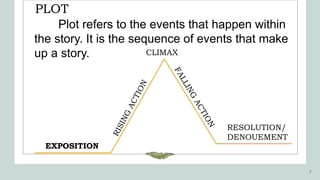
Plot refers to the events that happen within
the story. It is the sequence of events that make
up a story.
PLOT
EXPOSITION
CLIMAX
RESOLUTION/
DENOUEMENT
8
It introduces us to the characters and
background information of the story.
9
This is the part when tension
starts to build. It usually involves
facing and conquering minor
conflicts, which is what keeps the
plot moving forward.
10
Climax is the part of the story where
the characters finally have to face
and solve the major conflict.
This is the "peak" of the plot or the highest
point of interest where all the tensions of the
rising action lead to the success or failure of
the hero.
11
This is everything that happens
after the climax but before the
resolution. This is when the tension
lessens and starts bringing the
action to a close.
12
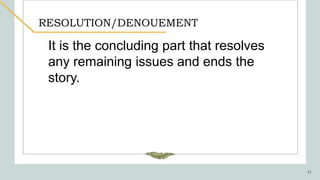
It is the concluding part that resolves
any remaining issues and ends the
story.
RESOLUTION/DENOUEMENT
13
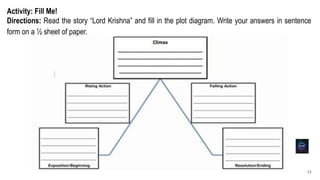
Activity: Fill Me!
Directions: Read the story “Lord Krishna” and fill in the plot diagram. Write your answers in sentence
form on a ½ sheet of paper.
Q&A
15
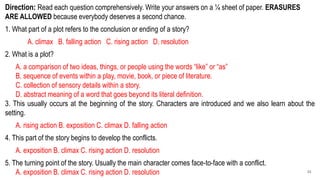
Direction: Read each question comprehensively. Write your answers on a ¼ sheet of paper. ERASURES
ARE ALLOWED because everybody deserves a second chance.
1. What part of a plot refers to the conclusion or ending of a story?
A. climax B. falling action C. rising action D. resolution
2. What is a plot?
A. a comparison of two ideas, things, or people using the words “like” or “as”
B. sequence of events within a play, movie, book, or piece of literature.
C. collection of sensory details within a story.
D. abstract meaning of a word that goes beyond its literal definition.
3. This usually occurs at the beginning of the story. Characters are introduced and we also learn about the
setting.
A. rising action B. exposition C. climax D. falling action
4. This part of the story begins to develop the conflicts.
A. exposition B. climax C. rising action D. resolution
5. The turning point of the story. Usually the main character comes face-to-face with a conflict.
A. exposition B. climax C. rising action D. resolution
Thank
you
GOODBYE
!

the five main ELEMENTS OF PLOT (ex).pptx

  • 1.
  • 2.
  • 3.
    3 CLASSROOM RULES R - Respecteach other E - Enjoy learning P - Participate in class T - Try your best
  • 4.
  • 5.
  • 6.
    6 A short storyis a work of prose fiction that can be read in one sitting – usually between 20 minutes to an hour. It is a self- contained work of prose fiction whose function is to impart a moral, capture a moment, or evoke a certain mood.
  • 7.
    7 Plot refers tothe events that happen within the story. It is the sequence of events that make up a story. PLOT EXPOSITION CLIMAX RESOLUTION/ DENOUEMENT
  • 8.
    8 It introduces usto the characters and background information of the story.
  • 9.
    9 This is thepart when tension starts to build. It usually involves facing and conquering minor conflicts, which is what keeps the plot moving forward.
  • 10.
    10 Climax is thepart of the story where the characters finally have to face and solve the major conflict. This is the "peak" of the plot or the highest point of interest where all the tensions of the rising action lead to the success or failure of the hero.
  • 11.
    11 This is everythingthat happens after the climax but before the resolution. This is when the tension lessens and starts bringing the action to a close.
  • 12.
    12 It is theconcluding part that resolves any remaining issues and ends the story. RESOLUTION/DENOUEMENT
  • 13.
    13 Activity: Fill Me! Directions:Read the story “Lord Krishna” and fill in the plot diagram. Write your answers in sentence form on a ½ sheet of paper.
  • 14.
  • 15.
    15 Direction: Read eachquestion comprehensively. Write your answers on a ¼ sheet of paper. ERASURES ARE ALLOWED because everybody deserves a second chance. 1. What part of a plot refers to the conclusion or ending of a story? A. climax B. falling action C. rising action D. resolution 2. What is a plot? A. a comparison of two ideas, things, or people using the words “like” or “as” B. sequence of events within a play, movie, book, or piece of literature. C. collection of sensory details within a story. D. abstract meaning of a word that goes beyond its literal definition. 3. This usually occurs at the beginning of the story. Characters are introduced and we also learn about the setting. A. rising action B. exposition C. climax D. falling action 4. This part of the story begins to develop the conflicts. A. exposition B. climax C. rising action D. resolution 5. The turning point of the story. Usually the main character comes face-to-face with a conflict. A. exposition B. climax C. rising action D. resolution
  • 16.

Editor's Notes

  • #2 Let us bow down our head and let us pray.
  • #3 How are you class? That good to know then. Class monitor, kindly check who’s absent today? Thank you class monitor. 1 minute scope. check if there are some pieces of trash under your chairs, kindly pick it up and put it in your bags. Thank you.
  • #4 Let me share with you our classroom rule. Are we clear with our rules? Good! Now I want everybody to please stand. Let us do some stretching. I want you first to take a deep breath in, and breathe out, two times. Face to your left, then to your right, for two times. Raise both your hands up, then shake it off. Finally, reach your feet and stand straight. I hope you feel energized and ready for our topic for today! Arrange your chairs and then you may take your seats! Our topic last meeting was about the six elements of a story. Who can give me the six elements of a story?
  • #5 Class, last week I gave you a Reading Material, right? Yes, I ask you to read the story ‘The Story of Ramayana’ by Maharshi Valmiki Have you read the story?
  • #6 Alright then, I will let you watch a short video summary of the story of Ramayana.
  • #7 Did you enjoy watching the short video summary of the short story of Ramayana, class? Alright! Let’s then proceed with our lesson the five main elements of a plot. But before that, does anyone know what is a short story? Excellent! To further understand what is a short story, kindly read its definition.
  • #8 Yes, a plot begins with an exposition. Next, the plot presents the rising action. Then leads to the climax. What follows is the falling action. Plot then ends with the resolution.
  • #9 Can you give me the exposition from the story? Tell me what happened in the very beginning of the story? From the beginning of the story the author introduces the place Ayohdya as the setting and presents the characters King Dasharata, Rama, and Sita.
  • #10 - What is the rising action from the story of Ramayana? The rising action in the story is when the tension started when Ravana devised a plan to abduct Sita.
  • #11 What is the climax of the story? Rama solved the major conflict when he fought and killed Ravana to save Sita.
  • #12 What is the falling action of the story? Falling action is when the tension started to lessen when Rama saved Sita, returned to Ayodhya, and became the king.
  • #13 What happened at the ending of the story of Ramayana? The story ended when Rama ruled Ayodhya in peace and harmony with his people. Do you already know how to distinguish the five elements of a plot? Do you have any question or clarification about our discussion? Okay, since there are no questions, I assume that you have understood our discussion, now we will have an activity.
  • #14 Are you done answering, class? Alright. You may now pass your papers in front.
  • #15 This time, let us have a summary of our lesson. What are again the 5 elements of plot? In every story, what happens in the climax part of the story? What important thing have you learned in our lesson today?
  • #16 Are you done answering, class? Alright. You may now pass your papers in front.