

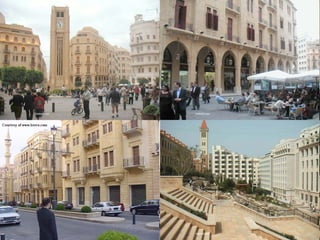

Architecture in the Middle East 0690-421 – Fall 2009 Dr. Yasser Mahgoub
The Evolving Arab City Chapter 3: Beirut: From Regional Node to Backwater and Back To Uncertainty by: Sofia T. Shwayri Pages 69-98 Part 1 The Evolving Arab City: Tradition, Modernity and Urban Development Editor - Yasser Elsheshtawy
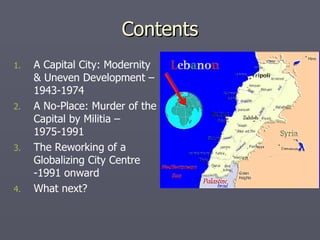
Contents A Capital City: Modernity & Uneven Development – 1943-1974 A No-Place: Murder of the Capital by Militia – 1975-1991 The Reworking of a Globalizing City Centre -1991 onward What next?
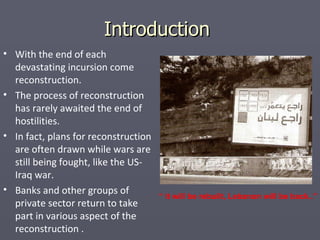
Introduction  With the end of each devastating incursion come reconstruction. The process of reconstruction has rarely awaited the end of hostilities. In fact, plans for reconstruction are often drawn while wars are still being fought, like the US-Iraq war. Banks and other groups of private sector return to take part in various aspect of the reconstruction . “  it will be rebuilt, Lebanon will be back..”
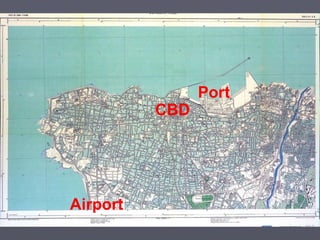
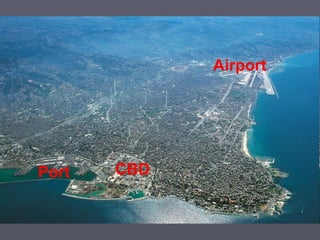
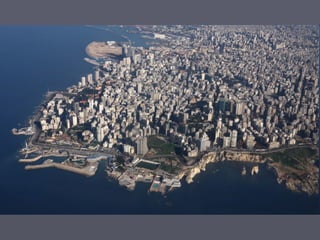
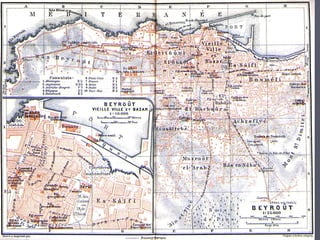
Introduction The infrastructure that had supported the re-emerging of Beirut as a globalized center: Beirut International Airport Port of Beirut Highways linking to Central Business District (CBD)
Port CBD Airport
 
Port CBD Airport
 
 
Part I: A Capital City: Modernity & Uneven Development From  1843  Beirut turned from an insignificant port town to the capital of a newly independent state. In  1923  it became the seat of the French High Commission. Focus: Making Beirut an economic & cultural center of France in the Levant connecting France to the Levant & the Far East. Development programme: Improving the road network within the capital Improving the existing port Building a modern airport
Road network  connecting the Central District to the hinterland & Syria was improved - Beirut-Damascus Highway. 1920s  work on the port started & Beirut became  a major regional port of the Eastern Mediterranean. 1927  Construction of Beirut’s  airport  was completed in Bir Hassan, south of the centre. Result : A new compressed  economic space  that made Beirut a strategic node during the Mandate period. Part I: A Capital City: Modernity & Uneven Development
Migration Foundation of the State of  Israel  ( 1948 ) led to  Palestinian migration to Beirut . Loss of Haifa and transfer of activities north to Beirut, the only port to the rest of the Arab world. Armenian  refugees fleeing Turkish persecution (1911-1930s) forming an important labor force. Middle-class intellectuals fled unstable political & economic conditions in Syria, Egypt, & Iraq. Part I: A Capital City: Modernity & Uneven Development
Finance Bank secrecy laws of 1956  aiming at promoting Lebanon as the financial hub of the Middle East. Free enterprise attracted Arab, Western, and expatriate monies. Results: Transformation of the Central District into a regional node (1950s-70’s) Expansion of the Port of Beirut (North)  An International Airport (South) Connected via network of modern highways Part I: A Capital City: Modernity & Uneven Development
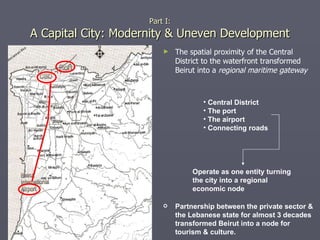
The spatial proximity of the Central District to the waterfront transformed Beirut into a  regional maritime gateway Part I: A Capital City: Modernity & Uneven Development Operate as one entity turning the city into a regional economic node Central District  The port The airport Connecting roads Partnership between the private sector & the Lebanese state for almost 3 decades transformed Beirut into a node for tourism & culture.
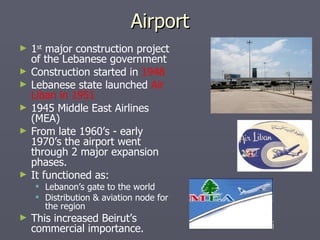
Airport 1 st  major construction project of the Lebanese government Construction started in  1948 Lebanese state launched  Air Liban in 1951 1945 Middle East Airlines (MEA)  From late 1960’s - early 1970’s the airport went through 2 major expansion phases. It functioned as: Lebanon’s gate to the world Distribution & aviation node for the region This increased Beirut’s commercial importance.
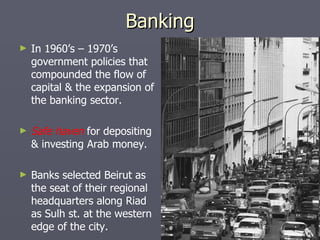
Banking In 1960’s – 1970’s government policies that compounded the flow of capital & the expansion of the banking sector. Safe haven  for depositing & investing Arab money. Banks selected Beirut as the seat of their regional headquarters along Riad as Sulh st. at the western edge of the city.
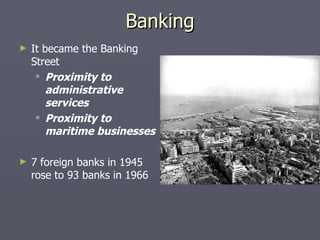
Banking It became the Banking Street  Proximity to administrative services Proximity to maritime businesses   7 foreign banks in 1945 rose to 93 banks in 1966
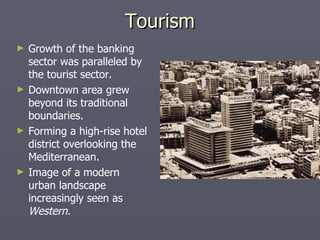
Tourism Growth of the banking sector was paralleled by the tourist sector. Downtown area grew beyond its traditional boundaries. Forming a high-rise hotel district overlooking the Mediterranean. Image of a modern urban landscape increasingly seen as  Western.
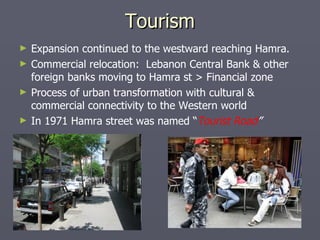
Tourism Expansion continued to the westward reaching Hamra. Commercial relocation:  Lebanon Central Bank & other foreign banks moving to Hamra st > Financial zone Process of urban transformation with cultural & commercial connectivity to the Western world In 1971 Hamra street   was named “ Tourist Road ”
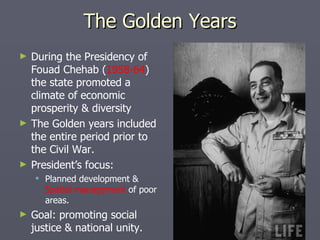
The Golden Years During the Presidency of Fouad Chehab ( 1958-64 ) the state promoted a climate of economic prosperity & diversity The Golden years included the entire period prior to the Civil War. President’s focus: Planned development &  Spatial management  of poor areas. Goal: promoting social justice & national unity.
Waves of Migration Rural-urban migrations raised the  inequality among social & religious groups in Beirut . Arab-Israeli wars (1948, 1967) waves of  Palestinian refugees. 1958  Syrian immigrants  following the agricultural reforms by the  Baathist regime . The population doubled from 450’000 in 1960’s to 940’000 in 1970’s. Large numbers of Arabs & non-Arabs claimed Beirut as a temporary home, an  immigrant centre . Migrants & refugees became marginalized. No official recognition to their presence. They lived in slums, shanty towns & refugee camps surrounding Beirut.
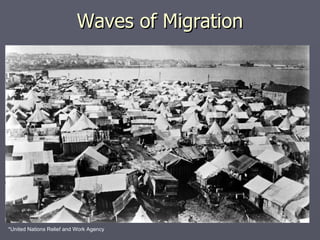
Refugee camps  are  legal settlements set up by an international body & the host country for a specified period of time. UNRWA* was responsible for leasing several plots of land from the Lebanese State for Palestinian refugees. Provided them with education, health, social services … etc. The physical form of the camps was planned as a space of “containment”. More  squatter settlements  appeared on the urban fringe on agricultural or public land . Some refugees managed to move into the city & lease their former homes (camps) to poorer new arrivals. Waves of Migration A mosaic of landscapes, each revealing a saga of a group of people & their struggles through time & space
Waves of Migration *United Nations Relief and Work Agency
Cairo Agreement The continuous influx of immigrants transformed parts of Beirut into “transitional homes”. And later became “spaces of struggles”. Cairo Agreement on 2 - Nov -1969 between the Lebanese army commander & Palestinian representatives, granting the Palestinians  the right to carry weapons  in the camps & attack Israel across the southern boarder In 1970 clashes erupted in the South resulting in Israeli raids. Local inhabitants abandoned their villages to seek shelter in southern suburbs of Beirut. Several Israeli attacks took place destroying key Lebanese infrastructure including Beirut International Airport & the MEA. * The Middle East Airlines
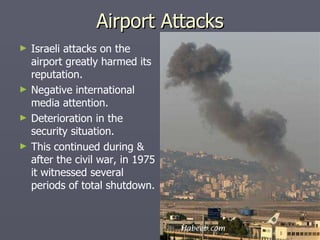
Israeli attacks on the airport greatly harmed its reputation. Negative international media attention. Deterioration in the security situation. This continued during & after the civil war, in 1975 it witnessed several periods of total shutdown. Airport Attacks
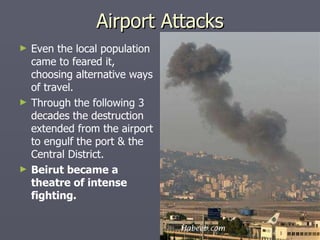
Even the local population came to feared it, choosing alternative ways of travel. Through the following 3 decades the destruction extended from the airport to engulf the port & the Central District. Beirut became a theatre of intense fighting. Airport Attacks
Stop Here
The Evolving Arab City Chapter 3: Beirut: From Regional Node to Backwater and Back To Uncertainty by: Sofia T. Shwayri Pages 69-98 Part 2 The Evolving Arab City: Tradition, Modernity and Urban Development Editor - Yasser Elsheshtawy
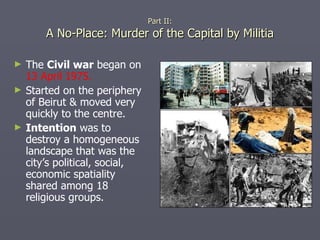
Part II: A No-Place: Murder of the Capital by Militia The  Civil war  began on  13 April 1975. Started on the periphery of Beirut & moved very quickly to the centre. Intention  was to destroy a homogeneous landscape that was the city’s political, social, economic spatiality shared among 18 religious groups.
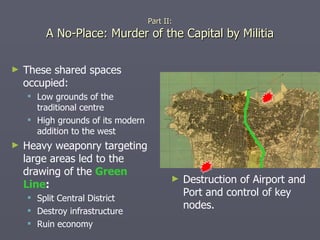
Part II: A No-Place: Murder of the Capital by Militia These shared spaces occupied: Low grounds of the traditional centre High grounds of its modern addition to the west Heavy weaponry targeting large areas led to the drawing of the  Green Line : Split Central District Destroy infrastructure Ruin economy Destruction of Airport and Port and control of key nodes.
The fighting Militia groups were organized under 2 movements: National Movement > leftist group with the Palestinians Lebanese Front > rightist group Militia groups controlled key nodes (airport, port) to support their newly formed “mini-states”. They built & maintained their own infrastructure such as illegal ports along the Mediterranean coast. CBD … No man’s land … backwater! 16 years long war! Part II: A No-Place: Murder of the Capital by Militia
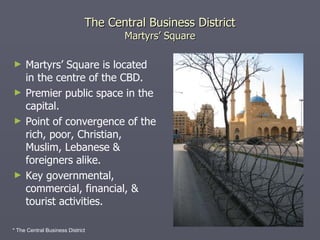
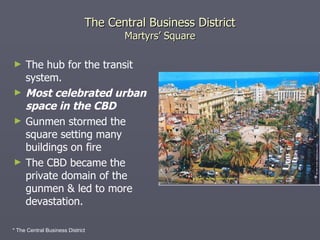
The Central Business District Martyrs’ Square Martyrs’ Square is located in the centre of the CBD. Premier public space in the capital. Point of convergence of the rich, poor, Christian, Muslim, Lebanese & foreigners alike. Key governmental, commercial, financial, & tourist activities. * The Central Business District
The Central Business District Martyrs’ Square The hub for the transit system. Most celebrated urban space in the CBD Gunmen stormed the square setting many buildings on fire  The CBD became the private domain of the gunmen & led to more devastation. * The Central Business District
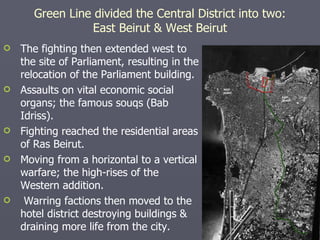
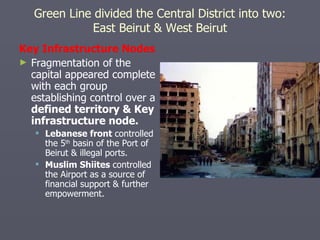
The fighting then extended west to the site of Parliament, resulting in the relocation of the Parliament building. Assaults on vital economic social organs; the famous souqs (Bab Idriss). Fighting reached the residential areas of Ras Beirut. Moving from a horizontal to a vertical warfare; the high-rises of the Western addition. Warring factions then moved to the hotel district destroying buildings & draining more life from the city. Green Line divided the Central District into two: East Beirut & West Beirut
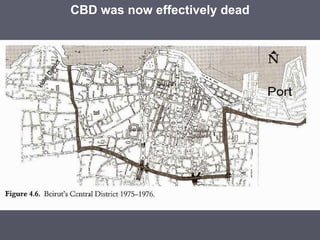
CBD was now effectively dead
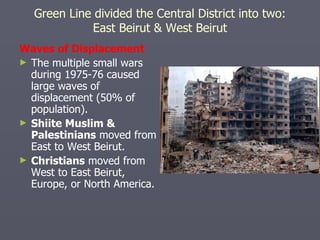
Waves of Displacement The multiple small wars during 1975-76 caused large waves of displacement (50% of population). Shiite Muslim & Palestinians  moved from East to West Beirut. Christians  moved from West to East Beirut, Europe, or North America. Green Line divided the Central District into two: East Beirut & West Beirut
Key Infrastructure Nodes Fragmentation of the capital appeared complete with each group establishing control over a  defined territory & Key infrastructure node. Lebanese front  controlled the 5 th  basin of the Port of Beirut & illegal ports. Muslim Shiites  controlled the Airport as a source of financial support & further empowerment. Green Line divided the Central District into two: East Beirut & West Beirut
The Evolving Arab City Chapter 3: Beirut: From Regional Node to Backwater and Back To Uncertainty by: Sofia T. Shwayri Pages 69-98 Part 3 The Evolving Arab City: Tradition, Modernity and Urban Development Editor - Yasser Elsheshtawy
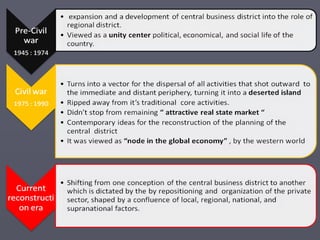
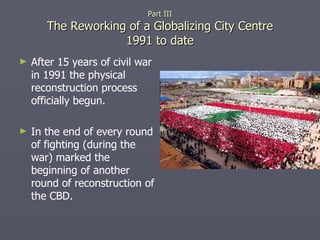
Part III The Reworking of a Globalizing City Centre 1991 to date After 15 years of civil war in 1991 the physical reconstruction process officially begun. In the end of every round of fighting (during the war) marked the beginning of another round of reconstruction of the CBD.
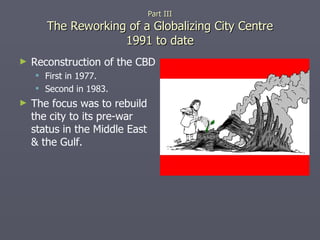
Part III The Reworking of a Globalizing City Centre 1991 to date Reconstruction of the CBD  First in 1977. Second in 1983. The focus was to rebuild the city to its pre-war status in the Middle East & the Gulf.
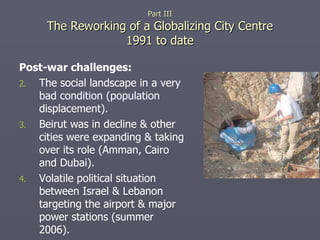
Post-war challenges: The social landscape in a very bad condition (population displacement). Beirut was in decline & other cities were expanding & taking over its role (Amman, Cairo and Dubai). Volatile political situation between Israel & Lebanon targeting the airport & major power stations (summer 2006). Part III The Reworking of a Globalizing City Centre 1991 to date
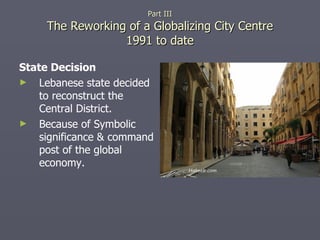
State Decision Lebanese state decided to reconstruct the Central District. Because of Symbolic significance & command post of the global economy. Part III The Reworking of a Globalizing City Centre 1991 to date
Key issues: Acquiring the  money  to jump-start the project of reconstruction. To devise a  strategy  to deal with the complex patterns of ownership. The recreation of this node depended on its  link  to other nodes  infrastructure . Strategy: Redevelopment of Beirut International  Airport ,  Port  of Beirut, & the development / expansion of a  connecting   road network . Part III The Reworking of a Globalizing City Centre 1991 to date
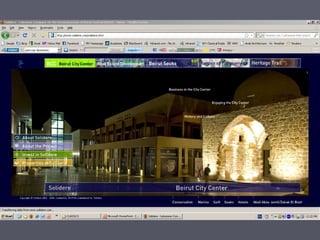
Part III The Reworking of a Globalizing City Centre 1991 to date Solidere, The Lebanese Company for the Development and Reconstruction of Beirut Central District s.a.l., was incorporated as a Lebanese joint-stock company on May 5, 1994.
 
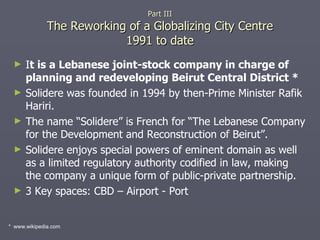
I t is a Lebanese joint-stock company in charge of planning and redeveloping Beirut Central District * Solidere was founded in 1994 by then-Prime Minister Rafik Hariri. The name “Solidere” is French for “The Lebanese Company for the Development and Reconstruction of Beirut”. Solidere enjoys special powers of eminent domain as well as a limited regulatory authority codified in law, making the company a unique form of public-private partnership. 3 Key spaces: CBD – Airport - Port Part III The Reworking of a Globalizing City Centre 1991 to date *  www.wikipedia.com
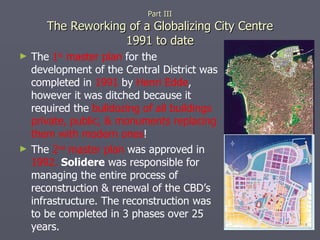
The  1 st  master plan  for the development of the Central District was completed in  1991  by  Henri Edde , however it was ditched because it required the  bulldozing of all buildings private, public, & monuments replacing them with modern ones ! The  2 nd  master plan  was approved in  1992.  Solidere  was responsible for managing the entire process of reconstruction & renewal of the CBD’s infrastructure. The reconstruction was to be completed in 3 phases over 25 years. Part III The Reworking of a Globalizing City Centre 1991 to date
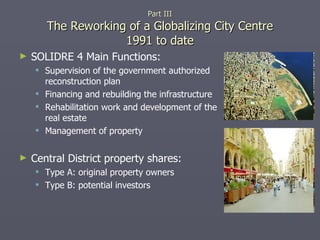
SOLIDRE 4 Main Functions: Supervision of the government authorized reconstruction plan Financing and rebuilding the infrastructure Rehabilitation work and development of the real estate Management of property Central District property shares: Type A: original property owners Type B: potential investors Part III The Reworking of a Globalizing City Centre 1991 to date
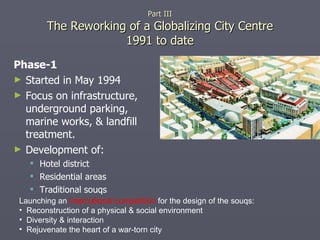
Phase-1 Started in May 1994 Focus on infrastructure, underground parking, marine works, & landfill treatment. Development of:  Hotel district Residential areas Traditional souqs Part III The Reworking of a Globalizing City Centre 1991 to date Launching an  international competition  for the design of the souqs: Reconstruction of a physical & social environment Diversity & interaction Rejuvenate the heart of a war-torn city
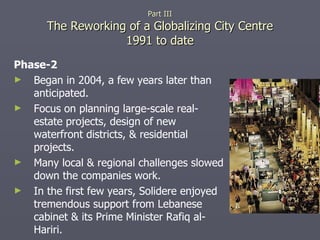
Phase-2 Began in 2004, a few years later than anticipated. Focus on planning large-scale real-estate projects, design of new waterfront districts, & residential projects. Many local & regional challenges slowed down the companies work. In the first few years, Solidere enjoyed tremendous support from Lebanese cabinet & its Prime Minister Rafiq al-Hariri. Part III The Reworking of a Globalizing City Centre 1991 to date
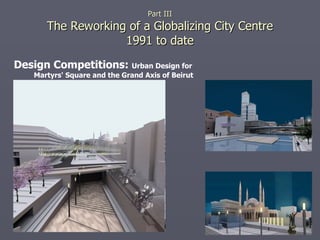
Design Competitions:  Urban Design for Martyrs' Square and   the Grand Axis of Beirut   Part III The Reworking of a Globalizing City Centre 1991 to date
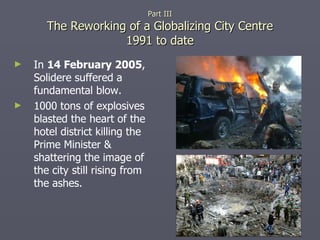
In  14 February 2005 , Solidere suffered a fundamental blow. 1000 tons of explosives blasted the heart of the hotel district killing the Prime Minister & shattering the image of the city still rising from the ashes. Part III The Reworking of a Globalizing City Centre 1991 to date
Conclusion: What Next? From early 1991 the Central District was the site of major post-war reconstruction. Reaching the peak of stability by mid-2006. By July 2006 a full scale war broke out again with Israel bringing the capital city to a standstill. The recent events revealed that the political divisions are deep & the future of the CBD is again in question. The history, topography, geographical location, tourist & business activities of the CBD are all promising factors.
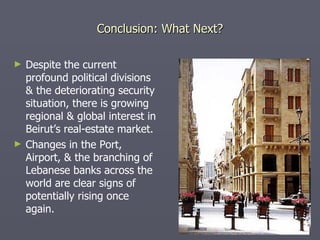
Conclusion: What Next? Despite the current profound political divisions & the deteriorating security situation, there is growing regional & global interest in Beirut’s real-estate market. Changes in the Port, Airport, & the branching of Lebanese banks across the world are clear signs of potentially rising once again.
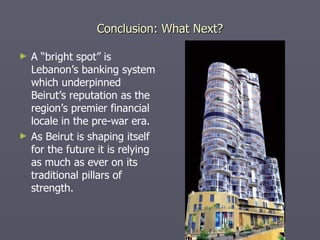
A “bright spot” is Lebanon’s banking system which underpinned Beirut’s reputation as the region’s premier financial locale in the pre-war era. As Beirut is shaping itself for the future it is relying as much as ever on its traditional pillars of strength. Conclusion: What Next?
Thank you
 
 
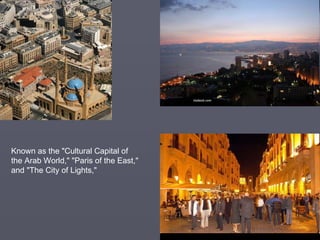
Known as the "Cultural Capital of the Arab World," "Paris of the East," and "The City of Lights,"
Sites http://www.macalester.edu/courses/geog61/jmhamilton/


The Evolving Arab City - Beirut

  • 1.
    Architecture in theMiddle East 0690-421 – Fall 2009 Dr. Yasser Mahgoub
  • 2.
    The Evolving ArabCity Chapter 3: Beirut: From Regional Node to Backwater and Back To Uncertainty by: Sofia T. Shwayri Pages 69-98 Part 1 The Evolving Arab City: Tradition, Modernity and Urban Development Editor - Yasser Elsheshtawy
  • 3.
    Contents A CapitalCity: Modernity & Uneven Development – 1943-1974 A No-Place: Murder of the Capital by Militia – 1975-1991 The Reworking of a Globalizing City Centre -1991 onward What next?
  • 4.
    Introduction Withthe end of each devastating incursion come reconstruction. The process of reconstruction has rarely awaited the end of hostilities. In fact, plans for reconstruction are often drawn while wars are still being fought, like the US-Iraq war. Banks and other groups of private sector return to take part in various aspect of the reconstruction . “ it will be rebuilt, Lebanon will be back..”
  • 5.
    Introduction The infrastructurethat had supported the re-emerging of Beirut as a globalized center: Beirut International Airport Port of Beirut Highways linking to Central Business District (CBD)
  • 6.
  • 7.
  • 8.
  • 9.
  • 10.
  • 11.
    Part I: ACapital City: Modernity & Uneven Development From 1843 Beirut turned from an insignificant port town to the capital of a newly independent state. In 1923 it became the seat of the French High Commission. Focus: Making Beirut an economic & cultural center of France in the Levant connecting France to the Levant & the Far East. Development programme: Improving the road network within the capital Improving the existing port Building a modern airport
  • 12.
    Road network connecting the Central District to the hinterland & Syria was improved - Beirut-Damascus Highway. 1920s work on the port started & Beirut became a major regional port of the Eastern Mediterranean. 1927 Construction of Beirut’s airport was completed in Bir Hassan, south of the centre. Result : A new compressed economic space that made Beirut a strategic node during the Mandate period. Part I: A Capital City: Modernity & Uneven Development
  • 13.
    Migration Foundation ofthe State of Israel ( 1948 ) led to Palestinian migration to Beirut . Loss of Haifa and transfer of activities north to Beirut, the only port to the rest of the Arab world. Armenian refugees fleeing Turkish persecution (1911-1930s) forming an important labor force. Middle-class intellectuals fled unstable political & economic conditions in Syria, Egypt, & Iraq. Part I: A Capital City: Modernity & Uneven Development
  • 14.
    Finance Bank secrecylaws of 1956 aiming at promoting Lebanon as the financial hub of the Middle East. Free enterprise attracted Arab, Western, and expatriate monies. Results: Transformation of the Central District into a regional node (1950s-70’s) Expansion of the Port of Beirut (North) An International Airport (South) Connected via network of modern highways Part I: A Capital City: Modernity & Uneven Development
  • 15.
    The spatial proximityof the Central District to the waterfront transformed Beirut into a regional maritime gateway Part I: A Capital City: Modernity & Uneven Development Operate as one entity turning the city into a regional economic node Central District The port The airport Connecting roads Partnership between the private sector & the Lebanese state for almost 3 decades transformed Beirut into a node for tourism & culture.
  • 16.
    Airport 1 st major construction project of the Lebanese government Construction started in 1948 Lebanese state launched Air Liban in 1951 1945 Middle East Airlines (MEA) From late 1960’s - early 1970’s the airport went through 2 major expansion phases. It functioned as: Lebanon’s gate to the world Distribution & aviation node for the region This increased Beirut’s commercial importance.
  • 17.
    Banking In 1960’s– 1970’s government policies that compounded the flow of capital & the expansion of the banking sector. Safe haven for depositing & investing Arab money. Banks selected Beirut as the seat of their regional headquarters along Riad as Sulh st. at the western edge of the city.
  • 18.
    Banking It becamethe Banking Street Proximity to administrative services Proximity to maritime businesses 7 foreign banks in 1945 rose to 93 banks in 1966
  • 19.
    Tourism Growth ofthe banking sector was paralleled by the tourist sector. Downtown area grew beyond its traditional boundaries. Forming a high-rise hotel district overlooking the Mediterranean. Image of a modern urban landscape increasingly seen as Western.
  • 20.
    Tourism Expansion continuedto the westward reaching Hamra. Commercial relocation: Lebanon Central Bank & other foreign banks moving to Hamra st > Financial zone Process of urban transformation with cultural & commercial connectivity to the Western world In 1971 Hamra street was named “ Tourist Road ”
  • 21.
    The Golden YearsDuring the Presidency of Fouad Chehab ( 1958-64 ) the state promoted a climate of economic prosperity & diversity The Golden years included the entire period prior to the Civil War. President’s focus: Planned development & Spatial management of poor areas. Goal: promoting social justice & national unity.
  • 22.
    Waves of MigrationRural-urban migrations raised the inequality among social & religious groups in Beirut . Arab-Israeli wars (1948, 1967) waves of Palestinian refugees. 1958 Syrian immigrants following the agricultural reforms by the Baathist regime . The population doubled from 450’000 in 1960’s to 940’000 in 1970’s. Large numbers of Arabs & non-Arabs claimed Beirut as a temporary home, an immigrant centre . Migrants & refugees became marginalized. No official recognition to their presence. They lived in slums, shanty towns & refugee camps surrounding Beirut.
  • 23.
    Refugee camps are legal settlements set up by an international body & the host country for a specified period of time. UNRWA* was responsible for leasing several plots of land from the Lebanese State for Palestinian refugees. Provided them with education, health, social services … etc. The physical form of the camps was planned as a space of “containment”. More squatter settlements appeared on the urban fringe on agricultural or public land . Some refugees managed to move into the city & lease their former homes (camps) to poorer new arrivals. Waves of Migration A mosaic of landscapes, each revealing a saga of a group of people & their struggles through time & space
  • 24.
    Waves of Migration*United Nations Relief and Work Agency
  • 25.
    Cairo Agreement Thecontinuous influx of immigrants transformed parts of Beirut into “transitional homes”. And later became “spaces of struggles”. Cairo Agreement on 2 - Nov -1969 between the Lebanese army commander & Palestinian representatives, granting the Palestinians the right to carry weapons in the camps & attack Israel across the southern boarder In 1970 clashes erupted in the South resulting in Israeli raids. Local inhabitants abandoned their villages to seek shelter in southern suburbs of Beirut. Several Israeli attacks took place destroying key Lebanese infrastructure including Beirut International Airport & the MEA. * The Middle East Airlines
  • 26.
    Israeli attacks onthe airport greatly harmed its reputation. Negative international media attention. Deterioration in the security situation. This continued during & after the civil war, in 1975 it witnessed several periods of total shutdown. Airport Attacks
  • 27.
    Even the localpopulation came to feared it, choosing alternative ways of travel. Through the following 3 decades the destruction extended from the airport to engulf the port & the Central District. Beirut became a theatre of intense fighting. Airport Attacks
  • 28.
  • 29.
    The Evolving ArabCity Chapter 3: Beirut: From Regional Node to Backwater and Back To Uncertainty by: Sofia T. Shwayri Pages 69-98 Part 2 The Evolving Arab City: Tradition, Modernity and Urban Development Editor - Yasser Elsheshtawy
  • 30.
    Part II: ANo-Place: Murder of the Capital by Militia The Civil war began on 13 April 1975. Started on the periphery of Beirut & moved very quickly to the centre. Intention was to destroy a homogeneous landscape that was the city’s political, social, economic spatiality shared among 18 religious groups.
  • 31.
    Part II: ANo-Place: Murder of the Capital by Militia These shared spaces occupied: Low grounds of the traditional centre High grounds of its modern addition to the west Heavy weaponry targeting large areas led to the drawing of the Green Line : Split Central District Destroy infrastructure Ruin economy Destruction of Airport and Port and control of key nodes.
  • 32.
    The fighting Militiagroups were organized under 2 movements: National Movement > leftist group with the Palestinians Lebanese Front > rightist group Militia groups controlled key nodes (airport, port) to support their newly formed “mini-states”. They built & maintained their own infrastructure such as illegal ports along the Mediterranean coast. CBD … No man’s land … backwater! 16 years long war! Part II: A No-Place: Murder of the Capital by Militia
  • 33.
    The Central BusinessDistrict Martyrs’ Square Martyrs’ Square is located in the centre of the CBD. Premier public space in the capital. Point of convergence of the rich, poor, Christian, Muslim, Lebanese & foreigners alike. Key governmental, commercial, financial, & tourist activities. * The Central Business District
  • 34.
    The Central BusinessDistrict Martyrs’ Square The hub for the transit system. Most celebrated urban space in the CBD Gunmen stormed the square setting many buildings on fire The CBD became the private domain of the gunmen & led to more devastation. * The Central Business District
  • 35.
    The fighting thenextended west to the site of Parliament, resulting in the relocation of the Parliament building. Assaults on vital economic social organs; the famous souqs (Bab Idriss). Fighting reached the residential areas of Ras Beirut. Moving from a horizontal to a vertical warfare; the high-rises of the Western addition. Warring factions then moved to the hotel district destroying buildings & draining more life from the city. Green Line divided the Central District into two: East Beirut & West Beirut
  • 36.
    CBD was noweffectively dead
  • 37.
    Waves of DisplacementThe multiple small wars during 1975-76 caused large waves of displacement (50% of population). Shiite Muslim & Palestinians moved from East to West Beirut. Christians moved from West to East Beirut, Europe, or North America. Green Line divided the Central District into two: East Beirut & West Beirut
  • 38.
    Key Infrastructure NodesFragmentation of the capital appeared complete with each group establishing control over a defined territory & Key infrastructure node. Lebanese front controlled the 5 th basin of the Port of Beirut & illegal ports. Muslim Shiites controlled the Airport as a source of financial support & further empowerment. Green Line divided the Central District into two: East Beirut & West Beirut
  • 39.
    The Evolving ArabCity Chapter 3: Beirut: From Regional Node to Backwater and Back To Uncertainty by: Sofia T. Shwayri Pages 69-98 Part 3 The Evolving Arab City: Tradition, Modernity and Urban Development Editor - Yasser Elsheshtawy
  • 40.
    Part III TheReworking of a Globalizing City Centre 1991 to date After 15 years of civil war in 1991 the physical reconstruction process officially begun. In the end of every round of fighting (during the war) marked the beginning of another round of reconstruction of the CBD.
  • 41.
    Part III TheReworking of a Globalizing City Centre 1991 to date Reconstruction of the CBD First in 1977. Second in 1983. The focus was to rebuild the city to its pre-war status in the Middle East & the Gulf.
  • 42.
    Post-war challenges: Thesocial landscape in a very bad condition (population displacement). Beirut was in decline & other cities were expanding & taking over its role (Amman, Cairo and Dubai). Volatile political situation between Israel & Lebanon targeting the airport & major power stations (summer 2006). Part III The Reworking of a Globalizing City Centre 1991 to date
  • 43.
    State Decision Lebanesestate decided to reconstruct the Central District. Because of Symbolic significance & command post of the global economy. Part III The Reworking of a Globalizing City Centre 1991 to date
  • 44.
    Key issues: Acquiringthe money to jump-start the project of reconstruction. To devise a strategy to deal with the complex patterns of ownership. The recreation of this node depended on its link to other nodes infrastructure . Strategy: Redevelopment of Beirut International Airport , Port of Beirut, & the development / expansion of a connecting road network . Part III The Reworking of a Globalizing City Centre 1991 to date
  • 45.
    Part III TheReworking of a Globalizing City Centre 1991 to date Solidere, The Lebanese Company for the Development and Reconstruction of Beirut Central District s.a.l., was incorporated as a Lebanese joint-stock company on May 5, 1994.
  • 46.
  • 47.
    I t isa Lebanese joint-stock company in charge of planning and redeveloping Beirut Central District * Solidere was founded in 1994 by then-Prime Minister Rafik Hariri. The name “Solidere” is French for “The Lebanese Company for the Development and Reconstruction of Beirut”. Solidere enjoys special powers of eminent domain as well as a limited regulatory authority codified in law, making the company a unique form of public-private partnership. 3 Key spaces: CBD – Airport - Port Part III The Reworking of a Globalizing City Centre 1991 to date * www.wikipedia.com
  • 48.
    The 1st master plan for the development of the Central District was completed in 1991 by Henri Edde , however it was ditched because it required the bulldozing of all buildings private, public, & monuments replacing them with modern ones ! The 2 nd master plan was approved in 1992. Solidere was responsible for managing the entire process of reconstruction & renewal of the CBD’s infrastructure. The reconstruction was to be completed in 3 phases over 25 years. Part III The Reworking of a Globalizing City Centre 1991 to date
  • 49.
    SOLIDRE 4 MainFunctions: Supervision of the government authorized reconstruction plan Financing and rebuilding the infrastructure Rehabilitation work and development of the real estate Management of property Central District property shares: Type A: original property owners Type B: potential investors Part III The Reworking of a Globalizing City Centre 1991 to date
  • 50.
    Phase-1 Started inMay 1994 Focus on infrastructure, underground parking, marine works, & landfill treatment. Development of: Hotel district Residential areas Traditional souqs Part III The Reworking of a Globalizing City Centre 1991 to date Launching an international competition for the design of the souqs: Reconstruction of a physical & social environment Diversity & interaction Rejuvenate the heart of a war-torn city
  • 51.
    Phase-2 Began in2004, a few years later than anticipated. Focus on planning large-scale real-estate projects, design of new waterfront districts, & residential projects. Many local & regional challenges slowed down the companies work. In the first few years, Solidere enjoyed tremendous support from Lebanese cabinet & its Prime Minister Rafiq al-Hariri. Part III The Reworking of a Globalizing City Centre 1991 to date
  • 52.
    Design Competitions: Urban Design for Martyrs' Square and the Grand Axis of Beirut Part III The Reworking of a Globalizing City Centre 1991 to date
  • 53.
    In 14February 2005 , Solidere suffered a fundamental blow. 1000 tons of explosives blasted the heart of the hotel district killing the Prime Minister & shattering the image of the city still rising from the ashes. Part III The Reworking of a Globalizing City Centre 1991 to date
  • 54.
    Conclusion: What Next?From early 1991 the Central District was the site of major post-war reconstruction. Reaching the peak of stability by mid-2006. By July 2006 a full scale war broke out again with Israel bringing the capital city to a standstill. The recent events revealed that the political divisions are deep & the future of the CBD is again in question. The history, topography, geographical location, tourist & business activities of the CBD are all promising factors.
  • 55.
    Conclusion: What Next?Despite the current profound political divisions & the deteriorating security situation, there is growing regional & global interest in Beirut’s real-estate market. Changes in the Port, Airport, & the branching of Lebanese banks across the world are clear signs of potentially rising once again.
  • 56.
    A “bright spot”is Lebanon’s banking system which underpinned Beirut’s reputation as the region’s premier financial locale in the pre-war era. As Beirut is shaping itself for the future it is relying as much as ever on its traditional pillars of strength. Conclusion: What Next?
  • 57.
  • 58.
  • 59.
  • 60.
    Known as the"Cultural Capital of the Arab World," "Paris of the East," and "The City of Lights,"
  • 61.
  • 62.
  • 63.
  • 64.