The Evolution of
Hardware
The evolution of hardware spans decades. It has brought immense change
and continues to shape our world, from the first computers to today's
mobile devices and beyond.
by Mehnaz K Raffi
From Vacuum Tubes to
Microchips
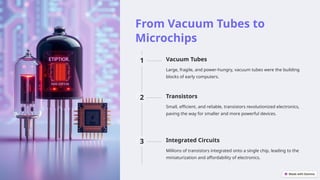
1 Vacuum Tubes
Large, fragile, and power-hungry, vacuum tubes were the building
blocks of early computers.
2 Transistors
Small, efficient, and reliable, transistors revolutionized electronics,
paving the way for smaller and more powerful devices.
3 Integrated Circuits
Millions of transistors integrated onto a single chip, leading to the
miniaturization and affordability of electronics.
The Rise of Personal
Computers
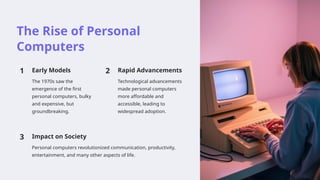
1 Early Models
The 1970s saw the
emergence of the first
personal computers, bulky
and expensive, but
groundbreaking.
2 Rapid Advancements
Technological advancements
made personal computers
more affordable and
accessible, leading to
widespread adoption.
3 Impact on Society
Personal computers revolutionized communication, productivity,
entertainment, and many other aspects of life.
Moore's Law and the Semiconductor Revolution
Moore's Law
Gordon Moore's prediction that
transistor density would double every
two years has fueled the
semiconductor revolution.
Advancements in Processing
Power
Moore's Law has driven rapid
advancements in processing power,
making computers faster and more
capable.
Impact on Technology
Moore's Law has enabled the
development of smartphones, cloud
computing, artificial intelligence, and
countless other technologies.
The Importance of
Hardware in the Digital
Age
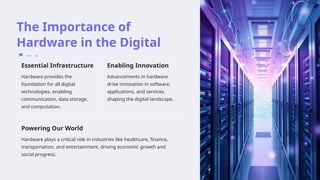
Essential Infrastructure
Hardware provides the
foundation for all digital
technologies, enabling
communication, data storage,
and computation.
Enabling Innovation
Advancements in hardware
drive innovation in software,
applications, and services,
shaping the digital landscape.
Powering Our World
Hardware plays a critical role in industries like healthcare, finance,
transportation, and entertainment, driving economic growth and
social progress.
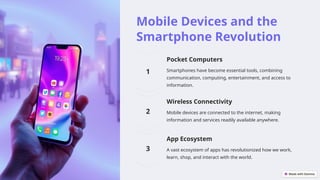
Mobile Devices and the
Smartphone Revolution
Pocket Computers
Smartphones have become essential tools, combining
communication, computing, entertainment, and access to
information.
Wireless Connectivity
Mobile devices are connected to the internet, making
information and services readily available anywhere.
App Ecosystem
A vast ecosystem of apps has revolutionized how we work,
learn, shop, and interact with the world.
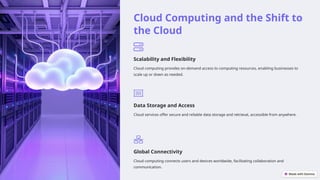
Cloud Computing and the Shift to
the Cloud
Scalability and Flexibility
Cloud computing provides on-demand access to computing resources, enabling businesses to
scale up or down as needed.
Data Storage and Access
Cloud services offer secure and reliable data storage and retrieval, accessible from anywhere.
Global Connectivity
Cloud computing connects users and devices worldwide, facilitating collaboration and
communication.
The Internet of Things
(IoT) and Embedded
Systems
IoT Embedded Systems
Connecting physical devices to
the internet
Special-purpose computers
embedded within larger systems
Data collection and analysis for
automation and efficiency
Controlling and managing
devices within a specific system
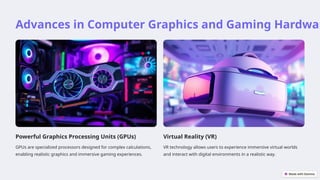
Advances in Computer Graphics and Gaming Hardwar
Powerful Graphics Processing Units (GPUs)
GPUs are specialized processors designed for complex calculations,
enabling realistic graphics and immersive gaming experiences.
Virtual Reality (VR)
VR technology allows users to experience immersive virtual worlds
and interact with digital environments in a realistic way.
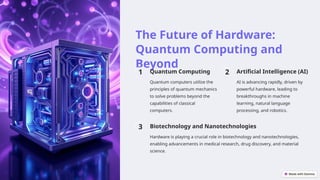
The Future of Hardware:
Quantum Computing and
Beyond
1 Quantum Computing
Quantum computers utilize the
principles of quantum mechanics
to solve problems beyond the
capabilities of classical
computers.
2 Artificial Intelligence (AI)
AI is advancing rapidly, driven by
powerful hardware, leading to
breakthroughs in machine
learning, natural language
processing, and robotics.
3 Biotechnology and Nanotechnologies
Hardware is playing a crucial role in biotechnology and nanotechnologies,
enabling advancements in medical research, drug discovery, and material
science.

The-Evolution-of-Hardware in computerscience.pptx

  • 1.
    The Evolution of Hardware Theevolution of hardware spans decades. It has brought immense change and continues to shape our world, from the first computers to today's mobile devices and beyond. by Mehnaz K Raffi
  • 2.
    From Vacuum Tubesto Microchips 1 Vacuum Tubes Large, fragile, and power-hungry, vacuum tubes were the building blocks of early computers. 2 Transistors Small, efficient, and reliable, transistors revolutionized electronics, paving the way for smaller and more powerful devices. 3 Integrated Circuits Millions of transistors integrated onto a single chip, leading to the miniaturization and affordability of electronics.
  • 3.
    The Rise ofPersonal Computers 1 Early Models The 1970s saw the emergence of the first personal computers, bulky and expensive, but groundbreaking. 2 Rapid Advancements Technological advancements made personal computers more affordable and accessible, leading to widespread adoption. 3 Impact on Society Personal computers revolutionized communication, productivity, entertainment, and many other aspects of life.
  • 4.
    Moore's Law andthe Semiconductor Revolution Moore's Law Gordon Moore's prediction that transistor density would double every two years has fueled the semiconductor revolution. Advancements in Processing Power Moore's Law has driven rapid advancements in processing power, making computers faster and more capable. Impact on Technology Moore's Law has enabled the development of smartphones, cloud computing, artificial intelligence, and countless other technologies.
  • 5.
    The Importance of Hardwarein the Digital Age Essential Infrastructure Hardware provides the foundation for all digital technologies, enabling communication, data storage, and computation. Enabling Innovation Advancements in hardware drive innovation in software, applications, and services, shaping the digital landscape. Powering Our World Hardware plays a critical role in industries like healthcare, finance, transportation, and entertainment, driving economic growth and social progress.
  • 6.
    Mobile Devices andthe Smartphone Revolution Pocket Computers Smartphones have become essential tools, combining communication, computing, entertainment, and access to information. Wireless Connectivity Mobile devices are connected to the internet, making information and services readily available anywhere. App Ecosystem A vast ecosystem of apps has revolutionized how we work, learn, shop, and interact with the world.
  • 7.
    Cloud Computing andthe Shift to the Cloud Scalability and Flexibility Cloud computing provides on-demand access to computing resources, enabling businesses to scale up or down as needed. Data Storage and Access Cloud services offer secure and reliable data storage and retrieval, accessible from anywhere. Global Connectivity Cloud computing connects users and devices worldwide, facilitating collaboration and communication.
  • 8.
    The Internet ofThings (IoT) and Embedded Systems IoT Embedded Systems Connecting physical devices to the internet Special-purpose computers embedded within larger systems Data collection and analysis for automation and efficiency Controlling and managing devices within a specific system
  • 9.
    Advances in ComputerGraphics and Gaming Hardwar Powerful Graphics Processing Units (GPUs) GPUs are specialized processors designed for complex calculations, enabling realistic graphics and immersive gaming experiences. Virtual Reality (VR) VR technology allows users to experience immersive virtual worlds and interact with digital environments in a realistic way.
  • 10.
    The Future ofHardware: Quantum Computing and Beyond 1 Quantum Computing Quantum computers utilize the principles of quantum mechanics to solve problems beyond the capabilities of classical computers. 2 Artificial Intelligence (AI) AI is advancing rapidly, driven by powerful hardware, leading to breakthroughs in machine learning, natural language processing, and robotics. 3 Biotechnology and Nanotechnologies Hardware is playing a crucial role in biotechnology and nanotechnologies, enabling advancements in medical research, drug discovery, and material science.