The Effective Change Manager The Change Management Institute
The Effective Change Manager The Change Management Institute
The Effective Change Manager The Change Management Institute
The Effective Change Manager The Change Management Institute
The Effective Change Manager The Change Management Institute
1.
The Effective ChangeManager The Change
Management Institute download
https://ebookbell.com/product/the-effective-change-manager-the-
change-management-institute-58751304
Explore and download more ebooks at ebookbell.com
2.
Here are somerecommended products that we believe you will be
interested in. You can click the link to download.
The Effective Change Managers Handbook Essential Guidance To The
Change Management Body Of Knowledge Apmg
https://ebookbell.com/product/the-effective-change-managers-handbook-
essential-guidance-to-the-change-management-body-of-knowledge-
apmg-6838920
Overcoming The Achievement Gap Trap Liberating Mindsets To Effective
Change Anthony Muhammad
https://ebookbell.com/product/overcoming-the-achievement-gap-trap-
liberating-mindsets-to-effective-change-anthony-muhammad-48949052
Mastering The Art Of Psychotherapy The Principles Of Effective
Psychological Change Challenging The Boundaries Of Selfexpression
William Symes
https://ebookbell.com/product/mastering-the-art-of-psychotherapy-the-
principles-of-effective-psychological-change-challenging-the-
boundaries-of-selfexpression-william-symes-51651410
Total Brain Coaching A Holistic System Of Effective Habit Change For
The Individual Team And Organization Illustrated Ted Wallace
https://ebookbell.com/product/total-brain-coaching-a-holistic-system-
of-effective-habit-change-for-the-individual-team-and-organization-
illustrated-ted-wallace-36521654
3.
Making The CaseFor Change Using Effective Business Cases To Minimize
Project And Innovation Failures Harrington
https://ebookbell.com/product/making-the-case-for-change-using-
effective-business-cases-to-minimize-project-and-innovation-failures-
harrington-5066710
Releasing Resistance 38 Highly Effective Ways To Change Let Go The
Little Things Holding You Back And Let In The Big Things You Really
Want Richardson
https://ebookbell.com/product/releasing-resistance-38-highly-
effective-ways-to-change-let-go-the-little-things-holding-you-back-
and-let-in-the-big-things-you-really-want-richardson-231878180
From Poverty To Power How Active Citizens And Effective States Can
Change The World Duncan Green
https://ebookbell.com/product/from-poverty-to-power-how-active-
citizens-and-effective-states-can-change-the-world-duncan-
green-1650710
From Poverty To Power 2nd Edition How Active Citizens And Effective
States Can Change The World Duncan Green
https://ebookbell.com/product/from-poverty-to-power-2nd-edition-how-
active-citizens-and-effective-states-can-change-the-world-duncan-
green-52520256
The 7 Habits Of Highly Effective People Powerful Lessons In Personal
Change Stephen R Covey
https://ebookbell.com/product/the-7-habits-of-highly-effective-people-
powerful-lessons-in-personal-change-stephen-r-covey-46474404
6.
The effective changemanager
The Change Management Body of Knowledge
First Edition
eBook conversion anddistribution by Fontaine Publishing Group, Australia
www.fontaine.com.au
9.
Foreword
I am delightedto introduce you to the first official and independent Change
Management Body of Knowledge (CMBoK) for the Change Management
profession. Our members and stakeholders told us the time had come to
define the knowledge that our profession relies on. Newcomers to change
management told us they needed a reliable and independent single source of
truth to guide their professional development. To experienced practitioners
this feels like a ‘coming of age’ for change management.
The feedback we have had on this first edition is encouraging. There were
comments such as:
‘[The CMBoK]… strikes a good balance between being professional,
theoretical and credible with being accessible, understandable and practical
for practicing or aspiring professionals’
‘I thoroughly enjoyed reading this content. It is well written, gave me some
timely reminders about the varied aspects of an effective Change Manager’s
work and inspired me to seek out some new readings.’
‘Very, very impressive!’
Now we want to hear from you. As with all our standards, this one has been
carefully developed and tested over a long period involving a wide range of
stakeholders. We know our profession is still growing so it is constantly open
for feedback and we’d love to hear what you think. Tell us if we’ve missed
something or if you have a great book or article that you refer to frequently so
we can share this information with your colleagues across the profession and
across the world.
Finally I would like to add a personal thank you to the team involved in
writing, managing and reviewing this incredible resource. Creating it has
been a three-year journey for CMI and it would not be in your hands now
without the hard work (most of it unpaid) of a group of dedicated people.
10.
Now turn thepage and enjoy! I guarantee you’ll learn something. I did.
Caroline Perkins
President, Change Management Institute
11.
Change Management
is anemerging
profession
Introduction
Change Management has its roots in the second
half of the 20th Century. Changes in social and
organizational structures, frequently driven by
changing technology, created an environment of
rapid and discontinuous change. Business leaders, managers and
professionals from a range of disciplines recognized the challenge of creating
and sustaining value in this challenging environment. It became a
commonplace observation that change in organizations frequently became
chaotic; it destroyed value, rather than creating it.
Organization Development practitioners and academics approached change
from the perspective of psychological and social disciplines. Half a century
of social science research was plundered to gather insights that might help
organizations to engage people more effectively in the change process. The
human side of change became a key driver of success.
Project and Programme Management professionals, drawing on operational
research and other well-developed academic disciplines approached change
from a different perspective. Their fast-developing profession provided
powerful tools to define, plan and control change initiatives in organizations.
They offered structures and processes that reassured organizations that
change could be managed.
Systems theory, chaos theory and other powerful strands of thought also
made their contributions to understanding change and shaping the way it is
managed. Large consulting firms began assigning their most capable
practitioners to support organizations approaching significant changes. The
literature of Change Management became more and more prominent in
business and universities began to offer courses dedicated to Change
Management.
From these diverse professional backgrounds, a number of individuals began
to define themselves as Change Specialists or Change Managers.
12.
Change Management
is aninterdisciplinary
profession
Organizations, struggling to maintain or increase value through times of
change started to employ people in roles identified as ‘Change Manager’,
either internally or through external recruitment processes. Consultants
advertised their Change Management services and were engaged to provide
guidance. The discipline of Change Management began to form.
There is a substantial and growing body of
literature about organizational change. However, it
is clear that effective Change Management draws
on the expertise of a wide range of other
professional disciplines. The history of Change Management illustrates some
of the disciplines that contribute to the effective management of
organizational change. In this Change Management Body of Knowledge
(CMBoK) we have sought to identify, recognize and calibrate those elements
on which the Change Management profession relies.
The specific context of any change initiative or process will determine which
of these elements are most significant. That context includes the national,
ethnic and organizational cultures in which the change takes place. It also
includes the particular nature of the change and the forces that are driving –
and resisting – it. It certainly includes the people involved, especially those
leading the change process, and the outcomes that are required.
Because of this variation in the context, no single definition of the knowledge
required to underpin effective Change Management will meet with universal
approval. Professionals with different orientations, from different cultures
and facing different challenges will (unsurprisingly) reach different
conclusions about the ‘correct’ content of a CMBoK.
In this edition we have built on eight years of Change Management Institute
research which has defined what effective Change Managers actually do.
This research has drawn on the experience of more than six hundred Change
Management professionals in thirty countries, and is published as a
competence framework for a Change Management practitioner
(www.change-management-institute.com).
In developing this CMBoK we have engaged in further research with a
13.
Change Management
is adeveloping
profession
similarly global constituency to define and balance ideas about what Change
Managers must know in order to display those competences effectively – and
to deliver change successfully. Our decisions about what to include, and with
what emphasis, will not please everyone – but the results are based on strong
global foundations. We believe it to be a worthwhile contribution to defining
this emergent profession.
The Change Management profession is no longer
embryonic and is readily identifiable in
organizational, and especially in business literature.
Nor is Change Management in its infancy. Early
faltering footsteps and hesitant speech have given way to a sense of balance
about the profession and to a clear voice that articulates a strong contribution
to thought leadership. Perhaps, however, we could say that Change
Management is in its adolescence. It is no longer dependent on its parent
disciplines – such as organization development and project management –
and is becoming ‘its own person’. Parental influences are still strong, but it is
now making substantial and distinctive contributions to the world around.
However, the Change Management profession is itself in a state of rapid
change and growth. Our research shows that the numbers of explicitly
Change Management jobs is growing, and more organizations are actively
seeking to build Change Management capacity and capability. The shapes of
these initiatives are many and varied; the knowledge and competence of the
effective Change Manager still needs to evolve to meet the resulting
demands. New ideas and innovative approaches –spread by online forums
faster than printed literature can keep up – are rushing around the globe and
are driving behaviour which varies from thoughtful and highly sophisticated
to reflexive and faddish.
This is a good time to identify the best in the developing Change
Management profession. We have taken an ‘agile’ approach in the CMBoK.
We have chosen not to wait until all is clear and the evidence is universally
agreed. This first edition is a work in progress. As we publish we are already
gathering data and insights from the global Change Management community,
which will shape the second edition. Through this iterative process we aim to
maintain a clear, current, convenient and valuable reference to what
Change Management
knowledge that
underpinseffective
practice
A Body of Knowledge
for Change
Management that
provides a firm
foundation for
organizations,
practitioners, authors
and academics
What is a ‘Body of Knowledge’?
A ‘Body of Knowledge’ is a document produced by
a professional association to describe and define the
knowledge that underpins effective practice in a
trade or profession.
The CMBoK:
• Identifies the Knowledge Areas required to practise effectively as a
Change Manager across a range of situations;
• Provides definitions and descriptions of each of these Knowledge Areas,
including a clear indication of the depth of knowledge required in each
area;
• Shows how areas of knowledge relate to one another, and to their
practical application in the Change Management Institute competence
model; and
• Offers a reliable, reputable and realistic range of reference sources in
which these Knowledge Areas can be found and studied.
Purpose
This CMBoK is designed for practitioners,
employers, authors and academics. It provides:
• Practising Change Managers – or those
aspiring to practise as Change Managers –
with a recognized outline of the required
knowledge (for those seeking accreditation
through the Change Management Institute’s
professional accreditation scheme it describes the knowledge applicants
must display in their work);
• People employing Change Managers (or contracting for Change
Management services) with a description of the areas of expertise they
16.
The CMBoK supports
theproject level of the
CMI Organisational
Change Management
Maturity Model
The CMBoK
complements the
Practitioner
Competency Model
and the Organisational
Maturity Model
can reasonably expect of an applicant; and
• Authors and academics with well-researched information on which to
base books and courses.
The CMI Change Management Maturity
Model and the CMBoK
The CMI Organisational Change Maturity Model
outlines three levels of maturity in our discipline:
• Project change management
• Business change readiness, and
• Organizational change leadership.
The table at Appendix A (see page 186) summarises how this guide relates to
all three maturity levels.
In response to feedback from members we have focused this first edition of
the CMBoK on project change management and the role of the Change
Manager as outlined in our Change Management Practitioner Competency
Model. Where it is relevant we have made reference to concepts from the
organizational and business domains (such as Change Management Offices,
emergent change and change leadership) but not covered them in detail.
As the body of knowledge develops we expect to incorporate the feedback
we receive to expand on the specific knowledge underpinning practice in the
business and across the organization.
The CMI CMBoK in context
Practitioners from across the world have developed
CMI’s independent Change Management standards
and these have been in use for several years. They
include two models:
• The Change Management Practitioner
Competency Model (issued in 2008, updated in 2010 and 2012) defines
what a practitioner does; and
17.
The CMBoK reflectsa
• The Organisational Change Management Maturity Model (issued in
2012) outlines what a mature organization does.
Information about both models can be downloaded from:
https://www.change-management-institute.com/tools-models
The CMBoK describes the knowledge that underpins Change Management
practice across both domains.
Practitioner accreditation
CMI offers accreditation of Change Management practitioners against a well-
established global benchmark. Accreditation provides colleagues and
employers with an independent validation of a practitioner’s ability to
perform a Change Management role effectively. The accreditation scheme
was developed in response to an ongoing call from practitioners for a high
quality, robust and reliable assessment process to recognize excellence in the
management of change. Those that have been awarded their accreditation tell
us it creates a greater respect for them and the profession and it helps them to
stand out from the crowd when applying for new roles. Employers tell us
how relieved they are to have an independent assessment of a candidate’s
workplace performance to rely on.
Practitioners with typically three or more years’ experience aim for the ACM
(Accredited Change Manager). The benchmark standard used is the CMI
Change Management Practitioner Competency Model. The assessment
process involves both a written and face to face assessment, as well as
reference checks.
Less experienced practitioners (typically with one to three years’ experience)
aim for our foundation level accreditation. They provide evidence of Change
Management knowledge (based on this CMBoK) as well as examples of their
experience in a novice level Change Management role.
Go to the CMI website to find more about accreditation.
www.change-management-institute.com/accreditation
18.
developing profession
and isa constant ‘work
in progress’ that will
be updated regularly
This is just the beginning
Our profession is built on a foundation of
consultation and this has been demonstrated in the
way the CMBoK has been developed. The content
reflects the views of CMI members and
stakeholders over a three year period from 2010 to 2013.
Our profession is constantly developing and this is reflected in the way we
manage this body of knowledge. We see it as a constant ‘work in progress’
always being updated with feedback from our community. In line with this,
and the approach we take with all our standards, the CMBoK is always open
for feedback and will be updated regularly. As this is the first issue we
anticipate an update towards the end of 2014, then another every two years
after that. Keep an eye on the CMI website for deadlines!
You can provide input at any time and there are two ways to do this:
1. Complete the short 10 minute survey on the CMI website (available at:
https://www.change-management-institute.com/cmbok); and
2. Send us an email at cmbok@change-management-institute.com. Please
provide the relevant page and section references so that we can use the
feedback you provide. If you would like to see specific literature
references included please provide full details following the format
used in this document.
19.
The CMBoK isa
collaboration between
CMI and the APMG
and is a product of the
effort, enthusiasm and
dedication of a team of
expert leads, authors
and reviewers
Acknowledgements
CMI would like to thank APMG for the partnership
and support demonstrated throughout this project.
Given CMI’s independent status the decision to
partner with another organization was not taken
lightly and involved several months of negotiation.
We have been delighted with the cooperation and
collaboration demonstrated between the two
organizations throughout.
Believers
The global Change Management community would like to recognize the
vision, energy and determination of the leaders of both organizations in
taking this from a good idea to a valuable contribution to the global practice
of Change Management.
Caroline Perkins (CMI), Richard Pharro & Keith Williams (APMG)
Authors
CMI would like to recognize the authors of the document who worked
tirelessly to turn everyone’s contributions and suggestions into a valuable
coherent reference.
Dan Skelsey, David King, Ranjit Sidhu, Richard Smith
The authoring team appreciates the consistent support of their work given by
Gavin Webb (APMG).
CMBoK Leads
CMI would like to recognize the contribution of the CMBoK Leads who set
the tone for the collaborative development and delivered a quality product to
a seemingly impossible deadline.
Helen Campbell ACM (CMI), Richard Smith (APMG)
20.
Review Panel
CMI knewthat Change Managers were keen to get their hands on this first
edition, so we used the data from three years of consultation to develop an
initial draft. Then we asked all those responding to the CMBoK survey “Who
would you trust to review the first draft of the CMBoK on your behalf?” The
responses drove the composition of the review panel with reviewers coming
from the UK, the USA, from Europe, Australasia and China. The panel
included academics, practitioners and Change Management experts as well as
CMI Board members, CMI Country Leads and CMI Accredited Change
Managers (ACMs).
This CMBoK, like every other CMI initiative, is the product of many hours
of hard work given freely by volunteers. While this document is the product
of many people’s input CMI particularly recognizes the significant
contribution, and many hours of work invested in the review, by the
following people:
Arnab Banerjee
Bithika O’Dwyer
Caroline Perkins ACM
Chantal Patruno
Chris Bayley ACM
Chris Macdonald
Dr Christina Kirsch
Clare Ellis
Dr Elizabeth Short
David Miller
Emma Hansford ACM
Fran Leys ACM
Gillian Perry ACM
Helen Campbell ACM
Ira Blake ACM
Jane Judd
21.
Dr Janet Cole
JoMillott
Melanie Franklin ACM
Nicola Busby
Patrick Mayfield
Phil Angell
Tanja van den Akker
22.
‘Knowledge Areas’
and ‘Knowledge
Components’
Whereto find help
with practical tools and
templates
Organizations describe
their change plans in
different ways
Editorial and practical information about the
CMBoK
Organization of the CMBoK
For the purposes of the CMBoK, ‘knowledge’
relating to effective Change Management is
organized into thirteen Knowledge Areas. Each Knowledge Area describes a
major aspect of the underpinning knowledge and practical experience
expected of an effective Change Manager.
Within each Knowledge Area there are three or more Knowledge
Components – distinct but related subsets of the Knowledge Area under
which they are described.
Tools and Templates
Tools and templates are an important resource for
Change Managers; their knowledge helps them to
decide which specific tools or templates to use when. The Change
Management Institute is an independent professional body and therefore does
not endorse any specific toolsets or methodologies. However, in support of
our members we have collected a number of generic tools, templates and
models, which are available on our website at:
www.change-management-institute.com/tools-models.
Common terms used in the CMBoK
Organizations use a wide variety of terms when
describing the plans associated with change
processes. This is influenced by their approach to project, programme and
portfolio management. For consistency we have adopted the following
terminology throughout the CMBoK:
Change initiative: except where the context requires an alternative, we have
23.
used this termas a general expression to include any intentional change
process, including those constituted formally as a change portfolio, change
programme or change project.
Change management plan: we have used this term for a plan that typically
includes change impact, the organization’s change readiness, capability and
capacity for change, meeting key learning needs and achievement of
outcomes.
Benefits realization plan: we have used this term for a plan that typically
identifies the benefit owners, includes a summary of the benefits of a change
initiative, states the timing of their expected realization and schedules benefit
reviews.
Delivery plan: our use of this term applies to a plan that can be created at
various levels of a change initiative (programme or project) and typically
includes the timing and sequence of key implementation tasks, delivery of
outputs and transition to the business.
General References
The references used throughout this edition are those that practitioners have
often cited as being of significant value. A number of these cover several of
the areas of knowledge in the CMBoK and are listed below for ease of
access.
Cameron, E. and Green, M., 2012. Making Sense of Change Management: a
complete guide to the models, tools and techniques of organizational
change. 3rd ed. London: Kogan Page.
Huczynski, A.A. and Buchanan, D.A., 2007. Organizational Behaviour. 6th
ed. Harlow: Pearson Education.
Kotter, J.P., 2012. Leading Change. 2nd ed. Boston, MA: Harvard Business
Review Press.
Reference should also be made to related CMI publications:
CMI, 2012. Organisational Change Management Maturity. [pdf]
CMI, 2012. Change Management Practitioner Competencies v.2.2. [pdf]
24.
Both are availableat:
www.change-management-institute.com/tools-models
Editorial note on spellings
During the review process we received strong feedback about our use of ‘z’ in spelling words (such as
‘organization’). Several reviewers expressed the opinion that these words should be spelt with ‘s’.
Although the ‘s’ spelling of organization and similar words is common in the UK and Australia, both
‘s’ and ‘z’ spellings are acceptable in British English. In fact, the Oxford English Dictionary uses the
‘z’ spelling for its own ‘house style’. We have adopted the same convention.
PRINCE2® is a registered trade mark of AXELOS Limited
MSP® is a registered trade mark of AXELOS Limited
M_o_R® is a registered trade mark of AXELOS Limited
P3M3® is a registered trade mark of AXELOS Limited
MoP® is a registered trade mark of AXELOS Limited
MoV® is a registered trade mark of AXELOS Limited
PMBOK® is a registered trade mark of Project Management Institute Inc.
Prosci® is a registered trade mark of Prosci Inc.
The Myers-Briggs Type Indicator® and MBTI® are registered trade marks of the MBTI Trust Inc.
25.
Contents
You don’t haveto read the CMBoK from front to back – all the Knowledge
Areas can be read separately. Use the navigation trees throughout the
CMBoK to find your way to the topics of most interest to you.
Title Page
Copyright Page
Foreword
Introduction
What is a ‘Body of Knowledge’?
Acknowledgements
Editorial and practical information about the CMBoK
1/ A Change Management Perspective – the overarching theories behind
change
1.1: Why change management matters
1.2: Change and the individual
1.3: Change and the organization
1.4: Key roles in organizational change
1.5: Organizational culture and change
1.6: Emergent change
2/ Defining Change – what is the change?
2.1: Aligning change with strategy
2.2: Drivers of change
2.3: Change definition
2.4: Developing vision
26.
2.5: Scenario designand testing
3/ Managing Benefits – ensuring change delivers value
3.1: Benefits management principles and processes
3.2: Benefits identification, mapping and analysis
3.3: Planning benefits realization
3.4: Supporting benefits realization
4/ Stakeholder Strategy – how to identify and engage stakeholders
4.1: Identifying and segmenting stakeholders
4.2: Stakeholder mapping and strategy
4.3: Managing relationships and mobilizing stakeholders
5/ Communication and Engagement – communicating change effectively
5.1: Theory of effective communicating
5.2: Communicating change
5.3: Communication channels
5.4: Planning communications
6/ Change Impact – assessing change impact and progress
6.1: Assessing the impact of change
6.2: Assessing and managing the risks of change
6.3: Business continuity and contingency during change
7/ Change Readiness, Planning and Measurement – preparing for
change
7.1: Building individual motivation to change
7.2: Building organizational readiness to change
7.3: Planning for resistance
7.4: Measuring change effectiveness
8/ Project Management – change initiatives, projects and programmes
27.
8.1: Change withinproject governance structures
8.2: Establishing a project
8.3: Change planning and scheduling
8.4: Executing change within a project environment
8.5: Transitioning to the business
9/ Education and Learning Support – training and supporting change
9.1: Learning Theory and Skills Development
9.2: Identifying and meeting learning needs
9.3: Behavioural Change and coaching
10/ Facilitation – facilitating group events through a change process
10.1: The role of the facilitator
10.2: Preparing a group process
10.3: Facilitating a group process
11/ Sustaining Systems – ensuring that change is sustained
11.1: Organization development levers
11.2: Leadership levers
11.3: Reinforcement systems
11.4: Achieving critical mass
11.5: Embedding change
12/ Personal and Professional Management – developing personal
effectiveness
12.1: Leadership principles
12.2: Building team effectiveness
12.3: Emotional intelligence
12.4: Effective Influence
12.5: Negotiation
28.
12.6: Conflict Management
13/Organizational Considerations – critical elements of awareness for
professional Change Managers
13.1: The Change Manager and Human Resources
13.2: Safety, health and environment issues in change
13.3: Process optimization in organizations
13.4: Financial management for change managers
Appendix A
29.
1/
1/ A ChangeManagement Perspective – the overarching theories behind
change
1.1 Why change management matters
1.2 Change and the individual
1.3 Change and the organization
1.4 Key roles in organizational change
1.5 Organizational culture and change
1.6 Emergent change
31.
Knowledge Area 1:
AChange Management Perspective
The overarching theories behind change
Background
A thorough knowledge of change principles and how to apply them is a key
reason that change managers exist as a distinct professional group. They do
not work in isolation, but connect intentionally and systematically with
professionals in a range of disciplines to enable effective change to take
place. However, the wide understanding that effective change managers have
of different perspectives on change enables them to contribute to the
organization’s success by:
• Advocating appropriate and effective change management practices;
• Defining change, placing it in context;
• Engaging people to the extent necessary for the change initiative to
succeed;
• Helping manage the benefits of a change to both the unit and the wider
organization;
• Supporting development and execution of comprehensive plans for
change initiatives;
• Facilitating the change process for individuals, teams and the wider
organization;
• Ensuring that change becomes embedded in the organization – the new
‘business as usual’; and
• Advising and coaching senior colleagues who are sponsoring or leading
change initiatives.
Change managers are aware of research findings since the 1990s showing the
high proportion of change initiatives that fail to deliver the promised benefits.
They use this to highlight the importance of a relentless focus on good
32.
change management practices,which have been shown to increase the
probability of successful change by a factor of four. They understand how to
structure a change initiative, and how to work with operational managers to
ensure that it has the best possible chance of delivering the expected benefits.
Turning from benefits to costs, the direct costs of a change initiative are often
relatively easy to identify. It is, however, also easy for change sponsors to
‘miss’ some major categories of cost which will prove critical to successful
change implementation. Change managers understand research on the factors
that impact the success rates of change initiatives. They use this information
to influence colleagues, ensuring that realistic assessments are made of the
costs of implementing change.
Effective change managers are able to apply to their organization a range of
research (theories and models) about change at all levels – from the strategic
to the human-scale of individuals and small groups. This applied
understanding leads to greater engagement of everyone involved in the
change process. Change managers also understand the procedural and
structural ‘levers’ an organization can use to facilitate change. They
understand how to apply these to organizations to drive and sustain the
required outcomes.
Because change managers understand the overarching theories behind
change, they can help protect organizations from beginning or continuing
with flawed initiatives. They support organizations in applying the best
available practice in managing the change process. They also greatly improve
the realization of the benefits of change, helping organizations to deliver full
value from the initiatives they do undertake.
Knowledge Components
These Knowledge Components are essential aspects of a change management
perspective:
1. Why change management matters
2. Change and the individual
3. Change and the organization
33.
4. Key rolesin organizational change
5. Organizational culture and change
6. Emergent change
Change Management in practice
Effective change managers have a broad understanding of organizational
change that helps an organization’s leaders and managers work through
change. This awareness is maintained by following developments in change
management thinking (concepts and theories), research and best practice.
Change managers often spend time with people to explain how change can be
successfully managed through adoption of different models of and
approaches to change. This also involves them in working closely with
Organization Development (OD) and Human Resources (HR) professionals,
to ensure that people involved in or affected by change are understood,
supported and motivated.
A key responsibility of change managers is to help senior managers select
suitable approaches from a range of change models. They ensure the right
people are involved in the right change ‘steps’ and know that building
‘agility’ throughout an organization (such as cross-boundary working)
increases the culture and capacity for continuous renewal and change.
Change managers also understand the distinctive contributions that different
individuals and groups make to successful change. They act as ‘agents’ for
change and work with individuals and groups, at different levels, to help
them make appropriate contributions.
Effective change managers recognize the nature and effect of ‘cultural
sensitivities’ on change in an organization. This enables them to help leaders
and managers develop appropriate strategies for developing the culture,
promoting change and addressing resistance.
Effective change managers understand that not all change can be scheduled
and planned and help senior managers in an organization recognize the
features of complex ‘emergent change’. They help create a supportive
environment for leading and effecting such change.
34.
How this KnowledgeArea supports the CMI Change
Management Practitioner competencies
Related Change
Manager Practitioner
Competencies
1.1 Why
change
matters
1.2 Change
and the
individual
1.3 Change
and the
organization
1.4 Key roles in
organizational
change
1.5
Organizational
culture and
change
1.6
Emergent
change
Facilitating Change O O O O O
Strategic Thinking O O O O
Thinking & Judgement O O
Influencing Others O O O O O
Coaching for Change O O O O O O
Project Management O O
Communication Skills O O O
Self Management O
Key References for this Knowledge Area
Cameron, E. and Green, M., 2012. Making Sense of Change Management: a
complete guide to the models, tools and techniques of organizational
change. 3rd ed. London: Kogan Page.
Dunphy, D.C. and Griffiths, A., 1994. Theories of Organisational Change as
Models of Intervention. Sydney: Centre for Corporate Change (Australian
Graduate School of Management at University of New South Wales).
Gilgeous, V., 1997. Operations and the Management of Change. Harlow,
Essex: Pitman.
Huczynski, A.A. and Buchanan, D.A., 2007. Organizational Behaviour. 6th
ed. Harlow: Pearson Education.
Kotter, J.P., 2012. Leading Change. 2nd ed. Boston, MA: Harvard Business
Review Press.
Prosci, 2012. Best Practices in Change Management, Loveland, CO: Prosci.
36.
Knowledge Component 1.1:
Whychange management matters
Change success rates and how to improve them
‘It is not the strongest of the species that survives, nor the most
intelligent that survives. It is the one that is the most adaptable to
change.’
Charles Darwin
Definition
The knowledge required to offer clear, concise and well-evidenced
information about the role of effective change management in enabling
successful change in organizations.
Explanation
Knowledge in this area is necessary because effective change managers must
be able to advocate the importance of good practice. They also need to
articulate clearly the high-level factors that lead to effective change
implementation.
When organization leaders or managers seek to initiate change, they are often
optimistic about the process. They can see clearly how beneficial the
proposed change will be, and assume others will see it just as easily. They
have confidence that the skill they and their team have developed in
(relatively) steady-state situations will transfer easily to change
implementation. Often they define too narrowly the range of people who are
likely to be affected. The change manager’s ability to offer caution, based on
good research, can help to define change more realistically.
However, it is not sufficient for change managers to disrupt unwarranted
optimism. They must be able to explain in a few sentences – the ‘elevator
pitch’ – what research shows about how to achieve successful change. This
37.
See also:
Knowledge
Component 4.3:
Managing
relationshipsand
mobilizing
stakeholders
Knowledge Area 7:
Change Readiness,
Planning and
Measurement
forms the basis of change managers’ confidence that they can help their line
colleagues to achieve a successful outcome.
Knowledge
The knowledge expected of an effective Change
Manager is:
1. Current information about the success rates
of change across a range of organizations.
For two decades it appears this has been
stuck at around 30% of change initiatives that
are mostly or wholly successful although this
figure is difficult to verify (Hughes, 2011).
2. The factors that have been shown to impact
positively on the probability of change
delivering the intended outcomes for the organization, and evidence of
how effective change management practices support these factors
(Prosci, 2012; PricewaterhouseCoopers, 2004; and LaClair and Rao,
2002).
3. The critical importance of preparing the organization and its people for
change, and of the research that supports this.
4. The key considerations in designing the change process (such as
Balogun and Hope–Hailey, 2008).
References
APMG-International, 2013. Change Management Practitioner Handbook.
Version 1.5. High Wycombe, Buckinghamshire: APMG-International.
Section 3.
Balogun, J. and Hope-Hailey, V., 2008. Exploring Strategic Change. 3rd ed.
Harlow: Pearson Education.
Change Track Insight, 2008. On The Path to High Performance: Three
fundamentals of successful change. Sydney, Australia: Change Track
Research.
38.
Changefirst, 2010. TheROI for Change Management. Haywards Heath, UK:
Changefirst.
Ferris, K., 2013. ITSM Solution Projects Need Organisational Change
Management. Australia: Macanta Consulting.
Hiatt, J.M. and Creasey, T.J., 2012. Change Management: The people side of
change. 2nd ed. Loveland, Colorado, USA: Prosci Research.
Hughes, M., 2011. Do 70 Per Cent of All Organizational Change Initiatives
Really Fail? Journal of Change Management, December 2011, 11(4),
pp.451–464.
IBM., 2008. Making Change Work. New York: IBM.
LaClair, J.A. and Rao, R.P., 2002. Helping Employees Embrace Change,
McKinsey Quarterly. November 2002.
Moorhouse Consulting, 2013. Barometer On Change 2013: If a change is
worth doing, focus on doing it well. London: Moorhouse.
PricewaterhouseCoopers, 2004. Boosting Business Performance through
Programme and Project Management. [pdf], available at:
http://www.pwc.com/us/en/operations-management/assets/pwc-global-
project-management-survey-first-survey-2004.pdf [Accessed 24
September 2013]
Prosci, 2012. Best Practices in Change Management, Loveland, CO: Prosci.
40.
Knowledge Component 1.2:
Changeand the individual
Major models of the individual change process
‘All changes, even the most longed for, have their melancholy; for
what we leave behind us is a part of ourselves; we must die to one life
before we can enter another.’
Anatole France
Definition
Knowledge of key insights from the fields of psychology and sociology about
how individuals (and groups or teams of individuals) experience change and
how these insights can be used to support people through change processes.
Explanation
Social science research over more than fifty years provides information about
how people respond to change. One of the distinctive contributions effective
change managers make to their organization is their understanding of the
human side of change. It is their role to ensure that these research insights are
applied effectively to the organization’s change initiatives.
Models of individual and group change see change as a function of time –
people go through a process. The many individuals affected will each
experience the change in their own unique ways, and each of these may be
different from the change process as seen from an organizational perspective.
In many cases effective change managers have an educational role. They
must help managers and leaders at all levels to focus on doing the things that
engage, support or challenge people appropriately. They may also provide
help for individuals facing change.
41.
See also:
Knowledge
Component 5.1:
Theoryof effective
communicating
Knowledge
Component 7.1:
Building individual
motivation to change
In applying their expertise in this area, change managers may have the
support of Organization Development (OD) or Human Resources (HR)
professionals. Effective change managers make full use of this professional
expertise from supportive colleagues. However it is the Change Manager’s
task to ensure that those who are sponsoring or leading change recognize and
understand the people-side of a change initiative, and that those who are
charged with designing and implementing it manage it effectively.
One key aspect of individual change is the learning process. Learning theory
helps change managers to understand the steps that they can take to improve
the rate and effectiveness of learning. It allows them to factor into their plans
the impact on performance of people learning new knowledge, skills and
behaviour patterns.
Knowledge
The knowledge expected of an effective Change
Manager is:
1. A range of perspectives on human
motivation, including:
• The use and limitations of rewards and
sanctions as sources of motivation to
change;
42.
Knowledge
Component 7.3:
Planning forresistance
Knowledge Area 9:
Education and
Learning Support
• The individual drives that shape behaviour,
and their role in helping or hindering
change; and
• Expectancy theories of motivation (see
Huczynski and Buchanan, 2007, pp.251–
254).
2. One or more models of individual difference
that enable the Change Manager to tailor messages to meet the needs of
different people, and to engage people with different personal styles.
Common examples include Learning Styles and the Myers-Briggs
Type Indicator® (MBTI®).
3. The core psychological conditions needed to enable individuals to
change, grow and develop (Rogers, 1967).
4. The difference between ‘planned change’ and ‘human transition’, and
the implications of this for change initiatives. The effective Change
Manager is able to describe appropriate leadership for people at
different stages of this process (Bridges, 2009).
5. The Transition curve (also called ‘change curve’ or ‘coping cycle’) and
its contribution to understanding the human response to change,
including:
• The ability to identify the main behaviour patterns associated with
different stages of the curve; and
• An understanding of appropriate and inappropriate responses from
supervisors and leaders to those behaviour patterns (Adams, Hayes
and Hopson, 1976).
6. Typical ways in which individuals express their resistance to change,
how to identify these and how to respond appropriately (Block, 2000).
References
Adams, J., Hayes, J. and Hopson, B., 1976. Transition: understanding and
managing personal change. London: Martin Robertson.
Block, P., 2000. Flawless Consulting: a guide to getting your expertise used.
2nd ed. San Francisco, CA: Jossey-Bass Pfeiffer.
43.
Bridges, W., 2009.Managing Transitions: making the most of change. 3rd
ed. London: Nicholas Brealey.
Briggs Myers, I. and Myers, P.B., 1995. Gifts Differing: understanding
personality type. 2nd ed. Mountain View, CA: CPP Inc.
Cameron, E. and Green, M., 2012. Making Sense of Change Management: a
complete guide to the models, tools and techniques of organizational
change. 3rd ed. London: Kogan Page. Chapter 1 and pp.134–138,
pp.190–192.
Honey, P. and Mumford, A., 1982. Manual of Learning Styles. Oxford,
Oxfordshire: Peter Honey Publications.
Huczynski, A.A. and Buchanan, D.A., 2007. Organizational Behaviour. 6th
ed. Harlow, Essex: Pearson Education. Chapters 4, 5, 8 and 18.
Kübler-Ross, E., 1969. On Death and Dying. Toronto: Macmillan.
Rogers, C.R., 1967. On Becoming A Person: a therapist’s view of
psychotherapy. London: Constable.
45.
Knowledge Component 1.3:
Changeand the organization
Major models of the organizational change process
‘No great improvements in the lot of mankind are possible, until a
great change takes place in the fundamental constitution of their
modes of thought.’
John Stuart Mill
Definition
Knowledge of key insights about organizational change and how it can be
made effective, drawn from a range of approaches.
Explanation
To be effective in their role, change managers need to understand how
organizational change works – and why it often does not. This goes beyond
the need to explain the value of change management and addresses the way
change actually works in the organization.
Observations of, and research into, this area have long roots. Effective
change managers distinguish the scope and scale of change and calibrate the
change approach accordingly. They understand Kurt Lewin’s classic
‘unfreeze–change–refreeze’ model and ensure that the right actions are in
place at each phase to achieve lasting change. They can apply one of the ‘n-
step’ approaches to change, such as John Kotter’s ‘8-step process for leading
change’ (Kotter, 1995), ensuring that the right people are involved, and that
they attend properly to each step. They are also familiar with approaches
based on systems theory. They can nurture small scale initiatives, growing
and shaping them into wider, more effective and more far-reaching
initiatives.
Finally effective change managers understand that some organization
46.
See also:
Knowledge
Component 2.1:
Aligningchange with
strategy
Knowledge
Component 2.2:
Drivers of change
Knowledge
Component 7.2:
Building
organizational
readiness to change
Knowledge
Component 11.5
Embedding change
structures and cultures tend to restrict change, while others enable it. They
know how to help build an agile organization, where change is embedded in
the design of the organization as a continuous process of renewal (Kotter
2012b).
Knowledge
The knowledge expected of an effective Change
Manager is:
1. How change initiatives vary, and require
different approaches. Local and narrowly-
defined changes need effective change
management, as do corporate
transformations; however, the strategy for the
change and the effort applied must be
tailored to the circumstances.
2. The different beliefs about organizations that
leaders might hold based on engineering,
sociological, ecological or other metaphors.
How these may be used to inform thinking
about a variety of change processes from
simple IT systems implementations to
fundamental cultural transformation
(Morgan, 2006).
3. Organization culture, and its ability to support or inhibit the change
process.
4. The way that Lewin’s ‘unfreeze–change–refreeze’ model can be
applied to a change process and the actions that managers, leaders and
change agents need to take at each stage to facilitate effective change.
5. One or more of the prescriptions for organizational change (so-called
‘n-step’ models) including the key people and roles at each stage, and
the main business to be concluded at that stage.
6. How application of ‘systems thinking’ can help develop and embed
sustainable change initiatives. This includes understanding the role of
feedback systems and the concept of the ‘learning organization’.
47.
7. How theboundaries inherent in traditional hierarchical organization
structures can inhibit change. How alternative and parallel structures
can be used to enable change to happen more freely.
References
Cameron, E. and Green, M., 2012. Making Sense of Change Management: a
complete guide to the models, tools and techniques of organizational
change. 3rd ed. London: Kogan Page. Chapter 3.
Dunphy, D. and Stace, D., 1994. Translating Business Strategy into Action:
transitions, transformations and turnarounds. Sydney: McGraw-Hill.
Huczynski, A.A. and Buchanan, D.A., 2007. Organizational Behaviour. 6th
ed. Harlow, Essex: Pearson Education. Chapter 18.
Kanter, R.M., 1983. The Change Masters: corporate entrepreneurs at work.
London: George Allen & Unwin.
Kotter, J.P., 1995. Leading Change: why transformation efforts fail. Harvard
Business Review, May–June.
Kotter, J.P., 2012a. Leading Change. 2nd ed. Boston, MA: Harvard Business
Review Press.
Kotter, J.P., 2012b. Accelerate: how the most innovative companies
capitalize on today’s rapid-fire strategic challenges and still make their
numbers. Harvard Business Review, November, 90(11), pp.44–58.
Lewin, K. (ed.), 1951. Field Theory in Social Science: selected theoretical
papers. New York: Harper & Row.
Morgan, G., 2006. Images of Organization. 4th ed. London: Sage.
Senge, P.M., 1993. The Fifth Discipline: the art and practice of the learning
organization. London: Century.
Senge, P. et al., 1999. The Dance Of Change: the challenge of sustaining
momentum in learning organizations. London: Nicholas Brealey.
Stace, D. and Dunphy, D., 1991. Beyond Traditional Paternalistic and
Developmental Approaches to Organizational Change and Human
48.
Resource Strategies. TheInternational Journal of Human Resources
Management, December, 2(3), pp.263–283.
50.
Knowledge Component 1.4:
Keyroles in organizational change
Sponsors, change agents and other key players
‘There is nothing more difficult to take in hand, more perilous to
conduct, or more uncertain in its success, than to take the lead in the
introduction of a new order of things. The challenges of change are
always hard. It is important that we begin to unpack those challenges
that confront this nation and realize that we each have a role that
requires us to change and become more responsible for shaping our
own future.’
Niccolo Machiavelli, The Prince (1532)
Definition
How the roles of individuals and groups associated with a change initiative
may be defined and fulfilled in order to maximise the probability of the
initiative’s success.
Explanation
NOTE: This section of the CMBoK is not about leadership as such.
Leadership principles are addressed elsewhere (see sidebar). This section is
about role clarity for all involved in successful change.
There can be many triggers for change in an organization. These include
business performance, external threats, market opportunities, customer
requirements and many others. However, all change initiatives start with an
idea that leads to a proposal for change. The source of the idea might be an
individual or (sometimes) a group of people.
To gain traction in an organization the idea must be picked up by someone
with the authority and drive to make something happen – a sponsor. There is
substantial research to suggest that having appropriate and effective
51.
See also:
Knowledge
Component 1.5:
Organizationculture
and change
Knowledge Area 4:
Stakeholder Strategy
Knowledge
Component 7.2:
Building
organizational
readiness to change
Knowledge
Component 9.3:
Behavioural change
and coaching
Knowledge
Component 12.1:
Leadership principles
sponsorship may be the single most significant determinant of the success of
a change initiative.
Senior and middle management, supervisors and people at all levels who are
impacted by the change need to be involved appropriately for the change to
be implemented and embedded. Effective Change Managers:
• Understand the distinctive contributions that these different individuals
and groups make to successful change;
• Are able to articulate and clarify the main expectations of each;
• Know how to act themselves as agents for change; and
• Coach, enable and support others who need to perform this function at
various levels of the organization – sometimes without formal authority
or recognition.
Knowledge
The knowledge expected of an effective Change
Manager is:
1. The key activities of leaders and contributors
to change, who are:
• Originators of proposals for change;
• Senior sponsors of change;
• Line managers and leaders at various levels;
• People impacted by change; or
• Others who support the change process
(such as change agents).
2. The role of the sponsor in:
• Maintaining a profile for the initiative and
championing it in a consistent manner;
• Obtaining the resources required;
• Gaining the continuing commitment and
involvement of senior and line management;
• Aligning the organization’s infrastructure,
52.
Knowledge
Component 12.2:
Building team
effectiveness
environmentand reward systems with the
initiative; and
• Ensuring alignment of the particular
initiative with other organization initiatives
and with its wider strategic goals.
3. The role of the change agent. This includes aspects of both the role of
the change manager and the roles of others who may act as change
agents in support of the change. Change managers need:
• A well-developed concept of what the role of the change agent is (and
what it is not);
• A clear model of the process associated with change agency or
consulting, especially of contracting with those in formal leadership
positions;
• A practical understanding of organizational culture and how it is
maintained;
• Insights into sources of power in organizations, and how to achieve
influence without authority; and
• An applied understanding of how to coach colleagues.
4. The ways in which middle management can be engaged and become
effective advocates for change within their areas. The ways in which
they can become barriers to, or distorters of, effective communication.
5. The ways in which the variety of team structures found in
organizations can be made more effective and can be used to support
change.
References
Balogun, J. and Hailey, V.H., 2008. Exploring Strategic Change. 3rd ed.
Harlow, Essex: Pearson Education.
Block, P., 2000. Flawless Consulting: a guide to getting your expertise used.
2nd ed. San Francisco, CA: Jossey-Bass Pfeiffer.
Cameron, E. and Green, M., 2012. Making Sense of Change Management: a
complete guide to the models, tools and techniques of organizational
change. 3rd ed. London: Kogan Page. Chapter 5 and pp.166–174.
53.
Huczynski, A.A. andBuchanan, D.A., 2007. Organizational Behaviour. 6th
ed. Harlow, Essex: Pearson Education. Chapter 18.
Kanter, R.M., 1983. The Change Masters: corporate entrepreneurs at work.
London: George Allen & Unwin.
O’Neill, M., 2007. Executive Coaching with Backbone and Heart. 2nd ed.
San Francisco, CA: Jossey-Bass.
Prosci, 2012. Best Practices in Change Management, Loveland, CO: Prosci.
pp.59–70.
Schein, E.H., 1985. Organizational Culture and Leadership. San Francisco,
CA: Jossey-Bass.
Senge, P. et al., 1999. The Dance Of Change: the challenge of sustaining
momentum in learning organizations. London: Nicholas Brealey.
This ebook isfor the use of anyone anywhere in the United
States and most other parts of the world at no cost and with
almost no restrictions whatsoever. You may copy it, give it away
or re-use it under the terms of the Project Gutenberg License
included with this ebook or online at www.gutenberg.org. If you
are not located in the United States, you will have to check the
laws of the country where you are located before using this
eBook.
Title: The Light Invisible
Author: Robert Hugh Benson
Release date: December 8, 2018 [eBook #58433]
Language: English
Credits: Produced by Sonya Schermann, Barry Abrahamsen, and
the
Online Distributed Proofreading Team at
http://www.pgdp.net
(This file was produced from images generously made
available by The Internet Archive)
*** START OF THE PROJECT GUTENBERG EBOOK THE LIGHT
INVISIBLE ***
“She moves intumult: round her lies
The silence of the world of grace;
The twilight of our mysteries
Shines like high noon-day on her
face,
Our piteous guesses, dim with fears,
She touches, handles, sees, and hears.
65.
“A willing sacrifice,she takes
The burden of our Fall within;
Holy she stands; while on her breaks
The lightning of the wrath of sin:
She drinks her Saviour’s Cup of pain,
And, one with Jesus, thirsts again.”
The Contemplative Soul
66.
BY THE SAMEAUTHOR
The Lord of the World
By What Authority?
The King’s Achievement
The Queen’s Tragedy
Richard Raynal, Solitary
The Sentimentalists
A Mirror of Shalott
A Book of the Love of Jesus
Sir Isaac Pitman & Sons, Ltd.
67.
The
Light Invisible
By
Robert HughBenson
Author of
“The King’s Achievement,” “By What Authority?”
“The History of Richard Raynal, Solitary,”
“A Book of the Love of Jesus,” etc.
New York, Cincinnati, Chicago
BENZIGER BROTHERS
PRINTERS TO THE HOLY APOSTOLIC SEE
1910
69.
Preface
My friend, whosetalk I have reported in this book so far as I am
able, would be the first to disclaim (as indeed he was always anxious
to do) the rôle of an accredited teacher, other than that which his
sacred office conferred on him.
All that he claimed (and this surely was within his rights) was to
be at least sincere in his perceptions and expressions of spiritual
truth. His power, as he was at pains to tell me, was no more than a
particular development of a faculty common to all who possess a
coherent spiritual life. To one Divine Truth finds entrance through
laws of nature, to another through the medium of other sciences or
arts; to my friend it presented itself in directly sensible forms. Had
his experiences, however, even seemed to contravene Divine
Revelation, he would have rejected them with horror: entire
submission to the Divine Teacher upon earth, as he more than once
told me, should normally precede the exercise of all other spiritual
faculties. The deliberate reversal of this is nothing else than
Protestantism in its extreme form, and must ultimately result in the
extinction of faith.
For the rest, I can add nothing to his own words. It is of course
more than possible that here and there I have failed to present his
exact meaning; but at least I have taken pains to submit the book
before publication to the judgment of those whose theological
learning is sufficient to reassure me that at least I have not so far
70.
misunderstood my friend’swords and tales, as to represent him as
transgressing the explicit laws of ascetical, moral, mystical, or
dogmatic theology.
To these counsellors I must express my gratitude, as well as to
others who have kindly given me the encouragement of their
sympathy.
R. B.
72.
Contents
PAGE
The Green Robe1
The Watcher 15
The Blood-Eagle 29
Over the Gateway 49
Poena Damni 65
Consolatrix Afflictorum 77
The Bridge over the Stream 95
In the Convent Chapel 107
Under which King? 127
73.
With Dyed Garments145
Unto Babes 159
The Traveller 181
The Sorrows of the World 203
In the Morning 227
The Expected Guest 241
“To see aworld in a grain of sand,
And a heaven in a wild flower;
Hold infinity in the palm of your hand,
And eternity in an hour.”
Blake.
77.
T
The Green Robe
heold priest was silent for a moment.
The song of a great bee boomed up out of the distance and
ceased as the white bell of a flower beside me drooped suddenly
under his weight.
“I have not made myself clear,” said the priest again. “Let me think
a minute.” And he leaned back.
We were sitting on a little red-tiled platform in his garden, in a
sheltered angle of the wall. On one side of us rose the old irregular
house, with its latticed windows, and its lichened roofs culminating
in a bell-turret; on the other I looked across the pleasant garden
where great scarlet poppies hung like motionless flames in the hot
June sunshine, to the tall living wall of yew, beyond which rose the
heavy green masses of an elm in which a pigeon lamented, and
above all a tender blue sky. The priest was looking out steadily
before him with great childlike eyes that shone strangely in his thin
face under his white hair. He was dressed in an old cassock that
showed worn and green in the high lights.
“No,” he said presently, “it is not faith that I mean; it is only an
intense form of the gift of spiritual perception that God has given
me; which gift indeed is common to us all in our measure. It is the
faculty by which we verify for ourselves what we have received on
authority and hold by faith. Spiritual life consists partly in exercising
78.
this faculty. Well,then, this form of that faculty God has been
pleased to bestow upon me, just as He has been pleased to bestow
on you a keen power of seeing and enjoying beauty where others
perhaps see none; this is called artistic perception. It is no sort of
credit to you or to me, any more than is the colour of our eyes, or a
faculty for mathematics, or an athletic body.
“Now in my case, in which you are pleased to be interested, the
perception occasionally is so keen that the spiritual world appears to
me as visible as what we call the natural world. In such moments,
although I generally know the difference between the spiritual and
the natural, yet they appear to me simultaneously, as if on the same
plane. It depends on my choice as to which of the two I see the
more clearly.
“Let me explain a little. It is a question of focus. A few minutes
ago you were staring at the sky, but you did not see the sky. Your
own thought lay before you instead. Then I spoke to you, and you
started a little and looked at me; and you saw me, and your thought
vanished. Now can you understand me if I say that these sudden
glimpses that God has granted me, were as though when you looked
at the sky, you saw both the sky and your thought at once, on the
same plane, as I have said? Or think of it in another way. You know
the sheet of plate-glass that is across the upper part of the fireplace
in my study. Well, it depends on the focus of your eyes, and your
intention, whether you see the glass and the fire-plate behind, or the
room reflected in the glass. Now can you imagine what it would be
to see them all at once? It is like that.” And he made an outward
gesture with his hands.
“Well,” I said, “I scarcely understand. But please tell me, if you
will, your first vision of that kind.”
“I believe,” he began, “that when I was a child the first clear vision
came to me, but I only suppose it from my mother’s diary. I have
not the diary with me now, but there is an entry in it describing how
I said I had seen a face look out of a wall and had run indoors from
the garden; half frightened, but not terrified. But I remember
79.
nothing of itmyself, and my mother seems to have thought it must
have been a waking dream; and if it were not for what has
happened to me since perhaps I should have thought it a dream too.
But now the other explanation seems to me more likely. But the first
clear vision that I remember for myself was as follows:
“When I was about fourteen years old I came home at the end of
one July for my summer holidays. The pony-cart was at the station
to meet me when I arrived about four o’clock in the afternoon; but
as there was a short cut through the woods, I put my luggage into
the cart, and started to walk the mile and a half by myself. The field
path presently plunged into a pine wood, and I came over the
slippery needles under the high arches of the pines with that intense
ecstatic happiness of home-coming that some natures know so well.
I hope sometimes that the first steps on the other side of death may
be like that. The air was full of mellow sounds that seemed to
emphasise the deep stillness of the woods, and of mellow lights that
stirred among the shadowed greenness. I know this now, though I
did not know it then. Until that day although the beauty and the
colour and sound of the world certainly affected me, yet I was not
conscious of them, any more than of the air I breathed, because I
did not then know what they meant. Well, I went on in this glowing
dimness, noticing only the trees that might be climbed, the squirrels
and moths that might be caught, and the sticks that might be
shaped into arrows or bows.
“I must tell you, too, something of my religion at that time. It was
the religion of most well-taught boys. In the fore-ground, if I may
put it so, was morality: I must not do certain things; I must do
certain other things. In the middle distance was a perception of God.
Let me say that I realised that I was present to Him, but not that He
was present to me. Our Saviour dwelt in this middle distance, one
whom I fancied ordinarily tender, sometimes stern. In the
background there lay certain mysteries, sacramental and otherwise.
These were chiefly the affairs of grown-up people. And infinitely far
away, like clouds piled upon the horizon of a sea, was the invisible
world of heaven whence God looked at me, golden gates and
80.
streets, now toweringin their exclusiveness, now on Sunday
evenings bright with a light of hope, now on wet mornings
unutterably dreary. But all this was uninteresting to me. Here about
me lay the tangible enjoyable world––this was reality: there in a
misty picture lay religion, claiming, as I knew, my homage, but not
my heart. Well; so I walked through these woods, a tiny human
creature, yet greater, if I had only known it, than these giants of
ruddy bodies and arms, and garlanded heads that stirred above me.
“My path presently came over a rise in the ground; and on my left
lay a long glade, bordered by pines, fringed with bracken, but itself a
folded carpet of smooth rabbit-cropped grass, with a quiet oblong
pool in the centre, some fifty yards below me.
“Now I cannot tell you how the vision began; but I found myself,
without experiencing any conscious shock, standing perfectly still,
my lips dry, my eyes smarting with the intensity with which I had
been staring down the glade, and one foot aching with the pressure
with which I had rested upon it. It must have come upon me and
enthralled me so swiftly that my brain had no time to reflect. It was
no work, therefore, of the imagination, but a clear and sudden
vision. This is what I remember to have seen.
“I stood on the border of a vast robe; its material was green. A
great fold of it lay full in view, but I was conscious that it stretched
for almost unlimited miles. This great green robe blazed with
embroidery. There were straight lines of tawny work on either side
which melted again into a darker green in high relief. Right in the
centre lay a pale agate stitched delicately into the robe with fine
dark stitches; overhead the blue lining of this silken robe arched out.
I was conscious that this robe was vast beyond conception, and that
I stood as it were in a fold of it, as it lay stretched out on some
unseen floor. But, clearer than any other thought, stood out in my
mind the certainty that this robe had not been flung down and left,
but that it clothed a Person. And even as this thought showed itself
a ripple ran along the high relief in dark green, as if the wearer of
81.
the robe hadjust stirred. And I felt on my face the breeze of His
motion. And it was this I suppose that brought me to myself.
“And then I looked again, and all was as it had been the last time
I had passed this way. There was the glade and the pool and the
pines and the sky overhead, and the Presence was gone. I was a
boy walking home from the station, with dear delights of the pony
and the air-gun, and the wakings morning by morning in my own
carpeted bedroom, before me.
“I tried, however, to see it again as I had seen it. No, it was not in
the least like a robe; and above all where was the Person that wore
it? There was no life about me, except my own, and the insect life
that sang in the air, and the quiet meditative life of the growing
things. But who was this Person I had suddenly perceived? And then
it came upon me with a shock, and yet I was incredulous. It could
not be the God of sermons and long prayers who demanded my
presence Sunday by Sunday in His little church, that God Who
watched me like a stern father. Why religion, I thought, told me that
all was vanity and unreality, and that rabbits and pools and glades
were nothing compared to Him who sits on the great white throne.
“I need not tell you that I never spoke of this at home. It seemed
to me that I had stumbled upon a scene that was almost dreadful,
that might be thought over in bed, or during an idle lonely morning
in the garden, but must never be spoken of, and I can scarcely tell
you when the time came that I understood that there was but one
God after all.”
The old man stopped talking. And I looked out again at the
garden without answering him, and tried myself to see how the
poppies were embroidered into a robe, and to hear how the chatter
of the starlings was but the rustle of its movement, the clink of jewel
against jewel, and the moan of the pigeon the creaking of the heavy
silk, but I could not. The poppies flamed and the birds talked and
sobbed, but that was all.
Welcome to ourwebsite – the perfect destination for book lovers and
knowledge seekers. We believe that every book holds a new world,
offering opportunities for learning, discovery, and personal growth.
That’s why we are dedicated to bringing you a diverse collection of
books, ranging from classic literature and specialized publications to
self-development guides and children's books.
More than just a book-buying platform, we strive to be a bridge
connecting you with timeless cultural and intellectual values. With an
elegant, user-friendly interface and a smart search system, you can
quickly find the books that best suit your interests. Additionally,
our special promotions and home delivery services help you save time
and fully enjoy the joy of reading.
Join us on a journey of knowledge exploration, passion nurturing, and
personal growth every day!
ebookbell.com





![Foreword
I am delighted to introduce you to the first official and independent Change
Management Body of Knowledge (CMBoK) for the Change Management
profession. Our members and stakeholders told us the time had come to
define the knowledge that our profession relies on. Newcomers to change
management told us they needed a reliable and independent single source of
truth to guide their professional development. To experienced practitioners
this feels like a ‘coming of age’ for change management.
The feedback we have had on this first edition is encouraging. There were
comments such as:
‘[The CMBoK]… strikes a good balance between being professional,
theoretical and credible with being accessible, understandable and practical
for practicing or aspiring professionals’
‘I thoroughly enjoyed reading this content. It is well written, gave me some
timely reminders about the varied aspects of an effective Change Manager’s
work and inspired me to seek out some new readings.’
‘Very, very impressive!’
Now we want to hear from you. As with all our standards, this one has been
carefully developed and tested over a long period involving a wide range of
stakeholders. We know our profession is still growing so it is constantly open
for feedback and we’d love to hear what you think. Tell us if we’ve missed
something or if you have a great book or article that you refer to frequently so
we can share this information with your colleagues across the profession and
across the world.
Finally I would like to add a personal thank you to the team involved in
writing, managing and reviewing this incredible resource. Creating it has
been a three-year journey for CMI and it would not be in your hands now
without the hard work (most of it unpaid) of a group of dedicated people.](https://image.slidesharecdn.com/29375652-250526004351-8b0ed755/75/The-Effective-Change-Manager-The-Change-Management-Institute-9-2048.jpg)






![used this term as a general expression to include any intentional change
process, including those constituted formally as a change portfolio, change
programme or change project.
Change management plan: we have used this term for a plan that typically
includes change impact, the organization’s change readiness, capability and
capacity for change, meeting key learning needs and achievement of
outcomes.
Benefits realization plan: we have used this term for a plan that typically
identifies the benefit owners, includes a summary of the benefits of a change
initiative, states the timing of their expected realization and schedules benefit
reviews.
Delivery plan: our use of this term applies to a plan that can be created at
various levels of a change initiative (programme or project) and typically
includes the timing and sequence of key implementation tasks, delivery of
outputs and transition to the business.
General References
The references used throughout this edition are those that practitioners have
often cited as being of significant value. A number of these cover several of
the areas of knowledge in the CMBoK and are listed below for ease of
access.
Cameron, E. and Green, M., 2012. Making Sense of Change Management: a
complete guide to the models, tools and techniques of organizational
change. 3rd ed. London: Kogan Page.
Huczynski, A.A. and Buchanan, D.A., 2007. Organizational Behaviour. 6th
ed. Harlow: Pearson Education.
Kotter, J.P., 2012. Leading Change. 2nd ed. Boston, MA: Harvard Business
Review Press.
Reference should also be made to related CMI publications:
CMI, 2012. Organisational Change Management Maturity. [pdf]
CMI, 2012. Change Management Practitioner Competencies v.2.2. [pdf]](https://image.slidesharecdn.com/29375652-250526004351-8b0ed755/75/The-Effective-Change-Manager-The-Change-Management-Institute-23-2048.jpg)





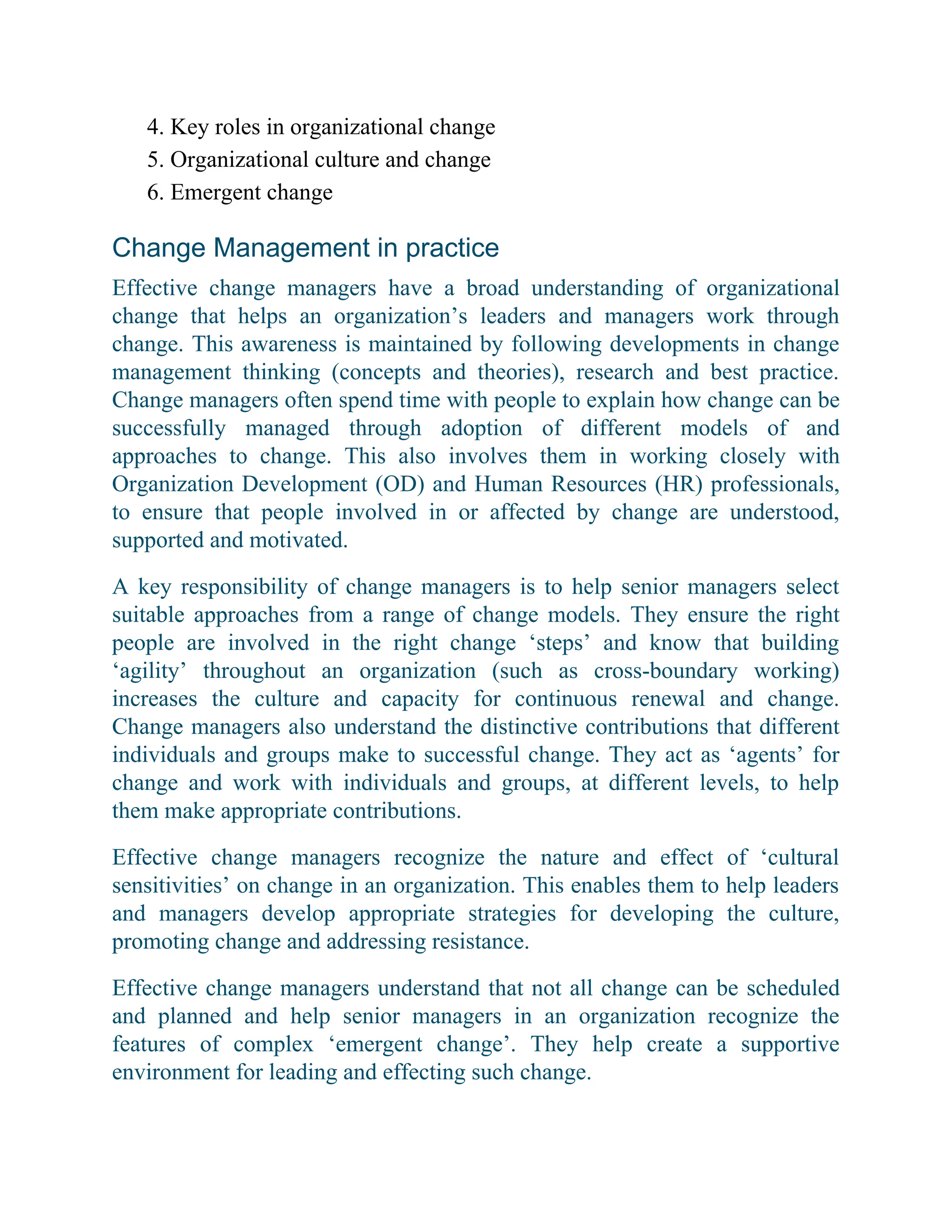
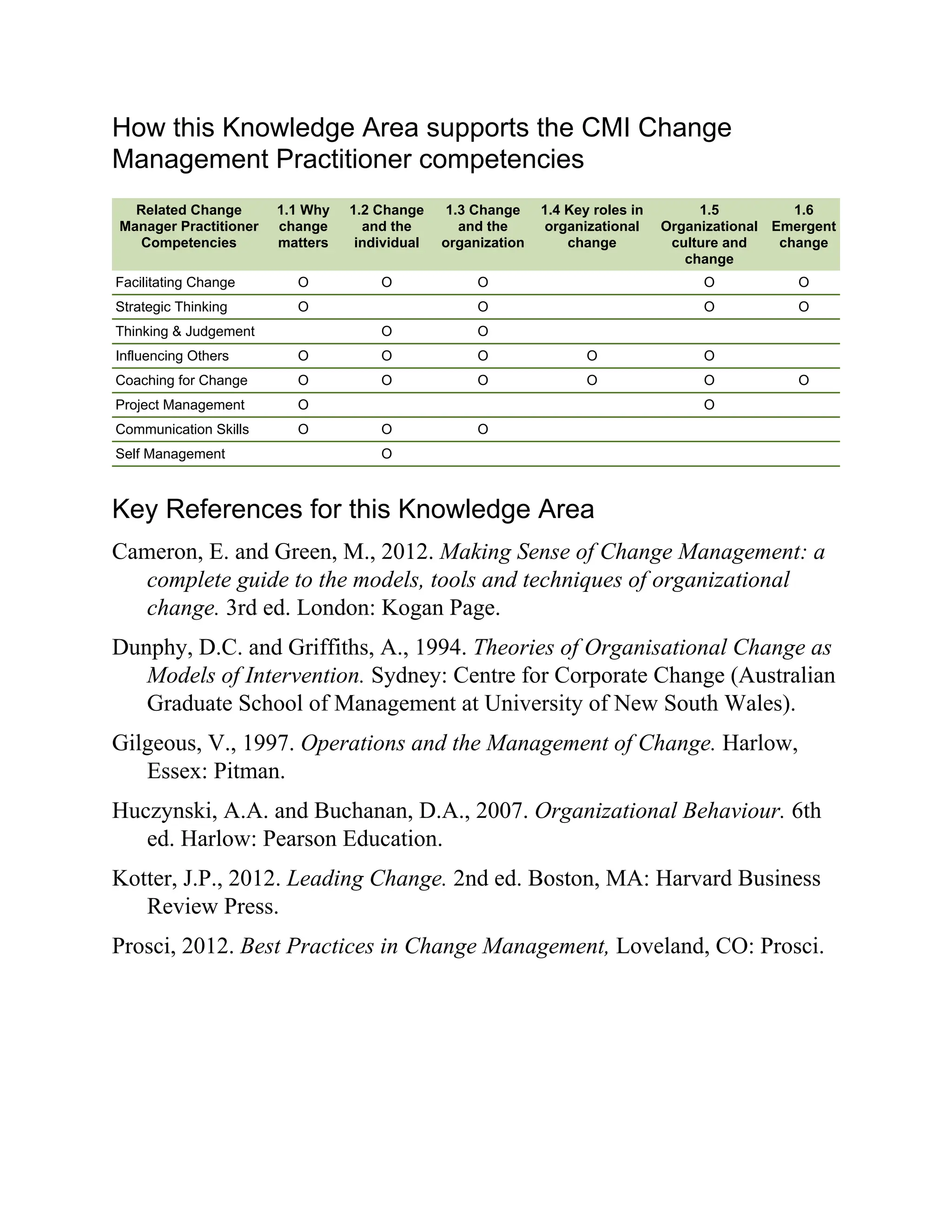


![Changefirst, 2010. The ROI for Change Management. Haywards Heath, UK:
Changefirst.
Ferris, K., 2013. ITSM Solution Projects Need Organisational Change
Management. Australia: Macanta Consulting.
Hiatt, J.M. and Creasey, T.J., 2012. Change Management: The people side of
change. 2nd ed. Loveland, Colorado, USA: Prosci Research.
Hughes, M., 2011. Do 70 Per Cent of All Organizational Change Initiatives
Really Fail? Journal of Change Management, December 2011, 11(4),
pp.451–464.
IBM., 2008. Making Change Work. New York: IBM.
LaClair, J.A. and Rao, R.P., 2002. Helping Employees Embrace Change,
McKinsey Quarterly. November 2002.
Moorhouse Consulting, 2013. Barometer On Change 2013: If a change is
worth doing, focus on doing it well. London: Moorhouse.
PricewaterhouseCoopers, 2004. Boosting Business Performance through
Programme and Project Management. [pdf], available at:
http://www.pwc.com/us/en/operations-management/assets/pwc-global-
project-management-survey-first-survey-2004.pdf [Accessed 24
September 2013]
Prosci, 2012. Best Practices in Change Management, Loveland, CO: Prosci.](https://image.slidesharecdn.com/29375652-250526004351-8b0ed755/75/The-Effective-Change-Manager-The-Change-Management-Institute-38-2048.jpg)


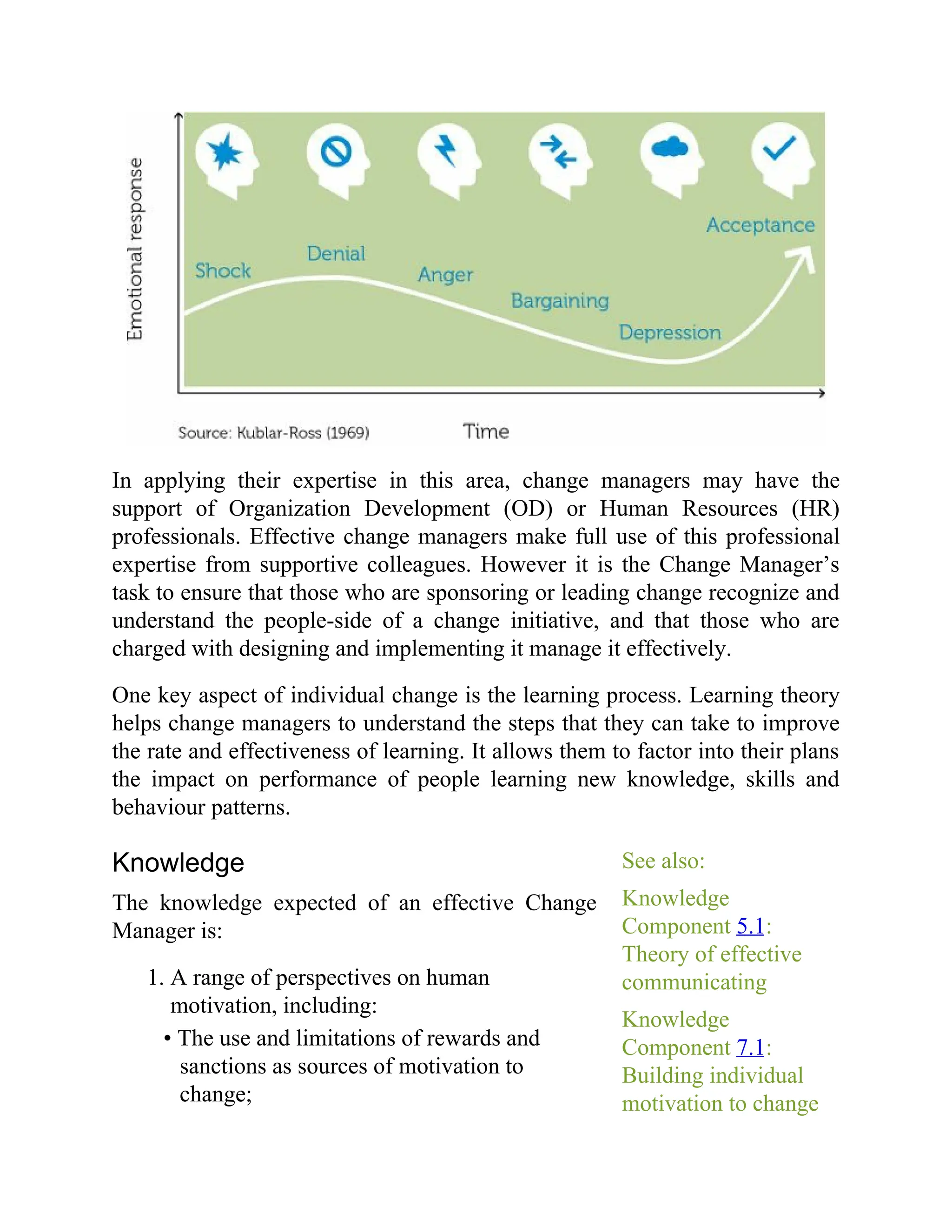











![This ebook is for the use of anyone anywhere in the United
States and most other parts of the world at no cost and with
almost no restrictions whatsoever. You may copy it, give it away
or re-use it under the terms of the Project Gutenberg License
included with this ebook or online at www.gutenberg.org. If you
are not located in the United States, you will have to check the
laws of the country where you are located before using this
eBook.
Title: The Light Invisible
Author: Robert Hugh Benson
Release date: December 8, 2018 [eBook #58433]
Language: English
Credits: Produced by Sonya Schermann, Barry Abrahamsen, and
the
Online Distributed Proofreading Team at
http://www.pgdp.net
(This file was produced from images generously made
available by The Internet Archive)
*** START OF THE PROJECT GUTENBERG EBOOK THE LIGHT
INVISIBLE ***](https://image.slidesharecdn.com/29375652-250526004351-8b0ed755/75/The-Effective-Change-Manager-The-Change-Management-Institute-60-2048.jpg)