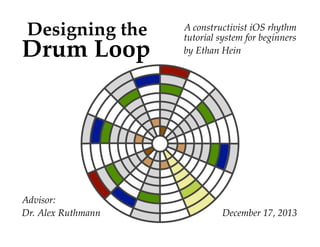
Designing the

Drum Loop

Advisor:
Dr. Alex Ruthmann

A constructivist iOS rhythm
tutorial system for beginners
by Ethan Hein

December 17, 2013
Beginners struggle with the way that standard
notation represents rhythm

The two measures of music above occupy the same
time duration, but it would appear to a novice that the
first is much longer than the second. While there are
valid typographical reasons not to represent rhythms
by their lengths on the page, it makes the symbology
that much more difficult to understand.
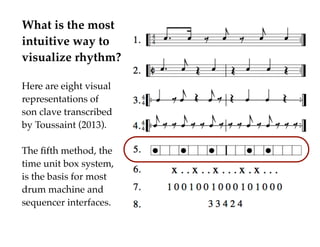
What is the most
intuitive way to
visualize rhythm?
Here are eight visual
representations of
son clave transcribed
by Toussaint (2013).
The fifth method, the
time unit box system,
is the basis for most
drum machine and
sequencer interfaces.
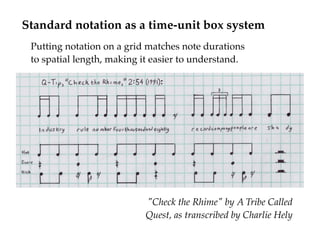
Standard notation as a time-unit box system
Putting notation on a grid matches note durations
to spatial length, making it easier to understand.

"Check the Rhime" by A Tribe Called
Quest, as transcribed by Charlie Hely
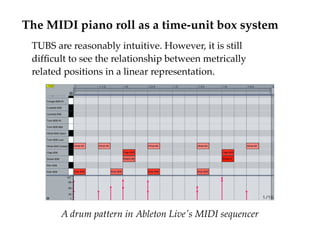
The MIDI piano roll as a time-unit box system
TUBS are reasonably intuitive. However, it is still
difficult to see the relationship between metrically
related positions in a linear representation.

A drum pattern in Ableton Live's MIDI sequencer
Constructivist music teaching
Beginners work best
at the mid-level of
abstraction, with
figures, phrases and
riffs. Real-world
drum patterns are
more intuitive than
musical "simples"
like eighth notes,
rests and time
signatures.

Large-Scale Design
• Motivic elaboration/development
• Sections and sectional functions
• Similarities and differences across
events distanced in time

Beginners
arrive here

Traditional
western music
education
begins here

Mid-Level
• Figures, phrases and functions
• Stability/instability
• Arrivals and departures

Details
• Pitch and metric values
• Intervals and chords
• Notation
Adapted from
Bamberger (1996)
Prototyping with
Max/MSP/Jitter
Christopher Jacoby
and I were able to
create a working
Drum Loop prototype
in six weeks using
Max. However, our
standalone app
suffered from severe
performance and
responsiveness
problems.

The Drum Loop.maxpat
model
sequencer

view

controller

drum circle

drum machine

drum wedge

poly drumbuffer

sequence
splitter

presentation
positioning

note on

poltocar
present

drumsamples
A breakbeat exercise: The Funky Drummer
Visualizing swing by resizing grid cells
A usability challenge - maximizing target area
Beyond the music classroom: math mode
A genre exercise: Four on the floor
A compositional challenge: subtractive rhythm
A kid-friendly version: the Groove Pizza
Other beginner-oriented radial rhythm apps

Propellerhead Figure
Casual Underground Loopseque
O-music O-generator
The Drum Loop's design contribution
• Presents an interface of toylike simplicity
• Uses culturally authentic and significant rhythms as
a springboard to the user’s own musical expression
• Makes clear which events are metrically related
• Reveals symmetries in the music that may not be
immediately apparent to the ear
• Creates an intuitive visualization of concepts like
syncopation and hemiola

The Drum Loop - A constructivist iOS rhythm tutorial system for beginners

  • 1.
    Designing the Drum Loop Advisor: Dr.Alex Ruthmann A constructivist iOS rhythm tutorial system for beginners by Ethan Hein December 17, 2013
  • 2.
    Beginners struggle withthe way that standard notation represents rhythm The two measures of music above occupy the same time duration, but it would appear to a novice that the first is much longer than the second. While there are valid typographical reasons not to represent rhythms by their lengths on the page, it makes the symbology that much more difficult to understand.
  • 3.
    What is themost intuitive way to visualize rhythm? Here are eight visual representations of son clave transcribed by Toussaint (2013). The fifth method, the time unit box system, is the basis for most drum machine and sequencer interfaces.
  • 4.
    Standard notation asa time-unit box system Putting notation on a grid matches note durations to spatial length, making it easier to understand. "Check the Rhime" by A Tribe Called Quest, as transcribed by Charlie Hely
  • 5.
    The MIDI pianoroll as a time-unit box system TUBS are reasonably intuitive. However, it is still difficult to see the relationship between metrically related positions in a linear representation. A drum pattern in Ableton Live's MIDI sequencer
  • 6.
    Constructivist music teaching Beginnerswork best at the mid-level of abstraction, with figures, phrases and riffs. Real-world drum patterns are more intuitive than musical "simples" like eighth notes, rests and time signatures. Large-Scale Design • Motivic elaboration/development • Sections and sectional functions • Similarities and differences across events distanced in time Beginners arrive here Traditional western music education begins here Mid-Level • Figures, phrases and functions • Stability/instability • Arrivals and departures Details • Pitch and metric values • Intervals and chords • Notation Adapted from Bamberger (1996)
  • 7.
    Prototyping with Max/MSP/Jitter Christopher Jacoby andI were able to create a working Drum Loop prototype in six weeks using Max. However, our standalone app suffered from severe performance and responsiveness problems. The Drum Loop.maxpat model sequencer view controller drum circle drum machine drum wedge poly drumbuffer sequence splitter presentation positioning note on poltocar present drumsamples
  • 8.
    A breakbeat exercise:The Funky Drummer
  • 9.
    Visualizing swing byresizing grid cells
  • 10.
    A usability challenge- maximizing target area
  • 11.
    Beyond the musicclassroom: math mode
  • 12.
    A genre exercise:Four on the floor
  • 13.
    A compositional challenge:subtractive rhythm
  • 14.
    A kid-friendly version:the Groove Pizza
  • 15.
    Other beginner-oriented radialrhythm apps Propellerhead Figure
  • 16.
  • 17.
  • 18.
    The Drum Loop'sdesign contribution • Presents an interface of toylike simplicity • Uses culturally authentic and significant rhythms as a springboard to the user’s own musical expression • Makes clear which events are metrically related • Reveals symmetries in the music that may not be immediately apparent to the ear • Creates an intuitive visualization of concepts like syncopation and hemiola