Download to read offline

![More warmup examples
"vilniusrb".length
[1, 2, 3].include?(3)
"vilniusrb".include?("rb")
print "YOLO" if 1 > 2
2 * 2 + 2](https://image.slidesharecdn.com/vilniusrb-rubyintroduction-141124031052-conversion-gate02/85/Ruby-new-VilniusRB-19-320.jpg)
![Flow control: if
if [1, "rb", nil].count >= 3
world_peace
else
depression_with_chocolate
end](https://image.slidesharecdn.com/vilniusrb-rubyintroduction-141124031052-conversion-gate02/85/Ruby-new-VilniusRB-29-320.jpg)
![Check the truth
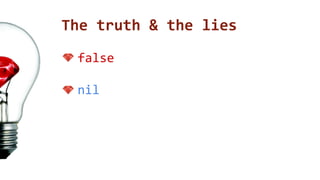
[]
0](https://image.slidesharecdn.com/vilniusrb-rubyintroduction-141124031052-conversion-gate02/85/Ruby-new-VilniusRB-31-320.jpg)
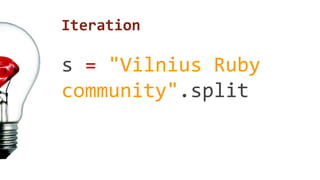
![Iteration
s = [
"Vilnius",
"Ruby",
"community"
]](https://image.slidesharecdn.com/vilniusrb-rubyintroduction-141124031052-conversion-gate02/85/Ruby-new-VilniusRB-33-320.jpg)
![Iteration: the classics
for (i = 0; i < s.length; i++) {
// do something with s[i]
}](https://image.slidesharecdn.com/vilniusrb-rubyintroduction-141124031052-conversion-gate02/85/Ruby-new-VilniusRB-34-320.jpg)
![Blocks: implementation
def each
size.times do |i|
yield(self[i])
end
end](https://image.slidesharecdn.com/vilniusrb-rubyintroduction-141124031052-conversion-gate02/85/Ruby-new-VilniusRB-37-320.jpg)
![Blocks: implementation
def each
size.times { |i| yield(self[i]) }
end](https://image.slidesharecdn.com/vilniusrb-rubyintroduction-141124031052-conversion-gate02/85/Ruby-new-VilniusRB-38-320.jpg)
![Blocks: implementation
def each(&block)
size.times do |i|
block.call(self[i])
end
end](https://image.slidesharecdn.com/vilniusrb-rubyintroduction-141124031052-conversion-gate02/85/Ruby-new-VilniusRB-39-320.jpg)
![Enumerable in action
[10, 5, 7]
.map { |n| n * 2 }
.select { |n| n > 10 }
.sort
.first](https://image.slidesharecdn.com/vilniusrb-rubyintroduction-141124031052-conversion-gate02/85/Ruby-new-VilniusRB-41-320.jpg)
![Enumerable in action
[10, 5, 7]
.map { |n| n * 2 } # [20, 10, 14]
.select { |n| n > 10 } # [20, 14]
.sort # [14, 20]
.first # 14](https://image.slidesharecdn.com/vilniusrb-rubyintroduction-141124031052-conversion-gate02/85/Ruby-new-VilniusRB-42-320.jpg)
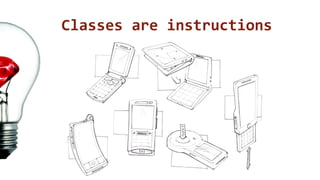
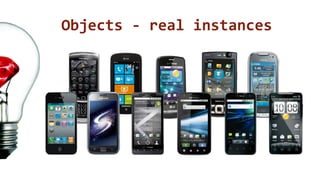
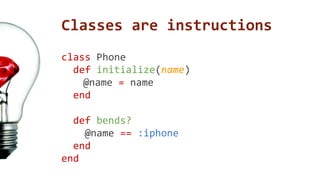
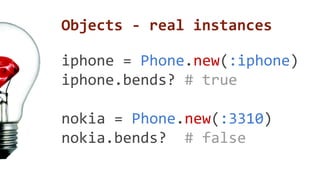

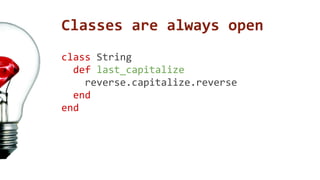
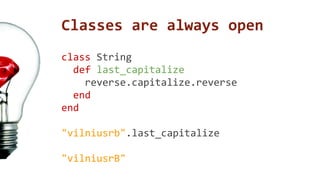
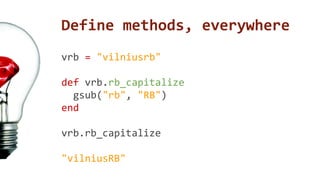
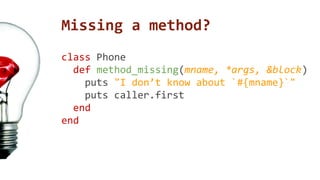
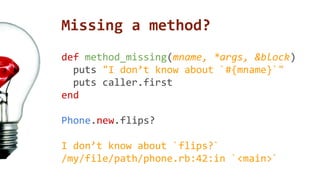
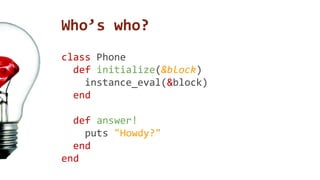
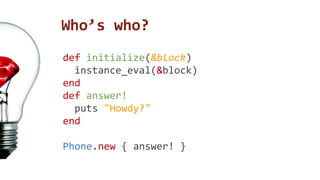
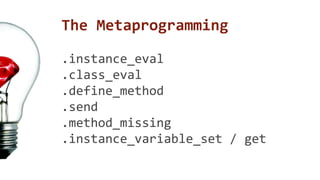

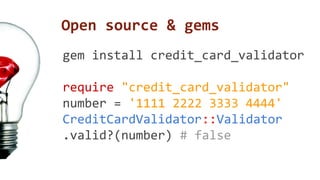

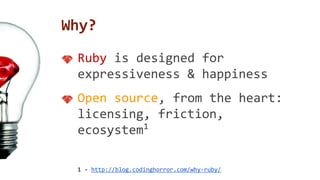
This document discusses the Ruby programming language and Vilnius Ruby community. It covers topics like Ruby being an interpreted, dynamic, object-oriented language. It provides examples of Ruby code like defining methods, iterating with blocks, and using classes and objects. It also mentions the Ruby ecosystem including open source and gems. The document encourages questions at the end.


