Artificial Intelligence and
Machine Learning:
Powering the Future
Welcome to this presentation exploring the exciting world of artificial
intelligence and machine learning. We'll dive into their definitions,
evolution, applications, and the transformative impact they have on our
world.
Introduction to AI and ML: Demystifying the
Buzzwords
Artificial Intelligence (AI)
The ability of a computer or machine to mimic human
intelligence, including learning, problem-solving, and
decision-making.
Machine Learning (ML)
A subset of AI where machines learn from data without
explicit programming, improving their performance over
time.
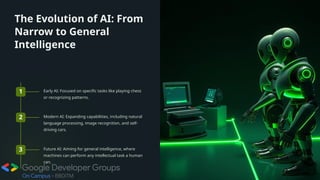
The Evolution of AI: From
Narrow to General
Intelligence
1 Early AI: Focused on specific tasks like playing chess
or recognizing patterns.
2 Modern AI: Expanding capabilities, including natural
language processing, image recognition, and self-
driving cars.
3 Future AI: Aiming for general intelligence, where
machines can perform any intellectual task a human
can.
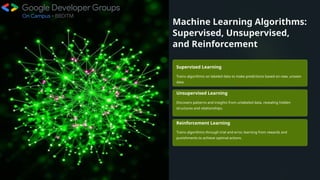
Machine Learning Algorithms:
Supervised, Unsupervised,
and Reinforcement
Supervised Learning
Trains algorithms on labeled data to make predictions based on new, unseen
data.
Unsupervised Learning
Discovers patterns and insights from unlabeled data, revealing hidden
structures and relationships.
Reinforcement Learning
Trains algorithms through trial and error, learning from rewards and
punishments to achieve optimal actions.
Data: The Fuel that Drives AI
and ML
Vast Amounts
AI and ML require large datasets to train effective models.
High Quality
Clean and accurate data is crucial for accurate predictions and insights.
Data Privacy
Ethical concerns regarding data privacy and responsible AI practices.
AI in Action: Real-World
Applications and Use
Cases
Healthcare
AI aids in diagnosing diseases, developing new
treatments, and personalizing patient care.
Finance
AI detects fraud, analyzes market trends, and provides
personalized financial advice.
E-commerce
AI powers personalized recommendations, improves
search results, and automates customer service.
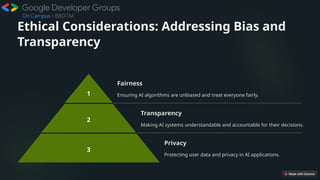
Ethical Considerations: Addressing Bias and
Transparency
1
Fairness
Ensuring AI algorithms are unbiased and treat everyone fairly.
2
Transparency
Making AI systems understandable and accountable for their decisions.
3
Privacy
Protecting user data and privacy in AI applications.
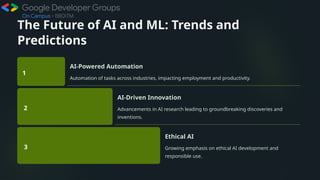
The Future of AI and ML: Trends and
Predictions
1
AI-Powered Automation
Automation of tasks across industries, impacting employment and productivity.
2
AI-Driven Innovation
Advancements in AI research leading to groundbreaking discoveries and
inventions.
3
Ethical AI
Growing emphasis on ethical AI development and
responsible use.
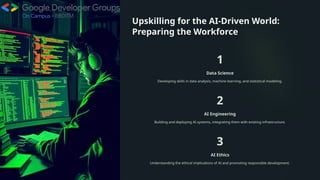
Upskilling for the AI-Driven World:
Preparing the Workforce
1
Data Science
Developing skills in data analysis, machine learning, and statistical modeling.
2
AI Engineering
Building and deploying AI systems, integrating them with existing infrastructure.
3
AI Ethics
Understanding the ethical implications of AI and promoting responsible development.
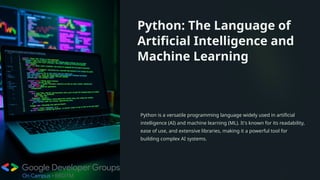
Python: The Language of
Artificial Intelligence and
Machine Learning
Python is a versatile programming language widely used in artificial
intelligence (AI) and machine learning (ML). It's known for its readability,
ease of use, and extensive libraries, making it a powerful tool for
building complex AI systems.
Introduction to Python
Simple Syntax
Python's clear syntax allows for easy reading and writing,
reducing the learning curve for new programmers.
Interpreted Language
Python executes code line by line, simplifying debugging
and allowing for rapid prototyping.
Key Features of Python
1 Object-Oriented
Programming
Python supports OOP principles,
allowing for modular and
reusable code.
2 Dynamic Typing
Python automatically infers data
types, eliminating the need for
explicit type declarations.
3 Extensive Libraries
Python boasts a wealth of pre-
built libraries, providing ready-
to-use solutions for various
tasks.
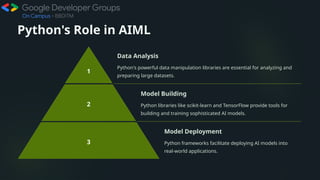
Python's Role in AIML
1
Data Analysis
Python's powerful data manipulation libraries are essential for analyzing and
preparing large datasets.
2
Model Building
Python libraries like scikit-learn and TensorFlow provide tools for
building and training sophisticated AI models.
3
Model Deployment
Python frameworks facilitate deploying AI models into
real-world applications.
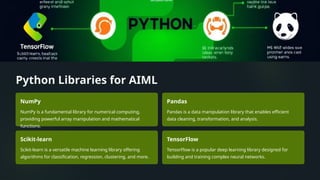
Python Libraries for AIML
NumPy
NumPy is a fundamental library for numerical computing,
providing powerful array manipulation and mathematical
functions.
Pandas
Pandas is a data manipulation library that enables efficient
data cleaning, transformation, and analysis.
Scikit-learn
Scikit-learn is a versatile machine learning library offering
algorithms for classification, regression, clustering, and more.
TensorFlow
TensorFlow is a popular deep learning library designed for
building and training complex neural networks.
Python for Data Preprocessing
Data Cleaning
Python libraries help remove inconsistencies, handle missing values, and ensure data quality.
Data Transformation
Python allows scaling, normalization, and encoding to prepare data for model training.
Feature Engineering
Python enables creating new features from existing data, improving model performance.
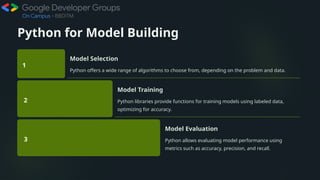
Python for Model Building
1
Model Selection
Python offers a wide range of algorithms to choose from, depending on the problem and data.
2
Model Training
Python libraries provide functions for training models using labeled data,
optimizing for accuracy.
3
Model Evaluation
Python allows evaluating model performance using
metrics such as accuracy, precision, and recall.
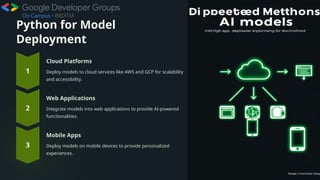
Python for Model
Deployment
Cloud Platforms
Deploy models to cloud services like AWS and GCP for scalability
and accessibility.
Web Applications
Integrate models into web applications to provide AI-powered
functionalities.
Mobile Apps
Deploy models on mobile devices to provide personalized
experiences.
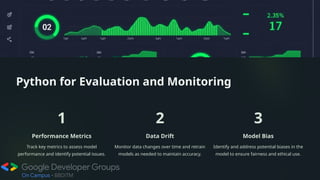
Python for Evaluation and Monitoring
1
Performance Metrics
Track key metrics to assess model
performance and identify potential issues.
2
Data Drift
Monitor data changes over time and retrain
models as needed to maintain accuracy.
3
Model Bias
Identify and address potential biases in the
model to ensure fairness and ethical use.
Challenges and Best Practices
Python's vast ecosystem presents challenges for beginners. Focusing on fundamental concepts and practicing regularly is
key. Leveraging best practices and community resources can streamline development and ensure ethical AI development.
Conclusion: The
Transformative Potential
of AI and ML
AI and ML are transformative technologies with the power to shape our
future. By understanding their principles, applications, and ethical
considerations, we can harness their potential to solve complex
challenges and create a more innovative and prosperous world.

Artificial Intelligence and Machine Learning and Python FINAL.pptx

  • 1.
    Artificial Intelligence and MachineLearning: Powering the Future Welcome to this presentation exploring the exciting world of artificial intelligence and machine learning. We'll dive into their definitions, evolution, applications, and the transformative impact they have on our world.
  • 2.
    Introduction to AIand ML: Demystifying the Buzzwords Artificial Intelligence (AI) The ability of a computer or machine to mimic human intelligence, including learning, problem-solving, and decision-making. Machine Learning (ML) A subset of AI where machines learn from data without explicit programming, improving their performance over time.
  • 3.
    The Evolution ofAI: From Narrow to General Intelligence 1 Early AI: Focused on specific tasks like playing chess or recognizing patterns. 2 Modern AI: Expanding capabilities, including natural language processing, image recognition, and self- driving cars. 3 Future AI: Aiming for general intelligence, where machines can perform any intellectual task a human can.
  • 4.
    Machine Learning Algorithms: Supervised,Unsupervised, and Reinforcement Supervised Learning Trains algorithms on labeled data to make predictions based on new, unseen data. Unsupervised Learning Discovers patterns and insights from unlabeled data, revealing hidden structures and relationships. Reinforcement Learning Trains algorithms through trial and error, learning from rewards and punishments to achieve optimal actions.
  • 5.
    Data: The Fuelthat Drives AI and ML Vast Amounts AI and ML require large datasets to train effective models. High Quality Clean and accurate data is crucial for accurate predictions and insights. Data Privacy Ethical concerns regarding data privacy and responsible AI practices.
  • 6.
    AI in Action:Real-World Applications and Use Cases Healthcare AI aids in diagnosing diseases, developing new treatments, and personalizing patient care. Finance AI detects fraud, analyzes market trends, and provides personalized financial advice. E-commerce AI powers personalized recommendations, improves search results, and automates customer service.
  • 7.
    Ethical Considerations: AddressingBias and Transparency 1 Fairness Ensuring AI algorithms are unbiased and treat everyone fairly. 2 Transparency Making AI systems understandable and accountable for their decisions. 3 Privacy Protecting user data and privacy in AI applications.
  • 8.
    The Future ofAI and ML: Trends and Predictions 1 AI-Powered Automation Automation of tasks across industries, impacting employment and productivity. 2 AI-Driven Innovation Advancements in AI research leading to groundbreaking discoveries and inventions. 3 Ethical AI Growing emphasis on ethical AI development and responsible use.
  • 9.
    Upskilling for theAI-Driven World: Preparing the Workforce 1 Data Science Developing skills in data analysis, machine learning, and statistical modeling. 2 AI Engineering Building and deploying AI systems, integrating them with existing infrastructure. 3 AI Ethics Understanding the ethical implications of AI and promoting responsible development.
  • 10.
    Python: The Languageof Artificial Intelligence and Machine Learning Python is a versatile programming language widely used in artificial intelligence (AI) and machine learning (ML). It's known for its readability, ease of use, and extensive libraries, making it a powerful tool for building complex AI systems.
  • 11.
    Introduction to Python SimpleSyntax Python's clear syntax allows for easy reading and writing, reducing the learning curve for new programmers. Interpreted Language Python executes code line by line, simplifying debugging and allowing for rapid prototyping.
  • 12.
    Key Features ofPython 1 Object-Oriented Programming Python supports OOP principles, allowing for modular and reusable code. 2 Dynamic Typing Python automatically infers data types, eliminating the need for explicit type declarations. 3 Extensive Libraries Python boasts a wealth of pre- built libraries, providing ready- to-use solutions for various tasks.
  • 13.
    Python's Role inAIML 1 Data Analysis Python's powerful data manipulation libraries are essential for analyzing and preparing large datasets. 2 Model Building Python libraries like scikit-learn and TensorFlow provide tools for building and training sophisticated AI models. 3 Model Deployment Python frameworks facilitate deploying AI models into real-world applications.
  • 14.
    Python Libraries forAIML NumPy NumPy is a fundamental library for numerical computing, providing powerful array manipulation and mathematical functions. Pandas Pandas is a data manipulation library that enables efficient data cleaning, transformation, and analysis. Scikit-learn Scikit-learn is a versatile machine learning library offering algorithms for classification, regression, clustering, and more. TensorFlow TensorFlow is a popular deep learning library designed for building and training complex neural networks.
  • 15.
    Python for DataPreprocessing Data Cleaning Python libraries help remove inconsistencies, handle missing values, and ensure data quality. Data Transformation Python allows scaling, normalization, and encoding to prepare data for model training. Feature Engineering Python enables creating new features from existing data, improving model performance.
  • 16.
    Python for ModelBuilding 1 Model Selection Python offers a wide range of algorithms to choose from, depending on the problem and data. 2 Model Training Python libraries provide functions for training models using labeled data, optimizing for accuracy. 3 Model Evaluation Python allows evaluating model performance using metrics such as accuracy, precision, and recall.
  • 17.
    Python for Model Deployment CloudPlatforms Deploy models to cloud services like AWS and GCP for scalability and accessibility. Web Applications Integrate models into web applications to provide AI-powered functionalities. Mobile Apps Deploy models on mobile devices to provide personalized experiences.
  • 18.
    Python for Evaluationand Monitoring 1 Performance Metrics Track key metrics to assess model performance and identify potential issues. 2 Data Drift Monitor data changes over time and retrain models as needed to maintain accuracy. 3 Model Bias Identify and address potential biases in the model to ensure fairness and ethical use.
  • 19.
    Challenges and BestPractices Python's vast ecosystem presents challenges for beginners. Focusing on fundamental concepts and practicing regularly is key. Leveraging best practices and community resources can streamline development and ensure ethical AI development.
  • 20.
    Conclusion: The Transformative Potential ofAI and ML AI and ML are transformative technologies with the power to shape our future. By understanding their principles, applications, and ethical considerations, we can harness their potential to solve complex challenges and create a more innovative and prosperous world.