The Critically Ill Patient: Basic
Concepts
Medical Surgical Nursing 111
F. NHLANE 2020
Learning objectives
• Define the terms: Critical illness and critical care
• Describe the 3 main categories in the management of the critically ill
patients
Definition of terms
Critical Illness
• Is a life-threatening multisystem illness that can result in significant
morbidity or mortality.
Critical care
• Also termed ` intensive care`
• Specialized care of patients whose conditions are life-threatening and
who require comprehensive care and constant monitoring
Overview of critical illness and critical care
• Care of the critically ill patients require a multidisciplinary approach
• Initial aspects of care of the critically ill patients include:
Resuscitation( Airway, Breathing, Circulation)
Stabilization
Monitoring
• After ABC…, are under control, patient`s condition is described as
stabilized which must be maintained through close monitoring in the
areas of:
• Hemodynamic and cardiopulmonary functionality
Categories in the management of patients in
the ICU setting
3 main categories:
A. Ventilatory and hemodynamic support
B. Treatment of specific illnesses
C. Preventive care
Ventilatory & Hemodynamic support
• Respiratory and CVS failures are common reasons for admissions in ICU
• Monitoring of respiratory & CVS functionality are typical procedures of ICU
routine
• Such procedures are quite complex and complicated requiring various
understanding of:
Monitoring Principles
Monitoring devices
Monitoring techniques
Interpretation of findings
Nursing interventions
Monitoring Respiratory functioning
• Respiratory failure is the most common cause of ICU admission
• ICU nurse must understand:
 physiology & pathophysiology of respiratory system;
variety of parameters/monitors used to evaluate respiratory status;
Why?
in order to make decisions about pulmonary function and gas exchange
Available respiratory monitoring techniques
Key aspects:
Technical functionality & clinical application
1. Physical examination
• Most basic technique
• Often under-estimated
• Provides first clue that something is wrong
• Utilizes traditional techniques of inspection, auscultation, palpation,
percussion
Physical examination CTs
• Provides on going assessment of respiratory function especially when
used with other monitoring tools
• Apparently, these physical signs do not provide adequate/timely
warning signs and do not change quickly to confirm intervention was
appropriate.
2. Chest X-Rays
• Provides data about lung pathology
• Not timely
• Requires knowledge/skill to inteprate.
Available respiratory monitoring techniques
3. Arterial Blood Gas Analysis
• Monitors blood gas exchange
• Most important indicator of respiratory monitoring system
• Provides a measure of PaO2, PaCO2, pH, HCO3 and SaO2
• These parameters define adequacy of gas exchange & acid base
balance and overall cardiopulmonary status
• Challenges:
Invasive procedure
Unavailability of blood gas analyzers
CT’
The key components to an ABG are:
1.pH - This measures the balance of acids and bases in the
blood.
2.Partial pressure of oxygen (PaO2) - This measures the
pressure of oxygen dissolved in the blood.
3.Partial pressure of carbon dioxide (PaCO2) - This measures
the amount of carbon dioxide in the blood and how well carbon
dioxide can move out of the body.
Ct’
4.Bicarbonate (HCO3) - This is calculated using the measured
values of pH and PaCO2 to determine the amount of the basic
compound made from carbon dioxide (CO2.)
5.Oxygen saturation (O2 Sat) - This measures how much
hemoglobin in your blood is carrying oxygen.
Ct’
6.Oxygen content (O2CT) - This measures the amount of oxygen
in your blood.
7.Hemoglobin - This measures the amount of hemoglobin in your
blood.
Normative Values
According to the National Institute of Health, typical normal values are:
•pH: 7.35-7.45
•Partial pressure of oxygen (PaO2): 75 to 100 mmHg
•Partial pressure of carbon dioxide (PaCO2): 35-45 mmHg
•Bicarbonate (HCO3): 22-26 mEq/L
•Oxygen saturation (O2 Sat): 95-100%
Ct’
[5]
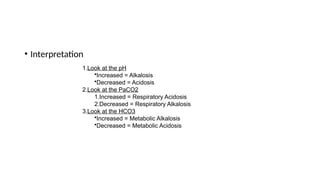
• Interpretation
1.Look at the pH
•Increased = Alkalosis
•Decreased = Acidosis
2.Look at the PaCO2
1.Increased = Respiratory Acidosis
2.Decreased = Respiratory Alkalosis
3.Look at the HCO3
•Increased = Metabolic Alkalosis
•Decreased = Metabolic Acidosis
Ct’
• The results should always be read and compared in reference
to the patients previous ABG (if available) as you will then be
able to assess a trend and make a more accurate assessment
on whether you should treat or if your treatment has be
successful or not.
Respiratory monitoring techniques Ct..,
4. Pulse Oximetry (SpO2)
• Routine monitoring of O2 status at tissue level
• Non-invasive & timely
5. Capnography (end tidal CO2)
• Monitors of ventilation
• Non invasive measurement of CO2 at the end of exhalation
graphically presented on some models of ventilators
Monitors of respiratory function in the
mechanically ventilated patients
• There are a variety of measurements that evaluate respiratory
function in the mechanically ventilated patients
• Such measurements are displayed on the air way pressure gauge
manometers;(ventilation equipment used to monitor the patients`
airway pressure); of different models of mechanical ventilators;
• Some are obtained through calculations of the available/recordable
pressures
Monitors of airway pressure CTs…..,
• Examples include:
Dynamic Compliance (Cdyn): this reflect pressure necessary to
overcome airway resistance and compliance in the lungs and chest
wall
Static compliance(Cstat); Pulmonary compliance during period
without gas flow
PEEP: Positive end expiratory pressure: Pressure in the lungs (alveolar
pressure) above atmospheric pressure that exists at the end of
expiration
Summary of respiratory monitoring
• A variety of monitors are available and used to evaluate respiratory
function
• Selection depends on understanding of the technique and
interpretation of the data in relation to the disease and management.
• Information can only be useful if collected by reliable equipment and
interpreted in the light of physical examination
Hemodynamic Monitoring
• Continuous monitoring of the movement of blood and the pressures
being exerted in the veins, arteries, and chambers of the heart
• Specialized methods of evaluation of cardio-respiratory performance
• Can be done invasively or non-invasively or derived
Hemodynamic Monitoring CT…,
• Non-invasively: no device inserted into the body; HR, B/P, urine
output(no breach of body surface)
• Invasive pressure monitoring: (Probes introduced into the body)
 requires the insertion of a catheter into an artery;
• Derived: Calculated from primary measurements
Purpose of hemodynamic monitoring
Provides information about:
• Tissue performance
• Blood volume
• Cardiac performance
• Tissue oxygenation
• Vascular tone
Importance of hemodynamic measurements
• To establish a precise health related diagnosis
• To determine appropriate therapy
• To monitor response to therapy
common monitoring technologies
Systemic arterial pressure monitoring:
• Measuring pressure invasively by penetrating the arterial wall
eg
Arterial Lines (A-lines)ABP
• Thin catheter inserted into an artery
• Can be inserted into radial, brachial, femoral arteries
• Indications:
• Used to monitor B/P(ABP)
• Convenient for blood sampling; can get blood samples
Complications of A-lines
• Failure to obtain readings if kinked
• Thrombosis
• Embolism
• Bacterial contamination
common monitoring technologies CTs
Central Venous Pressure (CVP)
• Achieved by passing a central venous catheter into any of the large
veins; the tip of the catheter rests on the lower third of the superior
vena cava.
• Reflects amount of blood returning to the heart and ability of the
heart to pump blood
• Gives an indication of fluid status
CVP CT….,
Indications
• Measuring Pressure in the right atrium
• Indicated whenever fluid volume status is questionable
• Drug administration
• Removal of air in the right atrium in air embolism
• Later insertion of pulmonary artery
Complications: Perforation of right atrium, air embolism, internal jugular
puncture.
CVP ct’
• Normal CVP ranges from 5 to 10 cmH2O
The 2 methods used to measure it includes
Manometer system, intermittent readings
Transducer system, continuous reading displayed on a monitor
common monitoring technologies CT..,
Pulmonary artery catheter
• Involves insertion of a catheter into pulmonary artery (internal
jugular to rt atrium to rt ventricle to the pulmonary artery)
Indications
• Measuring PAP
• Derive other parameters eg CI;(cardiac index), SVR
Complications:
Direct trauma eg cardiac perforation, infections like endocarditis
common monitoring technologies CT
• Non-invasive B/P monitoring ; presents as NIBP
2.Treatment of specific illnesses
• Involves rightful delivery of prescribed medical therapy without
shortcuts (5 rights)
• Due to availability of several tubings attached to patients; be cautious
of accidental injections: label extension tubes, watch for clots & air
bubbles in the lines, keep stopcocks clamped PRN,
3.Preventive Care In ICU Settings
• Care rendered to stabilized critically ill patients in ICU settings
• Intended to maximize therapeutic interventions and promote patient
safety
• Management of some complex probes may become a problem even
with protocols/checklist developed following research in ICU settings
• FAST HUG is yet another guide being utilized to provide quality safe
care in ICU settings
FAST HUG CONCEPT IN ICU SETTINGS
• MNEMONIC to guide health service delivery;
• Initially devised by Jean, Lewis Vicent (? Yr)
• A means of identifying & checking some key aspects in the general
care of critically ill patients
• Ensures that 7 essential aspects of patient care are not forgotten
NOTE
• FAST HUG may not apply to all ICU patients
• Does not cover all aspects of patient care
Key Elements of the FAST HUG CONCEPT
Element Importance Consideration
Feeding Malnutrition can compromise Initiate feeds as soon as
immune function and derail patients stabilizes.
recovery
Fluids To restore intravascular volume strict input and output monitoring
in patients hence maintain
hemodynamic status
Analgesia Key for comfort of the critica
lly ill patient Provide adequate analgesia
Key Elements of the FAST HUG CONCEPT CT…,
Element Importance Consideration
Sedation Reduces stress Keep critically ill patients calmed
Thromboemboli
tic prophylaxis ICU pts at risk for
VTE Initiate appropriate prophylaxis
Head of bed To reduce GIT Keep head of bed elevated prn
reflux
elevated
Key Elements of the FAST HUG CONCEPT
Element Importance Consideration
Stress UlcersStress ulcers a risk. Prevent
Prophylaxis
Glycemic control. Compromised. Monitor BS regularly
Note
FAST HUG not necessarily to be vocalized, but used as a mental
checklist when caring for ICU patients
Conclusion
• ICUs are designated for critically ill patients
• Cardiopulmonary compromise being common reasons for ICU
admissions
• Care in ICU is centered on resuscitation, stabilization, and monitoring
• Key management strategies in ICU include cardiopulmonary
monitoring, treatment of the underlying pathologies and preventive
care

The Critically iil patient; Basic concepts.pptx

  • 1.
    The Critically IllPatient: Basic Concepts Medical Surgical Nursing 111 F. NHLANE 2020
  • 2.
    Learning objectives • Definethe terms: Critical illness and critical care • Describe the 3 main categories in the management of the critically ill patients
  • 3.
    Definition of terms CriticalIllness • Is a life-threatening multisystem illness that can result in significant morbidity or mortality. Critical care • Also termed ` intensive care` • Specialized care of patients whose conditions are life-threatening and who require comprehensive care and constant monitoring
  • 4.
    Overview of criticalillness and critical care • Care of the critically ill patients require a multidisciplinary approach • Initial aspects of care of the critically ill patients include: Resuscitation( Airway, Breathing, Circulation) Stabilization Monitoring • After ABC…, are under control, patient`s condition is described as stabilized which must be maintained through close monitoring in the areas of: • Hemodynamic and cardiopulmonary functionality
  • 5.
    Categories in themanagement of patients in the ICU setting 3 main categories: A. Ventilatory and hemodynamic support B. Treatment of specific illnesses C. Preventive care
  • 6.
    Ventilatory & Hemodynamicsupport • Respiratory and CVS failures are common reasons for admissions in ICU • Monitoring of respiratory & CVS functionality are typical procedures of ICU routine • Such procedures are quite complex and complicated requiring various understanding of: Monitoring Principles Monitoring devices Monitoring techniques Interpretation of findings Nursing interventions
  • 7.
    Monitoring Respiratory functioning •Respiratory failure is the most common cause of ICU admission • ICU nurse must understand:  physiology & pathophysiology of respiratory system; variety of parameters/monitors used to evaluate respiratory status; Why? in order to make decisions about pulmonary function and gas exchange
  • 8.
    Available respiratory monitoringtechniques Key aspects: Technical functionality & clinical application 1. Physical examination • Most basic technique • Often under-estimated • Provides first clue that something is wrong • Utilizes traditional techniques of inspection, auscultation, palpation, percussion
  • 9.
    Physical examination CTs •Provides on going assessment of respiratory function especially when used with other monitoring tools • Apparently, these physical signs do not provide adequate/timely warning signs and do not change quickly to confirm intervention was appropriate. 2. Chest X-Rays • Provides data about lung pathology • Not timely • Requires knowledge/skill to inteprate.
  • 10.
    Available respiratory monitoringtechniques 3. Arterial Blood Gas Analysis • Monitors blood gas exchange • Most important indicator of respiratory monitoring system • Provides a measure of PaO2, PaCO2, pH, HCO3 and SaO2 • These parameters define adequacy of gas exchange & acid base balance and overall cardiopulmonary status • Challenges: Invasive procedure Unavailability of blood gas analyzers
  • 11.
    CT’ The key componentsto an ABG are: 1.pH - This measures the balance of acids and bases in the blood. 2.Partial pressure of oxygen (PaO2) - This measures the pressure of oxygen dissolved in the blood. 3.Partial pressure of carbon dioxide (PaCO2) - This measures the amount of carbon dioxide in the blood and how well carbon dioxide can move out of the body.
  • 12.
    Ct’ 4.Bicarbonate (HCO3) -This is calculated using the measured values of pH and PaCO2 to determine the amount of the basic compound made from carbon dioxide (CO2.) 5.Oxygen saturation (O2 Sat) - This measures how much hemoglobin in your blood is carrying oxygen.
  • 13.
    Ct’ 6.Oxygen content (O2CT)- This measures the amount of oxygen in your blood. 7.Hemoglobin - This measures the amount of hemoglobin in your blood.
  • 14.
    Normative Values According tothe National Institute of Health, typical normal values are: •pH: 7.35-7.45 •Partial pressure of oxygen (PaO2): 75 to 100 mmHg •Partial pressure of carbon dioxide (PaCO2): 35-45 mmHg •Bicarbonate (HCO3): 22-26 mEq/L •Oxygen saturation (O2 Sat): 95-100%
  • 15.
  • 16.
    • Interpretation 1.Look atthe pH •Increased = Alkalosis •Decreased = Acidosis 2.Look at the PaCO2 1.Increased = Respiratory Acidosis 2.Decreased = Respiratory Alkalosis 3.Look at the HCO3 •Increased = Metabolic Alkalosis •Decreased = Metabolic Acidosis
  • 17.
    Ct’ • The resultsshould always be read and compared in reference to the patients previous ABG (if available) as you will then be able to assess a trend and make a more accurate assessment on whether you should treat or if your treatment has be successful or not.
  • 18.
    Respiratory monitoring techniquesCt.., 4. Pulse Oximetry (SpO2) • Routine monitoring of O2 status at tissue level • Non-invasive & timely 5. Capnography (end tidal CO2) • Monitors of ventilation • Non invasive measurement of CO2 at the end of exhalation graphically presented on some models of ventilators
  • 19.
    Monitors of respiratoryfunction in the mechanically ventilated patients • There are a variety of measurements that evaluate respiratory function in the mechanically ventilated patients • Such measurements are displayed on the air way pressure gauge manometers;(ventilation equipment used to monitor the patients` airway pressure); of different models of mechanical ventilators; • Some are obtained through calculations of the available/recordable pressures
  • 20.
    Monitors of airwaypressure CTs….., • Examples include: Dynamic Compliance (Cdyn): this reflect pressure necessary to overcome airway resistance and compliance in the lungs and chest wall Static compliance(Cstat); Pulmonary compliance during period without gas flow PEEP: Positive end expiratory pressure: Pressure in the lungs (alveolar pressure) above atmospheric pressure that exists at the end of expiration
  • 21.
    Summary of respiratorymonitoring • A variety of monitors are available and used to evaluate respiratory function • Selection depends on understanding of the technique and interpretation of the data in relation to the disease and management. • Information can only be useful if collected by reliable equipment and interpreted in the light of physical examination
  • 22.
    Hemodynamic Monitoring • Continuousmonitoring of the movement of blood and the pressures being exerted in the veins, arteries, and chambers of the heart • Specialized methods of evaluation of cardio-respiratory performance • Can be done invasively or non-invasively or derived
  • 23.
    Hemodynamic Monitoring CT…, •Non-invasively: no device inserted into the body; HR, B/P, urine output(no breach of body surface) • Invasive pressure monitoring: (Probes introduced into the body)  requires the insertion of a catheter into an artery; • Derived: Calculated from primary measurements
  • 24.
    Purpose of hemodynamicmonitoring Provides information about: • Tissue performance • Blood volume • Cardiac performance • Tissue oxygenation • Vascular tone
  • 25.
    Importance of hemodynamicmeasurements • To establish a precise health related diagnosis • To determine appropriate therapy • To monitor response to therapy
  • 26.
    common monitoring technologies Systemicarterial pressure monitoring: • Measuring pressure invasively by penetrating the arterial wall eg Arterial Lines (A-lines)ABP • Thin catheter inserted into an artery • Can be inserted into radial, brachial, femoral arteries • Indications: • Used to monitor B/P(ABP) • Convenient for blood sampling; can get blood samples
  • 27.
    Complications of A-lines •Failure to obtain readings if kinked • Thrombosis • Embolism • Bacterial contamination
  • 28.
    common monitoring technologiesCTs Central Venous Pressure (CVP) • Achieved by passing a central venous catheter into any of the large veins; the tip of the catheter rests on the lower third of the superior vena cava. • Reflects amount of blood returning to the heart and ability of the heart to pump blood • Gives an indication of fluid status
  • 29.
    CVP CT…., Indications • MeasuringPressure in the right atrium • Indicated whenever fluid volume status is questionable • Drug administration • Removal of air in the right atrium in air embolism • Later insertion of pulmonary artery Complications: Perforation of right atrium, air embolism, internal jugular puncture.
  • 30.
    CVP ct’ • NormalCVP ranges from 5 to 10 cmH2O The 2 methods used to measure it includes Manometer system, intermittent readings Transducer system, continuous reading displayed on a monitor
  • 31.
    common monitoring technologiesCT.., Pulmonary artery catheter • Involves insertion of a catheter into pulmonary artery (internal jugular to rt atrium to rt ventricle to the pulmonary artery) Indications • Measuring PAP • Derive other parameters eg CI;(cardiac index), SVR Complications: Direct trauma eg cardiac perforation, infections like endocarditis
  • 32.
    common monitoring technologiesCT • Non-invasive B/P monitoring ; presents as NIBP
  • 33.
    2.Treatment of specificillnesses • Involves rightful delivery of prescribed medical therapy without shortcuts (5 rights) • Due to availability of several tubings attached to patients; be cautious of accidental injections: label extension tubes, watch for clots & air bubbles in the lines, keep stopcocks clamped PRN,
  • 34.
    3.Preventive Care InICU Settings • Care rendered to stabilized critically ill patients in ICU settings • Intended to maximize therapeutic interventions and promote patient safety • Management of some complex probes may become a problem even with protocols/checklist developed following research in ICU settings • FAST HUG is yet another guide being utilized to provide quality safe care in ICU settings
  • 35.
    FAST HUG CONCEPTIN ICU SETTINGS • MNEMONIC to guide health service delivery; • Initially devised by Jean, Lewis Vicent (? Yr) • A means of identifying & checking some key aspects in the general care of critically ill patients • Ensures that 7 essential aspects of patient care are not forgotten NOTE • FAST HUG may not apply to all ICU patients • Does not cover all aspects of patient care
  • 36.
    Key Elements ofthe FAST HUG CONCEPT Element Importance Consideration Feeding Malnutrition can compromise Initiate feeds as soon as immune function and derail patients stabilizes. recovery Fluids To restore intravascular volume strict input and output monitoring in patients hence maintain hemodynamic status Analgesia Key for comfort of the critica lly ill patient Provide adequate analgesia
  • 37.
    Key Elements ofthe FAST HUG CONCEPT CT…, Element Importance Consideration Sedation Reduces stress Keep critically ill patients calmed Thromboemboli tic prophylaxis ICU pts at risk for VTE Initiate appropriate prophylaxis Head of bed To reduce GIT Keep head of bed elevated prn reflux elevated
  • 38.
    Key Elements ofthe FAST HUG CONCEPT Element Importance Consideration Stress UlcersStress ulcers a risk. Prevent Prophylaxis Glycemic control. Compromised. Monitor BS regularly Note FAST HUG not necessarily to be vocalized, but used as a mental checklist when caring for ICU patients
  • 39.
    Conclusion • ICUs aredesignated for critically ill patients • Cardiopulmonary compromise being common reasons for ICU admissions • Care in ICU is centered on resuscitation, stabilization, and monitoring • Key management strategies in ICU include cardiopulmonary monitoring, treatment of the underlying pathologies and preventive care