“The Creation of Calit2”
Guest Lecture
Gordon Engineering Leadership Center
UC San Diego
January 25, 2017
Dr. Larry Smarr
Director, California Institute for Telecommunications and Information Technology
Harry E. Gruber Professor,
Dept. of Computer Science and Engineering
Jacobs School of Engineering, UCSD
http://lsmarr.calit2.net
1
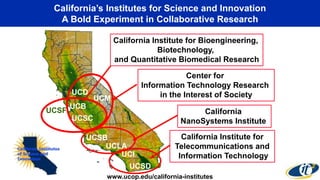
California’s Institutes for Science and Innovation
A Bold Experiment in Collaborative Research
UCSB
UCLA
California
NanoSystems Institute
UCSF
UCB
California Institute for Bioengineering,
Biotechnology,
and Quantitative Biomedical Research
UCI
UCSD
California Institute for
Telecommunications and
Information Technology
Center for
Information Technology Research
in the Interest of Society
UCSC
UCD
UCM
www.ucop.edu/california-institutes
Calit2’s Initial Mission Statement
Envisioning How the Extension of Innovative
Telecommunications and Information Technologies
Throughout the Physical World
will Transform Critical Applications
Important to the California Economy and
its Citizens’ Quality Of Life.
Calit2 is a University of California
“Institutional Innovation” Experiment on How to Invent
a Persistent Collaborative Research and Education
Environment that Provides Insight into How the UC, a
Major Research University, Might Evolve in the Future.
Calit2 Review Report: p.1
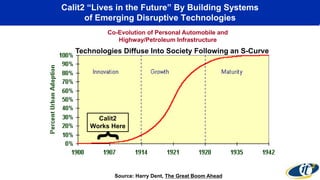
Calit2 “Lives in the Future” By Building Systems
of Emerging Disruptive Technologies
Co-Evolution of Personal Automobile and
Highway/Petroleum Infrastructure
Source: Harry Dent, The Great Boom Ahead
Calit2
Works Here
{
Technologies Diffuse Into Society Following an S-Curve
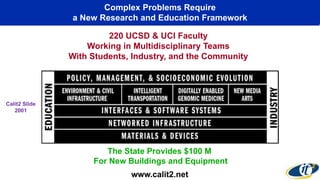
Complex Problems Require
a New Research and Education Framework
www.calit2.net
220 UCSD & UCI Faculty
Working in Multidisciplinary Teams
With Students, Industry, and the Community
The State Provides $100 M
For New Buildings and Equipment
Calit2 Slide
2001
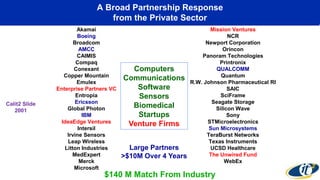
A Broad Partnership Response
from the Private Sector
Akamai
Boeing
Broadcom
AMCC
CAIMIS
Compaq
Conexant
Copper Mountain
Emulex
Enterprise Partners VC
Entropia
Ericsson
Global Photon
IBM
IdeaEdge Ventures
Intersil
Irvine Sensors
Leap Wireless
Litton Industries
MedExpert
Merck
Microsoft
Mission Ventures
NCR
Newport Corporation
Orincon
Panoram Technologies
Printronix
QUALCOMM
Quantum
R.W. Johnson Pharmaceutical RI
SAIC
SciFrame
Seagate Storage
Silicon Wave
Sony
STMicroelectronics
Sun Microsystems
TeraBurst Networks
Texas Instruments
UCSD Healthcare
The Unwired Fund
WebEx
Computers
Communications
Software
Sensors
Biomedical
Startups
Venture Firms
Large Partners
>$10M Over 4 Years
$140 M Match From Industry
Calit2 Slide
2001
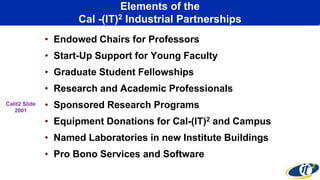
Elements of the
Cal -(IT)2 Industrial Partnerships
• Endowed Chairs for Professors
• Start-Up Support for Young Faculty
• Graduate Student Fellowships
• Research and Academic Professionals
• Sponsored Research Programs
• Equipment Donations for Cal-(IT)2 and Campus
• Named Laboratories in new Institute Buildings
• Pro Bono Services and Software
Calit2 Slide
2001
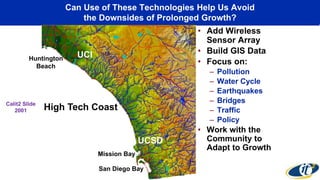
Can Use of These Technologies Help Us Avoid
the Downsides of Prolonged Growth?
• Add Wireless
Sensor Array
• Build GIS Data
• Focus on:
– Pollution
– Water Cycle
– Earthquakes
– Bridges
– Traffic
– Policy
• Work with the
Community to
Adapt to Growth
Huntington
Beach
Mission Bay
San Diego Bay
UCSD
UCI
High Tech CoastCalit2 Slide
2001
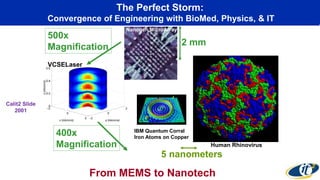
The Perfect Storm:
Convergence of Engineering with BioMed, Physics, & IT
5 nanometers
Human Rhinovirus
IBM Quantum Corral
Iron Atoms on Copper
400x
Magnification
From MEMS to Nanotech
VCSELaser
500x
Magnification 2 mm
Nanogen MicroArray
Calit2 Slide
2001
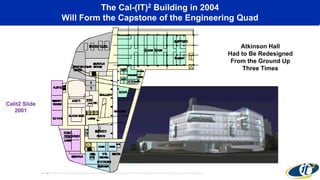
The Cal-(IT)2 Building in 2004
Will Form the Capstone of the Engineering Quad
Atkinson Hall
Had to Be Redesigned
From the Ground Up
Three Times
Calit2 Slide
2001
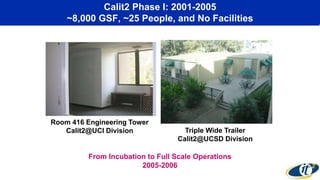
Calit2 Phase I: 2001-2005
~8,000 GSF, ~25 People, and No Facilities
Room 416 Engineering Tower
Calit2@UCI Division Triple Wide Trailer
Calit2@UCSD Division
From Incubation to Full Scale Operations
2005-2006
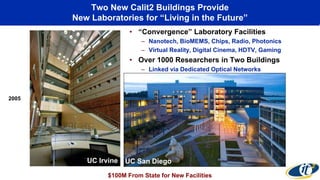
Two New Calit2 Buildings Provide
New Laboratories for “Living in the Future”
• “Convergence” Laboratory Facilities
– Nanotech, BioMEMS, Chips, Radio, Photonics
– Virtual Reality, Digital Cinema, HDTV, Gaming
• Over 1000 Researchers in Two Buildings
– Linked via Dedicated Optical Networks
UC Irvine
$100M From State for New Facilities
UC San Diego
2005
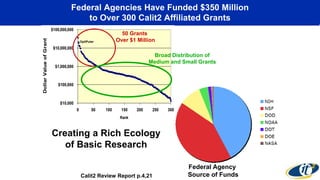
Federal Agency
Source of Funds
Federal Agencies Have Funded $350 Million
to Over 300 Calit2 Affiliated Grants
Creating a Rich Ecology
of Basic Research
$10,000
$100,000
$1,000,000
$10,000,000
$100,000,000
0 50 100 150 200 250 300
Rank
DollarValueofGrant
50 Grants
Over $1 Million
Broad Distribution of
Medium and Small Grants
OptIPuter
Calit2 Review Report p.4,21
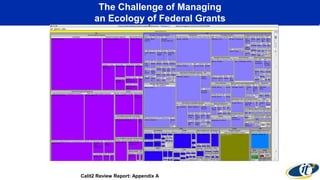
The Challenge of Managing
an Ecology of Federal Grants
Calit2 Review Report: Appendix A
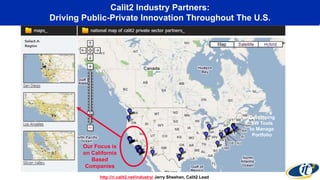
Calit2 Industry Partners:
Driving Public-Private Innovation Throughout The U.S.
Our Focus is
on California
Based
Companies
Developing
SW Tools
to Manage
Portfolio
http://ri.calit2.net/industry/ Jerry Sheehan, Calit2 Lead
Calit2 Works Closely with
San Diego and Orange County Industrial Groups
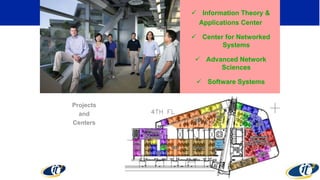
Projects
and
Centers
 Information Theory &
Applications Center
 Center for Networked
Systems
 Advanced Network
Sciences
 Software Systems
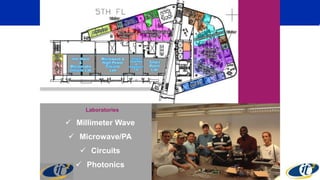
Laboratories
Millimeter Wave
Microwave/PA
Circuit Assembly
Smart Room
Laboratories
 Millimeter Wave
 Microwave/PA
 Circuits
 Photonics
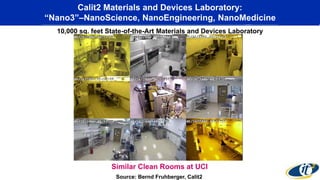
Nano3 Facility
CALIT2.UCSD
10,000 sq. feet State-of-the-Art Materials and Devices Laboratory
Calit2 Materials and Devices Laboratory:
“Nano3”–NanoScience, NanoEngineering, NanoMedicine
Source: Bernd Fruhberger, Calit2
Similar Clean Rooms at UCI
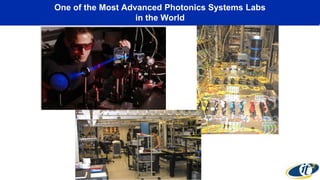
One of the Most Advanced Photonics Systems Labs
in the World
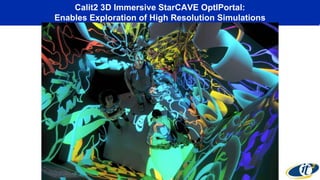
Calit2 3D Immersive StarCAVE OptIPortal:
Enables Exploration of High Resolution Simulations
Cluster with 30 Nvidia 5600 cards-60 GB Texture Memory
Source: Tom DeFanti, Greg Dawe, Calit2
Connected at 50 Gb/s to Quartzite
30 HD
Projectors!
15 Meyer Sound
Speakers +
Subwoofer
Passive Polarization--
Optimized the
Polarization Separation
and Minimized Attenuation
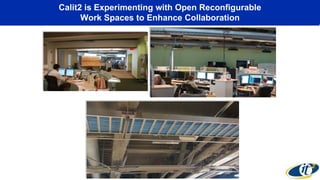
Calit2 is Experimenting with Open Reconfigurable
Work Spaces to Enhance Collaboration
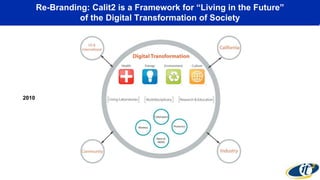
Re-Branding: Calit2 is a Framework for “Living in the Future”
of the Digital Transformation of Society
2010
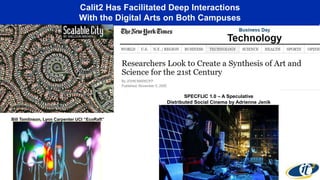
Calit2 Has Facilitated Deep Interactions
With the Digital Arts on Both Campuses
Ruth West, UCSD “Ecce Homology”
Bill Tomlinson, Lynn Carpenter UCI “EcoRaft”
SPECFLIC 1.0 – A Speculative
Distributed Social Cinema by Adrienne Jenik
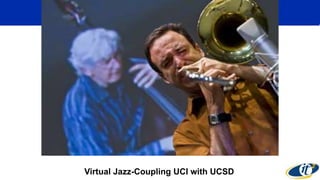
Virtual Jazz-Coupling UCI with UCSD
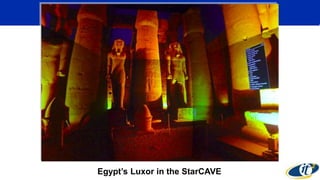
Egypt’s Luxor in the StarCAVE
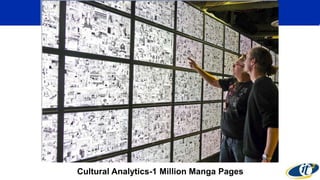
Cultural Analytics-1 Million Manga Pages
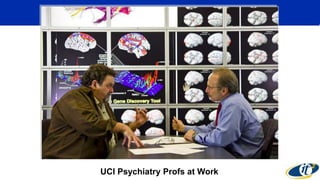
UCI Psychiatry Profs at Work
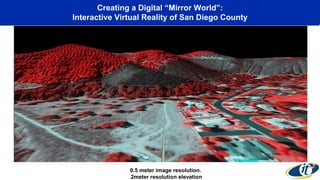
Creating a Digital “Mirror World”:
Interactive Virtual Reality of San Diego County
0.5 meter image resolution.
2meter resolution elevation
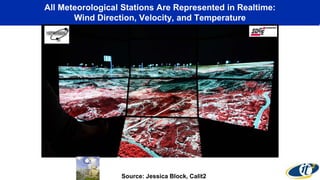
All Meteorological Stations Are Represented in Realtime:
Wind Direction, Velocity, and Temperature
Source: Jessica Block, Calit2
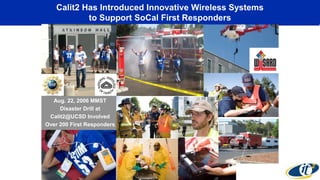
Calit2 Has Introduced Innovative Wireless Systems
to Support SoCal First Responders
Aug. 22, 2006 MMST
Disaster Drill at
Calit2@UCSD Involved
Over 200 First Responders
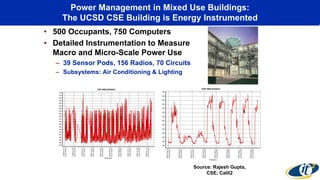
Power Management in Mixed Use Buildings:
The UCSD CSE Building is Energy Instrumented
• 500 Occupants, 750 Computers
• Detailed Instrumentation to Measure
Macro and Micro-Scale Power Use
– 39 Sensor Pods, 156 Radios, 70 Circuits
– Subsystems: Air Conditioning & Lighting
Source: Rajesh Gupta,
CSE, Calit2
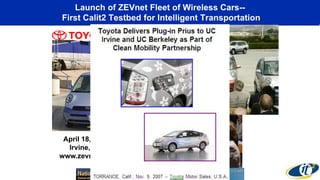
Launch of ZEVnet Fleet of Wireless Cars--
First Calit2 Testbed for Intelligent Transportation
April 18, 2002
Irvine, CA
www.zevnet.org
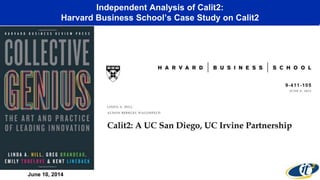
Independent Analysis of Calit2:
Harvard Business School’s Case Study on Calit2
June 10, 2014
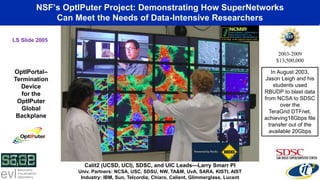
NSF’s OptIPuter Project: Demonstrating How SuperNetworks
Can Meet the Needs of Data-Intensive Researchers
OptIPortal–
Termination
Device
for the
OptIPuter
Global
Backplane
Calit2 (UCSD, UCI), SDSC, and UIC Leads—Larry Smarr PI
Univ. Partners: NCSA, USC, SDSU, NW, TA&M, UvA, SARA, KISTI, AIST
Industry: IBM, Sun, Telcordia, Chiaro, Calient, Glimmerglass, Lucent
2003-2009
$13,500,000
In August 2003,
Jason Leigh and his
students used
RBUDP to blast data
from NCSA to SDSC
over the
TeraGrid DTFnet,
achieving18Gbps file
transfer out of the
available 20Gbps
LS Slide 2005
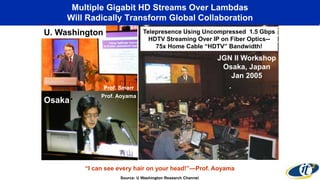
Multiple Gigabit HD Streams Over Lambdas
Will Radically Transform Global Collaboration
U. Washington
JGN II Workshop
Osaka, Japan
Jan 2005
Prof.Osaka
Prof. Aoyama
Prof. Smarr
Source: U Washington Research Channel
Telepresence Using Uncompressed 1.5 Gbps
HDTV Streaming Over IP on Fiber Optics--
75x Home Cable “HDTV” Bandwidth!
“I can see every hair on your head!”—Prof. Aoyama
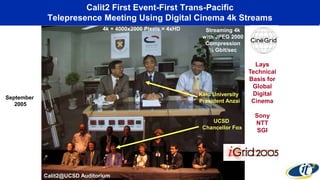
Calit2 First Event-First Trans-Pacific
Telepresence Meeting Using Digital Cinema 4k Streams
Keio University
President Anzai
UCSD
Chancellor Fox
Lays
Technical
Basis for
Global
Digital
Cinema
Sony
NTT
SGI
Streaming 4k
with JPEG 2000
Compression
½ Gbit/sec
Calit2@UCSD Auditorium
4k = 4000x2000 Pixels = 4xHD
September
2005
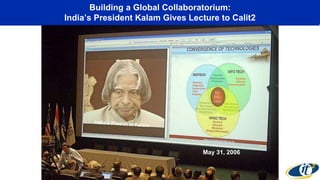
Building a Global Collaboratorium:
India’s President Kalam Gives Lecture to Calit2
May 31, 2006
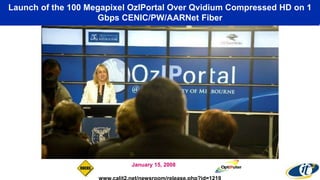
Launch of the 100 Megapixel OzIPortal Over Qvidium Compressed HD on 1
Gbps CENIC/PW/AARNet Fiber
January 15, 2008
Victoria Premier and Australian Deputy Prime Minister Asking Questions
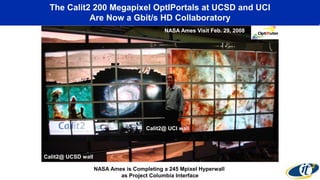
The Calit2 200 Megapixel OptIPortals at UCSD and UCI
Are Now a Gbit/s HD Collaboratory
Calit2@ UCSD wall
Calit2@ UCI wall
NASA Ames is Completing a 245 Mpixel Hyperwall
as Project Columbia Interface
NASA Ames Visit Feb. 29, 2008
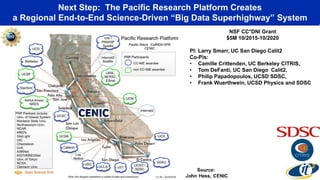
Next Step: The Pacific Research Platform Creates
a Regional End-to-End Science-Driven “Big Data Superhighway” System
NSF CC*DNI Grant
$5M 10/2015-10/2020
PI: Larry Smarr, UC San Diego Calit2
Co-Pis:
• Camille Crittenden, UC Berkeley CITRIS,
• Tom DeFanti, UC San Diego Calit2,
• Philip Papadopoulos, UCSD SDSC,
• Frank Wuerthwein, UCSD Physics and SDSC
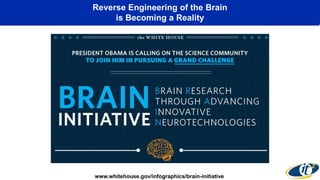
Reverse Engineering of the Brain
is Becoming a Reality
www.whitehouse.gov/infographics/brain-initiative
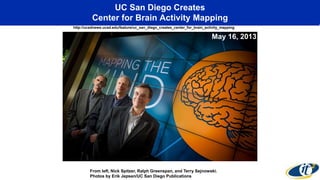
UC San Diego Creates
Center for Brain Activity Mapping
http://ucsdnews.ucsd.edu/feature/uc_san_diego_creates_center_for_brain_activity_mapping
From left, Nick Spitzer, Ralph Greenspan, and Terry Sejnowski.
Photos by Erik Jepsen/UC San Diego Publications
May 16, 2013
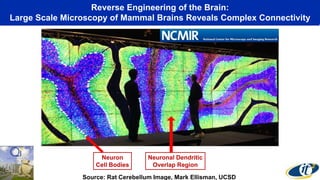
Reverse Engineering of the Brain:
Large Scale Microscopy of Mammal Brains Reveals Complex Connectivity
Neuron
Cell Bodies
Neuronal Dendritic
Overlap Region
Source: Rat Cerebellum Image, Mark Ellisman, UCSD
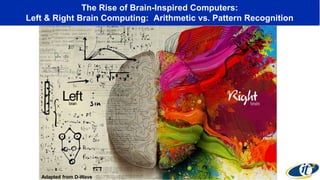
The Rise of Brain-Inspired Computers:
Left & Right Brain Computing: Arithmetic vs. Pattern Recognition
Adapted from D-Wave
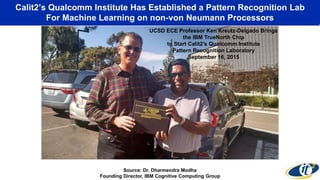
Calit2’s Qualcomm Institute Has Established a Pattern Recognition Lab
For Machine Learning on non-von Neumann Processors
“On the drawing board are collections of 64, 256, 1024, and 4096 chips.
‘It’s only limited by money, not imagination,’ Modha says.”
Source: Dr. Dharmendra Modha
Founding Director, IBM Cognitive Computing Group
August 8, 2014
UCSD ECE Professor Ken Kreutz-Delgado Brings
the IBM TrueNorth Chip
to Start Calit2’s Qualcomm Institute
Pattern Recognition Laboratory
September 16, 2015
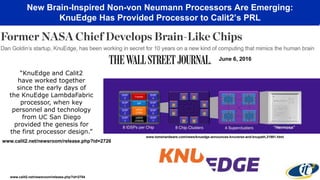
New Brain-Inspired Non-von Neumann Processors Are Emerging:
KnuEdge Has Provided Processor to Calit2’s PRL
www.tomshardware.com/news/knuedge-announces-knuverse-and-knupath,31981.html
www.calit2.net/newsroom/release.php?id=2704
“KnuEdge and Calit2
have worked together
since the early days of
the KnuEdge LambdaFabric
processor, when key
personnel and technology
from UC San Diego
provided the genesis for
the first processor design.”
www.calit2.net/newsroom/release.php?id=2726
June 6, 2016
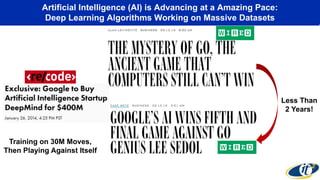
Artificial Intelligence (AI) is Advancing at a Amazing Pace:
Deep Learning Algorithms Working on Massive Datasets
Training on 30M Moves,
Then Playing Against Itself
Less Than
2 Years!
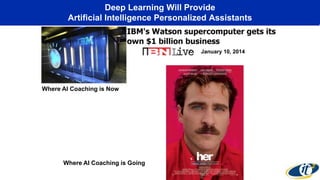
Deep Learning Will Provide
Artificial Intelligence Personalized Assistants
Where AI Coaching is Now
Where AI Coaching is Going
January 10, 2014

The Creation of Calit2

  • 1.
    “The Creation ofCalit2” Guest Lecture Gordon Engineering Leadership Center UC San Diego January 25, 2017 Dr. Larry Smarr Director, California Institute for Telecommunications and Information Technology Harry E. Gruber Professor, Dept. of Computer Science and Engineering Jacobs School of Engineering, UCSD http://lsmarr.calit2.net 1
  • 2.
    California’s Institutes forScience and Innovation A Bold Experiment in Collaborative Research UCSB UCLA California NanoSystems Institute UCSF UCB California Institute for Bioengineering, Biotechnology, and Quantitative Biomedical Research UCI UCSD California Institute for Telecommunications and Information Technology Center for Information Technology Research in the Interest of Society UCSC UCD UCM www.ucop.edu/california-institutes
  • 3.
    Calit2’s Initial MissionStatement Envisioning How the Extension of Innovative Telecommunications and Information Technologies Throughout the Physical World will Transform Critical Applications Important to the California Economy and its Citizens’ Quality Of Life. Calit2 is a University of California “Institutional Innovation” Experiment on How to Invent a Persistent Collaborative Research and Education Environment that Provides Insight into How the UC, a Major Research University, Might Evolve in the Future. Calit2 Review Report: p.1
  • 4.
    Calit2 “Lives inthe Future” By Building Systems of Emerging Disruptive Technologies Co-Evolution of Personal Automobile and Highway/Petroleum Infrastructure Source: Harry Dent, The Great Boom Ahead Calit2 Works Here { Technologies Diffuse Into Society Following an S-Curve
  • 5.
    Complex Problems Require aNew Research and Education Framework www.calit2.net 220 UCSD & UCI Faculty Working in Multidisciplinary Teams With Students, Industry, and the Community The State Provides $100 M For New Buildings and Equipment Calit2 Slide 2001
  • 6.
    A Broad PartnershipResponse from the Private Sector Akamai Boeing Broadcom AMCC CAIMIS Compaq Conexant Copper Mountain Emulex Enterprise Partners VC Entropia Ericsson Global Photon IBM IdeaEdge Ventures Intersil Irvine Sensors Leap Wireless Litton Industries MedExpert Merck Microsoft Mission Ventures NCR Newport Corporation Orincon Panoram Technologies Printronix QUALCOMM Quantum R.W. Johnson Pharmaceutical RI SAIC SciFrame Seagate Storage Silicon Wave Sony STMicroelectronics Sun Microsystems TeraBurst Networks Texas Instruments UCSD Healthcare The Unwired Fund WebEx Computers Communications Software Sensors Biomedical Startups Venture Firms Large Partners >$10M Over 4 Years $140 M Match From Industry Calit2 Slide 2001
  • 7.
    Elements of the Cal-(IT)2 Industrial Partnerships • Endowed Chairs for Professors • Start-Up Support for Young Faculty • Graduate Student Fellowships • Research and Academic Professionals • Sponsored Research Programs • Equipment Donations for Cal-(IT)2 and Campus • Named Laboratories in new Institute Buildings • Pro Bono Services and Software Calit2 Slide 2001
  • 8.
    Can Use ofThese Technologies Help Us Avoid the Downsides of Prolonged Growth? • Add Wireless Sensor Array • Build GIS Data • Focus on: – Pollution – Water Cycle – Earthquakes – Bridges – Traffic – Policy • Work with the Community to Adapt to Growth Huntington Beach Mission Bay San Diego Bay UCSD UCI High Tech CoastCalit2 Slide 2001
  • 9.
    The Perfect Storm: Convergenceof Engineering with BioMed, Physics, & IT 5 nanometers Human Rhinovirus IBM Quantum Corral Iron Atoms on Copper 400x Magnification From MEMS to Nanotech VCSELaser 500x Magnification 2 mm Nanogen MicroArray Calit2 Slide 2001
  • 10.
    The Cal-(IT)2 Buildingin 2004 Will Form the Capstone of the Engineering Quad Atkinson Hall Had to Be Redesigned From the Ground Up Three Times Calit2 Slide 2001
  • 11.
    Calit2 Phase I:2001-2005 ~8,000 GSF, ~25 People, and No Facilities Room 416 Engineering Tower Calit2@UCI Division Triple Wide Trailer Calit2@UCSD Division From Incubation to Full Scale Operations 2005-2006
  • 12.
    Two New Calit2Buildings Provide New Laboratories for “Living in the Future” • “Convergence” Laboratory Facilities – Nanotech, BioMEMS, Chips, Radio, Photonics – Virtual Reality, Digital Cinema, HDTV, Gaming • Over 1000 Researchers in Two Buildings – Linked via Dedicated Optical Networks UC Irvine $100M From State for New Facilities UC San Diego 2005
  • 13.
    Federal Agency Source ofFunds Federal Agencies Have Funded $350 Million to Over 300 Calit2 Affiliated Grants Creating a Rich Ecology of Basic Research $10,000 $100,000 $1,000,000 $10,000,000 $100,000,000 0 50 100 150 200 250 300 Rank DollarValueofGrant 50 Grants Over $1 Million Broad Distribution of Medium and Small Grants OptIPuter Calit2 Review Report p.4,21
  • 14.
    The Challenge ofManaging an Ecology of Federal Grants Calit2 Review Report: Appendix A
  • 15.
    Calit2 Industry Partners: DrivingPublic-Private Innovation Throughout The U.S. Our Focus is on California Based Companies Developing SW Tools to Manage Portfolio http://ri.calit2.net/industry/ Jerry Sheehan, Calit2 Lead
  • 16.
    Calit2 Works Closelywith San Diego and Orange County Industrial Groups
  • 17.
    Projects and Centers  Information Theory& Applications Center  Center for Networked Systems  Advanced Network Sciences  Software Systems
  • 18.
    Laboratories Millimeter Wave Microwave/PA Circuit Assembly SmartRoom Laboratories  Millimeter Wave  Microwave/PA  Circuits  Photonics
  • 19.
    Nano3 Facility CALIT2.UCSD 10,000 sq.feet State-of-the-Art Materials and Devices Laboratory Calit2 Materials and Devices Laboratory: “Nano3”–NanoScience, NanoEngineering, NanoMedicine Source: Bernd Fruhberger, Calit2 Similar Clean Rooms at UCI
  • 20.
    One of theMost Advanced Photonics Systems Labs in the World
  • 21.
    Calit2 3D ImmersiveStarCAVE OptIPortal: Enables Exploration of High Resolution Simulations Cluster with 30 Nvidia 5600 cards-60 GB Texture Memory Source: Tom DeFanti, Greg Dawe, Calit2 Connected at 50 Gb/s to Quartzite 30 HD Projectors! 15 Meyer Sound Speakers + Subwoofer Passive Polarization-- Optimized the Polarization Separation and Minimized Attenuation
  • 22.
    Calit2 is Experimentingwith Open Reconfigurable Work Spaces to Enhance Collaboration
  • 23.
    Re-Branding: Calit2 isa Framework for “Living in the Future” of the Digital Transformation of Society 2010
  • 24.
    Calit2 Has FacilitatedDeep Interactions With the Digital Arts on Both Campuses Ruth West, UCSD “Ecce Homology” Bill Tomlinson, Lynn Carpenter UCI “EcoRaft” SPECFLIC 1.0 – A Speculative Distributed Social Cinema by Adrienne Jenik
  • 25.
  • 26.
    Egypt’s Luxor inthe StarCAVE
  • 27.
  • 28.
  • 29.
    Creating a Digital“Mirror World”: Interactive Virtual Reality of San Diego County 0.5 meter image resolution. 2meter resolution elevation
  • 30.
    All Meteorological StationsAre Represented in Realtime: Wind Direction, Velocity, and Temperature Source: Jessica Block, Calit2
  • 32.
    Calit2 Has IntroducedInnovative Wireless Systems to Support SoCal First Responders Aug. 22, 2006 MMST Disaster Drill at Calit2@UCSD Involved Over 200 First Responders
  • 33.
    Power Management inMixed Use Buildings: The UCSD CSE Building is Energy Instrumented • 500 Occupants, 750 Computers • Detailed Instrumentation to Measure Macro and Micro-Scale Power Use – 39 Sensor Pods, 156 Radios, 70 Circuits – Subsystems: Air Conditioning & Lighting Source: Rajesh Gupta, CSE, Calit2
  • 34.
    Launch of ZEVnetFleet of Wireless Cars-- First Calit2 Testbed for Intelligent Transportation April 18, 2002 Irvine, CA www.zevnet.org
  • 35.
    Independent Analysis ofCalit2: Harvard Business School’s Case Study on Calit2 June 10, 2014
  • 36.
    NSF’s OptIPuter Project:Demonstrating How SuperNetworks Can Meet the Needs of Data-Intensive Researchers OptIPortal– Termination Device for the OptIPuter Global Backplane Calit2 (UCSD, UCI), SDSC, and UIC Leads—Larry Smarr PI Univ. Partners: NCSA, USC, SDSU, NW, TA&M, UvA, SARA, KISTI, AIST Industry: IBM, Sun, Telcordia, Chiaro, Calient, Glimmerglass, Lucent 2003-2009 $13,500,000 In August 2003, Jason Leigh and his students used RBUDP to blast data from NCSA to SDSC over the TeraGrid DTFnet, achieving18Gbps file transfer out of the available 20Gbps LS Slide 2005
  • 37.
    Multiple Gigabit HDStreams Over Lambdas Will Radically Transform Global Collaboration U. Washington JGN II Workshop Osaka, Japan Jan 2005 Prof.Osaka Prof. Aoyama Prof. Smarr Source: U Washington Research Channel Telepresence Using Uncompressed 1.5 Gbps HDTV Streaming Over IP on Fiber Optics-- 75x Home Cable “HDTV” Bandwidth! “I can see every hair on your head!”—Prof. Aoyama
  • 38.
    Calit2 First Event-FirstTrans-Pacific Telepresence Meeting Using Digital Cinema 4k Streams Keio University President Anzai UCSD Chancellor Fox Lays Technical Basis for Global Digital Cinema Sony NTT SGI Streaming 4k with JPEG 2000 Compression ½ Gbit/sec Calit2@UCSD Auditorium 4k = 4000x2000 Pixels = 4xHD September 2005
  • 39.
    Building a GlobalCollaboratorium: India’s President Kalam Gives Lecture to Calit2 May 31, 2006
  • 40.
    Launch of the100 Megapixel OzIPortal Over Qvidium Compressed HD on 1 Gbps CENIC/PW/AARNet Fiber January 15, 2008
  • 41.
    Victoria Premier andAustralian Deputy Prime Minister Asking Questions
  • 42.
    The Calit2 200Megapixel OptIPortals at UCSD and UCI Are Now a Gbit/s HD Collaboratory Calit2@ UCSD wall Calit2@ UCI wall NASA Ames is Completing a 245 Mpixel Hyperwall as Project Columbia Interface NASA Ames Visit Feb. 29, 2008
  • 43.
    Next Step: ThePacific Research Platform Creates a Regional End-to-End Science-Driven “Big Data Superhighway” System NSF CC*DNI Grant $5M 10/2015-10/2020 PI: Larry Smarr, UC San Diego Calit2 Co-Pis: • Camille Crittenden, UC Berkeley CITRIS, • Tom DeFanti, UC San Diego Calit2, • Philip Papadopoulos, UCSD SDSC, • Frank Wuerthwein, UCSD Physics and SDSC
  • 44.
    Reverse Engineering ofthe Brain is Becoming a Reality www.whitehouse.gov/infographics/brain-initiative
  • 45.
    UC San DiegoCreates Center for Brain Activity Mapping http://ucsdnews.ucsd.edu/feature/uc_san_diego_creates_center_for_brain_activity_mapping From left, Nick Spitzer, Ralph Greenspan, and Terry Sejnowski. Photos by Erik Jepsen/UC San Diego Publications May 16, 2013
  • 46.
    Reverse Engineering ofthe Brain: Large Scale Microscopy of Mammal Brains Reveals Complex Connectivity Neuron Cell Bodies Neuronal Dendritic Overlap Region Source: Rat Cerebellum Image, Mark Ellisman, UCSD
  • 47.
    The Rise ofBrain-Inspired Computers: Left & Right Brain Computing: Arithmetic vs. Pattern Recognition Adapted from D-Wave
  • 48.
    Calit2’s Qualcomm InstituteHas Established a Pattern Recognition Lab For Machine Learning on non-von Neumann Processors “On the drawing board are collections of 64, 256, 1024, and 4096 chips. ‘It’s only limited by money, not imagination,’ Modha says.” Source: Dr. Dharmendra Modha Founding Director, IBM Cognitive Computing Group August 8, 2014 UCSD ECE Professor Ken Kreutz-Delgado Brings the IBM TrueNorth Chip to Start Calit2’s Qualcomm Institute Pattern Recognition Laboratory September 16, 2015
  • 49.
    New Brain-Inspired Non-vonNeumann Processors Are Emerging: KnuEdge Has Provided Processor to Calit2’s PRL www.tomshardware.com/news/knuedge-announces-knuverse-and-knupath,31981.html www.calit2.net/newsroom/release.php?id=2704 “KnuEdge and Calit2 have worked together since the early days of the KnuEdge LambdaFabric processor, when key personnel and technology from UC San Diego provided the genesis for the first processor design.” www.calit2.net/newsroom/release.php?id=2726 June 6, 2016
  • 50.
    Artificial Intelligence (AI)is Advancing at a Amazing Pace: Deep Learning Algorithms Working on Massive Datasets Training on 30M Moves, Then Playing Against Itself Less Than 2 Years!
  • 51.
    Deep Learning WillProvide Artificial Intelligence Personalized Assistants Where AI Coaching is Now Where AI Coaching is Going January 10, 2014