The Complete
Guide to
Asset Recovery
Are you leaving valuable business
capital unclaimed without even knowing?
Everything your business needs to know
about asset recovery - Simplified.
NRISolutions.com (855) 709-9813
2 NRI Industrial
Table Of Contents:
Key Terms Glossary
What Is Asset Recovery? Who Can Manage Asset
Recovery?
What are the Different Methods
of Selling Surplus?
4
5
What are the Benefits Of
Asset Recovery?
How to Identify Surplus 7
Methods of Recovery
9
12
11
Who is NRI Industrial? 14
What Can Be Recovered? 8
6
3NRI Industrial
The Complete Guide to Asset
Recovery
These items are not helping your
corporation but are likely lingering on your
property and books. If your organization
is like most, you have a whole stock room,
closet or even a building dedicated to
unused equipment and MRO you no longer
use.
When you store equipment, tools, and
surplus inventory, you’re using up space
that could be put to better use. Whether you
want to give your team more space to work,
are tired of tripping over excess inventory,
or simply want to recover some of the funds
you’ve invested, asset recovery can help.
Outdated, obsolete, or used industrial parts, equipment you no longer use,
surplus assets that won’t appreciate with age.
4 NRI Industrial
Terms to Know:
The below terms are often used when discussing asset recovery and will be heavily
featured in this piece. We have defined each term below to allow full understanding
without overwhelming you with industry jargon.
Term Definition
Investment
Recovery
This is an alternative term for asset recovery and may be used
interchangeably. It describes the process of recouping the
value from the end of life assets or items purchased but never
deployed.
Open Bidding
Format
An open bid is a bid that can be changed or modified after
submission, in order to meet competing bids. Open bidding
may be done through a auctions, where an auctioneer calls
out prices as bidders indicate their willingness to pay.
Surplus
Equipment, parts, supplies or material that is no longer needed
for your operations. These items could be new or used.
Surplus Equipment
Buyers
Businesses that specialize in purchasing and resale of surplus
industrial assets.
Consignment Based
Selling
A form of selling in which a third party sells goods on the
owner’s behalf for a fee. In the industrial world consignment
based selling could be in the form of auctions or private treaty
sales.
Online Auction Platform
Online auction platform provide bidding technology or
marketplace services to buy or sell industrial assets in online
auctions. Generally, online auction platforms are integrated
into a marketplace that connects buyers and sellers.
Forced Liquidation
Process of liquidating assets in a time constrained
environment-where assets must be sold by within a certain
time period, regardless of price. Forced liquidation generally
yields lower recovery compared to Orderly Liquidation.
Orderly Liquidation
Processing of liquidating assets in a reasonable
timeframe with an emphasis placed on recovering fair market
value.
Private Treaty Sale
Method of selling assets via negotiating a sale price directly
with the buyer. Offers by buyers can be made directly to the
sellers or through an agent.
Businesses tend to purchase assets based on
projected needs. However, often those needs
change. A project is cancelled, specifications are
altered or technology becomes obsolete; and
items that were once crucial to operations either
become redundant or simply never put into use.
Asset recovery is the process of recovering the
capital poured into those assets which are now
surplus.
Industrial asset recovery is similar to other types
of capital recovery, with an emphasis on recouping
residual value from industrial assets. These assets
can range from small spare parts to entire
manufacturing plants.
The purpose of industrial asset recovery, as the
term implies, is to focus on surplus tangible assets
that can be converted to another form of capital
such as cash.
When you take the time to set up an asset
recovery plan, you are turning items that are no
longer serving a purpose or no longer have value
to your organization into liquid capital for your
business. You’re also clearing out space for new
items or inventory, cutting your costs and
ensuring you are not paying to house and protect
out of date machinery and inventory items while
also ensuring you maximize the value of every
asset.
5NRI Industrial
What Is Asset Recovery
Asset recovery allows an organization to reclaim the value of purchased assets by
reusing them, selling them, disposing of them or recycling them.
Inventory Write Down
Inventory write-down is the accounting process
where a company formally recognizes that a por-
tion of the company’s inventory value is reduced..
By performing inventory write-down on surplus
assets you are able to credit the value of the
write-down in the income statement. By crediting
the write down you are therefore reducing the net
revenue of the business, by doing this you are in
turn reduce taxable amount for the business.
Environmental Benefits & Factors
While not directly tied to a financial benefit
environmental factors provide a very important
benefit. By undergoing an asset recovery
strategy and finding other uses or reselling
industrial equipment to someone who may use
it you are preventing the item from ending up a
scrap yard or land fill.
Corporate Sustainability
As modern businesses continue to adjust one
buzz word that is continuously discussed is corpo-
rate sustainability. From the investor side seeing a
company that has a corporate sustainability plan
is beneficial and may warrant interest in future
investments. From the organization side failing to
meet promises or goals of sustainability can be
extremely costly.
Recover Capital
Recovering capital is the primary reason why most
businesses will implement an industrial asset
recovery strategy. This refers to the capital that is
realized through the sale of any used equipment
or surplus. By liquidating unused assets you are
able to see an increase in cash flow for the
business that can be redirected to better suit the
needs of the business at that time.
Free Up Space
Storage space is becoming more and more
expensive. By holding onto surplus industrial
assets you risk increasing expenses for additional
storage space. By liquidating your unused
industrial assets you free up additional storage
space that could be used for more cost-efficient
purposes.
Reduce Inventory
Another benefit of implementing an asset recovery
strategy is reducing slow moving or static
inventory in storage. By putting these items
through an asset recovery strategy you recover
value from these items while also clearing out
storage space for inventory you don’t need or
don’t regularly need.
6 NRI Industrial
What Are the Benefits of
Asset Recovery?
When you go through an asset recovery process, your business benefits in a variety
of ways. Here are the many ways your business will benefit from asset recovery
Buying too much of a supply or purchasing
equipment that doesn’t meet your needs, results in
an almost instant surplus. However, a surplus
problem does not always occur overnight in many
cases, a surplus issue arises over the course of many
years of production. Here are 3 ways to identify
surplus.
Check Your Financial Reports
When attempting to identify surplus the best place
to start is your financial records. These records are
a literal goldmine of information regarding surplus
within a company. By reviewing financial records, you
can review purchasing history for records of
equipment or MRO purchases as well as expense
reports documenting potential tax write-downs.
Check For Slow Moving Inventory
Another option when finding surplus within an
organization is to review company inventory. When
reviewing inventory, you should be looking for slow
moving items. For example, if you need a new pump
every 2 years, but you have 5 pumps on hand plus
additional pumps scheduled to be purchased you
are operating at a surplus.
Try to find items that have a slow turn over rate and
analyze realistically how quickly or slowly one may
go through the inventory.
Question the Need for Warehouse
Expansion
With the rising costs of warehouse storage space
rising to an average cost of $6.50 per square foot
per month in the USA it’s best to stay aware of
current storage situations. Receiving requests for
additional storage space should be the last line
of identifying surplus. Unless undertaking a new
project or product line storage space requirements
should remain constant if you are not operating
near surplus.
While all the above are strong methods of
identifying surplus assets another efficient method
to identify surplus is utilizing an asset
management software can greatly impact your
visibility on surplus. Most ERP systems have the
capability to identify and mark inventory and
assets that are being underutilized.
How to Identify Surplus
How can you tell if you have surplus? Most organizations have surplus MRO or
unused equipment, but they do not know where to look for it or the signs of it.
7NRI Industrial
9 y
p t
V v
8 NRI Industrial
What Can Be Recovered?
Material Handling Equipment,
Vehciles, Rolling Stock
Production Machinery & Process
Equipment
Tools, Maintenance Shop
Equipment
MRO & Spare Parts Inventory
Testing & Measurement
Equipment
IT Assets
While each organization is unique, there are many broad categories of items
that can be recovered and used to generate revenue, including:
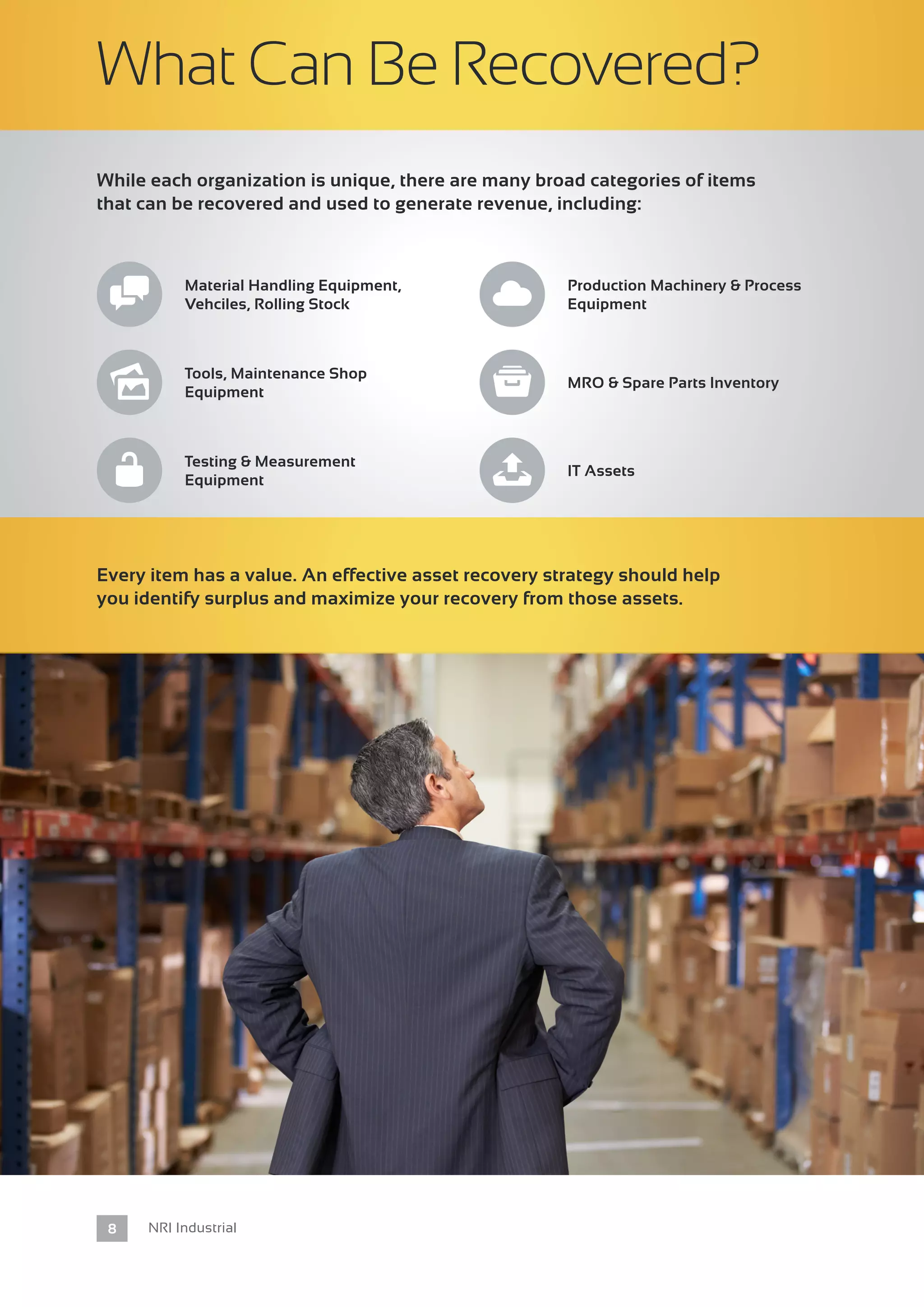
Every item has a value. An effective asset recovery strategy should help
you identify surplus and maximize your recovery from those assets.
9NRI Industrial
Redeploy
This is when a vendor has a buyback policy on
certain pieces of equipment. This could be a
buyback or return after use. The benefit of
returning unused industrial assets or used
larger pieces of industrial equipment to the
original vendor is the vendor removes
equipment at own costs freeing up vital space
for new equipment, while sometimes
providing credit for future item purchasing. The
risk associated with this option is not all vendors
offer a return to vendor option and the ones that
do offer them with very strict guidelines on the
previous usage, runtime, etc of the equipment
they will accept returns from.
This option occurs when the owner of the
surplus equipment elects for selling the
equipment through various methods including
direct sales, auctions, and more. This could be
either orderly liquidation or forced liquidation. The
benefits of this option include recovering vital
storage space for industrial assets while also
receiving an increase in cash flow from the
revenue generated from the sale. The downside of
this option is the sales and marketing of industrial
equipment or surplus MRO can be challenging
and expensive. Requires dedicated team
members or someone or a company with the
expertise to maximize return.
Redeploy refers to reusing used equipment or
incorporating surplus assets back into the
production line. This is where the items or
equipment are used in the exact same production
line with no modifications or changes. The
benefit of this option is your equipment does not
sit idle. You are able to put the assets
immediately back into production whether it be in
another limited capacity role or at another
production line or location. The risk of this option
is the potential break down of this equipment
costing more time and money to repair the
equipment or buying new ones.
Recondition
Refresh or refurbish used equipment or surplus
MRO to be added back into the production line at
the originally intended purpose or a new purpose.
The benefit of reconditioning industrial assets is it
is less expensive to recondition equipment than
to purchase new equipment. Familiarity with the
equipment allows your team to know the ins and
outs of using that equipment allowing for greater
ease of use when manufacturing. The downside to
reconditioning equipment is the prevention of new
technology from new equipment being introduced
into a production line.
Return to Vendor Resell
The 7 Methods of Asset Recovery
There are several options for the removal of this surplus however each method has risks and
benefits associated, below is a list of the seven different options for recovery with the risks
and benefits associated with each.
This is when the owner of the equipment pays for
the items/equipment to be removed. Once
removed the item is normally scrapped. The
benefit of this option is the removal of the surplus
asset from storage as well as any potential scrap
metal value. However, in many cases, you must
pay to remove the scrap resulting in spending
more to remove the item. This method generates
the least possible value for your business.
This method is when the owner takes parts or
sections of used equipment or surplus MRO that
are still good for use and re-used for other
purposes. The benefit of this method of asset
recovery is that it is cost effective for specific parts
that the equipment may already have. By
breaking down the machinery for additional parts
you save on additional spending on newer parts.
The downside of this option is not all equipment
and machinery require the same parts, Normally
parts and MRO are used for one purpose only,
trying to customize parts for specific functions
could cause future issues.
This is when the owner of the equipment donates
the equipment to a non-profit or other organization
The benefit of this recovery method is the
equipment is removed from storage. Potential tax
refunds for the donation of equipment. Builds
goodwill in the community for equipment donation.
The risks associated with this method of recovery
is that in most cases the tax refund is minimal and
does not provide much value to the company. In
some cases, items may not be to receive a tax
benefit back.
Reclaim Donation
Removal
Removal
Donation
Reclaim
Resell
Return To
Vendor
Recondition
Redeploy
ValueRecovedVia
AssetRecoveryStrategy
10 NRI Industrial
Internal Employees
If you have a team or individual that can handle
asset recovery on an ongoing basis, it can work.
You should be sure that the salary and
responsibilities of this person are not surpassing
the revenues generated by the recoveries they
perform.
If you do not have a lot of surplus and don’t have
a backlog, then an internal employee can take on
this role. Choosing someone that already works
for you and who is familiar with your systems,
workflow and inventory can help ensure success
since they are already accustomed to working with
your company. A large amount of surplus could be
an overwhelming task for solo employee or team;
an outside firm is generally a better choice in this
case.
External Employees
If you are not sure how to run the asset recovery
process, don’t want to go to the expense of hiring
or training an employee or are worried you’ll miss
something, an external contractor can help. If you
have a large backlog of surplus, an external
company can help you get through that backlog
then turn over the regular flow of recovery to an
internal team.
Using an external contractor for asset recovery is a
“set it and forget it” approach that generates extra
revenue and clears up space without a lot of extra
work or investment. That convenience, coupled
with the ability to get top dollar for surplus from
qualified buyers, are the primary reasons
companies choose professionals for the asset
recovery process.
11NRI Industrial
Who Can Manage Asset
Recovery
Your own team can manage asset recovery, but it does take time to identify items
for sale, assign value and find qualified buyers for your items. In many cases,
choosing an external contractor ensures that the team handling this process
has significant expertise and that you get the best possible return on your asset
recovery investment. Some options for managing your asset recovery process
include:
Orderly Liquidation Value
Forced Liquidation
Value
Value
Consignment
Auctions
Online Auctions
Private Treaty Sale
12 NRI Industrial
What Are the Different
Methods for Selling Surplus?
Now what? You have a few options when it comes to selling off surplus equipment, however, there are a
couple of factors you need to be aware of when selecting an option. The first thing you need to be aware of
when selecting a strategy is what form of liquidation is this. It is widely accepted that there are two forms of
liquidation, orderly liquidation is a process in which the price, timing, and terms of sale are fully controlled
by the selling party. Orderly liquidation aims for a selling price close to the fair market value of the assets.
The time to complete the sale is typically longer in an orderly liquidation process since willing buyers have
to be identified and the terms of the sale are negotiated.
Forced liquidation is a process in which the terms of the sale are largely controlled by the seller, however,
the pricing is dictated by the open market. Forced liquidation is typically utilized in situations where there
a time constraint is placed on the sale of the assets. For this guide, we will be reviewing the options sur-
rounding orderly liquidation.
You’ve done a comprehensive assessment of the items you have that you consider
surplus – and have made a list of equipment and surplus MRO you no longer need.
Private Treaty Sale
A private treaty sale is when the owner of an item
or equipment independently attempts to sell said
item. This is one of the most common methods
used by other corporations attempting to
generate capital from used assets, however, this
does not always mean this is the best option. In
order to liquidate the item, you must employ a
member with experience and knowledge in selling
the equipment and someone who can properly
market the equipment to ensure a quick
turnaround when selling the item. A private treaty
sale can be conducted in person as well as online
via various online sales channels.
Auctions
Auction falls into both orderly and forced
liquidation categories. This is when items are either
selected or forced for sale. The difference between
orderly and forced auctions start here. In a forced
auction the company is trying to recover any value
possible. As such companies will often accept
less value than the equipment is worth just for the
increase of liquid capital. In an orderly liquidation
auction, the seller can set the terms of the auction
and the minimum bid for the items to ensure the
value recovered is greater than a forced auction.
Certain items are also better suited for auction
instead of other orderly liquidation options. This
could include large industrial equipment, vehicles,
and more.
Online Auction
Online auctions is another version of orderly
liquidation. Much like in-person auctions
previously discussed online auctions allow for
the seller to dictate the terms of the sale and the
minimum bid amount. An advantage of an online
auction is the potential reach of the sale. Instead
of having to force potential buyers to be onsite
during the auction an online auction allows buyers
to access, browse and bid on lots from anywhere
in the world.
Consignment
This method of liquidation involves a third party. This
third party normally has expertise in selling or moving
equipment. The process is simple, first, you select and
ship the equipment you would like to liquidate. It is the
job of the consigner to sell the equipment on your
behalf. Once sold the consigner will pay out a portion
previously agreed on for the item sold. If an item is
needed and you no longer wish to sell the item, the
consigner will return the equipment to you as you
retain ownership of the item throughout the sales
process.
13NRI Industrial
14 NRI Industrial
How can you tell if you have surplus MRO? Most organizations have surplus MRO
or unused equipment, but they do not know where to look for it or the signs of it.
Who is NRI Industrial?
Innovative solutions and a comprehensive approach
to identifying and properly disposing of surplus and
capital assets allows NRI Industrial to have a
significant impact on revenues for clients of all sizes.
NRI Industrial is an industry leader when it comes to industrial asset recovery, NRI
Industrial helps organizations recover capital from unused industrial equipment and
surplus MRO every day.
While our proven strategies and approach to asset
recovery is based on industry best practices and our
long history of success, every recovery is unique.
Each customer has specific needs and specific items
that can be recovered, reclaimed and converted into
revenue, so each NRI Industrial customer receives a
custom solution that perfectly aligns with their needs
and goals.
With a long history of developing partnerships and an extensive client list, NRI
Industrial uniquely poised to help organizations recover key assets and regain
revenues that would otherwise be lost. We love showcasing the difference that our
brand makes for our clients. See some of our recent success stories here and learn
how we helped brands just like yours recover industrial assets and make the most
of the disposition process.
15NRI Industrial
Asset Liquidation
Your surplus items can be liquidated to generate
revenue and clear out space; you’ll be able to turn your
unwanted items into capital that can be used for other
projects. The asset liquidation process is ideal for
getting rid of items that you no longer want or need and
for clearing out large amounts of MRO and inventory.
Consignment Services
Consigning items allows them to be removed quickly and can
help maximize the recovered revenues and costs. You’ll be able
to track when your items are sold and get top dollar without
having to keep your capital surplus and MRO pieces on hand
until they are sold.
Decommissioning
Services
Some assets must be decommissioned before they
can be resold or recycled. This includes proprietary
equipment that cannot fall into the hands of your
competitors. Our team will decommission and salvage
none proprietary assets that can be sold for a profit,
while properly disposing of any equipment not suitable
for resale.
Equipment Purchase
Outright purchase is faster and easier than ever,
resulting in a smooth transition and swift recovery of
revenues. Some pieces can be purchased outright,
eliminating any delay or wait time as a buyer is located.
How NRI Industrial Helps
Corporations Recover Assets
www.NRISolutions.com
NRI Industrial
6401 Rogers RD
Delta OH 43515
Phone	+1 (855) 709-9813
Email	 Solutions@NRI-ISD.com

The Complete Guide To Asset Recovery

  • 1.
    The Complete Guide to AssetRecovery Are you leaving valuable business capital unclaimed without even knowing? Everything your business needs to know about asset recovery - Simplified. NRISolutions.com (855) 709-9813
  • 2.
    2 NRI Industrial TableOf Contents: Key Terms Glossary What Is Asset Recovery? Who Can Manage Asset Recovery? What are the Different Methods of Selling Surplus? 4 5 What are the Benefits Of Asset Recovery? How to Identify Surplus 7 Methods of Recovery 9 12 11 Who is NRI Industrial? 14 What Can Be Recovered? 8 6
  • 3.
    3NRI Industrial The CompleteGuide to Asset Recovery These items are not helping your corporation but are likely lingering on your property and books. If your organization is like most, you have a whole stock room, closet or even a building dedicated to unused equipment and MRO you no longer use. When you store equipment, tools, and surplus inventory, you’re using up space that could be put to better use. Whether you want to give your team more space to work, are tired of tripping over excess inventory, or simply want to recover some of the funds you’ve invested, asset recovery can help. Outdated, obsolete, or used industrial parts, equipment you no longer use, surplus assets that won’t appreciate with age.
  • 4.
    4 NRI Industrial Termsto Know: The below terms are often used when discussing asset recovery and will be heavily featured in this piece. We have defined each term below to allow full understanding without overwhelming you with industry jargon. Term Definition Investment Recovery This is an alternative term for asset recovery and may be used interchangeably. It describes the process of recouping the value from the end of life assets or items purchased but never deployed. Open Bidding Format An open bid is a bid that can be changed or modified after submission, in order to meet competing bids. Open bidding may be done through a auctions, where an auctioneer calls out prices as bidders indicate their willingness to pay. Surplus Equipment, parts, supplies or material that is no longer needed for your operations. These items could be new or used. Surplus Equipment Buyers Businesses that specialize in purchasing and resale of surplus industrial assets. Consignment Based Selling A form of selling in which a third party sells goods on the owner’s behalf for a fee. In the industrial world consignment based selling could be in the form of auctions or private treaty sales. Online Auction Platform Online auction platform provide bidding technology or marketplace services to buy or sell industrial assets in online auctions. Generally, online auction platforms are integrated into a marketplace that connects buyers and sellers. Forced Liquidation Process of liquidating assets in a time constrained environment-where assets must be sold by within a certain time period, regardless of price. Forced liquidation generally yields lower recovery compared to Orderly Liquidation. Orderly Liquidation Processing of liquidating assets in a reasonable timeframe with an emphasis placed on recovering fair market value. Private Treaty Sale Method of selling assets via negotiating a sale price directly with the buyer. Offers by buyers can be made directly to the sellers or through an agent.
  • 5.
    Businesses tend topurchase assets based on projected needs. However, often those needs change. A project is cancelled, specifications are altered or technology becomes obsolete; and items that were once crucial to operations either become redundant or simply never put into use. Asset recovery is the process of recovering the capital poured into those assets which are now surplus. Industrial asset recovery is similar to other types of capital recovery, with an emphasis on recouping residual value from industrial assets. These assets can range from small spare parts to entire manufacturing plants. The purpose of industrial asset recovery, as the term implies, is to focus on surplus tangible assets that can be converted to another form of capital such as cash. When you take the time to set up an asset recovery plan, you are turning items that are no longer serving a purpose or no longer have value to your organization into liquid capital for your business. You’re also clearing out space for new items or inventory, cutting your costs and ensuring you are not paying to house and protect out of date machinery and inventory items while also ensuring you maximize the value of every asset. 5NRI Industrial What Is Asset Recovery Asset recovery allows an organization to reclaim the value of purchased assets by reusing them, selling them, disposing of them or recycling them.
  • 6.
    Inventory Write Down Inventorywrite-down is the accounting process where a company formally recognizes that a por- tion of the company’s inventory value is reduced.. By performing inventory write-down on surplus assets you are able to credit the value of the write-down in the income statement. By crediting the write down you are therefore reducing the net revenue of the business, by doing this you are in turn reduce taxable amount for the business. Environmental Benefits & Factors While not directly tied to a financial benefit environmental factors provide a very important benefit. By undergoing an asset recovery strategy and finding other uses or reselling industrial equipment to someone who may use it you are preventing the item from ending up a scrap yard or land fill. Corporate Sustainability As modern businesses continue to adjust one buzz word that is continuously discussed is corpo- rate sustainability. From the investor side seeing a company that has a corporate sustainability plan is beneficial and may warrant interest in future investments. From the organization side failing to meet promises or goals of sustainability can be extremely costly. Recover Capital Recovering capital is the primary reason why most businesses will implement an industrial asset recovery strategy. This refers to the capital that is realized through the sale of any used equipment or surplus. By liquidating unused assets you are able to see an increase in cash flow for the business that can be redirected to better suit the needs of the business at that time. Free Up Space Storage space is becoming more and more expensive. By holding onto surplus industrial assets you risk increasing expenses for additional storage space. By liquidating your unused industrial assets you free up additional storage space that could be used for more cost-efficient purposes. Reduce Inventory Another benefit of implementing an asset recovery strategy is reducing slow moving or static inventory in storage. By putting these items through an asset recovery strategy you recover value from these items while also clearing out storage space for inventory you don’t need or don’t regularly need. 6 NRI Industrial What Are the Benefits of Asset Recovery? When you go through an asset recovery process, your business benefits in a variety of ways. Here are the many ways your business will benefit from asset recovery
  • 7.
    Buying too muchof a supply or purchasing equipment that doesn’t meet your needs, results in an almost instant surplus. However, a surplus problem does not always occur overnight in many cases, a surplus issue arises over the course of many years of production. Here are 3 ways to identify surplus. Check Your Financial Reports When attempting to identify surplus the best place to start is your financial records. These records are a literal goldmine of information regarding surplus within a company. By reviewing financial records, you can review purchasing history for records of equipment or MRO purchases as well as expense reports documenting potential tax write-downs. Check For Slow Moving Inventory Another option when finding surplus within an organization is to review company inventory. When reviewing inventory, you should be looking for slow moving items. For example, if you need a new pump every 2 years, but you have 5 pumps on hand plus additional pumps scheduled to be purchased you are operating at a surplus. Try to find items that have a slow turn over rate and analyze realistically how quickly or slowly one may go through the inventory. Question the Need for Warehouse Expansion With the rising costs of warehouse storage space rising to an average cost of $6.50 per square foot per month in the USA it’s best to stay aware of current storage situations. Receiving requests for additional storage space should be the last line of identifying surplus. Unless undertaking a new project or product line storage space requirements should remain constant if you are not operating near surplus. While all the above are strong methods of identifying surplus assets another efficient method to identify surplus is utilizing an asset management software can greatly impact your visibility on surplus. Most ERP systems have the capability to identify and mark inventory and assets that are being underutilized. How to Identify Surplus How can you tell if you have surplus? Most organizations have surplus MRO or unused equipment, but they do not know where to look for it or the signs of it. 7NRI Industrial
  • 8.
    9 y p t Vv 8 NRI Industrial What Can Be Recovered? Material Handling Equipment, Vehciles, Rolling Stock Production Machinery & Process Equipment Tools, Maintenance Shop Equipment MRO & Spare Parts Inventory Testing & Measurement Equipment IT Assets While each organization is unique, there are many broad categories of items that can be recovered and used to generate revenue, including: Every item has a value. An effective asset recovery strategy should help you identify surplus and maximize your recovery from those assets.
  • 9.
    9NRI Industrial Redeploy This iswhen a vendor has a buyback policy on certain pieces of equipment. This could be a buyback or return after use. The benefit of returning unused industrial assets or used larger pieces of industrial equipment to the original vendor is the vendor removes equipment at own costs freeing up vital space for new equipment, while sometimes providing credit for future item purchasing. The risk associated with this option is not all vendors offer a return to vendor option and the ones that do offer them with very strict guidelines on the previous usage, runtime, etc of the equipment they will accept returns from. This option occurs when the owner of the surplus equipment elects for selling the equipment through various methods including direct sales, auctions, and more. This could be either orderly liquidation or forced liquidation. The benefits of this option include recovering vital storage space for industrial assets while also receiving an increase in cash flow from the revenue generated from the sale. The downside of this option is the sales and marketing of industrial equipment or surplus MRO can be challenging and expensive. Requires dedicated team members or someone or a company with the expertise to maximize return. Redeploy refers to reusing used equipment or incorporating surplus assets back into the production line. This is where the items or equipment are used in the exact same production line with no modifications or changes. The benefit of this option is your equipment does not sit idle. You are able to put the assets immediately back into production whether it be in another limited capacity role or at another production line or location. The risk of this option is the potential break down of this equipment costing more time and money to repair the equipment or buying new ones. Recondition Refresh or refurbish used equipment or surplus MRO to be added back into the production line at the originally intended purpose or a new purpose. The benefit of reconditioning industrial assets is it is less expensive to recondition equipment than to purchase new equipment. Familiarity with the equipment allows your team to know the ins and outs of using that equipment allowing for greater ease of use when manufacturing. The downside to reconditioning equipment is the prevention of new technology from new equipment being introduced into a production line. Return to Vendor Resell The 7 Methods of Asset Recovery There are several options for the removal of this surplus however each method has risks and benefits associated, below is a list of the seven different options for recovery with the risks and benefits associated with each.
  • 10.
    This is whenthe owner of the equipment pays for the items/equipment to be removed. Once removed the item is normally scrapped. The benefit of this option is the removal of the surplus asset from storage as well as any potential scrap metal value. However, in many cases, you must pay to remove the scrap resulting in spending more to remove the item. This method generates the least possible value for your business. This method is when the owner takes parts or sections of used equipment or surplus MRO that are still good for use and re-used for other purposes. The benefit of this method of asset recovery is that it is cost effective for specific parts that the equipment may already have. By breaking down the machinery for additional parts you save on additional spending on newer parts. The downside of this option is not all equipment and machinery require the same parts, Normally parts and MRO are used for one purpose only, trying to customize parts for specific functions could cause future issues. This is when the owner of the equipment donates the equipment to a non-profit or other organization The benefit of this recovery method is the equipment is removed from storage. Potential tax refunds for the donation of equipment. Builds goodwill in the community for equipment donation. The risks associated with this method of recovery is that in most cases the tax refund is minimal and does not provide much value to the company. In some cases, items may not be to receive a tax benefit back. Reclaim Donation Removal Removal Donation Reclaim Resell Return To Vendor Recondition Redeploy ValueRecovedVia AssetRecoveryStrategy 10 NRI Industrial
  • 11.
    Internal Employees If youhave a team or individual that can handle asset recovery on an ongoing basis, it can work. You should be sure that the salary and responsibilities of this person are not surpassing the revenues generated by the recoveries they perform. If you do not have a lot of surplus and don’t have a backlog, then an internal employee can take on this role. Choosing someone that already works for you and who is familiar with your systems, workflow and inventory can help ensure success since they are already accustomed to working with your company. A large amount of surplus could be an overwhelming task for solo employee or team; an outside firm is generally a better choice in this case. External Employees If you are not sure how to run the asset recovery process, don’t want to go to the expense of hiring or training an employee or are worried you’ll miss something, an external contractor can help. If you have a large backlog of surplus, an external company can help you get through that backlog then turn over the regular flow of recovery to an internal team. Using an external contractor for asset recovery is a “set it and forget it” approach that generates extra revenue and clears up space without a lot of extra work or investment. That convenience, coupled with the ability to get top dollar for surplus from qualified buyers, are the primary reasons companies choose professionals for the asset recovery process. 11NRI Industrial Who Can Manage Asset Recovery Your own team can manage asset recovery, but it does take time to identify items for sale, assign value and find qualified buyers for your items. In many cases, choosing an external contractor ensures that the team handling this process has significant expertise and that you get the best possible return on your asset recovery investment. Some options for managing your asset recovery process include:
  • 12.
    Orderly Liquidation Value ForcedLiquidation Value Value Consignment Auctions Online Auctions Private Treaty Sale 12 NRI Industrial What Are the Different Methods for Selling Surplus? Now what? You have a few options when it comes to selling off surplus equipment, however, there are a couple of factors you need to be aware of when selecting an option. The first thing you need to be aware of when selecting a strategy is what form of liquidation is this. It is widely accepted that there are two forms of liquidation, orderly liquidation is a process in which the price, timing, and terms of sale are fully controlled by the selling party. Orderly liquidation aims for a selling price close to the fair market value of the assets. The time to complete the sale is typically longer in an orderly liquidation process since willing buyers have to be identified and the terms of the sale are negotiated. Forced liquidation is a process in which the terms of the sale are largely controlled by the seller, however, the pricing is dictated by the open market. Forced liquidation is typically utilized in situations where there a time constraint is placed on the sale of the assets. For this guide, we will be reviewing the options sur- rounding orderly liquidation. You’ve done a comprehensive assessment of the items you have that you consider surplus – and have made a list of equipment and surplus MRO you no longer need.
  • 13.
    Private Treaty Sale Aprivate treaty sale is when the owner of an item or equipment independently attempts to sell said item. This is one of the most common methods used by other corporations attempting to generate capital from used assets, however, this does not always mean this is the best option. In order to liquidate the item, you must employ a member with experience and knowledge in selling the equipment and someone who can properly market the equipment to ensure a quick turnaround when selling the item. A private treaty sale can be conducted in person as well as online via various online sales channels. Auctions Auction falls into both orderly and forced liquidation categories. This is when items are either selected or forced for sale. The difference between orderly and forced auctions start here. In a forced auction the company is trying to recover any value possible. As such companies will often accept less value than the equipment is worth just for the increase of liquid capital. In an orderly liquidation auction, the seller can set the terms of the auction and the minimum bid for the items to ensure the value recovered is greater than a forced auction. Certain items are also better suited for auction instead of other orderly liquidation options. This could include large industrial equipment, vehicles, and more. Online Auction Online auctions is another version of orderly liquidation. Much like in-person auctions previously discussed online auctions allow for the seller to dictate the terms of the sale and the minimum bid amount. An advantage of an online auction is the potential reach of the sale. Instead of having to force potential buyers to be onsite during the auction an online auction allows buyers to access, browse and bid on lots from anywhere in the world. Consignment This method of liquidation involves a third party. This third party normally has expertise in selling or moving equipment. The process is simple, first, you select and ship the equipment you would like to liquidate. It is the job of the consigner to sell the equipment on your behalf. Once sold the consigner will pay out a portion previously agreed on for the item sold. If an item is needed and you no longer wish to sell the item, the consigner will return the equipment to you as you retain ownership of the item throughout the sales process. 13NRI Industrial
  • 14.
    14 NRI Industrial Howcan you tell if you have surplus MRO? Most organizations have surplus MRO or unused equipment, but they do not know where to look for it or the signs of it. Who is NRI Industrial? Innovative solutions and a comprehensive approach to identifying and properly disposing of surplus and capital assets allows NRI Industrial to have a significant impact on revenues for clients of all sizes. NRI Industrial is an industry leader when it comes to industrial asset recovery, NRI Industrial helps organizations recover capital from unused industrial equipment and surplus MRO every day. While our proven strategies and approach to asset recovery is based on industry best practices and our long history of success, every recovery is unique. Each customer has specific needs and specific items that can be recovered, reclaimed and converted into revenue, so each NRI Industrial customer receives a custom solution that perfectly aligns with their needs and goals. With a long history of developing partnerships and an extensive client list, NRI Industrial uniquely poised to help organizations recover key assets and regain revenues that would otherwise be lost. We love showcasing the difference that our brand makes for our clients. See some of our recent success stories here and learn how we helped brands just like yours recover industrial assets and make the most of the disposition process.
  • 15.
    15NRI Industrial Asset Liquidation Yoursurplus items can be liquidated to generate revenue and clear out space; you’ll be able to turn your unwanted items into capital that can be used for other projects. The asset liquidation process is ideal for getting rid of items that you no longer want or need and for clearing out large amounts of MRO and inventory. Consignment Services Consigning items allows them to be removed quickly and can help maximize the recovered revenues and costs. You’ll be able to track when your items are sold and get top dollar without having to keep your capital surplus and MRO pieces on hand until they are sold. Decommissioning Services Some assets must be decommissioned before they can be resold or recycled. This includes proprietary equipment that cannot fall into the hands of your competitors. Our team will decommission and salvage none proprietary assets that can be sold for a profit, while properly disposing of any equipment not suitable for resale. Equipment Purchase Outright purchase is faster and easier than ever, resulting in a smooth transition and swift recovery of revenues. Some pieces can be purchased outright, eliminating any delay or wait time as a buyer is located. How NRI Industrial Helps Corporations Recover Assets
  • 16.
    www.NRISolutions.com NRI Industrial 6401 RogersRD Delta OH 43515 Phone +1 (855) 709-9813 Email Solutions@NRI-ISD.com