CASN
Center for Applied Social Neuroscience
CNE Cognitive Neuroeducation
A rigorously researched cutting-edge neuroscience-informed, human-values-oriented modality
for prevention of and recovery from cognitive and behavioral disorder
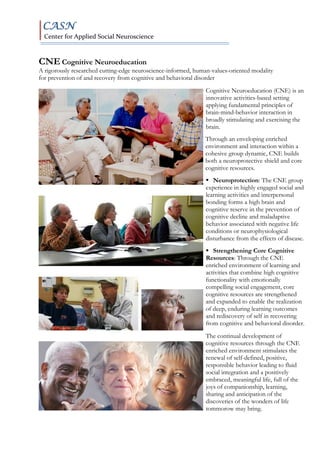
Cognitive Neuroeducation (CNE) is an
innovative activities-based setting
applying fundamental principles of
brain-mind-behavior interaction in
broadly stimulating and exercising the
brain.
Through an enveloping enriched
environment and interaction within a
cohesive group dynamic, CNE builds
both a neuroprotective shield and core
cognitive resources.
 Neuroprotection: The CNE group
experience in highly engaged social and
learning activities and interpersonal
bonding forms a high brain and
cognitive reserve in the prevention of
cognitive decline and maladaptive
behavior associated with negative life
conditions or neurophysiological
disturbance from the effects of disease.
 Strengthening Core Cognitive
Resources: Through the CNE
enriched environment of learning and
activities that combine high cognitive
functionality with emotionally
compelling social engagement, core
cognitive resources are strengthened
and expanded to enable the realization
of deep, enduring learning outcomes
and rediscovery of self in recovering
from cognitive and behavioral disorder.
The continual development of
cognitive resources through the CNE
enriched environment stimulates the
renewal of self-defined, positive,
responsible behavior leading to fluid
social integration and a positively
embraced, meaningful life, full of the
joys of companionship, learning,
sharing and anticipation of the
discoveries of the wonders of life
tommorow may bring.
2
The Origins of CNE
CNE is a second-generation social-interaction-focused cognitive
development and regeneration modality built on the framework of
Cognitive Enhancement Therapy (CET). CET was the first cognitive
rehabilitation program to emphasize social orientation in recruiting
positive neuroplasticity to improve social engagement and
broad-based cognitive functioning in cognitively impaired
individuals. [Neuroplasticity is defined herein as the
neurophysiological reaction of the human brain to environmental
conditions (including states of mind and physical illness) by cellular
structural and functional changes throughout an individual’s life –
such changes being critical in inducing either productive or
nonproductive (nonproductive = stagnant or deleterious) cognitive
reactiveness.]
Though CET was developed specifically for remediating deficits
in the cognitive functioning of individuals with schizophrenia and
schizoaffective disorder, its great success in improving overall
cognitive functioning and reestablishing the behavioral
fundamentals of social interaction over a widely varying population
of adults with schizophrenia or schizoaffective disorder led to
expanding CET treatment to include young adults defined as
high-functioning on the scale of autism spectrum disorders (ASD)
that however remained constrained in life choices by deficient social
engagement.
CET, through its emphases on both social interaction and the
recruitment of the inherent mechanisms of positive neuroplasticity
in the human brain to effect positive changes in cognitive
functioning, constituted a critical breakthrough in both the
understanding of and intervention in cognitive and behavioral
disorder. The remarkable results and duration of effect in cognitive
recovery and renewed social integration achieved by CET in
schizophrenia and schizoaffective disorder (and more recently
ASD) formerly resistent to significant cognitive rehabilitation is well
documented through 14 years of clinical trial studies and
reports of program outcomes from different mental health
facilities running CET clinics (see pages 14-17 for a listing of CET
background research reports and clinical trial results).
Intrigued by the great success of CET, but frustrated by the lack of
theoretical grounding in the CET literature and its ill-defined
perspective on neuroplasticity and the mechanisms which drive it,
the Center for Applied Social Neuroscience (CASN), in correlation
with CASN’s ongoing synthesis incorporating establised principles
and new findings in neuroscience, psychology, human evolution and
the social sciences, began to study the CET curriculum to
understand the mechanisms at work in CET, from which the
seeds of Cognitive Neuroeducation (CNE) were planted.
3
From CET to CNE
In a comprehensive study of the CET curriculum in coordination
with CASN’s intensely broad-based synthesis of established
principles and new findings in neuroscience, psychology, human
evolution, social sciences and adjacent fields, CASN developed an
entirely new paradigm in the understanding of the antecedents of
human behavior and the fundamental neurophysiological
mechanisms driving behavioral outcomes, culminating in a
theoretical foundation and basic operating principles in the
formation of a working model (i.e., a neurophysiological/cognitive
representational framework) of the human mind (i.e., a model of
human brain-mind-behavior interaction).
In applying this model to the CET curriculum to better understand
what CET was doing neurophysiologically, and to define the distinct
behavioral channels through which CET-induced cognitive changes
occurred, CASN began to experiment with the individual
parameters of the CET curriculum in identifying the mechanisms
responsible for positive behavioral outcomes and thereby defining
the conditions by which those mechanisms are disturbed to induce
adverse or negative behavioral outcomes that may present as a
cognitive and behavioral disorder. As a result, in acquiring a broadly
scientifically informed understanding of these mechanisms, and from
ongoing alterations in fine-tuning CET to optimize the promotion of
positive behavioral outcomes and more effectively prevent and
remediate negative behavioral outcomes across the widest
conditions of cognitive and behavioral disorder, CET evolved into
CNE.
In the evolution from CET to CNE, CNE retained key principles
of CET while adding emerging principles, all tightly conjoined
within an encompassing theoretical grounding; and, wholly
reconstructing the CET curriculum, CNE transitioned into a second-
generation modality in social-interaction-focused cognitive
rehabilitation, unfolding as the only comprehensively neuroscience-
informed, noninvasive, nonpharmacological intervention addressing
the full spectrum of cognitive and behavioral disorder.
Even though CNE evolved from CET, the differences between
them are substantial, briefly enumerated as follows: 1) CET was
developed in the absence of any fully formed theoretical base;
whereas CNE resulted from the application of principles derived
from a comprehensive, tightly integrated, intensively researched,
scientifically established theoretical foundation; 2) CNE has replaced
the CET computer-aided excercises with a natural, human-centered,
cognitively engrossing, socially bonding, enriched environment; and
3) CNE has eliminatated all references to the stigma and negative
connotations of pathology, disability, mental abnormality or
diagnostic label, replacing CET’s psychoeducation sessions with fun,
engaging activities in an enriched learning environment of
camaraderie and sharing in optimizing cognitive receptivity.
4
The Technical Dimensions of CNE
Though sharing a focus on social integration with CET, CNE’s
understanding of the mechanisms of social integration is an
inherent product of the CNE model of the mind centering on
the evolutionary basis of the uniquely human social brain. In
tracing the evolutionary forces that shaped the human social brain,
both the behavioral dispositions engendered therefrom and the
macrostructural neurophysiological mechanisms driving behavioral
patterns emerged. From this foundation, the linkage between a)
the fundamental macrostructural neurophysiology of the social
brain; b) behavioral traits and outcomes; and c) the relationship
between brain, mind and behavior and between productive
behavioral outcomes and nonproductive (i.e., stagnant or
deleterious) behavioral outcomes, provided the means to
most broadly and effectively address both the prevention of and
intervention in cognitive and behavioral disorder.
The uniquely human social brain is a well-established concept of
neuroscience emerging in the 1970s (Cozolino 2006, p. 11), and
is the very foundation of the field of social neuroscience as well as
its offspring, the field of applied social neuroscience (ASN)
[Cacioppo and Decety 2011; Cacioppo and Amarel et al. 2007;
Robinson 2015b], which not only recognize but center on the
critical issue of the unique orientation of the human brain in the
navigation of intricate social interaction and in understanding other
people in the formation of and reliance on complex social structures
constituting the core of human behavior [Saxe 2006;
Blakemore 2008 and 2010; Insel and Fernald 2004; Adolphs 2009;
Robinson 2015a (pp. 14-47, p. 123, pp. 128-134) and 2018 (pp. 4-6,
“Insights on Being Human”); Kennedy and Adolphs 2012; Frith and
Frith 2010; Leiberman 2013; Cozolino 2006 and 2013; Grossman
and Johnson 2007; etc. – see pages 18-19 for publication details on
the above citations and a more extensive list of studies regarding the
uniquely human social brain].
In the CNE model, the central operating principle of the social
brain is apperception – which refers to how individuals register
information, whereby any new experience is assimulated into and
transformed by the residuum of past experience of the individual to
form a new whole. Apperception consists of the counteractions
between the process of socialization and ingrained pseudo-fixed
action patterns constituting an autonomic cognitive processing
engine, the neurophysiological machinery of which is embedded
within the mechanics of neuroplasticity driven by the modulation of
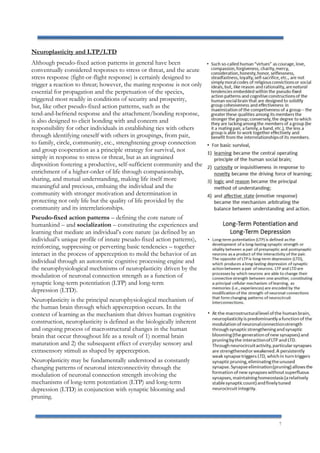
neuron connection strength predominantly through the interplay of
synaptic long-term potentiation (LTP) and long-term
depression (LTD).
5
The Foundations of the CNE Model
Apperception. Like the concept of the uniquely human social brain,
apperception is a well-established principle, first introduced by
Johann Friedrich Herbart in his seminal work of 1824 and 1825
(albeit in primative form), and adopted as a first principle by his
fellow founding fathers of psychology from the early to late
19th
century in the pioneering works of Alfred Adler (see
Ansbacher and Ansbacher 1964 and Griffith and Powers 2007),
Wilhelm Maximilian Wundt (1893 and 1919, and see Kim 2016),
and William James (1899). Although defined with a more modern
understanding from the 1940s (Wood 1942), the full implications of
the principle of apperception have failed to be appreciated in later
psychological discourses in the understanding of human behavior,
and, especially, in the understanding of disordered behavior.
(See pages 19-20 for the publication details of the above citations.)
Socialization. Socialization, the process of which in conjunction
with pseudo-fixed action patterns mediates apperception, arose as a
conceptual formulation from the advent of the field of sociology,
referring to the process by which individuals internalize the norms
and ideologies of the society in which they live. Based on the work
of John B. Watson and Jean-Jacques Rousseau, and the
identification of the stages of the socialization process throughout
the life course of the individual (the stages of moral development as
defined by Lawrence Kolberg and the stages of psychosocial
development as defined by Erik H. Erikson), socialization became
an integral component of the field of developmental psychology and
behaviorism, the latter developed from the social behaviorism of
George Herbert Mead and the school of behaviorism in psychology
founded by John B. Watson. Socialization also became the
conerstone of social psychology and a major principle of cultural
(social) anthropology.
Socialization is basically understood as the whole process of learning
throughout an individual’s life course, and, as such, socialization and
learning are inextricably intertwined – socialization is learning and
learning is socialization. This dual identification of socialization and
learning, as well as the concept of the uniquely human social brain
became a central core of the psychology of Lev Vygotsky as
interpreted and expanded by his followers – the Vygotsky school a
major influence today in the principles of education and pedagogy.
6
The Foundations of the CNE Model (continued)
Pseudo-Fixed Action Patterns. “Fixed action patterns” is a term
used in ethology to refer to the phenomenon first identified by
Konrad Lorenz (1970, pp. 316-350) as the automated responses of
nonhuman animals to particular stimuli (i.e., environmental
“triggers” – referred to as “sign stimuli” or “releasers”) within a
discrete habitat. In defining a range of human traits in distinction
from fixed action patterns, the CNE model has adopted the term
“pseudo-fixed action patterns” to refer to strong behavioral
dispositions that characterize quintessential human nature that,
rather than hardwired, are subject to mediation by genotype and
phenotype, and may even be entirely overridden by experience,
stressing the flexibility of human nature, its dependency on learned
response (i.e., socialization) and, consequently, its susceptibility to
environmental influence.
In fixed action patterns environmental changes may eliminate
some triggers required to elicit essential behavior or may
trigger ineffective or detrimental behavior with respect to the
new adaptation strategies required by the changed conditions,
leading over time to the demise of specific groups of animals (i.e.,
taxa). In human pseudo-fixed action patterns behavioral flexibility
and inventiveness can respond as group action to meet changing
environmental demands, however, social pressures (in the form of
social indoctrination) on individuals in the group can mold
individual characteristics to such extent that basic dispositions are
altered or overridden, skewing the very nature of the individual,
of groups, and even of entire societies, leading to cognitive and
behavioral disorder in individuals and/or dysfunctional (i.e.,
non-sustainable) societies.
Of course it must be understood that whatever characteristics that
are herein presented as distinctly human are uniquely human only in
context and with regard to extent or degree. While many kinds of
animals (i.e., taxa) are behaviorally oriented toward a community or
social structure, with biologically hardwired, preprogrammed
role-specific differentiation such as in ant and bee colonies, or by a
general rudimentary cognitive tendency toward forming simple
social groups, such as by chimpanzees or gorillas – some animals
eliciting such behaviors that appear as love, devotion, sympathy and
even altruism – only humankind can be definitively understood as
having evolved a unique social brain inherently biologically encoded
in the self-construction of the cognitive configuration and
interpretation of self and individual experience within the
framework of intricately defined social roles and the construction
of complex, intertwined layers of social organization.
7
Neuroplasticity and LTP/LTD
Although pseudo-fixed action patterns in general have been
conventually considered responses to stress or threat, and the acute
stress response (fight-or-flight response) is certainly designed to
trigger a reaction to threat; however, the mating response is not only
essential for propagation and the perpetuation of the species,
triggered most readily in conditions of security and prosperity,
but, like other pseudo-fixed action patterns, such as the
tend-and-befriend response and the attachment/bonding response,
is also designed to elicit bonding with and concern and
responsibility for other individuals in establishing ties with others
through identifying oneself with others in groupings, from pair,
to family, circle, community, etc., strenghtening group connection
and group cooperation as a principle strategy for survival, not
simply in response to stress or threat, but as an ingrained
disposition fostering a productive, self-sufficient community and the
enrichment of a higher-order of life through companionship,
sharing, and mutual understanding, making life itself more
meaningful and precious, embuing the individual and the
community with stronger motivation and determination in
protecting not only life but the quality of life provided by the
community and its interrelationships.
Pseudo-fixed action patterns – defining the core nature of
humankind – and socialization – constituting the experiences and
learning that mediate an individual’s core nature (as defined by an
individual’s unique profile of innate pseudo-fixed action patterns),
reinforcing, suppressing or perverting basic tendencies – together
interact in the process of apperception to mold the behavior of an
individual through an autonomic cognitive processing engine and
the neurophysiological mechnisms of neuroplasticity driven by the
modulation of neuronal connection strength as a function of
synaptic long-term potentiation (LTP) and long-term
depression (LTD).
Neuroplasticity is the principal neurophysiological mechanism of
the human brain through which apperception occurs. In the
context of learning as the mechanism that drives human cognitive
construction, neuroplasticity is defined as the biologically inherent
and ongoing process of macrostructural changes in the human
brain that occur throughout life as a result of 1) normal brain
maturation and 2) the subsequent effect of everyday sensory and
extrasensory stimuli as shaped by apperception.
Neuroplasticity may be fundamentally understood as constantly
changing patterns of neuronal interconnectivity through the
modulation of neuronal connection strength involving the
mechanisms of long-term potentiation (LTP) and long-term
depression (LTD) in conjunction with synaptic blooming and
pruning.
8
Social Integration, Learning and the Enriched Environment
All voluntary human behavior, including social integration, is
learned. All learning takes place in a social context and all positive,
lasting learning takes place in a normative stimulating environment
(or, in negative learning, in an impoverished environment –
“impoverished” referring to a lack of sufficient positive stimuli or
experiences, including lack of social interaction and lack of, or
inappropriate, social or interpersonal bonding). Recovery from
cognitive and behavioral disorder requires more intensive
stimulation than a positive normatively stimulating environment to
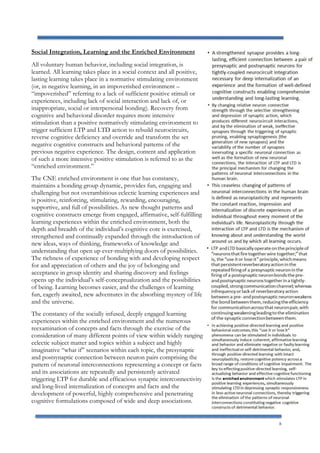
trigger sufficient LTP and LTD action to rebuild neurocircuits,
reverse cognitive deficiency and override and transform the set
negative cognitive constructs and behavioral patterns of the
previous negative experience. The design, content and application
of such a more intensive positive stimulation is referred to as the
“enriched environment.”
The CNE enriched environment is one that has constancy,
maintains a bonding group dynamic, provides fun, engaging and
challenging but not overambitious eclectic learning experiences and
is positive, reinforcing, stimulating, rewarding, encouraging,
supportive, and full of possibilities. As new thought patterns and
cognitive constructs emerge from engaged, affirmative, self-fulfilling
learning experiences within the enriched environment, both the
depth and breadth of the individual’s cognitive core is exercised,
strengthened and continually expanded through the introduction of
new ideas, ways of thinking, frameworks of knowledge and
understanding that open up ever-multiplying doors of possibilities.
The richness of experience of bonding with and developing respect
for and appreciation of others and the joy of belonging and
acceptance in group identity and sharing discovery and feelings
opens up the individual’s self-conceptualization and the possibilities
of being. Learning becomes easier, and the challenges of learning
fun, eagerly awaited, new adventures in the absorbing mystery of life
and the universe.
The constancy of the socially infused, deeply engaged learning
experiences within the enriched environment and the numerous
reexamination of concepts and facts through the exercise of the
consideration of many different points of view within widely ranging
eclectic subject matter and topics within a subject and highly
imaginative “what if” scenarios within each topic, the presynaptic
and postsynaptic connection between neuron pairs comprising the
pattern of neuronal interconnections representing a concept or facts
and its associations are repeatedly and persistently activated
triggering LTP for durable and efficacious synaptic interconnectivity
and long-lived internalization of concepts and facts and the
development of powerful, highly comprehensive and penetrating
cognitive formulations composed of wide and deep associations.
9
Social Integration, the Group Dynamic and CNE
Humankind has been evolutionarily directed to live in a social
environment, with a principal tendency toward sophisticated social
structures consisting of societies composed of a hierarchy of
overlapping nested groups, each constituting specific cultural and
social norms under the umbrella of the general cultural and social
norms of the encapsulating society. The well-being and quality of
life of the individual depends on the cognitive skills to effectively
negotiate social interaction in meeting the demands of the
individual’s social environment. Beyond pure social adaptation, the
human being is a psychologically complex being that neurotypically
requires different levels of interaction with other human beings to
meet basic psychological needs.
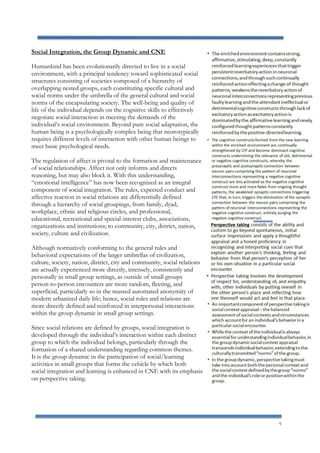
The regulation of affect is pivotal to the formation and maintenance
of social relationships. Affect not only informs and directs
reasoning, but may also block it. With this understanding,
“emotional intelligence” has now been recognized as an integral
component of social integration. The rules, expected conduct and
affective reaction in social relations are differentially defined
through a hierarchy of social groupings, from family, dyad,
workplace, ethnic and religious circles, and professional,
educational, recreational and special-interest clubs, associations,
organizations and institutions; to community, city, district, nation,
society, culture and civilization.
Although normatively conforming to the general rules and
behavioral expectations of the larger umbrellas of civilization,
culture, society, nation, district, city and community, social relations
are actually experienced more directly, intensely, consistently and
personally in small group settings, as outside of small groups
person-to-person encounters are more random, fleeting, and
superficial, particularly so in the massed automated anonymity of
modern urbanized daily life; hence, social rules and relations are
more directly defined and reinforced in interpersonal interactions
within the group dynamic in small group settings.
Since social relations are defined by groups, social integration is
developed through the individual’s interaction within each distinct
group to which the individual belongs, particularly through the
formation of a shared understanding regarding common themes.
It is the group dynamic in the participation of social/learning
activities in small groups that forms the vehicle by which both
social integration and learning is enhanced in CNE with its emphasis
on perspective taking.
10
CNE Learning Activities and the Enriched Environment
CNE is essentially a learning program whereby learning is
self-defined from within each participant through the experience of
group interaction and self-reflection that effectively energizes or
restarts the inherent cognitive developmental process of social
integration needed to acquire the cognitive competencies that
support a personally meaningful and rewarding life.
In CNE the participant learns to THINK AND FEEL, as opposed
to simple rote memorization, the accumulation of loosely connected
facts, or learning pure MECHANICAL BEHAVIOR. CNE is
designed for flexibility in implementation within a wide variety of
settings. This flexibility is achieved by a wide scope of learning
material and activities targeting different age, educational and
functional levels and capabilities.
To maintain the greatest flexibility in program efficacy across the
widest range of settings, CNE implementation is facilitator based.
The CNE facilitator determines the appropriate materials and
activities to incorporate within the CNE group dynamic, being
careful to ensure a fluid synergy between activities, materials and the
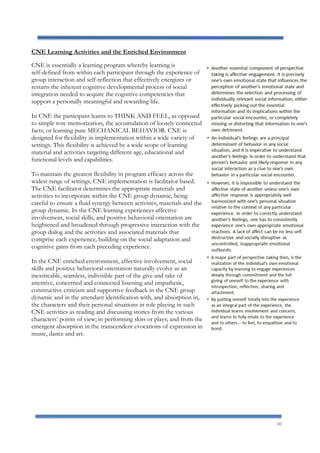
group dynamic. In the CNE learning experiences affective
involvement, social skills, and positive behavioral orientation are
heightened and broadened through progressive interaction with the
group dialog and the activities and associated materials that
comprise each experience, building on the social adaptation and
cognitive gains from each preceding experience.
In the CNE enriched environment, affective involvement, social
skills and positive behavioral orientation naturally evolve as an
inextricable, seamless, indivisible part of the give and take of
attentive, concerned and connected listening and empathetic,
constructive criticism and supportive feedback in the CNE group
dynamic and in the attendant identification with, and absorption in,
the characters and their personal situations in role playing in such
CNE activities as reading and discussing stories from the various
characters’ points of view; in performing skits or plays; and from the
emergent absorption in the transcendent evocations of expression in
music, dance and art.
11
The Cultivation of Curiosity, Imagination, Motivation and
Eager Anticipation Full of Possibilities
We are normally born with a pseudo-fixed action pattern of
curiosity about our environment and the world we live in. Through
this curiosity we learn about our environment and experience the
great wonder and delight of discovery. Curiosity is manifest from
infancy and becomes the dominant preoccupation of early
childhood. If this natural curiosity is nurtured it may be maintained
throughout life, fostering creativity, an open, receptive mind, critical
thinking, and a lifelong love of learning. Learning is inherently fun,
inspirational, and essential for self-development, independence and
fulfillment.
The accumulation of learning, that is, knowledge itself, is composed
of relative truths, as all things may be understood from many
different positions, starting points, frames of reference and personal
perspectives. Being relative does not make these “truths” any less
real to the frames of reference in which they reside. The full
recognition of this relativity leads to the undeniable, stirring
realization that there are so many more, endless things to discover,
so many more, endless ways by which to view all phenomena, so
many more, endless ways to think about life and all its mysteries and
so many more, endless contributions to knowledge waiting for
eager, imaginative, curious, probing, questioning minds to reveal.
Learning is the processing of new information involving thinking,
reflection, imagination and inspiration, not static memorization.
The formulation of ideas evolves through discussion, sharing ideas
and considering the ideas of others in a dialog in which one’s ideas
may be confirmed, reinforced, expanded, modified to greater or
lesser extent or entirely reformulated by the exchange of different
perspectives. We are what we know and we only know what we
read, are told and directly experience, all extensively enriched and
broadened in reconsideration and reflection through interactive
dialog.
The CNE activities, related materials and group dialog explore the
different realms of understanding and knowledge from the widest
possible perspectives, stimulating each of the group members with
the awe of the vast potentials of discovery, of endless paths on the
journey through life, and the eager anticipation of the possibilities
waiting beyond the next turn in the road on the great adventure of
being. We live within our mind, and the journey of life continues on
in elderhood and even in infirmity of body through a healthy,
active mind and an environment encouraging our innate curiosity
and deep human need to share and involve ourself with others.
12
Long-Term Elder Care, Dementia, and CNE
There is a great culture change movement that is gaining
ever more traction within the community of caregivers for
elders and those with dementia in long-term care facilities.
This movement and the initiatives it has inspired are referred
to by a variety of similar terms, such as: person-centered care,
patient-centered care, person-and-family-centered care,
resident-centered care, client-centered care, etc., and, though
each of the different initiatives propose their own specific
guidelines, they all embrace a philosophy that focuses on the
humanity of care, recognizing that every individual is a unique
personality, every long-term care resident an individual with
a unique set of needs, and that life in a residential care facility
need not, and most definitely must not deny the resident the
fundamental right to maintain her/his individuality with dignity
and respect.
In this philosophy, the long-term care facility, rather than a place
that simply provides for the bare rudimentary physical needs of a
dead-end existence, as in the conventional conception of the
“nursing home,” becomes instead the hub of a nourishing
environment that facilitates the engagement of life, providing
challenge and growth to the fullest of each individual’s capacity,
focusing on the resident’s strengths and activities that excite
the individual’s interests and promotes: a) a sense of
accomplishment, b) bonding with others; c) joy of the moment;
and d) a keen anticipation of the discoveries, camaraderie and
achievements tomorrow may bring. These qualities are infused
throughout the elements comprising the CNE program, such as
the enriched environment, the group dynamic, perspective
taking, empathetic engagement, individual initiative, facilitation
of the voice of the individual, and the confirmation of self.
Cognition is an essential component of well-being – a healthy,
active mind promotes a more fulfilling life. CNE can prevent
dementia and general cognitive decline by activation of
neuroprotective agents in the brain, can retard cognitive decline
in neurodegenerative disease by building up cognitive and brain
reserve and enhancing cognitive proficiency, and, in many cases
of preexisting conditions of cognitive erosion, can effect recovery
of fundamental cognitive reaction. In cases where tissue damage
is not excessive, CNE can effect full recovery of an individual’s
cognitive resources.
13
Long-Term Elder Care, Dementia, and CNE (continued)
Although developed from a completely different trajectory
than the person-centered care movement, CNE, from its
inception and fully implemented within its framework,
embodies the basic principles and philosophical
orientation of the person-centered care movement – both
incorporating an enriched environment – that of CNE directed
at the prevention of and intervention in dementia and cognitive
decline in later life, and that of the person-centered initiatives
directed at the process and manner of the daily personal care of
the elder and those with dementia in a long-term care facility.
Individually CNE and the person-centered care approach each
provide half of the recipe for well-being in a long-term care setting,
but together constitute a total, seamless intervention-care program.
The clinical approach to cognitive and behavioral disorder of
“treatment” and “session” is invalid since it is the day-to-day
orientation that is the critical factor in cognitive and behavioral
dysfunction and it is this orientation that must be modulated;
however, in a conventional long-term care setting, the institutional
milieu and stagnant, rote routine suppress natural inclinations,
opportunities of engagement and individual initiative, eroding
one’s sense of self, fostering social withdrawal leading to cognitive
decline, unmet psychological needs and responsive behaviors.
CNE, integrated within a person-centered care program,
transforming the setting from an institutional one to that of
a community of care, intervention and engagement, together
create the sustained, seamless environment for long-term
intervention-care in the restoration and maintenance of
cognitive acuity, behavioral balance and a realistic avenue for
growth and self-fulfillment in optimizing the well-being of the
individual residing in a long-term care facility.
14
Bibliography: Cognitive Enhancement Therapy (CET)
Background Research and Clinical Trial Results
APA/CAPP
1
Task Force on Serious Mental Illness and Severe Emotional
Disturbance (2007). Catalog of clinical training opportunities:
Best practices for recovery and improved outcomes for people
with serious mental illness (Version 2.0). Washington, DC:
American Psychological Association.
https://www.apa.org/practice/resources/grid/catalog.pdf.
Ben-Yisay Y, Piasetsky EB, & Rattok J (1987). A systematic method for
ameliorating disorders in basic attention. In MJ Meir, AL Benton &
L Diller (Eds.), Neuropsychological Rehabilitation (pp. 165-81).
New York: Guilford Press.
http://psycnet.apa.org/record/1987-97860-008.
Blanchard JJ & Neale JM (1994). The neuropsychological signature of
schizophrenia: Generalized or differential deficit?
American Journal of Psychiatry 151(1): 40-48.
doi: 10.1176/ajp.151.1.40.
Brenner HD, Roder V, Hodel B, Kiengle N, Reed D & Liberman R (1994).
Integrated psychological therapy for schizophrenia patients.
Seattle and Toronto: Hogrefe & Huber.
Brim OG (1966). Socialization through the life cycle. In OG Brim &
S Wheeler (Eds.), Socialization after childhood: Two essays
(pp. 3-49). New York: John Wiley & Sons.
Brooks D & McKinlay W (1983). Personality and behavioral change after
head injury: A relative’s view. Journal of Neurology,
Neurosurgery & Psychiatry 46(4): 336-44.
https://www.ncbi.nlm.nih.gov/pmc/articles/PMC1027357/.
Brothers L (1990). The social brain: A project for integrating primate
behavior and neurophysiology in a new domain.
Concepts in Neuroscience 1:27-51.
Corrigan PW & Penn DL (Eds.) (2001). Social cognition and schizophrenia.
Washington, DC: American Psychological Association.
http://dx.doi.org/10.1037/10407-000.
Eack SM (2012). Cognitive remediation: A new generation of psychosocial
interventions for people with schizophrenia.
Social Work 57(3): 235-46. doi:10.1093/sw/sws008.
Eack SM, Bahorik AL, Hogarty SS, Greenwald DP, Litschge MY,
Mazefsky CA & Minshew N.J (2013). Brief report: Is cognitive
rehabilitation needed in verbal adults with autism? Insights from
initial enrollment in a trial of cognitive enhancement therapy.
Journal of Autism and Developmental Disorders 43(9): 2233-7.
doi:10.1007/s10803-013-1774-2.
Eack SM, Greenwald DP, Hogarty SS, Bahorik AL, Litschge MY,
Mazefsky CA & Minshew NJ (2013). Cognitive enhancement
therapy for adults with autism spectrum disorder: Results of an
18-month feasibility study. Journal of Autism and Developmental
Disorders 43(12): 2866-77. doi: 10.1007/s10803-013-1834-7.
Eack SM, Greenwald DP, Hogarty SS, Cooley SJ, DiBarry AL, Montrose DM
& Keshavan MS (2009). Cognitive enhancement therapy for
early-course schizophrenia: Effects of a two-year randomized
controlled trial. Psychiatric Services 60(11): 1468-76.
doi: 10.1176/appi.ps.60.11.1468.
15
Eack SM, Greenwald DP, Hogarty SS & Keshavan MS (2010). One-year
durability of the effects of cognitive enhancement therapy on
functional outcome in early schizophrenia. Schizophrenia
Research 120(1): 210-16. doi:10.1016/j.schres.2010.03.042.
Eack SM, Hogarty SS, Bangalore SS, Keshavan MS & Cornelius JR (2016).
Patterns of substance use during cognitive enhancement therapy:
An 18-month randomized feasibility study. Journal of Dual
Diagnosis 12(1): 74-82. doi:10.1080/15504263.2016.1145778.
Eack SM, Hogarty GE, Cho RY, Prasad KN, Greenwald DP, Hogarty SS &
Keshavan MS (2010). Neuroprotective effects of cognitive
enhancement therapy against gray matter loss in early
schizophrenia: Results from a 2-year randomized controlled trial.
Archives of General Psychiatry 67(7): 674-82.
doi: 10.1001/archgenpsychiatry.2010.63.
Eack SM, Hogarty GE, Greenwald DP, Hogarty SS & Keshavan MS (2007).
Cognitive enhancement therapy improves emotional intelligence
in early course schizophrenia: Preliminary effects.
Schizophrenia Research 89(1-3): 308-11.
doi:10.1016/j.schres.2006.08.018.
____ (2011). Effects of cognitive enhancement therapy on employment
outcomes in early schizophrenia: Results from a 2-year
randomized trial. Research on Social Work Practice 21(1): 32-42.
doi: 10.1177/1049731509355812.
Eack SM, Hogarty SS, Greenwald DP, Litschge MY, McKnight SA,
Bangalore SS, Pogue-Geile MF, Keshavan MS & Cornelius JR
(2015). Cognitive enhancement therapy in substance misusing
schizophrenia: Results of an 18-month feasibility trial.
Schizophrenia Research 161(2-3): 478-83.
doi: 10.1016/j.schres.2014.11.017.
Eack SM, Mesholam-Gately RI, Greenwald DP, Hogarty SS &
Keshavan MS (2013). Negative symptom improvement during
cognitive rehabilitation: Results from a 2-year trial of cognitive
enhancement therapy. Psychiatry Research 209(1): 21-6.
doi: 10.1016/j.psychres.2013.03.020.
Eack SM, Newhill CE & Keshavan MS (2016). Cognitive enhancement
therapy improves resting-state functional connectivity in early
course schizophrenia. Journal of the Society for Social Work and
Research 7(2): 211-30. http://dx.doi.org/10.1086/686538.
Eack SM, Pogue-Geile MF, Greenwald DP, Hogarty SS &
Keshavan MS (2011). Mechanisms of functional improvement in a
two-year trial of cognitive enhancement therapy for early
schizophrenia. Psychological Medicine 41(6): 1253-61.
doi: 10.1017/S0033291710001765.
Hogarty GE (2002). Personal therapy for schizophrenia and related
disorders: A guide to individualized treatment.
New York: Guilford Press.
http://psycnet.apa.org/record/2002-18241-000.
16
Hogarty GE & Flesher S. (1999a). Developmental theory for
a cognitive enhancement therapy of schizophrenia.
Schizophrenia Bulletin 25(4): 677-92.
doi:10.1093/oxfordjournals.schbul.a033410.
____ (1999b). Practice principles of cognitive enhancement
therapy for schizophrenia. Schizophrenia Bulletin 25(4): 693-708.
http://dx.doi.org/10.1093/oxfordjournals.schbul.a033411.
Hogarty GE, Flesher S, Ulrich R, Carter M, Greenwald D, Pogue-Geile M,
Keshavan M, Cooley S, DiBarry AL, Garret A, Parepally H &
Zoretich R (2004). Cognitive enhancement therapy for
schizophrenia: Effects of a 2-year randomized trial on cognition
and behavior. Archives of General Psychiatry 61(9): 866-76.
doi: 10.1001/archpsyc.61.9.866.
Hogarty GE, Greenwald DP & Eack SM (2006). Durability and
mechanism of effects of cognitive enhancement therapy.
Psychiatric Services 57(12): 1751-7.
doi: 10.1176/ps.2006.57.12.1751.
Keshavan MS, Eack SM, Prasad KM, Haller CS & Cho RY (2017).
Longitudinal functional brain imaging study in early course
schizophrenia before and after cognitive enhancement therapy.
NeuroImage 151:55-64. doi: 10.1016/j.neuroimage.2016.11.060.
Keshavan MS, Eack SM, Wojtalik JA, Prasad KMR, Francis AN, Bhojraj TS,
Greenwald DP & Hogarty SS (2011). A broad cortical reserve
accelerates response to cognitive enhancement therapy in early
course schizophrenia. Schizophrenia Research 130(1-3): 123-9.
doi:10.1016/j.schres.2011.05.001.
Lewandowski KE, Eack SM, Hogarty SS, Greenwald DP & Keshavan MS
(2011). Is cognitive enhancement therapy equally effective for
patients with schizophrenia and schizoaffective disorder?
Schizophrenia Research 125(2-3): 291-4.
doi: 10.1016/j.schres.2010.11.017.
Mayer JP, Salovey P & Caruso DR (2004). Emotional intelligence: Theory,
findings, and implications. Psychological Inquiry 15(3): 197-215.
http://dx.doi.org/10.1207/s15327965pli1503_02..
Mohamed S, Paulsen JS, O’Leary D, Arndt S & Andreasen N (1999).
Generalized cognitive deficits in schizophrenia: A study of first-
episode patients. Archives of General Psychiatry 56(8): 749-54.
http://dx.doi.org/10.1001/archpsyc.56.8.749.
Newman LS (2001). What is “social cognition?” Four basic approaches and
their implications for schizophrenia research. In PW Corrigan &
DL Penn (Eds.), Social cognition and schizophrenia (pp. 41-72).
Washington, DC: American Psychological Association.
Penn DL, Corrigan PW, Bentall RP, Racenstein JM & Newman LS (1997).
Social cognition in schizophrenia. Psychological Bulletin 121(1):
114-132. http://penn.web.unc.edu/files/2017/03/PSYBULL.pdf.
Pinard R & Tri-City Mental Health Services Act Innovations Planning
Process: CET Workgroup (2011). Summary of key research
findings: Cognitive enhancement therapy. Pomona, CA:
Tri-City Mental Health Center.
https://www.slideshare.net/SpencerRobinson2/summary-of-cet-
research-findings.
17
Pinkham AE, Penn DL, Perkins DO & Lieberman J (2003). Implications for
the neural basis of social cognition for the study of schizophrenia.
American Journal of Psychiatry 160(5): 815-24.
doi: 10.1176/appi.ajp.160.5.815.
Robinson SM (2018). A brief introduction to Cognitive Enhancement
Therapy (CET). (Rev). CASN NeuroNotes 105.
https://www.slideshare.net/SpencerRobinson2/a-brief-
introduction-to-cognitive-enhancement-therapy-cet-revised.
Roder V, Müller DR, Brenner HD & Spaulding WD (2010). Integrated
psychological therapy (IPT) for the treatment of neurocognition,
social cognition, and social competency in schizophrenia patients.
Cambridge, MA: Hogrefe Publishing.
Salthouse TA (1987). Age, experience and compensation. In C Schooler &
KW Schaie (Eds.), Cognitive functioning and social structure over
the life course (pp. 142-57). Norwood, NJ: Ablex Publishing.
http://psycnet.apa.org/record/1987-97721-008.
Santoro J & Spiers M (1994). Social cognitive factors in brain-injury-
associated personality change. Brain Injury 8(3): 265-76.
https://doi.org/10.3109/02699059409150978.
Selman RL & Schultz LH (1990). Making a friend in youth: Developmental
theory and pair therapy. Chicago: University of Chicago Press.
http://psycnet.apa.org/record/1990-97922-000.
Spaulding WD & Reed D (1989). Procedural manual for cognitive group
therapy: UN-L/LRC version. Lincoln, NE: University of Nebraska.
Spaulding WD, Reed D, Sullivan M, Richardson C & Weiler M (1999).
Effects of cognitive treatment in psychiatric rehabilitation.
Schizophrenia Bulletin 25(4): 657-76.
http://psycnet.apa.org/buy/2005-09772-003.
Stanghellini G (2000). At issue: Vulnerability to schizophrenia and lack of
common sense. Schizophrenia Bulletin 26(4): 775-87.
https://pdfs.semanticscholar.org/19e7/5eca394c6ad16df7fca0bd
34ff5882540b32.pdf.
Sternberg RJ & Wagner RK (Eds.). (1986). Practical intelligence: Nature
and origins of competence in the everyday world. Cambridge:
Cambridge University Press.
Sternberg RJ, Wagner RK, Williams WM & Hovarth JA (1995). Testing
common sense. American Psychologist 50(11): 912-26.
http://psycnet.apa.org/buy/1996-13349-001.
Taylor EH & Cadet JL (1989). Social intelligence, a neurological
system? Psychological Reports 64(2): 423-44.
doi: 10.2466/pr0.1989.64.2.423.
Thorndike EL (1920). Intelligence and its uses. Harper’s 140:227-35.
https://harpers.org/archive/1920/01/intelligence-and-its-uses/.
Walker RE & Foley JM (1973). Social intelligence: Its history and
measurement. Psychological Reports 33(3): 839-64.
http://dx.doi.org/10.2466/pr0.1973.33.3.839.
Wojtalik JA, Hogarty SS, Cornelius JR, Phillips ML, Keshavan MS,
Newhill CE & Eack SM (2016). Cognitive enhancement therapy
improves frontolimbic regulation of emotion in alcohol and/or
cannabis misusing schizophrenia: A preliminary study.
Frontiers in Psychiatry 6:186. doi: 10.3389/fpsyt.2015.00186.
1
APA/CAPP = American Psychological Association Committee for the Advancement
of Professional Practice
18
Bibliography: The Uniquely Human Social Brain
Adolphs R (2009). The social brain: Neural basis of social knowledge.
Annual Review of Psychology 60:693-716.
Bhanji JP & Delgado MR (2014). The social brain and reward:
Social information processing in the human striatum.
WIREs
1
Cognitive Science 5(1): 61-73. doi: 10.1002/wcs.1266.
Blakemore SJ (2008). The social brain in adolescence. Nature Reviews
Neuroscience 9(4): 267-77. doi: 10.1038/nrn2353.
____ (2010). The developing social brain: Implications for education.
Neuron 65(6): 744-7. doi: 10.1016/j.neuron.2010.03.004.
Brothers L (1990). The social brain: A project for integrating primate
behavior and neurophysiology in a new domain.
Concepts in Neuroscience 1:27-51.
Brüne M, Ribbert H & Schiefenhövel W (Eds.) (2003). The social brain:
Evolution and pathology. Chichester, West Sussex, England: Wiley.
Cacioppo JT, Amaral DG, Blanchard JJ, Cameron JL, Carter CS, Crews D,
Fiske S, Heatherton T, Johnson MK, Kozak MJ, Levenson RW,
Lord C, Miller EK, Ochsner K, Raichle ME, Shea MT, Taylor SE,
Young LJ & Quinn KJ (2007). Social Neuroscience: Progress and
implications for mental health. Perspectives on Psychological
Science 2(2): 99-123. doi: 10.1111/j.1745-6916.2007.00032.x.
Cacioppo JT & Decety J (2011). Social neuroscience: Challenges and
opportunities in the study of complex behavior. Annals of the New
York Academy of Sciences 1224(1): 162-73.
https://doi: 10.1111/j.1749-6632.2010.05858.x.
Cozolino LJ (2006). The neuroscience of human relationships: Attachment
and the developing social brain. New York and London:
W.W. Norton.
____ (2013). Nine things educators need to know about the brain.
Greater Good Magazine. Greater Good Science Center,
University of California, Berkeley. Last accessed 1 March, 2018.
https://greatergood.berkeley.edu/article/item/nine_things_educa
tors_need_to_know_about_the_brain.
Eliot L (2000). What’s going on in there? How the brain and mind develop
in the first five years of life. New York: Bantam Books.
Frith U & Frith C (2010). The social brain: Allowing humans to boldly go
where no other species has been. Philosophical Transactions of
the Royal Society B 365(1537): 165-75.
doi: 10.1098/rstb.2009.0160.
Grossmann T & Johnson MH (2007). The development of the social brain
in human infancy. European Journal of Neuroscience 25(4):
909-19. doi: 10.1111/j.1460-9568.2007.05379.x.
Insel TR & Fernald RD (2004). How the brain processes social information:
Searching for the social brain.
Annual Review of Neuroscience 27:697-722.
doi: 10.1146/annurev.neuro.27.070203.144148.
Kennedy DP & Adolphs R (2012). The social brain in psychiatric and
neurological disorders.
Trends in Cognitive Sciences 16(11): 559-72.
doi: 10.1016/j.tics.2012.09.006.
Lieberman MD (2013). Social: Why our brains are wired to connect.
New York: Crown Publishers.
19
Lipina TV & Roder JC (2013). Co-learning facilitates memory in mice:
A new avenue in social neuroscience.
Neuropharmacology 64:283-93.
doi: 10.1016/j.neuropharm.2012.06.054.
Pretty J, Rogerson M & Baron J (2017). Green mind theory: How
brain-body-behaviour links into natural and social environments
for healthy habits. International Journal of Environmental
Research and Public Health 14(7). pii: E706.
doi: 10.3390/ijerph14070706.
Robinson SM (2015a). Education, learning and the mind: Cognitive
Neuroeducation (CNE). CASN NeuroNotes A02.
https://www.slideshare.net/SpencerRobinson2/education-
learning-and-the-mind-cognitive-neuroeducation-cne.
____ (2015b). Applied social neuroscience. ASN. CASN: Center for Applied
Social Neuroscience. https://www.brain-mind-behavior.org/asn.
____ (2018). Understanding mental illness. (Rev). CASN
NeuroNotes 103-Rev.
https://www.slideshare.net/SpencerRobinson2/understanding-
mental-illnessrevised-98206981.
Saxe R (2006). Uniquely human social cognition. Current Opinion in
Neurobiology 16(2): 235-9. doi: 10.1016/j.conb.2006.03.001.
Spitz R (1983). René A. Spitz: Dialogues from infancy —Selected papers.
(RN Emde, Ed.). New York: International Universities Press.
1
WIREs = Wiley Interdisciplinary Reviews
References: Apperception
Ansbacher HL & Ansbacher RR (Eds.). (1964). The individual psychology of
Alfred Adler: A systematic presentation in selections from his
writings. New York: Harper & Row.
Griffith J & Powers RL (2007). The lexicon of Adlerian psychology: 106
terms associated with the individual psychology of Alfred Adler
(2d ed., rev. and expanded). Port Townsend, WA: Adlerian
Psychology Associates.
Herbart JF (1824). Psychologie als Wissenschaft, neu gegründet auf
Erfahrung, Metaphysik und Mathematik. Erster, synthetischer
Theil. (1
st
ed.). Königsberg, East Prussia: August Wilhelm Unzer.
____ (1825). Psychologie als Wissenschaft, neu gegründet auf Erfahrung,
Metaphysik und Mathematik. Zweyter, analytischer Theil.
(1
st
ed.). Königsberg, East Prussia: August Wilhelm Unzer.
James W (1899). Apperception. In W James, Talks to teachers on
psychology: And to students on some of life’s ideals (pp. 155-68).
New York: Henry Holt and Company.
Kim A (2016). Wilhelm Maximilian Wundt. In EN Zalta (Ed.), The Stanford
encyclopedia of philosophy (Fall 2016 edition). Stanford, CA:
Metaphysics Research Lab, Stanford University.
https://plato.stanford.edu/archives/fall2016/entries/wilhelm-
wundt/.
Wood L (1942). Apperception. In DD Runes (Ed.), Dictionary of Philosophy
(p. 15). New York: Philosophical Library.
20
Wundt WM (1893). Grundzüge der physiologischen Psychologie.
(Zweiter Band, Vierte umgearbeitete Auflage). Leipzig, Germany:
Wilhelm Engelmann.
____ (1919). Logik: Eine Untersuchung der Prinzipien der Erkenntnis
und der Methoden wissenschaftlicher Forschung: Bd.1, Allgemeine
Logik und Erkenntnistheorie. (4
th
ed.). Stuttgart, Germany:
Ferdinand Enke.
21
Bibliography: Studies of the Interaction between LTP and
LTD, Neuroplasticity, the Enriched Environment, Brain
and Cognitive Reserve and Learning in Cognitive
Development and Rehabilitation
Aimone JB, Wiles J & Gage FH (2006). Potential role for adult neurogenesis
in the encoding of time in new memories.
Nature Neuroscience 9(6): 723-7. doi: 10.1038/nn1707.
Alwis DS & Rajan R (2014). Environmental enrichment and the sensory
brain: The role of enrichment in remediating brain injury.
Frontiers in Systems Neuroscience 8 (Article 156).
doi: 10.3389/fnsys.2014.00156.
Aronoff E, Hillyer R & Leon M (2016). Environmental enrichment therapy
for autism: Outcomes with increased access.
Neural Plasticity 2016 (Article ID 2734915).
doi: 10.1155/2016/2734915.
Artola A, von Frijtag JC, Fermont PC, Gispen WH, Schrama LH,
Kamal A & Spruijt BM (2006). Long-lasting modulation of the
induction of LTD and LTP in rat hippocampal CA1 by behavioural
stress and environmental enrichment.
European Journal of Neuroscience 23(1): 261-72.
doi: 10.1111/j.1460-9568.2005.04552.x.
Barnes SJ & Finnerty GT (2010). Sensory experience and cortical rewiring.
The Neuroscientist 16(2): 186-98.
doi: 10.1177/1073858409343961.
Begré S, Frommer A, von Känel R, Kiefer C & Federspiel A (2007).
Relation of white matter anisotropy to visual memory in 17
healthy subjects. Brain Research 1168:60-6.
doi: 10.1016/j.brainres.2007.06.096.
Bengtsson SL, Nagy Z, Skare S, Forsman L, Forssberg H &
Ullén F (2005). Extensive piano practicing has regionally specific
effects on white matter development.
Nature Neuroscience 8(9): 1148-50.
doi: 10.1038/nn1516. https://www.nature.com/articles/nn1516.
Blackerby WF (1990). Intensity of rehabilitation and length of stay.
Brain Injury 4(2): 167-73. doi: 10.3109/02699059009026162.
Bliss TVP & Collingridge GL (1993). A synaptic model of memory:
Long-term potentiation in the hippocampus.
Nature 361(6407): 31-9. doi: 10.1038/361031a0.
Bliss TVP & Lomo T (1973). Long-lasting potentiation of synaptic
transmission in the dentate area of the anaesthetized rabbit
following stimulation of the perforant path.
The Journal of Physiology 232(2): 331-56.
https://doi.org/10.1113/jphysiol.1973.sp010273.
Boman I-L, Lindstedt M, Hemmingsson H & Bartfai A (2004). Cognitive
training in home environment. Brain Injury 18(10): 985-95.
doi: 10.1080/02699050410001672396.
Boyke J, Driemeyer J, Gaser C, Büchel C & May A (2008). Training-induced
brain structure changes in the elderly.
The Journal of Neuroscience 28(28): 7031-5.
doi: 10.1523/JNEUROSCI.0742-08.2008.
Neurosurgery & Psychiatry 46(4): 336-44.
https://www.ncbi.nlm.nih.gov/pmc/articles/PMC1027357/.
22
Brothers L (1990). The social brain: A project for integrating primate
behavior and neurophysiology in a new domain.
Concepts in Neuroscience 1:27-51.
Büchel C, Coull JT & Friston KJ (1999). The predictive value of changes
in effective connectivity for human learning.
Science 283(5407): 1538-41.
doi: 10.1126/science.283.5407.1538.
http://science.sciencemag.org/content/283/5407/1538.full.
Chklovskii DB (2004). Synaptic connectivity and neuronal morphology:
Two sides of the same coin. Neuron 43(5): 609-17.
doi: 10.1016/j.neuron.2004.08.012.
Chklovskii DB, Mel BW & Svoboda K (2004). Cortical rewiring and
information storage. Nature 431(7010): 782-8.
doi: 10.1038/nature03012.
Cicerone KD, Mott T, Azulay J & Friel JC (2004). Community integration
and satisfaction with functioning after intensive cognitive
rehabilitation for traumatic brain injury. Archives of Physical
Medicine and Rehabilitation 85(6): 943-50.
doi: 10.1016/j.apmr.2003.07.019.
Cifu DX, Kreutzer JS, Kolakowsky-Hayner SA, Marwitz JH & Englander J
(2003). The relationship between therapy intensity and
rehabilitative outcomes after traumatic brain injury: A multicenter
analysis. Archives of Physical Medicine and Rehabilitation 84(10):
1441-8. doi: 10.1016/S0003-9993(03)00272-7.
Comery TA, Shah R & Greenough WT (1995). Differential rearing alters
spine density on medium-sized spiny neurons in the rat corpus
striatum: Evidence for association of morphological plasticity with
early response gene expression.
Neurobiology of Learning and Memory 63(3): 217-19.
doi: 10.1006/nlme.1995.1025..
Draganski B, Gaser C, Busch V, Schuierer G, Bogdahn U, & May A (2004).
Neuroplasticity: Changes in gray matter induced by training.
Nature 427(6972): 311-12. doi: 10.1038/427311a.
Draganski B, Gaser C, Kempermann G, Kuhn HG, Winkler J,
Büchel C & May A (2006). Temporal and spatial dynamics
of brain structure changes during extensive learning.
The Journal of Neuroscience 26(23): 6314-7.
doi: 10.1523/JNEUROSCI.4628-05.2006.
Draganski B & May A (2008). Training-induced structural changes in the
adult human brain. Behavioural Brain Research 192(1): 137-42.
doi: 10.1016/j.bbr.2008.02.015.
Driemeyer J, Boyke J, Gaser C, Büchel C & May A (2008). Changes in gray
matter induced by learning – revisited. PLoS ONE 3(7): e2669.
doi: 10.1371/journal.pone.0002669.
Eliot L (2000). What’s going on in there? How the brain and mind develop
in the first five years of life. New York: Bantam Books.
Engvig A, Fjell AM, Westlye LT, Moberget T, Sundseth Ø, Larsen VA
& Walhovd KB (2010). Effects of memory training on cortical
thickness in the elderly. NeuroImage 52(4): 1667-76.
doi: 10.1016/j.neuroimage.2010.05.041.
23
Feldman DE, Nicoll RA & Malenka RC (1999). Synaptic plasticity at
thalamocortical synapses in developing rat somatosensory cortex:
LTP, LTD, and silent synapses.
Journal of Neurobiology 41(1): 92-101.
https://doi.org/10.1002/(SICI)1097-4695(199910)41:1<92::AID-
NEU12>3.0.CO;2-U.
Filippi M, Ceccarelli A, Pagani E, Gatti R, Rossi A, Stefanelli L, Falini A,
Comi G & Rocca MA (2010). Motor learning in healthy humans is
associated to gray matter changes: A tensor-based morphometry
study. PLoS ONE 5(4): e10198.
doi: 10.1371/journal.pone.0010198.
Flor H, Elbert T, Knecht S, Wienbruch C, Pantev C, Birbaumers N, Larbig W
& Taub E (1995). Phantom-limb pain as a perceptual correlate of
cortical reorganization following arm amputation.
Nature 375(6531): 482-4. doi: 10.1038/375482a0.
Fox MD & Raichle ME (2007). Spontaneous fluctuations in brain activity
observed with functional magnetic resonance imaging.
Nature Reviews Neuroscience 8(9): 700-11. doi: 10.1038/nrn2201.
Frasca D, Tomaszczyk J, McFadyen BJ & Green RE (2013). Traumatic brain
injury and post-acute decline: What role does environmental
enrichment play? A scoping review. Frontiers in Human
Neuroscience 7 (Article 31). doi: 10.3389/fnhum.2013.00031.
Fujiwara Y, Chaves PH, Yoshida H, Amano H, Fukaya T, Watanabe N,
Nishi M, Lee S, Uchida H & Shinkai S (2009). Intellectual activity
and likelihood of subsequently improving or maintaining
instrumental activities of daily living functioning in
community-dwelling older Japanese: A longitudinal study.
International Journal of Geriatric Psychiatry 24(6): 547-55.
doi: 10.1002/gps.2148.
Gage FH (2002). Neurogenesis in the adult brain.
The Journal of Neuroscience 22(3): 612-13.
http://neurofuture.ru/_mozg/archive/gage.pdf.
Gaser C & Schlaug G (2003a). Brain structures differ between musicians
and non-musicians. The Journal of Neuroscience 23(27): 9240-5.
http://www.jneurosci.org/content/23/27/9240.short.
____ (2003b). Gray matter differences between musicians and
nonmusicians.
Annals of the New York Academy of Sciences 999:514-17.
http://dbm.neuro.uni-jena.de/pdf-files/Gaser-AnnNYAS.pdf.
Golestani N and Pallier C (2007). Anatomical correlates of foreign speech
sound production. Cerebral Cortex 17(4): 929-34.
doi: 10.1093/cercor/bhl003.
Golestani N, Paus T & Zatorre RJ (2002). Anatomical correlates of learning
novel speech sounds. Neuron 35(5): 997-1010.
http://www.unicog.org/publications/Golestani_et_al_2002.pdf.
Golestani N & Zatorre RJ (2004). Learning new sounds of speech:
Reallocation of neural substrates. NeuroImage 21(2): 494-506.
doi: 10.1016/j.neuroimage.2003.09.071.
Granert O, Peller M, Gaser C, Groppa S, Hallett M, Knutzen A,
Deuschl G, Zeuner KE & Siebner HR (2011). Manual activity shapes
structure and function in contralateral human motor hand area.
NeuroImage 54(1): 32-41.
doi: 10.1016/j.neuroimage.2010.08.013.
24
Hannan AJ (2014). Environmental enrichment and brain repair: Harnessing
the therapeutic effects of cognitive stimulation and physical
activity to enhance experience-dependent plasticity.
Neuropathology and Applied Neurobiology 40(1): 13-25.
doi: 10.1111/nan.12102.
Hayden ME, Plenger P, Bison K, Kowalske K, Masel B & Qualls D (2013).
Treatment effect versus pretreatment recovery in persons with
traumatic brain injury: A study regarding the effectiveness of
postacute rehabilitation. PM&R (Physical Medicine and
Rehabilitation) 5(4): 319-27; quiz 327.
doi: 10.1016/j.pmrj.2012.12.005.
Hebb, DO (1947). The effects of early experience on problem-solving at
maturity. American Psychologist 2:306-7.
____ (1949). The organization of behavior. New York: Wiley & Sons.
Henderson LA, Gustin SM, Macey PM, Wrigley PJ & Siddall PJ (2011).
Functional reorganization of the brain in humans following spinal
cord injury: Evidence for underlying changes in cortical anatomy.
The Journal of Neuroscience 31(7): 2630-7.
doi: 10.1523/JNEUROSCI.2717-10.2011.
Herdener M, Esposito F, di Salle F, Boller C, Hilti CC,
Habermeyer B, Scheffler K, Wetzel S, Seifritz E &
Cattapan-Ludewig K (2010). Musical training induces functional
plasticity in human hippocampus.
The Journal of Neuroscience 30(4): 1377-84.
doi: 10.1523/JNEUROSCI.4513-09.2010.
Holtmaat A, Wilbrecht L, Knott GW, Welker E & Svoboda K (2006).
Experience-dependent and cell-type-specific spine growth in the
neocortex. Nature 441(7096): 979-83. doi: 10.1038/nature04783.
Howland JG & Wang YT (2008). Synaptic plasticity in learning
and memory: Stress effects in the hippocampus.
Progress in Brain Research 169: 145-58.
doi: 10.1016/S0079-6123(07)00008-8.
Huttenlocher PR(1991). Dendritic and synaptic pathology in mental
retardation. Pediatric Neurology 7(2): 79-85.
Hyde KL, Lerch J, Norton A, Forgeard M, Winner E, Evans AC & Schlaug G
(2009). The effects of musical training on structural brain
development: A longitudinal study.
Annals of the New York Academy of Sciences 1169:182-6.
doi: 10.1111/j.1749-6632.2009.04852.x.
Hydén H & Lange PW (1983). Modification of membrane-bound proteins
of the hippocampus and entorhinal cortex by change in behavior
in rats. Journal of Neuroscience Research 9(1): 37-46.
doi: 10.1002/jnr.490090106.
Ilg R, Wohlschläger AM, Gaser C, Liebau Y, Dauner R, Wöller A, Zimmer C,
Zihl J & Mühlau M (2008). Gray matter increase induced by
practice correlates with task-specific activation: A combined
functional and morphometric magnetic resonance imaging study.
The Journal of Neuroscience 28(16): 4210-15.
doi: 10.1523/JNEUROSCI.5722-07.2008.
Jacobs B, Batal HA, Lynch B, Ojemann G, Ojemann LM & Scheibel AB
(1993). Quantitative dendritic and spine analyses of speech
cortices: A case study. Brain and Language 44(3): 239-53.
doi: 10.1006/brln.1993.1016.
25
Jain N, Florence SL, Qi H-X & Kaas JH (2000). Growth of new brainstem
connections in adult monkeys with massive sensory loss.
Proceedings of the National Academy of Sciences of the United
States of America 97(10): 5546-50. doi: 10.1073/pnas.090572597.
Jäncke L, Koeneke S, Hoppe A, Rominger C & Hänggi J (2009). The
architecture of the golfer's brain. PLoS ONE 4(3): e4785.
doi: 10.1371/journal.pone.0004785.
Jenkins WM & Merzenich MM (1987). Reorganization of neocortical
representations after brain injury: A neurophysiological model of
the bases of recovery from stroke.
Progress in Brain Research 71:249-66.
https://www.sciencedirect.com/science/article/pii/S00796123086
18294.
Jin M, Wang X-M, Tu Y, Zhang X-H, Gao X, Guo N, Xie Z, Zhao G, Jing N,
Li B-M & Yu L (2005). The negative cell cycle regulator, Tob
(transducer of ErbB-2), is a multifunctional protein involved in
hippocampus-dependent learning and memory.
Neuroscience 131(3): 647-59.
doi: 10.1016/j.neuroscience.2004.10.044.
Johansson BB (2004). Brain plasticity in health and disease.
The Keio Journal of Medicine 53(4): 231-46.
https://doi.org/10.2302/kjm.53.231.
Kandel ER (2001). The molecular biology of memory storage: A dialogue
between genes and synapses. Science 294(5544): 1030-8.
doi: 10.1126/science.1067020.
Kempermann G (2006). Adult neurogenesis. In PB Bates, PA Reuter-Lorenz
& F Rösler (Eds.), Lifespan development and the brain: The
perspective of biocultural co-constructivism (pp. 82-108).
Cambridge, England: Cambridge University Press.
https://doi.org/10.1017/CBO9780511499722.006.
Kleim JA (2011). Neural plasticity and neurorehabilitation:
Teaching the new brain old tricks.
Journal of Communication Disorders 44(5): 521-8.
doi: 10.1016/jcomdis.2011.04.006.
Kleim JA & Jones TA (2008). Principles of experience-dependent neural
plasticity: Implications for rehabilitation after brain damage.
Journal of Speech, Language, and Hearing Research 51(1):
S225-S239. doi: 10.1044/1092-4388(2008/018).
Kleim JA, Kleim ED & Cramer SC (2007). Systematic assessment of training-
induced changes in corticospinal output to hand using frameless
stereotaxic transcranial magnetic stimulation.
Nature Protocols 2(7): 1675-84. doi : 10.1038/nprot.2007.206.
Kleim JA, Lussnig E, Schwarz ER, Comery TA & Greenough WT (1996).
Synaptogenesis and Fos expression in the motor cortex
of the adult rat after motor skill learning.
The Journal of Neuroscience 16(14): 4529-35.
http://www.jneurosci.org/content/16/14/4529.short.
Klöppel S, Mangin J-F, Vongerichten A, Frackowiak RS &
Siebner HR (2010). Nurture versus nature: Long-term impact of
forced right-handedness on structure of pericentral cortex and
basal ganglia. The Journal of Neuroscience 30(9): 3271-5.
doi: 10.1523/JNEUROSCI.4394-09.2010.
26
Kolb B, Buhrmann K, McDonald R & Sutherland RJ (1994). Dissociation of
the medial prefrontal, posterior parietal, and posterior temporal
cortex for spatial navigation and recognition memory in the rat.
Cerebral Cortex 4(6): 664-80.
https://doi.org/10.1093/cercor/4.6.664.
Kramer AF, Bherer L, Colcombe SJ, Dong W & Greenough WT (2004).
Environmental influences on cognitive and brain plasticity during
aging. The Journals of Gerontology: Series A, Biological Sciences
and Medical Sciences 59(9): M940-M957.
doi: 10.1093/Gerona/59.9.M940.
Lee H, Devlin JT, Shakeshaft C, Stewart LH, Brennan A, Glensman J,
Pitcher K, Crinion J, Mechelli A, Frackowiak RS, Green DW &
Price CJ (2007). Anatomical traces of vocabulary acquisition in the
adolescent brain. The Journal of Neuroscience 27(5): 1184-9.
doi: 10.1523/JNEUROSCI.4442-06.2007.
Lerch JP, Yiu AP, Martinez-Canabal A, Pekar T, Bohbot VD, Frankland PW,
Henkelman RM, Josselyn SA & Sled JG (2011). Maze training in
mice induces MRI-detectable brain shape changes specific to the
type of learning. NeuroImage 54(3): 2086-95.
doi: 10.1016/j.neuroimage.2010.09.086.
Leuner B, Gould E & Shors TJ (2006). Is there a link between adult
neurogenesis and learning? Hippocampus 16(3): 216-24.
doi: 10.1002/hipo.20153.
Lipina TV & Roder JC (2013). Co-learning facilitates memory in mice:
A new avenue in social neuroscience.
Neuropharmacology 64:283-93.
doi: 10.1016/j.neuropharm.2012.06.054.
Lüscher C, Nicoll RA, Malenka RC & Muller D (2000). Synaptic plasticity
and dynamic modulation of the postsynaptic membrane.
Nature Neuroscience 3(6): 545-50. doi: 10.1038/75714.
Maguire EA, Gadian DG, Johnsrude IS, Good CD, Ashburner J,
Frackowiak RSJ & Frith CD (2000). Navigation-related
structural change in the hippocampi of taxi drivers.
Proceedings of the National Academy of Sciences of the United
States of America 97(8): 4398-4403.
doi: 10.1073/pnas.070039597.
http://discovery.ucl.ac.uk/id/eprint/128714.
Markham JA & Greenough WT (2004). Experience-driven brain plasticity:
Beyond the synapse. Neuron Glia Biology 1(4): 351-63.
doi: 10.1017/s1740925x05000219.
May A (2011). Experience-dependent structural plasticity in the adult
human brain. Trends in Cognitive Science 15(10): 475-82.
doi: 10.1016/j.tics.2011.08.002.
McAllister AK, Lo DC & Katz LC (1995). Neurotrophins regulate dendritic
growth in developing visual cortex. Neuron 15(4): 791-803.
https://doi.org/10.1016/0896-6273(95)90171-X.
McGaugh JL (2000). Memory – a century of consolidation.
Science 287(5451): 248-51.
doi: 10.1126/science.287.5451.248.
27
Mechelli A, Crinion JT, Noppeney U, O'Doherty J, Ashburner J,
Frackowiak RS & Price CJ (2004). Neurolinguistics: Structural
plasticity in the bilingual brain. Nature 431(7010): 757.
doi: 10.1038/431757a.
Milgram NW, Siwak-Tapp CT, Araujo J & Head E (2006). Neuroprotective
effects of cognitive enrichment. Ageing Research Reviews 5(3):
354-69. doi: 10.1016/j.arr.2006.04.004.
Muotri AR & Gage FH (2006). Generation of neuronal variability and
complexity. Nature 441(7097): 1087-93.
doi: 10.1038/nature04959.
Newson RS & Kemps EB (2005). General lifetime activities as a
predictor of current cognition and cognitive change in
older adults: A cross-sectional and longitudinal examination.
The Journals of Gerontology: Series B, Psychological Sciences &
Social Sciences 60(3): P113-P120. doi: 10.1093/geronb/60.3.P113.
Nithianantharajah J & Hannan AJ (2006). Enriched environments,
experience-dependent plasticity and disorders of the
nervous system. Nature Reviews Neuroscience 7(9): 697-709.
doi: 10.1038/nrn1970.
____ (2009). The neurobiology of brain and cognitive reserve:
Mental and physical activity as modulators of brain
disorders. Progress in Neurobiology 89(4): 369-82.
doi: 10.1016/j.pneurobio.2009.10.001.
____ (2011). Mechanisms mediating brain and cognitive reserve:
Experience-dependent neuroprotection and functional
compensation in animal models of neurodegenerative
diseases. Progress in Neuro-Psychopharmacology and
Biological Psychiatry 35(2): 331-9.
doi: 10.1016/j.pnpbp.2010.10.026.
Pang TY & Hannan AJ (2013). Enhancement of cognitive function in
models of brain disease through environmental enrichment
and physical activity. Neuropharmacology 64:515-28.
doi: 10.1016/j.neuropharm.2012.06.029.
Park NW & Ingles JL (2001). Effectiveness of attention rehabilitation
after an acquired brain injury: A meta-analysis.
Neuropsychology 15(2): 199-210.
doi: 10.1037/0894-4105.15.2.199.
Pascual-Leone A, Amedi A, Fregni F & Merabet LB (2005). The plastic
human brain cortex. Annual Review of Neuroscience 28:377-401.
doi: 10.1146/annurev.neuro.27.070203.144216.
Pons TP, Garraghty PE, Ommaya AK, Kaas JH, Taub E & Mishkin M (1991).
Massive cortical reorganization after sensory deafferentation in
adult macaques. Science 252(5014): 1857-60.
doi: 10.1126/science.1843843.
Powell J, Heslin J & Greenwood R (2002). Community based rehabilitation
after severe traumatic brain injury: A randomised controlled trial.
Journal of Neurology, Neurosurgery, and Psychiatry 72(2):
193-202. doi: 10.1136/jnnp.72.2.193.
Rampon C, Jiang CH, Dong H, Tang Y-P, Lockhart DJ, Schultz PG, Tsien JZ &
Hu Y (2000). Effects of environmental enrichment on gene
expression in the brain. Proceedings of the National Academy of
Sciences of the United States of America 97(23): 12880-4.
doi: 10.1073/pnas.97.23.12880.
28
Renner MJ & Rosenzweig MR (2013). Enriched and impoverished
environments: Effects on brain and behavior.
Recent Research in Psychology. New York: Springer Science &
Business Media.
Rioult-Pedotti M-S, Friedman D & Donoghue JP (2000). Learning-induced
LTP in neocortex. Science 290(5491): 533-6.
doi: 10.1126/science.290.5491.533.
Robinson SM (2015). Education, learning and the mind: Cognitive
Neuroeducation (CNE). CASN NeuroNotes A02.
https://www.slideshare.net/SpencerRobinson2/education-
learning-and-the-mind-cognitive-neuroeducation-cne.
Rosenzweig MR (1966). Environmental complexity, cerebral change, and
behavior. American Psychologist 21(4): 321-32.
Rosenzweig MR & Bennett EL (1996). Psychology of plasticity: Effects of
training and experience on brain and behavior.
Behavioural Brain Research 78(1): 57-65.
Rosenzweig MR, Krech D, Bennett EL & Diamond MC (1962). Effects of
environmental complexity and training on brain chemistry and
anatomy: A replication and extension. Journal of Comparative and
Physiological Psychology 55(4): 429-37.
Rubinov M, McIntosh AR, Valenzuela MJ & Breakspear M (2009).
Simulation of neuronal death and network recovery in a
computational model of distributed cortical activity.
American Journal of Geriatric Psychiatry 17(3): 210-17.
doi: 10.1097/JGP.0b013e318187137a.
Sampedro-Piquero P & Begega A (2017). Environmental enrichment as a
positive behavioral intervention across the lifespan. Current
Neuropharmacology 15(4): 459-70.
doi: 10.2174/1570159X14666160325115909.
https://www.researchgate.net/publication/299459148_Environm
ental_enrichment_as_a_positive_behavioral_intervention_across
_the_lifespan.
Scarmeas N & Stern Y (2003). Cognitive reserve and lifestyle. Journal of
Clinical and Experimental Neuropsychology 25(5): 625-33.
doi: 10.1076/jcen.25.5.625.14576.
Seeman TE, Lusignolo TM, Albert M & Berkman L (2001). Social
relationships, social support, and patterns of cognitive aging in
healthy, high-functioning older adults: MacArthur studies of
successful aging. Health Psychology 20(4): 243-55.
doi: 10.1037/0278-6133.20.4.243.
Shiel A, Burn JP, Henry D, Clark J, Wilson BA, Burnett ME & McLellan DL
(2001). The effects of increased rehabilitation therapy after brain
injury: Results of a prospective controlled trial.
Clinical Rehabilitation 15(5): 501-14.
doi: 10.1191/026921501680425225.
Slade A, Tennant A & Chamberlain MA (2002). A randomised controlled
trial to determine the effect of intensity of therapy upon length
of stay in a neurological rehabilitation setting. Journal of
Rehabilitation Medicine 34(6): 260-66.
doi: 10.1080/165019702760390347.
Sluming V, Barrick T, Howard M, Cezayirli E, Mayes A & Roberts N (2002).
Voxel-based morphometry reveals increased gray matter density
in Broca's area in male symphony orchestra musicians.
NeuroImage 17(3): 1613-22. doi: 10.1006/nimg.2002.1288.
29
Sohlberg MM, McLaughlin KA, Pavese A, Heidrich A & Posner MI (2000).
Evaluation of attention process training and brain injury education
in persons with acquired brain injury. Journal of Clinical and
Experimental Neuropsychology 22(5): 656-76.
doi: 10.1076/1380-3395(200010)22:5;1-9;FT656.
Spitz R (1983). René A. Spitz: Dialogues from infancy —Selected papers.
(RN Emde, Ed.). New York: International Universities Press.
Spivack G, Spettell CM, Ellis DW & Ross SE (1992). Effects of intensity of
treatment and length of stay on rehabilitation outcomes.
Brain Injury 6(5): 419-34. doi: 10.3109/02699059209008138.
Sur M & Rubenstein JL (2005). Patterning and plasticity of the cerebral
cortex. Science 310(5749): 805-10. doi: 10.1126/science.1112070.
Sweatt JD (2016). Neural plasticity and behavior – sixty years of
conceptual advances. Journal of Neurochemistry 139
(Suppl 2): 179-99. doi: 10.1111/jnc.13580.
Taubert M, Draganski B, Anwander A, Müller K, Horstmann A, Villringer A
& Ragert P (2010). Dynamic properties of human brain structure:
Learning-related changes in cortical areas and associated fiber
connections. The Journal of Neuroscience 30(35): 11670-7.
doi: 10.1523/JNEUROSCI.2567-10.2010.
Taubert M, Lohmann G, Margulies DS, Villringer A & Ragert P (2011).
Long-term effects of motor training on resting-state networks
and underlying brain structure. NeuroImage 57(4): 1492-8.
doi: 10.1016/j.neuroimage.2011.05.078.
Taubert M, Villringer A & Ragert P (2012). Learning-related gray
and white matter changes in humans: An update.
The Neuroscientist 18(4): 320-25.
doi: 10.1177/1073858411419048.
Till C, Colella B, Verwegen J & Green RE (2008). Postrecovery cognitive
decline in adults with traumatic brain injury. Archives of Physical
Medicine and Rehabilitation 89(12, Suppl): S25-S34.
doi: 10.1016/j.apmr.2008.07.004.
Toglia JP (1991). Generalization of treatment: A multicontext approach to
cognitive perceptual impairment in adults with brain injury.
American Journal of Occupational Therapy 45(6): 505-16.
doi: 10.5014/ajot.45.6.505.
Toglia JP, Johnston MV, Goverover Y & Dain B (2010). A multicontext
approach to promoting transfer of strategy use and self regulation
after brain surgery: An exploratory study.
Brain Injury 24(4) 664-77. doi: 10.3109/02699051003610474.
Trachtenberg JT, Chen BE, Knott GW, Feng G, Sanes JR, Welker E &
Svoboda K (2002). Long-term in vivo imaging of
experience-dependent synaptic plasticity in adult cortex.
Nature 420(6917): 788-94. doi:10.1038/nature01273.
Tuch DS, Salat DH, Wisco JJ, Zaleta AK, Hevelone ND & Rosas HD (2005).
Choice reaction time performance correlates with diffusion
anisotropy in white matter pathways supporting visuospatial
attention. Proceedings of the National Academy of Sciences of the
United States of America 102(34): 12212-7.
doi: 10.1073/pnas.0407259102.
van Praag H, Kempermann G & Gage FH (2000). Neural consequences of
environmental enrichment. Nature Reviews Neuroscience 1(3):
191-8. doi: 10.1038/35044558.
30
Voss MW, Nagamatsu LS, Liu-Ambrose T & Kramer AF (2011). Exercise,
brain and cognition across the life span.
Journal of Applied Physiology 111(5): 1505-1513.
doi: 10.1152/japplphysiol.00210.2011.
Warraich Z & Kleim JA (2010). Neural plasticity: The biological substrate
for neurorehabilitation. PM&R (Physical Medicine and
Rehabilitation) 2(12, Suppl): S208-S219.
doi: 10.1016/j.pmrj.2010.10.016.
Willer B, Button J & Rempel R (1999). Residential and home-based
postacute rehabilitation of individuals with traumatic brain injury:
A case control study. Archives of Physical Medicine and
Rehabilitation 80(4): 399-406.
doi: 10.1016/S0003-9993(99)90276-9.
Wilson RS, Barnes L & Bennett D (2003). Assessment of lifetime
participation in cognitively stimulating activities. Journal of Clinical
and Experimental Neuropsychology 25(5): 634-42.
doi: 10.1076/jcen.25.5.634.14572.
Woo CC, Donnelly JH, Steinberg-Epstein R & Leon M (2015).
Environmental enrichment as a therapy for autism:
A clinical trial replication and extension.
Behavioral Neuroscience 129(4): 412-22.
doi: 10.1037/bne0000068.
Zhu XL, Poon WS, Chan CCH & Chan SSH (2001). Does intensive
rehabilitation improve the functional outcome of patients with
traumatic brain injury? Interim result of a randomized
controlled trial. British Journal of Neurosurgery 15(6): 464-73.
doi: 10.1080/02688690120097688.
____ (2007). Does intensive rehabilitation improve the functional
outcome of patients with traumatic brain injury? A randomized
controlled trial. Brain Injury 21(7): 681-90.
https://doi.org/10.1080/02699050701468941.
Zilles K (1992). Neuronal plasticity as an adaptive property of the central
nervous system. Annals of Anatomy 174(5): 383-91.
http://europepmc.org/abstract/med/1333175.
31
Combined Bibliography
Adolphs R (2009). The social brain: Neural basis of social knowledge.
Annual Review of Psychology 60:693-716.
Aimone JB, Wiles J & Gage FH (2006). Potential role for adult neurogenesis
in the encoding of time in new memories.
Nature Neuroscience 9(6): 723-7. doi: 10.1038/nn1707.
Alwis DS & Rajan R (2014). Environmental enrichment and the sensory
brain: The role of enrichment in remediating brain injury.
Frontiers in Systems Neuroscience 8 (Article 156).
doi: 10.3389/fnsys.2014.00156.
Ansbacher HL & Ansbacher RR (Eds.). (1964). The individual psychology of
Alfred Adler: A systematic presentation in selections from his
writings. New York: Harper & Row.
APA/CAPP
1
Task Force on Serious Mental Illness and Severe Emotional
Disturbance (2007). Catalog of clinical training opportunities:
Best practices for recovery and improved outcomes for people
with serious mental illness (Version 2.0). Washington, DC:
American Psychological Association.
https://www.apa.org/practice/resources/grid/catalog.pdf.
Aronoff E, Hillyer R & Leon M (2016). Environmental enrichment therapy
for autism: Outcomes with increased access.
Neural Plasticity 2016 (Article ID 2734915).
doi: 10.1155/2016/2734915.
Artola A, von Frijtag JC, Fermont PC, Gispen WH, Schrama LH,
Kamal A & Spruijt BM (2006). Long-lasting modulation of the
induction of LTD and LTP in rat hippocampal CA1 by behavioural
stress and environmental enrichment.
European Journal of Neuroscience 23(1): 261-72.
doi: 10.1111/j.1460-9568.2005.04552.x.
Barnes SJ & Finnerty GT (2010). Sensory experience and cortical rewiring.
The Neuroscientist 16(2): 186-98.
doi: 10.1177/1073858409343961.
Begré S, Frommer A, von Känel R, Kiefer C & Federspiel A (2007).
Relation of white matter anisotropy to visual memory in 17
healthy subjects. Brain Research 1168:60-6.
doi: 10.1016/j.brainres.2007.06.096.
Bengtsson SL, Nagy Z, Skare S, Forsman L, Forssberg H &
Ullén F (2005). Extensive piano practicing has regionally specific
effects on white matter development.
Nature Neuroscience 8(9): 1148-50.
doi: 10.1038/nn1516. https://www.nature.com/articles/nn1516.
Ben-Yisay Y, Piasetsky EB, & Rattok J (1987). A systematic method for
ameliorating disorders in basic attention. In MJ Meir, AL Benton &
L Diller (Eds.), Neuropsychological Rehabilitation (pp. 165-81).
New York: Guilford Press.
http://psycnet.apa.org/record/1987-97860-008.
Bhanji JP & Delgado MR (2014). The social brain and reward:
Social information processing in the human striatum.
WIREs
2
Cognitive Science 5(1): 61-73. doi: 10.1002/wcs.1266.
Blackerby WF (1990). Intensity of rehabilitation and length of stay.
Brain Injury 4(2): 167-73. doi: 10.3109/02699059009026162.
32
Blakemore SJ (2008). The social brain in adolescence. Nature Reviews
Neuroscience 9(4): 267-77. doi: 10.1038/nrn2353.
____ (2010). The developing social brain: Implications for education.
Neuron 65(6): 744-7. doi: 10.1016/j.neuron.2010.03.004.
Blanchard JJ & Neale JM (1994). The neuropsychological signature of
schizophrenia: Generalized or differential deficit?
American Journal of Psychiatry 151(1): 40-48.
doi: 10.1176/ajp.151.1.40.
Bliss TVP & Collingridge GL (1993). A synaptic model of memory:
Long-term potentiation in the hippocampus.
Nature 361(6407): 31-9. doi: 10.1038/361031a0.
Bliss TVP & Lomo T (1973). Long-lasting potentiation of synaptic
transmission in the dentate area of the anaesthetized rabbit
following stimulation of the perforant path.
The Journal of Physiology 232(2): 331-56.
https://doi.org/10.1113/jphysiol.1973.sp010273.
Boman I-L, Lindstedt M, Hemmingsson H & Bartfai A (2004). Cognitive
training in home environment. Brain Injury 18(10): 985-95.
doi: 10.1080/02699050410001672396.
Boyke J, Driemeyer J, Gaser C, Büchel C & May A (2008). Training-induced
brain structure changes in the elderly.
The Journal of Neuroscience 28(28): 7031-5.
doi: 10.1523/JNEUROSCI.0742-08.2008.
Brenner HD, Roder V, Hodel B, Kiengle N, Reed D & Liberman R (1994).
Integrated psychological therapy for schizophrenia patients.
Seattle and Toronto: Hogrefe & Huber.
Brim OG (1966). Socialization through the life cycle. In OG Brim & S
Wheeler (Eds.), Socialization after childhood: Two essays
(pp. 3-49). New York: John Wiley & Sons.
Brooks D & McKinlay W (1983). Personality and behavioral change after
head injury: A relative’s view. Journal of Neurology,
Neurosurgery & Psychiatry 46(4): 336-44.
https://www.ncbi.nlm.nih.gov/pmc/articles/PMC1027357/.
Brothers L (1990). The social brain: A project for integrating primate
behavior and neurophysiology in a new domain.
Concepts in Neuroscience 1:27-51.
Brüne M, Ribbert H & Schiefenhövel W (Eds.) (2003). The social brain:
Evolution and pathology. Chichester, West Sussex, England: Wiley.
Büchel C, Coull JT & Friston KJ (1999). The predictive value of changes
in effective connectivity for human learning.
Science 283(5407): 1538-41.
doi: 10.1126/science.283.5407.1538.
http://science.sciencemag.org/content/283/5407/1538.full.
Cacioppo JT, Amaral DG, Blanchard JJ, Cameron JL, Carter CS, Crews D,
Fiske S, Heatherton T, Johnson MK, Kozak MJ, Levenson RW,
Lord C, Miller EK, Ochsner K, Raichle ME, Shea MT, Taylor SE,
Young LJ & Quinn KJ (2007). Social Neuroscience: Progress and
implications for mental health. Perspectives on Psychological
Science 2(2): 99-123. doi: 10.1111/j.1745-6916.2007.00032.x.
33
Cacioppo JT & Decety J (2011). Social neuroscience: Challenges and
opportunities in the study of complex behavior. Annals of the New
York Academy of Sciences 1224(1): 162-73.
https://doi: 10.1111/j.1749-6632.2010.05858.x.
Chklovskii DB (2004). Synaptic connectivity and neuronal morphology:
Two sides of the same coin. Neuron 43(5): 609-17.
doi: 10.1016/j.neuron.2004.08.012.
Chklovskii DB, Mel BW & Svoboda K (2004). Cortical rewiring and
information storage. Nature 431(7010): 782-8.
doi: 10.1038/nature03012.
Cicerone KD, Mott T, Azulay J & Friel JC (2004). Community integration
and satisfaction with functioning after intensive cognitive
rehabilitation for traumatic brain injury. Archives of Physical
Medicine and Rehabilitation 85(6): 943-50.
doi: 10.1016/j.apmr.2003.07.019.
Cifu DX, Kreutzer JS, Kolakowsky-Hayner SA, Marwitz JH & Englander J
(2003). The relationship between therapy intensity and
rehabilitative outcomes after traumatic brain injury: A multicenter
analysis. Archives of Physical Medicine and Rehabilitation 84(10):
1441-8. doi: 10.1016/S0003-9993(03)00272-7.
Comery TA, Shah R & Greenough WT (1995). Differential rearing alters
spine density on medium-sized spiny neurons in the rat corpus
striatum: Evidence for association of morphological plasticity with
early response gene expression.
Neurobiology of Learning and Memory 63(3): 217-19.
doi: 10.1006/nlme.1995.1025.
Corrigan PW & Penn DL (Eds.) (2001). Social cognition and schizophrenia.
Washington, DC: American Psychological Association.
http://dx.doi.org/10.1037/10407-000.
Cozolino LJ (2006). The neuroscience of human relationships: Attachment
and the developing social brain. New York and London:
W.W. Norton.
____ (2013). Nine things educators need to know about the brain.
Greater Good Magazine. Greater Good Science Center,
University of California, Berkeley. Last accessed 1 March, 2018.
https://greatergood.berkeley.edu/article/item/nine_things_educa
tors_need_to_know_about_the_brain.
Draganski B, Gaser C, Busch V, Schuierer G, Bogdahn U, & May A (2004).
Neuroplasticity: Changes in gray matter induced by training.
Nature 427(6972): 311-12. doi: 10.1038/427311a.
Draganski B, Gaser C, Kempermann G, Kuhn HG, Winkler J,
Büchel C & May A (2006). Temporal and spatial dynamics
of brain structure changes during extensive learning.
The Journal of Neuroscience 26(23): 6314-7.
doi: 10.1523/JNEUROSCI.4628-05.2006.
Draganski B & May A (2008). Training-induced structural changes in the
adult human brain. Behavioural Brain Research 192(1): 137-42.
doi: 10.1016/j.bbr.2008.02.015.
Driemeyer J, Boyke J, Gaser C, Büchel C & May A (2008). Changes in gray
matter induced by learning – revisited. PLoS ONE 3(7): e2669.
doi: 10.1371/journal.pone.0002669.
34
Eack SM (2012). Cognitive remediation: A new generation of psychosocial
interventions for people with schizophrenia.
Social Work 57(3): 235-46. doi:10.1093/sw/sws008.
Eack SM, Bahorik AL, Hogarty SS, Greenwald DP, Litschge MY,
Mazefsky CA & Minshew N.J (2013). Brief report: Is cognitive
rehabilitation needed in verbal adults with autism? Insights from
initial enrollment in a trial of cognitive enhancement therapy.
Journal of Autism and Developmental Disorders 43(9): 2233-7.
doi:10.1007/s10803-013-1774-2.
Eack SM, Greenwald DP, Hogarty SS, Bahorik AL, Litschge MY,
Mazefsky CA & Minshew NJ (2013). Cognitive enhancement
therapy for adults with autism spectrum disorder: Results of an
18-month feasibility study. Journal of Autism and Developmental
Disorders 43(12): 2866-77. doi: 10.1007/s10803-013-1834-7.
Eack SM, Greenwald DP, Hogarty SS, Cooley SJ, DiBarry AL, Montrose DM
& Keshavan MS (2009). Cognitive enhancement therapy for
early-course schizophrenia: Effects of a two-year randomized
controlled trial. Psychiatric Services 60(11): 1468-76.
doi: 10.1176/appi.ps.60.11.1468.
Eack SM, Greenwald DP, Hogarty SS & Keshavan MS (2010). One-year
durability of the effects of cognitive enhancement therapy on
functional outcome in early schizophrenia. Schizophrenia
Research 120(1): 210-16. doi:10.1016/j.schres.2010.03.042.
Eack SM, Hogarty SS, Bangalore SS, Keshavan MS & Cornelius JR (2016).
Patterns of substance use during cognitive enhancement therapy:
An 18-month randomized feasibility study. Journal of Dual
Diagnosis 12(1): 74-82. doi:10.1080/15504263.2016.1145778.
Eack SM, Hogarty GE, Cho RY, Prasad KN, Greenwald DP, Hogarty SS &
Keshavan MS (2010). Neuroprotective effects of cognitive
enhancement therapy against gray matter loss in early
schizophrenia: Results from a 2-year randomized controlled trial.
Archives of General Psychiatry 67(7): 674-82.
doi: 10.1001/archgenpsychiatry.2010.63.
Eack SM, Hogarty GE, Greenwald DP, Hogarty SS & Keshavan MS (2007).
Cognitive enhancement therapy improves emotional intelligence
in early course schizophrenia: Preliminary effects.
Schizophrenia Research 89(1-3): 308-11.
doi:10.1016/j.schres.2006.08.018.
____ (2011). Effects of cognitive enhancement therapy on employment
outcomes in early schizophrenia: Results from a 2-year
randomized trial. Research on Social Work Practice 21(1): 32-42.
doi: 10.1177/1049731509355812.
Eack SM, Hogarty SS, Greenwald DP, Litschge MY, McKnight SA,
Bangalore SS, Pogue-Geile MF, Keshavan MS & Cornelius JR
(2015). Cognitive enhancement therapy in substance misusing
schizophrenia: Results of an 18-month feasibility trial.
Schizophrenia Research 161(2-3): 478-83.
doi: 10.1016/j.schres.2014.11.017.
Eack SM, Mesholam-Gately RI, Greenwald DP, Hogarty SS &
Keshavan MS (2013). Negative symptom improvement during
cognitive rehabilitation: Results from a 2-year trial of cognitive
enhancement therapy. Psychiatry Research 209(1): 21-6.
doi: 10.1016/j.psychres.2013.03.020.
35
Eack SM, Newhill CE & Keshavan MS (2016). Cognitive enhancement
therapy improves resting-state functional connectivity in early
course schizophrenia. Journal of the Society for Social Work and
Research 7(2): 211-30. http://dx.doi.org/10.1086/686538.
Eack SM, Pogue-Geile MF, Greenwald DP, Hogarty SS &
Keshavan MS (2011). Mechanisms of functional improvement in a
two-year trial of cognitive enhancement therapy for early
schizophrenia. Psychological Medicine 41(6): 1253-61.
doi: 10.1017/S0033291710001765.
Eliot L (2000). What’s going on in there? How the brain and mind develop
in the first five years of life. New York: Bantam Books.
Engvig A, Fjell AM, Westlye LT, Moberget T, Sundseth Ø, Larsen VA
& Walhovd KB (2010). Effects of memory training on cortical
thickness in the elderly. NeuroImage 52(4): 1667-76.
doi: 10.1016/j.neuroimage.2010.05.041.
Feldman DE, Nicoll RA & Malenka RC (1999). Synaptic plasticity at
thalamocortical synapses in developing rat somatosensory cortex:
LTP, LTD, and silent synapses.
Journal of Neurobiology 41(1): 92-101.
https://doi.org/10.1002/(SICI)1097-4695(199910)41:1<92::AID-
NEU12>3.0.CO;2-U.
Filippi M, Ceccarelli A, Pagani E, Gatti R, Rossi A, Stefanelli L, Falini A,
Comi G & Rocca MA (2010). Motor learning in healthy humans is
associated to gray matter changes: A tensor-based morphometry
study. PLoS ONE 5(4): e10198.
doi: 10.1371/journal.pone.0010198.
Flor H, Elbert T, Knecht S, Wienbruch C, Pantev C, Birbaumers N, Larbig W
& Taub E (1995). Phantom-limb pain as a perceptual correlate of
cortical reorganization following arm amputation.
Nature 375(6531): 482-4. doi: 10.1038/375482a0.
Fox MD & Raichle ME (2007). Spontaneous fluctuations in brain activity
observed with functional magnetic resonance imaging.
Nature Reviews Neuroscience 8(9): 700-11. doi: 10.1038/nrn2201.
Frasca D, Tomaszczyk J, McFadyen BJ & Green RE (2013). Traumatic brain
injury and post-acute decline: What role does environmental
enrichment play? A scoping review. Frontiers in Human
Neuroscience 7 (Article 31). doi: 10.3389/fnhum.2013.00031.
Frith U & Frith C (2010). The social brain: Allowing humans to boldly go
where no other species has been. Philosophical Transactions of
the Royal Society B 365(1537): 165-75.
doi: 10.1098/rstb.2009.0160.
Fujiwara Y, Chaves PH, Yoshida H, Amano H, Fukaya T, Watanabe N,
Nishi M, Lee S, Uchida H & Shinkai S (2009). Intellectual activity
and likelihood of subsequently improving or maintaining
instrumental activities of daily living functioning in
community-dwelling older Japanese: A longitudinal study.
International Journal of Geriatric Psychiatry 24(6): 547-55.
doi: 10.1002/gps.2148.
Gage FH (2002). Neurogenesis in the adult brain.
The Journal of Neuroscience 22(3): 612-13.
http://neurofuture.ru/_mozg/archive/gage.pdf.
36
Gaser C & Schlaug G (2003a). Brain structures differ between musicians
and non-musicians. The Journal of Neuroscience 23(27): 9240-5.
http://www.jneurosci.org/content/23/27/9240.short.
____ (2003b). Gray matter differences between musicians and
nonmusicians.
Annals of the New York Academy of Sciences 999:514-17.
http://dbm.neuro.uni-jena.de/pdf-files/Gaser-AnnNYAS.pdf.
Golestani N and Pallier C (2007). Anatomical correlates of foreign speech
sound production. Cerebral Cortex 17(4): 929-34.
doi: 10.1093/cercor/bhl003.
Golestani N, Paus T & Zatorre RJ (2002). Anatomical correlates of learning
novel speech sounds. Neuron 35(5): 997-1010.
http://www.unicog.org/publications/Golestani_et_al_2002.pdf.
Golestani N & Zatorre RJ (2004). Learning new sounds of speech:
Reallocation of neural substrates. NeuroImage 21(2): 494-506.
doi: 10.1016/j.neuroimage.2003.09.071.
Granert O, Peller M, Gaser C, Groppa S, Hallett M, Knutzen A,
Deuschl G, Zeuner KE & Siebner HR (2011). Manual activity shapes
structure and function in contralateral human motor hand area.
NeuroImage 54(1): 32-41.
doi: 10.1016/j.neuroimage.2010.08.013.
Griffith J & Powers RL (2007). The lexicon of Adlerian psychology: 106
terms associated with the individual psychology of Alfred Adler
(2d ed., rev. and expanded). Port Townsend, WA: Adlerian
Psychology Associates.
Grossmann T & Johnson MH (2007). The development of the social brain
in human infancy. European Journal of Neuroscience 25(4):
909-19. doi: 10.1111/j.1460-9568.2007.05379.x.
Hannan AJ (2014). Environmental enrichment and brain repair: Harnessing
the therapeutic effects of cognitive stimulation and physical
activity to enhance experience-dependent plasticity.
Neuropathology and Applied Neurobiology 40(1): 13-25.
doi: 10.1111/nan.12102.
Hayden ME, Plenger P, Bison K, Kowalske K, Masel B & Qualls D (2013).
Treatment effect versus pretreatment recovery in persons with
traumatic brain injury: A study regarding the effectiveness of
postacute rehabilitation. PM&R (Physical Medicine and
Rehabilitation) 5(4): 319-27; quiz 327.
doi: 10.1016/j.pmrj.2012.12.005.
Hebb, DO (1947). The effects of early experience on problem-solving at
maturity. American Psychologist 2:306-7.
____ (1949). The organization of behavior. New York: Wiley & Sons.
Henderson LA, Gustin SM, Macey PM, Wrigley PJ & Siddall PJ (2011).
Functional reorganization of the brain in humans following spinal
cord injury: Evidence for underlying changes in cortical anatomy.
The Journal of Neuroscience 31(7): 2630-7.
doi: 10.1523/JNEUROSCI.2717-10.2011.
37
Herbart JF (1824). Psychologie als Wissenschaft, neu gegründet auf
Erfahrung, Metaphysik und Mathematik. Erster, synthetischer
Theil. (1
st
ed.). Königsberg, East Prussia: August Wilhelm Unzer.
____ (1825). Psychologie als Wissenschaft, neu gegründet auf Erfahrung,
Metaphysik und Mathematik. Zweyter, analytischer Theil.
(1
st
ed.). Königsberg, East Prussia: August Wilhelm Unzer.
Herdener M, Esposito F, di Salle F, Boller C, Hilti CC,
Habermeyer B, Scheffler K, Wetzel S, Seifritz E &
Cattapan-Ludewig K (2010). Musical training induces functional
plasticity in human hippocampus.
The Journal of Neuroscience 30(4): 1377-84.
doi: 10.1523/JNEUROSCI.4513-09.2010.
Hogarty GE (2002). Personal therapy for schizophrenia and related
disorders: A guide to individualized treatment.
New York: Guilford Press.
http://psycnet.apa.org/record/2002-18241-000.
Hogarty GE & Flesher S. (1999a). Developmental theory for
a cognitive enhancement therapy of schizophrenia.
Schizophrenia Bulletin 25(4): 677-92.
doi:10.1093/oxfordjournals.schbul.a033410.
____ (1999b). Practice principles of cognitive enhancement
therapy for schizophrenia. Schizophrenia Bulletin 25(4): 693-708.
http://dx.doi.org/10.1093/oxfordjournals.schbul.a033411.
Hogarty GE, Flesher S, Ulrich R, Carter M, Greenwald D, Pogue-Geile M,
Keshavan M, Cooley S, DiBarry AL, Garret A, Parepally H &
Zoretich R (2004). Cognitive enhancement therapy for
schizophrenia: Effects of a 2-year randomized trial on cognition
and behavior. Archives of General Psychiatry 61(9): 866-76.
doi: 10.1001/archpsyc.61.9.866.
Hogarty GE, Greenwald DP & Eack SM (2006). Durability and
mechanism of effects of cognitive enhancement therapy.
Psychiatric Services 57(12): 1751-7.
doi: 10.1176/ps.2006.57.12.1751.
Holtmaat A, Wilbrecht L, Knott GW, Welker E & Svoboda K (2006).
Experience-dependent and cell-type-specific spine growth in the
neocortex. Nature 441(7096): 979-83. doi: 10.1038/nature04783.
Howland JG & Wang YT (2008). Synaptic plasticity in learning
and memory: Stress effects in the hippocampus.
Progress in Brain Research 169: 145-58.
doi: 10.1016/S0079-6123(07)00008-8.
Huttenlocher PR(1991). Dendritic and synaptic pathology in mental
retardation. Pediatric Neurology 7(2): 79-85.
Hyde KL, Lerch J, Norton A, Forgeard M, Winner E, Evans AC & Schlaug G
(2009). The effects of musical training on structural brain
development: A longitudinal study.
Annals of the New York Academy of Sciences 1169:182-6.
doi: 10.1111/j.1749-6632.2009.04852.x.
Hydén H & Lange PW (1983). Modification of membrane-bound proteins
of the hippocampus and entorhinal cortex by change in behavior
in rats. Journal of Neuroscience Research 9(1): 37-46.
doi: 10.1002/jnr.490090106.
38
Ilg R, Wohlschläger AM, Gaser C, Liebau Y, Dauner R, Wöller A, Zimmer C,
Zihl J & Mühlau M (2008). Gray matter increase induced by
practice correlates with task-specific activation: A combined
functional and morphometric magnetic resonance imaging study.
The Journal of Neuroscience 28(16): 4210-15.
doi: 10.1523/JNEUROSCI.5722-07.2008.
Insel TR & Fernald RD (2004). How the brain processes social information:
Searching for the social brain.
Annual Review of Neuroscience 27:697-722.
doi: 10.1146/annurev.neuro.27.070203.144148.
Jacobs B, Batal HA, Lynch B, Ojemann G, Ojemann LM & Scheibel AB
(1993). Quantitative dendritic and spine analyses of speech
cortices: A case study. Brain and Language 44(3): 239-53.
doi: 10.1006/brln.1993.1016.
Jain N, Florence SL, Qi H-X & Kaas JH (2000). Growth of new brainstem
connections in adult monkeys with massive sensory loss.
Proceedings of the National Academy of Sciences of the United
States of America 97(10): 5546-50. doi: 10.1073/pnas.090572597.
James W (1899). Apperception. In W James, Talks to teachers on
psychology: And to students on some of life’s ideals (pp. 155-68).
New York: Henry Holt and Company.
Jäncke L, Koeneke S, Hoppe A, Rominger C & Hänggi J (2009). The
architecture of the golfer's brain. PLoS ONE 4(3): e4785.
doi: 10.1371/journal.pone.0004785.
Jenkins WM & Merzenich MM (1987). Reorganization of neocortical
representations after brain injury: A neurophysiological model of
the bases of recovery from stroke.
Progress in Brain Research 71:249-66.
https://www.sciencedirect.com/science/article/pii/S00796123086
18294.
Jin M, Wang X-M, Tu Y, Zhang X-H, Gao X, Guo N, Xie Z, Zhao G, Jing N,
Li B-M & Yu L (2005). The negative cell cycle regulator, Tob
(transducer of ErbB-2), is a multifunctional protein involved in
hippocampus-dependent learning and memory.
Neuroscience 131(3): 647-59.
doi: 10.1016/j.neuroscience.2004.10.044.
Johansson BB (2004). Brain plasticity in health and disease.
The Keio Journal of Medicine 53(4): 231-46.
https://doi.org/10.2302/kjm.53.231.
Kandel ER (2001). The molecular biology of memory storage: A dialogue
between genes and synapses. Science 294(5544): 1030-8.
doi: 10.1126/science.1067020.
Kempermann G (2006). Adult neurogenesis. In PB Bates, PA Reuter-Lorenz
& F Rösler (Eds.), Lifespan development and the brain: The
perspective of biocultural co-constructivism (pp. 82-108).
Cambridge, England: Cambridge University Press.
https://doi.org/10.1017/CBO9780511499722.006.
Kennedy DP & Adolphs R (2012). The social brain in psychiatric and
neurological disorders.
Trends in Cognitive Sciences 16(11): 559-72.
doi: 10.1016/j.tics.2012.09.006.
39
Keshavan MS, Eack SM, Prasad KM, Haller CS & Cho RY (2017).
Longitudinal functional brain imaging study in early course
schizophrenia before and after cognitive enhancement therapy.
NeuroImage 151:55-64. doi: 10.1016/j.neuroimage.2016.11.060.
Keshavan MS, Eack SM, Wojtalik JA, Prasad KMR, Francis AN, Bhojraj TS,
Greenwald DP & Hogarty SS (2011). A broad cortical reserve
accelerates response to cognitive enhancement therapy in early
course schizophrenia. Schizophrenia Research 130(1-3): 123-9.
doi:10.1016/j.schres.2011.05.001.
Kim A (2016). Wilhelm Maximilian Wundt. In EN Zalta (Ed.), The Stanford
encyclopedia of philosophy (Fall 2016 edition). Stanford, CA:
Metaphysics Research Lab, Stanford University.
https://plato.stanford.edu/archives/fall2016/entries/wilhelm-
wundt/.
Kleim JA (2011). Neural plasticity and neurorehabilitation:
Teaching the new brain old tricks.
Journal of Communication Disorders 44(5): 521-8.
doi: 10.1016/jcomdis.2011.04.006.
Kleim JA & Jones TA (2008). Principles of experience-dependent neural
plasticity: Implications for rehabilitation after brain damage.
Journal of Speech, Language, and Hearing Research 51(1):
S225-S239. doi: 10.1044/1092-4388(2008/018).
Kleim JA, Kleim ED & Cramer SC (2007). Systematic assessment of training-
induced changes in corticospinal output to hand using frameless
stereotaxic transcranial magnetic stimulation.
Nature Protocols 2(7): 1675-84. doi : 10.1038/nprot.2007.206.
Kleim JA, Lussnig E, Schwarz ER, Comery TA & Greenough WT (1996).
Synaptogenesis and Fos expression in the motor cortex
of the adult rat after motor skill learning.
The Journal of Neuroscience 16(14): 4529-35.
http://www.jneurosci.org/content/16/14/4529.short.
Klöppel S, Mangin J-F, Vongerichten A, Frackowiak RS &
Siebner HR (2010). Nurture versus nature: Long-term impact of
forced right-handedness on structure of pericentral cortex and
basal ganglia. The Journal of Neuroscience 30(9): 3271-5.
doi: 10.1523/JNEUROSCI.4394-09.2010.
Kolb B, Buhrmann K, McDonald R & Sutherland RJ (1994). Dissociation of
the medial prefrontal, posterior parietal, and posterior temporal
cortex for spatial navigation and recognition memory in the rat.
Cerebral Cortex 4(6): 664-80.
https://doi.org/10.1093/cercor/4.6.664.
Kramer AF, Bherer L, Colcombe SJ, Dong W & Greenough WT (2004).
Environmental influences on cognitive and brain plasticity during
aging. The Journals of Gerontology: Series A, Biological Sciences
and Medical Sciences 59(9): M940-M957.
doi: 10.1093/Gerona/59.9.M940.
Lee H, Devlin JT, Shakeshaft C, Stewart LH, Brennan A, Glensman J,
Pitcher K, Crinion J, Mechelli A, Frackowiak RS, Green DW &
Price CJ (2007). Anatomical traces of vocabulary acquisition in the
adolescent brain. The Journal of Neuroscience 27(5): 1184-9.
doi: 10.1523/JNEUROSCI.4442-06.2007.
40
Lerch JP, Yiu AP, Martinez-Canabal A, Pekar T, Bohbot VD, Frankland PW,
Henkelman RM, Josselyn SA & Sled JG (2011). Maze training in
mice induces MRI-detectable brain shape changes specific to the
type of learning. NeuroImage 54(3): 2086-95.
doi: 10.1016/j.neuroimage.2010.09.086.
Leuner B, Gould E & Shors TJ (2006). Is there a link between adult
neurogenesis and learning? Hippocampus 16(3): 216-24.
doi: 10.1002/hipo.20153.
Lewandowski KE, Eack SM, Hogarty SS, Greenwald DP & Keshavan MS
(2011). Is cognitive enhancement therapy equally effective for
patients with schizophrenia and schizoaffective disorder?
Schizophrenia Research 125(2-3): 291-4.
doi: 10.1016/j.schres.2010.11.017.
Lieberman MD (2013). Social: Why our brains are wired to connect.
New York: Crown Publishers.
Lipina TV & Roder JC (2013). Co-learning facilitates memory in mice:
A new avenue in social neuroscience.
Neuropharmacology 64:283-93.
doi: 10.1016/j.neuropharm.2012.06.054.
Lorenz, K (1970). Studies in animal and human behaviour (Vol. 1).
Cambridge, MA: Harvard University Press.
Lüscher C, Nicoll RA, Malenka RC & Muller D (2000). Synaptic plasticity
and dynamic modulation of the postsynaptic membrane.
Nature Neuroscience 3(6): 545-50. doi: 10.1038/75714.
Maguire EA, Gadian DG, Johnsrude IS, Good CD, Ashburner J,
Frackowiak RSJ & Frith CD (2000). Navigation-related
structural change in the hippocampi of taxi drivers.
Proceedings of the National Academy of Sciences of the United
States of America 97(8): 4398-4403.
doi: 10.1073/pnas.070039597.
http://discovery.ucl.ac.uk/id/eprint/128714.
Markham JA & Greenough WT (2004). Experience-driven brain plasticity:
Beyond the synapse. Neuron Glia Biology 1(4): 351-63.
doi: 10.1017/s1740925x05000219.
May A (2011). Experience-dependent structural plasticity in the adult
human brain. Trends in Cognitive Science 15(10): 475-82.
doi: 10.1016/j.tics.2011.08.002.
Mayer JP, Salovey P & Caruso DR (2004). Emotional intelligence: Theory,
findings, and implications. Psychological Inquiry 15(3): 197-215.
http://dx.doi.org/10.1207/s15327965pli1503_02.
McAllister AK, Lo DC & Katz LC (1995). Neurotrophins regulate dendritic
growth in developing visual cortex. Neuron 15(4): 791-803.
https://doi.org/10.1016/0896-6273(95)90171-X.
McGaugh JL (2000). Memory – a century of consolidation.
Science 287(5451): 248-51.
doi: 10.1126/science.287.5451.248.
Mechelli A, Crinion JT, Noppeney U, O'Doherty J, Ashburner J,
Frackowiak RS & Price CJ (2004). Neurolinguistics: Structural
plasticity in the bilingual brain. Nature 431(7010): 757.
doi: 10.1038/431757a.
Milgram NW, Siwak-Tapp CT, Araujo J & Head E (2006). Neuroprotective
effects of cognitive enrichment. Ageing Research Reviews 5(3):
354-69. doi: 10.1016/j.arr.2006.04.004.
41
Mohamed S, Paulsen JS, O’Leary D, Arndt S & Andreasen N (1999).
Generalized cognitive deficits in schizophrenia: A study of first-
episode patients. Archives of General Psychiatry 56(8): 749-54.
http://dx.doi.org/10.1001/archpsyc.56.8.749.
Muotri AR & Gage FH (2006). Generation of neuronal variability and
complexity. Nature 441(7097): 1087-93.
doi: 10.1038/nature04959.
Newman LS (2001). What is “social cognition?” Four basic approaches and
their implications for schizophrenia research. In PW Corrigan &
DL Penn (Eds.), Social cognition and schizophrenia (pp. 41-72).
Washington, DC: American Psychological Association.
Newson RS & Kemps EB (2005). General lifetime activities as a
predictor of current cognition and cognitive change in
older adults: A cross-sectional and longitudinal examination.
The Journals of Gerontology: Series B, Psychological Sciences &
Social Sciences 60(3): P113-P120. doi: 10.1093/geronb/60.3.P113.
Nithianantharajah J & Hannan AJ (2006). Enriched environments,
experience-dependent plasticity and disorders of the
nervous system. Nature Reviews Neuroscience 7(9): 697-709.
doi: 10.1038/nrn1970.
____ (2009). The neurobiology of brain and cognitive reserve:
Mental and physical activity as modulators of brain
disorders. Progress in Neurobiology 89(4): 369-82.
doi: 10.1016/j.pneurobio.2009.10.001.
____ (2011). Mechanisms mediating brain and cognitive reserve:
Experience-dependent neuroprotection and functional
compensation in animal models of neurodegenerative
diseases. Progress in Neuro-Psychopharmacology and
Biological Psychiatry 35(2): 331-9.
doi: 10.1016/j.pnpbp.2010.10.026.
Pang TY & Hannan AJ (2013). Enhancement of cognitive function in
models of brain disease through environmental enrichment
and physical activity. Neuropharmacology 64:515-28.
doi: 10.1016/j.neuropharm.2012.06.029.
Park NW & Ingles JL (2001). Effectiveness of attention rehabilitation
after an acquired brain injury: A meta-analysis.
Neuropsychology 15(2): 199-210.
doi: 10.1037/0894-4105.15.2.199.
Pascual-Leone A, Amedi A, Fregni F & Merabet LB (2005). The plastic
human brain cortex. Annual Review of Neuroscience 28:377-401.
doi: 10.1146/annurev.neuro.27.070203.144216.
Penn DL, Corrigan PW, Bentall RP, Racenstein JM & Newman LS (1997).
Social cognition in schizophrenia. Psychological Bulletin 121(1):
114-132. http://penn.web.unc.edu/files/2017/03/PSYBULL.pdf.
Pinard R & Tri-City Mental Health Services Act Innovations Planning
Process: CET Workgroup (2011). Summary of key research
findings: Cognitive enhancement therapy. Pomona, CA:
Tri-City Mental Health Center.
https://www.slideshare.net/SpencerRobinson2/summary-of-cet-
research-findings.
42
Pinkham AE, Penn DL, Perkins DO & Lieberman J (2003). Implications for
the neural basis of social cognition for the study of schizophrenia.
American Journal of Psychiatry 160(5): 815-24.
doi: 10.1176/appi.ajp.160.5.815.
Pons TP, Garraghty PE, Ommaya AK, Kaas JH, Taub E & Mishkin M (1991).
Massive cortical reorganization after sensory deafferentation in
adult macaques. Science 252(5014): 1857-60.
doi: 10.1126/science.1843843.
Powell J, Heslin J & Greenwood R (2002). Community based rehabilitation
after severe traumatic brain injury: A randomised controlled trial.
Journal of Neurology, Neurosurgery, and Psychiatry 72(2):
193-202. doi: 10.1136/jnnp.72.2.193.
Pretty J, Rogerson M & Baron J (2017). Green mind theory: How
brain-body-behaviour links into natural and social environments
for healthy habits. International Journal of Environmental
Research and Public Health 14(7). pii: E706.
doi: 10.3390/ijerph14070706.
Rampon C, Jiang CH, Dong H, Tang Y-P, Lockhart DJ, Schultz PG, Tsien JZ &
Hu Y (2000). Effects of environmental enrichment on gene
expression in the brain. Proceedings of the National Academy of
Sciences of the United States of America 97(23): 12880-4.
doi: 10.1073/pnas.97.23.12880.
Renner MJ & Rosenzweig MR (2013). Enriched and impoverished
environments: Effects on brain and behavior.
Recent Research in Psychology. New York: Springer Science &
Business Media.
Rioult-Pedotti M-S, Friedman D & Donoghue JP (2000). Learning-induced
LTP in neocortex. Science 290(5491): 533-6.
doi: 10.1126/science.290.5491.533.
Robinson SM (2015a). Education, learning and the mind: Cognitive
Neuroeducation (CNE). CASN NeuroNotes A02.
https://www.slideshare.net/SpencerRobinson2/education-
learning-and-the-mind-cognitive-neuroeducation-cne.
____ (2015b). Applied social neuroscience. ASN. CASN: Center for Applied
Social Neuroscience. https://www.brain-mind-behavior.org/asn.
____ (2015c). An introduction to CNE. Projects: Cognitive Neuroeducation
(CNE). CASN: Center for Applied Social Neuroscience.
https://www.brain-mind-behavior.org/projects.
____ (2018a). Understanding mental illness. (Rev). CASN
NeuroNotes 103-Rev.
https://www.slideshare.net/SpencerRobinson2/understanding-
mental-illnessrevised-98206981.
____ (2018b). A brief introduction to Cognitive Enhancement Therapy
(CET). (Rev). CASN NeuroNotes 105.
https://www.slideshare.net/SpencerRobinson2/a-brief-
introduction-to-cognitive-enhancement-therapy-cet-revised.
Roder V, Müller DR, Brenner HD & Spaulding WD (2010). Integrated
psychological therapy (IPT) for the treatment of neurocognition,
social cognition, and social competency in schizophrenia patients.
Cambridge, MA: Hogrefe Publishing.
43
Rosenzweig MR (1966). Environmental complexity, cerebral change, and
behavior. American Psychologist 21(4): 321-32.
Rosenzweig MR & Bennett EL (1996). Psychology of plasticity: Effects of
training and experience on brain and behavior.
Behavioural Brain Research 78(1): 57-65.
Rosenzweig MR, Krech D, Bennett EL & Diamond MC (1962). Effects of
environmental complexity and training on brain chemistry and
anatomy: A replication and extension. Journal of Comparative and
Physiological Psychology 55(4): 429-37.
Rubinov M, McIntosh AR, Valenzuela MJ & Breakspear M (2009).
Simulation of neuronal death and network recovery in a
computational model of distributed cortical activity.
American Journal of Geriatric Psychiatry 17(3): 210-17.
doi: 10.1097/JGP.0b013e318187137a.
Salthouse TA (1987). Age, experience and compensation. In C Schooler &
KW Schaie (Eds.), Cognitive functioning and social structure over
the life course (pp. 142-57). Norwood, NJ: Ablex Publishing.
http://psycnet.apa.org/record/1987-97721-008.
Sampedro-Piquero P & Begega A (2017). Environmental enrichment as a
positive behavioral intervention across the lifespan. Current
Neuropharmacology 15(4): 459-70.
doi: 10.2174/1570159X14666160325115909.
https://www.researchgate.net/publication/299459148_Environm
ental_enrichment_as_a_positive_behavioral_intervention_across
_the_lifespan.
Santoro J & Spiers M (1994). Social cognitive factors in brain-injury-
associated personality change. Brain Injury 8(3): 265-76.
https://doi.org/10.3109/02699059409150978.
Saxe R (2006). Uniquely human social cognition. Current Opinion in
Neurobiology 16(2): 235-9. doi: 10.1016/j.conb.2006.03.001.
Scarmeas N & Stern Y (2003). Cognitive reserve and lifestyle. Journal of
Clinical and Experimental Neuropsychology 25(5): 625-33.
doi: 10.1076/jcen.25.5.625.14576.
Seeman TE, Lusignolo TM, Albert M & Berkman L (2001). Social
relationships, social support, and patterns of cognitive aging in
healthy, high-functioning older adults: MacArthur studies of
successful aging. Health Psychology 20(4): 243-55.
doi: 10.1037/0278-6133.20.4.243.
Selman RL & Schultz LH (1990). Making a friend in youth: Developmental
theory and pair therapy. Chicago: University of Chicago Press.
http://psycnet.apa.org/record/1990-97922-000.
Shiel A, Burn JP, Henry D, Clark J, Wilson BA, Burnett ME & McLellan DL
(2001). The effects of increased rehabilitation therapy after brain
injury: Results of a prospective controlled trial.
Clinical Rehabilitation 15(5): 501-14.
doi: 10.1191/026921501680425225.
Slade A, Tennant A & Chamberlain MA (2002). A randomised controlled
trial to determine the effect of intensity of therapy upon length
of stay in a neurological rehabilitation setting. Journal of
Rehabilitation Medicine 34(6): 260-66.
doi: 10.1080/165019702760390347.
44
Sluming V, Barrick T, Howard M, Cezayirli E, Mayes A & Roberts N (2002).
Voxel-based morphometry reveals increased gray matter density
in Broca's area in male symphony orchestra musicians.
NeuroImage 17(3): 1613-22. doi: 10.1006/nimg.2002.1288.
Sohlberg MM, McLaughlin KA, Pavese A, Heidrich A & Posner MI (2000).
Evaluation of attention process training and brain injury education
in persons with acquired brain injury. Journal of Clinical and
Experimental Neuropsychology 22(5): 656-76.
doi: 10.1076/1380-3395(200010)22:5;1-9;FT656.
Spaulding WD & Reed D (1989). Procedural manual for cognitive group
therapy: UN-L/LRC version. Lincoln, NE: University of Nebraska.
Spaulding WD, Reed D, Sullivan M, Richardson C & Weiler M (1999).
Effects of cognitive treatment in psychiatric rehabilitation.
Schizophrenia Bulletin 25(4): 657-76.
http://psycnet.apa.org/buy/2005-09772-003.
Spitz R (1983). René A. Spitz: Dialogues from infancy —Selected papers.
(RN Emde, Ed.). New York: International Universities Press.
Spivack G, Spettell CM, Ellis DW & Ross SE (1992). Effects of intensity of
treatment and length of stay on rehabilitation outcomes.
Brain Injury 6(5): 419-34. doi: 10.3109/02699059209008138.
Stanghellini G (2000). At issue: Vulnerability to schizophrenia and lack of
common sense. Schizophrenia Bulletin 26(4): 775-87.
https://pdfs.semanticscholar.org/19e7/5eca394c6ad16df7fca0bd
34ff5882540b32.pdf.
Sternberg RJ & Wagner RK (Eds.). (1986). Practical intelligence: Nature
and origins of competence in the everyday world. Cambridge:
Cambridge University Press.
Sternberg RJ, Wagner RK, Williams WM & Hovarth JA (1995). Testing
common sense. American Psychologist 50(11): 912-26.
http://psycnet.apa.org/buy/1996-13349-001.
Sur M & Rubenstein JL (2005). Patterning and plasticity of the cerebral
cortex. Science 310(5749): 805-10. doi: 10.1126/science.1112070.
Sweatt JD (2016). Neural plasticity and behavior – sixty years of
conceptual advances. Journal of Neurochemistry 139
(Suppl 2): 179-99. doi: 10.1111/jnc.13580.
Taubert M, Draganski B, Anwander A, Müller K, Horstmann A, Villringer A
& Ragert P (2010). Dynamic properties of human brain structure:
Learning-related changes in cortical areas and associated fiber
connections. The Journal of Neuroscience 30(35): 11670-7.
doi: 10.1523/JNEUROSCI.2567-10.2010.
Taubert M, Lohmann G, Margulies DS, Villringer A & Ragert P (2011).
Long-term effects of motor training on resting-state networks
and underlying brain structure. NeuroImage 57(4): 1492-8.
doi: 10.1016/j.neuroimage.2011.05.078.
Taubert M, Villringer A & Ragert P (2012). Learning-related gray
and white matter changes in humans: An update.
The Neuroscientist 18(4): 320-25.
doi: 10.1177/1073858411419048.
Taylor EH & Cadet JL (1989). Social intelligence, a neurological
system? Psychological Reports 64(2): 423-44.
doi: 10.2466/pr0.1989.64.2.423.
Thorndike EL (1920). Intelligence and its uses. Harper’s 140:227-35.
https://harpers.org/archive/1920/01/intelligence-and-its-uses/.
45
Till C, Colella B, Verwegen J & Green RE (2008). Postrecovery cognitive
decline in adults with traumatic brain injury. Archives of Physical
Medicine and Rehabilitation 89(12, Suppl): S25-S34.
doi: 10.1016/j.apmr.2008.07.004.
Toglia JP (1991). Generalization of treatment: A multicontext approach to
cognitive perceptual impairment in adults with brain injury.
American Journal of Occupational Therapy 45(6): 505-16.
doi: 10.5014/ajot.45.6.505.
Toglia JP, Johnston MV, Goverover Y & Dain B (2010). A multicontext
approach to promoting transfer of strategy use and self regulation
after brain surgery: An exploratory study.
Brain Injury 24(4) 664-77. doi: 10.3109/02699051003610474.
Trachtenberg JT, Chen BE, Knott GW, Feng G, Sanes JR, Welker E &
Svoboda K (2002). Long-term in vivo imaging of
experience-dependent synaptic plasticity in adult cortex.
Nature 420(6917): 788-94. doi:10.1038/nature01273.
Tuch DS, Salat DH, Wisco JJ, Zaleta AK, Hevelone ND & Rosas HD (2005).
Choice reaction time performance correlates with diffusion
anisotropy in white matter pathways supporting visuospatial
attention. Proceedings of the National Academy of Sciences of the
United States of America 102(34): 12212-7.
doi: 10.1073/pnas.0407259102.
van Praag H, Kempermann G & Gage FH (2000). Neural consequences of
environmental enrichment. Nature Reviews Neuroscience 1(3):
191-8. doi: 10.1038/35044558.
Voss MW, Nagamatsu LS, Liu-Ambrose T & Kramer AF (2011). Exercise,
brain and cognition across the life span.
Journal of Applied Physiology 111(5): 1505-1513.
doi: 10.1152/japplphysiol.00210.2011.
Walker RE & Foley JM (1973). Social intelligence: Its history and
measurement. Psychological Reports 33(3): 839-64.
http://dx.doi.org/10.2466/pr0.1973.33.3.839.
Warraich Z & Kleim JA (2010). Neural plasticity: The biological substrate
for neurorehabilitation. PM&R (Physical Medicine and
Rehabilitation) 2(12, Suppl): S208-S219.
doi: 10.1016/j.pmrj.2010.10.016.
Willer B, Button J & Rempel R (1999). Residential and home-based
postacute rehabilitation of individuals with traumatic brain injury:
A case control study. Archives of Physical Medicine and
Rehabilitation 80(4): 399-406.
doi: 10.1016/S0003-9993(99)90276-9.
Wilson RS, Barnes L & Bennett D (2003). Assessment of lifetime
participation in cognitively stimulating activities. Journal of Clinical
and Experimental Neuropsychology 25(5): 634-42.
doi: 10.1076/jcen.25.5.634.14572.
Wojtalik JA, Hogarty SS, Cornelius JR, Phillips ML, Keshavan MS, Newhill
CE & Eack SM (2016). Cognitive enhancement therapy improves
frontolimbic regulation of emotion in alcohol and/or cannabis
misusing schizophrenia: A preliminary study.
Frontiers in Psychiatry 6:186. doi: 10.3389/fpsyt.2015.00186.
46
Woo CC, Donnelly JH, Steinberg-Epstein R & Leon M (2015).
Environmental enrichment as a therapy for autism:
A clinical trial replication and extension.
Behavioral Neuroscience 129(4): 412-22.
doi: 10.1037/bne0000068.
Wood L (1942). Apperception. In DD Runes (Ed.), Dictionary of Philosophy
(p. 15). New York: Philosophical Library.
Wundt WM (1893). Grundzüge der physiologischen Psychologie.
(Zweiter Band, Vierte umgearbeitete Auflage). Leipzig, Germany:
Wilhelm Engelmann.
____ (1919). Logik: Eine Untersuchung der Prinzipien der Erkenntnis
und der Methoden wissenschaftlicher Forschung: Bd.1, Allgemeine
Logik und Erkenntnistheorie. (4
th
ed.). Stuttgart, Germany:
Ferdinand Enke.
Zhu XL, Poon WS, Chan CCH & Chan SSH (2001). Does intensive
rehabilitation improve the functional outcome of patients with
traumatic brain injury? Interim result of a randomized
controlled trial. British Journal of Neurosurgery 15(6): 464-73.
doi: 10.1080/02688690120097688.
____ (2007). Does intensive rehabilitation improve the functional
outcome of patients with traumatic brain injury? A randomized
controlled trial. Brain Injury 21(7): 681-90.
https://doi.org/10.1080/02699050701468941.
Zilles K (1992). Neuronal plasticity as an adaptive property of the central
nervous system. Annals of Anatomy 174(5): 383-91.
http://europepmc.org/abstract/med/1333175.
1
APA/CAPP = American Psychological Association Committee for the Advancement
of Professional Practice
2
WIREs = Wiley Interdisciplinary Reviews
47
Postlude
In the CNE program we explore together conceptualizations,
beliefs, modes of social interaction and interpersonal
relationships, reactions to situations, emotive contours, flights of
imagination, aesthetic visions, creative artistry and nuance, duty,
purpose, loyalty, love, spirituality, sense of destiny and myriad
other products of the mind in a variety of contexts through a
range of media by which we gain insights on the essence of
being human.
We explore behavior through a variety of activities and media,
learning how to interpret frames of meaning in understanding
others and discovering or rediscovering ourselves in outings,
games, stories and through music, drama, motion picture films,
dance, etc.
In answering the criticism that a large portion of such material is
creative, often fanciful, and does not reflect real life; such
components are however indisputably products of the mind –
the depository of all that we experience and think about – and
therefore representative of our hopes, dreams, fears, longings,
visions, imaginings, in short, the true essence of being human,
and in such dialogue and group experience, we learn what it is to
be human and how to connect with others and through that
connection with others, discover our very own personal, unique
core of being, reforming our cognitive constructs in redefining a
more positive, personal, harmonious lifestyle supporting
balanced, self-actualizing behavior, fluid, engaged social
interaction and a real, unequivocal bonding and reengagement
with oneself, with others and with life itself.
48
CASN NeuroNotes 106
The CNE Booklet:
Cognitive Neuroeducation (CNE) _ Origins and Features
Spencer M. Robinson and
The Center for Applied Social Neuroscience (CASN)
Edited by Spencer M. Robinson for
The Center for Applied Social Neuroscience (CASN)
© 2018, The Center for Applied Social Neuroscience (CASN)
Center for Applied Social NeuroscienceCASN
Cognitive Development and Rehabilitation
Pioneering enrichment programs for the mind.
A healthy, active mind promotes a more fulfilling life.
http://www.brain-mind-behavior.org
email: casn@brain-mind-behavior.org
638-2 Keyakidai, Eiheiji-cho Ph: +81-776-63-2290
Yoshida-gun, Fukui 910-1223 Mobile: +81-80-5855-6639
Japan

The CNE Booklet

  • 1.
    CASN Center for AppliedSocial Neuroscience CNE Cognitive Neuroeducation A rigorously researched cutting-edge neuroscience-informed, human-values-oriented modality for prevention of and recovery from cognitive and behavioral disorder Cognitive Neuroeducation (CNE) is an innovative activities-based setting applying fundamental principles of brain-mind-behavior interaction in broadly stimulating and exercising the brain. Through an enveloping enriched environment and interaction within a cohesive group dynamic, CNE builds both a neuroprotective shield and core cognitive resources.  Neuroprotection: The CNE group experience in highly engaged social and learning activities and interpersonal bonding forms a high brain and cognitive reserve in the prevention of cognitive decline and maladaptive behavior associated with negative life conditions or neurophysiological disturbance from the effects of disease.  Strengthening Core Cognitive Resources: Through the CNE enriched environment of learning and activities that combine high cognitive functionality with emotionally compelling social engagement, core cognitive resources are strengthened and expanded to enable the realization of deep, enduring learning outcomes and rediscovery of self in recovering from cognitive and behavioral disorder. The continual development of cognitive resources through the CNE enriched environment stimulates the renewal of self-defined, positive, responsible behavior leading to fluid social integration and a positively embraced, meaningful life, full of the joys of companionship, learning, sharing and anticipation of the discoveries of the wonders of life tommorow may bring.
  • 2.
    2 The Origins ofCNE CNE is a second-generation social-interaction-focused cognitive development and regeneration modality built on the framework of Cognitive Enhancement Therapy (CET). CET was the first cognitive rehabilitation program to emphasize social orientation in recruiting positive neuroplasticity to improve social engagement and broad-based cognitive functioning in cognitively impaired individuals. [Neuroplasticity is defined herein as the neurophysiological reaction of the human brain to environmental conditions (including states of mind and physical illness) by cellular structural and functional changes throughout an individual’s life – such changes being critical in inducing either productive or nonproductive (nonproductive = stagnant or deleterious) cognitive reactiveness.] Though CET was developed specifically for remediating deficits in the cognitive functioning of individuals with schizophrenia and schizoaffective disorder, its great success in improving overall cognitive functioning and reestablishing the behavioral fundamentals of social interaction over a widely varying population of adults with schizophrenia or schizoaffective disorder led to expanding CET treatment to include young adults defined as high-functioning on the scale of autism spectrum disorders (ASD) that however remained constrained in life choices by deficient social engagement. CET, through its emphases on both social interaction and the recruitment of the inherent mechanisms of positive neuroplasticity in the human brain to effect positive changes in cognitive functioning, constituted a critical breakthrough in both the understanding of and intervention in cognitive and behavioral disorder. The remarkable results and duration of effect in cognitive recovery and renewed social integration achieved by CET in schizophrenia and schizoaffective disorder (and more recently ASD) formerly resistent to significant cognitive rehabilitation is well documented through 14 years of clinical trial studies and reports of program outcomes from different mental health facilities running CET clinics (see pages 14-17 for a listing of CET background research reports and clinical trial results). Intrigued by the great success of CET, but frustrated by the lack of theoretical grounding in the CET literature and its ill-defined perspective on neuroplasticity and the mechanisms which drive it, the Center for Applied Social Neuroscience (CASN), in correlation with CASN’s ongoing synthesis incorporating establised principles and new findings in neuroscience, psychology, human evolution and the social sciences, began to study the CET curriculum to understand the mechanisms at work in CET, from which the seeds of Cognitive Neuroeducation (CNE) were planted.
  • 3.
    3 From CET toCNE In a comprehensive study of the CET curriculum in coordination with CASN’s intensely broad-based synthesis of established principles and new findings in neuroscience, psychology, human evolution, social sciences and adjacent fields, CASN developed an entirely new paradigm in the understanding of the antecedents of human behavior and the fundamental neurophysiological mechanisms driving behavioral outcomes, culminating in a theoretical foundation and basic operating principles in the formation of a working model (i.e., a neurophysiological/cognitive representational framework) of the human mind (i.e., a model of human brain-mind-behavior interaction). In applying this model to the CET curriculum to better understand what CET was doing neurophysiologically, and to define the distinct behavioral channels through which CET-induced cognitive changes occurred, CASN began to experiment with the individual parameters of the CET curriculum in identifying the mechanisms responsible for positive behavioral outcomes and thereby defining the conditions by which those mechanisms are disturbed to induce adverse or negative behavioral outcomes that may present as a cognitive and behavioral disorder. As a result, in acquiring a broadly scientifically informed understanding of these mechanisms, and from ongoing alterations in fine-tuning CET to optimize the promotion of positive behavioral outcomes and more effectively prevent and remediate negative behavioral outcomes across the widest conditions of cognitive and behavioral disorder, CET evolved into CNE. In the evolution from CET to CNE, CNE retained key principles of CET while adding emerging principles, all tightly conjoined within an encompassing theoretical grounding; and, wholly reconstructing the CET curriculum, CNE transitioned into a second- generation modality in social-interaction-focused cognitive rehabilitation, unfolding as the only comprehensively neuroscience- informed, noninvasive, nonpharmacological intervention addressing the full spectrum of cognitive and behavioral disorder. Even though CNE evolved from CET, the differences between them are substantial, briefly enumerated as follows: 1) CET was developed in the absence of any fully formed theoretical base; whereas CNE resulted from the application of principles derived from a comprehensive, tightly integrated, intensively researched, scientifically established theoretical foundation; 2) CNE has replaced the CET computer-aided excercises with a natural, human-centered, cognitively engrossing, socially bonding, enriched environment; and 3) CNE has eliminatated all references to the stigma and negative connotations of pathology, disability, mental abnormality or diagnostic label, replacing CET’s psychoeducation sessions with fun, engaging activities in an enriched learning environment of camaraderie and sharing in optimizing cognitive receptivity.
  • 4.
    4 The Technical Dimensionsof CNE Though sharing a focus on social integration with CET, CNE’s understanding of the mechanisms of social integration is an inherent product of the CNE model of the mind centering on the evolutionary basis of the uniquely human social brain. In tracing the evolutionary forces that shaped the human social brain, both the behavioral dispositions engendered therefrom and the macrostructural neurophysiological mechanisms driving behavioral patterns emerged. From this foundation, the linkage between a) the fundamental macrostructural neurophysiology of the social brain; b) behavioral traits and outcomes; and c) the relationship between brain, mind and behavior and between productive behavioral outcomes and nonproductive (i.e., stagnant or deleterious) behavioral outcomes, provided the means to most broadly and effectively address both the prevention of and intervention in cognitive and behavioral disorder. The uniquely human social brain is a well-established concept of neuroscience emerging in the 1970s (Cozolino 2006, p. 11), and is the very foundation of the field of social neuroscience as well as its offspring, the field of applied social neuroscience (ASN) [Cacioppo and Decety 2011; Cacioppo and Amarel et al. 2007; Robinson 2015b], which not only recognize but center on the critical issue of the unique orientation of the human brain in the navigation of intricate social interaction and in understanding other people in the formation of and reliance on complex social structures constituting the core of human behavior [Saxe 2006; Blakemore 2008 and 2010; Insel and Fernald 2004; Adolphs 2009; Robinson 2015a (pp. 14-47, p. 123, pp. 128-134) and 2018 (pp. 4-6, “Insights on Being Human”); Kennedy and Adolphs 2012; Frith and Frith 2010; Leiberman 2013; Cozolino 2006 and 2013; Grossman and Johnson 2007; etc. – see pages 18-19 for publication details on the above citations and a more extensive list of studies regarding the uniquely human social brain]. In the CNE model, the central operating principle of the social brain is apperception – which refers to how individuals register information, whereby any new experience is assimulated into and transformed by the residuum of past experience of the individual to form a new whole. Apperception consists of the counteractions between the process of socialization and ingrained pseudo-fixed action patterns constituting an autonomic cognitive processing engine, the neurophysiological machinery of which is embedded within the mechanics of neuroplasticity driven by the modulation of neuron connection strength predominantly through the interplay of synaptic long-term potentiation (LTP) and long-term depression (LTD).
  • 5.
    5 The Foundations ofthe CNE Model Apperception. Like the concept of the uniquely human social brain, apperception is a well-established principle, first introduced by Johann Friedrich Herbart in his seminal work of 1824 and 1825 (albeit in primative form), and adopted as a first principle by his fellow founding fathers of psychology from the early to late 19th century in the pioneering works of Alfred Adler (see Ansbacher and Ansbacher 1964 and Griffith and Powers 2007), Wilhelm Maximilian Wundt (1893 and 1919, and see Kim 2016), and William James (1899). Although defined with a more modern understanding from the 1940s (Wood 1942), the full implications of the principle of apperception have failed to be appreciated in later psychological discourses in the understanding of human behavior, and, especially, in the understanding of disordered behavior. (See pages 19-20 for the publication details of the above citations.) Socialization. Socialization, the process of which in conjunction with pseudo-fixed action patterns mediates apperception, arose as a conceptual formulation from the advent of the field of sociology, referring to the process by which individuals internalize the norms and ideologies of the society in which they live. Based on the work of John B. Watson and Jean-Jacques Rousseau, and the identification of the stages of the socialization process throughout the life course of the individual (the stages of moral development as defined by Lawrence Kolberg and the stages of psychosocial development as defined by Erik H. Erikson), socialization became an integral component of the field of developmental psychology and behaviorism, the latter developed from the social behaviorism of George Herbert Mead and the school of behaviorism in psychology founded by John B. Watson. Socialization also became the conerstone of social psychology and a major principle of cultural (social) anthropology. Socialization is basically understood as the whole process of learning throughout an individual’s life course, and, as such, socialization and learning are inextricably intertwined – socialization is learning and learning is socialization. This dual identification of socialization and learning, as well as the concept of the uniquely human social brain became a central core of the psychology of Lev Vygotsky as interpreted and expanded by his followers – the Vygotsky school a major influence today in the principles of education and pedagogy.
  • 6.
    6 The Foundations ofthe CNE Model (continued) Pseudo-Fixed Action Patterns. “Fixed action patterns” is a term used in ethology to refer to the phenomenon first identified by Konrad Lorenz (1970, pp. 316-350) as the automated responses of nonhuman animals to particular stimuli (i.e., environmental “triggers” – referred to as “sign stimuli” or “releasers”) within a discrete habitat. In defining a range of human traits in distinction from fixed action patterns, the CNE model has adopted the term “pseudo-fixed action patterns” to refer to strong behavioral dispositions that characterize quintessential human nature that, rather than hardwired, are subject to mediation by genotype and phenotype, and may even be entirely overridden by experience, stressing the flexibility of human nature, its dependency on learned response (i.e., socialization) and, consequently, its susceptibility to environmental influence. In fixed action patterns environmental changes may eliminate some triggers required to elicit essential behavior or may trigger ineffective or detrimental behavior with respect to the new adaptation strategies required by the changed conditions, leading over time to the demise of specific groups of animals (i.e., taxa). In human pseudo-fixed action patterns behavioral flexibility and inventiveness can respond as group action to meet changing environmental demands, however, social pressures (in the form of social indoctrination) on individuals in the group can mold individual characteristics to such extent that basic dispositions are altered or overridden, skewing the very nature of the individual, of groups, and even of entire societies, leading to cognitive and behavioral disorder in individuals and/or dysfunctional (i.e., non-sustainable) societies. Of course it must be understood that whatever characteristics that are herein presented as distinctly human are uniquely human only in context and with regard to extent or degree. While many kinds of animals (i.e., taxa) are behaviorally oriented toward a community or social structure, with biologically hardwired, preprogrammed role-specific differentiation such as in ant and bee colonies, or by a general rudimentary cognitive tendency toward forming simple social groups, such as by chimpanzees or gorillas – some animals eliciting such behaviors that appear as love, devotion, sympathy and even altruism – only humankind can be definitively understood as having evolved a unique social brain inherently biologically encoded in the self-construction of the cognitive configuration and interpretation of self and individual experience within the framework of intricately defined social roles and the construction of complex, intertwined layers of social organization.
  • 7.
    7 Neuroplasticity and LTP/LTD Althoughpseudo-fixed action patterns in general have been conventually considered responses to stress or threat, and the acute stress response (fight-or-flight response) is certainly designed to trigger a reaction to threat; however, the mating response is not only essential for propagation and the perpetuation of the species, triggered most readily in conditions of security and prosperity, but, like other pseudo-fixed action patterns, such as the tend-and-befriend response and the attachment/bonding response, is also designed to elicit bonding with and concern and responsibility for other individuals in establishing ties with others through identifying oneself with others in groupings, from pair, to family, circle, community, etc., strenghtening group connection and group cooperation as a principle strategy for survival, not simply in response to stress or threat, but as an ingrained disposition fostering a productive, self-sufficient community and the enrichment of a higher-order of life through companionship, sharing, and mutual understanding, making life itself more meaningful and precious, embuing the individual and the community with stronger motivation and determination in protecting not only life but the quality of life provided by the community and its interrelationships. Pseudo-fixed action patterns – defining the core nature of humankind – and socialization – constituting the experiences and learning that mediate an individual’s core nature (as defined by an individual’s unique profile of innate pseudo-fixed action patterns), reinforcing, suppressing or perverting basic tendencies – together interact in the process of apperception to mold the behavior of an individual through an autonomic cognitive processing engine and the neurophysiological mechnisms of neuroplasticity driven by the modulation of neuronal connection strength as a function of synaptic long-term potentiation (LTP) and long-term depression (LTD). Neuroplasticity is the principal neurophysiological mechanism of the human brain through which apperception occurs. In the context of learning as the mechanism that drives human cognitive construction, neuroplasticity is defined as the biologically inherent and ongoing process of macrostructural changes in the human brain that occur throughout life as a result of 1) normal brain maturation and 2) the subsequent effect of everyday sensory and extrasensory stimuli as shaped by apperception. Neuroplasticity may be fundamentally understood as constantly changing patterns of neuronal interconnectivity through the modulation of neuronal connection strength involving the mechanisms of long-term potentiation (LTP) and long-term depression (LTD) in conjunction with synaptic blooming and pruning.
  • 8.
    8 Social Integration, Learningand the Enriched Environment All voluntary human behavior, including social integration, is learned. All learning takes place in a social context and all positive, lasting learning takes place in a normative stimulating environment (or, in negative learning, in an impoverished environment – “impoverished” referring to a lack of sufficient positive stimuli or experiences, including lack of social interaction and lack of, or inappropriate, social or interpersonal bonding). Recovery from cognitive and behavioral disorder requires more intensive stimulation than a positive normatively stimulating environment to trigger sufficient LTP and LTD action to rebuild neurocircuits, reverse cognitive deficiency and override and transform the set negative cognitive constructs and behavioral patterns of the previous negative experience. The design, content and application of such a more intensive positive stimulation is referred to as the “enriched environment.” The CNE enriched environment is one that has constancy, maintains a bonding group dynamic, provides fun, engaging and challenging but not overambitious eclectic learning experiences and is positive, reinforcing, stimulating, rewarding, encouraging, supportive, and full of possibilities. As new thought patterns and cognitive constructs emerge from engaged, affirmative, self-fulfilling learning experiences within the enriched environment, both the depth and breadth of the individual’s cognitive core is exercised, strengthened and continually expanded through the introduction of new ideas, ways of thinking, frameworks of knowledge and understanding that open up ever-multiplying doors of possibilities. The richness of experience of bonding with and developing respect for and appreciation of others and the joy of belonging and acceptance in group identity and sharing discovery and feelings opens up the individual’s self-conceptualization and the possibilities of being. Learning becomes easier, and the challenges of learning fun, eagerly awaited, new adventures in the absorbing mystery of life and the universe. The constancy of the socially infused, deeply engaged learning experiences within the enriched environment and the numerous reexamination of concepts and facts through the exercise of the consideration of many different points of view within widely ranging eclectic subject matter and topics within a subject and highly imaginative “what if” scenarios within each topic, the presynaptic and postsynaptic connection between neuron pairs comprising the pattern of neuronal interconnections representing a concept or facts and its associations are repeatedly and persistently activated triggering LTP for durable and efficacious synaptic interconnectivity and long-lived internalization of concepts and facts and the development of powerful, highly comprehensive and penetrating cognitive formulations composed of wide and deep associations.
  • 9.
    9 Social Integration, theGroup Dynamic and CNE Humankind has been evolutionarily directed to live in a social environment, with a principal tendency toward sophisticated social structures consisting of societies composed of a hierarchy of overlapping nested groups, each constituting specific cultural and social norms under the umbrella of the general cultural and social norms of the encapsulating society. The well-being and quality of life of the individual depends on the cognitive skills to effectively negotiate social interaction in meeting the demands of the individual’s social environment. Beyond pure social adaptation, the human being is a psychologically complex being that neurotypically requires different levels of interaction with other human beings to meet basic psychological needs. The regulation of affect is pivotal to the formation and maintenance of social relationships. Affect not only informs and directs reasoning, but may also block it. With this understanding, “emotional intelligence” has now been recognized as an integral component of social integration. The rules, expected conduct and affective reaction in social relations are differentially defined through a hierarchy of social groupings, from family, dyad, workplace, ethnic and religious circles, and professional, educational, recreational and special-interest clubs, associations, organizations and institutions; to community, city, district, nation, society, culture and civilization. Although normatively conforming to the general rules and behavioral expectations of the larger umbrellas of civilization, culture, society, nation, district, city and community, social relations are actually experienced more directly, intensely, consistently and personally in small group settings, as outside of small groups person-to-person encounters are more random, fleeting, and superficial, particularly so in the massed automated anonymity of modern urbanized daily life; hence, social rules and relations are more directly defined and reinforced in interpersonal interactions within the group dynamic in small group settings. Since social relations are defined by groups, social integration is developed through the individual’s interaction within each distinct group to which the individual belongs, particularly through the formation of a shared understanding regarding common themes. It is the group dynamic in the participation of social/learning activities in small groups that forms the vehicle by which both social integration and learning is enhanced in CNE with its emphasis on perspective taking.
  • 10.
    10 CNE Learning Activitiesand the Enriched Environment CNE is essentially a learning program whereby learning is self-defined from within each participant through the experience of group interaction and self-reflection that effectively energizes or restarts the inherent cognitive developmental process of social integration needed to acquire the cognitive competencies that support a personally meaningful and rewarding life. In CNE the participant learns to THINK AND FEEL, as opposed to simple rote memorization, the accumulation of loosely connected facts, or learning pure MECHANICAL BEHAVIOR. CNE is designed for flexibility in implementation within a wide variety of settings. This flexibility is achieved by a wide scope of learning material and activities targeting different age, educational and functional levels and capabilities. To maintain the greatest flexibility in program efficacy across the widest range of settings, CNE implementation is facilitator based. The CNE facilitator determines the appropriate materials and activities to incorporate within the CNE group dynamic, being careful to ensure a fluid synergy between activities, materials and the group dynamic. In the CNE learning experiences affective involvement, social skills, and positive behavioral orientation are heightened and broadened through progressive interaction with the group dialog and the activities and associated materials that comprise each experience, building on the social adaptation and cognitive gains from each preceding experience. In the CNE enriched environment, affective involvement, social skills and positive behavioral orientation naturally evolve as an inextricable, seamless, indivisible part of the give and take of attentive, concerned and connected listening and empathetic, constructive criticism and supportive feedback in the CNE group dynamic and in the attendant identification with, and absorption in, the characters and their personal situations in role playing in such CNE activities as reading and discussing stories from the various characters’ points of view; in performing skits or plays; and from the emergent absorption in the transcendent evocations of expression in music, dance and art.
  • 11.
    11 The Cultivation ofCuriosity, Imagination, Motivation and Eager Anticipation Full of Possibilities We are normally born with a pseudo-fixed action pattern of curiosity about our environment and the world we live in. Through this curiosity we learn about our environment and experience the great wonder and delight of discovery. Curiosity is manifest from infancy and becomes the dominant preoccupation of early childhood. If this natural curiosity is nurtured it may be maintained throughout life, fostering creativity, an open, receptive mind, critical thinking, and a lifelong love of learning. Learning is inherently fun, inspirational, and essential for self-development, independence and fulfillment. The accumulation of learning, that is, knowledge itself, is composed of relative truths, as all things may be understood from many different positions, starting points, frames of reference and personal perspectives. Being relative does not make these “truths” any less real to the frames of reference in which they reside. The full recognition of this relativity leads to the undeniable, stirring realization that there are so many more, endless things to discover, so many more, endless ways by which to view all phenomena, so many more, endless ways to think about life and all its mysteries and so many more, endless contributions to knowledge waiting for eager, imaginative, curious, probing, questioning minds to reveal. Learning is the processing of new information involving thinking, reflection, imagination and inspiration, not static memorization. The formulation of ideas evolves through discussion, sharing ideas and considering the ideas of others in a dialog in which one’s ideas may be confirmed, reinforced, expanded, modified to greater or lesser extent or entirely reformulated by the exchange of different perspectives. We are what we know and we only know what we read, are told and directly experience, all extensively enriched and broadened in reconsideration and reflection through interactive dialog. The CNE activities, related materials and group dialog explore the different realms of understanding and knowledge from the widest possible perspectives, stimulating each of the group members with the awe of the vast potentials of discovery, of endless paths on the journey through life, and the eager anticipation of the possibilities waiting beyond the next turn in the road on the great adventure of being. We live within our mind, and the journey of life continues on in elderhood and even in infirmity of body through a healthy, active mind and an environment encouraging our innate curiosity and deep human need to share and involve ourself with others.
  • 12.
    12 Long-Term Elder Care,Dementia, and CNE There is a great culture change movement that is gaining ever more traction within the community of caregivers for elders and those with dementia in long-term care facilities. This movement and the initiatives it has inspired are referred to by a variety of similar terms, such as: person-centered care, patient-centered care, person-and-family-centered care, resident-centered care, client-centered care, etc., and, though each of the different initiatives propose their own specific guidelines, they all embrace a philosophy that focuses on the humanity of care, recognizing that every individual is a unique personality, every long-term care resident an individual with a unique set of needs, and that life in a residential care facility need not, and most definitely must not deny the resident the fundamental right to maintain her/his individuality with dignity and respect. In this philosophy, the long-term care facility, rather than a place that simply provides for the bare rudimentary physical needs of a dead-end existence, as in the conventional conception of the “nursing home,” becomes instead the hub of a nourishing environment that facilitates the engagement of life, providing challenge and growth to the fullest of each individual’s capacity, focusing on the resident’s strengths and activities that excite the individual’s interests and promotes: a) a sense of accomplishment, b) bonding with others; c) joy of the moment; and d) a keen anticipation of the discoveries, camaraderie and achievements tomorrow may bring. These qualities are infused throughout the elements comprising the CNE program, such as the enriched environment, the group dynamic, perspective taking, empathetic engagement, individual initiative, facilitation of the voice of the individual, and the confirmation of self. Cognition is an essential component of well-being – a healthy, active mind promotes a more fulfilling life. CNE can prevent dementia and general cognitive decline by activation of neuroprotective agents in the brain, can retard cognitive decline in neurodegenerative disease by building up cognitive and brain reserve and enhancing cognitive proficiency, and, in many cases of preexisting conditions of cognitive erosion, can effect recovery of fundamental cognitive reaction. In cases where tissue damage is not excessive, CNE can effect full recovery of an individual’s cognitive resources.
  • 13.
    13 Long-Term Elder Care,Dementia, and CNE (continued) Although developed from a completely different trajectory than the person-centered care movement, CNE, from its inception and fully implemented within its framework, embodies the basic principles and philosophical orientation of the person-centered care movement – both incorporating an enriched environment – that of CNE directed at the prevention of and intervention in dementia and cognitive decline in later life, and that of the person-centered initiatives directed at the process and manner of the daily personal care of the elder and those with dementia in a long-term care facility. Individually CNE and the person-centered care approach each provide half of the recipe for well-being in a long-term care setting, but together constitute a total, seamless intervention-care program. The clinical approach to cognitive and behavioral disorder of “treatment” and “session” is invalid since it is the day-to-day orientation that is the critical factor in cognitive and behavioral dysfunction and it is this orientation that must be modulated; however, in a conventional long-term care setting, the institutional milieu and stagnant, rote routine suppress natural inclinations, opportunities of engagement and individual initiative, eroding one’s sense of self, fostering social withdrawal leading to cognitive decline, unmet psychological needs and responsive behaviors. CNE, integrated within a person-centered care program, transforming the setting from an institutional one to that of a community of care, intervention and engagement, together create the sustained, seamless environment for long-term intervention-care in the restoration and maintenance of cognitive acuity, behavioral balance and a realistic avenue for growth and self-fulfillment in optimizing the well-being of the individual residing in a long-term care facility.
  • 14.
    14 Bibliography: Cognitive EnhancementTherapy (CET) Background Research and Clinical Trial Results APA/CAPP 1 Task Force on Serious Mental Illness and Severe Emotional Disturbance (2007). Catalog of clinical training opportunities: Best practices for recovery and improved outcomes for people with serious mental illness (Version 2.0). Washington, DC: American Psychological Association. https://www.apa.org/practice/resources/grid/catalog.pdf. Ben-Yisay Y, Piasetsky EB, & Rattok J (1987). A systematic method for ameliorating disorders in basic attention. In MJ Meir, AL Benton & L Diller (Eds.), Neuropsychological Rehabilitation (pp. 165-81). New York: Guilford Press. http://psycnet.apa.org/record/1987-97860-008. Blanchard JJ & Neale JM (1994). The neuropsychological signature of schizophrenia: Generalized or differential deficit? American Journal of Psychiatry 151(1): 40-48. doi: 10.1176/ajp.151.1.40. Brenner HD, Roder V, Hodel B, Kiengle N, Reed D & Liberman R (1994). Integrated psychological therapy for schizophrenia patients. Seattle and Toronto: Hogrefe & Huber. Brim OG (1966). Socialization through the life cycle. In OG Brim & S Wheeler (Eds.), Socialization after childhood: Two essays (pp. 3-49). New York: John Wiley & Sons. Brooks D & McKinlay W (1983). Personality and behavioral change after head injury: A relative’s view. Journal of Neurology, Neurosurgery & Psychiatry 46(4): 336-44. https://www.ncbi.nlm.nih.gov/pmc/articles/PMC1027357/. Brothers L (1990). The social brain: A project for integrating primate behavior and neurophysiology in a new domain. Concepts in Neuroscience 1:27-51. Corrigan PW & Penn DL (Eds.) (2001). Social cognition and schizophrenia. Washington, DC: American Psychological Association. http://dx.doi.org/10.1037/10407-000. Eack SM (2012). Cognitive remediation: A new generation of psychosocial interventions for people with schizophrenia. Social Work 57(3): 235-46. doi:10.1093/sw/sws008. Eack SM, Bahorik AL, Hogarty SS, Greenwald DP, Litschge MY, Mazefsky CA & Minshew N.J (2013). Brief report: Is cognitive rehabilitation needed in verbal adults with autism? Insights from initial enrollment in a trial of cognitive enhancement therapy. Journal of Autism and Developmental Disorders 43(9): 2233-7. doi:10.1007/s10803-013-1774-2. Eack SM, Greenwald DP, Hogarty SS, Bahorik AL, Litschge MY, Mazefsky CA & Minshew NJ (2013). Cognitive enhancement therapy for adults with autism spectrum disorder: Results of an 18-month feasibility study. Journal of Autism and Developmental Disorders 43(12): 2866-77. doi: 10.1007/s10803-013-1834-7. Eack SM, Greenwald DP, Hogarty SS, Cooley SJ, DiBarry AL, Montrose DM & Keshavan MS (2009). Cognitive enhancement therapy for early-course schizophrenia: Effects of a two-year randomized controlled trial. Psychiatric Services 60(11): 1468-76. doi: 10.1176/appi.ps.60.11.1468.
  • 15.
    15 Eack SM, GreenwaldDP, Hogarty SS & Keshavan MS (2010). One-year durability of the effects of cognitive enhancement therapy on functional outcome in early schizophrenia. Schizophrenia Research 120(1): 210-16. doi:10.1016/j.schres.2010.03.042. Eack SM, Hogarty SS, Bangalore SS, Keshavan MS & Cornelius JR (2016). Patterns of substance use during cognitive enhancement therapy: An 18-month randomized feasibility study. Journal of Dual Diagnosis 12(1): 74-82. doi:10.1080/15504263.2016.1145778. Eack SM, Hogarty GE, Cho RY, Prasad KN, Greenwald DP, Hogarty SS & Keshavan MS (2010). Neuroprotective effects of cognitive enhancement therapy against gray matter loss in early schizophrenia: Results from a 2-year randomized controlled trial. Archives of General Psychiatry 67(7): 674-82. doi: 10.1001/archgenpsychiatry.2010.63. Eack SM, Hogarty GE, Greenwald DP, Hogarty SS & Keshavan MS (2007). Cognitive enhancement therapy improves emotional intelligence in early course schizophrenia: Preliminary effects. Schizophrenia Research 89(1-3): 308-11. doi:10.1016/j.schres.2006.08.018. ____ (2011). Effects of cognitive enhancement therapy on employment outcomes in early schizophrenia: Results from a 2-year randomized trial. Research on Social Work Practice 21(1): 32-42. doi: 10.1177/1049731509355812. Eack SM, Hogarty SS, Greenwald DP, Litschge MY, McKnight SA, Bangalore SS, Pogue-Geile MF, Keshavan MS & Cornelius JR (2015). Cognitive enhancement therapy in substance misusing schizophrenia: Results of an 18-month feasibility trial. Schizophrenia Research 161(2-3): 478-83. doi: 10.1016/j.schres.2014.11.017. Eack SM, Mesholam-Gately RI, Greenwald DP, Hogarty SS & Keshavan MS (2013). Negative symptom improvement during cognitive rehabilitation: Results from a 2-year trial of cognitive enhancement therapy. Psychiatry Research 209(1): 21-6. doi: 10.1016/j.psychres.2013.03.020. Eack SM, Newhill CE & Keshavan MS (2016). Cognitive enhancement therapy improves resting-state functional connectivity in early course schizophrenia. Journal of the Society for Social Work and Research 7(2): 211-30. http://dx.doi.org/10.1086/686538. Eack SM, Pogue-Geile MF, Greenwald DP, Hogarty SS & Keshavan MS (2011). Mechanisms of functional improvement in a two-year trial of cognitive enhancement therapy for early schizophrenia. Psychological Medicine 41(6): 1253-61. doi: 10.1017/S0033291710001765. Hogarty GE (2002). Personal therapy for schizophrenia and related disorders: A guide to individualized treatment. New York: Guilford Press. http://psycnet.apa.org/record/2002-18241-000.
  • 16.
    16 Hogarty GE &Flesher S. (1999a). Developmental theory for a cognitive enhancement therapy of schizophrenia. Schizophrenia Bulletin 25(4): 677-92. doi:10.1093/oxfordjournals.schbul.a033410. ____ (1999b). Practice principles of cognitive enhancement therapy for schizophrenia. Schizophrenia Bulletin 25(4): 693-708. http://dx.doi.org/10.1093/oxfordjournals.schbul.a033411. Hogarty GE, Flesher S, Ulrich R, Carter M, Greenwald D, Pogue-Geile M, Keshavan M, Cooley S, DiBarry AL, Garret A, Parepally H & Zoretich R (2004). Cognitive enhancement therapy for schizophrenia: Effects of a 2-year randomized trial on cognition and behavior. Archives of General Psychiatry 61(9): 866-76. doi: 10.1001/archpsyc.61.9.866. Hogarty GE, Greenwald DP & Eack SM (2006). Durability and mechanism of effects of cognitive enhancement therapy. Psychiatric Services 57(12): 1751-7. doi: 10.1176/ps.2006.57.12.1751. Keshavan MS, Eack SM, Prasad KM, Haller CS & Cho RY (2017). Longitudinal functional brain imaging study in early course schizophrenia before and after cognitive enhancement therapy. NeuroImage 151:55-64. doi: 10.1016/j.neuroimage.2016.11.060. Keshavan MS, Eack SM, Wojtalik JA, Prasad KMR, Francis AN, Bhojraj TS, Greenwald DP & Hogarty SS (2011). A broad cortical reserve accelerates response to cognitive enhancement therapy in early course schizophrenia. Schizophrenia Research 130(1-3): 123-9. doi:10.1016/j.schres.2011.05.001. Lewandowski KE, Eack SM, Hogarty SS, Greenwald DP & Keshavan MS (2011). Is cognitive enhancement therapy equally effective for patients with schizophrenia and schizoaffective disorder? Schizophrenia Research 125(2-3): 291-4. doi: 10.1016/j.schres.2010.11.017. Mayer JP, Salovey P & Caruso DR (2004). Emotional intelligence: Theory, findings, and implications. Psychological Inquiry 15(3): 197-215. http://dx.doi.org/10.1207/s15327965pli1503_02.. Mohamed S, Paulsen JS, O’Leary D, Arndt S & Andreasen N (1999). Generalized cognitive deficits in schizophrenia: A study of first- episode patients. Archives of General Psychiatry 56(8): 749-54. http://dx.doi.org/10.1001/archpsyc.56.8.749. Newman LS (2001). What is “social cognition?” Four basic approaches and their implications for schizophrenia research. In PW Corrigan & DL Penn (Eds.), Social cognition and schizophrenia (pp. 41-72). Washington, DC: American Psychological Association. Penn DL, Corrigan PW, Bentall RP, Racenstein JM & Newman LS (1997). Social cognition in schizophrenia. Psychological Bulletin 121(1): 114-132. http://penn.web.unc.edu/files/2017/03/PSYBULL.pdf. Pinard R & Tri-City Mental Health Services Act Innovations Planning Process: CET Workgroup (2011). Summary of key research findings: Cognitive enhancement therapy. Pomona, CA: Tri-City Mental Health Center. https://www.slideshare.net/SpencerRobinson2/summary-of-cet- research-findings.
  • 17.
    17 Pinkham AE, PennDL, Perkins DO & Lieberman J (2003). Implications for the neural basis of social cognition for the study of schizophrenia. American Journal of Psychiatry 160(5): 815-24. doi: 10.1176/appi.ajp.160.5.815. Robinson SM (2018). A brief introduction to Cognitive Enhancement Therapy (CET). (Rev). CASN NeuroNotes 105. https://www.slideshare.net/SpencerRobinson2/a-brief- introduction-to-cognitive-enhancement-therapy-cet-revised. Roder V, Müller DR, Brenner HD & Spaulding WD (2010). Integrated psychological therapy (IPT) for the treatment of neurocognition, social cognition, and social competency in schizophrenia patients. Cambridge, MA: Hogrefe Publishing. Salthouse TA (1987). Age, experience and compensation. In C Schooler & KW Schaie (Eds.), Cognitive functioning and social structure over the life course (pp. 142-57). Norwood, NJ: Ablex Publishing. http://psycnet.apa.org/record/1987-97721-008. Santoro J & Spiers M (1994). Social cognitive factors in brain-injury- associated personality change. Brain Injury 8(3): 265-76. https://doi.org/10.3109/02699059409150978. Selman RL & Schultz LH (1990). Making a friend in youth: Developmental theory and pair therapy. Chicago: University of Chicago Press. http://psycnet.apa.org/record/1990-97922-000. Spaulding WD & Reed D (1989). Procedural manual for cognitive group therapy: UN-L/LRC version. Lincoln, NE: University of Nebraska. Spaulding WD, Reed D, Sullivan M, Richardson C & Weiler M (1999). Effects of cognitive treatment in psychiatric rehabilitation. Schizophrenia Bulletin 25(4): 657-76. http://psycnet.apa.org/buy/2005-09772-003. Stanghellini G (2000). At issue: Vulnerability to schizophrenia and lack of common sense. Schizophrenia Bulletin 26(4): 775-87. https://pdfs.semanticscholar.org/19e7/5eca394c6ad16df7fca0bd 34ff5882540b32.pdf. Sternberg RJ & Wagner RK (Eds.). (1986). Practical intelligence: Nature and origins of competence in the everyday world. Cambridge: Cambridge University Press. Sternberg RJ, Wagner RK, Williams WM & Hovarth JA (1995). Testing common sense. American Psychologist 50(11): 912-26. http://psycnet.apa.org/buy/1996-13349-001. Taylor EH & Cadet JL (1989). Social intelligence, a neurological system? Psychological Reports 64(2): 423-44. doi: 10.2466/pr0.1989.64.2.423. Thorndike EL (1920). Intelligence and its uses. Harper’s 140:227-35. https://harpers.org/archive/1920/01/intelligence-and-its-uses/. Walker RE & Foley JM (1973). Social intelligence: Its history and measurement. Psychological Reports 33(3): 839-64. http://dx.doi.org/10.2466/pr0.1973.33.3.839. Wojtalik JA, Hogarty SS, Cornelius JR, Phillips ML, Keshavan MS, Newhill CE & Eack SM (2016). Cognitive enhancement therapy improves frontolimbic regulation of emotion in alcohol and/or cannabis misusing schizophrenia: A preliminary study. Frontiers in Psychiatry 6:186. doi: 10.3389/fpsyt.2015.00186. 1 APA/CAPP = American Psychological Association Committee for the Advancement of Professional Practice
  • 18.
    18 Bibliography: The UniquelyHuman Social Brain Adolphs R (2009). The social brain: Neural basis of social knowledge. Annual Review of Psychology 60:693-716. Bhanji JP & Delgado MR (2014). The social brain and reward: Social information processing in the human striatum. WIREs 1 Cognitive Science 5(1): 61-73. doi: 10.1002/wcs.1266. Blakemore SJ (2008). The social brain in adolescence. Nature Reviews Neuroscience 9(4): 267-77. doi: 10.1038/nrn2353. ____ (2010). The developing social brain: Implications for education. Neuron 65(6): 744-7. doi: 10.1016/j.neuron.2010.03.004. Brothers L (1990). The social brain: A project for integrating primate behavior and neurophysiology in a new domain. Concepts in Neuroscience 1:27-51. Brüne M, Ribbert H & Schiefenhövel W (Eds.) (2003). The social brain: Evolution and pathology. Chichester, West Sussex, England: Wiley. Cacioppo JT, Amaral DG, Blanchard JJ, Cameron JL, Carter CS, Crews D, Fiske S, Heatherton T, Johnson MK, Kozak MJ, Levenson RW, Lord C, Miller EK, Ochsner K, Raichle ME, Shea MT, Taylor SE, Young LJ & Quinn KJ (2007). Social Neuroscience: Progress and implications for mental health. Perspectives on Psychological Science 2(2): 99-123. doi: 10.1111/j.1745-6916.2007.00032.x. Cacioppo JT & Decety J (2011). Social neuroscience: Challenges and opportunities in the study of complex behavior. Annals of the New York Academy of Sciences 1224(1): 162-73. https://doi: 10.1111/j.1749-6632.2010.05858.x. Cozolino LJ (2006). The neuroscience of human relationships: Attachment and the developing social brain. New York and London: W.W. Norton. ____ (2013). Nine things educators need to know about the brain. Greater Good Magazine. Greater Good Science Center, University of California, Berkeley. Last accessed 1 March, 2018. https://greatergood.berkeley.edu/article/item/nine_things_educa tors_need_to_know_about_the_brain. Eliot L (2000). What’s going on in there? How the brain and mind develop in the first five years of life. New York: Bantam Books. Frith U & Frith C (2010). The social brain: Allowing humans to boldly go where no other species has been. Philosophical Transactions of the Royal Society B 365(1537): 165-75. doi: 10.1098/rstb.2009.0160. Grossmann T & Johnson MH (2007). The development of the social brain in human infancy. European Journal of Neuroscience 25(4): 909-19. doi: 10.1111/j.1460-9568.2007.05379.x. Insel TR & Fernald RD (2004). How the brain processes social information: Searching for the social brain. Annual Review of Neuroscience 27:697-722. doi: 10.1146/annurev.neuro.27.070203.144148. Kennedy DP & Adolphs R (2012). The social brain in psychiatric and neurological disorders. Trends in Cognitive Sciences 16(11): 559-72. doi: 10.1016/j.tics.2012.09.006. Lieberman MD (2013). Social: Why our brains are wired to connect. New York: Crown Publishers.
  • 19.
    19 Lipina TV &Roder JC (2013). Co-learning facilitates memory in mice: A new avenue in social neuroscience. Neuropharmacology 64:283-93. doi: 10.1016/j.neuropharm.2012.06.054. Pretty J, Rogerson M & Baron J (2017). Green mind theory: How brain-body-behaviour links into natural and social environments for healthy habits. International Journal of Environmental Research and Public Health 14(7). pii: E706. doi: 10.3390/ijerph14070706. Robinson SM (2015a). Education, learning and the mind: Cognitive Neuroeducation (CNE). CASN NeuroNotes A02. https://www.slideshare.net/SpencerRobinson2/education- learning-and-the-mind-cognitive-neuroeducation-cne. ____ (2015b). Applied social neuroscience. ASN. CASN: Center for Applied Social Neuroscience. https://www.brain-mind-behavior.org/asn. ____ (2018). Understanding mental illness. (Rev). CASN NeuroNotes 103-Rev. https://www.slideshare.net/SpencerRobinson2/understanding- mental-illnessrevised-98206981. Saxe R (2006). Uniquely human social cognition. Current Opinion in Neurobiology 16(2): 235-9. doi: 10.1016/j.conb.2006.03.001. Spitz R (1983). René A. Spitz: Dialogues from infancy —Selected papers. (RN Emde, Ed.). New York: International Universities Press. 1 WIREs = Wiley Interdisciplinary Reviews References: Apperception Ansbacher HL & Ansbacher RR (Eds.). (1964). The individual psychology of Alfred Adler: A systematic presentation in selections from his writings. New York: Harper & Row. Griffith J & Powers RL (2007). The lexicon of Adlerian psychology: 106 terms associated with the individual psychology of Alfred Adler (2d ed., rev. and expanded). Port Townsend, WA: Adlerian Psychology Associates. Herbart JF (1824). Psychologie als Wissenschaft, neu gegründet auf Erfahrung, Metaphysik und Mathematik. Erster, synthetischer Theil. (1 st ed.). Königsberg, East Prussia: August Wilhelm Unzer. ____ (1825). Psychologie als Wissenschaft, neu gegründet auf Erfahrung, Metaphysik und Mathematik. Zweyter, analytischer Theil. (1 st ed.). Königsberg, East Prussia: August Wilhelm Unzer. James W (1899). Apperception. In W James, Talks to teachers on psychology: And to students on some of life’s ideals (pp. 155-68). New York: Henry Holt and Company. Kim A (2016). Wilhelm Maximilian Wundt. In EN Zalta (Ed.), The Stanford encyclopedia of philosophy (Fall 2016 edition). Stanford, CA: Metaphysics Research Lab, Stanford University. https://plato.stanford.edu/archives/fall2016/entries/wilhelm- wundt/. Wood L (1942). Apperception. In DD Runes (Ed.), Dictionary of Philosophy (p. 15). New York: Philosophical Library.
  • 20.
    20 Wundt WM (1893).Grundzüge der physiologischen Psychologie. (Zweiter Band, Vierte umgearbeitete Auflage). Leipzig, Germany: Wilhelm Engelmann. ____ (1919). Logik: Eine Untersuchung der Prinzipien der Erkenntnis und der Methoden wissenschaftlicher Forschung: Bd.1, Allgemeine Logik und Erkenntnistheorie. (4 th ed.). Stuttgart, Germany: Ferdinand Enke.
  • 21.
    21 Bibliography: Studies ofthe Interaction between LTP and LTD, Neuroplasticity, the Enriched Environment, Brain and Cognitive Reserve and Learning in Cognitive Development and Rehabilitation Aimone JB, Wiles J & Gage FH (2006). Potential role for adult neurogenesis in the encoding of time in new memories. Nature Neuroscience 9(6): 723-7. doi: 10.1038/nn1707. Alwis DS & Rajan R (2014). Environmental enrichment and the sensory brain: The role of enrichment in remediating brain injury. Frontiers in Systems Neuroscience 8 (Article 156). doi: 10.3389/fnsys.2014.00156. Aronoff E, Hillyer R & Leon M (2016). Environmental enrichment therapy for autism: Outcomes with increased access. Neural Plasticity 2016 (Article ID 2734915). doi: 10.1155/2016/2734915. Artola A, von Frijtag JC, Fermont PC, Gispen WH, Schrama LH, Kamal A & Spruijt BM (2006). Long-lasting modulation of the induction of LTD and LTP in rat hippocampal CA1 by behavioural stress and environmental enrichment. European Journal of Neuroscience 23(1): 261-72. doi: 10.1111/j.1460-9568.2005.04552.x. Barnes SJ & Finnerty GT (2010). Sensory experience and cortical rewiring. The Neuroscientist 16(2): 186-98. doi: 10.1177/1073858409343961. Begré S, Frommer A, von Känel R, Kiefer C & Federspiel A (2007). Relation of white matter anisotropy to visual memory in 17 healthy subjects. Brain Research 1168:60-6. doi: 10.1016/j.brainres.2007.06.096. Bengtsson SL, Nagy Z, Skare S, Forsman L, Forssberg H & Ullén F (2005). Extensive piano practicing has regionally specific effects on white matter development. Nature Neuroscience 8(9): 1148-50. doi: 10.1038/nn1516. https://www.nature.com/articles/nn1516. Blackerby WF (1990). Intensity of rehabilitation and length of stay. Brain Injury 4(2): 167-73. doi: 10.3109/02699059009026162. Bliss TVP & Collingridge GL (1993). A synaptic model of memory: Long-term potentiation in the hippocampus. Nature 361(6407): 31-9. doi: 10.1038/361031a0. Bliss TVP & Lomo T (1973). Long-lasting potentiation of synaptic transmission in the dentate area of the anaesthetized rabbit following stimulation of the perforant path. The Journal of Physiology 232(2): 331-56. https://doi.org/10.1113/jphysiol.1973.sp010273. Boman I-L, Lindstedt M, Hemmingsson H & Bartfai A (2004). Cognitive training in home environment. Brain Injury 18(10): 985-95. doi: 10.1080/02699050410001672396. Boyke J, Driemeyer J, Gaser C, Büchel C & May A (2008). Training-induced brain structure changes in the elderly. The Journal of Neuroscience 28(28): 7031-5. doi: 10.1523/JNEUROSCI.0742-08.2008. Neurosurgery & Psychiatry 46(4): 336-44. https://www.ncbi.nlm.nih.gov/pmc/articles/PMC1027357/.
  • 22.
    22 Brothers L (1990).The social brain: A project for integrating primate behavior and neurophysiology in a new domain. Concepts in Neuroscience 1:27-51. Büchel C, Coull JT & Friston KJ (1999). The predictive value of changes in effective connectivity for human learning. Science 283(5407): 1538-41. doi: 10.1126/science.283.5407.1538. http://science.sciencemag.org/content/283/5407/1538.full. Chklovskii DB (2004). Synaptic connectivity and neuronal morphology: Two sides of the same coin. Neuron 43(5): 609-17. doi: 10.1016/j.neuron.2004.08.012. Chklovskii DB, Mel BW & Svoboda K (2004). Cortical rewiring and information storage. Nature 431(7010): 782-8. doi: 10.1038/nature03012. Cicerone KD, Mott T, Azulay J & Friel JC (2004). Community integration and satisfaction with functioning after intensive cognitive rehabilitation for traumatic brain injury. Archives of Physical Medicine and Rehabilitation 85(6): 943-50. doi: 10.1016/j.apmr.2003.07.019. Cifu DX, Kreutzer JS, Kolakowsky-Hayner SA, Marwitz JH & Englander J (2003). The relationship between therapy intensity and rehabilitative outcomes after traumatic brain injury: A multicenter analysis. Archives of Physical Medicine and Rehabilitation 84(10): 1441-8. doi: 10.1016/S0003-9993(03)00272-7. Comery TA, Shah R & Greenough WT (1995). Differential rearing alters spine density on medium-sized spiny neurons in the rat corpus striatum: Evidence for association of morphological plasticity with early response gene expression. Neurobiology of Learning and Memory 63(3): 217-19. doi: 10.1006/nlme.1995.1025.. Draganski B, Gaser C, Busch V, Schuierer G, Bogdahn U, & May A (2004). Neuroplasticity: Changes in gray matter induced by training. Nature 427(6972): 311-12. doi: 10.1038/427311a. Draganski B, Gaser C, Kempermann G, Kuhn HG, Winkler J, Büchel C & May A (2006). Temporal and spatial dynamics of brain structure changes during extensive learning. The Journal of Neuroscience 26(23): 6314-7. doi: 10.1523/JNEUROSCI.4628-05.2006. Draganski B & May A (2008). Training-induced structural changes in the adult human brain. Behavioural Brain Research 192(1): 137-42. doi: 10.1016/j.bbr.2008.02.015. Driemeyer J, Boyke J, Gaser C, Büchel C & May A (2008). Changes in gray matter induced by learning – revisited. PLoS ONE 3(7): e2669. doi: 10.1371/journal.pone.0002669. Eliot L (2000). What’s going on in there? How the brain and mind develop in the first five years of life. New York: Bantam Books. Engvig A, Fjell AM, Westlye LT, Moberget T, Sundseth Ø, Larsen VA & Walhovd KB (2010). Effects of memory training on cortical thickness in the elderly. NeuroImage 52(4): 1667-76. doi: 10.1016/j.neuroimage.2010.05.041.
  • 23.
    23 Feldman DE, NicollRA & Malenka RC (1999). Synaptic plasticity at thalamocortical synapses in developing rat somatosensory cortex: LTP, LTD, and silent synapses. Journal of Neurobiology 41(1): 92-101. https://doi.org/10.1002/(SICI)1097-4695(199910)41:1<92::AID- NEU12>3.0.CO;2-U. Filippi M, Ceccarelli A, Pagani E, Gatti R, Rossi A, Stefanelli L, Falini A, Comi G & Rocca MA (2010). Motor learning in healthy humans is associated to gray matter changes: A tensor-based morphometry study. PLoS ONE 5(4): e10198. doi: 10.1371/journal.pone.0010198. Flor H, Elbert T, Knecht S, Wienbruch C, Pantev C, Birbaumers N, Larbig W & Taub E (1995). Phantom-limb pain as a perceptual correlate of cortical reorganization following arm amputation. Nature 375(6531): 482-4. doi: 10.1038/375482a0. Fox MD & Raichle ME (2007). Spontaneous fluctuations in brain activity observed with functional magnetic resonance imaging. Nature Reviews Neuroscience 8(9): 700-11. doi: 10.1038/nrn2201. Frasca D, Tomaszczyk J, McFadyen BJ & Green RE (2013). Traumatic brain injury and post-acute decline: What role does environmental enrichment play? A scoping review. Frontiers in Human Neuroscience 7 (Article 31). doi: 10.3389/fnhum.2013.00031. Fujiwara Y, Chaves PH, Yoshida H, Amano H, Fukaya T, Watanabe N, Nishi M, Lee S, Uchida H & Shinkai S (2009). Intellectual activity and likelihood of subsequently improving or maintaining instrumental activities of daily living functioning in community-dwelling older Japanese: A longitudinal study. International Journal of Geriatric Psychiatry 24(6): 547-55. doi: 10.1002/gps.2148. Gage FH (2002). Neurogenesis in the adult brain. The Journal of Neuroscience 22(3): 612-13. http://neurofuture.ru/_mozg/archive/gage.pdf. Gaser C & Schlaug G (2003a). Brain structures differ between musicians and non-musicians. The Journal of Neuroscience 23(27): 9240-5. http://www.jneurosci.org/content/23/27/9240.short. ____ (2003b). Gray matter differences between musicians and nonmusicians. Annals of the New York Academy of Sciences 999:514-17. http://dbm.neuro.uni-jena.de/pdf-files/Gaser-AnnNYAS.pdf. Golestani N and Pallier C (2007). Anatomical correlates of foreign speech sound production. Cerebral Cortex 17(4): 929-34. doi: 10.1093/cercor/bhl003. Golestani N, Paus T & Zatorre RJ (2002). Anatomical correlates of learning novel speech sounds. Neuron 35(5): 997-1010. http://www.unicog.org/publications/Golestani_et_al_2002.pdf. Golestani N & Zatorre RJ (2004). Learning new sounds of speech: Reallocation of neural substrates. NeuroImage 21(2): 494-506. doi: 10.1016/j.neuroimage.2003.09.071. Granert O, Peller M, Gaser C, Groppa S, Hallett M, Knutzen A, Deuschl G, Zeuner KE & Siebner HR (2011). Manual activity shapes structure and function in contralateral human motor hand area. NeuroImage 54(1): 32-41. doi: 10.1016/j.neuroimage.2010.08.013.
  • 24.
    24 Hannan AJ (2014).Environmental enrichment and brain repair: Harnessing the therapeutic effects of cognitive stimulation and physical activity to enhance experience-dependent plasticity. Neuropathology and Applied Neurobiology 40(1): 13-25. doi: 10.1111/nan.12102. Hayden ME, Plenger P, Bison K, Kowalske K, Masel B & Qualls D (2013). Treatment effect versus pretreatment recovery in persons with traumatic brain injury: A study regarding the effectiveness of postacute rehabilitation. PM&R (Physical Medicine and Rehabilitation) 5(4): 319-27; quiz 327. doi: 10.1016/j.pmrj.2012.12.005. Hebb, DO (1947). The effects of early experience on problem-solving at maturity. American Psychologist 2:306-7. ____ (1949). The organization of behavior. New York: Wiley & Sons. Henderson LA, Gustin SM, Macey PM, Wrigley PJ & Siddall PJ (2011). Functional reorganization of the brain in humans following spinal cord injury: Evidence for underlying changes in cortical anatomy. The Journal of Neuroscience 31(7): 2630-7. doi: 10.1523/JNEUROSCI.2717-10.2011. Herdener M, Esposito F, di Salle F, Boller C, Hilti CC, Habermeyer B, Scheffler K, Wetzel S, Seifritz E & Cattapan-Ludewig K (2010). Musical training induces functional plasticity in human hippocampus. The Journal of Neuroscience 30(4): 1377-84. doi: 10.1523/JNEUROSCI.4513-09.2010. Holtmaat A, Wilbrecht L, Knott GW, Welker E & Svoboda K (2006). Experience-dependent and cell-type-specific spine growth in the neocortex. Nature 441(7096): 979-83. doi: 10.1038/nature04783. Howland JG & Wang YT (2008). Synaptic plasticity in learning and memory: Stress effects in the hippocampus. Progress in Brain Research 169: 145-58. doi: 10.1016/S0079-6123(07)00008-8. Huttenlocher PR(1991). Dendritic and synaptic pathology in mental retardation. Pediatric Neurology 7(2): 79-85. Hyde KL, Lerch J, Norton A, Forgeard M, Winner E, Evans AC & Schlaug G (2009). The effects of musical training on structural brain development: A longitudinal study. Annals of the New York Academy of Sciences 1169:182-6. doi: 10.1111/j.1749-6632.2009.04852.x. Hydén H & Lange PW (1983). Modification of membrane-bound proteins of the hippocampus and entorhinal cortex by change in behavior in rats. Journal of Neuroscience Research 9(1): 37-46. doi: 10.1002/jnr.490090106. Ilg R, Wohlschläger AM, Gaser C, Liebau Y, Dauner R, Wöller A, Zimmer C, Zihl J & Mühlau M (2008). Gray matter increase induced by practice correlates with task-specific activation: A combined functional and morphometric magnetic resonance imaging study. The Journal of Neuroscience 28(16): 4210-15. doi: 10.1523/JNEUROSCI.5722-07.2008. Jacobs B, Batal HA, Lynch B, Ojemann G, Ojemann LM & Scheibel AB (1993). Quantitative dendritic and spine analyses of speech cortices: A case study. Brain and Language 44(3): 239-53. doi: 10.1006/brln.1993.1016.
  • 25.
    25 Jain N, FlorenceSL, Qi H-X & Kaas JH (2000). Growth of new brainstem connections in adult monkeys with massive sensory loss. Proceedings of the National Academy of Sciences of the United States of America 97(10): 5546-50. doi: 10.1073/pnas.090572597. Jäncke L, Koeneke S, Hoppe A, Rominger C & Hänggi J (2009). The architecture of the golfer's brain. PLoS ONE 4(3): e4785. doi: 10.1371/journal.pone.0004785. Jenkins WM & Merzenich MM (1987). Reorganization of neocortical representations after brain injury: A neurophysiological model of the bases of recovery from stroke. Progress in Brain Research 71:249-66. https://www.sciencedirect.com/science/article/pii/S00796123086 18294. Jin M, Wang X-M, Tu Y, Zhang X-H, Gao X, Guo N, Xie Z, Zhao G, Jing N, Li B-M & Yu L (2005). The negative cell cycle regulator, Tob (transducer of ErbB-2), is a multifunctional protein involved in hippocampus-dependent learning and memory. Neuroscience 131(3): 647-59. doi: 10.1016/j.neuroscience.2004.10.044. Johansson BB (2004). Brain plasticity in health and disease. The Keio Journal of Medicine 53(4): 231-46. https://doi.org/10.2302/kjm.53.231. Kandel ER (2001). The molecular biology of memory storage: A dialogue between genes and synapses. Science 294(5544): 1030-8. doi: 10.1126/science.1067020. Kempermann G (2006). Adult neurogenesis. In PB Bates, PA Reuter-Lorenz & F Rösler (Eds.), Lifespan development and the brain: The perspective of biocultural co-constructivism (pp. 82-108). Cambridge, England: Cambridge University Press. https://doi.org/10.1017/CBO9780511499722.006. Kleim JA (2011). Neural plasticity and neurorehabilitation: Teaching the new brain old tricks. Journal of Communication Disorders 44(5): 521-8. doi: 10.1016/jcomdis.2011.04.006. Kleim JA & Jones TA (2008). Principles of experience-dependent neural plasticity: Implications for rehabilitation after brain damage. Journal of Speech, Language, and Hearing Research 51(1): S225-S239. doi: 10.1044/1092-4388(2008/018). Kleim JA, Kleim ED & Cramer SC (2007). Systematic assessment of training- induced changes in corticospinal output to hand using frameless stereotaxic transcranial magnetic stimulation. Nature Protocols 2(7): 1675-84. doi : 10.1038/nprot.2007.206. Kleim JA, Lussnig E, Schwarz ER, Comery TA & Greenough WT (1996). Synaptogenesis and Fos expression in the motor cortex of the adult rat after motor skill learning. The Journal of Neuroscience 16(14): 4529-35. http://www.jneurosci.org/content/16/14/4529.short. Klöppel S, Mangin J-F, Vongerichten A, Frackowiak RS & Siebner HR (2010). Nurture versus nature: Long-term impact of forced right-handedness on structure of pericentral cortex and basal ganglia. The Journal of Neuroscience 30(9): 3271-5. doi: 10.1523/JNEUROSCI.4394-09.2010.
  • 26.
    26 Kolb B, BuhrmannK, McDonald R & Sutherland RJ (1994). Dissociation of the medial prefrontal, posterior parietal, and posterior temporal cortex for spatial navigation and recognition memory in the rat. Cerebral Cortex 4(6): 664-80. https://doi.org/10.1093/cercor/4.6.664. Kramer AF, Bherer L, Colcombe SJ, Dong W & Greenough WT (2004). Environmental influences on cognitive and brain plasticity during aging. The Journals of Gerontology: Series A, Biological Sciences and Medical Sciences 59(9): M940-M957. doi: 10.1093/Gerona/59.9.M940. Lee H, Devlin JT, Shakeshaft C, Stewart LH, Brennan A, Glensman J, Pitcher K, Crinion J, Mechelli A, Frackowiak RS, Green DW & Price CJ (2007). Anatomical traces of vocabulary acquisition in the adolescent brain. The Journal of Neuroscience 27(5): 1184-9. doi: 10.1523/JNEUROSCI.4442-06.2007. Lerch JP, Yiu AP, Martinez-Canabal A, Pekar T, Bohbot VD, Frankland PW, Henkelman RM, Josselyn SA & Sled JG (2011). Maze training in mice induces MRI-detectable brain shape changes specific to the type of learning. NeuroImage 54(3): 2086-95. doi: 10.1016/j.neuroimage.2010.09.086. Leuner B, Gould E & Shors TJ (2006). Is there a link between adult neurogenesis and learning? Hippocampus 16(3): 216-24. doi: 10.1002/hipo.20153. Lipina TV & Roder JC (2013). Co-learning facilitates memory in mice: A new avenue in social neuroscience. Neuropharmacology 64:283-93. doi: 10.1016/j.neuropharm.2012.06.054. Lüscher C, Nicoll RA, Malenka RC & Muller D (2000). Synaptic plasticity and dynamic modulation of the postsynaptic membrane. Nature Neuroscience 3(6): 545-50. doi: 10.1038/75714. Maguire EA, Gadian DG, Johnsrude IS, Good CD, Ashburner J, Frackowiak RSJ & Frith CD (2000). Navigation-related structural change in the hippocampi of taxi drivers. Proceedings of the National Academy of Sciences of the United States of America 97(8): 4398-4403. doi: 10.1073/pnas.070039597. http://discovery.ucl.ac.uk/id/eprint/128714. Markham JA & Greenough WT (2004). Experience-driven brain plasticity: Beyond the synapse. Neuron Glia Biology 1(4): 351-63. doi: 10.1017/s1740925x05000219. May A (2011). Experience-dependent structural plasticity in the adult human brain. Trends in Cognitive Science 15(10): 475-82. doi: 10.1016/j.tics.2011.08.002. McAllister AK, Lo DC & Katz LC (1995). Neurotrophins regulate dendritic growth in developing visual cortex. Neuron 15(4): 791-803. https://doi.org/10.1016/0896-6273(95)90171-X. McGaugh JL (2000). Memory – a century of consolidation. Science 287(5451): 248-51. doi: 10.1126/science.287.5451.248.
  • 27.
    27 Mechelli A, CrinionJT, Noppeney U, O'Doherty J, Ashburner J, Frackowiak RS & Price CJ (2004). Neurolinguistics: Structural plasticity in the bilingual brain. Nature 431(7010): 757. doi: 10.1038/431757a. Milgram NW, Siwak-Tapp CT, Araujo J & Head E (2006). Neuroprotective effects of cognitive enrichment. Ageing Research Reviews 5(3): 354-69. doi: 10.1016/j.arr.2006.04.004. Muotri AR & Gage FH (2006). Generation of neuronal variability and complexity. Nature 441(7097): 1087-93. doi: 10.1038/nature04959. Newson RS & Kemps EB (2005). General lifetime activities as a predictor of current cognition and cognitive change in older adults: A cross-sectional and longitudinal examination. The Journals of Gerontology: Series B, Psychological Sciences & Social Sciences 60(3): P113-P120. doi: 10.1093/geronb/60.3.P113. Nithianantharajah J & Hannan AJ (2006). Enriched environments, experience-dependent plasticity and disorders of the nervous system. Nature Reviews Neuroscience 7(9): 697-709. doi: 10.1038/nrn1970. ____ (2009). The neurobiology of brain and cognitive reserve: Mental and physical activity as modulators of brain disorders. Progress in Neurobiology 89(4): 369-82. doi: 10.1016/j.pneurobio.2009.10.001. ____ (2011). Mechanisms mediating brain and cognitive reserve: Experience-dependent neuroprotection and functional compensation in animal models of neurodegenerative diseases. Progress in Neuro-Psychopharmacology and Biological Psychiatry 35(2): 331-9. doi: 10.1016/j.pnpbp.2010.10.026. Pang TY & Hannan AJ (2013). Enhancement of cognitive function in models of brain disease through environmental enrichment and physical activity. Neuropharmacology 64:515-28. doi: 10.1016/j.neuropharm.2012.06.029. Park NW & Ingles JL (2001). Effectiveness of attention rehabilitation after an acquired brain injury: A meta-analysis. Neuropsychology 15(2): 199-210. doi: 10.1037/0894-4105.15.2.199. Pascual-Leone A, Amedi A, Fregni F & Merabet LB (2005). The plastic human brain cortex. Annual Review of Neuroscience 28:377-401. doi: 10.1146/annurev.neuro.27.070203.144216. Pons TP, Garraghty PE, Ommaya AK, Kaas JH, Taub E & Mishkin M (1991). Massive cortical reorganization after sensory deafferentation in adult macaques. Science 252(5014): 1857-60. doi: 10.1126/science.1843843. Powell J, Heslin J & Greenwood R (2002). Community based rehabilitation after severe traumatic brain injury: A randomised controlled trial. Journal of Neurology, Neurosurgery, and Psychiatry 72(2): 193-202. doi: 10.1136/jnnp.72.2.193. Rampon C, Jiang CH, Dong H, Tang Y-P, Lockhart DJ, Schultz PG, Tsien JZ & Hu Y (2000). Effects of environmental enrichment on gene expression in the brain. Proceedings of the National Academy of Sciences of the United States of America 97(23): 12880-4. doi: 10.1073/pnas.97.23.12880.
  • 28.
    28 Renner MJ &Rosenzweig MR (2013). Enriched and impoverished environments: Effects on brain and behavior. Recent Research in Psychology. New York: Springer Science & Business Media. Rioult-Pedotti M-S, Friedman D & Donoghue JP (2000). Learning-induced LTP in neocortex. Science 290(5491): 533-6. doi: 10.1126/science.290.5491.533. Robinson SM (2015). Education, learning and the mind: Cognitive Neuroeducation (CNE). CASN NeuroNotes A02. https://www.slideshare.net/SpencerRobinson2/education- learning-and-the-mind-cognitive-neuroeducation-cne. Rosenzweig MR (1966). Environmental complexity, cerebral change, and behavior. American Psychologist 21(4): 321-32. Rosenzweig MR & Bennett EL (1996). Psychology of plasticity: Effects of training and experience on brain and behavior. Behavioural Brain Research 78(1): 57-65. Rosenzweig MR, Krech D, Bennett EL & Diamond MC (1962). Effects of environmental complexity and training on brain chemistry and anatomy: A replication and extension. Journal of Comparative and Physiological Psychology 55(4): 429-37. Rubinov M, McIntosh AR, Valenzuela MJ & Breakspear M (2009). Simulation of neuronal death and network recovery in a computational model of distributed cortical activity. American Journal of Geriatric Psychiatry 17(3): 210-17. doi: 10.1097/JGP.0b013e318187137a. Sampedro-Piquero P & Begega A (2017). Environmental enrichment as a positive behavioral intervention across the lifespan. Current Neuropharmacology 15(4): 459-70. doi: 10.2174/1570159X14666160325115909. https://www.researchgate.net/publication/299459148_Environm ental_enrichment_as_a_positive_behavioral_intervention_across _the_lifespan. Scarmeas N & Stern Y (2003). Cognitive reserve and lifestyle. Journal of Clinical and Experimental Neuropsychology 25(5): 625-33. doi: 10.1076/jcen.25.5.625.14576. Seeman TE, Lusignolo TM, Albert M & Berkman L (2001). Social relationships, social support, and patterns of cognitive aging in healthy, high-functioning older adults: MacArthur studies of successful aging. Health Psychology 20(4): 243-55. doi: 10.1037/0278-6133.20.4.243. Shiel A, Burn JP, Henry D, Clark J, Wilson BA, Burnett ME & McLellan DL (2001). The effects of increased rehabilitation therapy after brain injury: Results of a prospective controlled trial. Clinical Rehabilitation 15(5): 501-14. doi: 10.1191/026921501680425225. Slade A, Tennant A & Chamberlain MA (2002). A randomised controlled trial to determine the effect of intensity of therapy upon length of stay in a neurological rehabilitation setting. Journal of Rehabilitation Medicine 34(6): 260-66. doi: 10.1080/165019702760390347. Sluming V, Barrick T, Howard M, Cezayirli E, Mayes A & Roberts N (2002). Voxel-based morphometry reveals increased gray matter density in Broca's area in male symphony orchestra musicians. NeuroImage 17(3): 1613-22. doi: 10.1006/nimg.2002.1288.
  • 29.
    29 Sohlberg MM, McLaughlinKA, Pavese A, Heidrich A & Posner MI (2000). Evaluation of attention process training and brain injury education in persons with acquired brain injury. Journal of Clinical and Experimental Neuropsychology 22(5): 656-76. doi: 10.1076/1380-3395(200010)22:5;1-9;FT656. Spitz R (1983). René A. Spitz: Dialogues from infancy —Selected papers. (RN Emde, Ed.). New York: International Universities Press. Spivack G, Spettell CM, Ellis DW & Ross SE (1992). Effects of intensity of treatment and length of stay on rehabilitation outcomes. Brain Injury 6(5): 419-34. doi: 10.3109/02699059209008138. Sur M & Rubenstein JL (2005). Patterning and plasticity of the cerebral cortex. Science 310(5749): 805-10. doi: 10.1126/science.1112070. Sweatt JD (2016). Neural plasticity and behavior – sixty years of conceptual advances. Journal of Neurochemistry 139 (Suppl 2): 179-99. doi: 10.1111/jnc.13580. Taubert M, Draganski B, Anwander A, Müller K, Horstmann A, Villringer A & Ragert P (2010). Dynamic properties of human brain structure: Learning-related changes in cortical areas and associated fiber connections. The Journal of Neuroscience 30(35): 11670-7. doi: 10.1523/JNEUROSCI.2567-10.2010. Taubert M, Lohmann G, Margulies DS, Villringer A & Ragert P (2011). Long-term effects of motor training on resting-state networks and underlying brain structure. NeuroImage 57(4): 1492-8. doi: 10.1016/j.neuroimage.2011.05.078. Taubert M, Villringer A & Ragert P (2012). Learning-related gray and white matter changes in humans: An update. The Neuroscientist 18(4): 320-25. doi: 10.1177/1073858411419048. Till C, Colella B, Verwegen J & Green RE (2008). Postrecovery cognitive decline in adults with traumatic brain injury. Archives of Physical Medicine and Rehabilitation 89(12, Suppl): S25-S34. doi: 10.1016/j.apmr.2008.07.004. Toglia JP (1991). Generalization of treatment: A multicontext approach to cognitive perceptual impairment in adults with brain injury. American Journal of Occupational Therapy 45(6): 505-16. doi: 10.5014/ajot.45.6.505. Toglia JP, Johnston MV, Goverover Y & Dain B (2010). A multicontext approach to promoting transfer of strategy use and self regulation after brain surgery: An exploratory study. Brain Injury 24(4) 664-77. doi: 10.3109/02699051003610474. Trachtenberg JT, Chen BE, Knott GW, Feng G, Sanes JR, Welker E & Svoboda K (2002). Long-term in vivo imaging of experience-dependent synaptic plasticity in adult cortex. Nature 420(6917): 788-94. doi:10.1038/nature01273. Tuch DS, Salat DH, Wisco JJ, Zaleta AK, Hevelone ND & Rosas HD (2005). Choice reaction time performance correlates with diffusion anisotropy in white matter pathways supporting visuospatial attention. Proceedings of the National Academy of Sciences of the United States of America 102(34): 12212-7. doi: 10.1073/pnas.0407259102. van Praag H, Kempermann G & Gage FH (2000). Neural consequences of environmental enrichment. Nature Reviews Neuroscience 1(3): 191-8. doi: 10.1038/35044558.
  • 30.
    30 Voss MW, NagamatsuLS, Liu-Ambrose T & Kramer AF (2011). Exercise, brain and cognition across the life span. Journal of Applied Physiology 111(5): 1505-1513. doi: 10.1152/japplphysiol.00210.2011. Warraich Z & Kleim JA (2010). Neural plasticity: The biological substrate for neurorehabilitation. PM&R (Physical Medicine and Rehabilitation) 2(12, Suppl): S208-S219. doi: 10.1016/j.pmrj.2010.10.016. Willer B, Button J & Rempel R (1999). Residential and home-based postacute rehabilitation of individuals with traumatic brain injury: A case control study. Archives of Physical Medicine and Rehabilitation 80(4): 399-406. doi: 10.1016/S0003-9993(99)90276-9. Wilson RS, Barnes L & Bennett D (2003). Assessment of lifetime participation in cognitively stimulating activities. Journal of Clinical and Experimental Neuropsychology 25(5): 634-42. doi: 10.1076/jcen.25.5.634.14572. Woo CC, Donnelly JH, Steinberg-Epstein R & Leon M (2015). Environmental enrichment as a therapy for autism: A clinical trial replication and extension. Behavioral Neuroscience 129(4): 412-22. doi: 10.1037/bne0000068. Zhu XL, Poon WS, Chan CCH & Chan SSH (2001). Does intensive rehabilitation improve the functional outcome of patients with traumatic brain injury? Interim result of a randomized controlled trial. British Journal of Neurosurgery 15(6): 464-73. doi: 10.1080/02688690120097688. ____ (2007). Does intensive rehabilitation improve the functional outcome of patients with traumatic brain injury? A randomized controlled trial. Brain Injury 21(7): 681-90. https://doi.org/10.1080/02699050701468941. Zilles K (1992). Neuronal plasticity as an adaptive property of the central nervous system. Annals of Anatomy 174(5): 383-91. http://europepmc.org/abstract/med/1333175.
  • 31.
    31 Combined Bibliography Adolphs R(2009). The social brain: Neural basis of social knowledge. Annual Review of Psychology 60:693-716. Aimone JB, Wiles J & Gage FH (2006). Potential role for adult neurogenesis in the encoding of time in new memories. Nature Neuroscience 9(6): 723-7. doi: 10.1038/nn1707. Alwis DS & Rajan R (2014). Environmental enrichment and the sensory brain: The role of enrichment in remediating brain injury. Frontiers in Systems Neuroscience 8 (Article 156). doi: 10.3389/fnsys.2014.00156. Ansbacher HL & Ansbacher RR (Eds.). (1964). The individual psychology of Alfred Adler: A systematic presentation in selections from his writings. New York: Harper & Row. APA/CAPP 1 Task Force on Serious Mental Illness and Severe Emotional Disturbance (2007). Catalog of clinical training opportunities: Best practices for recovery and improved outcomes for people with serious mental illness (Version 2.0). Washington, DC: American Psychological Association. https://www.apa.org/practice/resources/grid/catalog.pdf. Aronoff E, Hillyer R & Leon M (2016). Environmental enrichment therapy for autism: Outcomes with increased access. Neural Plasticity 2016 (Article ID 2734915). doi: 10.1155/2016/2734915. Artola A, von Frijtag JC, Fermont PC, Gispen WH, Schrama LH, Kamal A & Spruijt BM (2006). Long-lasting modulation of the induction of LTD and LTP in rat hippocampal CA1 by behavioural stress and environmental enrichment. European Journal of Neuroscience 23(1): 261-72. doi: 10.1111/j.1460-9568.2005.04552.x. Barnes SJ & Finnerty GT (2010). Sensory experience and cortical rewiring. The Neuroscientist 16(2): 186-98. doi: 10.1177/1073858409343961. Begré S, Frommer A, von Känel R, Kiefer C & Federspiel A (2007). Relation of white matter anisotropy to visual memory in 17 healthy subjects. Brain Research 1168:60-6. doi: 10.1016/j.brainres.2007.06.096. Bengtsson SL, Nagy Z, Skare S, Forsman L, Forssberg H & Ullén F (2005). Extensive piano practicing has regionally specific effects on white matter development. Nature Neuroscience 8(9): 1148-50. doi: 10.1038/nn1516. https://www.nature.com/articles/nn1516. Ben-Yisay Y, Piasetsky EB, & Rattok J (1987). A systematic method for ameliorating disorders in basic attention. In MJ Meir, AL Benton & L Diller (Eds.), Neuropsychological Rehabilitation (pp. 165-81). New York: Guilford Press. http://psycnet.apa.org/record/1987-97860-008. Bhanji JP & Delgado MR (2014). The social brain and reward: Social information processing in the human striatum. WIREs 2 Cognitive Science 5(1): 61-73. doi: 10.1002/wcs.1266. Blackerby WF (1990). Intensity of rehabilitation and length of stay. Brain Injury 4(2): 167-73. doi: 10.3109/02699059009026162.
  • 32.
    32 Blakemore SJ (2008).The social brain in adolescence. Nature Reviews Neuroscience 9(4): 267-77. doi: 10.1038/nrn2353. ____ (2010). The developing social brain: Implications for education. Neuron 65(6): 744-7. doi: 10.1016/j.neuron.2010.03.004. Blanchard JJ & Neale JM (1994). The neuropsychological signature of schizophrenia: Generalized or differential deficit? American Journal of Psychiatry 151(1): 40-48. doi: 10.1176/ajp.151.1.40. Bliss TVP & Collingridge GL (1993). A synaptic model of memory: Long-term potentiation in the hippocampus. Nature 361(6407): 31-9. doi: 10.1038/361031a0. Bliss TVP & Lomo T (1973). Long-lasting potentiation of synaptic transmission in the dentate area of the anaesthetized rabbit following stimulation of the perforant path. The Journal of Physiology 232(2): 331-56. https://doi.org/10.1113/jphysiol.1973.sp010273. Boman I-L, Lindstedt M, Hemmingsson H & Bartfai A (2004). Cognitive training in home environment. Brain Injury 18(10): 985-95. doi: 10.1080/02699050410001672396. Boyke J, Driemeyer J, Gaser C, Büchel C & May A (2008). Training-induced brain structure changes in the elderly. The Journal of Neuroscience 28(28): 7031-5. doi: 10.1523/JNEUROSCI.0742-08.2008. Brenner HD, Roder V, Hodel B, Kiengle N, Reed D & Liberman R (1994). Integrated psychological therapy for schizophrenia patients. Seattle and Toronto: Hogrefe & Huber. Brim OG (1966). Socialization through the life cycle. In OG Brim & S Wheeler (Eds.), Socialization after childhood: Two essays (pp. 3-49). New York: John Wiley & Sons. Brooks D & McKinlay W (1983). Personality and behavioral change after head injury: A relative’s view. Journal of Neurology, Neurosurgery & Psychiatry 46(4): 336-44. https://www.ncbi.nlm.nih.gov/pmc/articles/PMC1027357/. Brothers L (1990). The social brain: A project for integrating primate behavior and neurophysiology in a new domain. Concepts in Neuroscience 1:27-51. Brüne M, Ribbert H & Schiefenhövel W (Eds.) (2003). The social brain: Evolution and pathology. Chichester, West Sussex, England: Wiley. Büchel C, Coull JT & Friston KJ (1999). The predictive value of changes in effective connectivity for human learning. Science 283(5407): 1538-41. doi: 10.1126/science.283.5407.1538. http://science.sciencemag.org/content/283/5407/1538.full. Cacioppo JT, Amaral DG, Blanchard JJ, Cameron JL, Carter CS, Crews D, Fiske S, Heatherton T, Johnson MK, Kozak MJ, Levenson RW, Lord C, Miller EK, Ochsner K, Raichle ME, Shea MT, Taylor SE, Young LJ & Quinn KJ (2007). Social Neuroscience: Progress and implications for mental health. Perspectives on Psychological Science 2(2): 99-123. doi: 10.1111/j.1745-6916.2007.00032.x.
  • 33.
    33 Cacioppo JT &Decety J (2011). Social neuroscience: Challenges and opportunities in the study of complex behavior. Annals of the New York Academy of Sciences 1224(1): 162-73. https://doi: 10.1111/j.1749-6632.2010.05858.x. Chklovskii DB (2004). Synaptic connectivity and neuronal morphology: Two sides of the same coin. Neuron 43(5): 609-17. doi: 10.1016/j.neuron.2004.08.012. Chklovskii DB, Mel BW & Svoboda K (2004). Cortical rewiring and information storage. Nature 431(7010): 782-8. doi: 10.1038/nature03012. Cicerone KD, Mott T, Azulay J & Friel JC (2004). Community integration and satisfaction with functioning after intensive cognitive rehabilitation for traumatic brain injury. Archives of Physical Medicine and Rehabilitation 85(6): 943-50. doi: 10.1016/j.apmr.2003.07.019. Cifu DX, Kreutzer JS, Kolakowsky-Hayner SA, Marwitz JH & Englander J (2003). The relationship between therapy intensity and rehabilitative outcomes after traumatic brain injury: A multicenter analysis. Archives of Physical Medicine and Rehabilitation 84(10): 1441-8. doi: 10.1016/S0003-9993(03)00272-7. Comery TA, Shah R & Greenough WT (1995). Differential rearing alters spine density on medium-sized spiny neurons in the rat corpus striatum: Evidence for association of morphological plasticity with early response gene expression. Neurobiology of Learning and Memory 63(3): 217-19. doi: 10.1006/nlme.1995.1025. Corrigan PW & Penn DL (Eds.) (2001). Social cognition and schizophrenia. Washington, DC: American Psychological Association. http://dx.doi.org/10.1037/10407-000. Cozolino LJ (2006). The neuroscience of human relationships: Attachment and the developing social brain. New York and London: W.W. Norton. ____ (2013). Nine things educators need to know about the brain. Greater Good Magazine. Greater Good Science Center, University of California, Berkeley. Last accessed 1 March, 2018. https://greatergood.berkeley.edu/article/item/nine_things_educa tors_need_to_know_about_the_brain. Draganski B, Gaser C, Busch V, Schuierer G, Bogdahn U, & May A (2004). Neuroplasticity: Changes in gray matter induced by training. Nature 427(6972): 311-12. doi: 10.1038/427311a. Draganski B, Gaser C, Kempermann G, Kuhn HG, Winkler J, Büchel C & May A (2006). Temporal and spatial dynamics of brain structure changes during extensive learning. The Journal of Neuroscience 26(23): 6314-7. doi: 10.1523/JNEUROSCI.4628-05.2006. Draganski B & May A (2008). Training-induced structural changes in the adult human brain. Behavioural Brain Research 192(1): 137-42. doi: 10.1016/j.bbr.2008.02.015. Driemeyer J, Boyke J, Gaser C, Büchel C & May A (2008). Changes in gray matter induced by learning – revisited. PLoS ONE 3(7): e2669. doi: 10.1371/journal.pone.0002669.
  • 34.
    34 Eack SM (2012).Cognitive remediation: A new generation of psychosocial interventions for people with schizophrenia. Social Work 57(3): 235-46. doi:10.1093/sw/sws008. Eack SM, Bahorik AL, Hogarty SS, Greenwald DP, Litschge MY, Mazefsky CA & Minshew N.J (2013). Brief report: Is cognitive rehabilitation needed in verbal adults with autism? Insights from initial enrollment in a trial of cognitive enhancement therapy. Journal of Autism and Developmental Disorders 43(9): 2233-7. doi:10.1007/s10803-013-1774-2. Eack SM, Greenwald DP, Hogarty SS, Bahorik AL, Litschge MY, Mazefsky CA & Minshew NJ (2013). Cognitive enhancement therapy for adults with autism spectrum disorder: Results of an 18-month feasibility study. Journal of Autism and Developmental Disorders 43(12): 2866-77. doi: 10.1007/s10803-013-1834-7. Eack SM, Greenwald DP, Hogarty SS, Cooley SJ, DiBarry AL, Montrose DM & Keshavan MS (2009). Cognitive enhancement therapy for early-course schizophrenia: Effects of a two-year randomized controlled trial. Psychiatric Services 60(11): 1468-76. doi: 10.1176/appi.ps.60.11.1468. Eack SM, Greenwald DP, Hogarty SS & Keshavan MS (2010). One-year durability of the effects of cognitive enhancement therapy on functional outcome in early schizophrenia. Schizophrenia Research 120(1): 210-16. doi:10.1016/j.schres.2010.03.042. Eack SM, Hogarty SS, Bangalore SS, Keshavan MS & Cornelius JR (2016). Patterns of substance use during cognitive enhancement therapy: An 18-month randomized feasibility study. Journal of Dual Diagnosis 12(1): 74-82. doi:10.1080/15504263.2016.1145778. Eack SM, Hogarty GE, Cho RY, Prasad KN, Greenwald DP, Hogarty SS & Keshavan MS (2010). Neuroprotective effects of cognitive enhancement therapy against gray matter loss in early schizophrenia: Results from a 2-year randomized controlled trial. Archives of General Psychiatry 67(7): 674-82. doi: 10.1001/archgenpsychiatry.2010.63. Eack SM, Hogarty GE, Greenwald DP, Hogarty SS & Keshavan MS (2007). Cognitive enhancement therapy improves emotional intelligence in early course schizophrenia: Preliminary effects. Schizophrenia Research 89(1-3): 308-11. doi:10.1016/j.schres.2006.08.018. ____ (2011). Effects of cognitive enhancement therapy on employment outcomes in early schizophrenia: Results from a 2-year randomized trial. Research on Social Work Practice 21(1): 32-42. doi: 10.1177/1049731509355812. Eack SM, Hogarty SS, Greenwald DP, Litschge MY, McKnight SA, Bangalore SS, Pogue-Geile MF, Keshavan MS & Cornelius JR (2015). Cognitive enhancement therapy in substance misusing schizophrenia: Results of an 18-month feasibility trial. Schizophrenia Research 161(2-3): 478-83. doi: 10.1016/j.schres.2014.11.017. Eack SM, Mesholam-Gately RI, Greenwald DP, Hogarty SS & Keshavan MS (2013). Negative symptom improvement during cognitive rehabilitation: Results from a 2-year trial of cognitive enhancement therapy. Psychiatry Research 209(1): 21-6. doi: 10.1016/j.psychres.2013.03.020.
  • 35.
    35 Eack SM, NewhillCE & Keshavan MS (2016). Cognitive enhancement therapy improves resting-state functional connectivity in early course schizophrenia. Journal of the Society for Social Work and Research 7(2): 211-30. http://dx.doi.org/10.1086/686538. Eack SM, Pogue-Geile MF, Greenwald DP, Hogarty SS & Keshavan MS (2011). Mechanisms of functional improvement in a two-year trial of cognitive enhancement therapy for early schizophrenia. Psychological Medicine 41(6): 1253-61. doi: 10.1017/S0033291710001765. Eliot L (2000). What’s going on in there? How the brain and mind develop in the first five years of life. New York: Bantam Books. Engvig A, Fjell AM, Westlye LT, Moberget T, Sundseth Ø, Larsen VA & Walhovd KB (2010). Effects of memory training on cortical thickness in the elderly. NeuroImage 52(4): 1667-76. doi: 10.1016/j.neuroimage.2010.05.041. Feldman DE, Nicoll RA & Malenka RC (1999). Synaptic plasticity at thalamocortical synapses in developing rat somatosensory cortex: LTP, LTD, and silent synapses. Journal of Neurobiology 41(1): 92-101. https://doi.org/10.1002/(SICI)1097-4695(199910)41:1<92::AID- NEU12>3.0.CO;2-U. Filippi M, Ceccarelli A, Pagani E, Gatti R, Rossi A, Stefanelli L, Falini A, Comi G & Rocca MA (2010). Motor learning in healthy humans is associated to gray matter changes: A tensor-based morphometry study. PLoS ONE 5(4): e10198. doi: 10.1371/journal.pone.0010198. Flor H, Elbert T, Knecht S, Wienbruch C, Pantev C, Birbaumers N, Larbig W & Taub E (1995). Phantom-limb pain as a perceptual correlate of cortical reorganization following arm amputation. Nature 375(6531): 482-4. doi: 10.1038/375482a0. Fox MD & Raichle ME (2007). Spontaneous fluctuations in brain activity observed with functional magnetic resonance imaging. Nature Reviews Neuroscience 8(9): 700-11. doi: 10.1038/nrn2201. Frasca D, Tomaszczyk J, McFadyen BJ & Green RE (2013). Traumatic brain injury and post-acute decline: What role does environmental enrichment play? A scoping review. Frontiers in Human Neuroscience 7 (Article 31). doi: 10.3389/fnhum.2013.00031. Frith U & Frith C (2010). The social brain: Allowing humans to boldly go where no other species has been. Philosophical Transactions of the Royal Society B 365(1537): 165-75. doi: 10.1098/rstb.2009.0160. Fujiwara Y, Chaves PH, Yoshida H, Amano H, Fukaya T, Watanabe N, Nishi M, Lee S, Uchida H & Shinkai S (2009). Intellectual activity and likelihood of subsequently improving or maintaining instrumental activities of daily living functioning in community-dwelling older Japanese: A longitudinal study. International Journal of Geriatric Psychiatry 24(6): 547-55. doi: 10.1002/gps.2148. Gage FH (2002). Neurogenesis in the adult brain. The Journal of Neuroscience 22(3): 612-13. http://neurofuture.ru/_mozg/archive/gage.pdf.
  • 36.
    36 Gaser C &Schlaug G (2003a). Brain structures differ between musicians and non-musicians. The Journal of Neuroscience 23(27): 9240-5. http://www.jneurosci.org/content/23/27/9240.short. ____ (2003b). Gray matter differences between musicians and nonmusicians. Annals of the New York Academy of Sciences 999:514-17. http://dbm.neuro.uni-jena.de/pdf-files/Gaser-AnnNYAS.pdf. Golestani N and Pallier C (2007). Anatomical correlates of foreign speech sound production. Cerebral Cortex 17(4): 929-34. doi: 10.1093/cercor/bhl003. Golestani N, Paus T & Zatorre RJ (2002). Anatomical correlates of learning novel speech sounds. Neuron 35(5): 997-1010. http://www.unicog.org/publications/Golestani_et_al_2002.pdf. Golestani N & Zatorre RJ (2004). Learning new sounds of speech: Reallocation of neural substrates. NeuroImage 21(2): 494-506. doi: 10.1016/j.neuroimage.2003.09.071. Granert O, Peller M, Gaser C, Groppa S, Hallett M, Knutzen A, Deuschl G, Zeuner KE & Siebner HR (2011). Manual activity shapes structure and function in contralateral human motor hand area. NeuroImage 54(1): 32-41. doi: 10.1016/j.neuroimage.2010.08.013. Griffith J & Powers RL (2007). The lexicon of Adlerian psychology: 106 terms associated with the individual psychology of Alfred Adler (2d ed., rev. and expanded). Port Townsend, WA: Adlerian Psychology Associates. Grossmann T & Johnson MH (2007). The development of the social brain in human infancy. European Journal of Neuroscience 25(4): 909-19. doi: 10.1111/j.1460-9568.2007.05379.x. Hannan AJ (2014). Environmental enrichment and brain repair: Harnessing the therapeutic effects of cognitive stimulation and physical activity to enhance experience-dependent plasticity. Neuropathology and Applied Neurobiology 40(1): 13-25. doi: 10.1111/nan.12102. Hayden ME, Plenger P, Bison K, Kowalske K, Masel B & Qualls D (2013). Treatment effect versus pretreatment recovery in persons with traumatic brain injury: A study regarding the effectiveness of postacute rehabilitation. PM&R (Physical Medicine and Rehabilitation) 5(4): 319-27; quiz 327. doi: 10.1016/j.pmrj.2012.12.005. Hebb, DO (1947). The effects of early experience on problem-solving at maturity. American Psychologist 2:306-7. ____ (1949). The organization of behavior. New York: Wiley & Sons. Henderson LA, Gustin SM, Macey PM, Wrigley PJ & Siddall PJ (2011). Functional reorganization of the brain in humans following spinal cord injury: Evidence for underlying changes in cortical anatomy. The Journal of Neuroscience 31(7): 2630-7. doi: 10.1523/JNEUROSCI.2717-10.2011.
  • 37.
    37 Herbart JF (1824).Psychologie als Wissenschaft, neu gegründet auf Erfahrung, Metaphysik und Mathematik. Erster, synthetischer Theil. (1 st ed.). Königsberg, East Prussia: August Wilhelm Unzer. ____ (1825). Psychologie als Wissenschaft, neu gegründet auf Erfahrung, Metaphysik und Mathematik. Zweyter, analytischer Theil. (1 st ed.). Königsberg, East Prussia: August Wilhelm Unzer. Herdener M, Esposito F, di Salle F, Boller C, Hilti CC, Habermeyer B, Scheffler K, Wetzel S, Seifritz E & Cattapan-Ludewig K (2010). Musical training induces functional plasticity in human hippocampus. The Journal of Neuroscience 30(4): 1377-84. doi: 10.1523/JNEUROSCI.4513-09.2010. Hogarty GE (2002). Personal therapy for schizophrenia and related disorders: A guide to individualized treatment. New York: Guilford Press. http://psycnet.apa.org/record/2002-18241-000. Hogarty GE & Flesher S. (1999a). Developmental theory for a cognitive enhancement therapy of schizophrenia. Schizophrenia Bulletin 25(4): 677-92. doi:10.1093/oxfordjournals.schbul.a033410. ____ (1999b). Practice principles of cognitive enhancement therapy for schizophrenia. Schizophrenia Bulletin 25(4): 693-708. http://dx.doi.org/10.1093/oxfordjournals.schbul.a033411. Hogarty GE, Flesher S, Ulrich R, Carter M, Greenwald D, Pogue-Geile M, Keshavan M, Cooley S, DiBarry AL, Garret A, Parepally H & Zoretich R (2004). Cognitive enhancement therapy for schizophrenia: Effects of a 2-year randomized trial on cognition and behavior. Archives of General Psychiatry 61(9): 866-76. doi: 10.1001/archpsyc.61.9.866. Hogarty GE, Greenwald DP & Eack SM (2006). Durability and mechanism of effects of cognitive enhancement therapy. Psychiatric Services 57(12): 1751-7. doi: 10.1176/ps.2006.57.12.1751. Holtmaat A, Wilbrecht L, Knott GW, Welker E & Svoboda K (2006). Experience-dependent and cell-type-specific spine growth in the neocortex. Nature 441(7096): 979-83. doi: 10.1038/nature04783. Howland JG & Wang YT (2008). Synaptic plasticity in learning and memory: Stress effects in the hippocampus. Progress in Brain Research 169: 145-58. doi: 10.1016/S0079-6123(07)00008-8. Huttenlocher PR(1991). Dendritic and synaptic pathology in mental retardation. Pediatric Neurology 7(2): 79-85. Hyde KL, Lerch J, Norton A, Forgeard M, Winner E, Evans AC & Schlaug G (2009). The effects of musical training on structural brain development: A longitudinal study. Annals of the New York Academy of Sciences 1169:182-6. doi: 10.1111/j.1749-6632.2009.04852.x. Hydén H & Lange PW (1983). Modification of membrane-bound proteins of the hippocampus and entorhinal cortex by change in behavior in rats. Journal of Neuroscience Research 9(1): 37-46. doi: 10.1002/jnr.490090106.
  • 38.
    38 Ilg R, WohlschlägerAM, Gaser C, Liebau Y, Dauner R, Wöller A, Zimmer C, Zihl J & Mühlau M (2008). Gray matter increase induced by practice correlates with task-specific activation: A combined functional and morphometric magnetic resonance imaging study. The Journal of Neuroscience 28(16): 4210-15. doi: 10.1523/JNEUROSCI.5722-07.2008. Insel TR & Fernald RD (2004). How the brain processes social information: Searching for the social brain. Annual Review of Neuroscience 27:697-722. doi: 10.1146/annurev.neuro.27.070203.144148. Jacobs B, Batal HA, Lynch B, Ojemann G, Ojemann LM & Scheibel AB (1993). Quantitative dendritic and spine analyses of speech cortices: A case study. Brain and Language 44(3): 239-53. doi: 10.1006/brln.1993.1016. Jain N, Florence SL, Qi H-X & Kaas JH (2000). Growth of new brainstem connections in adult monkeys with massive sensory loss. Proceedings of the National Academy of Sciences of the United States of America 97(10): 5546-50. doi: 10.1073/pnas.090572597. James W (1899). Apperception. In W James, Talks to teachers on psychology: And to students on some of life’s ideals (pp. 155-68). New York: Henry Holt and Company. Jäncke L, Koeneke S, Hoppe A, Rominger C & Hänggi J (2009). The architecture of the golfer's brain. PLoS ONE 4(3): e4785. doi: 10.1371/journal.pone.0004785. Jenkins WM & Merzenich MM (1987). Reorganization of neocortical representations after brain injury: A neurophysiological model of the bases of recovery from stroke. Progress in Brain Research 71:249-66. https://www.sciencedirect.com/science/article/pii/S00796123086 18294. Jin M, Wang X-M, Tu Y, Zhang X-H, Gao X, Guo N, Xie Z, Zhao G, Jing N, Li B-M & Yu L (2005). The negative cell cycle regulator, Tob (transducer of ErbB-2), is a multifunctional protein involved in hippocampus-dependent learning and memory. Neuroscience 131(3): 647-59. doi: 10.1016/j.neuroscience.2004.10.044. Johansson BB (2004). Brain plasticity in health and disease. The Keio Journal of Medicine 53(4): 231-46. https://doi.org/10.2302/kjm.53.231. Kandel ER (2001). The molecular biology of memory storage: A dialogue between genes and synapses. Science 294(5544): 1030-8. doi: 10.1126/science.1067020. Kempermann G (2006). Adult neurogenesis. In PB Bates, PA Reuter-Lorenz & F Rösler (Eds.), Lifespan development and the brain: The perspective of biocultural co-constructivism (pp. 82-108). Cambridge, England: Cambridge University Press. https://doi.org/10.1017/CBO9780511499722.006. Kennedy DP & Adolphs R (2012). The social brain in psychiatric and neurological disorders. Trends in Cognitive Sciences 16(11): 559-72. doi: 10.1016/j.tics.2012.09.006.
  • 39.
    39 Keshavan MS, EackSM, Prasad KM, Haller CS & Cho RY (2017). Longitudinal functional brain imaging study in early course schizophrenia before and after cognitive enhancement therapy. NeuroImage 151:55-64. doi: 10.1016/j.neuroimage.2016.11.060. Keshavan MS, Eack SM, Wojtalik JA, Prasad KMR, Francis AN, Bhojraj TS, Greenwald DP & Hogarty SS (2011). A broad cortical reserve accelerates response to cognitive enhancement therapy in early course schizophrenia. Schizophrenia Research 130(1-3): 123-9. doi:10.1016/j.schres.2011.05.001. Kim A (2016). Wilhelm Maximilian Wundt. In EN Zalta (Ed.), The Stanford encyclopedia of philosophy (Fall 2016 edition). Stanford, CA: Metaphysics Research Lab, Stanford University. https://plato.stanford.edu/archives/fall2016/entries/wilhelm- wundt/. Kleim JA (2011). Neural plasticity and neurorehabilitation: Teaching the new brain old tricks. Journal of Communication Disorders 44(5): 521-8. doi: 10.1016/jcomdis.2011.04.006. Kleim JA & Jones TA (2008). Principles of experience-dependent neural plasticity: Implications for rehabilitation after brain damage. Journal of Speech, Language, and Hearing Research 51(1): S225-S239. doi: 10.1044/1092-4388(2008/018). Kleim JA, Kleim ED & Cramer SC (2007). Systematic assessment of training- induced changes in corticospinal output to hand using frameless stereotaxic transcranial magnetic stimulation. Nature Protocols 2(7): 1675-84. doi : 10.1038/nprot.2007.206. Kleim JA, Lussnig E, Schwarz ER, Comery TA & Greenough WT (1996). Synaptogenesis and Fos expression in the motor cortex of the adult rat after motor skill learning. The Journal of Neuroscience 16(14): 4529-35. http://www.jneurosci.org/content/16/14/4529.short. Klöppel S, Mangin J-F, Vongerichten A, Frackowiak RS & Siebner HR (2010). Nurture versus nature: Long-term impact of forced right-handedness on structure of pericentral cortex and basal ganglia. The Journal of Neuroscience 30(9): 3271-5. doi: 10.1523/JNEUROSCI.4394-09.2010. Kolb B, Buhrmann K, McDonald R & Sutherland RJ (1994). Dissociation of the medial prefrontal, posterior parietal, and posterior temporal cortex for spatial navigation and recognition memory in the rat. Cerebral Cortex 4(6): 664-80. https://doi.org/10.1093/cercor/4.6.664. Kramer AF, Bherer L, Colcombe SJ, Dong W & Greenough WT (2004). Environmental influences on cognitive and brain plasticity during aging. The Journals of Gerontology: Series A, Biological Sciences and Medical Sciences 59(9): M940-M957. doi: 10.1093/Gerona/59.9.M940. Lee H, Devlin JT, Shakeshaft C, Stewart LH, Brennan A, Glensman J, Pitcher K, Crinion J, Mechelli A, Frackowiak RS, Green DW & Price CJ (2007). Anatomical traces of vocabulary acquisition in the adolescent brain. The Journal of Neuroscience 27(5): 1184-9. doi: 10.1523/JNEUROSCI.4442-06.2007.
  • 40.
    40 Lerch JP, YiuAP, Martinez-Canabal A, Pekar T, Bohbot VD, Frankland PW, Henkelman RM, Josselyn SA & Sled JG (2011). Maze training in mice induces MRI-detectable brain shape changes specific to the type of learning. NeuroImage 54(3): 2086-95. doi: 10.1016/j.neuroimage.2010.09.086. Leuner B, Gould E & Shors TJ (2006). Is there a link between adult neurogenesis and learning? Hippocampus 16(3): 216-24. doi: 10.1002/hipo.20153. Lewandowski KE, Eack SM, Hogarty SS, Greenwald DP & Keshavan MS (2011). Is cognitive enhancement therapy equally effective for patients with schizophrenia and schizoaffective disorder? Schizophrenia Research 125(2-3): 291-4. doi: 10.1016/j.schres.2010.11.017. Lieberman MD (2013). Social: Why our brains are wired to connect. New York: Crown Publishers. Lipina TV & Roder JC (2013). Co-learning facilitates memory in mice: A new avenue in social neuroscience. Neuropharmacology 64:283-93. doi: 10.1016/j.neuropharm.2012.06.054. Lorenz, K (1970). Studies in animal and human behaviour (Vol. 1). Cambridge, MA: Harvard University Press. Lüscher C, Nicoll RA, Malenka RC & Muller D (2000). Synaptic plasticity and dynamic modulation of the postsynaptic membrane. Nature Neuroscience 3(6): 545-50. doi: 10.1038/75714. Maguire EA, Gadian DG, Johnsrude IS, Good CD, Ashburner J, Frackowiak RSJ & Frith CD (2000). Navigation-related structural change in the hippocampi of taxi drivers. Proceedings of the National Academy of Sciences of the United States of America 97(8): 4398-4403. doi: 10.1073/pnas.070039597. http://discovery.ucl.ac.uk/id/eprint/128714. Markham JA & Greenough WT (2004). Experience-driven brain plasticity: Beyond the synapse. Neuron Glia Biology 1(4): 351-63. doi: 10.1017/s1740925x05000219. May A (2011). Experience-dependent structural plasticity in the adult human brain. Trends in Cognitive Science 15(10): 475-82. doi: 10.1016/j.tics.2011.08.002. Mayer JP, Salovey P & Caruso DR (2004). Emotional intelligence: Theory, findings, and implications. Psychological Inquiry 15(3): 197-215. http://dx.doi.org/10.1207/s15327965pli1503_02. McAllister AK, Lo DC & Katz LC (1995). Neurotrophins regulate dendritic growth in developing visual cortex. Neuron 15(4): 791-803. https://doi.org/10.1016/0896-6273(95)90171-X. McGaugh JL (2000). Memory – a century of consolidation. Science 287(5451): 248-51. doi: 10.1126/science.287.5451.248. Mechelli A, Crinion JT, Noppeney U, O'Doherty J, Ashburner J, Frackowiak RS & Price CJ (2004). Neurolinguistics: Structural plasticity in the bilingual brain. Nature 431(7010): 757. doi: 10.1038/431757a. Milgram NW, Siwak-Tapp CT, Araujo J & Head E (2006). Neuroprotective effects of cognitive enrichment. Ageing Research Reviews 5(3): 354-69. doi: 10.1016/j.arr.2006.04.004.
  • 41.
    41 Mohamed S, PaulsenJS, O’Leary D, Arndt S & Andreasen N (1999). Generalized cognitive deficits in schizophrenia: A study of first- episode patients. Archives of General Psychiatry 56(8): 749-54. http://dx.doi.org/10.1001/archpsyc.56.8.749. Muotri AR & Gage FH (2006). Generation of neuronal variability and complexity. Nature 441(7097): 1087-93. doi: 10.1038/nature04959. Newman LS (2001). What is “social cognition?” Four basic approaches and their implications for schizophrenia research. In PW Corrigan & DL Penn (Eds.), Social cognition and schizophrenia (pp. 41-72). Washington, DC: American Psychological Association. Newson RS & Kemps EB (2005). General lifetime activities as a predictor of current cognition and cognitive change in older adults: A cross-sectional and longitudinal examination. The Journals of Gerontology: Series B, Psychological Sciences & Social Sciences 60(3): P113-P120. doi: 10.1093/geronb/60.3.P113. Nithianantharajah J & Hannan AJ (2006). Enriched environments, experience-dependent plasticity and disorders of the nervous system. Nature Reviews Neuroscience 7(9): 697-709. doi: 10.1038/nrn1970. ____ (2009). The neurobiology of brain and cognitive reserve: Mental and physical activity as modulators of brain disorders. Progress in Neurobiology 89(4): 369-82. doi: 10.1016/j.pneurobio.2009.10.001. ____ (2011). Mechanisms mediating brain and cognitive reserve: Experience-dependent neuroprotection and functional compensation in animal models of neurodegenerative diseases. Progress in Neuro-Psychopharmacology and Biological Psychiatry 35(2): 331-9. doi: 10.1016/j.pnpbp.2010.10.026. Pang TY & Hannan AJ (2013). Enhancement of cognitive function in models of brain disease through environmental enrichment and physical activity. Neuropharmacology 64:515-28. doi: 10.1016/j.neuropharm.2012.06.029. Park NW & Ingles JL (2001). Effectiveness of attention rehabilitation after an acquired brain injury: A meta-analysis. Neuropsychology 15(2): 199-210. doi: 10.1037/0894-4105.15.2.199. Pascual-Leone A, Amedi A, Fregni F & Merabet LB (2005). The plastic human brain cortex. Annual Review of Neuroscience 28:377-401. doi: 10.1146/annurev.neuro.27.070203.144216. Penn DL, Corrigan PW, Bentall RP, Racenstein JM & Newman LS (1997). Social cognition in schizophrenia. Psychological Bulletin 121(1): 114-132. http://penn.web.unc.edu/files/2017/03/PSYBULL.pdf. Pinard R & Tri-City Mental Health Services Act Innovations Planning Process: CET Workgroup (2011). Summary of key research findings: Cognitive enhancement therapy. Pomona, CA: Tri-City Mental Health Center. https://www.slideshare.net/SpencerRobinson2/summary-of-cet- research-findings.
  • 42.
    42 Pinkham AE, PennDL, Perkins DO & Lieberman J (2003). Implications for the neural basis of social cognition for the study of schizophrenia. American Journal of Psychiatry 160(5): 815-24. doi: 10.1176/appi.ajp.160.5.815. Pons TP, Garraghty PE, Ommaya AK, Kaas JH, Taub E & Mishkin M (1991). Massive cortical reorganization after sensory deafferentation in adult macaques. Science 252(5014): 1857-60. doi: 10.1126/science.1843843. Powell J, Heslin J & Greenwood R (2002). Community based rehabilitation after severe traumatic brain injury: A randomised controlled trial. Journal of Neurology, Neurosurgery, and Psychiatry 72(2): 193-202. doi: 10.1136/jnnp.72.2.193. Pretty J, Rogerson M & Baron J (2017). Green mind theory: How brain-body-behaviour links into natural and social environments for healthy habits. International Journal of Environmental Research and Public Health 14(7). pii: E706. doi: 10.3390/ijerph14070706. Rampon C, Jiang CH, Dong H, Tang Y-P, Lockhart DJ, Schultz PG, Tsien JZ & Hu Y (2000). Effects of environmental enrichment on gene expression in the brain. Proceedings of the National Academy of Sciences of the United States of America 97(23): 12880-4. doi: 10.1073/pnas.97.23.12880. Renner MJ & Rosenzweig MR (2013). Enriched and impoverished environments: Effects on brain and behavior. Recent Research in Psychology. New York: Springer Science & Business Media. Rioult-Pedotti M-S, Friedman D & Donoghue JP (2000). Learning-induced LTP in neocortex. Science 290(5491): 533-6. doi: 10.1126/science.290.5491.533. Robinson SM (2015a). Education, learning and the mind: Cognitive Neuroeducation (CNE). CASN NeuroNotes A02. https://www.slideshare.net/SpencerRobinson2/education- learning-and-the-mind-cognitive-neuroeducation-cne. ____ (2015b). Applied social neuroscience. ASN. CASN: Center for Applied Social Neuroscience. https://www.brain-mind-behavior.org/asn. ____ (2015c). An introduction to CNE. Projects: Cognitive Neuroeducation (CNE). CASN: Center for Applied Social Neuroscience. https://www.brain-mind-behavior.org/projects. ____ (2018a). Understanding mental illness. (Rev). CASN NeuroNotes 103-Rev. https://www.slideshare.net/SpencerRobinson2/understanding- mental-illnessrevised-98206981. ____ (2018b). A brief introduction to Cognitive Enhancement Therapy (CET). (Rev). CASN NeuroNotes 105. https://www.slideshare.net/SpencerRobinson2/a-brief- introduction-to-cognitive-enhancement-therapy-cet-revised. Roder V, Müller DR, Brenner HD & Spaulding WD (2010). Integrated psychological therapy (IPT) for the treatment of neurocognition, social cognition, and social competency in schizophrenia patients. Cambridge, MA: Hogrefe Publishing.
  • 43.
    43 Rosenzweig MR (1966).Environmental complexity, cerebral change, and behavior. American Psychologist 21(4): 321-32. Rosenzweig MR & Bennett EL (1996). Psychology of plasticity: Effects of training and experience on brain and behavior. Behavioural Brain Research 78(1): 57-65. Rosenzweig MR, Krech D, Bennett EL & Diamond MC (1962). Effects of environmental complexity and training on brain chemistry and anatomy: A replication and extension. Journal of Comparative and Physiological Psychology 55(4): 429-37. Rubinov M, McIntosh AR, Valenzuela MJ & Breakspear M (2009). Simulation of neuronal death and network recovery in a computational model of distributed cortical activity. American Journal of Geriatric Psychiatry 17(3): 210-17. doi: 10.1097/JGP.0b013e318187137a. Salthouse TA (1987). Age, experience and compensation. In C Schooler & KW Schaie (Eds.), Cognitive functioning and social structure over the life course (pp. 142-57). Norwood, NJ: Ablex Publishing. http://psycnet.apa.org/record/1987-97721-008. Sampedro-Piquero P & Begega A (2017). Environmental enrichment as a positive behavioral intervention across the lifespan. Current Neuropharmacology 15(4): 459-70. doi: 10.2174/1570159X14666160325115909. https://www.researchgate.net/publication/299459148_Environm ental_enrichment_as_a_positive_behavioral_intervention_across _the_lifespan. Santoro J & Spiers M (1994). Social cognitive factors in brain-injury- associated personality change. Brain Injury 8(3): 265-76. https://doi.org/10.3109/02699059409150978. Saxe R (2006). Uniquely human social cognition. Current Opinion in Neurobiology 16(2): 235-9. doi: 10.1016/j.conb.2006.03.001. Scarmeas N & Stern Y (2003). Cognitive reserve and lifestyle. Journal of Clinical and Experimental Neuropsychology 25(5): 625-33. doi: 10.1076/jcen.25.5.625.14576. Seeman TE, Lusignolo TM, Albert M & Berkman L (2001). Social relationships, social support, and patterns of cognitive aging in healthy, high-functioning older adults: MacArthur studies of successful aging. Health Psychology 20(4): 243-55. doi: 10.1037/0278-6133.20.4.243. Selman RL & Schultz LH (1990). Making a friend in youth: Developmental theory and pair therapy. Chicago: University of Chicago Press. http://psycnet.apa.org/record/1990-97922-000. Shiel A, Burn JP, Henry D, Clark J, Wilson BA, Burnett ME & McLellan DL (2001). The effects of increased rehabilitation therapy after brain injury: Results of a prospective controlled trial. Clinical Rehabilitation 15(5): 501-14. doi: 10.1191/026921501680425225. Slade A, Tennant A & Chamberlain MA (2002). A randomised controlled trial to determine the effect of intensity of therapy upon length of stay in a neurological rehabilitation setting. Journal of Rehabilitation Medicine 34(6): 260-66. doi: 10.1080/165019702760390347.
  • 44.
    44 Sluming V, BarrickT, Howard M, Cezayirli E, Mayes A & Roberts N (2002). Voxel-based morphometry reveals increased gray matter density in Broca's area in male symphony orchestra musicians. NeuroImage 17(3): 1613-22. doi: 10.1006/nimg.2002.1288. Sohlberg MM, McLaughlin KA, Pavese A, Heidrich A & Posner MI (2000). Evaluation of attention process training and brain injury education in persons with acquired brain injury. Journal of Clinical and Experimental Neuropsychology 22(5): 656-76. doi: 10.1076/1380-3395(200010)22:5;1-9;FT656. Spaulding WD & Reed D (1989). Procedural manual for cognitive group therapy: UN-L/LRC version. Lincoln, NE: University of Nebraska. Spaulding WD, Reed D, Sullivan M, Richardson C & Weiler M (1999). Effects of cognitive treatment in psychiatric rehabilitation. Schizophrenia Bulletin 25(4): 657-76. http://psycnet.apa.org/buy/2005-09772-003. Spitz R (1983). René A. Spitz: Dialogues from infancy —Selected papers. (RN Emde, Ed.). New York: International Universities Press. Spivack G, Spettell CM, Ellis DW & Ross SE (1992). Effects of intensity of treatment and length of stay on rehabilitation outcomes. Brain Injury 6(5): 419-34. doi: 10.3109/02699059209008138. Stanghellini G (2000). At issue: Vulnerability to schizophrenia and lack of common sense. Schizophrenia Bulletin 26(4): 775-87. https://pdfs.semanticscholar.org/19e7/5eca394c6ad16df7fca0bd 34ff5882540b32.pdf. Sternberg RJ & Wagner RK (Eds.). (1986). Practical intelligence: Nature and origins of competence in the everyday world. Cambridge: Cambridge University Press. Sternberg RJ, Wagner RK, Williams WM & Hovarth JA (1995). Testing common sense. American Psychologist 50(11): 912-26. http://psycnet.apa.org/buy/1996-13349-001. Sur M & Rubenstein JL (2005). Patterning and plasticity of the cerebral cortex. Science 310(5749): 805-10. doi: 10.1126/science.1112070. Sweatt JD (2016). Neural plasticity and behavior – sixty years of conceptual advances. Journal of Neurochemistry 139 (Suppl 2): 179-99. doi: 10.1111/jnc.13580. Taubert M, Draganski B, Anwander A, Müller K, Horstmann A, Villringer A & Ragert P (2010). Dynamic properties of human brain structure: Learning-related changes in cortical areas and associated fiber connections. The Journal of Neuroscience 30(35): 11670-7. doi: 10.1523/JNEUROSCI.2567-10.2010. Taubert M, Lohmann G, Margulies DS, Villringer A & Ragert P (2011). Long-term effects of motor training on resting-state networks and underlying brain structure. NeuroImage 57(4): 1492-8. doi: 10.1016/j.neuroimage.2011.05.078. Taubert M, Villringer A & Ragert P (2012). Learning-related gray and white matter changes in humans: An update. The Neuroscientist 18(4): 320-25. doi: 10.1177/1073858411419048. Taylor EH & Cadet JL (1989). Social intelligence, a neurological system? Psychological Reports 64(2): 423-44. doi: 10.2466/pr0.1989.64.2.423. Thorndike EL (1920). Intelligence and its uses. Harper’s 140:227-35. https://harpers.org/archive/1920/01/intelligence-and-its-uses/.
  • 45.
    45 Till C, ColellaB, Verwegen J & Green RE (2008). Postrecovery cognitive decline in adults with traumatic brain injury. Archives of Physical Medicine and Rehabilitation 89(12, Suppl): S25-S34. doi: 10.1016/j.apmr.2008.07.004. Toglia JP (1991). Generalization of treatment: A multicontext approach to cognitive perceptual impairment in adults with brain injury. American Journal of Occupational Therapy 45(6): 505-16. doi: 10.5014/ajot.45.6.505. Toglia JP, Johnston MV, Goverover Y & Dain B (2010). A multicontext approach to promoting transfer of strategy use and self regulation after brain surgery: An exploratory study. Brain Injury 24(4) 664-77. doi: 10.3109/02699051003610474. Trachtenberg JT, Chen BE, Knott GW, Feng G, Sanes JR, Welker E & Svoboda K (2002). Long-term in vivo imaging of experience-dependent synaptic plasticity in adult cortex. Nature 420(6917): 788-94. doi:10.1038/nature01273. Tuch DS, Salat DH, Wisco JJ, Zaleta AK, Hevelone ND & Rosas HD (2005). Choice reaction time performance correlates with diffusion anisotropy in white matter pathways supporting visuospatial attention. Proceedings of the National Academy of Sciences of the United States of America 102(34): 12212-7. doi: 10.1073/pnas.0407259102. van Praag H, Kempermann G & Gage FH (2000). Neural consequences of environmental enrichment. Nature Reviews Neuroscience 1(3): 191-8. doi: 10.1038/35044558. Voss MW, Nagamatsu LS, Liu-Ambrose T & Kramer AF (2011). Exercise, brain and cognition across the life span. Journal of Applied Physiology 111(5): 1505-1513. doi: 10.1152/japplphysiol.00210.2011. Walker RE & Foley JM (1973). Social intelligence: Its history and measurement. Psychological Reports 33(3): 839-64. http://dx.doi.org/10.2466/pr0.1973.33.3.839. Warraich Z & Kleim JA (2010). Neural plasticity: The biological substrate for neurorehabilitation. PM&R (Physical Medicine and Rehabilitation) 2(12, Suppl): S208-S219. doi: 10.1016/j.pmrj.2010.10.016. Willer B, Button J & Rempel R (1999). Residential and home-based postacute rehabilitation of individuals with traumatic brain injury: A case control study. Archives of Physical Medicine and Rehabilitation 80(4): 399-406. doi: 10.1016/S0003-9993(99)90276-9. Wilson RS, Barnes L & Bennett D (2003). Assessment of lifetime participation in cognitively stimulating activities. Journal of Clinical and Experimental Neuropsychology 25(5): 634-42. doi: 10.1076/jcen.25.5.634.14572. Wojtalik JA, Hogarty SS, Cornelius JR, Phillips ML, Keshavan MS, Newhill CE & Eack SM (2016). Cognitive enhancement therapy improves frontolimbic regulation of emotion in alcohol and/or cannabis misusing schizophrenia: A preliminary study. Frontiers in Psychiatry 6:186. doi: 10.3389/fpsyt.2015.00186.
  • 46.
    46 Woo CC, DonnellyJH, Steinberg-Epstein R & Leon M (2015). Environmental enrichment as a therapy for autism: A clinical trial replication and extension. Behavioral Neuroscience 129(4): 412-22. doi: 10.1037/bne0000068. Wood L (1942). Apperception. In DD Runes (Ed.), Dictionary of Philosophy (p. 15). New York: Philosophical Library. Wundt WM (1893). Grundzüge der physiologischen Psychologie. (Zweiter Band, Vierte umgearbeitete Auflage). Leipzig, Germany: Wilhelm Engelmann. ____ (1919). Logik: Eine Untersuchung der Prinzipien der Erkenntnis und der Methoden wissenschaftlicher Forschung: Bd.1, Allgemeine Logik und Erkenntnistheorie. (4 th ed.). Stuttgart, Germany: Ferdinand Enke. Zhu XL, Poon WS, Chan CCH & Chan SSH (2001). Does intensive rehabilitation improve the functional outcome of patients with traumatic brain injury? Interim result of a randomized controlled trial. British Journal of Neurosurgery 15(6): 464-73. doi: 10.1080/02688690120097688. ____ (2007). Does intensive rehabilitation improve the functional outcome of patients with traumatic brain injury? A randomized controlled trial. Brain Injury 21(7): 681-90. https://doi.org/10.1080/02699050701468941. Zilles K (1992). Neuronal plasticity as an adaptive property of the central nervous system. Annals of Anatomy 174(5): 383-91. http://europepmc.org/abstract/med/1333175. 1 APA/CAPP = American Psychological Association Committee for the Advancement of Professional Practice 2 WIREs = Wiley Interdisciplinary Reviews
  • 47.
    47 Postlude In the CNEprogram we explore together conceptualizations, beliefs, modes of social interaction and interpersonal relationships, reactions to situations, emotive contours, flights of imagination, aesthetic visions, creative artistry and nuance, duty, purpose, loyalty, love, spirituality, sense of destiny and myriad other products of the mind in a variety of contexts through a range of media by which we gain insights on the essence of being human. We explore behavior through a variety of activities and media, learning how to interpret frames of meaning in understanding others and discovering or rediscovering ourselves in outings, games, stories and through music, drama, motion picture films, dance, etc. In answering the criticism that a large portion of such material is creative, often fanciful, and does not reflect real life; such components are however indisputably products of the mind – the depository of all that we experience and think about – and therefore representative of our hopes, dreams, fears, longings, visions, imaginings, in short, the true essence of being human, and in such dialogue and group experience, we learn what it is to be human and how to connect with others and through that connection with others, discover our very own personal, unique core of being, reforming our cognitive constructs in redefining a more positive, personal, harmonious lifestyle supporting balanced, self-actualizing behavior, fluid, engaged social interaction and a real, unequivocal bonding and reengagement with oneself, with others and with life itself.
  • 48.
    48 CASN NeuroNotes 106 TheCNE Booklet: Cognitive Neuroeducation (CNE) _ Origins and Features Spencer M. Robinson and The Center for Applied Social Neuroscience (CASN) Edited by Spencer M. Robinson for The Center for Applied Social Neuroscience (CASN) © 2018, The Center for Applied Social Neuroscience (CASN) Center for Applied Social NeuroscienceCASN Cognitive Development and Rehabilitation Pioneering enrichment programs for the mind. A healthy, active mind promotes a more fulfilling life. http://www.brain-mind-behavior.org email: casn@brain-mind-behavior.org 638-2 Keyakidai, Eiheiji-cho Ph: +81-776-63-2290 Yoshida-gun, Fukui 910-1223 Mobile: +81-80-5855-6639 Japan