HOW IT WORKS:
Theheart pumps
blood through
the body,
carrying oxygen
and nutrients.
6.
The circulatory systemis
responsible for transporting
nutrients, oxygen, and
waste throughout the body.
It consists of three main
components: the heart,
blood vessels, and blood.
CIRCULATORY
SYSTEM
7.
This system ensuresthat
every cell receives the
necessary substances to
function properly while also
removing waste products.
CIRCULATORY
SYSTEM
9.
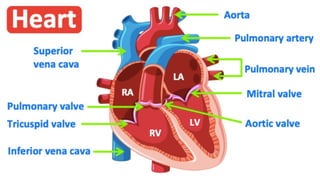
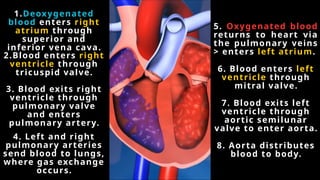
1.Deoxygenated
blood enters right
atriumthrough
superior and
inferior vena cava.
2.Blood enters right
ventricle through
tricuspid valve.
3. Blood exits right
ventricle through
pulmonary valve
and enters
pulmonary artery.
4. Left and right
pulmonary arteries
send blood to lungs,
where gas exchange
occurs.
5. Oxygenated blood
returns to heart via
the pulmonary veins
> enters left atrium.
6. Blood enters left
ventricle through
mitral valve.
7. Blood exits left
ventricle through
aortic semilunar
valve to enter aorta.
8. Aorta distributes
blood to body.
THE HUMAN HEART– THE
PUMP OF THE BODY
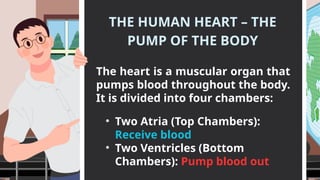
The heart is a muscular organ that
pumps blood throughout the body.
It is divided into four chambers:
• Two Atria (Top Chambers):
Receive blood
• Two Ventricles (Bottom
Chambers): Pump blood out
12.
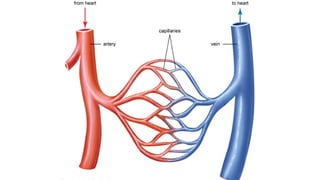
BLOOD VESSELS –THE
PATHWAYS
Blood moves through the
body in three types of blood
vessels:
• Arteries: Carry oxygen-
rich blood away from the
heart (except pulmonary
artery).
13.
BLOOD VESSELS –THE
PATHWAYS
• Veins: Carry oxygen-poor
blood toward the heart
(except pulmonary vein).
• Capillaries: Tiny blood
vessels that allow the
exchange of gases,
nutrients, and waste.
15.
BLOOD – THETRANSPORT
MEDIUM
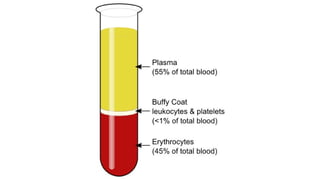
• Plasma (55%) – The liquid
portion that transports
nutrients and waste.
• Red Blood Cells (RBCs) –
Carry oxygen using
hemoglobin.
16.
BLOOD – THETRANSPORT
MEDIUM
• White Blood Cells (WBCs)
– Defend the body from
infection.
• Platelets – Help in blood
clotting to prevent
excessive bleeding.
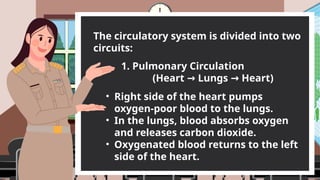
1. Pulmonary Circulation
(HeartLungs Heart)
→ →
The circulatory system is divided into two
circuits:
• Right side of the heart pumps
oxygen-poor blood to the lungs.
• In the lungs, blood absorbs oxygen
and releases carbon dioxide.
• Oxygenated blood returns to the left
side of the heart.
20.
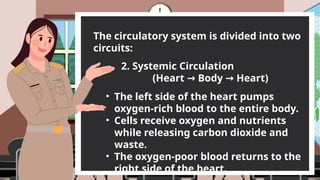
2. Systemic Circulation
(HeartBody Heart)
→ →
The circulatory system is divided into two
circuits:
• The left side of the heart pumps
oxygen-rich blood to the entire body.
• Cells receive oxygen and nutrients
while releasing carbon dioxide and
waste.
• The oxygen-poor blood returns to the
right side of the heart.
• Keeps cellsalive by
delivering oxygen and
nutrients.
• Helps maintain body
temperature and immune
defense.
• Supports the removal of
toxins and waste products.
• Essential for physical
activity and overall health.