The Big Documentation Extravaganza Stephan Schmidt <schst@php.net> 1&1 Internet AG
Agenda Why documentation is needed Types of documentation phpDocumentor DoxyGen DocBook / peardoc ReST
The Speaker PHP since 1999 Working for 1&1 Internet AG Founder of PHP Application Tools (www.php-tools.net) Member of PEAR QA Core Team and active PEAR developer Regular contributor to various magazines Speaker at conferences around the globe
Why write documentation? You are not alone Working in teams Communication is important Your brain leaks Do you remember what code you wrote four weeks ago actually does? If yes, what about two years ago? You could be hit by a bus!
More reasons for documentation Helps you design new parts of your code Write and document function prototypes &quot;PHP is as easy to read as English.&quot; Documentation is at a higher level There are people that don't &quot;talk&quot; PHP
Types of documentation Comments Documentation in the source code API-documentation May be generated from code (comments) description of functions, classes, methods,… Tutorials Helps you get started What? Why? How?
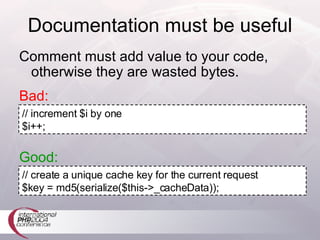
Documentation must be useful Bad: // increment $i by one $i++; Good: // create a unique cache key for the current request $key = md5(serialize($this->_cacheData)); Comment must add value to your code, otherwise they are wasted bytes.
Creating API documentation Document your code using DocBlocks Special comments that start with /** Classes, functions, variables, constants Contains a summary for these elements Purpose Function arguments / return value Visibility (in PHP4) Links for further reading
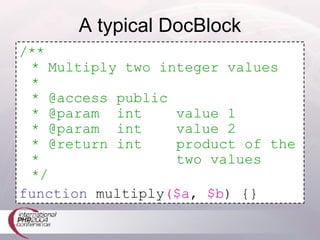
A typical DocBlock /** * Multiply two integer values * * @access public * @param  int  value 1 * @param  int  value 2 * @return int  product of the *  two values */ function  multiply ($a ,  $b ) {}
History of DocBlocks in PHP Borrowed from JavaDoc phpDoc by Ulf Wendel First public appearance on the PHP Kongress 2000 in Cologne Only one release (1.0beta) deprecated, not in CVS anymore ported to PEAR in 2002 Makes use of the tokenizer extension Also only one release
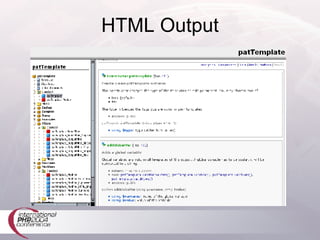
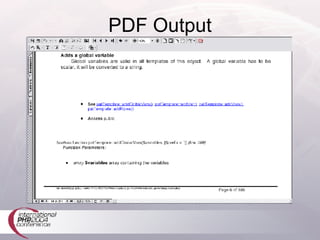
phpDocumentor De-facto standard for DocBlocks in PHP Mainly developed by Joshua Eichhorn and Greg Beaver Tons of features Creates HTML, PDF, CHM and DocBook Source code highlighting Creates tutorials, to-do lists, … Includes README, CHANGELOG, etc.
phpDocumentor Tags Common tags @var, @param, @return @static, @abstract, @access (in PHP4) @see, @uses, @link @category, @package, @subpackage @author, @copyright, @version Supports inline tags Supports DocBlock templates
phpDocumentor Easy to install using the PEAR installer Command-line interface Use command line options Create configuration files for common tasks Easy-to-Use web interface Creates more than one output format at once $ pear install phpDocumentor
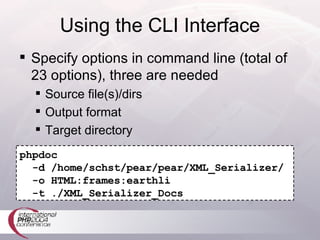
Using the CLI Interface Specify options in command line (total of 23 options), three are needed Source file(s)/dirs Output format Target directory phpdoc   -d /home/schst/pear/pear/XML_Serializer/   -o HTML:frames:earthli   -t ./XML_Serializer_Docs
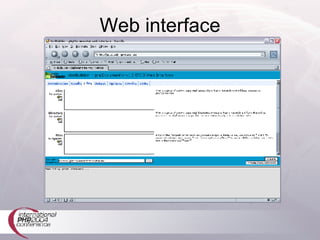
Web interface
Advanced Features Ability to include README files Ability to create tutorials that contain more information than just API documentation Based on SGML Syntax Possible for packages, classes and functions Include Links to source code of Examples
HTML Output
PDF Output
DoxyGen Documentation System for C++, C, Java, Objective-C, IDL   But also works for PHP Extracts DocBlocks but also creates documentation from undocumented source files Creates HTML, LaTeX, RTF, PDF, CHM, XML and Unix man pages
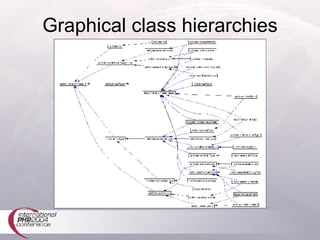
DoxyGen Features Supports documentation of files, namespaces, classes, variables, functions and defines (plus a lot entities not available in PHP). Creates class diagrams from your code as EPS or PNG with image maps Includes references to source code and examples
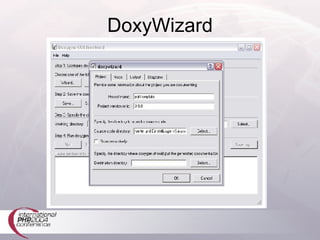
DoxyGen Features (cont.) some kind of Wiki markup inside DocBlocks HTML tags in documentation are allowed allows you to mark visibility for methods and properties more than 150 configuration options reads from configuration files Provides a wizard
DoxyWizard
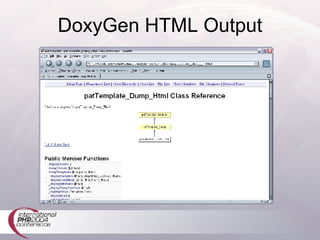
DoxyGen HTML Output
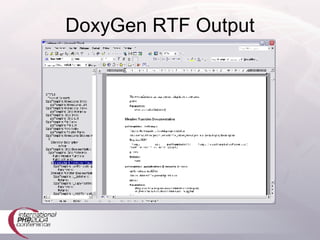
DoxyGen RTF Output
Graphical class hierarchies
Who uses DoxyGen Mozilla Xerxes KDevelop phpOpentracker http://www.phpopentracker.de/apidoc/ SPL http://www.php.net/~helly/php/ext/spl/
phpDocumentor vs. DoxyGen phpDocumentor easy to use made for PHP written in PHP several layouts created peardoc files DoxyGen Windows GUI not limited to PHP RTF output creates class diagrams
DocBook Set of SGML tags for describing articles, books and other prose documents Designed for writing documentation Created 1991 by HaL Computer Systems and O'Reilly Now managed by OASIS Making heavy use of external entities extremely complex
DocBook elements Sets Books Divisions Components (chapters) Sections Meta information Block level elements (lists, paragraphs,…) Inline elements (Emphasis, Quote, etc.)
DocBook sample document <!DOCTYPE article PUBLIC &quot;-//OASIS//DTD DocBook V3.1//EN&quot; [ <!ENTITY sect2 SYSTEM &quot;section2.sgm&quot;> ]> <article> <artheader> <title>My Article</title> <author> <honorific>Dr</honorific><firstname>Ed</firstname> <surname>Wood</surname> </author> </artheader> <para> ... </para> <sect1> <title>On the Possibility of Going Home</title> <para> ... </para> </sect1> &sect2; <bibliography> ... </bibliography> </article>
Publishing DocBook Make use of stylesheets FOSIs DSSSL CSS XSL You'll probably use DSSSL (as php.net uses it)
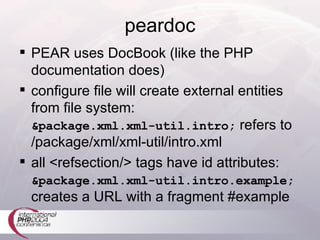
peardoc PEAR uses DocBook (like the PHP documentation does) configure file will create external entities from file system: &package.xml.xml-util.intro;  refers to /package/xml/xml-util/intro.xml all <refsection/> tags have id attributes: &package.xml.xml-util.intro.example;  creates a URL with a fragment #example
Contributing documentation $ cvs -d :pserver:cvsread:phpfi@cvs.php.net:/repository login $ cvs -d :pserver:cvsread:phpfi@cvs.php.net:/repository checkout peardoc $ cd peardoc $ autoconf $ ./configure [--with-lang=en] $ make Requires openjade and DSSSL stylesheets The rest is done by configure/make
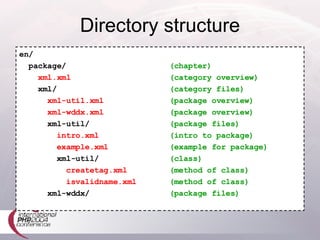
Directory structure en/ package/  (chapter) xml.xml  (category overview) xml/  (category files) xml-util.xml   (package overview) xml-wddx.xml  (package overview) xml-util/  (package files) intro.xml  (intro to package) example.xml  (example for package) xml-util/  (class) createtag.xml  (method of class) isvalidname.xml  (method of class) xml-wddx/  (package files)
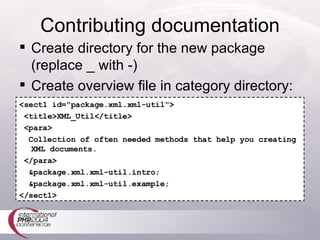
Contributing documentation Create directory for the new package (replace _ with -) Create overview file in category directory: <sect1 id=&quot;package.xml.xml-util&quot;> <title>XML_Util</title> <para> Collection of often needed methods that help you creating XML documents. </para> &package.xml.xml-util.intro; &package.xml.xml-util.example; </sect1>
Contributing documentation Add directories for classes in your package Write DocBook files (or let phpDocumentor do this for you) Add the new package to the overview page Rebuild the documentation commit
reStructuredText Easy-to-read plain-text markup, like Wiki Has been built to create Python documentation Great to write short documentation DocUtils convert it to HTML LaTeX (PDF) XML
Using DocUtils Python with XML-support is needed (xml.dom.minidom) Get DocUtils from http://docutils.sourceforge.net Install using python setup.py install Write your documents Transform it to HTML/LaTeX/XML
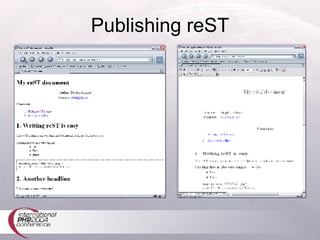
An example document ================= My reST document ================= :Author:  Stephan Schmidt :Contact:  [email_address] .. contents:: Contents .. section-numbering:: Writing reST is easy ==================== The reST syntax is easy to learn and documents look good in the source. Creating lists is also very simple: - One - Two - Three :: require_once 'XML/Util.php'; echo XML_Util::createTag('Foo');
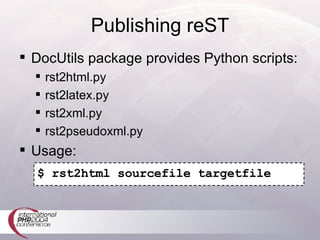
Publishing reST DocUtils package provides Python scripts: rst2html.py rst2latex.py rst2xml.py rst2pseudoxml.py Usage: $ rst2html sourcefile targetfile
Publishing reST
Other Tools Wikis Allow you to easy write structured documents xp Framework Uses its own parser to parse DocComments phpXRef Perl scripts to extract API documentation
Further reading and downloads phpDocumentor http://www.phpdoc.org DoxyGen http://www.doxygen.org DocBook http://www.docbook reST http://docutils.sourceforge.net/
The End Thanks for your attention. [email_address] http://www.php-tools.net

The Big Documentation Extravaganza

  • 1.
    The Big DocumentationExtravaganza Stephan Schmidt <schst@php.net> 1&1 Internet AG
  • 2.
    Agenda Why documentationis needed Types of documentation phpDocumentor DoxyGen DocBook / peardoc ReST
  • 3.
    The Speaker PHPsince 1999 Working for 1&1 Internet AG Founder of PHP Application Tools (www.php-tools.net) Member of PEAR QA Core Team and active PEAR developer Regular contributor to various magazines Speaker at conferences around the globe
  • 4.
    Why write documentation?You are not alone Working in teams Communication is important Your brain leaks Do you remember what code you wrote four weeks ago actually does? If yes, what about two years ago? You could be hit by a bus!
  • 5.
    More reasons fordocumentation Helps you design new parts of your code Write and document function prototypes &quot;PHP is as easy to read as English.&quot; Documentation is at a higher level There are people that don't &quot;talk&quot; PHP
  • 6.
    Types of documentationComments Documentation in the source code API-documentation May be generated from code (comments) description of functions, classes, methods,… Tutorials Helps you get started What? Why? How?
  • 7.
    Documentation must beuseful Bad: // increment $i by one $i++; Good: // create a unique cache key for the current request $key = md5(serialize($this->_cacheData)); Comment must add value to your code, otherwise they are wasted bytes.
  • 8.
    Creating API documentationDocument your code using DocBlocks Special comments that start with /** Classes, functions, variables, constants Contains a summary for these elements Purpose Function arguments / return value Visibility (in PHP4) Links for further reading
  • 9.
    A typical DocBlock/** * Multiply two integer values * * @access public * @param int value 1 * @param int value 2 * @return int product of the * two values */ function multiply ($a , $b ) {}
  • 10.
    History of DocBlocksin PHP Borrowed from JavaDoc phpDoc by Ulf Wendel First public appearance on the PHP Kongress 2000 in Cologne Only one release (1.0beta) deprecated, not in CVS anymore ported to PEAR in 2002 Makes use of the tokenizer extension Also only one release
  • 11.
    phpDocumentor De-facto standardfor DocBlocks in PHP Mainly developed by Joshua Eichhorn and Greg Beaver Tons of features Creates HTML, PDF, CHM and DocBook Source code highlighting Creates tutorials, to-do lists, … Includes README, CHANGELOG, etc.
  • 12.
    phpDocumentor Tags Commontags @var, @param, @return @static, @abstract, @access (in PHP4) @see, @uses, @link @category, @package, @subpackage @author, @copyright, @version Supports inline tags Supports DocBlock templates
  • 13.
    phpDocumentor Easy toinstall using the PEAR installer Command-line interface Use command line options Create configuration files for common tasks Easy-to-Use web interface Creates more than one output format at once $ pear install phpDocumentor
  • 14.
    Using the CLIInterface Specify options in command line (total of 23 options), three are needed Source file(s)/dirs Output format Target directory phpdoc -d /home/schst/pear/pear/XML_Serializer/ -o HTML:frames:earthli -t ./XML_Serializer_Docs
  • 15.
  • 16.
    Advanced Features Abilityto include README files Ability to create tutorials that contain more information than just API documentation Based on SGML Syntax Possible for packages, classes and functions Include Links to source code of Examples
  • 17.
  • 18.
  • 19.
    DoxyGen Documentation Systemfor C++, C, Java, Objective-C, IDL But also works for PHP Extracts DocBlocks but also creates documentation from undocumented source files Creates HTML, LaTeX, RTF, PDF, CHM, XML and Unix man pages
  • 20.
    DoxyGen Features Supportsdocumentation of files, namespaces, classes, variables, functions and defines (plus a lot entities not available in PHP). Creates class diagrams from your code as EPS or PNG with image maps Includes references to source code and examples
  • 21.
    DoxyGen Features (cont.)some kind of Wiki markup inside DocBlocks HTML tags in documentation are allowed allows you to mark visibility for methods and properties more than 150 configuration options reads from configuration files Provides a wizard
  • 22.
  • 23.
  • 24.
  • 25.
  • 26.
    Who uses DoxyGenMozilla Xerxes KDevelop phpOpentracker http://www.phpopentracker.de/apidoc/ SPL http://www.php.net/~helly/php/ext/spl/
  • 27.
    phpDocumentor vs. DoxyGenphpDocumentor easy to use made for PHP written in PHP several layouts created peardoc files DoxyGen Windows GUI not limited to PHP RTF output creates class diagrams
  • 28.
    DocBook Set ofSGML tags for describing articles, books and other prose documents Designed for writing documentation Created 1991 by HaL Computer Systems and O'Reilly Now managed by OASIS Making heavy use of external entities extremely complex
  • 29.
    DocBook elements SetsBooks Divisions Components (chapters) Sections Meta information Block level elements (lists, paragraphs,…) Inline elements (Emphasis, Quote, etc.)
  • 30.
    DocBook sample document<!DOCTYPE article PUBLIC &quot;-//OASIS//DTD DocBook V3.1//EN&quot; [ <!ENTITY sect2 SYSTEM &quot;section2.sgm&quot;> ]> <article> <artheader> <title>My Article</title> <author> <honorific>Dr</honorific><firstname>Ed</firstname> <surname>Wood</surname> </author> </artheader> <para> ... </para> <sect1> <title>On the Possibility of Going Home</title> <para> ... </para> </sect1> &sect2; <bibliography> ... </bibliography> </article>
  • 31.
    Publishing DocBook Makeuse of stylesheets FOSIs DSSSL CSS XSL You'll probably use DSSSL (as php.net uses it)
  • 32.
    peardoc PEAR usesDocBook (like the PHP documentation does) configure file will create external entities from file system: &package.xml.xml-util.intro; refers to /package/xml/xml-util/intro.xml all <refsection/> tags have id attributes: &package.xml.xml-util.intro.example; creates a URL with a fragment #example
  • 33.
    Contributing documentation $cvs -d :pserver:cvsread:phpfi@cvs.php.net:/repository login $ cvs -d :pserver:cvsread:phpfi@cvs.php.net:/repository checkout peardoc $ cd peardoc $ autoconf $ ./configure [--with-lang=en] $ make Requires openjade and DSSSL stylesheets The rest is done by configure/make
  • 34.
    Directory structure en/package/ (chapter) xml.xml (category overview) xml/ (category files) xml-util.xml (package overview) xml-wddx.xml (package overview) xml-util/ (package files) intro.xml (intro to package) example.xml (example for package) xml-util/ (class) createtag.xml (method of class) isvalidname.xml (method of class) xml-wddx/ (package files)
  • 35.
    Contributing documentation Createdirectory for the new package (replace _ with -) Create overview file in category directory: <sect1 id=&quot;package.xml.xml-util&quot;> <title>XML_Util</title> <para> Collection of often needed methods that help you creating XML documents. </para> &package.xml.xml-util.intro; &package.xml.xml-util.example; </sect1>
  • 36.
    Contributing documentation Adddirectories for classes in your package Write DocBook files (or let phpDocumentor do this for you) Add the new package to the overview page Rebuild the documentation commit
  • 37.
    reStructuredText Easy-to-read plain-textmarkup, like Wiki Has been built to create Python documentation Great to write short documentation DocUtils convert it to HTML LaTeX (PDF) XML
  • 38.
    Using DocUtils Pythonwith XML-support is needed (xml.dom.minidom) Get DocUtils from http://docutils.sourceforge.net Install using python setup.py install Write your documents Transform it to HTML/LaTeX/XML
  • 39.
    An example document================= My reST document ================= :Author: Stephan Schmidt :Contact: [email_address] .. contents:: Contents .. section-numbering:: Writing reST is easy ==================== The reST syntax is easy to learn and documents look good in the source. Creating lists is also very simple: - One - Two - Three :: require_once 'XML/Util.php'; echo XML_Util::createTag('Foo');
  • 40.
    Publishing reST DocUtilspackage provides Python scripts: rst2html.py rst2latex.py rst2xml.py rst2pseudoxml.py Usage: $ rst2html sourcefile targetfile
  • 41.
  • 42.
    Other Tools WikisAllow you to easy write structured documents xp Framework Uses its own parser to parse DocComments phpXRef Perl scripts to extract API documentation
  • 43.
    Further reading anddownloads phpDocumentor http://www.phpdoc.org DoxyGen http://www.doxygen.org DocBook http://www.docbook reST http://docutils.sourceforge.net/
  • 44.
    The End Thanksfor your attention. [email_address] http://www.php-tools.net