The Bet—Characterization Analysis
What does the text SAY? What does it MEAN? Why does it MATTER?
The banker, who was
younger and more nervous
in those days, was
suddenly carried away by
excitement; he struck the
table with his fist and
shouted at the young man:
"It's not true! I'll bet you
two millions you wouldn't
stay in solitary
confinement for five
years."
The author tells the
reader the banker was
“younger and more
nervous” in those days.
Another example in this
passage of the author
telling the reader
something about the
banker’s personality is
“suddenly carried away
by excitement”
Example of DIRECT
characterization
The banker, spoilt and
frivolous, with millions
beyond his reckoning, was
delighted at the bet.
The author tells the
reader that the banker
is “spoilt and frivolous”
This is an example of
DIRECT
characterization.
"Think better of it, young
man, while there is still
time. To me two millions
are a trifle, but you are
losing three or four of the
best years of your life. I
say three or four, because
you won't stay longer.
Don't forget either, you
unhappy man, that
voluntary confinement is a
great deal harder to bear
than compulsory. The
thought that you have the
right to step out in liberty
at any moment will poison
your whole existence in
prison. I am sorry for you."
This passage shows the
banker seeming to mock
the young lawyer by
dismissively saying that
the amount of money
the banker has is a
“trifle” and pretending
to feel sorry for the
lawyer who is giving up
part of his life for this
bet.
This is an example of
INDIRECT
characterization. NOTE:
the significance of
INDIECT
characterization is that
it requires the reader to
INFER something about
the character.

The bet characterization analysis

  • 1.
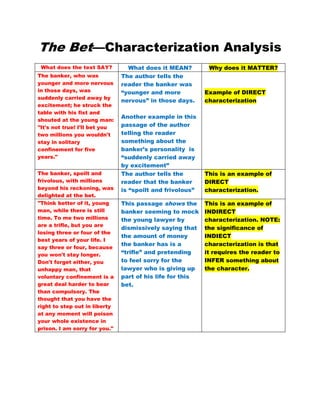
    The Bet—Characterization Analysis Whatdoes the text SAY? What does it MEAN? Why does it MATTER? The banker, who was younger and more nervous in those days, was suddenly carried away by excitement; he struck the table with his fist and shouted at the young man: "It's not true! I'll bet you two millions you wouldn't stay in solitary confinement for five years." The author tells the reader the banker was “younger and more nervous” in those days. Another example in this passage of the author telling the reader something about the banker’s personality is “suddenly carried away by excitement” Example of DIRECT characterization The banker, spoilt and frivolous, with millions beyond his reckoning, was delighted at the bet. The author tells the reader that the banker is “spoilt and frivolous” This is an example of DIRECT characterization. "Think better of it, young man, while there is still time. To me two millions are a trifle, but you are losing three or four of the best years of your life. I say three or four, because you won't stay longer. Don't forget either, you unhappy man, that voluntary confinement is a great deal harder to bear than compulsory. The thought that you have the right to step out in liberty at any moment will poison your whole existence in prison. I am sorry for you." This passage shows the banker seeming to mock the young lawyer by dismissively saying that the amount of money the banker has is a “trifle” and pretending to feel sorry for the lawyer who is giving up part of his life for this bet. This is an example of INDIRECT characterization. NOTE: the significance of INDIECT characterization is that it requires the reader to INFER something about the character.