

More Related Content
Similar to The Bermuda Triangle.pdf
Similar to The Bermuda Triangle.pdf (20)
More from TEWMAGAZINE
More from TEWMAGAZINE (20)
Recently uploaded
Recently uploaded (9)
The Bermuda Triangle.pdf
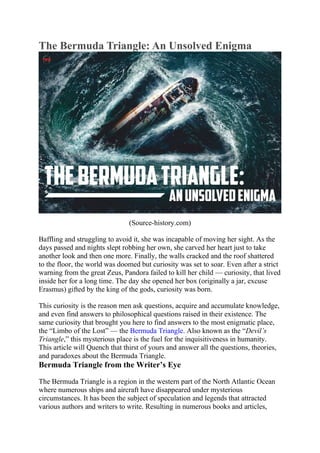
- 1. The Bermuda Triangle: An Unsolved Enigma (Source-history.com) Baffling and struggling to avoid it, she was incapable of moving her sight. As the days passed and nights slept robbing her own, she carved her heart just to take another look and then one more. Finally, the walls cracked and the roof shattered to the floor, the world was doomed but curiosity was set to soar. Even after a strict warning from the great Zeus, Pandora failed to kill her child — curiosity, that lived inside her for a long time. The day she opened her box (originally a jar, excuse Erasmus) gifted by the king of the gods, curiosity was born. This curiosity is the reason men ask questions, acquire and accumulate knowledge, and even find answers to philosophical questions raised in their existence. The same curiosity that brought you here to find answers to the most enigmatic place, the “Limbo of the Lost” — the Bermuda Triangle. Also known as the “Devil’s Triangle,” this mysterious place is the fuel for the inquisitiveness in humanity. This article will Quench that thirst of yours and answer all the questions, theories, and paradoxes about the Bermuda Triangle. Bermuda Triangle from the Writer’s Eye The Bermuda Triangle is a region in the western part of the North Atlantic Ocean where numerous ships and aircraft have disappeared under mysterious circumstances. It has been the subject of speculation and legends that attracted various authors and writers to write. Resulting in numerous books and articles,
- 2. each offering their perspective on the mystery. Here are a few descriptions of the Bermuda Triangle by some notable authors and writers. 1. Vincent Gaddis Vincent Gaddis coined the term “Bermuda Triangle” in his 1964 magazine article and later expanded it into a book titled “Invisible Horizons: True Mysteries of the Sea” (1965). Gaddis attributes the disappearances to a range of natural factors, magnetic anomalies, and violent weather. 2. Charles Berlitz Charles is perhaps one of the most famous authors associated with the Bermuda Triangle. His 1974 book, “The Bermuda Triangle,” popularized the mystery. He suggests that extraterrestrial forces or ancient civilizations might be responsible for the occurrence of unusual phenomena. 3. Larry Kusche In his book “The Bermuda Triangle Mystery Solved” (1975), Larry Kusche challenged the claims made by Berlitz and Gaddis. He conducted thorough research into many of the cases and concluded that most of the mysterious disappearances had logical explanations. 4. Berlitz and Winer’s Collaborative Works They both co-authored “The Bermuda Triangle Mystery – Solved” (1980). In this book, they explore various theories, including those involving time warps, underwater cities, and alien abductions. 5. Gian Quasar His book “Into the Bermuda Triangle” (2003), presents a more balanced view on this mystery. He examines both the skeptic’s and believer’s perspectives in his work. After Quasar, many such authors and writers contributed to the lore and legend of the Bermuda Triangle, making it a topic of enduring fascination to date. The Science Behind the Bermuda Triangle
- 3. (Source-History.com) This Devil’s Triangle has always been a source of fascination and intrigue for decades which captured the imagination of many. However, segregating the facts from fiction, the scientific community has been working diligently to understand the natural phenomena that might explain these apparent enigmas. Here is a list of what we have found about the Bermuda Triangle. Location and Dimensions: This Triangle is roughly bounded by Miami, Bermuda, and Puerto Rico, forming an area of about 500,000 square miles. Within this vast expanse, numerous ships and planes have reportedly vanished without a trace. Including the famous disappearances of Flight 19 in 1945 and the USS Cyclops in 1918. Natural Explanations: Scientists have been investigating this enigma for a long time. One of the most widely accepted theories is the presence of methane hydrates, which can be found on the ocean floor. Under certain conditions, these methane hydrates can become unstable and rapidly release methane gas into the water. This can create a phenomenon known as “methane hydrate eruptions,” which results in bubbles rising to the surface. Reducing the water’s density, causing ships to lose buoyancy and sink rapidly. If an aircraft is flying low at the time of such an eruption, it could potentially encounter engine failure due to a sudden loss of oxygen. Another natural explanation focuses on the powerful and unpredictable weather patterns in the region. The convergence of warm Caribbean air and cool North Atlantic air can
- 4. lead to the formation of violent thunderstorms and waterspouts. Ships and planes caught amid these storms could be at risk of accidents or going off course. Compass Variations: One intriguing aspect of the Bermuda Triangle is the alleged compass variations that some vessels have reported when traveling through the area. The region is one of the few places on Earth where true north and magnetic north align. However, this alignment is not constant, and the magnetic field of the Earth can change over time. Ships and planes using magnetic compasses may experience variations, leading to navigation errors. Human Error: In many reported cases of disappearances within the Bermuda Triangle, human error is believed to be a significant contributing factor. Pilots and sailors may misjudge their positions or fail to account for harmful weather conditions. These explanations by modern science such as methane hydrate eruptions, extreme weather, and human error provide plausible reasons for the reported incidents. However, the legend of the Bermuda Triangle is still a reminder that mysteries still exist within our world’s oceans and skies. After knowing all the fiction and facts about this intriguing part of the world, here is a story of one among many incidents that terrified the sky and the ocean. The Most Incredible Mystery in the History of Aviation — “The Lost Patrol” On a Wednesday afternoon, five TBM Avenger torpedo bombers lined up on runways at the Fort Lauderdale (Florida) Naval Air Station. The date was December 5, 1945. The bombers had been checked and fuelled up. The engines, controls, instruments, and compasses were in perfect condition, according to later testimony. Two minutes past two p.m., the flight leader closed his canopy, gunned his engine, and the first plane roared down the runway. The others followed in quick succession, climbing up into the clear sky and heading east over the Atlantic at 215 mph.
- 5. (Source-Pinterest) It was a routine patrol flight. The navigation plan for the formation was to fly due east for 160 miles, then north for forty miles, then back southwest to the air station, completing a triangle. The relatively short flight would require about two hours. The first word from the patrol came to the base control tower at three forty-five, but the strange message did not request the expected landing instructions. “Calling tower, this is an emergency,” the patrol leader said in a worried voice. “We seem to be off course. We cannot see land … repeat … we cannot see land.” “What is your position?” the tower radioed back. “We are not sure of our position,” came the reply. “We can’t be sure where we are. We seem to be lost.” Startled, the tower operators looked at one another. With ideal flight conditions, how could five planes manned by experienced crews be lost? “Assume bearing due west,” the tower instructed. “We don’t know which way is west. Everything is wrong …strange. We can’t be sure of any direction. Even the ocean doesn’t look as it should.” Keep in mind that the sun was still above the western horizon. The flyers could have ignored their compasses and flown west by observation of the sun. Not only
- 6. did the sea look strange, but the sun was invisible too. During the next few minutes, the tower operators listened in as the pilots talked to one another. Shortly after four p.m., the flight leader suddenly turned over the flight command to another pilot. At four twenty-five p.m., the new flight leader contacted the tower. “Tower,” he said, “we are not certain where we are … we think we must be about two hundred and twenty-five miles northeast of base. It looks like we are …” The message ended abruptly. That was the last word from “the doomed patrol.” Tower operators signaled a rescue alarm. Within a few minutes, a huge Martin Mariner flying boat with full rescue equipment and a crew of thirteen men was on its way. But there were no traces no signals. What was happening out there over the sea 200 miles away? By this time, it was dusk. Navy and Coast Guard vessels joined the search. Through the long night, they watched for possible signal flares from life rafts. But no lights broke through the darkness above the black sea. Military experts were baffled. How could six airplanes and twenty-seven men vanish in such a limited area? Did the planes eventually run out of fuel? While the Avengers were not especially buoyant, the Navy said they would remain afloat long enough for life rafts to be launched, and the crewmen “shouldn’t even get their feet wet.” All the missing men were trained in sea-survival procedures and had life jackets. Each plane had its radio facilities. Why was no SOS received from at least one of the planes? And what about the Mariner? Did it meet the same fate as the patrol? This was the story of the doomed patrol, from an article written by Vincent H. Gaddis in 1964. This article raised many questions and drew everyone’s attention. Raising several questions that no one had answers to. Conclusion The Bermuda Triangles mystery dates back to the never-explained, enigmatic light observed by Columbus when he first approached his landfall in the Bahamas. This place is a home for aberrations like “a hole in the sky,” “a lost underwater city” or even “a gateway for Mars.” The Bermuda Triangle underlines the fact that despite swift wings and internet signals, we still have a world large enough so that men and their machines and ships can disappear without a trace. We hope this article was a piece of delight for your curiosity and helped you open your box.