2.2.2.G1
The Basics of Taxes
Advanced Level
2.2.2.G1
© Take Charge Today – August 2013 – The Basics of Taxes – Slide 2
Funded by a grant from Take Charge America, Inc. to the Norton School of Family and Consumer Sciences Take Charge America Institute at the University of Arizona
What are taxes?
Are you a
taxpayer?
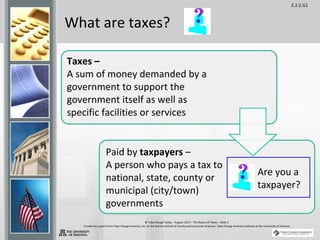
Taxes –
A sum of money demanded by a
government to support the
government itself as well as
specific facilities or services
Paid by taxpayers –
A person who pays a tax to
national, state, county or
municipal (city/town)
governments
2.2.2.G1
© Take Charge Today – August 2013 – The Basics of Taxes – Slide 3
Funded by a grant from Take Charge America, Inc. to the Norton School of Family and Consumer Sciences Take Charge America Institute at the University of Arizona
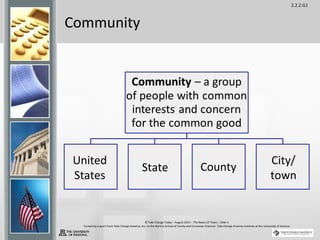
Community
United
States
State County
City/
town
2.2.2.G1
© Take Charge Today – August 2013 – The Basics of Taxes – Slide 4
Funded by a grant from Take Charge America, Inc. to the Norton School of Family and Consumer Sciences Take Charge America Institute at the University of Arizona
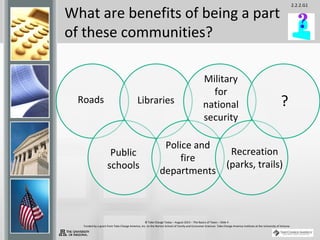
What are benefits of being a part
of these communities?
Roads Libraries
Military
for
national
security
Public
schools
Police and
fire
departments
Recreation
(parks, trails)
?
2.2.2.G1
© Take Charge Today – August 2013 – The Basics of Taxes – Slide 5
Funded by a grant from Take Charge America, Inc. to the Norton School of Family and Consumer Sciences Take Charge America Institute at the University of Arizona
“You are better off being in a
community than by yourself”
As a community member you
receive many benefits you
could not pay for individually
Taxes are a way members of a
community provide for one
another
2.2.2.G1
© Take Charge Today – August 2013 – The Basics of Taxes – Slide 6
Funded by a grant from Take Charge America, Inc. to the Norton School of Family and Consumer Sciences Take Charge America Institute at the University of Arizona
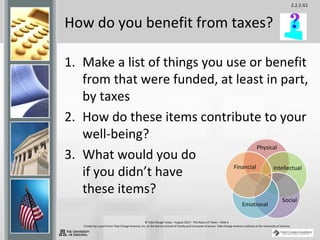
How do you benefit from taxes?
1. Make a list of things you use or benefit
from that were funded, at least in part,
by taxes
2. How do these items contribute to your
well-being?
3. What would you do
if you didn’t have
these items?
Physical
Intellectual
Emotional
Social
Financial
2.2.2.G1
© Take Charge Today – August 2013 – The Basics of Taxes – Slide 7
Funded by a grant from Take Charge America, Inc. to the Norton School of Family and Consumer Sciences Take Charge America Institute at the University of Arizona
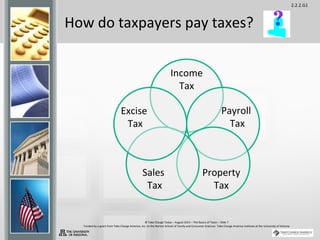
How do taxpayers pay taxes?
Income
Tax
Payroll
Tax
Property
Tax
Sales
Tax
Excise
Tax
2.2.2.G1
© Take Charge Today – August 2013 – The Basics of Taxes – Slide 8
Funded by a grant from Take Charge America, Inc. to the Norton School of Family and Consumer Sciences Take Charge America Institute at the University of Arizona
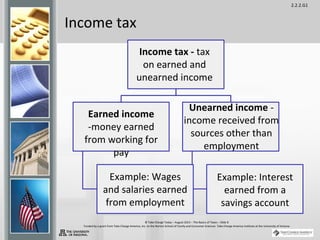
Income tax
Income tax - tax
on earned and
unearned income
Earned income
-money earned
from working for
pay
Unearned income -
income received from
sources other than
employment
Example: Wages
and salaries earned
from employment
Example: Interest
earned from a
savings account
2.2.2.G1
© Take Charge Today – August 2013 – The Basics of Taxes – Slide 9
Funded by a grant from Take Charge America, Inc. to the Norton School of Family and Consumer Sciences Take Charge America Institute at the University of Arizona
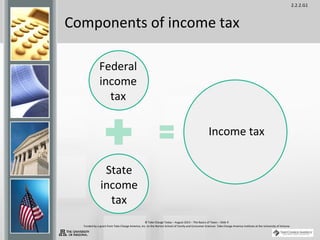
Components of income tax
Federal
income
tax
State
income
tax
Income tax
2.2.2.G1
© Take Charge Today – August 2013 – The Basics of Taxes – Slide 10
Funded by a grant from Take Charge America, Inc. to the Norton School of Family and Consumer Sciences Take Charge America Institute at the University of Arizona
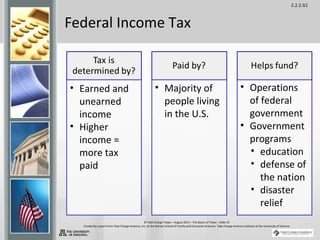
Federal Income Tax
• Earned and
unearned
income
• Higher
income =
more tax
paid
• Majority of
people living
in the U.S.
• Operations
of federal
government
• Government
programs
• education
• defense of
the nation
• disaster
relief
2.2.2.G1
© Take Charge Today – August 2013 – The Basics of Taxes – Slide 11
Funded by a grant from Take Charge America, Inc. to the Norton School of Family and Consumer Sciences Take Charge America Institute at the University of Arizona
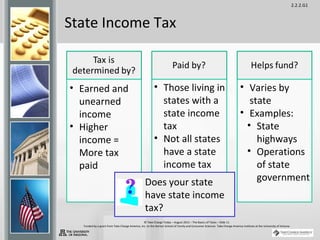
State Income Tax
Does your state
have state income
tax?
• Earned and
unearned
income
• Higher
income =
More tax
paid
• Those living in
states with a
state income
tax
• Not all states
have a state
income tax
• Varies by
state
• Examples:
• State
highways
• Operations
of state
government
2.2.2.G1
© Take Charge Today – August 2013 – The Basics of Taxes – Slide 12
Funded by a grant from Take Charge America, Inc. to the Norton School of Family and Consumer Sciences Take Charge America Institute at the University of Arizona
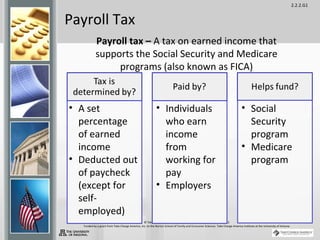
Payroll Tax
Payroll tax – A tax on earned income that
supports the Social Security and Medicare
programs (also known as FICA)
• A set
percentage
of earned
income
• Deducted out
of paycheck
(except for
self-
employed)
• Individuals
who earn
income
from
working for
pay
• Employers
• Social
Security
program
• Medicare
program
2.2.2.G1
© Take Charge Today – August 2013 – The Basics of Taxes – Slide 13
Funded by a grant from Take Charge America, Inc. to the Norton School of Family and Consumer Sciences Take Charge America Institute at the University of Arizona
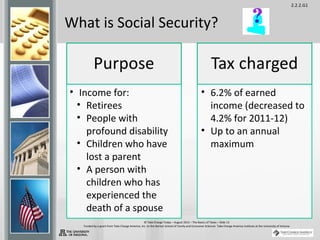
What is Social Security?
• Income for:
• Retirees
• People with
profound disability
• Children who have
lost a parent
• A person with
children who has
experienced the
death of a spouse
• 6.2% of earned
income (decreased to
4.2% for 2011-12)
• Up to an annual
maximum
2.2.2.G1
© Take Charge Today – August 2013 – The Basics of Taxes – Slide 14
Funded by a grant from Take Charge America, Inc. to the Norton School of Family and Consumer Sciences Take Charge America Institute at the University of Arizona
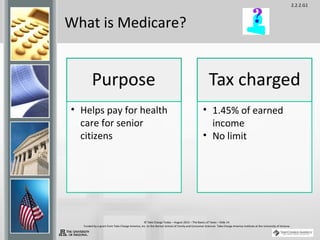
What is Medicare?
• Helps pay for health
care for senior
citizens
• 1.45% of earned
income
• No limit
2.2.2.G1
© Take Charge Today – August 2013 – The Basics of Taxes – Slide 15
Funded by a grant from Take Charge America, Inc. to the Norton School of Family and Consumer Sciences Take Charge America Institute at the University of Arizona
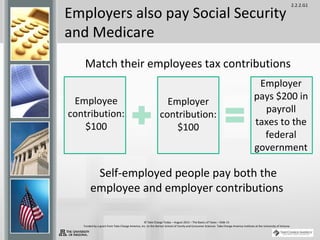
Employers also pay Social Security
and Medicare
Match their employees tax contributions
Self-employed people pay both the
employee and employer contributions
Employee
contribution:
$100
Employer
contribution:
$100
Employer
pays $200 in
payroll
taxes to the
federal
government
2.2.2.G1
© Take Charge Today – August 2013 – The Basics of Taxes – Slide 16
Funded by a grant from Take Charge America, Inc. to the Norton School of Family and Consumer Sciences Take Charge America Institute at the University of Arizona
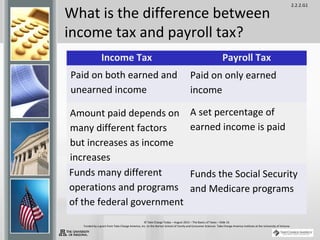
What is the difference between
income tax and payroll tax?
Income Tax Payroll Tax
Paid on both earned and
unearned income
Paid on only earned
income
Amount paid depends on
many different factors
but increases as income
increases
A set percentage of
earned income is paid
Funds many different
operations and programs
of the federal government
Funds the Social Security
and Medicare programs
2.2.2.G1
© Take Charge Today – August 2013 – The Basics of Taxes – Slide 17
Funded by a grant from Take Charge America, Inc. to the Norton School of Family and Consumer Sciences Take Charge America Institute at the University of Arizona
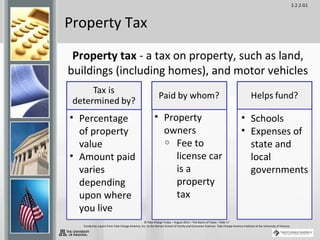
Property Tax
Property tax - a tax on property, such as land,
buildings (including homes), and motor vehicles
• Percentage
of property
value
• Amount paid
varies
depending
upon where
you live
• Property
owners
o Fee to
license car
is a
property
tax
• Schools
• Expenses of
state and
local
governments
2.2.2.G1
© Take Charge Today – August 2013 – The Basics of Taxes – Slide 18
Funded by a grant from Take Charge America, Inc. to the Norton School of Family and Consumer Sciences Take Charge America Institute at the University of Arizona
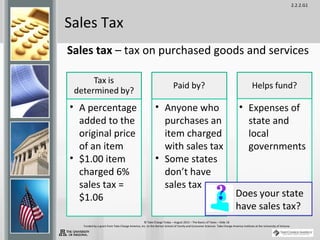
Sales Tax
Sales tax – tax on purchased goods and services
Does your state
have sales tax?
• A percentage
added to the
original price
of an item
• $1.00 item
charged 6%
sales tax =
$1.06
• Anyone who
purchases an
item charged
with sales tax
• Some states
don’t have
sales tax
• Expenses of
state and
local
governments
2.2.2.G1
© Take Charge Today – August 2013 – The Basics of Taxes – Slide 19
Funded by a grant from Take Charge America, Inc. to the Norton School of Family and Consumer Sciences Take Charge America Institute at the University of Arizona
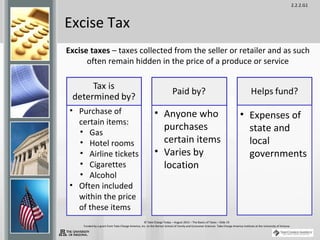
Excise Tax
Excise taxes – taxes collected from the seller or retailer and as such
often remain hidden in the price of a produce or service
• Purchase of
certain items:
• Gas
• Hotel rooms
• Airline tickets
• Cigarettes
• Alcohol
• Often included
within the price
of these items
• Anyone who
purchases
certain items
• Varies by
location
• Expenses of
state and
local
governments
2.2.2.G1
© Take Charge Today – August 2013 – The Basics of Taxes – Slide 20
Funded by a grant from Take Charge America, Inc. to the Norton School of Family and Consumer Sciences Take Charge America Institute at the University of Arizona
How are tax rates determined?
Determined by public representatives (city councils,
county commissions, state legislatures, Congress)
Elected by voters
Taxpayers = voters
Work as a voting group to elect representatives
who will represent the majority
2.2.2.G1
© Take Charge Today – August 2013 – The Basics of Taxes – Slide 21
Funded by a grant from Take Charge America, Inc. to the Norton School of Family and Consumer Sciences Take Charge America Institute at the University of Arizona
Taxes and Money Management
Why do you think understanding
taxes is an important part of
money management?
Taxes play a role in
both earning and
spending
One of the largest
expenses for many
people
2.2.2.G1
© Take Charge Today – August 2013 – The Basics of Taxes – Slide 22
Funded by a grant from Take Charge America, Inc. to the Norton School of Family and Consumer Sciences Take Charge America Institute at the University of Arizona
Summary
Without taxes it would
be hard to pay for
many of the benefits of
being a member of a
community
Taxes are charged in
many different forms
The amount of taxes
you pay and what you
pay those taxes on will
vary depending upon
where you live and
your income
Understanding taxes is
an important part of
money management

The basics of_taxes_power_point_2.2.2.g1

  • 1.
    2.2.2.G1 The Basics ofTaxes Advanced Level
  • 2.
    2.2.2.G1 © Take ChargeToday – August 2013 – The Basics of Taxes – Slide 2 Funded by a grant from Take Charge America, Inc. to the Norton School of Family and Consumer Sciences Take Charge America Institute at the University of Arizona What are taxes? Are you a taxpayer? Taxes – A sum of money demanded by a government to support the government itself as well as specific facilities or services Paid by taxpayers – A person who pays a tax to national, state, county or municipal (city/town) governments
  • 3.
    2.2.2.G1 © Take ChargeToday – August 2013 – The Basics of Taxes – Slide 3 Funded by a grant from Take Charge America, Inc. to the Norton School of Family and Consumer Sciences Take Charge America Institute at the University of Arizona Community United States State County City/ town
  • 4.
    2.2.2.G1 © Take ChargeToday – August 2013 – The Basics of Taxes – Slide 4 Funded by a grant from Take Charge America, Inc. to the Norton School of Family and Consumer Sciences Take Charge America Institute at the University of Arizona What are benefits of being a part of these communities? Roads Libraries Military for national security Public schools Police and fire departments Recreation (parks, trails) ?
  • 5.
    2.2.2.G1 © Take ChargeToday – August 2013 – The Basics of Taxes – Slide 5 Funded by a grant from Take Charge America, Inc. to the Norton School of Family and Consumer Sciences Take Charge America Institute at the University of Arizona “You are better off being in a community than by yourself” As a community member you receive many benefits you could not pay for individually Taxes are a way members of a community provide for one another
  • 6.
    2.2.2.G1 © Take ChargeToday – August 2013 – The Basics of Taxes – Slide 6 Funded by a grant from Take Charge America, Inc. to the Norton School of Family and Consumer Sciences Take Charge America Institute at the University of Arizona How do you benefit from taxes? 1. Make a list of things you use or benefit from that were funded, at least in part, by taxes 2. How do these items contribute to your well-being? 3. What would you do if you didn’t have these items? Physical Intellectual Emotional Social Financial
  • 7.
    2.2.2.G1 © Take ChargeToday – August 2013 – The Basics of Taxes – Slide 7 Funded by a grant from Take Charge America, Inc. to the Norton School of Family and Consumer Sciences Take Charge America Institute at the University of Arizona How do taxpayers pay taxes? Income Tax Payroll Tax Property Tax Sales Tax Excise Tax
  • 8.
    2.2.2.G1 © Take ChargeToday – August 2013 – The Basics of Taxes – Slide 8 Funded by a grant from Take Charge America, Inc. to the Norton School of Family and Consumer Sciences Take Charge America Institute at the University of Arizona Income tax Income tax - tax on earned and unearned income Earned income -money earned from working for pay Unearned income - income received from sources other than employment Example: Wages and salaries earned from employment Example: Interest earned from a savings account
  • 9.
    2.2.2.G1 © Take ChargeToday – August 2013 – The Basics of Taxes – Slide 9 Funded by a grant from Take Charge America, Inc. to the Norton School of Family and Consumer Sciences Take Charge America Institute at the University of Arizona Components of income tax Federal income tax State income tax Income tax
  • 10.
    2.2.2.G1 © Take ChargeToday – August 2013 – The Basics of Taxes – Slide 10 Funded by a grant from Take Charge America, Inc. to the Norton School of Family and Consumer Sciences Take Charge America Institute at the University of Arizona Federal Income Tax • Earned and unearned income • Higher income = more tax paid • Majority of people living in the U.S. • Operations of federal government • Government programs • education • defense of the nation • disaster relief
  • 11.
    2.2.2.G1 © Take ChargeToday – August 2013 – The Basics of Taxes – Slide 11 Funded by a grant from Take Charge America, Inc. to the Norton School of Family and Consumer Sciences Take Charge America Institute at the University of Arizona State Income Tax Does your state have state income tax? • Earned and unearned income • Higher income = More tax paid • Those living in states with a state income tax • Not all states have a state income tax • Varies by state • Examples: • State highways • Operations of state government
  • 12.
    2.2.2.G1 © Take ChargeToday – August 2013 – The Basics of Taxes – Slide 12 Funded by a grant from Take Charge America, Inc. to the Norton School of Family and Consumer Sciences Take Charge America Institute at the University of Arizona Payroll Tax Payroll tax – A tax on earned income that supports the Social Security and Medicare programs (also known as FICA) • A set percentage of earned income • Deducted out of paycheck (except for self- employed) • Individuals who earn income from working for pay • Employers • Social Security program • Medicare program
  • 13.
    2.2.2.G1 © Take ChargeToday – August 2013 – The Basics of Taxes – Slide 13 Funded by a grant from Take Charge America, Inc. to the Norton School of Family and Consumer Sciences Take Charge America Institute at the University of Arizona What is Social Security? • Income for: • Retirees • People with profound disability • Children who have lost a parent • A person with children who has experienced the death of a spouse • 6.2% of earned income (decreased to 4.2% for 2011-12) • Up to an annual maximum
  • 14.
    2.2.2.G1 © Take ChargeToday – August 2013 – The Basics of Taxes – Slide 14 Funded by a grant from Take Charge America, Inc. to the Norton School of Family and Consumer Sciences Take Charge America Institute at the University of Arizona What is Medicare? • Helps pay for health care for senior citizens • 1.45% of earned income • No limit
  • 15.
    2.2.2.G1 © Take ChargeToday – August 2013 – The Basics of Taxes – Slide 15 Funded by a grant from Take Charge America, Inc. to the Norton School of Family and Consumer Sciences Take Charge America Institute at the University of Arizona Employers also pay Social Security and Medicare Match their employees tax contributions Self-employed people pay both the employee and employer contributions Employee contribution: $100 Employer contribution: $100 Employer pays $200 in payroll taxes to the federal government
  • 16.
    2.2.2.G1 © Take ChargeToday – August 2013 – The Basics of Taxes – Slide 16 Funded by a grant from Take Charge America, Inc. to the Norton School of Family and Consumer Sciences Take Charge America Institute at the University of Arizona What is the difference between income tax and payroll tax? Income Tax Payroll Tax Paid on both earned and unearned income Paid on only earned income Amount paid depends on many different factors but increases as income increases A set percentage of earned income is paid Funds many different operations and programs of the federal government Funds the Social Security and Medicare programs
  • 17.
    2.2.2.G1 © Take ChargeToday – August 2013 – The Basics of Taxes – Slide 17 Funded by a grant from Take Charge America, Inc. to the Norton School of Family and Consumer Sciences Take Charge America Institute at the University of Arizona Property Tax Property tax - a tax on property, such as land, buildings (including homes), and motor vehicles • Percentage of property value • Amount paid varies depending upon where you live • Property owners o Fee to license car is a property tax • Schools • Expenses of state and local governments
  • 18.
    2.2.2.G1 © Take ChargeToday – August 2013 – The Basics of Taxes – Slide 18 Funded by a grant from Take Charge America, Inc. to the Norton School of Family and Consumer Sciences Take Charge America Institute at the University of Arizona Sales Tax Sales tax – tax on purchased goods and services Does your state have sales tax? • A percentage added to the original price of an item • $1.00 item charged 6% sales tax = $1.06 • Anyone who purchases an item charged with sales tax • Some states don’t have sales tax • Expenses of state and local governments
  • 19.
    2.2.2.G1 © Take ChargeToday – August 2013 – The Basics of Taxes – Slide 19 Funded by a grant from Take Charge America, Inc. to the Norton School of Family and Consumer Sciences Take Charge America Institute at the University of Arizona Excise Tax Excise taxes – taxes collected from the seller or retailer and as such often remain hidden in the price of a produce or service • Purchase of certain items: • Gas • Hotel rooms • Airline tickets • Cigarettes • Alcohol • Often included within the price of these items • Anyone who purchases certain items • Varies by location • Expenses of state and local governments
  • 20.
    2.2.2.G1 © Take ChargeToday – August 2013 – The Basics of Taxes – Slide 20 Funded by a grant from Take Charge America, Inc. to the Norton School of Family and Consumer Sciences Take Charge America Institute at the University of Arizona How are tax rates determined? Determined by public representatives (city councils, county commissions, state legislatures, Congress) Elected by voters Taxpayers = voters Work as a voting group to elect representatives who will represent the majority
  • 21.
    2.2.2.G1 © Take ChargeToday – August 2013 – The Basics of Taxes – Slide 21 Funded by a grant from Take Charge America, Inc. to the Norton School of Family and Consumer Sciences Take Charge America Institute at the University of Arizona Taxes and Money Management Why do you think understanding taxes is an important part of money management? Taxes play a role in both earning and spending One of the largest expenses for many people
  • 22.
    2.2.2.G1 © Take ChargeToday – August 2013 – The Basics of Taxes – Slide 22 Funded by a grant from Take Charge America, Inc. to the Norton School of Family and Consumer Sciences Take Charge America Institute at the University of Arizona Summary Without taxes it would be hard to pay for many of the benefits of being a member of a community Taxes are charged in many different forms The amount of taxes you pay and what you pay those taxes on will vary depending upon where you live and your income Understanding taxes is an important part of money management