5. The Ball Poem
JOHN BERRYMAN
A boy loses a ball. He is very upset. A ball doesn’t cost
much, nor is it difficult to buy another ball. Why then
is the boy so upset? Read the poem to see what the
poet thinks has been lost, and what the boy has to
learn from the experience of losing something.
John Berryman was an American poet
and scholar. He is best known for the
Dream Songs (1969) which was a
sequence of 385 poems. He won
Pulitzer Prize for the dream songs. He
also won National book award.
The poet John Berryman through his poem, ‘The ball poem’ has described the
reality of life which everyone has to face one day. He has touched the topic of
how to stand up against the miseries and sorrows of life.
o there are other balls: The words suggest that the loss is not
important enough to worry about
shaking grief: sadness which greatly affects the boy
rigid: stiff
Grief: sorrow
Rigid: fixed
Trembling: shaking
Harbour: dock, port
Intrude: invader
Dime: 10 cents (U.S)
Worthless: valueless, useless
(to) intrude on: here, to enter a situation where one is not
welcome a dime: ten cents (U.S.)
desperate: hopeless
epistemology of loss: understanding the nature of loss — what it
means to lose something
epistemology: The Greek word episteme means ‘knowledge’ (it
comes from a word meaning ‘to understand, to know’).
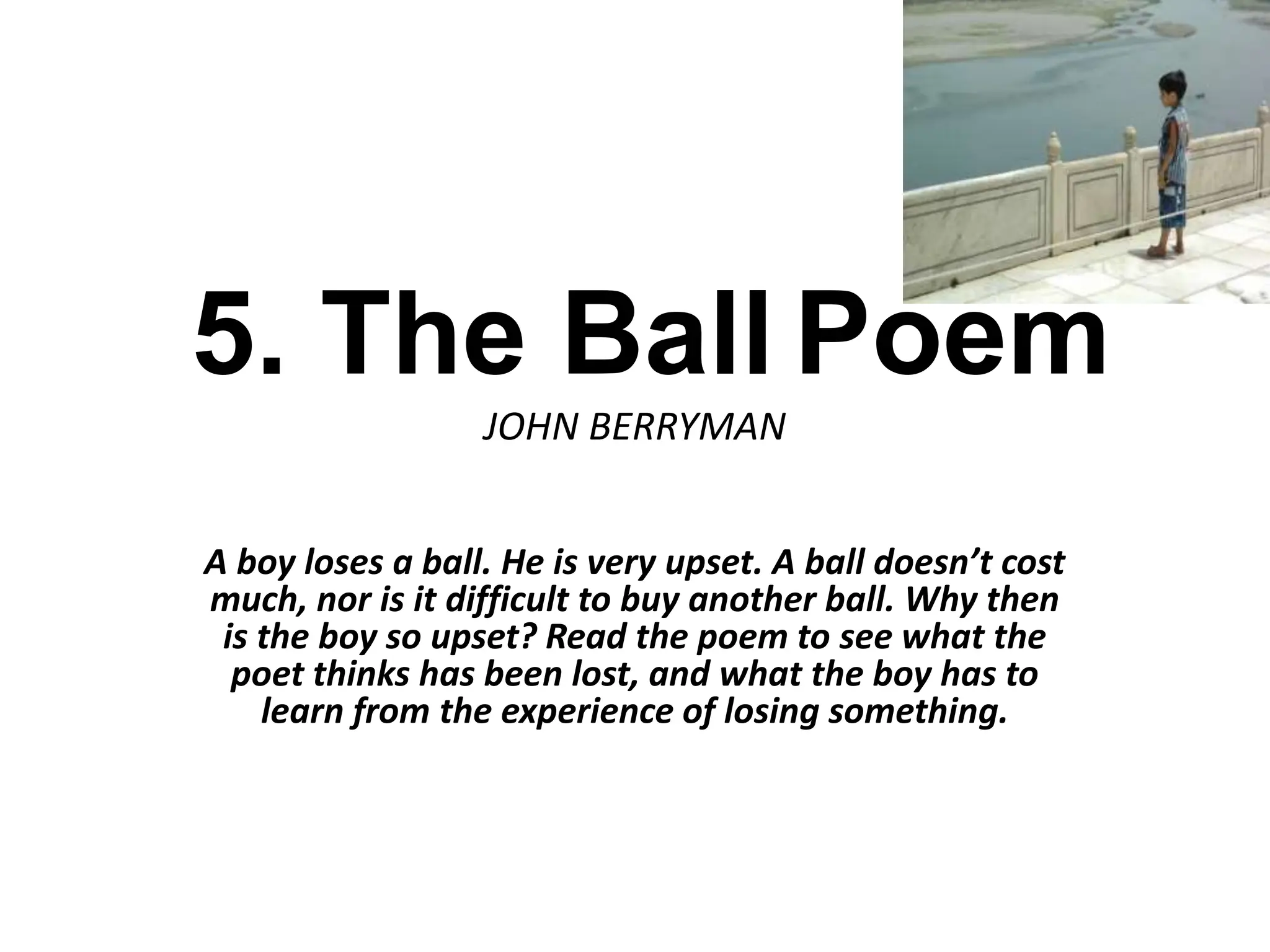
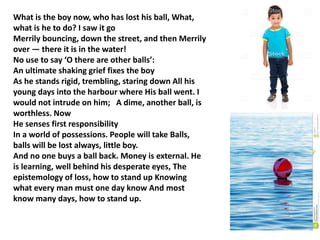
What is the boy now, who has lost his ball, What,
what is he to do? I saw it go
Merrily bouncing, down the street, and then Merrily
over — there it is in the water!
No use to say ‘O there are other balls’:
An ultimate shaking grief fixes the boy
As he stands rigid, trembling, staring down All his
young days into the harbour where His ball went. I
would not intrude on him; A dime, another ball, is
worthless. Now
He senses first responsibility
In a world of possessions. People will take Balls,
balls will be lost always, little boy.
And no one buys a ball back. Money is external. He
is learning, well behind his desperate eyes, The
epistemology of loss, how to stand up Knowing
what every man must one day know And most
know many days, how to stand up.
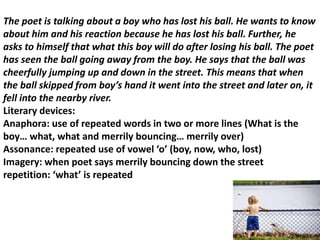
The poet is talking about a boy who has lost his ball. He wants to know
about him and his reaction because he has lost his ball. Further, he
asks to himself that what this boy will do after losing his ball. The poet
has seen the ball going away from the boy. He says that the ball was
cheerfully jumping up and down in the street. This means that when
the ball skipped from boy’s hand it went into the street and later on, it
fell into the nearby river.
Literary devices:
Anaphora: use of repeated words in two or more lines (What is the
boy… what, what and merrily bouncing… merrily over)
Assonance: repeated use of vowel ‘o’ (boy, now, who, lost)
Imagery: when poet says merrily bouncing down the street
repetition: ‘what’ is repeated
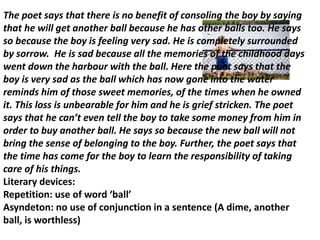
The poet says that there is no benefit of consoling the boy by saying
that he will get another ball because he has other balls too. He says
so because the boy is feeling very sad. He is completely surrounded
by sorrow. He is sad because all the memories of the childhood days
went down the harbour with the ball. Here the poet says that the
boy is very sad as the ball which has now gone into the water
reminds him of those sweet memories, of the times when he owned
it. This loss is unbearable for him and he is grief stricken. The poet
says that he can’t even tell the boy to take some money from him in
order to buy another ball. He says so because the new ball will not
bring the sense of belonging to the boy. Further, the poet says that
the time has come for the boy to learn the responsibility of taking
care of his things.
Literary devices:
Repetition: use of word ‘ball’
Asyndeton: no use of conjunction in a sentence (A dime, another
ball, is worthless)
Alliteration: use of sound ‘b’ at the start of two consecutive words
(buys a ball back)
Assonance: use of vowel sound ‘e’ (He is learning, well behind his
desperate eyes)
Repetition: ‘ball’ word is repeated
Rhyme scheme: There is no rhyme scheme followed
he says that he has to learn to live without them no matter what. He
says no one can buy back such things for him. The poet said so because
according to him money can’t buy you everything. If it does buy you
some materialistic thing, still, it will not be able to buy the sense of
belongingness. He says that the boy is learning how to stand up
against the sense of lost things. This means that the boy is trying to
learn the real truth of life which states that you have to accept the
miseries of life and stand up again. This is the truth which everyone
has to learn in his or her life. The harsh truth of standing up against
the odd miseries of life that everyone has to bear.
The poet is talking about a little boy who has lost his ball. He was playing
with his ball. The ball skipped from his hand and went into the nearby
water body. The poet says that this sight of the boy losing his favorite ball
made him think about the boy and his reaction to this situation. He further
says that the boy was helplessly looking into the water where his ball had
gone. He was sad and was trembling with fear. He got so immersed in his
sorrow that he kept standing near the harbour for a very long time and
kept on looking for his ball. The poet says that he could console him that
he may get new balls or he could also give him some money to buy
another ball. But he stops himself from doing so because he thinks that
the money may bring a new ball but will not bring the memories and
feelings attached to the lost ball. He further says that the time has come
for the boy to learn his responsibilities. Here the poet wants to say that
now the boy will learn the toughest lesson of life. The lesson of accepting
the harsh realities of life that one day we will lose our loved ones and our
loved things.
The message that the poet wants to convey is
the importance of loss and responsibility in life
The theme of the poem is that life is precious
and should not be wasted. Life has to be lived.
And life can be lived purposefully and fruitfully
only when we stand up and come out of
depression
The poem teaches us a philosophy
of life through the loss of ball. i.e. “Loss is a
universal truth in our life.” We have to lose
something at one point of time. Through
the loss of ball, the boy learns real knowledge
of the world.
The poet thinks that he may be sad at the
moment but he is also learning the lesson of
life.

The Ball Poem., 12 cbse explained ppt.

  • 1.
    5. The BallPoem JOHN BERRYMAN A boy loses a ball. He is very upset. A ball doesn’t cost much, nor is it difficult to buy another ball. Why then is the boy so upset? Read the poem to see what the poet thinks has been lost, and what the boy has to learn from the experience of losing something.
  • 2.
    John Berryman wasan American poet and scholar. He is best known for the Dream Songs (1969) which was a sequence of 385 poems. He won Pulitzer Prize for the dream songs. He also won National book award. The poet John Berryman through his poem, ‘The ball poem’ has described the reality of life which everyone has to face one day. He has touched the topic of how to stand up against the miseries and sorrows of life.
  • 3.
    o there areother balls: The words suggest that the loss is not important enough to worry about shaking grief: sadness which greatly affects the boy rigid: stiff Grief: sorrow Rigid: fixed Trembling: shaking Harbour: dock, port Intrude: invader Dime: 10 cents (U.S) Worthless: valueless, useless (to) intrude on: here, to enter a situation where one is not welcome a dime: ten cents (U.S.) desperate: hopeless epistemology of loss: understanding the nature of loss — what it means to lose something epistemology: The Greek word episteme means ‘knowledge’ (it comes from a word meaning ‘to understand, to know’).
  • 4.
    What is theboy now, who has lost his ball, What, what is he to do? I saw it go Merrily bouncing, down the street, and then Merrily over — there it is in the water! No use to say ‘O there are other balls’: An ultimate shaking grief fixes the boy As he stands rigid, trembling, staring down All his young days into the harbour where His ball went. I would not intrude on him; A dime, another ball, is worthless. Now He senses first responsibility In a world of possessions. People will take Balls, balls will be lost always, little boy. And no one buys a ball back. Money is external. He is learning, well behind his desperate eyes, The epistemology of loss, how to stand up Knowing what every man must one day know And most know many days, how to stand up.
  • 5.
    The poet istalking about a boy who has lost his ball. He wants to know about him and his reaction because he has lost his ball. Further, he asks to himself that what this boy will do after losing his ball. The poet has seen the ball going away from the boy. He says that the ball was cheerfully jumping up and down in the street. This means that when the ball skipped from boy’s hand it went into the street and later on, it fell into the nearby river. Literary devices: Anaphora: use of repeated words in two or more lines (What is the boy… what, what and merrily bouncing… merrily over) Assonance: repeated use of vowel ‘o’ (boy, now, who, lost) Imagery: when poet says merrily bouncing down the street repetition: ‘what’ is repeated
  • 6.
    The poet saysthat there is no benefit of consoling the boy by saying that he will get another ball because he has other balls too. He says so because the boy is feeling very sad. He is completely surrounded by sorrow. He is sad because all the memories of the childhood days went down the harbour with the ball. Here the poet says that the boy is very sad as the ball which has now gone into the water reminds him of those sweet memories, of the times when he owned it. This loss is unbearable for him and he is grief stricken. The poet says that he can’t even tell the boy to take some money from him in order to buy another ball. He says so because the new ball will not bring the sense of belonging to the boy. Further, the poet says that the time has come for the boy to learn the responsibility of taking care of his things. Literary devices: Repetition: use of word ‘ball’ Asyndeton: no use of conjunction in a sentence (A dime, another ball, is worthless)
  • 7.
    Alliteration: use ofsound ‘b’ at the start of two consecutive words (buys a ball back) Assonance: use of vowel sound ‘e’ (He is learning, well behind his desperate eyes) Repetition: ‘ball’ word is repeated Rhyme scheme: There is no rhyme scheme followed he says that he has to learn to live without them no matter what. He says no one can buy back such things for him. The poet said so because according to him money can’t buy you everything. If it does buy you some materialistic thing, still, it will not be able to buy the sense of belongingness. He says that the boy is learning how to stand up against the sense of lost things. This means that the boy is trying to learn the real truth of life which states that you have to accept the miseries of life and stand up again. This is the truth which everyone has to learn in his or her life. The harsh truth of standing up against the odd miseries of life that everyone has to bear.
  • 8.
    The poet istalking about a little boy who has lost his ball. He was playing with his ball. The ball skipped from his hand and went into the nearby water body. The poet says that this sight of the boy losing his favorite ball made him think about the boy and his reaction to this situation. He further says that the boy was helplessly looking into the water where his ball had gone. He was sad and was trembling with fear. He got so immersed in his sorrow that he kept standing near the harbour for a very long time and kept on looking for his ball. The poet says that he could console him that he may get new balls or he could also give him some money to buy another ball. But he stops himself from doing so because he thinks that the money may bring a new ball but will not bring the memories and feelings attached to the lost ball. He further says that the time has come for the boy to learn his responsibilities. Here the poet wants to say that now the boy will learn the toughest lesson of life. The lesson of accepting the harsh realities of life that one day we will lose our loved ones and our loved things.
  • 9.
    The message thatthe poet wants to convey is the importance of loss and responsibility in life The theme of the poem is that life is precious and should not be wasted. Life has to be lived. And life can be lived purposefully and fruitfully only when we stand up and come out of depression The poem teaches us a philosophy of life through the loss of ball. i.e. “Loss is a universal truth in our life.” We have to lose something at one point of time. Through the loss of ball, the boy learns real knowledge of the world. The poet thinks that he may be sad at the moment but he is also learning the lesson of life.