The Ancient World By: Yuh-yi Tan  ( 談玉儀 ) 台北商業技術學院 09/16/11 談玉儀
The Ancient World Area: The Mediterranean basin Period:  800 B.C.E. (Before the Common  Era )  to 400 C.E.  ( Common Era)  Languages: Hebrew, Greek, and Latin
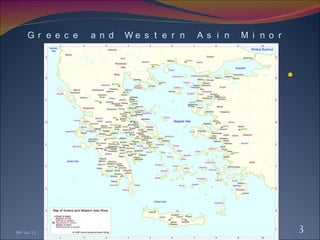
Greece and Western Asin Minor   09/16/11 談玉儀
The Ancient World Area: The Mediterranean basin Period:  800 B.C.E. (Before the Common  Era )  to 400 C.E.  ( Common Era)  Languages:  Hebrew, Greek, and Latin The Hebrew  Bible The  Iliad  and  Odyssey
Athens and Sparta The 2 most prominent city-states in the beginning of the 5 th  century B.C.E to against the Persian power Their hostility ended in 404 B.C.E with the total defeat of Athens. The war was known as the Peloponnesian War
The Greeks and Romans Greek history begins with Homer’s epic poem Latin literature written as  Virgil who based his epic on Homer but chose as his theme the coming of the Trojan prince Aeneas to Italy.
The Hebrew Bible (ca. 1000-300 B.C.E) Genesis 1 st  part (chapters 1-11) recounts “Creation history” God’s creation of the world and of humankind Disobedience of Adam and Eve and their expulsion from Eden to the construction of the Tower of Babel Noah and the ark Many languages
The Hebrew Bible (ca. 1000-300 B.C.E) Genesis 1-3 (The Creation—The Fall) God created the world in 6 days. “ And God created the human in his image” God planted a garden in Eden where Adam and Eve lived. Both Eden and Adam were driven out Eden and lived in the east of Eden since the serpent’s temptation.
The Hebrew Bible (ca. 1000-300 B.C.E) Genesis 4 (The First Murder) Cain was a tiller of the soil; Abel became a herder of sheep God cursed Cain as a restless wanderer since he murdered his brother Abel just because his jealousy.
The Hebrew Bible (ca. 1000-300 B.C.E) Genesis 6-9 (The Flood) God found favor in Noah and ask he to find an ark to survive from the flood. The water surged over the earth one hundred and fifty days, only Noah remained and those with him in the ark. God’s covenant with Noah’s posterity
The Hebrew Bible (ca. 1000-300 B.C.E) Genesis 11 (The Origin of Languages) Human beings made a city and a tower called Babel. And God made the language of all the earth babble and from Babel God scattered them over all the earth.
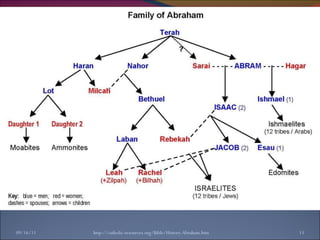
The Hebrew Bible (ca. 1000-300 B.C.E) Genesis 2 nd  (chapters 12-50) part 4 generations of ancestors of the people of Israel Abraham and Sarah Isaac and Rebekah Jacob and his wives, Leah and Rachel Joseph and his brothers
09/16/11 http://catholic-resources.org/Bible/History-Abraham.htm
The Hebrew Bible (ca. 1000-300 B.C.E) Genesis: ch apters 17-19 (Abraham and Sarah) God’s covenant with Abraham to make him be father to a multitude of nations. Sodom and Gomorrah have become synonymous with impenitent sin and as  metaphors  for  vice  and  homosexuality , and their fall with a proverbial manifestation of God's wrath Lot’s wife became a pillar of salt.
The Hebrew Bible (ca. 1000-300 B.C.E) Genesis: ch apters 25-27 (Jacob and Esau) Rebekah persuaded her beloved son Jacob to pretend himself as his brother Esau to ask a blessing from his father Jacob. Thus Jacob is blessed and nations bow before him. Yet Esau’s blessing was taken and he would serve Jacob.
The Hebrew Bible (ca. 1000-300 B.C.E) Genesis: ch apters 37,39-46 (Joseph) Joseph was betrayed by his brothers for selling him as a slave to an Egyptian. Yet he had the ability to interpret Pharaoh’s dream and solve the problematic famine and earned Pharaoh’s favor. Eventually he was united with his brothers and father and forgave their wrong-doing.
The Hebrew Bible (ca. 1000-300 B.C.E) Genesis: The emphasis on posterity as part of God’s covenant The strife between brothers Cain and Abel Jacob and Esau Joseph and his brothers The attainment of a settled home
The Hebrew Bible (ca. 1000-300 B.C.E) Genesis’s world where goodness is rewarded and sin is punished Yet  the book of Job challenges this sense of coherence and put the innocent Job in a suffering situation to suggest that there is misfortune and unhappiness in the world.
The Hebrew Bible (ca. 1000-300 B.C.E) The Song of Song A dialogue between lovers, a man and a woman who express their appreciation of each other’s bodies. Celebrating human sexuality and love and human life A mixture of allegory, religion, and history.

The ancient world

  • 1.
    The Ancient WorldBy: Yuh-yi Tan ( 談玉儀 ) 台北商業技術學院 09/16/11 談玉儀
  • 2.
    The Ancient WorldArea: The Mediterranean basin Period: 800 B.C.E. (Before the Common Era ) to 400 C.E. ( Common Era) Languages: Hebrew, Greek, and Latin
  • 3.
  • 4.
    The Ancient WorldArea: The Mediterranean basin Period: 800 B.C.E. (Before the Common Era ) to 400 C.E. ( Common Era) Languages: Hebrew, Greek, and Latin The Hebrew Bible The Iliad and Odyssey
  • 5.
    Athens and SpartaThe 2 most prominent city-states in the beginning of the 5 th century B.C.E to against the Persian power Their hostility ended in 404 B.C.E with the total defeat of Athens. The war was known as the Peloponnesian War
  • 6.
    The Greeks andRomans Greek history begins with Homer’s epic poem Latin literature written as Virgil who based his epic on Homer but chose as his theme the coming of the Trojan prince Aeneas to Italy.
  • 7.
    The Hebrew Bible(ca. 1000-300 B.C.E) Genesis 1 st part (chapters 1-11) recounts “Creation history” God’s creation of the world and of humankind Disobedience of Adam and Eve and their expulsion from Eden to the construction of the Tower of Babel Noah and the ark Many languages
  • 8.
    The Hebrew Bible(ca. 1000-300 B.C.E) Genesis 1-3 (The Creation—The Fall) God created the world in 6 days. “ And God created the human in his image” God planted a garden in Eden where Adam and Eve lived. Both Eden and Adam were driven out Eden and lived in the east of Eden since the serpent’s temptation.
  • 9.
    The Hebrew Bible(ca. 1000-300 B.C.E) Genesis 4 (The First Murder) Cain was a tiller of the soil; Abel became a herder of sheep God cursed Cain as a restless wanderer since he murdered his brother Abel just because his jealousy.
  • 10.
    The Hebrew Bible(ca. 1000-300 B.C.E) Genesis 6-9 (The Flood) God found favor in Noah and ask he to find an ark to survive from the flood. The water surged over the earth one hundred and fifty days, only Noah remained and those with him in the ark. God’s covenant with Noah’s posterity
  • 11.
    The Hebrew Bible(ca. 1000-300 B.C.E) Genesis 11 (The Origin of Languages) Human beings made a city and a tower called Babel. And God made the language of all the earth babble and from Babel God scattered them over all the earth.
  • 12.
    The Hebrew Bible(ca. 1000-300 B.C.E) Genesis 2 nd (chapters 12-50) part 4 generations of ancestors of the people of Israel Abraham and Sarah Isaac and Rebekah Jacob and his wives, Leah and Rachel Joseph and his brothers
  • 13.
  • 14.
    The Hebrew Bible(ca. 1000-300 B.C.E) Genesis: ch apters 17-19 (Abraham and Sarah) God’s covenant with Abraham to make him be father to a multitude of nations. Sodom and Gomorrah have become synonymous with impenitent sin and as metaphors for vice and homosexuality , and their fall with a proverbial manifestation of God's wrath Lot’s wife became a pillar of salt.
  • 15.
    The Hebrew Bible(ca. 1000-300 B.C.E) Genesis: ch apters 25-27 (Jacob and Esau) Rebekah persuaded her beloved son Jacob to pretend himself as his brother Esau to ask a blessing from his father Jacob. Thus Jacob is blessed and nations bow before him. Yet Esau’s blessing was taken and he would serve Jacob.
  • 16.
    The Hebrew Bible(ca. 1000-300 B.C.E) Genesis: ch apters 37,39-46 (Joseph) Joseph was betrayed by his brothers for selling him as a slave to an Egyptian. Yet he had the ability to interpret Pharaoh’s dream and solve the problematic famine and earned Pharaoh’s favor. Eventually he was united with his brothers and father and forgave their wrong-doing.
  • 17.
    The Hebrew Bible(ca. 1000-300 B.C.E) Genesis: The emphasis on posterity as part of God’s covenant The strife between brothers Cain and Abel Jacob and Esau Joseph and his brothers The attainment of a settled home
  • 18.
    The Hebrew Bible(ca. 1000-300 B.C.E) Genesis’s world where goodness is rewarded and sin is punished Yet the book of Job challenges this sense of coherence and put the innocent Job in a suffering situation to suggest that there is misfortune and unhappiness in the world.
  • 19.
    The Hebrew Bible(ca. 1000-300 B.C.E) The Song of Song A dialogue between lovers, a man and a woman who express their appreciation of each other’s bodies. Celebrating human sexuality and love and human life A mixture of allegory, religion, and history.