Psalm 114
- Stand in awe -
Author: Evert Jan Hempenius
© 2015
www.christianstudylibrary.org
For any questions about this Scripture passage or the notes,
please contact us through the Contact Us tab on the website.
Context
 This psalm belongs to the so-called Hallel Psalms (Ps. 113-118). Ps. 113 and 114 were (and still
are) sung at the beginning of the meal of the Passover. Jesus Christ probably sang this psalm
when he and his disciples celebrated the Passover, the Lord’s Supper. Each time when the
Israelites celebrated the deliverance out of Egypt, they sang this Psalm.
Form and structure
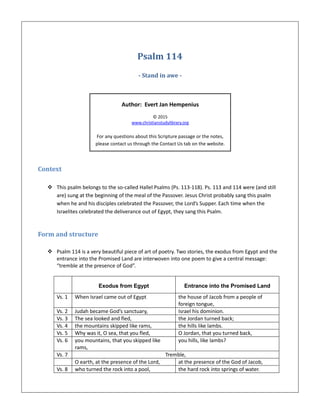
 Psalm 114 is a very beautiful piece of art of poetry. Two stories, the exodus from Egypt and the
entrance into the Promised Land are interwoven into one poem to give a central message:
“tremble at the presence of God”.
Exodus from Egypt Entrance into the Promised Land
Vs. 1 When Israel came out of Egypt the house of Jacob from a people of
foreign tongue,
Vs. 2 Judah became God’s sanctuary, Israel his dominion.
Vs. 3 The sea looked and fled, the Jordan turned back;
Vs. 4 the mountains skipped like rams, the hills like lambs.
Vs. 5 Why was it, O sea, that you fled, O Jordan, that you turned back,
Vs. 6 you mountains, that you skipped like
rams,
you hills, like lambs?
Vs. 7 Tremble,
O earth, at the presence of the Lord, at the presence of the God of Jacob,
Vs. 8 who turned the rock into a pool, the hard rock into springs of water.
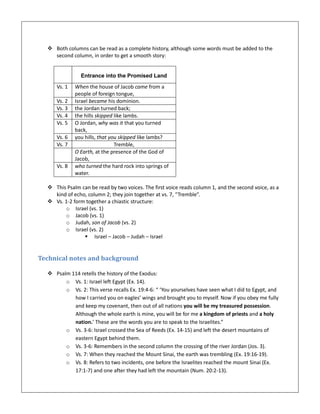
 Both columns can be read as a complete history, although some words must be added to the
second column, in order to get a smooth story:
Entrance into the Promised Land
Vs. 1 When the house of Jacob came from a
people of foreign tongue,
Vs. 2 Israel became his dominion.
Vs. 3 the Jordan turned back;
Vs. 4 the hills skipped like lambs.
Vs. 5 O Jordan, why was it that you turned
back,
Vs. 6 you hills, that you skipped like lambs?
Vs. 7 Tremble,
O Earth, at the presence of the God of
Jacob,
Vs. 8 who turned the hard rock into springs of
water.
 This Psalm can be read by two voices. The first voice reads column 1, and the second voice, as a
kind of echo, column 2; they join together at vs. 7, “Tremble”.
 Vs. 1-2 form together a chiastic structure:
o Israel (vs. 1)
o Jacob (vs. 1)
o Judah, son of Jacob (vs. 2)
o Israel (vs. 2)
 Israel – Jacob – Judah – Israel
Technical notes and background
 Psalm 114 retells the history of the Exodus:
o Vs. 1: Israel left Egypt (Ex. 14).
o Vs. 2: This verse recalls Ex. 19:4-6: “ ‘You yourselves have seen what I did to Egypt, and
how I carried you on eagles’ wings and brought you to myself. Now if you obey me fully
and keep my covenant, then out of all nations you will be my treasured possession.
Although the whole earth is mine, you will be for me a kingdom of priests and a holy
nation.’ These are the words you are to speak to the Israelites.”
o Vs. 3-6: Israel crossed the Sea of Reeds (Ex. 14-15) and left the desert mountains of
eastern Egypt behind them.
o Vs. 3-6: Remembers in the second column the crossing of the river Jordan (Jos. 3).
o Vs. 7: When they reached the Mount Sinai, the earth was trembling (Ex. 19:16-19).
o Vs. 8: Refers to two incidents, one before the Israelites reached the mount Sinai (Ex.
17:1-7) and one after they had left the mountain (Num. 20:2-13).
 The imagery of this psalm is very vivid:
o The rocky desert mountains of eastern Egypt are compared to “rams”; and the hills of
eastern countryside of the river Jordan are compared to “lambs.”
 The word “tremble” gets some emphasis.
Exposition
Verse 1-2
 The Psalms starts with the deliverance from Egypt, which should be remembered by all
generations, especially when celebrating the Passover (Ex. 12-13), the Feast of Tabernacles (Lev.
23:33-43) and when listening to the law (Ex. 20:1; Dt. 5:6; Dt. 5:15) and singing their psalms (Ps.
106; Ps. 136).
o The Psalmist uses both names, Jacob and Israel.
 When they arrived at the Mount Sinai, they were called a “treasured possession”, a “kingdom
of priests” and a “holy nation” (Ex. 19:4-6). They are the people of the covenant with Abraham,
Isaac and Jacob.
o “Judah and Israel” is a common denotation of the Israelites. This designation is already
found during the reign of King Saul (1 Sam. 17:52). Later, when the temple in Jerusalem
has been built, Judah will be the guardian of the sanctuary and Israel is still the
dominion of God.
o Judah and Israel are a holy nation, devoted to the LORD God as King. He wants to dwell
among his people, as symbolized by the tabernacle which had a central place
surrounded by the twelve tribes (Num. 2) when they were wandering in the desert.
o Judah (and Israel) were meant to be a living tabernacle, in which God was dwelling. The
second commandment of the law teaches the same idea. God doesn’t want to be
presented by an idol or image, but by his people who love him and obey him (Ex. 20:4-6)
in a covenantal relationship.
Verse 3-6
 These verses refer to both crossings through the waters of the Sea of Reeds and the river Jordan.
The Psalmist uses very vivid poetic images. He doesn’t mean that the hills and mountains
actually were skipping. He says: “look at them, the mountains are like rams, the hills like lambs.”
He also says: “the mountains and the hills” speak of the glory and might of God. The psalmists
often refer to nature glorifying God:
o “Let the sea resound, and everything in it, the world, and all who live in it. Let the rivers
clap their hands, let the mountains sing together for joy” (Ps. 98:7-8). The sound of a
waterfall is like the clapping of hands.
 “Why was it,” asks the poet, because those phenomena were not easy to explain. In a poetic
fashion, he is personalizing the sea and the river Jordan.
Verse 7
 The earth is summoned to tremble in the presence of God. The reason is given in vs. 8. This
tremble speaks of awe for the living God and his holiness.
Verse 8
 When the Israelites were thirsty, they said: “Is the Lord among us or not?” (Ex. 17:7). He showed
them his holiness (Num. 20:13) and his greatness. The Lord said to Moses: “I will stand there
before you by the rock at Horeb. Strike the rock, and water will come out of it for the people to
drink” (Ex. 17:6). The people were standing there in the presence of God.
Application
 Psalm 114 refers to Ex. 19:4-6 (see above) and the history of the Exodus. Ex. 19:4-6 is quoted by
Peter in his first letter and by John in the opening verses of the Revelation:
o “But you are a chosen people, a royal priesthood, a holy nation, a people belonging to
God, that you may declare the praises of him who called you out of darkness into his
wonderful light” (1 Pet. 2:9).
o “To him (Jesus Christ) who loves us and has freed us from our sins by his blood, and has
made us to be a kingdom and priests to serve his God and Father—to him be glory and
power for ever and ever! Amen” (Rev. 1:5-6).
 Although it will need some study about the use of Scripture by the apostle Paul, it is very
interesting to note what he writes about Christ in his first letter to the Corinthians:
o “For I do not want you to be ignorant of the fact, brothers, that our forefathers were all
under the cloud and that they all passed through the sea. They were all baptized into
Moses in the cloud and in the sea. They all ate the same spiritual food and drank the
same spiritual drink; for they drank from the spiritual rock that accompanied them,
and that rock was Christ” (1 Cor. 10:1-4).
 Christ was present in the Old Testament. He was there with his people. He
accompanied them. Christ is the fountain of the living water (Cf. John 4:10-14).
 This Psalm teaches two important things:
o God’s mighty acts of deliverance in the past should be celebrated by his people, thus the
church and each individual.
o God has set a high purpose for his people, both in the Old as in the New Testament: a
holy nation, a kingdom of priests, living a life of holiness.
o In compliance with the New Testament, the presence of God who gave water from the
rock, and the presence of Christ, summon the earth to tremble and the Christians to
stand in awe. This is an awe-inspiring Psalm.
o The Psalmist points at nature: the sea, the river Jordan, the mountains and the hills, the
water from the rock. All speak of the mighty acts of the Lord God.
Bibliography
Allen, L. (1983). Psalms 101-150. (WBC 21). Waco: Word Books.
Alter, R. (1985). The art of Biblical poetry. New York: Basic Books.
Alter, R. (2007). The book of Psalms: A translation with commentary. New York: W.W. Norton.
Aune, D. (1997). Revelation 1-5. (WBC 52A). Waco: Word Books.
Fee, G. (1987). The First Epistle to the Corinthians. (NICNT) Grand Rapids: W.B. Eerdmans Pub.
Thiselton, A. (2000). The First Epistle to the Corinthians: A commentary on the Greek text. (NIGTC) Grand
Rapids: W.B. Eerdmans.
Witherington, B. (1995). Conflict and community in Corinth: A socio-rhetorical commentary on 1 and 2
Corinthians. Grand Rapids: W.B. Eerdmans.

Psalm 114 - Sermon Outline

  • 1.
    Psalm 114 - Standin awe - Author: Evert Jan Hempenius © 2015 www.christianstudylibrary.org For any questions about this Scripture passage or the notes, please contact us through the Contact Us tab on the website. Context  This psalm belongs to the so-called Hallel Psalms (Ps. 113-118). Ps. 113 and 114 were (and still are) sung at the beginning of the meal of the Passover. Jesus Christ probably sang this psalm when he and his disciples celebrated the Passover, the Lord’s Supper. Each time when the Israelites celebrated the deliverance out of Egypt, they sang this Psalm. Form and structure  Psalm 114 is a very beautiful piece of art of poetry. Two stories, the exodus from Egypt and the entrance into the Promised Land are interwoven into one poem to give a central message: “tremble at the presence of God”. Exodus from Egypt Entrance into the Promised Land Vs. 1 When Israel came out of Egypt the house of Jacob from a people of foreign tongue, Vs. 2 Judah became God’s sanctuary, Israel his dominion. Vs. 3 The sea looked and fled, the Jordan turned back; Vs. 4 the mountains skipped like rams, the hills like lambs. Vs. 5 Why was it, O sea, that you fled, O Jordan, that you turned back, Vs. 6 you mountains, that you skipped like rams, you hills, like lambs? Vs. 7 Tremble, O earth, at the presence of the Lord, at the presence of the God of Jacob, Vs. 8 who turned the rock into a pool, the hard rock into springs of water.
  • 2.
     Both columnscan be read as a complete history, although some words must be added to the second column, in order to get a smooth story: Entrance into the Promised Land Vs. 1 When the house of Jacob came from a people of foreign tongue, Vs. 2 Israel became his dominion. Vs. 3 the Jordan turned back; Vs. 4 the hills skipped like lambs. Vs. 5 O Jordan, why was it that you turned back, Vs. 6 you hills, that you skipped like lambs? Vs. 7 Tremble, O Earth, at the presence of the God of Jacob, Vs. 8 who turned the hard rock into springs of water.  This Psalm can be read by two voices. The first voice reads column 1, and the second voice, as a kind of echo, column 2; they join together at vs. 7, “Tremble”.  Vs. 1-2 form together a chiastic structure: o Israel (vs. 1) o Jacob (vs. 1) o Judah, son of Jacob (vs. 2) o Israel (vs. 2)  Israel – Jacob – Judah – Israel Technical notes and background  Psalm 114 retells the history of the Exodus: o Vs. 1: Israel left Egypt (Ex. 14). o Vs. 2: This verse recalls Ex. 19:4-6: “ ‘You yourselves have seen what I did to Egypt, and how I carried you on eagles’ wings and brought you to myself. Now if you obey me fully and keep my covenant, then out of all nations you will be my treasured possession. Although the whole earth is mine, you will be for me a kingdom of priests and a holy nation.’ These are the words you are to speak to the Israelites.” o Vs. 3-6: Israel crossed the Sea of Reeds (Ex. 14-15) and left the desert mountains of eastern Egypt behind them. o Vs. 3-6: Remembers in the second column the crossing of the river Jordan (Jos. 3). o Vs. 7: When they reached the Mount Sinai, the earth was trembling (Ex. 19:16-19). o Vs. 8: Refers to two incidents, one before the Israelites reached the mount Sinai (Ex. 17:1-7) and one after they had left the mountain (Num. 20:2-13).
  • 3.
     The imageryof this psalm is very vivid: o The rocky desert mountains of eastern Egypt are compared to “rams”; and the hills of eastern countryside of the river Jordan are compared to “lambs.”  The word “tremble” gets some emphasis. Exposition Verse 1-2  The Psalms starts with the deliverance from Egypt, which should be remembered by all generations, especially when celebrating the Passover (Ex. 12-13), the Feast of Tabernacles (Lev. 23:33-43) and when listening to the law (Ex. 20:1; Dt. 5:6; Dt. 5:15) and singing their psalms (Ps. 106; Ps. 136). o The Psalmist uses both names, Jacob and Israel.  When they arrived at the Mount Sinai, they were called a “treasured possession”, a “kingdom of priests” and a “holy nation” (Ex. 19:4-6). They are the people of the covenant with Abraham, Isaac and Jacob. o “Judah and Israel” is a common denotation of the Israelites. This designation is already found during the reign of King Saul (1 Sam. 17:52). Later, when the temple in Jerusalem has been built, Judah will be the guardian of the sanctuary and Israel is still the dominion of God. o Judah and Israel are a holy nation, devoted to the LORD God as King. He wants to dwell among his people, as symbolized by the tabernacle which had a central place surrounded by the twelve tribes (Num. 2) when they were wandering in the desert. o Judah (and Israel) were meant to be a living tabernacle, in which God was dwelling. The second commandment of the law teaches the same idea. God doesn’t want to be presented by an idol or image, but by his people who love him and obey him (Ex. 20:4-6) in a covenantal relationship. Verse 3-6  These verses refer to both crossings through the waters of the Sea of Reeds and the river Jordan. The Psalmist uses very vivid poetic images. He doesn’t mean that the hills and mountains actually were skipping. He says: “look at them, the mountains are like rams, the hills like lambs.” He also says: “the mountains and the hills” speak of the glory and might of God. The psalmists often refer to nature glorifying God: o “Let the sea resound, and everything in it, the world, and all who live in it. Let the rivers clap their hands, let the mountains sing together for joy” (Ps. 98:7-8). The sound of a waterfall is like the clapping of hands.  “Why was it,” asks the poet, because those phenomena were not easy to explain. In a poetic fashion, he is personalizing the sea and the river Jordan. Verse 7  The earth is summoned to tremble in the presence of God. The reason is given in vs. 8. This tremble speaks of awe for the living God and his holiness.
  • 4.
    Verse 8  Whenthe Israelites were thirsty, they said: “Is the Lord among us or not?” (Ex. 17:7). He showed them his holiness (Num. 20:13) and his greatness. The Lord said to Moses: “I will stand there before you by the rock at Horeb. Strike the rock, and water will come out of it for the people to drink” (Ex. 17:6). The people were standing there in the presence of God. Application  Psalm 114 refers to Ex. 19:4-6 (see above) and the history of the Exodus. Ex. 19:4-6 is quoted by Peter in his first letter and by John in the opening verses of the Revelation: o “But you are a chosen people, a royal priesthood, a holy nation, a people belonging to God, that you may declare the praises of him who called you out of darkness into his wonderful light” (1 Pet. 2:9). o “To him (Jesus Christ) who loves us and has freed us from our sins by his blood, and has made us to be a kingdom and priests to serve his God and Father—to him be glory and power for ever and ever! Amen” (Rev. 1:5-6).  Although it will need some study about the use of Scripture by the apostle Paul, it is very interesting to note what he writes about Christ in his first letter to the Corinthians: o “For I do not want you to be ignorant of the fact, brothers, that our forefathers were all under the cloud and that they all passed through the sea. They were all baptized into Moses in the cloud and in the sea. They all ate the same spiritual food and drank the same spiritual drink; for they drank from the spiritual rock that accompanied them, and that rock was Christ” (1 Cor. 10:1-4).  Christ was present in the Old Testament. He was there with his people. He accompanied them. Christ is the fountain of the living water (Cf. John 4:10-14).  This Psalm teaches two important things: o God’s mighty acts of deliverance in the past should be celebrated by his people, thus the church and each individual. o God has set a high purpose for his people, both in the Old as in the New Testament: a holy nation, a kingdom of priests, living a life of holiness. o In compliance with the New Testament, the presence of God who gave water from the rock, and the presence of Christ, summon the earth to tremble and the Christians to stand in awe. This is an awe-inspiring Psalm. o The Psalmist points at nature: the sea, the river Jordan, the mountains and the hills, the water from the rock. All speak of the mighty acts of the Lord God. Bibliography Allen, L. (1983). Psalms 101-150. (WBC 21). Waco: Word Books.
  • 5.
    Alter, R. (1985).The art of Biblical poetry. New York: Basic Books. Alter, R. (2007). The book of Psalms: A translation with commentary. New York: W.W. Norton. Aune, D. (1997). Revelation 1-5. (WBC 52A). Waco: Word Books. Fee, G. (1987). The First Epistle to the Corinthians. (NICNT) Grand Rapids: W.B. Eerdmans Pub. Thiselton, A. (2000). The First Epistle to the Corinthians: A commentary on the Greek text. (NIGTC) Grand Rapids: W.B. Eerdmans. Witherington, B. (1995). Conflict and community in Corinth: A socio-rhetorical commentary on 1 and 2 Corinthians. Grand Rapids: W.B. Eerdmans.