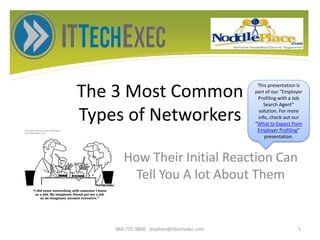




The 3 Most Common
Types of Networkers
How Their Initial Reaction Can
Tell You A lot About Them
866.755.9800 stephen@ittechexec.com 1
This presentation is
part of our “Employer
Profiling with a Job
Search Agent”
solution. For more
info, check out our
“What to Expect from
Employer Profiling”
presentation.
If you’ve been through employer profiling, let’s recap
where you’ve been: It’s been a whirlwind of activity.
Emails are now flying, and introductions abound.
• Step 1: We started out by having our writing team design your technical
resume and messaging portfolio.
• Step 2: Then we discussed a strategic vision for your job search and how we
were going to launch your search.
• Step 3: Afterward, Sue, our NoNonsense Job Search Agent, began working
with you on Employer Profiling. She began taking you through her Three-
Phase Solution to identify these employers and find contacts at them
(Phase 1: Write the Vision).
• Step 4: She reached out on your behalf and made introductions to these
contacts leveraging the power of connection (Phase 2: Make It Plain).
• Step 5: Sue met with you and set a plan for where to go from here. She also
followed up with any nonresponses (Phase 3: Run With It).
866.755.9800 stephen@ittechexec.com 2
Here are the goals your
job search agent set
(and accomplished)
with Employer Profiling:
• We targeted companies in your geographic area, field, industry, etc.
that are best suited for your goals.
• We researched and found contacts (at least 1 contact; maybe more)
at these companies based on your strength of connection
(leveraging alumni, military, professional association, etc.).
• We prioritized the companies based on your preferences and the
strength of the connections we found.
• We reached out on your behalf and made the initial introduction
with the contact names.
• We tried to secure a response from as many as we could, and we
tried to get them to agree to continue to talk to you at a later time
in more detail about the company, other possible connections, etc.
• We provided you with messaging and tutorials about where to take
the conversation from there.
• We moved you away from just relying on job boards and recruiters
to help you build a more effective network for you targeting specific
resources (keeping you away from networking mixer after
networking mixer).
• We saved you a lot of upfront research time that makes it so
difficult for professionals to get started with this approach, and we
leveraged our network to expand yours.
866.755.9800 stephen@ittechexec.com 3
If you’ve haven’t been
through our Employer
Profiling, maybe you’ve
done something similar
on your own as part of
your networking efforts.
OK, here is where you are
today:
• Your contacts are most likely in several different stages
– Some responded right away and have either agreed to meet with
you or to make further introductions (we call these the
“Enthusiasts”).
– Some responded initially but then kind of drifted away leaving
things in the air (which means you will need to nudge them gently)
(we call these the “Skeptics”).
– Some have yet to respond either to your initial contact or to your
follow-up note OR they responded that they aren’t interested in
speaking with you, etc. (we call these the “Dejecteds”).
*We will discuss the different types of contacts in more detail on the
next several slides.
• For the Enthusiasts, you are setting up phone/in-person meetings and you
are preparing to conduct informational interviews (if you haven’t already).
• You want to make sure to build in a strong follow-up plan to make the
most of these Enthusiast contacts.
• You need to determine whether to search for additional contacts with the
different organizations if the Skeptics don’t come through.
• You need a plan for moving past the Dejecteds on to someone else at the
company.
866.755.9800 stephen@ittechexec.com 4
Loving Our
Enthusiasts
Some people just love to do favors.
They “get” networking. They
understand what it’s like to need
better contacts. They want to do
whatever they can to help you even
though they barely know you.
866.755.9800 stephen@ittechexec.com 5
Why? Because we leveraged whatever connections we could to get to
them, we approached them respectfully, and they have an appreciation
for what your going through.
How to Identify Enthusiasts
These are the people who respond right away and who
respond, well, enthusiastically. They are willing to talk,
willing to set up introductions, etc.
Within reason, they want to help you and they are not
cautious when speaking with you.
866.755.9800 stephen@ittechexec.com 6
Be careful, though:
Enthusiasts require love in return.
Sometimes when we meet an Enthusiast in the course of networking, we get really excited about what they
can do for us because frankly they are so excited it’s infectious.
It’s important to remember, though, that as much as these people seem eager to help, they want to feel like
they are dealing with a fellow Enthusiast in return. They want to know that you would do the same if the
situations were reversed or if they sent someone to you.
So be sure to set that tone with them when you set up an informational interview with them or with someone
they connect you to. You want to make it clear to everyone involved that you are equally as open to being a
resource as they are.
It’s also important that you show the proper gratitude. Don’t overdo it, but make sure you acknowledge how
gracious they are. They might act like they don’t want to hear it, but they usually do. 
866.755.9800 stephen@ittechexec.com 7
Now, here are the next
steps for you with your
Enthusiasts…
• You will want to make the most out of your informational “chat”
with each Enthusiast by gathering more info about the company,
such as its culture, if it is growing, if there are other people you
should meet there, etc.
• You will want to ask the contact if there is anything you can do for
him or her…introductions you can make, etc.
• You will want to send a thank-you to the contact after the chat.
• You will take care of any action items that came up during your
chat.
• You will follow up with the contact every few weeks or so as
appropriate.
• You will be timely and responsive to anything the contact
recommends, such as contacting someone else or sending your
resume somewhere, etc.
• You will not overwhelm the contact with your wonderfulness; you
want to be bold but not pushy, determined but not desperate.
• You will recognize that networks and pipelines must be nurtured
and take some time to develop.
866.755.9800 stephen@ittechexec.com 8
Now that the ball is rolling, it’s important
not to get overwhelmed here and miss out
on the opportunity to build in better
contacts and networks at companies you
are best suited for. Too many people (that
95% again) do that and run back to sticking
with the poor performing job boards.
Instead, get excited about the opportunity
to take a proactive approach, aligning
yourself with well-matched employers and
building contacts at those employers.
We’ve taken care of the grunt work. Now
you get to “run with it”!
Nurturing
Our Skeptics
Some people like the “idea” of doing favors. Like
Enthusiasts, they “get” networking, BUT either they’ve
been burned before or they aren’t too sure of
themselves or your motives. They don’t want you to
“get one over on them”.
They also are genuinely concerned about sharing their
network connections with “strangers,” so they proceed
with caution. Safety is a big issue for them, and they
don’t want to look or feel stupid.
866.755.9800 stephen@ittechexec.com 9
Skeptics can go either way. They can either
become Dejecteds, meaning they totally
shut down on you, or they can become
better than Enthusiasts…they can become
“Believers” if you handle them well and
earn their trust. They really do want to
help, but they just aren’t sold yet.
Convince them you can be trusted, and you
could end up with the best advocate you
could ask for!
So be careful not to write them off too
quickly.
How to Identify Skeptics
They either respond to you after the initial contact or after the follow-up note. When they do respond to you, they are nice,
cautious…willing to help but often in a vague way.
Most likely they will avoid a direct answer to setting up an appointment with you or to making an introduction for you. You
might get something like, “maybe we can talk sometime” or “tell me more about what you’re looking for” (and tell it to me in
email form as I really don’t want to spend time actually conversing with you yet).
Sometimes they will respond initially, say they are going to do something or ask you for something, and then they kind of
drop off. Typically, they will respond to at least one nudge (apologizing for being busy). It means you still need to do some
convincing to put them at ease.
Nudge them too much, and they will become Dejecteds and run away.
866.755.9800 stephen@ittechexec.com 10
Now, here are the next
steps for you with your
Skeptics…
• You will most likely need to spend some time conversing via email
or messaging with them back and forth before you can get a
commitment to a phone/face chat (not always; older contacts,
despite being Skeptics, might be more willing to get on the phone
sooner, but typically they will make it clear that you are to keep it
brief or that they aren’t really sure they will be able to help you [to
try to dissuade you]).
• Take more time when conversing with them for small talk if they will
allow it. Find out about them, and find ways to identify with them.
Share stories or experiences with them that can help put them at
ease.
• Let them know that you are NOT relying on them to get you a job or
to solve all your career problems.
• Don’t rush them too much. Be sure to give them space to respond
to you. If they said they need a week, then respect that and give
them the week.
• Find out something you can help them with, and follow through on
that.
866.755.9800 stephen@ittechexec.com 11
Dismissing
Our Dejecteds
These are the ones who either never respond, for whatever
reason, or if they do respond, they tend to be curt.
They might act like you have inconvenienced them just by
reaching out and introducing yourself. They might act like you are
trying to sell them something, and they are just too busy to deal
with you. Either way, they aren’t willing to empathize with you,
and they definitely don’t want to make new friends. 
There are lots of reasons why people become Dejecteds, but for
our purposes, it doesn’t really matter. Coming at them with a
nonthreatening, simple introduction just isn’t going to cut it.
866.755.9800 stephen@ittechexec.com 12
How to Identify Dejecteds
In this case, you don’t have to work too hard to figure out who they are. Dejecteds like to make themselves known by
sending the “leave me alone” signal either indirectly by ignoring you or directly by telling you they aren’t “interested.”
Although it can be frustrating, in their own sad way, they are doing you a favor because now you can move on.
Coming at them in a direct manner is not going to work with them.
CAUTION: Don’t confuse the Dejected with meaning the company is completely lost to you.
If pursuing the company matters to you, then don’t let a Dejected derail you (even if he or she is the CEO).
866.755.9800 stephen@ittechexec.com 13
Here’s what’s next after
encountering a Dejected…
• First you need to decide if the Dejected’s company is still an
organization you want to pursue. (If not, then just move on to the
next one.)
• If so, then you obviously need a Plan B, which starts by finding a
second contact at the organization. (Our job search agent can help
you with this. It’s important not to try to connect with too many at
the same organization at once; that approach can backfire if you
aren’t careful.)
• Once you find the second contact, you will begin the introduction
process again.
• You will also need to assess whether the new contact is an
Enthusiast, Skeptic, or Dejected.
• Don’t be surprised if you are successful at establishing a rapport
with a second contact, if at some point down the road he or she
mentions the Dejected as someone you should “meet.” If so, don’t
hold a grudge…take the introduction!
• Dejecteds tend to be much more receptive to introductions from
someone they know/trust. You will probably find a completely
different demeanor when you enter into their circle that way.
• And chances are they will not even remember you or your initial
attempts at contacting them.
866.755.9800 stephen@ittechexec.com 14
Don’t make the mistake of trying to convert
a Dejected, like you might try to convert a
Skeptic. Of course, miracles do happen, but
most often, you will just exert more time
and energy and make little headway.
Dejecteds, who are often very direct people
themselves, don’t typically appreciate a
direct approach from others. That’s why
you received the response (or
nonresponse) you did.
So with them you will need to shift gears to
a more indirect approach…or just work
around them.
Perhaps you can relate...
“I have to admit that I was feeling a bit overwhelmed. I had my resume done. I had a strong brand
message in place. And I thought I had a plan for how I was going to conduct my job search: I was going to
do what I had always done in the past.
I was going to call a few colleagues to get them ‘looking’ for me, respond to some job boards, and reach
out to a few recruiters. So I did just that. And although I had some movement, it was very slow-going.
Companies were definitely much slower to respond and progress the discussion than they had been in
the past.
My colleagues were helpful and did put in a few good words for me, but frankly, there just weren’t
enough of them out there and the timing just wasn’t right. At that point, I had to decide either to give up
the search for now or switch tactics.
That’s when I heard about Employer Profiling. Although I was a ‘Skeptic’ myself, I was drawn to the idea of
1) proactively targeting companies I wanted to work for (many of which I didn’t even know existed) and 2)
having a ‘job search agent’ who did the upfront work for me (I knew if I had to rely on my ‘free’ time that
it would never happen).
Without a doubt, this was the push I needed. Before I knew it, I was building my LinkedIn network with
valuable contacts, profiling companies for my search, and being introduced to contacts at those
companies!
After launching me into this direction, although I still had to be diligent and follow through, I did succeed
in meeting with a decision maker on two separate occasions at one of my target companies who
eventually made me an offer…for a position that was never posted!
This approach was definitely hard work, but all along the way, I felt more in control of the process, more
directed, and less a part of the masses. I still applied to job boards and talked to recruiters (and even had
some interviews from that), but I never gave up on building those new relationships with people at these
target companies.
And now I can even say that I have leveraged those relationships to help others in my network. I think I
finally truly understand how networking should work.”
Meet Justine. Justine is a very busy Project Manager
in the pharmaceutical industry. She also happens to
be a busy mom of 3 and very active in her
community.
Justine has always moved from job to job pretty
easily until this time. Job boards and recruiters just
aren’t coming through for her, and she knows she
needs to build more professional contacts, but who
has the time?
Plus, Justine wasn’t born yesterday. Although her
current environment isn’t ideal, she doesn’t want to
just jump ship for greener pastures. She wants to
be careful about the next organization she works
with.
But that’s easier said than done…or so it seems.
866.755.9800 stephen@ittechexec.com 15
Silly me. I thought an MBA mixed with hard work was my ticket…
(A Note from Stephen Van Vreede, Co-Founder of ITtechExec/NoddlePlace)
866.755.9800 stephen@ittechexec.com 16
When I first started my career, generally I didn’t know anyone who actually paid to have their
resume (or résumé, for the purists among us) written, much less for “career services.”
Let's be real. It used to be pretty cut-and-dry. You put a basic 1-page (or maybe 2-page) resume
(or résumé) together, worked a few connections or answered a few "classifieds," and felt pretty
certain the right opportunity would come along. Then if you worked hard (got the right certs) and
didn't burn too many bridges, you most likely had a pretty secure career path ahead of you
perhaps even with the same company.
And at first, throughout most of the early part of my corporate life, that was generally how things
went. I moved from internal position to internal position without the need to invest in resume or
other career services, eventually landing a director-level role with a large GE Capital, multi-site
inbound call center serving the logistics industry.
But then the job market began to change, my priorities shifted, and job
security was, well, less secure.
866.755.9800 stephen@ittechexec.com 17
So I decided to go back for my MBA and obtain some other credentials (sound
familiar?), which cost me thousands and thousands (and thousands) of dollars
(just ask my lovely bride who helped pay for them!). I even clawed my way
through the Six Sigma process to become a Black Belt.
It was a great experience, but after two years of working full time and taking
night classes, when I graduated, the job market wasn’t much better, competition
for internal promotions was greater, and I wasn’t the only one with an MBA, a
Black Belt, etc.
That’s when I was introduced to resume design and career services.
866.755.9800 stephen@ittechexec.com 18
I came to recognize that the time and resources I had already spent on my
career were worth protecting. The market was too uncertain and
changing too rapidly for me to continue to go it alone.
At this point, I had already invested in someone to handle my retirement,
another someone to do my taxes, and another someone to find me the
right home. It wasn’t such a stretch to think that my career mattered as
much, if not more, than these other things. After all, without it, then I
couldn’t afford the retirement or the house (and yes even the taxes).
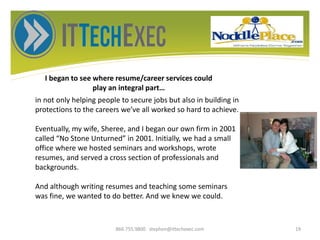
I began to see where resume/career services could
play an integral part…
866.755.9800 stephen@ittechexec.com 19
in not only helping people to secure jobs but also in building in
protections to the careers we’ve all worked so hard to achieve.
Eventually, my wife, Sheree, and I began our own firm in 2001
called “No Stone Unturned” in 2001. Initially, we had a small
office where we hosted seminars and workshops, wrote
resumes, and served a cross section of professionals and
backgrounds.
And although writing resumes and teaching some seminars
was fine, we wanted to do better. And we knew we could.
ITtechExec was launched…
866.755.9800 stephen@ittechexec.com 20
Thanks to my background in IT/telecom management for the supply chain/logistics industry and
to Sheree’s experience serving as an editor to the scientific/engineering community in the
publishing world, we soon realized that we were best suited to serve the technical professional
trying to maneuver through what by that point (2008) had become a complex and exhausting job
market. (Let’s face it…it’s a bit of a zoo out there!)
Not only that, we noticed that other resume writers were avoiding technical clients, unsure of
how best to position their specialized skills.
Therefore, it wasn’t long before we began to work exclusively with IT and technical or “STEM”
clientele, professionals who have devoted themselves to some of the most innovative and
rewarding fields in today’s industries, from engineering to healthcare IT to scientific exploration
to big data and cloud services to project/program management.
That’s when ITtechExec was born…
Silly me. I thought we could just write resumes…
866.755.9800 stephen@ittechexec.com 21
Then, before we knew it, unemployment skyrocketed and the tech market
began waging its war for sophisticated tech talent.
And on top of all that, social media recruiting burst onto the scene, and the
landscape became pretty messy, pretty fast. Soon, hiring folks were claiming
they were no longer reading resumes (even though they continued to ask for
them), and the job market became such a zoo that candidates found
themselves focused on a document that everyone says they won't look at for
more than 6 seconds but it better not have any typos in it!
That’s when we realized that we could no longer just write a resume and send
our clients on their way. They needed better preparation and lasting
protections. They needed strategies and tools that, well, worked.
We knew then that we had to become a full-service career advancement and
protection firm, not just another resume-writing firm.
95% of technical leaders obsess over the resume even though they don't
believe it has much value.
866.755.9800 stephen@ittechexec.com 22
So we asked ourselves, if you know the market is a zoo, that resumes aren't likely to be read, and
that obstacles like age or experience are more pronounced than ever, why would you (a) keep
approaching it from the same angle over and over or (b) sit back and do nothing? Why wouldn't
you instead focus on where the real value lies?
With tech professionals changing jobs every 3 to 4 years, consulting/contracting on the rise, and
fierce competition for promotions, it's time to try something that is based on how the market is
actually working now, not 10, 15, even 5 years ago.
It's why we've made a radical shift to a more portfolio-driven approach instead of just a
resume-based one.
Yes, the resume is part of it, but let’s get more from your investment.
866.755.9800 stephen@ittechexec.com 23
You still need a solid chronological resume (no matter what you may hear) geared toward a very specific
audience, but when done properly, having addenda to go along with the resume can be much more
effective (and much more likely to be read!), not to mention the significance of the LinkedIn profile, which
will continue to grow over the next few years.
Portfolios can help build in flexibility and prepare you to face different hiring scenarios. But you need to
know which tools are best for your situation. Although there is a lot out there you can do (or buy), you
don't need to do everything (that's the good news!).
So whether you are an external job seeker looking for a new full-time role, a consultant going for the next
contract, or an internal leader seeking promotion or just retention (such as during an acquisition),
because we are following the tech job market closely, the real investment is in knowing which tools are
right for you and how to properly use them. (To learn more about why we recommend a portfolio-driven
approach, check out our presentations: http://ow.ly/viT6C and http://ow.ly/vM9UH.)
No one can predict for certain what the market will do, but we can make sure that you are prepared for
whatever comes.
Building the messaging AND the strategic vision for your job search
that lead to solutions.
866.755.9800 stephen@ittechexec.com 24
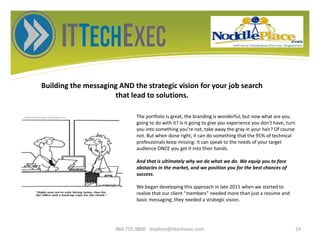
The portfolio is great, the branding is wonderful, but now what are you
going to do with it? Is it going to give you experience you don't have, turn
you into something you're not, take away the gray in your hair? Of course
not. But when done right, it can do something that the 95% of technical
professionals keep missing: It can speak to the needs of your target
audience ONCE you get it into their hands.
And that is ultimately why we do what we do. We equip you to face
obstacles in the market, and we position you for the best chances of
success.
We began developing this approach in late 2011 when we started to
realize that our client “members” needed more than just a resume and
basic messaging; they needed a strategic vision.
That’s how NoddlePlace came to be…
866.755.9800 stephen@ittechexec.com 25
To best provide this strategic visioning, we needed to differentiate our solutions even further!
This meant tailoring some to meet the needs of the more experienced tech pro, the leader with
15+ years of experience who was now wondering how to face this market that seemed to
penalize them often for things they can’t control, like age, experience, and high salaries. For
them, it isn’t so much about climbing ladders as it is about protecting what they’ve built so far
and staying relevant to the marketplace.
So we customized ITtechExec to meet the needs of this type of client.
Then we introduced NoddlePlace in 2013. Here we focus on the “emerging” technical
professional with 5 to 15 years of experience who knows another 25 years or more in the tech
job market means 8+ more career moves, statistically speaking, and wants to keep advancing in
the market but now has a lot of other demands on his or her time.
In either case, though, they are both looking for real solutions…
Maybe you can relate….
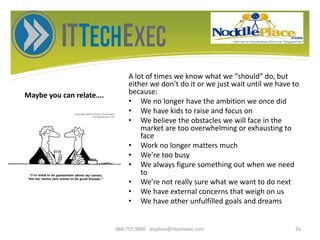
A lot of times we know what we “should” do, but
either we don’t do it or we just wait until we have to
because:
• We no longer have the ambition we once did
• We have kids to raise and focus on
• We believe the obstacles we will face in the
market are too overwhelming or exhausting to
face
• Work no longer matters much
• We’re too busy
• We always figure something out when we need
to
• We’re not really sure what we want to do next
• We have external concerns that weigh on us
• We have other unfulfilled goals and dreams
866.755.9800 stephen@ittechexec.com 26
BUT protecting careers protects families.
Too many times we think of our careers in terms of climbing the ladder of ambition and in having it all
“figured out.”
And although there’s nothing wrong with having ambition, there’s much more to our livelihoods than that.
There are people depending on us, and no matter where we stand on the corporate ladder, we all have
something to protect.
And that protection requires preparation. (If you want to toss in ambition, great!) It doesn’t necessarily
mean you have your whole life mapped out or that the obstacles you face aren’t real. It does mean,
though, that you aren’t going to keep letting corporate whims and job market trends toss you around with
no regard for you and your family.
866.755.9800 stephen@ittechexec.com 27
What is the cost of doing nothing?
So we’ve developed our solutions, not to be so much an investment in a
“resume” as an investment in proper positioning and solutions to the market.
866.755.9800 stephen@ittechexec.com 28
Call it holistic. Call it different. We like to think of it in terms of allowing us to track results and
ROI.
There are good resume writers out there. But they can’t/don’t/won’t do anything more than
write the resume and send you on your way. And the resume alone isn’t really addressing the
main issue: your age, lack of experience (too much experience), family or geographic restrictions,
job hopping, you name it.
Having the right messaging is good; having the right messaging with the right strategic vision
is better.
But the story doesn’t end there…or it shouldn’t…
To learn more about ITtechExec or our other solutions:
866.755.9800 stephen@ittechexec.com 29
Check Us Out
Or call Stephen toll-free at 1-866-755-9800; email at stephen@ittechexec.com.
Also, check out our free self-assessments:
From Tech Job Market Zoo to Corporate Goo...
How to Protect What You’ve Built So Far.
LI Profile Optimization Self-Assessment
Career Move Preparation Self-Assessment

The 3 Most Common Types of Networkers

  • 1.
    The 3 MostCommon Types of Networkers How Their Initial Reaction Can Tell You A lot About Them 866.755.9800 stephen@ittechexec.com 1 This presentation is part of our “Employer Profiling with a Job Search Agent” solution. For more info, check out our “What to Expect from Employer Profiling” presentation.
  • 2.
    If you’ve beenthrough employer profiling, let’s recap where you’ve been: It’s been a whirlwind of activity. Emails are now flying, and introductions abound. • Step 1: We started out by having our writing team design your technical resume and messaging portfolio. • Step 2: Then we discussed a strategic vision for your job search and how we were going to launch your search. • Step 3: Afterward, Sue, our NoNonsense Job Search Agent, began working with you on Employer Profiling. She began taking you through her Three- Phase Solution to identify these employers and find contacts at them (Phase 1: Write the Vision). • Step 4: She reached out on your behalf and made introductions to these contacts leveraging the power of connection (Phase 2: Make It Plain). • Step 5: Sue met with you and set a plan for where to go from here. She also followed up with any nonresponses (Phase 3: Run With It). 866.755.9800 stephen@ittechexec.com 2
  • 3.
    Here are thegoals your job search agent set (and accomplished) with Employer Profiling: • We targeted companies in your geographic area, field, industry, etc. that are best suited for your goals. • We researched and found contacts (at least 1 contact; maybe more) at these companies based on your strength of connection (leveraging alumni, military, professional association, etc.). • We prioritized the companies based on your preferences and the strength of the connections we found. • We reached out on your behalf and made the initial introduction with the contact names. • We tried to secure a response from as many as we could, and we tried to get them to agree to continue to talk to you at a later time in more detail about the company, other possible connections, etc. • We provided you with messaging and tutorials about where to take the conversation from there. • We moved you away from just relying on job boards and recruiters to help you build a more effective network for you targeting specific resources (keeping you away from networking mixer after networking mixer). • We saved you a lot of upfront research time that makes it so difficult for professionals to get started with this approach, and we leveraged our network to expand yours. 866.755.9800 stephen@ittechexec.com 3 If you’ve haven’t been through our Employer Profiling, maybe you’ve done something similar on your own as part of your networking efforts.
  • 4.
    OK, here iswhere you are today: • Your contacts are most likely in several different stages – Some responded right away and have either agreed to meet with you or to make further introductions (we call these the “Enthusiasts”). – Some responded initially but then kind of drifted away leaving things in the air (which means you will need to nudge them gently) (we call these the “Skeptics”). – Some have yet to respond either to your initial contact or to your follow-up note OR they responded that they aren’t interested in speaking with you, etc. (we call these the “Dejecteds”). *We will discuss the different types of contacts in more detail on the next several slides. • For the Enthusiasts, you are setting up phone/in-person meetings and you are preparing to conduct informational interviews (if you haven’t already). • You want to make sure to build in a strong follow-up plan to make the most of these Enthusiast contacts. • You need to determine whether to search for additional contacts with the different organizations if the Skeptics don’t come through. • You need a plan for moving past the Dejecteds on to someone else at the company. 866.755.9800 stephen@ittechexec.com 4
  • 5.
    Loving Our Enthusiasts Some peoplejust love to do favors. They “get” networking. They understand what it’s like to need better contacts. They want to do whatever they can to help you even though they barely know you. 866.755.9800 stephen@ittechexec.com 5 Why? Because we leveraged whatever connections we could to get to them, we approached them respectfully, and they have an appreciation for what your going through.
  • 6.
    How to IdentifyEnthusiasts These are the people who respond right away and who respond, well, enthusiastically. They are willing to talk, willing to set up introductions, etc. Within reason, they want to help you and they are not cautious when speaking with you. 866.755.9800 stephen@ittechexec.com 6
  • 7.
    Be careful, though: Enthusiastsrequire love in return. Sometimes when we meet an Enthusiast in the course of networking, we get really excited about what they can do for us because frankly they are so excited it’s infectious. It’s important to remember, though, that as much as these people seem eager to help, they want to feel like they are dealing with a fellow Enthusiast in return. They want to know that you would do the same if the situations were reversed or if they sent someone to you. So be sure to set that tone with them when you set up an informational interview with them or with someone they connect you to. You want to make it clear to everyone involved that you are equally as open to being a resource as they are. It’s also important that you show the proper gratitude. Don’t overdo it, but make sure you acknowledge how gracious they are. They might act like they don’t want to hear it, but they usually do.  866.755.9800 stephen@ittechexec.com 7
  • 8.
    Now, here arethe next steps for you with your Enthusiasts… • You will want to make the most out of your informational “chat” with each Enthusiast by gathering more info about the company, such as its culture, if it is growing, if there are other people you should meet there, etc. • You will want to ask the contact if there is anything you can do for him or her…introductions you can make, etc. • You will want to send a thank-you to the contact after the chat. • You will take care of any action items that came up during your chat. • You will follow up with the contact every few weeks or so as appropriate. • You will be timely and responsive to anything the contact recommends, such as contacting someone else or sending your resume somewhere, etc. • You will not overwhelm the contact with your wonderfulness; you want to be bold but not pushy, determined but not desperate. • You will recognize that networks and pipelines must be nurtured and take some time to develop. 866.755.9800 stephen@ittechexec.com 8 Now that the ball is rolling, it’s important not to get overwhelmed here and miss out on the opportunity to build in better contacts and networks at companies you are best suited for. Too many people (that 95% again) do that and run back to sticking with the poor performing job boards. Instead, get excited about the opportunity to take a proactive approach, aligning yourself with well-matched employers and building contacts at those employers. We’ve taken care of the grunt work. Now you get to “run with it”!
  • 9.
    Nurturing Our Skeptics Some peoplelike the “idea” of doing favors. Like Enthusiasts, they “get” networking, BUT either they’ve been burned before or they aren’t too sure of themselves or your motives. They don’t want you to “get one over on them”. They also are genuinely concerned about sharing their network connections with “strangers,” so they proceed with caution. Safety is a big issue for them, and they don’t want to look or feel stupid. 866.755.9800 stephen@ittechexec.com 9 Skeptics can go either way. They can either become Dejecteds, meaning they totally shut down on you, or they can become better than Enthusiasts…they can become “Believers” if you handle them well and earn their trust. They really do want to help, but they just aren’t sold yet. Convince them you can be trusted, and you could end up with the best advocate you could ask for! So be careful not to write them off too quickly.
  • 10.
    How to IdentifySkeptics They either respond to you after the initial contact or after the follow-up note. When they do respond to you, they are nice, cautious…willing to help but often in a vague way. Most likely they will avoid a direct answer to setting up an appointment with you or to making an introduction for you. You might get something like, “maybe we can talk sometime” or “tell me more about what you’re looking for” (and tell it to me in email form as I really don’t want to spend time actually conversing with you yet). Sometimes they will respond initially, say they are going to do something or ask you for something, and then they kind of drop off. Typically, they will respond to at least one nudge (apologizing for being busy). It means you still need to do some convincing to put them at ease. Nudge them too much, and they will become Dejecteds and run away. 866.755.9800 stephen@ittechexec.com 10
  • 11.
    Now, here arethe next steps for you with your Skeptics… • You will most likely need to spend some time conversing via email or messaging with them back and forth before you can get a commitment to a phone/face chat (not always; older contacts, despite being Skeptics, might be more willing to get on the phone sooner, but typically they will make it clear that you are to keep it brief or that they aren’t really sure they will be able to help you [to try to dissuade you]). • Take more time when conversing with them for small talk if they will allow it. Find out about them, and find ways to identify with them. Share stories or experiences with them that can help put them at ease. • Let them know that you are NOT relying on them to get you a job or to solve all your career problems. • Don’t rush them too much. Be sure to give them space to respond to you. If they said they need a week, then respect that and give them the week. • Find out something you can help them with, and follow through on that. 866.755.9800 stephen@ittechexec.com 11
  • 12.
    Dismissing Our Dejecteds These arethe ones who either never respond, for whatever reason, or if they do respond, they tend to be curt. They might act like you have inconvenienced them just by reaching out and introducing yourself. They might act like you are trying to sell them something, and they are just too busy to deal with you. Either way, they aren’t willing to empathize with you, and they definitely don’t want to make new friends.  There are lots of reasons why people become Dejecteds, but for our purposes, it doesn’t really matter. Coming at them with a nonthreatening, simple introduction just isn’t going to cut it. 866.755.9800 stephen@ittechexec.com 12
  • 13.
    How to IdentifyDejecteds In this case, you don’t have to work too hard to figure out who they are. Dejecteds like to make themselves known by sending the “leave me alone” signal either indirectly by ignoring you or directly by telling you they aren’t “interested.” Although it can be frustrating, in their own sad way, they are doing you a favor because now you can move on. Coming at them in a direct manner is not going to work with them. CAUTION: Don’t confuse the Dejected with meaning the company is completely lost to you. If pursuing the company matters to you, then don’t let a Dejected derail you (even if he or she is the CEO). 866.755.9800 stephen@ittechexec.com 13
  • 14.
    Here’s what’s nextafter encountering a Dejected… • First you need to decide if the Dejected’s company is still an organization you want to pursue. (If not, then just move on to the next one.) • If so, then you obviously need a Plan B, which starts by finding a second contact at the organization. (Our job search agent can help you with this. It’s important not to try to connect with too many at the same organization at once; that approach can backfire if you aren’t careful.) • Once you find the second contact, you will begin the introduction process again. • You will also need to assess whether the new contact is an Enthusiast, Skeptic, or Dejected. • Don’t be surprised if you are successful at establishing a rapport with a second contact, if at some point down the road he or she mentions the Dejected as someone you should “meet.” If so, don’t hold a grudge…take the introduction! • Dejecteds tend to be much more receptive to introductions from someone they know/trust. You will probably find a completely different demeanor when you enter into their circle that way. • And chances are they will not even remember you or your initial attempts at contacting them. 866.755.9800 stephen@ittechexec.com 14 Don’t make the mistake of trying to convert a Dejected, like you might try to convert a Skeptic. Of course, miracles do happen, but most often, you will just exert more time and energy and make little headway. Dejecteds, who are often very direct people themselves, don’t typically appreciate a direct approach from others. That’s why you received the response (or nonresponse) you did. So with them you will need to shift gears to a more indirect approach…or just work around them.
  • 15.
    Perhaps you canrelate... “I have to admit that I was feeling a bit overwhelmed. I had my resume done. I had a strong brand message in place. And I thought I had a plan for how I was going to conduct my job search: I was going to do what I had always done in the past. I was going to call a few colleagues to get them ‘looking’ for me, respond to some job boards, and reach out to a few recruiters. So I did just that. And although I had some movement, it was very slow-going. Companies were definitely much slower to respond and progress the discussion than they had been in the past. My colleagues were helpful and did put in a few good words for me, but frankly, there just weren’t enough of them out there and the timing just wasn’t right. At that point, I had to decide either to give up the search for now or switch tactics. That’s when I heard about Employer Profiling. Although I was a ‘Skeptic’ myself, I was drawn to the idea of 1) proactively targeting companies I wanted to work for (many of which I didn’t even know existed) and 2) having a ‘job search agent’ who did the upfront work for me (I knew if I had to rely on my ‘free’ time that it would never happen). Without a doubt, this was the push I needed. Before I knew it, I was building my LinkedIn network with valuable contacts, profiling companies for my search, and being introduced to contacts at those companies! After launching me into this direction, although I still had to be diligent and follow through, I did succeed in meeting with a decision maker on two separate occasions at one of my target companies who eventually made me an offer…for a position that was never posted! This approach was definitely hard work, but all along the way, I felt more in control of the process, more directed, and less a part of the masses. I still applied to job boards and talked to recruiters (and even had some interviews from that), but I never gave up on building those new relationships with people at these target companies. And now I can even say that I have leveraged those relationships to help others in my network. I think I finally truly understand how networking should work.” Meet Justine. Justine is a very busy Project Manager in the pharmaceutical industry. She also happens to be a busy mom of 3 and very active in her community. Justine has always moved from job to job pretty easily until this time. Job boards and recruiters just aren’t coming through for her, and she knows she needs to build more professional contacts, but who has the time? Plus, Justine wasn’t born yesterday. Although her current environment isn’t ideal, she doesn’t want to just jump ship for greener pastures. She wants to be careful about the next organization she works with. But that’s easier said than done…or so it seems. 866.755.9800 stephen@ittechexec.com 15
  • 16.
    Silly me. Ithought an MBA mixed with hard work was my ticket… (A Note from Stephen Van Vreede, Co-Founder of ITtechExec/NoddlePlace) 866.755.9800 stephen@ittechexec.com 16 When I first started my career, generally I didn’t know anyone who actually paid to have their resume (or résumé, for the purists among us) written, much less for “career services.” Let's be real. It used to be pretty cut-and-dry. You put a basic 1-page (or maybe 2-page) resume (or résumé) together, worked a few connections or answered a few "classifieds," and felt pretty certain the right opportunity would come along. Then if you worked hard (got the right certs) and didn't burn too many bridges, you most likely had a pretty secure career path ahead of you perhaps even with the same company. And at first, throughout most of the early part of my corporate life, that was generally how things went. I moved from internal position to internal position without the need to invest in resume or other career services, eventually landing a director-level role with a large GE Capital, multi-site inbound call center serving the logistics industry.
  • 17.
    But then thejob market began to change, my priorities shifted, and job security was, well, less secure. 866.755.9800 stephen@ittechexec.com 17 So I decided to go back for my MBA and obtain some other credentials (sound familiar?), which cost me thousands and thousands (and thousands) of dollars (just ask my lovely bride who helped pay for them!). I even clawed my way through the Six Sigma process to become a Black Belt. It was a great experience, but after two years of working full time and taking night classes, when I graduated, the job market wasn’t much better, competition for internal promotions was greater, and I wasn’t the only one with an MBA, a Black Belt, etc.
  • 18.
    That’s when Iwas introduced to resume design and career services. 866.755.9800 stephen@ittechexec.com 18 I came to recognize that the time and resources I had already spent on my career were worth protecting. The market was too uncertain and changing too rapidly for me to continue to go it alone. At this point, I had already invested in someone to handle my retirement, another someone to do my taxes, and another someone to find me the right home. It wasn’t such a stretch to think that my career mattered as much, if not more, than these other things. After all, without it, then I couldn’t afford the retirement or the house (and yes even the taxes).
  • 19.
    I began tosee where resume/career services could play an integral part… 866.755.9800 stephen@ittechexec.com 19 in not only helping people to secure jobs but also in building in protections to the careers we’ve all worked so hard to achieve. Eventually, my wife, Sheree, and I began our own firm in 2001 called “No Stone Unturned” in 2001. Initially, we had a small office where we hosted seminars and workshops, wrote resumes, and served a cross section of professionals and backgrounds. And although writing resumes and teaching some seminars was fine, we wanted to do better. And we knew we could.
  • 20.
    ITtechExec was launched… 866.755.9800stephen@ittechexec.com 20 Thanks to my background in IT/telecom management for the supply chain/logistics industry and to Sheree’s experience serving as an editor to the scientific/engineering community in the publishing world, we soon realized that we were best suited to serve the technical professional trying to maneuver through what by that point (2008) had become a complex and exhausting job market. (Let’s face it…it’s a bit of a zoo out there!) Not only that, we noticed that other resume writers were avoiding technical clients, unsure of how best to position their specialized skills. Therefore, it wasn’t long before we began to work exclusively with IT and technical or “STEM” clientele, professionals who have devoted themselves to some of the most innovative and rewarding fields in today’s industries, from engineering to healthcare IT to scientific exploration to big data and cloud services to project/program management. That’s when ITtechExec was born…
  • 21.
    Silly me. Ithought we could just write resumes… 866.755.9800 stephen@ittechexec.com 21 Then, before we knew it, unemployment skyrocketed and the tech market began waging its war for sophisticated tech talent. And on top of all that, social media recruiting burst onto the scene, and the landscape became pretty messy, pretty fast. Soon, hiring folks were claiming they were no longer reading resumes (even though they continued to ask for them), and the job market became such a zoo that candidates found themselves focused on a document that everyone says they won't look at for more than 6 seconds but it better not have any typos in it! That’s when we realized that we could no longer just write a resume and send our clients on their way. They needed better preparation and lasting protections. They needed strategies and tools that, well, worked. We knew then that we had to become a full-service career advancement and protection firm, not just another resume-writing firm.
  • 22.
    95% of technicalleaders obsess over the resume even though they don't believe it has much value. 866.755.9800 stephen@ittechexec.com 22 So we asked ourselves, if you know the market is a zoo, that resumes aren't likely to be read, and that obstacles like age or experience are more pronounced than ever, why would you (a) keep approaching it from the same angle over and over or (b) sit back and do nothing? Why wouldn't you instead focus on where the real value lies? With tech professionals changing jobs every 3 to 4 years, consulting/contracting on the rise, and fierce competition for promotions, it's time to try something that is based on how the market is actually working now, not 10, 15, even 5 years ago. It's why we've made a radical shift to a more portfolio-driven approach instead of just a resume-based one.
  • 23.
    Yes, the resumeis part of it, but let’s get more from your investment. 866.755.9800 stephen@ittechexec.com 23 You still need a solid chronological resume (no matter what you may hear) geared toward a very specific audience, but when done properly, having addenda to go along with the resume can be much more effective (and much more likely to be read!), not to mention the significance of the LinkedIn profile, which will continue to grow over the next few years. Portfolios can help build in flexibility and prepare you to face different hiring scenarios. But you need to know which tools are best for your situation. Although there is a lot out there you can do (or buy), you don't need to do everything (that's the good news!). So whether you are an external job seeker looking for a new full-time role, a consultant going for the next contract, or an internal leader seeking promotion or just retention (such as during an acquisition), because we are following the tech job market closely, the real investment is in knowing which tools are right for you and how to properly use them. (To learn more about why we recommend a portfolio-driven approach, check out our presentations: http://ow.ly/viT6C and http://ow.ly/vM9UH.) No one can predict for certain what the market will do, but we can make sure that you are prepared for whatever comes.
  • 24.
    Building the messagingAND the strategic vision for your job search that lead to solutions. 866.755.9800 stephen@ittechexec.com 24 The portfolio is great, the branding is wonderful, but now what are you going to do with it? Is it going to give you experience you don't have, turn you into something you're not, take away the gray in your hair? Of course not. But when done right, it can do something that the 95% of technical professionals keep missing: It can speak to the needs of your target audience ONCE you get it into their hands. And that is ultimately why we do what we do. We equip you to face obstacles in the market, and we position you for the best chances of success. We began developing this approach in late 2011 when we started to realize that our client “members” needed more than just a resume and basic messaging; they needed a strategic vision.
  • 25.
    That’s how NoddlePlacecame to be… 866.755.9800 stephen@ittechexec.com 25 To best provide this strategic visioning, we needed to differentiate our solutions even further! This meant tailoring some to meet the needs of the more experienced tech pro, the leader with 15+ years of experience who was now wondering how to face this market that seemed to penalize them often for things they can’t control, like age, experience, and high salaries. For them, it isn’t so much about climbing ladders as it is about protecting what they’ve built so far and staying relevant to the marketplace. So we customized ITtechExec to meet the needs of this type of client. Then we introduced NoddlePlace in 2013. Here we focus on the “emerging” technical professional with 5 to 15 years of experience who knows another 25 years or more in the tech job market means 8+ more career moves, statistically speaking, and wants to keep advancing in the market but now has a lot of other demands on his or her time. In either case, though, they are both looking for real solutions…
  • 26.
    Maybe you canrelate…. A lot of times we know what we “should” do, but either we don’t do it or we just wait until we have to because: • We no longer have the ambition we once did • We have kids to raise and focus on • We believe the obstacles we will face in the market are too overwhelming or exhausting to face • Work no longer matters much • We’re too busy • We always figure something out when we need to • We’re not really sure what we want to do next • We have external concerns that weigh on us • We have other unfulfilled goals and dreams 866.755.9800 stephen@ittechexec.com 26
  • 27.
    BUT protecting careersprotects families. Too many times we think of our careers in terms of climbing the ladder of ambition and in having it all “figured out.” And although there’s nothing wrong with having ambition, there’s much more to our livelihoods than that. There are people depending on us, and no matter where we stand on the corporate ladder, we all have something to protect. And that protection requires preparation. (If you want to toss in ambition, great!) It doesn’t necessarily mean you have your whole life mapped out or that the obstacles you face aren’t real. It does mean, though, that you aren’t going to keep letting corporate whims and job market trends toss you around with no regard for you and your family. 866.755.9800 stephen@ittechexec.com 27 What is the cost of doing nothing?
  • 28.
    So we’ve developedour solutions, not to be so much an investment in a “resume” as an investment in proper positioning and solutions to the market. 866.755.9800 stephen@ittechexec.com 28 Call it holistic. Call it different. We like to think of it in terms of allowing us to track results and ROI. There are good resume writers out there. But they can’t/don’t/won’t do anything more than write the resume and send you on your way. And the resume alone isn’t really addressing the main issue: your age, lack of experience (too much experience), family or geographic restrictions, job hopping, you name it. Having the right messaging is good; having the right messaging with the right strategic vision is better. But the story doesn’t end there…or it shouldn’t…
  • 29.
    To learn moreabout ITtechExec or our other solutions: 866.755.9800 stephen@ittechexec.com 29 Check Us Out Or call Stephen toll-free at 1-866-755-9800; email at stephen@ittechexec.com. Also, check out our free self-assessments: From Tech Job Market Zoo to Corporate Goo... How to Protect What You’ve Built So Far. LI Profile Optimization Self-Assessment Career Move Preparation Self-Assessment