PURPOSES OF
ASSESSMENT
Ronico T. Madanlo
There are three interrelated
purposes of assessment.
Knowledge of these purposes and
how they fit in the learning
process can result to a more
effective classroom assessment.
ASSESSMENT FOR
LEARNING (AFL)
• Assessment for Learning
pertains to diagnostic and
formative assessment tasks
which are used to determine
learning needs, monitor
academic progress of students
during a unit or block of
instruction and guide
instruction.
ASSESSMENT FOR
LEARNING (AFL)
• It ensures that learning is
going on while teacher is in
the process of teaching.
• Formative assessment also
includes the pretest and the
posttest that a teacher gives
to ensure learning. This is also
termed pre-assessment.
ASSESSMENT FOR
LEARNING (AFL)
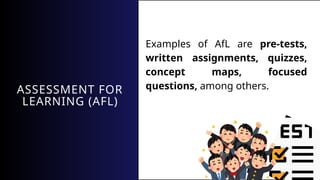
Examples of AfL are pre-tests,
written assignments, quizzes,
concept maps, focused
questions, among others.
ASSESSMENT AS
LEARNING (AAL)
• Assessment as Learning
employs tasks or activities that
provide students with an
opportunity to monitor and
further their own learning to
think about their personal
learning habits and how they
can adjust their learning
strategies to achieve their
goals.
ASSESSMENT AS
LEARNING (AAL)
• It is associated with self-
assessment.
• It involves metacognitive
processes like reflection and
self-regulation.
• Self- and peer-assessment
rubrics and portfolios are
examples of Aal.
ASSESSMENT OF
LEARNING (AOL)
• Assessment of Learning is
summative and done at the
end of a unit, task, process or
period.
• AoL is for grading, evaluation
and reporting purposes.
ASSESSMENT OF
LEARNING (AOL)
• Evaluative feedback on the
student's proficiency level is
given to the student
concerned, likewise to his/her
parents and other
stakeholders.
• Unit tests and final projects
are typical examples of
summative assessment.
GUIDING
PRINCIPLES IN THE
ASSESSMENT OF
LEARNING
Assessment of learning is an
integral part of the teaching-
learning process.
1.
Assessment tool should match with
performance objective.
2.
The result of assessment must be
fed back to the learners.
3.
In assessing learning, teachers must
consider learners, learning style and
multiple intelligences and so much
come up with a variety of ways of
assessing learning.
4.
To contribute to the building of
success in the school, it
pedagogically sounds that in our
assessment techniques we give
some positive feedback along with
not so good ones.
5.
Emphasize on self-assessment.
6.
If we believe that our task as teachers is
to teach all pupils/students, and that is
possible that all students even those
from limited backgrounds will have
access to opportunities and therefore
can achieve, then the bell curve
mentality must be abandoned.
7.
Assessment of learning should
never be used as punishment or as
a disciplinary measures.
8.
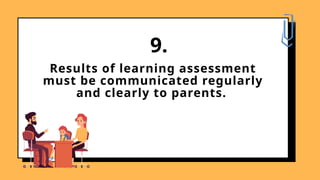
Results of learning assessment
must be communicated regularly
and clearly to parents.
9.
Emphasize on real world
application that favors realistic
performances over out-of-context
drill items.
10.
REFERENCES
Corpuz, B., Salandanan, G., (2009). Principles of Teaching 1. Lorimar
Publishing.
De Guzman, E., Adamos, J., (2015). Assessment of Learning 1.
Adriana Publishing Corp., Inc.
Navarro et al., (2019). Assessment in Learning. Lorimar Publishing.
THANK YOU!

THE 10 ASSESSMENT OF LEARNING PRINCIPLES

  • 1.
  • 2.
    There are threeinterrelated purposes of assessment. Knowledge of these purposes and how they fit in the learning process can result to a more effective classroom assessment.
  • 3.
    ASSESSMENT FOR LEARNING (AFL) •Assessment for Learning pertains to diagnostic and formative assessment tasks which are used to determine learning needs, monitor academic progress of students during a unit or block of instruction and guide instruction.
  • 4.
    ASSESSMENT FOR LEARNING (AFL) •It ensures that learning is going on while teacher is in the process of teaching. • Formative assessment also includes the pretest and the posttest that a teacher gives to ensure learning. This is also termed pre-assessment.
  • 5.
    ASSESSMENT FOR LEARNING (AFL) Examplesof AfL are pre-tests, written assignments, quizzes, concept maps, focused questions, among others.
  • 6.
    ASSESSMENT AS LEARNING (AAL) •Assessment as Learning employs tasks or activities that provide students with an opportunity to monitor and further their own learning to think about their personal learning habits and how they can adjust their learning strategies to achieve their goals.
  • 7.
    ASSESSMENT AS LEARNING (AAL) •It is associated with self- assessment. • It involves metacognitive processes like reflection and self-regulation. • Self- and peer-assessment rubrics and portfolios are examples of Aal.
  • 8.
    ASSESSMENT OF LEARNING (AOL) •Assessment of Learning is summative and done at the end of a unit, task, process or period. • AoL is for grading, evaluation and reporting purposes.
  • 9.
    ASSESSMENT OF LEARNING (AOL) •Evaluative feedback on the student's proficiency level is given to the student concerned, likewise to his/her parents and other stakeholders. • Unit tests and final projects are typical examples of summative assessment.
  • 10.
  • 11.
    Assessment of learningis an integral part of the teaching- learning process. 1.
  • 12.
    Assessment tool shouldmatch with performance objective. 2.
  • 13.
    The result ofassessment must be fed back to the learners. 3.
  • 14.
    In assessing learning,teachers must consider learners, learning style and multiple intelligences and so much come up with a variety of ways of assessing learning. 4.
  • 15.
    To contribute tothe building of success in the school, it pedagogically sounds that in our assessment techniques we give some positive feedback along with not so good ones. 5.
  • 16.
  • 17.
    If we believethat our task as teachers is to teach all pupils/students, and that is possible that all students even those from limited backgrounds will have access to opportunities and therefore can achieve, then the bell curve mentality must be abandoned. 7.
  • 18.
    Assessment of learningshould never be used as punishment or as a disciplinary measures. 8.
  • 19.
    Results of learningassessment must be communicated regularly and clearly to parents. 9.
  • 20.
    Emphasize on realworld application that favors realistic performances over out-of-context drill items. 10.
  • 21.
    REFERENCES Corpuz, B., Salandanan,G., (2009). Principles of Teaching 1. Lorimar Publishing. De Guzman, E., Adamos, J., (2015). Assessment of Learning 1. Adriana Publishing Corp., Inc. Navarro et al., (2019). Assessment in Learning. Lorimar Publishing.
  • 22.