TEXT AND VISUAL MEDIA
AND INFORMATION
TEXT MEDIA AND INFORMATION
• It is a factual type of writing that informs the readers about a specific topic.
• It is available in formal or informal types of text.
• In the absence of images or drawings, text is the easiest way of
communicating to your audience.
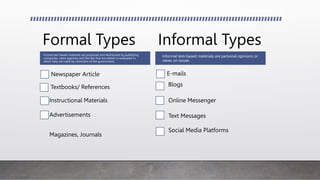
Formal Types
Newspaper Article
Textbooks/ References
Advertisements
Informal Types
Informal text-based materials are personal opinions or
views on issues.
Formal text-based materials are produced and distributed by publishing
companies, news agencies and the like that are edited or evaluated in
which they are ruled by restriction of the government.
Blogs
Instructional Materials
Magazines, Journals
E-mails
Online Messenger
Text Messages
Social Media Platforms
Design of Text Media
TYPEFACE
• It is also called font, font type, or type.
• It refers to the style of a text in the digital format.
• It is comprised of alphabets, numbers, punctuation marks, symbols
and other special characters.
Types of Typeface:
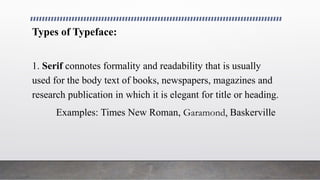
1. Serif connotes formality and readability that is usually
used for the body text of books, newspapers, magazines and
research publication in which it is elegant for title or heading.
Examples: Times New Roman, Garamond, Baskerville
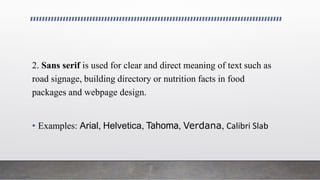
2. Sans serif is used for clear and direct meaning of text such as
road signage, building directory or nutrition facts in food
packages and webpage design.
• Examples: Arial, Helvetica, Tahoma, Verdana, Calibri Slab
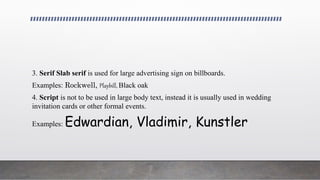
3. Serif Slab serif is used for large advertising sign on billboards.
Examples: Rockwell, Playbill, Black oak
4. Script is not to be used in large body text, instead it is usually used in wedding
invitation cards or other formal events.
Examples: Edwardian, Vladimir, Kunstler
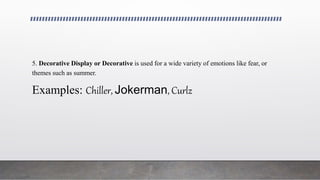
5. Decorative Display or Decorative is used for a wide variety of emotions like fear, or
themes such as summer.
Examples: Chiller, Jokerman, Curlz
VISUAL MEDIAAND INFORMATION
Visual media and information refer to the materials,
programs, applications and the like that teachers and students
use for information. They are formally produced by
organizations such as schools, government, and established
media/publishing outfits. Other visual media are considered
informally produced.
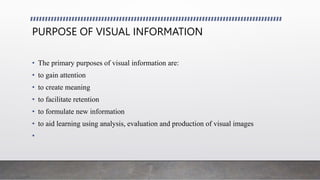
PURPOSE OF VISUAL INFORMATION
• The primary purposes of visual information are:
• to gain attention
• to create meaning
• to facilitate retention
• to formulate new information
• to aid learning using analysis, evaluation and production of visual images
•
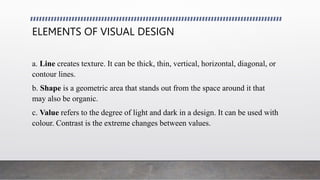
ELEMENTS OF VISUAL DESIGN
a. Line creates texture. It can be thick, thin, vertical, horizontal, diagonal, or
contour lines.
b. Shape is a geometric area that stands out from the space around it that
may also be organic.
c. Value refers to the degree of light and dark in a design. It can be used with
colour. Contrast is the extreme changes between values.
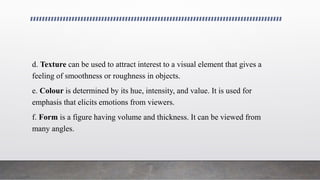
d. Texture can be used to attract interest to a visual element that gives a
feeling of smoothness or roughness in objects.
e. Colour is determined by its hue, intensity, and value. It is used for
emphasis that elicits emotions from viewers.
f. Form is a figure having volume and thickness. It can be viewed from
many angles.

TEXT AND VISUAL MIL.pptx

  • 1.
    TEXT AND VISUALMEDIA AND INFORMATION
  • 2.
    TEXT MEDIA ANDINFORMATION • It is a factual type of writing that informs the readers about a specific topic. • It is available in formal or informal types of text. • In the absence of images or drawings, text is the easiest way of communicating to your audience.
  • 3.
    Formal Types Newspaper Article Textbooks/References Advertisements Informal Types Informal text-based materials are personal opinions or views on issues. Formal text-based materials are produced and distributed by publishing companies, news agencies and the like that are edited or evaluated in which they are ruled by restriction of the government. Blogs Instructional Materials Magazines, Journals E-mails Online Messenger Text Messages Social Media Platforms
  • 4.
    Design of TextMedia TYPEFACE • It is also called font, font type, or type. • It refers to the style of a text in the digital format. • It is comprised of alphabets, numbers, punctuation marks, symbols and other special characters.
  • 5.
    Types of Typeface: 1.Serif connotes formality and readability that is usually used for the body text of books, newspapers, magazines and research publication in which it is elegant for title or heading. Examples: Times New Roman, Garamond, Baskerville
  • 6.
    2. Sans serifis used for clear and direct meaning of text such as road signage, building directory or nutrition facts in food packages and webpage design. • Examples: Arial, Helvetica, Tahoma, Verdana, Calibri Slab
  • 7.
    3. Serif Slabserif is used for large advertising sign on billboards. Examples: Rockwell, Playbill, Black oak 4. Script is not to be used in large body text, instead it is usually used in wedding invitation cards or other formal events. Examples: Edwardian, Vladimir, Kunstler
  • 8.
    5. Decorative Displayor Decorative is used for a wide variety of emotions like fear, or themes such as summer. Examples: Chiller, Jokerman, Curlz
  • 9.
    VISUAL MEDIAAND INFORMATION Visualmedia and information refer to the materials, programs, applications and the like that teachers and students use for information. They are formally produced by organizations such as schools, government, and established media/publishing outfits. Other visual media are considered informally produced.
  • 10.
    PURPOSE OF VISUALINFORMATION • The primary purposes of visual information are: • to gain attention • to create meaning • to facilitate retention • to formulate new information • to aid learning using analysis, evaluation and production of visual images •
  • 11.
    ELEMENTS OF VISUALDESIGN a. Line creates texture. It can be thick, thin, vertical, horizontal, diagonal, or contour lines. b. Shape is a geometric area that stands out from the space around it that may also be organic. c. Value refers to the degree of light and dark in a design. It can be used with colour. Contrast is the extreme changes between values.
  • 12.
    d. Texture canbe used to attract interest to a visual element that gives a feeling of smoothness or roughness in objects. e. Colour is determined by its hue, intensity, and value. It is used for emphasis that elicits emotions from viewers. f. Form is a figure having volume and thickness. It can be viewed from many angles.