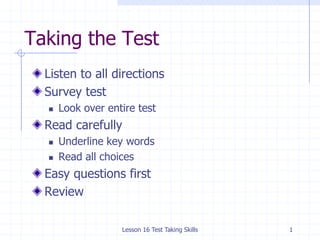
Taking the TestListen to all directionsSurvey testLook over entire testRead carefullyUnderline key wordsRead all choicesEasy questions firstReviewLesson 16 Test Taking Skills1
Lesson 16 Test Taking Skills2Top Ten Study PreventionsDon’t have the materials you need to study so you can make several phone calls to talk about studying rather than actually studying.Spend several hours explaining to friends or family how boring the teacher/ material is and why this prevents you from studying.Plan to study all the time and schedule no recreation time which will allow you to be an academic martyr but put in very little focused, productive study time.Only study in you room with the door open to be sure you don’t miss anyone walking by wanting to talk.Never send anyone away that interrupts your study because you don’t want to hurt their feelings.Develop a smug superior attitude that can be used to impress others with the fact that you don’t need to study.Find a place to study that also has great entertainment value because “Why be bored when you study?”Never study material you don’t enjoy since you’ll obviously never use it anyway.Always remember that people will think you’re smarter if you flunk a test because you didn’t study rather than flunking it when you did study.Focus on how boring the course is and if the instructor  were decent you would ace the class.
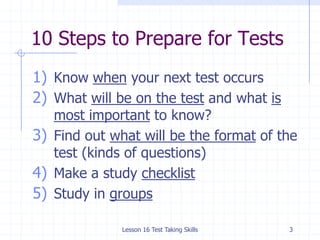
Lesson 16 Test Taking Skills310 Steps to Prepare for TestsKnow when your next test occursWhat will be on the test and what is most important to know?Find out what will be the format of the test (kinds of questions)Make a study checklistStudy in groups
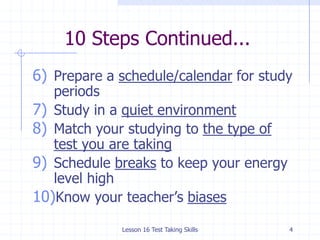
Lesson 16 Test Taking Skills410 Steps Continued...Prepare a schedule/calendar for study periodsStudy in a quiet environmentMatch your studying to the type of test you are takingSchedule breaks to keep your energy level highKnow your teacher’s biases
Lesson 16 Test Taking Skills5Taking Objective TestsRead all instructions carefully.Budget your time  so that you have time to cover each question.Generally, first answer the questions you can complete easily.If you get stuck or start to get anxious on a particular problem, move on to the next question
Lesson 16 Test Taking Skills6Taking Objective Tests Don’t jump too quickly at apparent answers that seem easy.Avoid negative statements to yourself during a test.If you do not understand a question, get help quickly from the teacher and move on  to the next questionRead the questions carefully.
Lesson 16 Test Taking Skills7Ron Fry, “Ace” Any Test If two answers sound alike, chose neitherIn math choose a number in the middleIf two amounts are close then chose one of themIf two numbers differ by a decimal point chose one of themIf two math answers look alike choose one of them
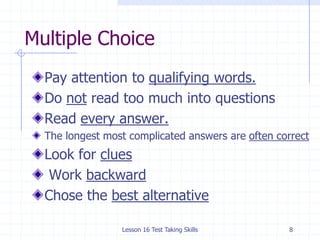
Lesson 16 Test Taking Skills8Multiple ChoicePay attention to qualifying words.Do not read too much into questionsRead every answer.The longest most complicated answers are often correctLook for clues Work backwardChose the best alternative
Lesson 16 Test Taking Skills9MatchingAsk if you can use alternatives more than onceDo not match if you are not sureTry to think of the answer before reading the choicesChoose the best answer and mark the answerNarrow down the fieldAvoid changing answers
Lesson 16 Test Taking Skills10Fill-in-the-BlankLook for cluesUse common sense.Chose the best word.Pay attention to the length of line given or to the number of lines.Read through after you answer
Lesson 16 Test Taking Skills11Short AnswerPay attention to grammarAnswer within the context of the courseUse terms the instructor used.Answer by giving an exampleBeef up your answer if you have time
Lesson 16 Test Taking Skills12True/FalsePay attention to qualifying words The answer is false if any part is falseDo not look for patternsGuess if you don’t knowStick with your first answer
Lesson 16 Test Taking Skills13Problem SolvingUse a diagram to visualize the problemReread to highlight the informationEstimate your answerWord backwardsWatch for careless errors
Lesson 16 Test Taking Skills14Essay ExamsRead all the questions carefullyPlan the amount of time for each questionAnswer all the questionsAnswer the easiest questions firstWrite neatlyLeave space between essaysPay attention to key words
Lesson 16 Test Taking Skills15Key WordsCOMPARECONTRASTCRITICIZEDEFINEDESCRIBEDIAGRAMDISCUSSENUMERATEList similaritiesStress differencesExpress your judgmentGive concise clear meaningRecount or relate in sequenceGive a drawingAnalyze carefully  Write in list or outline form
Lesson 16 Test Taking Skills16Key WordsEVALUATEEXPLAINILLUSTRATEINTERPRETLISTOUTLINEGive both pros and consClarify and interpret your answer  Use a figure, picture or drawing Give examples, solve, commentWrite in list or outlineOrganize under main points
Lesson 16 Test Taking Skills17Writing the EssayWrite down all the facts, ideas or pointsNumber your pointsBe appealing and draw the reader inPut in the examples and illustrationsUse transitionsChose precise wordsUse active rather than passive language
Lesson 16 Test Taking Skills18Writing the EssayOmit needless words.Vary your sentence patternsHave a very strong closing

Test taking

  • 1.
    Taking the TestListento all directionsSurvey testLook over entire testRead carefullyUnderline key wordsRead all choicesEasy questions firstReviewLesson 16 Test Taking Skills1
  • 2.
    Lesson 16 TestTaking Skills2Top Ten Study PreventionsDon’t have the materials you need to study so you can make several phone calls to talk about studying rather than actually studying.Spend several hours explaining to friends or family how boring the teacher/ material is and why this prevents you from studying.Plan to study all the time and schedule no recreation time which will allow you to be an academic martyr but put in very little focused, productive study time.Only study in you room with the door open to be sure you don’t miss anyone walking by wanting to talk.Never send anyone away that interrupts your study because you don’t want to hurt their feelings.Develop a smug superior attitude that can be used to impress others with the fact that you don’t need to study.Find a place to study that also has great entertainment value because “Why be bored when you study?”Never study material you don’t enjoy since you’ll obviously never use it anyway.Always remember that people will think you’re smarter if you flunk a test because you didn’t study rather than flunking it when you did study.Focus on how boring the course is and if the instructor were decent you would ace the class.
  • 3.
    Lesson 16 TestTaking Skills310 Steps to Prepare for TestsKnow when your next test occursWhat will be on the test and what is most important to know?Find out what will be the format of the test (kinds of questions)Make a study checklistStudy in groups
  • 4.
    Lesson 16 TestTaking Skills410 Steps Continued...Prepare a schedule/calendar for study periodsStudy in a quiet environmentMatch your studying to the type of test you are takingSchedule breaks to keep your energy level highKnow your teacher’s biases
  • 5.
    Lesson 16 TestTaking Skills5Taking Objective TestsRead all instructions carefully.Budget your time so that you have time to cover each question.Generally, first answer the questions you can complete easily.If you get stuck or start to get anxious on a particular problem, move on to the next question
  • 6.
    Lesson 16 TestTaking Skills6Taking Objective Tests Don’t jump too quickly at apparent answers that seem easy.Avoid negative statements to yourself during a test.If you do not understand a question, get help quickly from the teacher and move on to the next questionRead the questions carefully.
  • 7.
    Lesson 16 TestTaking Skills7Ron Fry, “Ace” Any Test If two answers sound alike, chose neitherIn math choose a number in the middleIf two amounts are close then chose one of themIf two numbers differ by a decimal point chose one of themIf two math answers look alike choose one of them
  • 8.
    Lesson 16 TestTaking Skills8Multiple ChoicePay attention to qualifying words.Do not read too much into questionsRead every answer.The longest most complicated answers are often correctLook for clues Work backwardChose the best alternative
  • 9.
    Lesson 16 TestTaking Skills9MatchingAsk if you can use alternatives more than onceDo not match if you are not sureTry to think of the answer before reading the choicesChoose the best answer and mark the answerNarrow down the fieldAvoid changing answers
  • 10.
    Lesson 16 TestTaking Skills10Fill-in-the-BlankLook for cluesUse common sense.Chose the best word.Pay attention to the length of line given or to the number of lines.Read through after you answer
  • 11.
    Lesson 16 TestTaking Skills11Short AnswerPay attention to grammarAnswer within the context of the courseUse terms the instructor used.Answer by giving an exampleBeef up your answer if you have time
  • 12.
    Lesson 16 TestTaking Skills12True/FalsePay attention to qualifying words The answer is false if any part is falseDo not look for patternsGuess if you don’t knowStick with your first answer
  • 13.
    Lesson 16 TestTaking Skills13Problem SolvingUse a diagram to visualize the problemReread to highlight the informationEstimate your answerWord backwardsWatch for careless errors
  • 14.
    Lesson 16 TestTaking Skills14Essay ExamsRead all the questions carefullyPlan the amount of time for each questionAnswer all the questionsAnswer the easiest questions firstWrite neatlyLeave space between essaysPay attention to key words
  • 15.
    Lesson 16 TestTaking Skills15Key WordsCOMPARECONTRASTCRITICIZEDEFINEDESCRIBEDIAGRAMDISCUSSENUMERATEList similaritiesStress differencesExpress your judgmentGive concise clear meaningRecount or relate in sequenceGive a drawingAnalyze carefully Write in list or outline form
  • 16.
    Lesson 16 TestTaking Skills16Key WordsEVALUATEEXPLAINILLUSTRATEINTERPRETLISTOUTLINEGive both pros and consClarify and interpret your answer Use a figure, picture or drawing Give examples, solve, commentWrite in list or outlineOrganize under main points
  • 17.
    Lesson 16 TestTaking Skills17Writing the EssayWrite down all the facts, ideas or pointsNumber your pointsBe appealing and draw the reader inPut in the examples and illustrationsUse transitionsChose precise wordsUse active rather than passive language
  • 18.
    Lesson 16 TestTaking Skills18Writing the EssayOmit needless words.Vary your sentence patternsHave a very strong closing