What is Testof Significance?
• A test of significance is a statistical procedure used to
determine whether the observed data provide enough
evidence to reject a stated hypothesis (usually the null
hypothesis). It helps assess whether an observed effect,
difference, or relationship is real or simply due to
random chance.
• The P value is the probability of rejecting or failing to
reject the null hypothesis (H0).
3.
• Level ofsignificance:
The significance level is the maximum probability of
rejecting H0 when it is true, and it is usually determined
in advance before testing the hypothesis.
• Confidence Interval:
A confidence interval provides a range of values
within which the true population parameter (such as
mean or proportion) is likely to lie.
4.
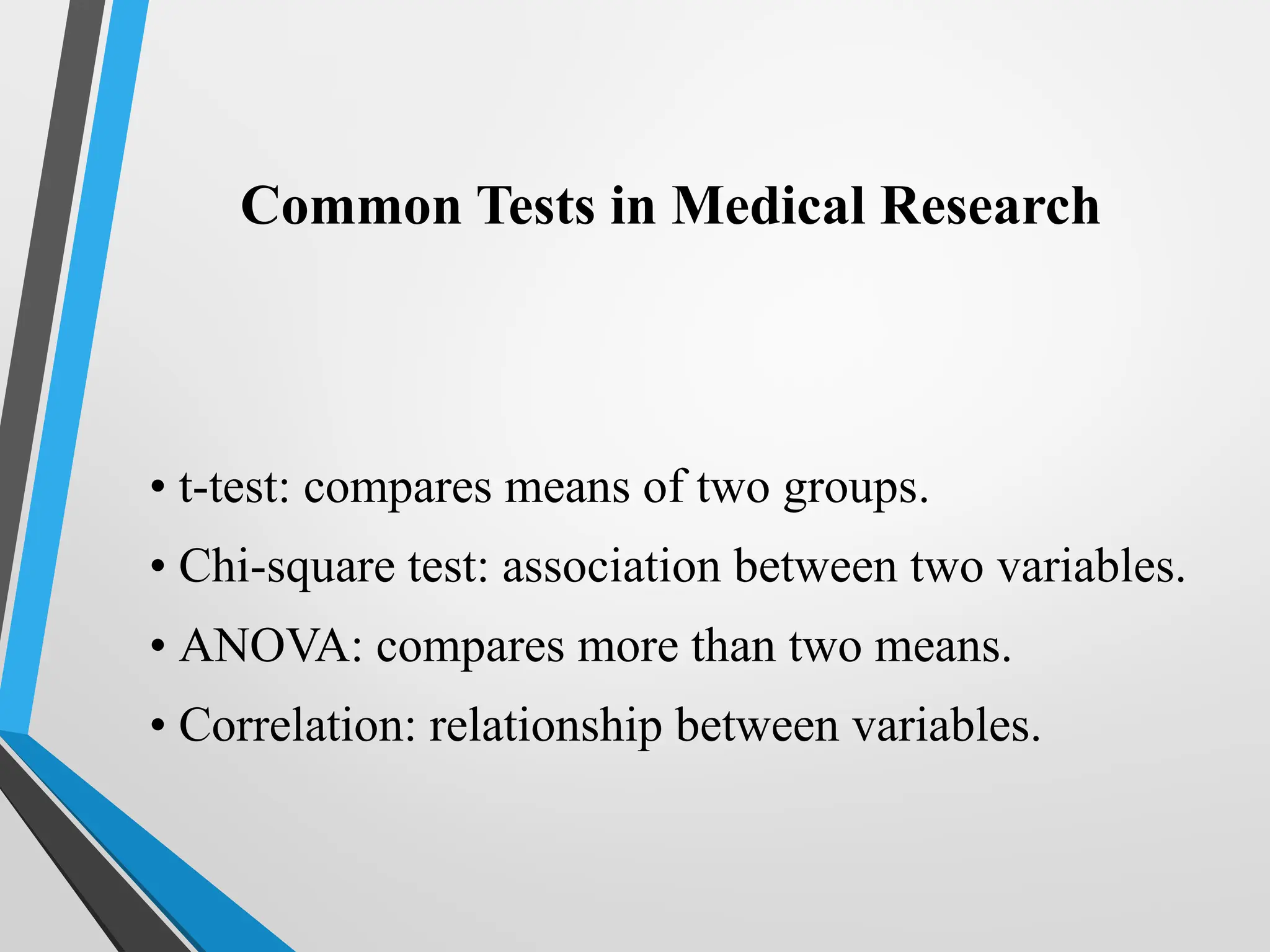
Common Tests inMedical Research
• t-test: compares means of two groups.
• Chi-square test: association between two variables.
• ANOVA: compares more than two means.
• Correlation: relationship between variables.
6.
Assumptions of ParametricTests
• Parametric tests (e.g., t-test, ANOVA, Pearson correlation) require certain
conditions:
• Normality
Data should be approximately normally distributed (in each group/sample).
• Homogeneity of Variance
Groups being compared should have equal variances (e.g., for t-test,
ANOVA).
• Independence
Observations should be independent of each other.
• Measurement Scale
Data must be measured on an interval or ratio scale.
• Random Sampling
Samples should be drawn randomly from the population.
7.
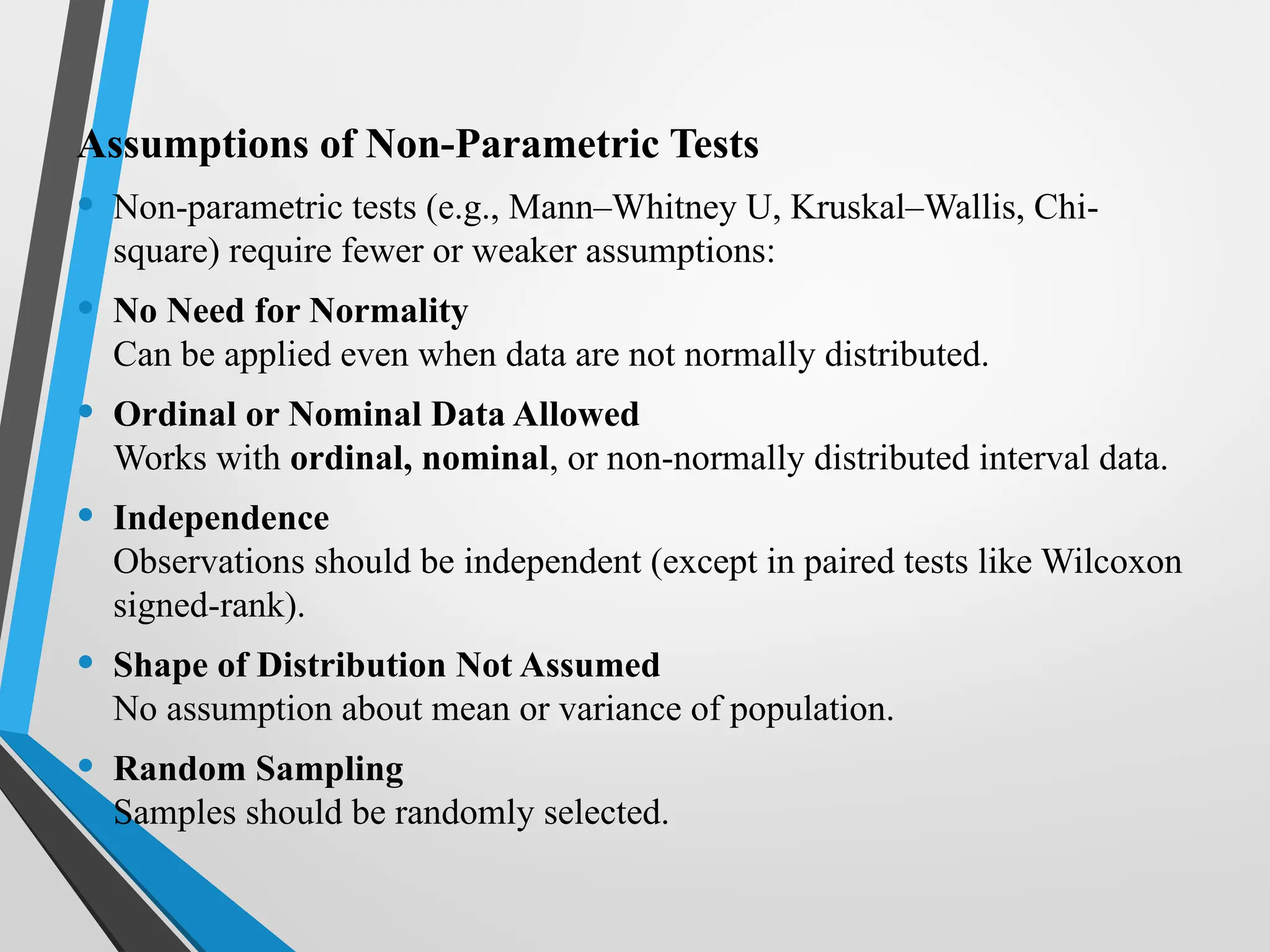
Assumptions of Non-ParametricTests
• Non-parametric tests (e.g., Mann–Whitney U, Kruskal–Wallis, Chi-
square) require fewer or weaker assumptions:
• No Need for Normality
Can be applied even when data are not normally distributed.
• Ordinal or Nominal Data Allowed
Works with ordinal, nominal, or non-normally distributed interval data.
• Independence
Observations should be independent (except in paired tests like Wilcoxon
signed-rank).
• Shape of Distribution Not Assumed
No assumption about mean or variance of population.
• Random Sampling
Samples should be randomly selected.
8.
Uses of SignificanceTests
• To compare the means of groups.
• To determine treatment effectiveness
• To verify research hypotheses.
• To support medical decision-making.






![[DSC Europe 25] Aleksandra Dragicevic - AI-Boosted Research in Healthcare: Fr...](https://cdn.slidesharecdn.com/ss_thumbnails/iqwngszurf2r7pi1lnnj-4-aleksandra-dragicevic-ad-dsc-europe-conference-20-251208151905-37c3238a-thumbnail.jpg?width=640&height=640&fit=bounds)
![[DSC Europe 25] Kaja Kandare - LLM as a judge.pptx](https://cdn.slidesharecdn.com/ss_thumbnails/arxyccaxsdsd1ba99wjw-7-251212104007-2b4e3f64-thumbnail.jpg?width=640&height=640&fit=bounds)
![[DSC Europe 25] Ivan Peric - Intelligence Swarm Logic and Techno-Functional M...](https://cdn.slidesharecdn.com/ss_thumbnails/7my7c97fsduiccadgavw-2-251212103249-5a03f7c6-thumbnail.jpg?width=640&height=640&fit=bounds)


![[DSC Europe 25] Marija Vlajkovic & Andrea Radonjanin - Integration of AI tool...](https://cdn.slidesharecdn.com/ss_thumbnails/qf1jrglttoc3bm8s3aop-final-integration-of-ai-tools-251208151905-394f3a6a-thumbnail.jpg?width=640&height=640&fit=bounds)

![[DSC Europe 25] Katherine Forrest - AI NOW: Understanding the Velocity of Cha...](https://cdn.slidesharecdn.com/ss_thumbnails/wvvbruqfrci0sfq9xwgb-4-251212104007-e5ad1987-thumbnail.jpg?width=640&height=640&fit=bounds)
![[DSC Europe 25] Jovan Bogicevic - Legacy to AI-Driven Defense: Transforming D...](https://cdn.slidesharecdn.com/ss_thumbnails/rsarluadt563hntyfc8q-3-251211083849-3e7bc4c0-thumbnail.jpg?width=640&height=640&fit=bounds)
![[DSC Europe 25] Nikolay Burlutskiy - Best Practices for Building Enterprise M...](https://cdn.slidesharecdn.com/ss_thumbnails/uirvaiuvq8y1w8hzd9tx-7-251212103249-2619edb4-thumbnail.jpg?width=640&height=640&fit=bounds)

![[DSC Europe 25] Miodrag Pesovic & Vladislav Radonjic - Federated Data Archite...](https://cdn.slidesharecdn.com/ss_thumbnails/gsbe3y5it5uhndi4e08e-1-251212103249-f1008e0c-thumbnail.jpg?width=640&height=640&fit=bounds)
![[DSC Europe 25] Milan Sekuloski - Data, Defence, and Development: Cybersecuri...](https://cdn.slidesharecdn.com/ss_thumbnails/dfrkwwx4qly6atqpbl4z-4-251209104645-c3d4b0ca-thumbnail.jpg?width=640&height=640&fit=bounds)
![[DSC Europe 25] Jon Dajci - Bridging TradFi and DeFi: Building the Future of ...](https://cdn.slidesharecdn.com/ss_thumbnails/fqmhfvlbqhkihjvqvhmu-7-251211083849-6af7e325-thumbnail.jpg?width=640&height=640&fit=bounds)
![[DSC Europe 25] Vladimir Jelic - The AI-Driven Security Shift From Reactive D...](https://cdn.slidesharecdn.com/ss_thumbnails/6g5gj25mtjwayniqem1t-6-251209104645-7a5a5fc6-thumbnail.jpg?width=640&height=640&fit=bounds)
![[DSC Europe 25] Dobrica Cosic - Savings by the Second: How Dynamic Pricing an...](https://cdn.slidesharecdn.com/ss_thumbnails/znp09f3smtqz3w2sq6wn-1-dobrica-cosic-savings-by-the-second-how-dynamic-pricing-and-smart-data-are-bu-251208151905-26e6f41e-thumbnail.jpg?width=640&height=640&fit=bounds)