Download the fullversion and explore a variety of test banks
or solution manuals at https://testbankbell.com
Test Bank for Java Programming, 7th Edition
_____ Follow the link below to get your download now _____
http://testbankbell.com/product/test-bank-for-java-
programming-7th-edition/
Access testbankbell.com now to download high-quality
test banks or solution manuals
2.
Here are somerecommended products for you. Click the link to
download, or explore more at testbankbell.com
Solution Manual for Java Programming 9th Edition
http://testbankbell.com/product/solution-manual-for-java-
programming-9th-edition/
Java Programming 9th Edition Joyce Farrell Solutions
Manual
http://testbankbell.com/product/java-programming-9th-edition-joyce-
farrell-solutions-manual/
Java Programming 8th Edition Joyce Farrell Solutions
Manual
http://testbankbell.com/product/java-programming-8th-edition-joyce-
farrell-solutions-manual/
Test Bank Living Religions 9th Edition Fisher
http://testbankbell.com/product/test-bank-living-religions-9th-
edition-fisher/
3.
Discrete Mathematics andIts Applications 7th Edition
Rosen Test Bank
http://testbankbell.com/product/discrete-mathematics-and-its-
applications-7th-edition-rosen-test-bank/
Test Bank for Marketing Research 9th by Burns
http://testbankbell.com/product/test-bank-for-marketing-research-9th-
by-burns/
Calculus and Its Applications 11th Edition Bittinger Test
Bank
http://testbankbell.com/product/calculus-and-its-applications-11th-
edition-bittinger-test-bank/
Test bank for Social Media Marketing 0132551799
http://testbankbell.com/product/test-bank-for-social-media-
marketing-0132551799/
Test Bank For American Foreign Policy: The Dynamics of
Choice in the 21st Century (Fourth Edition) by Bruce W.
Jentleson
http://testbankbell.com/product/test-bank-for-american-foreign-policy-
the-dynamics-of-choice-in-the-21st-century-fourth-edition-by-bruce-w-
jentleson/
4.
Test Bank forFinancial Markets and Institutions, 10th
Edition
http://testbankbell.com/product/test-bank-for-financial-markets-and-
institutions-10th-edition/
5.
Test Bank forJava Programming,
7th Edition
Full download chapter at: https://testbankbell.com/product/test-bank-for-java-
programming-7th-edition/
Chapter 2: Using Data
TRUE/FALSE
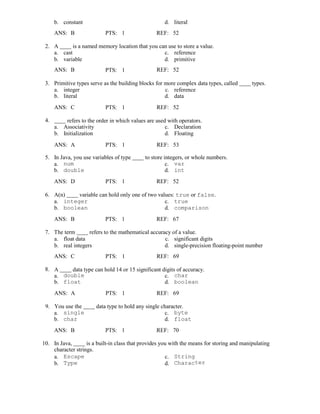
1. A variable can hold more than one value at a time.
ANS: F PTS: 1 REF: 52
2. The legal integer values are -231
through 231
-1. These are the highest and lowest values that you can
store in four bytes of memory, which is the size of an int variable.
ANS: T PTS: 1 REF: 62
3. Multiplication, division, and remainder always take place after addition or subtraction in an
expression.
ANS: F PTS: 1 REF: 93
4. The term parse means to break into component parts.
ANS: T PTS: 1 REF: 108
5. You can create a confirm dialog box with five arguments.
ANS: T PTS: 1 REF: 90
6. Once a variable has been declared and initialized, new values may not be assigned to the variable.
ANS: F PTS: 1 REF: 53
7. The expression boolean isTenLarger = (10 < 5) will produce a value of true.
ANS: F PTS: 1 REF: 68
8. Even if a statement occupies multiple lines, the statement is not complete until the semicolon is
reached.
ANS: T PTS: 1 REF: 54
9. You are limited to declaring a maximum of three variables in a single statement.
ANS: F PTS: 1 REF: 54
10. Constants hold a single value for the duration of the program execution.
ANS: T PTS: 1 REF: 58
6.
MULTIPLE CHOICE
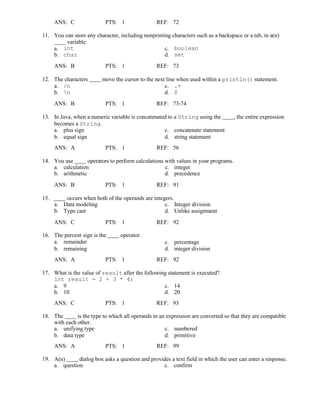
1. Adata item is when it cannot be changed while a program is running.
a. variable c. primitive
7.
a. integer
b. literal
c.
d.
reference
data
ANS:C PTS: 1 REF: 52
refers to the order in which values are used with operators.
a. Associativity
b. Initialization
c.
d.
Declaration
Floating
ANS: A PTS: 1 REF: 53
a. float data
b. real integers
c.
d.
significant digits
single-precision floating-point number
ANS: C PTS: 1 REF: 69
A data type can hold 14 or 15 significant digits of accuracy.
a.
b.
double
float
c.
d.
char
boolean
a. Escape c. String
b. Type d. Charac
b. constant d. literal
ANS: B PTS: 1 REF: 52
2. A is a named memory location that you can use to store a value.
a. cast c. reference
b. variable
ANS: B PTS: 1
d.
REF:
primitive
52
3. Primitive types serve as the building blocks for more complex data types, called types.
4.
5. In Java, you use variables of type to store integers, or whole numbers.
a. num c. var
b. double d. int
ANS: D PTS: 1 REF: 52
6. A(n) variable can hold only one of two values: true or false.
a. integer c. true
b. boolean d. comparison
ANS: B PTS: 1 REF: 67
7. The term refers to the mathematical accuracy of a value.
8.
ANS: A PTS: 1 REF: 69
9. You use the data type to hold any single character.
a. single c. byte
b. char d. float
ANS: B PTS: 1 REF: 70
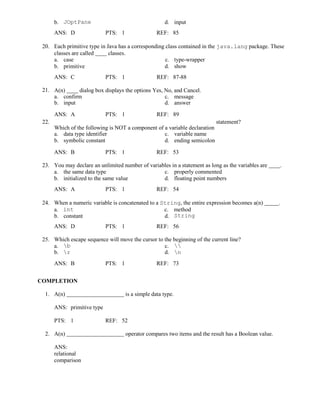
10. In Java, is a built-in class that provides you with the means for storing and manipulating
character strings.
ter
8.
ANS: C PTS:1 REF: 72
11. You can store any character, including nonprinting characters such as a backspace or a tab, in a(n)
variable.
a. int c. boolean
b. char d. set
ANS: B PTS: 1 REF: 73
12. The characters move the cursor to the next line when used within a println() statement.
a. /n c. .+
b. n d. $
ANS: B PTS: 1 REF: 73-74
13. In Java, when a numeric variable is concatenated to a String using the , the entire expression
becomes a String.
a. plus sign c. concatenate statement
b. equal sign
ANS: A PTS: 1
d.
REF:
string statement
56
14. You use operators to perform calculations with values in your programs.
a. calculation
b. arithmetic
c.
d.
integer
precedence
ANS: B PTS: 1 REF: 91
15. occurs when both of the operands are integers.
a. Data modeling
b. Type cast
c.
d.
Integer division
Unlike assignment
ANS: C PTS: 1 REF: 92
16. The percent sign is the operator.
a. remainder c. percentage
b. remaining d. integer division
ANS: A PTS: 1 REF: 92
17. What is the value of result after the following statement is executed?
int result = 2 + 3 * 4;
a. 9 c. 14
b. 10 d. 20
ANS: C PTS: 1 REF: 93
18. The is the type to which all operands in an expression are converted so that they are compatible
with each other.
a. unifying type c. numbered
b. data type
ANS: A PTS: 1
d.
REF:
primitive
99
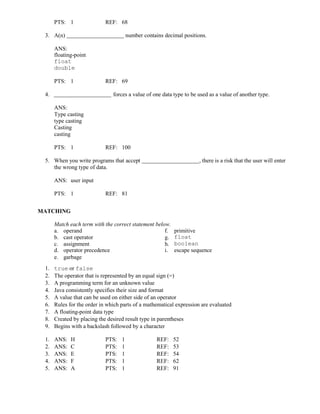
19. A(n) dialog box asks a question and provides a text field in which the user can enter a response.
a. question c. confirm
9.
a. case
b. primitive
c.
d.
type-wrapper
show
ANS:C PTS: 1 REF: 87-88
A(n) dialog box displays the options Yes, No, and Cancel.
a. confirm
b. input
c.
d.
message
answer
ANS: A PTS: 1 REF: 89
Which of the following is NOT a component of a variable declaration
a. data type identifier
b. symbolic constant
c.
d.
variable name
ending semicolon
b. JOptPane d. input
ANS: D PTS: 1 REF: 85
20. Each primitive type in Java has a corresponding class contained in the java.lang package. These
classes are called classes.
21.
22. statement?
ANS: B PTS: 1 REF: 53
23. You may declare an unlimited number of variables in a statement as long as the variables are .
a. the same data type c. properly commented
b. initialized to the same value d. floating point numbers
ANS: A PTS: 1 REF: 54
24. When a numeric variable is concatenated to a String, the entire expression becomes a(n) .
a. int c. method
b. constant d. String
ANS: D PTS: 1 REF: 56
25. Which escape sequence will move the cursor to the beginning of the current line?
a. b c.
b. r d. n
ANS: B PTS: 1 REF: 73
COMPLETION
1. A(n) is a simple data type.
ANS: primitive type
PTS: 1 REF: 52
2. A(n) operator compares two items and the result has a Boolean value.
ANS:
relational
comparison
10.
PTS: 1 REF:68
3. A(n) number contains decimal positions.
ANS:
floating-point
float
double
PTS: 1 REF: 69
4. forces a value of one data type to be used as a value of another type.
ANS:
Type casting
type casting
Casting
casting
PTS: 1 REF: 100
5. When you write programs that accept , there is a risk that the user will enter
the wrong type of data.
ANS: user input
PTS: 1 REF: 81
MATCHING
Match each term with the correct statement below.
a. operand f. primitive
b. cast operator g. float
c. assignment h. boolean
d. operator precedence i. escape sequence
e. garbage
1. true or false
2. The operator that is represented by an equal sign (=)
3. A programming term for an unknown value
4. Java consistently specifies their size and format
5. A value that can be used on either side of an operator
6. Rules for the order in which parts of a mathematical expression are evaluated
7. A floating-point data type
8. Created by placing the desired result type in parentheses
9. Begins with a backslash followed by a character
1. ANS: H PTS: 1 REF: 52
2. ANS: C PTS: 1 REF: 53
3. ANS: E PTS: 1 REF: 54
4. ANS: F PTS: 1 REF: 62
5. ANS: A PTS: 1 REF: 91
11.
6. ANS: DPTS: 1 REF: 93
7. ANS: G PTS: 1 REF: 69
8. ANS: B PTS: 1 REF: 100
9. ANS: I PTS: 1 REF: 73
SHORT ANSWER
1. A variable declaration is a statement that reserves a named memory location. It includes what four
elements?
ANS:
A data type that identifies the type of data that the variable will store
An identifier that is the variable’s name
An optional assignment operator and assigned value, if you want a variable to contain an initial value
An ending semicolon
PTS: 1 REF: 53
2. Describe the variation types byte, short, and long of the integer type.
ANS:
The types byte, short, and long are all variations of the integer type. The byte and short types
occupy less memory and can hold only smaller values; the long type occupies more memory and can
hold larger values.
PTS: 1 REF: 62
3. Describe how to assign values based on the result of comparisons to Boolean variables.
ANS:
Java supports six relational operators that are used to make comparisons. A relational operator
compares two items; an expression that contains a relational operator has a Boolean value. When you
use any of the operators that have two symbols (==, <=, >=, or !=), you cannot place any whitespace
between the two symbols. You also cannot reverse the order of the symbols. That is, =<, =>, and =! are
all invalid operators.
PTS: 1 REF: 68
4. What is the difference between the float data type and the double data type?
ANS:
Java supports two floating-point data types: float and double. A float data type can hold
floating-point values of up to six or seven significant digits of accuracy. A double data type requires
more memory than a float, and can hold 14 or 15 significant digits of accuracy. The term significant
digits refers to the mathematical accuracy of a value. For example, a float given the value
0.324616777 displays as 0.324617 because the value is accurate only to the sixth decimal position.
PTS: 1 REF: 69
5. What is an escape sequence and why would a Java programmer use it to store a character?
ANS:
12.
You can storeany character—including nonprinting characters such as a backspace or a tab—in a
char variable. To store these characters, you can use an escape sequence, which always begins with a
backslash followed by a character—the pair represents a single character.
PTS: 1 REF: 73
6. Describe and give an example of operator precedence.
ANS:
Operator precedence refers to the rules for the order in which parts of a mathematical expression are
evaluated. The multiplication, division, and remainder operators have the same precedence. Their
precedence is higher than that for the addition and subtraction operators. Addition and subtraction have
the same precedence. In other words, multiplication, division, and remainder always take place from
left to right prior to addition or subtraction in an expression. For example, the following statement
assigns 14 to result: int result = 2 + 3 * 4;.
PTS: 1 REF: 93
7. In Java, how is it possible to perform mathematical operations on operands with unlike types?
ANS:
When you perform arithmetic operations with operands of unlike types, Java chooses a unifying type
for the result. The unifying type is the type to which all operands in an expression are converted so that
they are compatible with each other. Java performs an implicit conversion; that is, it automatically
converts nonconforming operands to the unifying type.
PTS: 1 REF: 99
8. Explain how you can override a unifying type imposed by Java.
ANS:
You can explicitly (or purposely) override the unifying type imposed by Java by performing a type
cast. Type casting forces a value of one data type to be used as a value of another type. To perform a
type cast, you use a cast operator, which is created by placing the desired result type in parentheses.
Using a cast operator is an explicit conversion. The cast operator is followed by the variable or
constant to be cast.
PTS: 1 REF: 100
9. How can you create and use an input dialog box in Java?
ANS:
You can create an input dialog box using the showInputDialog() method. Six overloaded
versions of this method are available, but the simplest version uses a single argument that is the
prompt you want to display within the dialog box. The showInputDialog() method returns a
String that represents a user’s response; this means that you can assign the
showInputDialog() method to a String variable and the variable will hold the value that the
user enters.
PTS: 1 REF: 85-86
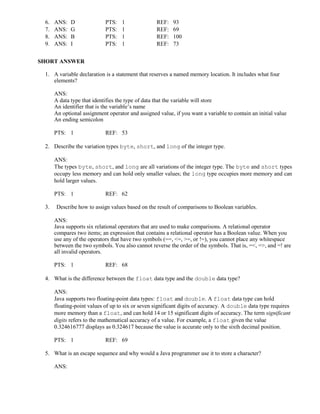
10. How would you ask the user to confirm an action using a dialog box?
13.
ANS:
A confirm dialogbox displays the options Yes, No, and Cancel; you can create one using the
showConfirmDialog() method in the JOptionPane class. Four overloaded versions of the
method are available; the simplest requires a parent component (which can be null) and the String
prompt that is displayed in the box. The showConfirmDialog() method returns an integer
containing one of three possible values: JOptionPane.YES_OPTION,
JOptionPane.NO_OPTION, or JOptionPane.CANCEL_OPTION.
PTS: 1 REF: 89
11. Describe how the use of named constants can provide advantages over the use of literal values.
ANS:
Using named constants makes programs easier to read and understand.
When a constant is defined, you can change the constant at one location, which saves time and
prevents you from missing other references.
Using named constants reduces typographical errors that may not be recognized by the compiler.
Constants can be easily identified when named conventionally (all caps).
PTS: 1 REF: 55
12. Describe why it is important to assign an appropriate data type to variables in an application.
ANS:
If a value is too large for the data type assigned, the compiler will issue an error message and the
program will not execute.
If a data type is used that is larger than needed, memory is wasted.
PTS: 1 REF: 62-63
13. Describe how the Scanner class works with the System.in object in order to provide flexibility.
ANS:
The System.in object is designed to read bytes only. Since it is common to accept data of other
types, the Scanner object can connect to the System.in property. This creates a Scanner object
that will be connected to the default input device.
PTS: 1 REF: 76
14. 100 = salesAmount;
In terms of assignment operators, why is the above statement illegal?
ANS:
This assignment operator has a right-to-left associativity. Associativity is the order in which values are
used with operators. Since 100 is a numeric constant, it is an rvalue, which is an item that can appear
only on the right side of the assignment operator. An identifier that can appear on the left side of an
assignment operator is referred to as an lvalue (left-to-right associativity).
PTS: 1 REF: 53
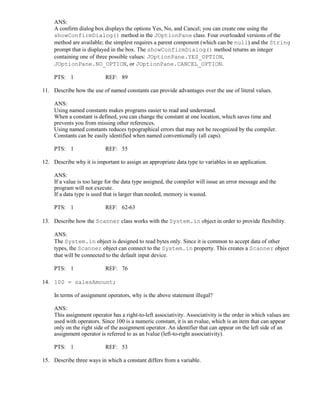
15. Describe three ways in which a constant differs from a variable.
14.
ANS:
Constants are precededby the keyword final in a declaration statement.
Constants can be assigned a value once only and the value cannot be changed.
Constants conventionally have identifiers in all uppercase letters, distinguishing them from other
forms.
PTS: 1 REF: 54
CASE
1. Write the statement to declare an uninitialized integer value for salesAmt.
ANS:
int salesAmt;
The statement must end with a semicolon.
PTS: 1 REF: 54
2. Write the statement that will declare and assign two integer variables, salesAmt and costAmt, in a
single statement. Assign values of your choice to the variables.
ANS:
int salesAmt = 100, costAmt = 15;
A semicolon must end the statement. Variable declarations are separated with a comma.
PTS: 1 REF: 54
3. import javax.swing.JOptionPane;
public class salesJune
{
public static void main(String[] args)
{
int storeSales = 250;
}
}
In the above code, complete the statement that will display a message dialog box that will appear
centered on the screen and will display the following text:
Congratulations! June sales were $250!
ANS:
JOptionPane.showMessageDialog(null, "Congratulations! June sales were
$" + storeSales + "!";
PTS: 1 REF: 57-58
4. final int COSTPERITEM = 10;
double sales2012 = amtSold * COSTPERITEM;
15.
In the abovestatements, identify the named constant and describe how a programmer can recognize
named constants.
ANS:
The named constant identifier is COSTPERITEM.
Constant declaration statements use the final keyword.
Constants are conventionally given identifiers in all uppercase letters.
PTS: 1 REF: 54-55
5. Write the statement that will declare a char data type named testScore that will hold a letter
grade of your choice.
ANS:
char testScore = ‘A’;
Letter assigned may vary.
PTS: 1 REF: 71
6. public class YourGrade
{
public static void main(String[] args)
{
int projectPoints = 89;
System.out.print("Your grade for this class is ");
System.out.print(projectPoints);
System.out.println("%");
}
}
Given the above code, what will be the output at the command prompt?
ANS:
Output will be as follows:
Your grade for this class is 89%
A blank line will follow the output.
PTS: 1 REF: 56-57
7. Describe the error message that will be produced when the following code is compiled.
public class SalesOct
{
public static void main(String[] args)
{
int salesAmt;
System.out.print("October sales are $");
System.out.println(salesAmt);
}
}
16.
ANS:
The second printlnstatement will generate an error message because the variable used in the
statement is undeclared. It is legal to declare an uninitialized variable, but it cannot be used in a
println() statement uninitialized. If you assign a numeric value to int salesAmt, the program
will compile.
PTS: 1 REF: 61-62
8. public class EndValue
{
public static void main(String[] args)
{
int aByte = 940;
System.out.print("The ending value is "+ aByte);
}
}
When the above code is compiled, what error message will be generated and why?
ANS:
The above code will result in the error message “possible loss of precision”. The assigned value of 940
to the aByte variable is larger than the maximum value allowed. A byte type can hold a value
between -128 and 127. Thus, the accuracy of the number has been compromised.
PTS: 1 REF: 62-65
9. Why is the following relational operator expression invalid? How could you rewrite the statement so
that it is valid?
boolean isGradePassing = (grade => 70);
ANS:
In this statement, the order of the operator symbols is reversed. It is illegal to use =<, =>, and =!.
The statement could be modified as follows:
boolean isGradePassing = (grade >= 70);
PTS: 1 REF: 68
10. char aCharacter = 2;
int aNumber = '2';
In the above statements, what values will be output after a println() statement is executed? Why
are the output results different for the two statements?
ANS:
aCharacter will output a blank.
aNumber will output a value of 50.
Unicode values are used to assign a unique numeric code. Every computer stores each character it uses
as a number and each character is assigned a unique Unicode numeric value.
17.
PTS: 1 REF:71
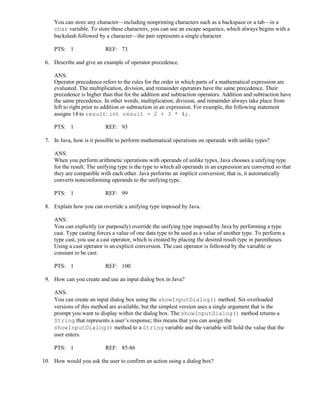
11. How could you alter the following statement to display “Welcome” on one line and “back” on another
line?
System.out.println("Welcome back");
ANS:
There are two possible options:
System.out.println("Welcomenback");
and
System.out.println("Welcome");
System.out.println("back");
PTS: 1 REF: 73-74
Dark eyed,
O womanof my dreams,
Ivory sandaled,
There is none like thee among the dancers,
None with swift feet.
I have not found thee in the tents,
In the broken darkness.
I have not found thee at the well-head
Among the women with pitchers.
Thine arms are as a young sapling under the bark;
Thy face as a river with lights.
White as an almond are thy shoulders;
As new almonds stripped from the husk.
They guard thee not with eunuchs;
Not with bars of copper.
Gilt turquoise and silver are in the place of thy rest.
A brown robe, with threads of gold woven in patterns,
hast thou gathered about thee,
O Nathat-Ikanaie, “Tree-at-the-river.”
As a rillet among the sedge are thy hands upon me;
Thy fingers a frosted stream.
Thy maidens are white like pebbles;
Their music about thee!
There is none like thee among the dancers;
None with swift feet.
20.
April
Nympharum membra disjecta.
Threespirits came to me
And drew me apart
To where the olive boughs
Lay stripped upon the ground:
Pale carnage beneath bright mist.
21.
Gentildonna
She passed andleft no quiver in the veins, who now
Moving among the trees, and clinging
in the air she severed,
Fanning the grass she walked on then, endures:
Grey olive leaves beneath a rain-cold sky.
22.
The Rest
O helplessfew in my country,
O remnant enslaved!
Artists broken against her,
A-stray, lost in the villages,
Mistrusted, spoken-against,
Lovers of beauty, starved,
Thwarted with systems,
Helpless against the control;
You who can not wear yourselves out
By persisting to successes,
You who can only speak,
Who can not steel yourselves into reiteration;
You of the finer sense,
Broken against false knowledge,
You who can know at first hand,
Hated, shut in, mistrusted:
Take thought:
I have weathered the storm,
I have beaten out my exile.
23.
Les Millwin
The littleMillwins attend the Russian Ballet.
The mauve and greenish souls of the little Millwins
Were seen lying along the upper seats
Like so many unused boas.
The turbulent and undisciplined host of art students—
The rigorous deputation from “Slade”—
Was before them.
With arms exalted, with fore-arms
Crossed in great futuristic X’s, the art students
Exulted, they beheld the splendours of Cleopatra.
And the little Millwins beheld these things;
With their large and anæmic eyes they looked out upon this configuration.
Let us therefore mention the fact,
For it seems to us worthy of record.
24.
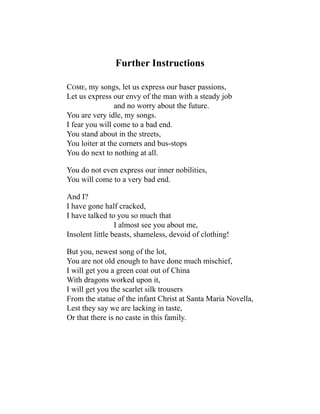
Further Instructions
Come, mysongs, let us express our baser passions,
Let us express our envy of the man with a steady job
and no worry about the future.
You are very idle, my songs.
I fear you will come to a bad end.
You stand about in the streets,
You loiter at the corners and bus-stops
You do next to nothing at all.
You do not even express our inner nobilities,
You will come to a very bad end.
And I?
I have gone half cracked,
I have talked to you so much that
I almost see you about me,
Insolent little beasts, shameless, devoid of clothing!
But you, newest song of the lot,
You are not old enough to have done much mischief,
I will get you a green coat out of China
With dragons worked upon it,
I will get you the scarlet silk trousers
From the statue of the infant Christ at Santa Maria Novella,
Lest they say we are lacking in taste,
Or that there is no caste in this family.
25.
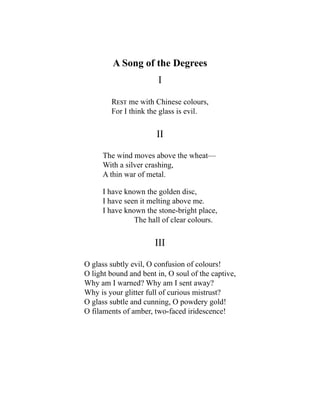
A Song ofthe Degrees
I
Rest me with Chinese colours,
For I think the glass is evil.
II
The wind moves above the wheat—
With a silver crashing,
A thin war of metal.
I have known the golden disc,
I have seen it melting above me.
I have known the stone-bright place,
The hall of clear colours.
III
O glass subtly evil, O confusion of colours!
O light bound and bent in, O soul of the captive,
Why am I warned? Why am I sent away?
Why is your glitter full of curious mistrust?
O glass subtle and cunning, O powdery gold!
O filaments of amber, two-faced iridescence!
26.
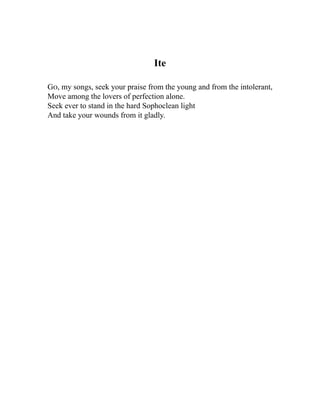
Ite
Go, my songs,seek your praise from the young and from the intolerant,
Move among the lovers of perfection alone.
Seek ever to stand in the hard Sophoclean light
And take your wounds from it gladly.
27.
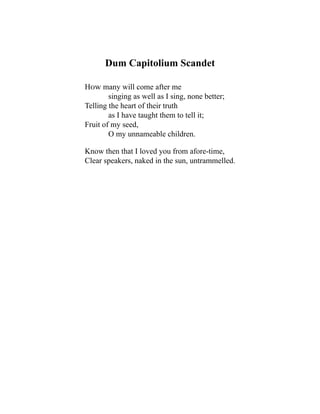
Dum Capitolium Scandet
Howmany will come after me
singing as well as I sing, none better;
Telling the heart of their truth
as I have taught them to tell it;
Fruit of my seed,
O my unnameable children.
Know then that I loved you from afore-time,
Clear speakers, naked in the sun, untrammelled.
28.
To καλὀν
Even inmy dreams you have denied yourself to me
And sent me only your handmaids.
29.
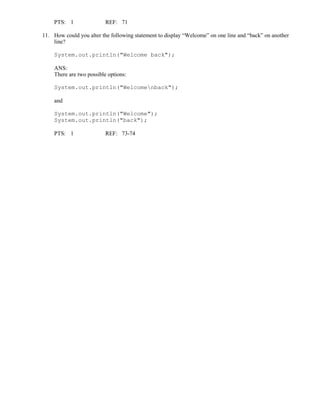
The Study inAesthetics
The very small children in patched clothing,
Being smitten with an unusual wisdom,
Stopped in their play as she passed them
And cried up from their cobbles:
Guarda! Ahi, guarda! ch’è be’a![A]
But three years after this
I heard the young Dante, whose last name I do not know—
For there are, in Sirmione, twenty-eight young
Dantes and thirty-four Catulli;
And there had been a great catch of sardines,
And his elders
Were packing them in the great wooden boxes
For the market in Brescia, and he
Leapt about, snatching at the bright fish
And getting in both of their ways;
And in vain they commanded him to sta fermo!
And when they would not let him arrange
The fish in the boxes
He stroked those which were already arranged,
Murmuring for his own satisfaction
This identical phrase:
Ch’è be’a.
And at this I was mildly abashed.
[A] Bella.
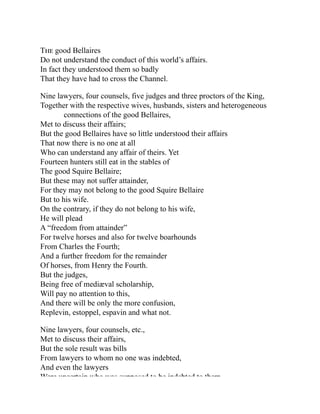
The good Bellaires
Donot understand the conduct of this world’s affairs.
In fact they understood them so badly
That they have had to cross the Channel.
Nine lawyers, four counsels, five judges and three proctors of the King,
Together with the respective wives, husbands, sisters and heterogeneous
connections of the good Bellaires,
Met to discuss their affairs;
But the good Bellaires have so little understood their affairs
That now there is no one at all
Who can understand any affair of theirs. Yet
Fourteen hunters still eat in the stables of
The good Squire Bellaire;
But these may not suffer attainder,
For they may not belong to the good Squire Bellaire
But to his wife.
On the contrary, if they do not belong to his wife,
He will plead
A “freedom from attainder”
For twelve horses and also for twelve boarhounds
From Charles the Fourth;
And a further freedom for the remainder
Of horses, from Henry the Fourth.
But the judges,
Being free of mediæval scholarship,
Will pay no attention to this,
And there will be only the more confusion,
Replevin, estoppel, espavin and what not.
Nine lawyers, four counsels, etc.,
Met to discuss their affairs,
But the sole result was bills
From lawyers to whom no one was indebted,
And even the lawyers
Were uncertain who was supposed to be indebted to them
32.
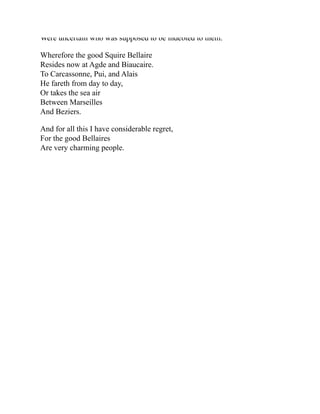
Were uncertain whowas supposed to be indebted to them.
Wherefore the good Squire Bellaire
Resides now at Agde and Biaucaire.
To Carcassonne, Pui, and Alais
He fareth from day to day,
Or takes the sea air
Between Marseilles
And Beziers.
And for all this I have considerable regret,
For the good Bellaires
Are very charming people.
33.
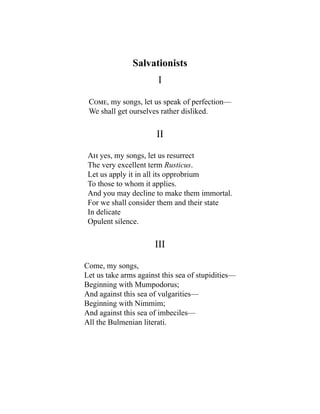
Salvationists
I
Come, my songs,let us speak of perfection—
We shall get ourselves rather disliked.
II
Ah yes, my songs, let us resurrect
The very excellent term Rusticus.
Let us apply it in all its opprobrium
To those to whom it applies.
And you may decline to make them immortal.
For we shall consider them and their state
In delicate
Opulent silence.
III
Come, my songs,
Let us take arms against this sea of stupidities—
Beginning with Mumpodorus;
And against this sea of vulgarities—
Beginning with Nimmim;
And against this sea of imbeciles—
All the Bulmenian literati.
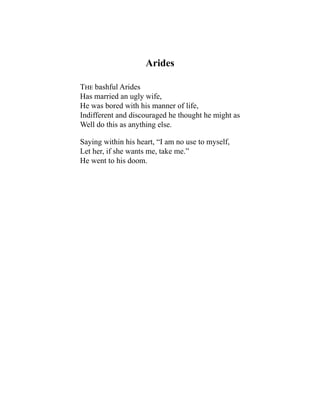
34.
Arides
The bashful Arides
Hasmarried an ugly wife,
He was bored with his manner of life,
Indifferent and discouraged he thought he might as
Well do this as anything else.
Saying within his heart, “I am no use to myself,
Let her, if she wants me, take me.”
He went to his doom.
35.
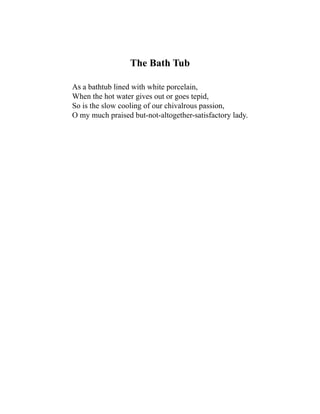
The Bath Tub
Asa bathtub lined with white porcelain,
When the hot water gives out or goes tepid,
So is the slow cooling of our chivalrous passion,
O my much praised but-not-altogether-satisfactory lady.
36.
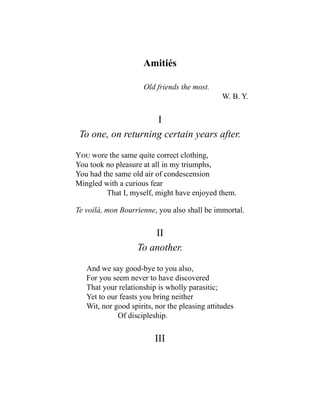
Amitiés
Old friends themost.
W. B. Y.
I
To one, on returning certain years after.
You wore the same quite correct clothing,
You took no pleasure at all in my triumphs,
You had the same old air of condescension
Mingled with a curious fear
That I, myself, might have enjoyed them.
Te voilà, mon Bourrienne, you also shall be immortal.
II
To another.
And we say good-bye to you also,
For you seem never to have discovered
That your relationship is wholly parasitic;
Yet to our feasts you bring neither
Wit, nor good spirits, nor the pleasing attitudes
Of discipleship.
III
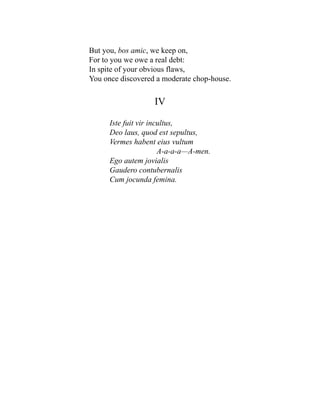
37.
But you, bosamic, we keep on,
For to you we owe a real debt:
In spite of your obvious flaws,
You once discovered a moderate chop-house.
IV
Iste fuit vir incultus,
Deo laus, quod est sepultus,
Vermes habent eius vultum
A-a-a-a—A-men.
Ego autem jovialis
Gaudero contubernalis
Cum jocunda femina.
38.
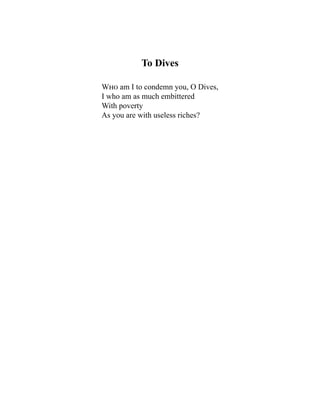
To Dives
Who amI to condemn you, O Dives,
I who am as much embittered
With poverty
As you are with useless riches?
39.
Welcome to ourwebsite – the perfect destination for book lovers and
knowledge seekers. We believe that every book holds a new world,
offering opportunities for learning, discovery, and personal growth.
That’s why we are dedicated to bringing you a diverse collection of
books, ranging from classic literature and specialized publications to
self-development guides and children's books.
More than just a book-buying platform, we strive to be a bridge
connecting you with timeless cultural and intellectual values. With an
elegant, user-friendly interface and a smart search system, you can
quickly find the books that best suit your interests. Additionally,
our special promotions and home delivery services help you save time
and fully enjoy the joy of reading.
Join us on a journey of knowledge exploration, passion nurturing, and
personal growth every day!
testbankbell.com



![ANS:
Constants are preceded by the keyword final in a declaration statement.
Constants can be assigned a value once only and the value cannot be changed.
Constants conventionally have identifiers in all uppercase letters, distinguishing them from other
forms.
PTS: 1 REF: 54
CASE
1. Write the statement to declare an uninitialized integer value for salesAmt.
ANS:
int salesAmt;
The statement must end with a semicolon.
PTS: 1 REF: 54
2. Write the statement that will declare and assign two integer variables, salesAmt and costAmt, in a
single statement. Assign values of your choice to the variables.
ANS:
int salesAmt = 100, costAmt = 15;
A semicolon must end the statement. Variable declarations are separated with a comma.
PTS: 1 REF: 54
3. import javax.swing.JOptionPane;
public class salesJune
{
public static void main(String[] args)
{
int storeSales = 250;
}
}
In the above code, complete the statement that will display a message dialog box that will appear
centered on the screen and will display the following text:
Congratulations! June sales were $250!
ANS:
JOptionPane.showMessageDialog(null, "Congratulations! June sales were
$" + storeSales + "!";
PTS: 1 REF: 57-58
4. final int COSTPERITEM = 10;
double sales2012 = amtSold * COSTPERITEM;](https://image.slidesharecdn.com/5050-250320081256-6f0b3fb1/85/Test-Bank-for-Java-Programming-7th-Edition-14-320.jpg)
![In the above statements, identify the named constant and describe how a programmer can recognize
named constants.
ANS:
The named constant identifier is COSTPERITEM.
Constant declaration statements use the final keyword.
Constants are conventionally given identifiers in all uppercase letters.
PTS: 1 REF: 54-55
5. Write the statement that will declare a char data type named testScore that will hold a letter
grade of your choice.
ANS:
char testScore = ‘A’;
Letter assigned may vary.
PTS: 1 REF: 71
6. public class YourGrade
{
public static void main(String[] args)
{
int projectPoints = 89;
System.out.print("Your grade for this class is ");
System.out.print(projectPoints);
System.out.println("%");
}
}
Given the above code, what will be the output at the command prompt?
ANS:
Output will be as follows:
Your grade for this class is 89%
A blank line will follow the output.
PTS: 1 REF: 56-57
7. Describe the error message that will be produced when the following code is compiled.
public class SalesOct
{
public static void main(String[] args)
{
int salesAmt;
System.out.print("October sales are $");
System.out.println(salesAmt);
}
}](https://image.slidesharecdn.com/5050-250320081256-6f0b3fb1/85/Test-Bank-for-Java-Programming-7th-Edition-15-320.jpg)
![ANS:
The second println statement will generate an error message because the variable used in the
statement is undeclared. It is legal to declare an uninitialized variable, but it cannot be used in a
println() statement uninitialized. If you assign a numeric value to int salesAmt, the program
will compile.
PTS: 1 REF: 61-62
8. public class EndValue
{
public static void main(String[] args)
{
int aByte = 940;
System.out.print("The ending value is "+ aByte);
}
}
When the above code is compiled, what error message will be generated and why?
ANS:
The above code will result in the error message “possible loss of precision”. The assigned value of 940
to the aByte variable is larger than the maximum value allowed. A byte type can hold a value
between -128 and 127. Thus, the accuracy of the number has been compromised.
PTS: 1 REF: 62-65
9. Why is the following relational operator expression invalid? How could you rewrite the statement so
that it is valid?
boolean isGradePassing = (grade => 70);
ANS:
In this statement, the order of the operator symbols is reversed. It is illegal to use =<, =>, and =!.
The statement could be modified as follows:
boolean isGradePassing = (grade >= 70);
PTS: 1 REF: 68
10. char aCharacter = 2;
int aNumber = '2';
In the above statements, what values will be output after a println() statement is executed? Why
are the output results different for the two statements?
ANS:
aCharacter will output a blank.
aNumber will output a value of 50.
Unicode values are used to assign a unique numeric code. Every computer stores each character it uses
as a number and each character is assigned a unique Unicode numeric value.](https://image.slidesharecdn.com/5050-250320081256-6f0b3fb1/85/Test-Bank-for-Java-Programming-7th-Edition-16-320.jpg)



![The Study in Aesthetics
The very small children in patched clothing,
Being smitten with an unusual wisdom,
Stopped in their play as she passed them
And cried up from their cobbles:
Guarda! Ahi, guarda! ch’è be’a![A]
But three years after this
I heard the young Dante, whose last name I do not know—
For there are, in Sirmione, twenty-eight young
Dantes and thirty-four Catulli;
And there had been a great catch of sardines,
And his elders
Were packing them in the great wooden boxes
For the market in Brescia, and he
Leapt about, snatching at the bright fish
And getting in both of their ways;
And in vain they commanded him to sta fermo!
And when they would not let him arrange
The fish in the boxes
He stroked those which were already arranged,
Murmuring for his own satisfaction
This identical phrase:
Ch’è be’a.
And at this I was mildly abashed.
[A] Bella.](https://image.slidesharecdn.com/5050-250320081256-6f0b3fb1/85/Test-Bank-for-Java-Programming-7th-Edition-29-320.jpg)



![All based on Zybooks = AP Java with zylabsQUESTION 1char[][] tab.pdf](https://cdn.slidesharecdn.com/ss_thumbnails/allbasedonzybooksapjavawithzylabsquestion1chartab-230704004311-9eca311a-thumbnail.jpg?width=640&height=640&fit=bounds)


