Test Bank for Java Software Solutions, 9th Edition John Lewis
Test Bank for Java Software Solutions, 9th Edition John Lewis
Test Bank for Java Software Solutions, 9th Edition John Lewis
Test Bank for Java Software Solutions, 9th Edition John Lewis
Test Bank for Java Software Solutions, 9th Edition John Lewis
1.
Test Bank forJava Software Solutions, 9th
Edition John Lewis download pdf
http://testbankbell.com/product/test-bank-for-java-software-
solutions-9th-edition-john-lewis/
Visit testbankbell.com to explore and download the complete
collection of test banks or solution manuals!
2.
We have selectedsome products that you may be interested in
Click the link to download now or visit testbankbell.com
for more options!.
Test Bank for Java Software Solutions, 9th Edition John
Lewis William Loftus
http://testbankbell.com/product/test-bank-for-java-software-
solutions-9th-edition-john-lewis-william-loftus/
Solution Manual for Java Software Solutions 9th by Lewis
http://testbankbell.com/product/solution-manual-for-java-software-
solutions-9th-by-lewis/
Test Bank for Java Software Solutions 7th Edition
(International Edition). John Lewis / William Loftus
http://testbankbell.com/product/test-bank-for-java-software-
solutions-7th-edition-international-edition-john-lewis-william-loftus/
Test Bank for Medical-Surgical Nursing: Concepts &
Practice, 2nd Edition, Susan C. deWit, ISBN-10:
1437717071, ISBN-13: 9781437717075
http://testbankbell.com/product/test-bank-for-medical-surgical-
nursing-concepts-practice-2nd-edition-susan-c-dewit-
isbn-10-1437717071-isbn-13-9781437717075/
3.
Test Bank forHuman Anatomy and Physiology 2nd Edition by
Amerman
http://testbankbell.com/product/test-bank-for-human-anatomy-and-
physiology-2nd-edition-by-amerman/
Test Bank for Management: Leading & Collaborating in a
Competitive World 13th Edition
http://testbankbell.com/product/test-bank-for-management-leading-
collaborating-in-a-competitive-world-13th-edition/
Test Bank for Health Assessment for Nursing Practice 6th
Edition by Wilson
http://testbankbell.com/product/test-bank-for-health-assessment-for-
nursing-practice-6th-edition-by-wilson/
Test Bank for Human Diseases 4th Edition by Neighbors
http://testbankbell.com/product/test-bank-for-human-diseases-4th-
edition-by-neighbors/
Test Bank for Understanding Canadian Business 8th Canadian
Edition William Nickels Download
http://testbankbell.com/product/test-bank-for-understanding-canadian-
business-8th-canadian-edition-william-nickels-download/
4.
Test Bank forFinancial Reporting and Analysis, 8th
Edition, Lawrence Revsine, Daniel Collins, Bruce Johnson,
Fred Mittelstaedt Leonard Soffer
http://testbankbell.com/product/test-bank-for-financial-reporting-and-
analysis-8th-edition-lawrence-revsine-daniel-collins-bruce-johnson-
fred-mittelstaedt-leonard-soffer/
5.
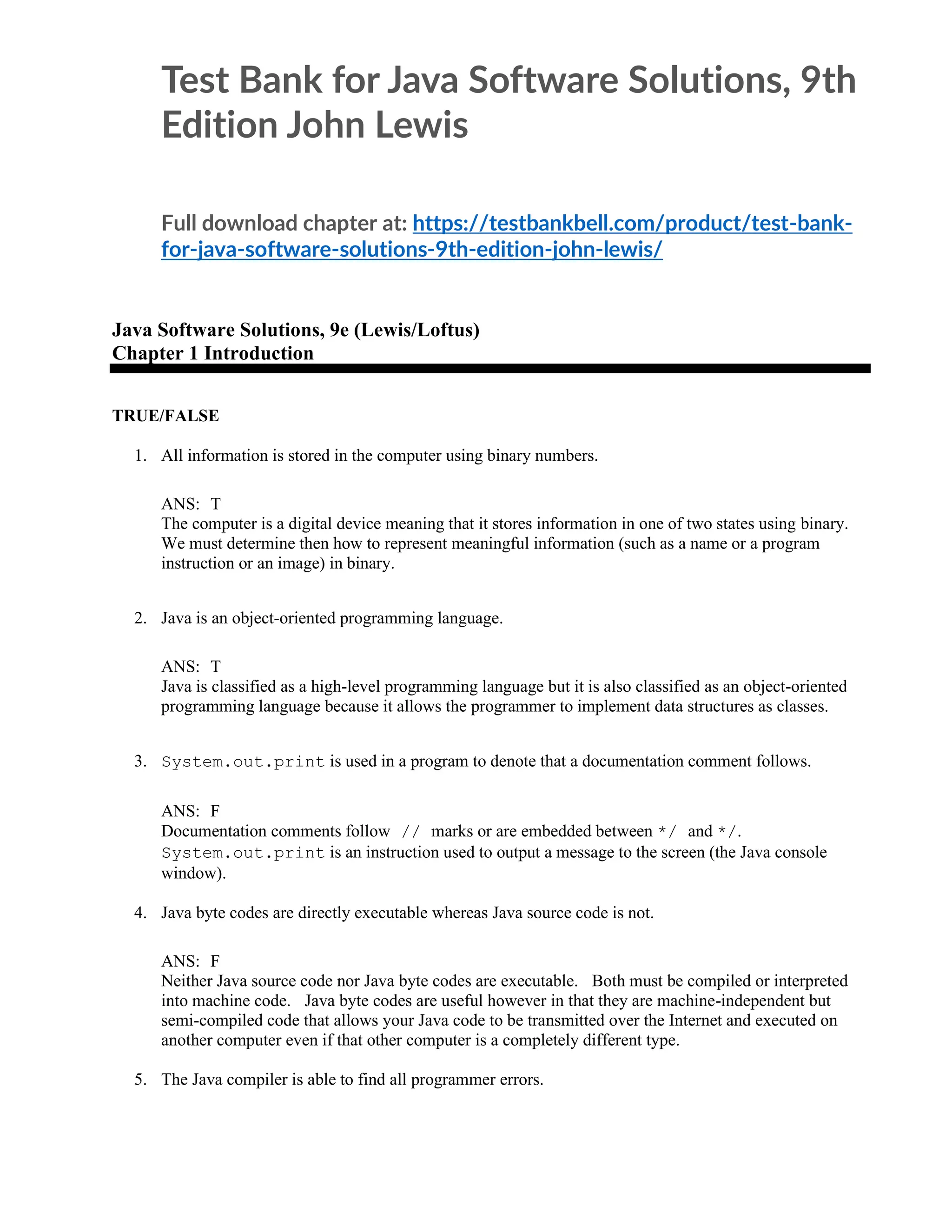
Test Bank forJava Software Solutions, 9th
Edition John Lewis
Full download chapter at: https://testbankbell.com/product/test-bank-
for-java-software-solutions-9th-edition-john-lewis/
Java Software Solutions, 9e (Lewis/Loftus)
Chapter 1 Introduction
TRUE/FALSE
1. All information is stored in the computer using binary numbers.
ANS: T
The computer is a digital device meaning that it stores information in one of two states using binary.
We must determine then how to represent meaningful information (such as a name or a program
instruction or an image) in binary.
2. Java is an object-oriented programming language.
ANS: T
Java is classified as a high-level programming language but it is also classified as an object-oriented
programming language because it allows the programmer to implement data structures as classes.
3. System.out.print is used in a program to denote that a documentation comment follows.
ANS: F
Documentation comments follow // marks or are embedded between */ and */.
System.out.print is an instruction used to output a message to the screen (the Java console
window).
4. Java byte codes are directly executable whereas Java source code is not.
ANS: F
Neither Java source code nor Java byte codes are executable. Both must be compiled or interpreted
into machine code. Java byte codes are useful however in that they are machine-independent but
semi-compiled code that allows your Java code to be transmitted over the Internet and executed on
another computer even if that other computer is a completely different type.
5. The Java compiler is able to find all programmer errors.
6.
ANS: F
The Javacompiler can find syntax errors but cannot find either logical errors (errors that are caused
because of poor logic in writing the program) or run-time errors (errors that arise during the execution
of the program).
6. Java is a case-sensitive language which means Current, CURRENT, and current will all reference
the same identifier.
ANS: F
Java is case sensitive which means that Current, CURRENT, and current will all be recognized
as different identifiers. This causes problems with careless programmers who do not spell an
identifier consistently in terms of upper and lower case characters.
7. Code placed inside of comments will not be compiled and, therefore, will not execute.
ANS: T
The compiler discards comments; therefore, any code inside a comment is discarded and is not
compiled. Your executable program consists only of the code that is compiled.
8. The word Public is a reserved word.
ANS: F
public is a reserved word, but since Java is case sensitive, Public differs from public and
therefore Public is not a reserved word.
9. Reserved words in Java can be redefined by the programmer to mean something other than their
original intentions.
ANS: F
Java reserved words cannot be redefined.
10. In a Java program, dividing by zero is a syntax error.
ANS: F
Dividing by 0 is not detected at compile time, and because a computer cannot divide by 0, this is a run-
time error.
11. In a Java program, dividing by zero is a syntax error.
ANS: F
Dividing by 0 is not detected at compile time, and because a computer cannot divide by 0, this is a run-
time error.
12. During translation, the compiler puts its output (the compiled Java program) into ROM.
7.
ANS: F
ROM standsfor read-only-memory. The compiled output (the byte codes) may be placed into RAM
(writable random access memory) or into a file (on your hard drive, for example).
13. Objects are defined by a class that describes the characteristics common to all instances of the class.
ANS: T
An object is an instance of a class. And, the purpose of a class is to describe these common
characteristics.
14. Inheritance is a form of software reuse.
ANS: T
Inheritance allows us to capitalize on the similarities among various kinds of classes that have a
common base (parent) class. Thus we reuse the base class each time a class inherits from it.
15. Polymorphism is the idea that we can refer to multiple types of related objects in consistent ways.
ANS: T
Polymorphism allows us to use the same name for similar behaviors that occur among diverse and
possibly unrelated objects. For example, to "open" may refer to a file, or to a device, or to a
communications line, etc. The same term, "open," is being used even though the objects that are
being opened are quite different.
16. In Java, identifiers may be of any length up to a limit determined by the compiler.
ANS: F
Java (and Java compilers) do not limit the length of the identifiers you use. Identifiers may be as long
as you wish. Good programming practice, however, will limit the lengths of the identifiers you
create.
MULTIPLE CHOICE
1. A Java program is best classified as
a. hardware
b. software
c. storage
d. processor
e. input
ANS: B
Programs are classified as software to differentiate them from the mechanisms of the computer
(hardware). Storage and the processor are two forms of hardware while input is the information that
the program processes.
2. Six bits can be used to represent __________ distinct items or values.
a. 6
b. 20
c. 24
8.
d. 32
e. 64
ANS:E
With n bits, we can represent 2^n different values. 2^6 = 64.
3. When executing a program, the processor reads each program instruction from
a. secondary memory (storage)
b. the Internet
c. registers stored in the processor
d. main memory
e. Any of these
ANS: D
The program is first loaded from secondary memory into main memory before it is executed so that the
processor is not slowed down by reading each instruction. This idea of executing programs stored in
memory is called the Stored Program Computer and was pioneered by John Von Neumann in the
1940s.
4. Which memory capacity is the largest?
a. 1,500,000,000,000 bytes
b. 100 gigabytes
c. 3,500,000 kilobytes
d. 10 terabytes
e. 12,000,000 megabytes
ANS: E
We convert each of these capacities to bytes (rounding off) to compare them. The value in A remains
the same, 1 1/2 trillion bytes. The value in B is 100 billion bytes. The value in C is 3 1/2 billion
bytes. The value in D is 10 trillion bytes. The answer in E is 12 trillion bytes.
5. Binary numbers are composed entirely of
a. 0s
b. 1s
c. 0s and 1s
d. any digits between 0 and 9
e. 0s, 1s, and 2s
ANS: C
Binary is base 2. In Mathematics, numbers in base n are composed entirely of digits between 0 and n-
1.
6. Volatility is a property of
a. RAM
b. ROM
c. disk
d. software
e. computer networks
ANS: A
9.
Volatility means thatthe contents of memory are lost if the electrical power is shut off. This
is true of RAM (Random Access Memory), but not ROM (Read Only Memory) or disk.
Software and computer networks are not forms of memory.
7. The ability to directly obtain a stored item by referencing its address is known as
a. random access
b. sequential access
c. read-only access
d. fetch access
e. volatility
ANS: A
Random access is meant to convey the idea that accessing any item is equally easy, and that any item
is retrievable based solely on its address. Random access is the form of access used by both RAM
and ROM memory. Disk access, called direct access, is a similar idea, and direct and random access
are sometimes referred to synonymously. Sequential access is used by tape.
8. Which phase of the fetch-decode-execute cycle might use a circuit in the arithmetic-logic unit?
a. fetch
b. decode
c. execute
d. during fetch or execute, but not decode
e. any of the phases
ANS: C
The fetch phase retrieves (fetches) the next program instruction from memory. The decode phase
determines which circuit(s) needs to be used to execute the instruction. The instruction is executed
during the execute phase. If the instruction is either an arithmetic operation (like add or multiply) or a
logical operation (like comparing two values), then it is carried out by the ALU.
9. In order for a computer to be accessible over a computer network, the computer needs its own
a. MODEM
b. communication line
c. network address
d. packet
e. router
ANS: C
In order to differentiate between the computers on a network, each is given its own, unique, network
address. In this way, a message intended for one computer can be recognized by that computer
through the message's destination address. A MODEM is a device that is used to allow a computer to
communicate to another computer over a telephone line. A communication line is the network media
itself. A packet is a collection of data that is sent over a network. A router is a hardware device used
to take a message from one network and move it to another based on the message's destination address.
10. For a computer to communicate over the Internet, it must use
a. the TCP protocol
b. the IP protocol
c. the combined TCP/IP protocol
d. the Ethernet protocol
10.
e. the ARPANETprotocol
ANS: C
IP is the Internet Protocol, but the TCP (Transmission Control Protocol) also must be used because it
handles such problems as how to piece together packets of the same message that arrive out of order.
Ethernet is a LAN protocol, which might be used in addition to TCP/IP in some networks, but it is not
needed to communicate over the Internet. There is no such thing as the ARPANET protocol.
11. A URL (Uniform Resource Locator) specifies the address of a
a. computer on any network
b. computer on the Internet
c. local area network (LAN) on the Internet
d. a document or other type of file on the Internet
e. a Java program on the Internet
ANS: D
URLs are used to locate documents (or other types of files such as an image or sound file) anywhere
on the Internet. A URL contains the address of the LAN or WAN and the specific computer from
which the file is to be retrieved; it specifies the file's address, not just the computer's address.
12. It is important to dissect a problem into manageable pieces before trying to solve the problem because
a. most problems are too complex to be solved as a single, large activity
b. most problems are solved by multiple people and it is easy to assign each piece to a
separate person
c. ir is easier to integrate small pieces of a program into one program than it is to integrate
one big chunk of code into one program
d. the first solution may not solve the problem correctly
e. All of these
ANS: A
Any interesting problem will be too complex to solve easily as a single activity. By decomposing the
problem, we can build small solutions for each piece and then integrate the pieces. Answer D is true,
but it is not the reason why we will break a problem into pieces.
13. Once we have implemented a solution, we are not done with the problem because
a. the solution may not be the best (most efficient)
b. the solution may have errors and need testing and fixing
c. the solution may, at a later date, need revising to handle new specifications
d. the solution may, at a later date, need revising because of new programming language
features
e. All of these
ANS: E
A program should not be considered as a finished product until we are reasonably assured that it is
efficient and error-free. Further, it is common that programs require modification in the future
because of a change to specifications or a change to the language or computer running the program.
14. Java is an example of a(n)
a. machine language
b. Assembly language
11.
c. high-level language
d.fourth generation language
e. both high-level and fourth generation language
ANS: E
While Java was created during the fourth generation, it is clearly also a high-level language. Machine
language is the executable language of a machine, with programs written in 1s and 0s only. Assembly
language uses mnemonics. Fourth generation languages are tools wrapped inside of programs so that
the user has the flexibility to write some code to executed from within the program.
15. Of the following, which statement is not true regarding Java as a programming language?
a. Java is a relatively recent language; it was introduced in 1995.
b. Java is a language whose programs do not require translating into machine language
before they are executed.
c. Java is an object-oriented language.
d. Java is a language that embraces the idea of writing programs to be executed with the
World Wide Web.
e. All of these are true
ANS: B
All languages require translation into machine language. The other statements are all true about Java.
16. Comments should
a. rephrase all the code to explain it in English
b. be insightful and explain the intention of an instruction or block of code
c. only be included with code that is difficult to understand
d. be used to define variables that have hard to understand names
e. All of these
ANS: B
Comments should not rephrase in English what an instruction says, but instead should explain what
that instruction is doing in relation to the program. Introductory programmers often have difficult
explaining their code and wind up stating the obvious in their comments. While answer D is partially
correct, it is not entirely true even though all variables should have comments that explain their use.
17. The main method for a Java program is defined by
a. public static main()
b. public static main(String[] args);
c. public static main(String[] args)
d. private static main(String[] args)
e. The main method could be defined by all of these except B
ANS: C
In A, the parameter is missing. The parameters are defined later in the text, but in effect, they allow
the user to run the program and include some initial arguments if the program calls for it. In B, the
semicolon at the end of the statement is not allowed. In D, private instead of public would
make the program non-executable by anyone and thus makes the definition meaningless.
18. What does the following line of Java code do?
//System.out.println("Hello");
12.
a. nothing
b. causeHello to be output
c. cause a syntax error
d. cause ("Hello") to be output
e. There is no way to tell without executing the code.
ANS: A
The characters // denote the beginning of a comment. The comment is not compiled and so, nothing
would happen when this code is executed.
19. What comment might be added to explain the following instruction?
System.out.println("Hello World");
a. // prints "Hello World" to the screen
b. //prints a message
c. //used to demonstrate an output message
d. //
e. // meaningless instruction
ANS: C
Comments in A and B state the obvious while the comments in D and E are meaningless. The
comment in C explains why the instruction appears in the program.
20. Which character belowis not allowed in an identifier?
a. $
b. _
c. 0
d. 1
e. ^
ANS: E
Java identifiers can consist of any letter, digit, $ or _ as long as the identifier starts with a letter or _.
^ is not a legal character.
21. Which of the following is not syntactically legal in Java?
a. System.out.println("Hi");
b. public class Foo
c. s t a t i c main(String[] args)
d. {}
e. only A is legally valid; all the others are illegal
ANS: C
The Java compiler would not recognize "s t a t i c" as "static" because the Java compiler
treats white space (blanks) as separators between entities. The other statements are all legal, including
"{}" which is a block that happens to have no statements within it.
22. Which of the following is a legal Java identifier?
a. i
b. class
c. 1likeclass!
13.
d. idon'tlikeclass
e. i-like-class
ANS:A
Java identifiers cannot have the characters !, ' or - in them so answers C, D and E are wrong. The
word class is a reserved word in Java and cannot be used as an identifier. The identifier i is
perfectly legal although it is not necessarily a good identifier since it is not descriptive of its use.
23. A unique aspect of Java that allows code compiled on one machine to be executed on a machine with a
different hardware platform is Java's
a. bytecodes
b. syntax
c. use of objects
d. use of exception handling
e. All of these
ANS: A
The translation process for a Java program is to first compile it into bytecodes, which are
architecturally neutral (that is, they can be used no matter what the architectural platform is). To
execute the program, the bytecodes must be further compiled by a Java compiler or interpreted by a
Java Virtual Machine.
24. Java is similar in syntax to which of the following high-level languages?
a. Pascal
b. Ada
c. C++
d. FORTRAN
e. BASIC
ANS: C
The creators of Java decided to use syntax similar to C++ so that C++ programmers could easily learn
Java. Variable declarations, assignment statements, loops, selection statements and comments are
among the features that have nearly identical syntax. There are many differences however, so don't
assume that any C or C++ programmer will easily or instantly be able to program in Java.
25. An error in a program that results in the program outputtinh $100 instead of the correct answer, $250,
is a
a. compiler error
b. syntax error
c. run-time error
d. logical error
e. snafu
ANS: D
While this is an error, programmers classify the type of error in order to more easily solve the problem.
Syntax errors are caught by the compiler and the program cannot run without fixing all syntax errors.
Run-time errors arise during program execution and cause the program to stop running. Logical
errors are errors whereby the program can run to completion, but gives the wrong answer. If the
result should have been $250, then the logic of the program is wrong since it output $100. A snafu is
a term expressing a messed up situation in combat and should not be used by respectable
programmers!
14.
26. Which ofthe following is true regarding Java syntax and semantics?
a. A Java compiler can determine if you have followed proper syntax but not proper
semantics.
b. A Java compiler can determine if you have followed proper semantics but not proper
syntax.
c. A Java compiler can determine if you have followed both proper syntax and proper
semantics.
d. A Java compiler cannot determine if you have followed either proper syntax or proper
semantics.
e. A Java compiler can determine if you have followed proper syntax but not proper
semantics only if you follow the Java naming convention rules.
ANS: A
Compilers for all languages have the ability to detect syntax errors because improper use of the syntax
leads to situations where the compilers cannot translate the code properly. However, compilers are
unable to follow the semantics of a program because this requires a degree of understanding what the
program is intended to do and computers have no sense of understanding (at least at this point).
27. Using Java naming convention, which of the following would be a good variable name for the current
value of a stock?
a. curstoval
b. theCurrentValueOfThisStock
c. currentStockVal
d. csv
e. current
ANS: C
Java allows long variable names but the programmer must find a good compromise between an
excessive long name (as with B) and names too short to understand their use (A and D). The name
current possibly might be reasonable if there are no other "current" values being referenced in the
program.
28. Which of the following is a legal Java identifier?
a. 1ForAll
b. oneForAll
c. one/4/all
d. 1_4_all
e. 1forall
ANS: B
Java identifiers cannot start with a number (so the answers in A, D and E are illegal) and cannot
include the / character, so the answer in C is illegal.
29. A color image is broken down into individual pixels (points), each of which is represented by
a. a 1 for white and a 0 for black
b. 3 values denoting the intensity of red, green, and blue in the image
c. a single number indicating the intensity of color between white and black
d. two numbers, where one indicates where the color is between white and black and the
other denotes the brightness
15.
e. None ofthese; it is not possible to represent color
ANS: B
Black and white images are stored using 0s and 1s while color images are stored using three values,
one each for the degree of red, the degree of blue, and the degree of green.
30. Which of the following characters does not need to have an associated closing character in a Java
program?
a. {
b. (
c. [
d. <
e. All of these require closing characters
ANS: D
{ is used to open a block, and so } is needed to close the block. ( is used to open an expression and
so ) is needed to close an expression. [ is used to start an array index so ] is needed to close the
array index. < is "less than" and > is "greater than" and these are not needed together, so < requires
no closing character.
31. Mistyping println as printn will result in
a. a syntax error
b. a run-time error
c. a logical error
d. no error
e. the statement being converted to a comment
ANS: A
If the Java compiler cannot make sense of a command, the compiler cannot convert it and responds
with a syntax error. While println is recognized as a command, printn is not, and so the
compiler provides a syntax error.
PROBLEM
1. What is wrong with the following class definition?
public class Program1
{
public static void main(String[ ] args)
{
System.out.println("My first Java program")
}
}
ANS:
The one executable statement in the main method is missing a ";" at the end of the line. Executable
statements end with ";".
2. What is wrong with the following class definition?
public class Program2
16.
public static voidmain(String[] args)
{
System.out.println("My second Java program");
}
ANS:
The definition of a class is placed within {} statements, which are missing here.
3. Given the following class definition, what are the reserved words and what are the identifiers?
public class Program3
{
public static void main(String[] args)
{
System.out.println("My third Java program");
}
}
ANS:
The reserved words are public, class, static, void. The identifiers are main, String,
System.out, Program3, and args. main is the name of a method defined within the
Program3 class. string and System.out are classes already defined in Java and println is
a method of System.out. Program3 is a class, defined here, and args is a variable.
4. Provide a brief explanation of the role of main memory, the control unit, the arithmetic logic unit, and
registers. (Refer to figure 1.13 in the text)
ANS:
Main memory is used to store the currently executing processes along with their data. The control
unit performs the fetch-decode-execute cycle, which fetches an instruction from memory, decodes it
and determines how it is to be executed. The arithmetic logic unit comprises a number of circuits that
execute arithmetic and logic instructions. Registers are used to store values in the CPU temporarily
while the current instruction(s) need them.
5. What is the output of the following code when the main method is executed?
public class Question4
{
public static void main(String[] args)
{
System.out.println("hi there");
System.out.println(" ");
System.out.println("how are you doing today? ");
}
}
ANS:
hi there
how are you doing today?
17.
Notice that whilethe Java compiler ignores "white space", blanks that appear in a println statement
inside of quote marks are retained and output in that manner.
6. What is wrong with the following println statement?
System.out.println("My fourth Java Program);
ANS:
It is missing a closing ". The compiler will look for a second " before the end of the statement. So,
like {}, (), and [], an initial " must have a corresponding closing ".
7. Provide identifier names that would be used to represent a person's social security number, income tax
withheld, and net pay.
ANS:
socialSecurityNumber, or ssn, incomeTaxWithheld or incomeTax, and netPay all
would be reasonable.
8. There are a number of reserved words in Java that have no current meaning (denoted with an * in
figure 1.18 in the text). Why?
ANS:
Java language designers anticipate introducing these statements in future versions, but have not yet
implemented them because they are lower priority, or it has not been decided how they will be
implemented or precisely what they will mean.
9. A document of text is 15 pages long. Each page contains approximately 200 words and the average
length of each word is 5 characters. Also assume one blank space between each word and no
punctuation. How many bytes will it take to store this document in memory or on disk using ASCII?
ANS:
A character is stored in ASCII using 8 bits or 1 byte. Therefore, 5 characters per word plus 1 blank
space between words take 6 bytes per word (except for the first). Each page stores 200 words and
there are 15 pages. So we need 15 * 200 * 6 - 1 (no blank space to start the text) = 17,999 bytes
which is 17.58 kilobytes, or nearly 18 Kbytes.
10. Provide a brief description of the roles of the following hardware elements (that is, what each is used
for):
a) CPU
b) Main memory
c) Secondary memory devices
d) Input/Output devices
ANS:
a) The CPU is the processor. It executes all program instructions. It does this through the fetch-
decode-execute cycle where the next program instruction is fetched from memory, decoded in the
CPU, and then executed by one or more circuits.
b) Main memory is stored on chips on the motherboard and is used for quick access to the current
program for the fetch-decode-execute cycle and to store data being used by this program.
18.
c) Secondary memorydevices are storage devices, used to store programs and data not currently
being used. Storage devices, such as the hard disk, also are used to store things for permanence and
archives.
d) Input/Output devices are used to communicate with the computer. Input devices, like the
keyboard, take commands and data from the user and output devices, like the monitor, display the
results of the process/computation.
11. Examine figure 1.7 before answering this question. What 8-bit value comes immediately before and
what 8-bit value comes immediately after 10010111?
ANS:
10010110 comes immediately before 10010111 and 10010100 comes immediately after
10010111.
12. Rewrite the following comment so that is can appear over multiple lines.
// This is one really enormously long comment that might run off
the page
ANS:
We can do this in two ways, preceding each line with // or by enclosing the comment in /* and */.
/* This is one really enormously
long comment that might run
off the page */
or
// This is one really enormously
// long comment that might run
// off the page
13. Rewrite the following program with better formatting to make it easier to read.
public
class
MyProgram
{ public static void
main(
String[]
args)
{ System.out.println(
"Wow, this is messed up!"
);
} }
ANS:
There are many ways this program might appear. The following would be very acceptable:
public class MyProgram
{
public static void main(String[] args)
{
19.
System.out.println("Wow, this ismessed up!");
}
}
14. Write a Java program that will output on two separate lines the names of the authors of this textbook.
ANS:
public class OutputNames
{
public static void main(String[] args)
{
System.out.println("John Lewis"); // 1st author's name
System.out.println("William Loftus");// 2nd author's name
}
}
15. Correct all the syntax errors in the following program.
Public Class Program A problem program
(
Public static voided main[Strings() args]
{
system.out.println('This program'); * oh, my... *
system.out.println('has several syntax errors'); *
lots of errors *
}
)
ANS:
public class Program // A problem program
{
public static void main(String[] args)
{
System.out.println("This program"); /* oh, my... */
System.out.println("has several syntax errors"); /*
lots of errors */
}
}
16. Write a Java program that will display the following three lines when it is run:
*
* * *
* * * * *
ANS:
public class Stars
{
public static void main(String[] args)
{
System.out.println(" *");
System.out.println(" * * *");
System.out.println("* * * * *");
}
}
20.
17. Name fiveof the fundamental terms which encompass object-oriented programming.
ANS:
There are seven terms to choose from: object, attribute, method, class, encapsulation,
inheritance, and polymorphism.
The Project GutenbergeBook of The American
Missionary — Volume 37, No. 2, February,
1883
26.
This ebook isfor the use of anyone anywhere in the United
States and most other parts of the world at no cost and with
almost no restrictions whatsoever. You may copy it, give it away
or re-use it under the terms of the Project Gutenberg License
included with this ebook or online at www.gutenberg.org. If you
are not located in the United States, you will have to check the
laws of the country where you are located before using this
eBook.
Title: The American Missionary — Volume 37, No. 2, February,
1883
Author: Various
Release date: September 17, 2019 [eBook #60314]
Most recently updated: October 17, 2024
Language: English
Credits: Produced by Joshua Hutchinson, KarenD and the Online
Distributed Proofreading Team at http://www.pgdp.net
(This
file was produced from images generously made
available
by Cornell University Digital Collections)
*** START OF THE PROJECT GUTENBERG EBOOK THE AMERICAN
MISSIONARY — VOLUME 37, NO. 2, FEBRUARY, 1883 ***
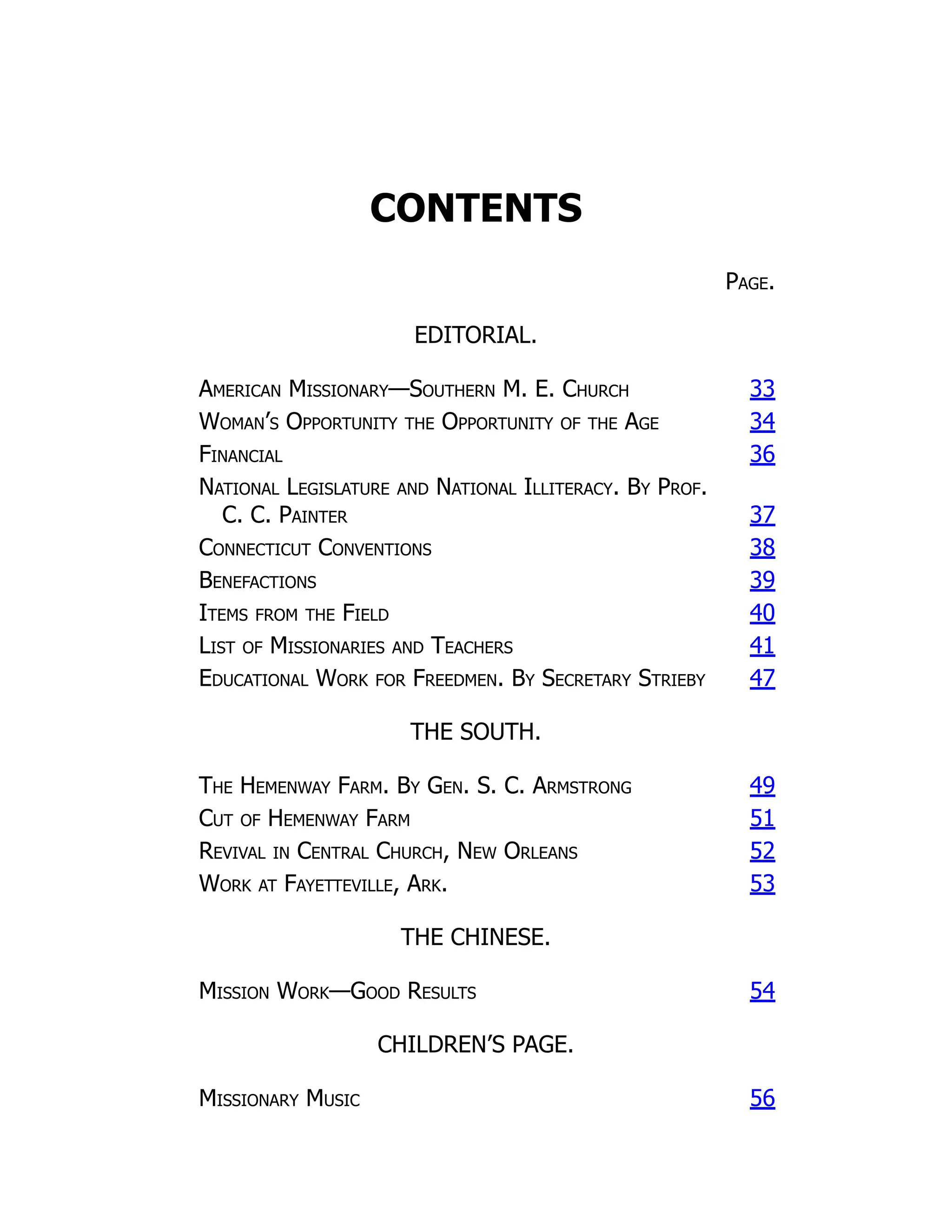
CONTENTS
Page.
EDITORIAL.
American Missionary—Southern M.E. Church 33
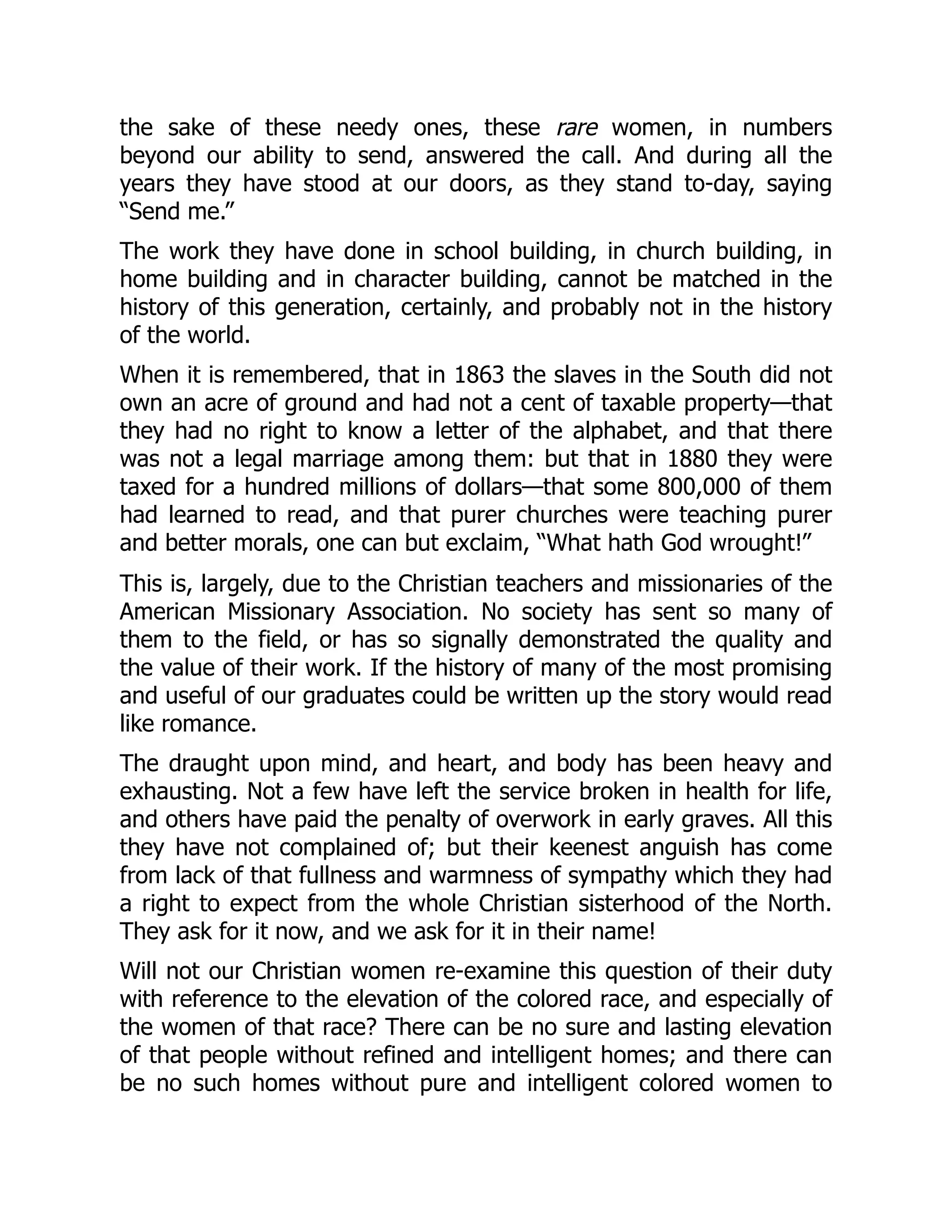
Woman’s Opportunity the Opportunity of the Age 34
Financial 36
National Legislature and National Illiteracy. By Prof.
C. C. Painter 37
Connecticut Conventions 38
Benefactions 39
Items from the Field 40
List of Missionaries and Teachers 41
Educational Work for Freedmen. By Secretary Strieby 47
THE SOUTH.
The Hemenway Farm. By Gen. S. C. Armstrong 49
Cut of Hemenway Farm 51
Revival in Central Church, New Orleans 52
Work at Fayetteville, Ark. 53
THE CHINESE.
Mission Work—Good Results 54
CHILDREN’S PAGE.
Missionary Music 56
NEW YORK.
PUBLISHED BYTHE AMERICAN MISSIONARY ASSOCIATION,
Rooms, 56 Reade Street.
Price 50 Cents a Year, in Advance.
Entered at the Post-Office at New York, N.Y., as second-class matter.
31.
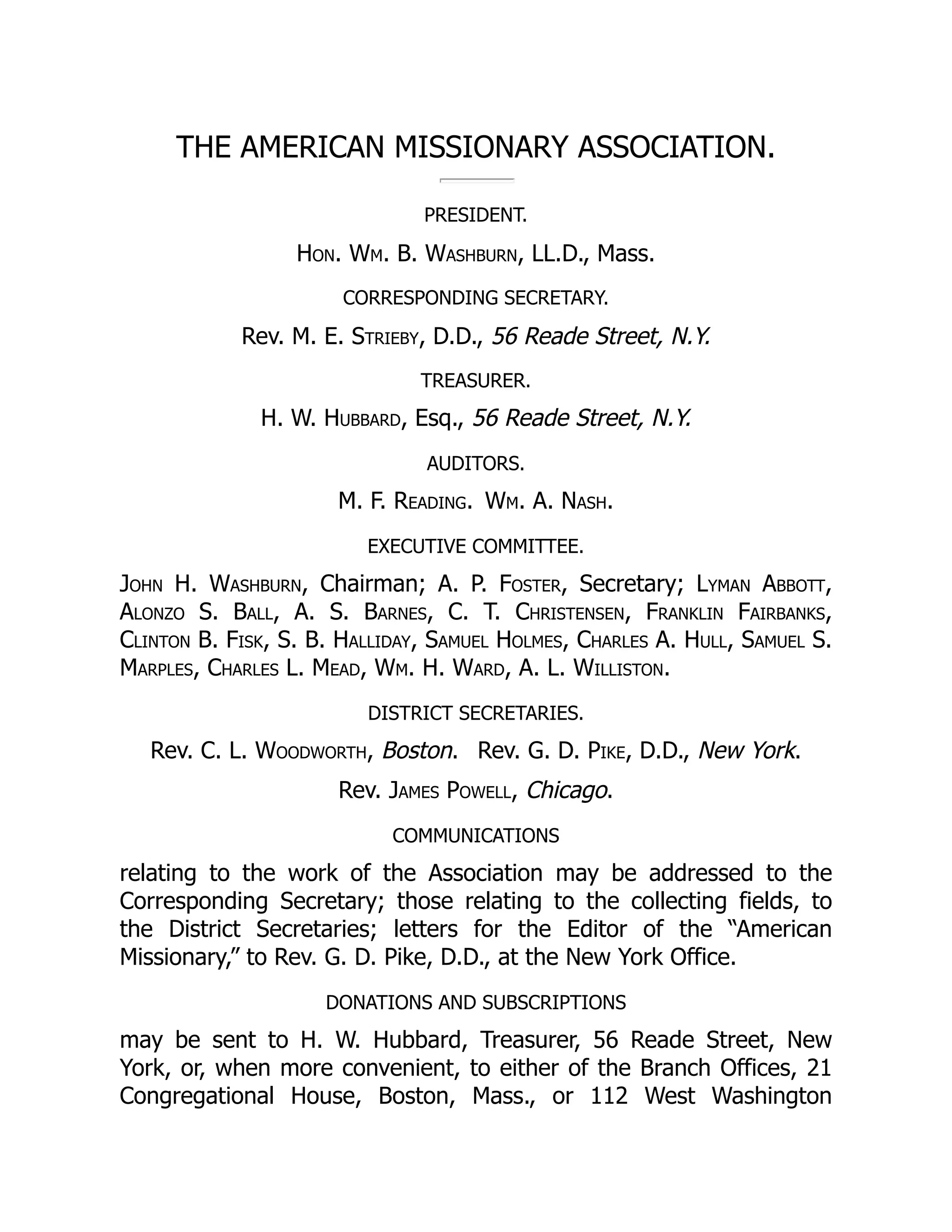
THE AMERICAN MISSIONARYASSOCIATION.
PRESIDENT.
Hon. Wm. B. Washburn, LL.D., Mass.
CORRESPONDING SECRETARY.
Rev. M. E. Strieby, D.D., 56 Reade Street, N.Y.
TREASURER.
H. W. Hubbard, Esq., 56 Reade Street, N.Y.
AUDITORS.
M. F. Reading. Wm. A. Nash.
EXECUTIVE COMMITTEE.
John H. Washburn, Chairman; A. P. Foster, Secretary; Lyman Abbott,
Alonzo S. Ball, A. S. Barnes, C. T. Christensen, Franklin Fairbanks,
Clinton B. Fisk, S. B. Halliday, Samuel Holmes, Charles A. Hull, Samuel S.
Marples, Charles L. Mead, Wm. H. Ward, A. L. Williston.
DISTRICT SECRETARIES.
Rev. C. L. Woodworth, Boston. Rev. G. D. Pike, D.D., New York.
Rev. James Powell, Chicago.
COMMUNICATIONS
relating to the work of the Association may be addressed to the
Corresponding Secretary; those relating to the collecting fields, to
the District Secretaries; letters for the Editor of the “American
Missionary,” to Rev. G. D. Pike, D.D., at the New York Office.
DONATIONS AND SUBSCRIPTIONS
may be sent to H. W. Hubbard, Treasurer, 56 Reade Street, New
York, or, when more convenient, to either of the Branch Offices, 21
Congregational House, Boston, Mass., or 112 West Washington
32.
Street, Chicago, Ill.A payment of thirty dollars at one time
constitutes a Life Member.
FORM OF A BEQUEST.
“I bequeath to my executor (or executors) the sum of —— dollars, in
trust, to pay the same in —— days after my decease to the person
who, when the same is payable, shall act as Treasurer of the
‘American Missionary Association’ of New York City, to be applied,
under the direction of the Executive Committee of the Association, to
its charitable uses and purposes.” The Will should be attested by
three witnesses.
WANTED
$375,000,
Efficiently to prosecute the work in hand.
CO-OPERATION
Of every Congregational minister, and of every office bearer in our
Congregational churches to secure (a) an annual presentation of the
work, and claims of the A. M. A. in every Congregational church; and
(b) an annual contribution from every Congregational church in the
country for this great work.
HELP
Of every Congregational Sunday-school superintendent to secure
from his school a contribution to our “Student Aid Fund.”
AID
Of every Ladies’ Missionary Society to sustain our work among the
colored women and girls.
ENDOWMENTS
33.
For Professorships andScholarships in our schools. The time has
come when in our larger institutions the chairs of instruction should
be endowed, that the Association may be left to enlarge its
missionary work in other directions.
GIFTS
For the improvement of schools and churches already built, and the
erection of additional buildings, imperatively needed.
A SUBSCRIBER
In every family for our monthly magazine,
THE AMERICAN MISSIONARY.
Subscription Price, 50c. per annum.
American Missionary Association.
Weare encouraged by the request for the renewal of the American
Missionary for 1883, and by the subscriptions already received. The
price is 50 cents. We aim to secure subscriptions sufficient to meet
the cost of the magazine, and this is a reminder to such of our
readers as desire to assist us in this object. We do what we can to
make it worth the price asked. Nearly all the articles it contains are
written expressly for the Missionary, and pains is taken to give variety
and freshness to each number.
Upon annual application, the following persons are entitled to
receive the American Missionary free: life members, ministers whose
churches take an annual collection for the Association,
Superintendents of Sabbath Schools, and donors who contribute in a
year not less than five dollars.
We wish to congratulate the Southern Methodist Episcopal Church
on her growing helpfulness to the colored people. A recent and most
timely gift in this direction was that of Dr. Haygood, as the agent for
the disbursing of the John F. Slater Fund. His broad liberality, his
intimate knowledge of the Southern field, and his honest impartiality
make him just the man for that place. We anticipate a most effective
administration of the Slater Fund under his care. Another event in
the history of the Methodist Episcopal Church South was the
inauguration, in May last, at the General Conference, of a plan for
founding a school of high grade for the training of teachers and
preachers among the colored people. A new and crowning impulse
to this was given at the recent meeting of the North Georgia
Conference, in the appointment of Dr. Morgan Galloway as the
36.
President of thenew institution, which is to be located in Augusta,
Ga., and named “Paine College.” All honor to our Southern Methodist
friends for these movements in so important a matter, and all
success to them in these and every other like endeavor, which their
hearts may prompt them to plan and their hands to execute.
Revivals How and When, is the title of a very timely and useful volume
by Rev. Wm. W. Newell, D.D. The following subjects with others are
discussed: Why use the word revival, Evangelistic meetings,
Household revivals, Bible class and Sabbath-school revivals, Revival
preaching, Fixed laws for the promotion of revivals, Temperance
revivals, When should we have revivals. Dr. Newell speaks from a
rich experience of many years and enforces his views with copious
incidents and pertinent quotations from the words of eminent men.
The whole subject is discussed in a clear, comprehensive and
interesting manner. The book was prepared to help ministers and
laymen, and contains an abundance of suggestive and available
information. There is no work more dear to this Association than
revival work, and no volume has recently come to our knowledge
apparently more fitted to promote it.
37.
WOMAN’S OPPORTUNITY THEOPPORTUNITY
OF THE AGE.
There is nothing like it in any land—the opportunity of the Christian
women of America to labor for the uplift of womanhood the world
over. The call, however, for woman’s work in America during the past
twenty years seems to us to have been peculiarly urgent, and yet we
think the majority of the noble Christian women in our churches
have, up to this time, seen only dimly the demands upon them in
this regard. How loving, pitying woman, whose labors and sacrifices
are so abounding in behalf of women, should have seen with so little
responsive interest the necessities for work among the colored
women of this land, is among the marvels of Christian ethics.
If women, anywhere, are under obligation to help women, it seems
to us the women in our churches are indebted, beyond words to tell,
to the negro women in the South. Their condition is what we have
made it, and remains what we will it.
But let us not convey the impression that Christian women have
been wholly indifferent to the wants of their colored sisters. On the
other hand, we affirm that there is not a brighter page in modern
missions, than that which records the labors and sacrifices of
Northern women for the lowly dwellers in the cabins of the South.
We only speak, comparatively, of the great body, who need to be
stirred and mastered, as have been the few who have hurried with
the medicine of light and love to relieve the stricken and the
despairing. These have sacrificed youth and beauty, and the hope of
family love and joy, in the attempt to serve a race. With a calm and
reverent step they have gone into the darkest homes of poverty and
suffering to clothe the naked, to minister to the sick, to comfort the
dying, and to save the perishing.
Twenty-one years ago, when this Association called for teachers and
missionaries to submit to reproach, and obloquy, and ostracism for
38.
the sake ofthese needy ones, these rare women, in numbers
beyond our ability to send, answered the call. And during all the
years they have stood at our doors, as they stand to-day, saying
“Send me.”
The work they have done in school building, in church building, in
home building and in character building, cannot be matched in the
history of this generation, certainly, and probably not in the history
of the world.
When it is remembered, that in 1863 the slaves in the South did not
own an acre of ground and had not a cent of taxable property—that
they had no right to know a letter of the alphabet, and that there
was not a legal marriage among them: but that in 1880 they were
taxed for a hundred millions of dollars—that some 800,000 of them
had learned to read, and that purer churches were teaching purer
and better morals, one can but exclaim, “What hath God wrought!”
This is, largely, due to the Christian teachers and missionaries of the
American Missionary Association. No society has sent so many of
them to the field, or has so signally demonstrated the quality and
the value of their work. If the history of many of the most promising
and useful of our graduates could be written up the story would read
like romance.
The draught upon mind, and heart, and body has been heavy and
exhausting. Not a few have left the service broken in health for life,
and others have paid the penalty of overwork in early graves. All this
they have not complained of; but their keenest anguish has come
from lack of that fullness and warmness of sympathy which they had
a right to expect from the whole Christian sisterhood of the North.
They ask for it now, and we ask for it in their name!
Will not our Christian women re-examine this question of their duty
with reference to the elevation of the colored race, and especially of
the women of that race? There can be no sure and lasting elevation
of that people without refined and intelligent homes; and there can
be no such homes without pure and intelligent colored women to
39.
build them. Suchwomen can be brought forward, only as they have
pure models to imitate, and refined teachers to instruct and guide
them.
Fortunately, Northern homes are full of such models and of such
teachers; and they only need the supporting word and hand of their
sisters to go forth in larger numbers, and to lay, more broadly and
grandly, the foundations of a regenerated South. They know that the
colored woman can be elevated by the gospel of Christ, they know
that she can take on culture like a garment, and be made a power in
redeeming her race.
May we not, then, once more call the attention of Christian women
to this work, so peculiarly theirs, and laid upon them by so many
providential tokens?
It will be of interest to a large circle of friends on both sides of the
water to learn of the marriage at Prof. Geo. L. White’s residence,
Fredonia, N.Y., of Miss Ella Sheppard, pianist of the original Jubilee
Singer Company, to Rev. Geo. W. Moore, of Oberlin. Mr. Moore is a
graduate of Fisk University and acted as pastor of the Howard
Chapel at Nashville for some time, where his labors were much
appreciated. He has recently been connected with the theological
department of Oberlin College and has preached with acceptance to
churches in Ohio.
40.
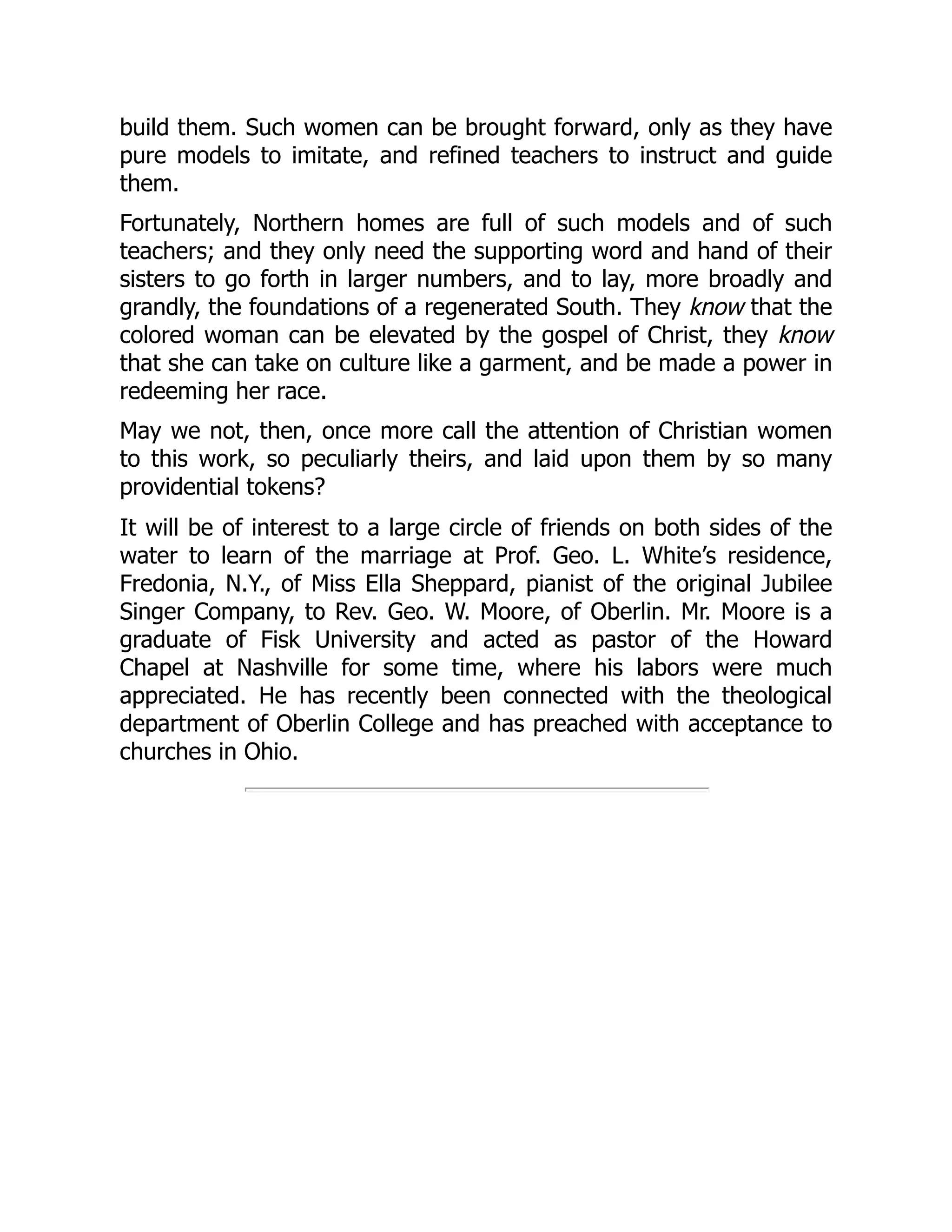
A FALLING OFFOF 17 PER CENT. IN
DONATIONS FROM THE LIVING.
The receipts from living donors for the first three months of our
fiscal year amounted to $39,528.77, against $48,174.97 for the
corresponding months of the previous year, showing a falling off of
more than 17 per cent. The receipts from legacies, however,
amounted to $15,486.65, against $7,029.65 of the year before. The
total receipts for the three months ending Dec. 31st amounted to
$55,015.42, against $55,204.62 for the previous year.
The Committee on Finance at Cleveland estimated that for this year
$375,000 would be wanted, against $300,000 for the year then
closed, an increase of 25 per cent. If this gain had been realized, we
should have received for the first quarter $93,750 instead of
$55,015.42, a difference of $38,734.58. The friends of this
Association will see from these figures that if the plans suggested at
our Annual Meeting are carried out, not only must the smaller
sources of contributions be augmented, but the churches having the
means to give must contribute more largely. With this in view we
take the liberty of making the following suggestions:
1. That in localities where money is raised by solicitation from a few
old friends who have already taken a deep interest in the Negroes,
efforts for collecting funds be made immediately.
2. In parishes where the benevolent organizations connected with
the church give no assistance to the Freedmen, we suggest that
special efforts be made in Sabbath-schools, the monthly concert and
at the annual collection, so that the amount raised for this
Association may be in due proportion to that given to the other
missionary societies supported by the Congregational churches.
3. In churches that do not follow a fixed system as to time for taking
collections, we suggest that the claims of our work be explained and
41.
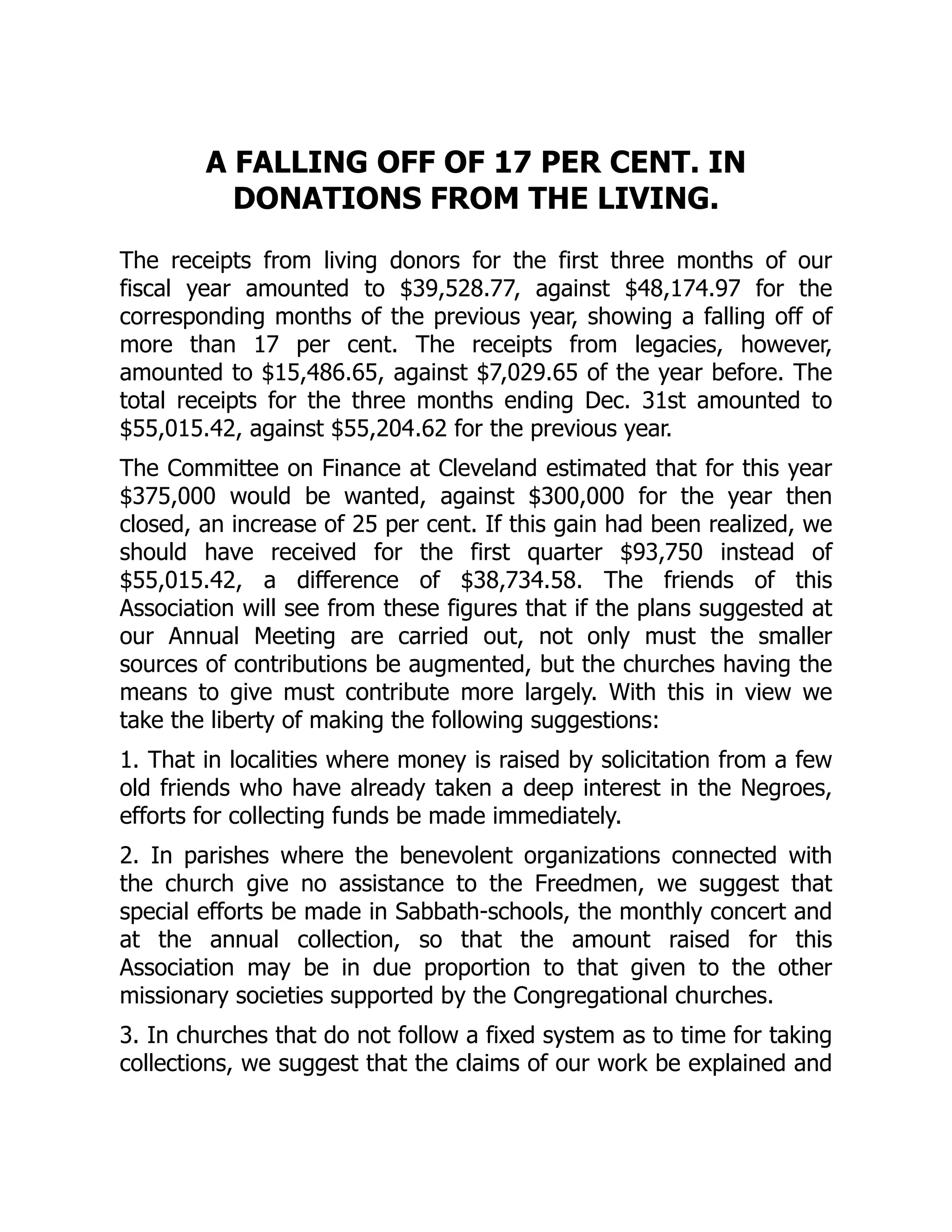
urged at leastonce a year, and that contributions be forwarded to us
at the earliest date possible.
We commend these suggestions to that thoughtful and prayerful
consideration which we believe is justified and demanded by the
necessities of the great work in which we are engaged.
42.
THE NATIONAL LEGISLATUREAND NATIONAL
ILLITERACY.
BY PROF. C. C. PAINTER.
Broad questions of Statesmen receive tardy attention from the
average legislator because they receive but little from his
constituents, while such matters as the imposition or removal of a
tax upon cigars is to him of pressing interest, because it concerns
the “boys” who run the caucases. This is perhaps well, as questions
of policy are tentatively settled and affect only passing and limited
interests; issues that are fundamental and vital, which are to be
settled for all time, come to a full recognition slowly.
Statutes are enacted as average intellects may decide, or the
balance of selfishness allow, but laws are not made, but discovered
as God has enacted, and related them to permanent interests. The
making or unmaking of the one is the facile work of charlatans when
by some mysterious providence they find their way into our
legislative halls; the discovery of the other is work for seers and
statesmen which once done is done forever.
The Revised Statutes of this Congress make obsolete those of the
last, not necessarily because superior wisdom has devised better,
which must prove a permanent gain; but when a law of human
society has been recognized and so enunciated that it becomes a
regulating force, civilization has taken a forward step. The race is not
simply less disturbed and more comfortable because temporary
adjustments have been made of conflicting interests, but it is richer
and stronger because of an enduring possession, and we can afford
to labor and wait for such.
Each new application of an old principle calls for a fresh statement of
the principle. That man’s personal rights are modified by the fact of
his social relations, is a truth old as the beginning of civilized life, but
that he may not suffer his children to grow up in ignorance, is a
43.
proposition startling tomany, and practically asserted by but few of
our State governments, though it is well-known that our government
itself as well as all our social interests are put in jeopardy by the
ignorant citizen who becomes a voter.
That the constitutional duty of the President to execute the laws,
and of Congress to provide for the safety of the Republic involved
the right to levy war against states, to blockade their harbors, to
emancipate their slaves, to dictate the Constitutions under which
they could resume their autonomy as States in the union, this was
recognized only in face of fearful dangers and admitted only when
established on many bloody fields of a desolating war, but is now so
familiar, so axiomatic that no one doubts the nation’s right to defend
its own life by all means which do not of themselves subvert that
life.
That the safety of the Republic requires a general diffusion of
intelligence no sane man will deny, and yet some assert that it will
subvert the fundamental principles of this government if it practically
secured this prime condition of its own life—that it must delegate to
other hands the control of conditions and facts vital to its life, with
no power or right to enforce attention to them. The right and
capacity of self-government are found only in the virtue and
intelligence of the people. If this be so, the obligation of a free
government to enforce the education of its citizens is involved in its
right to live.
This obligation is recognized, or should be, in the constitutional
guarantee of a Republican form of government to each State, for the
guarantee of such a form of government carries with it the
conditions essential to it, one of which, and a prime one, is the
intelligence of the citizen. This cannot be secured by the military arm
of the nation, but by the school-master alone, who thus becomes a
constitutional officer of the republic. The proposition that a
republican form of government may be maintained by force over a
people too ignorant to maintain it for themselves is too absurd for
serious debate.
44.
The right ofthe national government to interfere in case a State
neglects the education of its children, seems clear on the ground of
self-protection. The duty to aid the States struggling to accomplish
this work, but unable to do it, because of its vastness, and of its own
poverty, seems also clear, and has now become urgent in view of the
appalling facts revealed in the last census.
Our national Congress is constrained to hear the cry that is coming
up from all parts of the country calling attention to this duty. Let not
those who feel an interest in this, relax effort or lose heart. It is not
a measure to be adopted in a moment. It means much; it involves
much. It will bring with it new and seemingly revolutionary
conceptions of the functions of the government when it reaches out
its strong arms to defend its life, not in the sad work of shooting
down ignorant and brutalized parricides, but in the better work of
helping to qualify for their children, who are to be charged with
duties, the gravest which fall to men, and for positions the highest to
which ambition can impel them—the duties and position of a citizen
of this free republic.
Arrangements have been made by the Missionary Society of
Connecticut to hold thirty conventions in the State, at which the
following benevolent societies supported by the Congregationalists
will be represented; American Board, American Congregational
Union, American Home Missionary Society, American Missionary
Association, American College and Education Society, New West
Education Commission, Congregational Publishing Society. The
meetings for the first month will be held as follows: Tuesday, Feb. 6,
Stamford, morning and afternoon; Wed. the 7th, Danbury, 1st
Church, morning and afternoon; Thursday the 8th, Hartford, Park
Church, afternoon and evening; Tuesday the 13th, Bridgeport, 1st
Church, morning and afternoon; Wednesday the 14th, New Milford,
morning and afternoon; Thursday, the 15th, Bridgeport, Park st.
Church, morning and afternoon; Tuesday the 20th, New Haven, 1st
Church, afternoon and evening; Wednesday the 21st, Ansonia,
45.
morning and afternoon;Thursday the 22d, Hartford, South Church,
afternoon and evening; Tuesday the 27th, Middletown, 1st Church,
morning and afternoon; Wednesday the 28th, New Haven, College
st. Church, morning and afternoon.
46.
BENEFACTIONS.
Liberty E. Holdenhas given $150,000 to Western Reserve University,
Cleveland, Ohio.
Mr. John I. Blair has given $15,000 to Iowa College for building
purposes.
Atlanta University and Berea College have received $5,000 each for
endowment purposes from Mr. Tuthill King, of Chicago.
The University of Pennsylvania has received $20,000 towards the
endowment of a veterinary school in connection with the University.
John R. Buchtel has sold $200,000 worth of stock in the Buckeye
Works to Lewis Miller and his three sons, in order to make an
additional gift of $100,000 to Buchtel College.
James McLaren, a brother of Professor McLaren, of Toronto, Canada,
has subscribed $50,000 to endow a chair of Systematic Theology in
Knox College, Toronto.
Mrs. L. A. Messenger has given $25,000 in addition to her previous
large gifts to Buchtel College, Akron, Ohio.
Williams College is to receive $50,000 from the estate of J. B.
Jermain, as a memorial to his son, Barclay Jermain.
The gift of $10,000 from the late Tracy R. Edson, which his trustees
are now ready to pay, to the General Theological Seminary for “The
Tracy R. Edson Foundation,” makes over $160,000 received by the
Seminary in the last three years. The interest of Mr. Edson’s gift is to
be used in instructing students in the church service.
The number of persons over ten years of age among the colored
people who could not write, in the sixteen old slave states, according
to the census report of November, 1882, was upwards of three
millions; the number of native-born whites who were equally
illiterate was upwards of one and a half millions. We believe there is
47.
no more imperativenecessity than endowments for educational
institutions sustained for the purpose of ridding the country of this
illiteracy.
48.
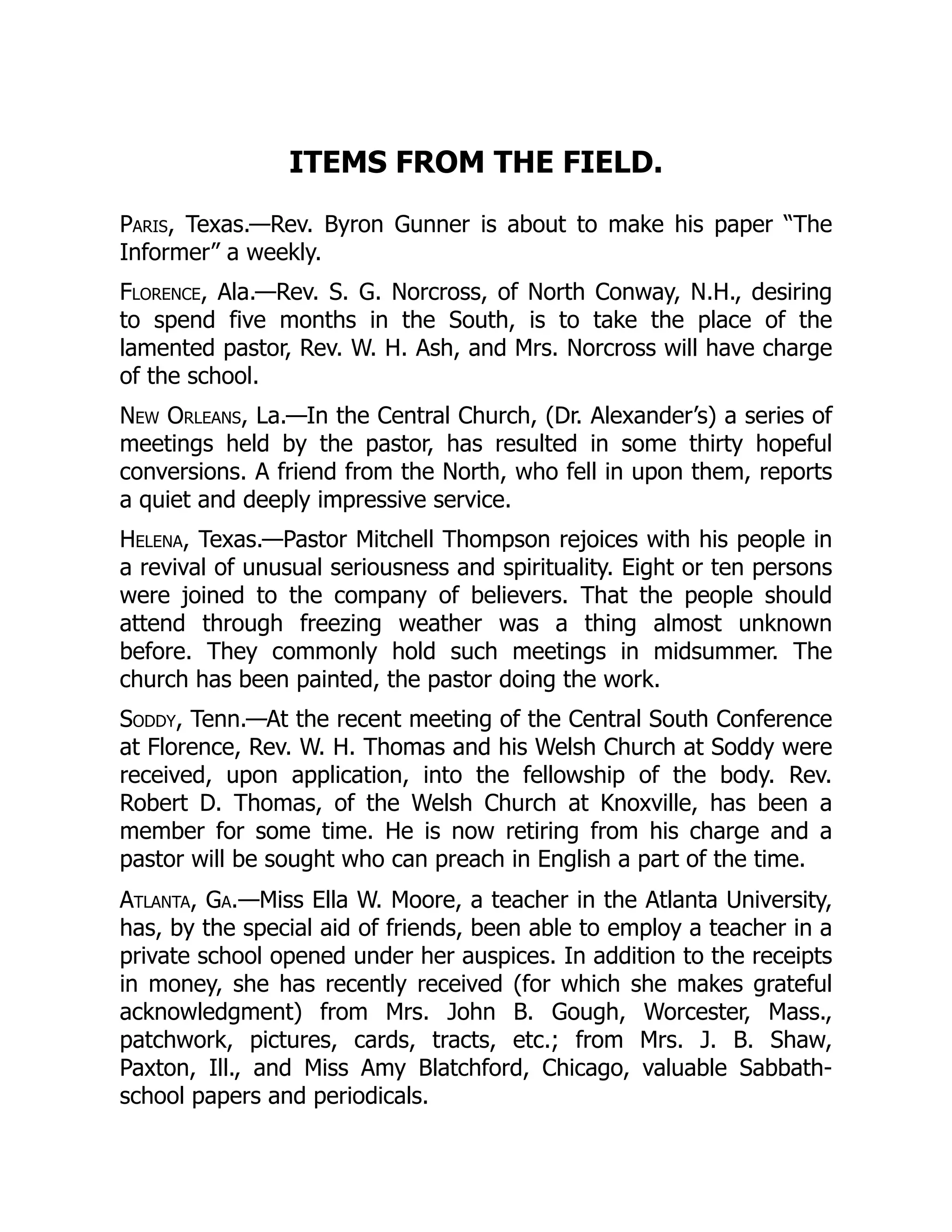
ITEMS FROM THEFIELD.
Paris, Texas.—Rev. Byron Gunner is about to make his paper “The
Informer” a weekly.
Florence, Ala.—Rev. S. G. Norcross, of North Conway, N.H., desiring
to spend five months in the South, is to take the place of the
lamented pastor, Rev. W. H. Ash, and Mrs. Norcross will have charge
of the school.
New Orleans, La.—In the Central Church, (Dr. Alexander’s) a series of
meetings held by the pastor, has resulted in some thirty hopeful
conversions. A friend from the North, who fell in upon them, reports
a quiet and deeply impressive service.
Helena, Texas.—Pastor Mitchell Thompson rejoices with his people in
a revival of unusual seriousness and spirituality. Eight or ten persons
were joined to the company of believers. That the people should
attend through freezing weather was a thing almost unknown
before. They commonly hold such meetings in midsummer. The
church has been painted, the pastor doing the work.
Soddy, Tenn.—At the recent meeting of the Central South Conference
at Florence, Rev. W. H. Thomas and his Welsh Church at Soddy were
received, upon application, into the fellowship of the body. Rev.
Robert D. Thomas, of the Welsh Church at Knoxville, has been a
member for some time. He is now retiring from his charge and a
pastor will be sought who can preach in English a part of the time.
Atlanta, Ga.—Miss Ella W. Moore, a teacher in the Atlanta University,
has, by the special aid of friends, been able to employ a teacher in a
private school opened under her auspices. In addition to the receipts
in money, she has recently received (for which she makes grateful
acknowledgment) from Mrs. John B. Gough, Worcester, Mass.,
patchwork, pictures, cards, tracts, etc.; from Mrs. J. B. Shaw,
Paxton, Ill., and Miss Amy Blatchford, Chicago, valuable Sabbath-
school papers and periodicals.
49.
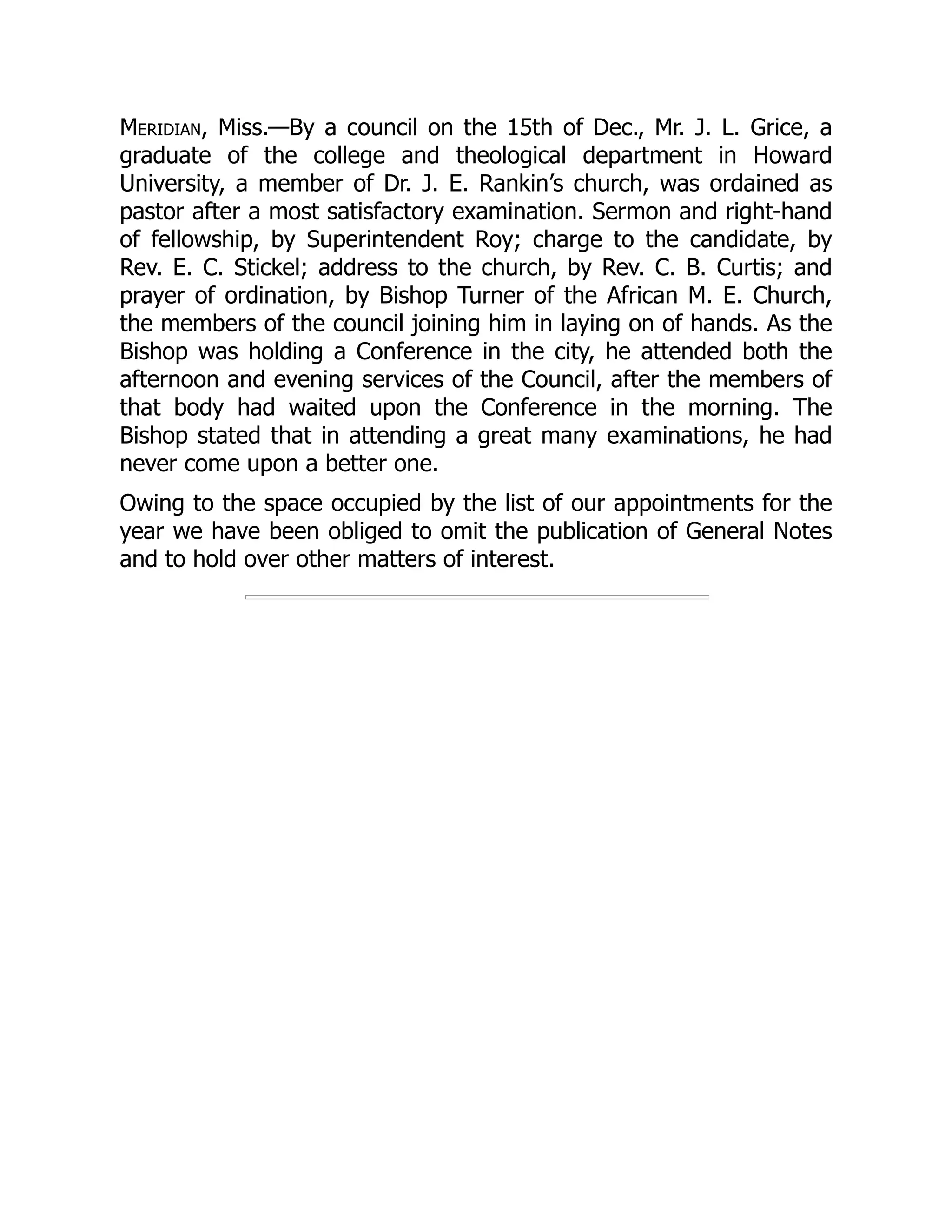
Meridian, Miss.—By acouncil on the 15th of Dec., Mr. J. L. Grice, a
graduate of the college and theological department in Howard
University, a member of Dr. J. E. Rankin’s church, was ordained as
pastor after a most satisfactory examination. Sermon and right-hand
of fellowship, by Superintendent Roy; charge to the candidate, by
Rev. E. C. Stickel; address to the church, by Rev. C. B. Curtis; and
prayer of ordination, by Bishop Turner of the African M. E. Church,
the members of the council joining him in laying on of hands. As the
Bishop was holding a Conference in the city, he attended both the
afternoon and evening services of the Council, after the members of
that body had waited upon the Conference in the morning. The
Bishop stated that in attending a great many examinations, he had
never come upon a better one.
Owing to the space occupied by the list of our appointments for the
year we have been obliged to omit the publication of General Notes
and to hold over other matters of interest.
50.
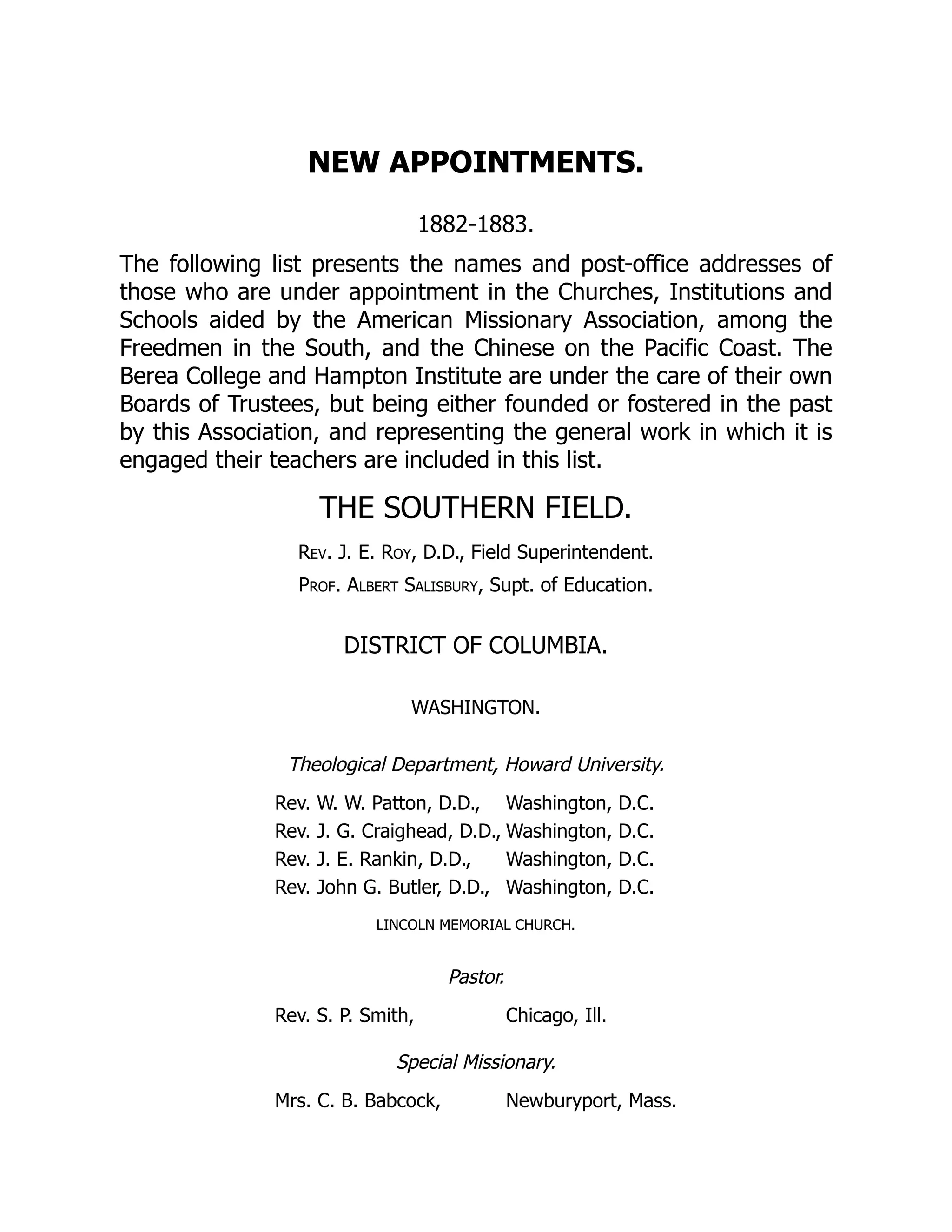
NEW APPOINTMENTS.
1882-1883.
The followinglist presents the names and post-office addresses of
those who are under appointment in the Churches, Institutions and
Schools aided by the American Missionary Association, among the
Freedmen in the South, and the Chinese on the Pacific Coast. The
Berea College and Hampton Institute are under the care of their own
Boards of Trustees, but being either founded or fostered in the past
by this Association, and representing the general work in which it is
engaged their teachers are included in this list.
THE SOUTHERN FIELD.
Rev. J. E. Roy, D.D., Field Superintendent.
Prof. Albert Salisbury, Supt. of Education.
DISTRICT OF COLUMBIA.
WASHINGTON.
Theological Department, Howard University.
Rev. W. W. Patton, D.D., Washington, D.C.
Rev. J. G. Craighead, D.D., Washington, D.C.
Rev. J. E. Rankin, D.D., Washington, D.C.
Rev. John G. Butler, D.D., Washington, D.C.
LINCOLN MEMORIAL CHURCH.
Pastor.
Rev. S. P. Smith, Chicago, Ill.
Special Missionary.
Mrs. C. B. Babcock, Newburyport, Mass.
51.
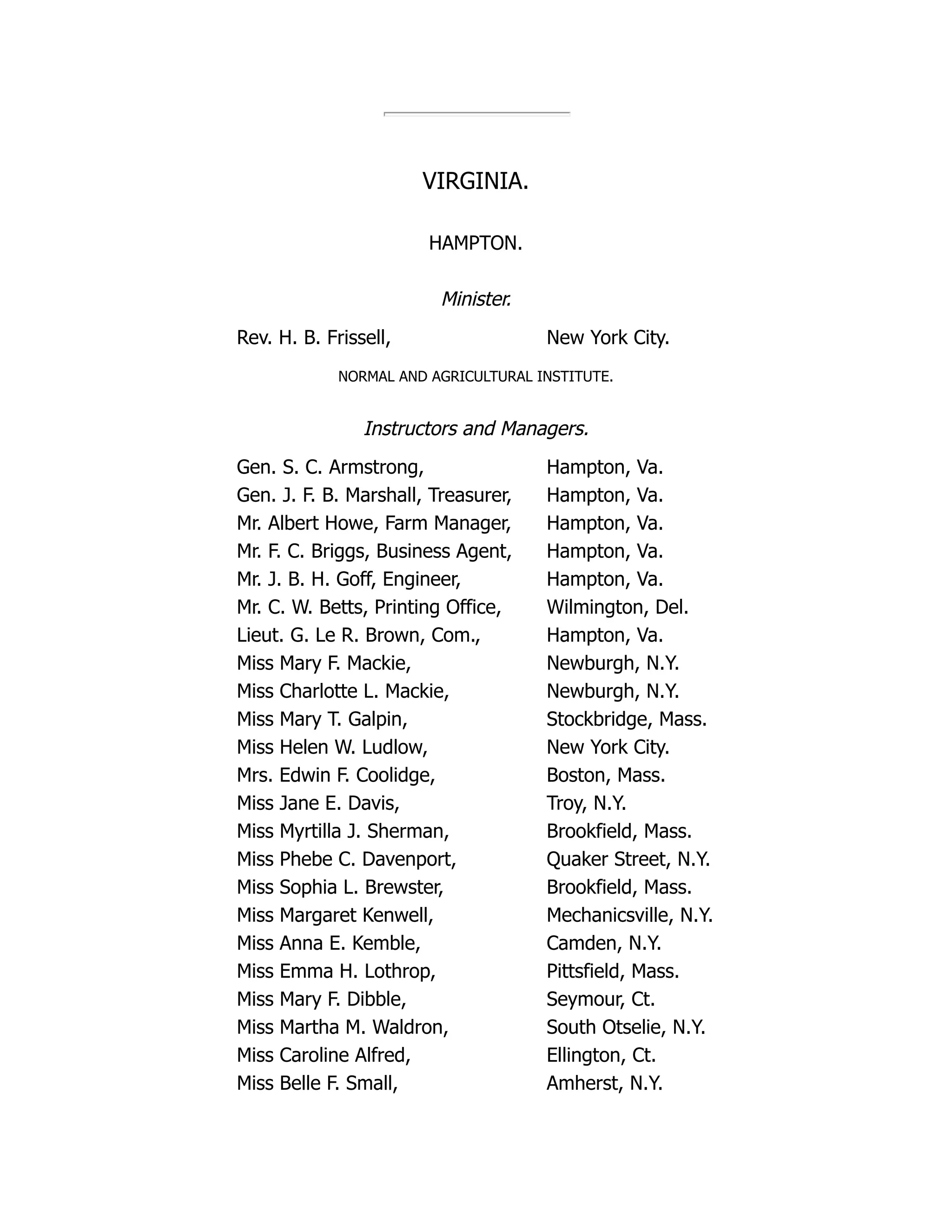
VIRGINIA.
HAMPTON.
Minister.
Rev. H. B.Frissell, New York City.
NORMAL AND AGRICULTURAL INSTITUTE.
Instructors and Managers.
Gen. S. C. Armstrong, Hampton, Va.
Gen. J. F. B. Marshall, Treasurer, Hampton, Va.
Mr. Albert Howe, Farm Manager, Hampton, Va.
Mr. F. C. Briggs, Business Agent, Hampton, Va.
Mr. J. B. H. Goff, Engineer, Hampton, Va.
Mr. C. W. Betts, Printing Office, Wilmington, Del.
Lieut. G. Le R. Brown, Com., Hampton, Va.
Miss Mary F. Mackie, Newburgh, N.Y.
Miss Charlotte L. Mackie, Newburgh, N.Y.
Miss Mary T. Galpin, Stockbridge, Mass.
Miss Helen W. Ludlow, New York City.
Mrs. Edwin F. Coolidge, Boston, Mass.
Miss Jane E. Davis, Troy, N.Y.
Miss Myrtilla J. Sherman, Brookfield, Mass.
Miss Phebe C. Davenport, Quaker Street, N.Y.
Miss Sophia L. Brewster, Brookfield, Mass.
Miss Margaret Kenwell, Mechanicsville, N.Y.
Miss Anna E. Kemble, Camden, N.Y.
Miss Emma H. Lothrop, Pittsfield, Mass.
Miss Mary F. Dibble, Seymour, Ct.
Miss Martha M. Waldron, South Otselie, N.Y.
Miss Caroline Alfred, Ellington, Ct.
Miss Belle F. Small, Amherst, N.Y.
52.
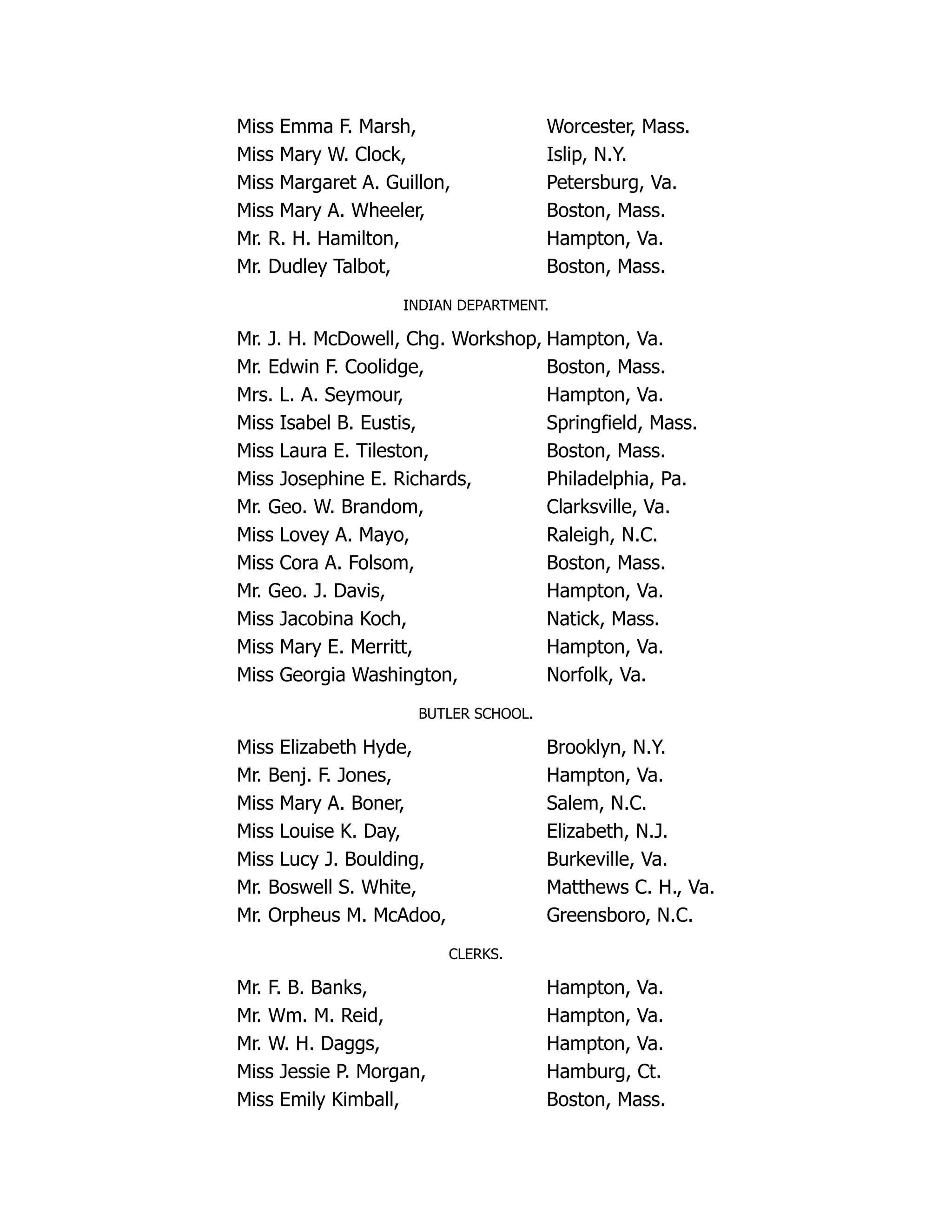
Miss Emma F.Marsh, Worcester, Mass.
Miss Mary W. Clock, Islip, N.Y.
Miss Margaret A. Guillon, Petersburg, Va.
Miss Mary A. Wheeler, Boston, Mass.
Mr. R. H. Hamilton, Hampton, Va.
Mr. Dudley Talbot, Boston, Mass.
INDIAN DEPARTMENT.
Mr. J. H. McDowell, Chg. Workshop, Hampton, Va.
Mr. Edwin F. Coolidge, Boston, Mass.
Mrs. L. A. Seymour, Hampton, Va.
Miss Isabel B. Eustis, Springfield, Mass.
Miss Laura E. Tileston, Boston, Mass.
Miss Josephine E. Richards, Philadelphia, Pa.
Mr. Geo. W. Brandom, Clarksville, Va.
Miss Lovey A. Mayo, Raleigh, N.C.
Miss Cora A. Folsom, Boston, Mass.
Mr. Geo. J. Davis, Hampton, Va.
Miss Jacobina Koch, Natick, Mass.
Miss Mary E. Merritt, Hampton, Va.
Miss Georgia Washington, Norfolk, Va.
BUTLER SCHOOL.
Miss Elizabeth Hyde, Brooklyn, N.Y.
Mr. Benj. F. Jones, Hampton, Va.
Miss Mary A. Boner, Salem, N.C.
Miss Louise K. Day, Elizabeth, N.J.
Miss Lucy J. Boulding, Burkeville, Va.
Mr. Boswell S. White, Matthews C. H., Va.
Mr. Orpheus M. McAdoo, Greensboro, N.C.
CLERKS.
Mr. F. B. Banks, Hampton, Va.
Mr. Wm. M. Reid, Hampton, Va.
Mr. W. H. Daggs, Hampton, Va.
Miss Jessie P. Morgan, Hamburg, Ct.
Miss Emily Kimball, Boston, Mass.
53.
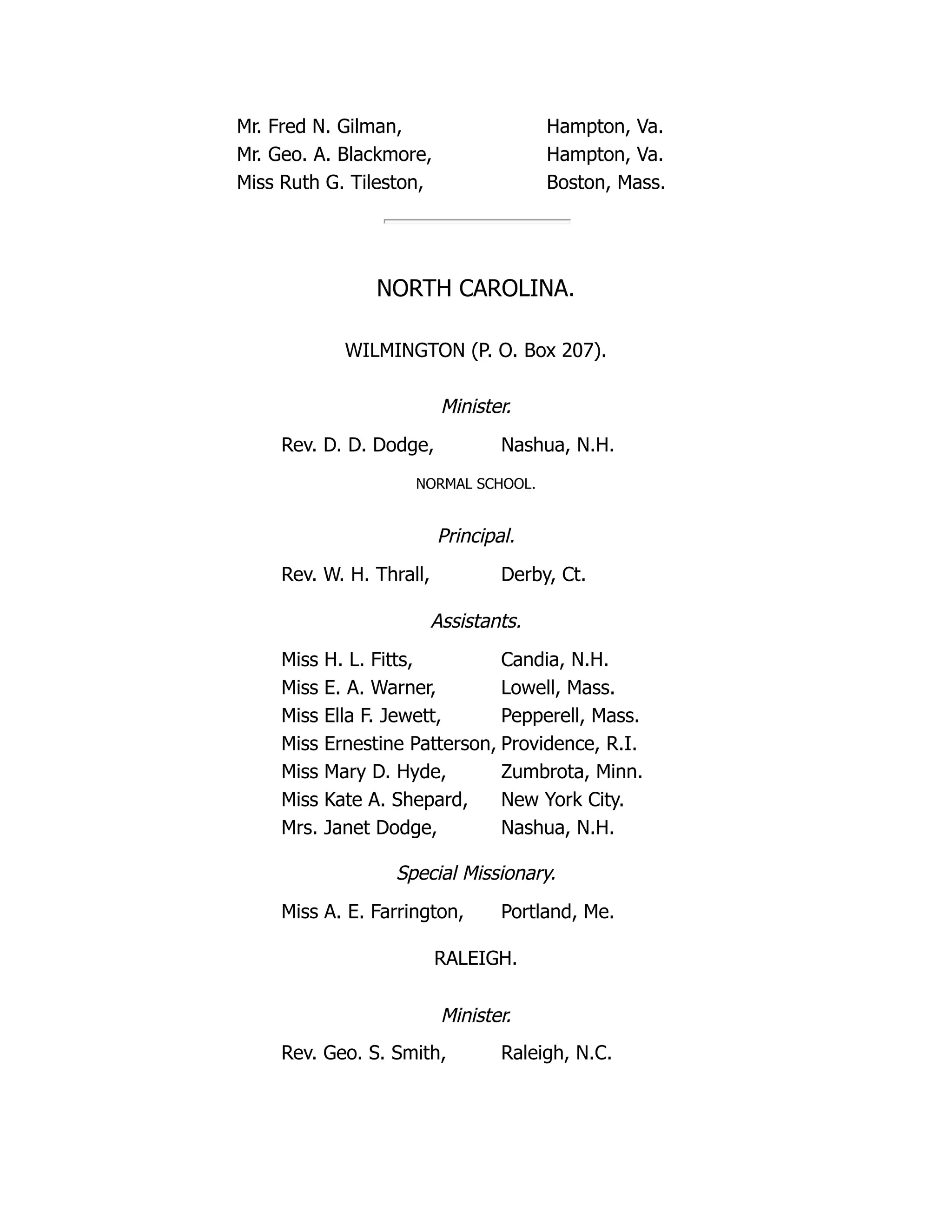
Mr. Fred N.Gilman, Hampton, Va.
Mr. Geo. A. Blackmore, Hampton, Va.
Miss Ruth G. Tileston, Boston, Mass.
NORTH CAROLINA.
WILMINGTON (P. O. Box 207).
Minister.
Rev. D. D. Dodge, Nashua, N.H.
NORMAL SCHOOL.
Principal.
Rev. W. H. Thrall, Derby, Ct.
Assistants.
Miss H. L. Fitts, Candia, N.H.
Miss E. A. Warner, Lowell, Mass.
Miss Ella F. Jewett, Pepperell, Mass.
Miss Ernestine Patterson, Providence, R.I.
Miss Mary D. Hyde, Zumbrota, Minn.
Miss Kate A. Shepard, New York City.
Mrs. Janet Dodge, Nashua, N.H.
Special Missionary.
Miss A. E. Farrington, Portland, Me.
RALEIGH.
Minister.
Rev. Geo. S. Smith, Raleigh, N.C.
54.
Welcome to ourwebsite – the perfect destination for book lovers and
knowledge seekers. We believe that every book holds a new world,
offering opportunities for learning, discovery, and personal growth.
That’s why we are dedicated to bringing you a diverse collection of
books, ranging from classic literature and specialized publications to
self-development guides and children's books.
More than just a book-buying platform, we strive to be a bridge
connecting you with timeless cultural and intellectual values. With an
elegant, user-friendly interface and a smart search system, you can
quickly find the books that best suit your interests. Additionally,
our special promotions and home delivery services help you save time
and fully enjoy the joy of reading.
Join us on a journey of knowledge exploration, passion nurturing, and
personal growth every day!
testbankbell.com



![c. high-level language
d. fourth generation language
e. both high-level and fourth generation language
ANS: E
While Java was created during the fourth generation, it is clearly also a high-level language. Machine
language is the executable language of a machine, with programs written in 1s and 0s only. Assembly
language uses mnemonics. Fourth generation languages are tools wrapped inside of programs so that
the user has the flexibility to write some code to executed from within the program.
15. Of the following, which statement is not true regarding Java as a programming language?
a. Java is a relatively recent language; it was introduced in 1995.
b. Java is a language whose programs do not require translating into machine language
before they are executed.
c. Java is an object-oriented language.
d. Java is a language that embraces the idea of writing programs to be executed with the
World Wide Web.
e. All of these are true
ANS: B
All languages require translation into machine language. The other statements are all true about Java.
16. Comments should
a. rephrase all the code to explain it in English
b. be insightful and explain the intention of an instruction or block of code
c. only be included with code that is difficult to understand
d. be used to define variables that have hard to understand names
e. All of these
ANS: B
Comments should not rephrase in English what an instruction says, but instead should explain what
that instruction is doing in relation to the program. Introductory programmers often have difficult
explaining their code and wind up stating the obvious in their comments. While answer D is partially
correct, it is not entirely true even though all variables should have comments that explain their use.
17. The main method for a Java program is defined by
a. public static main()
b. public static main(String[] args);
c. public static main(String[] args)
d. private static main(String[] args)
e. The main method could be defined by all of these except B
ANS: C
In A, the parameter is missing. The parameters are defined later in the text, but in effect, they allow
the user to run the program and include some initial arguments if the program calls for it. In B, the
semicolon at the end of the statement is not allowed. In D, private instead of public would
make the program non-executable by anyone and thus makes the definition meaningless.
18. What does the following line of Java code do?
//System.out.println("Hello");](https://image.slidesharecdn.com/43030-250615195717-faa868a0/75/Test-Bank-for-Java-Software-Solutions-9th-Edition-John-Lewis-11-2048.jpg)
![a. nothing
b. cause Hello to be output
c. cause a syntax error
d. cause ("Hello") to be output
e. There is no way to tell without executing the code.
ANS: A
The characters // denote the beginning of a comment. The comment is not compiled and so, nothing
would happen when this code is executed.
19. What comment might be added to explain the following instruction?
System.out.println("Hello World");
a. // prints "Hello World" to the screen
b. //prints a message
c. //used to demonstrate an output message
d. //
e. // meaningless instruction
ANS: C
Comments in A and B state the obvious while the comments in D and E are meaningless. The
comment in C explains why the instruction appears in the program.
20. Which character belowis not allowed in an identifier?
a. $
b. _
c. 0
d. 1
e. ^
ANS: E
Java identifiers can consist of any letter, digit, $ or _ as long as the identifier starts with a letter or _.
^ is not a legal character.
21. Which of the following is not syntactically legal in Java?
a. System.out.println("Hi");
b. public class Foo
c. s t a t i c main(String[] args)
d. {}
e. only A is legally valid; all the others are illegal
ANS: C
The Java compiler would not recognize "s t a t i c" as "static" because the Java compiler
treats white space (blanks) as separators between entities. The other statements are all legal, including
"{}" which is a block that happens to have no statements within it.
22. Which of the following is a legal Java identifier?
a. i
b. class
c. 1likeclass!](https://image.slidesharecdn.com/43030-250615195717-faa868a0/75/Test-Bank-for-Java-Software-Solutions-9th-Edition-John-Lewis-12-2048.jpg)
![e. None of these; it is not possible to represent color
ANS: B
Black and white images are stored using 0s and 1s while color images are stored using three values,
one each for the degree of red, the degree of blue, and the degree of green.
30. Which of the following characters does not need to have an associated closing character in a Java
program?
a. {
b. (
c. [
d. <
e. All of these require closing characters
ANS: D
{ is used to open a block, and so } is needed to close the block. ( is used to open an expression and
so ) is needed to close an expression. [ is used to start an array index so ] is needed to close the
array index. < is "less than" and > is "greater than" and these are not needed together, so < requires
no closing character.
31. Mistyping println as printn will result in
a. a syntax error
b. a run-time error
c. a logical error
d. no error
e. the statement being converted to a comment
ANS: A
If the Java compiler cannot make sense of a command, the compiler cannot convert it and responds
with a syntax error. While println is recognized as a command, printn is not, and so the
compiler provides a syntax error.
PROBLEM
1. What is wrong with the following class definition?
public class Program1
{
public static void main(String[ ] args)
{
System.out.println("My first Java program")
}
}
ANS:
The one executable statement in the main method is missing a ";" at the end of the line. Executable
statements end with ";".
2. What is wrong with the following class definition?
public class Program2](https://image.slidesharecdn.com/43030-250615195717-faa868a0/75/Test-Bank-for-Java-Software-Solutions-9th-Edition-John-Lewis-15-2048.jpg)
![public static void main(String[] args)
{
System.out.println("My second Java program");
}
ANS:
The definition of a class is placed within {} statements, which are missing here.
3. Given the following class definition, what are the reserved words and what are the identifiers?
public class Program3
{
public static void main(String[] args)
{
System.out.println("My third Java program");
}
}
ANS:
The reserved words are public, class, static, void. The identifiers are main, String,
System.out, Program3, and args. main is the name of a method defined within the
Program3 class. string and System.out are classes already defined in Java and println is
a method of System.out. Program3 is a class, defined here, and args is a variable.
4. Provide a brief explanation of the role of main memory, the control unit, the arithmetic logic unit, and
registers. (Refer to figure 1.13 in the text)
ANS:
Main memory is used to store the currently executing processes along with their data. The control
unit performs the fetch-decode-execute cycle, which fetches an instruction from memory, decodes it
and determines how it is to be executed. The arithmetic logic unit comprises a number of circuits that
execute arithmetic and logic instructions. Registers are used to store values in the CPU temporarily
while the current instruction(s) need them.
5. What is the output of the following code when the main method is executed?
public class Question4
{
public static void main(String[] args)
{
System.out.println("hi there");
System.out.println(" ");
System.out.println("how are you doing today? ");
}
}
ANS:
hi there
how are you doing today?](https://image.slidesharecdn.com/43030-250615195717-faa868a0/75/Test-Bank-for-Java-Software-Solutions-9th-Edition-John-Lewis-16-2048.jpg)
![Notice that while the Java compiler ignores "white space", blanks that appear in a println statement
inside of quote marks are retained and output in that manner.
6. What is wrong with the following println statement?
System.out.println("My fourth Java Program);
ANS:
It is missing a closing ". The compiler will look for a second " before the end of the statement. So,
like {}, (), and [], an initial " must have a corresponding closing ".
7. Provide identifier names that would be used to represent a person's social security number, income tax
withheld, and net pay.
ANS:
socialSecurityNumber, or ssn, incomeTaxWithheld or incomeTax, and netPay all
would be reasonable.
8. There are a number of reserved words in Java that have no current meaning (denoted with an * in
figure 1.18 in the text). Why?
ANS:
Java language designers anticipate introducing these statements in future versions, but have not yet
implemented them because they are lower priority, or it has not been decided how they will be
implemented or precisely what they will mean.
9. A document of text is 15 pages long. Each page contains approximately 200 words and the average
length of each word is 5 characters. Also assume one blank space between each word and no
punctuation. How many bytes will it take to store this document in memory or on disk using ASCII?
ANS:
A character is stored in ASCII using 8 bits or 1 byte. Therefore, 5 characters per word plus 1 blank
space between words take 6 bytes per word (except for the first). Each page stores 200 words and
there are 15 pages. So we need 15 * 200 * 6 - 1 (no blank space to start the text) = 17,999 bytes
which is 17.58 kilobytes, or nearly 18 Kbytes.
10. Provide a brief description of the roles of the following hardware elements (that is, what each is used
for):
a) CPU
b) Main memory
c) Secondary memory devices
d) Input/Output devices
ANS:
a) The CPU is the processor. It executes all program instructions. It does this through the fetch-
decode-execute cycle where the next program instruction is fetched from memory, decoded in the
CPU, and then executed by one or more circuits.
b) Main memory is stored on chips on the motherboard and is used for quick access to the current
program for the fetch-decode-execute cycle and to store data being used by this program.](https://image.slidesharecdn.com/43030-250615195717-faa868a0/75/Test-Bank-for-Java-Software-Solutions-9th-Edition-John-Lewis-17-2048.jpg)
![c) Secondary memory devices are storage devices, used to store programs and data not currently
being used. Storage devices, such as the hard disk, also are used to store things for permanence and
archives.
d) Input/Output devices are used to communicate with the computer. Input devices, like the
keyboard, take commands and data from the user and output devices, like the monitor, display the
results of the process/computation.
11. Examine figure 1.7 before answering this question. What 8-bit value comes immediately before and
what 8-bit value comes immediately after 10010111?
ANS:
10010110 comes immediately before 10010111 and 10010100 comes immediately after
10010111.
12. Rewrite the following comment so that is can appear over multiple lines.
// This is one really enormously long comment that might run off
the page
ANS:
We can do this in two ways, preceding each line with // or by enclosing the comment in /* and */.
/* This is one really enormously
long comment that might run
off the page */
or
// This is one really enormously
// long comment that might run
// off the page
13. Rewrite the following program with better formatting to make it easier to read.
public
class
MyProgram
{ public static void
main(
String[]
args)
{ System.out.println(
"Wow, this is messed up!"
);
} }
ANS:
There are many ways this program might appear. The following would be very acceptable:
public class MyProgram
{
public static void main(String[] args)
{](https://image.slidesharecdn.com/43030-250615195717-faa868a0/75/Test-Bank-for-Java-Software-Solutions-9th-Edition-John-Lewis-18-2048.jpg)
![System.out.println("Wow, this is messed up!");
}
}
14. Write a Java program that will output on two separate lines the names of the authors of this textbook.
ANS:
public class OutputNames
{
public static void main(String[] args)
{
System.out.println("John Lewis"); // 1st author's name
System.out.println("William Loftus");// 2nd author's name
}
}
15. Correct all the syntax errors in the following program.
Public Class Program A problem program
(
Public static voided main[Strings() args]
{
system.out.println('This program'); * oh, my... *
system.out.println('has several syntax errors'); *
lots of errors *
}
)
ANS:
public class Program // A problem program
{
public static void main(String[] args)
{
System.out.println("This program"); /* oh, my... */
System.out.println("has several syntax errors"); /*
lots of errors */
}
}
16. Write a Java program that will display the following three lines when it is run:
*
* * *
* * * * *
ANS:
public class Stars
{
public static void main(String[] args)
{
System.out.println(" *");
System.out.println(" * * *");
System.out.println("* * * * *");
}
}](https://image.slidesharecdn.com/43030-250615195717-faa868a0/75/Test-Bank-for-Java-Software-Solutions-9th-Edition-John-Lewis-19-2048.jpg)



![This ebook is for the use of anyone anywhere in the United
States and most other parts of the world at no cost and with
almost no restrictions whatsoever. You may copy it, give it away
or re-use it under the terms of the Project Gutenberg License
included with this ebook or online at www.gutenberg.org. If you
are not located in the United States, you will have to check the
laws of the country where you are located before using this
eBook.
Title: The American Missionary — Volume 37, No. 2, February,
1883
Author: Various
Release date: September 17, 2019 [eBook #60314]
Most recently updated: October 17, 2024
Language: English
Credits: Produced by Joshua Hutchinson, KarenD and the Online
Distributed Proofreading Team at http://www.pgdp.net
(This
file was produced from images generously made
available
by Cornell University Digital Collections)
*** START OF THE PROJECT GUTENBERG EBOOK THE AMERICAN
MISSIONARY — VOLUME 37, NO. 2, FEBRUARY, 1883 ***](https://image.slidesharecdn.com/43030-250615195717-faa868a0/75/Test-Bank-for-Java-Software-Solutions-9th-Edition-John-Lewis-26-2048.jpg)