





Marketing du point
de vente
•

Introduction

•

Historical and place on the market
•
•

•

Historical
The market: Topologu an data

Different ways of distribution
•

The stores

•

Internet

•

The innovations

•

Conclusion
•

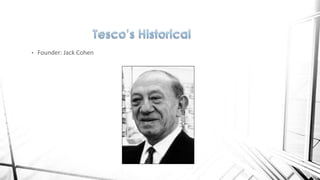
Founder: Jack Cohen
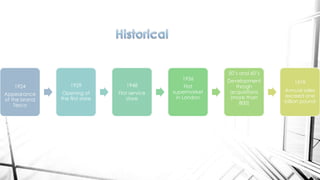
1956
1924

1929

1948

Appearance
of the brand
Tesco

Opening of
the first store

First service
store

First
supermarket
in London

50’s and 60’s
Development
throgh
acquisitions
(more than
800)

1979
Annual sales
exceed one
billion pound
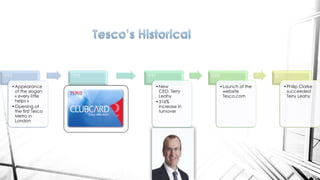
1992
•Appearance
of the slogan
« every little
helps »
•Opening of
the first Tesco
Metro in
London

1995

1997
•New
CEO, Terry
Leahy
•316%
increase in
turnover

2000
•Launch of the
website
Tesco.com

2011
•Philip Clarke
succeeded
Terry Leahy
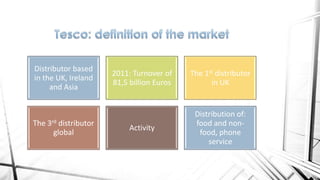
Distributor based
in the UK, Ireland
and Asia

The 3rd distributor
global

2011: Turnover of
81,5 billion Euros

The 1st distributor
in UK

Activity

Distribution of:
food and nonfood, phone
service
•

•

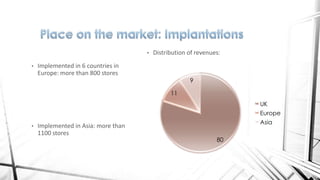
Distribution of revenues:

Implemented in 6 countries in
Europe: more than 800 stores

9
11
UK
Europe

•

Implemented in Asia: more than
1100 stores

Asia
80
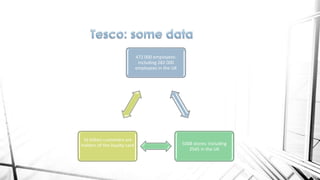
472 000 employees:
including 282 000
employees in the UK

16 billion customers are
holders of the loyalty card

5008 stores: including
2545 in the UK
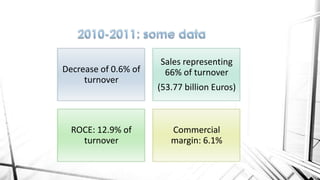
Decrease of 0.6% of
turnover

ROCE: 12.9% of
turnover

Sales representing
66% of turnover
(53.77 billion Euros)

Commercial
margin: 6.1%
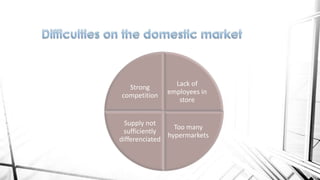
Strong
competition

Lack of
employees in
store

Supply not
Too many
sufficiently
hypermarkets
differenciated
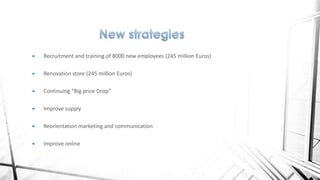
Recruitment and training of 8000 new employees (245 million Euros)
Renovation store (245 million Euros)
Continuing “Big price Drop”

Improve supply
Reorientation marketing and communication
Improve online
•

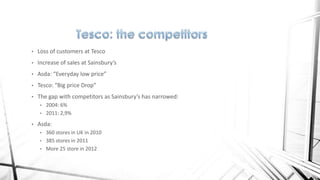
Loss of customers at Tesco

•

Increase of sales at Sainsbury’s

•

Asda: “Everyday low price”

•

Tesco: “Big price Drop”

•

The gap with competitors as Sainsbury’s has narrowed:
•
•

•

2004: 6%
2011: 2,9%

Asda:
•
•
•

360 stores in UK in 2010
385 stores in 2011
More 25 store in 2012
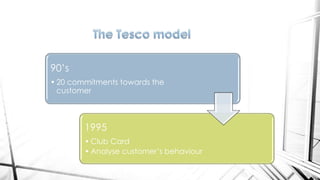
90’s
• 20 commitments towards the
customer

1995
• Club Card
• Analyse customer’s behaviour
•

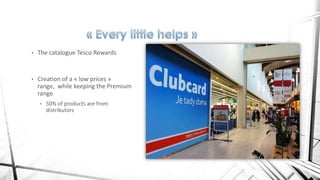
The catalogue Tesco Rewards

•

Creation of a « low prices »
range, while keeping the Premium
range
•

50% of products are from
distributors
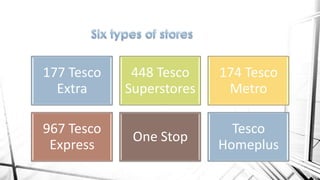
177 Tesco
Extra
967 Tesco
Express

448 Tesco
Superstores

174 Tesco
Metro

One Stop

Tesco
Homeplus
•

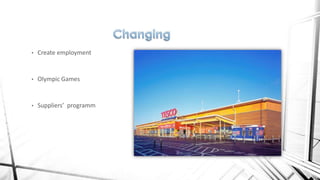
Create employment

•

Olympic Games

•

Suppliers’ programm
•

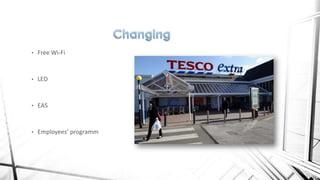
Free Wi-Fi

•

LED

•

EAS

•

Employees’ programm
•

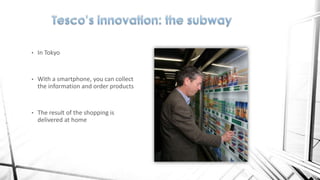
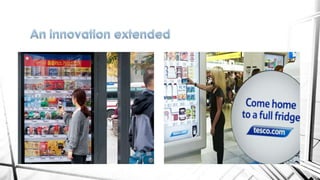
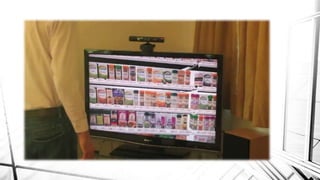
In Tokyo

•

With a smartphone, you can collect
the information and order products

•

The result of the shopping is
delivered at home
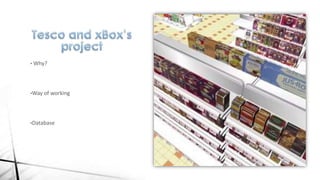
• Why?

•Way of working

•Database
•

Place on the market

•

Different ways of distribution, in order to extend the offer

•

Various ways of innovation
Strengths

Weaknesses
Opportunities

Threatens

Tesco