For many years, CBI has raised concern that only a small number of captive insurance companies participating in the program respond to Treasury’s compulsory data calls such as the one subject to this Notice. Treasury has been generally dismissive of CBI’s concerns. CBI again raises this concern coupled supported by data from the National Association of Insurance Commissioners and Treasury’s own analysis suggesting that Treasury’s data collection reaches at most one-third of all participating captive insurers.
Captive insurance companies are insurers formed to insure the risks of their corporate owners. Because only large businesses have the resources to form captives, captive insurance company performance under the program is a fair proxy for determining the extent to which program benefits flow to large corporations (i.e., through their participating captives) or to small and medium businesses (i.e., through traditional insurers).
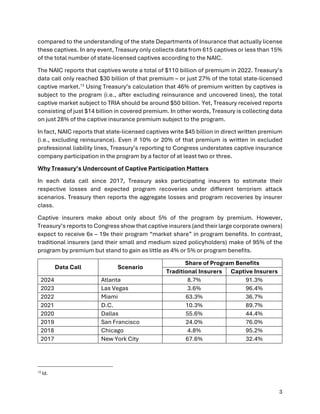
While representing a relatively small amount of direct written premium covered by the program, captives play an outsized role in the receipt of potential benefits under the program. Based on Treasury’s own reporting, captives represent a mere 5% of the program’s premium but are expected to receive up to 95% of any benefits paid out under the program. Given the low response rate of captives to Treasury’s data call, even this extraordinary proportion understates the dominance of captive insurance companies (and of their large corporate parents) in the consumption of program benefits.
More complete collection of data from captive insurers would surely reveal that closer to 99% of program benefits flow to large corporations through their participating captive insurance subsidiaries, while small and medium sized businesses receive nearly no benefits under the program. CBI suggests that through outreach to state licensed or registered captive managers Treasury would be in a better position to fulfill its statutory mandate to report on the effectiveness of the program.



![Aba On Captives[1]](https://cdn.slidesharecdn.com/ss_thumbnails/abaoncaptives1-13105274119087-phpapp01-110712222513-phpapp01-thumbnail.jpg?width=640&height=640&fit=bounds)


