TThheerrmmooccoouupplleess
AAddvvaannttaaggeess DDiissaaddvvaannttaaggeess
Simple, Rugged
High temperature
operation
Low cost
No resistance lead wire
problems
Point temperature sensing
Fastest response to
temperature changes
Least stable, least
repeatable
Low sensitivity to small
temperature changes
Extension wire must be of
the same thermocouple
type
Wire may pick up radiated
electrical noise if not
shielded
Lowest accuracy
RRTTDDss
AAddvvaannttaaggeess DDiissaaddvvaannttaaggeess
► Most stable over time
► Most accurate
► Most repeatable
temperature measurement
► Very resistant to
contamination/
► corrosion of the RTD
element
► High cost
► Slowest response time
► Low sensitivity to small
temperature changes
► Sensitive to vibration
(strains the platinum
element wire)
► Decalibration if used
beyond sensor’s
temperature ratings
► Somewhat fragile
10.
TThheerrmmiissttoorrss
► Asemiconductor used as a temperature sensor.
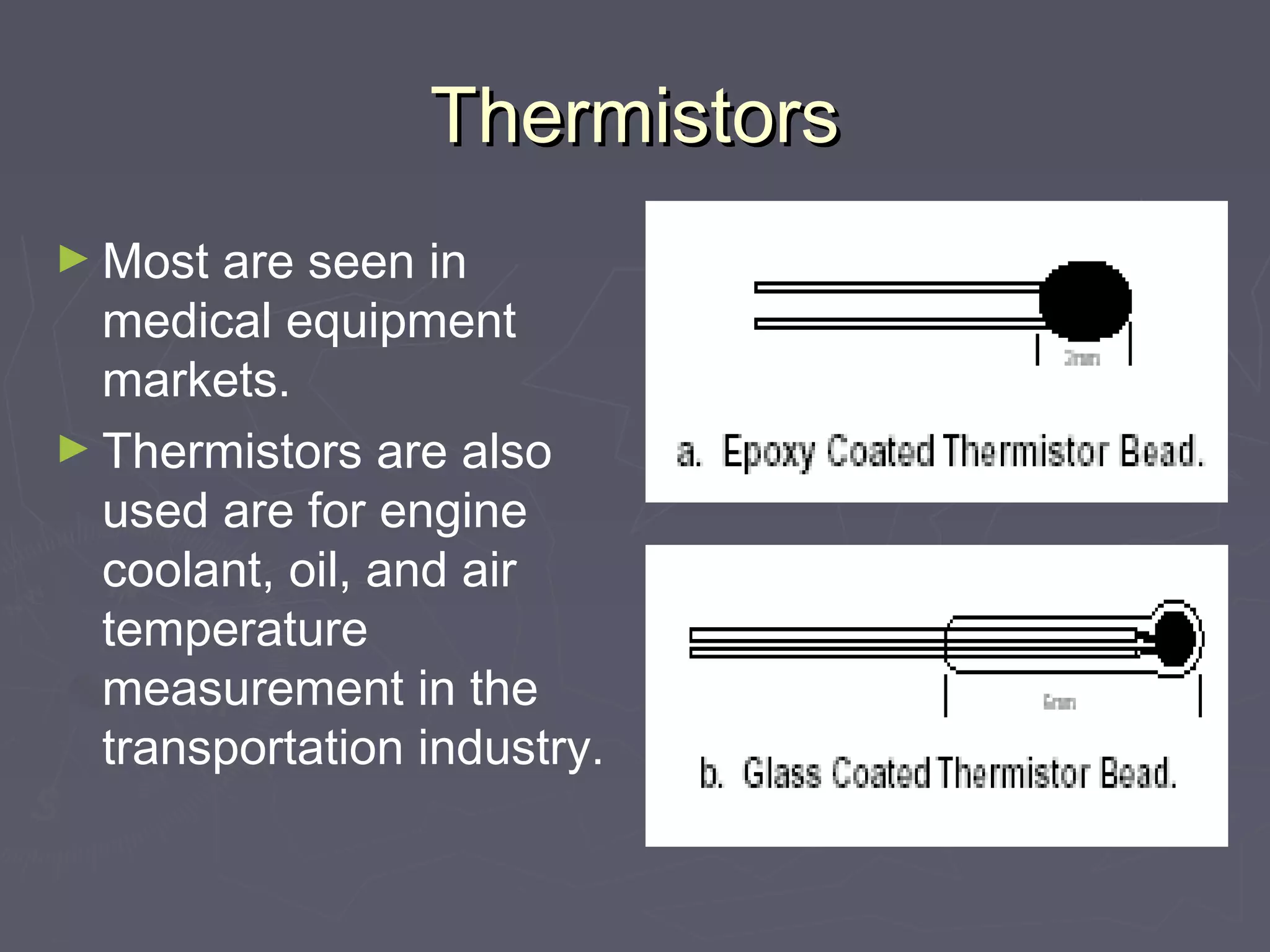
► Mixture of metal oxides pressed into a bead, wafer or other
shape.
► Beads can be very small, less than 1 mm in some cases.
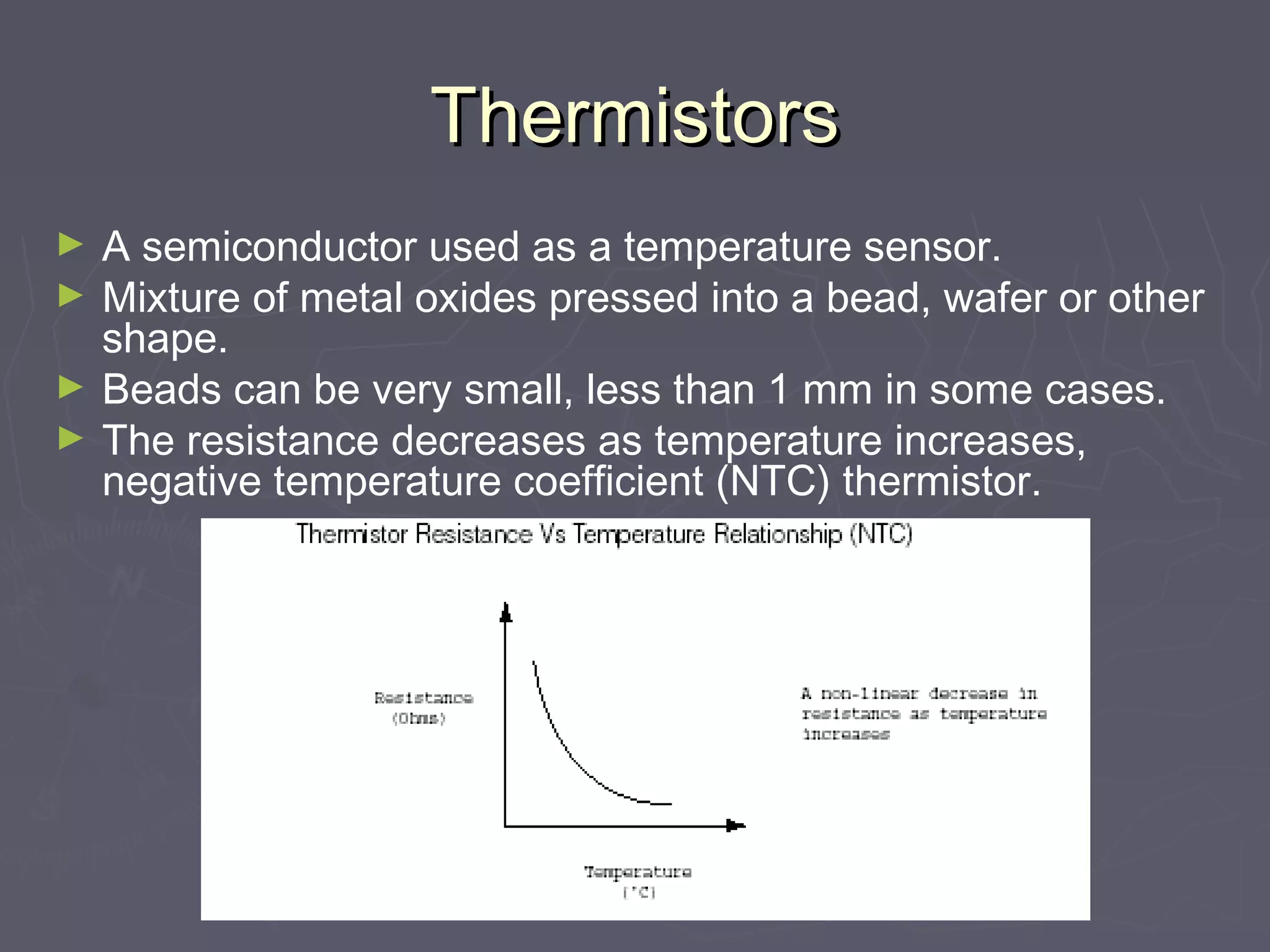
► The resistance decreases as temperature increases,
negative temperature coefficient (NTC) thermistor.
11.
TThheerrmmiissttoorrss
►Most areseen in
medical equipment
markets.
►Thermistors are also
used are for engine
coolant, oil, and air
temperature
measurement in the
transportation industry.
12.
TThheerrmmiissttoorrss
AAddvvaannttaaggeess DDiissaaddvvaannttaaggeess
►High sensitivity to
small temperature
changes
►Temperature
measurements
become more stable
with use
►Copper or nickel
extension wires can be
used
►Limited temperature
range
►Fragile
►Some initial accuracy
“drift”
►Decalibration if used
beyond the sensor’s
temperature ratings
►Lack of standards for
replacement
13.
IInnffrraarreedd SSeennssoorrss
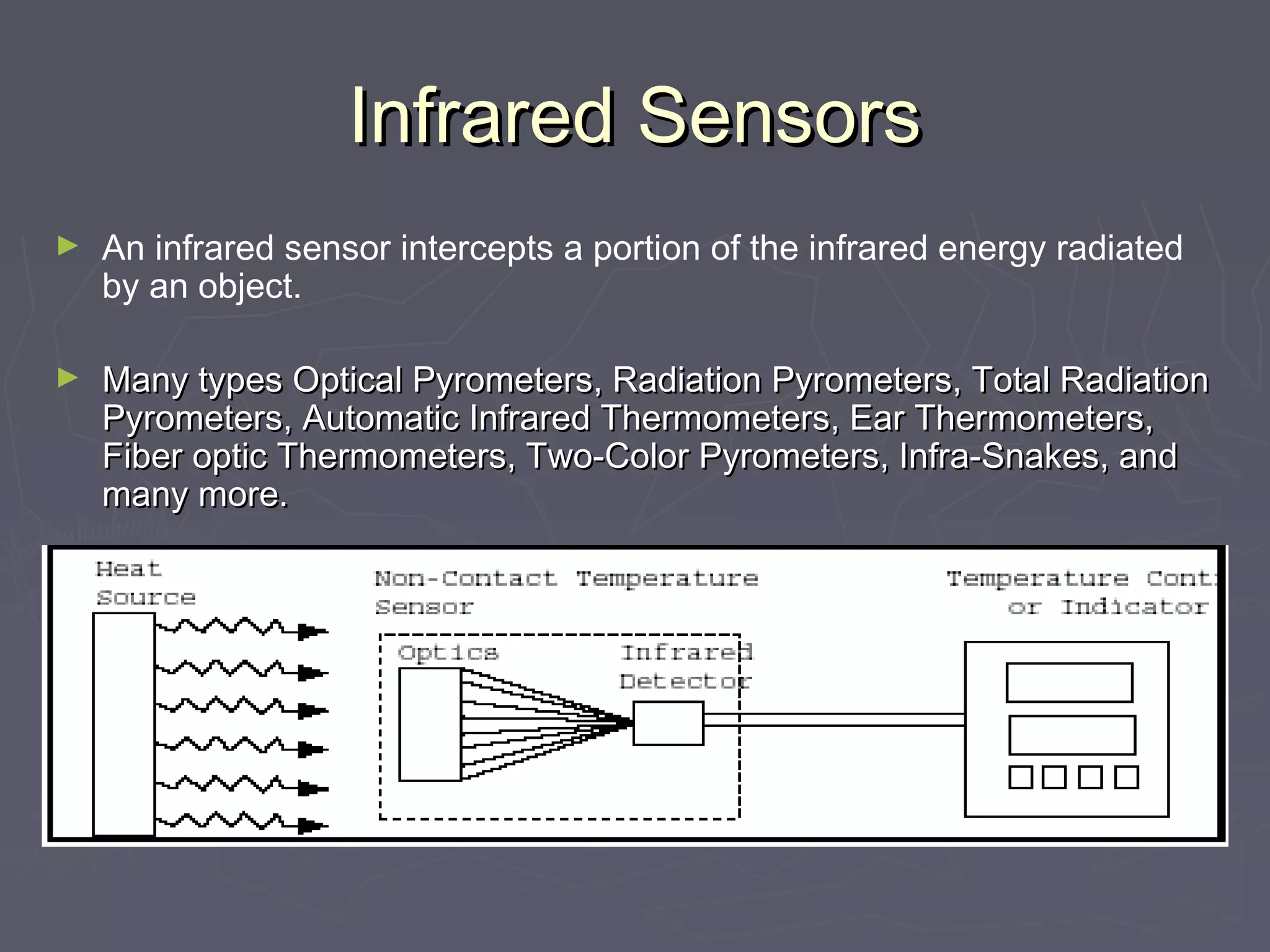
►An infrared sensor intercepts a portion of the infrared energy radiated
by an object.
► MMaannyy ttyyppeess OOppttiiccaall PPyyrroommeetteerrss,, RRaaddiiaattiioonn PPyyrroommeetteerrss,, TToottaall RRaaddiiaattiioonn
PPyyrroommeetteerrss,, AAuuttoommaattiicc IInnffrraarreedd TThheerrmmoommeetteerrss,, EEaarr TThheerrmmoommeetteerrss,,
FFiibbeerr ooppttiicc TThheerrmmoommeetteerrss,, TTwwoo--CCoolloorr PPyyrroommeetteerrss,, IInnffrraa--SSnnaakkeess,, aanndd
mmaannyy mmoorree..
IInnffrraarreedd SSeennssoorrss
AAddvvaannttaaggeessDDiissaaddvvaannttaaggeess
► No contact with the
product required
► Response times as fast or
faster than thermocouples
► No corrosion or oxidation
to affect sensor accuracy
► Good stability over time
► High repeatability
► High initial cost
► More complex - support
electronics required
► Emissivity variations affect
temperature measurement
accuracy
► Field of view and spot size
may restrict sensor
application
► Measuring accuracy
affected by dust, smoke,
background
► radiation, etc.