TELSTRA & AUSTRALIA POST
IN A DIGITAL ECONOMY
Oliver Romanes
Email: oromanes@icloud.com
TODAY’S PRESENTATION
 What works in business?
 Nohria 4 + 2
 Drucker:The theory of business
 Telstra and Australia Post in a digital economy
 Winning or losing… and why?
 What’s in it for libraries?
A DIGITAL ECONOMY
Underpinned by: rapid change, rapid access
$10.2bn
Discount Department Stores
$18bn
Online Shopping
$79bn
Integrated Logistics
DIGITAL EVOLUTION
BUSINESS
 200 well established management
practices
 10 years (1986-1996)
 160 companies (private industry)
What really works?
Nohria et al. (2003)
Harvard Business Review
 No causal relationships with management
practice and business success
 Imperative: business basics (90% success
rate)
Findings
4 (PRIMARY PRACTICES) + 2
EXECUTION
Develop and maintain
flawless operational
execution
STRATEGY
Devise and maintain a
clearly stated, focused
strategy
CULTURE
Develop and maintain a
performance-oriented
culture
STRUCTURE
Build and maintain a
fast, flexible, flat
organisation
4 + 2 (SECONDARY PRACTICES)
LEADERSHIP
Choosing great
Chief Executives can raise
performance significantly
TALENT
Hold onto talented
employees and develop
more
INNOVATION
Agility = innovative
products and services
MERGERS &
PARTNERSHIPS
Seek growth through mergers and
partnerships (complimentary)
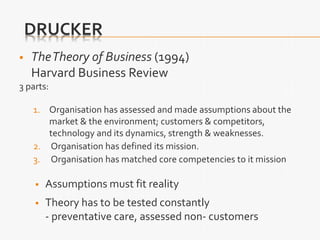
DRUCKER
 TheTheory of Business (1994)
Harvard Business Review
3 parts:
1. Organisation has assessed and made assumptions about the
market & the environment; customers & competitors,
technology and its dynamics, strength & weaknesses.
2. Organisation has defined its mission.
3. Organisation has matched core competencies to it mission
 Assumptions must fit reality
 Theory has to be tested constantly
- preventative care, assessed non- customers
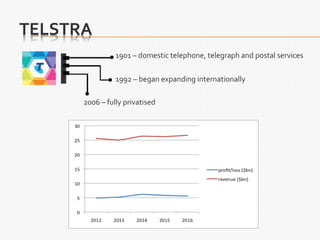
TELSTRA
1901 – domestic telephone, telegraph and postal services
1992 – began expanding internationally
2006 – fully privatised
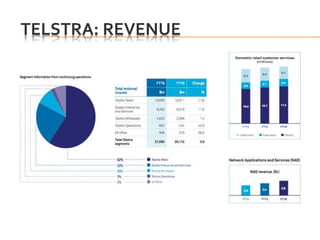
TELSTRA: REVENUE
TELSTRA:THE FUTURE
Strategic Directions
Telecommunications
Technology
• improve customer advocacy
• drive value and growth from the core
• build new growth businesses
AUSTRALIA POST
Oldest continuing organisation in Australia (1809)
Private company (1989)
Single shareholder – Australian Government
Community service obligations (regulations)
AUSTRALIA POST
AUSTRALIA POST:THE FUTURE
Vision
Postal Service
eCommerce
Delivering eCommerce:
• Everyone
• Everywhere
• Everyday
LIBRARIES OFTHE FUTURE?
SUMMARY
Are libraries:
 businesses?
 community service organisations?
 a combination of both?
Managers and Executives:
What’s your 4 + 2?
What’s your theory of business? Does it fit reality?
Staff:
Do you know your organisation’s core business and message?
What’s your role in your 4 + 2?
TELSTRA & AUSTRALIA POST
IN A DIGITAL ECONOMY
Oliver Romanes
Email: oromanes@icloud.com

Telstra & au post final1

  • 1.
    TELSTRA & AUSTRALIAPOST IN A DIGITAL ECONOMY Oliver Romanes Email: oromanes@icloud.com
  • 2.
    TODAY’S PRESENTATION  Whatworks in business?  Nohria 4 + 2  Drucker:The theory of business  Telstra and Australia Post in a digital economy  Winning or losing… and why?  What’s in it for libraries?
  • 3.
    A DIGITAL ECONOMY Underpinnedby: rapid change, rapid access $10.2bn Discount Department Stores $18bn Online Shopping $79bn Integrated Logistics
  • 4.
  • 5.
    BUSINESS  200 wellestablished management practices  10 years (1986-1996)  160 companies (private industry) What really works? Nohria et al. (2003) Harvard Business Review  No causal relationships with management practice and business success  Imperative: business basics (90% success rate) Findings
  • 6.
    4 (PRIMARY PRACTICES)+ 2 EXECUTION Develop and maintain flawless operational execution STRATEGY Devise and maintain a clearly stated, focused strategy CULTURE Develop and maintain a performance-oriented culture STRUCTURE Build and maintain a fast, flexible, flat organisation
  • 7.
    4 + 2(SECONDARY PRACTICES) LEADERSHIP Choosing great Chief Executives can raise performance significantly TALENT Hold onto talented employees and develop more INNOVATION Agility = innovative products and services MERGERS & PARTNERSHIPS Seek growth through mergers and partnerships (complimentary)
  • 8.
    DRUCKER  TheTheory ofBusiness (1994) Harvard Business Review 3 parts: 1. Organisation has assessed and made assumptions about the market & the environment; customers & competitors, technology and its dynamics, strength & weaknesses. 2. Organisation has defined its mission. 3. Organisation has matched core competencies to it mission  Assumptions must fit reality  Theory has to be tested constantly - preventative care, assessed non- customers
  • 9.
    TELSTRA 1901 – domestictelephone, telegraph and postal services 1992 – began expanding internationally 2006 – fully privatised
  • 10.
  • 11.
    TELSTRA:THE FUTURE Strategic Directions Telecommunications Technology •improve customer advocacy • drive value and growth from the core • build new growth businesses
  • 12.
    AUSTRALIA POST Oldest continuingorganisation in Australia (1809) Private company (1989) Single shareholder – Australian Government Community service obligations (regulations)
  • 13.
  • 14.
    AUSTRALIA POST:THE FUTURE Vision PostalService eCommerce Delivering eCommerce: • Everyone • Everywhere • Everyday
  • 15.
  • 16.
    SUMMARY Are libraries:  businesses? community service organisations?  a combination of both? Managers and Executives: What’s your 4 + 2? What’s your theory of business? Does it fit reality? Staff: Do you know your organisation’s core business and message? What’s your role in your 4 + 2?
  • 17.
    TELSTRA & AUSTRALIAPOST IN A DIGITAL ECONOMY Oliver Romanes Email: oromanes@icloud.com

Editor's Notes

  • #3 Introduce self: Physiotherapist, 15 years – not for profit health sector. Last 5 years as a manager. MBA.
  • #4 Fuelled by an internet savvy world Underpinned by connectivity AND easy access – TIME poor, changing society Rapid change: walkman, discman. Minidiscman, iPod Grocery shopping Driverless cars
  • #5 Examples of change
  • #6 Ideas and innovations didn’t just come from nowhere…. Business successes are always built on strong foundations Questions: not to answer now but to stimulate your thinking about where to for library’s and how they can stay relevant, competitive and viable in a low funding world.
  • #7 Strategy: Consistently communicate to customers, employees, stakeholders -Simple value proposition to target customers & realistic appraisal of your capacity Execution: -Disciplined attention to operations is what counts Culture: -high level performance (team and individual) and ethical behaviour -hold employees and managers responsible for success Structure: Trim red tape Structures & processes simple for employees & customers
  • #8 Leadership: Management focus on connection with all levels Innovation: Anticipate disruptive events rather than reacting
  • #9 Valid theory that is clear, consistent, and focused is extremely powerful Applies equally to for profit and not for profit businesses Every theory of business becomes obsolete Assumptions the 3 areas must fit each other
  • #10 *Got lucky: Inherited infrastructure
  • #12 Basis of accessibility and the best network. 42% market share NPS every time Telstra Air – internationally millions and domestically thousands NPS - 10m surveys, 50m calls
  • #13 *Got lucky: Inherited infrastructure
  • #15 Basis of accessibility and the best network. 42% market share NPS every time Telstra Air – internationally millions and domestically thousands NPS - 10m surveys, 50m calls
  • #17 Are libraries a business? Or a mix? What’s your purpose? Community hub? Creative hub? How do we entice the next generation into our libraries when the next generation just ‘Google it’? How can we attract new customers to our libraries through digital technology?