ELPS-TELPAS Proficiency LevelDescriptors
Texas Education Agency
Student Assessment Division
August 2024
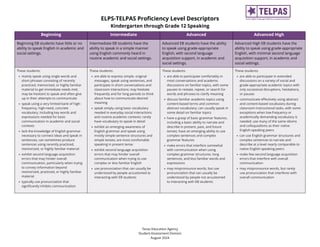
Kindergarten through Grade 12 Listening
Beginning Intermediate Advanced Advanced High
Beginning EB students have little or no
ability to understand spoken English
used in academic and social settings.
Intermediate EB students have the
ability to understand simple, high-
frequency spoken English used in
routine academic and social settings.
Advanced EB students have the ability
to understand, with second language
acquisition support, grade-appropriate
spoken English used in academic and
social settings.
Advanced High EB students have the
ability to understand, with minimal
second language acquisition support,
grade-appropriate spoken English used
in academic and social settings.
These students:
• struggle to understand simple
conversations and simple discussions
even when the topics are familiar and the
speaker uses linguistic supports (e.g.,
visuals, slower speech and other verbal
cues, gestures)
• struggle to identify and distinguish
individual words and phrases during
social and instructional interactions that
have not been intentionally modified for
EB students
• may not seek clarification in English when
failing to comprehend the English they
hear; frequently remain silent, watching
others for cues
These students:
• usually understand simple or routine
directions, as well as short, simple
conversations and short, simple
discussions on familiar topics; when
topics are unfamiliar, require extensive
linguistic supports and adaptations (e.g.,
visuals, slower speech and other verbal
cues, simplified language, gestures, pre-
teaching to preview or build topic-related
vocabulary)
• often identify and distinguish key words
and phrases necessary to understand the
general meaning (gist) during social and
basic instructional interactions that have
not been intentionally modified for EB
students
• have the ability to seek clarification in
English when failing to comprehend the
English they hear by requiring/requesting
the speaker to repeat, slow down, or
rephrase speech
These students:
• usually understand longer, more
elaborated directions, conversations, and
discussions on familiar and some
unfamiliar topics, but sometimes need
processing time and sometimes depend
on visuals, verbal cues, and gestures to
support understanding
• understand most main points, most
important details, and some implicit
information during social and basic
instructional interactions that have not
been intentionally modified for EB
students
• occasionally require/request the speaker
to repeat, slow down, or rephrase to
clarify the meaning of the English they
hear
These students:
• understand longer, elaborated directions,
conversations, and discussions on
familiar and unfamiliar topics with only
occasional need for processing time and
with little dependence on visuals, verbal
cues, and gestures; some exceptions
when complex academic or highly
specialized language is used
• understand main points, important
details, and implicit information at a level
nearly comparable to native English-
speaking peers during social and
instructional interactions
• rarely require/request the speaker to
repeat, slow down, or rephrase to clarify
the meaning of the English they hear
2.
ELPS-TELPAS Proficiency LevelDescriptors
Texas Education Agency
Student Assessment Division
August 2024
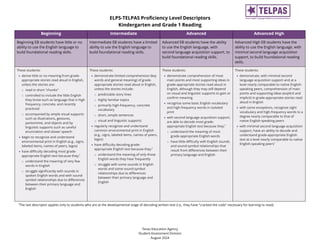
Kindergarten through Grade 12 Speaking
Beginning Intermediate Advanced Advanced High
Beginning EB students have little or no
ability to speak English in academic and
social settings.
Intermediate EB students have the
ability to speak in a simple manner
using English commonly heard in
routine academic and social settings.
Advanced EB students have the ability
to speak using grade-appropriate
English, with second language
acquisition support, in academic and
social settings.
Advanced High EB students have the
ability to speak using grade-appropriate
English, with minimal second language
acquisition support, in academic and
social settings.
These students:
• mainly speak using single words and
short phrases consisting of recently
practiced, memorized, or highly familiar
material to get immediate needs met;
may be hesitant to speak and often give
up in their attempts to communicate
• speak using a very limited bank of high-
frequency, high-need, concrete
vocabulary, including key words and
expressions needed for basic
communication in academic and social
contexts
• lack the knowledge of English grammar
necessary to connect ideas and speak in
sentences; can sometimes produce
sentences using recently practiced,
memorized, or highly familiar material
• exhibit second language acquisition
errors that may hinder overall
communication, particularly when trying
to convey information beyond
memorized, practiced, or highly familiar
material
• typically use pronunciation that
significantly inhibits communication
These students:
• are able to express simple, original
messages, speak using sentences, and
participate in short conversations and
classroom interactions; may hesitate
frequently and for long periods to think
about how to communicate desired
meaning
• speak simply using basic vocabulary
needed in everyday social interactions
and routine academic contexts; rarely
have vocabulary to speak in detail
• exhibit an emerging awareness of
English grammar and speak using
mostly simple sentence structures and
simple tenses; are most comfortable
speaking in present tense
• exhibit second language acquisition
errors that may hinder overall
communication when trying to use
complex or less familiar English
• use pronunciation that can usually be
understood by people accustomed to
interacting with EB students
These students:
• are able to participate comfortably in
most conversations and academic
discussions on familiar topics, with some
pauses to restate, repeat, or search for
words and phrases to clarify meaning
• discuss familiar academic topics using
content-based terms and common
abstract vocabulary; can usually speak in
some detail on familiar topics
• have a grasp of basic grammar features,
including a basic ability to narrate and
describe in present, past, and future
tenses; have an emerging ability to use
complex sentences and complex
grammar features
• make errors that interfere somewhat
with communication when using
complex grammar structures, long
sentences, and less familiar words and
expressions
• may mispronounce words, but use
pronunciation that can usually be
understood by people not accustomed
to interacting with EB students
These students:
• are able to participate in extended
discussions on a variety of social and
grade-appropriate academic topics with
only occasional disruptions, hesitations,
or pauses
• communicate effectively using abstract
and content-based vocabulary during
classroom instructional tasks, with some
exceptions when low-frequency or
academically demanding vocabulary is
needed; use many of the same idioms
and colloquialisms as their native
English-speaking peers
• can use English grammar structures and
complex sentences to narrate and
describe at a level nearly comparable to
native English-speaking peers
• make few second language acquisition
errors that interfere with overall
communication
• may mispronounce words, but rarely
use pronunciation that interferes with
overall communication
3.
ELPS-TELPAS Proficiency LevelDescriptors
Texas Education Agency
Student Assessment Division
August 2024
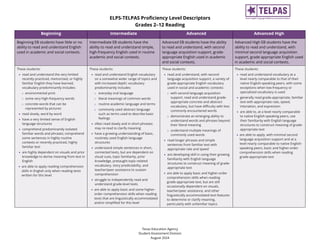
Kindergarten and Grade 1 Reading
Beginning Intermediate Advanced Advanced High
Beginning EB students have little or no
ability to use the English language to
build foundational reading skills.
Intermediate EB students have a limited
ability to use the English language to
build foundational reading skills.
Advanced EB students have the ability
to use the English language, with
second language acquisition support, to
build foundational reading skills.
Advanced High EB students have the
ability to use the English language, with
minimal second language acquisition
support, to build foundational reading
skills.
These students:
• derive little or no meaning from grade-
appropriate stories read aloud in English,
unless the stories are:
o read in short “chunks”
o controlled to include the little English
they know such as language that is high
frequency, concrete, and recently
practiced
o accompanied by ample visual supports
such as illustrations, gestures,
pantomime, and objects and by
linguistic supports such as careful
enunciation and slower speech
• begin to recognize and understand
environmental print in English (e.g., signs,
labeled items, names of peers, logos)
• have difficulty decoding most grade-
appropriate English text because they:*
o understand the meaning of very few
words in English
o struggle significantly with sounds in
spoken English words and with sound-
symbol relationships due to differences
between their primary language and
English
These students:
• demonstrate limited comprehension (key
words and general meaning) of grade-
appropriate stories read aloud in English,
unless the stories include:
o predictable story lines
o highly familiar topics
o primarily high-frequency, concrete
vocabulary
o short, simple sentences
o visual and linguistic supports
• regularly recognize and understand
common environmental print in English
(e.g., signs, labeled items, names of peers,
logos)
• have difficulty decoding grade-
appropriate English text because they:*
o understand the meaning of only those
English words they hear frequently
o struggle with some sounds in English
words and some sound-symbol
relationships due to differences
between their primary language and
English
These students:
• demonstrate comprehension of most
main points and most supporting ideas in
grade-appropriate stories read aloud in
English, although they may still depend
on visual and linguistic supports to gain or
confirm meaning
• recognize some basic English vocabulary
and high-frequency words in isolated
print
• with second language acquisition support,
are able to decode most grade-
appropriate English text because they:*
o understand the meaning of most
grade-appropriate English words
o have little difficulty with English sounds
and sound-symbol relationships that
result from differences between their
primary language and English
These students:
• demonstrate, with minimal second
language acquisition support and at a
level nearly comparable to native English-
speaking peers, comprehension of main
points and supporting ideas (explicit and
implicit) in grade-appropriate stories read
aloud in English
• with some exceptions, recognize sight
vocabulary and high-frequency words to a
degree nearly comparable to that of
native English-speaking peers
• with minimal second language acquisition
support, have an ability to decode and
understand grade-appropriate English
text at a level nearly comparable to native
English-speaking peers*
*
The last descriptor applies only to students who are at the developmental stage of decoding written text (i.e., they have “cracked the code” necessary for learning to read).
4.
ELPS-TELPAS Proficiency LevelDescriptors
Texas Education Agency
Student Assessment Division
August 2024
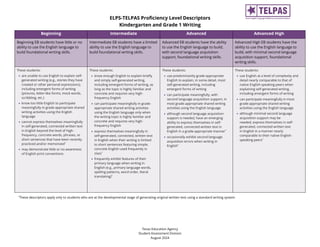
Grades 2–12 Reading
Beginning Intermediate Advanced Advanced High
Beginning EB students have little or no
ability to read and understand English
used in academic and social contexts.
Intermediate EB students have the
ability to read and understand simple,
high-frequency English used in routine
academic and social contexts.
Advanced EB students have the ability
to read and understand, with second
language acquisition support, grade-
appropriate English used in academic
and social contexts.
Advanced High EB students have the
ability to read and understand, with
minimal second language acquisition
support, grade appropriate English used
in academic and social contexts.
These students:
• read and understand the very limited
recently practiced, memorized, or highly
familiar English they have learned;
vocabulary predominantly includes:
o environmental print
o some very high-frequency words
o concrete words that can be
represented by pictures
• read slowly, word by word
• have a very limited sense of English
language structures
• comprehend predominantly isolated
familiar words and phrases; comprehend
some sentences in highly routine
contexts or recently practiced, highly
familiar text
• are highly dependent on visuals and prior
knowledge to derive meaning from text in
English
• are able to apply reading comprehension
skills in English only when reading texts
written for this level
These students:
• read and understand English vocabulary
on a somewhat wider range of topics and
with increased depth; vocabulary
predominantly includes:
o everyday oral language
o literal meanings of common words
o routine academic language and terms
o commonly used abstract language
such as terms used to describe basic
feelings
• often read slowly and in short phrases;
may re-read to clarify meaning
• have a growing understanding of basic,
routinely used English language
structures
• understand simple sentences in short,
connected texts, but are dependent on
visual cues, topic familiarity, prior
knowledge, pretaught topic-related
vocabulary, story predictability, and
teacher/peer assistance to sustain
comprehension
• struggle to independently read and
understand grade-level texts
• are able to apply basic and some higher-
order comprehension skills when reading
texts that are linguistically accommodated
and/or simplified for this level
These students:
• read and understand, with second
language acquisition support, a variety of
grade-appropriate English vocabulary
used in social and academic contexts:
o with second language acquisition
support, read and understand grade-
appropriate concrete and abstract
vocabulary, but have difficulty with less
commonly encountered words
o demonstrate an emerging ability to
understand words and phrases beyond
their literal meaning
o understand multiple meanings of
commonly used words
• read longer phrases and simple
sentences from familiar text with
appropriate rate and speed
• are developing skill in using their growing
familiarity with English language
structures to construct meaning of grade-
appropriate text
• are able to apply basic and higher-order
comprehension skills when reading
grade-appropriate text, but are still
occasionally dependent on visuals,
teacher/peer assistance, and other
linguistically accommodated text features
to determine or clarify meaning,
particularly with unfamiliar topics
These students:
• read and understand vocabulary at a
level nearly comparable to that of their
native English-speaking peers, with some
exceptions when low-frequency or
specialized vocabulary is used
• generally read grade-appropriate, familiar
text with appropriate rate, speed,
intonation, and expression
• are able to, at a level nearly comparable
to native English-speaking peers, use
their familiarity with English language
structures to construct meaning of grade-
appropriate text
• are able to apply, with minimal second
language acquisition support and at a
level nearly comparable to native English-
speaking peers, basic and higher-order
comprehension skills when reading
grade-appropriate text
5.
ELPS-TELPAS Proficiency LevelDescriptors
Texas Education Agency
Student Assessment Division
August 2024
Kindergarten and Grade 1 Writing
Beginning Intermediate Advanced Advanced High
Beginning EB students have little or no
ability to use the English language to
build foundational writing skills.
Intermediate EB students have a limited
ability to use the English language to
build foundational writing skills.
Advanced EB students have the ability
to use the English language to build,
with second language acquisition
support, foundational writing skills.
Advanced High EB students have the
ability to use the English language to
build, with minimal second language
acquisition support, foundational
writing skills.
These students:
• are unable to use English to explain self-
generated writing (e.g., stories they have
created or other personal expressions),
including emergent forms of writing
(pictures, letter-like forms, mock words,
scribbling, etc.)
• know too little English to participate
meaningfully in grade-appropriate shared
writing activities using the English
language
• cannot express themselves meaningfully
in self-generated, connected written text
in English beyond the level of high-
frequency, concrete words, phrases, or
short sentences that have been recently
practiced and/or memorized*
• may demonstrate little or no awareness
of English print conventions
These students:
• know enough English to explain briefly
and simply self-generated writing,
including emergent forms of writing, as
long as the topic is highly familiar and
concrete and requires very high-
frequency English
• can participate meaningfully in grade-
appropriate shared writing activities
using the English language only when
the writing topic is highly familiar and
concrete and requires very high-
frequency English
• express themselves meaningfully in
self-generated, connected, written text
in English when their writing is limited
to short sentences featuring simple,
concrete English used frequently in
class*
• frequently exhibit features of their
primary language when writing in
English (e.g., primary language words,
spelling patterns, word order, literal
translating)*
These students:
• use predominantly grade-appropriate
English to explain, in some detail, most
self-generated writing, including
emergent forms of writing
• can participate meaningfully, with
second language acquisition support, in
most grade-appropriate shared writing
activities using the English language
• although second language acquisition
support is needed, have an emerging
ability to express themselves in self-
generated, connected written text in
English in a grade-appropriate manner*
• occasionally exhibit second language
acquisition errors when writing in
English*
These students:
• use English at a level of complexity and
detail nearly comparable to that of
native English-speaking peers when
explaining self-generated writing,
including emergent forms of writing
• can participate meaningfully in most
grade-appropriate shared writing
activities using the English language
• although minimal second language
acquisition support may be
needed, express themselves in self-
generated, connected written text
in English in a manner nearly
comparable to their native English-
speaking peers*
*
These descriptors apply only to students who are at the developmental stage of generating original written text using a standard writing system.
6.
ELPS-TELPAS Proficiency LevelDescriptors
Texas Education Agency
Student Assessment Division
August 2024
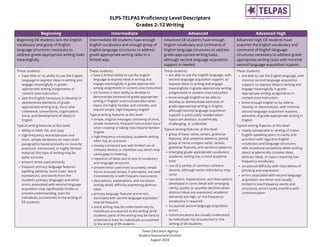
Grades 2–12 Writing
Beginning Intermediate Advanced Advanced High
Beginning EB students lack the English
vocabulary and grasp of English
language structures necessary to
address grade-appropriate writing tasks
meaningfully.
Intermediate EB students have enough
English vocabulary and enough grasp of
English language structures to address
grade-appropriate writing tasks in a
limited way.
Advanced EB students have enough
English vocabulary and command of
English language structures to address
grade-appropriate writing tasks,
although second language acquisition
support is needed.
Advanced High EB students have
acquired the English vocabulary and
command of English language
structures necessary to address grade-
appropriate writing tasks with minimal
second language acquisition support.
These students:
• have little or no ability to use the English
language to express ideas in writing and
engage meaningfully in grade-
appropriate writing assignments in
content area instruction
• lack the English necessary to develop or
demonstrate elements of grade-
appropriate writing (e.g., focus and
coherence, conventions, organization,
voice, and development of ideas) in
English
Typical writing features at this level:
• ability to label, list, and copy
• high-frequency words/phrases and
short, simple sentences (or even short
paragraphs) based primarily on recently
practiced, memorized, or highly familiar
material; this type of writing may be
quite accurate
• present tense used primarily
• frequent primary language features
(spelling patterns, word order, literal
translations, and words from the
student’s primary language) and other
errors associated with second language
acquisition may significantly hinder or
prevent understanding, even for
individuals accustomed to the writing of
EB students
These students:
• have a limited ability to use the English
language to express ideas in writing and
engage meaningfully in grade-appropriate
writing assignments in content area instruction
• are limited in their ability to develop or
demonstrate elements of grade-appropriate
writing in English; communicate best when
topics are highly familiar and concrete, and
require simple, high-frequency English
Typical writing features at this level:
• simple, original messages consisting of short,
simple sentences; frequent inaccuracies occur
when creating or taking risks beyond familiar
English
• high-frequency vocabulary; academic writing
often has an oral tone
• loosely connected text with limited use of
cohesive devices or repetitive use, which may
cause gaps in meaning
• repetition of ideas due to lack of vocabulary
and language structures
• present tense used most accurately; simple
future and past tenses, if attempted, are used
inconsistently or with frequent inaccuracies
• descriptions, explanations, and narrations
lacking detail; difficulty expressing abstract
ideas
• primary language features and errors
associated with second language acquisition
may be frequent
• some writing may be understood only by
individuals accustomed to the writing of EB
students; parts of the writing may be hard to
understand even for individuals accustomed
to the writing of EB students
These students:
• are able to use the English language, with
second language acquisition support, to
express ideas in writing and engage
meaningfully in grade-appropriate writing
assignments in content area instruction
• know enough English to be able to
develop or demonstrate elements of
grade-appropriate writing in English,
although second language acquisition
support is particularly needed when
topics are abstract, academically
challenging, or unfamiliar
Typical writing features at this level:
• grasp of basic verbs, tenses, grammar
features, and sentence patterns; partial
grasp of more complex verbs, tenses,
grammar features, and sentence patterns
• emerging grade-appropriate vocabulary;
academic writing has a more academic
tone
• use of a variety of common cohesive
devices, although some redundancy may
occur
• narrations, explanations, and descriptions
developed in some detail with emerging
clarity; quality or quantity declines when
abstract ideas are expressed, academic
demands are high, or low-frequency
vocabulary is required
• occasional second language acquisition
errors
• communications are usually understood
by individuals not accustomed to the
writing of EB students
These students:
• are able to use the English language, with
minimal second language acquisition
support, to express ideas in writing and
engage meaningfully in grade-
appropriate writing assignments in
content area instruction
• know enough English to be able to
develop or demonstrate, with minimal
second language acquisition support,
elements of grade-appropriate writing in
English
Typical writing features at this level:
• nearly comparable to writing of native
English-speaking peers in clarity and
precision with regard to English
vocabulary and language structures,
with occasional exceptions when writing
about academically complex ideas,
abstract ideas, or topics requiring low-
frequency vocabulary
• occasional difficulty with naturalness of
phrasing and expression
• errors associated with second language
acquisition are minor and usually
limited to low-frequency words and
structures; errors rarely interfere with
communication



![Module 1 Ffd[1]](https://cdn.slidesharecdn.com/ss_thumbnails/module1ffd1-091031122605-phpapp01-thumbnail.jpg?width=640&height=640&fit=bounds)


