The English Language Proficiency
Standards (ELPS)
MODULE 2
ELPS and Assessment
Presented by the Brownsville Independent School District
Bilingual Department
Reference: Texas Education Agency and Region One
Education Service Center
Identification

Home Language Survey (HLS)
 If the HLS indicates a language
other than English then testing
must be initiated to determine
English proficiency*
*Parent permission for testing is not required.
2
2008 END-OF-YEAR LPAC:
Assessment DATA for Review
 TPRI/TEJAS LEE (K - 3)
 APRENDA/STANFORD 10 (1 - 2)
 TAKS (3-12)
 LAT (3-12)
 TAKS-A (3-12)
 TAKS-ALT (3-12)
 RPTE 2002 for SPED/LEP only (3-12)
 TELPAS (K-12)
 SELP/SSLP (PK-12)
Stanford Spanish and English
Language Proficiency Tests
Copyright 2005 by Harcourt Assessment, Inc.
SIX TEST LEVELS
 Readiness/PreEscolar Pre K
 Preliteracy/PrePrimaria K
 Primary/Primario 1 — 2
 Elementary/Elemental 3 — 5
 Middle Grades 6 — 8
 High School 9 — 12
4
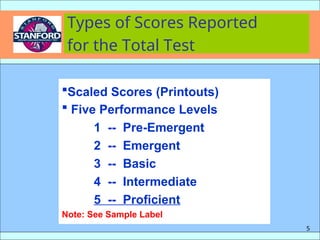
Scaled Scores (Printouts)
 Five Performance Levels
1 -- Pre-Emergent
2 -- Emergent
3 -- Basic
4 -- Intermediate
5 -- Proficient
Note: See Sample Label
Types of Scores Reported
for the Total Test
5
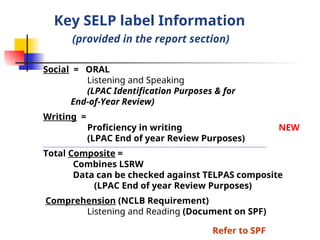
Key SELP label Information
(provided in the report section)
Social = ORAL
Listening and Speaking
(LPAC Identification Purposes & for
End-of-Year Review)
Writing =
Proficiency in writing NEW
(LPAC End of year Review Purposes)
____________________________________________________________________________________________________________________________________________
Total Composite =
Combines LSRW
Data can be checked against TELPAS composite
(LPAC End of year Review Purposes)
Comprehension (NCLB Requirement)
Listening and Reading (Document on SPF)
Refer to SPF
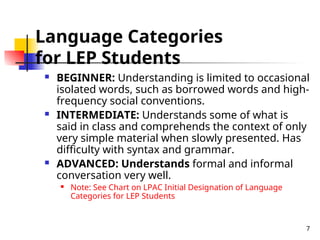
Language Categories
for LEP Students
 BEGINNER: Understanding is limited to occasional
isolated words, such as borrowed words and high-
frequency social conventions.
 INTERMEDIATE: Understands some of what is
said in class and comprehends the context of only
very simple material when slowly presented. Has
difficulty with syntax and grammar.
 ADVANCED: Understands formal and informal
conversation very well.
 Note: See Chart on LPAC Initial Designation of Language
Categories for LEP Students
7
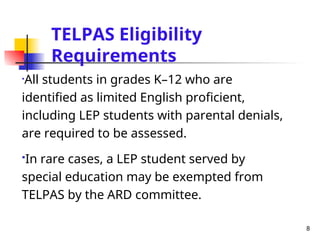
•All students in grades K–12 who are
identified as limited English proficient,
including LEP students with parental denials,
are required to be assessed.
In rare cases, a LEP student served by
special education may be exempted from
TELPAS by the ARD committee.
TELPAS Eligibility
Requirements
8
•All students in grades K–12 who are
identified as limited English proficient,
including LEP students with parental denials,
are required to be assessed.
In rare cases, a LEP student served by
special education may be exempted from
TELPAS by the ARD committee.
TELPAS Eligibility
Requirements
9
9
ELPS and TELPAS
 The newly adopted English language proficiency
standards are closely aligned with the Texas
English language proficiency assessments
(TELPAS).
 Together, the standards and assessments promote
the English acquisition that ELLs need to succeed
academically.
 Effective implementation of the ELP standards
should support not only better English acquisition
but better academic achievement, which should be
evident in state assessment results.
Source: TEA Assessment Division
11
ELPS and TELPAS
 TELPAS assesses the English language
proficiency in listening, speaking, reading, and
writing of K-12 ELLs
 TELPAS measures how well ELLs understand
and use English for everyday use and academic
purposes.
 TELPAS reports four English language
proficiency levels:
 Beginning
 Intermediate
 Advanced
 Advanced High
*Meets Requirements of NCLB
Source: TEA Assessment Division
11
Beginning Level: Little or no ability, uses high frequency, routine
words; in writing, typically lists, labels, copies.
Intermediate Level: Limited ability, understands and uses short,
simple sentences. Uses present tense.
Advanced Level: Typically have grasp of basic verbs, tenses,
grammar features and sentence patterns/ partial grasp of more
complex verbs, tenses, grammar features and sentence patterns,
needs support
Advanced High Level: Ability, with minimal support very close to
native English speaking peers
Listening Speaking Reading Writing
Key Features of Each Proficiency Level
Source: TEA Assessment Division
http://www.tea.state.tx.us/studen.assesment/admin/rpte/Training_on_the_2_12_PLD
s_Sp_08_final.ppt
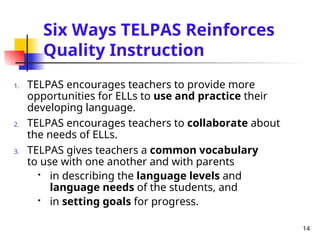
Goal # 2
English Language Proficiency
beginning
intermediate
advanced
Advanced
High
Best teaching practices
TELPAS
Texas English Language
Proficiency Assessment System
13
Six Ways TELPAS Reinforces
Quality Instruction
1. TELPAS encourages teachers to provide more
opportunities for ELLs to use and practice their
developing language.
2. TELPAS encourages teachers to collaborate about
the needs of ELLs.
3. TELPAS gives teachers a common vocabulary
to use with one another and with parents
 in describing the language levels and
language needs of the students, and
 in setting goals for progress.
14
Six Ways TELPAS Reinforces
Quality Instruction
4. TELPAS helps teachers see the need to differentiate
instruction according to the English language
proficiency levels of ELLs.
5. TELPAS helps teachers understand the importance and
benefit of building the communication skills that get
students to the next proficiency level.
6. TELPAS supports academic achievement goals because
ELLs learn academic content more readily when they
understand the language of their instruction.
15
16
ELPS and LAT
 NCLB requires students in grades 3-8 &10 for whom
the LPAC had granted a LEP exemption from testing,
to be assessed in reading, mathematics, and
science.
 All LEP-exempt students in grades 3-8 and 10
participate in LAT math.
 All LEP-exempt students in grades 5,8 and 10
participate in LAT science.
 Linguistic accommodations are made in order to
assist students in overcoming language barriers and
provide a meaningful assessment of academic
knowledge and skills.
17
ELPS and LAT
 Linguistic accommodations are part of
quality instruction for all ELLs and should
be taking place all year long.
 Only those accommodations that have been
used routinely in instruction and
assessment may be afforded to students
during their LAT administration.
 Linguistic accommodations help students
learn academic content.
LAT Eligibility
 Eligibility criteria for math/science vs.
reading/ELA differ somewhat.
 LAT math and science

Given to all LEP-exempt students whether it is
their 1st
, 2nd
, or 3rd
school year in the U.S.
 LAT reading and ELA

Given to 2nd
and 3rd
year LEP-exempt immigrants

NOT given to 1st
year LEP-exempt immigrant
18
MLAT/SLAT & AYP
 MLAT/SLAT examinees in their first school
year of enrollment in U.S. schools are
included in AYP participation measures.
Their results do not count in AYP
performance measures.
 MLAT/SLAT examinees in their second and
third school years of enrollment in U.S.
schools count in both AYP participation
and performance measures.
19
Determining MLAT/SLAT
Accommodations
 Multiple accommodations will often
be appropriate.
 Decisions must be based on the
individual needs of the student and
whether the accommodations are
used 51% of the time in math/science
instruction and testing.
20
Allowable Accommodations
 Linguistic simplification
 Oral translation
 Reading assistance
 Bilingual dictionary
 Bilingual glossary
 English and Spanish side by side
(3-6 only)
21
RLAT & AYP
 First year immigrant students will continue
to be included in AYP through TELPAS
Reading.
 LEP students will continue to take TELPAS
reading as long as they are classified as
limited English proficient in PEIMS. TELPAS
results are used in state and federal
accountability and performance
monitoring indicators.
22
RLAT Direct
Accommodations
1. Bilingual dictionary
2. English dictionary
3. Reading aloud – word or phrase
4. Reading aloud – entire test item
5. Oral translation – word or phrase
6. Clarification – word or phrase
 Grade 10 ELA exceptions for writing section:
• A bilingual dictionary is the only allowable LAT accommodation for the written
composition. (English dictionaries are allowed for all students, so they are not
an accommodation.)
• Dictionaries and other reference materials are not allowed on the
revising/editing section.
23
RLAT Indirect
Accommodations
Indirect Linguistic Support:
1. Clarifying directions as needed
2. Breaks at request of student
3. Testing over 2 days
 Accommodations 1–3 apply to all LAT
reading examinees. LPAC decisions
and documentation are not needed
for these.
24
ELPS and TAKS
Language Appropriateness
Decisions about whether to give TAKS in English or
Spanish are guided by—
 the language of the student’s instruction, and
 the language in which the student is best able to
demonstrate academic skills.
 The decision to administer TAKS in Spanish or
English may vary by subject area.
Page 13
25
Rules
 Spanish TAKS may be taken for 3 years.
 Years of LEP exemption plus Spanish TAKS
may not exceed 3.
 Years of taking Spanish TAKS are counted
in terms of years of TAKS administrations.
That is, grades 1 and 2 don’t count because
TAKS is not administered in these grades.
26
CONTACT INFORMATION:
Bilingual Director:
Maria V. Gonzales 548-8271
Bilingual Specialist.
Flor Robinson 698-3196
ESL Counselor:
Elizabeth Llongueras 698-1081
Lead Teachers:
Maricela Camarillo 698-3195 Cynthia Cavazos 698-1325
Norma Lopez 698-1326 Deyanira Martinez 698-1327
Josie Pineda 698-1328 Dr. Paty Quesada 698-0081
Pat Segura 698-0083
Lead Tester:
Lucy Escamilla 698-1321
Questions?
http://www.bisd.us/Bilingual_Education/
27

ELPS study MODULE for learning english.ppt

  • 1.
    The English LanguageProficiency Standards (ELPS) MODULE 2 ELPS and Assessment Presented by the Brownsville Independent School District Bilingual Department Reference: Texas Education Agency and Region One Education Service Center
  • 2.
    Identification  Home Language Survey(HLS)  If the HLS indicates a language other than English then testing must be initiated to determine English proficiency* *Parent permission for testing is not required. 2
  • 3.
    2008 END-OF-YEAR LPAC: AssessmentDATA for Review  TPRI/TEJAS LEE (K - 3)  APRENDA/STANFORD 10 (1 - 2)  TAKS (3-12)  LAT (3-12)  TAKS-A (3-12)  TAKS-ALT (3-12)  RPTE 2002 for SPED/LEP only (3-12)  TELPAS (K-12)  SELP/SSLP (PK-12)
  • 4.
    Stanford Spanish andEnglish Language Proficiency Tests Copyright 2005 by Harcourt Assessment, Inc. SIX TEST LEVELS  Readiness/PreEscolar Pre K  Preliteracy/PrePrimaria K  Primary/Primario 1 — 2  Elementary/Elemental 3 — 5  Middle Grades 6 — 8  High School 9 — 12 4
  • 5.
    Scaled Scores (Printouts) Five Performance Levels 1 -- Pre-Emergent 2 -- Emergent 3 -- Basic 4 -- Intermediate 5 -- Proficient Note: See Sample Label Types of Scores Reported for the Total Test 5
  • 6.
    Key SELP labelInformation (provided in the report section) Social = ORAL Listening and Speaking (LPAC Identification Purposes & for End-of-Year Review) Writing = Proficiency in writing NEW (LPAC End of year Review Purposes) ____________________________________________________________________________________________________________________________________________ Total Composite = Combines LSRW Data can be checked against TELPAS composite (LPAC End of year Review Purposes) Comprehension (NCLB Requirement) Listening and Reading (Document on SPF) Refer to SPF
  • 7.
    Language Categories for LEPStudents  BEGINNER: Understanding is limited to occasional isolated words, such as borrowed words and high- frequency social conventions.  INTERMEDIATE: Understands some of what is said in class and comprehends the context of only very simple material when slowly presented. Has difficulty with syntax and grammar.  ADVANCED: Understands formal and informal conversation very well.  Note: See Chart on LPAC Initial Designation of Language Categories for LEP Students 7
  • 8.
    •All students ingrades K–12 who are identified as limited English proficient, including LEP students with parental denials, are required to be assessed. In rare cases, a LEP student served by special education may be exempted from TELPAS by the ARD committee. TELPAS Eligibility Requirements 8
  • 9.
    •All students ingrades K–12 who are identified as limited English proficient, including LEP students with parental denials, are required to be assessed. In rare cases, a LEP student served by special education may be exempted from TELPAS by the ARD committee. TELPAS Eligibility Requirements 9
  • 10.
    9 ELPS and TELPAS The newly adopted English language proficiency standards are closely aligned with the Texas English language proficiency assessments (TELPAS).  Together, the standards and assessments promote the English acquisition that ELLs need to succeed academically.  Effective implementation of the ELP standards should support not only better English acquisition but better academic achievement, which should be evident in state assessment results. Source: TEA Assessment Division
  • 11.
    11 ELPS and TELPAS TELPAS assesses the English language proficiency in listening, speaking, reading, and writing of K-12 ELLs  TELPAS measures how well ELLs understand and use English for everyday use and academic purposes.  TELPAS reports four English language proficiency levels:  Beginning  Intermediate  Advanced  Advanced High *Meets Requirements of NCLB Source: TEA Assessment Division
  • 12.
    11 Beginning Level: Littleor no ability, uses high frequency, routine words; in writing, typically lists, labels, copies. Intermediate Level: Limited ability, understands and uses short, simple sentences. Uses present tense. Advanced Level: Typically have grasp of basic verbs, tenses, grammar features and sentence patterns/ partial grasp of more complex verbs, tenses, grammar features and sentence patterns, needs support Advanced High Level: Ability, with minimal support very close to native English speaking peers Listening Speaking Reading Writing Key Features of Each Proficiency Level Source: TEA Assessment Division http://www.tea.state.tx.us/studen.assesment/admin/rpte/Training_on_the_2_12_PLD s_Sp_08_final.ppt
  • 13.
    Goal # 2 EnglishLanguage Proficiency English Language Proficiency beginning intermediate advanced Advanced High Best teaching practices TELPAS Texas English Language Proficiency Assessment System 13
  • 14.
    Six Ways TELPASReinforces Quality Instruction 1. TELPAS encourages teachers to provide more opportunities for ELLs to use and practice their developing language. 2. TELPAS encourages teachers to collaborate about the needs of ELLs. 3. TELPAS gives teachers a common vocabulary to use with one another and with parents  in describing the language levels and language needs of the students, and  in setting goals for progress. 14
  • 15.
    Six Ways TELPASReinforces Quality Instruction 4. TELPAS helps teachers see the need to differentiate instruction according to the English language proficiency levels of ELLs. 5. TELPAS helps teachers understand the importance and benefit of building the communication skills that get students to the next proficiency level. 6. TELPAS supports academic achievement goals because ELLs learn academic content more readily when they understand the language of their instruction. 15
  • 16.
    16 ELPS and LAT NCLB requires students in grades 3-8 &10 for whom the LPAC had granted a LEP exemption from testing, to be assessed in reading, mathematics, and science.  All LEP-exempt students in grades 3-8 and 10 participate in LAT math.  All LEP-exempt students in grades 5,8 and 10 participate in LAT science.  Linguistic accommodations are made in order to assist students in overcoming language barriers and provide a meaningful assessment of academic knowledge and skills.
  • 17.
    17 ELPS and LAT Linguistic accommodations are part of quality instruction for all ELLs and should be taking place all year long.  Only those accommodations that have been used routinely in instruction and assessment may be afforded to students during their LAT administration.  Linguistic accommodations help students learn academic content.
  • 18.
    LAT Eligibility  Eligibilitycriteria for math/science vs. reading/ELA differ somewhat.  LAT math and science  Given to all LEP-exempt students whether it is their 1st , 2nd , or 3rd school year in the U.S.  LAT reading and ELA  Given to 2nd and 3rd year LEP-exempt immigrants  NOT given to 1st year LEP-exempt immigrant 18
  • 19.
    MLAT/SLAT & AYP MLAT/SLAT examinees in their first school year of enrollment in U.S. schools are included in AYP participation measures. Their results do not count in AYP performance measures.  MLAT/SLAT examinees in their second and third school years of enrollment in U.S. schools count in both AYP participation and performance measures. 19
  • 20.
    Determining MLAT/SLAT Accommodations  Multipleaccommodations will often be appropriate.  Decisions must be based on the individual needs of the student and whether the accommodations are used 51% of the time in math/science instruction and testing. 20
  • 21.
    Allowable Accommodations  Linguisticsimplification  Oral translation  Reading assistance  Bilingual dictionary  Bilingual glossary  English and Spanish side by side (3-6 only) 21
  • 22.
    RLAT & AYP First year immigrant students will continue to be included in AYP through TELPAS Reading.  LEP students will continue to take TELPAS reading as long as they are classified as limited English proficient in PEIMS. TELPAS results are used in state and federal accountability and performance monitoring indicators. 22
  • 23.
    RLAT Direct Accommodations 1. Bilingualdictionary 2. English dictionary 3. Reading aloud – word or phrase 4. Reading aloud – entire test item 5. Oral translation – word or phrase 6. Clarification – word or phrase  Grade 10 ELA exceptions for writing section: • A bilingual dictionary is the only allowable LAT accommodation for the written composition. (English dictionaries are allowed for all students, so they are not an accommodation.) • Dictionaries and other reference materials are not allowed on the revising/editing section. 23
  • 24.
    RLAT Indirect Accommodations Indirect LinguisticSupport: 1. Clarifying directions as needed 2. Breaks at request of student 3. Testing over 2 days  Accommodations 1–3 apply to all LAT reading examinees. LPAC decisions and documentation are not needed for these. 24
  • 25.
    ELPS and TAKS LanguageAppropriateness Decisions about whether to give TAKS in English or Spanish are guided by—  the language of the student’s instruction, and  the language in which the student is best able to demonstrate academic skills.  The decision to administer TAKS in Spanish or English may vary by subject area. Page 13 25
  • 26.
    Rules  Spanish TAKSmay be taken for 3 years.  Years of LEP exemption plus Spanish TAKS may not exceed 3.  Years of taking Spanish TAKS are counted in terms of years of TAKS administrations. That is, grades 1 and 2 don’t count because TAKS is not administered in these grades. 26
  • 27.
    CONTACT INFORMATION: Bilingual Director: MariaV. Gonzales 548-8271 Bilingual Specialist. Flor Robinson 698-3196 ESL Counselor: Elizabeth Llongueras 698-1081 Lead Teachers: Maricela Camarillo 698-3195 Cynthia Cavazos 698-1325 Norma Lopez 698-1326 Deyanira Martinez 698-1327 Josie Pineda 698-1328 Dr. Paty Quesada 698-0081 Pat Segura 698-0083 Lead Tester: Lucy Escamilla 698-1321 Questions? http://www.bisd.us/Bilingual_Education/ 27

Editor's Notes

  • #1 This training was developed with existing Texas Education Agency sponsored trainings developed by Education Service Centers, Region 2, Region 4, Region 1 and trainings by the TEA Assessment Division on TELPAS-Texas English Language Proficiency Assessment System along with the LEP Instructional Excellence Center: Project Tesoro at Region One Education Service Center. Funding was provided by the TEA School Initiatives. This training was also developed in response to the need for understanding the Required Curriculum as stated and adopted in December 2007.
  • #4 In the regular catalog Stanford ELP Form A product, you will see references to a preliteracy or primary level test that you are not administering at this time. Please ignore those references
  • #5 These proficiency levels are those Harcourt used to report out on the performance of students on the Stanford ELP Test. These will be levels you will see on your score reports this year. Talk to the DOE and see how they plan to align these levels with there own for 2006.
  • #10 Read highlighted section
  • #12 The development of language may be at different levels for different English language learners. The TELPAS has proficiency level descriptors for each of the language domains (PLDs). They are the rubrics that raters use to determine students’ English language proficiency levels. It is important that teachers who serve ELLs are familiar with the proficiency levels in order to effectively plan and deliver instruction. This slide summarizes the major characteristics of the PLDs in terms of how well ELLs can understand and/or use English in social and academic settings at each of the four levels. These key features are found in the summary statements at the top of the PLDs for each language domain. As an example, refer participants to the summary statements at the top of the PLDs for listening. Let’s look at some examples of what a beginning and intermediate student might understand from an academic stand.
  • #13 In addition to addressing effective teaching and TAKS, our goal is to address the following: Texas English Language Proficiency Assessment System (TELPAS) In Response to federal testing requirements of the No Child Left Behind Act of 2001 (NCLB), the Texas Education Agency developed TELPAS. This system has four components: TELPAS Reading, Writing, Listening, Speaking
  • #14 Because of their English limitations, ELLs are sometimes hesitant to participate in class and to try to express thoughts and ideas in English. Through TELPAS, teachers are encouraged to interact more with their ELLs and give them frequent opportunities to use and practice their developing English. Teachers not used to working with ELLs will better understand that the way ELLs communicate as they learn English is a natural part of second language acquisition. This will help them put students at ease so that they feel less reluctant about taking risks and trying to express themselves in English. When teachers collaborate, they share instructional strategies that help their ELLs. TELPAS helps teachers understand what the English language proficiency levels of second language acquisition really mean, giving them a common vocabulary to use when talking to one another and to parents. Content area teachers are accustomed to thinking in terms of whether students are able to perform required grade-level academic skills. TELPAS helps them also think in terms of how the language development of their ELLs affects their academic learning and how helping ELLs with their English will support their ability to achieve academically. Teachers who are actively involved in evaluating the proficiency levels of their ELLs become much more adept at understanding and addressing the students’ linguistic needs.
  • #15 TELPAS helps content area teachers better understand how to linguistically accommodate academic instruction to make it comprehensible. Using language at the level an ELL currently understands helps the student more effectively learn the academic content taught. 5/6. Communicating with ELLs at their current level of understanding is not sufficient, however. Teachers must also make gradual and deliberate efforts to move students from their current level of English proficiency to higher levels. The TELPAS proficiency level descriptors give teachers a “road map” for doing this. When teachers are successful in helping students reach higher proficiency levels, teachers and students both benefit. Teachers benefit because they don’t need to make such extensive linguistic accommodations during instruction, which makes their job easier. Students benefit because they become more proficient in English, which builds their confidence and makes it easier for them to progress academically.
  • #25 Note: Page 13 of the manual explains the criteria for determining whether a student may take TAKS in Spanish rather than English, regardless of past performance on RPTE.
  • #26 These rules come from the commissioner’s rules, TAC, §101.1007 (a). Links to the exact rule language may be found in Appendix A of the manual. The footnotes on page 12 address questions that may come up about absent or retained students.