WebRTC
Web Real-Time Communication
1
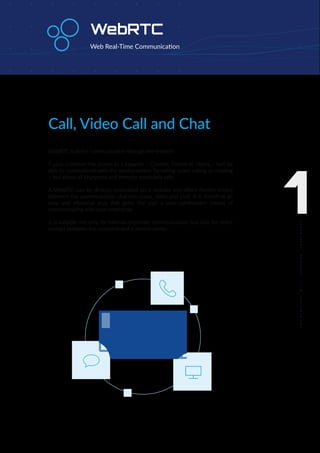
WebRTC is direct communication through the browser.
If your customer has access to a browser – Chrome, Firefox or Opera – he’ll be
able to communicate with the service center. By calling, video-calling or chatting
– but above all encrypted and therefor absolutely safe.
A WebRTC can be directly embedded on a website and offers flexible choice
between the communication channels voice, video and chat. It is therefore an
easy and attractive plus that gives the user a very comfortable means of
communicating with your enterprise.
It is suitable not only for internal corporate communication, but also for direct
contact between the customer and a service center.
Call, Video Call and Chat
2
Multichannel communication
Audio- and video-calls and live-chat
Audio, video, chat conferencing
FUNCTION OVERVIEW
Supported platforms
-Backend: Linux
-Web App: WebRTC supporting browsers: Google Chrome, Mozilla Firefox,
Opera
-Mobile Native App: Android, iOS*
TEHNICAL SPECIFICATION
WebRTC
-Web socket secure (WSS) connection
-Proprietary communication protocol between server and client
-Javascript Client
-NAT traversal when using STUN, ICE, TURN*
-Call API*
SIP
-SIP over UDP (RFC2833)
-SIP Back-to-back UA
-User registration
-Registration pass-through Modus
-DTMF SIP INFO
TEHNICAL SPECIFICATION
General service specification
3
G.711 A/Ulaw, G722, OPUS, H264, VP8 pass-through
Codec filtering
Dynamic jitter control
NAT/NAPT on media
RTP inactivity monitoring
Echo Test service
MEDIA SERVICES
Active-active redundancy model
Distributed configuration
Dynamical scaling to fit load requirements
HIGH AVAILABILITY AND SCALING
ROUTING
Partitioning (multi domains Support)
Call authorization
Routing by many parameters:
-URI: B-number+Domain
-A-number, source IP, transport protocol, source Domain
Call blocking and filtering
Embedded routing engine
External routing engine
Load balancing
Alternative routing on failure
Dynamical bandwidth estimation and adoption
QUALITY OF SERVICE MONITORING
Secured Web-based UI for configuration and monitoring
Logging of alarms, events, statistics
Troubleshooting via UI
RESTful API
SSH access
MANAGEMENT
WSS, RTP, SRTP, DTLS, RTCP, SIP UDP,
RFC 4585, RFC 3550, RFC 5104
Translation between transport protocols
SUPPORTED PROTOCOLS
4Hardware independent
Runs on all virtualisation platforms
HARDWARE AND VIRTUALIZING

telerion: WebRTC

  • 1.
    WebRTC Web Real-Time Communication 1 WebRTCis direct communication through the browser. If your customer has access to a browser – Chrome, Firefox or Opera – he’ll be able to communicate with the service center. By calling, video-calling or chatting – but above all encrypted and therefor absolutely safe. A WebRTC can be directly embedded on a website and offers flexible choice between the communication channels voice, video and chat. It is therefore an easy and attractive plus that gives the user a very comfortable means of communicating with your enterprise. It is suitable not only for internal corporate communication, but also for direct contact between the customer and a service center. Call, Video Call and Chat
  • 2.
    2 Multichannel communication Audio- andvideo-calls and live-chat Audio, video, chat conferencing FUNCTION OVERVIEW Supported platforms -Backend: Linux -Web App: WebRTC supporting browsers: Google Chrome, Mozilla Firefox, Opera -Mobile Native App: Android, iOS* TEHNICAL SPECIFICATION WebRTC -Web socket secure (WSS) connection -Proprietary communication protocol between server and client -Javascript Client -NAT traversal when using STUN, ICE, TURN* -Call API* SIP -SIP over UDP (RFC2833) -SIP Back-to-back UA -User registration -Registration pass-through Modus -DTMF SIP INFO TEHNICAL SPECIFICATION General service specification
  • 3.
    3 G.711 A/Ulaw, G722,OPUS, H264, VP8 pass-through Codec filtering Dynamic jitter control NAT/NAPT on media RTP inactivity monitoring Echo Test service MEDIA SERVICES Active-active redundancy model Distributed configuration Dynamical scaling to fit load requirements HIGH AVAILABILITY AND SCALING ROUTING Partitioning (multi domains Support) Call authorization Routing by many parameters: -URI: B-number+Domain -A-number, source IP, transport protocol, source Domain Call blocking and filtering Embedded routing engine External routing engine Load balancing Alternative routing on failure Dynamical bandwidth estimation and adoption QUALITY OF SERVICE MONITORING
  • 4.
    Secured Web-based UIfor configuration and monitoring Logging of alarms, events, statistics Troubleshooting via UI RESTful API SSH access MANAGEMENT WSS, RTP, SRTP, DTLS, RTCP, SIP UDP, RFC 4585, RFC 3550, RFC 5104 Translation between transport protocols SUPPORTED PROTOCOLS 4Hardware independent Runs on all virtualisation platforms HARDWARE AND VIRTUALIZING