Bachelor of ElementaryEducation
OBE COURSE SYLLABUS
1st Semester 2024-2025
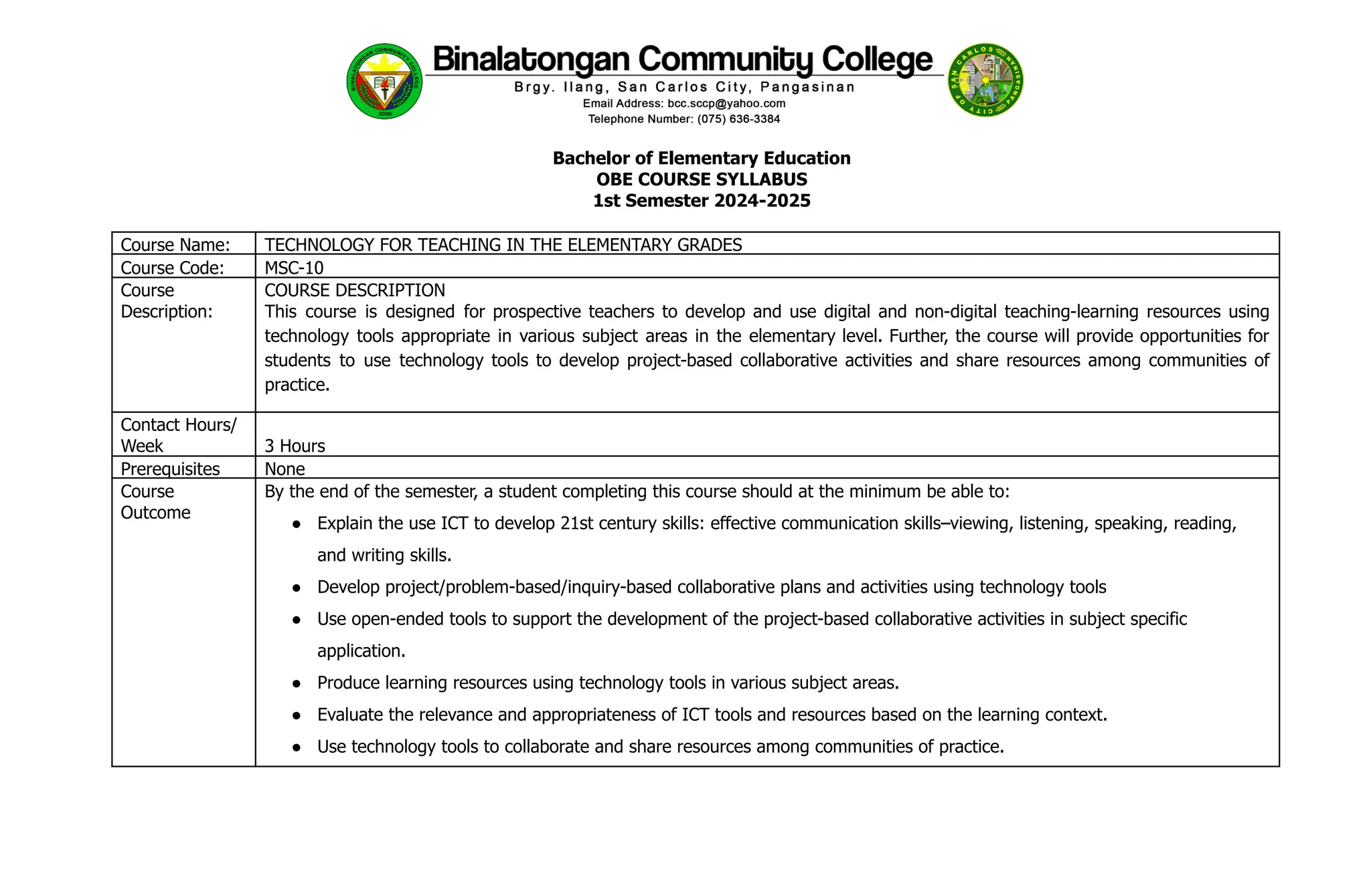
Course Name: TECHNOLOGY FOR TEACHING IN THE ELEMENTARY GRADES
Course Code: MSC-10
Course
Description:
COURSE DESCRIPTION
This course is designed for prospective teachers to develop and use digital and non-digital teaching-learning resources using
technology tools appropriate in various subject areas in the elementary level. Further, the course will provide opportunities for
students to use technology tools to develop project-based collaborative activities and share resources among communities of
practice.
Contact Hours/
Week 3 Hours
Prerequisites None
Course
Outcome
By the end of the semester, a student completing this course should at the minimum be able to:
● Explain the use ICT to develop 21st century skills: effective communication skills–viewing, listening, speaking, reading,
and writing skills.
● Develop project/problem-based/inquiry-based collaborative plans and activities using technology tools
● Use open-ended tools to support the development of the project-based collaborative activities in subject specific
application.
● Produce learning resources using technology tools in various subject areas.
● Evaluate the relevance and appropriateness of ICT tools and resources based on the learning context.
● Use technology tools to collaborate and share resources among communities of practice.
2.
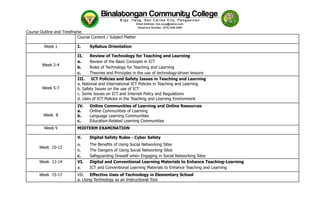
Course Outline andTimeframe
Course Content / Subject Matter
Week 1 I. Syllabus Orientation
Week 2-4
II. Review of Technology for Teaching and Learning
a. Review of the Basic Concepts in ICT
b. Roles of Technology for Teaching and Learning
c. Theories and Principles in the use of technology-driven lessons
Week 5-7
III. ICT Policies and Safety Issues in Teaching and Learning
a. National and International ICT Policies in Teaching and Learning
b. Safety Issues on the use of ICT
c. Some Issues on ICT and Internet Policy and Regulations
d. Uses of ICT Policies in the Teaching and Learning Environment
Week 8
IV. Online Communities of Learning and Online Resources
a. Online Communities of Learning
b. Language Learning Communities
c. Education-Related Learning Communities
Week 9 MIDTERM EXAMINATION
Week 10-12
V. Digital Safety Rules - Cyber Safety
a. The Benefits of Using Social Networking Sites
b. The Dangers of Using Social Networking Sites
c. Safeguarding Oneself when Engaging in Social Networking Sites
Week 12-14 VI. Digital and Conventional Learning Materials to Enhance Teaching-Learning
a. ICT and Conventional Learning Materials to Enhance Teaching and Learning
Week 15-17 VII. Effective Uses of Technology in Elementary School
a. Using Technology as an Instructional Tool
3.
b. Student UsingTechnology to Self-reflect on Their Learning and Progress
c. Using Technology to Provide Choice and Spark Students’ Creativity
Week 18 FINAL EXAMINATION
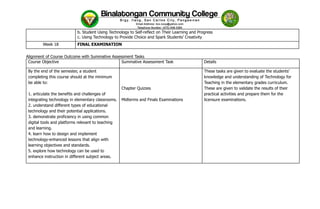
Alignment of Course Outcome with Summative Assessment Tasks
Course Objective Summative Assessment Task Details
By the end of the semester, a student
completing this course should at the minimum
be able to:
1. articulate the benefits and challenges of
integrating technology in elementary classrooms.
2. understand different types of educational
technology and their potential applications.
3. demonstrate proficiency in using common
digital tools and platforms relevant to teaching
and learning.
4. learn how to design and implement
technology-enhanced lessons that align with
learning objectives and standards.
5. explore how technology can be used to
enhance instruction in different subject areas.
Chapter Quizzes
Midterms and Finals Examinations
These tasks are given to evaluate the students’
knowledge and understanding of Technology for
Teaching in the elementary grades curriculum.
These are given to validate the results of their
practical activities and prepare them for the
licensure examinations.
4.
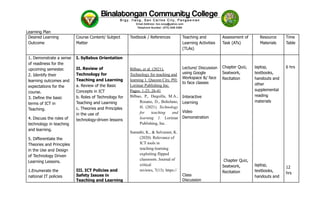
Learning Plan
Desired Learning
Outcome
CourseContent/ Subject
Matter
Textbook / References Teaching and
Learning Activities
(TLAs)
Assessment of
Task (ATs)
Resource
Materials
Time
Table
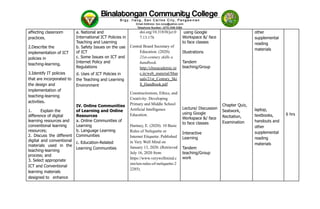
1. Demonstrate a sense
of readiness for the
upcoming semester.
2. Identify their
learning outcomes and
expectations for the
course.
3. Define the basic
terms of ICT in
Teaching.
4. Discuss the roles of
technology in teaching
and learning.
5. Differentiate the
Theories and Principles
in the Use and Design
of Technology Driven
Learning Lessons.
1.Enumerate the
national IT policies
I. Syllabus Orientation
II. Review of
Technology for
Teaching and Learning
a. Review of the Basic
Concepts in ICT
b. Roles of Technology for
Teaching and Learning
c. Theories and Principles
in the use of
technology-driven lessons
III. ICT Policies and
Safety Issues in
Teaching and Learning
Bilbao, et al. (2021).
Technology for teaching and
learning 1. Quezon City, PH:
Lorimar Publishing Inc.
Pages: 1-25, 26-41
Bilbao, P., Dequilla, M.A.,
Rosano, D., Boholano,
H. (2021). Technology
for teaching and
learning 1. Lorimar
Publishing, Inc.
Sumathi, K., & Selvarani, K.
(2020). Relevance of
ICT tools in
teaching-learning
exploiting flipped
classroom. Journal of
critical
reviews, 7(13). https://
Lecture/ Discussion
using Google
Workspace &/ face
to face classes
Interactive
Learning
Video
Demonstration
Class
Discussion
Chapter Quiz,
Seatwork,
Recitation
Chapter Quiz,
Seatwork,
Recitation
laptop,
textbooks,
handouts and
other
supplemental
reading
materials
laptop,
textbooks,
handouts and
6 hrs
12
hrs
5.
affecting classroom
practices.
2.Describe the
implementationof ICT
policies in
teaching-learning.
3.Identify IT policies
that are incorporated to
the design and
implementation of
teaching-learning
activities.
1. Explain the
difference of digital
learning resources and
conventional learning
resources;
2. Discuss the different
digital and conventional
materials used in the
teaching-learning
process; and
3. Select appropriate
ICT and Conventional
learning materials
designed to enhance
a. National and
International ICT Policies in
Teaching and Learning
b. Safety Issues on the use
of ICT
c. Some Issues on ICT and
Internet Policy and
Regulations
d. Uses of ICT Policies in
the Teaching and Learning
Environment
IV. Online Communities
of Learning and Online
Resources
a. Online Communities of
Learning
b. Language Learning
Communities
c. Education-Related
Learning Communities
doi.org/10.31838/jcr.0
7.13.176
Central Board Secretary of
Education. (2020).
21st-century skills a
handbook.
http://cbseacademic.ni
c.in/web_material/Man
uals/21st_Century_Ski
ll_Handbook.pdf
Constructionism, Ethics, and
Creativity: Developing
Primary and Middle School
Artificial Intelligence
Education.
Hartney, E. (2020). 10 Basic
Rules of Netiquette or
Internet Etiquette. Published
in Very Well Mind on
January 13, 2020. (Retrieved
July 16, 2020 from
https://www.verywellmind.c
om/ten-rules-of-netiquette-2
2285).
using Google
Workspace &/ face
to face classes
Illustrations
Tandem
teaching/Group
Lecture/ Discussion
using Google
Workspace &/ face
to face classes
Interactive
Learning
Tandem
teaching/Group
work
Chapter Quiz,
Seatwork,
Recitation,
Examination
other
supplemental
reading
materials
laptop,
textbooks,
handouts and
other
supplemental
reading
materials
6 hrs
6.
the teaching and
learningprocess.
Online Sources
User blog: W A N I S A
H/Understanding the
basic concept in ....
https://community.fand
om.com/wiki/User_blo
g:W_A_N_I_S_A_H/
Understanding_the_ba
sic_concept_in_ICT
Role of Educational
Technology in Public
and Private ....
http://www.macrothink
.org/journal/index.php/
ijld/article/download/2
337/5905
https://fandon.fandom.com/
wiki/LESSON_2:_Understan
ding_the_Basic_Concept_in
_ICT
M I D T E R M E X A M I N A T I O N
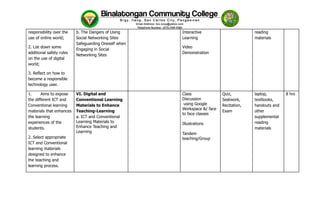
1. Understand that
being a digital or online
user has to know one’s
V. Digital Safety Rules -
Cyber Safety
a. The Benefits of Using
Social Networking Sites
Lecture/ Discussion
using Google
Workspace &/ face
to face classes
Chapter Quiz,
Seatwork,
Recitation
laptop,
textbooks,
handouts and
other
supplemental
8 hrs
7.
responsibility over the
useof online world;
2. List down some
additional safety rules
on the use of digital
world;
3. Reflect on how to
become a responsible
technology user.
b. The Dangers of Using
Social Networking Sites
Safeguarding Oneself when
Engaging in Social
Networking Sites
Interactive
Learning
Video
Demonstration
reading
materials
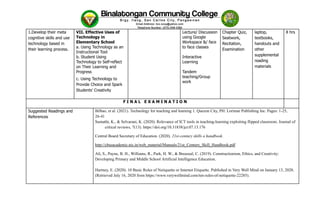
1. Aims to expose
the different ICT and
Conventional learning
materials that enhances
the learning
experiences of the
students.
2. Select appropriate
ICT and Conventional
learning materials
designed to enhance
the teaching and
learning process.
VI. Digital and
Conventional Learning
Materials to Enhance
Teaching-Learning
a. ICT and Conventional
Learning Materials to
Enhance Teaching and
Learning
Class
Discussion
using Google
Workspace &/ face
to face classes
Illustrations
Tandem
teaching/Group
Quiz,
Seatwork,
Recitation,
Exam
laptop,
textbooks,
handouts and
other
supplemental
reading
materials
8 hrs
8.
1.Develop their meta
cognitiveskills and use
technology based in
their learning process.
VII. Effective Uses of
Technology in
Elementary School
a. Using Technology as an
Instructional Tool
b. Student Using
Technology to Self-reflect
on Their Learning and
Progress
c. Using Technology to
Provide Choice and Spark
Students’ Creativity
Lecture/ Discussion
using Google
Workspace &/ face
to face classes
Interactive
Learning
Tandem
teaching/Group
work
Chapter Quiz,
Seatwork,
Recitation,
Examination
laptop,
textbooks,
handouts and
other
supplemental
reading
materials
8 hrs
F I N A L E X A M I N A T I O N
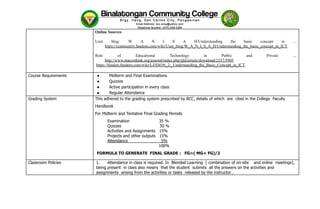
Suggested Readings and
References
Bilbao, et al. (2021). Technology for teaching and learning 1. Quezon City, PH: Lorimar Publishing Inc. Pages: 1-25,
26-41
Sumathi, K., & Selvarani, K. (2020). Relevance of ICT tools in teaching-learning exploiting flipped classroom. Journal of
critical reviews, 7(13). https://doi.org/10.31838/jcr.07.13.176
Central Board Secretary of Education. (2020). 21st-century skills a handbook.
http://cbseacademic.nic.in/web_material/Manuals/21st_Century_Skill_Handbook.pdf
Ali, S., Payne, B. H., Williams, R., Park, H. W., & Breazeal, C. (2019). Constructionism, Ethics, and Creativity:
Developing Primary and Middle School Artificial Intelligence Education.
Hartney, E. (2020). 10 Basic Rules of Netiquette or Internet Etiquette. Published in Very Well Mind on January 13, 2020.
(Retrieved July 16, 2020 from https://www.verywellmind.com/ten-rules-of-netiquette-22285).
9.
Online Sources
User blog:W A N I S A H/Understanding the basic concept in ....
https://community.fandom.com/wiki/User_blog:W_A_N_I_S_A_H/Understanding_the_basic_concept_in_ICT
Role of Educational Technology in Public and Private ....
http://www.macrothink.org/journal/index.php/ijld/article/download/2337/5905
https://fandon.fandom.com/wiki/LESSON_2:_Understanding_the_Basic_Concept_in_ICT
Course Requirements ● Midterm and Final Examinations
● Quizzes
● Active participation in every class
● Regular Attendance
Grading System This adhered to the grading system prescribed by BCC, details of which are cited in the College Faculty
Handbook
For Midterm and Tentative Final Grading Periods
Examination 35 %
Quizzes 30 %
Activities and Assignments 15%
Projects and other outputs 15%
Attendance 5%
100%
FORMULA TO GENERATE FINAL GRADE : FG=( MG+ FG)/2
Classroom Policies 1. Attendance in class is required. In Blended Learning ( combination of on-site and online meetings),
being present in class also means that the student submits all the answers on the activities and
assignments arising from the activities or tasks released by the instructor .
10.
2. Each studentmust have an official Gmail account and FB Messenger account to be able to participate in
any classroom activities, both online and on-site. It is expected that he/she regularly checks the Messenger
group chat account of the class for updates and announcements.
3. Timely submission of outputs and language skill tryouts is enforced.
4. Students must come to online class meetings, on time. Coming late to class is rude.
5. An employed student must provide a copy of certificate of employment, with said certificate containing
the work schedule of the student.
6. Students can consult a professor or instructor on matters relative to this course within the given
consultation period and that such period takes place every Wednesday, 8-11:30 am.
7. Students are expected to embrace academic honesty as a way of students’ life. Engagement with
plagiarism and other forms of cheating will never be tolerated. Violation of this policy shall be dealt with
disciplinary action.
8. Students who get an INC status in this course are given one-term as an extension to settle their
deficiencies and eventually obtain a grade. If a student fails to settle his/her INC status with the instructor or
professor within the extended term, he/she will be given a 0-rating or failed status, thus the need to repeat
this course.
9. Request to take a special exam due to failure to take midterm or final exam on the prescribed schedule
of the College, is not accommodated. Request is only considered when justification, supported by evidences ,
went through usual process of validation .
Prepared by: Noted: Approved:
Janu Peralta, LPT, MIT Elizabeth P. Vistro, Ed.D Macrina Cajala, DBA, Ed.D
Faculty, Teacher Education Dept. Dean, Teacher Education Department College President
Jesusa T. Alguno, MAEd
Program Head, Teacher Education Department