TECHNIQUES FOR
TEACHING WRITING
SKILLS
April Joy D. Ferrer
Reporter
First, pictures provide a shared experience for students
in the class, a common base that leads to a variety of
language activities.
TECHNIQUES IN USING PICTURES
Second, picture can be the basis for not just one task but
many, ranging from fairly mechanical controlled
compositions, sentence-combining exercises, or
sequencing of sentences to the writing of original
dialogs, letters, reports, or essay.
Finally, because everybody likes to look at pictures, their use
in the classroom provides a stimulating focus for students’
attention. pictures bring the outside world into the
classroom in avividly concrete way.
Readings can also, like pictures, be used to create an information gap that
leads to communicative activities:
TECHNIQUES IN USING READINGS
Example:
If the students work
with a variety of
readings at the same
time , then they will be
dealing with different
content, and anything
they write to each other
will thus be authentic
communication,
conveying new and real
information.
The more our students
read, the more they
become familiar with the
vocabulary, idiom,
sentence patterns,
organizational flow, and
cultural assumptions of
native speakers of the
language.
There are two types of
reading: Extensive
Reading and Close
Reading
EXTENSIVE READING
Students read whole stories or whole books, where
they have so much to read that they cannot stop to
look up every unfamiliar word or to translate every
sentence.
Students read a short passage and give close attention
to all the choices the writer has made in, for example,
the content, vocabulary, and organization.
TECHNIQUES IN USING READINGS
CLOSE READING
A boy, about ten years old,
appeared at a third-floor window. It
wouldn’t open. He was very
frightened.
TECHNIQUES IN USING READINGS
1. COPYING
It gives pratice in mastering
wht might be a new
alphabet, moving the hand
on the page from left to
right, and developing fluency
of handwriting. It gives all
the students practice with
the mechanics of
punctuation, spelling,
capitalization, and
paragraph indention.
2. EXAMINING COHESIVE LINKS
When students examine a piece of writing closely,
they can make discoveries the writer has used to
connect one sentence to another in order to make
the text cohesive.
Example:
Students read a passage, with all the pronouns and
possessive adjectives circled. Then they draw a line to
connect the circled words they refer to:
3. EXAMINING PUNCTUATION AND GRAMMAR
Students can make discoveries not only about cohesive
devices the writer uses but also about the rules of
punctuation and grammar that the writer employs. Short
reading lets the students scrutinize the choices the writer has
made and the rules he has followed.
Example:
Give students a passage with all punctuations marks omitted
and task them to fill in the punctuation. If they do the task in
group, they will become involved in discussion and will even
argue about whrere commas belong, and why.
TECHNIQUES IN USING READINGS
4. EXAMINING SENTENCE ARRANGEMENTS
Students of ESL will write a series of sentences that are
accurate grammatically if we look at each sentence in
isolation; however, the sentences do not seem to “hang
together” very well.
Example:
(1) Our house had four bedrooms and two sittings. (2) A large
garden was in front of the house. (3) My father had planted a
lot of flowers in the garden.
What students need here is a lot of practice in making choices
within a text between sentences that convey the same
meaning as individual sentences, but are arranged differently.
TECHNIQUES IN USING READINGS
5. SUMMARIZING
This provides students with valuable practice in
searching for meaning and communicating that
meaning. Faced with a reading passage, they have not
only to find out what the main ideas are, but also to be
able to express them in their own words. This ability of
the language learner to understand concepts, process
them, and restate3 them in his own words is a major
goal of the language-learning process.
TECHNIQUES IN USING READINGS
6. COMPLETING
When students examine a reading passage with parts (words,
phrases, sentences, or larger chunks) missing, they have to
consider a great many features of writing if they are to
complete it. They have to consider meaning and the
grammatical and syntactic fit of the part they add. Completion
exercises ask students to discern the original writer’s purpose,
audience, and personal style and to pay attention to those in
the completed version.
TECHNIQUES IN USING READINGS
7. SPECULATING
Speculation involves thinking beyond the given text. Speculative questions
open up opportunities for both discussion and writing.
TECHNIQUES IN USING READINGS
8. REACTING
Readings help expand the world of the classroom by bringing subject matter
in to it. Students can get interested in controversial issues, they can connect
stories with their own personal experiences, and they can explore new
worlds of interest. They can react to a reading assignment by discussing,
writing about it, or even by doing something active, like following directions.
TECHNIQUES IN USING ALL LANGUAGE SKILL
If we want our language learning classes to come as close as
possible to real-life communicative situations, then we have to
organize activities that let students use all of the language skills. In
order to do this, students should speak (not just repeat) and speak
not only to the teacher but to each other. So students must also
listen • Student 1 speaks while Student 2 listens.
• Student 2 writes.
• Student 3 reads what Student 2 wrote and responds.
• Student 1 checks that 2 and 3 understood.
The value of such sequence of activity is that it begins with the
students handling the target language.
1.Brainstorming
This lets students work together in the classroom in small
groups to say as much as they can about a topic.
Another way to get students’ focus on specific aspects of a
topic is to provide guidelines for group or a whole-class
discussion. If a teacher provides guidelines for discussion,
then it helps students beforehand with the vocabulary and
sentence forms that they might need in their discussion.
2. Guided Discussion
3. Interviews
This technique can help teachers get to know with the
students. When the students write the record of an interview,
they convey others genuine information transmitted to them by
other students.
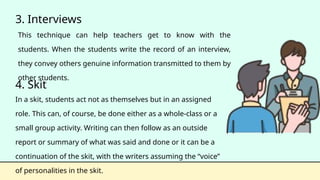
4. Skit
In a skit, students act not as themselves but in an assigned
role. This can, of course, be done either as a whole-class or a
small group activity. Writing can then follow as an outside
report or summary of what was said and done or it can be a
continuation of the skit, with the writers assuming the “voice”
of personalities in the skit.
5. Dictation
The teacher reads a passage through once, then reads it slowly,
broken down into short, meaningful segments, which the
students write down, and then the teacher reads it through once
more. this gives students practice in listening carefully and
paying attention to inflections and through the mechanics of
spelling, punctuation, and capitalization.
6. Note-Taking
This technique teaches students to just write down the
summary of what the speaker or a text says, picking out
the important information.
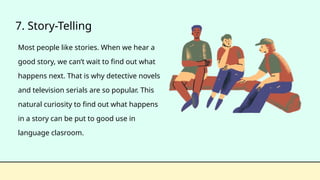
7. Story-Telling
Most people like stories. When we hear a
good story, we can’t wait to find out what
happens next. That is why detective novels
and television serials are so popular. This
natural curiosity to find out what happens
in a story can be put to good use in
language clasroom.
Techniques in Using
Controlled Writing
Controlled Composition
• Students are given passage to work with, they do
not, therefore, have to concern themselves. They
only focus with the specific features of the written
language.
Question and Answer
• This allows students a little more freedom in
structuring sentences. They are not given the
actual text that they will write, rather, they are given
a series of questions, the answers to which form
the text.
Guided Composition
• This is an extension of controlled composition. It is
less controlled. Students should be able to discuss,
make notes, share findings, and plan strategies
together before they begin to write.
Parallel Writing
• It is the Freest kind of controlled writing. Instead of making
changes in a given passage or writing according to an outline
or given sentences, students read and study a passage and
then write their own on a similar theme.
Thank You

Techniques for Teaching Writing Skill.pptx

  • 1.
  • 2.
    First, pictures providea shared experience for students in the class, a common base that leads to a variety of language activities. TECHNIQUES IN USING PICTURES Second, picture can be the basis for not just one task but many, ranging from fairly mechanical controlled compositions, sentence-combining exercises, or sequencing of sentences to the writing of original dialogs, letters, reports, or essay. Finally, because everybody likes to look at pictures, their use in the classroom provides a stimulating focus for students’ attention. pictures bring the outside world into the classroom in avividly concrete way.
  • 3.
    Readings can also,like pictures, be used to create an information gap that leads to communicative activities: TECHNIQUES IN USING READINGS Example: If the students work with a variety of readings at the same time , then they will be dealing with different content, and anything they write to each other will thus be authentic communication, conveying new and real information. The more our students read, the more they become familiar with the vocabulary, idiom, sentence patterns, organizational flow, and cultural assumptions of native speakers of the language. There are two types of reading: Extensive Reading and Close Reading
  • 4.
    EXTENSIVE READING Students readwhole stories or whole books, where they have so much to read that they cannot stop to look up every unfamiliar word or to translate every sentence. Students read a short passage and give close attention to all the choices the writer has made in, for example, the content, vocabulary, and organization. TECHNIQUES IN USING READINGS CLOSE READING
  • 5.
    A boy, aboutten years old, appeared at a third-floor window. It wouldn’t open. He was very frightened. TECHNIQUES IN USING READINGS 1. COPYING It gives pratice in mastering wht might be a new alphabet, moving the hand on the page from left to right, and developing fluency of handwriting. It gives all the students practice with the mechanics of punctuation, spelling, capitalization, and paragraph indention. 2. EXAMINING COHESIVE LINKS When students examine a piece of writing closely, they can make discoveries the writer has used to connect one sentence to another in order to make the text cohesive. Example: Students read a passage, with all the pronouns and possessive adjectives circled. Then they draw a line to connect the circled words they refer to:
  • 6.
    3. EXAMINING PUNCTUATIONAND GRAMMAR Students can make discoveries not only about cohesive devices the writer uses but also about the rules of punctuation and grammar that the writer employs. Short reading lets the students scrutinize the choices the writer has made and the rules he has followed. Example: Give students a passage with all punctuations marks omitted and task them to fill in the punctuation. If they do the task in group, they will become involved in discussion and will even argue about whrere commas belong, and why. TECHNIQUES IN USING READINGS
  • 7.
    4. EXAMINING SENTENCEARRANGEMENTS Students of ESL will write a series of sentences that are accurate grammatically if we look at each sentence in isolation; however, the sentences do not seem to “hang together” very well. Example: (1) Our house had four bedrooms and two sittings. (2) A large garden was in front of the house. (3) My father had planted a lot of flowers in the garden. What students need here is a lot of practice in making choices within a text between sentences that convey the same meaning as individual sentences, but are arranged differently. TECHNIQUES IN USING READINGS
  • 8.
    5. SUMMARIZING This providesstudents with valuable practice in searching for meaning and communicating that meaning. Faced with a reading passage, they have not only to find out what the main ideas are, but also to be able to express them in their own words. This ability of the language learner to understand concepts, process them, and restate3 them in his own words is a major goal of the language-learning process. TECHNIQUES IN USING READINGS
  • 9.
    6. COMPLETING When studentsexamine a reading passage with parts (words, phrases, sentences, or larger chunks) missing, they have to consider a great many features of writing if they are to complete it. They have to consider meaning and the grammatical and syntactic fit of the part they add. Completion exercises ask students to discern the original writer’s purpose, audience, and personal style and to pay attention to those in the completed version. TECHNIQUES IN USING READINGS
  • 10.
    7. SPECULATING Speculation involvesthinking beyond the given text. Speculative questions open up opportunities for both discussion and writing. TECHNIQUES IN USING READINGS 8. REACTING Readings help expand the world of the classroom by bringing subject matter in to it. Students can get interested in controversial issues, they can connect stories with their own personal experiences, and they can explore new worlds of interest. They can react to a reading assignment by discussing, writing about it, or even by doing something active, like following directions.
  • 11.
    TECHNIQUES IN USINGALL LANGUAGE SKILL If we want our language learning classes to come as close as possible to real-life communicative situations, then we have to organize activities that let students use all of the language skills. In order to do this, students should speak (not just repeat) and speak not only to the teacher but to each other. So students must also listen • Student 1 speaks while Student 2 listens. • Student 2 writes. • Student 3 reads what Student 2 wrote and responds. • Student 1 checks that 2 and 3 understood. The value of such sequence of activity is that it begins with the students handling the target language.
  • 12.
    1.Brainstorming This lets studentswork together in the classroom in small groups to say as much as they can about a topic. Another way to get students’ focus on specific aspects of a topic is to provide guidelines for group or a whole-class discussion. If a teacher provides guidelines for discussion, then it helps students beforehand with the vocabulary and sentence forms that they might need in their discussion. 2. Guided Discussion
  • 13.
    3. Interviews This techniquecan help teachers get to know with the students. When the students write the record of an interview, they convey others genuine information transmitted to them by other students. 4. Skit In a skit, students act not as themselves but in an assigned role. This can, of course, be done either as a whole-class or a small group activity. Writing can then follow as an outside report or summary of what was said and done or it can be a continuation of the skit, with the writers assuming the “voice” of personalities in the skit.
  • 14.
    5. Dictation The teacherreads a passage through once, then reads it slowly, broken down into short, meaningful segments, which the students write down, and then the teacher reads it through once more. this gives students practice in listening carefully and paying attention to inflections and through the mechanics of spelling, punctuation, and capitalization. 6. Note-Taking This technique teaches students to just write down the summary of what the speaker or a text says, picking out the important information.
  • 15.
    7. Story-Telling Most peoplelike stories. When we hear a good story, we can’t wait to find out what happens next. That is why detective novels and television serials are so popular. This natural curiosity to find out what happens in a story can be put to good use in language clasroom.
  • 16.
  • 17.
    Controlled Composition • Studentsare given passage to work with, they do not, therefore, have to concern themselves. They only focus with the specific features of the written language. Question and Answer • This allows students a little more freedom in structuring sentences. They are not given the actual text that they will write, rather, they are given a series of questions, the answers to which form the text.
  • 18.
    Guided Composition • Thisis an extension of controlled composition. It is less controlled. Students should be able to discuss, make notes, share findings, and plan strategies together before they begin to write. Parallel Writing • It is the Freest kind of controlled writing. Instead of making changes in a given passage or writing according to an outline or given sentences, students read and study a passage and then write their own on a similar theme.
  • 19.

Editor's Notes

  • #2 Writing teachers can find a valuable resource in pictures: drawings, photos, posters and the like. But what is it that's valuable? (Read first paragraph)
  • #12 the teacher does not have to monitor grammar or pronunciation , except when the speaker cannot be understood, though the teacher will obviously be the resource person whom students turn to as they search for the right word or the right structure to express their ideas.