The Technical Interview
Matt McGovern
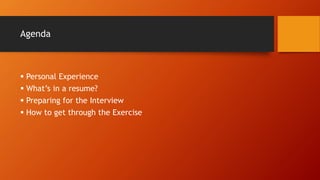
Agenda
 Personal Experience
 What’s in a resume?
 Preparing for the Interview
 How to get through the Exercise
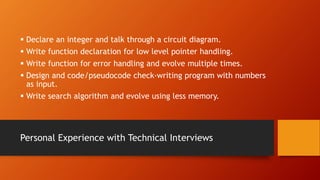
Personal Experience with Technical Interviews
 Declare an integer and talk through a circuit diagram.
 Write function declaration for low level pointer handling.
 Write function for error handling and evolve multiple times.
 Design and code/pseudocode check-writing program with numbers
as input.
 Write search algorithm and evolve using less memory.
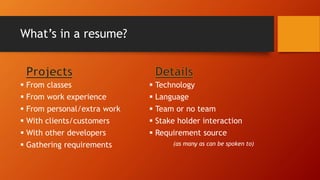
What’s in a resume?
 From classes
 From work experience
 From personal/extra work
 With clients/customers
 With other developers
 Gathering requirements
 Technology
 Language
 Team or no team
 Stake holder interaction
 Requirement source
(as many as can be spoken to)
Preparing for the Interview
 Review everything!
 The projects & work you’ve done.
 Any technology specified on your resume.
 Programming concepts.
 Basics of the languages you already know.
 Practice on your own
 Code Katas – exercises in all languages for many concepts
 W3Schools.com – reference and exercises for any/all languages used for web
 Coding on a white board – sounds silly, but can be difficult if you’ve not
done it before or often.
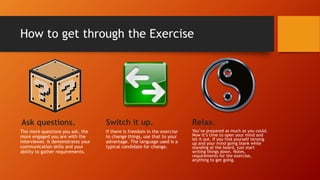
How to get through the Exercise
Ask questions.
The more questions you ask, the
more engaged you are with the
interviewer. It demonstrates your
communication skills and your
ability to gather requirements.
Switch it up.
If there is freedom in the exercise
to change things, use that to your
advantage. The language used is a
typical candidate for change.
Relax.
You’ve prepared as much as you could.
Now it’s time to open your mind and
let it out. If you find yourself tensing
up and your mind going blank while
standing at the board, just start
writing things down. Notes,
requirements for the exercise,
anything to get going.
Questions?
Thank you!

Technical interview mc govern

  • 1.
  • 2.
    Agenda  Personal Experience What’s in a resume?  Preparing for the Interview  How to get through the Exercise
  • 3.
    Personal Experience withTechnical Interviews  Declare an integer and talk through a circuit diagram.  Write function declaration for low level pointer handling.  Write function for error handling and evolve multiple times.  Design and code/pseudocode check-writing program with numbers as input.  Write search algorithm and evolve using less memory.
  • 4.
    What’s in aresume?  From classes  From work experience  From personal/extra work  With clients/customers  With other developers  Gathering requirements  Technology  Language  Team or no team  Stake holder interaction  Requirement source (as many as can be spoken to)
  • 5.
    Preparing for theInterview  Review everything!  The projects & work you’ve done.  Any technology specified on your resume.  Programming concepts.  Basics of the languages you already know.  Practice on your own  Code Katas – exercises in all languages for many concepts  W3Schools.com – reference and exercises for any/all languages used for web  Coding on a white board – sounds silly, but can be difficult if you’ve not done it before or often.
  • 6.
    How to getthrough the Exercise Ask questions. The more questions you ask, the more engaged you are with the interviewer. It demonstrates your communication skills and your ability to gather requirements. Switch it up. If there is freedom in the exercise to change things, use that to your advantage. The language used is a typical candidate for change. Relax. You’ve prepared as much as you could. Now it’s time to open your mind and let it out. If you find yourself tensing up and your mind going blank while standing at the board, just start writing things down. Notes, requirements for the exercise, anything to get going.
  • 7.
  • 8.